
Rockville City Zoning Code
ARTICLE 17
- PUBLIC USE SPACE, LANDSCAPING AND SCREENING, UTILITY PLACEMENT AND SCREENING, LIGHTING, SIDEWALKS, AND SHADOWS
Sec. 25.17.01.- Public use space.
a.
Purpose. Public use space requirements are intended to promote an appropriate balance between the built environment, public parks and other open spaces intended for respite from urban development, and to protect natural features and preserve the character of the City.
b.
General requirements. Where provided, such public use space must be accessible for use and enjoyment by the general public when provided in a residential, retail or mixed-use project. Development consisting primarily of office and/or industrial uses may provide an open area, as defined in article 3, for the purpose of satisfying the public use space requirement. The Approving Authority may allow reasonable limitations on access to the public use space to meet safety or security concerns.
1.
Where development does not comply with the public use space requirement, the following regulations apply:
(a)
Building expansions or cumulative additions that exceed fifty (50) percent and up to but not including one hundred (100) percent of the existing gross floor area must provide a proportionate amount of public use space on site using the following calculation factors: multiplying the percentage increase in floor area by the following factors - .05 where the public use space requirement is five (5) percent; .10 where the public use space requirement is ten (10) percent; .15 where the public use space requirement is fifteen (15) percent.
(b)
Any building expansion or cumulative addition that exceeds one hundred (100) percent of the existing gross floor area must provide public use space as set forth in subsection 25.13.05.b.1.
c.
Dedication of public use space. Land may be dedicated to the City for public use in connection with the approval of a site plan or subdivision for the purpose of providing public parks, open areas, or recreation areas that will be owned and operated as part of the City's public park system. Dedication must be made consistent with the recommendations of the relevant plan indicating the locations where such public use space is desired.
d.
Fee in lieu of public use space requirements.
1.
The Approving Authority may approve the payment of a fee in lieu of some or all of the public use space requirement under any of the following circumstances:
(a)
The City could use the fee to provide and/or improve another more usable public space in the vicinity of the project;
(b)
The site cannot realistically provide the required area for public use and meet all of the other City development standard requirements; or
(c)
The applicable master plan makes specific recommendations on how and where public use space is to be provided on or in the vicinity of the site.
2.
Any approved fee in lieu of the public use space requirement shall be paid in an amount set by resolution of Mayor and Council.
e.
Exemption for affordable housing projects or for housing for senior adults and persons with disabilities. The following are exempt from the public use space requirement: Projects that consist entirely of affordable dwelling units, defined as units designated for households with incomes at or below the area median income limits; and projects including housing for senior adults and persons with disabilities.
(Ord. No. 2-10, § 2, 2-8-10; Ord. No. 17-10, 9-20-10; Ord. No. 7-11, § 17, 6-6-11; Ord. No. 1-18, 1-22-18)
Sec. 25.17.02. - Landscaping and screening.
a.
Landscaping, screening and lighting manual. Landscaping and screening is required in all zones in accordance with the landscaping, screening and lighting manual and the forest and tree preservation ordinance (chapter 10.5 of the Code). The landscaping, screening and lighting manual provides information and guidance on matters such as:
1.
How to prepare landscape plans;
2.
Appropriate use of plants;
3.
Screening requirements (including items such as depth, maintenance, location, etc., and additional requirements where industrial uses abut residential uses);
4.
Maintenance; and
5.
Lighting standards.
b.
Approving Authority requirements. The Approving Authority may impose reasonable requirements relating to the nature and type of the screening for any such lot, and may require additional screening in such manner and of such materials that may be reasonably necessary to adequately screen such lot from view from the adjacent residential street.
c.
Screening of parking areas required in the MXT zone. In the MXT zone, off-street parking areas required by this chapter must be screened, to the extent possible, to minimize the visibility of such areas to residential zones and to public streets and walkways.
d.
Screening of mechanical equipment required in all zones other than single dwelling unit residential zones. In all zones other than the single dwelling unit residential zones, all air conditioning equipment, transformers, emergency generators, elevator equipment, and similar mechanical equipment on any roof, ground, or building must be screened from public view at ground level from the edge of the property. Such screening must be done in such a manner and with such materials as may be reasonably required.
e.
Screening of trash, recycling, and waste oil/grease collection areas enclosures required in all zones other than single dwelling unit residential zones. In all zones other than the single dwelling unit residential zone, all trash recycling, and waste oil/grease collection areas shall be inside a building or screened in such a manner and with such materials as may reasonably be required. Trash recycling, and waste oil/grease collection area enclosures should not be located next to residential development. Where such enclosures are visible from residential development or from a public street, they shall be constructed of materials complementary to the building architecture.
(Ord. No. 29-09, § 17, 10-26-09; Ord. No. 9-15, 5-18-15; Ord. No. 16-23, 10-9-23)
Sec. 25.17.03. - Underground installation of utility lines required; screening or underground installation of transformers; and equipment lockers required.
a.
Underground installation of utility lines and cables. In all zones, electric, telecommunication, television, (including cable) and other utility lines and cables must be installed underground wherever an extension or relocation of a contiguous segment of said lines or cables is required. All underground lines and cables shall be placed in a public utility easement, or otherwise on private property. No utilities may be placed in the public right-of-way or on City property without the express written permission of the City, and subject to such terms and conditions that the City may require.
b.
Placement of utility equipment. Except as otherwise provided, all electrical equipment (including transformers and equipment cabinets, but excluding emergency generators), telecommunications equipment, and television equipment (including cable television) must be located as follows:
1.
In all residential zones, electrical, telecommunications, and television equipment must be placed below ground or in an enclosed building.
2.
In the MXTD, MXCD, MXT, MXE, MXB, MXC and MXNC zones, electrical, telecommunications, and cable television equipment must be placed underground or in an enclosed building, unless waived pursuant to subsection 25.17.03.c.
3.
In all other zones, electrical, telecommunications, and television equipment may be placed above ground and outside of an enclosed building only if the following requirements are satisfied:
(a)
Screening is required on four (4) sides of the equipment at a minimum of eighty (80) percent opacity. This screen may consist of either vegetative or building materials. The side for access may be a gate.
(b)
Vegetative screening must use plant material that will result in eighty (80) percent opacity within one (1) growing season.
(c)
Screening made of building materials must be designed in a manner that is complementary to the building architecture including material and scale.
(d)
Where practical, all above ground electrical, telecommunications, and television equipment not incorporated into a building must be clustered with other utility equipment and dumpsters, trash enclosures, and generators, and shall be located in an inconspicuous manner so as to blend in with the landscaping and topography of the site. The side of the screening enclosure that provides access to the equipment must be oriented and either gated or screened in a manner that provides access while minimizing the visual impacts of the equipment.
(e)
The location and screening of all above ground electrical, telecommunications, and television equipment must be approved by the Approving Authority as part of the applicable site plan review.
4.
Exceptions. The provisions of this subsection b do not apply to wireless communication facilities, related structures and equipment, installed in accordance with the provisions of section 25.09.08.
c.
Waiver of requirements.
1.
Upon finding that installing utility equipment within an enclosed building is not feasible, the Planning Commission may grant a waiver of any requirement of this section for any of the following reasons:
(a)
A unique or peculiar site condition provides a physical impediment to installing equipment underground;
(b)
It would be unsafe to locate the equipment underground; or
(c)
The equipment cannot successfully operate below ground.
2.
The Planning Commission may allow equipment that has been placed underground to be reinstalled above ground if the owner of such equipment can demonstrate and fully document that such equipment has resulted in service degradation in violation of state or federal laws or regulations or contrary to the terms of any governing contractual agreements, and that reasonable improvements in maintenance and/or equipment cannot restore and/or improve the quality of service.
3.
All utility equipment installed above ground pursuant to this subsection c. must satisfy the location and screening requirements of subsection 25.17.03.b.3.
d.
[Compliance with Montgomery County Code.] All equipment must comply with the noise requirements of chapter 31B of the Montgomery County Code, as amended.
(Ord. No. 29-09, § 17, 10-26-09)
Sec. 25.17.04. - Lighting.
a.
Purpose. The purposes of lighting requirements are to:
1.
Protect against glare and spillover of light onto adjacent properties or into the sky;
2.
Protect against glare onto public rights-of-way that can impair vision of motorists, pedestrians, and bicyclists;
3.
Increase nighttime utility, safety, security, and productivity of the sites where lighting is provided;
4.
Foster the nighttime use of property; and
5.
Protect the privacy of residents.
b.
Lighting manual. Lighting must be provided in accordance with the requirements and guidelines of the landscaping, screening and lighting manual approved by resolution of the Mayor and Council. This manual will provide information and guidance on matters such as:
1.
Design of light fixtures;
2.
Types of bulbs;
3.
Cut-off requirements;
4.
Height of light standards;
5.
Recommended maximum and minimum foot-candles;
6.
Special provisions for high-density and entertainment districts; and
7.
Other appropriate provisions.
Sec. 25.17.05. - Sidewalks.
a.
Purpose. The purposes of sidewalk provisions are to:
1.
Encourage a safe pedestrian-oriented environment;
2.
Help create a visually attractive streetscape;
3.
Provide connectivity among surrounding properties and uses;
4.
Promote overall commerce; and
5.
Provide attractive pedestrian connections to transit centers.
b.
Sidewalk guidelines. Sidewalk shall be provided and designed using the applicable standards as follows:
1.
In cases where sidewalk standards are recommended in the plan or other documents adopted by the Mayor and Council, such standards must be complied with.
2.
In mixed use zones, sidewalks shall be provided pursuant to article 13.
3.
In all other zones except single unit detached residential zones, sidewalks are to be provided according to the table below:
Sidewalk Design Standards1
4.
In single unit detached residential zones, sidewalks must meet the minimum requirements of the "Standards and Details for Construction" manual issued by the Department of Public Works, the requirements of the Americans with Disabilities Act, and any other provisions of chapter 21 of the City Code.
Sec. 25.17.06. - Shadows, general regulations.
a.
In the MXTD, MXCD, MXE, IH, and RMD-25 zones, developments must be so planned in relation to one another that no building will cast a shadow between 10:00 a.m. and 2:00 p.m. on December 21st on existing or approved structures that are principally (i.e., fifty (50) percent or more) residential or on existing designated historic structures. This requirement does not apply to residential towers in a single development separated by a distance at least equal to the height of the tallest residential building in the proposed development and having a length less than ten (10) percent greater than width.
b.
Areas designed or intended for use as publicly-accessible use space, parks, or other green area must be located where they will receive direct sun for a cumulative total of at least two (2) hours between the hours of 8:00 a.m. and 4:00 p.m. on December 21st.
Sec. 25.17.07. - Environmental guidelines.
a.
Purpose. All development is subject to the environmental guidelines adopted by resolution of the Mayor and Council.
b.
General allowance of certain environmental facilities. Rain barrels, rain gardens, and other nonstructural environmental facilities are permitted, as needed.
Sec. 25.17.08. - Building restriction lines and build-to lines.
a.
Subject to the exceptions provided herein, no building permit can be issued and no building or part thereof nor any fence, wall, sign or structure can be erected or structurally changed within the area between the building restriction lines or build-to lines and the centerline of the particular street or highway referred to in establishing the building restriction or build-to line. This section does not apply to underground parking facilities.
b.
Building restriction lines and build-to lines established.
1.
Building restriction lines along Hungerford Drive.
(a)
East side. Beginning for the same at a point on the northerly line of A Street eighty-five (85) feet easterly from the point of intersection of the centerline of Hungerford Drive with the northerly line of A Street and running thence northerly and parallel to the centerline of Hungerford Drive and eighty-five (85) feet therefrom to the northerly line of Gude Drive.
(b)
West side. Beginning for the same at a point on the westerly line of North Washington Street eighty-five (85) feet westerly from the point of intersection of the centerline of Hungerford Drive with the westerly line of North Washington Street and running thence northerly and parallel to the centerline of Hungerford Drive and eighty-five (85) feet therefrom to the southerly line of College Parkway; thence still northerly and parallel with the centerline of Frederick Road and ninety-five (95) feet westerly therefrom to the northerly line of Gude Drive.
2.
Build-to lines along Rockville Pike. Within the Rockville Pike Neighborhood Plan area, the build-to lines are as established in section 25.13.05.
3.
Exceptions.
(a)
Where the building restriction lines established by subsections a. and b.1. above reduces the buildable depth of any lot or parcel of land bounded by the W.M.A.T.A. right-of-way, to less than three hundred (300) feet, then such line will be adjusted by establishing same at a point three-quarters of the distance from the W.M.A.T.A. right-of-way and the rights-of-way of Hungerford Drive but, in no event, can such building restriction line be less than eighty-five (85) feet from the centerline of Hungerford Drive.
(b)
Where the applicable master plan recommends a greater or lesser building restriction line than set forth herein, the plan recommendation takes precedence over the requirements set forth in subsections a. and b. above. Where there is no master plan recommendation, the Approving Authority may waive building restriction line requirements if the waiver will result in a better form of development consistent with the intent of the master plan and the development standards for mixed-use zones set forth in article 13.
c.
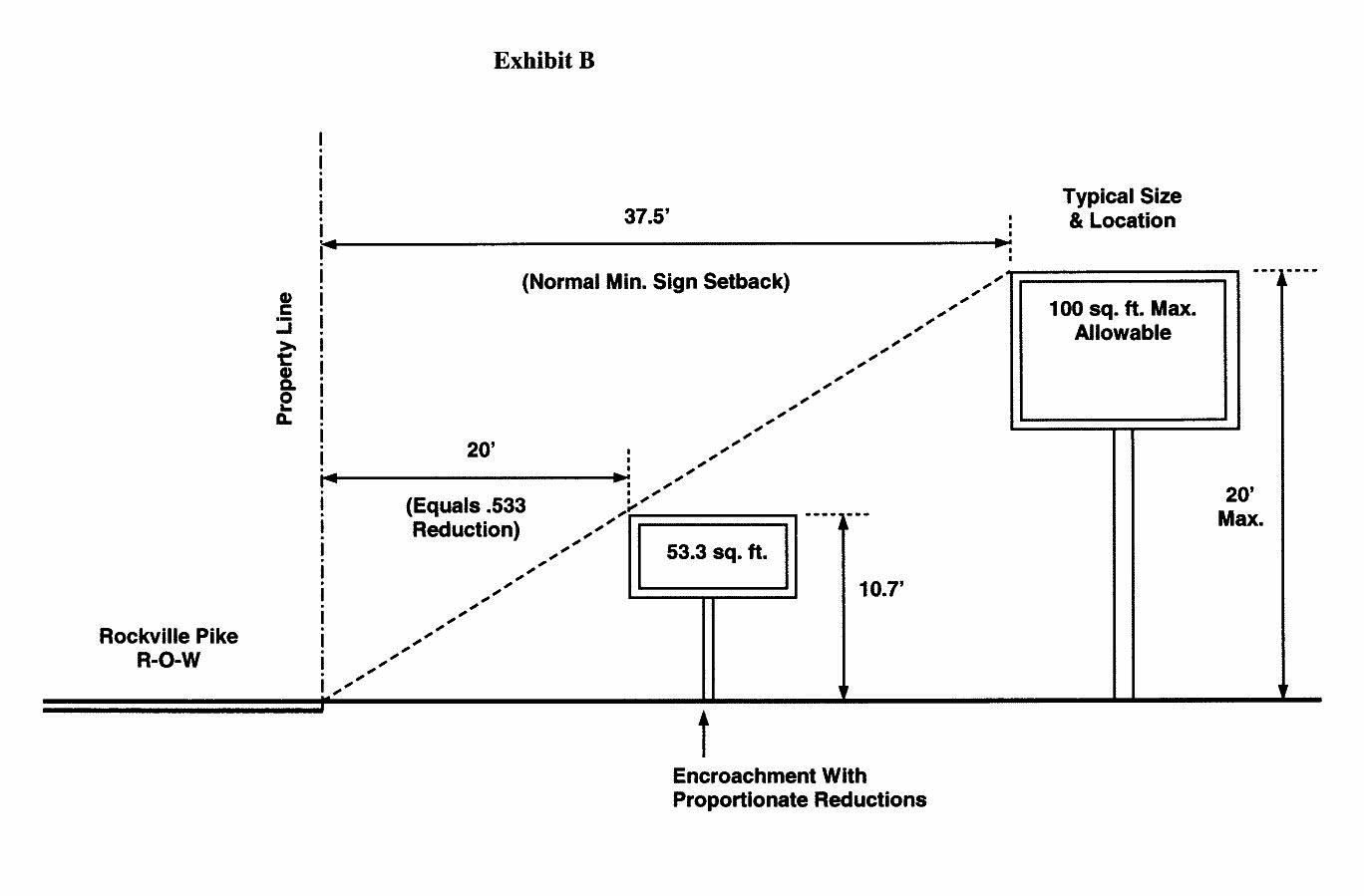
Signs. Notwithstanding any other provisions of this chapter, one (1) sign may be erected and maintained within the building restriction lines or build-to lines set forth in this section and the front line of the lot provided that the sign area and sign height of any such sign must be reduced in direct proportion to the distance of the sign from Hungerford Drive or Rockville Pike. Expressed in terms of mathematical formulas, the sign area and sign height reductions applicable to signs within the building restriction lines of Hungerford Drive and the build-to lines of Rockville Pike would be as shown in Exhibit A and are further illustrated in the graphic described in Exhibit B below:
Exhibit A
(Ord. No. 29-09, § 17, 10-26-09; Ord. No. 1-18, 1-22-18; Ord. No. 25-19, § 4, 10-21-19)

