
Rockville City Zoning Code
ARTICLE 18
- SIGNS
Sec. 25.18.01.- Legislative findings; purposes.
a.
Legislative findings. The Mayor and Council finds that signs provide an important medium through which individuals and entities may convey a variety of commercial and noncommercial messages. However, left completely unregulated, signs can become a threat to public safety as a hazard to property, persons, and the motoring public, and a detriment to property values and the overall public welfare as an unattractive nuisance.
b.
Purposes. In addition to the purposes of this chapter established in section 25.01.02, the purposes of this article are:
1.
To enable the public to locate goods, services, facilities, and geographic areas without difficulty, danger, or confusion;
2.
To reduce traffic and pedestrian hazards and prevent interference with the effectiveness of traffic regulation;
3.
To promote the compatibility of signs with the surrounding land uses;
4.
To protect the public investment in the roadways in the City;
5.
To promote and preserve the economic well-being and vitality of the community;
6.
To enhance and improve the environment and aesthetics of the City and to protect property values by preventing visual clutter and blight;
7.
To preserve the residential character of the City's residential neighborhoods; and
8.
To provide effective opportunities for the expression of commercial and noncommercial communication while protecting the public and the community against adverse effects from the unrestricted proliferation of signs.
(Ord. No. 15-12, 7-30-12; Ord. No. 25-19, § 5, 10-21-19)
Sec. 25.18.02. - Severability.
a.
Without diminishing or limiting in any way the declaration of severability in section 25.01.08 it is the express intent of this section that if any provision (including any section, sentence, clause, or phrase) of this article 18 or any other provision of this chapter pertaining to signs, including but not limited to provisions pertaining to sign permits, is declared by a court of competent jurisdiction to be unconstitutional and void, such declaration of unconstitutionality does not affect any other provision of this article 18 or other provision of this chapter, including, but not limited to, the prohibition of certain signs, and the requirements pertaining to the size, height, location, numbers, illumination, maintenance, construction, and removal of signs.
b.
In particular, and without limitation, in the event any provision of this article 18 or other provision of this chapter is declared invalid as applied to noncommercial signs, this article 18 or any surviving portions thereof, remain in full force and effect as applied to commercial signs.
c.
Without diminishing or limiting in any way the foregoing declaration of severability, it is the express intent of this section 25.18.02, that if any provision (including any section, sentence, clause, or phrase) of this article 18 or any other provision of this chapter pertaining to signs is declared by a court of competent jurisdiction to be unconstitutional and void, such declaration of unconstitutionality does not affect any other provision of this article 18 or other provision of this chapter even if such severability would result in a situation where there would be less speech, whether by subjecting previously exempt signs to the provision of this chapter or otherwise.
Sec. 25.18.03. - Sign variances.
a.
This section allows variances from the standards of this article only when, because of special circumstances applicable to the property, including location, shape, size, surroundings, topography, or other conditions, the strict application of this article denies the property owner privileges enjoyed by other property owners in the vicinity and under identical zoning districts.
b.
Intent. The intent of this section is to allow relief, in certain situations, from the strict application of the regulations identified within this article only by reason of:
1.
The exceptional narrowness, shallowness, or the unusual shape of a structure or parcel of property; or
2.
The exceptional topographic conditions or other extraordinary situation of the structure or parcel.
c.
Application for sign variances. An application for a sign variance shall be reviewed by the chief of zoning and governed only by the development standards identified in this article.
d.
Findings for sign variances. The chief of zoning may approve a sign variance, with or without conditions, only after making all of the following findings:
1.
Strict compliance would preclude an effective design solution improving sign functionality, operational efficiency or appearance;
2.
Strict compliance would preclude an effective design solution fulfilling the basic intent of the applicable regulations;
3.
The variance will not constitute a grant of special privilege inconsistent with limitations imposed on similarly zoned properties or inconsistent with the purposes of this article; and
4.
The proposed sign is architecturally compatible with the major structures on the subject site, and adjacent sites and is compatible with the character of the established neighborhood and general environment.
e.
Implementation period. Any sign or signs must be installed within six (6) months of the date of the approval of the sign variance.
(Ord. No. 25-19, § 5, 10-21-19)
Editor's note— Ord. No. 25-19, § 5, adopted October 21, 2019, amended section 25.18.03 in its entirety to read as herein set out. Formerly, section 25.18.03 pertained to special application requirements for the sign review board, and derived from Ord. No. 19-08, § 1, adopted December 15, 2008.
Sec. 25.18.04. - Only allowed signs lawful; signs specifically prohibited.
a.
No sign may be erected, installed, substantially altered, or illuminated unless in compliance with all of the requirements of this article 18.
b.
The following signs are specifically prohibited in the City:
1.
Signs that impede the operation of any window, door, fire escape, stairway, ladder, or opening required to provide light, air, ingress, or egress for any building or structure;
2.
Signs which, by reason of position, size, shape, or color, may interfere with, obstruct the view of, or be confused with any traffic sign, signal, or device, or which make use of any word, phrase, symbol, or character in such a manner as to interfere with, mislead, or confuse traffic;
3.
Off-premises signs, except as set forth in sections 25.18.18 and 25.18.19;
4.
Any sign placed or erected on property without the permission of the property owner;
5.
Signs which move or have any moving part, or which give the illusion of motion;
6.
Signs which use blinking, flashing, or fluttering illumination or illumination which varies in color or intensity or which create the appearance or illusion of writing or printing, including, but not limited to, strobe, rotating beacon, chasing, or zip lights;
7.
Signs erected by any person on any public property or right-of-way except as provided for in this article 18;
8.
Signs erected in such a location as to interfere with pedestrian or vehicular circulation onto or off of the property on which it is located;
9.
Portable signs, except noncommercial signs displayed by hand or as may be allowed in subsections 25.18.14.a.5 and b.7.;
10.
Signs displayed on billboard vehicles;
11.
Signs with changeable copy, except as provided for herein;
12.
Signs extending above the roof of any building in excess of one (1) percent of the building height, except as allowed by section 25.18.19;
13.
Flags, banners, pennants, spinners, ribbon, streamers, balloons, and similar devices visible from a public right-of-way, except as expressly permitted by this article;
14.
Signs projecting more than thirty-six (36) inches from a building wall;
15.
Temporary signs, except as provided for herein;
16.
Any sign with words, scenes, or graphics of an obscene, indecent, or prurient character which offend public morals or decency;
17.
Any sign not expressly allowed or permitted by this article 18;
18.
Vehicular signs when the vehicle is parked such that the sign is visible from a right-of-way within fifty (50) feet of the vehicle, except when there is no reasonable alternative location on the site to park the vehicle; and
(Ord. No. 15-12, 7-30-12; Ord. No. 25-19, § 5, 10-21-19)
Sec. 25.18.05. - Exemptions.
This article 18 does not apply to the following signs, and no permit for such signs is required:
1.
Any sign or portion thereof required to be posted or displayed by this chapter or other applicable federal, state, or local law or regulation;
2.
Signs and other visual displays erected by, or at the direction of, federal, state, or local governmental or quasi-governmental agencies;
3.
Any sign not readable from any right-of-way or abutting property, except as set forth in subsection 25.18.04.b.13 above;
4.
Any unilluminated sign smaller than one (1) square foot in area;
5.
Up to two (2) noncommercial flags not exceeding one hundred (100) square feet per face in area on nonresidential parcels and not exceeding twenty-five (25) square feet per face in area on residential parcels;
6.
Signs conforming to or required by the Manual of Uniform Traffic Control Devices as published by the Federal Highway Administration from time to time under 23 Code of Federal Regulations, Part 655, Subpart F;
7.
Numerals not exceeding eighteen (18) inches in height identifying an address on a lot. It is hereby expressly found and determined that such numerals are necessary to serve life safety purposes in the evening emergency services personnel are required to locate and access a particular property.
(Ord. No. 15-12, 7-30-12; Ord. No. 25-19, § 5, 10-21-19)
Sec. 25.18.06. - Construction, design, illumination, and maintenance of signs.
a.
Permanent signs.
1.
Construction. Permanent signs must be permanently attached to the ground, a building, or another structure by direct attachment to a rigid wall, frame, or structure.
(a)
Signs attached to masonry, concrete, or steel must be safely and securely fastened by means of metal anchors, bolts, or approved expansion screws of sufficient size and anchorage to safely support the loads applied.
(b)
Where wood anchors or supports are embedded in the soil, the wood must be pressure treated with an approved preservative.
2.
Design. Permanent signs must be designed and constructed to withstand wind pressure as provided for in the current edition of the International Building Code, as amended, or in such other code adopted as the building code for the City.
3.
Illumination. When illumination of a sign is proposed, it must satisfy the following requirements:
(a)
A sign must be illuminated only with electric lighting, and electrical devices and wiring must be installed in accordance with the requirements of chapter 5, article VII of the City Code.
(b)
Sign illumination must use an enclosed lamp design or indirect lighting from a shielded source in a manner that prevents glare from beyond the property line.
(c)
Sign illumination must not cause traffic interference.
b.
Temporary signs.
1.
Construction. Temporary signs must:
(a)
Not be constructed in a manner that requires a building or electrical permit; and
(b)
Be securely anchored to the structure or land in which it is located.
2.
Design. Temporary signs must not have changeable copy.
3.
Illumination. Temporary signs must not be illuminated in any manner.
c.
Maintenance.
1.
All signs and sign support structures, together with their supports, braces, guys, and anchors, must be maintained in good structural condition, in compliance with all applicable building and electrical codes, and in conformance with this article at all times.
2.
The display surfaces of all signs must be kept neatly painted or posted at all times.
(Ord. No. 15-12, 7-30-12; Ord. No. 25-19, § 5, 10-21-19)
Sec. 25.18.07. - Measurement of sign area and height.
a.
Sign area.
1.
Sign area includes the total areas of all allowed signs, except as otherwise provided for herein.
2.
Sign areas are measured as follows:
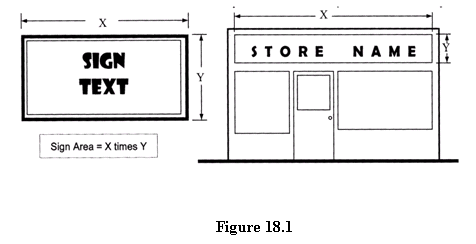
(a)
For sign copy mounted or painted on a background panel or area distinctively painted, textured, lighted, or constructed as background for the sign copy, sign area is measured as that area contained within the outside dimensions of the background panel or surface.
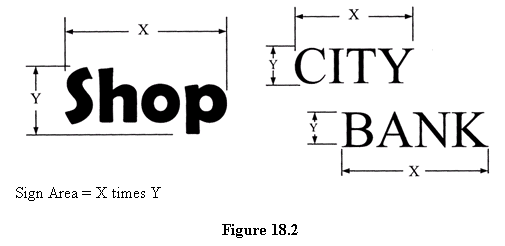
(b)
For sign copy mounted as individual letters and/or graphics on an area of a building that has not been painted, textured, lighted, or otherwise altered to provide a distinctive background for the sign copy, sign area is measured as the area or the sum of the areas enclosed by the smallest rectangle that will enclose each word and graphic.
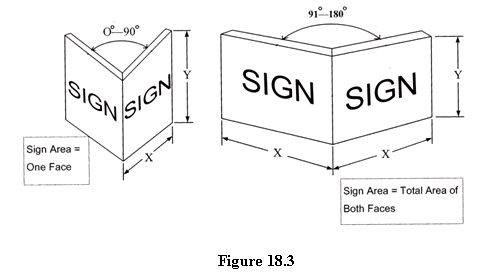
(c)
For freestanding signs or projecting signs not more than two (2) sign faces shall be allowed. If the interior angle between the two (2) sign faces is ninety (90) degrees or less, the area of only one (1) face will be the sign area. If the angle between the two (2) faces is greater than ninety (90) degrees, the sign area will be the sum of the areas of the two (2) faces.
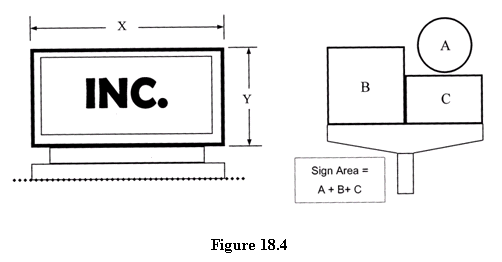
(d)
For a freestanding sign, the sign area will be the area that will encompass all components of the sign excluding the supporting structure that does not form part of the sign proper.
b.
Sign height. Sign height is measured from the distance at the top of the sign structure to the normal grade of the street upon which the sign faces or to the level of the lot on which the sign is erected, whichever is higher. Normal grade shall be construed to be the newly established grade after construction, exclusive of any filling, berming, mounding or excavating solely for the purpose of locating the sign. In cases where the normal grade is below grade at street level, sign height shall be computed on the assumption that the elevation of the normal grade at the base of the sign is equal to the elevation of the nearest point of the crown of a public or private street.
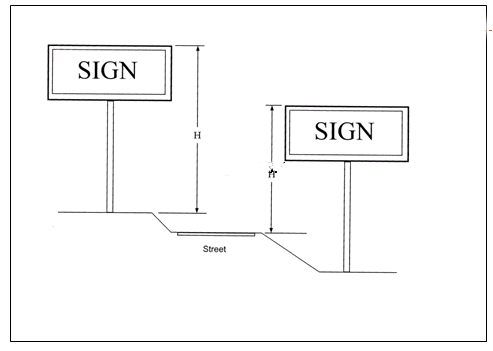
Figure 18.5
(Ord. No. 25-19, § 5, 10-21-19)
Sec. 25.18.08. - Sign plans; sign permits; appeals.
a.
Sign plans. For a lot occupied by more than one (1) business/tenant and where more than one (1) permanent building sign will be installed, a sign plan indicating the size, location, shape, materials, and mounting details of all permanent building signs must be approved. A sign plan must be approved by the Chief of Zoning prior to the issuance of the first sign permit for a lot where more than one (1) permanent building sign will be installed. The sign plan will serve as the basis for all sign permit applications for permanent building signs on the lot subject to the sign plan. A revised sign plan must be approved if a sign to be installed deviates from the size, location, shape, materials, or mounting details of an approved sign plan.
b.
Sign permits. Except as expressly exempted or otherwise provided in this article 18, a sign permit must be obtained prior to the installation, erection, enlargement, illumination, or substantial alteration of any permanent or temporary sign allowed under this article. The changing of the sign face is a substantial alteration requiring a new sign permit.
c.
Applications for a sign plan or sign permit must be submitted to the Chief of Zoning.
d.
Each application must be submitted on forms provided therefore by the Chief of Zoning, and be accompanied by such fee as is established by resolution of the Council. The applicant must furnish as part of the application the following information:
1.
The street address of the property upon which the sign is to be located and a plat map of the property showing the proposed location of the sign and identifying any adjacent residential property;
2.
The aggregate area for all tenant/business signs erected by or on behalf of the applicant and/or the aggregate area for all signs on the premises;
3.
The name(s) and address(es) of the owner(s) of the premises upon which the subject sign is to be located;
4.
Consent of the owner(s), or the owner's(') agent, granting permission for the placement or maintenance of the sign;
5.
The name, address, phone number, and business license number of the sign contractor;
6.
Plans indicating the location of the sign on the property or building wall, including the road frontage or building elevation;
7.
Plans indicating the dimensions, height, and shape of the sign, and materials, and mounting details;
8.
The size and type of any vegetation required to be moved for sign installation or visibility; and
9.
Such other information as determined by the Chief of Zoning to be necessary to assess whether the sign complies with the provisions of this article.
e.
The Chief of Zoning must review the application within fifteen (15) business days from the date of submission of the application and required fee and either approve or deny the application or return the application to the applicant if the application is incomplete as follows:
1.
A sign permit must be issued or a sign plan approved if the Chief of Zoning finds that the sign or sign plan proposed in the application complies with the requirements of this article 18 and, if applicable, any approved sign plan for a building or lot.
2.
If the permit or sign plan is denied, the denial must be in writing and must identify the specific section or sections of this article or other applicable law with which the proposed sign(s) is inconsistent.
3.
If the application is returned due to incompleteness, the Chief of Zoning must advise the applicant in writing as to the information needed to complete the application.
4.
Failure of the Chief of Zoning to take action on an application within the time frame set forth above is appealable to the Board of Appeals in the same manner as an appeal from a denial of a permit.
f.
An applicant may appeal the denial of a sign permit or sign plan by filing a sign permit review application with the Sign Review Board within ten (10) business days of appeals in accordance with the decision of the Chief of Planning procedure identified in subsection 25.04.06.b.2.
g.
No permit for a sign issued hereunder will be deemed to constitute permission or authorization to erect or maintain an unlawful sign, nor will any permit issued hereunder constitute a defense in any action to remove an unlawful sign.
(Ord. No. 29-09, § 18, 10-26-09; Ord. No. 25-19, § 5, 10-21-19)
Sec. 25.18.09. - Nonconforming signs.
a.
Any nonconforming sign may remain erected, installed, or in use subject to the requirements of this section.
b.
Whenever an existing nonconforming sign is structurally altered, abandoned, destroyed, replaced, or substantially damaged, it must be modified to bring it into conformance with this article 18. Repairs and maintenance of nonconforming signs, such as repainting and electrical repairs, shall be permitted, provided that repainting does not include a change of copy or color, and provided further that no repairs will be permitted where the cost of the repairs exceeds one thousand dollars ($1,000.00) or fifty (50) percent of the replacement cost of the sign.
c.
Whenever an existing business/tenant erects a new or additional sign, all signs on the premises pertaining to that business/tenant must be modified to bring them into conformance with this article 18.
d.
Any sign lawfully existing immediately prior to the effective date of this chapter, or any application amendment thereof, but which does not conform to the requirements as now constituted, must be removed within eight (8) years from the date that the sign became nonconforming.
e.
In all other respects, nonconforming signs must comply with the applicable requirements of article 8, transitional provisions, nonconformities, nonconforming alteration approval.
(Ord. No. 25-19, § 5, 10-21-19)
Sec. 25.18.10. - Removal of signs.
a.
Prohibited signs on public property/rights of way. Any prohibited sign found on any public property or right-of-way within the City will be removed and disposed of by the Chief of Inspection Services or designee in the same manner as trash. Nothing herein prohibits the imposition of a fine or initiation of any other enforcement action against any person or entity found to have installed a prohibited sign on any public property or right-of-way within the City.
b.
Unlawful sign. Any sign unlawfully existing immediately prior to the effective date of this chapter, or any applicable amendment thereof, and which does not conform to the requirements of this article, as now constituted or as it may be amended from time to time, must be removed by the owner after notice from the City to do so.
c.
Abandoned signs.
1.
An abandoned sign must be removed within thirty (30) days from the time the activity on the premises ceases and/or the business owner vacates the premises by:
(a)
The sign's owner;
(b)
The owner of the property on which the sign is located; or
(c)
Any other persons otherwise responsible for the sign.
2.
Removal consists of the disassembly of the sign face and installation of temporary replacement face where applicable. Nonconforming signs are subject to the provisions of section 25.18.09.
(Ord. No. 25-19, § 5, 10-21-19)
Sec. 25.18.11. - Signs allowed for residential uses in all zones.
The following signs are allowed for residential uses in all zones:
1.
Entrance signs. A permanent entrance sign for principally residential development containing ten (10) or more dwelling units in accordance with the following:
(a)
One (1) sign not exceeding twenty-four (24) square feet in area with a maximum height of five (5) feet located at or near the entrance to the development and within the boundaries of such development;
(b)
Where the dwelling units are separately owned, such sign must be located in an easement or tract of land to be owned and/or maintained by the home owners association, civic association, or similar entity;
(c)
Final location of such sign must be approved by the Director of the Department of Public Works or designee, to ensure that the sign does not obstruct the sight distance triangle; and
(d)
Such sign must be located in a landscaped area of at least two (2) square feet per each square foot of sign area except that for multi-family dwellings such sign may be a building sign.
2.
Directional signs. Directional signs for principally residential developments of any size are allowed in accordance with the following:
(a)
Such signs must not exceed three (3) square feet in area; and
(b)
If freestanding, such signs must not exceed six (6) feet in height.
3.
Temporary signs. Temporary signs are allowed as follows:
(a)
Real estate signs for individual residential lots or dwelling units.
i.
One (1) building or freestanding sign per street frontage not exceeding six (6) square feet in area and, if free standing, not exceeding five (5) feet in height, provided that any sign installed within ten (10) feet from the property line must not exceed forty-two (42) inches in height;
ii.
Such signs must not be illuminated; and
iii.
No sign permit is required.
(b)
Real estate signs for recorded subdivision. For recorded subdivisions containing ten (10) or more lots, signs must comply with the following:
i.
One (1) sign per subdivision not exceeding forty-eight (48) square feet in area and, if freestanding, not exceeding twelve (12) feet in height located within the subdivision;
ii.
Such signs must not be illuminated;
iii.
Such signs may be maintained for a period of two (2) years, or until all the lots in the subdivision are sold, whichever occurs first; and
iv.
Sign permits are required and are renewable for such signs.
(c)
Real estate signs for new or renovated multi-unit dwelling developments.
i.
For developments containing up to ten (10) dwelling units, signs must comply with the following:
A.
One (1) sign per street frontage not exceeding twelve (12) feet in height located on the property;
B.
Such signs must not be illuminated; and
C.
No sign permit is required for such signs.
ii.
For developments containing more than ten (10) dwelling units, signs must comply with the following:
A.
One (1) sign per street frontage not exceeding forty-eight (48) square feet in area and, if freestanding, not exceeding twelve (12) feet in height located on the property;
B.
Such signs must not be illuminated;
C.
Such signs may be maintained for a period of two (2) years, or until all the units in the development are rented, sold, or leased whichever occurs first; and
D.
Sign permits are required and are renewable for such signs.
(d)
Temporary noncommercial signs.
i.
Such signs must not exceed five (5) square feet in area.
ii.
If freestanding, such signs must not exceed five (5) feet in height, provided that any sign installed within ten (10) feet from the property line must not exceed forty-two (42) inches in height;
iii.
Such signs must not be illuminated; and
iv.
No sign permit is required for such signs.
(e)
Yard sale signs. One (1) yard sale sign per lot is allowed in accordance with the following:
i.
Signs may be displayed for a period no longer than two (2) days during any calendar month in which the yard sale occurs, and such signs must not exceed five (5) square feet in area.
ii.
Such signs must not be illuminated.
iii.
No sign permit is required for such signs.
iv.
Signs must be removed upon the conclusion of the sale.
(Ord. No. 25-19, § 5, 10-21-19)
Sec. 25.18.12. - Signs allowed for nonresidential uses in residential zones.
a.
Signs for permitted uses in residential zones. Except for child care homes and child care centers located on lots under twenty thousand (20,000) square feet, the following signs for permitted nonresidential uses are allowed as follows:
1.
One (1) permanent sign, not exceeding twenty-four (24) square feet in area for each street frontage.
(a)
If freestanding, it must not be located less than ten (10) feet from any lot line; and
(b)
The sign may contain changeable copy.
2.
Directional signs, provided that:
(a)
Such signs do not exceed three (3) square feet in area; and
(b)
If freestanding, such signs must not exceed six (6) feet in height.
b.
Signs for special exceptions. For non-residential special exception uses in residential zones:
1.
All signs must be as authorized by the Board of Appeals in its approval of the special exception application, except that the Board of Appeals may not authorize any sign prohibited under section 25.18.04.
2.
Special exceptions valid on December 31, 1983 have the following options:
(a)
One (1) sign not exceeding twenty (20) square feet in area is allowed. It may be a building sign or freestanding. If freestanding, the sign must not exceed five (5) feet in height; or
(b)
A qualified applicant may apply to the Board of Appeals for an amendment to existing sign conditions in compliance with subsection 25.15.01.b.
c.
Temporary real estate signs. Temporary real estate signs are allowed for all nonresidential uses in residential zones in accordance with the provisions of section 25.18.11.3 and will be allowed in addition to any other temporary sign allowed under this article 18.
d.
Temporary noncommercial signs. Temporary noncommercial signs are allowed in accordance with the provisions of subsection 25.18.11.3.(d).
(Ord. No. 15-12, 7-30-12; Ord. No. 25-19, § 5, 10-21-19)
Sec. 25.18.13. - Signs allowed in the industrial zones.
a.
Permanent building signs. Permanent building signs are permitted in the Industrial (I-L and I-H) Zones in accordance with the following:
1.
Total aggregate area.
(a)
The total aggregate area of all signs on the premises allowed for each business/tenant must not exceed:
i.
Two (2) square feet for each linear foot of exterior building wall enclosing the business/tenant space for the first fifty (50) linear feet.
ii.
If such building wall or portion thereof measures more than fifty (50) linear feet, then the aggregate area of all signs on the premises for that business/tenant may be increased in area at the rate of one (1) square foot for each additional linear foot of exterior building wall.
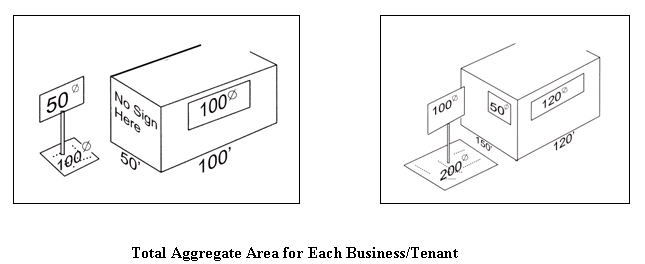
Figure 18.6 Figure 18.7
(b)
For business/tenant space with multiple exterior building walls, each exterior wall may be so measured. All signs must be placed on the exterior building wall or portion thereof used for measurement.
2.
Design.
(a)
For a lot occupied by more than one (1) business/tenant, each building sign must be consistent with any sign plan and be compatible and harmonious (but not necessarily identical) in terms of design, color, shape, size, style, material, and mounting with all other signs on the building or lot.
(b)
In addition to the principal sign color, up to two (2) additional accent colors, such as drop shadows or letter outlines may be included in the design.
b.
Freestanding signs.
1.
Freestanding signs are allowed in the I-L and I-H Zones in accordance with the following:
i.
There may be only one (1) freestanding sign per lot;
ii.
Such signs must have a maximum area of fifty (50) square feet and a maximum height of ten (10) feet; and
iii.
Such signs must not be closer than thirty (30) feet to any residential zone.
c.
Directional signs. Directional signs in the Industrial (I-L and I-H) Zones are allowed in accordance with the following:
1.
The signs must not exceed three (3) square feet in area; and
2.
If freestanding, the signs must not exceed six (6) feet in height.
d.
Gasoline price signs. In the Industrial (I-L and I-H) Zones, gasoline price signs required by state law for automobile filling stations may be freestanding or erected as a building sign. Any such sign or portion thereof that exceeds the minimum requirements of state law must be counted in the number, size, and total aggregate area for the business/tenant.
e.
Changeable copy signs. Changeable copy signs are allowed in the Industrial (I-L and I-H) Zones. Such sign may be freestanding and shall be counted in the number, size, and aggregate sign area permitted for the business/tenant.
f.
Temporary signs. Temporary signs are allowed in the Industrial (I-L and I-H) Zones in accordance with the following:
1.
One (1) real estate sign per lot not exceeding forty-eight (48) square feet in area, and not more than twelve (12) feet in height if freestanding, or one (1) building sign not exceeding seventy-two (72) square feet in area if mounted at least seventy (70) feet above adjacent grade, in accordance with the following:
(a)
Such signs must not be illuminated;
(b)
Such signs may be maintained for a period of two (2) years or until the building or lot is rented, leased, or sold, whichever occurs first. Signs must be removed within thirty (30) days after sale, lease, or rental. Signs installed for a two (2) year renewal period are limited to a maximum size of twenty-four (24) square feet; and
(c)
Such signs must not be located within thirty (30) feet of a residential zone.
2.
One (1) sign may be erected during the period of construction with a total maximum sign area of two hundred (200) square feet.
3.
Upon occupancy of a space by a business or tenant, banners, and displays not exceeding thirty-two (32) square feet in total area may be erected for up to sixty (60) consecutive days including days before or after actual occupancy date by the business or tenant. If the building has more than fifty (50) feet of linear frontage, the total area of the banner or display may be increased up to forty-eight (48) square feet.
4.
Temporary noncommercial signs are allowed in the Industrial (I-L and I-H) zones in accordance with the provisions of subsection 25.18.14.a.4.(b).
g.
Subdivision entrance signs. In the Industrial zones, permanent signs within recorded subdivisions of four (4) or more lots are allowed in accordance with the following:
1.
One (1) sign is permitted, not exceeding fifty (50) square feet in area and not exceeding six (6) feet in height.
2.
Such sign must be located at or near the entrance to the subdivision within the boundaries of the subdivision.
3.
Final location of such sign must be approved by the Director of Public Works to ensure that the sign does not obstruct the sight distance triangle.
4.
Such sign must be located in a landscaped area of at least two (2) square feet per each square foot of sign area.
5.
Such sign must not use internal illumination.
(Ord. No. 29-09, § 18, 10-26-09; Ord. No. 15-12, 7-30-12; Ord. No. 25-19, § 5, 10-21-19)
Editor's note— Ord. No. 29-09, § 18, adopted October 26, 2009, changed the title of section 25.18.13 from "Signs permitted in MXNC, MXC, and industrial zones" to "Signs permitted in MXC and industrial zones."
Sec. 25.18.14. - Signs allowed in other mixed-use zones—MXTD, MXCD, MXCT, MXNC, MXE, MXB, MXC and MXT.
a.
The following signs are allowed in the MXT and MXC zones:
1.
Permanent building signs in accordance with the following:
(a)
The total area of all building signs must not exceed fifteen (15) square feet on any building;
(b)
Such signs must not utilize internal illumination; and
(c)
Such signs must not be placed above the first-story level of any building;
2.
Permanent freestanding signs in accordance with the following:
(a)
One (1) freestanding sign is allowed for each lot not exceeding eight (8) square feet in area and not exceeding five (5) feet in height;
(b)
Such sign must not utilize internal illumination; and
(c)
Such sign must be located not less than ten (10) feet from a lot line of any lot used principally for a residence;
3.
Directional signs in accordance with the following:
(a)
Such signs must not to exceed three (3) square feet in area; and
(b)
If freestanding, not to exceed six (6) feet in height;
4.
Temporary signs in accordance with the following:
(a)
One (1) real estate sign per lot not exceeding twenty-four (24) square feet in area and eight (8) feet in height, in accordance with the following:
i.
Such signs must not be illuminated;
ii.
Such signs may be maintained for a period of two (2) years or until the building or lot is rented, leased, sold, whichever occurs first; and
iii.
Such signs must not be located within thirty (30) feet of a residential zone.
(b)
Temporary noncommercial signs are allowed in accordance with the following:
i.
The total aggregate area of all such signs on a single lot must not exceed thirty-two (32) square feet;
ii.
No single sign may exceed twelve (12) square feet in size;
iii.
If freestanding, such signs must not exceed eight (8) feet in height;
iv.
In lieu of the signage allowed in subsection (b)(i) and (ii) above, on any lot that abuts a limited access highway noncommercial temporary signs may be attached to the side of a building facing a limited access highway. Such signs must be mounted to the top floor face of the building, must not obstruct windows, and must not exceed an aggregate size of one hundred (100) square feet.
v.
Such signs must not be illuminated;
vi.
Such signs must not be located within thirty (30) feet of a residential zone;
vii.
No sign permit is required for such signs.
5.
Portable signs. One (1) portable sign may be allowed as follows:
(a)
The sign must be located within ten (10) feet of the front building entrance of the business and must not impede pedestrian movements;
(b)
Each sign face cannot exceed six (6) square feet in area and be no taller than three (3) feet:
(c)
The sign can only be displayed when the business is open to the public.
b.
Signs allowed in the MXTD, MXCD, MXNC, MXCT, MXB, and MXE Zones:
1.
Permanent building signs. Permanent building signs are permitted in the MXTD, MXCD, MXNC, MXCT, MXB, and MXE Zones in accordance with the following:
(a)
MXTD, MXCD, MXCT, MXE, and MXNC zones.
i.
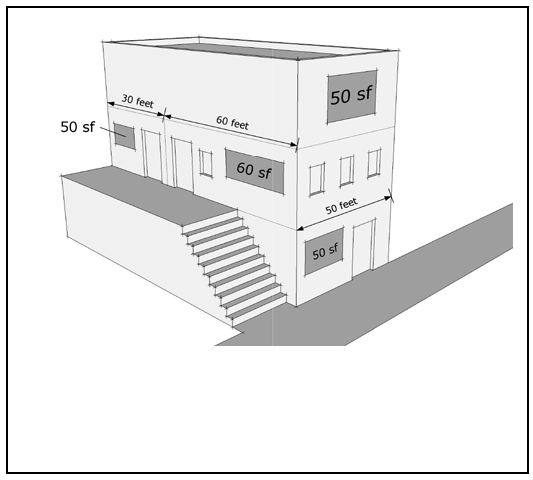
The total aggregate area of all signs on the premises allowed for each business/tenant must not exceed:
A.
Two (2) square feet for each linear foot of exterior building wall enclosing the business/tenant space for the first fifty (50) linear feet.
B.
If such building wall or portion thereof measures more than fifty (50) linear feet, then the aggregate area of all signs on the premises for that business/tenant may be increased in area at the rate of one (1) square foot for each additional linear foot of exterior building wall.
ii.
For a lot occupied by more than one (1) business/tenant, each building sign must be consistent and harmonious in terms of design, color, shape, size, style, material, and mounting with other such signs on the building or in the center.
iii.
In addition to the principal sign color, up to two (2) additional accent colors, such as drop shadows or letter outlines may be included in the design.
iv.
In addition to the above, buildings occupied by two (2) or more businesses/tenants may have building signs with a maximum area of fifty (50) square feet each located on any exterior wall that has frontage on the public right-of-way.
(b)
Total aggregate area—MXB zone.
i.
The total area of all signs erected on a lot in the MXB zone must not exceed two hundred fifty (250) square feet.
ii.
For a lot occupied by more than one (1) business/tenant, each building sign must be consistent and harmonious in terms of design, color, shape, size, style, material, and mounting with other such signs on the building or in the center.
iii.
In addition to the principal sign color, up to two (2) additional accent colors, such as drop shadows or letter outlines may be included in the design.
2.
Freestanding signs.
(a)
Freestanding signs are allowed in the MXTD zone in accordance with the following:
i.
On a lot, one (1) freestanding sign is allowed for each frontage on a major arterial or business district street;
ii.
Such sign must not exceed a three (3) feet by eight (8) inches with a maximum height of six (6) feet;
iii.
Such sign must not use internal illumination;
iv.
Such sign must not have a separate supporting structure;
v.
Final location of such sign must be approved by the Director of the Department of Public Works, or their designee, to ensure that the sign does not obstruct the sight distance triangle; and
vi.
Freestanding signs may also be subject to the provisions of subsection 25.17.08.c for areas along Rockville Pike and Hungerford Drive.
(b)
Freestanding signs are allowed in the MXCD, MXCT, MXB, and MXNC zones in accordance with the following:
i.
Freestanding signs erected on a lot with a single business/tenant must be counted as a portion of the total aggregate sign area allowed for that business/tenant. Freestanding signs erected on a lot with more than one (1) business/tenant must not be counted in the aggregate sign area allowed for any individual business/tenant. Such signs must be in accordance with the following:
A.
One (1) freestanding sign for each lot. On lots larger than five (5) acres, one (1) freestanding sign shall be permitted on each public street frontage. Where more than one (1) freestanding sign is permitted, they must be erected at least one hundred (100) feet apart;
B.
Such signs must not exceed a maximum area of one hundred (100) square feet and a maximum height of twenty (20) feet, provided that the area of a freestanding sign must not exceed the aggregate sign area allowed for the premises as measured by the most proximate building wall;
C.
Such signs must not be closer than thirty (30) feet to any residential zone;
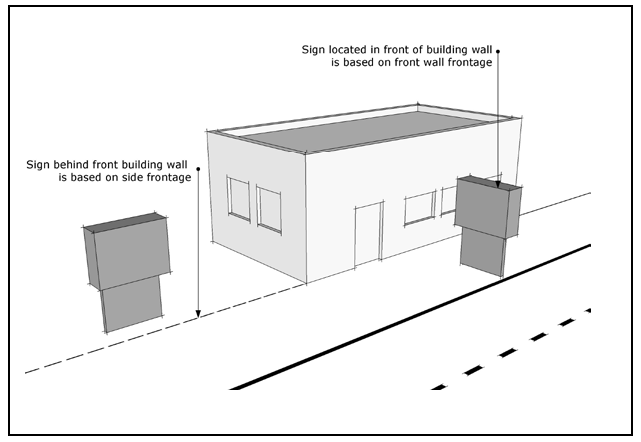
Figure 18.11 - Freestanding Signs
D.
A landscaped area must be provided at the base of the freestanding sign, with the landscaped area a minimum area of two (2) square feet for each square foot of sign area;
E.
The design of the sign shall be compatible and harmonious with the sign plan and architecture for the entire building or lot; and
F.
Freestanding signs are also subject to the provisions of subsection 25.17.08.c for areas along Rockville Pike or Hungerford Drive.
(c)
Freestanding signs are permitted in the MXE Zone in accordance with the following:
i.
Freestanding signs must be counted as a portion of the total aggregate sign area of the lot;
ii.
One (1) freestanding sign for each lot not exceeding one hundred (100) square feet in area and not exceeding twenty (20) feet in height is allowed. Such sign must be located not less than fifty (50) feet from any lot line;
iii.
In addition, lots which abut a limited access highway may have one (1) additional freestanding sign not exceeding fifty (50) square feet in area and not exceeding five (5) feet in height to be located at the principal point of ingress to such lot and not less than ten (10) feet from any lot line;
iv.
A landscaped area must be provided at the base of the freestanding sign. The landscaped area must be a minimum area of two (2) square feet for each square foot of sign area; and
v.
Letters and graphics on such signs must not exceed six (6) inches in height.
3.
Directional signs. Directional signs are allowed in accordance with the following:
(a)
The sign must not exceed three (3) square feet in area; and
(b)
If freestanding, the sign must not exceed six (6) feet in height.
4.
Gasoline price signs. Gasoline price signs required by state law for automobile filling stations may be freestanding or erected as a building sign. Any such sign or portion thereof that exceeds the minimum requirements of state law must be counted in the number, size, and total aggregate area for the business/tenant.
5.
Changeable copy signs. Changeable copy signs are permitted. Such sign may be freestanding and must be counted in the number, size, and aggregate sign area allowed for the business/tenant.
6.
Temporary signs. Temporary signs are allowed in the mixed-use transit district (MXTD), mixed-use corridor district (MXCD), mixed-use corridor transition (MXCT), mixed-use business district (MXB), mixed-use neighborhood commercial (MXNC), and mixed-use employment (MXE) zones in accordance with the following:
(a)
One (1) real estate sign is allowed per lot not exceeding forty-eight (48) square feet in area, and not more than twelve (12) feet in height if freestanding, or one (1) building sign not exceeding seventy-two (72) square feet in area if mounted at least seventy (70) feet above adjacent grade, in accordance with the following:
i.
Such signs must not be illuminated;
ii.
Such signs may be maintained for a period of two (2) years or until the building or lot is rented, leased, or sold, whichever occurs first. Signs must be removed within thirty (30) days after sale, lease, or rental. Signs installed for a two (2) year renewal period are limited to a maximum size of twenty-four (24) square feet; and
iii.
Such signs must not be located within thirty (30) feet of a residential zone.
(b)
One (1) sign may be erected along each side facing a public street during the period of construction with a total maximum sign area of two hundred (200) square feet for each side.
(c)
Upon occupancy of a space by a business or tenant, banners, and displays not exceeding thirty-two (32) square feet in total area may be erected for up to sixty (60) consecutive days including days before or after actual occupancy date by the business or tenant. If the building has more than fifty (50) feet of linear frontage, the total area of the banner or display may be increased up to forty-eight (48) square feet.
(d)
Temporary noncommercial signs are allowed in the MXTD, MXCD, MXNC, MXCT, MXB, and MXE zones in accordance with the provisions of subsection 25.18.14.a.4.(b).
7.
Portable signs. One (1) small, portable sign may be allowed as follows:
(a)
The sign must be located within ten (10) feet of the front building entrance of the business and must not impede pedestrian movements;
(b)
Each sign face cannot exceed six (6) square feet in area and be no taller than three (3) feet; and
(c)
The sign can only be displayed when the business is open to the public.
(Ord. No. 29-09, § 18, 10-26-09; Ord. No. 15-12, 7-30-12; Ord. No. 8-14, § 1, 4-21-14; Ord. No. 25-19, § 5, 10-21-19)
Sec. 25.18.15. - Reserved.
Editor's note— Ord. No. 25-19, § 5, adopted October 21, 2019, repealed the former section 25.18.15 in its entirety, which pertained to election signs, and derived from Ord. No. 19-08, § 1, adopted December 15, 2008.
Sec. 25.18.16. - Signs on public property and the public right-of-way.
a.
Signs prohibited. No sign is allowed on public property or within the public right-of-way unless specifically authorized or required by this Code.
b.
Exceptions. This section does not prohibit the erection or display of the following signs on public property or within the public right-of-way:
1.
Any sign required by a valid and applicable federal, state, or local law, ordinance, or regulation.
2.
Signs and other visual displays erected by, or at the direction of, federal, state, or local governmental or quasi-governmental agencies.
3.
Signs conforming to or required by the Manual of Uniform Traffic Control Devices, as published by the Federal Highway Administration from time to time under 23 Code of Federal Regulations, Part 655, Subpart.
(Ord. No. 25-19, § 5, 10-21-19)
Sec. 25.18.17. - Noncommercial signs in lieu of commercial signs.
Notwithstanding any provision of this article or chapter to the contrary, any sign allowed by this article or chapter to contain a commercial message may, in lieu thereof, contain a noncommercial message unrelated to the business, tenant, or entity located on the premises where the sign is erected, provided that the other criteria and regulations contained in this article and chapter have been satisfied, including but not limited to size, height, setback, location, duration, design, maintenance, and construction regulations and criteria.
(Ord. No. 25-19, § 5, 10-21-19)
Sec. 25.18.18. - Signs in planned development zones.
a.
Except as otherwise provided in this article 18, signs in any of the planned development zones as set forth in article 14 will be regulated based on the applicable designated equivalent zones described in each planned development.
b.
Notwithstanding the provisions of article 18, the following is specifically allowed in the PD-TS zone:
(a)
Freestanding signs in accordance with the following:
i.
One (1) off-premises sign per lot limited to thirty-five (35) square feet of sign area and twenty-five (25) feet in height.
ii.
Up to eighteen (18) off-premises signs limited to four (4) square feet of sign area and ten (10) feet in height installed on existing light posts located on lots covered by and subject to a preliminary development plan.
c.
Notwithstanding the provisions of article 18, the following are specifically allowed in the planned development zones listed in subsections 25.14.07.c.1.(a), 25.14.07.c.2, and 25.14.07.c.3:
1.
Freestanding signs in accordance with the following:
(a)
One (1) freestanding sign facing each public road bordering the project and designated as a major arterial roadway or limited access highway;
(b)
Each sign is limited to one hundred (100) square feet of sign area and twenty (20) feet in height;
(c)
Each sign must be located within the boundaries of the approved planned development;
(d)
Each sign must be located on a tract of land owned by the homeowner's association, civic association, or similar entity;
(e)
Each sign must be compatible and harmonious with the architectural style, character, materials, color, and details of the adjacent buildings and signs;
(f)
Such signs must not use internal illumination;
(g)
Except in the PD-TS zone, a landscaped area must be provided at the base of the sign, with the landscaped area a minimum of two (2) square feet for each square foot of sign area;
(h)
If the sign is a commercial sign, it must refer only to a tenant or tenants located within the boundaries of the approved planned development, it being expressly found and determined that such signs are necessary to identify the goods and services available in the planned development and, as regulated herein, do not create an unattractive nuisance in the manner of general off-premises advertising;
(i)
In the PD-CB zone, a sign must comply with the provisions contained in subsection 25.17.08.c.
2.
Directional signs, in accordance with the following:
(a)
Signs must not exceed three (3) feet in square area; and
(b)
If freestanding, signs must not exceed six (6) feet in height.
(Ord. No. 7-11, § 18, 6-6-11; Ord. No. 15-12, 7-30-12; Ord. No. 16-12, 9-24-12; Ord. No. 25-19, § 5, 10-21-19)
Sec. 25.18.19. - Optional sign package.
a.
Purpose. The preceding requirement of this article 18 ensure that signs that meet certain minimum standards and are consistent with the character and quality of the built environment in the City of Rockville may be quickly approved and displayed. In some situations, alternative standards may contribute to a project's aesthetic qualities and enhance vehicular, bicycle, and pedestrian safety. The purpose of this section is to set forth an optional method for signage to be provided within larger-scale projects in certain areas in the city. Approval of an optional sign package pursuant to the standards of this section allows for consistent presentation of signage throughout larger-scale projects, flexibility to provide for unique environments, and more pre-approval of designs and design elements to make subsequent applications for sign permits more efficient.
b.
Applicability. To be eligible to apply for an optional sign package, the property or properties subject to an application must consist of: (i) development including buildings three (3) or more stories in height; and (ii) (a) be located within one or more of the MXTD, MXCD, or MXNC zones; (b) be located entirely within either the Town Center Performance District or the Twinbrook Metro Performance District; or (c) include ten (10) or more contiguous acres and be located entirely within the MXE zone.
c.
Total sign area and location of signs.
1.
Aggregate sign area. The total aggregate area of freestanding and building signs that may be provided subject to an optional sign package must not exceed: two (2) square feet for each linear foot of exterior building wall enclosing any building with a non-residential use.
2.
Location. Freestanding or building signs may be erected anywhere within the area subject to an optional sign package, provided that such signs comply with the following:
(a)
Signs may extend above roof level by no more than twenty-five (25) percent of the sign face area;
(b)
Building signs may project up to forty-two (42) inches from the building face;
(c)
Freestanding signs must not exceed two hundred (200) square feet or a height of twenty (20) feet;
(d)
If the sign is a commercial sign, it must refer only to a tenant or tenants located within the area subject to an optional sign package; it being expressly found and determined that such signs are necessary to identify the goods and services available in the optional sign package area, and, as regulated herein, do not create an unattractive nuisance in the manner of general off-premises advertising;
(e)
No freestanding signs are allowed within thirty (30) feet of any residential zone or residential equivalent zone;
(f)
Signs along Rockville Pike or Hungerford Drive must comply with subsection 25.17.08.c.
d.
Directional signs. Directional signs are allowed anywhere within an area subject to an application, provided that: (i) such signs must not exceed three (3) square feet in area; and (ii) if freestanding, the signs must not exceed six (6) feet in height. Directional signs do not count toward the aggregate sign limit and do not need to be included as part of an optional sign package application. A permit must be obtained prior to the erection or installation of a directional sign.
e.
Entrance signs. One (1) permanent entrance sign is allowed for any principally residential building within an area subject to an application. The provisions set forth in section 25.18.11.1 apply to any such signs. Permanent entrance signs do not count toward the aggregate sign limit and do not need to be included as part of an optional sign package application. A permit must be obtained prior to the erection or installation of a permanent entrance sign.
f.
Submittal requirements. Any person desiring an optional sign package must submit the following materials to the Chief of Zoning:
1.
A completed application on a form provided by the City;
2.
The application fee as determined by resolution of the Mayor and Council;
3.
A scaled drawing showing existing property lines, and existing and approved buildings (including dimensions of building/unit frontage and square footage for each building), lighting, and landscaping;
4.
Location, materials, and maximum area for each sign that each occupant will be allowed to display;
5.
Scaled, color elevations of the proposed signage with appropriate dimensions, including height, width, and depth drawing of the proposed signage;
6.
A calculation of the total amount of sign area for each structure, and for each lot as a whole; and
7.
Any other supplemental material reasonably necessary for the review of the permit request.
g.
Completeness review. The Chief of Zoning will check each application submittal for its completeness and provide notification to the applicant of any deficiencies in the application within ten (10) days following receipt and review of the application. Upon the Chief of Zoning's determination that the application is complete and receipt of all fees, the application will be reviewed by the Chief of Zoning for conformity with this section.
h.
Criteria for approval. An optional sign package must meet the following criteria:
1.
Safety. The proposed signs will not create a safety or security hazard to pedestrians, drivers, or the public, and not interfere with pedestrian and bicycle movements.
2.
Scale. The proposed signs, both individually and in the aggregate, must be proportional to the building size and massing, relevant to both buildings within the area subject to the optional sign package and the neighborhood context.
3.
Architectural features. The proposed signs must be compatible and harmonious with the architectural style, character, materials, color, and detail of adjacent buildings and signs.
4.
Compliance with size and location requirements. The proposed signs must comply with the requirements set forth in subsection c.
5.
Lighting. The proposed signs must comply with the illumination requirements of subsection 25.18.06.a.3.
6.
No prohibited signs. The proposed signs must not include any signs prohibited by subsection 25.18.04.b., unless otherwise allowed by this section.
i.
Approval. If the Chief of Zoning finds that the proposed optional sign package conforms with the criteria for approval set forth in this section, the Chief of Zoning must approve the optional sign package within sixty (60) days of the date the completed application and applicable fee were received. Any denial of an optional sign package application must be in writing and identify the aspects of the application that do not conform to the criteria for approval set forth in this section.
1.
Effect of approval. Notwithstanding any other provision of this article 18, an approved optional sign package will govern the signage that is located within an area that is subject to an application. Prior to the erection of any signs implementing an optional sign package, an applicant must obtain a permit from the City of Rockville. All signs erected or maintained within the area subject to an optional sign package must conform at all times to the approved optional sign package. Any deviations from an approved optional sign package will be unlawful unless and until the approved optional sign package is revised, amended, and approved in accordance with this section.
2.
Expiration. An approved optional sign package will expire one (1) year from the date of approval if no permits for allowed signs have been issued.
3.
Amendment. Revisions or amendments to an approved optional sign package may be requested and approved in accordance with the procedure for new optional sign packages set forth in this section.
4.
Appeals. Any applicant who is denied an optional sign package may file a written appeal to the Board of Appeals within ten (10) days following receipt of the written copy of the denial.
(Ord. No. 25-19, § 5, 10-21-19)

