
Rockville City Zoning Code
ARTICLE 16
- PARKING AND LOADING
Sec. 25.16.01.- Purpose.
The purposes of parking standards are to:
1.
Provide adequate parking to support the uses served;
2.
Minimize the detrimental impact of off-street parking on adjoining properties;
3.
Minimize parking to encourage the use of public transit or other alternatives to the automobile;
4.
Ensure the proper and uniform development of parking areas throughout the City;
5.
Ensure safe and convenient circulation of pedestrians and bicycles within parking areas;
6.
Ensure proper loading configurations and access; and
7.
Minimize stormwater runoff from parking lots and structures.
Sec. 25.16.02. - General requirements.
a.
General provisions.
1.
No land can be used or occupied, no structure can be designed, erected, attached, used, or occupied, and no use can be operated unless the required parking and loading facilities are provided:
(a)
In the minimum or maximum amounts set forth in this article;
(b)
In accordance with the design standards set forth in this article; and
(c)
In accordance with this article and may not be rearranged or altered without approval in accordance with the provisions of subsection 25.05.07.b.
2.
Automobile off-street parking and loading areas cannot be reduced in area or encroached upon by buildings, vehicle storage, loading or unloading, or any other use where such reduction or encroachment will reduce the area below that required by this article.
3.
Any additional off-street parking and loading facilities required as a result of an expansion of or a change in any use must be likewise established and maintained or such use is required to cease until such facilities are provided.
b.
Special provisions for certain zones.
1.
R-400, R-200, R-150, R-90, R-75, R-60, and R-40 zones. In the R-400, R-200, R-150, R-90, R-75, R-60, and R-40 zones, off-street parking of motor vehicles is limited to:
(a)
Passenger vehicles;
(b)
Not more than one (1) delivery-type commercial vehicle per dwelling unit not exceeding three-quarter-ton capacity or one (1) that has been issued a special permit pursuant to section 23-27 of the City Code; and
(c)
One (1) trailer which cannot be used for dwelling purposes or any accessory use, provided such trailer is parked behind the front building line whenever possible. A semi-trailer for transport by a truck tractor under the Maryland Vehicle Law is not allowed except as a temporary use in accordance with subsection 25.09.04.d.
2.
RMD zones. In the RMD zones:
(a)
Off-street parking of motor vehicles is limited to:
(i)
Passenger vehicles; and
(ii)
Not more than one (1) delivery-type commercial vehicle not exceeding three-quarter-ton capacity per dwelling unit or one (1) truck that has been issued a special permit pursuant to section 23-27 of the City Code.
(b)
Off-street parking of trailers in such zones is prohibited.
3.
MXTD zones. In the MXTD zone, limited off-street parking of motor vehicles between the front building line and the front lot line may be allowed by the Approving Authority in accordance with the provisions of subsection 25.13.07.a.6. The Approving Authority also has the authority to waive the requirements of this section, subsection 25.16.04.b., and subsections 25.16.07.a. and b. provided that:
(a)
A previously existing single unit detached dwelling is being converted to a permitted use in the MXTD zone;
(b)
Due to the location of the existing structure or structures on the lot, compliance with the parking, loading, and access requirements of this section 25.16.02, cannot be reasonably accomplished; or
(c)
Such a waiver would enable the proposed use to better satisfy the parking space requirements of section 25.16.03.
4.
MXE zone. In the MXE zone, the required parking may be reduced by up to fifteen (15) percent by the Planning Commission if:
(a)
The main building entrance is located within two thousand five hundred (2,500) feet of a Metro rail transit station entrance; and
(b)
The site has environmental requirements on at least ten (10) percent of the net lot area that limits the developable area of the site. For purposes of this subsection, environmental requirements include significant tree preservation areas, stream buffer areas, or other natural features of the site identified in the City development approval as a significant environmental feature to be retained.
(Ord. No. 29-09, § 16, 10-26-09; Ord. No. 8-14, § 1, 4-21-14)
Sec. 25.16.03. - Number of spaces required.
a.
Employee calculation. For the purposes of this article, the number of employees for a use shall be computed on the basis of the maximum number of persons to be employed at any one (1) time other than at changes of shifts.
b.
Handicapped spaces. The number of spaces required includes spaces for the handicapped and aged as set forth in the Maryland Code for the Handicapped.
c.
Prohibited uses of parking areas and loading spaces. No parking area or loading space can be used for the storage, sale, repair, dismantling, or servicing of any vehicles, equipment, materials, or supplies.
d.
Table of space requirements. The number of parking spaces for both vehicles and bicycles required for each class of land use are as shown in the following table:
1 For hotels located within seven-tenths of a mile (3,696 feet) walking distance of a transit station entrance shown on the Washington Metropolitan Area Transit Authority Adopted Regional Rail System, the base number required is 0.33 spaces per guest room or suite.
2 The parking requirement for research and development use within one (1) mile of a Metrorail station or bus stop is one (1.0) spaces per one thousand (1,000) gross square feet.
e.
Religious exception. No parking spaces are required for a building used by a congregation on a lot of twelve thousand (12,000) square feet or less, whose religious beliefs prohibit the use of motor vehicles in traveling to and from religious services on the Sabbath and principal religious holidays and which the building may only be used for religious services on the Sabbath and principal religious holidays and as a residence for the clergy and his/her family. Such a building must, however, provide two (2) off-street parking spaces on its property. Other uses that may be located on the property that involve activities on days other than the Sabbath must provide off-street parking in accordance with this article 16, or as may be required by the Board of Appeals in approving a special exception on the site.
f.
Maximum parking limits. In order to limit excessive off-street parking and encourage parking reductions in the MXTD and MXCD zones, the number of parking spaces to be provided is limited to no more than the standard shown in the tables above. Additional parking can only be provided if:
1.
The additional parking consists of a permeable surface acceptable to the Department of Public Works;
2.
The additional parking is provided via an automated parking structure or in a structure above or below grade;
3.
Parking in connection with an automobile sharing program; or
4.
All of the required public use space is provided on-site.
g.
Determination of requirements for multiple uses.
1.
Except as provided in paragraph 3 of this subsection and in subsections h.5. and h.6. below, when any land or building is used for two (2) or more purposes, the number of parking spaces required must be the sum of the requirements for the various individual uses, computed separately in accordance with this article. Parking facilities for one (1) use cannot be considered as providing the required parking facilities for any other use, except as otherwise provided.
2.
Requirements for the provision of parking facilities with respect to two (2) or more uses of the same or different types may be satisfied by the permanent allocation of the requisite number of spaces for each use in a common parking facility, cooperatively established and operated. The number of spaces so designated may not be less than the sum of the individual requirements for each use except as hereinafter provided, and all design requirements contained in this division must be complied with. A common parking facility so established must be located so that a major point of pedestrian access to such common facility is within a 500-foot walking distance of the entrance to each use served thereby. The Approving Authority may attach such conditions to the approval of a common parking facility as may be reasonable and necessary to assure that the use will be consistent with the purpose and intent of this chapter.
3.
In a predominantly office, multiple-use building located in the MXTD zone with frontage on a transit station link, and not part of a previously approved project plan, the number of parking spaces required may be determined by using the parking standards for office use applied over the entire floor area of the building and not on the requirements for the individual uses. Office uses must occupy more than 75 percent of the gross floor area of the building. If the mix of uses contains one (1) or more restaurants that, in the aggregate, exceed four thousand five hundred (4,500) square feet of gross floor area, the parking requirement for the restaurant or restaurants exceeding four thousand five hundred (4,500) square feet of gross floor area, must be calculated according to the restaurant parking standard.
4.
On a lot or parcel that contains a church, synagogue, or other place of worship and an affiliated private institution, the Board of Appeals, as part of the consideration of the special exception application for the private educational institution, may grant a parking reduction of up to thirty (30) percent of the total required parking for the site upon the finding that the uses on the property will not have overlapping peak hour parking requirements and the reduction will not adversely affect the site of the adjacent area.
h.
Flexible parking standards. The Approving Authority may permit reductions in the number of parking spaces required, if certain standards and requirements are met as set forth below.
1.
Mayor and Council and Planning Commission reductions. The Mayor and Council, in the approval of a project plan, or the Planning Commission in the approval of a site plan within the MXTD, MXCD, MXE, MXNC and PD zones, have the authority to reduce the required number of parking spaces for uses in the building or buildings to be constructed provided that:
(a)
A major point of pedestrian access to such building or buildings is within seven-tenths of a mile (3,696 feet) walking distance of a transit station entrance shown on the Washington Metropolitan Area Transit Authority Adopted Regional Rail Transit System;
(b)
There are three (3) or more bus routes in the immediate vicinity of the building or buildings; or
(c)
There is a major public parking facility available to the public within one thousand (1,000) feet of a building entrance;
(d)
Where the size of the lot is so small that meeting the parking requirement would prevent redevelopment;
(e)
Where there is a bikeway in close proximity to the site and the applicant demonstrates that the uses in the proposed development are conducive to bicycle use; or
(f)
For any other good cause shown.
2.
[Previous reductions.] The Planning Commission may not approve a further reduction on site plans that implement all or part of a project plan where the Mayor and Council has previously granted a reduction.
3.
Reductions with proximity to a transit station. Within any mixed-use zone where the building entrance is more than seven-tenths of a mile (3,696 feet) walking distance from a transit station entrance as shown on the Washington Metropolitan Area Transit Authority Adopted Regional Rail Transit System, a reduction of not more than ten (10) percent of the required parking spaces may be approved if a parking management plan approved by the Approving Authority will be implemented with occupancy of the building or buildings using such features as car and van pooling and public or private transit. A Transportation Demand Management strategy must be submitted with the goal of reducing parking demand by the building to meet the amount of reduction requested. The effectiveness of this plan must be demonstrated periodically after the use has been operating, as determined by the Approving Authority.
4.
Multiple-unit residential projects. For multiple-unit residential projects, a condition of approval of a project plan or site plan may limit parking below the normal requirements set forth in the tables in subsection 25.16.03.d. above.
5.
City owned land. Parking may be provided under an approved integrated parking demand program for a mixed-use development on City-owned land or land purchased by the applicant from the City within the MXTD zone, or for development within a designated parking district.
6.
Reductions for shared uses. Parking within a project application may be reduced by the appropriate percentage as shown in the parking credit schedule for each of the five (5) time periods shown in the chart below. The number of parking spaces required is determined by totaling the resulting numbers in each column; the column total that generates the highest number parking spaces then becomes the parking requirement.
i.
Deferral for providing spaces.
1.
The Approving Authority, in considering a project plan or site plan, may approve a deferral of providing the number of parking spaces required where it can be demonstrated that the use served does not need the number of spaces otherwise required by this section 25.16.03 due to one (1) or more of the following:
(a)
The age characteristics of the patrons or tenants served;
(b)
The unique character of the use being served;
(c)
Proximity to a transit station.
2.
A deferral in providing required parking spaces may be approved by the Approving Authority to enhance or preserve the environment, such as preservation of significant trees or avoiding impact on sensitive environmental areas. However, an inability to comply with the forest conservation requirements or other environment requirements is not a reason, per se, to approve a deferral.
3.
Where such deferrals are allowed, the applicant must demonstrate that there is sufficient useable land area available to provide the total number of spaces that would otherwise be required. Any changes in the conditions under which the reductions were approved will require the deferred spaces to be provided in accordance with the conditions of the approved site plan.
j.
Provisions for off-site parking.
1.
The parking requirements set forth in section 25.16.03 may be met with the execution of a formal agreement in a form satisfactory to the Chief of Zoning and the City Attorney to use off-site parking spaces for some or all of the required parking.
2.
In the case of parking in connection with alcoholic beverage production, the Approving Authority may consider the availability of on-street parking to serve patrons for periodic tours or tasting events.
k.
Reduced parking for affordable townhouse dwelling units.
1.
One (1) off-street parking space is required for each townhouse dwelling unit that is a moderately priced dwelling unit, as defined in chapter 13.5, provided that:
a.
The unit is located in a PD zone;
b.
Public on-street parking, visitor parking, and other unrestricted parking on the unit's approved site plan exceeds one-half (0.5) spaces per dwelling unit; and
c.
A major point of pedestrian access from the unit's development is within seven-tenths of one mile (three thousand six hundred ninety-six (3,696) feet) walking distance of a transit station entrance shown on the Washington Metropolitan Area Transit Authority Adopted Regional Rail Transit System or a bus stop or there is a parking facility available to the public within one thousand (1,000) feet of this major point of pedestrian access.
2.
The Chief of Zoning may reduce the off-street parking required by a site plan approved before March 3, 2025, for any townhouse dwelling unit that is a moderately priced dwelling unit upon finding that the unit meets the requirements of subsection 25.16.03.k.1.
(Ord. No. 29-09, § 16, 10-26-09; Ord. No. 7-11, § 16, 6-6-11; Ord. No. 3-14, § 1, 2-10-14; Ord. No. 8-14, § 1, 4-21-14; Ord. No. 3-18, 2-5-18; Ord. No. 14-21, 9-27-21; Ord. No. 18-21, 10-25-21; Ord. No. 5-25, 3-3-25)
Sec. 25.16.04. - Location of parking and loading facilities.
a.
All off-street parking and loading facilities required by this article for any use must be located on and entirely within the same record lot with that use, unless otherwise provided in this chapter.
b.
Off-street parking and loading facilities that make it necessary for vehicles to back out directly into a public road are prohibited, except that this prohibition does not apply to the off-street parking area of one (1) single-family detached or semi-detached dwelling units.
c.
All garages or other space allocated for parking of vehicles within buildings or in basements or open spaces on the roofs of buildings are considered part of the required off-street parking facilities and may be included as such in computing the requirements outlined in this article.
(Ord. No. 29-09, § 16, 10-26-09)
Sec. 25.16.05. - Location in relation to use served.
Requirements for the provision of parking facilities in the MXTD, and MXCD zones, and the MXNC zone within the town center performance district, may be satisfied on a separate lot from the use served by a permanent automobile parking structure. An automobile parking structure must be within a 1,000-foot walking distance of the entrance to the use being served to satisfy the parking requirements. The Planning Commission may attach such conditions to the approval of an automobile parking structure as may be reasonable and necessary to assure that it will be consistent with the purpose and intent of this chapter.
Sec. 25.16.06. - Parking design standards.
a.
Interior drive aisles and turning radii.
1.
The width of interior drive aisles must not be less than:
(a)
Twenty-four (24) feet when used with 70- to 90-degree angled parking, except that 20-foot-wide driveways may be used in a parking structure;
(b)
Eighteen (18) feet when used with 46- to 69-degree angled parking; or
(c)
Fourteen (14) feet when used with parallel to 45-degree angled parking.
2.
Interior driveways must not be less than fourteen (14) feet wide for one (1) direction circulation, or eighteen (18) feet wide for two (2) direction circulation.
3.
Pavement directional arrows and/or signs must be provided in sufficient quantities and locations so as to ensure safe and efficient on-site traffic circulation.
4.
At the entry into a parking facility from a public right-of-way, a minimum safety zone of ten (10) feet must be provided behind the right-of-way line to allow for maneuvering of vehicles within the parking facility.
5.
Interior driveways may not be installed on a grade in excess of fourteen (14) percent. Interior drive aisles in commercial and industrial areas cannot be installed on a grade of more than ten (10) percent. This requirement may be waived by the Department of Public Works for ramps within parking structures.
b.
Parking spaces.
1.
Each automobile parking space must be a rectangle not less than nine (9) feet wide and eighteen (18) feet long, except as follows:
(a)
Spaces provided for the physically handicapped and aged must be in accordance with the Maryland Building Code for the Handicapped.
(b)
For parallel parking spaces, the length must be increased to a minimum of twenty-one (21) feet. In addition:
(i)
Adequate interior driveways and entrance and exit driveways must be provided to connect each public parking space with a public street; except that,
(ii)
Where parking of vehicles by attendants is provided, at least thirty-three (33) percent of all parking spaces must have direct access to interior entrance and exit driveways in areas designated on the site plan for attendant parking areas.
2.
Parking spaces must not be installed on a grade in excess of five (5) percent.
3.
All parking spaces must be separated from walkways, sidewalks, roads, streets, or alleys by curbing and all roads, streets, alleys, sidewalks, walkways, and lot lines must be protected from vehicular overhang by wheel bumpers or curbs. Wheel bumpers or curbs must be installed at least five (5) feet from a street right-of-way line.
4.
For purposes of computing the area of any parking space hereunder, a parking space may extend beyond a wheel bumper or curb provided that:
(a)
The computed area of such parking space does not extend beyond a wheel bumper or curb more than two (2) feet as measured along the side of the space which extends the greatest distance beyond the wheel bumper or curb; and
(b)
The computed area of such parking space does not extend beyond a wheel bumper or curb which is more than six (6) inches high, and the area of overhang is free of all obstructions above curb height.
5.
Each parking space must be clearly marked and adequate pavement directional arrows or signs provided.
6.
No off-street surface parking facility can contain more than one hundred fifty (150) spaces. If a greater number of spaces is required by this article, separate parking areas of not more than one hundred fifty (150) spaces must be provided and must be separated by a landscaped area at least ten (10) feet in width.
7.
In considering a project plan or site plan, the Approving Authority may allow parking spaces on private streets to be applied towards the total parking requirement for the development.
c.
Entrance and exit driveways.
1.
Driveways for single-unit residential or duplex buildings, or buildings containing four (4) dwelling units or less in the RMD-Infill zone, must have a width of not less than ten (10) feet.
2.
For all other uses, there must be at least two (2) one-direction driveways fifteen (15) feet in width or one (1) two-direction driveway twenty-five (25) feet in width, except that two-direction driveways on four (4) lane or wider highways or within the central business district must be between twenty-five (25) and thirty-five (35) feet in width. The number, type, and width of such driveways must be as reasonably determined by the Approving Authority.
3.
In the MXE, MXNC, and MXCD zones, vehicular access to a secondary residential street is prohibited.
4.
In the MXE, I-L, and I-H zones, vehicular access to any residential street is prohibited.
d.
Paving specifications. All off-street parking and loading areas must be so drained as to prevent damage to abutting properties or public streets and must be paved with a minimum of:
1.
A pervious paving material as approved by the Director of the Department of Public Works;
2.
Six (6) inches of concrete;
3.
Six (6) inches of bituminous asphalt;
4.
Six (6) inches of compacted gravel and two (2) inches of bituminous asphalt; or
5.
Other paving as approved by the Director of the Department of Public Works.
e.
Internal landscaping of surface parking facilities. See subsection 4.d of the landscaping, screening, and lighting manual.
f.
Pedestrian walkways and bicycle paths in parking facilities. The design of parking facilities must include a pedestrian and bicycle circulation plan providing full and safe access to and through the facility. Pedestrian walkways, sidewalks, crosswalks, and bike paths must be provided in all off-street parking facilities where necessary for pedestrian and cycling safety. Such walkways, sidewalks, and bike paths must be clearly marked and protected from vehicular encroachment by wheel stops or curbs. Pedestrian walkways and bike travel lanes shall be linked with walkways and lanes in adjacent parking facilities and with entrances to buildings and public sidewalks and bike facilities. All pedestrian ways that cross private travel ways must be provided with crosswalks acceptable to the Department of Public Works.
g.
Lighting requirements. Lighting for parking facilities must be provided in accordance with the provisions of article 17 and the landscaping, screening and lighting manual.
h.
Loading facilities.
1.
For any building in any industrial or mixed-use zone, adequate off-street space for the loading and unloading of goods and materials must be provided, taking into consideration the size of the building and the uses allowed in such zone.
2.
Each loading space provided must have a minimum width of twelve (12) feet, clearance height of at least fourteen (14) feet, and a depth sufficient to accommodate the maximum length of delivery trucks reasonably likely to serve the building. In the event that intermediate tractor-trailer (WB-50) loading or unloading is reasonably likely, a depth of sixty (60) feet must be provided. Loading space shall be located so that trucks will not obstruct pedestrian or vehicle traffic movement or project into any public right-of-way. Maneuvering area must provide a turning radius of not less than forty-eight (48) feet.
(Ord. No. 29-09, § 16, 10-26-09; Ord. No. 7-11, § 16, 6-6-11; Ord. No. 14-21, 9-27-21)
Sec. 25.16.07. - Parking structures design.
a.
In addition to the provisions of section 25.16.06 above, parking garages must be designed so as to be as open as possible, have sufficient lighting, and easily visible compatible stairways and elevator lobbies. The exterior design should match or be compatible with the other structures on the site or adjacent to the garage.
b.
Entry to a garage not having direct access to a public street must be indicated by sufficient signage on-site.
c.
Where an automated directional sign systems is installed, there must be a readily legible indication from the street of the status of available parking within the structure.
d.
Where a parking structure confronts residential development, the design must not allow headlights to shine through the structure.
Sec. 25.16.08. - Automated parking structures.
Automated parking structures may be used to meet all or a portion of the required off-street parking requirements. Such structures may be freestanding or used in conjunction with parking garages. If freestanding, they must be located only in the rear yard, and screened from adjoining properties with landscaping, walls, or other means, and comply with all noise standards.
Sec. 25.16.09. - Bicycle parking.
a.
Purpose. The purpose of the bicycle parking standards are:
1.
To encourage bicycling as an alternate mode of transportation by providing adequate bicycle parking at common destinations;
2.
To ensure safe and convenient parking spaces for bicycles; and
3.
To address the need for and to provide both short-term and long-term bicycle parking.
b.
General requirements.
1.
Section 25.16.03 sets forth the required minimum number of bicycle parking spaces for each use category. Bicycle parking is calculated based on predicted demand generated by the use categories and on the security for bicycle parking necessary to encouraging bicycling as a form of transportation.
2.
Primary uses on a site are the determining factor when calculating bicycle parking spaces. Accessory uses do not have bicycle parking requirements.
3.
If a site has two (2) primary uses, the parking requirement is the sum of the required bicycle parking for the individual primary uses.
c.
Standards.
1.
Short-term bicycle parking.
(a)
Purpose. Short-term bicycle parking provides incentives to visitors to use bicycles through convenient placement of short-term bicycle parking.
(b)
Design. The following standards must be met for required short-term bicycle parking:
(i)
Short-term bicycle parking should be located at a building's main entrance and should be clearly visible to pedestrians and bicyclists.
(ii)
Short-term bicycle parking must consist of racks or lockers meeting the standards of subsection 25.16.09.c.3.
(iii)
Short-term bicycle parking must be within the following distances of the main entrance:
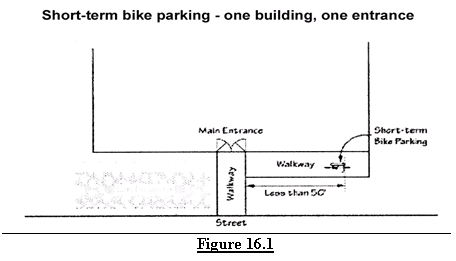
A.
Building having one (1) entrance. Measuring by the most directly accessible pedestrian route, the bicycle parking must be within fifty (50) feet of the main entrance to the building when a building has only one (1) main entrance.
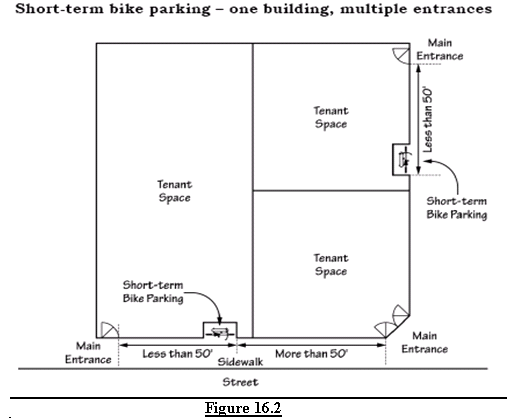
B.
Building having more than one (1) main entrance. Measuring by the most directly accessible pedestrian route, bicycle parking must be along all building frontages with a main entrance, and within fifty (50) feet of at least one (1) main entrance on each building frontage that has a main entrance when a building has more than one (1) main entrance.
C.
Bicycle parking for a building or multiple buildings or entries within a campus setting. Measuring by the most directly accessible pedestrian route, bicycle parking must be within fifty (50) feet of a main entrance or all entrances for a building or multiple buildings or entries within a campus setting.
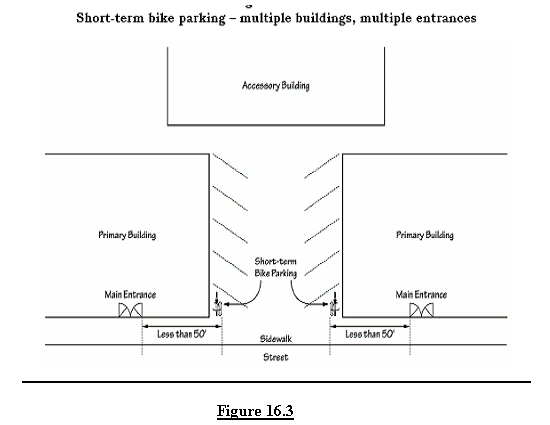
D.
Sites with more than one (1) primary building, with exception to an institutional campus. Measuring by the most directly accessible pedestrian route, bicycle parking must be distributed to serve all primary buildings and be within fifty (50) feet of the main entrance for sites with more than one (1) primary building, with exception of an institutional campus.
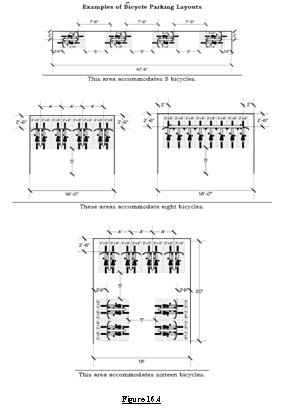
E.
[Minimum size.] Each short-term bicycle parking space must be at least two (2) feet by (6) six feet.
2.
Long-term bicycle parking standards.
(a)
Purpose. Long-term bicycle parking provides secure and weather-protected areas to park bicycles for those staying at a site for several hours.
(b)
Standards. Required long-term bicycle parking must meet the following standards:
(i)
Long-term bicycle parking must be supplied through racks or lockers that meet the standards of subsection 25.16.09.c.3.
(ii)
Long-term bicycle parking must be covered in accordance with the standards of subsection 25.16.09.c.3.(e).
(iii)
Long-term bicycle parking must be positioned on the site or in an area where the closest point is within three hundred (300) feet of the principle entrance.
(iv)
Where long-term bicycle parking spaces are required for office use categories, for every fifty thousand (50,000) square feet of gross floor area (GFA), one (1) shower per gender must be installed, up to a maximum of three (3) showers per gender. Showers must be accessible to all tenants of the building.
(v)
Where long-term bicycle parking spaces are required for office use categories, a minimum of one (1) clothes storage locker per gender must be installed for every long-term bicycle parking space. The lockers must be installed adjacent to the showers in a safe and secured area and be accessible to all tenants.
(vi)
To heighten security, long-term bicycle parking must be in at least one (1) of the following locations:
A.
In a locked room;
B.
In an area enclosed by a fence with a locked gate. The fence must be floor-to-ceiling or eight (8) feet high;
C.
In an area visible by an attendant or security guard;
D.
Within one hundred (100) feet of an attendant or security guard;
E.
In an area monitored by a security camera; or
F.
Contained within a dwelling unit or dormitory unit. If long-term bicycle parking is provided in a dwelling unit or dormitory unit, neither racks nor lockers are required.
3.
Additional standards for all bicycle parking.
(a)
Purpose. The purpose of these standards is to ascertain that the design of the required bicycle parking allows bicycles to be locked securely and conveniently, protecting bicycles from damage.
(b)
Bicycle lockers. The Department of Public Works provides standards for bicycle lockers. Lockers must be securely anchored where required bicycle parking is provided in lockers.
(c)
Bicycle racks. The Department of Public Works maintains a handbook of racks and site location guidelines that meet the standards of this subsection. Floor, wall, or ceiling racks are acceptable locations for required bicycle parking. Bicycle racks must meet the following standards:
(i)
If both wheels are left on the bicycle, the bicycle frame and one (1) wheel can be locked to the rack with a high security lock;
(ii)
A six-foot long bicycle can be securely held with its frame supported, providing that the bicycle cannot be pushed or fall in a manner that will damage the wheels or components; and
(iii)
The rack must be securely anchored.
(d)
Maneuvering and parking areas.
(i)
Each required bicycle parking space must be accessible without moving another bicycle.
(ii)
To allow room for bicycle maneuvering, an aisle must be placed at least five (5) feet wide behind all required bicycle parking.
(iii)
The area designated for bicycle parking must be hard surfaced.
(iv)
If the bicycle parking is adjacent to a sidewalk, the maneuvering area may extend into the right-of-way.
(e)
Covered parking.
(i)
Long-term bicycle parking must be covered.
(ii)
If possible, short-term bicycle parking should be covered.
(iii)
Covered parking can be provided by locating the bicycle parking inside buildings, in bicycle lockers, under roof overhangs, awnings, canopies, or within or under other structures.
(iv)
Where required covered bicycle parking is not within a building or locker, the cover must be:
A.
Permanent;
B.
Protect the bicycle from rain and snow; and
C.
Exist a minimum of seven (7) feet above the floor or ground.
(f)
Use of required parking spaces.
(i)
Shoppers, customers, messengers, and other visitors to the site must be given access to use required short-term bicycle parking spaces.
(ii)
Employees, students, residents, commuters, and those who stay at the site for several hours must be given access to use required long-term bicycle parking spaces.
(g)
Signs.
(i)
A sign must be posted at a light rail station or transit center indicating the location of the bicycle parking if required bicycle parking is not able to be seen from the transit station link or transit center.
(ii)
A sign must be posted at the main building entrance, for uses other than transit station links or transit centers, indicating the location of the bicycle parking if required bicycle parking is not visible from the street or main building entrance.
(Ord. No. 7-11, § 16, 6-6-11)

