
Rockville City Zoning Code
ARTICLE 3
- DEFINITIONS; TERMS OF MEASUREMENTS AND CALCULATIONS
Sec. 25.03.01.- General rules of interpretation.
The following rules of construction apply to the text of this chapter:
1.
The particular controls the general.
2.
In case of any difference of meaning or implication between the text of this chapter and any caption, illustration, summary table, or illustrative table, the text controls.
3.
The words "shall," "may not," and "must" are always mandatory and not discretionary. The words "should" and "may" are permissive.
4.
Words used in the present tense also include the future.
5.
Words used in the singular number also include the plural; and plural the singular, unless the context clearly indicates the contrary.
6.
The phrase "used for" includes "arranged for," "designed for," "intended for," "maintained for," or "occupied for."
7.
Words or terms not otherwise included are defined by their common dictionary meaning.
8.
Unless the context clearly indicates the contrary, where a regulation involves two (2) or more items, conditions, provisions, or events connected by the conjunctions "and," "or," or "either…or," the conjunction will be interpreted as follows:
(a)
When used to connect a list of requirements or required conditions, "and" indicates that all the connected items apply.
(b)
When used to connect a list of permitted items or events, "and" indicates that the items or events are permitted singly or in any combination.
(c)
"Or" indicates that the connected items, conditions, provisions, or events may apply singly or in any combination.
(d)
"And…or" indicates that the connected items, conditions, provisions, or events will apply singly or in combination.
(e)
"Either…or" indicates that the connected items, conditions, provisions, or events will apply singly but not in combination.
(f)
The word "includes" does not limit a term to the specified examples, but is intended to extend its meaning to all other instances or circumstances of like kind or character, and has the same meaning as "includes but is not limited to."
9.
All terms appearing in this chapter that are defined under various sections of the City Building Code have the meanings specified in the Building Code except where specifically defined in this chapter; however, in case of a conflict, the more restrictive meaning applies.
10.
The word "State" means the State of Maryland. The word "County" means the County of Montgomery County, Maryland, and the term "City" means the City of Rockville, Maryland.
Sec. 25.03.02. - Words and terms defined.
Abandoned sign. See "Sign, abandoned."
Abutting or adjoining means having a common point or border.
Accessory drive-through window means a drive-through window which is incidental to the primary use of the structure and which consist of one (1) drive-through window and an associated single queue lane. An accessory drive-through window is a special exception use under this chapter.
Accessory swimming pool. See "Swimming pool, accessory."
Accessory use. See "Use, accessory."
Adjacent means near or close to but not necessarily touching.
Administrative adjustment means a modification of certain regulations by the Chief of Zoning as set forth in section 25.06.05.
Adult day care center means a licensed facility in which day care services, recreation and/or care are provided to four (4) or more persons over the age of sixteen (16), for any part of a 24-hour period in accordance with all applicable State and County laws and regulations.
Adult oriented establishment means any commercial establishment which devotes either two hundred fifty (250) or more square feet or five (5) percent of its gross floor area, whichever is smaller, to the retailing, distributing, exhibiting, and/or storing of sexually oriented materials, or to affording customers the opportunity to engage in sexually oriented activities.
1.
The term includes, but is not limited to, the following establishments which meet the criteria of this definition: bookstores, live theaters, motion picture theaters or arcades, massage parlors, model studios, and nightclubs; but does not include hotels or motels.
2.
Live theaters or motion picture theaters do not meet this definition unless a predominance of the pictures or performances exhibited constitute sexually oriented materials as defined herein.
Alcoholic beverage production means the production of any alcoholic beverage or neutral spirits by means of distilling, fermenting, brewing, or rectifying under the following Maryland State production classifications: Classes 1, 2, 3, 4, 5, 6, 7, and 9. Tastings or samplings of products are permitted in accordance with State law.
Alcoholic beverage production, limited means the production of any alcoholic beverage or neutral spirits by means of distilling, fermenting, brewing, or rectifying under the following Maryland State production classifications: Classes 4, 6, and 7, and 9. Tastings or samplings of products are permitted in accordance with State law.
Alley means a right-of-way that provides secondary access for vehicles to the side and rear of abutting properties. A private driveway is not an alley.
Alteration, structural means any change to a building or structure including:
1.
Bearing walls;
2.
Load-bearing columns;
3.
Beams or girders;
4.
An enlargement or reduction in the gross floor area or building height.
Amenity means a natural or created feature that enhances the aesthetic quality or visual appeal or makes more attractive or satisfying a particular property, place, or area.
Animal hospital means a facility staffed by at least one (1) veterinarian licensed by the State for the medical treatment and care of animals; and which keeps animals overnight only for medical purposes.
Antenna means any structure or device used to collect, receive, transmit, or radiate electromagnetic waves, including both directional antennae (such as panels, microwave dishes, satellite earth station antennae over two (2) meters in diameter) and omni-directional antennae (such as whips). This term does not include antennae two (2) meters or less in diameter, and antennae regulated by 47 C.F.R. Section 1.4000, as amended.
Antenna support structure means a structure designed for the primary purpose of supporting one (1) or more antennae (including telescoping mast, tower, monopole, tethered blimp, or other support structure). The term includes structures located on buildings or other structures, ground-mounted, or tethered.
Apartment, accessory. See "Accessory apartment."
Apartment building. See "Dwelling, multiple-unit."
Applicant means the person who is authorized by the owner to file an application for any type of development application regulated under this chapter.
Approving authority means the elected or appointed body or other City representative authorized by this chapter to render a final decision on specific application requests administered under the chapter.
Archaeological site means a location that contains physical evidence of past human activities for which a boundary can be established and which derives its primary documentary and interpretive information through archaeological research techniques.
Artisanal craft production means the manufacture and production of specialty products by entrepreneurs which involve a substantial degree of hand work. Examples of such products include, but are not limited to, pottery, art glass, custom furniture, jewelry, food, drink and similar products.
Atrium means a space enclosed within a building that is open and unobstructed from the floor level to the roof of the building.
Attached accessory dwelling unit means a second dwelling unit that shares a common wall with and is subordinate to an existing single unit detached dwelling and that contains a kitchen and facilities for sanitation and sleeping. An attached accessory dwelling unit is not an accessory use, or a home-based business enterprise as defined in this chapter.
Attached dwelling unit. See "Dwelling unit, attached."
Automobile filling station means a building, lot, or both having pumps and fuel storage tanks for dispensing or selling for retail sale and where repair service is incidental. An automobile filling station is in one (1) of two (2) classes, as follows:
1.
Class I. The retailing of groceries is incidental, and no storage or parking space is offered for rent.
2.
Class II. The retailing of groceries is incidental, no storage or parking space is offered for rent, and a mechanical car wash is included as an integral part of the site.
Automobile fluid maintenance station means any area of land, including buildings and other structures thereon, that is used to service the routine fluid maintenance of a motor vehicle, including engine, transmission, differential, power steering, battery, brakes cooling, and windshield washer systems; and where no general motor vehicle repair, junk, and auto wrecking business is conducted.
Automobile parking facility. See "Parking facility."
Automobile parking lot, commercial. See "Commercial parking lot."
Automobile parking structure means a public or private building or structure, or part of the same, designed and used for the parking of motor vehicles, with or without compensation.
Automobile repair garage means a building where the business of general motor vehicle repair and service such as engine work or body repair is conducted within the building, but excluding a junk and/or auto wrecking business.
Awning means a retractable cover that can be extended from a building wall to provide shade or cover to the pedestrian area below.
Banner means any type of fabric containing distinctive colors, patterns or symbols and that is intended to be secured to a building or structure.
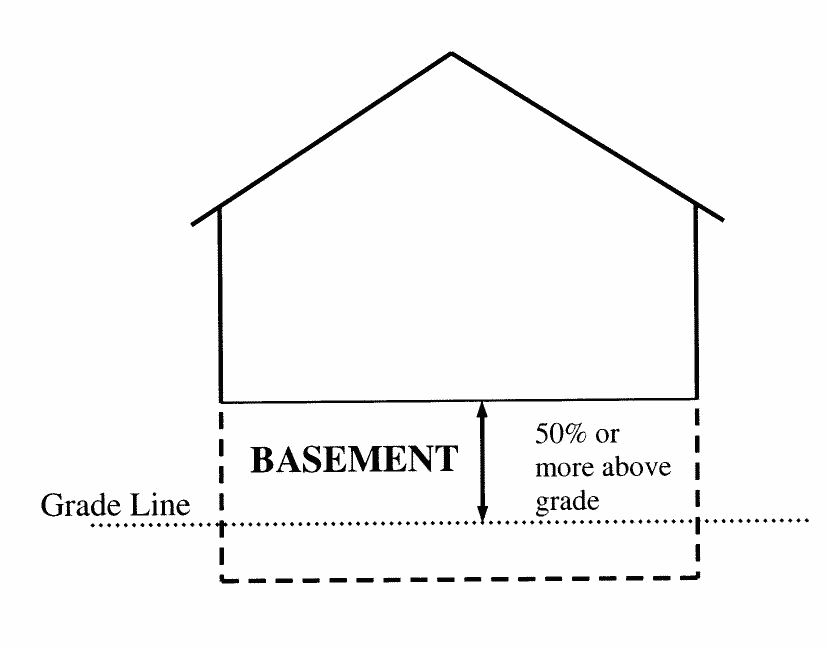
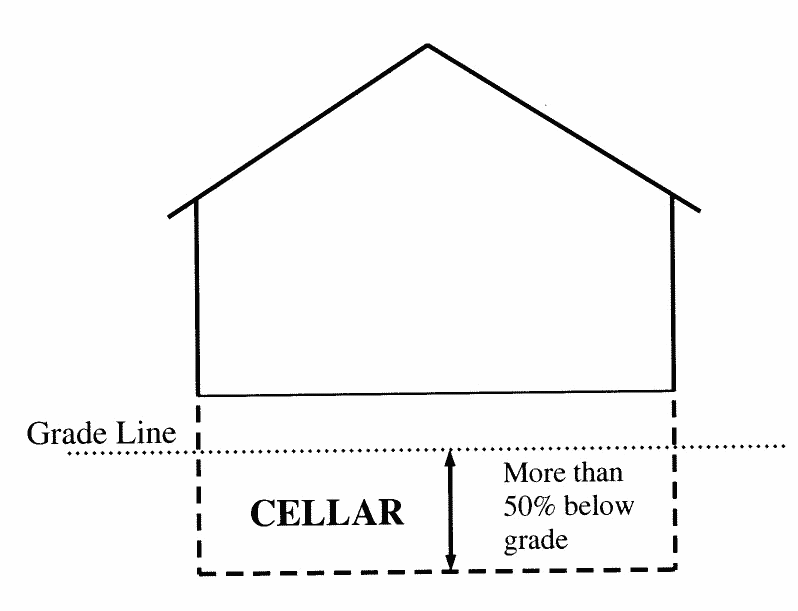
Basement means that portion of a building below the first floor joists, at least half of whose clear ceiling height is above the level of the adjacent finished grade (compare with "Cellar").
Bed and breakfast lodging means:
1.
A single unit detached dwelling that:
(a)
Is owner-occupied;
(b)
Provides a guest room or rooms within the dwelling, for compensation, as overnight accommodations for transient visitors who remain no longer than two (2) weeks in any one (1) visit; and
(c)
Customarily serves breakfast which is included in the charge for the room.
2.
A bed-and-breakfast lodging is not a hotel, motel, inn, restaurant, home-based business enterprise, or other use as defined or regulated elsewhere in this chapter.
Bicycle parking means a stationary rack, locker, or similar structure that supports a bicycle in a stable position and to which the user can lock the bicycle with a cable or chain and lock.
1.
Bicycle parking, long term means parking for bicycles located in a secure and weather-protected area where the bicycles will remain for several hours.
2.
Bicycle parking, short term means parking for bicycles that will be left for short stops and can consist of either racks or lockers.
Bicycle storage facility means areas, structures, and other devices to accommodate the short-term or long-term parking or storage of bicycles.
Bikeway means a pathway designed to accommodate bicycling, and which pedestrians may also share. A bikeway may be classified in accordance with the Bikeway Master Plan.
Billboard vehicle means a vehicle constructed or designed primarily to accommodate a sign, the face or faces of which display commercial messages.
Board, the means the Board of Appeals of the City, unless otherwise specified.
Boardinghouse means a dwelling in which lodging or meals, or both, are furnished to three (3) or more guests for compensation. A boarding house is not considered a home-based business enterprise. This use is not permitted within the City, and violations will be subject to the enforcement provisions of article 19 of this chapter.
Breezeway means a covered passage way, which may be enclosed or unenclosed, for the purpose of providing a connection from the main dwelling to an accessory building. No portion of the breezeway may be constructed in a way that could be interpreted to provide a common wall between the main building and the accessory building.
Buildable lot. See "Lot, buildable."
Building means a structure having one (1) or more stories and a roof, designed primarily for the shelter, support, or enclosure of persons, animals, or property of any kind.
1.
Building, accessory means a building subordinate to, and located on the same lot with a main building, the use of which is clearly incidental to that of the main building or to the use of the land, and which is not attached by any part of a common wall or common roof to the main building.
2.
Building, main means a building in which is conducted the principal use of the lot on which it is situated. In any residential zone, any dwelling shall be deemed to be a main building on the lot on which the same is located.
Building footprint. See "Footprint."
Building line means a line tracing the foundation wall or any enclosed porch, vestibule, or other enclosed portion of a building.
Building permit means an official City document or certification authorizing the construction, alteration, enlargement, conversion, reconstruction, remodeling, rehabilitation, erection, moving, or repair of a building or structure.
Building sign. See "Sign, building."
Build-to line means a setback line established by the applicable master plan that sets the location of building construction on the lot. A build-to line typically runs parallel to the front property line and is established to create an even building facade line along a street. Encroachments may be allowed in accordance with the provisions of section 25.09.05.
Business equipment sales and services mean retail services directed primarily to the support of office functions. Such uses may include duplicating services, office furniture sales and service, private postal service, medical supplies and equipment, and/or scientific and laboratory supplies. Items separately regulated in this chapter are not included in this definition.
Canopy means a marquee, porte-cochere, or other unenclosed covering structure projecting from and attached to a building, with or without supporting members, protecting pedestrians and vehicles outside of an entrance doorway from inclement weather.
Capital Improvements Program (CIP) means a schedule of future public improvements adopted annually by the Mayor and Council to provide a means of estimating construction schedules, costs, and means of financing projects such as roads, sewer and water systems, and parks, or improvements to the same.
Car wash, mechanical means a place or structure used for the washing of automobiles in which all or part of the washing function is performed by mechanical equipment.
Carry-out means an establishment where ready-to-eat food products are sold at retail primarily for consumption off the premises and not having drive-through or walk-up window services. Such an establishment is not considered to be a restaurant.
Caterer means an establishment licensed to prepare food for delivery and consumption off the premises.
Cellar means that portion of a building below the first floor joists at least half of whose clear ceiling height is below the level of the adjacent ground (compare with "Basement").
Cemetery means a place used for the permanent interment of dead human or animal bodies or the cremated remains thereof. It may be either:
1.
A burial park for earth interments;
2.
A mausoleum for vault or crypt interments;
3.
A columbarium for cinerary interments; or
4.
A combination of one (1) or more thereof.
Centerline of a street. See "Street, Centerline of."
Certificate of approval means an official City document issued under the auspices of the Historic District Commission authorizing the construction, alteration, enlargement, conversion, reconstruction, remodeling, rehabilitation, erection, demolition, moving, or repair of the exterior of a building or structure or the alteration of the environmental setting of a site within a designated historic district zone (multi-site or single-site) in the City.
Champion project means a development project that is located within the South Pike and meets the following standards:
1.
Contains at least five (5) acres of private property that is (i) contiguous, or (ii) confronting, separated only by a Business District Class I or Class II street; and
2.
Significantly advances one or more of the following goals:
(a)
Increases multifamily housing that provides more than the minimum requirement of moderately priced dwelling units near the Twinbrook Metro Station; and/or
(b)
Provides more than the required public use space; and/or
(c)
Provides more than the required vehicular, bicycle and/or pedestrian safety measures and/or provides pedestrian and bicycle access over or under the CSX/Metro tracks; and/or
(d)
Provides a significant increase in the amount of employment.
Charitable or philanthropic institution:
1.
The office or operations facility for a private, non-profit, and tax-exempt organization which is not organized or operated for the purpose of carrying on a trade or business, which provides either:
(a)
Volunteer aid to the sick and wounded of the armed forces in time of war and national relief in case of great national calamities; or
(b)
Any of the following: religious, social, physical, recreational, and/or benevolent services.
2.
No member of the organization can benefit directly from the net earnings of the organization.
Chief of inspection services means the individual holding the position of Chief of Inspection Services within the City's Department of Community Planning and Development Services or such individual's designee.
Chief of planning means the individual holding the position of Chief of Zoning within the City's Department of Community Planning and Development Services or such individual's designee.
Chief of zoning means the individual holding the position of Chief of Zoning within the City's Department of Community Planning and Development Services or such individual's designee.
Child care center means a building or residence in which child day care services are provided to more than eight (8) children at any one (1) time in accordance with all applicable State and County laws and regulations.
Child care home means a private residence in which a registered family day care provider cares for up to eight (8) children for compensation for any part of a 24-hour period in accordance with all applicable State and County laws and regulations.
Code means the compilation of the laws of the City of Rockville, otherwise known as the Rockville City Code.
Collocation means the use of a wireless telecommunication facility by more than one (1) wireless service provider.
Columbarium means a building or structure located primarily above-ground and used for the interment of the cremated remains of deceased persons or animals.
Commercial parking facility means a lot, structure, or portion thereof, other than an automobile sales lot, held out or used for the storage or parking of six (6) or more motor vehicles for compensation as the principal use of the property.
Commercial sign. See "Sign, commercial."
Commission, the means the Planning Commission of the City, unless otherwise specified.
Comprehensive Transportation Review (CTR) means an analysis that addresses requirements for multimodal transportation facilities, automobile traffic standards, and site access and circulation for the purpose of assuring adequate transportation facilities to serve proposed development.
Conditional use. See "Use, conditional."
Confronting means properties directly opposite each other, and separated only by public right-of-way.
Consumable goods to be used in the home means products used in the home that must be replenished on a regular basis, including but not limited to groceries, baked goods, hobby and craft supplies, pharmaceuticals, personal care items, and similar products. Items that are separately regulated in this chapter are not included in this definition.
Contiguous means sharing an edge or boundary; touching and not separated by other property or a public street or alley.
Copy, for purposes of signs, means the content of a sign.
Corner lot. See "Lot, corner."
Cornice means an architectural feature or design element on a building facade that denotes the roof line of the building.
Courtyard means an open space uncovered to the sky, bounded by buildings.
1.
Courtyard, inner means the open space formed on four (4) sides by building walls.
2.
Courtyard, outer means the open space bounded on three (3) sides by building walls.
Coverage. See "Lot coverage."
Crematorium means an establishment used for the cremation of the remains of deceased persons or animals.
Crosswalk means a specially paved or marked path for pedestrians crossing a street, road or other vehicular driveway.
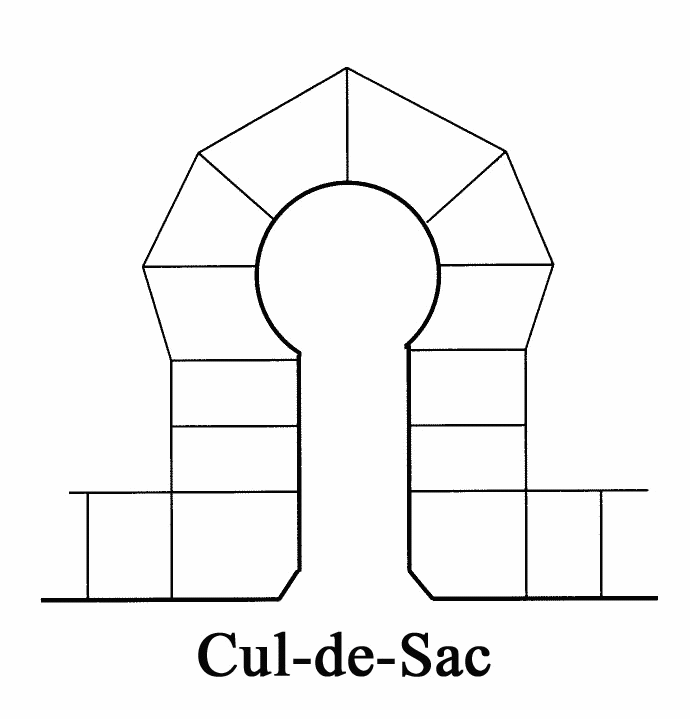
Cul-de-sac means a secondary street with only one (1) outlet and having an appropriate terminal for the convenient reversal of traffic movement.
Day care center, adult. See "Adult day care center."
Decision means the final determination of an Approving Authority.
Deck means an uncovered accessory structure attached to a dwelling and providing a level outdoor recreation space elevated at least six (6) inches from the ground level.
Demolition means the complete razing or removal of more than fifty (50) percent of the floor area of a building or structure, or substantial reconstruction that removes more than fifty (50) percent of the building floor area, as defined in chapter 5.
Demolition by neglect of historic properties means failure to maintain property, or any component thereof, located within a designated historic district zone so as to jeopardize the historic integrity of the property.
Dental clinic means an establishment where patients are accepted for specialized study and/or treatment by a group of two (2) or more dentists practicing dentistry together.
Detached accessory dwelling unit means a dwelling unit within a detached accessory building located on the same lot as a single unit detached dwelling. A detached accessory dwelling unit must be subordinate to the main dwelling unit on the lot and must contain a kitchen and facilities for sanitation and sleeping. A detached accessory dwelling unit is not an accessory use or a home-based business enterprise as defined in this chapter.
Development means any activity, other than unimproved open space activity, which materially affects the existing condition or use of any land or structure.
Development standards nonconformity means a building, structure, or site improvement that was lawful when established but no longer conforms to development standards of the zone in which it is located, as set forth in this chapter (such as, but not limited to, parking, lot coverage, green space, etc.), because of the adoption or amendment of this chapter or the zoning map.
Directional sign. See "Sign, directional."
Domestic partnership means two (2) individuals of the same or different genders who have registered as a domestic partnership in a jurisdiction where such a registration system exists, or who share a close personal relationship for each other's welfare, and share financial and legal obligations.
Dormitory means a building or portion thereof used for sleeping purposes in connection with a school, college, or other institution.
Drive-through window, accessory. See "Accessory drive-through window."
Durable goods to be used in the home means items for use in the home that last for a significant time span, including but not limited to bicycles, home electronics equipment, household appliances, paint and wallpaper supplies, hardware, home furniture and furnishings, floor coverings, antiques, and similar items. Other items separately regulated in this chapter are not included in this definition.
Dwelling unit means a building or portion thereof providing complete living facilities for not more than one (1) family, including, at a minimum, a kitchen, and facilities for sanitation and sleeping.
1.
Dwelling, single unit attached means one (1) of a group of three (3) or more single dwelling units sharing common party walls or floors. Each dwelling unit must have one (1) direct entrance from the outside. This term does not include townhouses.
2.
Dwelling, duplex. See "Dwelling, semidetached."
3.
Dwelling, multiple-unit. A building containing three (3) or more dwelling units which may or may not share a common entry. This term includes apartment buildings, condominiums and cooperatives.
4.
Dwelling, semidetached (duplex). One (1) of two (2) single unit attached dwellings located on abutting lots meeting the following criteria:
(a)
The dwellings are joined by a party wall along the common lot line and extending from the basement floor to the highest point of the roof with no openings; and
(b)
No other buildings or structures adjoin either dwelling unit.
5.
Dwelling, single unit detached means a building designed and intended for use as a single dwelling and entirely separated from any other building or structure on all sides. A single unit detached dwelling may include an attached accessory dwelling unit approved as a conditional use.
6.
Dwelling, two-unit detached means a building containing two (2) single dwelling units on one (1) lot. The building is entirely separated from any other building or structure on all sides. The units must share a common wall or common floor/ceiling. The term does not include accessory apartments.
7.
Dwelling, townhouse means one (1) of a group of three (3) or more single unit dwellings separated from each other by a party wall extending from the basement floor to the highest point of the roof with no openings. Each dwelling unit must have two (2) separate entrances from the outside.
8.
Dwelling, rowhouse means one (1) of a group of three (3) or more single unit dwellings separated from each other by a party wall extending from the basement floor to the highest point of the roof with no openings. Rowhouses must front on a public street and must not contain any vehicular parking or access to the front yard.
Easement means a grant or reservation by the owner of land for the use of all or a portion of such property to the public or others, for a specific purpose.
Educational institution, private means:
1.
A private school or training institution which offers a formal educational program.
2.
This term does not include any establishment having a single teacher, tutor, instructor, or supervisor teaching a maximum of four (4) persons at any one (1) time.
Effective date means the effective date of a decision or approval of an Approving Authority is the date set forth in the resolution or ordinance adopted by the Mayor and Council, or the date of the written notice of the decision or approval.
Electronic smoking device has the same meaning as in Rockville City Code subsection 13-21(a).
Environmental Guidelines means a document adopted by Resolution Number 11-99 by the Mayor and Council establishing guidelines for the protection and enhancement of the City's natural resources, as that document may be amended or revised.
Environmental setting means the area associated with a site within a designated historic district zone, including buildings and grounds.
Equipment enclosure means, for purposes of a wireless communication facility, a freestanding or mounted structure, shelter, cabinet, or vault used to house and to protect the electronic equipment and associated equipment necessary for processing wireless communication signals. Associated equipment may include air conditioners, back-up power supplies, and emergency generators.
Established setback means where the majority of lots located on one (1) side of a street between two (2) intersecting streets are occupied by buildings having a front setback different from the standard specified, all buildings must conform to the setback line thus established up to the maximum specified in the zone as set forth in section 25.10.05.a.
Expression line means an architectural feature or design element on a building facade that indicates a demarcation between floor levels.
Facade means the exterior walls of a building or structure exposed to public view or that wall viewed by a person not within the building.
Family:
(a)
An individual, or two (2) or more persons, all of whom are related to each other by blood, marriage, domestic partnership, adoption, guardianship or other duly authorized custodial relationship, and not more than two (2) other unrelated persons as long as all of the occupants are living together as a single housekeeping group in a dwelling unit; or
(b)
A group of not more than five (5) persons who are not collectively related to each other by blood, marriage, domestic partnership, adoption, guardianship, or other duly authorized custodial relationship, and are living together as a single housekeeping group in a dwelling unit.
Fence means a vertical structure used to delineate a boundary or act as a barrier or means of protection, confinement, or screening. This term includes walls used for the purpose of a lot boundary demarcation.
Firearm means a rifle, shotgun, revolver, pistol, air gun, air rifle, and any similar mechanism, by whatever name known, which is designed to expel a projectile through a gun barrel by the action of any explosive, gas, compressed air, spring, or elastic and including any such mechanism that is loaded with blank or live cartridges or projectiles of any kind.
Flag means any fabric, containing distinctive colors, patterns or symbols secured along one edge to a pole that is (i) intended to be permanently affixed to the ground; or (ii) attached to a building.
Flea market means a group of vendors assembled in an open area or a structure on an occasional or periodic basis to offer goods for trade or sale to the general public.
Floodplain means the normally dry land adjoining a river, stream or watercourse that is temporarily subject to partial or complete inundation by storms that exceed the capacity of the channel. Floodplains are delineated by the expected frequency of flooding. The 100-year floodplain delineates the area subject to flooding, on average, once every one hundred (100) years; thus it has a one (1) percent chance of flooding any given year.
Footprint means, with regard to a building, the area encompassed by a building's outer wall at ground level.
Freestanding sign. See "Sign, freestanding."
Front lot line. See "Lot line, front."
Front yard. See "Yard, front."
Frontage means the length of the front property line of the lot or tract of land abutting a public street.
Funeral home means:
1.
An establishment providing any or all of the following services:
(a)
Temporary holding and transporting of human remains to and from the premises;
(b)
Embalming and preparation of remains;
(c)
Visiting of the premises by family members and the public for the purpose of viewing the remains and conducting funeral and memorial services; and/or
(d)
Organizing funeral processions.
2.
A crematorium is not included in this definition.
General warehousing means the storage of goods, wares, and merchandise which will be processed, sold, transferred, or otherwise disposed of for ultimate consumption off the premises.
Glare means a harsh brilliance from a direct or reflected light source that causes the observer to squint, shield, or avert the eyes.
Gross floor area means:
1.
The total number of square feet of floor area in a building,
(a)
Excluding uncovered steps, uncovered porches, atriums, rooftop mechanical equipment enclosures, and off-street parking; but
(b)
Including basements and/or attics designed and available for tenant use or occupancy.
2.
All measurements must be made between exterior faces of walls or the centerline of walls of abutting buildings, foundations, piers, or other means of support.
Group home means a facility licensed, funded, certified, or registered by the State or the County operating as a group home or domiciliary care home offering residential accommodations, supervision, or assisted community living for the residents. The number of residents includes members of the staff who reside at the group home, but does not include infants less than two (2) months old. Group homes are classified as follows:
1.
Group home, small means a group home for three (3), but not more than eight (8), residents.
2.
Group home, large means a group home for nine (9), but not more than sixteen (16), residents or the limit set by State law, whichever is less.
Half story. See "Story, half."
Hazardous material means any material that, because of its quantity, concentration, or physical or chemical characteristics, poses a significant present or potential hazard to human health and safety or to the environment if released into the home, workplace, or the environment.
Health and fitness establishment means a membership facility providing space and specialized equipment for exercise individually or in a group.
Health professional means a person licensed or certified by a board administered by the State Department of Health and Mental Hygiene.
Historic period of significance means the length of time when a property was associated with important events, activities, or persons, or attained the characteristics which qualify it as a significant example of a type, period, or method of construction. Period of significance usually begins and ends with the dates when significant activities or events occurred, giving the property its historic significance; for a significant example of a type, period, or method of construction this is often a date of construction.
Home improvement service means services that supply, install, or maintain the constructed elements, plumbing, and electrical wiring of homes, such as plumber, electrician, carpenter, and specialty trade contractors providing services to alter, remodel, repair or replace a building or part of a building used as a residence, including but not limited to roofing, flooring, tiling, windows, brick and stone masonry. Items separately regulated in this chapter are not included in this definition.
Home maintenance service means services that supply, install, or maintain durable goods in homes such as locksmith; household appliance repair; upholstering, glass studio sales and installation; picture framing; interior decorator; and similar services for the upkeep of the home. Items separately regulated in this chapter are not included in this definition.
Home-based business enterprise means any occupation that provides a service or product and is conducted within a dwelling unit or accessory structure by a resident or residents of the dwelling unit without diminishing its residential character.
1.
A home-based business enterprise is not an accessory use.
2.
A home-based business enterprise does not include the following: bed-and-breakfast establishment, boardinghouse, day care facility, display of goods not associated with a home-based business enterprise, landscape contractor, private educational institution, tourist home, or the repair and maintenance of motor vehicles.
3.
Work at home in connection with off premises employment not involving any visits to the site, such as telecommuting, is not considered a home-based business enterprise but is permitted in all residential dwellings as an accessory use.
Hospital means any institution receiving inpatients and rendering medical care, including but not limited to general hospitals and institutions in which service is limited to special fields such as cardiac, eye, ear, nose and throat, pediatric, orthopedic, skin and cancer, mental, tuberculosis, chronic disease, and obstetrics. The term "hospital" shall also include sanitariums, including but not limited to, those treating inpatient physical or mental disorders or substance abuse.
Hotel (including motel) means any building containing rooms or suites of rooms designed and intended for the temporary lodging of guests, and which are available to the general public for compensation. A hotel may also include related accessory uses such as meeting rooms and restaurants.
Housing for senior adults and persons with disabilities means a building or buildings containing dwelling units and related services and facilities for senior adults or persons with disabilities. Occupancy is restricted as provided in subsection 25.15.02.j.4. The use may also include facilities for such services to residents as meal preparation and service, day care, personal care, nursing, or therapy, or any service to the senior adult or disabled population of the community that is an ancillary part of any of the above operations.
Impervious surface means an area that prevents or severely restricts water from reaching the sub-surface and recharging groundwater. This condition can be caused by a structure, paving, compacted soil or gravel or other feature that forms a barrier between precipitation and the earth's surface. Impervious surface also includes elevated structures, such as a bridge or deck regardless of whether the land surface beneath it itself is pervious or impervious.
Implementation period means the date by which activity pursuant to an approval must commence in order to avoid expiration of the approval.
Improvement means any building, structure, road, driveway, parking or loading area, pedestrian path, landscaping, screening, fencing, or recreational facility.
Improvement, public means any or all of the following improvements for the benefit of the public generally: roads and streets, alleys, grading, road pavement, fire hydrants, curbs and gutters, sidewalks, crosswalks and pedestrian paths, water mains, sanitary sewer lines, storm drains, drainage structures, rain gardens, stormwater swales, curb returns, sidewalks and driveway entrances in rights-of-way, guardrails, retaining walls, sodding, planting, monuments, streetlights, and other infrastructure owned by the City or other governmental entities.
Industrial, heavy means production of service operations that require heavy machinery and may produce air or waste pollution, dust, noise, smoke, odors, or other potentially adverse emanations. Such uses include, but are not limited to, concrete or asphalt batch plants; machine shops; trucking terminals; foundries; sawmills; alcoholic beverage production; junk yards and recycling facilities; fertilizer mixing; and similar uses. Items separately regulated in this chapter are not included in this definition.
Industrial, light means light manufacturing and industrial services that may involve fabrication and assembly of materials. Such uses include, but are not limited to contractor's storage yards; cold storage facility; wholesaling; general warehousing; commercial greenhouses; printing and publishing; outdoor parking and storage; bottling plant; ice plants; dry cleaning plant; manufacture of light sheet metal products; automotive body shop and repairs; manufacturing, compounding or assembly of articles from previously prepared materials; roofing services; blacksmith; manufacture of electrical and electronic equipment and precision instruments; and similar uses. Items separately regulated in this chapter are not included in this definition.
Industrial, service means services intended to serve residents of the City and surrounding areas, including retailing facilities for certain commodities appropriate in an industrial zone. Such uses include, but are not limited to, assembly of electrical and electronic appliances and equipment and precision instruments; photographic processing; radio and television recording studios; research laboratories; home improvement services; and similar types of uses. Items separately regulated in this chapter are not included in this definition.
Interim comprehensive plan floating zone means a zone that complies with the Rockville 2040 Comprehensive Plan land use goals and policies and that may be implemented by a floating zone map amendment.
Interim historic review means that period of time between the initiation of the historic designation process as set forth in subsection 25.14.01.d.1 and the completion of the designation process as set forth in subsection 25.14.01.d.5.
Interior lot. See "Lot, interior."
Junk yard means any land or building used for the abandonment, storage, keeping, collecting or baling of paper, rags, scrap metals, other scrap or discarded materials, or for the abandonment of inoperable automobiles or other vehicles, machinery, or associated parts.
Kennel means any building or land used, designed, or arranged for the boarding, breeding, or care of dogs or cats.
Kitchen means any room or area used or intended to be used for the preparation and cooking of food. The presence of a range or oven, or utility connections suitable for servicing a range or oven establishes a kitchen.
Laboratory, dental means a place where dental bridgework and orthodontic appliances are made.
Laboratory, medical means a place for the testing and classification of human tissue at the request of a physician for a particular patient.
Laboratory, research means a facility for scientific research in the fields of physics, chemistry, medicine, genetics, biotechnology, and similar fields of inquiry.
Landscaping means grass, trees, hedges, shrubs, vines, ground covers, or flowers planted and maintained to enhance the appearance of a development. Landscaping may include non-botanical features such as walks, fountains, reflecting pools, art works, rain gardens, stormwater management features, screens, walls, fences, and benches.
Landscaping, screening, and lighting manual means a document adopted by the Mayor and Council that sets out the parameters for tree planting and landscaping installation, including guidelines for location and varieties of plantings. The manual also includes standards for the design and performance of exterior lighting installations.
Law means any law, ordinance, resolution or regulation having the effect of law, whether adopted by the Federal, State, County, City, or other unit of government or agency thereof.
Life care facility means a facility housed in a single building or group of buildings that provides for continuing progressive care of residents. Occupancy is restricted as provided in Anno. Code of Md., Art. 70B, as amended, and any other applicable provisions issued by the Maryland Health Resources Planning Commission. A life care facility must include dwelling units for either independent or assisted living, or both, plus a nursing home of a suitable size to provide treatment or care of the residents; it may include ancillary facilities for the further enjoyment, service or care of the residents.
Life science means the research, development, and manufacturing activities in one or more of the following scientific fields: biology, biophysics, biochemistry, bioelectronics, biotechnology, biomedical engineering, bioinformatics, medicine, immunology, embryology, clinical engineering, diagnostics, therapeutics, nutraceuticals, pharmacogenomics, drug production, genetic testing, or gene therapy activities. For a business, institution, or government agency conducting such activities, Life sciences also includes related activities and supporting services, such as administrative offices, educational facilities, libraries, data services, nanotechnology, informational technology, and robotics.
Live/work unit means a building or spaces within a building used jointly for commercial and residential purposes where the residential use of the space is secondary or accessory to the primary use as a place of work.
Loading space means an off-street space used only for the parking of a vehicle while loading or unloading goods or materials and which cannot be counted towards the off-street parking requirement.
Lot means a parcel or quantity of land. Lots include the following:
1.
Lot, buildable means any record lot except for lots created prior to August 3, 1932 in a single dwelling unit residential zone that contain less than four thousand (4,000) square feet in area or are less than thirty-five (35) feet wide at the building line.
2.
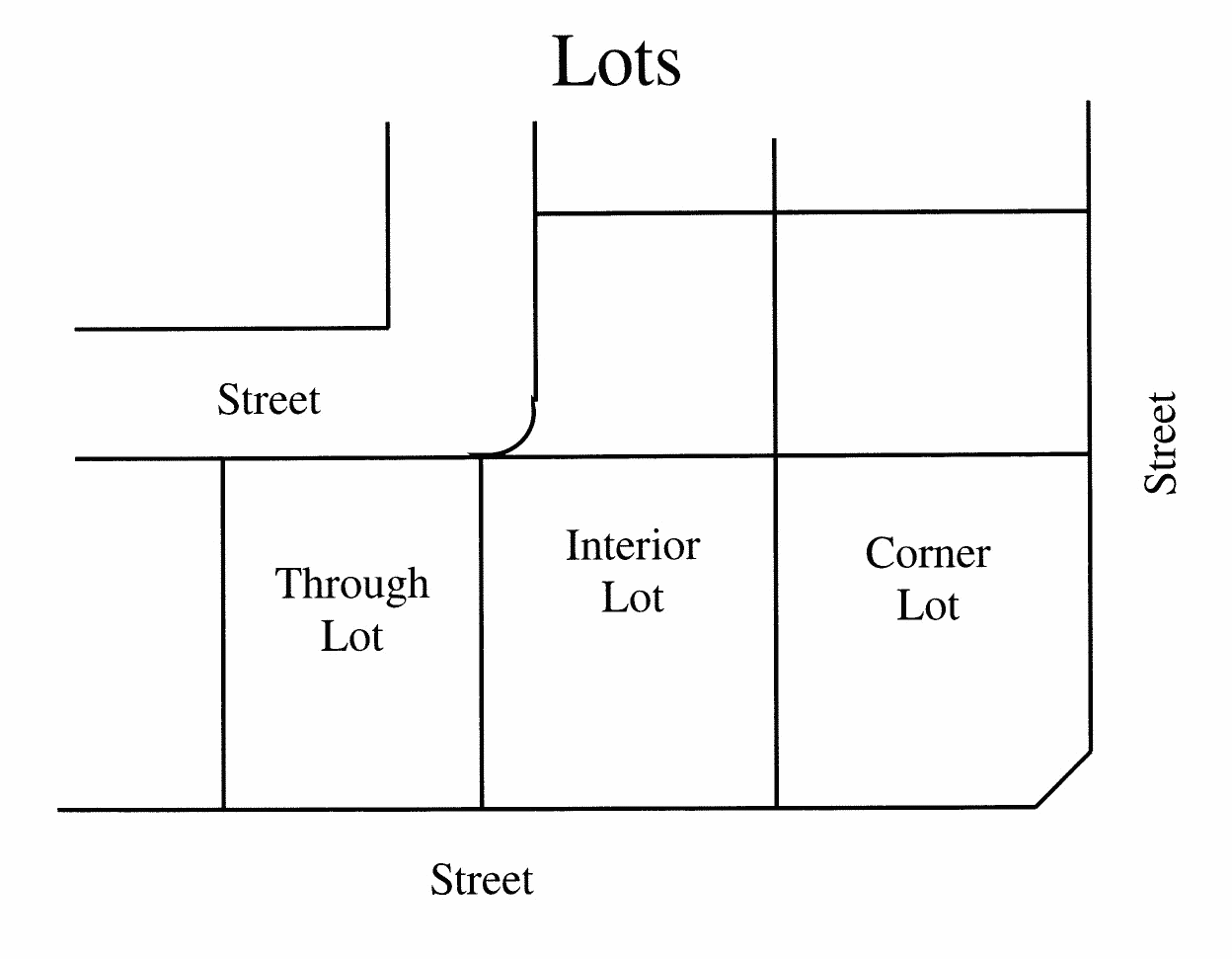
Lot, corner means a lot abutting the intersection of two (2) or more streets where the interior angle of the intersection does not exceed one hundred thirty-five (135) degrees.
3.
Lot, interior means any lot other than a corner lot, or a through lot.
4.
Lot, ownership means land designated as a separate and distinct parcel of land for purposes of ownership or financing on a legally recorded ownership plat filed among the land records of the County. Any land so designated does not constitute a record lot or plan of subdivision.
5.
Lot, pipe stem. See "Pipe stem lot."
6.
Lot, qualifying undersized means a lot with a net area of less than six thousand (6,000) square feet but at least five thousand (5,000) square feet, or with a width at the front building line of less than sixty (60) feet but at least fifty (50) feet shown on a plat or deed recorded prior to October 1, 1957.
7.
Lot, record means the land designated as a separate and distinct parcel of land on a legally recorded subdivision plat filed among the land records of the County, but does not include land identified on any such plat as an outlot or an ownership lot shown on an ownership plat.
8.
Lot, through means an interior lot fronting on two (2) or more streets that do not intersect adjacent to the lot.
Lot coverage means the percentage of lot area covered by buildings, including covered porches and accessory buildings.
Lot line means the lines bounding a record lot or deeded lot, as herein defined:
1.
Lot line, front means the street line running along the front of the lot and separating it from the street. In a through lot and a corner lot, both lines abutting the street are deemed to be front lot lines.
2.
Lot line, rear means the lot line generally opposite or parallel to the front lot line, except in a through lot. If the rear lot line is less than ten (10) feet long or the lot comes to a point at the rear, the rear lot line is assumed to be a line not less than ten (10) feet long, lying wholly within the lot, parallel to the front lot line, or in the case of a curved front lot line, parallel to the chord of the arc of the front lot line.
3.
Lot line, side means a line connecting a front lot line to a rear lot line. A side lot line is also applied under the following conditions:
a.
In the case of a corner lot, there must be one (1) rear and one (1) side lot line for the purpose of meeting both the side and rear setback requirements.
b.
In the case of a through lot, two (2) side lot lines separate the lot from abutting lots or parcels and connect the two (2) front lot lines.
c.
In the case of a corner lot where there is only one (1) lot line that is not a front lot line, the lot line abutting another lot or parcel is deemed to be a side lot line.
Manufacturing means the mechanical or chemical transformation of materials or substances into new products, including the assembling of component parts, the creation of products, and the blending of materials, such as lubricating oils, plastics, resins, or liquors.
Map amendment means a change in the zoning designation(s) of a property or area as depicted on the zoning map for the City. A map amendment may be one (1) of the following:
1.
Comprehensive map amendment means a zoning action affecting the entire City that may rezone some or all areas of the City and reconfirm the zoning in other areas of the City.
2.
Local map amendment means a change of zoning, normally sought by a property owner or other person having a proprietary interest in the property to be affected by the amendment. A local map amendment can include more than one (1) tract of land. Land can be combined for the purpose of rezoning. All portions of the property rezoned must be classified in one (1) zone or two (2) alternative zones.
3.
Sectional map amendment means a zoning action affecting a section of the City. A sectional map amendment is a type of comprehensive amendment as defined by Maryland case law.
4.
Floating zone map amendment means a map amendment implementing an interim comprehensive plan floating zone.
Medical clinic means an establishment where patients are accepted on an outpatient basis for specialized study and/or treatment by a group of physicians practicing medicine together.
Metes and bounds means a system of describing and identifying land by measurement (metes) and compass direction (bounds) from an identifiable point of reference such as a monument, marker, point of intersection, stone, or other permanent feature.
Mezzanine means a partial story projecting out over the floor below and no larger than one-third (⅓) of a main floor.
Mid-block access means a path within a block, intended primarily for pedestrians and bicycles and from which motor-propelled vehicles are excluded, and which is designed to improve access to adjacent roads or lots.
Minor subdivision. See "Subdivision, minor."
Mixed-use development means a development containing any combination of office, commercial, and residential uses integrated vertically or horizontally.
Mobile use means a self-contained mobile unit in which general and professional offices are operated. All functional necessities for the operation of the use such as water, sanitary facilities, power, etc., shall be self-contained and the unit shall have its own motive power. Trailers which require a separate locomotion unit shall not be considered a mobile unit.
Motor vehicle and trailer sales lot means a lot arranged, designed, or used for the storage and display for sale of any motor vehicle or any type of trailer.
Multiple-unit dwelling. See "Dwelling, multiple-unit."
New construction. When the value of the proposed work equals or exceeds fifty (50) percent of the assessed value of the building ("Improvements") as reported by the Maryland State Department of Assessments and Taxation (SDAT), the finding shall deem the work to be new construction for purposes of this Code.
Noncommercial sign. See "Sign, noncommercial."
Nonconforming sign. See "Sign, nonconforming."
Nonconforming use means a use that was lawful when established but no longer conforms to the requirements of the zone in which it is located because of the adoption or amendment of this chapter or zoning map.
Nonconformity, development standard. See "Development standard nonconformity."
Nursing home means a facility licensed, funded, or registered by the State of Maryland or the County devoted primarily to the maintenance and operation of resources for the treatment and care of persons suffering from illness, disease, aging, or injury and not requiring acute care that is normally provided in a hospital, but who require care in excess of room and board and who need the availability of on-site medical, nursing, convalescent, or chronic care.
Off-premises sign. See "Sign, off-premises."
Open area means an area of land associated with and located on the same tract of land as a major building or group of buildings providing light and air, scenic or recreational space, or other similar purpose.
1.
Open area must, in general, be available for entry and use by the occupants of the building involved, but may include space so located and treated as to enhance the amenity of the development by providing landscaping features, screening for the benefit of the occupants or those in neighboring areas, or a general appearance of openness.
2.
Open area may include, but not be limited to, lawns, decorative planting, sidewalks and walkways, and active and passive recreation areas, including children's playgrounds, fountains, swimming pools, rooftop recreation areas, wooded areas, and watercourses; but shall not include parking lots or vehicular surfaces, accessory buildings other than swimming pools, or areas of open space so located or so small or so circumscribed by buildings, parking, or drainage areas as to have no substantial value for the purposes stated in this paragraph.
Outlot means an unbuildable parcel of land which has not been included on a recorded plat as a numbered lot due to insufficient size or frontage, poor topography, lack of accessibility, or other reasons.
Overlay zone means a geographic area that constitutes a mapped district superimposed over the underlying base zone on the official zoning map. An overlay zone includes development regulations and standards that either add to or modify the requirements of the underlying zone.
Owner means the owner of property as shown on the assessment records of the State Department of Assessments and Taxation.
Ownership lot. See "Lot, ownership."
Ownership plat means a plat legally recorded and filed among the land records of the County which designates land as separate lots for purposes of ownership identification only. An ownership plat is not a plat of subdivision.
Parcel means a contiguous area of land described in a single description by a deed or other instrument or as one (1) of a number of lots on a plat or plan, capable of being separately conveyed.
Park means land owned or administered by a branch of government and available to the general public for recreational purposes.
Parking lot. See "Parking facility."
Parking facility means a lot and/or structure or portion thereof used for the storage or parking of seven (7) or more automobiles, incidental to an office, commercial, institutional, recreational, industrial use, or residential use other than for a single-unit detached or semi-detached dwelling, with or without compensation.
Party of record means any person who registers an appearance at a public hearing or proceeding, either through direct testimony or written submission, or who provides written notice of intent to participate in a public hearing or proceeding.
Patio means an uncovered level outdoor recreation space, normally masonry that is less than twelve (12) inches above grade.
Pawnbroker means any person, corporation, or other business entity engaged in the business of lending money on the deposit or pledge of tangible personal property or in the business of purchasing tangible personal property on the condition of reselling same to the seller at a stipulated price or reselling same to the general public upon the failure of the seller to reclaim the property. Without limiting the foregoing, any person, corporation, or other business entity required by the State or County, to have a pawnbroker or pawn dealer license or other similar license to operate a pawn shop or otherwise engage in pawning operations shall be deemed to be a pawnbroker under this definition.
Pennant means any series of small flag-like or streamer-like pieces of cloth, plastic, paper, or similar material attached in a row to any staff, cord, building, or at only one (1) or two (2) edges, the remainder hanging loosely.
Permanent sign. See "Sign, permanent."
Permitted use. See "Use, permitted."
Person means an individual, association, firm, partnership, corporation, or government agency, not including the City.
Person with a disability means a person who is determined by a qualified medical authority to have physical or mental impairments that:
1.
Are expected to be long continued and of indefinite duration;
2.
Substantially impede the ability to live independently; and
3.
Are of such a nature that the ability to live independently could be improved by more suitable housing conditions.
Personal living quarters means a permanent residential unit with incomplete kitchen or bathroom facilities, occupied by no more than two (2) persons in each such unit, and located within a larger structure that contains at least five (5) such units, plus a residential unit for an on-site manager.
Personal care facility means a commercial facility providing services such as a barber shop, beauty salon, massage therapy, cosmetology, and similar uses. Items separately regulated in this chapter are not included in this definition.
Personal services office means offices directly serving the public, such as real estate office; travel agency; investment broker; insurance sales; and similar uses. Items separately regulated in this chapter are not included in this definition.
Pet grooming means a facility, other than a veterinary hospital, used for the grooming of household pets for profit, and not including overnight boarding.
Petitioner. See "Applicant."
Philanthropic institution. See "Charitable or philanthropic institution."
Pipe stem lot means a lot that does not meet the required frontage at the normal minimum front setback line, due to being configured with a narrow panhandle or pipe stem, which panhandle or pipe stem provides vehicular and pedestrian access to a street, with the bulk of the property lying to the rear of one (1) or more lots.
Plan means the policies, statements, goals, and interrelated plans for private and public land use, transportation, and community facilities documented in texts and maps which constitute the guide for the City's future development. For the purposes of this definition, the word "plan" shall include general plan, master plan, neighborhood plans, and the like as adopted in accordance with the applicable provisions of State law. "Plan" does not include the term "project plan" as defined elsewhere in this article.
Planned development governing documents mean the collection of documents that establish the density, use, development standards, and special provisions that guide the build-out of a planned development located in any of the planned development zones contained in article 14 of this chapter. Those documents include one or more of the following:
1.
Any resolution of approval by the Mayor and Council and any subsequent amendment thereto including any attachments;
2.
Any preliminary development plan approval by the Planning Commission and any subsequent amendment thereto including any attachments;
3.
Any annexation agreement or other development agreement;
4.
The provisions of this chapter applicable to the particular planned development prior to March 16, 2009 and not inconsistent with the resolution of approval or the approved preliminary development plan, or the annexation agreement or other development agreement.
Plat means a plotted map, chart or plan; or a map of a legally recorded subdivision showing the boundaries and locations of the lot or lots recorded thereon.
1.
Plat, ownership. See "Ownership plat."
2.
Plat, final record means a map that illustrates a metes and bounds description of the property into a system of lot and block numbering, the naming of the tract (subdivision name), and the assignment of a plat number when recorded among the land records of Montgomery County, Maryland.
Porch means a roofed, open area attached to or part of a building, and with direct access to and from the building.
Portable sign. See "Sign, portable."
Pre-existing grade means the height of the ground prior to construction or earth moving by human means as of March 16, 2009.
Preliminary report means an initial report prepared by the Planning Commission providing recommendations on appropriate zoning classifications for properties being annexed into the City.
Premises means a lot, a building, or part of a building, including any appurtenances.
Private club means an incorporated or unincorporated association for civic, social, cultural, religious, literary, political, recreational, or like activities, operated for the benefits of its members and not open to the general public.
Prohibited use. See "Use, prohibited."
Project plan means a conceptual plan of development for a major project proposal as determined under the provisions of section 25.07.02 that must be approved by the Mayor and Council and may encompass multiple buildings or multiple uses, and which may include a phasing plan for completion of the development over time.
Public use space means an open area associated with and located on the same tract of land as a principal building or group of buildings providing light and air, recreational space, or other similar purpose. Such open area must be accessible for use and enjoyment by the general public when provided in a residential, retail or mixed-use project, and may include space so located and treated as to enhance the amenity of the development by providing landscaping features, screening, or a general appearance of openness, and may include accessible portions of a stormwater management facility. In addition, public use space may also consist of indoor spaces dedicated to the provision of publicly-accessible art and open areas or dedicated spaces open to the public such as museums, art galleries, science centers and/or facilities, cultural arts centers, or community rooms. Public use space may also consist of open areas recommended in an adopted master plan, including enhanced public walkways and off-site public improvements. Such public improvements do not include road improvements or other capital projects in the vicinity of the property. Internal landscaping within a parking facility, as required in section 4.d of the landscaping, screening and lighting manual, does not constitute public use space. Development consisting primarily of office and/or industrial uses may include space accessible to the public or the employees of the site for the purpose of satisfying the public use space requirement.
Public utility building means buildings and structures of a public utility company for the housing of switching equipment, regulators, and stationary transformers for supplying electric service; telephone offices and exchanges; radio and television stations, and buildings and structures of similar nature and characteristics. The term public utility building does not include a wireless communication facility and its related equipment enclosures. This term does not include publicly-owned or publicly-operated facilities.
Qualifying undersized lot. See "Lot, qualifying undersized."
Real estate sign. See, "Sign, real estate."
Rear lot line. See "Lot line, rear."
Rear yard. See "Yard, rear."
Record lot. See "Lot, record."
Recreational establishment, indoor, commercial means an activity of an athletic nature for which a fee is paid which takes place inside a building, including baseball batting in cages, basketball, golf driving practice, gymnastics, golf, racquetball, rock climbing, skiing practice, swimming, tennis, volleyball, bowling, billiards, or other athletic activity.
Recreational establishment, outdoor, commercial means an activity of an athletic nature for which a fee is paid which takes place outside a building.
Recreational facility means any non-accessory swimming pool, community building, golf course, tennis court, baseball diamond, football field, basketball court, play area, handball court, or other athletic field or facility.
Renewable energy generation equipment means any equipment necessary for the onsite generation and use of energy from renewable energy sources including but not limited to solar, wind and geothermal.
Research and development means study, research, or experimentation in one or more scientific fields such as life sciences, biomedical research, communications, chemistry, computer science, electronics, medicine, and physics. Research and development also includes the development of prototypes and the marketing of resultant products and related activities and may include the use of administrative offices, educational facilities, libraries, and data services, and the manufacturing, mixing, fermentation, treatment, assembly, packaging, and servicing of products.
Restaurant means an establishment that merchandises or dispenses food and drink and provides patron seating and/or drive-through facilities.
1.
Restaurant, accessory means a restaurant that is an accessory use to a hotel or office building and intended primarily to serve those guests or workers already on site, and does not include drive-through or walk-up services, a separate outside entrance, or signage visible from a public way;
2.
Restaurant, fast food means an establishment in which food and drink are usually prepared in advance and served in disposable containers and which may be consumed on premises or may be taken from the premises. Such establishment may or may not have drive-through facilities or may be a drive-through only restaurant with no indoor enclosed seating.
3.
Restaurant, full service means an establishment merchandising or dispensing food and drink which may include curb side pick-up but not a drive-through facility, and whose principal method of operation includes one (1) or more of the following characteristics:
(a)
Customers, normally provided with an individual menu, are served their food by a restaurant employee at the same table or counter at which said items are consumed, and/or
(b)
A cafeteria or buffet style operation where food or drink is generally consumed within the restaurant building.
4.
Restaurant, ancillary means a restaurant that is ancillary to and located within an office building containing at least one hundred fifty thousand (150,000) gross square feet of floor area.
Retail means the sale of commodities or goods to the end consumer.
Right-of-way, public means that area along which the public has a right to pass or travel, which area was originally intended for development as a road, street, or highway, with or without related sidewalks or other appurtenances, and was accepted on behalf of the public by plat, easement, eminent domain, purchase, fee simple title, or prescriptive use.
Rockville Pike Core Area means that area identified as the Core area in the Rockville Pike Neighborhood Plan and encompassing all that area beginning at a point on the CSX/Metro west right-of-way line established by the extension of the southeast property line of Lot 5, Block O of the Rockland subdivision and extending said line to the east line of Rockville Pike; the east line of Rockville Pike; the southern boundary of the City; and the west line of the CSX/Metro right-of-way.
Sale, wholesale means the sale of goods, wares, and merchandise to other than the ultimate consumer or user for the purpose of resale.
Self-storage warehouse. See "Warehouse, self-storage."
Semidetached dwelling. See "Dwelling, semidetached (duplex)."
Senior adult means a person who is sixty-two (62) years of age or older.
Setback means the minimum perpendicular distance required between a lot line and any building or structure constructed or which may be constructed thereon consistent with the setback requirements of the zone in which such lot is located.
Sexually oriented activity means any of the following:
1.
The fondling or other erotic touching in a sexual context of human or animal genitals, pubic region, buttocks, or female breast;
2.
Sex acts, heterosexual or homosexual, actual or simulated, including but not limited to oral, anal, or vaginal intercourse, sodomy, masturbation, and masochistic or sadistic acts; or
3.
Excretory functions of any nature as part of or in connection with any of the activities set forth above.
Sexually oriented material means any material, display, or performance whether written, oral or visual, whose predominant character and theme is the depiction or description of sexually oriented activities or specified anatomical areas, as well as any instrument, device or paraphernalia, which is designed for use in connection with sexually oriented activities.
Shooting gallery means any establishment which, as part of its activities, provides a location in which firearms are discharged indoors.
Shopping center means a group of six (6) or more commercial establishments on a single record lot which are planned, developed, and managed as a single unit with off-street parking provided on the property and related in location, size, and type of shops to the trade area that the unit serves.
Side lot line. See, "Lot line, side."
Side yard. See "Yard, side."
Sight distance triangle means an area that provides the driver of a vehicle approaching an intersection an unobstructed view of any opposing vehicle or pedestrian movements. These triangular areas must be large enough that drivers can see approaching vehicles and pedestrians in sufficient time to slow or stop and avoid an accident.
Sign means any structure which requires a permanent or temporary location, that has a visual display readable from a public right-of-way and is designed to identify, announce, direct, or inform.
1.
Sign, abandoned means a sign which identifies a business, lessor, service, owner, product, or activity that is no longer located on the premises, or a sign for which no legal owner can be found. "Abandoned sign" also includes any permanent sign not properly maintained or operated for a period of six (6) months or longer, any temporary sign that has deteriorated, and any sign structure that no longer supports the sign for which it was designed. Permanent signs applicable to a business temporarily suspended because of a change of ownership or management of such business shall not be deemed abandoned unless the property, building, or space remains vacant for a period of six (6) months or more.
2.
Sign, building means any sign mounted on a wall, window, marquee, fascia, mansard, canopy, or parapet of a building.
3.
Sign, commercial means a sign that directly or indirectly names, advertises, or calls attention to a product, commodity, service, sale, sales event, activity, entertainment, or other commercial activity.
4.
Sign, directional means a sign reasonably necessary for the safe and efficient circulation of pedestrian or vehicular traffic within a given parcel or among a number of parcels, which may be freestanding or attached to a building.
5.
Sign, freestanding means a sign, not including a flag, supported from the ground and not attached to any building.
6.
Sign, noncommercial means a sign that is not a commercial sign.
7.
Sign, nonconforming means any sign that does not conform to the provisions of this chapter, but was placed or constructed in accordance with City ordinances existing at the time of its placement or construction.
8.
Sign, off-premises means a sign that directs attention to a building, product, business, organization, service, entertainment, commodity, accommodations, activity, or institution that is not located, conducted, sold, rented, produced, manufactured, and/or furnished on the same lot as the sign.
(a)
Off-premises signs include, but are not limited to, signs commonly referred to as "billboards."
(b)
Off-premises sign does not include noncommercial signs that comply with all other requirements of this chapter.
9.
Sign, permanent means a sign that is constructed in a manner and of materials that will withstand long-term display and is intended to be displayed for an indefinite period of time.
10.
Sign, portable means any sign not permanently attached to the ground.
11.
Sign, real estate means a temporary sign displayed during the time the real property on which the sign is located is offered for sale, rental, or lease.
12.
Sign, temporary means a non-permanent sign constructed of durable, semi-durable, or non-durable material not intended to be displayed for an indefinite period.
13.
Sign, vehicular means a commercial sign which is attached to, mounted, pasted, painted, or drawn on a vehicle and covers more than four (4) square feet on any side of the vehicle.
14.
Sign, yard sale means any onsite temporary sign displayed on a lot during the time period in which a yard sale, garage sale, lawn sale, home sale, estate sale, attic sale, moving sale, rummage sale, or any other type of similar sale occurs on the lot.
Sign face means the entire surface area of a sign upon, against or through which copy is placed, and does not include a sign's supporting elements or structure.
Single housekeeping group means the functional equivalent of a traditional family, whose members are a non-transient interactive group of persons jointly occupying a single dwelling unit, including the joint use of common areas, and sharing household activities and responsibilities such as meals, chores, and expenses.
Single unit detached dwelling. See "Dwelling, single unit detached."
Site means a lot, tract, or parcel of land considered as one (1) land unit for the purposes of this chapter.
Site plan means the development plan for one (1) or more lots on which is shown the existing and proposed conditions of the lot, including topography, vegetation, drainage, floodplains, wetlands, and waterways; landscaping and open spaces; walkways; vehicle circulation, parking and loading areas; historic and archaeological resources; utility services; structures and buildings; signs; exterior lighting; buffers and screening; surrounding development; and any other information that reasonably may be required by the Approving Authority.
Smoke has the same meaning as in Rockville City Code subsection 13-21(a).
South Pike Area means that portion of the City contained within the Twinbrook Metro Performance District including the area within the PD-TC Zone as shown on the adopted zoning map.
Special exception means a grant of a specific use that would not be appropriate generally or without restriction and must be based upon a finding that certain conditions governing special exceptions as detailed in this chapter exist, that the use conforms to the plan, and that the use is compatible with the existing neighborhood.
Specified anatomical area means any of the following:
1.
Less than completely and opaquely covered human genitals, pubic region, buttocks, anus, or female breasts below a point immediately above the top of the areola; or
2.
Human male genitals in a discernable turgid state, even if completely and opaquely covered.
Sport facility, multi-purpose, indoor, commercial means a multi-purpose indoor facility that provides for recreational facilities including, but not limited to, the following activities: ice hockey, figure skating, recreational ice skating, indoor soccer, in-line skating, and health and fitness activities, excluding shooting galleries or ranges, conducted in a building containing not less than sixty thousand (60,000) square feet of gross floor area. Such a facility may also contain meeting rooms.
Story. A story is:
1.
That portion of a building included between the surface of any floor and the surface of the floor next above it or, if there be no floor above it, the space between such floor and ceiling next above it.
2.
A basement will be counted as a story if its ceiling is over five (5) feet above the level from which the height of the building is measured or if it is used for dwelling purposes.
3.
A mezzanine floor will be counted as a story if it covers over one-third (⅓) of the area of the floor next below it or if the vertical distance between the floor next below it and the floor next above it is twenty (20) feet or more.
Story, half means a story under a gable, hip, or gambrel roof, the wall plates of which on the least two (2) opposite exterior walls are not more than two (2) feet above the floor of such story.
Stream buffer means the land area extending out from either side of a stream channel or wetland that protects the stream channel integrity and filters pollutants from reaching the stream itself. The width of a specific stream or wetland buffer is determined by the criteria set forth in the Rockville Environmental Guidelines for the Protection and Enhancement of the City's Natural Resources, July 1999, hereby incorporated by reference.
Street means a public dedicated way which affords the principal means of access to abutting property, including street, avenue, place, drive, boulevard, highway, road, pike, cul-de-sac, court, and any other public way except an alley or driveway.
Street, centerline of means a line:
1.
Established as a centerline of a street by any state, county, or other official agency or governing body having jurisdiction thereof and shown as such on an officially adopted or legally recorded map; or
2.
If there be no official center line of a street, the center line shall be a line lying midway between the street or right-of-way lines thereof. When the street lines are indeterminate, and pavement or a well-defined traveled way exists, the centerline is assumed to be a line midway between the edges of such pavement or traveled way.
Street width means the horizontal distance at right angles between the faces of the curbs or, where no curb is present, from the edges of the pavement.
Structural alteration. See "Alteration, structural."
Structure means a combination or assembly of materials designed for permanent location on the ground and intended for occupancy or use, but not including appurtenances attached to the combination or assembly of materials. This definition includes, but is not limited to, items such as buildings, arenas, tents intended for public assembly, towers for electric power transmission towers and antennae for telecommunications, bridges, water tanks, fences, signs, and utility poles.
Subdivider means any person or duly authorized agent who undertakes the subdivision of land as defined herein and includes the term "developer" even though the personnel involved in the successive stages of the project may vary.
Subdivision means the division of a lot, tract, or parcel of land into two (2) or more lots, plats, sites, or other divisions of land or assemblage of land for the purpose, whether immediate or future, of sale or of building development. "Subdivision" includes resubdivision and, when appropriate to the context, relates to the process of resubdividing. "Subdivision" may also refer to the land or territory subdivided.
Subdivision, minor means a division of a lot, tract, or parcel of land into no more than three (3) lots fronting on an existing road, not involving any new road or the extension of municipal facilities and not adversely affecting the development of the remainder of the parcel or adjoining property and not in conflict with a provision or portion of the plan or this chapter.
Swimming pool means a pool for swimming by human beings having adequate legal capacity and deck size.
1.
Swimming pool, accessory means swimming pools or wading pool, including buildings necessary or incidental thereto, conducted as an accessory use:
(a)
Maintained and operated by the management of any multiple-dwelling unit or attached development in any residential medium density or mixed-use zone or within any planned development zone. An accessory swimming pool may provide memberships to persons residing in single-unit dwellings if the pool was originally approved under a special exception for a private, non-commercial community swimming pool for use by residents in a development containing both single-dwelling unit and multiple-dwelling unit residences;
(b)
Maintained and operated by the management of a hotel or motel for the use of patrons thereof; Maintained and operated by any industry for exclusive use of employees of such industry;
(c)
Maintained and operated in conjunction with a bona fide country club located on a site having at least fifty (50) acres for exclusive use of members of such club and their guest(s); or
(d)
Owned and maintained by an individual or group of less than five (5) individuals or families for the sole use of the owner and guests of the owner, without charge for admission, and not for the purpose of profit or in connection with any business operated for profit, located on a lot as an accessory use to a residence.
2.
Swimming pool, non-accessory means any swimming pool that is not an accessory swimming pool.
Tangible personal property means property having physical substance that is movable and not fixed permanently to one (1) location. Examples of tangible personal property include, but not limited to:
1.
Art objects;
2.
Audio-visual equipment, including a radio, television set, video disk machine, video cassette recorder, or stereo equipment;
3.
Bicycles;
4.
Cameras;
5.
Carpets or rugs;
6.
Computer equipment or typewriters;
7.
Fine or historic china, crystal, glass, and porcelain;
8.
Firearms;
9.
Fur and leather goods;
10.
Household appliances;
11.
Jewelry or watches;
12.
Musical instruments;
13.
Office machines or equipment (except furniture of similar furnishings);
14.
Optical equipment;
15.
Tangible personal property pledged as collateral (pawned items);
16.
Tools; and
17.
Any item serialized, marked for personal identification purposes, or engraved.
Temporary sign. See "Sign, temporary."
Through lot. See "Lot, through."
Tobacco and vape shop means any retail establishment that devotes at least ten (10) percent of its floor area to the sale or display of tobacco products or electronic smoking devices or allows customers to vape or smoke indoors on site.
Tobacco product means any product made or derived from tobacco, or containing nicotine from any source, that is intended for human consumption, including any component, part, or accessory of a tobacco product (except for raw materials other than tobacco used in manufacturing a component, part, or accessory of a tobacco product). The term "tobacco product" includes, but is not limited to, cigarettes, cigars, cigarillos, smokeless tobacco, bidis, dissolvable tobacco, kreteks, and loose tobacco intended for use in a pipe, hookah, or other smoking device.
Toll means to suspend or stop temporarily.
Town Center Performance District means that area delineated as the Town Center Performance District on the zoning map.
Townhouse. See "Dwelling unit, townhouse."
Tract means an area of land with definite or ascertainable boundaries and which may include multiple lots or parcels.
Trailer means an unpowered wheeled vehicle designed to be towed by a motor vehicle.
Transit station link means an exterior pedestrian walkway, accessible for public use and separate and apart from vehicular traffic that provides a direct connection to a Metrorail station.
Twinbrook Metro Performance District means that area delineated as the Twinbrook Metro Performance District on the zoning map.
Urban means within the City, those areas characterized by a concentration of commercial and multi-unit residential uses with building heights averaging more than forty (40) feet tall and representing the highest development densities within the City.
Use means the purpose for which a lot or portion thereof or the building or structure thereon or part thereof is designed, arranged, or intended and for which it is or may be used, occupied or maintained.
1.
Use, accessory means a use customarily associated with and clearly incidental and subordinate to a permitted, conditional, or special exception use which complies with the conditions for an accessory use in article 9 of this chapter.
2.
Use, conditional means a use that is permitted in a zone, but which must comply with specified conditions that may limit some aspect of that use.
3.
Use, nonconforming. See "Nonconforming use."
4.
Use, permitted means a use of land permitted by right anywhere within the zone.
5.
Use, prohibited means a use of land or building not permitted anywhere within the zone, either by right or by special exception.
6.
Use, special exception. See "Special exception."
Use, principal means the principal purpose for which a lot or the main building on the lot is designed, arranged, or intended and for which it may be used, occupied, or maintained as a permitted, conditional, or special exception use.
Vape has the same meaning as in Rockville City Code subsection 13-21(a).
Variance means a modification only of density, bulk, or area requirements in the zoning ordinance where such modification will not be contrary to the public interest and where owing to conditions peculiar to the property, and not the result of any action taken by the applicant, a literal enforcement of this chapter would result in practical difficulty.
Vehicular sign. See "Sign, vehicular."
Veterinary office means a facility staffed by at least one (1) veterinarian duly licensed by the State for the care of animals and their treatment on an outpatient basis only.
Visible construction means the initiation of laying and/or installing material for a future structure. Visible construction requires more than locating markers and site grading.
Visit means a trip to a residence by one (1) vehicle transporting one (1) or more clients or customers or one (1) vehicle picking up or delivering parcels in connection with a home-based business enterprise.
Warehouse, self-storage means a building consisting of individual storage spaces available for rent or lease to individual persons. A resident care-taker dwelling unit may be allowed as an accessory use.
Wearing apparel service means services such as tailor or dressmaker; dry cleaning pick-up station; dry cleaning provided only to customers visiting the premises; shoe repair; laundromat; and valet. Items separately regulated in this chapter are not included in this definition.
Wireless communication facility means a facility for the transmission and/or reception of wireless communication services, consisting of one (1) or more antennas. Such a facility also may include transmission cables, related equipment enclosures, and, in some cases, a freestanding ground-mounted antenna support structure to achieve the necessary elevation.
Wireless communication service means those services defined in the same manner as in Title 47, U.S. Code, Section 332(c)(7)(c), as they may be amended from time to time, and such other services that consist of the transmission and/or reception of information by electromagnetic wave, digital signals, broadcast television signals, analog signals, radio frequencies, or other communication signals.
Yard means the undeveloped space created by the setback requirements, lying between the lot lines and any structure or building, and not occupied nor obstructed from the ground upward, except as provided in this chapter.
1.
Yard, front means open space extending across the full width of lot between the front lot line or the proposed front street line and nearest line of the building or any enclosed portion thereof. The depth of such yard is the shortest horizontal distance between the front lot line and the nearest point of the building. For a corner lot in a residential zone defined by two (2) street lines connected by a third line having a length of less than fifty (50) feet (commonly known as a "truncation"), the front yard must be measured from the front lot line, not from the truncation line.
2.
Yard, rear means the open space extending across the full width of the lot between the rear line of the lot and the nearest line of the building, porch, or projection thereof. The depth of such yard is the shortest horizontal distance between the rear lot line and the nearest point of the building. When the rear lot line is less than ten (10) feet long or, if the lot comes to a point in the rear, the depth of rear yard is measured to an assumed rear lot line, as defined under lot line, rear.
3.
Yard, side means the open space between the side lot line, the side street line, or the proposed side street line, if such line falls within the lot, and the nearest line of the building, porch, or projection thereof, extending from the front yard to the rear yard, or, in the absence of either of such yards, to the front lot line or rear lot line. The width of a side yard shall be the shortest distance between the side lot line and the nearest point of the building, porch, or projection thereof.
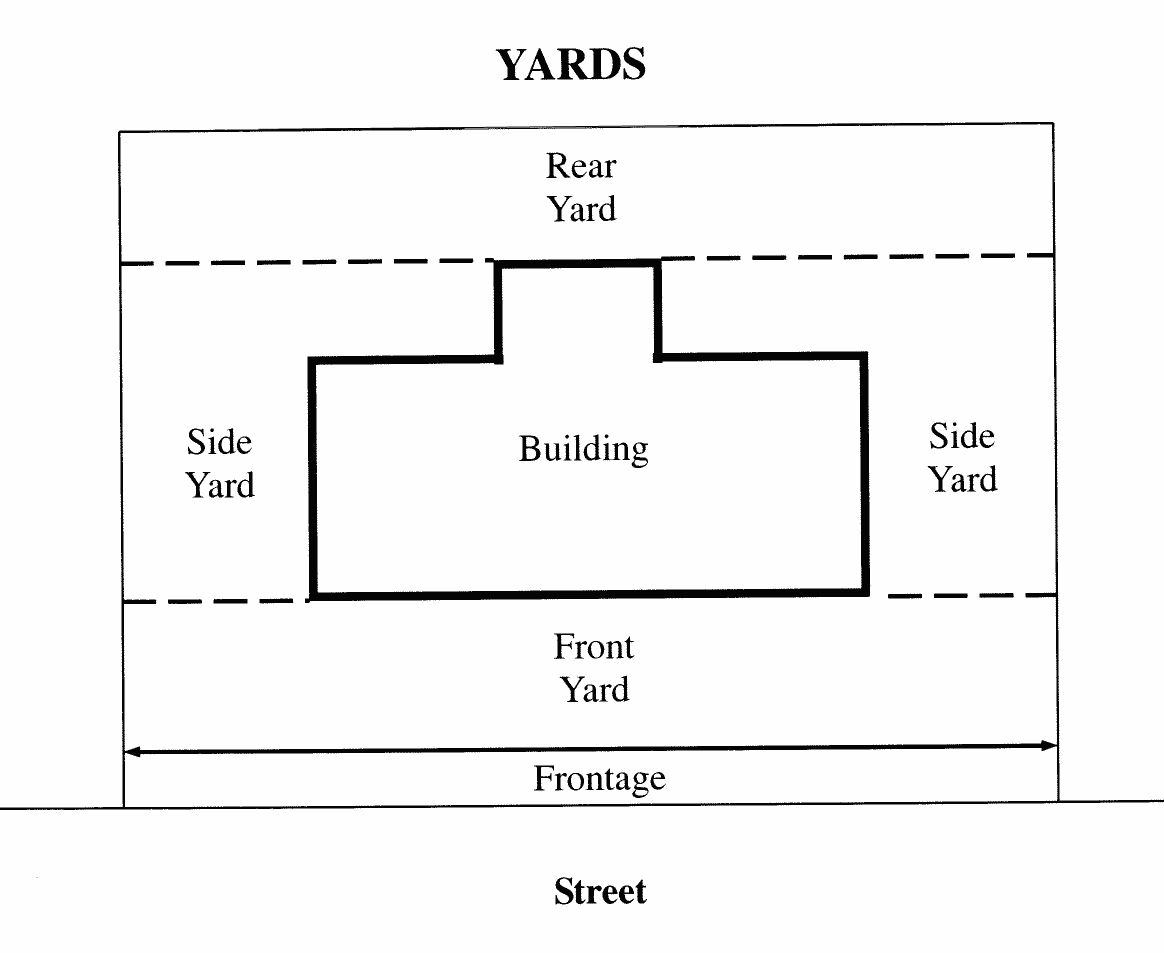
Yard sale means the occasional sale or offering for sale to the general public of items of personal property by the owner or tenant of an improved lot in a residential zone whether such sale is designated as a yard sale, garage sale, lawn sale, home sale, attic sale, moving sale, rummage sale, or similar designation.
Zone means an established zoning district within which certain uses of land and buildings are permitted with or without conditions and certain others are permitted only by special exception or are prohibited; yards and other opens spaces are required; lot areas, building height limits, and other requirements are established.
Zoning map means the zoning map of the City of Rockville, Maryland, officially adopted by the Mayor and Council, together with all amendments thereto subsequently adopted.
(Ord. No. 29-09, § 3, 10-26-09; Ord. No. 2-10, § 3, 2-8-10; Ord. No. 15-10, § 2, 6-21-10; Ord. No. 16-10, § 1, 9-13-10; Ord. No. 17-10, 9-20-10; Ord. No. 7-11, § 4, 6-6-11; Ord. No. 1-12, 1-30-12; Ord. No. 8-14, § 1, 4-21-14; Ord. No. 2-15, 2-2-15; Ord. No. 26-15, 10-12-15; Ord. No. 1-18, 1-22-18; Ord. No. 3-18, 2-5-18; Ord. No. 2-19, 1-7-19; Ord. No. 25-19, § 1, 10-21-19; Ord. No. 14-21, 9-27-21; Ord. No. 18-21, 10-25-21; Ord. No. 13-22, 7-18-22; Ord. No. 16-23, 10-9-23; Ord. No. 17-23, § 1, 10-9-23; Ord. No. 8-24, 7-29-24; Ord. No. 13-24, § 1, 9-16-24)
Sec. 25.03.03. - Terms of measurement and calculation.
a.
Rules of measurement. All measured distances are to be measured to the nearest integral foot. Measurements up to 0.49 feet are rounded down; measurements of 0.5 feet or more are rounded up. In the case of parking calculations, any fraction of a parking space requirement is rounded up to the next higher number.
b.
Calculations. The following subsections provide methods for calculating various areas and densities:
1.
Rounding. Measurements or other numbers are not rounded up in order to meet a minimum requirement or rounded down in order to meet a maximum requirement.
2.
Computation of time. In computing the time limits specified in this chapter:
(a)
The day of the act, event, or default after which the designated period of time begins to run is not included.
(b)
Unless business days are specified, if the period of time allowed is more than seven (7) days, all calendar days are counted. If the period of time allowed is equal to or less than seven (7) days, intermediate Saturdays, Sundays, and holidays are not counted. The final day is counted unless it is a Saturday, Sunday, holiday, or other day on which City Hall is not open for regular business; in which case, the next day on which City Hall is open for regular business will count as the last day.
c.
Terms of measurement. For purposes of this chapter, the following terms have the following meanings:
1.
Acre means a land area containing forty-three thousand five hundred sixty (43,560) square feet.
2.
Fenestration means openings in the building wall allowing light and views between the interior and exterior. Fenestration is measured as the glass area (excluding mountings and similar window frame elements with a dimension greater than one (1) inch) for conditioned space and as open area for parking structures or other unconditioned, enclosed space.
3.
Height (of a building):
(a)
Generally. Except as otherwise provided, the height of a building is measured from the level of the approved street grade opposite the middle of the front of the building. The height is measured to:
(i)
The highest point of roof surface of a flat roof;
(ii)
The deck line of a mansard roof; or
(iii)
The mean height level between the eaves and ridge or peak of a gable, hip, or gambrel roof, except as set forth in section 25.10.09.
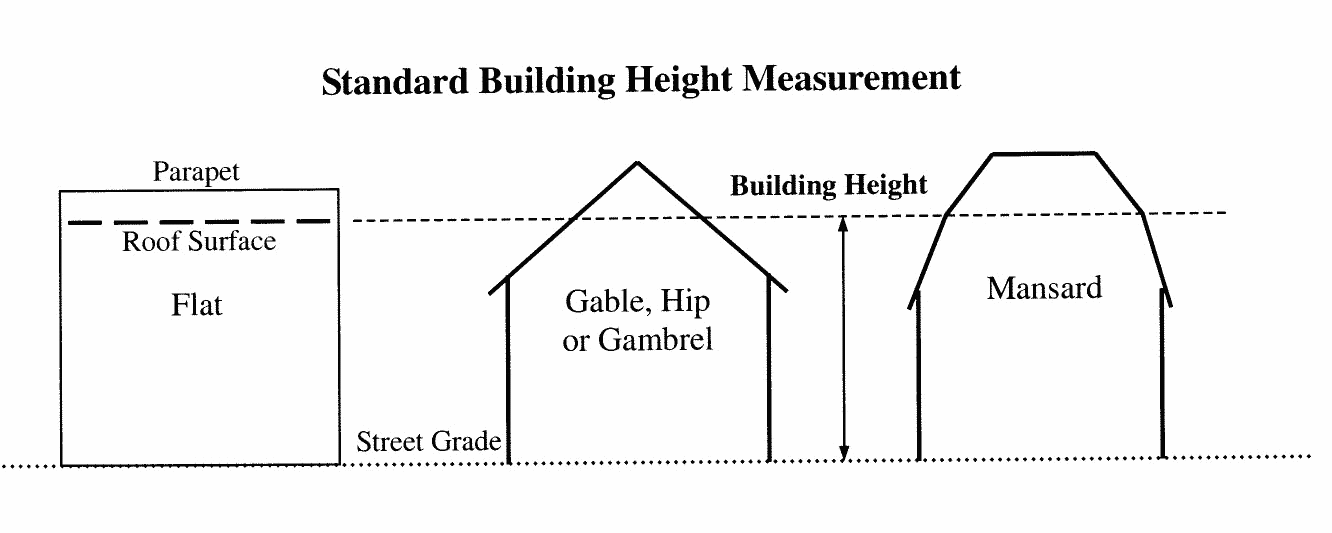
(b)
Exceptions.
(i)
Greater than 35-foot setback. If a building is set back thirty-five (35) feet or more from the street line, the building height is measured from the average elevation of the finished grade along the front of the building.
(ii)
Corner lot exceeding twenty thousand (20,000) square feet. On a corner lot exceeding twenty thousand (20,000) square feet of area, the height of a building may be measured from either adjoining street grade.
(iii)
Terraces above street grade. If the building is located on a terrace above the street grade, the height is measured from the top of the terrace.
(iv)
Through lots. For a through lot, the height may be measured from either street grade, provided that the maximum height permitted on the higher street extends to a point one hundred fifty (150) feet from the lower street line, at which point the maximum height must be measured from the lower street.
(v)
Special provision for lots in the R-60, R-75, and R-90 zones. See section 25.10.09.
4.
Lot area.
(a)
Lot area, minimum. That minimum net lot area required in each zone.
(b)
Lot area, net. The horizontal area included within the rear, side, and front lot or proposed street lines of the lot, excluding any street or highway, whether dedicated or not dedicated to public use, but including off-street automobile parking areas and other accessory uses.
(i)
No yard or open area provided around any building for the purpose of complying with the provisions of this chapter can be considered as a yard or open area for any other building.
(ii)
Any lot as defined in this chapter, which was legally recorded prior to October 1, 1957, and which was a buildable lot under the zoning ordinance in effect prior to that date, is deemed a buildable lot even though it may have less than the minimum area required for any single dwelling unit residential zone.
(iii)
As to any lot deemed buildable, in the event that such lot is narrower than the minimum width required in the zone in which such lot is located, the side yard requirements as to such lot can be reduced to those in effect in the next higher density detached residential zone.
(c)
Lot area, useable. The useable area upon which the density of development is calculated must be determined by deducting from the gross area of the tract the following:
(i)
All land indicated in the plan for highways with a designated right-of-way width of one hundred (100) feet or greater;
(ii)
All 100-year flood plains.
5.
Lot, minimum width at front lot line. The least permissible width of a lot, measured horizontally along the front lot line.
6.
Parking spaces.
(a)
Number of employees. For the purposes of this article, the number of employees for a use must be computed on the basis of the maximum number of persons to be employed at any one (1) time other than at changes of shifts.
(b)
Wheel bumper and curbs. For purposes of computing the area of any public parking space, a parking space may extend beyond a wheel bumper or curb provided that:
(i)
The computed area of such parking space does not extend beyond a wheel bumper or curb more than two (2) feet as measured along the side of the space which extends the greatest distance beyond the wheel bumper or curb; and
(ii)
The computed area of such parking space does not extend beyond a wheel bumper or curb which is more than six (6) inches high, and the area of overhang is free of all obstructions above curb height.
7.
Sign area and height. See section 25.18.07.
8.
Swimming pool, legal capacity. The sum of the following:
(a)
One (1) person for each ten (10) square feet of water surface where the water depth is less than five (5) feet; and
(b)
One (1) person for each twenty-four (24) square feet of water surface where the water depth is five (5) feet or greater, excluding three hundred (300) square feet of such water surface which shall be required for each diving board or diving platform.
9.
Swimming pool, minimum deck size legal capacity. Twenty (20) square feet per person, exclusive of the pool proper, of pool apron, deck or other structure surrounding the pool proper multiplied by the number of persons constituting the legal capacity of the pool.
(Ord. No. 29-09, § 3, 10-26-09)
Sec. 25.03.04. - Chart of symbols.
The following symbols are used throughout this chapter:

