
Rockville City Zoning Code
ARTICLE 12
- INDUSTRIAL ZONES
Sec. 25.12.01.- Purpose.
a.
Light industrial. The purpose of this zone is to provide space for limited light manufacturing, warehousing, and wholesaling facilities necessary to serve residents of the City and surrounding areas, to provide general retailing facilities for certain commodities appropriate in an industrial zone, and to provide certain limited housing opportunities.
b.
Heavy industrial. The purpose of this zone is to provide sites for a wide range of industrial and related uses which may need various types of access, and which, because of the nature of their operation, may or may not be compatible in close proximity to other land uses.
Sec. 25.12.02. - Zones established.
The individual zones include the following:
Sec. 25.12.03. - Land use tables.
The uses permitted in the industrial zones are shown in the table below. Uses are subject to applicable conditions of site plan approval. All special exceptions are subject to the requirements of article 15.
Key: P = Permitted Use; S = Special Exception; C = Conditional Use; N = Not Permitted
(Ord. No. 29-09, § 12, 10-26-09; Ord. No. 2-15, 2-2-15; Ord. No. 3-18, 2-5-18; Ord. No. 14-21, 9-27-21; Ord. No. 18-21, 10-25-21; Ord. No. 8-24, 7-29-24)
Sec. 25.12.04. - Development standards.
a.
Table of development standard.
b.
Setbacks.
1.
Side yard setbacks. Two (2) side yard setbacks are required unless otherwise specified in the development standards table in subsection 25.12.04.a. above.
2.
Side and rear setbacks with residential land abutting. The minimum setback from abutting residential land shall not apply when the land is shown for nonresidential use in the plan.
c.
Parking structures. Parking structures constructed at or below grade are excluded from the lot coverage and building setback requirements.
d.
Additional industrial zone standards. Additional standards to mitigate the impact of development on adjoining residential development, excluding mixed-use developments which include residential uses are as follows:
1.
Facade and structured parking abutting residential land. For new nonresidential development or redevelopment, when abutting residential land that is shown as residential in the plan, the following standards apply:
(a)
A building facade of one hundred (100) feet or more should include projections, recessions, or other treatments sufficient to reduce the unbroken massing of the facade along all sides of the building facing public streets.
(b)
If a building facade exceeds two hundred (200) feet long facing a residential zone, the building must be set back one (1) foot for each additional foot of length exceeding two hundred (200) feet.
(c)
Structured parking above grade is prohibited where the parking structure would be immediately adjacent to a single dwelling unit residential zone property.
2.
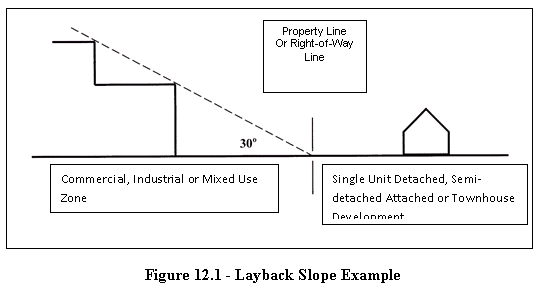
Layback slope. In addition to the height limits set forth in this article, a building cannot penetrate a layback slope line of thirty (30) degrees, beginning from the closest ground point of the lot line of any property within any residential zone where single unit detached, semi-detached, attached, or townhouse development exists or is recommended in the plan, regardless of intervening roads or other transportation facilities as shown in Figure 12.1.
(Ord. No. 7-11, § 12, 6-6-11)
Sec. 25.12.05. - Accessory uses.
All accessory uses within industrial zones must comply with the provisions of article 9 of this chapter.
Sec. 25.12.06. - Nonconformities.
All nonconforming uses and structures within industrial zones must comply with the provisions of article 8 of this chapter.
Sec. 25.12.07. - Parking and loading requirements.
All parking and loading within industrial zones must comply with the provisions of article 16 of this chapter.
Sec. 25.12.08. - Landscaping and buffer requirements.
All landscaping and buffering within industrial zones must comply with the provisions of article 17 of this chapter and, where applicable, the forest and tree preservation ordinance.
Sec. 25.12.09. - Signs.
All signs within industrial zones must comply with the provisions of article 18 of this chapter.

