
Saint Leo City Zoning Code
ARTICLE X
- DEVELOPMENT REVIEW PROCEDURES AND DEVELOPMENT STANDARDS AND GUIDELINES FOR GENERAL SITE PLANS AND PLANNED UNIT DEVELOPMENTS3
Editor's note—Ord. No. 20-01, § 1, adopted Jan. 13, 2020, amended Art. X in its entirety to read as herein set out. Former Art. X, §§ 10.1—10.13, pertained to similar subject matter and derived from Ord. No. 11-01, § 2, 1-10-2011; Ord. No. 12-01, § 4, 12-12-2011; Ord. No. 13-03, § 6, 2-11-2013.
Sec. 10.1.- Applicability.
A.
Prior to undertaking any development or use of land in the Town of St. Leo, a development review approval shall be obtained in accordance with the procedures of this article and this chapter unless otherwise exempt. All development and use of land, whether or not subject to the procedures of this chapter, is subject to all other provisions of this chapter.
B.
A building permit may not be issued unless the proposed development activity is authorized by a development review approval (unless exempt) processed pursuant to this chapter.
C.
No earth moving, utility work, grading, construction or development activity may be undertaken unless a development review approval (unless exempt) is authorized pursuant to this chapter.
Sec. 10.2. - Development review approval.
A.
Any development or use of land not exempted in this article shall obtain approval as outlined in this article and pursuant to this chapter according to the type of use or development. There are three types of development review approval: General site plan, special exception use and planned unit development. All development review approvals shall be conducted by the town commission and/or its designee.
B.
Upon determination by the town commission or its designee that the development review application is complete, the town commission or its designee shall review the general site plan, special exception or planned unit development application and provide written comments regarding compliance with this chapter. The comments will include recommendations to approve, approve with conditions or reasons for denying the application.
C.
Where a development review approval is conditional, failure to meet conditions of approval can result in voiding the approval and/or imposing penalties pursuant to Article XVII.
(Ord. No. 20-01, § 1, 1-13-2020; Ord. No. 26-02, § 3(Exh. B), 11-10-2025)
Sec. 10.3. - Exemptions.
The following types of development are exempt from the development review approval procedures in this article provided said development complies with all applicable requirements of this chapter and obtains all applicable permits including building permits:
A.
The construction or alteration of a single-family dwelling or duplex on a lot in a valid recorded subdivision plat approved prior to the adoption of this chapter or on a lot of record;
B.
The construction of a dwelling unit on a lot created consistent with this chapter that did not require platting;
C.
Bona fide agricultural activity as defined by Florida Statutes;
D.
Removal of trash, debris, and vegetation except trees protected by the Land Development Code; and
E.
A subdivision of land into parcels of five acres or more not involving the construction of or any change in existing right of way lines, dedication of new right of way, or public easements.
Sec. 10.4. - Modifications after development review approval.
After development review approval has been issued, it shall be unlawful to substantially change, modify, alter, or otherwise deviate from the terms or conditions of the plan or approval without first obtaining an approval of the modification. The town commission or its designee shall determine the type of review for the modification and a written record of the modification shall be maintained in the files of the town clerk.
Sec. 10.5. - General site plan review procedures and development guidelines.
A.
A general site plan shall be submitted for review and approval for any use or development that is not exempt or is not required to be reviewed as a special exception use or planned unit development.
B.
A general site plan application shall be submitted to the town clerk containing the following information:
1.
The completion and submittal of the Town of St. Leo application form signed by the property owner of record and the application fee as established by the town commission. The filing of the application acknowledges the applicant's agreement to be responsible for any and all outside costs to the town for the review of the application and associated materials.
2.
A written narrative describing the proposed use or development, any requested variances to this chapter, and identification of any impact to established visual corridors.
3.
A survey of the property, including topographic vertical contours no greater than at five-foot contour intervals and identification of soils.
4.
A letter of authorization/affidavit from the property owner for any representative to act on behalf of the property owner.
5.
A site plan drawn to a scale of not greater than one-inch equals 100 feet, and to include the following:
a.
Location of existing buildings and proposed buildings, parking layout, driveway locations, stormwater ponds and landscaping, and trees to be removed (see Article XII—Landscape Buffering and Tree Protection).
b.
Dimensional information relative to building square footage, floor area ratio, building/structure height and setbacks; impervious surface area, location, size and setback of signs; parking space and drive aisle dimensions; number of required and provided parking spaces; stormwater facility locations and volumes; landscape buffer width and planting plan; building elevations and perspective drawings related to view corridors; and additional information as required by the town for sufficient review of the development.
6.
Other information as may be deemed necessary by the town to evaluate the plan for compliance with this chapter.
C.
Procedural and notification requirements.
1.
Within ten business days of the receipt of the submittal requirements contained in this section, the town commission or its designee shall determine if the application is determined to be complete. A complete application may be scheduled for review and action by the town commission at the next regularly scheduled meeting provided that such meeting is at least ten business days after the submittal is determined to be complete.
2.
The applicant shall be responsible for notice of the town commission meeting to the surrounding owners of property within 1,000 feet, excluding the distance over water bodies, of the perimeter of the subject property boundaries. At a minimum, at least the five closest abutting property owners shall be notified. Said notice shall be on a public meeting notice form provided by the Town of St. Leo and mailed by the applicant by U.S. Postal Service certificate of mailing at least ten business days prior to the public meeting date. A copy of the certificate of mailing shall be provided to the town clerk at least five calendar days prior to the public meeting date.
3.
The town commission may take the following action at their meeting:
a.
Approve a resolution approving the application as submitted or with conditions;
b.
Deny the application;
c.
Defer action on the application to a future town commission meeting not more than 60 days from the date of the initial meeting.
D.
All proposed development shall be evaluated for visual impacts on St. Leo's unique topography, natural forested landscape, historic sites, historic landmarks (such as the St. Leo Abbey and Bell Tower), and visual corridors and view sheds as identified in the Visual Corridor Study adopted by the town commission on August 11, 2001. (Resolution No. 01-03). Factors to be considered in evaluating the impacts of development shall be consistent with the PUD review requirements and standards as applicable.
E.
All applications for review of a proposed dock shall conform to the submittal requirements of this article, as may be related to docks, and include, but not be limited to the following:
1.
A survey of the property including the topographic vertical contour showing the mean high water mark.
2.
A scaled (not greater than one-inch equals 50 feet) dimensioned site plan and elevation drawing showing dock square footage and height of the dock and any related structures, dock setbacks from adjacent properties, lake shoreline and location of the mean high water mark. In addition, the drawing shall show any other accessory structures within the permanently open land (POL) zoned portion of the property, including their location, size, height and dimensions.
3.
Copy of any required approvals or exemptions from other governmental and non-governmental regulatory agencies.
Sec. 10.6. - Special exception use review procedures and development guidelines.
A.
Review and approval for special exception uses shall be in accordance with requirements and procedures contained in article VIII.
Sec. 10.7. - Planned unit development (PUD): Purpose and intent.
A.
A planned unit development (PUD) is a large-scale project constructed by a single owner or group of owners acting jointly and involving a related group of existing and/or proposed uses planned, developed, and regulated as an entity. The planned unit development process is designed to promote the efficient use of land and public services by providing a flexible means of land development on property. A PUD may be proposed for any use or combination of uses consistent with the uses and intensity and/or density of development permitted by the underlying comprehensive plan land use category. In the case of mixed-use development, residential density shall be calculated based on gross land area designated for residential use and floor area ratio (FAR) based on gross land area designated for nonresidential use. Per FLUE Policy 2.2.4, where a planned unit development (PUD), pursuant to the LDC, encumbers multiple future land use categories, the combined development entitlements (density and/or FAR) of the area occupied by each land use category may be applied to and located anywhere within the entire PUD area, except for areas assigned POL or CON, subject to approval by the town commission. In calculating the maximum permitted number of dwelling units and/or floor area (square feet), any fraction thereof shall be rounded down to the next whole number.
B.
The PUD is intended to facilitate a unified design that provides for the proper accommodation and separation of incompatible uses, promotes energy conserving land use patterns to reduce greenhouse gases and vehicle trips, promotes energy conserving development, provides for adequate buffering and protection of adjacent land uses, provides for the necessary supporting facilities, and proper consideration of environmental features.
C.
To encourage quality design, a PUD applicant may be granted variances to this chapter relative to certain standards, such as minimum lot size, setbacks, signage and parking requirements.
D.
A property with an approved PUD will retain its underlying zoning district designation with a notation on the official zoning map indicating the PUD ordinance number.
E.
Any proposed residential or institutional development of five acres or more, except for platting of subdivisions pursuant to article XIV, or any proposed commercial (office and/or retail) or mixed-use development of three acres or more is required to be reviewed and approved through the PUD process.
(Ord. No. 20-01, § 1, 1-13-2020; Ord. No. 26-02, § 3(Exh. B), 11-10-2025)
Sec. 10.8. - Planned unit development (PUD): Application requirements and procedures.
A.
Prior to formally submitting a request for a PUD, the applicant shall be required to meet with the Town of St. Leo staff at a pre-application meeting. The purpose of this meeting is to give the applicant the benefit of comments about the advisability of undertaking a PUD at the proposed location and PUD procedures and requirements.
B.
The applicant may apply for and be granted approval for the entire PUD or for any phase(s) of the project. Approval of the PUD is a binding agreement between the developer and the town commission that establishes use and building locations, range of uses, land area for each use, densities and intensities, and site improvements such as parking, open space and stormwater areas.
C.
The PUD application shall include the following:
1.
The completion and submittal of the Town of St. Leo application form signed by the property owner of record and the application fee as established by the town commission. The filing of the application acknowledges the applicant's agreement to be responsible for any and all outside costs to the town for the review of the application and associated materials.
2.
A location map showing the relationship of the project to cities, highways, and natural features;
3.
A property map showing the current use and zoning of the tract and all contiguous property;
4.
A survey of PUD site including but not limited to the following: tree survey of tree species protected pursuant to this chapter, including delineating tree species, diameter and canopy area (trees located within proposed dedicated open space areas are not required to be surveyed), jurisdictional wetlands, soils and topographic vertical contours of not more than five-foot intervals;
5.
A narrative project description of the total project in sufficient detail to provide an understanding of the nature of the development proposal; its probable impact on the surrounding uses, public facilities, and natural resources; and any problem area with the proposed solutions;
6.
A site plan or conceptual bubble plan showing the layout of lots; the density and size of each type of land use; the typical minimum lot sizes and dimensions for each use and unit type; the dimensions, locations, and types of buffers, easements, open space areas, parking and loading areas, setbacks, and vehicular circulation routes;
7.
A legal description of the entire property encompassing the PUD or component phase;
8.
A list and description of approvals necessary to construct the proposed improvements including, but not limited to, streets and access roads, drainage systems, and water and sanitary sewer systems;
9.
A general location and description of the proposed legal measures to provide for perpetual maintenance of any common or dedicated open space, common improvements, easements, dedications, and reservations;
10.
A proposed development schedule indicating the approximate starting and completion dates for the entire project or any phases with appropriate identification and description of such phases;
11.
An Impact Assessment Statement applicable to the total project in sufficient detail to provide an understanding of the nature of the development proposal and its probable impact on the surrounding uses, visual corridors, public facilities (water, wastewater, traffic) and natural resources, and narrative relative to addressing the guidelines contained in this article; and
12.
Any additional information and materials as the town commission or its staff may reasonably require.
D.
Procedural and notification requirements.
1.
Within ten business days of the submittal of the submittal requirements contained in this section, the town commission or its designee shall determine if the application is complete. If the application is determined to be complete, then the request shall be formally advertised for public hearings before the town commission. Said advertisement must occur at least seven days prior to the first public hearing. The second hearing and adoption by the town commission must be at least ten days after the first public hearing. The applicant requesting the PUD shall be responsible for paying all advertising costs prior to the first public hearing. Costs shall be as determined by the town clerk.
2.
The applicant shall be responsible for notice of the public hearings to the surrounding owners of property within 1,000 feet, excluding the distance over water bodies, of the perimeter of the subject property boundaries. At a minimum, at least the five closest abutting property owners shall be notified. Said notice shall be on a public hearing notice form provided by the Town of St. Leo and mailed by the applicant by U.S. Postal Service certificate of mailing 30 days prior to the second public hearing date. A copy of the certificate of mailing shall be provided to the town clerk at least five calendar days prior to the initial public hearing date.
3.
The town commission shall conduct the public hearings as quasi-judicial proceedings, and may take the following action after adjourning the second public hearing:
a.
Approve an ordinance approving the application as submitted or with conditions;
b.
Deny the application;
c.
Adjourn the public hearing and defer action on the application to a future town commission meeting not more than 60 days from the date of the public hearing, and then take final action; or
d.
Continue the public hearing to a date certain not be more than 60 days from the public hearing date.
Sec. 10.9. - Planned unit development (PUD): Review requirements and standards.
A.
The applicant shall have the right to a range of land uses and design flexibility at any location. However, the applicant shall demonstrate that the PUD is not contrary to the public interest and that it substantially conforms to the town of St. Leo Comprehensive Plan. The following standards are established to ensure adequate provision of community services, sensitivity to environmental features and to avoid adverse impacts.
1.
Location. PUDs should be located on or have direct access to an arterial or collector Road, with minimum impact on residential local roads.
2.
Size. All lands in the PUD must be contiguous. An existing public road through the property shall not be deemed to divide the PUD area.
3.
Compatibility. The proposed PUD shall be compatible with adjacent land uses or zoning districts or shall achieve compatibility through special design characteristics and buffers between incompatible uses to minimize differences between the proposed project and existing surrounding land uses or zoning districts.
4.
Open space and recreation areas. A minimum of 25 percent open space/recreation area shall be provided. The applicant shall indicate who will be responsible for the on-going maintenance of any common open space or recreation areas within the PUD. Where development land encompasses jurisdictional wetlands or documented habitat for listed species as described in Section 7.11, said areas shall be protected by conservation (CON) overlay and by covenants running with the land, conveyances; or dedications. At least 50 percent of the required open space/recreation area (based on mature tree canopy coverage area) shall be landscaped with native plants and trees. Existing forested areas, wetlands and/or documented wildlife habitat areas should be utilized to meet open space requirements.
5.
Lots and buildings. Buildings shall be uniform in architectural design theme and building materials. A building or group of buildings shall have a compatible relationship with one another and surrounding properties based on, but not limited to, the following design elements:
a.
Lots shall be arranged and/or clustered to create an efficient development pattern to promote pedestrian orientation, reduce vehicle trips, recognize environmentally sensitive lands and visual corridor features and create useable and interconnected open spaces.
b.
Building scale, height, mass and setbacks.
c.
Building materials and color.
d.
Building architectural theme/style, forms and roof shape.
e.
Transitions between buildings relative to height, facade details, and landscape buffers.
f.
Architectural detailing that highlights entrances and introduces features such as porches, arches, or bay windows, and roof detailing such as cornice lines, dormers, gables, or roof plane changes. Flat or mansard roofs are discouraged.
g.
Separations and/or changes in the building plane (facade and roof) and facade details.
h.
Buildings shall incorporate energy efficient facade design features and buildings and/or development site shall be encouraged to accommodate non-fossil fuel energy sources such as solar.
i.
Parking structures and lots should be located to the side or rear of the principal building with no more than 50 percent of the street frontage occupied with parking structures or lots. Parking structures shall be compatible in terms of scale, height and design with the architectural character of principal buildings.
6.
Lake Jovita/C.R. 52 Visual Corridor. All proposed development shall be evaluated for visual impacts on St. Leo's unique topography, natural forested landscape, historic sites, historic landmarks (such as the St. Leo Abbey and Bell Tower), and important adopted visual corridors and view sheds as identified in the Visual Corridor Study adopted by the town commission on August 11, 2001 (Resolution No. 01-03). Factors to be considered in evaluating the impacts of development include, but are not limited, to the following:
a.
Siting, massing and height of buildings and structures.
b.
Building facades that are visible within the view shed shall provide architectural details, landscaping and fencing/wall treatments appropriate for the architectural style of the building.
c.
Ridgelines, hillsides and hilltops should be preserved in their natural green and/or forested state and contour. Tree canopy/forested areas on the hilltop and hillside shall be protected to preserve view corridors and the forested character of the town.
d.
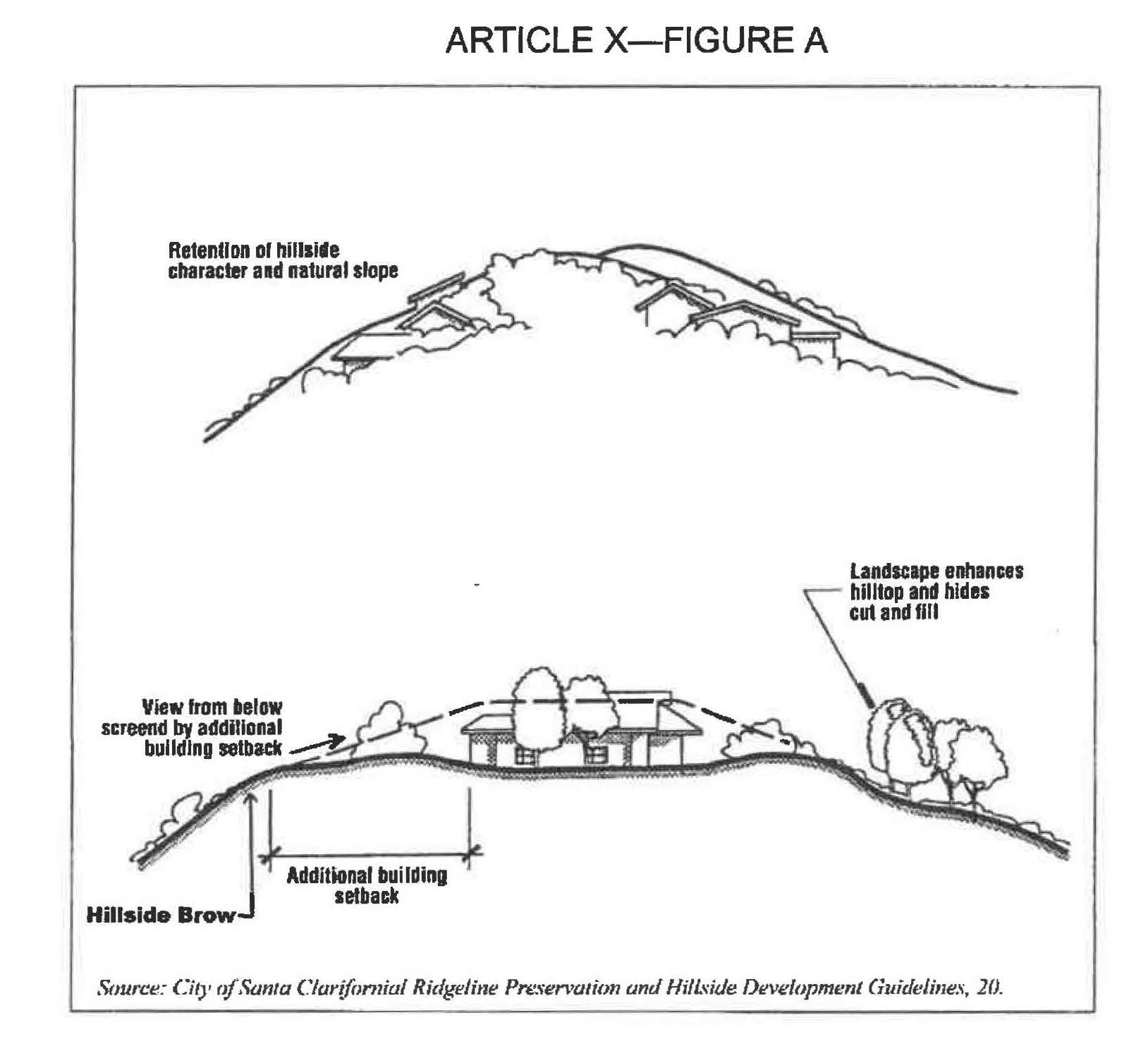
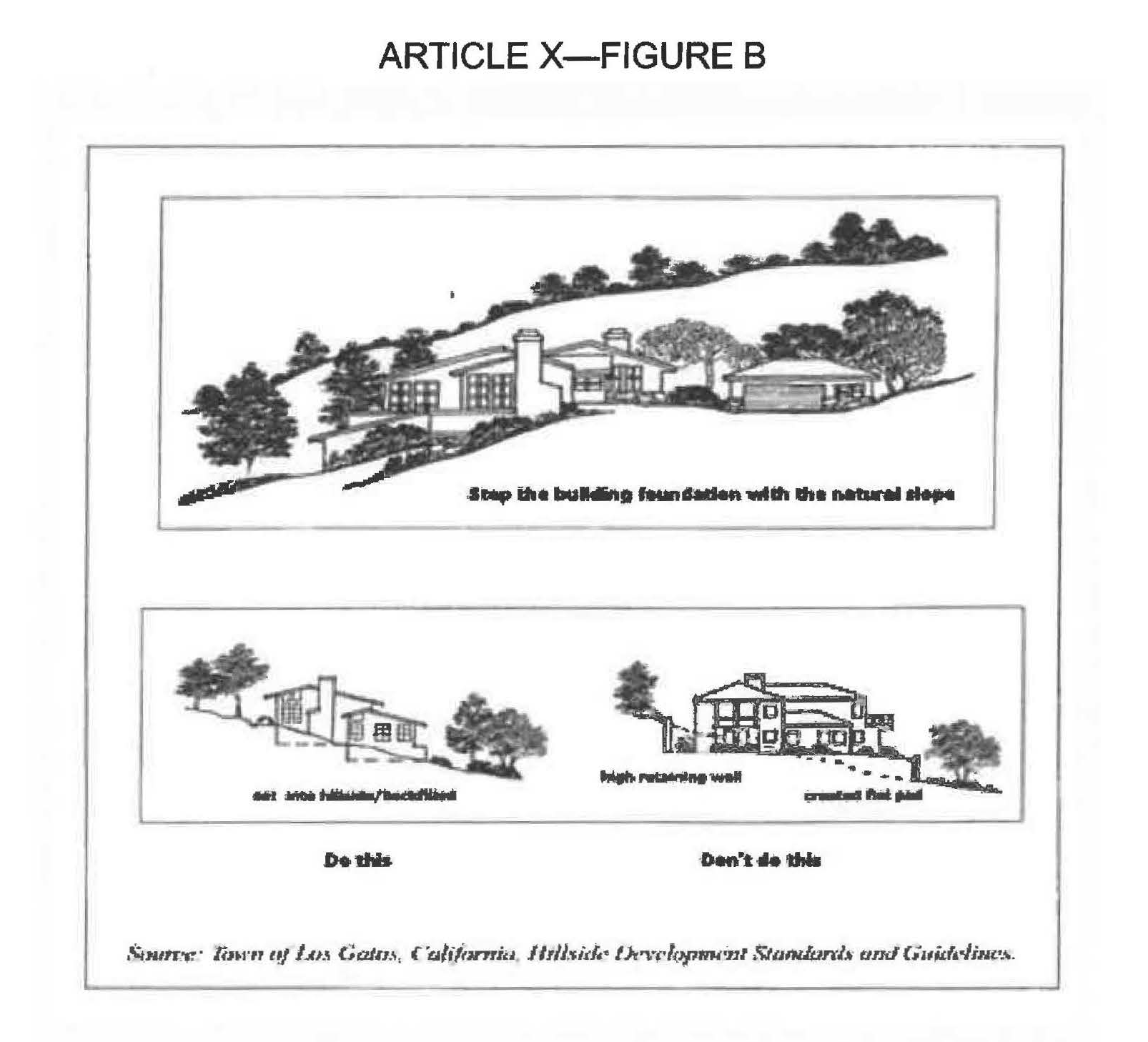
Buildings located on the hilltop shall be setback from the hillside brow and buildings located on the hillside slope shall be located such that the building height does not extend beyond the hillside brow. Buildings shall be situated to be sensitive to the hillside slopes by fitting into or blending with the contour of the hillside, such as stepping the building down the hillside to match the topography and slope of the hillside as opposed to altering the hillside topography. Cluster new development to retain surrounding tree canopy and minimize alterations to the existing hillside topography. Figures A and B illustrate the above concepts.
e.
Altering the hillside contour shall be avoided. Use of retaining walls or other construction techniques to preserve hillside contours shall be encouraged.
f.
Building heights should not extend above the surrounding tree canopy or above the hilltop or ridgeline more than 35 feet in height in order to maintain the natural relationship between the forested tree canopy, hillside topography and slope, ridgeline and skyline.
g.
Open spaces within developments should be located to create large open space foreground areas as viewed from public roads, which is a typical rural characteristic. Open spaces should be interconnected with adjacent open space, agricultural land and/or sensitive environmental areas.
7.
Master signage plan. A master signage plan shall be submitted illustrating the master sign design, colors and materials for free-standing and building signs. The signage plan shall also indicate the sign area for each free-standing and building sign.
8.
Streets and internal transportation system. Streets shall be designed and constructed in accordance with the provisions of the Town of St. Leo Subdivision Regulations, with such modifications as may be approved as part of the plan submitted at all phases of town review. Connection of the internal street system to the public road and highway network (via connectors of adequate design, construction, and capacity) shall be the responsibility of the developer and any required improvements shall be included in the PUD plans.
9.
Principal vehicular access points. Principal vehicular access points to the PUD shall be designed to encourage smooth traffic flow with controlled turning movements and minimum hazard for vehicular or pedestrian traffic. Acceleration, deceleration, and turn lanes and similar improvements may be required where existing or anticipated heavy traffic flows indicate a need for such improvements.
10.
Surface water management (including drainage). The surface water management plans for the PUD shall be approved by the town commission and other state/federal agencies having jurisdiction. All stormwater ponds shall be landscaped pursuant to article XII and meet stormwater requirements pursuant to article XV.
11.
Utilities and services. The applicant shall provide for water and sewer facilities approved by the town commission and Pasco County and/or the Florida Department Environmental Protection. The developer shall provide for all necessary solid waste disposal and other public or private utilities or service required.
12.
Other development impact assessments. The town commission or its designee, may require the applicant to provide analysis of development impacts in addition to those referenced above. Such impacts may include, but not be limited to, impact assessment on wildlife, wildfires, groundwater recharge areas and/or lake water quality.
B.
Pursuant to the comprehensive plan, the town commission may grant additional residential density up to four dwelling units/acre, provided the town commission determines that the PUD substantially meets the above development guidelines and requirements.
(Ord. No. 20-01, § 1, 1-13-2020; Ord. No. 26-02, § 3(Exh. B), 11-10-2025)
Sec. 10.10. - Modification of a planned unit development (PUD).
A.
All PUD plans submitted for approval shall be reviewed by the town commission or its designee to determine whether a major or minor modification from previously approved plans or conditions has occurred. If such a variation has occurred, the applicant shall apply for a modification of a PUD. The applicant may also initiate an application for modification to a PUD.
B.
Major modifications.
1.
Any modification of an approved PUD which involves a change in land use or expansion of the PUD land area or any phasing area or more than a ten percent increase in building square footage shall be considered a major modification. Other PUD changes may be declared a major modification if the town commission or its designee determines that the proposed changes deviate substantially from an approved PUD.
2.
Applications for a major modification of PUD shall require the same submittal and procedural requirements including public hearings as a new PUD application.
C.
Minor modifications.
1.
Any modification to an approved PUD which does not constitute a major modification as determined by the town commission or its designee shall be considered a minor modification.
2.
Applications for a minor modification shall meet the requirements for a general site plan as contained within this section and include an updated, revised PUD plan indicating the effect of the proposed change and the justification for the change.
3.
The procedural requirements for minor modifications shall be the same as the requirements for a general site plan as contained within this section.
Sec. 10.11. - Final planned unit development (PUD) approval.
A.
Prior to submittal of the final PUD site plan prior to a building permit application, the town commission's designee shall review the PUD or relevant approved PUD phase for final approval. Such review shall be to determine if the final PUD plan has not changed from its original approval and meets the conditions of that approval. If the town commission's designee determines that a change has occurred, then it shall be considered a modification of a planned unit development and shall be subject to the regulations pertaining to major or minor modifications as outlined in this section.
B.
The final PUD site plan submittal shall include but not be limited to, illustrating the lot layout and location of buildings (except single-family development may show building envelope in lieu of specific building location), parking areas, stormwater facilities and landscape buffer areas. The final PUD submittal shall also include typical building elevation(s) and/or perspective drawing of the buildings.
Sec. 10.12. - Planned unit development (PUD): Time limitations.
A.
PUD approval shall be valid for 24 months after approval of the PUD or component phase. An applicant may submit a request for an extension of the PUD approval to the town commission if no building permit has been issued for the PUD or approved component phase. The town commission shall determine if an extension is warranted and may either (1) approve the extension, (2) approve the extension with conditions, (3) request additional information or (4) deny the request. No more than a total of two extension requests may be granted. The total cumulative extension of time for all extension requests shall not exceed more than three years.
Sec. 10.13. - Review procedures and development guidelines for temporary uses.
A.
A temporary use application shall be submitted to the town clerk containing the following information:
1.
The completion and submittal of the Town of St. Leo application form signed by the property owner of record and the application fee as established by the town commission. The filing of the application acknowledges the applicant's agreement to be responsible for any and all outside costs to the town for the review of the application and associated materials.
2.
A written narrative describing the proposed use or development, any requested variances to this chapter, and identification of any impact to established visual corridors.
3.
A letter of authorization/affidavit from the property owner for any representative to act on behalf of the property owner.
4.
Notation of the duration of the temporary use and hours of operation.
5.
The applicant/operator shall provide designated, safe and adequate on-site and off-site parking; no parking shall be allowed within a public right-of-way in order to maintain the safe and orderly flow of traffic.
6.
The applicant/operator shall provide safe and adequate ingress and egress to the property including safe clear sight distance for vehicles entering or leaving the property. Barriers (such as railroad ties, fencing or other acceptable barrier as approved by the town commission) shall be provided to direct vehicle ingress/egress to an existing driveway(s). Where a delineated driveway does not exist on the property, a driveway location shall be delineated, as approved by the town commission, for the purpose of ingress/egress during the duration of the temporary use.
7.
The applicant/operator shall insure that all temporary use areas such as trailers, outdoor storage areas, stages, tents, retail sales and food vending areas, other than parking, are located at least 25 feet from a public right-of-way and any neighboring residential areas.
8.
The applicant/operator shall obtain appropriate permits and fire inspections for any structures to be located on the property; or if such use requires electricity or plumbing permits, the applicant shall obtain such permits and inspections prior to operation of the temporary use. A business license tax fee must also be obtained from the town clerk and shall be available on-site during the operation of the temporary use.
9.
Signage is permitted on the temporary use structure, vehicle, mobile trailer or cart. No signage shall be located on the roof of any structure, vehicle or mobile trailer. In lieu of signage on the structure, vehicle, mobile trailer or cart, appropriate free-standing signage shall be permitted during the duration of the temporary use permit and shall be subject to the sign area, setback and height requirements as set forth in article XI, sign regulations, section 11.9.4, religious institutions. Directional signage is permitted pursuant to section 11.4, exempt signage.
10.
The applicant/operator shall submit a general site plan application which includes a detailed site plan of the total area to be utilized for the temporary use with dimensions showing the location and setback of the tent or temporary structure; maximum capacity (number of persons) to be within the tent or temporary structure; the number and location of all sales/food vendors directly affiliated with the temporary use; location of all on-site and off-site parking areas; a traffic circulation plan showing all ingress/egress locations and barriers to channel ingress/egress to these driveway locations; and the location, number and a description of any signs, lights, balloons, fences, banners, etc. Such plan shall be examined by the town commission or its designee to determine compliance with this code and other applicable codes, ordinances or regulations. No temporary use permit or building permit shall be issued until such plan complies with these provisions.
11.
Other information as may be deemed necessary by the town to evaluate the plan for compliance with this chapter and the Land Development Code.
B.
Procedural and notification requirements.
1.
Within ten business days of the receipt of the submittal requirements contained in this section, the town commission or its designee shall determine if the application is determined to be complete. A complete application may be scheduled for review and action by the town commission at the next regularly scheduled meeting provided that such meeting is at least ten business days after the submittal is determined to be complete.
2.
The town commission may take the following action at their meeting:
a.
Approve a resolution approving the application as submitted or with conditions;
b.
Deny the application;
c.
Defer action on the application to a future town commission meeting not more than 60 days from the date of the initial meeting.
3.
Failure by the operator/applicant to comply with any conditions of approval for the temporary use permit shall result in immediate voiding of the temporary use permit and all temporary uses shall cease immediately.
4.
Any extension of time for the temporary use beyond that provided for in the approval shall require a public hearing pursuant to article IX. The town commission shall establish a maximum time limit on any extension.
Sec. 10.14. - Certified recovery residences.
A.
Purpose and intent. The purpose of this subsection is to establish procedures for the review and approval of reasonable accommodation requests to the town land use and zoning, ordinances, rules, regulations, policies and procedures that serve to prohibit establishment of certified recovery residences pursuant to F.S. § 397.487. Facilitating reasonable accommodation requests ensures that individuals with a disability have equal opportunity to use and enjoy dwellings, buildings or structures, or to provide accessibility in another manner, as provided by the Federal Fair Housing Amendments Act (42 U.S.C. 3601, et seq., "FHA") and Title II of the Americans with Disabilities Amendments (42 U.S.C. Section 12131 et seq.) ("ADA"). Any person who is disabled and/or a provider of services to disabled individuals qualifying for a reasonable accommodation, may request a reasonable accommodation allowing for the establishment of a certified recovery residence pursuant to the procedures set forth herein.
B.
Applicability. This section shall apply exclusively to the reasonable accommodations request process for certified recovery residences seeking to locate or operate within the town. Nothing in this section shall prohibit ordinary residential use by unrelated persons in compliance with applicable occupancy limits.
C.
Definitions. The following terms as used throughout this section are defined as follows:
Certified recovery residence. A recovery residence that holds a valid certificate of compliance and is actively managed by a certified recovery residence administrator, as defined in F.S. § 397.311.
Disabled individual or person. An individual that qualifies as disabled under the FHA and/or ADA.
Reasonable accommodation. A modification or exception to the town's land-use, zoning or occupancy regulations necessary to afford a person with a disability equal opportunity to use and enjoy housing.
D.
Exceptions. The application of this section shall not supersede the following:
1.
Any current or future condominium declaration adopted pursuant to F.S. ch. 718;
2.
Any cooperative document adopted pursuant to F.S. ch. 719; or
3.
Any declarations or declaration of covenants adopted pursuant to F.S. ch. 720.
E.
Application requirements.
1.
An applicant (any person who is disabled or a provider of services to disabled individuals qualifying for a reasonable accommodation, collectively referred to as "applicant") must complete a certified recovery residences application signed by the property owner of record and submit to the town administrator or designee.
2.
The applicant may apply for a reasonable accommodation on their own behalf or may be represented at all stages of the process by an attorney, legally appointed guardian, or other person designated by the applicant as a power of attorney.
3.
Required components of the application shall include:
a.
Name and contact information of the applicant or the applicant's authorized representative. If the applicant is not the owner of the property, then the name and contact information of the property owner and an owner's authorization form is also required.
b.
Property address and parcel identification number of location the reasonable accommodation is being requested.
c.
A description of the reasonable accommodation requested, identifying the ordinances, rules, regulations or policies from which the applicant is requesting a reasonable accommodation (if any) and why the requested accommodation is needed.
d.
Proof of current certification under F.S. § 397.487.
e.
Name and certification number of the certified recovery residence administrator.
f.
Site plan showing existing structures and parking.
g.
Contact information for the operator.
h.
A certification signed by the applicant stating: "I CERTIFY UNDER PENALTY OF PERJURY THAT THE INFORMATION PROVIDED IN THIS REQUEST IS TRUE AND CORRECT. I UNDERSTAND THAT IF I KNOWINGLY PROVIDE FALSE INFORMATION WITH THIS REQUEST, MY REQUEST SHALL BECOME NULL AND VOID."
i.
A verification of disability status for executed by someone with personal knowledge of the applicant's, or those who are being provided services', disability, such as a medical or social services profession.
j.
Any additional information or documents the applicant feels is necessary to supplement the request for reasonable accommodation.
k.
Other information as may be deemed necessary by the town to evaluate the plan for compliance with the town Land Development Code and Code of Ordinances.
4.
The town administrator or designee will evaluate the application on the following objective criteria:
a.
Has the applicant established that they are protected under the FHA and/or ADA by demonstrating that they or those being provided recovery services are disabled, as defined in the FHA and/or ADA? To do this, the following must be shown:
i.
A physical or mental impairment which substantially limits one or more major life activities;
ii.
That they are regarded as having such impairment; and
iii.
A record of having such impairment.
b.
Is this residence certified and actively managed by a certified administrator?
c.
Is the requested accommodation reasonable and necessary to afford disabled persons equal opportunity for housing?
d.
Does the requested accommodation impose any undue financial or administrative burden on the town?
e.
Does the requested accommodation require a fundamental alteration in the nature of the land use and zoning regulations of the town?
F.
Procedural and notification requirements.
1.
The town administrator or designee will date-stamp the application upon receipt and notify the applicant, in writing, within 30 days if additional information is required. Failure of the applicant to provide a response within 30 days will result in the application being denied, unless the applicant requests an extension of time in writing.
2.
When conducting the review, the town administrator or designee may make a site visit to the property where the reasonable accommodation is being requested.
3.
The town shall not impose spacing, occupancy or location restrictions that treat certified recovery residences less favorably than other residential uses, except as expressly allowed under federal or state law.
4.
The town shall not require public hearings beyond the minimum required by law to grant the requested accommodation.
5.
If the town administrator or designee finds that the requested accommodation will impose an undue financial or administrative burden on the town or will require a fundamental alteration in the nature of the town's land use and zoning regulation, they may consider whether an alternative reasonable accommodation exists which would effectively meet the disability-related need. An alternative reasonable accommodation may constitute an approval of the requested accommodation with conditions.
6.
Within 60 days of receipt of a complete application, the town administrator, or designee will provide a written decision to:
a.
Approve the application.
b.
Approve the application, with conditions.
c.
Deny the application stating with specificity the objective, evidence-based reasons for denial and identifying any deficiencies or actions necessary for reconsideration.
7.
If the written decision is not issued within 60 days after receipt of the completed application, the reasonable accommodation request is deemed approved unless the parties agree in writing to a reasonable extension of time.
8.
In the event that a reasonable accommodation is granted, the applicant shall continue to comply with any and all other applicable building and/or engineering permitting processes required by the towns' Code of Ordinances and Land Development Code and all other state and federal laws.
9.
A reasonable accommodation is specific to the applicant and does not run with the subject property.
G.
Appeals. A decision by the town administrator or designee may be appealed to the town commission. Such appeal shall be submitted to the town clerk in writing and include the name, address and contact information of the applicant; a written summary of the reason for the appeal; and a copy of the original written decision. Appeals shall follow the filing and notice requirements outlined in Section 9.1.
H.
Revocation. If a certified recovery residence loses its certification or fails to comply with the conditions of approval, the town may revoke its approval after written notice and opportunity to cure in accordance with F.S. § 379.487.
(Ord. No. 26-03, § 2, 1-12-2026)

