
Saint Leo City Zoning Code
ARTICLE XIII
PARKING AND ACCESS MANAGEMENT
Sec. 13.1.- Parking requirements.
The following tables identify parking requirements for various uses. The town commission or its designee may make interpretations relative to the definition of uses and related parking requirements. Parking requirements for uses not delineated in the table shall be as determined by the town commission. In terms of calculating required number of parking spaces, any fraction thereof shall be rounded up to the next whole number.
ARTICLE XIII—TABLE A
Parking Requirements
(Ord. No. 11-01, § 2, 1-10-2011; Ord. No. 26-02, § 3(Exh. B), 11-10-2025)
Sec. 13.2. - Parking dimensional standards.
A.
Minimum parking space dimensions:
1.
Single-family: 8.5 feet in width by 18 feet in length.
2.
Nonresidential: Nine feet in width by 18 feet in length. Up to 25 percent of the total required parking may be compact spaces at 8.5 feet in width by 18 feet in length.
3.
All paved parking spaces shall be striped and have wheel stops.
B.
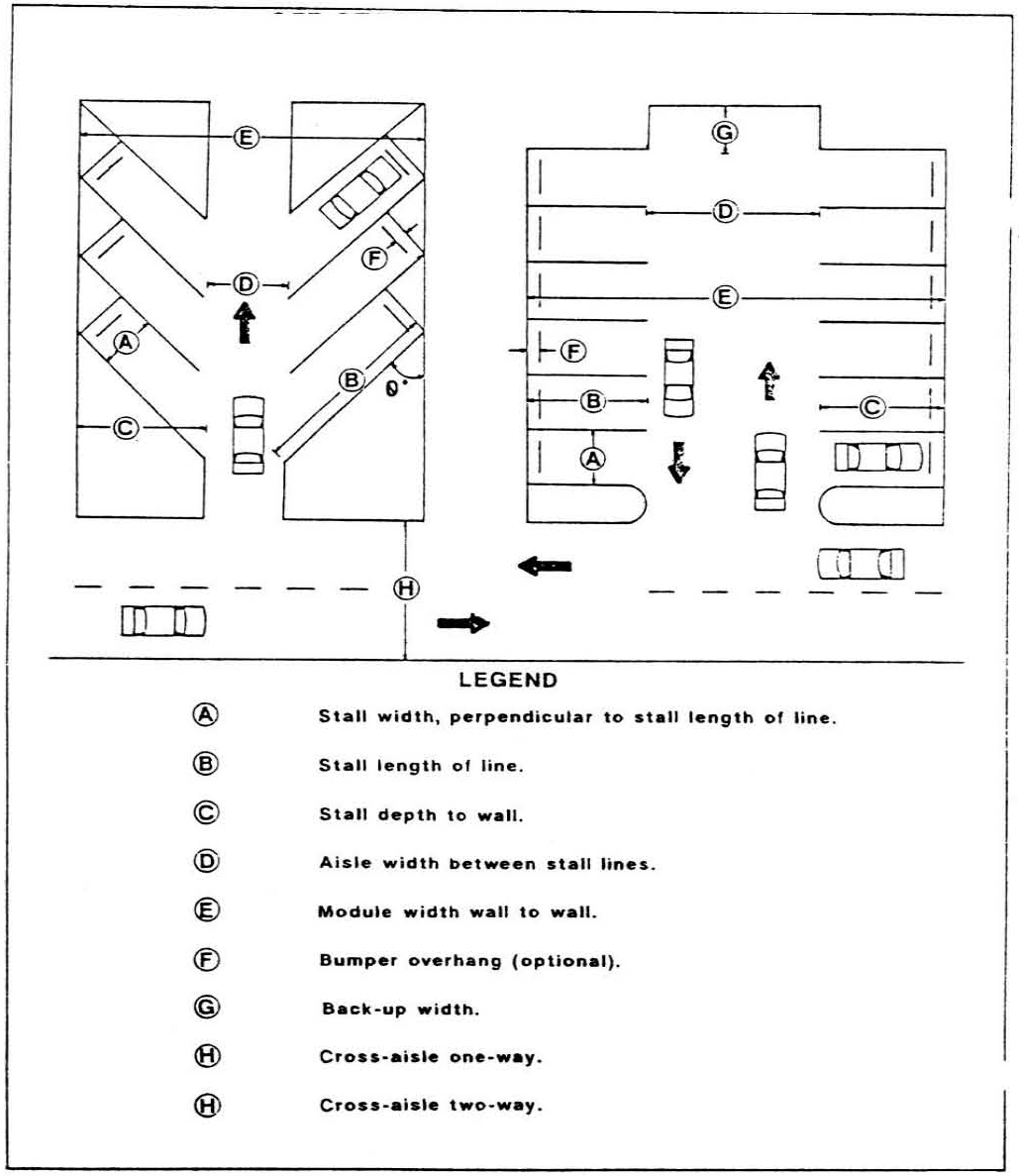
Parking space and lot layout dimensional standards are defined in Table B and illustrated on Figure A:
ARTICLE XIII—TABLE B
Parking Lot Layout Dimensional Standards
ARTICLE XIII—FIGURE A
Parking Lot Layout Illustration
(Ord. No. 11-01, § 2, 1-10-2011)
Sec. 13.3. - Vehicle use areas.
A.
All vehicle use areas shall be graded for proper drainage and shall be surfaced so as to provide a durable and dustless surface including, but not limited to, a gravel, concrete, pervious pavement or bituminous concrete surface. Where practical, pervious pavement should be utilized. Grass parking surfaces may be approved for up to 25 percent of the required parking spaces and for all parking spaces in excess of the required parking. However, all Americans with Disabilities Act accessible spaces and driveway aprons onto a public street shall be paved.
B.
All parking spaces and related maneuvering shall be accomplished completely on-site and shall not utilize rights-of-way for maneuvering into and/or backing out of the parking space or loading area.
(Ord. No. 11-01, § 2, 1-10-2011; Ord. No. 26-02, § 3(Exh. B), 11-10-2025)
Sec. 13.4. - Obstructions to vision at street intersections prohibited.
A.
In all districts on a corner lot, within the triangular area formed by a straight line connecting the points on the centerlines of the streets at a distance of 90 feet from their intersections, there shall be no obstruction to vision between a height of three and one-half feet and a height of ten feet above the average grade of each street at the center line thereof. The requirements of this section apply to plant materials, signs and structures, but shall not prohibit any necessary retaining wall.
(Ord. No. 11-01, § 2, 1-10-2011)
Sec. 13.5. - Nonconformities to parking requirement.
A.
An existing development that does not comply with the requirements of this article must be brought into full compliance when one of the following occurs:
1.
Twenty-five percent or more of the site building square footage is increased.
2.
Site and/or building renovations exceed 50 percent of the assessed value of the property (buildings and land) based on the current assessment as shown on the Pasco County Property Appraiser records or an approved appraisal prepared by a certified property appraiser.
3.
A change to a use with a greater parking requirement.
(Ord. No. 11-01, § 2, 1-10-2011)
Sec. 13.6. - Access management.
A.
The main intent of access management is the reduction of conflict points and improvement of traffic circulation. The measurable improvements to the road system resulting from access management include reducing the number and severity of accidents, increasing highway capacity, and decreasing travel time. These goals can be achieved by a number of means, including but not limited to:
1.
Limiting the number of conflict points that a vehicle experiences in its travel.
2.
Separating conflict points as much as possible where they cannot be completely eliminated.
3.
Removing slower turning vehicles which require access to adjacent sites from the traffic lanes of through vehicles.
4.
Requiring cross-access between development parcels.
B.
Driveway design and spacing requirements.
1.
One driveway on any local road shall be permitted for ingress/egress purposes for any project, including a single-family lot. No driveway access to any local road shall have a turning radius of less than 25 feet.
2.
For projects proposing more than one driveway on a county road, the developer must provide a copy of the driveway/access management application and approval permit or letter from the county. For projects proposing one or more driveways on a FDOT road, the developer must provide a copy of the driveway/access management application and approval permit or letter from FDOT.
(Ord. No. 11-01, § 2, 1-10-2011)

