
Saint Leo City Zoning Code
ARTICLE XI
SIGN REGULATIONS
Sec. 11.1.- Purpose.
The sign regulations are intended to ensure consistent and fair regulation, permitting and enforcement for all signs and sign structures. They are also intended to protect the health, safety and general welfare of those residing, visiting and working in the Town of St. Leo. These regulations also require sign design sensitivity to recognize the importance of preserving the visual qualities of the town and particularly the Lake Jovita and County Road 52 visual corridors. The intent is to discourage the proliferation of visual clutter, promote community aesthetics and provide for vehicle and pedestrian safety. Further, signs shall improve pedestrian and vehicular traffic safety and be used for business and public locational and directional purposes only. Implementation of the sign regulations shall be consistent with the Town of St. Leo Comprehensive Plan and this chapter.
(Ord. No. 11-01, § 2, 1-10-2011; Ord. No. 26-02, § 3(Exh. B), 11-10-2025)
Sec. 11.2. - Compliance.
Every business, institution, multifamily development and residential subdivision, whether new or established in an existing structure, new structure or reconstructed, shall be required to obtain a sign permit for any sign placed on a building or free-standing sign constructed on property in the Town of St. Leo, except as may be exempted pursuant to this article. Regulations governing nonconforming signs are found in Section 11.12 of this article.
(Ord. No. 11-01, § 2, 1-10-2011)
Sec. 11.3. - General provisions.
These sign regulations are intended to complement the requirements of this chapter, building and electrical codes. In the case of an inconsistency between those codes and these sign regulations, the more stringent requirement shall apply. Unless otherwise provided for in this article, the following requirements apply to all signs in the Town of St. Leo:
A.
Sign definition. A sign is defined as any visual display that uses characters, letters, logos, symbols, color or any visual medium to advertise the use, product or company that occupies the site (on-site sign) or a product or company that does not occupy the site (off-premise sign).
B.
Street address numbers. Street numbers may be included on any sign and shall not count toward the square footage requirement for each business. Street address numbers are assigned by the town commission or its designee and are required for all buildings. The numbers shall be not less than three inches in height and shall be visible from a public thoroughfare.
C.
Permit required. The town commission or its designee shall review every application for a permit to construct, erect, alter or extend a sign, and shall, when satisfied that the sign is in compliance with this chapter and other applicable codes of the town, issue a sign permit. No sign shall be constructed, altered or extended until such permit has been issued. This requirement shall apply to all but exempt signs.
An application for a sign permit shall include a scaled or dimensioned drawing of all proposed signs (including sign height, design features, sign area and yard setbacks) and any additional information deemed necessary by the town commission or its designee to adequately review the permit application.
D.
Illumination. For signs that are not internally or back lighted, white and yellow are the only colors of floodlights permitted on signs. No other type of lighting is permitted. Floodlights may only be directed at the face of the sign, and sign lighting shall not be directed at adjacent residential uses or be of such intensity or brilliance as to cause glare or impair the vision of motorists, cyclists, or pedestrians using or entering a public right-of-way.
E.
Engineering plans required for signs. Engineering plans may be required for any sign at the discretion of the building official.
F.
Variances. Variances for number of signs, sign structure setback, height, area or the total signage for a development site and other regulations within this article will be considered pursuant to Article IX, Variances, Appeals, Rezonings and Amendments.
(Ord. No. 11-01, § 2, 1-10-2011)
Sec. 11.4. - Exempt signs.
The following signs are exempt from the requirements of this article, provided that they are not placed or constructed so as to create a hazard of any kind or located within the sight visibility triangle pursuant to Article XIII, Parking.
A.
Public signs necessary to promote health, safety and welfare, as well as other regulatory, statutory, traffic control or directional signs erected on public or private property.
B.
Legal notices and official instruments.
C.
Holiday lights and decorations.
D.
Memorial signs or tablets not exceeding 12 square feet in sign area containing the names of buildings, dates of erection and other non-advertising information when inscribed in a masonry surface or metal plaque and permanently affixed to the building.
E.
Public warning signs to indicate the dangers of trespassing, swimming, animals or similar hazards.
F.
Signs carried by a person.
G.
Religious displays erected on church grounds.
H.
One construction sign not exceeding 16 square feet in sign area and six feet in height.
I.
One real estate yard sign per lot not exceeding six square feet in sign area and four feet in height, to advertise that the premise is for sale, rent or lease or is a model home.
J.
Political signs for candidates who have qualified for office shall be permitted from the date the candidate qualifies until the primary election date or, if the candidate is successful, until the date of a run-off or the general election. Political signs are permitted on private property only and shall be removed within ten days following the primary election if the candidate is unsuccessful or within ten days following a run-off or the general election.
K.
The American, state, or town flag, when displayed properly, is not a sign under these regulations; however, the number of flags is limited to two flags per development site or residential lot and not to exceed a height of 12 feet.
L.
Directional signs for construction sites, development entrance, parking lot or driveway entrance/exit signs. Directional signs shall not have the name, address or occupation of the tenants of a building. Two directional signs are permitted at each entrance provided that each sign does not exceed four square feet in area and two feet in height.
M.
Yard or garage sale signs are permitted for the legal length of the garage or yard sale as per this chapter. Yard or garage sale signs shall not exceed four square feet in size and shall not exceed four feet in height. Yard or garage sales are permitted for a period of not more than two consecutive days and not more often than twice per year or as permitted by this chapter.
N.
Grand opening signs for a new business or a relocated business in a new area. Displays consisting of one or more banners, flags, pennants, ribbons, spinners, streamers or captive balloons, as well as other objects or material fastened in such a manner as to move in the wind, are permitted as grand opening signs. Grand opening signs shall be limited to a period not exceeding 30 days from the first day of the display of the grand opening signage, after which time the sign, displays and related paraphernalia shall be removed.
(Ord. No. 11-01, § 2, 1-10-2011; Ord. No. 12-01, § 5, 12-12-2011)
Sec. 11.5. - Prohibited signs.
Except as otherwise permitted, the following types of signs are prohibited in all districts:
A.
Abandoned signs. These are sign structures with no signage or incomplete signage or where only a partial sign structure exists. The building official shall issue a violation within 30 days of the creation of the abandoned sign. The violation shall stipulate the time certain, but not to exceed more than 60 days, for its removal or compliance with this article.
B.
Signs that are in violation of the adopted building and/or electrical codes shall be brought into compliance with said codes.
C.
Any sign that, in the opinion of the town commission or its designee, constitutes a public safety hazard.
D.
Signs imitating or resembling official traffic or government signs or signals.
E.
Signs attached to trees, telephone poles, power poles, benches, streetlights, or signs placed on any public property or public right-of-way.
F.
Signs placed on vehicles or trailers that advertise and are permanently parked or located off premises for the primary purpose of displaying said sign. This regulation does not apply to lettering on buses, taxis, or vehicles operating during the normal course of business.
G.
Signs with changeable copy.
H.
Any sign obstructing traffic visibility or located within the visibility triangle pursuant to article XIII, parking, of this chapter.
I.
Signs with moving, revolving or rotating parts.
J.
Signs with lights or illuminations that flash, move, rotate, blink, flicker, or vary in intensity or color, except on theater marquees and electronic message boards that display community messages and/or time-temperature-date information.
K.
Illuminated signs of such intensity or brilliance as to cause glare or impair the vision of motorists, cyclists, or pedestrians using or entering a public right-of-way, or that are a hazard or nuisance to occupants of any property because of glare or other characteristics.
L.
Signs emitting sound, odors, smoke, or steam.
M.
Temporary signs, except as expressly permitted in this article or as may be deemed appropriate by the building official relative to public health, safety and welfare.
N.
Portable signs.
O.
Inflatable signs and advertising balloons if not classified as an exempt sign.
P.
Signs consisting of one or more banners, flags, pennants, ribbons, spinners, streamers or captive balloons, or other objects or material fastened in such a manner as to move in the wind, as well as searchlights, lasers, and other paraphernalia used to advertise or promote a business or to attract customers to a property, if not classified as an exempt sign pursuant to the provisions of this article.
Q.
Roof-mounted signs that extend above any roof line of a building.
R.
Signs painted on buildings.
S.
Signage incorporating any water feature or the use of water in accompaniment with signage.
T.
Any type of sign not specifically enumerated in this article.
(Ord. No. 11-01, § 2, 1-10-2011; Ord. No. 24-02, § 1, 10-9-2023)
Sec. 11.6. - Measurement of sign area.
The area of a sign shall be that area contained within the common geometric figure such as a square, rectangle, parallelogram, triangle, circle or semicircle that encloses all names, numbers, logos, pictures, trademarks or other symbols or commercial messages, the sides of which touch the extreme points or edges of the sign face. Permitted maximum sign area is per sign face. A sign is permitted to have not more than two sign faces.
Where a sign is composed of letters or pictures attached directly to a wall, facade or marquee and the letters or pictures are not enclosed by a border or trimming, the sign area shall be the sum of areas within the smallest rectangle, parallelogram, triangle, circle or semicircle whose sides touch the extreme points of each letter or picture.
(Ord. No. 11-01, § 2, 1-10-2011)
Sec. 11.7. - Sign setbacks/landscaping.
All signs, except exempt signs, shall be set back at least ten feet from the property line or as otherwise permitted by this article. Setbacks shall be measured from the leading edge of the sign structure. All exempt signs can be located on the property line. No sign shall project over or be located within the public rights-of-way or within the sight visibility triangle pursuant to Article XIII, Parking.
(Ord. No. 11-01, § 2, 1-10-2011; Ord. No. 12-01, § 5, 12-12-2011)
Sec. 11.8. - Master signage plan.
All projects require approval of a master signage plan. The master signage plan shall require uniform architectural theme, materials, lettering style and color for all signage proposed for a project. The town commission may, as part of the approval of a PUD master signage plan, permit up to an additional 25 percent of the total permitted sign area. All project master signage plans must include an illustration of each proposed signage type for the project.
(Ord. No. 11-01, § 2, 1-10-2011)
Sec. 11.9. - Permitted signs.
All signs pursuant to this section require a sign permit, except exempt signs. Sign permits shall be submitted to the town clerk and shall be approved by the town commission or their designee.
(Ord. No. 11-01, § 2, 1-10-2011)
Sec. 11.9.1. - Business zoning district—Single user.
On-site and off-premises signs are permitted on property zoned for such uses within the Business District as specified below.
A.
Total signage. A total of 80 square feet of signage (the sum of all sign faces for all types of permitted signs) is permitted for each development site, except that each development site may construct or erect only one freestanding sign.
B.
The one permitted freestanding sign may be a pole or ground-mounted sign. The maximum sign area for a pole or ground sign is as follows:
1.
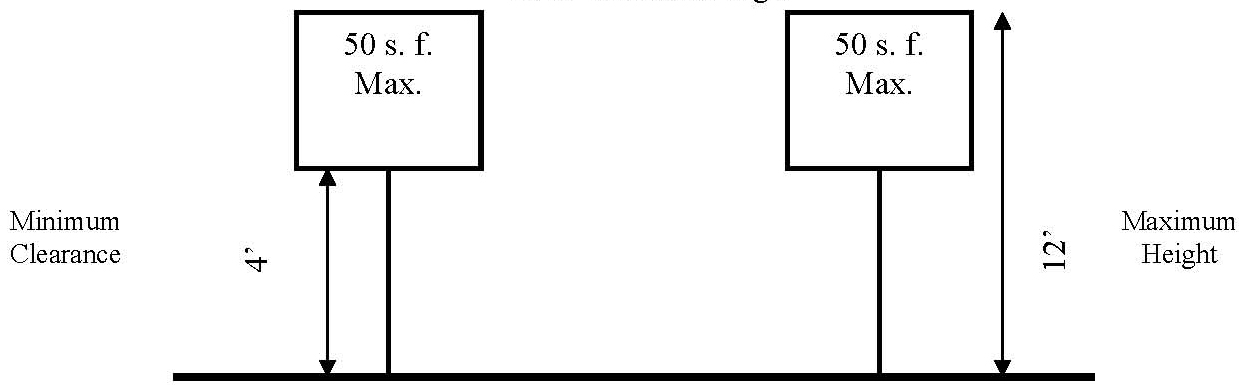
Pole-mounted sign. A pole-mounted sign shall not be greater than 12 feet in height with a sign face area of not more than 50 square feet and a minimum four-foot clear area between the ground and the bottom edge of the sign. The sign may be constructed or erected on one or more poles (Figure A).
ARTICLE XI-FIGURE A
Pole-Mounted Sign
2.
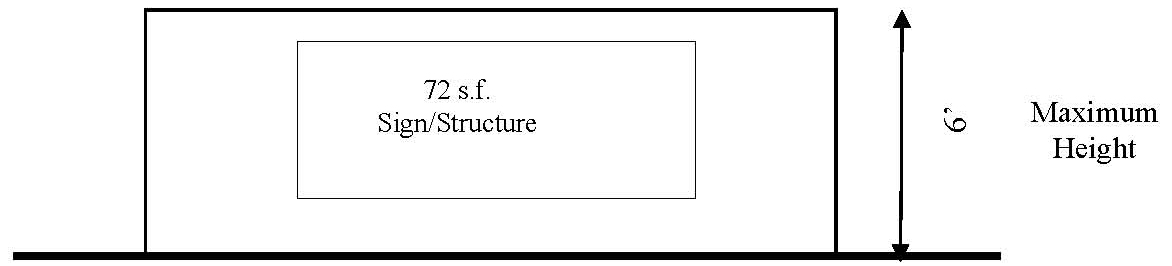
Ground-mounted sign. To encourage ground-mounted signs (either horizontally or vertically oriented), the maximum area of the sign face shall not be greater than 72 square feet. The maximum height of a ground-mounted sign structure shall not exceed six feet (Figure B). To further encourage ground-mounted signs, the total site permitted sign area may be increased to 96 square feet.
ARTICLE XI-FIGURE B
Ground-Mounted Sign
C.
Building-mounted signs. A building-mounted sign is a sign that is mounted flat on a wall or projecting from the building or roof or is part of a canopy. Only one building-mounted sign is permitted and its area is included in the calculation of total signage permitted for the development site. A building-mounted sign may be mounted on the roof, but shall not exceed the height of the building roofline or three feet, whichever is the lesser height. No building-mounted sign shall project more than three feet perpendicular from the building.
D.
Window advertising. Window advertising of the kind described in this paragraph shall not count against the total signage for a development site; however, it is regulated in the following manner. Not more than 25 percent of glass surfaces of windows facing a public street or right-of-way in any building may be utilized for signage or display of goods. This includes, but is not limited to, posters, fliers, advertisements or display racks.
(Ord. No. 11-01, § 2, 1-10-2011)
Sec. 11.9.2. - Drive-thru restaurant menu sign.
Drive-thru restaurants are permitted one outdoor menu board per drive-thru lane. The maximum sign face area shall not exceed 24 square feet, nor shall the sign structure exceed six feet in height. The menu board shall be set back a minimum ten feet from the property line and shall not count toward the total permitted signage for the development site.
(Ord. No. 11-01, § 2, 1-10-2011)
Sec. 11.9.3. - Business zoning district—Shopping/business center signs.
Shopping centers, professional or medical office centers, and new automobile dealerships make up a special category of business land uses. Because they are composed of a center owner and individual businesses within the center, the following signage is permitted:
A.
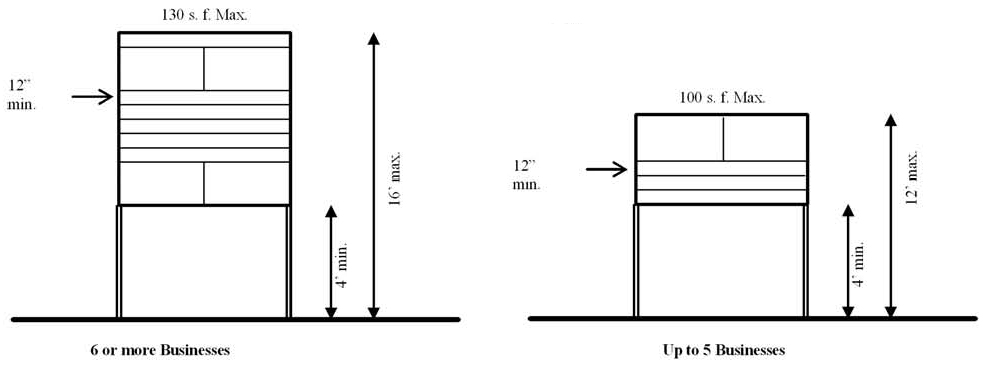
Pole-mounted sign. One pole-mounted sign is permitted along each front or street side yard that abuts an arterial or collector roadway. For the purposes of this section, on corner lots, the front yard shall be considered the largest street frontage dimension and any other street frontage shall be considered the street side yard. The maximum sign area is based on the number of tenants.
The maximum sign area and height for a sign along the front yard is limited as depicted in Figure C and shall contain not more than two sign faces. The maximum sign area and height along the street side yard shall be 50 percent of that permitted in the front yard. The sign may be constructed or erected on one or more poles. Business directories are inclusive of the total permitted sign area, not in addition to it. Individual business directory signs should be a minimum of 12 inches in height.
ARTICLE XI-FIGURE C
Business District
Free Standing Sign
B.
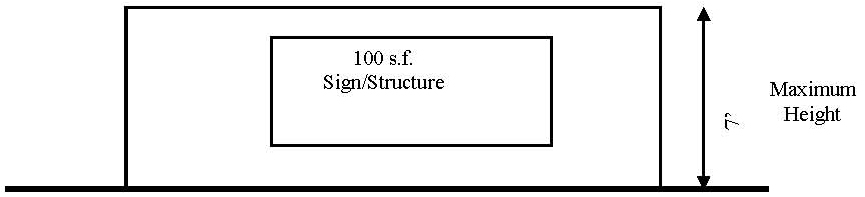
Ground-mounted sign. A maximum of two ground-mounted signs (either horizontally or vertically oriented) are permitted along the property's front yard that abuts an arterial or collector roadway. One additional sign is permitted on any street side yard that abuts an arterial or collector roadway. For the purposes of this section, on corner lots, the front yard shall be considered the largest street frontage dimension and any other street frontage shall be considered the street side yard. The maximum sign area per face for a ground-mounted sign in the front yard is 100 square feet (Figure D). The maximum sign area per face permitted along the street side yard is 72 square feet. The maximum sign height permitted is seven feet. Business directories are permitted as a part of this sign, but not in addition to it. Individual business directory signs should be a minimum of 12 inches in height.
ARTICLE XI-FIGURE D
Freestanding
Ground-Mounted Sign-Front Yard
C.
Business in a shopping/strip center. Individual businesses within a center are permitted one building-mounted sign, which includes a wall-mounted sign, projecting sign, awning sign and/or hanging sign. A building-mounted sign may be mounted on the roof but shall not exceed the height of the building roofline or be three feet in height, whichever is the lesser height. No building-mounted sign shall project more than three feet perpendicular from the building. Hanging signs shall provide for a minimum height clearance of eight feet from the ground or sidewalk to the bottom of the sign. The total building-mounted signage for an individual business in a shopping/strip center is based on the following table:
D.
Window advertising. Window advertising of the kind described in this paragraph shall not count against the total signage for a development site; however, not more than 25 percent of the glass surface of windows facing a public street or right-of-way in any building may be utilized for signage or occupied by any other opaque items that block the glass. This includes, but is not limited to, posters, fliers, advertisements, display racks, other interior furnishings, and similar materials or objects or a neon sign.
(Ord. No. 11-01, § 2, 1-10-2011)
Sec. 11.9.4. - Religious institutions.
Churches are permitted the following signage provided that all such signage is submitted for approval as part of an architecturally consistent sign package for the entire property:
A.
Wall signage square footage shall be limited to a maximum of 12 percent of the square footage of the façade of the building on which it is located. Such signage may or may not be illuminated and may consist of one or more signs. If wall signage is placed on more than one building façade, the total building wall signage square footage for each building shall be equal to or less than 12 percent of the square footage of that building's largest façade.
B.
One freestanding sign shall be permitted at a maximum height of eight feet and a maximum sign area square footage of 70 square feet per sign face. Such sign area may include an electronic message board or illuminated or non-illuminated signage. Display of the property address on the sign shall not be counted toward the square footage limitation. Such freestanding sign shall be setback a minimum of ten feet from all property lines.
(Ord. No. 11-01, § 2, 1-10-2011; Ord. No. 24-05, § 1, 4-8-2024)
Sec. 11.9.5. - Signs in residential zoning districts.
Certain uses that may be located in residential zoning districts are permitted to construct or erect signs as follows:
A.
Residential subdivision signs. Residential subdivision signs are permitted to display only the name of the subdivision, condominium or apartment complex. A residential subdivision sign shall be a ground-mounted or wall/fence-mounted sign. Ground-mounted and/or wall-mounted signs are permitted at each entrance. The total maximum area of the signage at each entrance, as seen from one side, shall not exceed 42 square feet in area. The maximum height of a ground-mounted and/or wall-mounted sign structure shall not exceed six feet.
(Ord. No. 11-01, § 2, 1-10-2011)
Sec. 11.9.6. - Signs in institutional land zoning district.
Uses in the institutional land zoning district are public or semi-public in nature and have the following on-site sign regulations:
A.
An institutional use identity sign shall be a ground-mounted or wall/fence-mounted sign. The maximum area of the sign face and structure as seen from one side shall not exceed 48 square feet in area. The maximum height of a ground-mounted or wall-mounted sign structure shall not exceed six feet. Two freestanding ground-mounted or wall-mounted signs, one on each side of every approved entrance, are permitted.
B.
One directory sign (a sign which gives the direction, name and/or address of the buildings) is permitted at each major entrance to the facility. Saint Leo University is permitted unlimited additional directory/directional signage internal (not located at a main entrance and set back at least 50 feet from C.R. 52 and campus boundaries) to the campus. The directory/directional sign shall not exceed 32 square feet in size and six feet in height as measured from finished grade.
C.
Each building is permitted one building-mounted sign not to exceed 24 square feet in size and four feet in height on each side of the building and one ground-mounted sign not to exceed 24 square feet in size and four feet in height. Each building entrance is permitted a maximum of 12 square feet of signage not to exceed two feet in height.
D.
An institution is permitted stadium scoreboards which are permitted to have advertising, at each athletic field not to exceed 20 feet in height as measured from finished grade. Scoreboards may be free standing or attached to a building.
E.
An institution is permitted an entrance sign which spans a main entrance point to the institution in the form of an arch. Such entrance archway sign is subject to the following:
1.
Shall be architecturally consistent as determined by the town commission, with the primary architecture of the institution;
2.
Shall not exceed a maximum height of 24 feet above the entrance roadway;
3.
Shall provide a minimum of 14 feet of clearance from the roadway at any point of the archway above the entrance roadway and 1.5 feet from the edge of the pavement of the entrance roadway to the supporting columns for the archway sign;
4.
Shall have a maximum combined sign area of 60 square feet; and
5.
Shall not be internally illuminated nor backlighted. White or yellow floodlights directed only at the sign face may be permitted provided they do not impair or cause glare to the vision of motorists, cyclists, or pedestrians using or entering the driveway or public right-of-way.
(Ord. No. 11-01, § 2, 1-10-2011; Ord. No. 12-01, § 5, 12-12-2011; Ord. No. 22-01, § 1, 12-13-2021; Ord. No. 26-02, § 3(Exh. B), 11-10-2025)
Sec. 11.9.7. - Signs in agricultural zoning district.
Uses in the agricultural zoning district have the following sign regulations:
A.
One sign with the name of the farm or agricultural business is permitted as a ground-mounted, entrance feature type (e.g., archway over entrance) or wall/fence-mounted sign with a maximum 24 square feet in size and four feet in height; however, an entrance archway feature type sign may be permitted up to 12 feet in height.
B.
One roadside stand sign (ground- or building-mounted sign) not exceeding 16 square feet in size and four feet in height, relative to the sale of farm produce, is permitted.
(Ord. No. 11-01, § 2, 1-10-2011)
Sec. 11.9.8. - Signs in permanently open land district.
Uses in the permanently open space zoning district have the following on-site sign regulations:
A.
A use identity sign shall be a ground-mounted or wall/fence-mounted sign. The maximum area of the sign face and structure as seen from one side shall not exceed 42 square feet in area. The maximum height of a ground-mounted or wall-mounted sign structure shall not exceed six feet.
B.
Each building is permitted one building-mounted sign not to exceed 24 square feet in size and four feet in height.
(Ord. No. 11-01, § 2, 1-10-2011)
Sec. 11.10. - Maintenance.
All signs, including their supports, braces, guys and anchors, electrical parts and lighting fixtures, and all painted and display areas, shall be maintained in accordance with the building and electrical codes adopted by the Town of St. Leo and shall present a neat and clean appearance. The vegetation around, in front of, behind, and underneath the base of ground signs for a distance of ten feet shall be neatly trimmed and free of unsightly weeds, and no rubbish or debris that would constitute a fire or health hazard shall be permitted under or near the sign.
(Ord. No. 11-01, § 2, 1-10-2011)
Sec. 11.11. - Nonconforming signs.
A sign that legally existed prior to the adoption of this article that does not strictly comply with the regulations of this article is both a legal nonconforming use and a legal nonconforming structure. Every nonconforming sign shall be brought into compliance with the regulations of this article under certain conditions.
A.
Damage requiring compliance. Nonconforming signs shall be maintained in the same good appearance and safe condition as required by this chapter and the town's building code for conforming signs and structures in the town. Nonconforming sign structures that become damaged from any cause and are deemed by the building official to no longer comply with the building code shall be removed within 30 days. The sign may be replaced with a sign and structure that is in compliance with these regulations.
B.
Alterations and modifications requiring compliance. Alterations, modifications and other changes can result in the loss of the legal nonconforming status of a sign and/or sign structure. The following activities or circumstances constitute alterations, modifications, changes and actions that result in the loss of legal nonconforming status and the requirement that the sign and/or sign structure be brought into full compliance with this article or removed entirely.
1.
A change in the land use conducted on the development site. A change of land use for the purposes of this article shall mean a change to a use with different sign regulations or a change from one zoning district to another zoning district.
2.
A change in ownership or the name of a business which involves the voluntary replacement of the face of a nonconforming sign, even though the business and other structures on the development site are not otherwise altered. Individual business directory boards for nonconforming shopping center signs may be changed without requiring the entire nonconforming sign to be brought into compliance.
3.
Relocation or replacement of a nonconforming sign structure, whether voluntarily by the owner of the business or because of the required relocation of the nonconforming sign structure due to an acquisition or taking associated with a public improvement, shall require the sign to be brought into compliance with this chapter.
4.
No sign may be altered in such a way that it increases the degree of nonconformity. Any alteration or renovation of a sign that exceeds 25 percent of its replacement value shall require the sign to be brought into compliance with this chapter.
5.
Movement, in whole or in part, of a legal nonconforming sign structure to another location on the same parcel or lot that it occupies, or transportation of the sign to any other parcel of land in the town, unless such movement or transportation shall render the sign and/or sign structure fully conforming with this article, shall be prohibited.
(Ord. No. 11-01, § 2, 1-10-2011)

