
Saint Leo City Zoning Code
ARTICLE XII
LANDSCAPE BUFFERING AND TREE PROTECTION4
Editor's note—Ord. No. 20-04, § 1, adopted July 13, 2020, amended Art. XII in its entirety to read as herein set out. Former Art. XII, §§ 12.0—12.6.11, pertained to similar subject matter and derived from Ord. No. 11-01, § 2, 1-10-2011; Ord. No. 12-01, § 6, 12-12-2011; Ord. No. 19-14, § 1, 10-14-2019.
Sec. 12.0.- Landscape buffering: Purpose and intent.
A.
The intent is to provide for general landscaping requirements for development and the buffering between potentially incompatible land uses and associated activities through landscaping. Associated activities include, but are not limited to open spaces, stormwater ponds, vehicular use areas, loading dock areas and outdoor storage.
Sec. 12.1. - Definitions.
A.
Definitions.
1.
Diameter at breast height (DBH) means the diameter of the tree measured at four and one-half feet above the existing grade.
2.
Canopy trees are plant specimens that have a three-inch DBH or greater, are at least ten feet in height, and are of the following Florida native species:
1.
Pine (Pinus spp. except pinaster).
2.
Live oak (Quercus virginiana or geminata).
3.
Laurel oak (Quercus hemispherica or laurifolia).
4.
Eastern red cedar (Juniperus virginiana).
5.
Maple (Acer spp. except platanoides).
6.
Cypress (Taxodium spp.).
7.
Magnolia (Magnolia spp.).
8.
Sweet gum (Liquidambar styraciflua).
9.
Royal palms (Roystonea regia).
10.
Coastalplain willow (Salix caroliniana).
11.
Hickory (Carya spp.).
12.
Other Florida native trees not listed above as determined to be an acceptable, regionally- and site-appropriate canopy tree through the review process or other Florida-friendly trees as determined to be an acceptable, regionally- and site-appropriate canopy tree in the review process. The Florida-friendly plant list as most recently updated by University of Florida/IFAS will be utilized as a guide in the approval of appropriate plant materials.
3.
Understory trees are plant specimens that have a one and one-half-inch DBH or greater, are at least five feet in height and are of the following Florida native or Florida-friendly species: Crape myrtle (Lagerstroemia spp.); bottle-brush (Callistemon spp. except viminalis); yaupon holly (Ilex vomitoria); Florida privet (forestiera segregata); wax myrtle (Myrica cerifera); or other specimen determined to be an acceptable understory tree through the review process. The Florida-friendly plant list as most recently updated by the University of Florida/IFAS Extension will be utilized as a guide in the approval of appropriate plant materials.
4.
Shrubs are plant specimens at least 24 inches in height and are of the following Florida native or Florida-friendly species: India hawthorn (Rhaphiolepis spp.), pittosporum (Pittosporum spp.), viburnum (Viburnum spp.), azaleas (Rhododendron spp.), junipers or other specimen determined to be an acceptable shrub through the review process. The Florida-friendly plant list as most recently updated by the University of Florida/IFAS Extension will be utilized as a guide in the approval of appropriate plant materials.
5.
Palm trees are plant specimens having a minimum of ten feet of clear trunk including, but not limited to royal palms or other Florida native or Florida-friendly species determined to be an acceptable palm tree through the review process. The Florida-friendly plant list as most recently updated by the University of Florida/IFAS Extension will be utilized as a guide in the approval of appropriate plant materials.
6.
Grand trees are plant specimens that have a 20-inch or greater DBH and are of a Florida native species.
7.
Exempt trees are plant specimens that have less than a five-inch DBH or are of the following species: Australian pine; Brazilian pepper, palms with the exception of royal palms, and any species listed as "Prohibited," "Invasive (No Uses)," "Invasive" or "High Invasion Risk" for central Florida by the University of Florida/IFAS Assessment of Non-native Plants in Florida's Natural Areas.
(Ord. No. 20-04, § 1, 7-13-2020; Ord. No. 26-02, § 3(Exh. B), 11-10-2025)
Sec. 12.2. - General landscaping requirements.
A.
All new residential development shall provide or preserve on site a minimum of three canopy trees as defined in this article, per dwelling unit in addition to any other required landscaping as identified on the site plan or through plat approval. Prior to the issuance of a certificate of occupancy, the building inspector shall verify that said landscaping is provided.
B.
All new commercial and institutional development shall provide or preserve on site a minimum of 20 canopy trees as defined in this article, per acre in addition to any other required landscaping as approved through the required site plan review process. Prior to the issuance of a certificate of occupancy, the building inspector shall verify that said landscaping is provided.
(Ord. No. 20-04, § 1, 7-13-2020; Ord. No. 26-02, § 3(Exh. B), 11-10-2025)
Sec. 12.3. - Landscape buffers between potentially incompatible uses.
A.
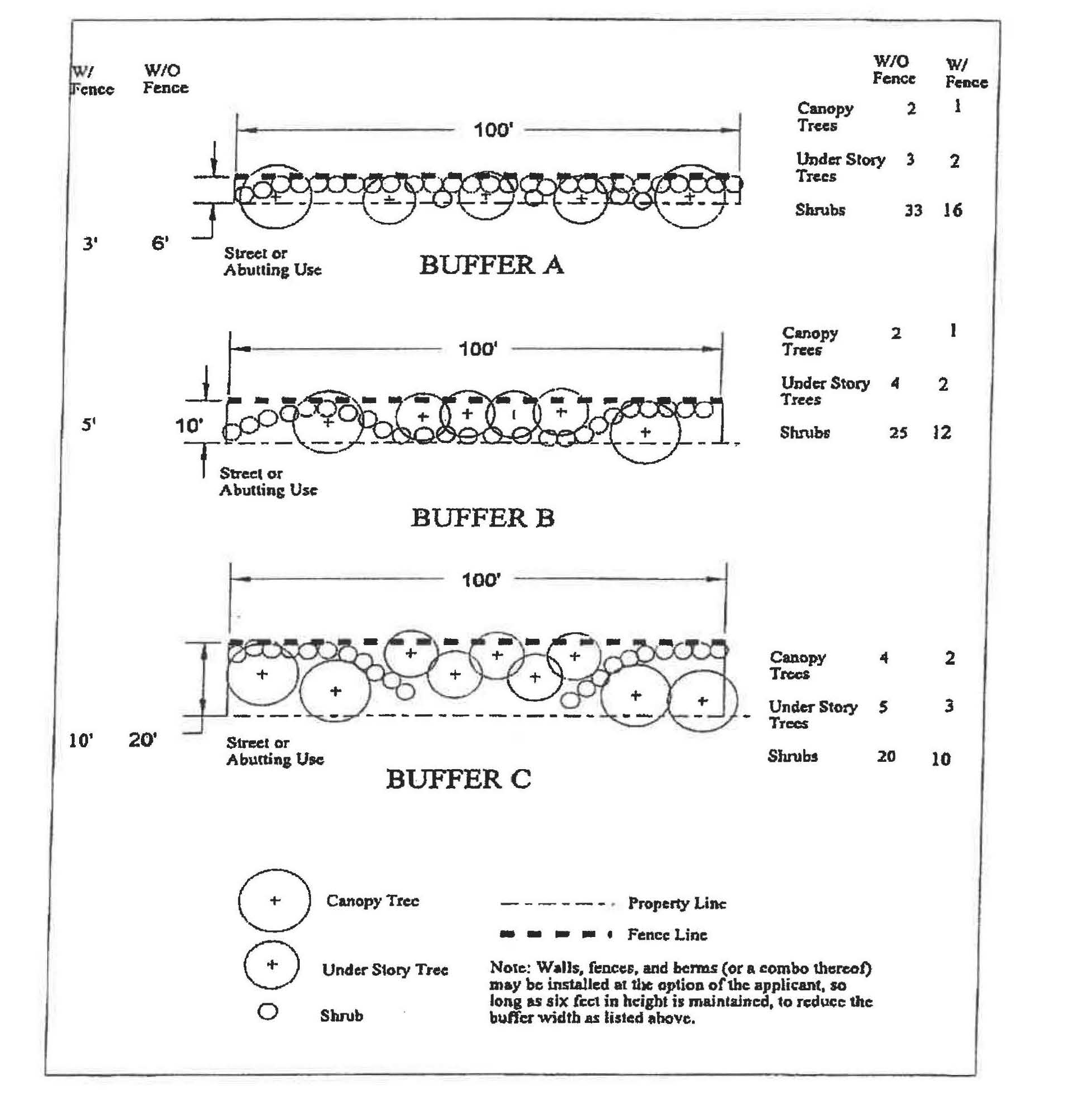
Required landscape buffering is in accordance with the landscape buffer matrix (Table A), which establishes buffer types and requirements from abutting uses. Figure A illustrates the planting requirements for each buffer type. The buffer width requirements are based on two landscaping alternatives: the provision of landscaping only or the provision of landscaping with a fence, decorative masonry wall or berm. Where a wall or solid fence is provided or required by this section, all landscaping shall be in front of the wall or fence. All landscape buffers are required to be irrigated with an in-ground water efficient system and, where possible, utilize reclaimed water.
B.
Buffer and landscaping requirements for special exception uses as defined in the zoning district use matrix shall be established by the town commission as part of the special exception use approval process, but shall, at a minimum, conform with Type B buffer requirements, except as provided for in this section.
C.
Vehicle sales, service stations, convenience stores with or without gas pumps, restaurants with drive-throughs, lounges and bars and shopping centers and other similar permitted or special exception uses, because of their level of activity and hours of operation, require greater buffering from abutting single-family and multifamily residential districts. The required landscape buffer width shall be ten feet, landscaped pursuant to the Type B buffer requirements and shall provide a six-foot high decorative, solid fence or masonry wall.
D.
Planting requirements.
1.
The required landscaping shall be based on the number of plants per 100 linear feet or fraction thereof (rounding up to the nearest whole number). At least 80 percent of all canopy and understory trees shall be site and regionally appropriate native species. Credit shall be given for existing on-site healthy native canopy trees that are located along the property boundary. Credit for existing healthy trees is as follows: One canopy tree for each tree between three-inch DBH and less than a ten-inch diameter at breast height (DBH) and two canopy trees for each tree with a ten-inch DBH or greater. Existing healthy understory trees a minimum one and one-half inch DBH will be credited on a one to one basis. The substitution of three palm trees or two understory trees for each required canopy tree may be approved through the review process. All landscape planting materials shall be Florida Grade No. 1.
E.
Maintenance and management.
1.
All required landscaping and irrigation shall be maintained and managed to ensure efficient water use, prevent wasteful practices and promote healthy and proper tree, shrub and turf/grass growth. Maintenance shall include utilizing best management practices such as proper pruning, mulching and periodic sprinkler system maintenance.
2.
Should the town commission or its designee find that required landscaping is not being properly maintained or has died, the property owner shall be required to replace the landscaping pursuant to a compliance time prescribed by the town commission or its designee or be subject to Article XVII.
ARTICLE XII—TABLE A
Landscape Buffer Matrix
Notes:
1 Refer to zoning district use matrix for a list of permitted and special exception uses for each of the above general use categories. "N" refers to no buffer required. The letters "A," "B," and "C" refer to type of required buffer and are described in Figure A below.
2 If the abutting use is vacant land or the abutting use is a nonconforming use, then the buffer shall be based solely on the zoning district.
3 All development along C.R. 52, except for single-family homes, shall provide a Type C buffer. Development along other road rights-of-way refer to Table A for the required buffer.
4 Institutional and business uses, because of their level of activity and scale of development, require greater buffering from abutting single-family and multifamily residential districts. The minimum required landscape buffer width shall be 20 feet, landscaped pursuant to the Type C buffer planting requirements, and shall provide a six-foot high decorative solid fence or masonry wall. The required landscaping must be placed in front of the fence/wall.
ARTICLE XII—FIGURE A
Buffer Types and Requirements 1
Note:
1 Refer to section 12.1 for permitted tree species and section 12.3 for planting requirements.
(Ord. No. 20-04, § 1, 7-13-2020; Ord. No. 26-02, § 3(Exh. B), 11-10-2025)
Sec. 12.4. - Vehicular use area landscaping requirements.
A.
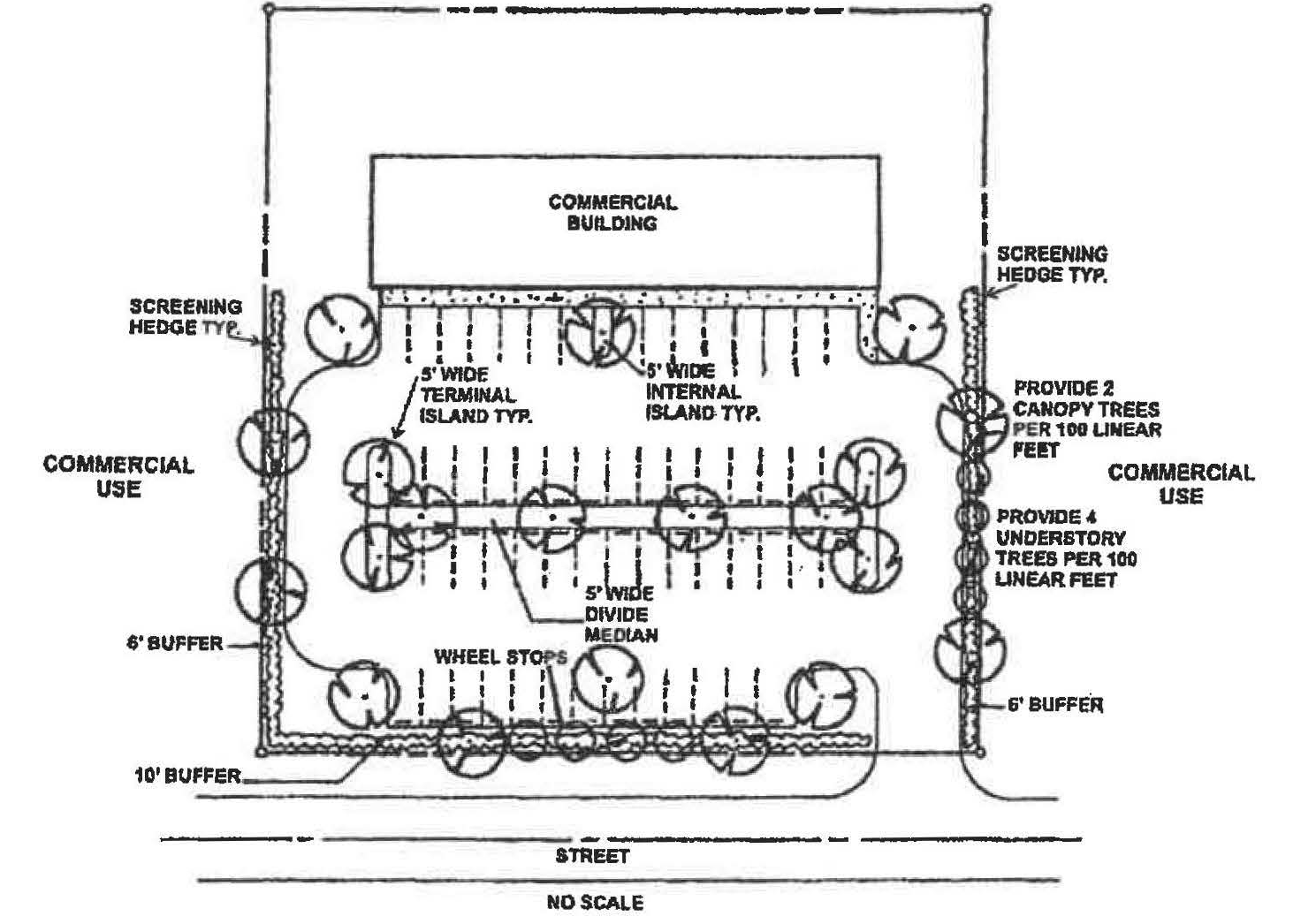
Vehicular use areas (all areas used for the circulation, parking, and/or display of any and all types of vehicles, boats, or heavy construction equipment, whether self-propelled or not, and all land upon which vehicles traverse, including parking lot driveways) shall provide at a minimum a Type B landscape buffer along the perimeters of the vehicular use areas that abut adjacent property boundaries or rights-of-way. Where a greater buffer is required pursuant to Table A of this article, then the greater buffer requirement shall be provided. One landscaped island shall be provided at the terminal end of each row of parking and one landscaped island is required for each ten parking spaces (see Figure B).
B.
Where a parking lot perimeter does not abut an adjacent property or right-of-way, then a minimum perimeter buffer width of five feet with one canopy tree/30 linear feet is required. One landscaped island shall be provided at the terminal end of each row of parking and one landscaped island is required for each ten parking spaces (see Figure B).
C.
Vehicular use areas shall provide a minimum ten percent of the total vehicular use area in interior landscaped open space. Perimeter landscape buffers provided in excess of the perimeter requirement can be counted toward meeting the interior open space requirement.
D.
Interior landscape islands shall be at a minimum five feet in width. Where a linear landscaped divider median (minimum five feet in width) is provided to separate parking spaces, one landscaped island shall be provided at the terminal end of each row of parking. Where a linear landscaped divider median is not provided, then one landscaped island is required for each ten parking spaces (see Figure B).
E.
Interior and perimeter landscaping shall provide at a minimum one canopy tree for each terminal end landscape island. One canopy tree shall be planted for each 30 linear feet of a landscape divider median (see Figure B).
ARTICLE XII—FIGURE B
Parking Lot Landscape Example
(Ord. No. 20-04, § 1, 7-13-2020; Ord. No. 26-02, § 3(Exh. B), 11-10-2025)
Sec. 12.5. - Nonconforming landscape buffers and vehicular use area landscaping requirements.
A.
An existing development that does not comply with the requirements of this article must be brought into full compliance when one of the following occurs:
1.
The site building square footage is increased by 25 percent or more or the vehicular use area is replaced or paved.
2.
Site and/or building renovations exceed 50 percent of the assessed value of the property (buildings and land) per the Pasco County Property Appraiser's records.
Sec. 12.6. - Open space and stormwater pond landscaping requirements.
A.
Required open space areas shall be landscaped with one canopy tree or two understory trees for each 2,000 square feet of open space area.
B.
Stormwater ponds located adjacent to public right-of-way or private property shall be landscaped along the top of the bank with one canopy tree or two understory trees for every 50 linear feet. pond slopes shall be planted with grass and/or plants as recommended by the Southwest Florida Water Management District. Any fencing along the pond perimeter shall be decorative wood, PVC or composite fencing, wrought iron or simulated wrought iron, or black or green vinyl coated chain link fencing.
C.
Fifty percent of a stormwater pond may be located within the required perimeter buffer and/or parking lot buffer, provided the buffer planting requirement is met along the top of the bank.
Sec. 12.7.1. - Purpose and intent.
A.
To promote the health, safety and welfare of the current and future residents of the Town of St. Leo by establishing minimum standards for the regulation of the preservation, protection and removal of trees within the Town of St. Leo.
B.
Trees are declared as a significant natural and visual resource, particularly as related to protecting the aesthetic character of the forested areas and visual corridors (C.R. 52 and Lake Jovita) defined in the Town of St. Leo visual corridor study.
C.
Protecting trees maintains the aesthetic character and quality of the Town of St. Leo as adopted in the comprehensive plan. The aesthetic quality of the town is comprised of the forested shoreline of Lake Jovita and its surrounding hillside, and the forested hillsides along C.R. 52.
D.
Trees provide significant environmental benefits such as purifying and cooling the ambient air, providing shade, conserving energy, reducing noise levels, providing important habitats for wildlife, preventing soil erosion and flood control.
(Ord. No. 20-04, § 1, 7-13-2020; Ord. No. 26-02, § 3(Exh. B), 11-10-2025)
Sec. 12.7.2. - Tree removal permit not required.
A.
A tree removal permit is not required for any property within a residential zoning district or for a grand tree to be removed if the property owner possesses an on-site assessment performed and signed by an arborist certified by the International Society of Arboriculture (ISA), or a Florida licensed landscape architect, that the tree poses an unacceptable risk to persons or property. A tree poses an unacceptable risk if removal is the only means of practically mitigating its risk below moderate, as determined by the tree risk assessment procedures outlined in Best Management Practices—Tree Risk Assessment, Second Edition (2017). For property within a commercial or institutional zoning district, said documentation is required to be filed by the property owner or his/her designated representative with the town clerk.
B.
Lands classified as bona fide agricultural land for ad valorem taxation purposes pursuant to F.S. § 193.461 are exempt from this section, with the exception that a tree removal permit is required for the removal of any grand tree not posing an unacceptable risk to persons or property as assessed pursuant to Section 12.7.2.A.
C.
The removal of any exempt tree.
D.
Upon the declaration of a state of emergency pursuant to F.S. ch. 252, the town commission or their designee may temporarily suspend the enforcement of the requirements of this section in order to expedite the removal of damaged and destroyed trees in the interest of public safety, health, and general welfare. However, the removal of undamaged trees during the suspension of this section shall constitute a violation of this section punishable according to Section 12.8.
(Ord. No. 20-04, § 1, 7-13-2020; Ord. No. 26-02, § 3(Exh. B), 11-10-2025)
Sec. 12.7.3. - Tree removal permit required.
A.
Any commercial or institutional development requires a tree removal permit for any of the following:
1.
Removal of ten percent or more of the total trees on a property or development site.
2.
Removal or relocation of any canopy trees that are five-inch DBH or greater.
3.
Removal of a grand tree, except as specifically provided in Section 12.7.2.A.
B.
The removal of a grand tree on any property not within a residential zoning district requires approval by the town commission at a public hearing pursuant to the requirements of Section 9.1.
C.
Information required for a tree removal permit:
1.
Identify all canopy and native understory trees on the property, indicating the tree(s) to be removed either on a site plan or aerial photograph (scale of one inch: 200 feet or smaller). Plans or an aerial photograph shall delineate the tree species, height and size (DBH) to be removed.
2.
Provide photographs of any grand trees to be removed.
3.
Submit a written justification statement for the proposed tree removal based on the criteria contained in Section 12.7.4.A.
(Ord. No. 20-04, § 1, 7-13-2020; Ord. No. 26-02, § 3(Exh. B), 11-10-2025)
Sec. 12.7.4. - Issuance of a tree removal permit when required.
A.
The justification criteria identified below shall be addressed by the applicant for the tree removal permit:
1.
Demonstrate that the least number of trees are proposed to be removed in order to accommodate the proposed development.
2.
Demonstrate that the tree removal does not create a negative impact relative to the Lake Jovita and C.R. 52 visual corridors.
B.
No tree removal permit shall be issued along the Lake Jovita shoreline within the mean high water mark as defined in Section 7.9, except if the tree poses an unacceptable risk to persons or property as assessed pursuant to Section 12.7.2.A.
C.
The tree removal permit shall be reviewed in accordance with this article and the criteria listed above. Upon finding that the tree removal permit meets the above criteria, the town commission and/or its designee shall issue a permit.
(Ord. No. 20-04, § 1, 7-13-2020; Ord. No. 26-02, § 3(Exh. B), 11-10-2025)
Sec. 12.7.5. - Tree replacement.
A.
Minimum tree replacement size is three-inch DBH and ten feet in height, and Florida No. 1 grade quality or better.
B.
The replacement tree(s) shall be Canopy Trees as defined by this article. The replacement tree(s) may be located anywhere on the subject property. Required tree replacement is pursuant to subsections (C), (D), and (E) below or by providing replacement trees (greater than three-inch DBH) equivalent to the total required DBH.
C.
The minimum number of replacement trees for the removal of a canopy tree between five-inch DBH but less than ten-inch DBH is at a ratio of two canopy tree replacement trees for each tree removed. Palm trees may be utilized as replacement trees at a ratio of three palms per required replacement tree.
D.
The minimum number of replacement trees for removal of a canopy tree between ten-inch DBH to less than 20-inch DBH is at a ratio of three canopy tree replacement trees for each tree removed.
E.
The minimum number of replacement trees for removal of a grand tree is at a ratio of four canopy tree replacement trees for each grand tree removed.
F.
Pursuant to approval by the town commission, tree replacement may be achieved by contribution to the Town of St. Leo Tree Mitigation Fund as outlined in section 12.7.8.
G.
Required landscape buffers and parking lot landscaping cannot be utilized to meet the tree replacement requirement.
Sec. 12.7.6. - Tree protection relative to land development.
A.
All trees not permitted for removal shall be protected from land development activities (land grading and grubbing and stormwater) and building (new buildings and additions) and road construction activities. Protective barriers shall remain in place until completion of the land development and construction activity.
B.
Protective barrier means a physical structure composed of wood, metal or other substantial materials of at least four feet in height. The barrier shall be constructed around the tree or groups of trees and located at least six feet from the base of the tree or tree group.
C.
Topping, pruning or trimming a tree inconsistent with the American National Standards Institute (ANSI) A300 Tree Care Standards, as amended, which is incorporated by reference, is prohibited.
(Ord. No. 20-04, § 1, 7-13-2020; Ord. No. 26-02, § 3(Exh. B), 11-10-2025)
Sec. 12.7.7. - Variances to building setbacks and parking requirements to preserve trees.
The town commission or its designee may grant administrative variances to building setbacks and/or parking requirements and standards in order to preserve canopy or grand trees, to avoid power lines, or in other special circumstances as determined by the town commission.
(Ord. No. 26-02, § 3(Exh. B), 11-10-2025)
Editor's note— Ord. No. 26-02, § 3(Exh. B), adopted Nov. 10, 2025, amended LDC § 12.7.7 in its entirety, in effect repealing and reenacting said LDC § 12.7.7 to read as set out herein. The former LDC § 12.7.7 pertained to waivers to building setbacks and parking requirements to preserve trees and derived from Ord. No. 20-04, § 1, adopted July 13, 2020.
Sec. 12.7.8. - Tree mitigation fund.
A.
A tree mitigation fund is hereby established as a separate revenue line item, which consists of all monies collected pursuant to this article or as budgeted by the town commission. Revenues from the tree mitigation fund shall be used solely for the purchase, planting and maintenance of trees on Town of St. Leo property, properties designated permanently open land or within street rights-of-way.
B.
In lieu of providing on-site replacement trees for the removal of trees required by Section 12.7.5, the property owner and/or developer shall have the option to make a cash contribution in the amount of the total retail cost of the number of replacement canopy trees required but not provided on-site, plus installation costs and administrative fees as established by the town commission. The retail cost per replacement canopy tree, as established by the town commission, shall be based on the cost for a canopy tree of Florida No. 1 grade quality or better.
(Ord. No. 20-04, § 1, 7-13-2020; Ord. No. 26-02, § 3(Exh. B), 11-10-2025)
Sec. 12.7.9. - Appeals and variances.
A.
An appeal to the denial of a tree removal permit by the town commission or its designee or a request for a variance to the provisions of this article can be filed with the town clerk under the provisions of article IX.
Sec. 12.8. - Violations and penalties.
A.
Whenever a violation(s) of this section occurs or exists, or has occurred or existed, any person, individual, entity, or otherwise who has legal, beneficial, or equitable interest in the facility or instrumentality causing or contributing to the violations, and any person, individual, entity, or otherwise, who has legal, beneficial, or equitable interest in the real property upon which such violation(s) occurs or exists, or has occurred or existed, shall be liable for such violation(s).
B.
Fines, penalties, remedies, and prosecution for any violation of this section shall be pursuant to article XVII, enforcement, penalties and remedies.

