
Seabrook Island City Zoning Code
ARTICLE 11
LANDSCAPING AND BUFFERING
Section 11.1 - Purpose.
The TOWN determines it is necessary and desirable to enact landscaping and tree preservation regulations for the protection of the public health, safety, and general welfare. The importance of plant material is recognized for its contribution to shade, cooling, noise and wind reduction, soil EROSION prevention, oxygen production, dust filtration, carbon dioxide absorption, aesthetic and economic enhancement of all real property, and its contribution to the general well-being and quality of life for the citizens of Seabrook Island. Consistent with the expressed purpose of this article, all PERSONs shall make reasonable efforts to preserve and retain certain existing, self-supporting trees, as defined in these regulations. It is also the intent of this article that all applicable sites within the TOWN maintain or obtain tree canopy coverage. In order to achieve these purposes, this article calls for the conservation, planting, and replacement of trees, SHRUBs, tall grasses, and groundcover while ensuring the reasonable use and enjoyment of real property.
Section 11.2 - General Provisions.
A.
Applicability. This article governs and regulates the following activities within the TOWN:
1.
All lands within the TOWN which are devoted to the following uses, as set forth below:
a.
Non-residential.
b.
MULTI-FAMILY.
c.
TOWNHOME.
2.
The SUBDIVISION of land.
3.
The planting, removal, and perpetual MAINTENANCE of trees within any common area or public land.
B.
Exceptions. The MAINTENANCE provisions of this article shall apply in all areas of the TOWN except those lands which may in the future be annexed into the TOWN and, on the effective date of that annexation, are improved by the construction of a BUILDING or other STRUCTURE, or have received final approval for residential SUBDIVISION, in compliance with the applicable zoning ordinance in force at the date of annexation. The removal and replacement of an existing individual BUILDING within a larger DEVELOPMENT shall also be exempt; provided such removal and replacement is less than 50 percent of the total floor area of all BUILDINGs within a single DEVELOPMENT.
Section 11.3 - Specific Landscaping Requirements.
A.
BUFFERs.
1.
BUFFER requirement.
a.
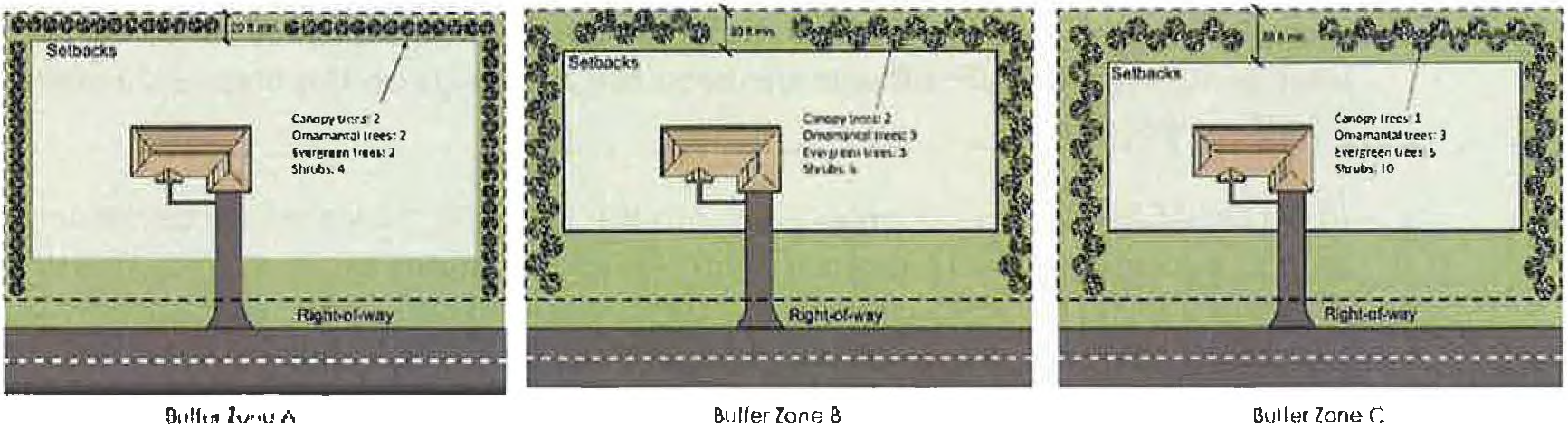
When proposed DEVELOPMENT abuts a less intense zoning district or use, a BUFFER zone shall be provided from the shared property line(s) with the less intense zoning district or use, as shown in Table 11-3.
b.
Where a BUFFER or trees and vegetation exist within the required BUFFER area, the existing trees and vegetation may count toward meeting the BUFFER requirements of this section and shall be supplemented, as needed, to fully comply with the requirements shown in Table 11-3a, BUFFER Zone Specifications.
c.
When two (2) adjoining parcels are vacant, no BUFFER shall be required until the more intensively zoned property or NONRESIDENTIAL USE for that property, as applicable, acquires a ZONING PERMIT.
d.
In calculating the area devoted to meeting the BUFFER requirements, areas dedicated for drainage ditches, EASEMENTs, or rights-of-way shall not be included.
2.
BUFFER materials. The BUFFER may consist of a combination of required plantings, wall, screen FENCE, or BERMs. In the event walls, FENCEs, or BERMs are used to provide screening within the BUFFER, the review authority may reduce the required number of trees and SHRUBs by up to 50 percent, if it is determined that the purpose of the BUFFER will still be achieved. However, where topographic conditions, minimal separation of uses, noise generation, or other characteristics of the property or use exist, the review authority may require construction of a FENCE, wall, or BERM in addition to the required plantings along all or a portion of the BUFFER.
a.
Plantings. Plantings shall consist of a combination of trees and SHRUBs, as specified in Table 11-3a. Planted areas shall be located along the abutting property lines in areas that will provide the most effective screening.
i.
Evergreen species, under normal growing conditions, shall attain a minimum height of eight (8) feet. The spacing of evergreens shall be such that within three (3) years the plantings can be expected to provide a continuous opaque screen.
ii.
All other trees and SHRUBs used within any BUFFER area shall conform to the size requirements specified in Table 11-4 at time of planting.
iii.
Existing trees and other vegetation within the BUFFER area shall be retained to the extent possible and may be counted toward meeting the applicable BUFFER requirement.
iv.
Protected trees, as defined in Section 11.6 B, shall be identified and the requirements of Section 11.6 shall be met.
b.
Walls. If walls are incorporated into the BUFFER, they shall be constructed of masonry material on both sides and be six (6) feet in height. The wall shall be placed along the interior side of the BUFFER with the required plantings on the outer side facing the adjoining property.
c.
FENCEs. If FENCEs are incorporated into the BUFFER, they shall be constructed of stucco, cypress, pressure-treated wood, or similar materials, in accordance with prevailing BUILDING industry standards for appearance, soundness, safety, and resistance to decay and weather. FENCEs shall be placed along the interior side of the BUFFER with the required plantings on the outer side facing the adjoining property.
d.
BERMs. Earthen BERMs, if incorporated into the BUFFER, shall have a slope of 3:1 and a flat-topped crown at least two (2) feet wide. Plant material shall be placed along the top of the BERM and the side slope facing the adjoining property. BERMs shall not exceed six (6) feet in height and shall be undulated to provide a more natural appearance.
3.
BUFFER design. All BUFFERs required by this article shall conform to the following specifications:
a.
Landscape plans and tree surveys shall be required to show the types and locations of all existing and proposed plantings within a required BUFFER.
b.
Landscaping within BUFFER areas shall be used to screen objectionable views or nuisances, such as parking and service areas, loading docks, outdoor activity areas, refuse containers, air conditioning units, and transformers. To achieve such purposes, trees may be clustered rather that uniformly spaced to provide optimum screening and BUFFERing.
c.
Protected trees within the BUFFER area shall be regulated in accordance with Section 11.5.
4.
BUFFER location. BUFFERs shall be located on the outer perimeter of a LOT or parcel along the lot lines between dissimilar zone districts or residential and NONRESIDENTIAL USEs within the same district. BUFFERs shall not be located on any portion of existing, dedicated, or reserved public or PRIVATE STREET right-of-way. No BUFFER shall be required along a property line where a public or PRIVATE STREET separates two (2) properties which otherwise would be BUFFERed from one another. BUFFERs shall not be located beyond the SCDHEC-OCRM CRITICAL LINE and may be waived by the review authority where the established SCDHEC-OCRM depth and/or vegetation within the CRITICAL AREA is sufficient to satisfy the intent of the BUFFER requirement.
5.
Modification of requirements. The requirements of this article may be waived or modified by the review authority, in accordance with the provisions of Section 11.5 B, under any of the following conditions:
a.
If it is clearly demonstrated that the existing topography and/or vegetation will achieve the purposes of this article;
b.
If it is clearly demonstrated that, for topographic reasons, no required screening device could reasonably screen the ground level activities of the use from the first-floor view of the abutting STRUCTURE or use; or
c.
The adjoining property owners mutually agree in writing that the required BUFFER is not necessary for a satisfactory use and enjoyment of their property rights, and such agreement is made and recorded as a covenant running with each parcel or parcels of land.
6.
Use of BUFFERs. A BUFFER may be used for some forms of passive recreation such as pedestrian, bike, or equestrian trails, or as stormwater retention, detention, or water quality area provided that:
a.
No planted materials shall be eliminated;
b.
The total width of the required BUFFER area shall be maintained; and
c.
The effectiveness of the desired screening shall not be diminished.
7.
Driveways in BUFFERs. Except in limited circumstances, no driveway shall be constructed within a required BUFFER area. The reviewing authority may permit a driveway to encroach within a required Buffer, subject to the following conditions:
a.
The driveway is intended to provide internal connectivity between two (2) or more adjacent properties;
b.
The driveway is constructed roughly perpendicular to the property line, rather than parallel to the property line, so that the extent of the encroachment into the BUFFER area is minimized to the greatest extent feasible; and
c.
The DEVELOPER shall provide enhanced screening in the vicinity of the encroachment to meet the intent of this section.
8.
MAINTENANCE. The responsibility for MAINTENANCE shall remain with the owner of the property. Any required plant that has died shall be REPLACEd. MAINTENANCE of planted areas shall consist of mowing, removal of litter and dead plant materials, and necessary pruning. FENCEs and walls shall be kept in a condition that meets the requirements of this article.
9.
Failure to comply. Any failure to comply with the requirements of this article shall be subject to the enforcement and penalty provisions of this ordinance, per Article 22.
10.
Surety for BUFFER installation. When the date for issuing a certificate of occupancy does not coincide with the planting conditions that are necessary to install a required BUFFER, the ZONING ADMINISTRATOR may accept a surety for the BUFFER installation. The amount of the surety shall be at least 150% of the total cost of completing and/or planting the required BUFFER. The required surety shall be in the form of a cash deposit, certified check, irrevocable bank letter of credit, or surety bond acceptable to the TOWN. Such surety shall be considered part of the tree and landscape PERFORMANCE GUARANTEE required by this article.
B.
Screening of Storage, Service, and Dumpster Areas.
1.
Outdoor storage, service, trash storage, and similar areas, for all uses other than SINGLE-FAMILY and TWO-FAMILY dwellings, shall be screened with permanent walls when visible from adjacent properties or public or PRIVATE STREETs, in accordance with the following:
a.
The design and materials of a screening wall shall be the same architectural style as the principal BUILDING or BUILDINGs on the LOT.
b.
Except where otherwise allowed by these regulations, any wall shall be opaque to prevent the passage of light and debris.
c.
The height of a wall shall be adequate to block views to the area being screened, but shall not exceed eight (8) feet, except as otherwise allowed by this section.
d.
The height of a wall shall be measured from the FINISHED GRADE at the base of the STRUCTURE to the top of the wall but shall not include columns or posts.
e.
Walls shall be interrupted at intervals not exceeding 25 feet by architectural features such as pilasters or columns, or by various species of plants that are at least as tall as or taller than the wall.
f.
Such walls shall encroach no more than 50% into any required SIDE YARD or REAR YARD SETBACK, unless otherwise approved by the reviewing authority.
2.
Additionally, the reviewing authority may require that evergreen plantings be provided along the wall that, at maturity, will screen at least 25 percent of the wall face area. Such plantings may be required based on the proximity of the wall to adjoining property, the compatibility of the adjoining uses, or the nature of the area being screened.
C.
PARKING LOTs.
1.
PARKING LOT perimeter. All PARKING LOTs shall be screened from the adjacent street and abutting property by a perimeter landscaped strip in accordance with the following requirements:
a.
The landscape strip shall be located within five (5) feet of the edge of the paved surface area.
b.
The landscape strip shall be at least 20 feet wide and, at a minimum, contain the following:
i.
A solid row of SHRUBs, hedges, or tall grasses not less than three (3) feet in height extending along the length of the paved surface. The SHRUBs, hedges, or tall grasses shall be of sufficient size and spacing to attain the required height and opacity of at least 75 percent within two (2) years of planting.
ii.
One (1) canopy tree for each 50 linear feet, or part thereof, of perimeter paved area to be screened shall be provided. Trees shall be evenly spaced within the landscaped strip unless the reviewing authority permits otherwise during the review of the SITE DEVELOPMENT PLAN. In considering a deviation from the uniform spacing requirement, the reviewing authority shall consider the presence of existing trees, sight lines from adjacent streets or property, and the distance of the parking area from the street or abutting property.
c.
Where the required PARKING LOT screening would fall within or overlap with a required perimeter BUFFER requirement, the BUFFER requirements would prevail.
2.
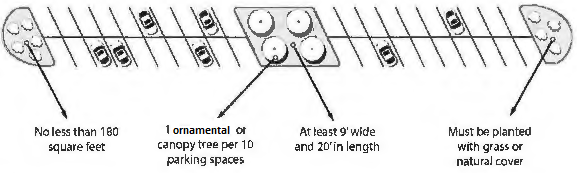
PARKING LOT interior. Interior planting islands shall be provided within all parking areas containing 10 or more PARKING SPACEs.
a.
One (1) landscape island having at least 180 square feet. in area and a minimum width of nine (9) feet shall be provided for every 10 PARKING SPACEs.
b.
Each required landscape island shall contain at least one (1) ornamental or canopy tree and be surfaced with grass, ground cover, SHRUBs, tall grasses, or other plant material or with at least two (2) inches of wood chips, bark, or pine straw.
c.
Landscape islands shall be located and dispersed in accordance with the following:
i.
Rows of PARKING SPACEs located adjacent to the perimeter of all paved areas shall contain no more than 10 PARKING SPACEs uninterrupted by a landscape island, and no PARKING SPACE in such a row shall be separated from a required landscape area by more than five (5) PARKING SPACEs.
ii.
Interior rows of PARKING SPACEs shall contain no more than 14 PARKING SPACEs uninterrupted by a required landscape area, and no PARKING SPACE in any such row shall be separated from a required landscape area by more than seven (7) PARKING SPACEs.
iii.
The review authority, during SITE DEVELOPMENT PLAN review, may allow an adjustment of the landscape island spacing to preserve existing trees, or where it is determined upon review that such adjustment is necessary to provide for the safe maneuvering of vehicles.
D.
Site Development.
1.
SUBDIVISIONs.
a.
During the construction of required SUBDIVISION IMPROVEMENTs, no more than 30 percent of the property's existing tree canopy may be removed. To ensure that this limitation is not exceeded, the PLANNING COMMISSION may require, during the SUBDIVISION approval process, that plans, calculations, aerial photographs, or other data be provided sufficient to allow an accurate determination to be made.
b.
Overstory canopy trees shall be provided on each SUBDIVISION LOT in accordance with the following requirements:
i.
One (1) tree of a minimum three (3) inch DBH, shall be planted for every 150 linear feet of right-of-way.
ii.
The tree(s) shall be located within five (5) feet of the right-of-way of each street within the SUBDIVISION.
iii.
Trees shall be planted no closer than 120 feet on-center.
iv.
Except where property on one side of the right-of-way is not owned by the subdivider, such trees shall be planted alternately on either side of the street.
2.
Other DEVELOPMENT. As a condition of approval for any property requiring site plan approval, there shall exist or be planted on the property within one (1) year of that approval, at least one (1) canopy tree for each 4,000 square feet of gross LOT AREA.
a.
Newly planted trees shall be installed according to the approved site plan and shall be distributed throughout the developed areas of the site to ensure the availability of shade and aesthetic relief throughout the site.
b.
Within 1,000 feet of the SCDHEC-OCRM beachfront jurisdictional line, palmetto trees may be substituted for canopy trees.
Section 11.4 - Materials, Installation, and MAINTENANCE.
A.
Material Standards.
1.
Existing trees within any required BUFFER landscaped area shall be preserved, unless dead or diseased. In addition, the following standards apply as a minimum to all newly planted landscape areas and additional trees needed to meet the respective requirements of this article.
a.
Indigenous and regionally appropriate plant species are required. Invasive species, as identified by the United States Forest Service, the South Carolina Forestry Commission, or included in Section D.3 (Appendix D), shall not be planted in the TOWN. Further, the replacement of invasive species with desirable hardwood species is strongly encouraged.
b.
All plant and tree material shall meet the American Standard for Nursery Stock standards that are published by and available from the American Association of Nurserymen.
c.
Tree and landscape materials selected for planting must be free from injury, pests, disease, nutritional disorders, or root defects, and must be of good vigor to assure a reasonable expectation of survivability.
d.
A variety of species shall be used within any DEVELOPMENT site and no more than 30 percent of any one (1) species shall be used.
2.
The minimum standards specified in Table 11-4 shall apply to all plantings required by this article at the time of planting, except as otherwise specified.
B.
Installation Standards.
1.
Installation of trees and landscape materials shall be in accordance with the standards established by the American National Standards Institute (ANSI).
2.
Root barriers shall be installed wherever a tree is planted less than seven (7) feet from the pavement edge of a street to prevent root penetration and destruction of infrastructure.
3.
Large, medium, and overstory trees shall not be planted underneath or directly adjacent to overhead power lines and shall be a minimum of 10 feet from any BUILDING or underground UTILITY unless a root barrier is used.
4.
Understory trees and palms shall be a minimum of five (5) feet from any BUILDING or underground UTILITY.
5.
All trees and landscaped areas shall be provided with a means for water delivery in a quantity sufficient to establish and maintain the viability of the plants.
a.
A water supply is not required for areas of established trees and other vegetation that are retained; provided, site grading or DEVELOPMENT activities will not result in damage to those areas.
b.
While an automatic irrigation system is preferred, at a minimum, all required plantings must be within 100 feet of a permanent water source.
c.
If an irrigation system is provided, it shall include a rain sensor, weather sensor, or other means of automatic shut off when irrigation is not needed due to actual climatic conditions.
C.
MAINTENANCE Standards.
1.
All plant material shall be maintained in good condition in accordance with standards established by ANSI. All required plantings that die or are destroyed must be REPLACEd, during the next suitable planting season.
2.
Attaching lights, signage, FENCE rails, and any other items to trees is prohibited.
3.
All sites are required to remain in compliance with the requirements of this article for DEVELOPMENT and are subject to inspection by the TOWN for this purpose. If deficiencies are found, the owner of the property shall be notified to correct the deficiencies within 90 days. If the deficiencies are not corrected in 90 days, the TOWN will seek administrative or judicial relief, as appropriate.
Section 11.5 - Tree Preservation.
A.
Tree Credit. Whenever the terms of this article require planting canopy trees on any LOT, credit shall be given for the preservation of existing trees which are properly protected during any clearing or construction on the property, are in good health, and meet the following criteria:
1.
Such trees must meet the requirements of this article for location, spacing, and type of tree.
2.
Trees less than four-inch DBH and 10-foot CROWN SPREAD shall not qualify for credit.
3.
Credit toward the requirements of this section shall be given in accordance with the following table for larger trees:
4.
To receive credit for the preservation of an existing tree, the following requirements must be met:
a.
Fifty percent of the area within the drip line of the tree shall be naturally preserved or provided with PERVIOUS landscape material and shall be maintained at its original grade with no trenching or cutting of roots in this area. Within this area, there shall be no storage of fill or compaction of the soil, as from heavy construction equipment or any evidence of concrete, paint, chemicals, or other foreign substances in the soil.
b.
The tree shall not be damaged from skinning, barking, bumping and the like.
c.
There shall be no evidence of active insect infestation potentially lethal to the trees.
d.
There shall be no IMPERVIOUS SURFACE or grade change within five (5) feet of the trunk.
5.
If it is determined by the ZONING ADMINISTRATOR that the above requirements have not been complied with, credit for an existing tree may nevertheless be given upon proof, satisfactory to the ZONING ADMINISTRATOR, from a certified arborist that such tree is healthy and has not been seriously damaged during DEVELOPMENT.
6.
If any tree for which credit was given pursuant to this ordinance is not alive and healthy one (1) year after all associated construction and DEVELOPMENT is completed, it shall be removed and REPLACEd with the tree or trees that would have been required originally. This shall be the responsibility of the developer of the subject property.
B.
Protected Tree Permit for Removal. No living tree which is 24 inches or more DBH may be removed or relocated without a removal permit, as provided for below. Trees that require such permit for removal or relocation shall be called "protected" trees.
1.
Permit Filing.
a.
An application for a permit to remove or relocate a protected tree shall be filed with the ZONING ADMINISTRATOR under the following conditions:
i.
If a protected tree is located outside an area regulated by SIPOA, or
ii.
In conjunction with any new DEVELOPMENT requiring approval of a site plan or SUBDIVISION PLAT, in which case such application shall be considered and either approved or denied by the PLANNING COMMISSION or ZONING ADMINISTRATOR, as applicable, at the same time a site plan or PLAT is approved.
b.
Any PERSON desiring to remove or relocate a protected tree on a residential LOT in an area which is subject to review and approval by SIPOA shall file an application and obtain prior approval from SIPOA for such tree removal.
2.
Application Submissions. All applications filed with the ZONING ADMINISTRATOR for removal of a protected tree shall include or be accompanied by the following information, which may be included in the proposed SUBDIVISION or SITE DEVELOPMENT PLAN or supporting documentation:
a.
A tree survey prepared by a licensed Engineer, Land Surveyor, Registered Landscape Architect, or Certified Arborist.
i.
The tree survey shall be of the same scale as, and superimposed on, the SUBDIVISION PLAT or SITE DEVELOPMENT PLAN.
ii.
The tree survey shall include the location, number, size (DBH), and species with a scaled graphic representation of each protected tree, along with the canopy size and shape, and trunk location
iii.
All protected trees within 40 feet of proposed DEVELOPMENT and trees within required buffers must be surveyed and mapped.
iv.
The tree survey shall include all trees to be protected or preserved, and those scheduled to be removed, including dead, diseased, and damaged trees.
b.
A statement of how any other protected trees are to be preserved during any approved tree removal or relocation and any associated construction or clearing.
c.
A statement identifying any proposed grade changes on the LOT and the precautions to be taken to ensure that such changes will not adversely affect or endanger any protected trees, which are not to be removed or relocated.
3.
Permit Approvals.
a.
Trees identified for removal on an approved site plan shall be marked as specified by the ZONING ADMINISTRATOR. Any tree not approved for removal shall not be removed.
b.
The ZONING ADMINISTRATOR, within 10 working days of the filing of such applications, shall verify the information contained in the application and either approve or deny the application as to each protected tree proposed to be removed or relocated.
c.
Applications for removal or relocation of protected trees shall only be approved if the ZONING ADMINISTRATOR determines that one (1) or more of the following conditions exist:
i.
The tree poses an imminent safety hazard to nearby BUILDINGs, pedestrians, or vehicular traffic;
ii.
The tree is diseased, dead or dying;
iii.
The tree has been weakened by age, storm, fire, or other injury to the extent that it is irreparably damaged; or
iv.
The tree removal has been approved by the Board of Zoning Appeals, pursuant to the provisions of this ordinance.
d.
Trees that do not meet the above criteria may be removed only where approved by the Board of Zoning Appeals, subject to the VARIANCE provisions of Section 20.3. Any trees so removed shall be REPLACEd according to a schedule determined by the Board. The ZONING ADMINISTRATOR will make recommendations to the Board concerning the number, species, DBH or caliper, and placement of such trees.
C.
Special Authorization. Regardless of the requirements of this section, the TOWN COUNCIL may authorize the cutting of protected trees for commercial timbering purposes upon such conditions as will ensure the preservation or replacement of an adequate tree population.
D.
Mitigation.
1.
Trees planted for mitigation of removed trees shall meet the performance standards of this article. Mitigation shall be based on replacing the species of tree that was removed with the same species; provided, species listed as invasive or prohibited in Section D.3 (Appendix D) shall not be used. In addition, the following requirements shall apply:
2.
Any tree at least six (6) inches DBH but less than 12 inches DBH retained within the area of disturbance may be retained to contribute, inch-for-inch, to a tree mitigation requirement; provided, the tree does not stand in a WETLAND, any required BUFFER or designated OPEN SPACE, or other area in which the tree would otherwise be required to be conserved.
3.
Tree species listed as invasive or prohibited in Section D.3 (Appendix D) may be removed and mitigated at one-half (½) the rate otherwise required by Table 11-5a; provided, the replacement trees shall be of a non-prohibited species.
4.
Trees planted for mitigation shall be in addition to those required for streetscapes, BUFFERing, and PARKING LOTs.
5.
In lieu of planting trees required for mitigation, the developer may, if approved by the PLANNING COMMISSION or ZONING ADMINISTRATOR, as applicable, pay a fee per caliper-inch in an amount set by TOWN COUNCIL. The fee shall be based on the current cost, at wholesale value, of installing a required tree to standards of the American Nursery and Landscape Association and its MAINTENANCE for one (1) year. Fees-in-lieu shall be put into an account reserved solely for the beautification of public lands and rights-of-way within the TOWN.

