
Seabrook Island City Zoning Code
ARTICLE 2
GENERAL PROVISIONS
Section 2.1 - General Compliance.
A.
Ordinance Compliance.
1.
Except as otherwise provided in this ordinance, no BUILDING, STRUCTURE, or premises shall be used or occupied; and no BUILDING or part of any BUILDING or other STRUCTUREs shall be erected, razed, moved, placed, reconstructed, extended, enlarged, or altered, except in conformity with the provisions of this ordinance.
2.
No LOT may be altered or diminished in size to less than the minimum requirements of this ordinance; provided, a LOT may be reduced below the requirements of this ordinance to meet the needs of a PRIVATE or PUBLIC UTILITY (e.g., a pumping station or electrical substation).
B.
Unlawful BUILDINGs and Uses. Any BUILDING, use, or LOT which has been unlawfully constructed, occupied, or created prior to the date of adoption of this ordinance shall continue to be unlawful, unless expressly permitted by this ordinance. Such unlawful BUILDINGs, uses, or LOTs shall not be considered to be NONCONFORMING BUILDINGs, uses, or LOTs of record and shall not be afforded any protections or allowances otherwise granted to legally NONCONFORMING BUILDINGs, uses, or LOTs.
C.
Withholding Approval. The TOWN COUNCIL, PLANNING COMMISSION, Board of Zoning Appeals, ZONING ADMINISTRATOR, or other authorized board, commission, or administrative staff may, in its sole discretion, withhold approval of any plan, use, or permit request pending receipt of permits or approvals from other local, county, state, or federal departments or agencies.
D.
Excavations or Fill.
1.
The construction, MAINTENANCE, or existence within the TOWN of any unprotected, unbarricaded, open, or dangerous excavations, holes, pits, or wells, which constitute or are likely to constitute a danger or menace to the public health, safety, or welfare, is hereby prohibited; provided, this subsection shall not apply to the following:
a.
Any excavation under a permit issued by the ZONING ADMINISTRATOR where such excavation is properly protected and warning signs are posted in such manner as approved by the TOWN; and
b.
Natural water bodies, marshes, ditches, reservoirs, and other such bodies of water created or existing by authority of governmental units or agencies.
2.
No property shall be increased in size by filling any CRITICAL AREA or WATERBODY by any method.
E.
Lighting.
1.
Purpose. The purpose of this subsection is to permit reasonable uses of outdoor lighting for night-time safety, utility, security, productivity, enjoyment, and commerce while minimizing the effects of excessive or uncontrolled light in order to:
a.
Maintain consistent and uniform light levels for traffic and pedestrian safety along streets, sidewalks, and in PARKING LOTs;
b.
Ensure uniform lighting for security and law enforcement;
c.
Minimize glare, obtrusive light, and artificial sky glow by limiting outdoor lighting that is misdirected, excessive, or unnecessary;
d.
Curtail and reverse the degradation of the nighttime environment and the night sky;
e.
Prevent impacts upon shoreline wildlife;
f.
Minimize light pollution and light trespass from light sources onto adjacent properties; and
g.
Conserve energy and resources to the greatest extent possible.
2.
Applicability. These provisions shall apply to all new DEVELOPMENT subject to this ordinance, unless otherwise specified. When a BUILDING, STRUCTURE, or lighting fixture is extended, enlarged, or reconstructed after the effective date of this ordinance, the applicable lighting standards shall apply.
3.
Exemptions. The following lighting types shall be exempt from the lighting standards of this subsection:
a.
Lighting within swimming pools or other water features that are governed by SCDHEC regulations;
b.
Exit signs, stairs, ramps, and other illumination required by BUILDING CODES;
c.
Holiday decorations;
d.
Lighting of the American and government flags; and
e.
Any lighting fixture that is exempt from the provisions of this subsection by state and/or federal law.
4.
Prohibitions. The following types of lighting features shall be prohibited:
a.
Search lights,
b.
Strobe lights,
c.
Laser source lights,
d.
Any similar high-intensity or flashing light, except in emergencies by police and fire personnel or at their direction, and
e.
Mercury Vapor fixtures.
5.
Standards. Unless otherwise specified, the following standards shall apply to lighting fixtures in all zoning districts and applications, except those located within a street right-of-way and approved by the TOWN or SIPOA.
a.
General.
i.
All exterior illuminating devices, except as may be specifically exempt, shall be hooded or shielded to prevent glare and light spill onto adjoining properties.
ii.
No light fixture shall exceed a height of 24 feet, measured from the ground to the top of the fixture; provided, the Planning Commission may approve taller fixtures for athletic fields where it is demonstrated that such fixtures will be properly positioned and shielded to prevent light trespass and glare onto adjoining properties; not impact shoreline wildlife; and not degrade the nighttime environment.
iii.
Light sources shall not be aimed at adjoining properties, streets, beaches, or upward, except in accordance with paragraph 5(d) below.
iv.
To control light spill and glare, lighting fixtures shall be properly aimed when installed, and proper aiming shall be maintained at all times.
v.
Canopy or under soffit fixtures shall be recessed into the soffit, shall not be visible from off-site, and shall not emit any glare.
vi.
No light fixture shall be permitted within 25 feet of the CRITICAL LINE or any BEACH TRUST property.
b.
Nonresidential Lighting
i.
Light levels in PARKING LOTs shall be reduced during non-business or non-use hours.
ii.
Signs shall not be illuminated between the hours of 11:00 PM and 6:00 AM or during any period of time when the establishment is not in use, whichever is more restrictive.
c.
Residential Lighting.
i.
Light fixtures in any residential district, including RESIDENTIAL USEs within the mixed-use district, shall not exceed 16 feet in height.
ii.
Light fixtures mounted on a BUILDING in a residential district may not be mounted above the 1st floor of the BUILDING.
iii.
Bollard lights are permitted to light driveways and pedestrian areas.
d.
Accent lighting. Accent lighting for sculptures, statues, trees, landscape features, flags, signs, architectural features, and entrances may orient light upward, provided the directed light shall be substantially confined to the object intended to be illuminated to minimize glare, sky glow, and light trespass. Accent lighting shall not shine directly into the window of a neighboring STRUCTURE or directly onto a street.
e.
Gas lamp fixtures. Fixtures with clear, seeded, and/or translucent glass are permitted only when used with low wattage "flicker" bulbs that mimic gas lamps. Use of frosted bulbs is not a substitute for using Dark Sky compliant fixtures. Lamp types shall produce a light color that is in the color spectrum between 2700 and 3100 Kelvin. Lamp types producing a light color outside this range (e.g., mercury vapor, sodium vapor, CFL, and others) are prohibited. All lamps/light fixtures shall provide a color rendering index (CRI) of 85 or higher.
f.
SIGN lighting. Illumination of signs shall comply with the requirements of Article 13. Internally illuminated signs are not permitted and light fixtures directed at a SIGN may only be permitted where the fixtures are shielded so not to cause visible glare to PERSONs on adjacent streets or adjacent property.
g.
Decorative or aesthetic light fixtures. The ZONING ADMINISTRATOR may approve decorative or aesthetic lighting fixtures, including those that do not orient all light downward, if the following conditions are met:
i.
The fixtures shall not exceed the maximum height specified in this subsection;
ii.
The fixtures shall offer a design element that is complementary to the architectural style of the adjacent BUILDING(s); and
iii.
The fixtures shall not negatively impact neighboring residential properties or any street right-of-way.
6.
Photometric Plan. A photometric plan, prepared by a registered lighting engineer, is required as part of any development plan reviewed by the PLANNING COMMISSION. The photometric plan shall be overlain on the development plan illustrating the proposed layout of lighting fixtures and foot-candles of site lighting. The following are required for review:
a.
Lighting plan showing light pole and fixture locations and type designations;
b.
Photometric plan showing horizontal luminance levels in a point-by-point format with contour lines. Canopy lighting will also be included in luminance levels;
c.
Lighting manufacturers' equipment specifications and data sheets on the photometric plan; and
d.
Any other presentations required to convey the intent of the design.
(Ord. No. 2024-06, § 1, 12-17-2024)
Section 2.2 - BUILDINGs.
A.
ACCESSORY BUILDINGs.
1.
ACCESSORY BUILDINGs or GARAGEs shall be considered to be part of the main BUILDING if structurally and architecturally integrated into the main BUILDING, or if attached by an enclosed breezeway or similar enclosed STRUCTURE.
2.
Detached ACCESSORY BUILDINGs shall not be located closer than 10 feet to the main BUILDING or any structural appurtenance attached to the main BUILDING, such as a PORCH or raised DECK.
3.
No ACCESSORY BUILDING, other than detached GARAGEs, shall be located in a FRONT YARD.
4.
Accessory STRUCTUREs, such as gazebos and similar roofed, but unenclosed, STRUCTUREs, shall not be permitted within a residential zoning district, except if attached to the principal dwelling.
5.
No ACCESSORY BUILDING shall be constructed on a LOT before the principal BUILDING or use is constructed or established on the LOT.
6.
Unless otherwise provided in this ordinance, ACCESSORY BUILDINGs and GARAGES shall meet the minimum SETBACK requirements for principal BUILDINGS in all zoning districts.
7.
If a detached GARAGE is accessed from an alley, there shall be no rear SETBACK requirement.
8.
The maximum total floor area of all ACCESSORY BUILDINGs on a SINGLE-FAMILY LOT shall not exceed 50 percent of the ground floor area of the dwelling or 600 square feet, whichever is less.
9.
In the R-CL, R-TH, and R-MF districts, detached GARAGEs shall be exempt from limits on number and size. In addition, up to three (3) ACCESSORY BUILDINGs serving a DEVELOPMENT of multiple-family or TOWNHOME units may be permitted for MAINTENANCE and storage.
10.
The area of ACCESSORY BUILDINGs shall be included in the maximum LOT COVERAGE.
11.
The maximum BUILDING HEIGHT of an ACCESSORY BUILDING shall not exceed 14 feet.
12.
No ACCESSORY BUILDING, except as may otherwise be permitted in this ordinance, shall be occupied or rented for RESIDENTIAL USE.
B.
Restoring Unsafe BUILDINGs. Nothing in this ordinance shall prevent the strengthening or restoration to a safe condition of any part of any BUILDING or STRUCTURE declared unsafe by the BUILDING OFFICIAL or required to comply with his or her lawful order; provided, such restoration shall be subject to and completed in accordance with the applicable BUILDING CODES and all other applicable ordinances.
Section 2.3 - LOTs.
A.
CORNER LOTs. On CORNER LOTs, the minimum FRONT YARD requirement shall be met on each street. Each CORNER LOT shall be comprised of two (2) FRONT YARDs and two (2) SIDE YARDs. CORNER LOTs shall have extra widths where necessary to permit the establishment of clear vision corners, as required at Section 2.4 A.
B.
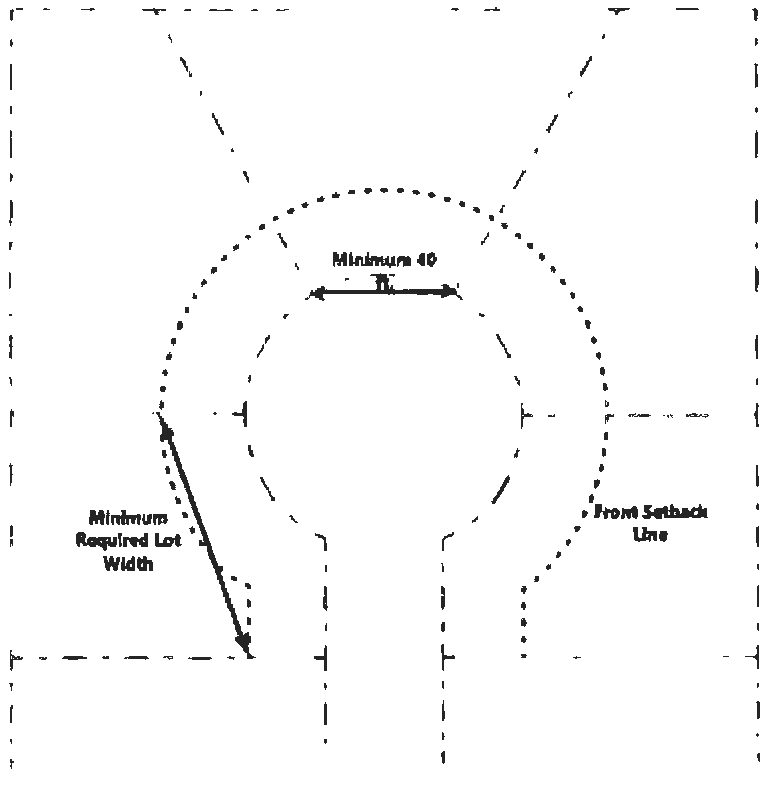
CUL-DE-SAC Lots. In the case of LOTs abutting CUL-DE-SAC streets, the minimum required LOT WIDTH shall be measured at the required front SETBACK line. CUL-DE-SAC lots shall have a minimum width of 40 feet at the front lot line.
C.
THROUGH LOTs. On THROUGH LOTs, the minimum FRONT YARD requirement shall be met on each street.
D.
Minimum LOT FRONTAGE. All LOTs and parcels created after the effective date of this ordinance shall have FRONTAGE upon and be accessed from a public or PRIVATE STREET right-of-way.
E.
Required Area or Space. No LOT or LOTs in common ownership and no yard, court, parking area, or other space shall be so divided, altered, or reduced as to make the area or space smaller than the minimum required for the district under this ordinance in which it is located. If already less than the minimum size required, the area or space shall not be further divided or reduced.
Section 2.4 - SETBACKs.
A.
Clear Vision Corner. In all zoning districts, signs, FENCEs, walls, STRUCTUREs, benches, shrubbery, or other potential obstructions to vision, shall not be permitted to exceed a height of three (3) feet above the center line FINISHED GRADE of the road within a triangular area formed by the intersection of the street right-of-way lines and a line connecting two points located on those intersecting right-of-way lines 25 feet from the point where the right-of-way lines intersect; provided, UTILITY poles, street lights, and street signs shall be exempt from this requirement.
B.
Driveways.
1.
No part of a driveway for a SINGLE-FAMILY residence shall be closer than three (3) feet to the side property lines on NONCONFORMING lots and six (6) feet on all other LOTs.
2.
Residential driveways shall be at least 12 feet wide.
3.
No residential driveway shall be constructed within 50 feet of an intersecting street right-of-way.
4.
A shared driveway for cluster, TOWNHOME, or MULTI-FAMILY LOTs or DEVELOPMENTs is permitted to cross property lines for those properties accessed by that driveway.
a.
All such driveways shall be engineered on SITE DEVELOPMENT PLANs and presented to the ZONING ADMINISTRATOR at the time of application. With the approval of the PLANNING COMMISSION, shared driveways for cluster, TOWNHOME, and MULTI-FAMILY DEVELOPMENTs may be permitted.
b.
In such instances, the driveway must be a minimum of 16 feet wide.
c.
The ZONING ADMINISTRATOR must further certify that the proposed shared driveway does not in any manner affect proper ingress or egress to the properties sharing such driveway or other adjoining properties.
d.
Where shared driveways are approved, REGIME covenants must clearly define ownership and MAINTENANCE responsibilities of the owners sharing the driveway.
C.
FRONT YARDs. All yards abutting upon a street right-of-way, whether public or private, shall be considered as FRONT YARDs for SETBACK purposes, except as otherwise provided in this ordinance.
D.
Encroachments in Right-of-Way. No BUILDINGs, STRUCTUREs, service areas, or off-street parking and loading facilities, except driveways, shall be permitted to encroach into street rights-of-way.
E.
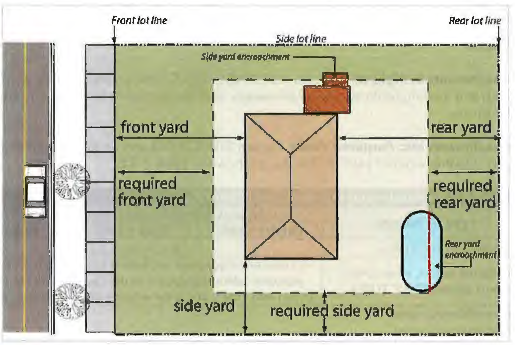
Encroachments into Required Yards. Certain STRUCTUREs and architectural features may project into the required yard SETBACKs, as shown in Table 2-4 E.
F.
SETBACK Requirements. All SETBACKs shall be measured from the property lines; provided, if a beachfront jurisdictional line, CRITICAL AREA, or WATERBODY is present on the property, the SETBACK shall be the greater of the minimum yard SETBACK or the Oceanfront and North Edisto River SETBACK (Section 10.4 B), CRITICAL AREA SETBACK (Section 10.5 A) or WATERBODY SETBACK (Section 10.5 B), as applicable. If located on a PRIVATE STREET, the SETBACK shall be measured from the right-of-way line or 30 feet from the edge of pavement, whichever is greater. A BUILDING shall not be erected, converted, enlarged, reconstructed, or structurally altered, except in conformity with the SETBACK requirements of the district in which it is located.
G.
SCDHEC-OCRM CRITICAL LINE. Whenever this ordinance requires measurement from, or based on, the SCDHEC-OCRM CRITICAL LINE, the CRITICAL LINE shall have been reviewed and certified by SCDHEC-OCRM within the previous five (5) years. Notwithstanding this requirement, CRITICAL AREAs by their nature are dynamic and subject to change over time. As such, in the event there is reason to believe a CRITICAL AREA has changed since its last review (even if the review occurred within five (5) years), the property owner may be required to have the CRITICAL LINE reviewed again and, if such a change has occurred, relocated before making any determinations requiring a measurement based on the CRITICAL LINE.
Section 2.5 - STRUCTUREs.
A.
Awnings.
1.
All awnings shall be securely attached to and supported by a BUILDING wall. No other means of support will be approved.
2.
No part of the awning or its supporting frame shall be less than seven (7) feet above the surface over which it is erected.
3.
No advertising shall be placed on any awning, unless specifically authorized in Article 13 as an awning SIGN and duly permitted by the town.
B.
FENCEs and Walls.
1.
FENCEs and walls, including retaining walls, shall be permitted in all zoning districts; provided, they conform with the following:
a.
Any open spaces or non-solid areas shall be evenly spaced;
b.
Walls must be made of stucco, cypress, pressure-treated wood, wood composite, brick, stone, architectural concrete masonry units (CMU), or similar materials;
c.
FENCEs must be made of stucco, cypress, pressure-treated wood, wood composite, iron, powder coated aluminum, or similar materials. Barbed wire, concertina wire, razor wire, chain link, poultry wire and vinyl are strictly prohibited;
d.
Walls and FENCEs shall be constructed with quality materials and workmanship in accordance with prevailing BUILDING industry standards for appearance, soundness, safety, and resistance to decay and weather, and shall be maintained in good REPAIR;
e.
Walls and FENCEs shall be located no closer to a side or rear property line than fifty percent (50%) of the required side or rear setback for principal structures;
f.
No wall or FENCE shall be permitted within a required CRITICAL AREA or beachfront SETBACK area;
g.
No wall or FENCE shall be taller than six (6) feet in height, measured from the finished elevation at its base to the highest point of the wall or FENCE; provided, however, the PLANNING COMMISSION may allow a wall or FENCE to exceed six (6) feet in height when the wall or FENCE is used to screen a public BUILDING or storage yard, UTILITY STRUCTUREs or equipment, or an approved outdoor storage area in a district zoned for conservation, business, community facility, or recreation uses.
h.
Walls and FENCEs shall not exceed a height of three (3) feet within any sight EASEMENT or clear vision corner;
i.
When a wall or FENCE has both a finished side and an unfinished side, the finished side shall face the adjoining property or, if on the interior of the site, shall face outward toward the perimeter of the site;
j.
Plant materials, where required, shall be installed on the exterior side of the wall or FENCE; and
k.
Walls and FENCEs shall not be constructed in a way that negatively impacts drainage on the site or on adjacent properties.
2.
The requirements of this section shall not apply to the REPAIR, replacement, or reconstruction of any wall or FENCE which was legally in existence as of the effective date of this ordinance. Any such wall or FENCE may be REPAIRed, REPLACEd, or reconstructed, provided:
a.
The extent of any NONCONFORMING element shall not be increased. For the purpose of this section, the term "element" shall include the design, materials, height and/or location of the existing FENCE;
b.
The extent of any previously NONCONFORMING element may not be re-established once that element has been brought into conformity, or made less NONCONFORMING, with the provisions of this ordinance;
c.
In the case of replacement or reconstruction, installation of the new wall or FENCE shall be completed no more than 120 days following demolition or destruction of the wall or FENCE which it will REPLACE. The ZONING ADMINISTRATOR may authorize a one-time 60-day extension in the event he or she finds, in writing, that installation may not be completed within 120 days due to circumstances which are beyond the applicant's control; and
d.
Nothing in this paragraph shall be interpreted to conflict with or supersede the requirements of the applicable BUILDING CODES.
3.
The provisions of this section shall not apply to the construction and/or MAINTENANCE of any wall, revetment, riprap, or similar STRUCTURE which has been duly permitted by the SCDHEC-OCRM.
4.
Whenever a hedge is used in landscaping BUILDINGs other than SINGLE-FAMILY homes, the hedge shall be installed with plants of sufficient size and spacing as to attain the height required and opacity of at least seventy-five percent (75%) within two (2) years of planting. If a hedge is not in compliance with the above height and opacity requirements within two (2) years after planting, the hedge must be completed with mature plants at the developer's expense.
C.
Height Exceptions. The maximum BUILDING HEIGHT for any BUILDING in the Town shall be thirty-six (36) feet above the DESIGN FLOOD ELEVATION, as required by Section 20-22 of the Town Code; provided, however, the following exceptions shall apply:
1.
MULTI-FAMILY and commercial buildings may increase the maximum allowable height by one (1) additional foot for each three (3) feet of additional FRONT YARD SETBACK, with a maximum BUILDING HEIGHT of 40 feet above the required DESIGN FLOOD ELEVATION.
2.
The maximum BUILDING HEIGHT for residential structures permitted on or after January 29, 2021, may be measured from the ALTERNATE DESIGN FLOOD ELEVATION; provided, 1) the ALTERNATE DESIGN FLOOD ELEVATION is higher than the DESIGN FLOOD ELEVATION required at the time of permitting; and 2) the lowest floor elevation of the residential structure also complies with the ALTERNATE DESIGN FLOOD ELEVATION requirement.
3.
Unless otherwise expressly stated, the height limitations of this ordinance shall not apply to any of the following:
a.
Farm buildings in the AGR zoning district;
b.
Electrical power transmission lines;
c.
Belfries, cupolas, spires, domes, monuments, flagpoles, chimneys, radio/television receiving antennas or chimney flues; or
d.
Bulkhead, elevator, water tank, or any other similar structure or necessary mechanical appurtenance extending above the roof of any building, if such structure does not occupy more than 33⅓ percent of the area of the roof.
D.
Mechanical Equipment.
1.
Mechanical equipment located on the ground shall be located in the rear or SIDE YARD in accordance with the requirements of Table 2-4 E.
2.
When attached to a BUILDING, the mechanical equipment shall be architecturally integrated or appropriately screened by shrubbery or fencing so as not to be visible from neighboring property and to provide sound BUFFERing. Screening shall comply with the requirements of Section 11.3 B.
3.
If located on the roof of a BUILDING or in a location that cannot otherwise be screened, the equipment shall be enclosed or designed in a manner that is architecturally integrated with the BUILDING where it is located.
4.
Mechanical equipment shall not be placed within any EASEMENT, except with written permission of the EASEMENT holder.
5.
The mechanical equipment shall be elevated to meet the requirements of Section 20-22 of the Town Code and all applicable BUILDING CODES.
6.
All such equipment shall be located to have the least adverse impact on surrounding property owners.
7.
A permit shall be obtained from the ZONING ADMINISTRATOR.
E.
Swimming Pools, Spas, Reflecting Ponds, and Hot Tubs. Any swimming pool, spa, hot tub, reflecting pond, or similar STRUCTURE whose depth at any point exceeds 24 inches shall be subject to the following regulations and shall be fenced securely, in accordance with the applicable requirements of the BUILDING CODES.
1.
Swimming pools, spas, hot tubs, reflecting ponds, and similar STRUCTUREs, including changing rooms and mechanical equipment, shall only be permitted in the REAR YARD; provided, on CORNER LOTs they may be located within a SIDE YARD.
2.
Swimming pools, spas, hot tubs, reflecting ponds, and similar STRUCTUREs, whether above or below ground, shall be subject to the minimum SETBACK requirements for principal BUILDINGs.
3.
As required by the South Carolina BUILDING CODES, all in-ground pools must be fenced.
a.
The FENCE must be at least 48 inches in height, with an opening in one direction that does not exceed five and one-half (5½) inches.
b.
The FENCE must be accented with landscaping on all exterior sides not abutting a BUILDING so as to minimize its visual impact.
c.
In lieu of fencing, certified mechanical pool covers may be approved by the ZONING ADMINISTRATOR.
d.
Fencing material around community pools must be approved by the ZONING ADMINISTRATOR. Only materials that are harmonious and architecturally compatible with surrounding areas and DEVELOPMENTs shall be approved.
F.
TEMPORARY STRUCTUREs or BUILDINGs.
1.
TEMPORARY STRUCTUREs and Tents.
a.
No STRUCTURE of a temporary nature shall be authorized or allowed to remain on any property; and no trailer, camper, shack, tent, or other similar STRUCTURE shall be used as a residence or for any other purpose, except for construction trailers and temporary sanitary facilities as provided for elsewhere in this ordinance.
b.
The erection of large tents and other TEMPORARY STRUCTUREs associated with recreational activities and temporary events may be authorized by the ZONING ADMINISTRATOR. In making such determination, the ZONING ADMINISTRATOR shall consider traffic patterns to and from the STRUCTURE, its proximity to nearby residences, potential noise from amplified music or other sources, the hours of the event for which the tent or STRUCTURE is being erected, and the number of days it will be present.
c.
All such STRUCTUREs or tents shall meet the minimum SETBACK requirements of the zoning district in which they are located.
2.
Temporary Storage Units.
a.
It shall be unlawful to place or permit the placement of a temporary storage unit on any property for more than seven (7) consecutive days; provided, a longer period may be approved by the ZONING ADMINISTRATOR for BUILDING construction or remodeling projects.
b.
Temporary storage units shall only be placed upon or within a driveway, parking area or, if access exists to the rear of the LOT, the REAR YARD.
c.
No temporary storage unit shall be placed upon or within public property or a public place including, without limitation, a street, sidewalk, or out lawn.
d.
The temporary storage unit shall not exceed eight (8) feet in height, eight (8) feet in width and sixteen (16) feet in length.
e.
The temporary storage unit shall be secured in a manner that does not endanger the safety of PERSONs or property in the vicinity of the unit.
f.
The temporary storage unit shall be maintained in good condition, free from evidence of deterioration, weathering, discoloration, graffiti, rust, ripping, tearing or other holes or breaks at all times.
g.
No temporary storage unit shall be used for human occupancy or to store solid waste, construction debris, demolition debris, business inventory, commercial goods, or goods for property other than the property where the storage unit is located or any illegal or hazardous material. Upon reasonable notice, the ZONING ADMINISTRATOR may inspect the contents of any temporary storage unit at any reasonable time to ensure compliance with these requirements.
h.
Any temporary storage unit which is not removed at the end of the time for which it may lawfully remain in place, may be removed by the TOWN immediately, without notice, and the violation shall be enforced in accordance with Article 22 of this ordinance.
i.
A SIGN identifying the storage unit supplier, mounted on the temporary storage unit, shall not require a SIGN permit; provided, the storage unit complies with the requirements of this subsection and all other applicable ordinances.
Section 2.6 - USEs.
A.
Illegal Dwellings. The use of any floor area below BASE FLOOD ELEVATION for dwelling purposes is prohibited in all zoning districts unless the floor area meets the applicable BUILDING code requirements. BUILDINGs erected as GARAGEs or ACCESSORY BUILDINGs, except approved ACCESSORY DWELLING UNITs, shall not be occupied for dwelling purposes.
B.
PRINCIPAL USE. A LOT or parcel shall not be devoted to more than one (1) PRINCIPAL USE, or contain more than one (1) principal BUILDING; except for groups of multiple family BUILDINGs, TOWNHOMEs, business establishments, or other BUILDINGs which are determined by the ZONING ADMINISTRATOR to be a PRINCIPAL USE collectively, based on the following considerations:
1.
Individual BUILDINGs share common parking areas;
2.
Access to the BUILDINGs/uses is provided via shared access drives or streets;
3.
BUILDINGs are under single ownership;
4.
Individual activities support one another (such as MARINA/convenience store or cycle rental/RETAIL sporting goods); or
5.
The BUILDING or USE is located within the MU Mixed Use zoning district.
C.
Domestic Animals.
1.
The keeping of household pets, including dogs, cats, fish, birds, hamsters, and other animals commonly considered household pets is permitted in any residential district; provided, no more than three (3) dogs or cats, six (6) months of age or older, in any combination shall be kept or housed in or at one (1) dwelling.
2.
The keeping of animals not generally considered to be household pets, including, but not limited to, exotic animals, horses, pigs, sheep, cattle, goats, and poultry is prohibited in all zoning districts, except within the RC and CSC Districts.
D.
Outdoor Storage. Outdoor storage of merchandise, equipment, supplies, products, or other materials shall only be permitted as a CONDITIONAL USE within those districts and under such conditions as specifically authorized by this ordinance.
E.
Parking, Storage, and REPAIR of Vehicles.
1.
In order to prevent nuisance effects within the community including, but not limited to, noise, soil contamination, unsightly conditions, and diminution of property values, it shall be unlawful for the owner, tenant, or lessee of any BUILDING or land within the TOWN to permit the open storage or parking of any inoperable motor vehicle, machinery, or equipment, or parts thereof, outside of an enclosed GARAGE or enclosed BUILDING. Inoperable, for purposes of this subsection, shall mean motor vehicles, machinery, or equipment which, by reason of dismantling, disrepair, or other cause, are incapable of being propelled under their own power, operated or used, are unsafe for operation on the streets and highways of this state because of the inability to comply with the South Carolina Motor Vehicle Code, or do not have a current license and registration as required for operation by the South Carolina Motor Vehicle Code.
2.
The REPAIR, restoration, and MAINTENANCE of vehicles in any district shall be conducted entirely within an enclosed BUILDING, except for vehicle cleaning, tire changing, or replacement of a battery.
3.
It shall be unlawful for the owner, tenant or lessee of any LOT or BUILDING in a residential district or on property containing a DWELLING UNIT to permit the open storage or parking outside of a BUILDING of semi-truck tractors and/or semi-truck trailers, box trucks, bulldozers, earth carriers, cranes, or any other similar equipment or machinery, unless parked for purposes of construction, MAINTENANCE, moving, or similar purpose being conducted on that LOT.
F.
RECREATIONAL VEHICLE Storage. RECREATIONAL VEHICLEs shall only be stored within areas specifically designated for that purpose as allowed by this ordinance.
G.
Similar Uses. Every type of potential use cannot be addressed in this ordinance, each district provides for "similar uses" referencing this section. All requests for a use not specifically addressed in any zoning district shall be submitted to the ZONING ADMINISTRATOR for review, based on the following standards:
1.
A finding has been made by the ZONING ADMINISTRATOR that the proposed use is not listed as a permitted or CONDITIONAL USE in any zoning district.
2.
If the use is not addressed in this ordinance, the ZONING ADMINISTRATOR shall select the use listed which most closely approximates the proposed use, using criteria such as the nature of the use, conformance with the purpose of the zoning district in which it is proposed, aesthetics, traffic characteristics, and potential nuisance effects including, but not limited to, noise, vibration, dust, smoke, odor, glare, and hours of operation).
3.
Once a similar use is determined, the use shall comply with any conditions and review procedures that may apply to that use, including the CONDITIONAL USE requirements of Article 9, as applicable.
4.
If the ZONING ADMINISTRATOR determines a proposed use is not similar to any use addressed in this ordinance, the applicant may petition TOWN COUNCIL for an amendment to this ordinance, as described in Article 19.
5.
The determination as to whether a proposed use is similar in nature and class to another permitted or CONDITIONAL USE within a district shall be considered as an expansion of the use regulations, not a VARIANCE applying to a particular situation. Any use determined by the ZONING ADMINISTRATOR to be similar shall thereafter be included in the enumeration of the uses.
H.
Voting Place. The provisions of this ordinance shall not interfere with the temporary use of any property as a voting place in connection with a federal, state, county, municipal, or other public election.
Section 2.7 - Utilities and Services.
A.
Essential Public Services. The erection, construction, alteration, or MAINTENANCE of essential public services shall be permitted in any zoning district and shall be exempt from the application of this ordinance; provided, BUILDINGs, parking areas, and other uses or STRUCTUREs accessory to the essential service shall not be exempt and shall conform to all applicable ordinance requirements and procedures. This provision, however, shall not be construed to waive the rights of the TOWN to require that specific services be installed underground.
B.
Water and Sanitary Sewer Service. No STRUCTURE for human occupancy shall, after the effective date of this ordinance, be erected, altered, or moved upon any LOT or premises and used, in whole or in part, for dwelling, business, industrial, institutional, or recreational purposes unless provided with a safe, sanitary, and potable water supply and with a safe and effective means of collection, treatment and disposal of human, domestic, commercial, and industrial waste. Such installations and facilities shall conform to the minimum requirements for such facilities as established by the State of South Carolina, Charleston County, the TOWN, and other relevant government codes, ordinances, and standards.
C.
Underground Storage Tanks. All underground storage tanks utilized for the storage of propane gas, oil, fuel, or other substances shall be secured in place by straps, bands, or other fastening devices sufficient to keep the tanks securely in place and to prevent them from rising above ground level. Any underground storage tank already in place at the time this ordinance is adopted shall be brought into compliance within two (2) years. Installing or allowing the installation of an underground tank in violation of this ordinance shall be a misdemeanor and prosecuted in accord with Article 22 of this ordinance. No underground storage tank shall be located closer than 25 feet to a CRITICAL AREA or WATERBODY.

