
Seabrook Island City Zoning Code
ARTICLE 12
PARKING AND LOADING
Section 12.1 - Purpose.
The purpose of this article is to prescribe regulations for off-street parking of motor vehicles in residential and non-residential zoning districts; to ensure by the provision of these regulations that adequate parking and access are provided in a safe and convenient manner; and to afford reasonable protection to adjacent land uses from light, noise, air/water pollution and other effects of PARKING LOT proximity.
Section 12.2 - General Requirements.
A.
Applicability of Parking Requirements. For all BUILDINGs and uses established after the effective date of this ordinance, off-street parking shall be provided as required by this article. In addition, the following shall apply:
1.
Whenever use of a BUILDING or LOT is changed to another classification of use, off-street parking facilities shall be provided, as required for that use.
2.
If the intensity of use of any BUILDING or LOT is increased, through the addition of floor area, increase in seating capacity, or other means, additional off-street parking shall be provided, as required by this article.
3.
Off-street parking facilities in existence on the effective date of this ordinance shall not be reduced below the requirements of this article, nor shall NONCONFORMING parking facilities be further reduced or made more NONCONFORMING.
4.
An area designated as required off-street parking shall not be changed to another use, unless equal facilities are provided elsewhere in accordance with the provisions of this article.
B.
Location. Off-street parking facilities required for dwellings shall be located on the same LOT or plot of ground as the dwelling they are intended to serve and shall consist of at least a driveway, parking strip, parking apron, or PARKING LOT. Off-street parking facilities required for all uses other than dwellings shall be located on the LOT or within 300 feet of the BUILDING(s) or use they are intended to serve, as measured from the nearest point of the parking facility to the nearest public entry of the BUILDING(s) or use served. Driveways shall not be located closer than six (6) feet to an adjacent property line, unless otherwise provided by this ordinance.
C.
Shared/Common Parking. Parking requirements may be modified where it can be shown that the hours of operation of two (2) or more businesses are such that they can share the same PARKING SPACEs (e.g., a RETAIL store or office that closes before a RESTAURANT in the same location opens.) The periods of peak use must not overlap and there must exist a written agreement between the parties involved providing for joint use of the spaces. A copy of such agreement shall be kept on file with the ZONING ADMINISTRATOR.
1.
A request for shared parking that will result in fewer than the total number of spaces required for all uses separately may be approved as part of SITE DEVELOPMENT PLAN review. The following documentation shall be provided in conjunction with such a request:
a.
A shared parking analysis, in a form established by or acceptable to the ZONING ADMINISTRATOR, shall be submitted to the ZONING ADMINISTRATOR demonstrating the feasibility of shared parking. It must address, at a minimum, the size and type of the proposed DEVELOPMENT or combination of uses, the composition of tenants, the hours of operation of the uses, and the peak hours of use if the hours of operation overlap.
b.
A shared parking plan shall be enforced through written agreement among all owners of record and included in the DEVELOPMENT agreements filed with the TOWN. The owner of the shared parking area shall enter into a written agreement with the TOWN with enforcement running to the TOWN. The agreement shall state that:
i.
The land comprising the parking area shall never be disposed of, except in conjunction with the sale of the BUILDING which the parking area serves so long as the facilities are required; and
ii.
The owner agrees to bear the expense of recording the agreement which shall bind his or her heirs, successors, and assigns.
2.
An attested copy of the shared parking agreement between the owners of record shall be submitted to the ZONING ADMINISTRATOR to be recorded in a form established by the TOWN attorney. The agreement must be recorded before issuance of a BUILDING permit or certificate of occupancy for any use to be served by the shared parking area. A shared parking agreement may only be revoked if all required off-street PARKING SPACEs will be otherwise provided on-site for all BUILDINGs or uses which are party to the agreement. The TOWN shall void the written agreement if other off-street facilities are provided in accordance with the provisions of this ordinance.
D.
Modification of Parking Requirements. The PLANNING COMMISSION may reduce the PARKING SPACE requirements of this article for any use, based upon a finding that one (1) or more of the following conditions shall be met. A parking study may be required, at the sole discretion of the PLANNING COMMISSION, to document conformance with one (1) or more of the following criteria:
1.
Bicycle or pedestrian travel is likely to be used and the site design will incorporate both bicycle parking facilities and pedestrian connections.
2.
Boat or other marine travel is likely to be used the site design will incorporate wet slips or dry dock storage with associated dock facilities and pedestrian connections.
3.
Shared parking is available to multiple uses where there will be a high proportion of multipurpose visits or where uses have peak parking demands during differing times of the day or days of the week and meeting the following requirements:
a.
Pedestrian connections shall be maintained between the uses.
b.
Unless the multiple uses are all within a unified BUSINESS CENTER or mixed-use DEVELOPMENT all under the same ownership, shared parking agreements shall be filed by the ZONING ADMINISTRATOR with the TOWN clerk after approval and recording.
4.
Available shared off-street parking or on-street spaces are located within 300 feet of the subject property.
5.
Expectation of walk-in trade is reasonable due to sidewalk connections to adjacent residential neighborhoods. To allow for a PARKING SPACE reduction, the site design shall incorporate pedestrian connections to the site and on-site pedestrian circulation, providing safe and convenient access to the BUILDING entrance.
6.
Where the applicant has provided a parking study, conducted by a qualified transportation engineer, demonstrating that another standard would be more appropriate based on actual number of employees, expected level of customer traffic, or actual counts at a similar establishment.
E.
Temporary Parking. It is recognized that there may be temporary events or situations that occur infrequently which would result in a temporary reduction in the availability of required PARKING SPACEs. Such events may include, but are not limited to, outdoor vehicle sales, festivals or fairs, charity car washes, or sporting events. In those instances, the ZONING ADMINISTRATOR may authorize the use of a portion of the required parking area for other purposes on a temporary basis or permit temporary parking, upon a demonstration by the applicant that:
1.
The loss of the required PARKING SPACEs may be offset by requiring employees or customers to park elsewhere or that due to the time of year or nature of the on-site business, the required spaces are not needed;
2.
All or part of the displaced parking may be accommodated on unpaved areas of the site;
3.
Neighboring property owners or operators have granted permission to use their parking facilities;
4.
The duration of the temporary event is so short or of such a nature as to not create any appreciable parking shortage for the normal operation of the existing on-site use;
5.
Temporary off-site parking is located and designed to ensure safe and efficient circulation for both pedestrians and vehicles (a SITE DEVELOPMENT PLAN may be required to demonstrate this); and
6.
The proposed temporary event satisfies all other applicable TOWN regulations.
Section 12.3 - Required Off-Street Parking.
The minimum number of required off-street PARKING SPACEs shall be provided and maintained on the premises or as otherwise allowed by this article, as specified in Table 12-3.
A.
When the calculation of required PARKING SPACEs result in a fraction over one-half (½),the number of required PARKING SPACEs shall be rounded up to the next full number.
B.
In the case of a use not specifically mentioned, the requirement for off-street parking facilities for a specified use which is most similar, as determined by the ZONING ADMINISTRATOR, shall apply.
C.
Each 24 inches of bench, pew, or similar seating facilities shall be counted as one (1) seat, except if specifications and plans filed in conjunction with a BUILDING permit application specify a maximum seating capacity, that number may be used as the basis for required PARKING SPACEs.
D.
Where parking requirements are based upon maximum seating or occupancy capacity, the capacity shall be as determined by the applicable fire and BUILDING CODES.
E.
Unless otherwise indicated, floor area shall be USABLE FLOOR AREA (UFA).
F.
Maximum Allowed Parking. To minimize excessive areas of pavement that detract from aesthetics, contribute to high rates of storm water runoff, and generate reflective heat, the minimum PARKING SPACE requirements of this section may not be exceeded by more than 10 percent, except as specifically approved as part of the SITE DEVELOPMENT PLAN. In approving additional PARKING SPACE beyond 10 percent, the site plan reviewing authority shall determine that the parking is necessary, based on documented evidence, to accommodate the use on a typical day. Further, any PARKING SPACEs provided in excess of 10 percent above the minimum required shall only be located on permeable surfaces.
Section 12.4 - Design Requirements.
A.
Location and SETBACKs. Off-street PARKING LOTs shall meet the SETBACK requirements applicable to parking, as may be specified in the zoning district or which may be specified for individual uses.
B.
Parking Construction and DEVELOPMENT. The construction of any PARKING LOT shall require approval of a site plan, in accordance with Article 14. Construction shall be completed and approved by the ZONING ADMINISTRATOR before a certificate of occupancy is issued and the PARKING LOT is used.
1.
Pavement. All required PARKING LOTs and vehicle and equipment storage areas shall be paved with asphalt or concrete and shall be graded and drained to dispose of surface water which might accumulate. Alternative materials, such as permeable pavers, stone or asphalt millings, or grass may be approved for all or a portion of the following areas, based upon credible evidence of the durability and appearance of the proposed surfaces:
a.
Additional parking areas beyond the minimum required parking,
b.
Outdoor storage areas, and
c.
Required parking for OPEN AIR RECREATIONal uses and uses within the CSC District.
2.
Drainage. Surface water from parking areas shall be managed in accordance with the SCDHEC engineering standards. The TOWN engineering consultant shall determine the appropriate detention or retention treatment.
3.
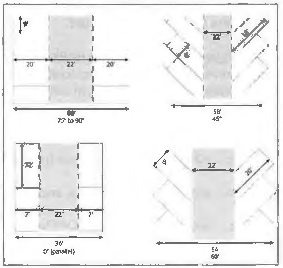
Dimensions. PARKING SPACE and aisle dimensions shall meet the following requirements and as specified in Table 12-4.
a.
Angled parking between these ranges shall be to the nearest degree.
b.
Sidewalks shall have a minimum width of seven (7) feet when abutting a parking area. There shall be a minimum distance of seven (7) feet between the PARKING LOT curb and BUILDING. Where curbing does not exist, bumper blocks shall be provided to protect pedestrian space adjacent to the BUILDING.
c.
All PARKING LOTs shall be striped and maintained showing individual parking bays, in accordance with the following dimensions; provided, if alternative materials are used wheel stops shall be installed to define the spaces.
4.
Stacking Spaces. Waiting/stacking spaces for drive-through uses (such as banks, car washes, pharmacies, or dry cleaners) shall be at least 24 feet long and 10 feet wide. Stacking spaces shall not block required off-street PARKING SPACEs. Where the drive-through waiting lane provides for a single lane for five (5) or more vehicles, an escape/by-pass lane shall be provided to allow vehicles to exit the waiting lane.
5.
Ingress and Egress. Adequate vehicular ingress and egress to the parking area, not including single- and TWO-FAMILY DWELLINGs, shall be provided by means of clearly limited and defined drives. Driveways shall not exceed 30 feet in width and shall not be located closer than 125 feet to any other driveway or street intersection. PARKING SPACEs shall be accessed only from interior access and circulation aisles. The use of adjacent streets for maneuvering into or out of off-street PARKING SPACEs shall be prohibited.
6.
Landscaping. Off-street parking areas shall be landscaped and/or screened, in accordance with the requirements of Section 11.3 C. The use of rain gardens and other low impact design solutions to minimize the impact of stormwater runoff is encouraged.
7.
Lighting. Light fixtures used to illuminate off-street parking areas shall be arranged to deflect the light away from adjoining properties and adjacent streets. Lighting fixtures in parking areas shall conform to the requirements of subsection 2.1 E. Light fixtures shall be designed to achieve 90-degree luminary cutoff.
8.
Fire Lanes. Fire lanes shall be designated on the site and posted with signage prior to occupancy. Vehicle circulation shall meet turning radius requirements set by the St. Johns Fire District.
9.
Crosswalks. Pedestrian pathways and crosswalks within parking areas shall be distinguished from driving surfaces by using durable, low-MAINTENANCE, surface materials such as pavers, bricks, or scored, stamped, or colored concrete/asphalt to enhance pedestrian safety and comfort as well as the attractiveness of the parking area.
C.
Barrier Free Parking in PARKING LOTs. Within each PARKING LOT, signed and marked barrier free spaces shall be provided at a convenient location, in accordance with the applicable requirements of the Americans with Disabilities Act of 1990 (ADA). Barrier free spaces shall be located as close as possible to BUILDING entrances. Where a curb exists between a PARKING LOT surface and a sidewalk entrance, an inclined approach or curb cut with a gradient of not more than a 1:12 slope and width of a minimum four (4) feet shall be provided for wheelchair access. At a minimum, the following number of barrier free PARKING SPACEs shall be provided, based on the total number of PARKING SPACEs:
D.
MAINTENANCE. All parking areas shall be maintained free of trash and debris. Surface, curbing, light fixtures, and signage shall be maintained in good condition.
E.
Limitations on Use of PARKING LOTs.
1.
Off-street parking areas are intended only for temporary vehicle parking. Parking areas or open land shall not be used for the parking of disabled vehicles or storage of junk.
2.
It shall be unlawful to use a PARKING LOT or open area to store or park any vehicle for the purpose of displaying vehicles for sale, except in an approved vehicle sales dealership.
F.
RECREATIONAL VEHICLE Parking. Overnight parking of RECREATIONAL VEHICLEs, trucks larger than three-fourth (¾) ton capacity, or similar vehicle is prohibited along any street within the TOWN or on any LOT or parcel of property, except within an enclosed GARAGE or designated parking area authorized by the ZONING ADMINISTRATOR.
(Ord. No. 2024-06, § 4, 12-17-2024)
Section 12.5 - Off-Street LOADING Requirements.
A.
Uses Requiring LOADING Area. On the same premises with every BUILDING, STRUCTURE, or part thereof, erected and occupied for storage, warehouse, RETAILs sales, consumer services or other uses similarly involving the receipt or distribution of vehicles, materials or merchandise, there shall be provided and maintained on the LOT adequate space for standing, LOADING, and unloading services in order to avoid undue interference with public use of the streets, alleys and PARKING SPACEs. This provision shall not apply to consumer service uses of less than 10,000 square feet.
B.
LOADING Area Requirements. LOADING and unloading spaces shall be paved and, unless otherwise adequately provided for, shall be 10 feet by 50 feet, with 15-foot height clearance, according to the following schedule:
C.
Orientation of Overhead Doors. Overhead doors for truck LOADING areas shall not face a public or private right-of-way and shall be screened to not be visible from any street or an adjacent residential district.
D.
Residential SETBACK. LOADING and unloading SPACEs shall not be located closer than 50 feet to any residential district boundary, unless the spaces are within a completely enclosed building or completely screened from the residential district by a solid, sight-obscuring wall or FENCE at least six (6) feet in height and approved by the review authority.

