
Spokane City Zoning Code
CHAPTER 17C
200 Landscaping and Screening
Section 17C.200.010 Purpose
The City of Spokane recognizes the aesthetic, ecological, and economic value of landscaping and requires its use to:
promote the distinct character and quality of life and development expected by the community as indicated and supported in the policies of the comprehensive plan;
maintain and protect property values;
enhance the visual appearance of the City;
enhance the compatibility of new development with surrounding properties;
preserve and enhance Spokane’s urban forest;
preserve and enhance existing vegetation;
reduce stormwater runoff pollution, temperature, and volume;
aid in energy conservation by providing shade and shelter from the wind; and
promote water conservation and reduced maintenance.
The following landscaping and screening standards are applicable to all sites in RA, R1, R2, RMF, RHD, O, OR, NR, NMU, CB, GC, CC, LI, PI HI, downtown zones and FBC zones. These standards address materials, placement, layout, and timing of installation.
Date Passed: Monday, January 12, 2015
Effective Date: Wednesday, February 25, 2015
ORD C35212 Section 2
Section 17C.200.020 Plan Submittal Requirements
Landscape plans are required for all development of more than seven thousand square feet of lot area.
- For all development types, landscape plans shall:
1. be submitted at the time of application for a development permit; and
2. include the following elements:
- The footprint of all structures.
- All parking areas and driveways.
- All sidewalks, pedestrian walkways and other pedestrian areas.
- The location, height and materials for all fences and walls.
- The common and scientific names of all plant materials used, along with their size at time of planting.
- The location of all existing and proposed plant materials on the site; and
- A proposed irrigation plan.
- In addition, for development except residential construction of six or fewer dwelling units on a lot, landscape plane shall:
- 1. be prepared and stamped by a licensed landscape architect, registered in the state of Washington;
- 2. include the following elements:
- the final site grading;
- location of all overhead utility and community lines; and
- location of all driveways and street signs.
Date Passed: Monday, November 20, 2023
Effective Date: Monday, January 1, 2024
ORD C36459 Section 19
Section 17C.200.030 Landscape Types
The applicant is encouraged to utilize plant materials which complement the natural character of the Spokane region and which are adaptable to the climatic, topographic and hydrologic characteristics of the site. In selecting species, the applicant is encouraged to utilize plant materials, which reduce or eliminate the need for fertilizers, herbicides, or other chemical controls.
General Requirements:
Plantings shall consist of a mix of evergreen and deciduous species including living trees, shrubs and ground covers (with bark, gravel and river rock as an accent only). Shrubs and ground covers shall be chosen, arranged and of suitable size at planting to result in covering the entire length and width of the planting strip within three years of planting.
Deciduous trees shall meet the most recent ANSI standards for a two-inch caliper tree at the time of planting. Evergreen trees shall be a minimum of eight feet tall at the time of planting.
Trees to be located in the vicinity of overhead power lines shall be limited to a mature height of twenty-five feet in order to avoid conflict with utility lines and maintenance crews.
Plants used in the various situations shall be as follows (existing vegetation may be incorporated into the landscape design and be considered acceptable in lieu of new plantings so long as it contributes to achieving the intent of this chapter):
- L1: Visual Screen.
L1 plantings are intended to provide a continuous visual screen between different types of uses. Plantings shall be selected to ensure residential privacy and screen views such as, but not limited to, area lighting, headlights, traffic and service areas. The planting strip shall include shrubs that will provide a continuous screen at a minimum height of six feet within three years of planting. Trees shall be included as necessary to provide continuous canopy and shall be spaced at intervals resulting in touching of branches after ten years of normal growth.
- L2: See-Through Buffer.
L2 plantings are intended to provide a continuous three- to four-foot tall screen (the plants shall be evergreen when adjacent to parking areas in order to block headlights), while maintaining buffered views into and out of the site. Shrubs of a species that will achieve a minimum approximate height of three feet and maximum approximate height of four feet shall be included for the entire length of the planting area. Groundcovers shall be included as necessary to fill in the width of the planting area. Trees shall cover the length of the planting strip and be spaced at intervals resulting in touching of branches after ten years of normal growth.
- L3: Open Area Landscaping.
L3 plantings are required for the purpose of meeting the objectives as stated in SMC 17C.200.010. Shrubs and/or groundcover plants shall be species that will achieve a maximum approximate height of three feet. Trees shall be included throughout the planting area.
Date Passed: Tuesday, May 31, 2005
Effective Date: Wednesday, July 6, 2005
ORD C33636 Section 4
Section 17C.200.040 Site Planting Standards
Sites shall be planted in accordance with the following standards:
- Street Frontages.
- The type of plantings as specified below shall be provided inside the property lines:
- along all commercial, light industrial, and planned industrial zoned properties except where buildings are built with no setback from the property line: a six-foot wide planting area of L2 see-through buffer, including street trees as prescribed in SMC 17C.200.050. Remaining setback areas shall be planted in L3.
- along all downtown, CC1, CC2, CC4, and FBC zoned properties except where buildings are built with no setback from the property line, or along a Type 1 Street of the FBC: a five-foot wide planting area of L2 see-through buffer, including street trees as prescribed in SMC 17C.200.050. Remaining setback areas shall be planted in L3. Living ground cover shall be used, with non-living materials (gravel, river rock, etc.) as accent only. In addition, earthen berms, trellises, low decorative masonry walls, or raised masonry planters (overall height including any plantings shall not exceed three feet) may be used to screen parking lots from adjacent streets and walkways.
- in the heavy industrial zone, along a parking lot, outdoor sales, or outdoor display area that is across from a residential zone: a six-foot wide planting area of L2 see-through buffer, including street trees as prescribed in SMC 17C.200.050. Remaining setback areas shall be planted in L3.
- in industrial zones, all uses in the commercial categories (see chapter 17C.190 SMC, Use Category Descriptions, Article III, Commercial Categories) are subject to the standards for uses in the general commercial (GC) zone.
- along all RA, R1, R2, RMF, and RHD zones: six feet of L3 open area landscaping and street trees as prescribed in SMC 17C.200.050 are required, except that for single-unit residential and middle housing development, only street trees are required in addition to the landscape design standards of SMC 17C.111.305. For residential development along principal and minor arterials, a six-foot high fence with shrubs and trees may be used for screening along street frontages. The fence and landscaping shall comply with the standards of SMC 17C.120.310 for the clear view triangle and must be placed no closer than twelve feet from the curb lin A minimum of fifty percent of the fence line shall include shrubs and trees. The landscaping is required to be placed on the exterior (street side) of the fence.
- Within the clear view triangle (defined at SMC 17A.020.030) at street intersections on corner lots and at driveway entries to public streets, plantings may not exceed thirty-six inches in height or hang lower than ninety-six inches. The City Engineer may further limit the height of plantings, landscaping structures, and other site development features within a particular clear view triangle or may expand the size of the clear view triangle as conditions warrant in a particular case.

- Other Property Perimeters.
A planting strip of five feet in width shall be provided along all other property lines except where buildings are built with no setback from the property line or where a parking lot adjoins another parking lot. In CC zoned properties, the planting strip shall be eight feet in width to enhance the screening between CC and Residential zoned properties. The type of planting in this strip varies depending upon the zone designation of the properties sharing the property line (with or without an intervening alley) as indicated in the matrix below. Where properties with dissimilar zones share a common boundary, the property with the more intense zone shall determine the required type of planting and the planting width. The owners of adjacent properties may agree to consolidate their perimeter plantings along shared boundaries. For example, instead of each property providing a five-foot wide planting strip, adjacent property owners could provide a single, shared five-foot wide planting strip, so long as the required planting type, as indicated in the matrix below, is provided. Types of landscaping to be provided in planting strips alongside and rear property lines:
ADJACENT PROPERTY ZONE | ||||||||||||||
SUBJECT PROPERTY ZONE (vertical) | RA | R1 | R2 | RMF | RHD | O, OR | NR, NMU | CB | GC | CC, FBC | LI, PI | HI | DT | |
RA | -- | -- | -- | -- | -- | -- | -- | -- | -- | -- | -- | -- | -- | |
R1 | -- | -- | -- | -- | -- | -- | -- | -- | -- | -- | -- | -- | -- | |
R2 | -- | -- | -- | -- | -- | -- | -- | -- | -- | -- | -- | -- | -- | |
RMF | L2 | L2 | L2 | L3 | L2 | L2 | L2 | L1 | L1 | L1 | -- | -- | L1 | |
RHD | L2 | L2 | L2 | L2 | L3 | L2 | L2 | L2 | L2 | L2 | -- | -- | L2 | |
O, OR | L2 | L2 | L2 | L2 | L2 | L3 | L2 | L2 | L2 | -- | -- | -- | L2 | |
NR, NMU | L2 | L1 | L2 | L2 | L2 | L2 | L3 | L3 | L2 | -- | -- | -- | L3 | |
CB | L1 | L1 | L1 | L1 | L2 | L2 | L3 | L3 | L3 | -- | -- | -- | L3 | |
GC | L1 | L1 | L1 | L1 | L2 | L2 | L2 | L3 | L3 | -- | -- | -- | L3 | |
CC, FBC | L1 | L1 | L1 | L1 | L2 | -- | -- | -- | -- | -- | -- | -- | -- | |
LI, PI [3] | L1 | L1 | L1 | L1 | L1 | L1 | L2 | -- | -- | -- | -- | -- | -- | |
HI [3] | L1 | L1 | L1 | L1 | L1 | L1 | L1 | -- | -- | -- | -- | -- | -- | |
DT | L1 | L1 | L1 | L1 | L1 | L2 | L2 | L3 | L3 | -- | -- | -- | -- | |
Notes: [1] In the industrial zones, all uses in the commercial categories (see chapter 17C.190 SMC, Use Category Descriptions, Article III, Commercial Categories) are subject to the standards for uses in the general commercial (GC) zone. | ||||||||||||||
- Planning Director Discretion.
The planning director shall have the discretion to waive or reduce the requirements of subsections (A)(1) and (B) of this section based on the following factors:
- No useable space for landscaping exists between the proposed new structure and existing structures on adjoining lots or alleys because of inadequate sunlight or inadequate width.
- The building setback provided in front of the new structure is less than six feet or is developed as a plaza with decorative paving/pavers, trees, planters, or other amenities.
- Xeriscape landscaping is utilized in designated stormwater control areas.
- When existing trees and other vegetation serves the same or similar function as the required landscaping, they may be substituted for the required landscaping if they are healthy and appropriate for the site at mature size. When existing trees are eight inches or more in diameter, they shall be equivalent to three required landscape trees. If necessary, supplemental landscaping shall be provided in areas where existing vegetation is utilized to accomplish the intent of this chapter.
- Other Areas.
All other portions of a site not covered by structures, hard surfaces, or other prescribed landscaping shall be planted in L3 open area landscaping until the maximum landscape requirement threshold is reached (see SMC 17C.200.080).
- Parking Lot Landscaping Design.
- Purpose.
To reduce the visual impact of parking lots through landscaped areas, trellises, and/or other architectural features that complement the overall design and character of developments.

- Parking Lot Landscaping Design Implementation.
This section is subject to the provisions of SMC 17C.120.015, Design Standards Administration.
- The parking lot landscape shall reinforce pedestrian and vehicle circulation, especially parking lot entrances, ends of driving aisles, and pedestrian walkways leading through parking lots. (P)
- Planted areas next to a pedestrian walkways and sidewalks shall be maintained or plant material chosen to maintain a clear zone between three and eight feet from ground level. (R)

- Low walls and raised planters (a maximum height of three feet), trellises with vines, architectural features, or special interest landscape features shall be used to define entrances to parking areas. Where signs are placed on walls, they shall be integrated into the design and complement the architecture or character of other site features. (P)
- Landscape plant material size, variety, color, and texture within parking lots should be integrated with the overall site landscape design. (C)
- Parking, Outdoor Sales, and Outdoor Display Areas.
- In residential, commercial, center and corridor, and FBC zones, a six-foot wide planting area of L2 see-through buffer landscaping shall be provided between any parking lot, outdoor sales, outdoor display area, and a street right-of-way. Living ground cover shall be used, with non-living materials (gravel, river rock, etc.) as accent only. In addition, earthen berms, trellises, low decorative masonry walls, raised masonry planters, or L1 visual screen landscaping shall be used to screen parking lots from adjacent streets and walkways (overall height including any plantings or structures shall not exceed three feet). Trees required as a part of the L2 landscape strip shall be located according to the standards for street trees in SMC 17C.200.050, Street Tree Requirements.
- In residential, commercial, center and corridor, and FBC zones all parking stalls shall be within sixty feet of a planted area with L3 open area landscaping. All individual planting areas within parking lots shall be at least one hundred fifty square feet in size.
- In residential, commercial, center and corridor, and FBC zones all paved parking areas on a site with more than fifty cumulative parking spaces shall have plantings that satisfies one of the following options:
- Option 1.
Interior landscaping consisting of L3 open area landscaping, including trees amounting to at least ten percent of the total area of the paved parking area, excluding required perimeter and street frontage strips. A minimum of one interior tree shall be planted for every six parking spaces.
- Option 2.
Tree plantings shall be spaced in order that tree canopies cover a minimum of seventy percent of the entire paved area of the parking lot within fifteen years of project completion. Canopy coverage shall be measured in plan view, and be based on projected mature size of the selected tree species. All individual planting areas within parking lots shall be a minimum of eight feet in width, be at least one hundred fifty square feet in size, and in addition to the required trees, shall be planted with a living groundcover. See the “Landscape Plants for the Inland Northwest” issued by the Washington State University cooperative extension and the U.S. department of agriculture, available from the City planning services department, for acceptable mature tree size to be used when calculating canopy size.

- Where parking lots are located between the building and a street, the amount of required interior landscaped area shall be increased by fifty percent and the minimum amount of tree shade cover shall increase to eighty percent. Where parking lots are behind buildings, the amount of interior landscaping may be decreased by fifty percent of what the code requires and the minimum amount of tree shade cover shall decrease to fifty percent.
- A planting strip of five feet in depth with L1 visual screen landscaping or site-obscuring decorative wood, iron, etc. fences or masonry walls at least six feet in height shall be installed along property lines where any adjacent single-family residential zone would have views of parking or service areas.
- A minimum of two-foot setback shall be provided for all trees and shrubs where vehicles overhang into planted areas.

- In industrial zones, parking lots, outdoor sales, and outdoor display areas that are abutting or across the street from residential zones are subject to all of the requirements of subjections (E) and (F) of this section.
- In industrial zones, all uses in the commercial categories (see chapter 17C.190 SMC, Use Category Descriptions, Article III, Commercial Categories) are subject to the standards for uses in the general commercial (GC) zones.
- In downtown zones an applicant must demonstrate to the director that the following required elements meet the intent of the Downtown Design Guidelines. Key design elements for these features include integrating storm water facilities, improving the pedestrian environment, and adding public amenities next to surface parking; outdoor sales and outdoor display areas so that they help to define space and contribute to a more active street environment.
- Surface Parking Lot Liner Walls in the Downtown Zones.
Surface parking lots must have a solid, decorative concrete or masonry wall adjacent to a complete street and behind a sidewalk. The wall must have a minimum height above the surface of the parking lot of two and one-half feet and a maximum height of three feet. The wall shall screen automobile headlights from surrounding properties. A wrought iron fence may be constructed on top of the wall for a combined wall and fence height of six feet. An area with a minimum width of two feet, measured from the property line, must be provided, landscaped and maintained on the exterior of the required wall. Such walls, fences, and landscaping shall not interfere with the clear view triangle. Pedestrian access through the perimeter wall shall be spaced to provide convenient access between the parking lot and the sidewalk. There shall be a pedestrian access break in the perimeter wall at least every one hundred fifty feet and a minimum of one for every street frontage. Any paving or repaving of a parking lot over one thousand square feet triggers these requirements.


Parking liner walls with plantings contribute to an interesting pedestrian environment. The parking liner wall and screen pictured above is enhanced by larger wall sections near automobile crossing points and a change in sidewalk scoring pattern. Both give cues to pedestrians and drivers.
- Surface parking lots in the Downtown zones are subject to the interior parking lot landscaping standard sections (F)(2) through (F)(6).
- The exterior boundary of all surface parking lots adjacent to any public right-of-way must include trees spaced no more than twenty-five feet apart. The leaves of the trees or any other landscaping features at maturity shall not obscure vision into the parking lot from a height of between three and eight feet from the ground. The species of trees shall be selected from the city’s street tree list. If street trees exist or are provided consistent with SMC 17C.200.050 then this landscaping strip may be omitted.
- Outdoor sales and display areas shall contribute to an interesting streetscape by providing the following:
- Monument Features or Artistic Elements along the Street Edge between the Outdoor Display Area and the Sidewalk.
These shall be integrated with display area lighting and pedestrian amenities.
- Additional Streetscape Features in the Sidewalk Environment.
Items may include elements that improve the health of street trees and plantings, improve storm water management, or artistic features that improve the pedestrian environment. This may include items such as permeable pavers in the pedestrian buffer strip, increased soil volumes for street trees, suspended sidewalks around the street tree to increase the amount of un-compacted soils, and engineered soils to support larger and healthier trees.
Date Passed: Monday, November 20, 2023
Effective Date: Monday, January 1, 2024
ORD C36459 Section 20
Section 17C.200.050 Street Tree Requirements
- Purpose.
To provide consistent street frontage character within the street right-of-way. The street tree standards also maintain and add to Spokane’s tree canopy and enhance the overall appearance of commercial and neighborhood development. Trees are an integral aspect of the Spokane landscape and add to the livability of Spokane. They provide aesthetic and economic value to property owners and the community at large.
- Street Tree Implementation.
- Street trees are required along all city streets in downtown, commercial, center and corridor, industrial, residential and FBC zones.
- Street trees shall be planted between the curb and the walking path of the sidewalk.

- Street trees, tree grates and other landscaping shall be maintained and irrigated by the adjacent property owner. If the adjacent property owner fails to maintain the adjacent street trees and other landscaping, the City may perform the required tree and other landscaping work at the abutting property owner’s expense as referenced in SMC 12.02.0210(B)(2).
- If a street has a uniform planting of street trees or a distinctive species within the right-of-way, then new street trees should be of a similar form, character and planting pattern.
- For a full list of approved trees in the city of Spokane, see the urban forestry program’s approved street tree list. Species selection should be guided by individual site conditions including hydrology, soil, solar orientation, and physical constraints.
- Planting Zones.
- Provide continuous planting strips or individual planting areas per Table 17C.200.050-1, Tree Planting Dimensional Standards.
TABLE 17C.200.050-1 | ||
ZONE | CONTINUOUS | INDIVIDUAL |
Downtown | Individual Planting Areas (tree vaults) required [1] | 4 ft. minimum |
CC | 5 ft. | 4 ft. minimum |
FBC | Individual Planting Areas (tree vaults) required [1] | 5 ft [2] |
Commercial | 5 ft. | 4 ft. minimum |
Industrial | 6 ft. | Continuous Planting Strip required [3] |
RA, R1, R2 | 6 ft. | Continuous Planting Strip required [3] |
RMF, RHD | 6 ft. | Continuous Planting Strip required [3] |
School/Church Loading Zone | Not Applicable | 4 ft. minimum |
Notes: | ||
- Continuous Planting Strips.
- Continuous planting strips may be planted with living ground cover or low plantings that are maintained at a height less than three (3) feet from ground level.
- When auto traffic is immediately adjacent to the curb, new street trees must be planted at least three (3) feet from the edge of the automobile travel way.

- Individual Planting Areas.
- When an individual planting area is not symmetrical, the longer dimension shall run along the curb.
- Tree grates or plantings are acceptable. However, when there is on-street parking, a tree grate or a paved walk eighteen (18) inches wide behind the curb are encouraged to help avoid conflicts with car doors and foot traffic. The minimum clear pedestrian walking path as required for the zone shall be maintained.
Tree Grates

Street Trees with plantings up to 3 ft.

- Where tree grates are used, they shall be ADA accessible and have a similar size and material as tree grates found in adjacent developments. Where tree grates are used, tree guards are encouraged for tree protection.
Tree Grate with Tree Guard

- Un-compacted soils are necessary for street trees. A minimum of one hundred (100) cubic feet per tree at a maximum depth of three feet is require See Engineering Design Standards for examples of potential options in individual planting areas and for retrofitting sidewalks.

- Size Requirements for New Street Trees.
- Street trees shall meet the most recent ANSI standards for a two-inch caliper tree at the time of planting
- Larger shade trees with spreading canopies or branches are desirable where possible. Species of street trees within the public rights-of-way shall be approved by the City urban forester and reviewed by the director of engineering services.
- If overhead power lines are present, street trees shall be limited to a mature height of twenty-five (25) feet to avoid conflict with utility lines and maintenance crews.
- Spacing Requirements for Street Tree Spacing.
The objective, when planting and maintaining street trees, is to create and maintain in a healthy condition a continuous tree canopy over the sidewalk.
- Continuous planting strips.
Average spacing shall be twenty-five (25) feet for small and columnar trees and thirty (30) feet for canopy trees. The planning director may allow increased spacing for exceptionally large trees or upon the recommendation of the urban forester.
- Individual planting areas.
Average spacing for all tree sizes and types shall be twenty-five (25) feet. Trees planted adjacent to parallel parking stalls with meters may be spaced twenty (20) feet apart.
- Street tree plantings shall consider the location of existing utilities, lighting, driveways, business entrances and existing and proposed signs. See the Engineering Design Standards for required dimensions.
- Clear View Zone.
Landscaped areas between the curb and sidewalk, as well as landscaped areas within the clear view triangle as defined in SMC 17A.020.030 shall be maintained or plant material chosen to maintain a vertical clear view zone between three and eight feet from ground level.

Date Passed: Monday, April 29, 2024
Effective Date: Wednesday, June 12, 2024
ORD C36514 Section 9
Section 17C.200.060 Stormwater Drainage
Vegetated stormwater facilities, such as “bio-infiltration” swales, bioretention areas, and infiltration planters, as defined by the State of Washington Department of Ecology’s “best management practices,” may be incorporated into the required landscape areas, provided neither the stormwater management nor the landscape requirements are compromised.
Date Passed: Monday, August 26, 2013
Effective Date: Tuesday, October 1, 2013
ORD C35021 Section 7
Section 17C.200.070 Screening and Impact Abatement
Screening and impact abatement is required where necessary to reduce the impact of service, storage, loading, and trash areas.
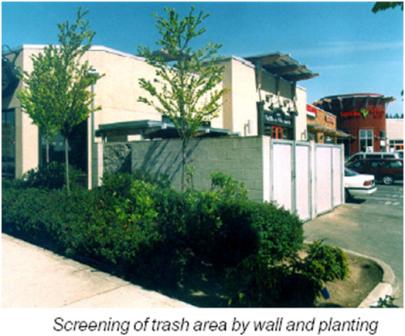
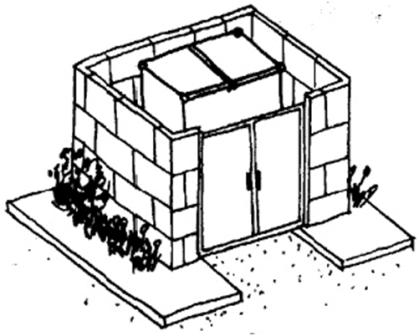
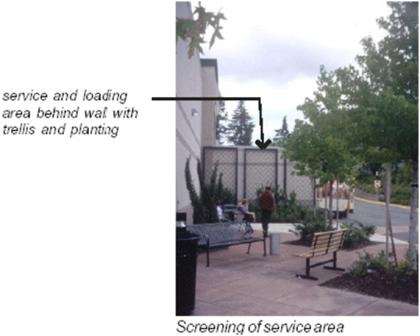
- In residential, commercial, center and corridor, downtown, light industrial, and planned industrial zones, all garbage collection, dumpsters, recycling areas, loading, and outdoor storage or activity areas (including but not limited to areas used to store raw materials, finished and partially finished products and wastes) shall be screened from view of persons on adjacent properties and properties that are located across a street or alley. (See development standards for mini-storage requirements.) Screening may be accomplished by any one of the following techniques or their equivalent:
- An L1 visual screen.
- A six-foot high solid masonry wall or sight-obscuring fence five feet inside the property line with an L2 see-through buffer between the fence and the property line.
- A five-foot tall earth berm planted with L3 open area landscaping.
- Storage areas are not allowed within fifteen feet of a street lot line; and
- Screening shall comply with the clear view triangle requirements defined in SMC 17C.111.245(G) for Residential Zones, SMC 17C.120.310(E) for Commercial Zones, SMC 17C.122.135(E) for Center and Corridor Zones, SMC 17C.124.310(E) for Downtown Zones, and SMC 17C.130.310(E) for Industrial Zones. The director of engineering services may further limit the height of plantings, structures, and other site development features within the clear view triangle or may expand the size of the clear view triangle as conditions warrant.
- In heavy industrial zones, garbage collection, loading, and outdoor storage areas that are abutting or across the street from residential zones are subject to all of the requirements of this section.
- In the industrial zones, all uses in the commercial categories area subject to the standards for uses in the general commercial zone.
Date Passed: Monday, July 23, 2012
Effective Date: Thursday, August 30, 2012
ORD C34888 Section 12
Section 17C.200.080 Maximum Landscaping Requirements
In no case shall these provisions require more than fifteen percent (15%) of the total site area to be landscaped.
Date Passed: Monday, December 2, 2019
Effective Date: Monday, January 20, 2020
ORD C35844 Section 3
Section 17C.200.090 Completion and Bonding
- All required landscaping, shall be in place before certificates of occupancy are issued. If a landscape plan was required per 17C.200.020, the applicant shall provide a form signed by the project’s landscape architect verifying that required landscaping has been installed in substantial conformance with the landscaping plans approved by the City. The City shall provide the form for documenting the assessment. If, due to weather conditions, it is not feasible to install required landscape improvements, a temporary certificate of occupancy may be issued after a performance bond or other device acceptable to the City has been posted in the amount of one hundred twenty-five percent (125%) of the value of the required improvements, including labor and materials. Upon completion of the landscape improvements, the bond or device is released and a permanent certificate of occupancy issued; except a bond or device representing twenty-five percent (25%) of the value of the landscaping covering a period of two (2) years shall be provided to assure the full establishment of the landscaped area as prescribed in subsection (B) of this section.
- A certificate of occupancy may be issued only after a performance bond or other device acceptable to the city has been posted in the amount of twenty-five percent (25%) of the value of the required landscaping. This bond or device shall be held for a period of two (2) years to assure the full establishment of all plantings. After two (2) years, if the plantings are fully established, the bond or device is released. If the plantings have not been fully established, the bond or device shall be held for one additional year, then released or used to re-establish the plantings, whichever is appropriate.
Date Passed: Monday, December 2, 2019
Effective Date: Monday, January 20, 2020
ORD C35844 Section 4
Section 17C.200.100 Irrigation Requirements
The owners of the adjacent property shall keep and maintain all required planting areas and street trees in a healthy condition. For development of six or fewer dwelling units on an infill lot and modification of non-conforming development that fall below thresholds found in 17C.210.090, the Planning Director, in consultation with the Urban Forester, may approve the use of species-specific alternative methods of irrigation. For all other forms of new construction and modification of non-confirming development that meet thresholds found in 17C.210.090 the installation and maintenance of an automatic irrigation system is required.
Date Passed: Monday, November 20, 2023
Effective Date: Monday, January 1, 2024
ORD C36459 Section 21
Section 17C.200.110 Water Conservation Measures
- Landscape areas that are irrigated should be designed so that plants are grouped according to distinct hydrozones for irrigation of plants with similar water needs at good efficiency.
- Newly landscaped areas should have soils be amended with either four (4) inches of appropriate organic material with the first two-inch layer tilled into existing soils, or as called for in a soil amendment plan for the landscape prepared by a state registered landscape architect or a professional agronomist.
- Newly landscaped areas, except turf, should be covered and maintained with at least two (2) inches of organic mulch to minimize evaporation.
- Irrigated turf strips that are less than five (5) feet in width are discouraged.
- Irrigated turf on slopes with finished grades in excess of thirty-three percent (33%) is discouraged.
- Retention of existing trees and associated understory vegetation is encouraged to reduce impacts to the stormwater system and to reduce water use. To provide an incentive for new development to retain existing trees and associated plantings, property owners proposing new development may apply for a credit against their future utility charges as provided in Chapter 13.14, SMC.
Date Passed: Monday, December 2, 2019
Effective Date: Monday, January 20, 2020
ORD C35844 Section 6
Section 17C.200.120 Fees in Lieu of Planting Street Trees
The Planning and Economic Development Services Director, based upon a recommendation of the Urban Forester, may allow the payment of fees in lieu of street tree planting when site features and infrastructure prohibit adequate space for installation. In the case of existing or planned bus stops, a payment of the fee in lieu of planting shall be required at those locations. When allowed, the owner of property which is adjacent to an area for which street trees are required, or the third party making the site and infrastructure improvements, may pay a fee of $650 per tree in lieu of undertaking the planting of street trees. Fees in lieu of funds shall be used for maintenance and growth of existing tree canopy including planting, pruning, removing, mulching, root excavation, and other treatments deemed appropriate by the Urban Forester to maintain and improve the health and coverage of Spokane’s tree canopy.
Date Passed: Monday, December 2, 2019
Effective Date: Monday, January 20, 2020
ORD C35844 Section 7
Section 17C.200.130 Guarding against Damage from Construction Work
Any person, firm or corporation engaged in or responsible for the excavation, demolition, or construction of any building, structure, street, or engaging in any utility work, and prior to the commencement of such work, shall sufficiently guard and protect street trees, public trees, and shrubs located within the limits of streets or alleys and near the location where such work is conducted so as to minimize potential injury to said trees and to maximize their chance for survival. When street and public trees are near the project, any construction permits issued by the City must be approved by the director, who may require protective measures as specified in the Arboricultural Manual.
Date Passed: Monday, December 2, 2019
Effective Date: Monday, January 20, 2020
ORD C35844 Section 8
Section 17C.200.140 Unauthorized Removal; Damage or Destruction; Penalty
- No street tree shall be removed without the adjacent owner first obtaining a street tree permit obtained pursuant to SMC 12.02.960.
- No person shall intentionally cause or suffer to be caused to any street tree any act or effort to destroy, kill, injure, mutilate, or deface a street tree by any means.
- Any person responsible for a violation of SMC 17C.200.140(B) must pay the cost of repairing or replacing any tree or shrub damaged by the violation and may be subject to treble the amount of damages assessed in any enforcement action brought by the City, pursuant to RCW 64.12.030. The value of trees and shrubs is to be determined in accordance with the latest revision of the Guide for Plant Appraisals as published by the International Society of Arboriculture.
- In addition to the other remedies required by this section, violation of this section is a civil infraction. The director has the discretion to issue a warning for a first-time violation.
Date Passed: Monday, July 14, 2025
Effective Date: Sunday, August 24, 2025
ORD C36702 Section 47
Section 17C.200.150 Incentives
- Property owners who retain existing trees during new construction activities on their property may be eligible for additional reductions in their water service (for residential customers) or water meter (for commercial customers) charges based on the number of points accumulated according to Table 17C.200.150-1, under which each point is equal to a 1% reduction, up to a maximum point accumulation of 50 points.
Table 17C.200.150-1 – Tree Retention Incentives (new construction only)
For lots < 0.5 acre, if tree is: | Then points received are: |
| For lot > 0.5 acre, if tree is: | Then points received are: |
|
|
|
|
|
8-15” diameter measured at 4 ½’ above the ground | 10 |
| 8-15” diameter measured at 4 ½’ above the ground | 5 |
16” + diameter measured at 4 ½’ above the ground | 20 |
| 16” + diameter measured at 4 ½’ above the ground | 10 |
Ponderosa Pine bonus | 5 per additional tree |
| Ponderosa Pine bonus | 5 per additional tree |
To determine additional discount available on water service or water meter charges, add the number of points received from this table. Each point equals a one percent (1%) reduction to the water service or water meter charge. For example, if a property owner retains one 16” diameter tree and two Ponderosa Pines that are both 8” in diameter on a lot > 0.5 acre during new construction, that property has accumulated 30 points and therefore receives a thirty percent (30%) discount on either the water service or water meter charge for that lot. | ||||
- Additional Eligibility Criteria:
- Applicant must show and describe tree protection zones (“TPZ”) in development plans.
- Applicant must maintain TPZs during the entire period of construction.
- Species maintained must be non-invasive species in order to qualify for the incentive created by this section.
- Retained tree(s) must be in fair condition or better.
- All eligibility determinations may be subject to site inspections, upon reasonable notice to the property owner, and may be conducted before, during, and after construction activities.
- Tree retention incentives as described in this section shall have a duration of one year for commercial customers and three years for residential customers.
Date Passed: Monday, December 2, 2019
Effective Date: Monday, January 20, 2020
ORD C35844 Section 10

