
Spokane City Zoning Code
CHAPTER 17C
240 Signs
Section 17C.240.010 Intent and Purpose
Signs have a strong visual impact on the character and quality of the community. As a prominent part of the scenery, they attract or repel the viewing public, affect the safety of vehicular traffic, and their suitability or appropriateness helps to set the tone for the neighborhood. The City relies upon its scenery and physical beauty to attract commerce, aesthetic considerations assume economic value. It is the intent of the City, through this Chapter, to protect and enhance the City’s historic and residential character and its economic base through the provision of appropriate and aesthetic signage. In addition, it is the intent of the City to limit the size, type and location of signs in order to minimize their distracting effect on drivers and thereby improve traffic safety. The City seeks to balance the need for the protection of public health, safety, welfare and community aesthetics, with the desire to protect the freedom of speech, and prevent discrimination in the application of free speech principles and tenets through the use of content-neutral regulations.
The purpose of this Chapter is to promote the public health, safety and welfare through a comprehensive system of reasonable, effective, consistent, content-neutral and nondiscriminatory sign standards and requirements. This Chapter has also been adopted to:
Promote and accomplish the goals, policies and objectives of the City’s Comprehensive Plan and Zoning Code;
To provide minimum standards in order to safeguard life, health, property and public welfare, and promote traffic safety by following the established design standards, including quality of materials, construction, illumination, size, location and maintenance of sign and sign structures;
Recognize free speech rights by regulating signs in a content-neutral manner;
Promote the free flow of traffic and protect pedestrians and motorists from injury and property damage caused by, or which may be fully or partially attributable to, cluttered, distracting and/or illegible signage;
Protect the beauty of the City’s built environment by encouraging signs that are compatible with the architectural style, characteristics and scale of the building to which it may be attached, and to encourage signs that are compatible with adjacent buildings and businesses;
Protect property values, the local economy, and the quality of life by preserving and enhancing the appearance of the streetscape;
Provide consistent sign design standards;
Encourage creative and innovative approaches to signage, and signs that are of a quality design, pleasing in appearance and are appropriate in size, materials and illumination to the surrounding neighborhood;
Provide an improved visual environment for the citizens of and visitors to the City; and
Adopt clear, understandable regulations which enable the fair and consistent enforcement of this Chapter.
Date Passed: Monday, January 29, 2018
Effective Date: Saturday, March 17, 2018
ORD C35577 Section 1
Section 17C.240.015 Definitions
“A” Definitions
Abandoned Temporary Sign.
A temporary sign that, because of the passage of time, has faded, peeled, cracked or otherwise become deteriorated or dilapidated, or is no longer affixed to the ground, or is missing the sign face, or otherwise meets the definition of litter set forth in SMC 10.08.010.Abandoned Sign Structure.
A sign structure where no sign has been in place for a continuous period of at least six months.Alter
To change the copy, color, size, shape, illumination, position, location, construction or supporting structure of a sign, not including ordinary maintenance.Animated Sign.
A sign that uses movement, by either natural or mechanical means, to depict action to create a special effect or scene.
“B” Definitions
Backed Sign.
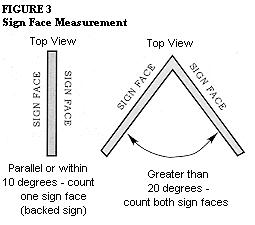
A sign where the faces of the sign are parallel or within twenty degrees of parallel to each other.Balloon Sign.
A sign that is blown up with air or gas.Banner.
A sign made of fabric or other similar non-rigid material with no enclosing framework or electrical components that is supported or anchored on two or more edges or at all four corners. Banners also include non-rigid signs anchored along one edge, or two corners, with weights installed that reduce the reaction of the sign to wind.
“C” Definitions
Clear View Triangle.
See SMC 17A.020.030Community Banner.
A temporary banner made of sturdy cloth or vinyl that is not commercial advertising that has the purpose of the promotion of a civic event, public service announcement, holiday decorations, or similar community and cultural interests and is placed on a structure located in the public right-of-way, subject to procedures authorized by city administrator.Copy.
Letters, characters, illustrations, logos, graphics, symbols, writing, or any combination thereof designed to communicate information of any kind, or to advertise, announce or identify a person, entity, business, business product, or to advertise the sale, rental, or lease of premises.
“D” Definitions
Directional Sign.
A sign exclusively limited to guiding the circulation of motorists or pedestrians on the site.Director
See SMC 17A.020.040
“E” Definitions
Electric Sign.
Any sign containing electrical wiring, lighting, or other electrical components, but not including signs illuminated by a detached exterior light source.Electronic Message Center Sign.
An on-premises sign capable of displaying words, symbols, figures, or images that can be electronically or mechanically changed by remote or automatic means including signs using a video display method.
“F” Definitions
Facade.
See SMC 17A.020.060(A).Fascia Sign.
A single-faced sign attached flush to a building or other structure or a sign consisting of light projected onto a building or other structure. Fascia signs do not include signs that are attached to or projected onto structures defined as sign structures by this chapter.Flag.
A sign made of fabric or other similar non-rigid material supported or anchored along only one edge or supported or anchored at only two corners. If any dimension of the flag is more than three times as long as any other dimension, it is classified and regulated as a banner regardless of how it is anchored or supported.Flashing Sign.
A pattern of changing light illumination where the sign illumination alternates suddenly between fully illuminated and fully non-illuminated in a strobe-like fashion for the purpose of drawing attention to the sign.
Time and temperature signs are excluded from this definition.
For the purpose of this title, electronic message centers consistent with the standards of SMC 17C.240.240 shall not be considered flashing signs
Freestanding Sign.
A sign on a frame, pole, or other support structure that is not attached to any building.
“I” Definitions
Illuminated Wall Highlights
See SMC 17A.020.090Interpretive Signs.
A sign that identifies historic buildings or sites where important events occurred or which serve educational, cultural, historical, or scientific purposes.
“M” Definitions
Marquee Sign.
A sign incorporated into or attached to a marquee or permanent canopy.Monument Sign.
A freestanding sign where the base of the sign structure is on the ground or a maximum of twelve inches above the lowest point of the ground adjacent to the sign. The width of the top of the sign structure can be no more than one hundred twenty percent of the width of the base.MUTCD.
See SMC 17A.020.130
“N” Definitions
Nonconforming Sign.
A sign that was created and issued a permit in conformance with development regulations, but which subsequently, due to a change in the zone or land use regulations, is no longer in conformance with the current applicable development standards.
“O” Definitions
Off-premises Sign.
A sign relating, through its message and content, to a business activity, use, product, or service not available on the premises upon which the sign is erected.
“P” Definitions
Painted Wall Highlights.
Painted areas that highlight a building's architectural or structural features and that do not convey a message or image.Painted Wall Sign.
A sign applied to a building wall with paint or a thin layer of vinyl, paper, or similar material adhered directly to the building surface and that has no sign structure.Pedestrian-Scaled Signs
Permanent, first-floor, exterior signs designed and placed to address pedestrian traffic; may be mounted flush with or projecting from a column, building wall, awning or transom.Permanent Sign.
Any sign not classified as a temporary sign.Projecting Sign.
A sign attached to and projecting out from a building face or wall, generally at right angles to the building. Projecting signs include signs that are totally in the right-of-way, partially in the right-of-way, or fully on private property.
“R” Definitions
Right-of-way
See SMC 17A.020.180Roadway
See SMC 17A.020.180Roof Line.
The top edge of a roof or building parapet, whichever is higher, excluding any cupolas, chimneys, or other projections.Roof mounted sign.
A sign which has a point of attachment to the roof or mansard of a building. Architectural projections, including mechanical equipment screens, above any parapet or roof line whose sole function is a background for signs shall be considered a sign structure. A sign on such an architectural projection shall be considered a roof sign.
“S” Definitions
Sandwich Board Sign.
A self-supporting A-shaped freestanding temporary sign with only two visible sides that are situated adjacent to a business, typically on a sidewalk.Sign.
Materials placed or constructed or light projected, but not including any lawful display of merchandise, that:Conveys a message or image, and
Is used to inform or attract the attention of the public
Some examples of signs are materials or lights meeting the definition of the preceding sentence and which are commonly referred to as signs, placards, A-boards, posters, murals, diagrams, banners, flags, or projected slides, images, or holograms.
The scope of the term sign does not depend on the content of the message or image conveyed.
Sign Face.
The portion of a sign which contains lettering, logo, trademark, or other graphic representations. (See SMC 17C.240.110, Sign Face Area.)Sign Maintenance.
Normal care needed to keep a sign functional, such as cleaning, painting, oiling, and changing of light bulbs.Sign Repair.
Fixing or replacement of broken or worn parts. Replacement includes comparable materials only. Repairs may be made with the sign in position or with the sign removed.Sign Structure.
A structure specifically intended for supporting or containing a sign.Special Event Sign.
A temporary sign used to announce a circus, a carnival, festivals, or other similar events.Structural Alteration.
Modification of a sign, sign structure, or awning that affects size, shape, height, or sign location.
Changes in structural materials; or
Replacement of electrical components with other than comparable materials.
The replacement of wood parts with metal parts, the replacement of incandescent bulbs with light emitting diodes (LED), or the addition of electronic elements to a non-electrified sign would all be structural alterations.
Structural alteration does not include ordinary maintenance or repair, repainting an existing sign surface, including changes of message or image, exchanging painted and pasted or glued materials on painted wall signs, or exchanging display panels of a sign through release and closing of clips or other brackets.
“T” Definitions
Temporary sign (which may include special event sign)
Any sign that is used temporarily and is not permanently mounted, painted or otherwise affixed, including any poster, banner, pennants, placard, stake sign or sign not placed in the ground with concrete or other means to provide permanent support, stability and rot prevention. Temporary signs do not include off-premise signs, as defined in this chapter. Temporary signs may only be made of non-durable materials including, but not limited to, paper, corrugated board, flexible, bendable or foldable plastics, foamcore board, vinyl canvas or vinyl mesh products of less than 20 oz. fabric, vinyl canvas and vinyl mesh products without polymeric plasticizers and signs painted or drawn with water soluble paints or chalks. Signs made of any other materials shall be considered permanent and are subject to the permanent sign regulations of this Chapter.
Date Passed: Monday, January 29, 2018
Effective Date: Saturday, March 17, 2018
ORD C35577 Section 2
Section 17C.240.025 Applicability and Interpretations
This Chapter applies to all signs as defined in Section17C.240.015 (Definitions), within the City which are visible or audible from any street, sidewalk or public place, regardless of the type or nature.
This Chapter is not intended to, and shall not be interpreted to, restrict speech on the basis of its content, viewpoint, or message. Any classification of sign authorized in this chapter for commercial purposes shall be interpreted to also be permitted for non-commercial purposes. No part of this Chapter shall be construed to favor commercial speech over non-commercial speech. To the extent that any provision of this Chapter is ambiguous, the term shall be interpreted not to regulate speech on the basis of the content of the message.
Substitution Clause
Notwithstanding anything herein to the contrary, noncommercial copy may be substituted for commercial copy on any lawful sign structure.Severability
If a section, subsection, paragraph, sentence, clause, or phrase of this chapter is declared unconstitutional or invalid for any reason, the decision shall not affect the validity of the remaining portions of this chapter.
Date Passed: Monday, January 29, 2018
Effective Date: Saturday, March 17, 2018
ORD C35577 Section 4
Section 17C.240.030 Hierarchy of Regulations
Conflicts within Chapter 17C.240 SMC.
In general, an area with base zoning or overlay zoning is subject to all of the sign regulations of each. When the regulations conflict, unless specifically indicated otherwise, the regulations for an overlay zone supersede regulations for base zones. The regulations for overlay zones also supersede conflicting regulations for a specific use or development unless specifically stated otherwise. Where there is a conflict between regulations for a specific use or development and the base zone regulations, the specific use or development regulations supersede the base zone regulations.
Date Passed: Monday, June 22, 2009
Effective Date: Wednesday, August 5, 2009
ORD C34390 Section 1
Section 17C.240.040 Relationship to Approved Land Use Reviews
The sign-related provisions of any approved land use permit that applies to the site supersede the standards of this code. Examples of land use reviews include PUDs and binding site plans and conditional uses, and other discretionary permits.
Date Passed: Monday, June 22, 2009
Effective Date: Wednesday, August 5, 2009
ORD C34390 Section 1
Section 17C.240.050 Authority
- Responsibility.
This chapter will be administered by the planning and economic development services director and enforced by the code enforcement division and the street department.
- Administration.
The director will administer these sign standards as set forth under Title 17A SMC. The director may implement procedures, forms, and written policies for administering the provisions of this chapter.
- Violations.
Violations of this chapter are civil infractions enforced under SMC 1.05.160.
Date Passed: Monday, June 22, 2009
Effective Date: Wednesday, August 5, 2009
ORD C34390 Section 1
Section 17C.240.060 Exemptions
The following signs are exempt from a sign permit (unless otherwise noted). The area and number of such signs shall not be included in the area and number of signs permitted for any site or use, however, all other relevant requirements of this chapter shall apply. This shall not be construed as relieving the owner of the sign from the responsibility of its erection and maintenance and its compliance with the provisions of this chapter or any other law or ordinance.
Flags. Any flags, provided that they conform to all provisions of this chapter for signs. Freestanding flagpoles require a building permit for structural review.
Memorial signs or tablets, names of buildings, stained glass windows, and dates of erection when cut into the surface or the facade of the building or when projecting not more than two inches.
Governmental signs. Signs installed by the City, County, or a federal or State governmental agency for the protection of the public health, safety and general welfare, including, but not limited to, the following:
Emergency and warning signs necessary for public safety or civil defense;
Traffic and/or wayfinding signs erected and maintained by an authorized public agency;
Signs required to be displayed by law;
Signs showing the location of public facilities including public and private hospitals and emergency medical services; and
Any sign, posting, notice, or similar sign placed by or required by a governmental agency in carrying out its responsibility to protect the public health, safety and general welfare.
Signs of public utility companies indicating danger or which serve as an aid to public safety or which show the location of underground facilities.
Flush-mounted wall signs, used to identify the name and address of the occupant for each dwelling provided the sign does not exceed two square feet in sign area.
Non-visible signs. Signs not visible beyond the boundaries of the lot or parcel upon which they are located, or from any public right-of-way. Such freestanding signs require a building permit for structural review.
Changes to the face or copy of changeable copy signs, digital signs, electronic messaging signs, provided such changes do not change the material or appearance of the sign as originally permitted by the City.
The normal repair and maintenance, (painting, repainting, cleaning) of conforming or legal nonconforming signs that does not involve structural alteration of the sign or supporting structure.
Sculptures, fountains, mosaics, murals, public art and design features which do not otherwise constitute a sign.
"No trespassing," "no dumping," "no parking," "private" signs identifying essential public needs (i.e., restrooms, entrance, exit, telephone, etc.) and other informational warning signs, which shall not exceed three square feet in surface area.
Publicly approved non-illuminated interpretive signs, or historical signs, or tablets displayed by a public, educational non-profit agency, or private development pursuant to SMC 17E.060.820 through SMC 17E.060.840, strictly for the purpose of informing or educating the public.
Illuminated wall highlights that do not contain words, logos, or corporate images.
Interior signs. Signs or displays located entirely inside of a building and located at least three (3) feet away from transparent doors and windows.
Temporary signs (provided they comply with 17C.240.244, Temporary Signs).
Date Passed: Monday, January 29, 2018
Effective Date: Saturday, March 17, 2018
ORD C35577 Section 5
Section 17C.240.070 Prohibitions
The following are prohibited and existing ones must be removed:
Flashing signs or lights. A sign that contains an intermittent or flashing light source, or a sign that includes the illusion of intermittent or flashing light by means of animation, or an externally mounted intermittent light source, except as consistent with the standards contained in Table 17C.240.247-1.
Abandoned signs and abandoned sign structures.
Signs placed on or painted on a motor vehicle or trailer parked with the primary purpose of providing signs not otherwise allowed by the code.
Permanent balloon signs.
Hazardous signs. Any sign that is dangerous or confusing to motorists on the public right- of-way, including any sign which by its color, wording, design, location or illumination resembles, conflicts, imitates or interferes with the effectiveness of any official traffic control device or which otherwise impedes the safe and efficient flow of traffic.
Signs which are located upon or projecting over public streets, sidewalks, or rights of way except as provided for awnings and marquees in SMC 17F.040.140, sandwich board signs in SMC17C.240.220,signs extending into the right-of-way allowed in SMC17C.240.180(B), and temporary signs in SMC 17C.240.244 (E).
Off premises signs (except as expressly allowed in other sections of this chapter). No off-premises sign shall be located on a vacant lot, parcel or easement. No off-premises sign shall be located on a lot, parcel or easement as the principal use of that lot, parcel or easement. Signs may only be established as an accessory use to a principally permitted use.
Signs erected, constructed or structurally altered that are required to have a permit that were erected, constructed, or altered without a permit.
Except as otherwise allowed under this chapter or other ordinances, laws, or regulations of the City of Spokane, it shall be unlawful for any person, except a public officer or employee in the performance of his public duty, to affix, post, paint, nail, fasten, place, or locate any sign, card, banner, handbill, poster, advertisement or notice of any kind, or cause the same to be done, upon any City owned or maintained structure located in the public right of way, including but not limited to, any building, curbstone, traffic control device, street sign, utility pole, hydrant, fence, lamp post, guardrail, tree or shrubbery or any other structure situated within any such areas or to affix the same to a wire or appurtenance thereof. City-owned or maintained structures include, but are not limited to, bridges, overpasses, street medians, retaining walls, fences, street furniture, and shelters, among other structures located upon public streets, highways, public right-of-way or other public property.
No sign may impede free ingress and egress from any door, window or exit way required by building and/or fire code regulations.
Date Passed: Monday, January 29, 2018
Effective Date: Saturday, March 17, 2018
ORD C35577 Section 6
Section 17C.240.090 Sign Permit Required
Permit Requirements.
No sign governed by the provisions of this code shall be erected, structurally altered, or relocated by any person, firm, or corporation without a permit issued by the City unless an exemption applies under this chapter. No new permit is required for signs which have permits and which conform with the requirements of this code on the date of its adoption unless and until the sign is structurally altered or relocated.Permit Applications.
Permit applications shall include a site plan that provides the following information:The location of the affected lot, building(s), and sign(s).
The scale of the site plan.
A scaled-drawing of the proposed sign or sign revision, including size, height, copy, structural footing details, method of attachment, and illumination.
The location of all existing signs on the site including size and height.
For signs subject to spacing regulations, the location of neighboring signs on adjacent properties.
Tax parcel number or correct address where proposed sign will be located.
Fee Schedule.
Fees for sign permits are as provided by SMC 8.02.031(G).
Date Passed: Monday, January 29, 2018
Effective Date: Saturday, March 17, 2018
ORD C35577 Section 8
Section 17C.240.120 Measurements
The standards contained in SMC 17C.240.130 through SMC 17C.240.180 address how the signs allowed in the various zoning categories are measured including sign area, height, and other parameters. These standards work in combination with the standards of SMC 17C.240. 210 through SMC 17C.240.310 regarding allowed sign size, number, type, and other provisions.
Date Passed: Monday, January 29, 2018
Effective Date: Saturday, March 17, 2018
ORD C35577 Section 10
Section 17C.240.130 Primary Building Walls
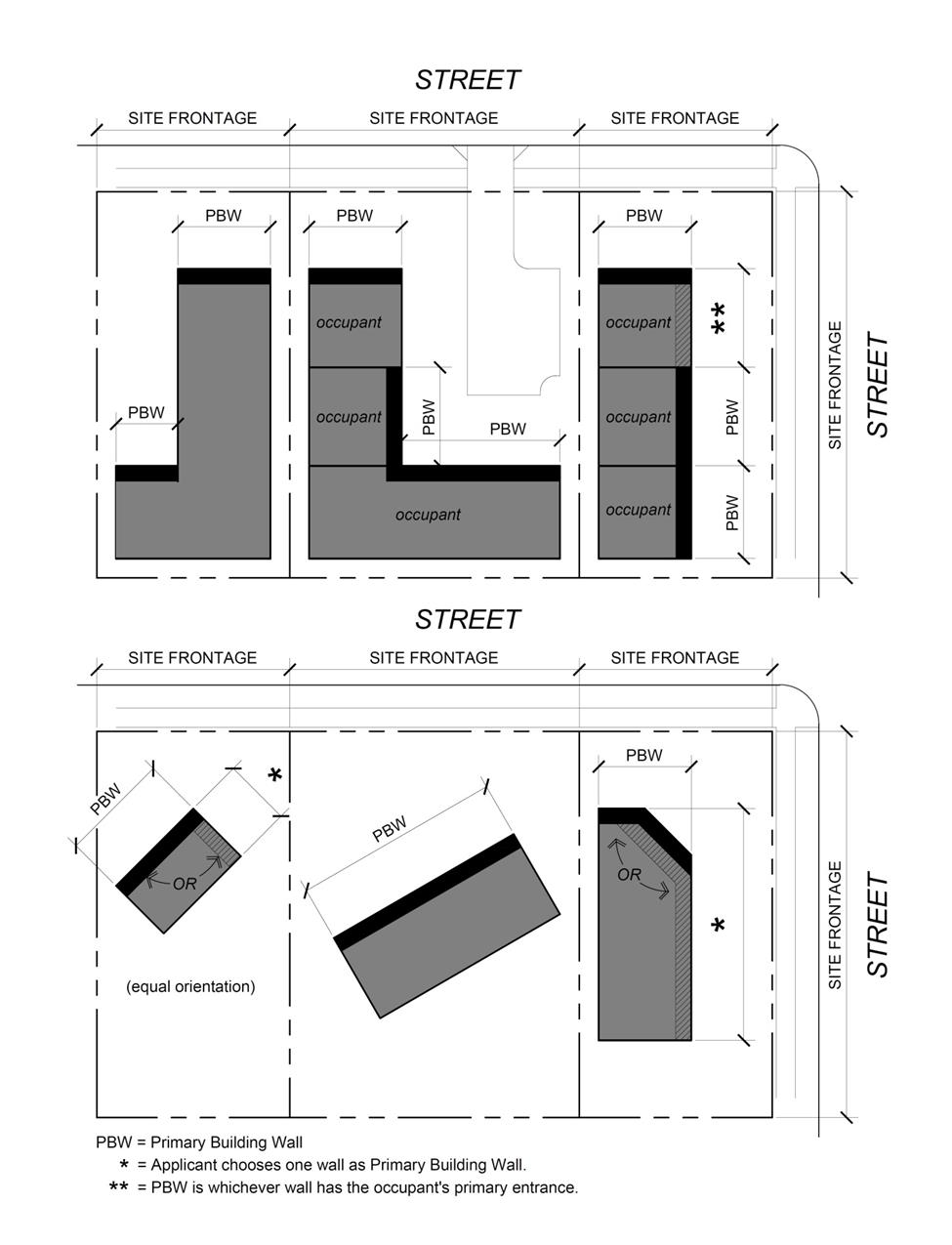
The length of a primary building wall is derived for each tenant space's ground floor exterior wall (See Figure 1). When walls are not parallel to a street, they are assigned to the street frontage to which they are most oriented. When the primary entrance is located in a building wall that is adjacent to, at an angle from, and shorter than the street-facing wall, the primary building wall will be measured as a combination of the street wall and the wall containing the entrance. Where the angled wall is on the corner of the building between two street-facing walls, the applicant may choose which street facing wall to combine with the wall containing the entrance to be considered the primary building wall. The length of the primary building wall will be measured in a straight line parallel to the street-facing wall.
Figure 1
Primary and Secondary Building Wall
Date Passed: Monday, January 29, 2018
Effective Date: Saturday, March 17, 2018
ORD C35577 Section 12
Section 17C.240.140 Sign Face Area
Sign Cabinets.
The area of sign faces enclosed in frames or cabinets is determined based on the outer dimensions of the frame or cabinet surrounding the sign face (See Figure 2).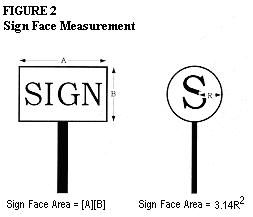
Backed Signs.
Only one side of a backed sign is counted in determining the area of sign faces. Where the two sides are not of equal size, the larger of the two sides is used for the determination of sign area (See Figure 3).
Multiple Cabinets.
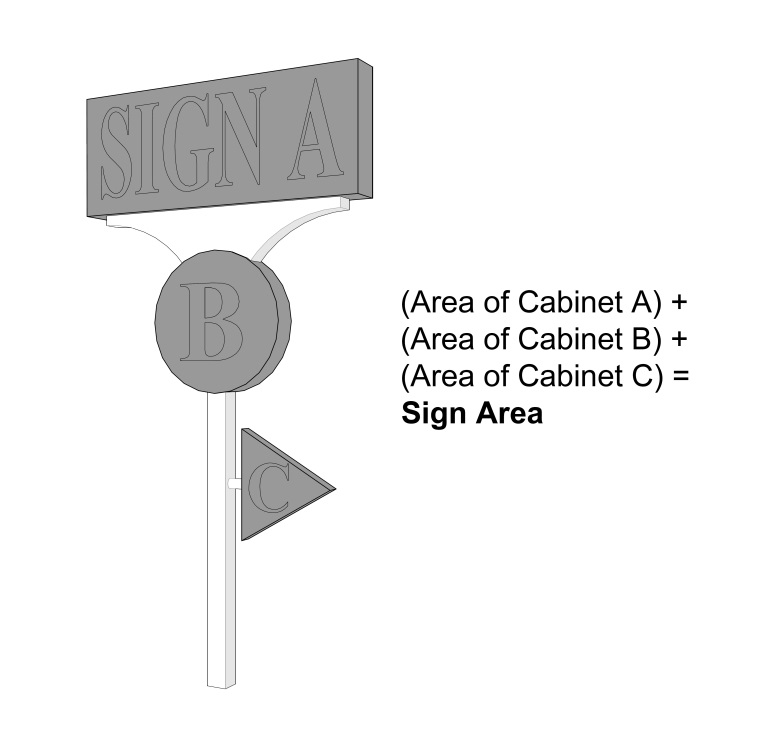
For freestanding and projecting signs that contain multiple cabinets on one structure and oriented in the same direction, the modules together are counted as one sign face (See Figure 4).
Figure 4
Multiple Cabinets
Round Signs.
The maximum surface area visible at one time of a round, three dimensional, or three or more sided sign is counted to determine sign area.
Background panel or surface.
Sign copy mounted, affixed or painted on a background panel or surface distinctively painted, textured or constructed as a background for the sign copy, is measured as that area contained within the smallest rectangle, parallelogram, triangle, or circle that will enclose the sign copy and the background, as shown in Figure 5.
Figure 5
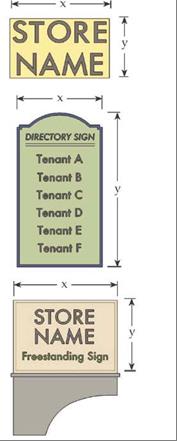
Individual letters or graphics.
Sign copy mounted as individual letters or graphics against a wall of a building or surface of another structure, that has not been painted, textured or otherwise altered to provide a distinctive background for the sign copy, is measured as the sum of the smallest square, rectangle, parallelogram, triangle or circle that will enclose each word, sentence and complete message, and each graphic in the sign.
Figure 6
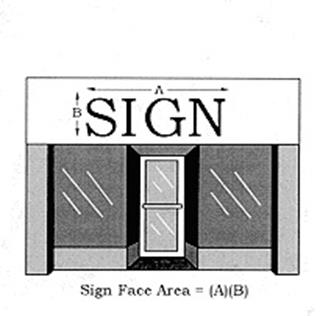
Painted Wall Signs.
Painted wall signs are measured as the sum of the smallest square, rectangle, parallelogram, triangle or circle that will enclose each word, sentence and complete message, and each graphic in the sign.Awnings and Marquees.
When signs are incorporated into awnings, the sign area is determined by computing the area of an imaginary rectangle drawn around the sign face. When the ends of awnings or marquees are parallel and contain sign faces, only one side is counted in addition to the sign face area on the front.
Date Passed: Monday, January 29, 2018
Effective Date: Saturday, March 17, 2018
ORD C35577 Section 12
Section 17C.240.150 Sign Heights and Clearances
Height
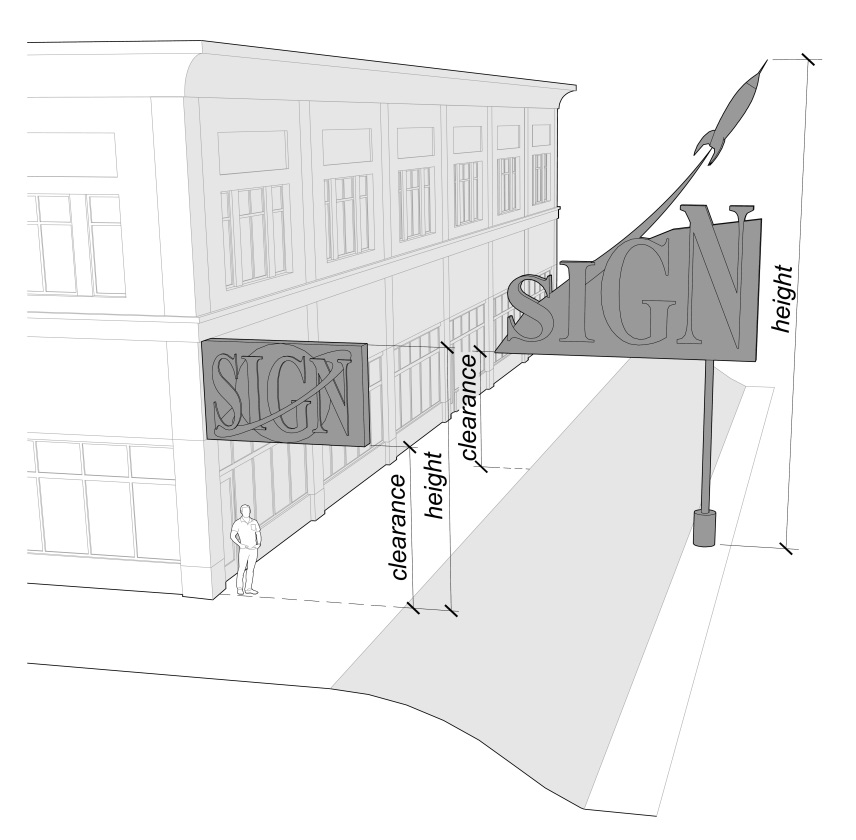
The overall height of a sign or sign structure is measured from the finish grade to the highest point of the sign or sign structure (See Figure 7).Clearance
Clearances are measured from the highest point of the ground directly below the sign to the bottom of the sign structure enclosing the sign face (See Figure 7).
Figure 7
Sign Heights and Clearances
Date Passed: Monday, January 29, 2018
Effective Date: Saturday, March 17, 2018
ORD C35577 Section 13
Section 17C.240.180 Diagonal Corner Signs
Diagonal corner signs that face more than one street must be assigned to a street and building frontage by the applicant. The sign must meet all standards for the street and building frontage to which it is assigned.
Date Passed: Monday, January 29, 2018
Effective Date: Saturday, March 17, 2018
ORD C35577 Section 15
Section 17C.240.210 Uses, Use Categories, and Structure Types
In some cases, sign regulations are applied based on the land use or use category of a site, or structure type on the site. All of these are described or defined in Title 17C SMC.
Date Passed: Monday, June 22, 2009
Effective Date: Wednesday, August 5, 2009
ORD C34390 Section 1
Section 17C.240.220 Standards in Residential Zones
- General Standards.
All permanent signs in Residential zones must comply with the standards detailed in Table 17C.240.220-1.
Table 17C.240.220-1. Standards for Permanent Signs in Residential and CA4 Zones [1] | |||||
Use Category/Structure Type [2] | Number of Signs | Max. Sign Face Area | Types of Signs Allowed | Maximum Sign Height | Additional Signs Allowed [3] |
Residential Household Living/Houses, Duplexes, Attached Houses | 1 per site | 3 sq. ft. | Fascia, Painted Wall | Top of wall, or 10 ft. whichever is less | Directional Signs |
Freestanding | 6 ft. | ||||
Residential Household Living/Multi-family Residential Building, Group Living, Day Care, Nonresidential Category Uses Not Listed Below | 1 per building | 15 sq. ft. | Fascia, Painted Wall | Top of wall | Directional Signs |
Freestanding | 10 ft. | ||||
Subdivisions, PUDs, Agricultural Uses [4] | 1 per entrance |
32 sq. ft. | Monument | 10 ft. | Directional Signs |
Mobile Home Parks | The sign standards for mobile home parks are contained in 17C.345.120 | ||||
Parks and Open Areas [5] | 1 per street frontage | 10 sq. ft. | Monument | 10 ft. | Directional Signs |
Colleges, Community Services, Medical Centers, Religious Institutions, Schools, Commercial Outdoor Recreation, Major Event Entertainments, Nonconforming Uses in Commercial and Industrial Use Categories, Uses in the Office Use Category Allowed as a Conditional Use in the RMF and RHD Zones | The sign standards of the NR zone apply. See SMC 17C.240.160. | ||||
Notes: | |||||
- Sign Features.
Signs in all residential zones, except for those subject to the NR zone sign standards, are subject to the standards of this subsection. Illuminated signs placed in windows are subject to these sign regulations. Extensions into the right-of-way are prohibited.
Date Passed: Monday, January 29, 2018
Effective Date: Saturday, March 17, 2018
ORD C35577 Section 18
Section 17C.240.230 Standards in the Commercial and Industrial Zones
- General Standards and Sign Features.
All permanent signs in Commercial and Industrial zones must comply with the standards detailed in Tables 17C.240.230-1 and 17C.240.230-2.
Table 17C.240.230-1 | |||||
| DTC, DTG, DTU, DTS, GC, LI & HI [8] | CC2, CB, & CA3 [2][8] | O, OR, NR, NMU | CC1, CA1 & CA2 [2] | CC4 [2] |
SIGNS ATTACHED TO BUILDINGS | |||||
Size Allocation | 1-1/2 sq. ft. per 1 ft. of primary building wall or 15 percent of the primary building wall, whichever is greater | 1 sq. ft. per 1 ft. of primary building wall if a freestanding sign is also on the same street frontage, | Same | Same | 15 sq. ft. |
Maximum Number | No limit within size allocation | Same | Same | Same | 1 |
Maximum Area Per Sign | 250 sq. ft. In the DT Zones, the maximum area per sign attached to a building is not limited | 100 sq. ft. | 50 sq. ft. | 50 sq. ft. | 15 sq. ft. |
Minimum Guaranteed Sign Area for a Ground Floor Tenant Space | 32 sq. ft. | Same | Same | Same | 15 sq. ft. |
TYPES ALLOWED | |||||
Fascia, Awning, Marquee, Roof Mounted, Painted Wall | Yes | Yes | Yes | Yes | Yes |
Projecting | Yes, but no projecting signs if a freestanding sign is also on the same street frontage | Same | Same | Same | Same |
FREESTANDING SIGNS | |||||
Maximum Number | 1 per site or 1 per 300 ft. of arterial street frontage and 1 for each additional 300 ft. or fraction thereof [3] | 1 per arterial street frontage | 1 per arterial street frontage | 1 monument sign per arterial street frontage | 1 monument sign per building |
When Not Allowed | Not Limited | Not allowed if there is already a projecting sign on the same site frontage, or if existing signs attached to buildings exceed the limit of 1 sq. ft. to 1 ft. of primary building wall | Same | Same | Not allowed if there is already a wall or projecting sign |
Size Allocation for All Freestanding Signs | 1 sq. ft. per 1 ft. of arterial street frontage | Same | Same | Same | 15 sq. ft. |
Size Limit | 250 sq. ft. | 75 sq. ft. [5] | 50 sq. ft. [5] | 50 sq. ft. | 15 sq. ft. |
Maximum Height [6] | 35 ft. In the DTS zone, the maximum height is 60 ft. | 20 ft. | 20 ft. | 5 ft. | 5 ft. |
ADDITIONAL SIGNS ALLOWED | |||||
Directional Signs, Temporary Signs [7] | See SMC 17C.240.243(D) and SMC 17C.240. 244 | ||||
Yes = Allowed No = Prohibited | |||||
Table 17C.240.230-2 | |
| GC, CC2, Downtown, CB, LI, HI, O, OR, NR, NMU, CC1 & CC4 |
Electronic Message Center Sign Features | Allowed [1][2] |
Lighting | Direct, Indirect, or Internal |
Maximum Distance | |
Maximum Area | |
Bonus Allowance for Outstanding Design | |
Notes: | |
Date Passed: Monday, January 29, 2018
Effective Date: Saturday, March 17, 2018
ORD C35577 Section 19
Section 17C.240.240 Sign Placement and Location Restrictions
- Sign Placement.
All signs and sign structures must be erected and attached totally within the site except when allowed to extend into the right-of-way by this chapter.
- Signs Extending Into the Right-of-way.
The standards of this subsection apply to permanent signs that are erected on private property and that extend into the right-of-way.
- Projecting Signs.
Projecting signs that extend into the right-of-way must meet the following standards:
- Distance Into the Right-of-way.
- Where allowed, signs may extend into the right-of-way not more than ten feet or within two feet of the curbline, whichever is the smaller projection.
- Diagonal corner signs may extend into the right-of-way to a point that is determined by extending a line from the maximum points allowed for projecting signs on each street frontage (See Figure 8).
Figure 8
Signs Projecting into the Right of Way

- Maximum Sign Face Area In the Right-of-way.
The area of a sign is limited by the amount the sign extends into the right-of-way, as follows:
- A sign extending more than six feet cannot have a total area of projection in excess of sixty square feet; and
- A sign extending less than six feet may not exceed one hundred square feet in area.
- Blanketing.
A projecting sign that extends into the right-of-way more than three feet may not be within twenty feet of another projecting or freestanding sign that extends more than three feet into the right-of-way if the new sign is within horizontal lines drawn from the top and bottom of the prior sign.
- Awnings and Marquees.
Awnings and marquees that contain signs may extend into the right-of-way the same distance as awnings and marquees that do not contain signs (See SMC 17F.040.140, Awnings).
- Clearances.
- Clear View Triangle
- Subject to the authority of the traffic engineer to make adjustments and special requirements in particular cases, all signs and sign features within the Clear View Triangle defined in SMC 17A.020.030 shall be maintained to keep a vertical clear view zone between three and ten feet from ground immediately below the sign or awning (see Figure 9).
Figure 9
Vertical Clear View Zone

- Signs may not be located within a clear view triangle as defined in this paragraph. Support structures for a sign may only be located in a clear view triangle if the combined total width is twelve inches or less and the combined total depth is twelve inches or less.
- Vehicle Area Clearances.
In areas outside of rights-of-way, when a sign or awning extends over where vehicles travel or are parked, the bottom of the structure must be at least fourteen feet above the ground. Vehicle areas include driveways, alleys, parking areas, and loading and maneuvering areas.
- Pedestrian Area Clearances.
When a sign or awning extends over a sidewalk, walkway, or other space used by pedestrians, the bottom of the structure must be at least eight feet above the ground. Free-hanging valances made of fabric or other non-rigid material hung on signs, awnings, and marquees must be at least seven feet above of a sidewalk, walkway, or other space used by pedestrians.
- Access to Signs.
Access clear of all obstructions must be provided to all signs.
- Removal of Signs.
- The director of public works and utilities may require any legally permitted or legal non-conforming signs extending into the right-of-way to be modified or moved if streets are widened, or other improvements made in the right-of-way, which result in the creation of unsafe conditions. The modification or moving will be at the owner’s expense. If a legal nonconforming sign is moved under this requirement, it may be re-erected on the site without being brought into conformance.
- Abandoned signs and signs not explicitly allowed within the right-of-way shall be subject to immediate removal, under the authority of the director of public works or his/her designee.
Date Passed: Monday, January 29, 2018
Effective Date: Saturday, March 17, 2018
ORD C35577 Section 20
Section 17C.240.241 Building Mounted Wall Signs
- Placement.
Signs attached to buildings or structures that are based on the sign rights of a primary building wall may be placed on that primary building wall, on a secondary building wall, or on another structure. They may not be placed on another primary building wall.
- Awnings and Marquees.
Signs attached to an awning or marquee that extends into the right-of-way must comply with the pedestrian clearance and right-of-way extension standards of SMC 17F.040.140, Awnings
- Fascia Signs.
- Vertical Extensions.
Fascia signs may not extend more than six inches above the top of the building wall. Fascia signs attached to other structures may not extend above the top of the structure.
- Horizontal Extensions.
A fascia sign may not extend more than eighteen inches out from the wall or structure to which it is attached. Fascia signs may not extend beyond the corner of buildings or other structures.
- Projecting Signs.
- Vertical extensions.
The face of a projecting sign may not extend more than six inches above the roof line.
- Placement.
Projecting signs that extend over the right-of-way must meet the placement standards of SMC 17C.240.240(B), Signs Extending Into the Right-of-way.
Date Passed: Monday, January 29, 2018
Effective Date: Saturday, March 17, 2018
ORD C35577 Section 21
Section 17C.240.242 Roof-Mounted Signs
No permit shall issue for a roof-mounted sign which does not comply with the following standards:
Number. No more than one (1) roof-mounted sign shall be allowed for each building.
Area. The area of the roof-mounted sign shall not exceed the total amount of wall sign area that would be allowed for the building or site on which the roof mounted sign is located.
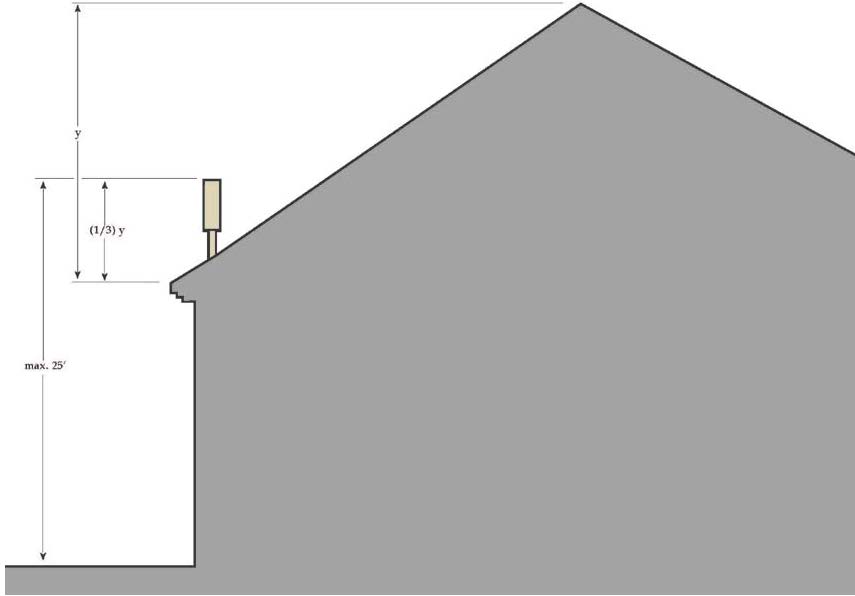
Location. Allowed on the slope of peaked/sloped roof buildings only, and only on the lowest one-third (1/3) of the slope of the peaked roof. Roof-mounted signs shall be installed so that the structural supports of the sign are minimized. Angle irons, guy wires, braces or other secondary supports shall appear to be an integral part of the roof or roof-mounted sign.
Zone. Roof-mounted signs are permitted in nonresidential zones only.
Design. Roof-mounted signs may be non-illuminated, internally illuminated or indirectly illuminated, provided that the light is limited to the sign face only.
Figure 10
Roof Mounted Signs
Date Passed: Monday, January 29, 2018
Effective Date: Saturday, March 17, 2018
ORD C35577 Section 22
Section 17C.240.243 Freestanding Signs
- Setbacks.
Freestanding signs are regulated as follows:
- Residential Zones.
- In residential zones, freestanding signs are allowed in required setbacks; however, in required front setbacks, monument signs exceeding three and one-half feet tall shall be setback ten feet from the front property line, provided that the requirements of SMC 17C.240.240(C) are met.
- Freestanding signs with structural supports less than two feet in width, with copy area placed at a height of seven feet or more above grade, may be located at the front property line, provided that the requirements of SMC 17C.240.240(C) are met.
- Freestanding signs with structural supports of more than two feet shall be set back not less than ten feet from the front property line, provided that the requirements of SMC 17C.240.240(C) are met.
- Commercial and Industrial Zones.
In O, OR, NR, NMU, CB, CC-2, GC, LI, and HI zones, freestanding signs are allowed in required setbacks for buildings and parking areas. However, freestanding signs are prohibited in the setback between a property line abutting a residentially zoned site and the building line or parking area setback line.
- Frontages.
Freestanding signs must be placed on arterial street frontages unless there are none. Freestanding signs that are allowed based on the length of one arterial street frontage may not be placed on another arterial street frontage. Frontage on a freeway is not considered arterial street frontage.
- Extensions Into the Right-of-way.
Freestanding signs may project into the public right-of-way as follows, provided they also meet the requirements of 17C.240.240(B):
- No more than ten feet beyond the property line; or
- Within two feet of the curbline, whichever is the smaller projection.
- The area of a sign is limited by the amount of projection beyond the property line, as follows:
- A sign projecting more than six feet cannot have a total area of projection in excess of sixty square feet; and
- A sign projecting less than six feet may not exceed one hundred square feet in area.
- All supports of a freestanding sign must be on private property.
- Directional Signs.
- General Standards.
Directional signs that meet the standards of this subsection are allowed in all zones and are not counted in the total square footage of permanent signage allowed on the site. Adjustments or modifications to the standards of this subsection are prohibited.
- Size.
Freestanding directional signs may be up to six square feet in area and forty two inches in height. Fascia directional signs may be up to six square feet in area and eight feet in height.
- Sign Features.
Direct, internal or indirect lighting is allowed. Extensions into the right-of-way are prohibited. Up to 25 percent of the area of the sign may contain a logo, image, or other copy.
- Directional Signs that Do Not Meet the Standards of this Subsection.
Directional signs that do not meet the standards of this subsection must meet either the standards for signs attached to buildings or the standards for freestanding signs.
Date Passed: Monday, January 29, 2018
Effective Date: Saturday, March 17, 2018
ORD C35577 Section 23
Section 17C.240.244 Temporary Signs
- No Permit required. No sign permit is required for temporary signs.
- Removal. Any abandoned temporary sign, or other temporary signs that are not explicitly allowed within the right-of-way shall be removed. Failure to remove such signs shall constitute a violation of this chapter.
- The director of public works and utilities shall have the authority to require the immediate removal of any abandoned temporary sign or other temporary signs not explicitly allowed in the public right-of-way.
- Authority over abandoned temporary signs in other locations is described in SMC 17C.240.050. The removal shall be at the cost of the sign and/or property owner.
- Materials. See the definition of “temporary sign” in Section 17C.240.015.
- City property (excluding City right-of-way). Temporary signs on City-owned property (excluding City right-of-way) are allowed only in conjunction with an approved Special Event permit.
- City Right-of-Way outside of the Roadway. Temporary signs allowed to be placed in the right-of-way shall meet the following standards:
- The sign is entirely outside the roadway.
- The sign is no larger than the maximum allowed for a freestanding temporary sign in the zoning district.
- The sign is entirely outside of the area of a right-of-way corner that is between the curb and the lines created by extending the property line to the curb face (See Figure 11a)
Figure 11a
Exclusion Area

- The sign is entirely outside the area of a sidewalk that is between the lines created by extending the edges of any curb ramp across the sidewalk to the property line.
- The edge of the sign is within six inches of the curb (See Figure 11b).
Figure 11b
Temporary Signs in the Right of Way

- The sign does not obstruct a continuous through pedestrian zone of at least six feet in width.
- The sign does not obstruct pedestrian and wheelchair access from the sidewalk to any of the following:
- Transit stop areas.
- Designated disabled parking spaces.
- Disabled access ramps; or
- Building exits including fire escapes.
- Physical Attachment to Public Property.
See SMC 17C.240.070(I).
- Additional Placement Standards for Temporary Signs.
Temporary signs placed in the right-of-way must meet the following additional standards:
- Where no curb exists, the sign must be placed outside the roadway at least five feet from the edge of the roadway. Temporary signs may not be placed in medians, traffic islands, or other areas within the roadway.
- Temporary signs must not be placed in parking spaces, pedestrian pathways, or bicycle paths.
- Temporary signs placed in the right-of-way must have the permission for such placement of the abutting property owner, resident, or respective agent. For purposes of this section, the public right-of-way shall mean that portion of the public right-of-way located next to a street between the roadway and the adjacent private property open to the public for general pedestrian passage, including the buffer/planting strip.
- Temporary signs may be placed on property residentially zoned in accordance with the requirements of this Section and the following:
- Freestanding signs (includes post-mounted, stake and portable signs).
- Single-family zones: Temporary free-standing signs shall not exceed four (4) square feet in size and five (5) feet in height, if the sign is post mounted on the ground, and not to exceed three (3) feet in height if the sign is stake-mounted or portable.
- Multi-family zones: Temporary free-standing signs shall not exceed six (6) square feet in size and five (5) feet in height if the sign is post mounted on the ground, and not to exceed three (3) feet in height if the sign is stake-mounted or portable.
- Surface-mounted signs. Limited to sites two (2) acres or larger:
- Size. No larger than thirty-two (32) square feet.
- Location. Must be flatly affixed to walls below the fascia or parapet line, or flatly affixed to on-site fences either facing or abutting the street, or facing inward to the subject site. Signs shall not be attached or tethered to other site improvements.
- Non-residential zones. Temporary signs are allowed on non-residentially zoned property in accordance with the requirements of this Section and the following:
- Freestanding signs (including post-mounted, stake and portable signs): Size/height. Limited to four (4) square feet and five (5) feet in height if the temporary sign is mounted in the ground, and not to exceed three (3) feet in height if the temporary sign is portable.
- Surface-mounted signs:
- Size. Limited to thirty-two (32) square feet.
- Location. Must be flatly affixed to walls below the fascia or parapet line, or flatly affixed to on-site fences either facing the abutting street, or facing inward to the subject site. Signs shall not be attached or tethered to other site improvements.
Date Passed: Monday, January 29, 2018
Effective Date: Saturday, March 17, 2018
ORD C35577 Section 24
Section 17C.240.245 Sandwich Board Signs
- Sandwich board signs shall be limited to one sign per address. These signs are subject to the following conditions:
- Size.
The area of the sign shall not exceed nine square feet per side in size and shall not exceed three feet in any dimension.
- Maintenance Standards
Signs shall be constructed out of materials able to withstand typical northwest weather. Such materials may be metal, finished wood, chalkboard, whiteboard, or plastic; signs and copy shall be of professional quality. Owners of sandwich board signs shall be required to keep their signs in a legible, intact, and well-maintained manner.
- Display Time.
Signs may only be displayed during business or event hours. If business or event hours continue past daylight hours, precautions should be taken to place the sign in a location where it is readily visible after dark. This shall not be construed to allow the wiring of a sign for lighting.
- Location.
Signs may be located no further than twelve feet from the business, sponsoring establishment, or event location. Such signs shall not be placed in a location which is within the vision triangle or any location which will impede vehicular traffic. Further, such signs shall not be placed in a manner which will block or otherwise obstruct the safe use of sidewalks, building entrances or stairs by pedestrians, including pedestrians who are visually impaired or otherwise handicapped.
Date Passed: Monday, January 29, 2018
Effective Date: Saturday, March 17, 2018
ORD C35577 Section 25
Section 17C.240.246 Community Banners
- Community Banners.
Such signs may be permitted and extend into the public right-of-way by permission of the city administrator or appointed representative. Such signs may only be placed at City-designated locations provided that the banner:
- is not commercial advertising but, rather, has as its principal purpose the promotion of a civic event, public service announcement, holiday decoration, or similar community interests;
- complies with all applicable codes and officially adopted city policies; and
- does not, in the judgment of the street director, present a traffic hazard.
Date Passed: Monday, January 29, 2018
Effective Date: Saturday, March 17, 2018
ORD C35577 Section 26
Section 17C.240.247 Electronic Message Center Signs
- Electronic Message Center Signs.
Electronic message center signs are permitted subject to the limitations in Table 17C.240.247-1.
Table 17C 240.247-1 Electronic Message Center Sign Features | ||||||||
Zoning Category | Maximum Allowed Sign Size by Zoning Designation: Freestanding/Wall | Electronic Message Center Sign Size | Hours of Operation | Brightness | Timing | Content | Signs Using Video Display Methods Permitted? | |
CC4 | Wall: 15 sq. ft. Freestanding: 15 sq. ft. | Not Allowed |
|
|
|
|
| |
All Residential & CA4 | Residential Use: 15 sq. ft. Institutional Use: | Not allowed for residential use. Not greater than 50% of the allowed sign size for institutional uses. | Shall be turned off between the hours of 10 pm and 6 am | [1] | [2][3] | On premises advertising only | No | |
CC1, CA1 & CA2 | Wall: 50 sq. ft. Freestanding: 50 sq. ft. | No greater than 50% maximum total allowable sign area | Not Limited | [1] | [2][3] | On premises advertising only | No | |
O, OR, NR [4], NMU | Wall: 50 sq. ft. Freestanding: 50 sq. ft. | No greater than 50% maximum total allowable sign area | Not Limited | [1] | [2][3] | On premises advertising only | No | |
CC2, CB, CA3 | Wall: 100 sq. ft. Freestanding: 75 sq. ft. | No greater than 50% maximum total allowable sign area or 48 sq. feet. (the lesser of the two) | Not Limited | [1] | [2][3] | On premises advertising only | No | |
GC, LI, HI | Wall: 250 sq. ft. Freestanding: 250 sq. ft. | No greater than 50% maximum total allowable sign area or 48 sq. feet. (the lesser of the two) | Not Limited | [1] | [2][3] | On premises advertising only | Yes | |
DTC, DTG, DTU, DTS [5] | Wall: 250 sq. ft. Freestanding: 250 sq. ft. | Not Allowed |
|
|
|
|
| |
| Notes: | |||||||
Date Passed: Monday, January 29, 2018
Effective Date: Saturday, March 17, 2018
ORD C35577 Section 27
Section 17C.240.250 Off-premises Signs
- No new off-premises signs may be constructed, on any site.
- Off-premises signs now in existence in any zone, meeting the requirements of 17C.240.280, are considered nonconforming uses and may remain, subject to the following restrictions:
- A nonconforming off-premises sign may not be increased in size or elevation, relocated to another site or to a new location on the same site or expanded, enlarged, or extended in any way, including, but not limited to, the addition of advertising faces or the addition of rotating faces with movable panels designed to create additional advertising, except as provided for in the public works exception below.
- Public Works Exception
A legal, non-conforming off-premises sign shall be allowed to be relocated if necessitated for the accomplishment of a governmental public works project. The relocation of an off-premises sign under this exception must occur within six (6) months of removal or its legal, non-conforming status shall be discontinued pursuant to SMC 17C.240.280. Relocation of these off-premises signs for public works projects shall be subject to the limitations in subsections (a) through (f) below:
- No increase in square footage of off-premises sign copy shall be permitted. These signs shall be replaced at the same size they existed at immediately prior to relocation.
- No additional sign faces shall be added.
- No increase in height of the existing off-premises sign shall be permitted except where needed to provide for minimum height clearance (from the ground to the bottom of the off-premises signs) to comply with roadway safety.
- The off-premises sign shall be relocated along the same roadway it was removed from in the geographical vicinity and shall comply with the Scenic Vistas Act of 1971 (chapter 47.42 RCW and chapter 468-66 WAC) if located along a state highway. For purposes of this provision, the term “roadway” shall apply to both directions of a couplet.
- The off-premise sign shall not be relocated to a site with a Residential, Neighborhood Retail, or Center and Corridor zoning designation including CA zones, or located within an historic district, regardless of the zoning or district of the original sign location.
- The relocation of the off-premises sign shall be subject to all current City of Spokane rules, regulations, and procedures relating to the regulation and control of signs, excepting size, height, and off premise advertising limitations.
- A nonconforming off-premises sign may not be structurally altered. Structural alterations mean alterations to, including replacement of, either the off-premises sign face, or the supporting structure. Normal maintenance and repair including painting, cleaning, or replacing damaged parts of the off-premises sign, shall not be considered a structural alteration.
- Any nonconforming off-premises sign which deteriorates, is damaged or destroyed by fire, explosion, wind, act of nature, failure to maintain or other accidental means may be restored if the cost thereof does not exceed fifty percent of its replacement cost. Off-premises signs damaged in an amount in excess of fifty percent of replacement cost shall be removed.
- All nonconforming off-premises signs shall be kept in good repair and maintained in a neat, clean, attractive and safe condition. Any work required to repair or maintain an off-premises sign shall be completed promptly so long as the off-premises sign is not structurally altered, and so long as the cost of such repair and/or maintenance does not exceed fifty percent of the cost of replacing the off-premise sign.
Date Passed: Monday, October 16, 2023
Effective Date: Thursday, November 23, 2023
ORD C36448 Section 4
Section 17C.240.260 Additional Standards for Specific Uses
- Bed and Breakfast Facilities.
Sites with bed and breakfast facilities must meet the sign regulations for household living.
- Home Occupations.
Sites with home occupations must meet the sign regulations for household living.
Date Passed: Monday, January 29, 2018
Effective Date: Saturday, March 17, 2018
ORD C35577 Section 29
Section 17C.240.270 Additional Standards in Shoreline Districts
General Shoreline Regulations.
In addition to any restrictions and conditions in this chapter, signs in the shoreline jurisdiction are subject to special regulations as set forth in SMC 17C.240.270(A) through SMC 17C.240.270(D). These special regulations address general shoreline sign requirements and those that are specific to shoreline districts as generally represented on the shoreline districts map.
The following regulations apply in all shoreline districts:
No sign may front directly on the watercourse.
No sign may be located on the water side of a street parallel and adjacent to the watercourse or any place where it would impair a vista or visual access to the water.
Off-premises signs, permanent banners and roof signs are not allowed.
In the shoreline natural environment or those areas identified under SMC 17E.060.020, Natural Land Forms, all signs may be prohibited at the discretion of the director, with exceptions made for wayfinding or interpretative signs giving directions to viewpoints or trails and signs describing special flora, fauna, or historical or cultural features.
Directional and interpretive signs accessory to park uses shall be allowed within the shoreline buffer and may not exceed an area of twelve square feet or a height of nine feet.
Pursuant to SMC 17E.060.280(R), required access signs that indicate the public’s right of access and hours of access shall be installed and maintained by the property owner and shall not exceed an area of twelve square feet or a height of nine feet.
Pre-existing signs are governed by the nonconforming use provisions of SMC 17C.240.280.
Upriver District.
Signs must be flat against the building or a variation of a flat sign, such as a "V" sign, and may not project more than eighteen inches into a required yard or public right-of-way.
No sign may exceed thirty-five feet in height above average grade along the front of the building.
Signs are subject to maximum area limitations based on lineal frontage and building size as follows:
One square foot of sign area is allowed for every lineal foot of street frontage, to a maximum sign area of twenty square feet.
On corner lots, additional signs up to one-half square foot in area are permitted for each lineal foot of frontage on the side street, to a maximum of twenty square feet of sign area.
The maximum sign area for a building over two stories is ten percent of the building facade on the principal street, to a maximum of sixty square feet.
Signs may be directly, internally, or indirectly illuminated but not animated, flashing, or rotating.
The illumination of a sign may not exceed the equivalent of:
eight hundred MA fluorescent lamps spaced on twelve-inch centers penetrating a three-sixteenths inch white Plexiglas facing, or
sixty MA neon tubing in an individual letter with no more than three tubes per letter.
Downtown and Campus Districts.
Signs must be flat against the building, or a variation of a flat sign such as a "V" sign, and may not project more than eighteen inches into a required yard or public right-of-way.
No sign may exceed thirty-five feet in height above average grade along the front of the building.
Signs are subject to maximum area limitations based on lineal frontage and building size as follows:
One square foot of sign area is allowed for every lineal foot of street frontage, to a maximum sign area of fifty square feet.
Additional signs may be allowed up to one-half square foot in area for each lineal foot of frontage measured along the side street, to a maximum of fifty square feet of sign area.
The maximum sign area for a building over two stories is ten percent of the area of the building facade on the principal street, up to a maximum sign area of one hundred fifty square feet.
Signs may be directly, internally, or indirectly illuminated but not animated, flashing, or rotating.
The illumination of a sign may not exceed the equivalent of:
eight hundred MA fluorescent lamps spaced on eight-inch centers penetrating a three-sixteenth inch Plexiglas facing material, or
sixty MA neon tubing in an individual letter with no more than four tubes per letter.
Great Gorge Park, Downriver, and Latah Creek Districts.
No sign may be illuminated, animated, flashing, or rotating.
Up to two signs of an area of six square feet or less each may be used to advertise the sale of products raised or grown on the premises.
Any Peaceful Valley commercial area is governed by regulations of the Upriver District.
Date Passed: Monday, January 29, 2018
Effective Date: Saturday, March 17, 2018
ORD C35577 Section 30
Section 17C.240.280 Nonconforming Signs
- Any sign legally existing prior to August 5, 2009 that does not conform in use, location, height, or size with the regulations of the zone in which such sign is located shall be considered nonconforming and may continue in such status until such time as it is removed by its owner.
- Regulations that Apply to All Nonconforming Signs.
- Sign maintenance, sign repair, and changing of permanent sign faces is allowed so long as structural alterations are not made and the sign is not increased in size. In the DTS zone, for existing signs that are sixty feet or more in height, the replacement of the sign cabinet with a sign cabinet of equal or smaller sign area is permitted if the sign height is not more than the existing sign.
- Permanent signs and sign structures that are moved, replaced, or structurally altered must be brought into conformance with the sign regulations. However, nonconforming signs required to be moved because of public right-of-way improvements may be re-established (See SMC 17C.240.240D, Removal of Signs, and SMC 17C.240.250(B)(2), Public Works Exception.)
- Nonconforming temporary signs must be removed.
- Ownership.
The status of a nonconforming sign is not affected by changes in ownership.
- Change to a Conforming Sign.
A nonconforming sign may be altered to become conforming or be replaced with a conforming sign by right. Once a sign is altered to conform or is replaced with a conforming sign, the nonconforming rights for that sign are lost and a nonconforming sign may not be re-established. Unless prohibited, proposed changes that are not in conformance are subject to the adjustment process.
- Loss of Nonconforming Sign Status.
- Discontinuance.
If there is no sign face in place on a sign structure or building wall for six continuous months, the nonconforming rights are lost and a nonconforming sign may not be re-established.
- Destruction.
When a sign or sign structure is removed or intentionally destroyed, replacement signs and sign structures must comply with the current standards. However:
- Repair and Maintenance.
A nonconforming sign or sign structure may be removed temporarily to perform sign maintenance or sign repair. In order to preserve the nonconforming sign status, the person removing the sign must inform the director, in writing, before the sign is removed. If the responsible party fails to inform the director, any re-erected sign will be considered a new sign.
- Unintentional Destruction.
When a sign or sign structure that has nonconforming elements is damaged or destroyed by fire, explosion, wind, act of nature, or other accidental means, it may be rebuilt to the same size and height using the same or similar materials, so long as the cost of such repair and/or maintenance does not exceed fifty percent of the cost of replacing the non-conforming sign.
- Documenting a Nonconforming Sign.
To document legal nonconforming status, the applicant must provide evidence to show that the sign was established prior to the effective date of this chapter or allowed when established, and that the sign has been maintained over time. If the applicant provides standard evidence from the lists below, the director will determine if the evidence is satisfactory.
- Sign Established Before effective Date of this Chapter.
If the sign was established before the effective date of this chapter, the applicant must provide evidence to show that the sign was established before the effective date of this chapter. Standard evidence that the sign was established before the effective date of this chapter is a:
- building, zoning, sign, or development permit;
- date-stamped photograph of the sign at its current location.
- Sign Maintained Over Time.
The applicant must provide evidence to show that the sign has been maintained over time. Standard evidence that the sign has been maintained over time is:
- utility bills;
- sign-specific property or income tax records;
- business licenses;
- listings in telephone, business, or Polk directories;
- advertisements in dated publications;
- building, sign, land use, or development permits; or
- records of sign lease agreements;
- tax returns or schedules.
Date Passed: Monday, January 29, 2018
Effective Date: Saturday, March 17, 2018
ORD C35577 Section 31
Section 17C.240.310 Exceptions
Approval Required. An exception may be granted from the strict application of the regulations in this Chapter which apply to: (a) sign placement on a parcel or building frontage; (b) sign area; or (3) sign height, as regulated in this Chapter. An exception may not be granted to allow any prohibited signs or prohibited sign features, as described in Section 17C.240.070, or for any other purpose not listed in this subsection. The exception procedure in this Section does not apply to any street Right-of-Way Use permit or Building permit.
Need for Sign Permit, Consolidation of Processing. An application for an exception may be submitted before or concurrent with the associated sign permit application. No sign permit application requiring an exception for issuance will be processed without a sign exception application unless the applicant specifically requests that the application be processed without an exception.
Review Procedures. The following steps shall be followed in the processing of sign exception applications:
Determination of Complete Application (Section 17G.061.120)
Notice of Decision (Section 17G.061.320)
Appeals (Section 17G.061.340)
Application Requirements. A complete sign exception application shall consist of the following:
Application form. A completed sign exception application, including the applicant’s name, address, phone number and e-mail address. If the applicant is not the property owner, then the property owner must be identified and the application must include an affidavit from the property owner, verifying that the property owner has given permission to the applicant for the submission of the sign exception application and for the installation/posting of the sign on the property owner’s property.
Sign Permit Application (all of the materials required by Section 17C.240.080 Sign Permit required). However, the applicant may submit an exception application without a sign permit application as provided in subsection B above.
A narrative report which describes the requested exception in detail. The report shall identify all of the sections of this Chapter from which the applicant is requesting the exception, as well as the nature and extent of the exception (in size, area, location on the property, height).
The narrative report shall also include the applicant’s description of the manner in which the sign exception satisfies all of the exception criteria in subsection E below.
Fees. Payment of the appropriate sign exception application fee.
Exception Criteria for Approval. Sign exception applications shall be reviewed by the planning director to determine whether all of the following criteria are satisfied. In order to approve any sign exception, the director must make written findings to show that all of the following criteria have been met:
The request for an exception is due to unusual conditions pertaining to sign visibility needs for a specific building or lot; and
The sign will not create a hazard; and
The sign will not violate any state statute or any City Code provision (other than the ones identified in this Chapter relating to signs); and
The sign will not negatively affect adjacent property; and
The sign will be in keeping with the general character of the surrounding area and the granting of the exception would not result in an alteration of the essential character of the surrounding area; and
The proposed exception is consistent with the purposes and intent of the Zoning Code and the purposes of this Chapter; and
The exception is consistent with the City’s Comprehensive Plan; and
The applicant has established that there are practical difficulties in complying with the provision(s) of this Chapter and that the proposed sign is a reasonable use of the property. (Economic considerations alone do not constitute practical difficulties.); and
The plight of the applicant is due to circumstances unique to the property, which were not created by the applicant or landowner; and
The exception will not permit any sign type or use that is not allowed in the zoning district where the affected land is located, nor will it allow any sign or sign feature prohibited under Section 17C.240.070.
First Amendment Exception. Where an applicant can demonstrate that the strict application of the regulations in this Chapter would violate his/her First Amendment rights, the City may grant an exception that does not conform to all of the exception criteria in subsection E above. However, the applicant shall submit an application which provides his/her response to each of the exception criteria in subsection E. The City need not make findings that all of the exception criteria have been satisfied, but if not all criteria have not been satisfied, the exception may only be granted to the extent reasonably necessary to protect the applicant’s First Amendment rights. If a First Amendment exception is granted, it shall be treated as an approval of an exception for purposes of this Chapter.
Notice of Final Decision. A Notice of Decision incorporating the decision on the exception application shall issue not more than 120 days after issuance of the Determination of Complete Application.
Expiration of Exception. If the exception is approved, the sign identified in the exception must be installed within 180 days or the exception will expire. No sign may be erected if there is no sign permit for the sign, or if the exception or the sign permit has expired, even if the applicant has received associated building permits or street Right-of-Way Use permits, and the latter have not expired.
Date Passed: Monday, January 29, 2018
Effective Date: Saturday, March 17, 2018
ORD C35577 Section 34

