
Tecumseh City Zoning Code
ARTICLE XI
PARKING, LOADING AND ACCESS MANAGEMENT
DIVISION 3. - PARKING DESIGN STANDARDS
Off-street parking facilities, other than parking for one- or two-family dwellings, shall be designed, constructed, and maintained in accordance with the following.
Sec. 98-274. - Intent.
Off-street facilities designed for the parking of self-propelled motor vehicles for occupants, employees and patrons of buildings erected, used, altered or extended after the effective date of adoption or amendment of this chapter shall be provided and maintained in accordance with the provisions of this article. Such facilities shall be maintained and not encroached upon so long as the principal use remains, unless an equivalent number of spaces are provided elsewhere in conformance with this chapter.
The purpose of this article is also to protect water quality and the capacity of drainage and stormwater management systems; to limit the number of off-street parking spaces and amount of impervious surfaces that may be permitted on a parcel of land or accessory to a use or building; to establish flexible minimum and maximum standards for off-street parking and loading; and to promote the use and development of shared parking facilities and cross-access between sites.
(Ord. No. O-06-25, § 1(Exh. A), 8-4-2025)
Sec. 98-275. - Scope.
Adequate off-street parking and loading spaces shall be provided in all districts in accordance with the provisions in this article whenever a structure or use is established, constructed, altered, or expanded, an existing use is replaced by a new use (change of use), or the intensity of a use is increased through additional dwelling units, an increase in floor area or seating capacity or similar means. Such spaces shall be provided in accordance with the provisions of this Article and shall be constructed prior to the issuance of a certificate of occupancy.
(Ord. No. O-06-25, § 1(Exh. A), 8-4-2025)
Sec. 98-276. - General standards.
(a)
Location of spaces.
(1)
Proximity to site. Off-street parking for other than residential use shall be either on the same lot or within five hundred (500) feet of the building it is intended to serve, measured from the nearest point of the building to the nearest point of the off-street parking lot. Ownership shall be shown of all lots or parcels intended for use as parking by the applicant.
(2)
Rear yards. Parking may be located in any rear yard in any zoning district.
(3)
Front and required side yards. Off-street parking shall not be permitted in a side or front yard except as follows:
a.
Off-street parking may be permitted to occupy a required front yard in the I-1, I-C, B-1, and B-3 districts after approval of the parking plan layout, provided that there shall be maintained a minimum unobstructed and landscaped setback of twenty (20) feet in I-1 and I-C (industrial) districts and ten (10) feet in the B-1 and B-3 districts between the nearest point of the off-street parking area, exclusive of driveways, and the nearest existing or proposed right-of-way line. The buffer area between the parking lot and the right-of-way line shall be landscaped in accordance with Sec. 98-255.
b.
Off-street parking may be located in a required side yard abutting a nonresidential zoning district in the I-1, I-C, B-1, B-3, D-1, D-2, and D-3 districts provided that there shall be an unobstructed and landscaped setback of at least ten (10) feet maintained between the nearest point of the off-street parking lot, exclusive of driveways, and the side lot line. Such unobstructed and landscaped setback shall extend continuously and uninterrupted along the side lot line from the edge of the parking area nearest the front lot line to the rear yard.
The unobstructed and landscaped setback of at least ten (10) feet may be reduced or waived by the reviewing authority upon determining that such reduction or waiver is compatible with and/or part of a comprehensive plan with the adjacent properties.
(4)
Setback from residential districts and uses. Parking areas, and circulation or access drives shall be setback from adjoining or abutting residentially zoned property as follows:
a.
Where the parking lot or drive abuts a residential district at the side or rear lot line said parking lot or drive shall be setback a minimum of ten (10) feet from said lot line.
b.
Where the parking lot or drive shares common, contiguous street frontage with an abutting residentially zoned parcel, said parking lot or drive shall maintain the same minimum front or street side setback required for the residential parcel dependent upon orientation to the common street of said parcel and other residential parcels in the same block.
c.
Private roads, private drives and off-street parking areas, including maneuvering lanes, shall not be permitted within required yards in the RM-1 and RM-2 districts where the adjacent property is zoned one-family residential.
(5)
Setback from buildings. Parking, loading areas, and circulation or access drives shall set back at least seven (7) feet from any building or structure. Concrete curbing shall be installed along the perimeter of the vehicular use area to prevent encroachments.
(b)
Residential parking spaces. Residential off-street parking spaces shall consist of a driveway, garage, or combination and shall be located on the premises they are intended to serve. Parking shall be limited to asphalt or concrete surfacing, or any other surfacing approved by the building services director. No Parking shall be allowed on grass.
(c)
Alteration of existing parking. In all districts except the downtown district (D-1, D-2, D-3), off-street parking existing at the effective date of the ordinance from which this chapter derives in connection with the operation of an existing building or use shall not be reduced to an amount less than required in this Article for a similar new building or use. Off-street parking spaces provided to meet the minimum parking requirements may not be changed to any other use unless equal facilities are provided elsewhere in compliance with this chapter.
(d)
Pedestrian circulation. The parking lot layout shall accommodate pedestrian circulation. Pedestrian crosswalks shall be provided, distinguished by textured paving or pavement striping, and integrated into the sidewalk network.
(e)
Cross access. Common, shared parking facilities are encouraged. As such, wherever feasible, cross-access connections between adjacent parking lots or a future connection when no adjacent parking lot exists but can reasonably be expected to be constructed on an adjacent parcel at a future date are required. Blanket cross-access easements across the entire parking lot area shall be provided for connected lots under separate ownership or management. The cross-access easement shall be without limitation and shall be recorded with the county register of deeds.
(f)
Prohibited activities. The storage of merchandise, motor vehicles for sale, trucks, or the repair of vehicles is prohibited in off-street parking areas.
(g)
Permit required. No parking lot shall be constructed, altered, or reconstructed unless a permit is issued by the building official. Applications for a permit shall be submitted to the City in such form as may be determined by the building official and shall be accompanied with two (2) sets of plans for the development and construction of the parking lot showing that the provisions of this article will be fully complied with.
(Ord. No. O-06-25, § 1(Exh. A), 8-4-2025)
Sec. 98-277. - General provisions.
(a)
Uses not listed. For uses not specifically listed in Sec. 98-282, the development services director shall determine the use that is most closely related. The use determined shall determine the standard for required parking spaces.
(b)
Uses meeting more than one category. Where more than one (1) use is present in a building or on a site (such as a gas station with a convenience store and/or restaurant, or a place of worship with a day care center and community center) the various components of the use shall comply with the parking requirement applicable to each component. In such a case, the applicant must provide information regarding the floor area, employees, or other relevant information about each use in order to allow the City to determine the minimum parking requirement for the building or site. The shared parking provisions of Sec. 98-278 may be applied if applicable.
(c)
Fractional spaces. When units or measurements determining the number of required parking spaces result in the requirement of a fractional space, any fraction up to and including one-half (½) shall be disregarded, and fractions over one-half (½) shall require one (1) parking space.
(d)
On-Street Parking Credit. On-street parking within five hundred (500) feet of the property may count towards meeting the minimum parking requirements in Sec. 98-282.
(e)
Units of measurement. The following units of measurement are used in calculating required parking:
(1)
Floor area. Where floor area is the unit for determining the required number of parking spaces, said unit shall mean gross floor area.
(2)
Usable floor area. Usable floor area shall mean the floor area used for service to the public and shall not include floor area used for storage or processing and packaging of merchandise where it is undertaken in a room in which service to the public is not involved. When usable floor area is not known at the time of site plan submittal, eighty percent (80%) of the total floor area shall be used for usable floor area for parking computations.
(3)
Places of assembly. For places of worship, sports arenas or similar places of assembly in which those in attendance occupy benches, pews or similar seating, each twenty-four (24) inches of such seating shall be counted as one (1) seat.
(4)
Employees. For requirements stated in terms of employees, the calculation shall be based on the maximum number of employees on the premises during the largest shift.
(Ord. No. O-06-25, § 1(Exh. A), 8-4-2025)
Sec. 98-278. - Shared parking.
Different types of uses have different peak usage times, for instance, residential land uses generate the most parking demand during evening and night hours, while office uses generate the most parking demand during business hours. Therefore, the minimum parking requirement may be adjusted by a shared parking factor that considers a mixture of uses sharing a common parking facility. The uses that share a common parking facility may be located within a single building or in separate buildings located on the same or different sites.
(a)
Shared parking procedure. The number of shared parking spaces required for two (2) or more land uses sharing a parking lot or located on the same parcel of land shall be determined by the following procedure:
(1)
Multiply the minimum parking required for each individual use, as set forth in the following shared parking factors table, by the appropriate percentage indicated in the Shared Parking Factors table below for each of the six (6) designated time periods.
(2)
Add the resulting sums for each of the six (6) columns.
(3)
The minimum parking requirement shall be the highest sum among the six (6) columns resulting from the above calculations.
(4)
Other uses. If one (1) or all of the land uses proposing to make use of shared parking facilities do not conform to the general land use classifications in the Shared Parking Factor table, as determined by the planning commission, the applicant shall submit sufficient data to indicate the principal operating hours of the uses. Based upon this information, the planning commission shall determine the appropriate shared parking requirement, if any, for such uses.
(5)
Other uses. If one (1) or all of the land uses proposing to make use of shared parking facilities do not conform to the general land use classifications in the Shared Parking Factor table, as determined by the planning commission, the applicant shall submit sufficient data to indicate the principal operating hours of the uses. Based upon this information, the planning commission shall determine the appropriate shared parking requirement, if any, for such uses.
(b)
Agreement. A written agreement between joint users in a form approved by the City shall be filed with the Lenawee County Register of Deeds. The agreement shall assure the continued availability of the parking facility for the uses it is intended to serve.
(Ord. No. O-06-25, § 1(Exh. A), 8-4-2025)
Sec. 98-279. - Banked parking.
If the minimum number of required parking spaces exceeds the amount necessary to serve a proposed use, the planning commission may approve construction of a lesser number of parking spaces, subject to the following:
(a)
The banked parking shall be shown on the site plan and set aside as landscaped open space.
(b)
The banked parking shall be constructed if the City documents three incidents of problem parking on the site within any one-year period.
(c)
Banked parking shall be located in areas that are suitable for future parking and comply with the requirements of this chapter.
(Ord. No. O-06-25, § 1(Exh. A), 8-4-2025)
Sec. 98-280. - Modification of parking requirements.
(a)
The planning commission may modify the numerical requirements for off-street parking based on evidence submitted by the applicant that another standard would be more reasonable because of the level of current or future employment or customer traffic.
(b)
The planning commission may attach conditions to the approval of a modification of the requirements of Section 98-736 that bind such approval to the specific use in question.
(Ord. No. O-06-25, § 1(Exh. A), 8-4-2025)
Sec. 98-281. - Maximum parking permitted.
In order to minimize excessive areas of pavement which negatively impact aesthetic standards and contribute to high volumes of stormwater runoff, the maximum amount of off-street parking permitted for any use shall not exceed one hundred thirty (130) percent of the minimum parking requirements of Sec. 98-282. This requirement shall not apply to single-family or two-family dwellings. The planning commission may permit additional parking over and above the maximum parking limit based on documented evidence indicating that the maximum parking permitted will not be sufficient to accommodate the use on a typical day.
(Ord. No. O-06-25, § 1(Exh. A), 8-4-2025)
Sec. 98-282. - Minimum parking required.
Off-street parking shall be provided in compliance with the minimum requirements in the following table:
* Places of assembly are commercial uses where parking demand is generated by occupancy rather than floor area. Examples include movie and live action theatres, banquet halls, fraternal organizations, etc.
(Ord. No. O-06-25, § 1(Exh. A), 8-4-2025)
Sec. 98-283. - Parking layout.
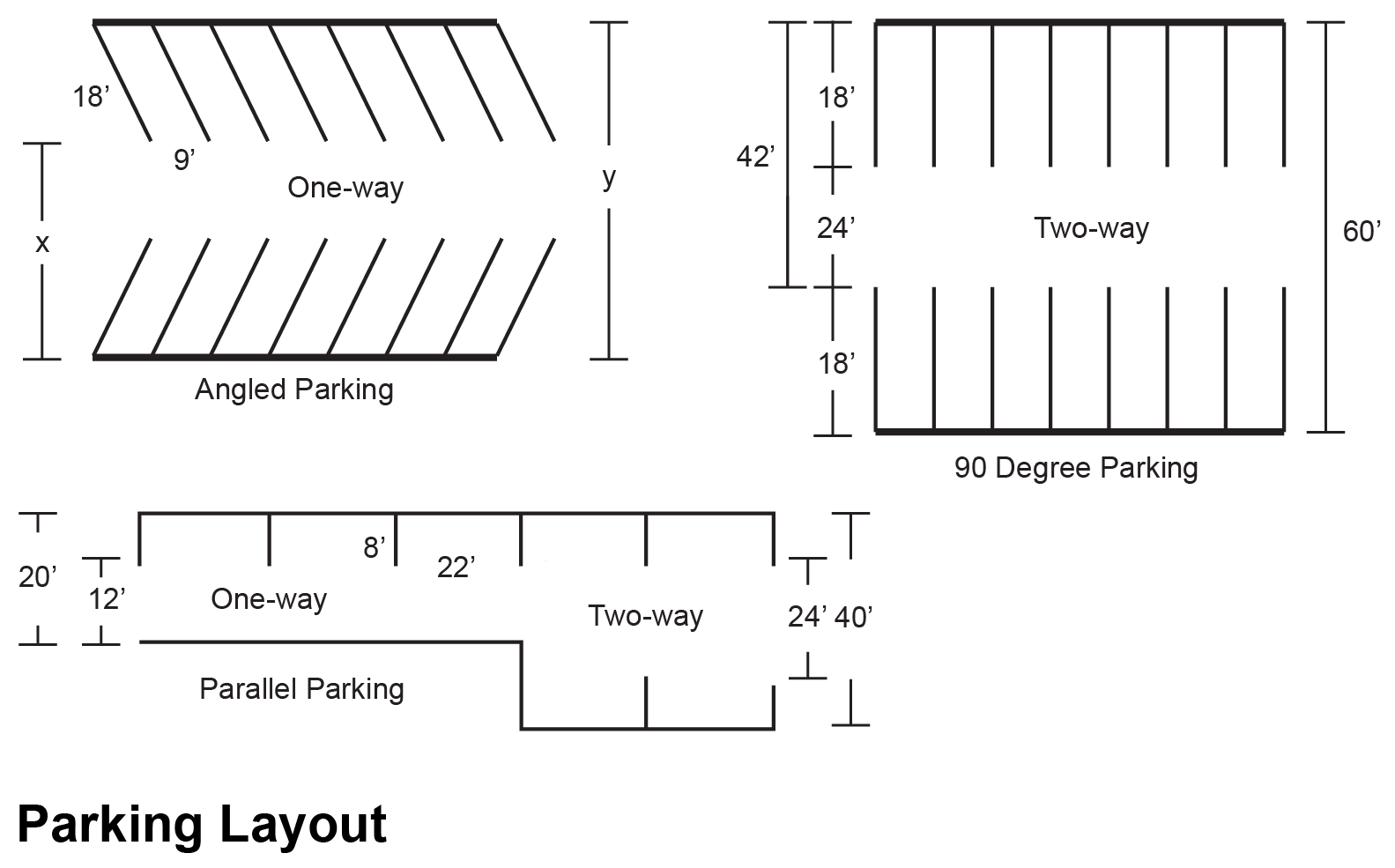
The layout of off-street parking facilities shall be in accordance with the following minimum requirements:
(a)
The depth and width of parking spaces and the width of maneuvering lanes shall be measured from the face of the curb, or when no curb is proposed, parking spaces and maneuvering lanes shall be measured from the edge of pavement. If any fixed objects, including, but not limited to, bollards, posts, building edges, bumper posts and light poles, are located within the pavement area of a parking space or maneuvering lane, the depth and width of the parking space and the width of the maneuvering lane shall be measured from the edge of the fixed object.
(b)
Fire hydrants shall not be located closer than five (5) feet from the back of the curb adjacent to any parking space, loading area, fire lane or maneuvering lane.
(c)
Parking aisles shall not exceed three hundred (300) feet in length without a break in circulation.
(d)
All parking lots shall be provided with wheel stops or bumper guards so located that no part of parked vehicles will extend beyond the lot boundaries, into required screening or landscaping, or across sidewalks or pedestrian pathways.
(e)
Parking structures may be built to satisfy off-street parking regulations when located in other than residential districts subject to the area, height, bulk and placement regulations of such district in which located.
(f)
When a wall extends to an alley which is a means of ingress and egress to and from an off-street parking area, it shall be permissible to end the wall not more than ten (10) feet from such alley line in order to permit a wider means of access to the parking area.
(g)
Each entrance and exit to and from any off-street parking lot located in an area zoned for other than single-family residential use shall be at least twenty (20) feet distant from any adjacent property located in any single-family residential district.
(Ord. No. O-06-25, § 1(Exh. A), 8-4-2025)
Sec. 98-284. - Barrier-free parking requirements.
(a)
Barrier-free parking spaces shall be provided per the state construction code, shall be accessible from and conveniently located near each primary building entrance, and shall be identified by above grade signs and pavement striping.
(b)
The following table is a summary of the barrier-free parking space requirements in effect at the effective date of this Ordinance:
(Ord. No. O-06-25, § 1(Exh. A), 8-4-2025)
Sec. 98-285. - Lighting and landscaping.
Parking lot landscaping shall be provided as required by Article X and lighting shall be provided as required by Article VIII, Division 2.
(Ord. No. O-06-25, § 1(Exh. A), 8-4-2025)
Sec. 98-286. - Pavement striping.
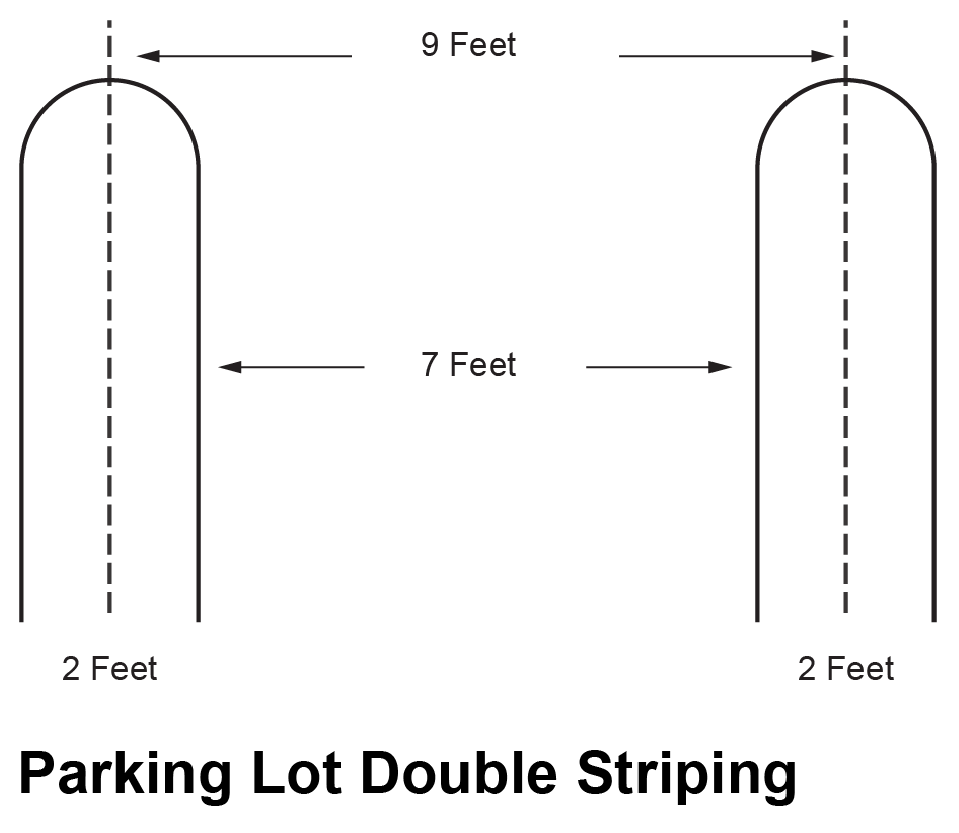
All parking spaces shall be clearly striped with double four-inch wide lines, spaced twenty-four (24) inches apart, to facilitate movement and to help maintain an orderly parking arrangement. Refer to Parking Lot Double Striping Figure.
(Ord. No. O-06-25, § 1(Exh. A), 8-4-2025)
Sec. 98-287. - Off-street stacking spaces.
Where required by this chapter, stacking spaces shall be eight (8) feet wide by sixteen (16) feet long. Stacking spaces shall not intrude into any street right-of-way or interior maneuvering lane.
(Ord. No. O-06-25, § 1(Exh. A), 8-4-2025)
Sec. 98-288. - Off-street loading.
There shall be provided and maintained on the same premises with every structure, use or part thereof involving the receipt or distribution of vehicles, equipment, materials or merchandise adequate space for standing, loading, and unloading to avoid undue interference with public use of dedicated rights-of-way. Such space shall be provided as follows:
(a)
Spaces Required. B-1, B-3, D-1, D-2, D-3 districts. The districts a minimum of one (1) loading space shall be provided per establishment or building, whichever is less. Such off-street loading spaces shall be located in the rear yard and shall have a minimum dimension of ten (10) feet by forty (40) feet.
(b)
Spaces Required. I-1, and I-C districts. All spaces in the I-1 and I-C districts shall measure ten by fifty (50) feet, or five hundred (500) square feet in area, with a clearance of at least fourteen (14) feet in height. Loading dock approaches shall be provided with a pavement having an asphaltic or Portland cement binder so as to provide a permanent durable and dustless surface. All spaces shall be provided in the following ratio of spaces to usable floor area:
(1)
Buildings up to and including two thousand (2,000) square feet of floor area shall not be required to provide a dedicated loading space.
(2)
Buildings with more than two thousand (2,000) square feet in floor area, but less than twenty thousand (20,000) square feet of gross floor area shall provide at least one (1) space.
(3)
Buildings with more than twenty thousand (20,000) square feet in floor area, but less than one hundred thousand (100,000) square feet shall provide a minimum of one (1) space plus one space for each twenty thousand (20,000) square feet in excess of twenty thousand and one (20,001) square feet.
(4)
Buildings one hundred thousand and one (100,001) square feet and greater in floor area shall provide five (5) spaces plus one (1) space for each additional forty thousand (40,000) square feet or fraction thereof.
(c)
Location of loading spaces. The location and arrangement of loading spaces shall be subject to the following:
(1)
Off-street loading space may be completely enclosed within a building or may occupy a portion of the site outside of the building. Where any portion of a loading space is open to view from a public right-of-way or residential zoning district, screening shall be provided in accordance with Article X of this chapter (Landscaping and Screening).
(2)
All loading and unloading in an I-1 or I-C district shall be provided off-street in a rear or side yard. Loading and unloading facilities shall be prohibited in the front yard.
(3)
Off-street loading facilities that make it necessary or possible to back directly into a public street shall be prohibited. All maneuvering of trucks and other vehicles shall take place on the site and not within a public right-of-way.
(4)
Off-street loading facilities shall be located so as to not interfere with pedestrian access.
(5)
Cross-access agreements between adjacent properties to facilitate off-street truck maneuverability are encouraged.
(d)
Loading restrictions. Delivery vehicles and trailers shall load or unload or park only in designated loading/unloading zones as indicated on the approved site plan. Delivery vehicles and trailers shall not park or load or unload elsewhere on the premises. Under no circumstances shall a delivery vehicle or trailer park or be allowed to park in a designated loading/unloading zone for longer than forty-eight (48) hours.
(e)
Modification of loading space requirements. The planning commission may modify or waive the requirement for off-street loading areas, upon determining that adequate loading space is available to serve the building or use, or that provision of such loading space is unnecessary or impractical to provide.
(Ord. No. O-06-25, § 1(Exh. A), 8-4-2025)
Sec. 98-289. - Grading and drainage.
Driveways and parking areas shall be graded and provided with adequate drainage to dispose of surface waters in accordance with applicable construction and design standards established by the City. Surface water shall not drain on to adjoining lots, towards buildings or across a public street, except in accordance with an approved drainage plan.
(Ord. No. O-06-25, § 1(Exh. A), 8-4-2025)
Sec. 98-290. - Construction.
(a)
The parking area shall be surfaced within one (1) year of the date the permit is issued.
(b)
Off-street parking areas shall be drained so as to dispose of all surface water accumulated in the parking area in such a way as to preclude drainage of water onto adjacent property or toward buildings, and plans shall meet the approval of the City engineer.
(c)
The entire parking area, including parking spaces and maneuvering lanes required under this section, shall be provided with asphaltic or concrete surfacing in accordance with specifications approved by the City engineer.
(d)
Exceptions:
(1)
The City engineer may permit alternative paving materials, such as permeable pavers, for off-street parking areas.
(2)
In the I-C and I-1 district, gravel may be permitted for overflow parking, subject to site plan approval from planning commission.
(Ord. No. O-06-25, § 1(Exh. A), 8-4-2025)
Sec. 98-291. - Maintenance.
All parking and loading areas shall be maintained in accordance with the provisions of this article, an approved site plan and the following:
(a)
Alterations to an approved parking or loading facility that are not in accordance with an approved site plan shall be considered a violation of this chapter.
(b)
All parking areas, perimeter landscaped areas, and required screening shall be kept free from tall grass, weeds, trash, and debris. Surfacing, curbing, lighting fixtures, signage, and related improvements shall be kept in good repair.
(c)
Parking and loading areas shall be diligently kept clear of snow. Up to ten percent (10%) the parking area may be used for snow deposit.
(d)
Parking lots shall be maintained in a clean and debris-free manner.
(Ord. No. O-06-25, § 1(Exh. A), 8-4-2025)

