
Tecumseh City Zoning Code
ARTICLE XII
DEFINITIONS
Sec. 98-292.- Definitions, A, B.
(a)
Accessory building. A type of structure that: has a roof which is supported by columns or walls; is intended for the shelter or enclosure of persons, animals, goods or property; and is further intended to be used in a manner that is clearly incidental to, customarily found in connection with, subordinate to, and located on the same zoning lot as the principal use to which it is exclusively related.
Examples of accessory buildings include garages, storage sheds, gazebos, play houses, greenhouses, pump houses, and dog houses.
(b)
Accessory structure. Anything constructed or erected, the use of which requires permanent location on the ground or attachment to something having such location, and that is intended to be used in a manner that is clearly incidental to, customarily found in connection with, subordinate to, and located on the same lot or parcel as the principal use to which it is exclusively related. Examples of accessory structures include: accessory buildings, swimming pools, play structures, HVAC units, generators, and tennis courts.
(c)
Accessory use. A use that is clearly incidental to, customarily found in connection with, subordinate to, and located on the same lot or parcel as the principal use to which it is exclusively related.
(d)
Adjacent. Lots are adjacent when at least one (1) boundary line of one (1) lot touches a boundary line or lines of another lot. Exception: when the only touching boundary lines are located within a road easement or right-of-way.
(e)
Alley. Any dedicated public way affording a secondary means of access to abutting property, and not intended for general traffic circulation.
(f)
Alteration. Any change, addition or modification in construction or type of occupancy, or in the structural members of a building such as walls or partitions, columns, beams or girders, the consummated act of which may be referred to as altered or reconstructed.
(g)
Antenna. Any exterior transmitting or receiving device mounted on a tower, building or structure and used in communications that radiate or capture electromagnetic waves, digital signals, analog signals, radio frequencies (excluding radar signals), wireless telecommunications signals or other communication signals, but excluding facilities considered to be essential public services or facilities preempted from City regulation by applicable state, Federal Communications Commission (FCC) or other federal laws or regulations.
(h)
Antenna support structure or tower. Any structure that is designed and constructed primarily for the purpose of supporting one (1) or more antennas for telephone, radio and similar communication purposes, including self-supporting lattice towers, guyed towers, or monopole towers. The term includes radio and television transmission towers, microwave towers, common carrier towers, cellular telephone towers, alternative tower structures and the like. The term includes the structures and any support thereto. All such structures may be attached to the ground, attached to a roof or otherwise attached to a building.
(i)
Appeal. An appeal is a formal request submitted to the Zoning Board of Appeals by an applicant who alleges that an error has been made in an order, requirement, permit, decision, or interpretation issued by the development services director, zoning enforcement officer, or any other administrative official, board, or commission responsible for enforcing this Ordinance.
(j)
Appearance. The outward aspect visible to the public.
(k)
Applicant (petitioner or developer). A person, agent, firm, association, partnership, corporation, government agency or any combination thereof, which may have interest in or ownership of land or property.
(l)
Appropriate. Sympathetic, or fitting, to the context of the site and the whole community.
(m)
Architectural ambiance. The architectural character or tone of buildings in an area, as determined by building scale and design, amount and type of activity, intensity of use, location and design of space, and related factors that influence the perceived quality of the environment.
(n)
Architectural and urban scale. The relationship of a particular project, development or building in terms of size, height, bulk, intensity, and aesthetics, to its surroundings and to general character and scale of the City.
(o)
Architectural features. Distinctive design elements or details of a building's structure or façade that contribute to its style, character, and visual interest.
(1)
Architraves. The lowermost part of an entablature in classical architecture, or more generally, a decorative molding surrounding doors or windows.
(2)
Belt courses. Horizontal bands of brick, stone, or other material running across a building's facade, often used for decorative or visual division between floors.
(3)
Brick and/or wrought iron wing walls. Low, often decorative, extensions of a wall that project from the main structure, typically flanking steps or walkways.
(4)
Chimneys. Vertical structures that provide ventilation for smoke and gases from fireplaces, stoves, or furnaces to exit a building.
(5)
Pediments. Triangular or arched architectural elements placed above windows, doors, or porticos, often used in classical and neoclassical styles for ornamentation.
(6)
Steps. A series of flat surfaces (treads) that allow vertical movement between different elevations, commonly found at entrances.
(7)
Window sills. The horizontal ledge at the bottom of a window frame, often projecting outward to shed water away from the wall.
(p)
As-built plans. Revised construction plans in accordance with all approved field changes.
(q)
Assisted living facility. A facility providing responsible adult supervision or assistance with routine living functions of an individual in instances where the individual's condition necessitates that supervision or assistance.
(r)
Automobile repair. See Vehicle service.
(s)
Awning and canopy. A roof-like structure which projects from the wall of a building for the purpose of providing shielding from the elements.
(t)
Bakery or confectionary. A use involved in the transformation of livestock and agricultural products primarily for final consumption on the premises or sale directly to customers. Products manufactured on the site may be sold or distributed to other retailers for distribution to customers as an incidental use.
(u)
Banquet Hall/Conference Center. A facility which provides rental space for such functions as, but not limited to: Concerts, dancing, weddings, receptions conferences, club meetings and other similar gatherings, and may include the catering of food services both on and off the premises.
(v)
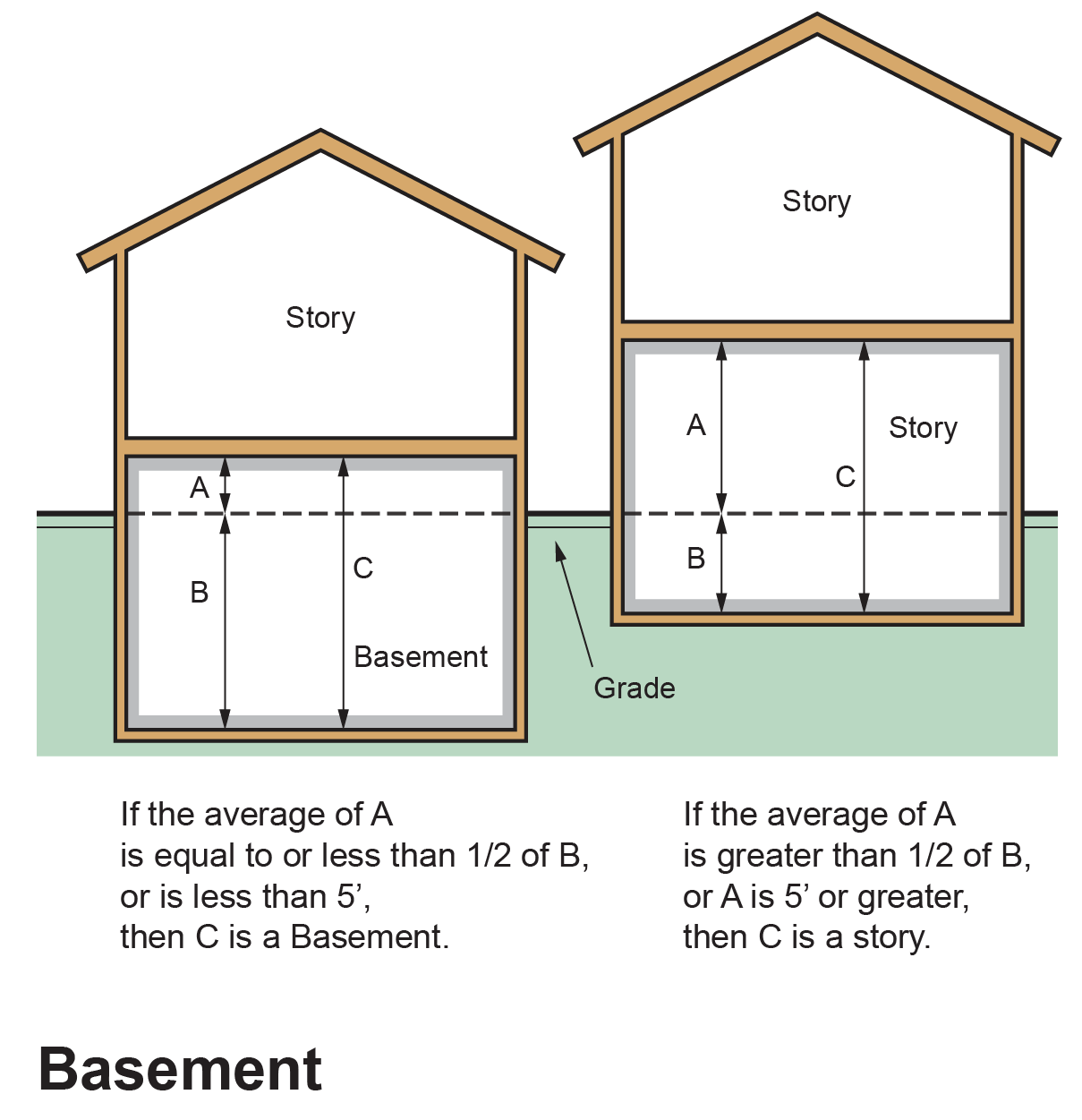
Basement. The portion of a building located partly below grade but located so as the vertical distance from the average grade to the basement floor is greater than the vertical height from the average grade to the basement ceiling; provided, however, that if the vertical distance from the average grade to the basement ceiling is five (5) feet or more, such basement shall be considered as a story.
(w)
Bed and breakfast. A small lodging establishment, typically in a private home or converted residence, that offers overnight accommodations and a morning meal to guests.
(x)
Berm. A continuous and raised earthen mound comprised of nontoxic materials, with a flattened top and sloped sides, that is capable of supporting landscape material and plantings.
(y)
Block. The property abutting one (1) side of a street and lying between the two (2) nearest intersecting streets (crossing or terminating), or between the nearest such street and railroad right-of-way, un-subdivided acreage, lake, river or live stream; or between any of the foregoing and any other barrier to the continuity of development, or corporate boundary lines of the City.
(z)
Board of appeals. The zoning board of appeals as established under this chapter.
(aa)
Boarding and Rooming Dwelling. A residential building or part thereof, other than a hotel or motel, in which sleeping rooms are provided for compensation to three (3) or more unrelated persons for periods of thirty (30) days or more. Such dwellings may include shared common areas such as kitchens, dining rooms, and bathrooms, but do not provide individual cooking facilities within the rented rooms. Meals may or may not be provided as part of the lodging arrangement.
(bb)
Buffer. A landscaped area composed of living plant material, wall, berm, or combination thereof, established and/or maintained to provide visual screening, noise reduction, and transition between zoning districts.
(cc)
Buildable area. The space remaining on a lot after compliance with the minimum required setbacks of this chapter.
(dd)
Building. Any structure, either temporary or permanent, having a roof supported by columns, walls or any other supports which is used for the purpose of housing, sheltering, storing or enclosing persons, animals or personal property or carrying on business activities. This definition shall include tents, awnings, or mobile homes used for such purposes. When any portion of a building is completely separated from every other part of the building by division walls having no openings, each portion of such building shall be deemed a separate building.
(ee)
Building code. The latest edition of the Michigan Building Code, or any other code adopted by the municipality.
(ff)
Building envelope. The area of a lot which is defined by minimum setback and spacing requirements and within which building construction is permitted by this chapter. For condominium developments, the building envelope shall be illustrated on a site plan.
(gg)
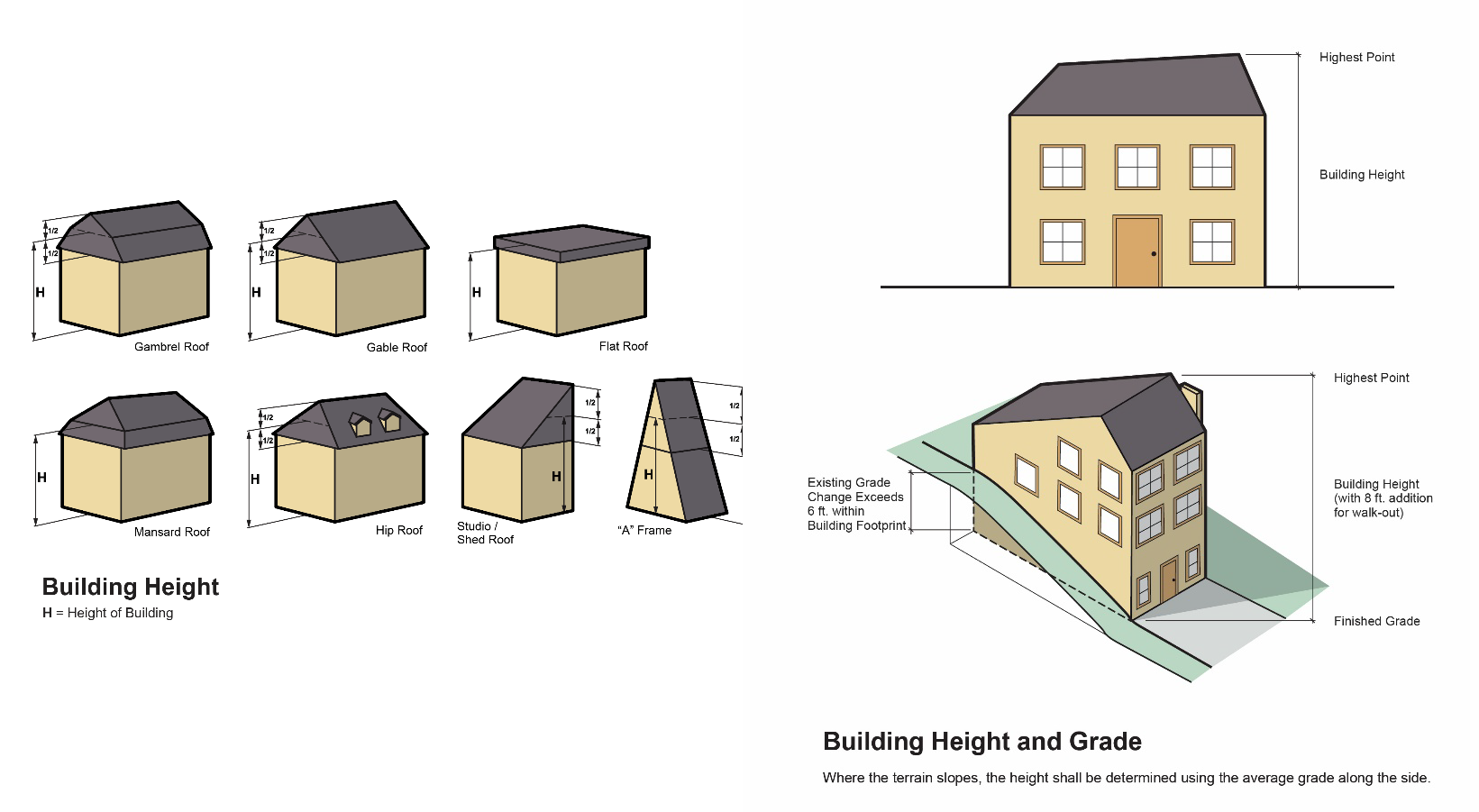
Building height. The vertical distance from the established sidewalk grade at the center of the front of the building to the highest point of the roof surface of a flat roof, to the deck line for mansard roof, and the mean height between the eaves and the ridge for gable, hip and gambrel roofs. Penthouses, towers, cupolas, steeples, antennas and other roof structures used only for mechanical operation of the building shall not be included as the height of the building. Where a building is located on sloping terrain, the height may be measured from the average ground level of the grade at the building wall.
(hh)
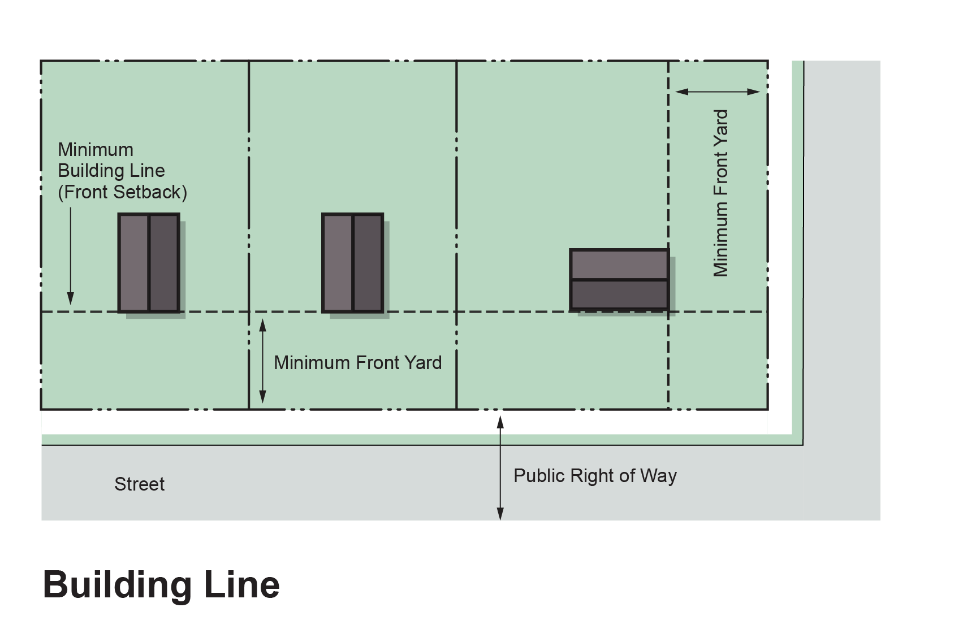
Building line. A horizontal line generally parallel to a front, side or rear lot line which is located at the point of the principal building foundation nearest the front, side or rear lot line.
(ii)
Building, main or principal. A building in which is conducted the principal use of the lot on which it is situated.
(jj)
Building official. The Building Official of the City of Tecumseh, as designated by the City council, or their authorized representative.
(kk)
Building permit. The written authority issued by the Building Official permitting the construction, removal, moving, alteration or use of a building in conformity with the provisions of this chapter.
(Ord. No. O-06-25, § 1(Exh. A), 8-4-2025)
Sec. 98-293. - Definitions, C, D.
(a)
Carport. An automobile shelter with at least two (2) sides open which may be either freestanding (detached) or formed by the extension of the roof from the side or rear of a building. A detached carport shall conform to the setback requirements for a garage.
(b)
Car wash. Any building, structure or portion thereof, either as a principal or an accessory use, containing facilities for washing motor vehicles using production line methods with a conveyor, blower, steam cleaning device or other mechanical washing devices, and shall also include coin- and attendant-operated drive-thru, self-serve, track-mounted units and similar high-volume washing establishments, but shall not include, handwashing operations. An automobile wash may include accessory automobile detailing, upholstery cleaning or vacuuming.
(c)
Certificate of Occupancy. A required permit, issued by the Building Official, allowing the use of a building or structure, after having determined that all the requirements of applicable ordinances have been met.
(d)
Child care center. A facility, other than a private residence, receiving one (1) or more preschool or school age children for care for periods of less than twenty-four (24) hours a day, and where the parents are not immediately available to the child.
(e)
Clinic. A place for the care, diagnosis and treatment of sick or injured persons, and those in need of medical or minor surgical attention. A clinic may incorporate customary laboratories and pharmacies incidental or necessary to its operation or to the service of its patients but may not include facilities for inpatient care of major surgery.
(f)
Club. An organization of persons for special purposes or for the promulgation of sports, arts, sciences, literature, politics or the like, but not operated for profit.
(g)
Commercial recreation:
(1)
Large scale indoor. Indoor facilities such as gymnasiums, handball, racquetball, tennis clubs, ice or roller skating rinks, swimming pools, archery, or indoor shooting ranges, etc., that are greater than twenty-five thousand (25,000) square feet in floor area. This classification may include restaurants, snack bars, and other incidental food and beverage service to patrons.
(2)
Small scale indoor. Indoor facilities such as gymnasiums, handball, racquetball, tennis clubs, ice or roller skating rinks, swimming pools, archery, or indoor shooting ranges, poolrooms, arcades, etc., that are less than twenty-five thousand (25,000) square feet in floor area. This classification may include restaurants, snack bars, and other incidental food and beverage service to patrons.
(3)
Outdoor. Outdoor sports and recreation facilities such as sports fields, amusement or theme parks, racetracks, golf driving ranges not in conjunction with a golf course, etc. This classification may include restaurants, snack bars, and other incidental food and beverage service to patrons.
(h)
Comprehensive plan. The comprehensive community plan, including graphic and written proposals indicating the general location for streets, parks, schools, public buildings, and all physical development of the City, and includes any unit or part of such plan, and any amendment to such plan or parts of the plan.
(i)
Condominium definitions.
(1)
Condominium Act means Public Act No. 59 of 1978 (MCL 559.101 et seq.).
(2)
Condominium document means the master deed, recorded pursuant to the Condominium Act, and any other instrument referred to in the master deed or bylaws which affects the rights and obligations of a co-owner in the condominium.
(3)
Condominium subdivision plan means the drawings and information prepared in accordance with Section 66 of the Condominium Act (MCL 599.166).
(4)
Condominium unit means the portion of a condominium project designed and intended for separate ownership and use, as described in the master deed.
(5)
Consolidating master deed means the final amended master deed for a contractible or expandable condominium project, or a condominium project containing convertible land or convertible space, which final amended master deed fully describes the condominium project as completed.
(6)
Contractible condominium means a condominium project which any portion of the submitted land or buildings may be withdrawn in accordance with this chapter and the Condominium Act.
(7)
Conversion condominium means a condominium project containing condominium units some or all of which were occupied before the filing of a notice of taking reservations under Section 7 of the Condominium Act (MCL 599.107).
(8)
Expandable condominium means a condominium project to which additional land may be added in accordance with this chapter and the Condominium Act.
(9)
Master deed means the condominium document recording the condominium project to which are attached as exhibits and incorporated by reference the bylaws for the project and the condominium subdivision plan for the project, and all other information required by Section 8 of the Condominium Act (MCL 599.108).
(10)
Notice of proposed action means the notice required by Section 71 of the Condominium Act (MCL 599.171), to be filed with the City and other agencies.
(11)
Site condominium means a condominium development containing residential, commercial, office, industrial or other structures for uses permitted in the zoning district in which located, in which each co-owner owns exclusive rights to a parcel of land defined in this section as a condominium unit, as described in the master deed, as well as a described space in a building located on a condominium unit.
(j)
Condominium subdivision (site condominium). A method of subdivision where land ownership of sites is regulated by the Condominium Act, Public Act No. 59 of 1978 (MCL 559.101 et seq.) as opposed to the Land Division Act, Public Act No. 288 of 1967 (MCL 560.101 et seq.). Condominium subdivision shall be equivalent to the term "subdivision" as used in this chapter and in chapter 46.
(k)
Convalescent or nursing home. A home for the care of children, the aged, the infirm, or a place of rest for persons suffering serious bodily disorders, wherein two (2) or more persons are cared for. A convalescent or nursing home is subject to the licensing requirements of applicable State laws (Public Act 139 of 1956, as amended).
(l)
Cottage court. A cottage court is a development consisting of a group of small, detached homes arranged around a shared, common space, often a courtyard or garden.
(m)
Court. An open space, other than a yard, on the same lot with and bounded on two (2) or more sides by a building or group of buildings.
(n)
Deck. A structure intended for use as or expansion of outdoor living space, which may be attached to or separate from a building.
(o)
Decorative items. Non-structural elements placed on a property for visual interest, ambiance, or informal communication, including temporary or movable features.
(p)
Density. The number of dwelling units built on, or to be built on, a specified area of land (expressed in dwelling units per acre).
(q)
Development. The construction or relocation of a building or buildings on an appropriately zoned lot or utilization of open land that is appropriately zoned for a new use.
(r)
Development Services Director. The Development Services Director leads the Development Services Department, which is responsible for overseeing all new construction and building additions in the City, across industrial, commercial, and residential properties. The department ensures that all construction complies with State of Michigan codes and all activity in the City adheres to the Zoning Ordinance. The director may designate another qualified individual to perform duties outlined in the Zoning Ordinance, provided that the designee also complies with State of Michigan codes.
(s)
District. A portion of the incorporated area of the City within which certain regulations and requirements or various combinations apply under the provisions of this chapter.
(t)
Drive-in or Drive-through Establishment. A business designed so that its primary retail or service function relies on accommodating patrons in motor vehicles, either by providing a driveway approach, service window, booth, or designated parking area. These establishments serve customers while they remain in or near their vehicles, rather than entering a building, to facilitate convenience and, in some cases, off-premises consumption.
(u)
Driveway. A passageway (primarily for the use of vehicles) over private property leading from a street or other public way, which is intended to provide access to a parking space, garage, or dwelling.
(v)
Dwelling. A building or portion thereof designed for occupancy by one (1) family for residential purposes, which has cooking and bath facilities. In no case shall a recreational vehicle, automobile, tent or other portable building, garage, or accessory building be considered a dwelling unit. In the case of mixed-use occupancy, where a building is occupied in part as a dwelling unit, the part so occupied shall be deemed as such and shall comply with the provisions thereof relative to dwellings. The following additional definitions are provided:
(1)
Accessory dwelling unit/Carriage house. A small, independent residential dwelling unit located on the same lot as a principal dwelling unit.
(2)
Attached dwelling. A dwelling unit attached to two (2) or more dwelling units by common major structural elements.
a.
Apartment. A building with multiple residential units.
b.
Townhouse/Rowhouse. Two (2) or more attached, single-family dwelling units with each typically having one (1) or more common walls, a front and rear door, front and rear yard, and separate utility connections. Townhouses/rowhouses may include basements.
(3)
Duplex/Two-family dwelling. A building designed exclusively for residential occupancy by two (2) sperate occupants and arranged to provide separate kitchen and sleeping accommodations and sanitary facilities for each occupant.
(4)
Detached dwelling. A dwelling unit which is not attached to any other dwelling unit by any means.
(5)
Efficiency unit. A dwelling unit with a bathroom and principal kitchen facilities designed as a self-contained unit for living, cooking, and sleeping purposes, and having no separate designated bedroom.
(6)
Manufactured home dwelling. As provided in the Mobile Homes Commission Act, a manufactured home is a dwelling unit that is transportable in one (1) or more sections, which is built upon a chassis and designed to be used as a dwelling with or without permanent foundation, when connected to the required utilities, and includes the plumbing, heating, air-conditioning, and electrical systems contained in the structure. Recreational vehicles as described and regulated herein shall not be considered "manufactured homes" for the purposes of this chapter.
(7)
Modular dwelling. A dwelling which consists of prefabricated units transported to the site in two (2) or more sections on a removable undercarriage or flat-bed and assembled for permanent location upon a permanent foundation on the lot, and to which such major elements as the heating system or a substantial portion of the siding are installed after transport and shall not be considered a mobile home.
(8)
One-family dwelling. A building designed with only one (1) dwelling unit.
(9)
Quadplex/Four-family dwelling. A building designed exclusively for residential occupancy by four (4) sperate occupants and arranged to provide separate kitchen and sleeping accommodations and sanitary facilities for each occupant.
(10)
Triplex/Three-family dwelling. A building designed exclusively for residential occupancy by three (3) sperate occupants and arranged to provide separate kitchen and sleeping accommodations and sanitary facilities for each occupant.
(Ord. No. O-06-25, § 1(Exh. A), 8-4-2025)
Sec. 98-294. - Definitions, E, F.
(a)
Easement. The right to use the property of another for purposes of ingress, egress, utilities, drainage and similar uses.
(b)
Erect. To build, construct, reconstruct, move, attach, hang, place, suspend, affix, paint or undertake any physical operation on the premises required for development of a building, sign, site or structure; including, but not limited to, construction, grading, excavations, fill and drainage activities.
(c)
Essential services. The erection, construction, alteration or maintenance by public utilities or municipal departments of underground, surface, or overhead gas, electrical, steam, fuel or water transmission or distribution system, collection, communication, supply or disposal systems, including towers, poles, wires, mains, drains, sewers, pipes, conduits, cables, fire alarm and police call boxes, traffic signals, hydrants and similar equipment in connection therewith, but not including buildings which are necessary for the furnishing of adequate services by such utilities or municipal departments for the general health, safety or welfare. Wireless communication towers or antennas, utility buildings and storage yards are not considered essential services under this chapter.
(d)
Established building line. The established building line is equal to the average front yard setbacks of adjacent dwellings within two hundred (200) feet and on the same side of the street as the subject parcel. The front setback of an adjacent structure shall be measured at the shortest distance between the structure's exterior surface and the front lot line. In the event that any of the parcels located within two hundred (200) feet of the subject parcel is vacant, the minimum front yard setback required for that district shall be used as the front yard setback for that parcel in calculating the average setback.
(e)
Excavation. The removal of sand, stone, gravel or fill dirt below the average grade of the surrounding land or road, whichever shall be higher. Excavation does not include normal garden or lawn maintenance.
(1)
An individual or group of two (2) or more persons related by blood, marriage or adoption, together with foster children and servants of the principal occupants, with not more than one (1) additional unrelated person, who are domiciled together as a single, domestic, housekeeping unit in a dwelling unit; or
(2)
A collective number of individuals domiciled together in one (1) dwelling unit whose relationship is of a continuing non-transient domestic character and who are cooking and living as a single nonprofit housekeeping unit. This definition does not include any society, club, fraternity, sorority, association, lodge, coterie, organization, or group of students or other individuals whose domestic relationship is of a transitory or seasonal nature or for an anticipated limited duration of a school term or other similar determinable period.
(f)
Façade. The front of a building or any face of a building given special architectural treatment extending from grade to top of the building elevation.
(g)
Fence. A structure of definite height and location intended as a screening device, physical barrier, or enclosure, which may be constructed of wood; wire; metal; vinyl; or bollard and poles, connected by chains or a combination of other materials.
(1)
Fence, decorative. A structure of definite height and location intended as a screening device, physical barrier, enclosure, or architectural element, which may be constructed of wrought iron, brick, masonry, stone or other traditional materials. All spaces in the fence shall be open and unobstructed and the fence shall not block vision to an extent greater than forty percent (40%). Ornamental fences shall not include chain-link or wire fences or fences of similar construction. For purposes of this chapter, solid masonry walls are not considered a decorative fence.
(h)
Fill. Matter or material deposited or placed onto or into the ground, such as soil, gravel, sand and stone.
(i)
Floodplain. Any land area susceptible to being inundated by floodwaters from any source, but typically flat areas or lowlands adjoining the channel or watercourse of a body of water. These areas are defined as flood hazard zones by the Federal Emergency Management Administration (FEMA) based upon the following:
(1)
Contiguous areas paralleling major rivers or streams that constitute at their maximum edge the highest flood levels experienced in a period of one hundred (100) years.
(2)
Principal wetland areas that are part of the river flow system.
(3)
Contiguous areas paralleling major rivers or streams.
(j)
Floodway. A naturally occurring or designed channel of any watercourse and those portions of the floodplain adjoining the channel, which carry and discharge floodwater.
(k)
Floor Area. The area included within the surrounding exterior walls of a building or portion thereof, exclusive of vent shafts and courts. For the purpose of computing the minimum allowable floor area in a residential dwelling unit, the sum of the horizontal areas of each story of the building shall be measured from the exterior faces of the exterior walls or from the centerline of walls separating two (2) dwellings. The floor area measurement is exclusive of areas of basements, unfinished attics, attached garages, breezeways, and open and enclosed porches.
(1)
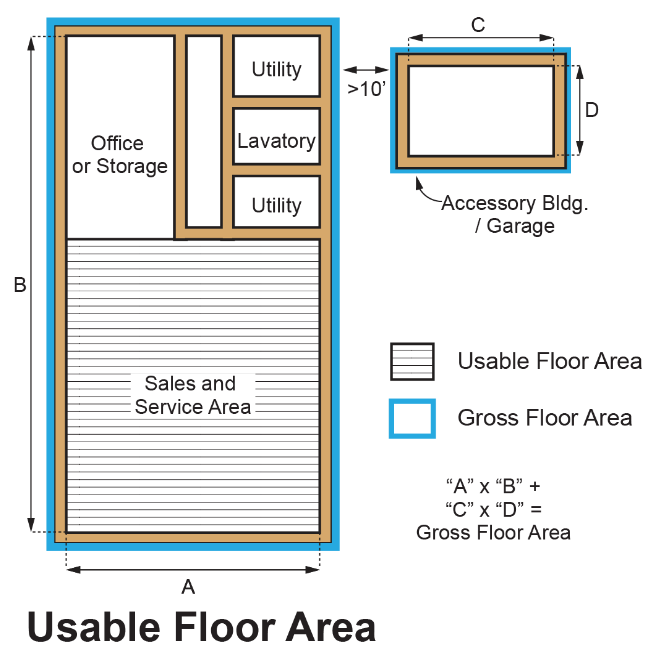
Floor Area, Gross. For the purpose of computing parking, the area that is the sum of the horizontal areas of each story of the building, measured from the interior surfaces of the exterior walls. "Gross floor area" shall include hallways, stairways, interior lobbies, and similar areas but shall exclude exterior porches, attached garages, attics and basements, which cannot accommodate commercial or office operations other than storage.
(2)
Floor Area, Usable. For the purpose of computing parking, that area used for or intended to be used for the sale of merchandise or services or for use to serve patrons, clients or customers. Such floor area which is used or intended to be used principally for the storage or processing of merchandise, or for utilities, shall be excluded from this computation of usable floor area. Measurement of floor area shall be the sum of the gross horizontal areas of the several floors of the building, measured from the interior faces of the exterior walls. For the purpose of computing parking for those uses not enclosed within a building, the area used for the sale or display of merchandise and/or the area used to serve patrons or clients shall be measured to determine necessary parking spaces. A figure of eighty percent (80%) of gross floor area shall be permitted for usable floor area in instances where determining usable floor area by measurement is not possible.
(l)
Floor plate. The horizontal area of the first floor of a building measured to the exterior face or exterior walls at grade level. The "floor plate" does not include the area of upper stories or basements.
(m)
Food manufacturing. The transformation of livestock and agricultural products for intermediate consumption. Food products manufactured at this type of operation are intended primarily for distribution to wholesalers or retailers.
(n)
Frontage. The linear dimension of a parcel or lot measured along the public street right-of-way line.
(Ord. No. O-06-25, § 1(Exh. A), 8-4-2025)
Sec. 98-295. - Definitions, G, H.
(a)
Garage, private. An accessory building or portion of a main building that is designed or used primarily for the parking or storage of motor vehicles, boats, lawn equipment, tools, and residential items used by occupants of the primary structure.
(b)
Garage, public. A building designed for the short-term parking of motor vehicles, which may contain a booth, office, or similar ancillary space, which may be freestanding or part of an office, commercial or mixed-use development.
(c)
Garage sale. Any sale of personal effects, jewelry or household items, furnishings and equipment belonging to the owner or occupant of the property held in any district by the owner, occupant or his personal representative.
(d)
Grade. A line, slope, or elevation used in reference to a property or parcel.
(1)
Grade, slope. The degree of rise or descent of a sloping surface.
(2)
Grade, average. The arithmetic average of the lowest and highest grade elevations in an area within five (5) feet of the foundation line of a building or structure, or in the area between the foundation line and the lot line, where the foundation line is less than five (5) feet from the lot line. Average grade shall be used in determining building height and number of stories.
(3)
Grade, finished. The final elevation of the ground surface after development.
(4)
Grade, road. The elevation of the curb at the midpoint of the front of the lot. Where no curb exists, the grade shall be the average elevation of the road adjacent to the property line.
(e)
Greenbelt. A landscape area located between the property line or public right-of-way and a building setback, which is intended to provide a transition area between public and private property and/or an area between a conflicting land use or an existing or proposed land use.
(f)
Guarantee. A cash deposit, certified check, irrevocable bank letter of credit, or such other instrument acceptable to the City.
(g)
Habitable space. Space in a dwelling used for living, sleeping, eating or cooking. Bathrooms, toilet compartments, closets, halls, storage, utility space, or similar areas are not considered as habitable.
(h)
Hazardous substance. Any substance or material, whether liquid, solid, or gas, that may be a risk to health, safety, property or the environment due to its toxic, caustic, corrosive, abrasive, or otherwise injurious properties. Substances may include hazardous chemicals as defined by the Michigan Department of Public Health and the Michigan Department of Labor; flammable and combustible liquids as defined by the Michigan Department of State Police, Fire Marshal Division; hazardous materials as defined by the United States Department of Transportation; critical materials, polluting materials, and hazardous waste as defined by the Michigan Department of Natural Resources, and hazardous substances as defined in Michigan Public Act 307 of 1982, as amended, and the Federal Comprehensive Environmental Response Compensation and Utility Act of 1980, Public Act 96-510, 94 Stat 2767, as amended. (The Environmental Response Act (P.A. 307, MCL 299.601 et seq.) was repealed by P.A. 1994, No. 451. See now MCL 324.20101.)
(i)
Hardship. A situation created by circumstances unique to an individual property that do not generally occur to land or buildings in the neighborhood or zoning district of the property in question and which circumstances make the use of such property unfeasible under conditions imposed by this chapter. Hardship shall not include personal or financial hardship or economic disadvantage, nor shall it constitute circumstances that are self-created.
(j)
Hemp product. A product that contains a compound, blend, extract, infuse, or derivative of industrial hemp that is intended to either be used or consumed by a consumer.
(k)
Home occupation. An occupation or profession customarily carried on by the occupant of a dwelling unit at the dwelling unit as a secondary use which is clearly subservient to the use of the dwelling for residential purposes.
(1)
Home occupation, major. A home occupation that may be evident to the surrounding area and/or involve the resident utilizing an accessory building or outdoor areas for operations and/or being the type of occupation which involves routine client or non-resident visits to the home. Examples of major home occupations include, but are not limited to, offices and storage for small landscaping or contracting businesses, medical and dental offices, hair or makeup stylists, and organized classes with up to six (6) students at a time.
(2)
Home occupation, minor. A home occupation that is wholly contained within the main residential structure, is not generally evident to the surrounding area, and as a maximum of one (1) non-resident employee. Examples of minor home occupations include, but are not limited to, administrative and technical office facilities (excluding medical or dental offices), preparation of food or food products to be sold or served off-site, artists, craftsmen and sculptors, tailoring and sewing, and individual tutoring or instruction.
(l)
Hospice. A lodging place for the ill where persons are housed and furnished meals and attendant care.
(m)
Hospital. A state-licensed facility for inpatient care and services for observation, diagnosis, and active treatment of patients with a medical, surgical, obstetric or chronic condition requiring daily care and supervision by physicians and professional medical support staff.
(n)
Hotel. A building or group of buildings with a common entrance or entrances containing rooms designed to provide transient lodging for compensation for periods of thirty (30) days or less and in which one (1) or more of the following services are offered: maid service, furnishing of linen, telephone, secretarial or desk service and bellhop service. A hotel may include a restaurant or cocktail lounge, public banquet hall, ballroom or meeting room.
(o)
Housing for the elderly. A building or group of buildings containing dwellings intended for, and solely occupied by, elderly persons as defined by the Federal Fair Housing Amendments Act of 1988. Housing for the elderly may include independent and/or assisted living arrangements but shall not include convalescent or nursing facilities regulated by the State of Michigan.
(1)
Independent elderly housing. Housing for the elderly or seniors provided in a multiple-family or cluster housing form with full facilities for self-sufficiency in each individual unit. A community center for this overall development may be provided.
(2)
Dependent elderly housing. housing for the elderly or seniors provided in a multiple-family housing form with central dining facilities provided as a basic service to each unit. Dependent elderly housing may also include congregate care or assisted care facilities where some assistance with the activities of daily living is provided.
(p)
Human scale. The relationship between the person and his or her environment, whether natural or created which is comfortable, intimate, and contributes to the individual's sense of accessibility.
(Ord. No. O-06-25, § 1(Exh. A), 8-4-2025)
Sec. 98-296. - Definitions, I, J.
(a)
Improvements. Those features and actions associated with a project which are considered necessary by the City to protect natural resources or the health, safety and welfare of the residents of the City, and future users or inhabitants of the proposed project or project area, including parking areas, landscaping, roadways, lighting, utilities, sidewalks, screening and drainage. Improvements do not include the entire project which is the subject of zoning approval.
(b)
Industrial hemp. A crop that is limited to types of the plant Cannabis Sativa Linnaeus having no more than three-tenths of one percent (0.3% or 0.003) tetrahydrocannabinol (THC) contained in the dried flowering tops, whether growing or not; the seeds of the plant; the resin extracted from any part of the plant; and every compound, manufacture, salt, derivative, mixture, or preparation of the plant, its seeds or resin produced therefrom.
(c)
Industrial hemp facility. A facility authorized to manufacture hemp products in the City.
(1)
Type A industrial hemp facility. An industrial hemp business authorized to compound, blend, infuse, or otherwise make or prepare hemp products that contain a concentration of no more than three-tenths of one percent (0.3% or 0.003) tetrahydrocannabinol (THC), but may not include extraction for industrial hemp products such as cannabinoids, including, but not limited to cannabidiol (CBD), from industrial hemp.
(2)
Type B industrial hemp facility. An industrial hemp business authorized to compound, blend, infuse, or otherwise make or prepare hemp products that contain a concentration of no more than three-tenths of one percent (0.3% or 0.003) tetrahydrocannabinol (THC). Type B industrial hemp businesses are authorized to extract for industrial hemp products such as cannabinoids, including, but not limited to cannabidiol (CBD), from industrial hemp through natural solvent (olive oil or ethanol), CO2, or steam extraction methods, or other means approved by the City.
(d)
Junkyard. An area where waste, used or secondhand materials are bought and sold, exchanged, stored, baled, packed, disassembled or handled, including, but not limited to, scrap iron and other metals, paper, rags, rubber tires and bottles. A junkyard includes automobile wrecking yards and includes any open area of more than two hundred (200) square feet for storage, keeping or abandonment of junk.
(Ord. No. O-06-25, § 1(Exh. A), 8-4-2025)
Sec. 98-297. - Definitions, K, L.
(a)
Kennel. Any lot or premises on which three (3) or more dogs, cats or other household pets are either permanently or temporarily boarded or bred and raised for remuneration.
(1)
Kennel, commercial. Any building and/or land used, designed, or arranged for the boarding, breeding, or care of more than five (5) dogs, cats, or other domestic animals for profit but shall not include those animals raised for agricultural purposes.
(2)
Kennel, private. Any building and/or land used, designed or arranged for the boarding, breeding, or care of dogs, cats, or other domestic animals belonging to the owner thereof and kept for purposes of show, hunting, or as pets (but not to include riding stables or animals raised for agricultural purposes), provided that no more than three (3) such animals six (6) months old or older are kept on the premises either permanently or temporarily. The keeping of such animals shall be strictly incidental to the principal use of the premises and shall not be for the purposes of remuneration or sale.
(b)
Land division. The partitioning or dividing of a parcel or tract of land by the proprietor thereof, or by his or her heirs, executors, administrators, legal representatives, successors or assigns, for the purpose of sale, or building development where the act of division creates five (5) or more parcels of land, each of which is ten (10) acres or less in area, or where five (5) or more parcels of land, each of which is ten (10) acres or less in area, are created by successive divisions within a period of ten (10) years.
(c)
Land Division Act. The Subdivision Control Act, being Public Act 288 of 1967, as amended. (See MCL 560.101 et seq.)
(d)
Landscaping. The treatment of the ground surface with live plant materials such as, but not limited to, grass ground cover, trees, shrubs, vines and other live plantings. In addition, a landscape design may include other decorative, man-made materials, such as: wood chips, crushed stone, boulders or mulch. Structural features such as fountains, pools, statues, decorative features, benches, and street features shall also be considered a part of landscaping if provided in combination with live plant material.
(e)
Live-work unit. A live-work unit combines residential living quarters with a dedicated workspace, often a business or office. These units are typically designed to be flexible, allowing for both living and working within the same space.
(f)
Loading space. An off-street space on the same lot with a building or group of buildings for the temporary parking of a commercial vehicle while loading and unloading merchandise or materials.
(g)
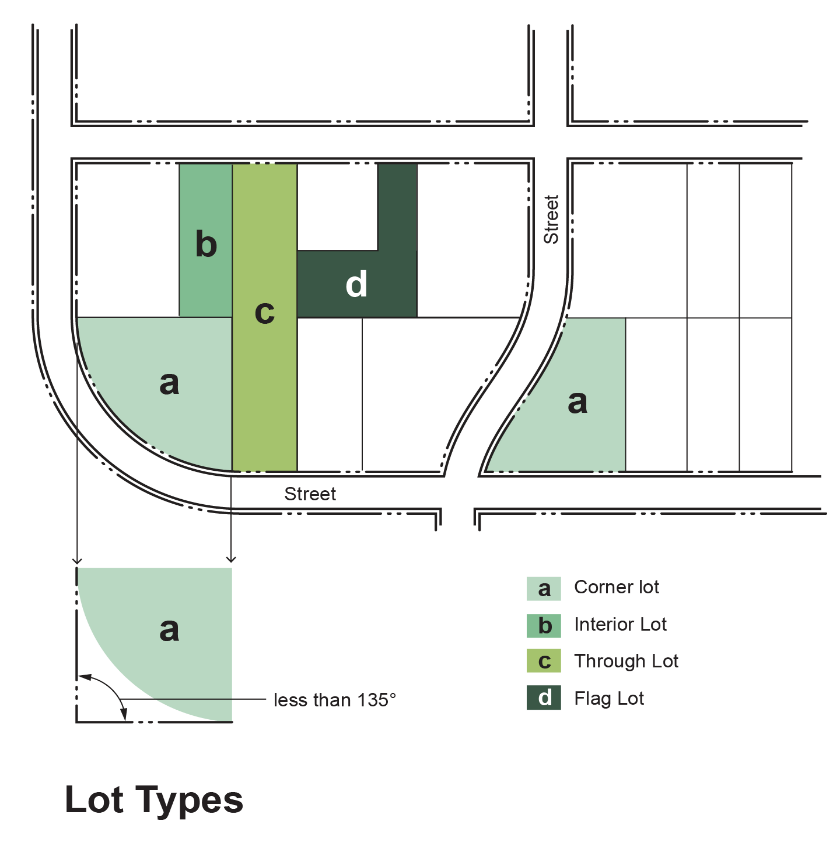
Lot. A parcel of land occupied or intended to be occupied by a main building or a group of such buildings and accessory buildings, or utilized for the principal use and accessory uses, together with such yards and open spaces as are required under the provisions of this chapter. A lot may or may not be specifically designated as such on public records. Lot shall mean the same as homesite and condominium unit in site condominium developments.
(1)
Lot area, gross. The total horizontal area within the lot lines of the lot.
(2)
Lot area, net. Gross lot area minus any portions of the lot located within dedicated rights-of-way, drainage easements, or bodies of water.
(3)
Lot, corner. A lot where the interior angle of two (2) adjacent sides at the intersection of two (2) streets is less than one hundred thirty-five (135) degrees. A lot abutting upon a curved street shall be considered a corner lot for the purposes of this chapter if the arc is of less radius than one hundred fifty (150) feet and the tangents to the curve, at the two (2) points where the lot lines meet the curve or the straight street line extended, form an interior angle of less than one hundred thirty-five (135) degrees.
(4)
Lot coverage. The part or percentage of the lot occupied by buildings, including accessory buildings and including, but not limited to, patios, decks, pools and similar structures.
(5)
Lot depth. The horizontal distance between the front and rear lot lines, measured along the median between the side lot lines.
(6)
Lot, interior. Any lot other than a corner lot. See Lot Types figure above.
(h)
Lot line. Any line dividing one lot from another lot, or from a street right-of-way or from any public place.
(1)
Front lot line.
a.
In the case of an interior lot, the line separating the lot from the street, except if the shape of the parcel, or some other reason, makes it impractical to use such line as the front line, another line may be used as the front upon approval by the Zoning Board of Appeals, if the placement of the structures and resulting yards are consistent with, and more easily blend with, the other buildings and development in the adjoining area.
b.
In the case of a corner lot, the front lot line is that line separating such lot from the street which is designated as the front street in the plat and in the application for a building permit or zoning occupancy permit. In the case of a double frontage lot the front line is that line separating such lot from that street which is designated as the front street in the plat, or in the request for a building permit.
(2)
Rear lot line. The lot line opposite the front lot line. In the case of a lot pointed at the rear, the rear lot line shall be an imaginary line parallel to the front lot line, not less than ten (10) feet long lying farthest from the front lot line and wholly within the lot. In any case where this definition does not apply, the planning commission shall designate the rear lot line.
(3)
Side lot line. Any lot lines other than the front lot line or rear lot line. A side lot line separating a lot from a street is a side street lot line. A side lot line separating a lot from another lot is an interior side lot line.
(i)
Lot of record. A parcel of land the dimensions of which are shown on a document or map on file with the county register of deeds or in common use by City or county officials, and which actually exists as so shown, or any part of such parcel held in a record ownership separate from that of the remainder of the parcel.
(j)
Lot, through. Any interior lot having frontage on two (2) more-or-less parallel streets as distinguished from a corner lot. In the case of a row of double-frontage lots, all yards of lots adjacent to streets shall be considered frontage, and front yard setbacks shall be provided as required.
(k)
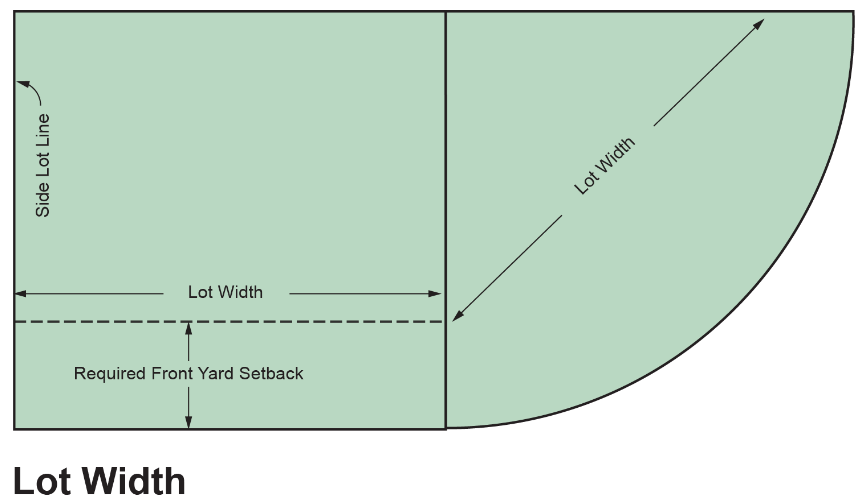
Lot width. The horizontal straight-line distance between the side lot lines, measured between the two (2) points where the front setback line intersects the side lot lines. See figure below.
(l)
Lot, zoning. A single tract of land, located within a single block which, at the time of filing for a building permit, is designated by its owner or developer as a tract to be used, developed or built upon as a unit, under single ownership or control. A zoning lot shall satisfy this chapter with respect to area, size, dimensions and frontage as required in the district in which the zoning lot is located. A zoning lot, therefore, may not coincide with a lot of record as filed with the county register of deeds, but may include one (1) or more lots of record.
(Ord. No. O-06-25, § 1(Exh. A), 8-4-2025)
Sec. 98-298. - Definitions, M, N.
(a)
Makerspace. A non-residential space designed to be used for personal-scale, low-impact artisan production of wholesale goods. Examples include, but are not limited to: artwork, foodstuffs, beverages, handmade furniture luthiers, jewelry, other handcrafted small-batch products. The use shall not cause negative impacts on surrounding properties due to noise, odor, dust, or vibration. Similar uses may be considered for makerspaces by a determination of the City council, with the advice of planning commission, per Sec. 98-64; excluding uses that may cause negative impacts on surrounding properties due to noise, odor, dust, or vibration, which shall be considered general manufacturing or industrial uses.
(b)
Manufacturing. The use of land, buildings or structures for the principal purpose of manufacturing, assembling, making, preparing, inspecting, finishing, treating, altering, repairing, fabricating or adapting for sale any goods, substance, articles, raw or processed materials or substances.
(c)
Manufactured home. A structure, transportable in one (1) or more sections, which is built on a non-motorized chassis and designed to be used with or without a permanent foundation as a dwelling when connected to the required utilities, and includes the plumbing, heating, air-conditioning, and electrical systems contained in the structure. A mobile home shall not include modular homes, motor homes, house trailer, trailer coach, or travel trailers.
(d)
Manufactured home park. A parcel of land under single ownership or unified control that is developed for the placement of multiple manufactured homes for residential occupancy on leased spaces. The park typically includes shared infrastructure such as roads, utilities, open spaces, and amenities maintained by the park operator or owner, and is subject to the rules and requirements of the Mobile Home Commission Act, Public Act 96, of 1987, as amended (MCL 139.2301 et seq.) and the Manufactured Housing Commission General Rules. A person, as used in this definition, means an individual, partnership, association, trust, corporation or any other legal entity or combination of legal entities.
(e)
Manufactured home subdivision. A residential subdivision designed and platted specifically for the placement of manufactured homes on individually owned lots. Residents own both the home and the land, and the subdivision is typically governed by a homeowners' association or similar entity, with public or privately maintained infrastructure and is subject to the rules and requirements of the Mobile Home Commission Act, Public Act 96, of 1987, as amended (MCL 139.2301 et seq.) and the Manufactured Housing Commission General Rules. A person, as used in this definition, means an individual, partnership, association, trust, corporation or any other legal entity or combination of legal entities.
(f)
Microbrewery, small winery, and craft distillery. A microbrewery produces malt or brewed beverages in a quantity of seven thousand (7,000) barrels (U.S. barrels) or less per year. A small winery is an agricultural processing facility used for the fermenting and processing of grape juice into wine, and the refermenting of still wine into sparkling wine that produces less than five thousand (5,000) cases per year. A craft distillery is a facility that produces spirits for consumption, by distillation, in an amount less than one hundred fifty thousand (150,000) gallons per year.
Accessory uses that are clearly incidental to the production of brewed beverages, wine, and spirits are permitted, including tap rooms, food service and retail establishments open to the public for on-site and/or off-site consumption. All microbreweries, small wineries, and craft distilleries are further subject to all licensing and regulatory requirements of the State of Michigan.
(g)
Motel. A building or group of buildings containing residential rental units, in which each rental unit contains a bedroom and a bathroom, designed to provide transient lodging for compensation for periods of thirty (30) days or less.
(h)
Nonconformities.
(1)
Nonconforming structure. A structure or portion thereof lawfully existing at the effective date of this chapter or amendments thereto that does not conform to provisions of this chapter for the district in which it is located but is otherwise in compliance with all other applicable federal, state, county and City laws, ordinances, regulations and codes.
(2)
Nonconforming use of land. A use that lawfully occupied a parcel or contiguous parcels of land or structure and land in combination at the effective date of the ordinance from which this chapter derives or amendments thereto that does not conform to the use regulations of the district in which it is located, or does not have special approval where provisions of this chapter require such approval, but is otherwise in compliance with all other applicable federal, state, county and City laws, ordinances, regulations and codes.
(3)
Nonconforming lot of record. A platted or unplatted parcel of land lawfully existing at the effective date of this Ordinance or amendments thereto that does not conform to the provisions of this chapter for the district in which it is located.
(4)
Nonconforming site. A parcel of land that was developed or improved with structures and other site improvements prior to the date of adoption of current Zoning Ordinance provisions for site design, landscaping, pedestrian access, exterior lighting, paving and other site elements.
(5)
Illegal structure. A structure or portion thereof, which is not a conforming or a nonconforming structure, or is not in compliance with all applicable federal, state, county and City laws, ordinances, regulations and codes.
(6)
Illegal use of land. A use that occupies one (1) or more contiguous parcels of land, or structures and land in combination, which is not a conforming or a nonconforming use, or is not in compliance with all applicable federal, state, county and City laws, ordinances, regulations and codes.
(7)
Cessation. To terminate, abandon or discontinue a use of land for a period of time that, under the provisions of this chapter, would prevent the use from being resumed.
(i)
Nuisance. An offensive, annoying, unpleasant or obnoxious thing or practice, a cause or source of annoyance, especially a continuing or repeating invasion of any physical characteristics of activity or use across a property line which can be perceived by or affects a human being, or the generation of an excessive or concentrated movement of people or things, such as but not limited to, noise, dust, smoke, odor, glare, fumes, flashes, vibration, shock waves, heat, electronic or atomic radiation, objectionable effluent, noise of congregation of people particularly at night, passenger traffic, invasion of nonabutting street frontage by traffic, a burned structure, or a condemned structure.
(j)
Nursery, plant material. A space, building or structure, or combination, for the storage of live trees, shrubs or plants offered for retail sale on the premises, including products used for gardening or landscaping. The definition of nursery within the meaning of this chapter does not include any space, building or structure used for the sale of fruits, vegetables or Christmas trees.
(k)
Nursing home. See "Convalescent or nursing home."
(Ord. No. O-06-25, § 1(Exh. A), 8-4-2025)
Sec. 98-299. - Definitions, O, P.
(a)
Office, medical. A room or group of rooms used by physicians, dentists, or other medical professions.
(b)
Office, professional. A room or group of rooms used for conducting a business profession, service, or government. Such facilities may include, but are not limited to, offices of attorneys, engineers, architects, accountants, financial institutions, real estate companies, insurance companies, financial planners, or corporate offices. Offices exclude manufacturing activities.
(c)
Off-street loading space. A designated area or areas adjacent to a building where commercial vehicles may park temporarily to load or unload cargo or merchandise.
(d)
Off-street parking lot. A vehicular parking area, together with access aisles and drives, which is located outside of street rights-of-way providing parking accommodation for two or more vehicles. Off-street parking areas may also include loading areas and associated maneuvering space.
(e)
Opacity. The state of being impervious to sight.
(f)
Open Space. An area that is intended to provide light and air and that is designed for environmental, scenic or recreational purposes. Open space may include, but is not limited to, lawns, decorative planting beds, walkways, active and passive recreation areas, playgrounds, fountains, swimming pools, living plant materials, wetlands and watercourses. Open space shall not be deemed to include driveways, parking lots or other surfaces designed or intended for vehicular travel.
(g)
Outdoor Dining Area. A designated space located outside the walls of a building where food and/or beverages are served and consumed. This area may be situated on a patio, sidewalk, rooftop, or other open-air location and may include tables, chairs, umbrellas, fencing, or other furnishings to accommodate patrons in an open or semi-enclosed setting.
(1)
Sidewalk Café. An outdoor dining area located on a public sidewalk or within the public right-of-way, directly adjacent to the principal business.
(h)
Outdoor Storage. The keeping of any goods, materials, merchandise, supplies, vehicles, or junk in an unenclosed area for more than twenty-four (24) hours. For purposes of this chapter, outdoor storage does not include temporary construction sites where materials and/or equipment may be stored for limited periods of time during the project.
(i)
Parking space. An area of definite length and width, exclusive of access drives, aisles or entrances, fully accessible for the parking of permitted vehicles.
(j)
Performance guarantee. A financial guarantee to ensure that all improvements, facilities or work required by this chapter will be completed in compliance with City ordinances and regulations and the approved plans and specifications of a development.
(k)
Performance standard. A criterion developed to control nuisance factors.
(l)
Permanent Structure. A building or structure that is fixed in place and constructed with materials intended for long-term use. It is typically anchored to a foundation, not intended to be moved or dismantled, and meets applicable building codes and permitting requirements for durability and stability.
(m)
Permitted Use. Any use allowed by right in a zoning district and subject to the restrictions applicable to that zoning district.
(n)
Personal service establishment. A business where personal services are provided for profit and where the sale of goods is only accessory to the provision of such services, including, but not limited to, the following: barbershops, beauty shops, tailor shops, laundry or drycleaning shops, and shoe repair shops. Services may be licensed by the State of Michigan when applicable.
(o)
Pet boarding facility. A business for the temporary boarding and care of common household pets generally during daytime hours, but in some cases including overnight boarding. Pet boarding facilities may provide related services such as grooming or training. No animals may be bred or sold at a pet boarding facility.
(p)
Planned residential development. A specific parcel of land or several contiguous parcels of land, located entirely within the PRD districts, under single ownership and control for which a comprehensive physical plan meeting the requirements of this chapter and establishing functional use areas, density patterns, a fixed system of residential collector streets, provisions for public utilities, drainage and other essential services, and similar factors necessary or incidental to residential development has been approved by the City council and which has been or will be developed in accordance with the approved plan.
(q)
Planned unit development (PUD). A form of development usually characterized by the flexible application of zoning regulations and unified site design for a number of housing units, or where buildings may be clustered, providing common open space, and a mix of building types and land uses. PUDs permit the planning of a project and the calculation of densities over the entire development rather than on an individual lot-by-lot basis. It also refers to a process, mainly revolving around site plan review, in which the City will have considerable involvement in determining the nature and design of the development.
(r)
Planning commission. The Planning Commission of the City as designated in Public Act No. 33 of 2008.
(s)
Plant material. A collection of living evergreen and/or deciduous, woody-stemmed trees, shrubs, vines and ground cover and non-woody annual and perennial bedding plants.
(t)
Porch, enclosed. A covered entrance to a building or structure which is totally enclosed, which projects out from the main wall of such building or structure and which has a separate roof or an integral roof with the principal building or structure to which it is attached.
(u)
Porch, open. A covered entrance to a building or structure which is unenclosed, except for columns supporting the porch roof, which projects out from the main wall of such building or structure and which has a separate roof or an integral roof with the principal building or structure to which it is attached.
(v)
Principal use. The main use to which the premises are devoted and the principal purpose for which the premises exist.
(w)
Public institution. A government operated or non-profit organization dedicated to the preservation or promotion of educational, cultural, or historical objects or values. Examples of public institutions include libraries and museums.
(x)
Public service. Public service facilities within the context of this chapter shall include such uses and services as voting booths, pumping stations, fire halls, police stations, temporary quarters for welfare agencies, public health activities and similar uses including essential services.
(y)
Public utility. Any municipal department, public entity or franchised corporation duly authorized to furnish and furnishing to the public, under federal, state or municipal regulations, electricity, gas, steam, communications, telegraph, transportation, water and other similar services and commodities. Telecommunications towers and antennas are not defined as a public utility.
(Ord. No. O-06-25, § 1(Exh. A), 8-4-2025)
Sec. 98-300. - Definitions, Q, R.
(a)
Recreation, indoor. This use includes, but is not limited to, indoor recreation facilities, community centers, senior centers, gymnasiums, indoor tennis or racquet courts, indoor sports arenas, swimming pools, or similar uses which are enclosed in buildings and are open to all community residents or those living within certain developments or neighborhoods. "Indoor recreation center" shall include any accessory uses, such as snack bars, pro shops, accessory offices and locker rooms, which are designed and intended primarily for the use of patrons of the principal recreational use.
(b)
Recreation, outdoor. Active recreation facilities which are not enclosed in buildings and are open to the public or operated on a commercial or membership basis for the use of persons not residing on the same lot on which the recreation use is located. Facilities may include golf courses, driving ranges, swimming pools, tennis courts, playing fields or courts, and the like as well as accessory uses such as concession stands, equipment rental or storage, pro shops, and clubhouses used primarily by the patrons of the principal recreational use.
(c)
Recreation equipment. Travel trailers, pickup campers or coaches, motorized dwellings, tent trailers, boats and boat trailers, snowmobiles, horse trailers, dune buggies, and other similar equipment and conveyances.
(d)
Religious Institution. A site used for the regular assembly of persons, for the conducting of religious services, and for related accessory uses, including offices and living quarters for church ministry and other members of the religious order who carry out their duties primarily on the site, religious education classes, day care and limited recreation facilities. Rescue missions, tent revivals and other temporary assemblies are not included in this definition.
(e)
Restaurant. Any establishment whose principal business is the sale of food and beverages to the customer in a ready-to-consume state and whose method of operation is characteristic of a carry-out, drive-in, drive-through, fast-food, or sit-down restaurant or a combination thereof, as defined below:
(1)
Carry-out. A carry-out restaurant is a business establishment whose method of operation involves the sale of food, beverages and/ or frozen desserts in disposable or edible containers or wrappers, in a ready-to-consume state and for consumption primarily off the premises, but in which seating for up to thirty (30) persons may be provided.
(2)
Drive-In/Drive-Through Restaurant. A business establishment whose method of operation involves the delivery of prepared food to customers in motor vehicles. Food may be consumed in the vehicle, elsewhere on the premises outside of an enclosed building (as with drive-in service), or off the premises (as with drive-through service). Limited interior seating may also be provided.
(3)
Sidewalk café. An area adjacent to and directly in front of a street-level eating or drinking establishment located within the sidewalk area of the public right-of-way and used exclusively for dining, drinking, and pedestrian circulation. The encroachment area of a sidewalk cafe may be separated from the remainder of the sidewalk by railings, fencing, or landscaping planter boxes or a combination thereof.
(4)
Sit-down restaurant. A sit-down restaurant is a business establishment whose method of operation involves either the delivery of prepared food by waiters and waitresses to customers seated at tables within a completely enclosed building or the acquisition of prepared food by customers in a cafeteria line where food is subsequently consumed by the customers at tables within a completely enclosed building.
(f)
Retail sales establishment. Any generally recognized retail business that supplies commodities on the premises to the general public. Commodities supplied may include groceries and similar food products for consumption off the premises. Restaurants or any similar establishment that serves prepared food as its primary business is not considered a retail sales establishment.
(g)
Right-of-way. A legal right of one to pass over the property of another; a strip of land acquired by reservation, dedication, forced dedication, prescription, or condemnation and intended to be occupied by a road, crosswalk, railroad, electric transmission line, oil or gas pipeline, water line, sanitary sewer, storm sewer, and other similar utilities and uses.
(h)
Room. For the purpose of determining lot area requirements and density in a multiple-family district, a living room, dining room or bedroom, equal to at least eighty (80) square feet in area. A room shall not include the area in kitchen, sanitary facilities, utility provisions, corridors, hallways, and storage. Plans presented showing one-, two- or three-bedroom units and including a den, library, or other extra room shall count such extra room as a bedroom for the purpose of computing density.
(Ord. No. O-06-25, § 1(Exh. A), 8-4-2025)
Sec. 98-301. - Definitions, S, T.
(a)
Self-Storage Facility. Storage buildings for lease to the general public for storage of personal and household effects and for dry storage of office or business effects, not including the warehousing of products or supplies.
(b)
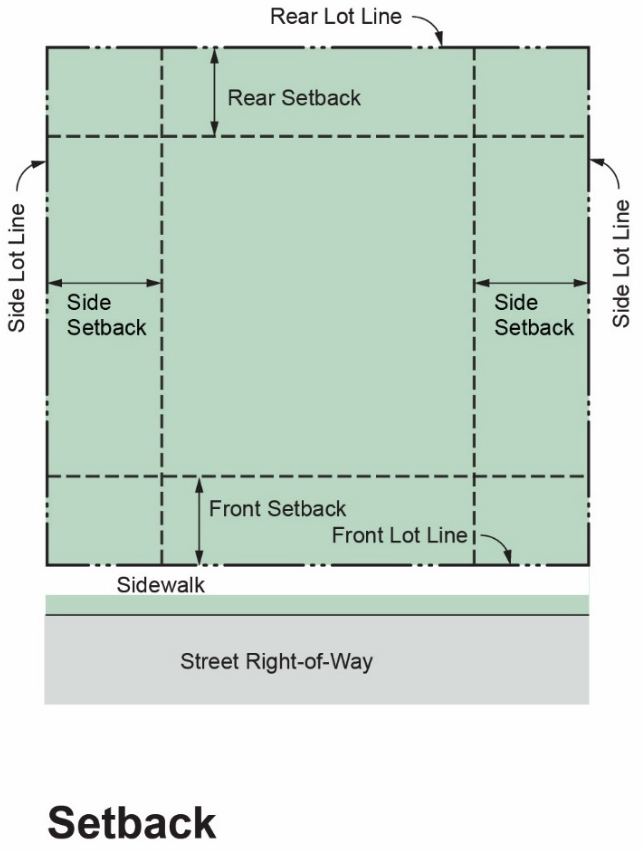
Setback Line. The distance required to obtain the minimum required distance between the front, side or rear lot lines and the building line or parking lot. Setbacks from a public street or private road shall be measured from the right-of-way line or easement. Front setbacks along curvilinear streets shall be established along a line connecting points along the side lot lines meeting the required front yard setbacks. Driveways and pedestrian walkways may be located within the setback, but the remainder of the area shall be deemed open space. Setbacks for buildings shall be measured from the foundation wall.
(c)
Shopping center. A grouping of two (2) or more business establishments developed in accordance with an overall plan and designed and built as an interrelated project. Buildings constructed on outlots shall not be considered part of the shopping center unless access and parking easements are provided.
(d)
Short-term rental. A dwelling unit, or portion thereof, that is rented or offered for rent to guests for a period of less than thirty (30) consecutive days, typically through online platforms or other means. Short-term rentals may be owner-occupied or non-owner-occupied and are distinct from hotels, motels, and bed and breakfast establishments.
(e)
Sign. See Sec. 98-230 for sign definitions.
(f)
Special event. Any festival, fair, event, bazaar, historic tour or other specially scheduled activity, sponsored by a church, fraternal organization, nonprofit corporation, or service club where persons are permitted to sell goods, wares or merchandise, or are permitted to accept donations at a location not customarily used in such a manner.
(g)
Special land use. A use of land for an activity, which under normal circumstances may be necessary or desirable in a zoning district, but due to its potential impact on neighboring uses or public facilities requires additional review by the planning commission. The planning commission will base its decision upon standards, which allow the special use to be developed in a manner consistent with surrounding uses, assures adequate infrastructure capacity, and protects the community overall.
(h)
Sponsor. Any person or organization responsible for planning, promoting or making arrangements for any special land use or special event.
(i)
Solar Energy System. A system designed to capture and convert sunlight into usable energy, typically electricity or heat. This includes photovoltaic (PV) panels, solar thermal collectors, batteries for energy storage, and inverters.
(j)
State licensed residential facility. Any structure constructed for residential purposes that is licensed by the State of Michigan pursuant to Michigan Public Act 116 of 1973 (the Child Care Licensing Act) or Michigan Public Act 218 of 1979 (the Adult Foster Care Facility Licensing Act). This definition includes adult foster care facilities, foster family homes, foster family group homes, family day care homes, and group day care homes (see Human Services Facilities Subject to State Licensing Chart).
(1)
Adult foster care facility means a residential structure that is licensed to provide foster care, but not continuous nursing care, for unrelated adults over the age of seventeen (17). Adult foster care facilities are subject to all applicable provisions, definitions, and regulations of Michigan Public Act 218 of 1979, as amended (MCL 400.701 et seq.).
a.
Foster care means the provision of supervision, personal care, and protection in addition to room and board, for twenty-four (24) hours a day, five (5) or more days a week, and for two (2) or more consecutive weeks for compensation.
b.
Adult foster care facility does not include any of the following:
1.
A licensed child caring institution, children's camp, foster family home, or foster family group home, subject to the limitations contained in Section 3(4f) of Michigan Public Act 218 of 1979, as amended (MCL 400.703).
2.
A licensed foster family home that has a person who is eighteen (18) years of age or older placed in the foster family home under Section 5(7) of Michigan Public Act 116 of 1973, as amended (MCL 722.115).
3.
An establishment commonly described as an alcohol or a substance abuse rehabilitation center; a residential facility for persons released from or assigned to adult correctional institutions; a maternity home; or a hotel or rooming house that does not provide or offer to provide foster care.
4.
A veterans' facility created by 1885 PA 152, MCL 36.1 to 36.12.
c.
The following types of adult foster care facilities are provided for by this chapter:
1.
Adult foster care family home means a private home with the approved capacity to receive not more than six (6) adults to be provided with foster care. The adult foster care family home licensee shall be a member of the household and an occupant of the residence.
2.
Adult foster care small group home means an adult foster care facility with the approved capacity to receive not more than twelve (12) adults to be provided with foster care. Facilities with the approved capacity for seven (7) or more adults are subject to special use approval.
3.
Adult foster care large group home means an adult foster care facility with the approved capacity to receive at least thirteen (13) but not more than twenty (20) adults to be provided with foster care. Facilities are subject to special use approval.
4.
Adult foster care congregate facility means an adult foster care facility with the approved capacity to receive more than twenty (20) adults to be provided with foster care. Facilities are subject to special use approval.
(2)
Family child care home means a private home in which one but fewer than eight (8) minor children are received for care and supervision for periods of less than twenty-four (24) hours a day, unattended by a parent or legal guardian, except children related to an adult member of the family by blood, marriage, or adoption. Family day care home includes a home in which care is given to an unrelated minor child for more than four (4) weeks during a calendar year.
(3)
Foster family home means a private home in which one (1) but not more than four (4) minor children, who are not related to an adult member of the household by blood or marriage, or who are not placed in the household under the Michigan Adoption Code, are given care and supervision for twenty-four (24) hours a day, for four (4) or more days a week, for two (2) or more consecutive weeks, unattended by a parent or legal guardian.
(4)
Foster family group home means a private home in which more than four (4) but fewer than seven (7) minor children, who are not related to an adult member of the household by blood or marriage, or who are not placed in the household under the Michigan Adoption Code, are given care and supervision for twenty-four (24) hours a day, for four (4) or more days a week, for two (2) or more consecutive weeks, unattended by a parent or legal guardian.
(5)
Group child care home means a private home in which up to fourteen (14) minor children are given care and supervision for periods of less than twenty-four (24) hours a day unattended by a parent or legal guardian, except children related to an adult member of the family by blood, marriage, or adoption. Group day care home includes a home in which care is given to an unrelated minor child for more than four (4) weeks during a calendar year.
(6)
Private home means a private residence in which the licensee or registrant permanently resides as a member of the household, which residency is not contingent upon caring for children or employment by a licensed or approved child placing agency.
(k)
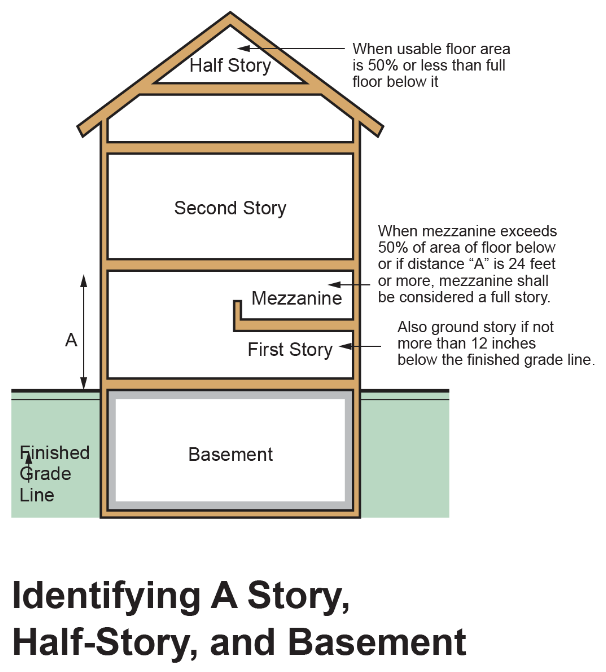
Story. That part of a building, other than a mezzanine, included between the surface of one floor and the surface of the floor next above, or if there be no floor above, that part of the building which is above the surface of the highest floor thereof. Specifically:
(1)
Top story attic. A half-story when the main line of the eaves is not above the middle of the interior height of said story.
(2)
First story. The highest story having its interior floor surface not more than four (4) feet above the curb level, or the average elevation of the finished grade along the front of the building were it set back from the street.
(3)
Basement. A story if over fifty percent (50) of its height is above the level from which the height of the building is measured, or if it is used for dwelling purposes by other than a janitor or domestic servant employed in the same building, including the family of the same.
(4)
Half-story. That part of a building between a pitched roof and the uppermost full story, such part having a floor area which does not exceed one-half (½) of the floor area of such full story, provided the area contains at least two hundred (200) square feet, with a clear height of at least seven-feet six-inches (7'6").
(5)
Mezzanine. A full story when it covers more than thirty-three percent (33%) of the area of the story underneath such mezzanine or if the vertical distance from the floor next below it to the floor next above it is twenty-four (24) feet or more.
(l)
Street. A dedicated public right-of-way, other than an alley, which affords the principal means of access to abutting property.
(m)
Structure. Anything constructed or erected, the use of which requires location on the ground or attachment to something having location on the ground.
(n)
Subdivision. The partitioning or dividing of a parcel or tract of land by the proprietor or by his heirs, executors, administrators, legal representatives, successors or assigns for the purpose of sale, or lease of more than one year, or of building development, where the act of division creates five or more parcels of land, each of which is ten acres or less in area; or five (5) or more parcels of land each of which is ten (10) acres or less in area and created by successive divisions within a period of ten (10) years.
(o)
Swimming pool. Any structure or container, permanent or temporary, portable or nonportable, storable or non-storable, capable of holding water to a depth of twenty-four (24) inches or more located above or below grade. This definition excludes structures with a surface area of fifty (50) square feet or less, such as a spa or hot tub.
(p)
Temporary building or structure. A building which is not permanently affixed to the property, and which is permitted to exist for a specific reason for a period of time specified by the Administrative Site Plan Review Committee or other applicable review board. A temporary structure shall include tents, manufactured units and similar structures.
(q)
Temporary use. Uses intended for limited duration within any zoning district. A temporary use shall not be interpreted to be a continuance of a nonconforming use. Temporary uses may include carnivals, circuses, art fairs, craft shows, sidewalk sales, antique sales, estate sales, auctions and similar events.
(r)
Traditional urban form. The combination of buildings, structures, and streetscapes that form a distinct neighborhood, or section of a City, or the City overall.
(Ord. No. O-06-25, § 1(Exh. A), 8-4-2025)
Sec. 98-302. - Definitions, U, V.
(a)
Use. The principal purpose for which land or a building is arranged, designed or intended, or for which land or a building is or may be occupied.
(b)
Variance. A variation or modification of this chapter granted by the zoning board of appeals relating to the construction, or structural changes in, equipment or alteration of buildings or structures or the use of land, buildings, or structures, where there is a practical difficulty or unnecessary hardship in the way of carrying out the strict letter of this chapter.
(c)
Vehicle fueling station. A place for the dispensing, sale or offering for sale of motor fuels directly to users of motor vehicles, together with the sale of minor accessories and services for motor vehicles but not including major automobile repair.
(d)
Vehicle service. A building or premises where the following services may be carried out in a completely enclosed building: major repairs, including, but not limited to, engine rebuilding and the rebuilding of motor vehicles; application of paint preservation materials; radiator repair and replacement; transmission repair and replacement; automobile and van customizing; collision service, such as body, frame or fender straightening and repair; the painting and rustproofing of automobiles; tire recapping; and upholstery work. Automotive repair garages may also include facilities and/or equipment allowing for the repair of other motor vehicles including trucks, recreational vehicles, vans and buses, among others.
(Ord. No. O-06-25, § 1(Exh. A), 8-4-2025)
Sec. 98-303. - Definitions, W, X.
(a)
Waiver. An exclusion from the normal rules and regulations of this chapter. Waivers allow particular uses or structures which are considered essential or appropriate in certain locations or under certain conditions as may be approved by the Zoning Board of Appeals or Planning Commission. A variance is not required for uses or structures which are permitted because of a waiver.
(b)
Wall.
(1)
Obscuring. An obscuring structure of definite height and location constructed of masonry, concrete or similar material.
(2)
Decorative. A screening structure walls of definite height and location constructed of an aesthetically pleasing masonry or rock material, such as face brick, stone or simulated stone, split-face CMU or other decorative block.
(c)
Warehouse. A building used primarily for the storage of goods and materials.
(d)
Wetland (state- or federally-regulated). Land characterized by the presence of surface water at a frequency and duration sufficient to support, and that under normal circumstances does support, wetland vegetation or aquatic life, commonly referred to as a "bog," "swamp" or "marsh" and which is any of the following:
(1)
Contiguous to the Great Lakes or to an inland lake, pond, river or stream.
(2)
Not contiguous to the Great Lakes or to an inland lake, pond, river or stream and more than five (5) acres in size.
(3)
Not contiguous to the Great Lakes or to an inland lake, pond, river or stream and more than five (5) acres in size, if the Michigan Department of Natural Resources (MDNR) determines that protection of the area is essential to the preservation of the natural resources of the state from pollution, impairment or destruction and if the MDNR has so notified the owner.
(e)
Wind Energy System. A facility or equipment, including turbines, towers, and associated infrastructure, designed to convert wind energy into usable electrical power.
(1)
Roof-mounted energy system. A type of small wind energy conversion system that is mounted on a roof with a height not greater than fifteen (15) feet above the ridgeline of a pitched roof or parapet of a flat roof.
(2)
Small wind energy system. A wind energy conversion system consisting of a wind turbine, tower or axis, blades or blade system, and associated control or conversion electronics primarily intended to reduce on-site consumption of utility power.
(3)
Tower-mounted wind energy system. A wind energy conversion system that is mounted on a freestanding or guyed tower attached to the ground, and not attached to any other permanent or temporary structure.
(4)
Utility wind energy system. A wind energy conversion system consisting of a wind turbine, tower or axis, blades or blade system, and associated control or conversion electronics primarily intended to provide wholesale or retail energy to the electric utility grid.
(5)
Wind energy system. Any wind energy conversion device including all associated control or conversion electronics.
(f)
Wireless communication tower. All structures and accessory facilities relating to the use of the radio frequency spectrum for the purpose of transmitting or receiving radio signals shall be considered wireless communication facilities. This may include, but is not limited to, radio towers, television towers, telephone devices and exchanges, microwave relay towers, telephone transmission equipment buildings, and commercial mobile radio service facilities. Not included within this definition are citizens band radio facilities, short-wave facilities, ham and amateur radio facilities, satellite dishes, and governmental facilities which are subject to state or federal law or regulations which preempt municipal regulatory authority. For purposes of this chapter, the following additional terms are defined:
(1)
Attached wireless communications facilities. Wireless communication facilities that are affixed to existing structures, such as buildings, towers, water tanks, utility poles, and the like. A wireless communication support structure proposed to be newly established shall not be included within this definition.
(2)
Wireless communication support structures. Structures erected or modified to support wireless communication antennas. Support structures within this definition include, but are not limited to, monopoles, lattice towers, light poles, wood poles and guyed towers, or other structures which appear to be something other than a mere support structure.
(3)
Co-location. The location by two (2) or more wireless communication providers of wireless communication facilities on a common structure, tower, or building, with the view toward reducing the overall number of structures required to support wireless communication antennas within the community.
(Ord. No. O-06-25, § 1(Exh. A), 8-4-2025)
Sec. 98-304. - Definitions, Y, Z.
(a)
Yard. An open space of prescribed width or depth on the same land with a building or group of buildings, which lies between the building or group of buildings and the nearest lot line and is unoccupied and unobstructed from the ground upward, except as otherwise provided herein.
(1)
Yard, front. A space extending the full width of the lot between any building and the front lot line and measured perpendicular to the building at the closest point to the front lot line.
(2)
Yard, rear. A space extending across the full width of the lot between the principal building and the rear lot line and measured perpendicular to the building to the closest point of the rear lot line.
(3)
Yard, side. A space extending from the front yard to the rear yard between the principal building and the side lot line and measured perpendicular from the side lot line to the closest point of the principal building.
(4)
Yard, street side. A space extending from the front yard to the rear yard between the principal building and the side street lot line and measured perpendicular from the side street lot line to the closest point of the principal building.
(b)
Yard, required. The open space between a lot line and the yard line within which no structure shall be located except as provided in the Zoning Ordinance.
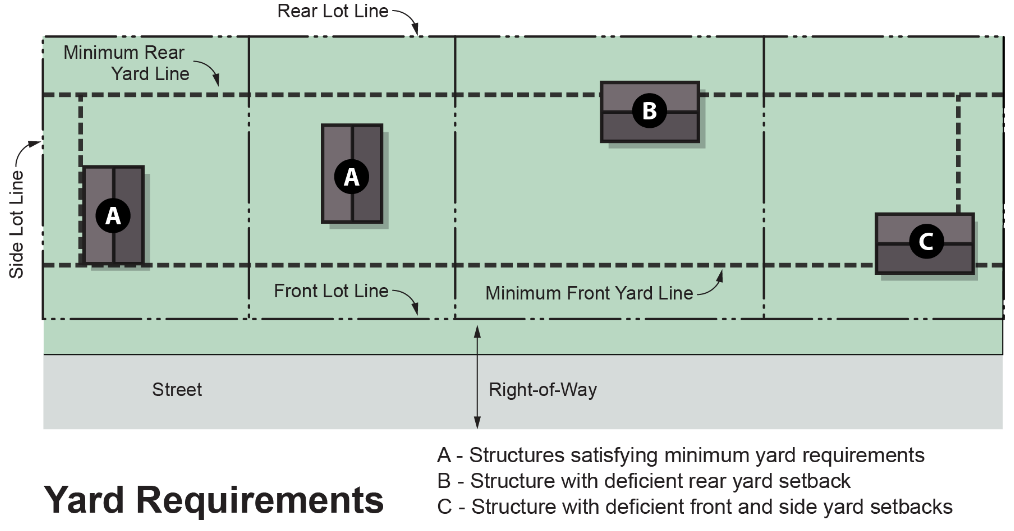
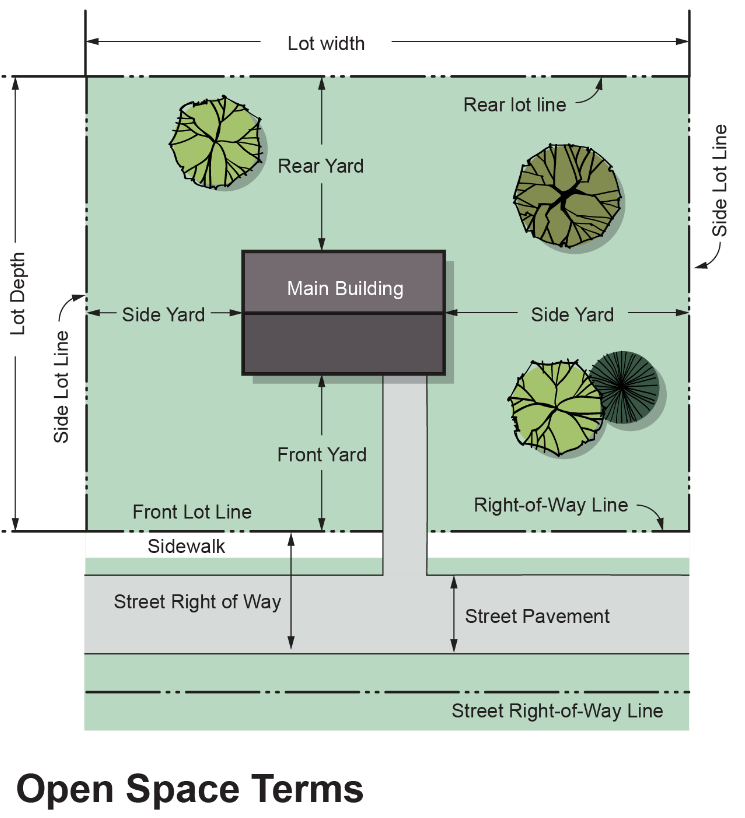
(c)
Zoning board of appeals. The Zoning Board of Appeals as provided under provisions of the Michigan Zoning Enabling Act, Public Act 110 if 2006, as amended, with powers and duties as defined in those statutes, except as modified herein.
(d)
Zoning district. A specifically delineated area or section of the City, as shown on the Official Zoning Map, within which uniform regulations and requirements govern the use, placement, spacing, and size of land and buildings.
(Ord. No. O-06-25, § 1(Exh. A), 8-4-2025)

