
Tecumseh City Zoning Code
ARTICLE VIII
GENERAL STANDARDS
DIVISION 1. - ACCESSORY STRUCTURES AND BUILDINGS
Accessory structures, except as otherwise permitted in this chapter, shall be subject to the following.
DIVISION 6. - PERFORMANCE STANDARDS
The following performance standards are established in order to preserve the environmental health, safety and welfare of the City. No activity, operation or use of land, building or equipment shall be used or occupied in any manner so as to create any dangerous, injurious, noxious or otherwise objectionable element or condition that adversely affects the surrounding area.
Any use permitted by this Ordinance shall be operated in conformance with all applicable performance standards set forth in this chapter. The following standards are deemed the minimum requirements to be maintained.
Sec. 98-190. - General standards for accessory structures.
(a)
Principal building required. Accessory buildings or structures may only be constructed on the same lot as a principal building to which they are appurtenant.
(b)
Appearance. The exterior façade materials and architectural design of all accessory structures shall have a residential character. The overall appearance of the structure shall be in accordance with the purpose of the district where it is located.
(c)
Temporary accessory structures. Temporary accessory structures that are less than one hundred twenty (120) square feet and are only erected for thirty (30) calendar days or less, shall comply with the setback requirements for detached accessory structures for the district in which they are located. A permit is required for structures that are erected longer than thirty (30) calendar days and must comply with the following conditions:
(1)
Fabric, portable or tent style structures shall only be permitted for a maximum of one hundred eighty (180) days;
(2)
All temporary structures shall be maintained and in good condition as to preserve their weather-tight integrity and prevent any loose or torn materials.
(d)
Portable Storage Units. Portable storage units are temporary, movable containers used for the short-term storage of personal or household items. They are usually constructed of metal or durable plastic and vary in size. Portable storage units are not permanently affixed to the ground.
(1)
Portable storage units are permitted in residential driveways or in the rear yard for a period of fifteen (15) days without a permit.
(2)
Portable storage units are permitted in residential driveways or in the rear yard for a period of sixty (60) days with a permit obtained from the development services director.
(3)
Portable Storage units are not permitted in any non-residentially used property unless approved as part of an approved site plan, or as authorized with a building permit as part of a construction or expansion project.
(4)
In no instances may a portable storage unit be located in a public right-of-way for any duration.
(Ord. No. O-06-25, § 1(Exh. A), 8-4-2025)
Sec. 98-191. - Attached accessory structures.
(a)
Lot coverage and setback. Where the accessory structure is attached to a main building, it shall be considered a part of the main building and shall be subject to the area, lot coverage and setback regulations of this Ordinance applicable to main buildings.
(b)
Determination of attachment. For the purpose of determining lot coverage and setback, an accessory structure located within ten feet of a main building shall be considered "attached."
(c)
Height. The maximum height for attached accessory structures shall be the maximum height permitted in the zoning district or the height of the principal structure, whichever is less.
(Ord. No. O-06-25, § 1(Exh. A), 8-4-2025)
Sec. 98-192. - Detached accessory structures.
(a)
Location and setbacks. A structure accessory to any building shall only be erected in a side or rear yard.
(1)
Side yard structures. If the accessory building or structure is erected in a side yard, it must conform to the all yard regulations of this chapter applicable to main buildings.
(2)
Rear yard structures. A detached structure accessory to a residential building located in the rear yard shall not be located closer than ten (10) feet to any principal building nor shall it be located closer than six (6) feet to any side or rear yard. However, if the detached building accessory to a residential building is two hundred (200) square feet or less it may be located one (1) foot from any lot line. In those instances where the rear lot line is conterminous with an alley right-of-way, the accessory building shall be no closer than one (1) foot to such rear lot line.
(b)
Accessory structure lot coverage in residential districts.
(1)
The combined lot coverage of all detached structures shall not exceed twenty-five percent (25%) of a rear yard area or the ground floor living area of the principal building, whichever is less.
(2)
Each property may have one shed not to exceed eighty (80) square feet that is exempt from the accessory structure lot coverage calculations.
(3)
On a corner lot, all of the land to the rear of the house, including the side yard abutting the street, may be used in the computation of percent of lot coverage for accessory structures.
(4)
In no case shall an accessory structure be located in the front yard.
(c)
Height.
(1)
Residential accessory structures. No detached building or structure accessory to a residential dwelling unit or group of dwelling units may exceed one story or fourteen (14) feet in height provided that a detached accessory building may be constructed not to exceed one and one-half (1½) stories or sixteen (16) feet in height on those properties occupied with two-story dwellings and where fifty percent (50%) of all properties within two hundred (200) feet of such property are occupied with two-story dwellings. In those instances, where an accessory building or structure exceeds fourteen (14) feet in height, side and rear setbacks shall be increased one (1) foot for each two (2) feet or height in excess or fourteen (14) feet of height.
(2)
Nonresidential accessory structures. Accessory buildings in all other districts may be constructed to equal the permitted maximum height of structures in such districts, subject to board of appeals review and approval, when such structures exceed two (2) stories in height. In nonresidential districts, buildings or structures accessory to residences shall not exceed the height limits for accessory buildings or structures required in residential districts.
(Ord. No. O-06-25, § 1(Exh. A), 8-4-2025)
Sec. 98-193. - Corner lots.
When a building accessory to a residential building is located on a corner lot, the side lot line of which is substantially a continuation of the front lot line of the lot to its rear, the building shall not project beyond the front yard line required on the lot in the rear of such corner lot. When an accessory building is located on a corner lot, the side lot line of which is substantially a continuation of the side lot line of the lot to its rear, the building shall not project beyond the side yard line of the lot in the rear of such corner lot.
(Ord. No. O-06-25, § 1(Exh. A), 8-4-2025)
Sec. 98-194. - Swimming pools.
(a)
Lot coverage. Swimming pools shall be erected only in a rear yard on residentially zoned properties and shall be included in the accessory structure lot coverage calculations.
(b)
Setbacks. Swimming pools shall be set back six (6) feet from any residential property line and eight (8) feet from any commercial or industrial property line.
(Ord. No. O-06-25, § 1(Exh. A), 8-4-2025)
Sec. 98-195. - Fences.
Fences are subject to the following:
(a)
Residential districts. Fences or walls in residential districts not exceeding six (6) feet in height may be constructed within a required rear or side yard, e.g., along the property line. Fence materials shall be specifically designed for such purposes.
(1)
Decorative fences not exceeding three (3) feet in height may be located one foot from the front property line within a front yard. The height of such ornamental fence shall be measured from established grade. In those instances where no sidewalks exist, the height of such ornamental fence shall be measured from the curb grade.
(2)
Fences that run parallel to any occupied structure and or any adjacent occupied structure must be set back at least three (3) feet from the structure if there are any openings, such as windows or doors, along the parallel section.
(3)
Barbed wire and other similar hazardous materials shall be prohibited from all residential fences.
(4)
Temporary athletic type netting not less than ninety percent (90%) open may be allowed for basketball goals where such goals are located adjacent to abutting residential properties to avoid annoyance to neighbors. Such netting shall only be allowed upon concurrence of adjacent and abutting neighbors. Such netting shall not exceed a dimension of ten (10) feet in height and eight (8) feet in width and shall be mounted on four-by-four (4 x 4) treated lumber posts or on metal pipe three (3) inches in diameter or less. The use of chain link or wire fencing material shall be prohibited. A temporary permit for a period of two (2) years shall be obtained from the building official and may be renewed by the building official provided the fence or netting is maintained in satisfactory condition.
(b)
Industrial districts. Fences are permitted in the I-1 and I-C districts as follows:
(1)
Decorative fences not exceeding three (3) feet in height are allowed within the required front yard.
(2)
Fences not to exceed eight (8) feet in height shall be permitted in side, rear yards and non-required front yards. Barbed wire in not more than three (3) strands mounted in a cradle at the top of the fence shall be permitted provided such cradle is located to project over the property being fenced.
(c)
Commercial districts. Fences are permitted in the B-1 and B-3 districts as follows:
(1)
Decorative fences not exceeding three (3) feet in height are allowed within the front yard.
(2)
Fences up to six (6) feet in height are permitted in side and rear yards. All fences in commercial districts shall be decorative in nature, and barbed wire and other hazardous materials are prohibited.
(d)
General requirements. All fences shall comply with the following general requirements:
(1)
Construction and maintenance. Fences shall be securely constructed in conformance with this Ordinance and all applicable building codes and shall consist of materials that are found by the building official to be durable and weather resistant. Masonry piers may be used as part of a fence installation with the approval of the building official. Fences shall be maintained in good order, painted, rust-proofed, or otherwise protected against damage and decay so as to present an orderly appearance.
(2)
Hazards. Fences shall not be erected within public rights-of-way, or any corner clearance area as described in Sec. 98-205 (Corner clearance).
(3)
Orientation of finished side. Where a fence has a single finished or decorative side, it shall be oriented to face outward towards adjacent parcels or street rights-of-way (away from the interior of the lot to which the fence is associated).
(4)
Site drainage and utilities. Fences shall not be erected in a manner that obstructs the free flow of surface water or causes damage to underground utilities.
(5)
Location. Fences shall be located completely within the boundaries of the lot to which they are associated. In addition, the following documentation shall be provided to ensure compliance with this section: a) copy of a recent land survey completed by a licensed surveyor; or b) provide documentation of permanent property corner markers (pins) with supporting evidence such as a copy of an older land survey or mortgage survey; or c) provide a notarized letter from the abutting property owner(s) that they concur with the designated property line; or d) erect the fence at least three (3) feet inside the approximate property boundary as demonstrated by a mortgage survey, aerial photograph or accepted field indicators. Access must be maintained for regular required maintenance.
(6)
Removal of illegal or damaged fences. Damaged or illegal fences shall be immediately repaired or removed by the property owner. Upon identification of a damaged or illegal fence, the building official shall order the property owner to remove such fences or make necessary repairs within twenty (20) days. In the case of a damaged fence, the property owner may make appeal to the property maintenance board of the building official's order within the twenty-day period and shall not be required to make repairs until a decision is made by the property maintenance board.
If the property owner fails to take such actions within twenty (20) days, the City may act to remove such fences at the expense of the property owner. The City may then place a lien on the property, adding necessary removal expenses to the tax bill for the property.
(Ord. No. O-06-25, § 1(Exh. A), 8-4-2025)
Sec. 98-196. - Satellite dish antennas.
Satellite dish antennas are subject to the following:
(a)
Satellite dish antennas are permitted in rear yards only and may not be located nearer than six (6) feet from a side or rear lot line and may not be located on or placed on an easement.
(b)
In districts other than residential districts when a satellite dish antenna cannot be installed in conformance to the requirements of this division, a satellite dish antenna is permitted in a side yard or upon the roof of a main building upon the express written approval of the development services director.
(c)
In districts that permit the sale of a satellite dish antenna, the owner of a business may display satellite dish antennas for sales purposes in the front yard or side yard of the business premises, provided such satellite dish antennas do not obstruct or hinder public access and are not located on a sidewalk or within a dedicated right-of-way, and provided further that such displays conform with Article IX.
(d)
In residential districts, satellite dish antenna not exceeding two (2) feet in diameter may occupy a rear or interior side yard not closer than six (6) feet from any interior side or rear lot line and shall not be located in a front or side yard which abuts a street. A tower height, including the reception dish of no greater than thirty (30) feet, shall be permitted. In residential districts, a satellite dish antenna not exceeding two (2) feet in diameter may be located on a roof and shall not exceed a height, including the reception dish, of four (4) feet above the highest point of the roof and shall be mounted on the rear portion or peak of the roof.
(Ord. No. O-06-25, § 1(Exh. A), 8-4-2025)
Sec. 98-197. - Outdoor wood burning furnaces.
Outdoor wood burning furnaces designed to be located outside the living space ordinarily used for human habitation and designed to transfer or provide heat via liquid or other means through the burning of wood or solid waste for the purpose of heating spaces other than where the structure or appliance is located are prohibited.
(Ord. No. O-06-25, § 1(Exh. A), 8-4-2025)
Sec. 98-198. - Charity collection boxes.
Charity collection boxes, which are a box or receptacle other than an accessory building or shed complying with all building code and land use requirements, that can be or are used for the reception of money or goods intended for charitable use, are permitted in the City subject to the following requirements:
(a)
Approval required. No charity collection box may be placed or located within the City unless the operator of the box is issued a permit by the director of development services. A permit for a charity collection box shall only be issued if all of the requirements of this section are met.
(b)
Charitable status. The operator of the collection box must be a not-for-profit organization that has qualified for tax-exempt status under Section 501(C)(3). The operator shall submit proof of 501(C)(3) status to the City as part of their permit application. This proof shall consist of copies of the following forms and information required to qualify for 501(C)(3) status:
(1)
Michigan Articles of Incorporation.
(2)
IRS Form 1023.
(3)
Proof of directors and officers (D & O) insurance.
(4)
Proof of license to solicit donations issued by the Michigan Attorney General's office.
(5)
Copies of the organization's three most recent Michigan Annual Reports, filed each October 1 with the Michigan Corporation, Securities and Land Development Bureau. This requirement may be waived or modified if the organization has not existed long enough to have filed three Michigan Annual Reports.
(c)
Property owner consent required. The operator of the collection box shall submit evidence that the owner of the property where the collection box is proposed to be located agrees to allow the collection box on their property.
(d)
Where permitted. Collection boxes are permitted as an accessory use to a non-residential principal use of the property.
(e)
Location.
(1)
Front yard or side yard. Collection boxes in the front or side yard shall be located adjacent to a building in a location that does not impede vehicular or pedestrian circulation. For the purposes of this section, "adjacent" shall mean anywhere within five (5) feet of an exterior building wall. Collection boxes may not be located in any parking space.
(2)
Rear yard. Collection boxes located in a rear yard shall be located within the building envelope applicable to a principal building on the site.
(f)
Number. No more than two (2) collection boxes may be located on any one (1) property.
(g)
Size and mass. Collection boxes have a maximum size of six (6) feet in depth or width and a maximum height of eight (8) feet.
(h)
Operation standards. All donations must be fully enclosed in the collection box. Donations that are not fully enclosed in the collection box are considered a public nuisance and subject to removal by the City at the property owner or collection box operator's expense.
(Ord. No. O-06-25, § 1(Exh. A), 8-4-2025)
Sec. 98-199. - Intent.
The intent of this chapter is to preserve, protect, and enhance the lawful night-time use and enjoyment of all properties in the City through the use of appropriate lighting practices and systems. Exterior lighting shall be designed, installed and maintained to control glare and light trespass, minimize obtrusive light, conserve energy and resources, maintain safety, security and productivity, and prevent the degradation of the night-time visual environment. It is the further intent of this chapter to encourage the use of innovative lighting designs and decorative light fixtures that enhance the character of the community while preserving the night-time visual environment.
(Ord. No. O-06-25, § 1(Exh. A), 8-4-2025)
Sec. 98-200. - General provisions.
The design and illumination standards of this division shall apply to all exterior lighting sources and other light sources visible from the public right-of-way, road easement, or adjacent parcels, except where specifically exempted herein.
(a)
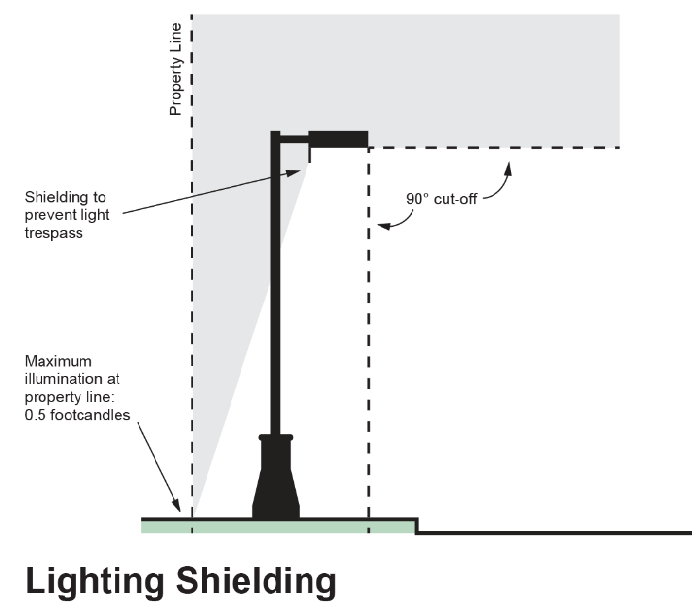
Shielding. Exterior lighting shall be fully shielded and directed downward at a ninety (90) degree angle. Oblique lenses (such as many wall-pack fixtures) are prohibited. All fixtures shall incorporate full cutoff housings, louvers, glare shields, optics, reflectors or other measures to prevent off-site glare and minimize light pollution. Only flat lenses are permitted on light fixtures; sag or protruding lenses are prohibited.
(b)
Intensity. The following light intensity requirements shall apply on all sites within the City:
(1)
The intensity of light within a site shall not exceed ten footcandles. Exception: The maximum intensity permitted in areas of intensive vehicular use, such as the area underneath gas station pump canopies, in the immediate vicinity of ATM facilities, or outdoor sales areas shall be twenty (20) footcandles.
(2)
The maximum light intensity permitted at a street right-of-way line shall be one (1) footcandle, or the average light intensity generated by public street lighting at the property line (up to a limit of five footcandles), whichever is greater.
(3)
The maximum light intensity permitted at any property line other than a street right-of-way shall be one-half (½ or 0.5) footcandles.
(c)
Glare and light trespass. Exterior lighting sources shall be designed, constructed, located and maintained in a manner that does not cause off-site glare on neighboring properties or street rights-of-way. In general, the hot spot, or light emitting element of any light fixture shall not be directly visible from a neighboring property, as this is the primary cause of glare.
(d)
Lamps.
(1)
Wattage. Lamps with a maximum wattage of two hundred fifty watts (250W) per fixture are permitted for use in the City to maintain a unified lighting standard and to minimize light pollution. The planning commission may permit the use of lamps with wattages up to four hundred watts (400W) if the applicant can demonstrate that the higher wattage fixture is necessary to provide adequate lighting on the site and that the light fixture is in compliance with all other requirements of this chapter. The exemption for higher wattage lamps shall not be granted if the same lighting effect can be reasonably accomplished on the site by incorporating additional two hundred fifty watt (250W) fixtures into the site design.
(2)
Low traffic areas. Low-pressure sodium lamps are recommended for security lighting purposes in areas of low vehicular and pedestrian traffic.
(3)
High traffic areas. Due to their superior color rendering characteristics, high pressure sodium or metal halide lamps should be used in parking lots and other areas of high pedestrian and vehicular traffic use.
(4)
LED lighting. LED fixtures may be used for any outdoor lighting application. Any LED fixture used for parking lot or street lighting purposes shall comply with applicable Illuminating Engineering Society of North America standards.
(e)
Animated lighting. Permanent exterior lighting shall not be of a flashing, moving, animated, or intermittent type.
(f)
Outline lighting. Outline lighting with a visible source of light of any type such as neon, fluorescent, LED, or similar around the perimeter of a window, sign, or architectural feature is prohibited, with the exception of historic neon signs that are included in a site plan approval as part of a historic building/site restoration. Such lighting may be used if the source of light is shielded from direct view of the public by translucent panels or similar methods.
(g)
Hours of operation. All exterior lighting in non-residential districts shall incorporate automatic timers and shall be turned off between the hours of midnight and sunrise, except for lighting necessary for security purposes or accessory to a use that continues after midnight.
(h)
Measurement. Light intensity shall be measured in footcandles on the horizontal plane at grade level within the site, and on the vertical plane at the property or street right-of-way boundaries of the site at a height of five (5) feet above grade level.
(Ord. No. O-06-25, § 1(Exh. A), 8-4-2025)
Sec. 98-201. - Standards by type of fixture.
(a)
Freestanding pole and building-mounted lighting. The maximum height of such fixtures is twenty (20) feet. Where a pole or building-mounted fixture is located within 50 feet of a residentially zoned or used property, the maximum pole height shall be fifteen (15) feet.
(b)
Decorative light fixtures. The planning commission may approve decorative light fixtures as an alternative to shielded fixtures, provided that such fixtures would enhance the aesthetics of the site and would not cause undue off-site glare or light pollution. Such fixtures may utilize incandescent, tungsten-halogen, metal halide or high-pressure sodium lamps with a maximum wattage of one hundred watts (100W) per fixture.
(Ord. No. O-06-25, § 1(Exh. A), 8-4-2025)
Sec. 98-202. - Exempt lighting.
(a)
The following exterior lighting types are exempt from the requirements of this article, except that the development services director may take steps to minimize glare, light trespass or light pollution impacts where determined to be necessary to protect the health, safety and welfare of the public:
(1)
Holiday decorations.
(2)
Pedestrian walkway lighting.
(3)
Instances where federal or state laws, rules or regulations take precedence over the provisions of this chapter.
(4)
Temporary emergency lighting.
(Ord. No. O-06-25, § 1(Exh. A), 8-4-2025)
Sec. 98-203. - Exceptions.
(a)
It is recognized by the City that there are certain uses or circumstances not otherwise addressed in this chapter, such as sports stadiums, street lighting, or lighting for monuments and flags, that may have special exterior lighting requirements. The reviewing authority may waive or modify specific provisions of this chapter for a particular use or circumstance upon determining that all of the following conditions have been satisfied. The planning commission shall be the deciding body in all cases where site plan or special use approval is required, while the director of development services shall decide in all other cases:
(1)
The waiver or modification is necessary because of safety or design factors unique to the use, circumstance or site.
(2)
The minimum possible light intensity is used that would be adequate for the intended purpose. Consideration shall be given to maximizing safety and energy conservation, and to minimizing light pollution, off-site glare and light trespass on to neighboring properties or street rights-of-way.
(3)
For lighting related to streets or other vehicle access areas, a determination is made that the purpose of the lighting cannot be achieved by installation of reflectorized markers, lines, informational signs or other passive means.
Additional conditions or limitations may be imposed by the reviewing authority to protect the public health, safety or welfare, or to fulfill the purpose of this chapter.
(Ord. No. O-06-25, § 1(Exh. A), 8-4-2025)
Sec. 98-204. - Standard methods of measurement.
(a)
Required yards. Attached accessory structures shall be deemed a part of such main building for the purpose of determining compliance with the yard requirements of this chapter.
(b)
Lot coverage. Accessory garages and other structures, open and enclosed porches, patios, terraces and decks exceeding three (3) feet in height shall be deemed a part of such main building for the purpose of determining compliance with any lot coverage requirements of this Ordinance.
(c)
Buildable lot area, open space and recreation area calculations.
(1)
Lakes, ponds, state or federally regulated wetlands, utility easements, public street rights-of-way and private road easements are excluded from area calculations for buildable lot area.
(2)
No area which, for the purpose of a building or dwelling group, has been counted or calculated as part of a side yard, rear yard or front yard setback required by this Ordinance may be counted or calculated to satisfy any open space or recreation area requirement of this chapter.
(Ord. No. O-06-25, § 1(Exh. A), 8-4-2025)
Sec. 98-205. - Corner clearance.
No fence, wall, shrubbery, sign or other obstruction to vision above a height of two (2) feet from the established sidewalk grades shall be permitted within the triangular area formed the intersection of the following vehicle use areas. Canopy trees may be located in the corner clearance area provided that the first branch is a minimum of eight (8) feet above grade level.
(a)
Street intersections. The intersection of any street right-of-way lines by a straight line drawn between the right-of-way lines at a distance along each line of twenty-five (25) feet from their point of intersection
(b)
Non-residential driveways. The triangular area formed at the intersection of any non-residential driveway and a street right-of-way line at a distance along each line of fifteen (15) feet from the point of intersection between the driveway and the right-of-way.
(c)
Residential driveways. The triangular area formed at the intersection of any residential driveway and a street right-of-way line at a distance along each line of ten feet from the point of intersection between the driveway and the right-of-way.
(Ord. No. O-06-25, § 1(Exh. A), 8-4-2025)
Sec. 98-206. - Frontage.
No building permit shall be issued for any construction located on any lot or parcel of land in the City that does not abut an approved public or private street, or that does not meet the minimum lot width requirement along an approved public or private street. All access to public or private streets shall be hard surfaced with concrete or plant-mixed bituminous material and shall meet the requirements of this Ordinance and all other City ordinances.
(Ord. No. O-06-25, § 1(Exh. A), 8-4-2025)
Sec. 98-207. - Area and height exceptions.
The regulations in this division shall be subject to the following interpretations and exceptions:
(a)
Height limit. The height limitations of this chapter shall not apply to farm buildings, chimneys, church spires, or public monuments; however, the planning commission may specify a height limit for any such structure when such structure requires authorization as a use permitted on special conditions under this division.
(b)
Lots adjoining alleys. In calculating the area of a lot that adjoins an alley or lane, for the purpose of applying lot area requirements of this division, half (½) the width of such alley abutting the lot shall be considered as part of such lot.
(c)
Yard regulations. When yard regulations cannot reasonably be complied with, as in the case of planned development in a multiple-family district, or where their application cannot be determined on lots existing and of record on April 25, 1991, and on lots of peculiar shape, topography or due to architectural or site arrangement, such regulations may be modified or determined by the board of appeals.
(d)
Projections into yards.
(1)
Existing architectural features, such as porches that are permanent and not demountable which existed prior to the adoption of the Ordinance from which this chapter derives and which occupy portions of required yards may be maintained and expanded, provided such expansion does not encroach to a greater distance into a yard than the setback of the existing architectural feature.
(2)
Decks or raised patios not exceeding three (3) feet in height may project into a required rear yard not more than ten (10) feet.
(3)
In a residential district, a porch or deck may extend up to six (6) feet into the required front yard but must remain at least twenty (20) feet from the front property line. Additionally, any portion of the deck or porch may have a maximum one-foot overhang beyond its main structure.
(e)
Minor setback and height allowances. Buildings, structures or signs for which a plan has been submitted, reviewed and approved for zoning compliance and upon construction completion are found to be at minor variance with the approved plan, may be granted approval by the building official subject to the following:
(1)
Minimum side and rear setbacks may be reduced but not to exceed one (1) inch for each one (1) foot of required setback.
(2)
Maximum height requirements for buildings or structures specified in Sec. 98-72 may be increased one-half (½) inch for each one (1) foot of maximum height specified. This does not apply to signs.
(3)
Exemptions for setbacks or height shall not be allowed for fences, ground signs or wall signs.
(4)
Minor setback allowances shall not be granted within corner clearance areas.
(5)
Maximum sign face square footage, as specified in Article IX of this chapter may be exceeded by one (1) square foot.
(f)
Accessibility ramps.
(1)
Landings to which ramps are attached for disabled access may be permitted to project into a required front yard not to exceed seven feet in RA-1 and RA-2 districts by special permit issued by the building official subject to the following:
a.
No other location in a side or rear yard is available for access to the dwelling;
b.
Removal of access ramps shall be required upon termination of the need for such ramps;
c.
Such landings and ramps shall comply with all barrier-free rules and regulations; or
d.
Landscaping may be required to reduce the impact on other residential properties.
(2)
Ramps for disabled access may be permitted in RM-1 and RM-2 districts when incorporated into the design of the structure so as not to encroach on a required front yard and shall comply with all barrier-free rules and regulations and the Fair Housing Act, as applicable.
(3)
All accessibility in all office, business and industrial districts shall comply with all state and federal guidelines as outlined in the Americans with Disabilities Act (ADA).
(g)
Landscape and lawn ornaments. Landscape and lawn ornaments may be permitted in any required yard if that placement does not conflict with any other requirement of any other ordinance.
(Ord. No. O-06-25, § 1(Exh. A), 8-4-2025)
Sec. 98-208. - Temporary residence mobile home.
During a period of reconstruction due to fire or act of nature to a permanent dwelling, the owner of such permanent dwelling may apply to the City for a permit to occupy one (1) mobile home as a temporary residence. The building official may issue a permit for a six-month period, and it may be renewed for one (1) additional six-month period, for a total period not to exceed one (1) year. The owner shall deposit as security, cash, bank draft or certified check payable to the City an amount determined by the City council in its schedule of fees. The security deposit shall be forfeited to the City should there be any violation of the provisions of this chapter or any other ordinances of the City; and should there be no violations the security deposit shall be refunded to the owner. As a temporary residence, the mobile home does not have to meet the required conditions for dwelling units in the RA-1, RA-2, RM-1 and RM-2 districts. However, the following conditions are required:
(a)
Only one (1) mobile home shall be permitted on the site.
(b)
The mobile home shall comply with all setback requirements of the zoning district and shall be allowed in the side or rear yard only.
(c)
The mobile home shall contain sleeping accommodations, a flush toilet, and a tub or shower adequate to serve the occupants.
(d)
The sanitary facilities of the mobile home shall be properly connected to City water and sewer system available to the property.
(e)
The building official may require additional conditions as are necessary. The building official shall further have the full authority to conduct inspections, with other persons, of the property and the mobile home at any reasonable time.
(Ord. No. O-06-25, § 1(Exh. A), 8-4-2025)
Sec. 98-209. - Essential services.
Essential services shall be permitted as authorized and regulated by law and other ordinances of the City, it being the intention of this subsection to exempt such essential services from the application of this division.
(Ord. No. O-06-25, § 1(Exh. A), 8-4-2025)
Sec. 98-210. - Voting place.
The provisions of this division shall not be so construed as to interfere with the temporary use of any property as a voting place in connection with a City or other public election.
(Ord. No. O-06-25, § 1(Exh. A), 8-4-2025)
Sec. 98-211. - Detention/retention ponds.
(a)
Statement of intent. Detention/retention ponds are an essential function for development design and shall be incorporated as an integral part of the site layout. Factors such as safety, maintenance, function and aesthetics shall be considered.
(b)
Detention/retention ponds shall not be permitted in the front yard unless the planning commission determines there is no feasible engineering alternative or that placement in another location would be burdensome on adjacent properties. In such situations, the detention/retention pond shall meet the minimum front yard setback requirement for principal buildings and shall be designed as a visual amenity (a water feature, boulder walls, varying shape, extensive landscaping, etc.).
(c)
Detention areas shall appear natural in configuration, be appropriately landscaped, and enhance the site. Inlet structures shall be screened from view. Aeration shall be provided where appropriate.
(Ord. No. O-06-25, § 1(Exh. A), 8-4-2025)
Sec. 98-212. - Personal vehicle sales.
(a)
Residential Lots.
(1)
A resident of dwelling unit may have not more than one (1) motorized vehicle for sale on the site of such dwelling unit at any one (1) time, and in no instance shall vacant residential lots or parcels be used for the sale of vehicles.
(2)
A resident may repair vehicles they own; however, repairing vehicles owned by non-residents of the dwelling unit is not permitted on the property.
(3)
In no instance shall vehicles for sale be displayed in the front yard other than on the driveway proportion of such yard.
(4)
Storage of a vehicle on the property, which is listed for sale, may not exceed thirty (30) calendar days.
(5)
The sale of vehicles from a residential property shall not exceed two (2) vehicles in any calendar year.
(6)
Recreation Vehicles. Recreational vehicles (RVs) and portable living quarters (campers) are not permitted to be stored on the property while being listed for sale.
(7)
Signs located on the property in relation to vehicle sales must comply with Article IX of the Zoning Ordinance.
(b)
Non-Residential Lots.
(1)
Prohibited activities. Motor vehicles for sale and repair of vehicles is prohibited in off-street parking areas.
(Ord. No. O-06-25, § 1(Exh. A), 8-4-2025)
Sec. 98-213. - Rooftop equipment.
In all office, service and business districts, rooftop equipment and apparatus shall be screened from ground level by being housed in a penthouse or structure constructed of the same type of building materials used in the principal structure, or by building design.
(Ord. No. O-06-25, § 1(Exh. A), 8-4-2025)
Sec. 98-214. - Recreational and commercial vehicle storage.
(a)
Purpose. The purpose of this section is to preserve and promote the health, safety and general welfare of citizens, motorists and pedestrians alike through regulation of parking and storage of commercial and recreational vehicles and equipment and through prohibition of junk vehicles and junk accumulation on residential property. Such regulation is necessary to avoid excessive noise and exhaust levels; enhance the appearance and character of neighborhoods and the value and marketability of surrounding property; avoid overcrowding of land; reduce traffic hazards; and avoid attractive nuisances for children.
(b)
Definitions. The following words, terms and phrases, when used in this division, shall have the meanings ascribed to them in this section, except where the context clearly indicates a different meaning:
Bus means a motor vehicle, other than a trailer, designed to carry more than fifteen (15) passengers. The term does not include a school bus or a motor vehicle that is converted, equipped and used for living or camping purposes.
Camper enclosure means a structure or enclosure designed for mounting on a pickup truck or truck chassis in such a manner as to provide temporary living or sleeping quarters, including, but not limited to, a slide-in camper or truck cap.
Commercial equipment means any machinery, parts, accessories, construction equipment or other equipment used primarily in the course of conducting a trade or business.
Commercial vehicle means any vehicle used to generate income or which has the appearance that it is used for business, due to size, type, signage and/or accessories. A pickup truck, passenger/cargo-style van with seating of up to fifteen (15) persons, sports/utility vehicle and passenger car without signage and accessories shall not be considered, for purposes of this Ordinance, as a commercial vehicle, even though used in business.
Construction equipment means a bulldozer, front-end loader, backhoe, power shovel, cement mixer, trencher, and any other equipment designed or used for construction, including parts and accessories thereto, or trailers designed for the transportation of such equipment.
Recreational equipment means any recreational vehicle or personal recreational device not intended to provide daily motorized transportation such as an all-terrain vehicle or jet-ski.
Recreational vehicle means a vehicle which is: 1) built on a single chassis; 2) four hundred (400) square feet or less when measured at the largest horizontal projections; 3) self-propelled or permanently towable by motor vehicle or light duty truck; 4) designed primarily not for use as permanent dwelling but as temporary living quarters for recreational, camping, travel, or seasonal use; and 5) required by Michigan law to have a valid vehicle registration when traveling upon public streets.
Residential district means any RA-1, RA-2, RM-1, RM-2, or PRD zoning district.
School bus means a motor vehicle, other than a station wagon, with a manufacturer's rated seating capacity of eight (8) or more children which is owned by a public, private or governmental agency and which is operated for the transportation of children to or from school. The term also means a motor vehicle, other than a station wagon, that is privately owned and operated for compensation for the transportation of children to or from school.
Trailer means a vehicle, other than a utility trailer, designed for carrying property and for being drawn by a motor vehicle.
Truck tractor means a truck designed primarily for drawing another vehicle and not so constructed as to carry a load other than a part of the weight of the vehicle or trailer and of the load so drawn.
Utility trailer means a vehicle designed to be towed by a motor vehicle in order to carry personal property, including, but not limited to, firewood, refuse, snowmobiles, boats, motorcycles or recreational equipment, or used solely for noncommercial purposes.
Vehicle means any device in, upon, or by which a person or property may be transported or drawn.
(c)
Recreational equipment. Recreational equipment may be parked or stored outside on an individual lot used for one-family residential purposes subject to the following requirements:
(1)
Recreational equipment shall not be parked or stored in any front yard or required front yard setback. Where an individual residential lot does not allow for recreational equipment to be parked or stored in accordance with subsection (c)(2) or (c)(3) of this section, recreational equipment may be parked for loading, unloading and trip preparation purposes, which shall not exceed forty-eight (48) continuous hours on the issuance of a permit by the development services director.
(2)
Recreational equipment may be parked or stored in that part of the side yard that is not a part of the required front yard setback, provided the recreational equipment is no closer than three (3) feet to any principal structure. A unit of recreational equipment shall include a boat on a boat trailer, snowmobile on a snowmobile trailer or any other kind of trailer being used to transport similar equipment.
(3)
Recreational equipment, including trailers used to transport recreational equipment, may be parked or stored in a rear yard provided the recreational equipment is no closer than three feet to any principal structure and that the recreational equipment shall not occupy more than fifteen percent (15%) of the required rear yard.
(4)
Recreational equipment may be used for temporary occupancy purposes for nonresident guests for a period not exceeding fourteen (14) consecutive days provided a permit is issued by the development services director based on the following requirements:
a.
Recreational equipment may be parked in the driveway of a front yard or a front yard setback provided that it is located no closer than ten (10) feet from a front lot line or in the case of a front yard setback, ten (10) feet from a side lot line, and provided that the equipment is no closer than three (3) feet to any principal structure.
b.
Recreational equipment shall not be connected to sanitary facilities.
c.
Recreational equipment shall not be parked in any public right-of-way.
d.
A resident will be limited to not more than two (2) permits in a twelve-month period for such temporary occupancy purposes.
(d)
Storage of motor vehicles in commercial, industrial-commercial and residential districts.
(1)
Definitions. For the purpose of this section, the term "motor vehicle" shall apply to automobiles, trucks, motorcycles, mopeds and recreational vehicles required to be registered/titled with the State of Michigan. The terms "store," "stored," and "storage" refers to vehicles left parked, stopped or standing on a single parcel of property within the City for a period of forty-eight (48) hours or more.
(2)
Residential districts. Motor vehicles stored on private property outside of a permanent structure, as defined Article XII of this chapter, for more than forty-eight (48) hours must:
a.
Be parked upon a hard surface (concrete, asphalt or compacted gravel) specifically designed for the parking and exterior storage of motor vehicles.
b.
Display current Michigan registration, registered to that vehicle.
c.
Be operable for its intended purpose (engine runs, transmission moves the vehicle, no flat tires).
d.
Have all major components, parts and accessories attached and operational for its intended purpose.
e.
Not be resting upon jacks, blocks or similar device, for minor or major repairs for more than forty-eight (48) hours.
f.
Exception. The only exception to this requirement is a motor vehicle meeting the criteria of a historic vehicle as defined by the Michigan Motor Vehicle Code and the following:
1.
An historic vehicle may be stored outside for more than forty-eight (48) hours as long as it is stored upon a hard surface (concrete, asphalt or compacted gravel) specifically designed for the parking and exterior storage of motor vehicles.
2.
Is completely covered by a motor vehicle tarp specifically designed and tailored for the vehicle it is covering. For the purposes of this section a flat polymer, canvas, nylon or plastic tarp is not considered a tarp specifically designed and tailored for the vehicle it is covering.
Any motor vehicle failing to meet the listed criteria shall be stored within a permanent enclosed accessory structure. For the purpose of this article, a temporary structure shall not be considered permanent.
(3)
Commercial, industrial-commercial, industrial districts. A privately owned motor vehicle may not be stored outside of a permanent structure in any commercial, industrial-commercial, or industrial district as defined by the City of Tecumseh Zoning Map, unless permission to store a privately owned motor vehicle has been granted to the vehicle's owner by property owner.
a.
Notification. After the City has provided the property's resident or vehicle's owner a forty-eight-hour written or verbal notice of violation, the police department may take enforcement action against the property's resident or vehicle's owner if the violation has not been resolved as specified under this section.
b.
Violation and penalty.
1.
The property or vehicle owner who is found to be in violation of this section shall be guilty of a civil infraction for the first offense as set forth in the City of Tecumseh Code of Ordinances and subject to the fines and costs set forth therein. The first violation of this section may be waived within ten (10) working days if the violation is rectified.
2.
The second and subsequent violations of this section are a misdemeanor punishable as identified in the City of Tecumseh Code of Ordinances. In all incidents resulting in a second and subsequent violation the presiding judge will order the removal of all vehicles found to be in violation of this section, from the property cited in the complaint or citation.
(e)
Commercial vehicles and equipment.
(1)
Public property. No person shall park or store any commercial vehicle identified in subsection 98-214(e)(2)a., or commercial equipment on public property located in any zoning district, including, but not limited to, public streets, stub streets, rights-of-way, bike paths, greenbelts, and planting areas between bike paths and streets, except as allowed in subsection 98-214(e)(4).
(2)
Residential districts.
a.
No person shall park or store any step vans, cube vans, buses, dump trucks, stake trucks, flatbed trucks, wreckers, semitrucks and trailers, tank trucks, commercial and construction equipment and trailers and any similar trucks and equipment in a residential district, except as allowed in subsection 98-214(e)(4).
b.
Commercial vehicles other than as specified subsection 98-214(e)(2)a., such as pickup trucks, passenger/cargo-style vans with seating of up to fifteen (15) persons, sport utility vehicles, passenger cars, and similar type vehicles, with no more than allowed accessories as provided in subsection 98-214(e)(2)d. may be parked or stored in a residential district.
c.
No more than one (1) commercial vehicle of the type described in subsection 98-214(e)(2)b. which is used for transportation by occupants of the home on the property shall be stored or parked outside of an enclosed building.
d.
Allowed accessories shall mean equipment attached to vehicles which does not extend a vehicle to more than nine (9) feet in height or wider or longer than the manufacturer's specification for the vehicle without the equipment. Roof accessory racks, but not side racks, shall be allowed. A plow on the front and a spreader on the rear of a vehicle may be attached even if the length of the vehicle is extended beyond the manufacturer's specification.
(3)
Nonresidential districts. No person shall park or store any commercial vehicle identified in subsection 98-214(e)(2)a., or commercial equipment on private property in any nonresidential district except as is allowed in subsection 98-214(e)(4) or unless such vehicle or equipment is parked or stored in relation to a permitted principal or accessory use of the property. In such event, parking or storage must comply with all other City codes and ordinances.
(4)
Exception. The parking or storage of commercial vehicles identified in subsection 98-214(e)(2)a., or commercial equipment shall be allowed in any zoning district, where such parking or storage is limited to vehicles or equipment engaged in the performance of a service on the adjacent or underlying property, for the period of time reasonably necessary to complete the service.
(Ord. No. O-06-25, § 1(Exh. A), 8-4-2025)
Sec. 98-215. - Special events.
Special events may be permitted in any zoning district provided that the special event does not harm or interfere with the use of neighboring premises or harm the health, safety, and welfare of any person.
(a)
Duration. Special events may be scheduled for a single period not exceeding thirty (30) days during a calendar year, or for up to four (4) nonconsecutive ten-day periods during a calendar year. For the purpose of this section, nonconsecutive is defined as the end of one period and the beginning of another period being separated by more than six (6) calendar days. Farmer's markets, as well as other vendors approved to participate in community events such as festivals or historic/holiday home tours sponsored by local organizations that promote our City and local businesses may be granted a permit for weekend only events.
(b)
Application. Any special event shall obtain an application from the development services. The application shall include the following information:
(1)
Sponsor's name;
(2)
Name of use or event;
(3)
Dates, times, and location of the use or event;
(4)
Size, number, and location of all signs;
(5)
The expected number of participants.
(c)
Sketch drawing. The application shall also include a sketch drawing of the premises on which the special event will be held. The sketch drawing must show the entrance and exit to the event, parking areas, signs and other pertinent details as requested by the appropriate department. If the special event is to be held on more than one premises, such as a tour of buildings, the application shall include a map of the relevant details at each of the participating buildings or sites.
(d)
Signs. Temporary signs associated with the special event shall be permitted according to the standards of Sec. 98-234(a) and Sec. 98-235(g), as well as all of the other relevant standards in Article IX.
(e)
Review. The special event permit shall be submitted to the building official, who shall distribute the application to any City departments affected by the special event for review and comment. These departments may include the development services department, police department, fire department, City clerk, public works director, or any other City department. In reviewing the application, the departments shall consider traffic circulation, parking, sign placement, and surrounding uses. The development services director reserves the right to classify; the type of event and to set procedures for approval.
(f)
Decision. The development services director shall approve, approve with conditions, or deny the application within sixty (60) days of the receipt of the application.
(g)
Effect of denial. The sponsor of any application that is denied by the development services director may appeal the decision to the zoning board of appeals under the provisions of Sec. 98-45.
(Ord. No. O-06-25, § 1(Exh. A), 8-4-2025)
Sec. 98-216. - Wind energy systems.
(a)
Purpose. It is the purpose of this section to promote the safe, effective, and efficient use of wind energy systems to reduce or replace on-site consumption of utility supplied electricity. It is the purpose of this chapter to standardize and streamline the review and permitting process for small wind energy systems.
(b)
Findings. The City has found that wind energy is an abundant, renewable, and nonpolluting energy resource and that its conversion to electricity will reduce our dependence on non-renewable energy resources and decrease air and water pollution that results from the use of conventional fossil-fuel inputs. Wind energy systems will also enhance the reliability and power quality of the power grid, reduce peak power demands, and help diversify the City's energy supply portfolio.
(c)
Definitions. The terms used in this section have the following meanings:
(1)
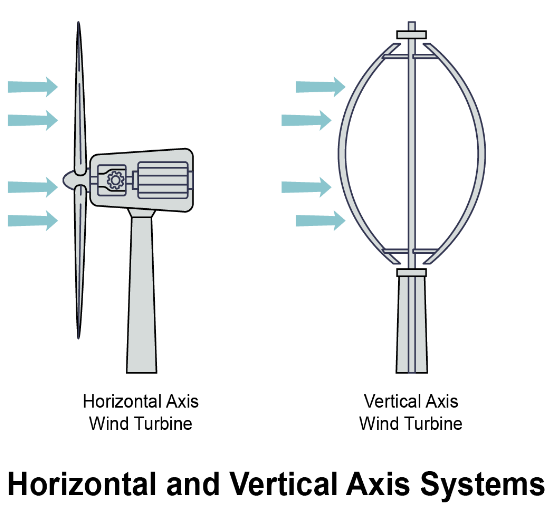
Height. The vertical distance from grade level adjacent to the base of the structure to the center of the hub for a horizontal axis wind turbine or the highest point of a vertical-axis wind turbine.
(2)
Roof-mounted energy system. A type of small wind energy conversion system that is mounted on a roof with a height not greater than fifteen (15) feet above the ridgeline of a pitched roof or parapet of a flat roof.
(3)
Small wind energy system. A wind energy conversion system consisting of a wind turbine, tower or axis, blades or blade system, and associated control or conversion electronics primarily intended to reduce on-site consumption of utility power.
(4)
Tower-mounted wind energy system. A wind energy conversion system that is mounted on a freestanding or guyed tower attached to the ground, and not attached to any other permanent or temporary structure.
(5)
Utility wind energy system. A wind energy conversion system consisting of a wind turbine, tower or axis, blades or blade system, and associated control or conversion electronics primarily intended to provide wholesale or retail energy to the electric utility grid.
(6)
Wind energy system. Any wind energy conversion device including all associated control or conversion electronics.
(d)
Where permitted.
(1)
Small wind energy systems are permitted by right in any zoning district, provided that the requirements of this division are met.
(2)
Utility wind energy systems may be permitted in any zoning district as a conditional use by the City council, provided that the requirements of this division are met.
(e)
Review procedures and standards.
(1)
Small wind energy systems.
a.
Submittal requirements. Applications for small wind energy systems shall be reviewed administratively by the development services department.
b.
Height modification procedure. If the applicant requests a height modification, the application shall be reviewed by the Planning Commission following a public hearing held in accordance with the requirements of Sec. 98-28.
(2)
Utility wind energy systems. The review process for any utility wind energy system shall follow the special land use review process set forth in Sec. 98-39.
(f)
General standards. The following requirements are applicable to all wind energy systems:
(1)
Noise. A wind energy system shall not generate a noise level of fifty-five decibels (55dB)(A), measured at the property line, for more than three (3) minutes in any hour of the day. EXCEPTION: if the constant ambient sound pressure level exceeds fifty-five decibels (55dB)(A), measured at the base of the wind energy system, a decibel level of the ambient decibels (dB)(A) plus five decibels (5dB)(A) shall not be exceeded for more than three (3) minutes in any hour of the day.
(2)
Lighting. No wind energy system shall be artificially lighted unless required by the Federal Aviation Administration.
(3)
Appearance, color, and finish. The wind energy system shall be maintained in the color or finish that was originally applied by the manufacturer, unless otherwise approved in the building permit. All wind energy systems shall be finished in a non-reflective matte finished color.
(4)
Signs. All signs other than the manufacturer or installer's identification, appropriate warning signs, or owner identification signs are prohibited.
(5)
Electrical wires. All electrical wires associated with a wind energy system other than wire necessary to connect the wind generator to the tower wiring, the tower wiring to the disconnect junction box, and grounding wires shall be located underground.
(6)
Compliance with electrical code. Building permit applications for wind energy systems shall be accompanied by line drawings of the electrical components in sufficient detail to allow for a determination that the manner of installation conforms to the National Electrical Code.
(7)
System access. The tower shall be designed and installed such that step bolts, ladders, or other means of access readily accessible to the public are located at least eight (8) feet above grade level.
(8)
Wind access. The City makes no assurance of wind access other than the provisions of this section. The applicant may provide evidence of covenants, easement, or similar documentation for abutting property owners providing access to wind for the operation of a wind energy system.
(g)
Small wind energy systems. The following standards are applicable to small wind energy systems:
(1)
Minimum site area. A small wind energy system may only be located on a lot with a minimum area of one-half (½) acre.
(2)
Height. The maximum height for the fixed portion of the tower, excluding the blades or blade system, for small wind energy systems shall be based on the area of the parcel in question. In no case shall a wind energy system exceed height limits imposed by FAA regulations.
(3)
Setbacks.
a.
The minimum setback for any tower-mounted small wind energy system from any property line shall be equal to the height of the wind turbine plus five (5) feet.
b.
The minimum setback for any tower-mounted small wind energy system from a road right-of-way or overhead utility line shall be equal to the height of the wind turbine unless written permission is granted by the governmental agency with jurisdiction over the road or the affected utility.
c.
Roof-mounted wind energy systems shall be set back a minimum of fifteen (15) feet from any property line.
d.
Tower-mounted small wind energy systems may not be located in the front yard of any lot. EXCEPTION: if the principal building is set back two hundred (200) feet or more from the street, tower-mounted systems may be located in the front yard provided that a minimum one hundred fifty-foot front yard setback is provided.
(h)
Utility wind energy systems. The following standards are applicable to large wind energy systems:
(1)
Minimum site area. Utility wind energy systems may only be developed on a zoning lot with an area of twenty (20) acres or greater.
(2)
Setbacks. Any utility wind energy system shall be set back a distance equal to the height of the tower plus five (5) feet from any property line, road right-of-way, or overhead utility line.
(3)
Towers. Utility wind energy systems shall use tubular monopole towers, and shall not contain lettering, company insignia, advertising, or graphics on the tower or turbine that are visible beyond the property boundaries.
(4)
Environmental impact. The applicant shall submit an environmental impact analysis prepared by a qualified third party assessing any potential impacts on the natural environment including, but not limited to, wetlands and other fragile ecosystems, historical and cultural sites, wildlife, and antiquities. The applicant shall take appropriate measures, if possible, to minimize, eliminate or mitigate adverse impacts identified in the analysis. If the adverse impacts cannot be sufficiently mitigated or eliminated, City council shall deny the request for a conditional use permit for the utility wind energy system.
(5)
Community impact. The applicant shall be responsible for repairing any public roads or other public infrastructure damaged or otherwise worn beyond typical usage by the construction of the utility wind energy system.
(6)
Decommissioning. The applicant shall submit a decommissioning plan, including the following items of information:
a.
The anticipated life of the project.
b.
The estimated decommissioning costs and net salvage value in present dollars.
c.
The method of ensuring funds will be available for decommissioning and removal of towers, and restoration of the site to a pre-construction condition.
d.
Anticipated manner in which the project will be decommissioned, and the site restored.
(7)
Complaint resolution. The applicant shall develop a process to resolve any potential complaints from nearby residents concerning the construction and operation of the project. The process may use an independent mediator or arbitrator and shall include a time limit for acting upon a complaint. The process shall not preclude any governmental body from acting on a complaint. The applicant shall maintain and make available to nearby residents a telephone number where a project representative can be reached during normal business hours.
(Ord. No. O-06-25, § 1(Exh. A), 8-4-2025)
Sec. 98-217. - Solar energy systems.
(a)
Definitions.
(1)
Solar energy system. A solar photovoltaic cell, panel, or array that converts solar energy to usable thermal, mechanical, chemical, or electrical energy.
(2)
Solar storage battery. A device that stores energy from the sun and makes it available in an electrical form.
(b)
Rooftop solar energy systems. Rooftop and building-mounted solar energy systems are permitted in all zoning districts, subject to the following regulations:
(1)
Roof-mounted systems shall not extend more than four (4) feet above the surface to which it is affixed.
(2)
No solar energy system may protrude beyond the edge of the roof.
(3)
A building permit shall be required for installation of rooftop and building-mounted systems.
(c)
Ground-mounted solar energy systems. Ground-mounted and freestanding solar energy systems are permitted in all zoning districts, subject to the following regulations:
(1)
Location. Solar energy systems may be located in a side or rear yard and are prohibited in the front yard.
(2)
Height. The height of the solar energy system and any mounts shall not exceed ten (10) feet when oriented at maximum tilt.
(3)
Building permit. A building permit shall be required for any ground-mounted solar energy system.
(4)
Area. No more than twenty percent (20%) of the total lot area may be covered by a ground-mounted solar energy system.
(d)
Batteries. When solar storage batteries are included as part of the solar collector system, they must be placed in a secure container or enclosure when in use, and when no longer used shall be disposed of in accordance with applicable laws and regulations.
(e)
Removal. If a solar energy system ceases to perform its intended function for more than twelve (12) consecutive months, the property owner shall remove the collector, mount, and associated equipment and facilities no later than ninety (90) days after the end of the twelve-month period.
(Ord. No. O-06-25, § 1(Exh. A), 8-4-2025)
Sec. 98-218. - Solar access permit.
(a)
Purpose. This section is adopted for the purpose of protecting the health, safety and general welfare of the community by promoting the use of solar energy systems, protecting access to sunlight for solar energy systems, and assuring that potentially conflicting interests of individual property owners are accommodated to the greatest extent possible compatible with the overall purpose and intent of this chapter.
(b)
Definitions.
(1)
Collector surface. Any part of a solar collector that absorbs solar energy for use in the collector's energy transformation process, but not including frames, support, and mounting hardware.
(2)
Southern property line. A property line that forms a generally south facing boundary of a lot, and which has a bearing greater than or equal to forty (40) degrees from either true north or true south.
(3)
Permit. Any property owner who has installed or intends to install a solar collector may apply for a solar access permit. A solar access permit shall prohibit property owners on adjacent properties that are separated from the property holding a solar access permit by a southern property line from erecting any structure or planting any vegetation that would create prohibited interference obstructing the collector surface of the solar energy system.
(c)
Permit review process. Applications for solar access permits are reviewed by the development services director or his or her designee, unless a hearing is requested by a property owner that will be restricted by the solar access permit. If a hearing is requested, the planning commission shall be the reviewing body. The review process for a solar access permit is as follows:
(1)
Application. An application for a permit under this section may be obtained from the development services department and shall be completed by the applicant. The application shall indicate the tax ID number of adjacent properties that are proposed to be restricted by the permit.
(2)
Notice. Once a completed application is filed, the development services department shall provide the applicant with a notice that shall be the applicant's responsibility to deliver by hand or certified mail to any property the applicant proposes to restrict as part of the solar access permit. The notice shall contain the following information:
a.
The name and address of the applicant, and the address of the land upon which the solar energy system will be located.
b.
That an application has been filed by the applicant.
c.
That the permit, if granted, may affect the rights of the notified property owner to develop his or her property or to plant vegetation.
d.
That any person who received a notice may request a hearing within thirty (30) days of receipt of the notice. If a hearing is requested, the planning commission shall hold the hearing within ninety (90) days of the date of the request. The City shall notify the applicant, the person requesting the hearing, and any other property owners proposed to be restricted by the permit between fifteen (15) and thirty (30) days prior to the hearing.
e.
The procedure for filing a hearing request and the telephone number, address, and hours of the development services department.
(3)
Review criteria. The reviewing authority shall grant a solar access permit if it determines that:
a.
The granting of a permit will not unduly or unreasonably interfere with the orderly land use and development of the City.
b.
No person has demonstrated that he or she has present plans to construct a structure that would create prohibited interference by showing that he or she has applied for a building permit prior to receipt of notice, has expended at least five hundred dollars ($500.00) on planning or designing such a structure, or by submitting any other credible evidence that he or she has made substantial progress toward planning or constructing a structure that would create prohibited interference.
c.
No person has demonstrated that the granting of a permit would cause an undue hardship in using his or her property in a manner consistent with existing zoning regulations and neighboring uses.
(4)
Conditions. The reviewing authority may attach any condition deemed necessary to minimize the possibility that the future development of nearby property will create prohibited interference or to minimize any other burden on any person affected by the granting of the permit. Such conditions or exemptions may include restrictions on the location of the solar energy system or considerations for persons affected by the granting of the permit.
(5)
Appeals. Any person aggrieved by a decision under this section may appeal the decision by making a written request to the zoning board of appeals within ten (10) days of the decision.
(d)
Rights of permit holder. The holder of a permit granted under this section is entitled to access to sunlight for the solar collector subject to any conditions or exemptions in the permit and may seek damages for any loss caused by a prohibited interference or an injunction to prohibit a prohibited interference.
(e)
Interference.
(1)
Permitted and prohibited obstructions. If a solar access permit has been granted to a property owner in the City, no owner, occupier, or person in control shall allow vegetation or structures to be placed or planted so as to cast a shadow on a solar collector surface that is greater than the shadow that would be cast by a hypothetical ten-foot tall wall located along a southern property line of the holder of the solar access permit on December 21 (the day when the sun is lowest in the sky and structures or vegetation will cast the longest shadow).
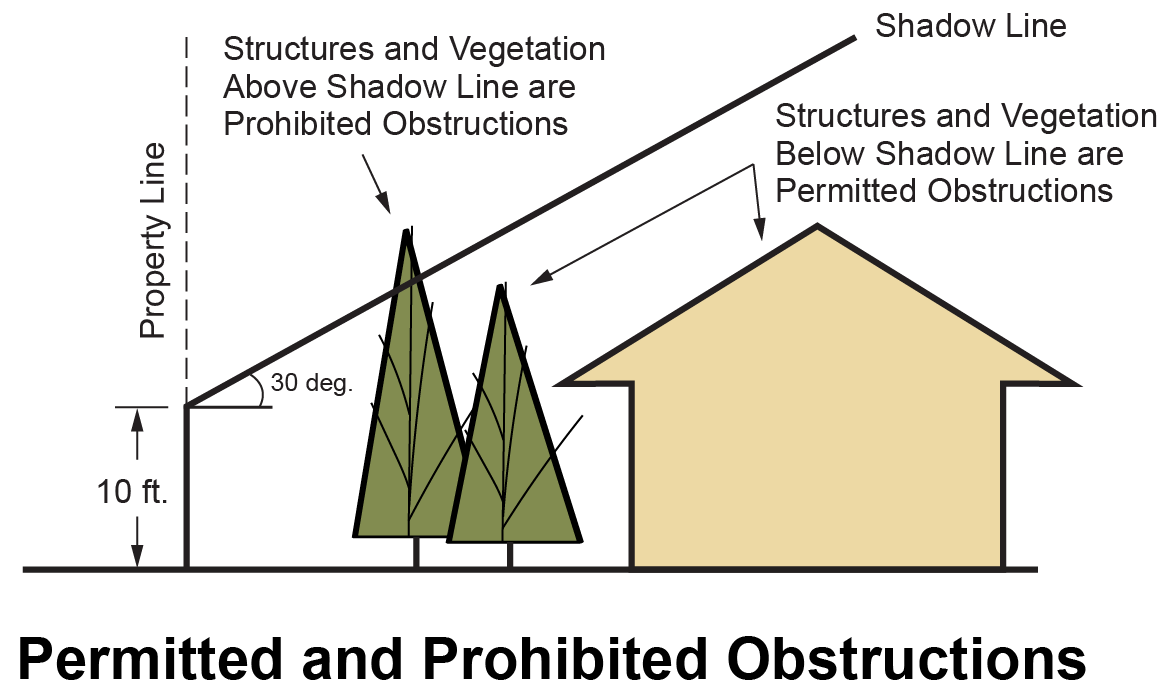
The shadow line is calculated by drawing a line thirty (30) degrees above horizontal from the top of the ten-foot tall hypothetical wall. Any structure or vegetation (at maturity) that will be located wholly below the line is a permitted obstruction and is not affected by a solar access permit, while any structure or vegetation (at maturity) that will have any portion protruding above the line is prohibited by a solar access permit.
Exempt obstruction. Any blockage of solar energy by a narrow protrusion, vegetation, or other object that never obstructs more than five percent of a solar collector surface, or blockage by any structure or vegetation that was constructed, planted or permitted prior to the date of solar access permit approval is exempt and is not restricted by a solar access permit.
(f)
Record of permit. The applicant shall record with the Lenawee County Register of Deeds a copy of the solar access permit listing the property on which the solar energy system will be located and any properties restricted by the solar access permit. The City shall note the location of any solar collector that is the subject of a permit and any restricted properties on a map showing all solar collectors and restricted properties that are affected by a solar access permit.
(g)
Termination of permit. Any rights protected by a permit under this section shall terminate if:
(1)
The solar collector is removed or is not used for six (6) consecutive months or is not installed and functioning within six (6) months of the date of permit approval.
(2)
The holder of the solar access permit submits written notice to the City that the permit holder has waived all or part of any right protected by the permit. A copy of the notice shall be filed with the county register of deeds.
(h)
Transfer of rights. The transfer of title to any property shall not change the rights and duties provided by a permit granted under this section.
(Ord. No. O-06-25, § 1(Exh. A), 8-4-2025)
Sec. 98-219. - Airborne emissions.
It shall be unlawful for any person, firm, or corporation to permit the emission of any smoke or air contaminant in violation of applicable air quality standards adopted by the Federal Clean Air Act and the Michigan Department of Environment, Great Lakes, and Energy.
(Ord. No. O-06-25, § 1(Exh. A), 8-4-2025)
Sec. 98-220. - Odors.
Any condition or operation which results in the creation of odors of such intensity and character as to be detrimental to the health and welfare of the public or which interferes unreasonably with the comfort of the public shall be removed, stopped, or so modified as to remove the odor. Such odors shall be prohibited when perceptible at any point along the property line.
(Ord. No. O-06-25, § 1(Exh. A), 8-4-2025)
Sec. 98-221. - Gases.
The escape or emission of any gas which is injurious or destructive, harmful to person or property, or explosive is prohibited.
(Ord. No. O-06-25, § 1(Exh. A), 8-4-2025)
Sec. 98-222. - Noise and vibration.
(a)
Noise. Noise which is objectionable due to intensity, frequency, or duration shall be muffled, attenuated, or otherwise controlled, subject to the following:
(1)
Objectionable sounds of an intermittent nature, or sounds characterized by high frequencies shall be controlled so as not to become a nuisance to adjacent uses.
(2)
Sirens and related apparatus used solely for public purposes are exempt from this requirement. Noise resulting from temporary construction activity shall also be exempt from this requirement.
(3)
The emission of measurable noises from the premises shall not exceed sixty-five decibels (65 dB) as measured at the boundary or property lines, except that where normal street traffic noises exceed sixty-five decibels (65 dB) during such periods, the measurable noise emanating from the premises may equal, but shall not exceed, such traffic noises. Within the I-C and I-1 districts sound levels not exceeding seventy-five decibels (75 dB) may be permitted.
(4)
In addition, objectionable sounds of an intermittent nature or sounds characterized by high frequencies, even if falling below the decibel limits, shall be so controlled so as not to become a nuisance to adjacent uses. This shall particularly apply to loading and unloading areas in commercial or industrial districts adjacent to residential districts.
(5)
Construction activity creating noise exceeding fifty-five decibels (55 dB) as measured at the boundary or property lines is allowed only during the hours of 7:00 a.m. to dusk unless otherwise approved by the City.
(b)
Vibration. No use shall generate any ground transmitted vibration in excess of the limits set forth below. Vibration shall be measured at the nearest adjacent lot line. The vibration maximums set forth below are stated in terms of particle velocity, which may be measured with suitable instrumentation or computed on the basis of displacement and frequency. When computed, the following standards shall apply:
(1)
If requested by the enforcement official the petitioner shall provide evidence of compliance with the above noted vibration calculations.
(2)
Vibrations resulting from temporary construction activity shall be exempt from the requirements of this section.
(Ord. No. O-06-25, § 1(Exh. A), 8-4-2025)
Sec. 98-223. - Electrical disturbance, electromagnetic, or radio frequency interference.
No use shall create any electrical disturbance that adversely affects any operations of equipment other than those of the creator of such disturbance, or cause, create or contribute to the interference with electronic signals (including television and radio broadcasting transmission) to the extent that the operation of any equipment not owned by the creator of such disturbance is adversely affected.
(Ord. No. O-06-25, § 1(Exh. A), 8-4-2025)
Sec. 98-224. - Hazardous substances.
(a)
Any person, firm, corporation, or other legal entity operating a business of conducting an activity with uses, stores, or generates hazardous substances shall obtain the necessary permits and/or licenses from the appropriate federal, state or local authority having jurisdiction. The City shall be informed of any and all inspections conducted by a federal, state of local authority in connection with a permit and/or license.
(b)
Any person, firm, corporation or other legal entity operating a business or conducting an activity which uses, stores, or generates hazardous substances shall complete and file a hazardous materials survey on a form supplied by the City in conjunction with the following:
(1)
Upon submission of a site plan.
(2)
Upon any change of use or occupancy of a structure or premises.
(3)
Upon any change of the manner in which such substances are used, handled, stored, and/or in the event of a change in the type of substances to be used, handled or stored.
(Ord. No. O-06-25, § 1(Exh. A), 8-4-2025)
Sec. 98-225. - Glare and radioactive materials.
(a)
Glare from any process, such as or similar to arc welding or acetylene torch cutting, which emits harmful ultraviolet rays shall be performed in such a manner as not to be seen from any point beyond the property line, and as not to create a public nuisance or hazard along lot lines.
(b)
Radioactive materials and wastes, including electromagnetic radiation such as X-ray machine operation, shall not be emitted to exceed quantities established as safe by the U.S. Bureau of Standards, when measured at the property line.
(c)
Glare from automobile headlights or commercial or industrial vehicle headlights shall not be directed into any adjacent property so as to become a nuisance.
(Ord. No. O-06-25, § 1(Exh. A), 8-4-2025)
Sec. 98-226. - Fire and explosive hazards.
The storage and handling of flammable liquids, liquified petroleum gases and explosives shall comply with the state rules and regulations as established by Public Act No. 207 of 1941 (MCL 29.1 et seq.).
(Ord. No. O-06-25, § 1(Exh. A), 8-4-2025)
Sec. 98-227. - Waste and rubbish dumping.
No garbage, sewage, filth, refuse, waste, trash, debris or rubbish, including cans, bottles, wastepaper, cartons, boxes and crates, or other offensive or obnoxious matter shall be kept in open containers or piled, placed, stored or dumped on any land within the City in such a manner as to constitute a nuisance or create a hazard to health, safety, morals and general welfare of the citizens of the City.
(Ord. No. O-06-25, § 1(Exh. A), 8-4-2025)
Sec. 98-228. - Building mechanical equipment.
For all uses, except residential uses, heating, ventilation and air conditioning mechanical equipment located on the exterior of the building shall be screened from adjacent public or private streets and adjacent properties. If the equipment is mounted on the building, it shall be screened in a manner that is architecturally compatible with the building design. If the equipment is ground-mounted, it shall be screened in a similar manner and/or with evergreen plant materials. The method of screening shall be approved by the planning commission or official approving the site plan. Other types of mechanical equipment located on the exterior of the building, such as dust collectors, hoppers, stacks, etc., that cannot practicably be screened, shall be designed, located and/or painted to minimize the adverse visual impact.
(Ord. No. O-06-25, § 1(Exh. A), 8-4-2025)

