
Tecumseh City Zoning Code
ARTICLE VI
DOWNTOWN DISTRICT
Sec. 98-156. - Intent.
The intent of the D-1, D-2, and D-3 district (Downtown District) is to create clear and simple regulations on the design of new development or redevelopment in the traditional downtown district of the City. The regulations of this article require development to have a physical form that complements the historic nature of existing development in the downtown area. Specifically, these regulations encourage a pedestrian friendly and walkable character, permit a mixture of land uses; encourage streets that serve the needs of pedestrians, bicycles, and motorized vehicle traffic equitably; encourage places for informal social activity and recreation in the downtown area; and encourage building frontages that define the public space of streets. With proper physical form, a building can accommodate a wide range of uses without generating undue impact on neighboring properties or the downtown as a whole.
It is further the purpose of the Downtown District to:
(a)
Create a core downtown area that maintains the traditional physical form of a historic small City downtown.
(b)
Create a unique, historic, walkable mixed-use district including residential, retail, entertainment, office, and other compatible uses.
(c)
Promote the orderly development, redevelopment, and continued maintenance of Tecumseh's central business district.
(d)
Encourage shared parking areas throughout the downtown area rather than requiring each individual property owner to provide physical parking space on their property.
(e)
Create quantitative and qualitative building design guidelines that ensure new development is compatible with the historic character existent in downtown.
(f)
Ensure buildings create a solid street wall that helps to define streets as public spaces.
(g)
Ensure that permitted uses complement each other in terms of character and location, and to ensure that uses in the downtown district do not have an adverse impact on the overall economic and social vitality of the downtown area, street capacity, public utilities or services, or the overall image and function of the district.
(h)
Prevent automobile-oriented development from eroding or destroying the character of the downtown area.
(i)
Encourage harmonious residential infill and adaptive reuse of noteworthy buildings to provide a mix of housing types, unit sizes, and compatible uses within walking distance of Tecumseh's historic downtown area.
(j)
Encourage accessible housing options in the downtown area.
(Ord. No. O-06-25, § 1(Exh. A), 8-4-2025)
Sec. 98-157. - Instructions.
(a)
Application of requirements. The provisions of this article are activated by "shall" or "must" when required, "should" or "encouraged" when recommended, and "may" when optional.
(b)
Conflict. Wherever there is or appears to be a conflict between the regulations of this article and other sections of this chapter (as applied to a particular development), the requirements specifically set forth in this article shall prevail. For development standards not addressed in this article, the other applicable sections of this chapter shall be used as the requirement.
(Ord. No. O-06-25, § 1(Exh. A), 8-4-2025)
Sec. 98-158. - Approval process.
(a)
Site plan approval. Site plan approval shall be required in accordance with the requirements of Article II, Division 3 of this chapter, and shall follow the procedures established therein.
(b)
Special land use approval. Any development that contains a use requiring special land use approval shall be reviewed following the procedures and review criteria of Article III, Division 4.
(Ord. No. O-06-25, § 1(Exh. A), 8-4-2025)
Sec. 98-159. - Existing development in the Downtown district.
(a)
Expansions of developed sites.
(1)
Less than twenty-five percent (25%) of existing condition. Any development activity on a developed site that would increase the floor area of the existing building or the area of existing site improvements by less than twenty-five percent (25%) need not comply with the requirements of this article VI. However, any new building area or site improvements should result in the site being more compliant and shall not result in the site being less compliant with the requirement of this article VI.
(2)
More than twenty-five percent (25%) of existing condition. Whenever a building or site improvement expansion of greater than twenty-five percent (25%) of the existing condition is proposed, the activity shall comply with the requirements of this article.
(3)
Expansions measured cumulatively. For the purposes of determining compliance with this section, expansions shall be measured cumulatively, with the baseline being the building area and improved site area that existed at the date of adoption of this chapter.
(4)
Redevelopment. Redevelopment of existing buildings shall comply with the following requirements, in addition to the requirements of subsection 98-159(a), above:
a.
Whenever fifty percent (50%) or less of the existing building will be demolished or replaced, the development activity need not comply with the requirements of this article. However, any site layout or building design changes that may occur as a result of the development activity should result in the site being more compliant with the requirements of this article.
b.
Whenever more than fifty percent (50%) of an existing building will be demolished or replaced, the development activity shall comply with all of the requirements of this article.
(Ord. No. O-06-25, § 1(Exh. A), 8-4-2025)
Sec. 98-160. - Waiver of requirements.
(a)
Purpose and limitations.
(1)
The reviewing authority for an activity in the downtown districts may grant a waiver from certain dimensional requirements contained in this article. Regulations that may be altered through the waiver process are described in the various sections of this article, along with the specific parameters by which the regulation may be altered.
(2)
Waivers are separate and distinct from dimensional variances in that they are limited in their bounds and are intended to permit reasonable use of property where the strict application of the requirements of this article would not further the public purpose, and a relaxed or altered dimensional standard will still meet the intent and purpose of the downtown districts.
(3)
Whenever a regulation may be altered through the waiver process, specific bounds are listed within which the waiver must be maintained. If an alteration to a dimensional requirement is requested that is greater than that listed in this article, the applicant must obtain a variance following the procedures and review standards in Sec. 98-44.
(b)
Applicability. Where a standard may be waived, it shall be indicated in the related section and include the parameters in which the standard may be altered.
(c)
Application and review procedures. The applicant shall clearly identify all requested waivers on the application and site plan. The reviewing authority shall evaluate the requested waivers and approve, approve with conditions, or deny the waiver request. In evaluating a waiver request, the reviewing authority shall take into account the following considerations:
(1)
Approval of the waiver will not result in development that is incompatible with or will negatively impact existing or potential future development in the vicinity of the property to be developed.
(2)
The requested waiver is consistent with the intent and purpose of this article.
(3)
The waiver will result in a superior development when compared with what could be achieved through the strict application of the requirements of this article.
(4)
A lesser waiver will not accomplish the same purpose as the requested waiver.
(5)
The waiver will not negatively impact the potential of adjacent parcels to develop according to the requirements of this article.
(Ord. No. O-06-25, § 1(Exh. A), 8-4-2025)
Sec. 98-161. - Definitions used in this article.
This division provides definitions for terms that are used in this article that are technical in nature or that might not otherwise reflect a common usage of the term. Where a definition in this section conflicts with a definition provided in Article XII, the definition presented in this section shall prevail for the purposes of administering the downtown district requirements. If a term is not defined in this section, the planning and development director shall determine the correct definition of the term.
(a)
Balcony: An open portion of an upper floor that extends beyond or indents into a building's exterior wall.
(b)
Block: The aggregate of private lots, pedestrian pass-throughs, rear lanes and alleys, the perimeter of which abuts perimeter or internal streets.
(c)
Block perimeter: The linear distance around a block measured along the right-of-way line or road easement.
(d)
Buffer: An area of land, including landscaping, walls, and fences located between land uses of different characters and which is intended to mitigate negative impacts of the more intense land use on the less intense land use.
(e)
Build-to area: An area at the front of the lot in which a front building facade must be located.
(f)
Floorplate: The total indoor floor area of any given story of a building, measured to the exterior of the wall or balcony.
(g)
Frontage lot line: The lot line that coincides with the public right-of-way or edge of a space dedicated for public use. Building facades parallel to frontage lines define public space and are therefore subject to a higher level of regulation than the elevations that face other lot lines.
(h)
Habitable space: Building space that involves human presence with direct view of the affronting streets or public or private open space. Habitable space does not include parking garages, storage facilities, warehouses, and display windows separated from retail activity.
(i)
Liner shop or Liner building: A building or part of a building with habitable space specifically designed to front a public space while masking a function without the capacity to monitor public space such as a parking garage, storage facility, or large building exceeding the building width limitations of this article.
(j)
Private frontage: The private frontage is the area between the right-of-way and the principal building façade.
(k)
Tree lawn: A grassed or landscaped area located between the sidewalk and the curb of the street intended to accommodate street tree plantings.
(Ord. No. O-06-25, § 1(Exh. A), 8-4-2025)
Sec. 98-162. - D-1 Downtown Core.
| Permitted Building Private Frontages | ||
| Frontage Type | Illustrations | Dimensional Requirements |
| Shopfront. A frontage where the building facade is located close to the front lot line with the building entrance at sidewalk grade. This frontage type is suitable for nonresidential uses on the first floor | 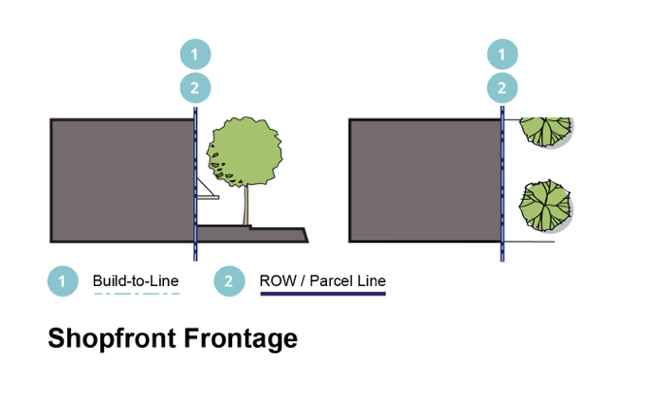 | The building shall be set back a maximum of five (5) feet from the front lot line. |
| Courtyard. A frontage where a portion of the building facade is close to the front lot line with a portion set back. The courtyard may accommodate tree plantings or a vehicle drop-off area. This frontage is suitable for any building use. | 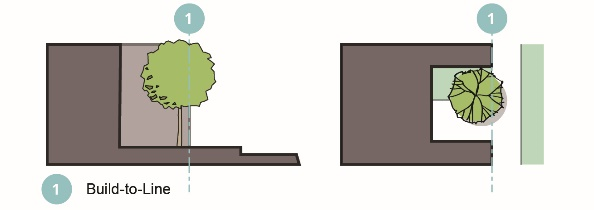 |
• The building shall be set back a maximum of five (5) feet from the front lot line.
• The courtyard area shall be considered part of the front building facade for the purposes of determining compliance with the requirements of section 98-162. |
| Residential Building Types | ||
| See Article VI, Division 4, residential building types | ||
| Design Standards | ||
| See Article VI, Division 5, dimension and design standards | ||
| General Standards | ||
| See Article VI, Division 6, general requirements | ||
(Ord. No. O-06-25, § 1(Exh. A), 8-4-2025)
Sec. 98-163. - D-2 Downtown Edge.
| Permitted Building Private Frontages | ||
| Frontage Type | Illustrations | Dimensional Requirements |
| Shopfront. A frontage where the building facade is located close to the front lot line with the building entrance at sidewalk grade. This frontage type is suitable for nonresidential uses on the first floor | 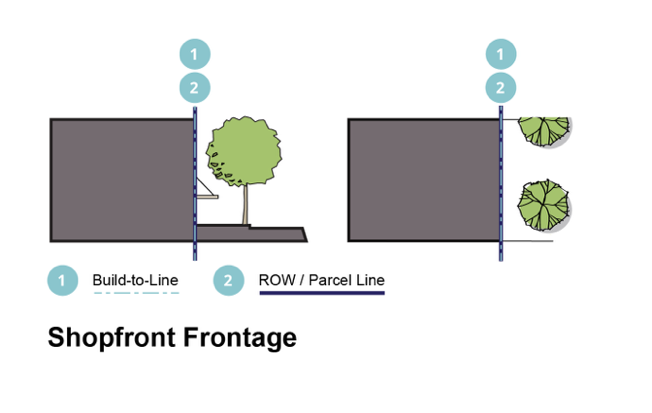 | • The building shall be set back a maximum of five (5) feet from the front lot line. |
| Courtyard. A frontage where a portion of the building facade is close to the front lot line with a portion set back. The courtyard may accommodate tree plantings or a vehicle drop-off area. This frontage is suitable for any building use. | 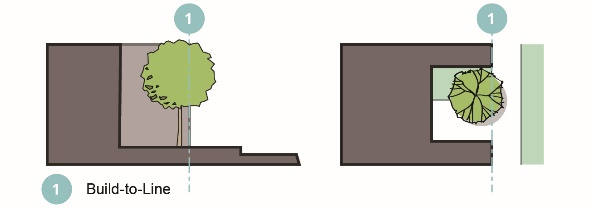 |
• The building shall be set back a maximum of five (5) feet from the front lot line.
• The courtyard area shall be considered part of the front building facade for the purposes of determining compliance with the requirements of Sec. 98-163. |
| Stoop. A frontage where the first floor is elevated from the sidewalk to provide privacy for first floor windows. The entrance is usually from an exterior stair and landing. This frontage is suitable for ground-floor residential use. | 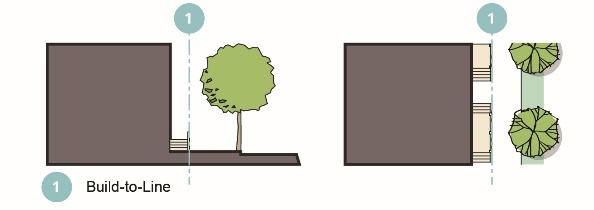 |
• The building shall be set back a minimum of seven (7) feet from the front lot line.
• The stoop or porch area shall be set back a minimum of two (2) feet from the front lot line. |
| Lawn. A frontage where the building is set back from the street with a landscaped front yard area. This frontage is suitable for any building use. | 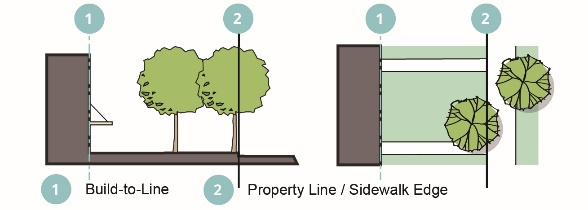 |
• The building shall be set back a minimum of ten (10) feet from the front lot line.
• Unenclosed front porches shall be set back a minimum of five (5) feet from the front lot line. |
| Residential Building Types | ||
| See Article VI, Division 4, residential building types | ||
| Design Standards | ||
| See Article VI, Division 5, dimension and design standards | ||
| General Standards | ||
| See Article VI, Division 6, general requirements | ||
(Ord. No. O-06-25, § 1(Exh. A), 8-4-2025)
Sec. 98-164. - D-3 Downtown Residential.
| Permitted Building Private Frontages | ||
| Frontage Type | Illustrations | Dimensional Requirements |
| Shopfront. A frontage where the building facade is located close to the front lot line with the building entrance at sidewalk grade. This frontage type is suitable for nonresidential uses on the first floor | 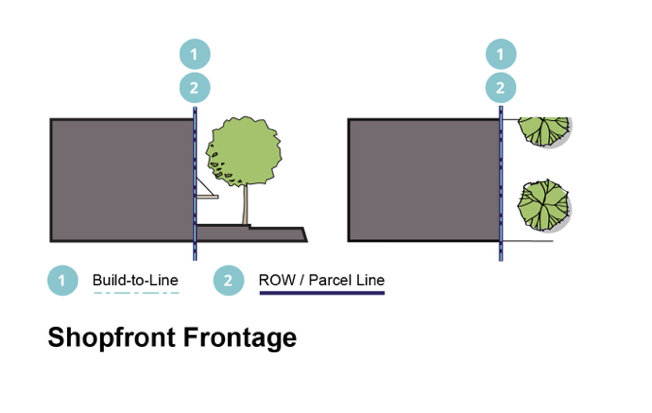 | The building shall be set back a maximum of five (5) feet from the front lot line. |
| Courtyard. A frontage where a portion of the building facade is close to the front lot line with a portion set back. The courtyard may accommodate tree plantings or a vehicle drop-off area. This frontage is suitable for any building use. | 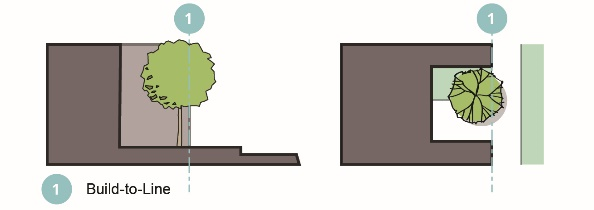 |
• The building shall be set back a maximum of five (5) feet from the front lot line.
• The courtyard area shall be considered part of the front building facade for the purposes of determining compliance with the requirements of Sec. 98-164. |
| Stoop. A frontage where the first floor is elevated from the sidewalk to provide privacy for first floor windows. The entrance is usually from an exterior stair and landing. This frontage is suitable for ground-floor residential use. | 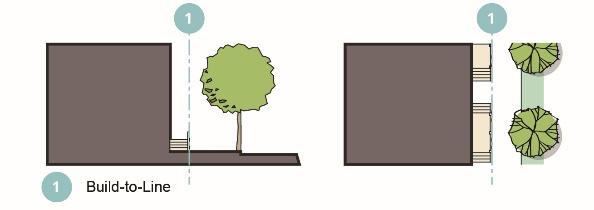 |
• The building shall be set back a minimum of seven (7) feet from the front lot line.
• The stoop or porch area shall be set back a minimum of two (2) feet from the front lot line. |
| Lawn. A frontage where the building is set back from the street with a landscaped front yard area. This frontage is suitable for any building use. | 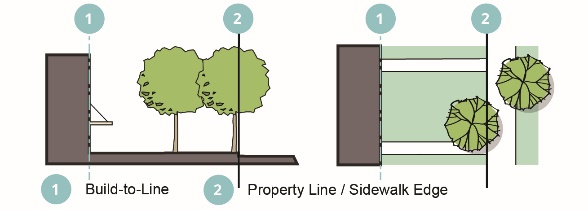 |
• The building shall be set back a minimum of ten (10) feet from the front lot line.
• Unenclosed front porches shall be set back a minimum of five (5) feet from the front lot line. |
| Residential Building Types | ||
| See Article VI, Division 4, residential building types | ||
| Design Standards | ||
| See Article VI, Division 5, dimension and design standards | ||
| General Standards | ||
| See Article VI, Division 6, general requirements | ||
(Ord. No. O-06-25, § 1(Exh. A), 8-4-2025)
Sec. 98-165. - Scope.
This division applies to all residential buildings in the downtown district (D-1, D-2, D-3), except single-family detached dwellings. All applicable buildings must adhere to the design standards of this division.
(Ord. No. O-06-25, § 1(Exh. A), 8-4-2025)
Sec. 98-166. - Carriage house/accessory dwelling unit.
(a)
Carriage houses/accessory dwelling units in the downtown district are required to conform to the following design guidelines:
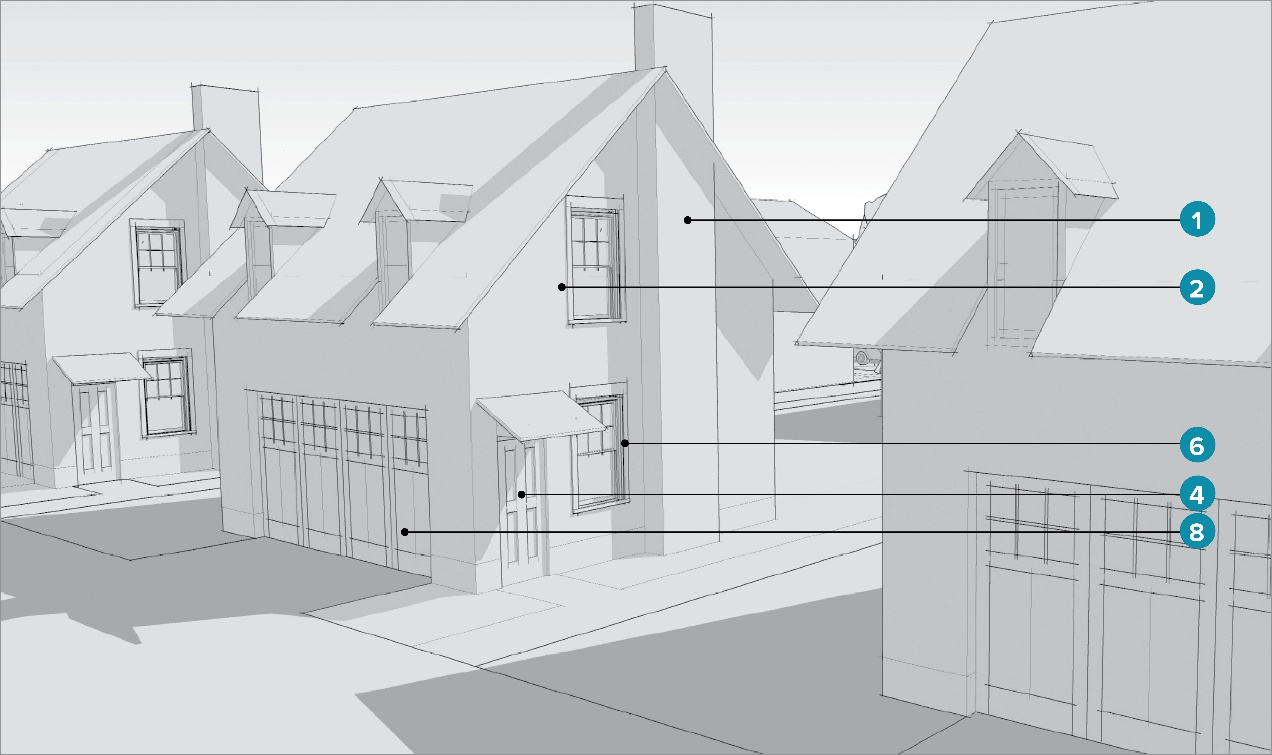 |
| Requirements |
| (1) Small, traditionally styled residential garage form containing one residential unit, indoor parking, or one residential unit above indoor parking. Ground floor finish floor 24"—36" above grade (if not above parking). |
| (2) Window and door openings shall be recessed (garage doors excepted). |
| (3) Window groupings encouraged, with groups of up to three (3) allowable. |
| (4) Residential entrance articulation and indoor stairway (stairway if more than one (1) story). |
| (5) Floor to floor heights limited to 10'-6". |
| (6) Window screens to be made of wood or, if non-masonry structure, windows to have 3½" ht. painted wood aprons added beneath sills to width of cased openings. |
| (7) Must be concealed behind a primary building type. Not to be located in view of frontage corresponding to street of primary building address. |
| (8) Garage door openings, garage doors, garage door window panes, and garage door panels must all be square or rectangular. |
(1)
Allowable materials.
(b)
Planning commission may waive the above requirements finding one (1) of the following standards have been met:
(1)
The architectural design of the proposed structure is consistent with the character of the surrounding area.
(2)
The architectural design otherwise meets the building design standards of the downtown district, Sec. 98-176.
(3)
The project is an adaptive reuse of an existing structure, and the architectural design brings the building more into compliance with the building design standards of the downtown.
(Ord. No. O-06-25, § 1(Exh. A), 8-4-2025)
Sec. 98-167. - Duplex/two-family dwelling unit and triplex/three-family dwelling.
(a)
Duplex/two-family and triplex/three-family dwelling units, both stacked and adjacent, in the downtown district are required to conform to the following design guidelines:
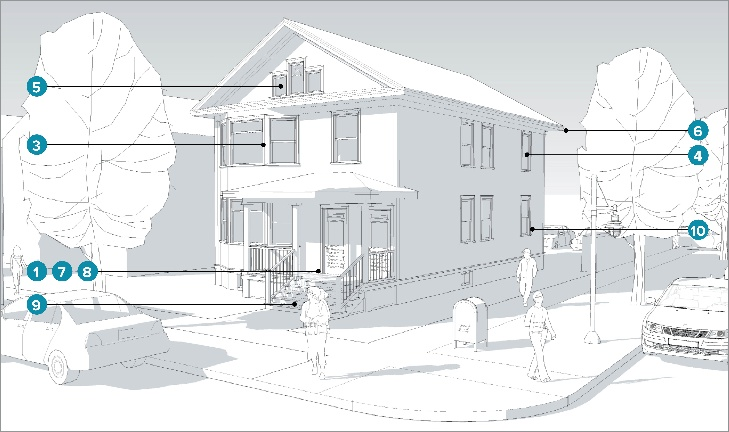 | 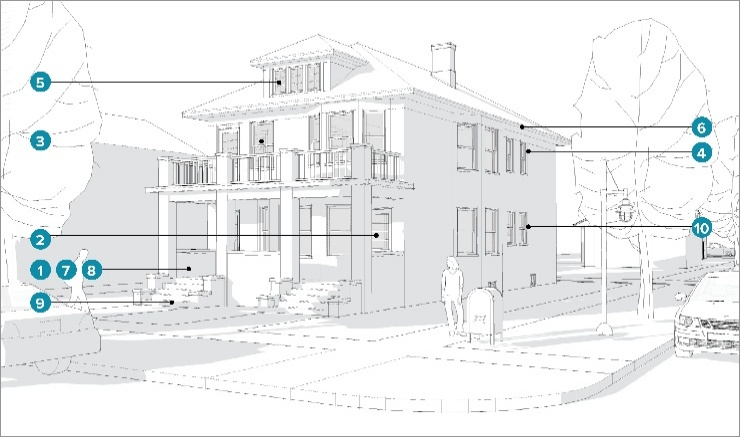 |
| Requirements | |
| (1) Traditionally styled single-family house form containing two residential units with two main entrances at the front, and alternate or service entrances along the sides and/or back. Finished floor located 24" to 30" above grade. | |
| (2) Residential units exist above one another within building enclosure. | |
| (3) Window and door openings shall be recessed. | |
| (4) Pattern of solids and voids generated by the vertical and horizontal alignment of windows and doors in variously repeating sizes. | |
| (5) Window groupings encouraged, with groups of up to three (3) allowable. | |
| (6) Building overhangs commensurate with style of architecture. | |
| (7) Ground floor 24" to 30" above grade. | |
| (8) Min. 6'-6" deep front porch maximum 30" above grade with optional decorative rail 28"—36" above porch floor. | |
| (9) Main entrance articulation (entrances may have separate doors or share a vestibule). | |
| (10) Window screens to be made of wood or, if non-masonry structure, windows to have 3½" ht. painted wood aprons added beneath sills to width of cased openings. | |
| (11) Floor to floor heights limited to 10'-6". | |
(1)
Allowable Materials.
(b)
Planning commission may waive the above requirements finding one of the following standards have been met:
(1)
The architectural design of the proposed structure is consistent with the character of the surrounding area.
(2)
The architectural design otherwise meets the building design standards of the downtown district, Sec. 98-176.
(3)
The project is an adaptive reuse of an existing structure, and the architectural design brings the building more into compliance with the building design standards of the downtown district.
(Ord. No. O-06-25, § 1(Exh. A), 8-4-2025)
Sec. 98-168. - Fourplex/four-family dwelling unit.
(a)
Fourplexes/four-family dwellings in the downtown district are required to conform to the following design guidelines:
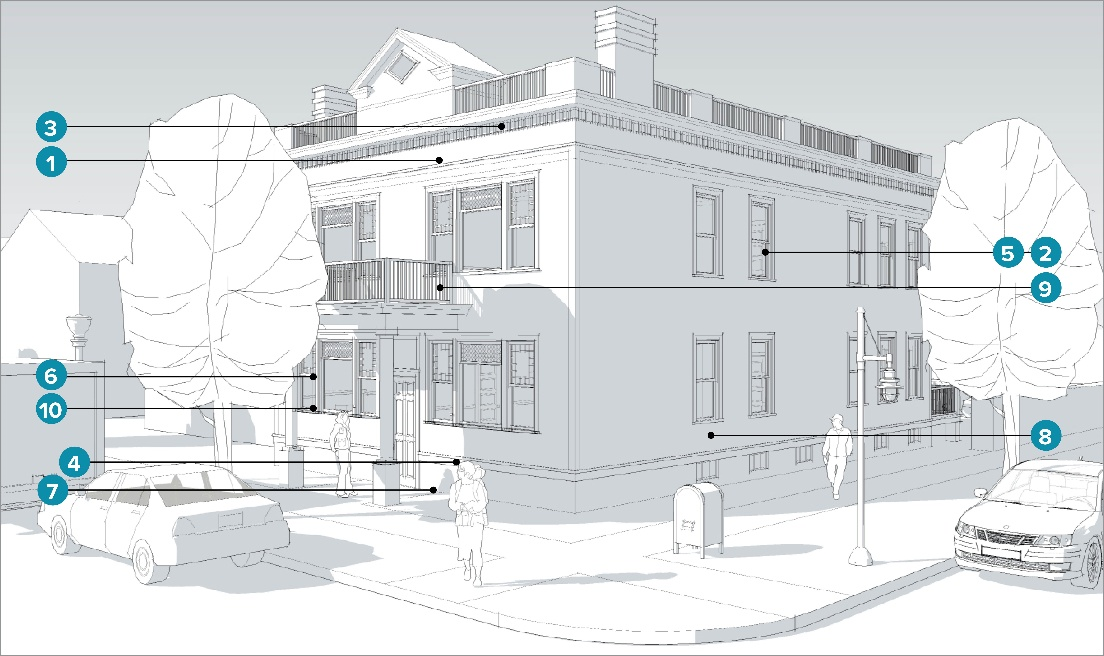 |
| Requirements |
| (1) Traditional building façade treatments (including masonry reliefs and/ or motifs) and main entrances located along street of building address. |
| (2) Window and door openings shall be recessed. |
| (3) Building cornice must have the most prominent shadow line. |
| (4) Minimum one (1) additional horizontal molding or accent material projection dividing the building into layers or creating water table expression on ground floor level. |
| (5) Pattern of solids and voids generated by the vertical and horizontal alignment of windows and doors in repeating sizes. |
| (6) Window groupings encouraged, with groups of up to three (3) allowable. |
| (7) Main entrances at grade for accessibility, working in conjunction with interior lobby or vestibule and lift or ramp servicing first floor units. |
| (8) Ground-floor units finish floor-elevation 36" to 42" above grade. |
| (9) Main entrance articulation. |
| (10) Prominent sills and/or heads required for Windows located along facades. |
| (11) No building entrances from side parking lots allowable. Otherwise, sides and backs of buildings not regulated by this code, except at corners (as shown here). |
| (12) Building façade treatments optional along intersecting streets. |
| (13) Floor to floor heights limited to 10'-6". |
(1)
Allowable Materials.
(b)
Planning commission may waive the above requirements finding one (1) of the following standards have been met:
(1)
The architectural design of the proposed structure is consistent with the character of the surrounding area.
(2)
The architectural design otherwise meets the building design standards of the downtown district, Sec. 98-176.
(3)
The project is an adaptive reuse of an existing structure, and the architectural design brings the building more into compliance with the building design standards of the downtown district.
(Ord. No. O-06-25, § 1(Exh. A), 8-4-2025)
Sec. 98-169. - Townhouse/Rowhouse.
(a)
Townhouses/rowhomes in the downtown district are required to conform to the following design guidelines:
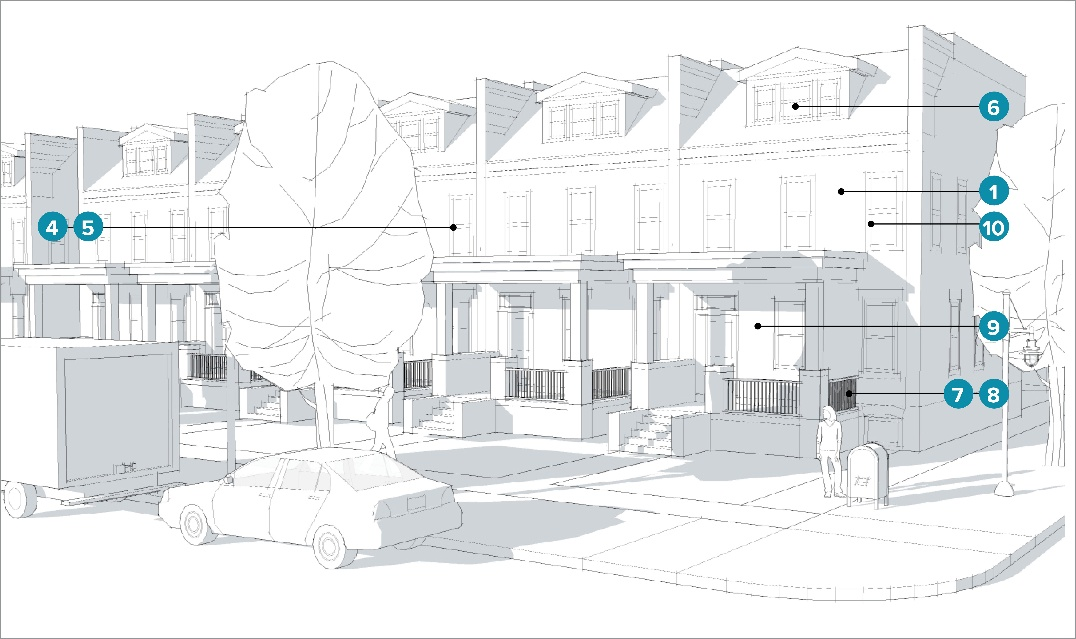 |
| Requirements |
| (1) Residential units existing side-by side within building enclosure with each unit extending from foundation to roof. |
| (2) Parking at rear or within building at ground floor with parking entrance at rear of building. |
| (3) Side parking lots prohibited. |
| (4) Window and door openings shall be recessed. |
| (5) Pattern of solids and voids generated by the vertical and horizontal alignment of windows and doors in variously repeating sizes. |
| (6) Window groupings encouraged, with groups of up to three (3) allowable. |
| (7) Ground floor (finished floor) 24" to 30" above grade. |
| (8) Min. 6'-6" deep required front porch maximum 30" above grade with decorative rail 28"—36" above porch floor (porches may be individual or shared and continuous across front of building). |
| (9) Individual main entrance articulation. Porch may be shared (entrances may have separate doors or share a vestibule). |
| (10) Window screens to be made of wood or, if non-masonry structure, Windows to have 3½" ht. painted wood aprons added beneath sills to width of cased openings. |
| (11) Floor to floor heights limited to 10'-6". |
(1)
Allowable Materials.
(b)
Planning commission may waive the above requirements finding one of the following standards have been met:
(1)
The architectural design of the proposed structure is consistent with the character of the surrounding area.
(2)
The architectural design otherwise meets the building design standards of the downtown district, Sec. 98-176.
(3)
The project is an adaptive reuse of an existing structure, and the architectural design brings the building more into compliance with the building design standards of the downtown district.
(Ord. No. O-06-25, § 1(Exh. A), 8-4-2025)
Sec. 98-170. - Apartments.
(a)
Apartments in the downtown district are required to conform to the following design guidelines:
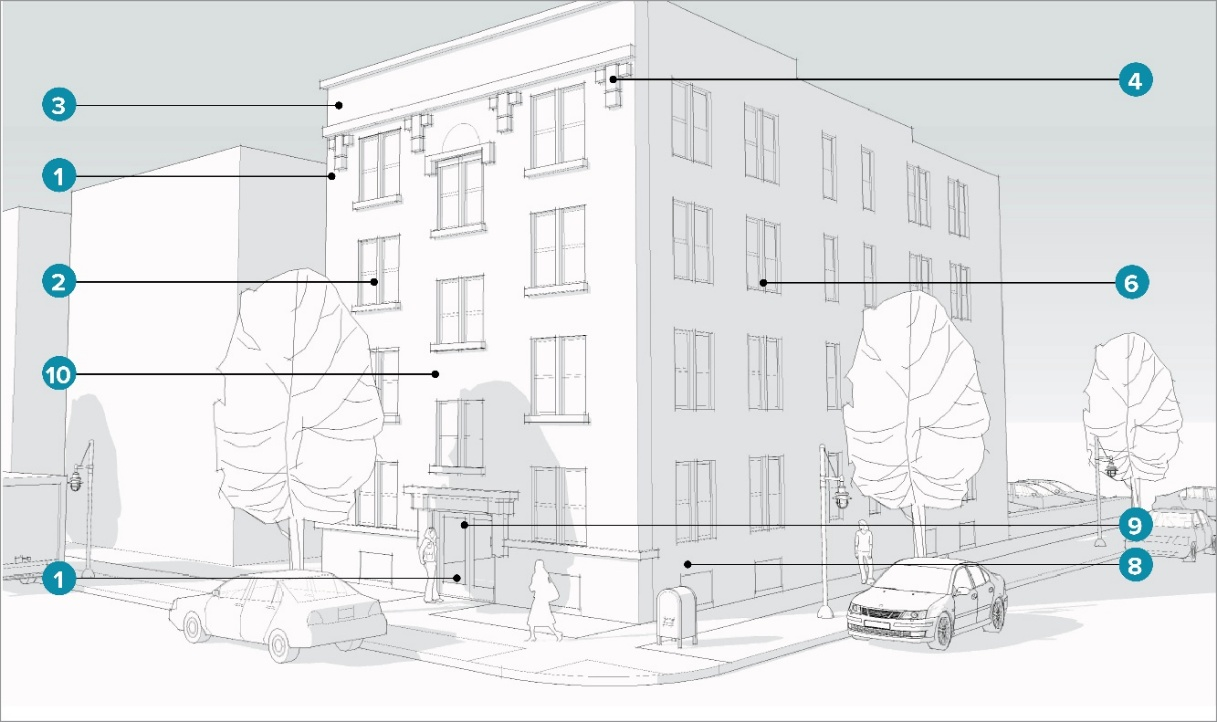 |
| Requirements |
| (1) Traditional building façade treatments (including masonry reliefs and/or motifs) and main entrances located along street of building address. |
| (2) Window and door openings shall be recessed. |
| (3) Building cornice (at top of building) of substantial height and decoration.* |
| (4) Minimum one (1) horizontal molding or accent material projection dividing the façade into layers.* |
| (5) Pattern of solids and voids generated by the vertical and horizontal alignment of windows and doors in repeating sizes. |
| (6) Window groupings encouraged, with groups of up to three (3) allowable. |
| (7) Main entrances at grade for accessibility, working in conjunction with interior lobby or vestibule and elevator(s). |
| (8) Ground Floor Units (finished floor) 36" to 42" above grade. |
| (9) Main entrance articulation. |
| (10) Prominent sills and/or heads required for Windows located along facades (discouraged along other exterior walls). |
| (11) No building entrances from side parking lots allowable. Otherwise, sides and backs of buildings not regulated by this code, except at corners (as shown here). |
| (12) Building façade treatments optional along intersecting streets. |
| (13) Towers, sculptures, and other characteristic forms and/or focal points encouraged (not illustrated). |
| (14) Floor to floor heights limited to 10'-6". |
| * Feature excepted on Art Deco style buildings. |
(1)
Allowable Materials.
(b)
Planning commission may waive the above requirements finding one (1) of the following standards have been met:
(1)
The architectural design of the proposed structure is consistent with the character of the surrounding area.
(2)
The architectural design otherwise meets the building design standards of the downtown district, Sec. 98-176.
(3)
The project is an adaptive reuse of an existing structure, and the architectural design brings the building more into compliance with the building design standards of the downtown district.
(Ord. No. O-06-25, § 1(Exh. A), 8-4-2025)
Sec. 98-171. - Live/work unit.
(a)
Live/work units in the downtown district are required to conform to the following design guidelines:
 |
| Requirements |
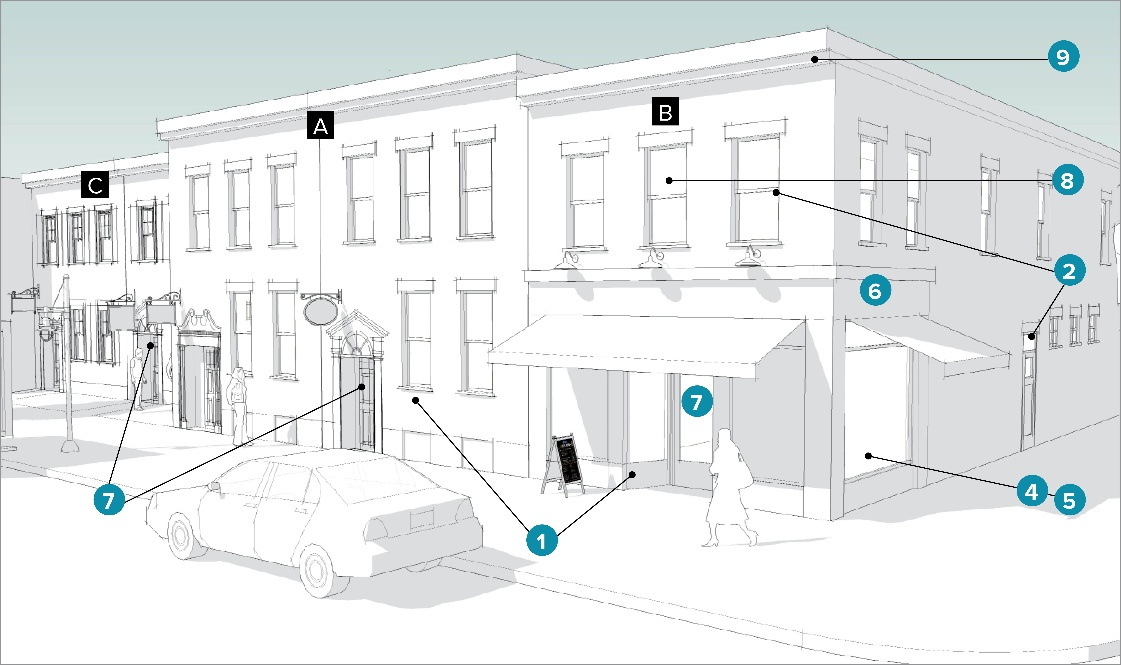
| (1) Ground floor elevated 30" to 42" above average grade at front of building with interior lift for accessibility (Type A). Main level may be accessible at grade with plate glass storefront (Type B) or if building is setback from right-of-way line minimum 7'-0" (Type C). |
| (2) Traditional building façade treatments (as well as main business entrances) to be located along streets of corresponding building addresses and corresponding to right-of-way lines. Side entrances subordinate and allowable at right-of-way lines along intersecting streets only. Side entrances along parking lots prohibited. Rear entrances also subordinate. Storefront main entrance at corner may substitute for that listed above (see Mixed-Use Building). |
| (3) Main business entrance doors must remain unlocked during business hours. |
| (4) Open, plate-glass shopfronts (Type B) encouraged at ground-floor level along street of building address, with façade supported above by columns and beams and extending for a distance of 12' to 14' around building corners at intersecting streets. |
| (5) Plate glass material beginning 15" to 18" above finished grade (top of sidewalk) and extending to underside of beam, with alternate leaded or stained-glass transoms minimum 8'-0" above finish grade. |
| (6) Sign band and/or secondary cornice to be integral with any shopfronts and located above plate glass shopfronts or transoms (Type B). |
| (7) At-grade doorways to be recessed (see numerical parameters below). |
| (8) Window and door openings shall be recessed (except at shopfronts, which are to have plate glass column to column). |
| (9) Building cornice (at top of building) casting tallest horizontal shadow upon building façade. Must be the most prominent shadow line (aside from those cast individually by awnings above shopfronts). |
| (10) Phasing of site development to be coordinated with individual units (each 16' to 25' in width), any first unit developed front to back for a minimum distance of 25' before development of any adjacent unit is to begin. Adjacent and subsequent units to be developed front to back in a similar manner. Eight (8) units per building maximum. |
| (11) Pattern of solids and voids above ground floor, coordinated within structural bays, generated by the vertical and horizontal alignment of rectangular Windows and doors in repeating sizes. Full and segmented arches allowable atop rectangular Windows in these locations. |
| (12) Radii of arches on segmented-arch windows must equal widths of corresponding Windows. |
| (13) Arched building tops prohibited. |
| (14) Window groupings allowable above ground floor. |
| (15) Open-ended, canvas, sloped awnings above shopfront windows. (Type B). |
| (16) Decorative sills and/or headers required on upper-floor windows located along exterior walls. |
| (17) Sides and backs of buildings not regulated by this code, except at corners (as shown here). |
| (18) Building façade treatments optional along intersecting streets. |
| (19) Floor to floor heights limited to 15'. |
(b)
Allowable Materials.
(c)
Planning commission may waive the above requirements finding one (1) of the following standards have been met:
(1)
The architectural design of the proposed structure is consistent with the character of the surrounding area.
(2)
The architectural design otherwise meets the building design standards of the downtown district, Sec. 98-176.
(3)
The project is an adaptive reuse of an existing structure, and the architectural design brings the building more into compliance with the building design standards of the downtown district.
(Ord. No. O-06-25, § 1(Exh. A), 8-4-2025)
Sec. 98-172. - Mixed-Use Buildings.
(a)
Mixed use buildings in the downtown district are required to conform to the following design guidelines:
 |
| Requirements |
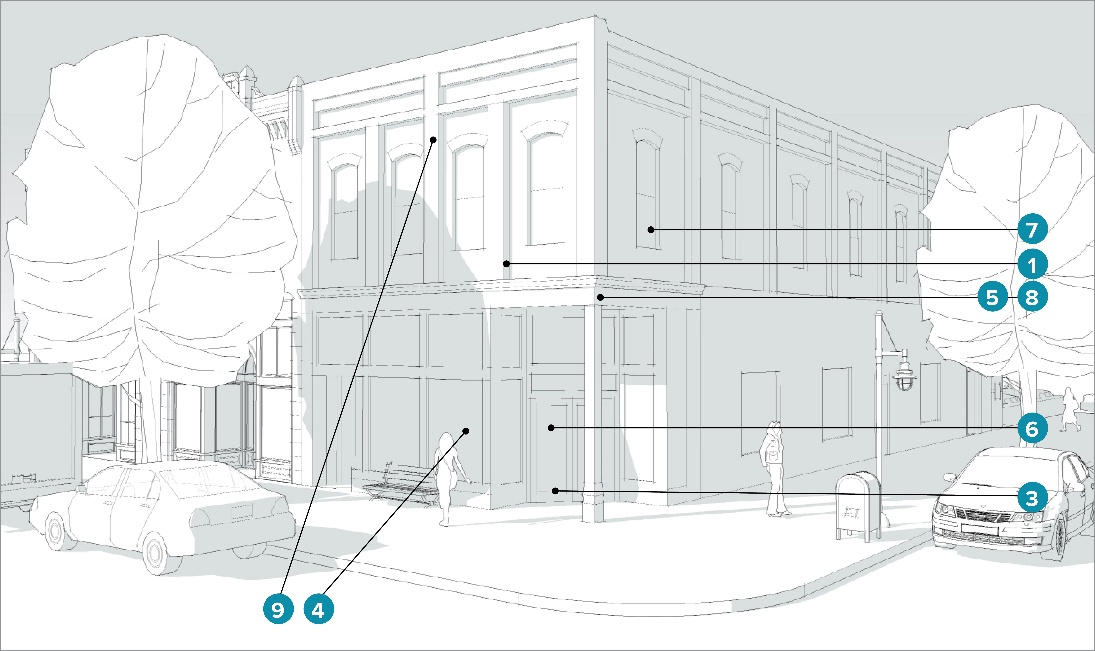
| (1) Traditional building façade treatments (including masonry reliefs and/or motifs), as well as main business entrances, to be located along streets of corresponding building addresses and at right-of-way lines. Side entrances subordinate and allowable at right-of-way lines along intersecting streets only. Side entrances along parking lots prohibited. Rear entrances also subordinate. Main entrance at corner may substitute for that listed above. |
| (2) Main entrance doors must remain unlocked during business hours. |
| (3) Main level accessible at grade. |
| (4) Open, plate-glass shopfronts (curtain walls), located at ground-floor level along street of building address, with façade supported above by columns and beams and extending for a distance of one structural bay around building corners at intersecting streets. Plate glass material beginning 15" to 18" above finish grade (top of sidewalk) and extending to underside of beam, with alternate leaded or stained-glass transoms minimum 8'-0" above finish grade. |
| (5) Sign band and/or secondary cornice integral with shopfronts and above plate glass and/or transoms. (Such cornice may be used to satisfy the one horizontal molding or accent material band projection requirement.) |
| (6) Recessed doorways located within shopfronts (see numerical parameters below). |
| (7) Window and door openings shall be recessed. |
| (8) Minimum one (1) additional horizontal molding or accent material band projection, casting a secondary horizontal shadow line, dividing the façade into layers. This feature is excepted on Art Deco-style buildings. |
| (9) Vertical façade projections (corresponding to structural columns) casting vertical shadows on façade and articulating regular structural bays, each 20' to 30' in width. |
| (10) Phasing of site development to be coordinated with structural bays, any first bay developed front to back for a minimum distance of 20' before development of any adjacent bay is to begin. Adjacent and subsequent bays to be developed front to back in a similar manner. |
| (11) Pattern of solids and voids above ground floor, coordinated within structural bays, generated by the vertical and horizontal alignment of rectangular windows and doors in repeating sizes. Full and segmented arches allowable atop rectangular Windows in these locations. |
| (12) Radii of arches on segmented-arch windows must equal widths of corresponding Windows. |
| (13) Arched building tops prohibited. |
| (14) Window groupings allowable above ground floor, corresponding to structural bays. |
| (15) Open-ended, canvas, sloped awnings above shopfront Windows. |
| (16) Decorative sills and/or headers required on upper-floor Windows located along façades. |
| (17) Sides and backs of buildings not regulated by this code, except at corners (as illustrated here). |
| (18) Building façade treatments optional along intersecting streets. |
| (19) Towers, sculptures, and other characteristic forms and/or focal points encouraged (not illustrated). |
| (20) Characteristic forms echoed or repeated within structural bays. |
| (21) Floor to floor heights limited to 15'. |
(b)
Allowable Materials.
(c)
Planning commission may waive the above requirements finding one (1) of the following standards have been met:
(1)
The architectural design of the proposed structure is consistent with the character of the surrounding area.
(2)
The architectural design otherwise meets the building design standards of the downtown district, Sec. 98-176.
(3)
The project is an adaptive reuse of an existing structure, and the architectural design brings the building more into compliance with the building design standards of the downtown district.
(Ord. No. O-06-25, § 1(Exh. A), 8-4-2025)
Sec. 98-173. - In general.
The following dimensional and design standards regulate the physical characteristics of development in the downtown district. The standards are broken into sections addressing a specific development characteristic: Blocks and streets, lot requirements, and building requirements.
(Ord. No. O-06-25, § 1(Exh. A), 8-4-2025)
Sec. 98-174. - Block and street design.
(a)
Blocks and street network. The street network in and proximate to the Downtown districts should be designed to foster a walkable, pedestrian scale environment. The existing street pattern is designed in such a manner. Existing blocks in the downtown district have a length between four hundred (400) and five hundred (500) feet, and block perimeters are about one thousand six hundred (1,600) feet.
The existing block pattern should be maintained in the Downtown districts in order to retain a pedestrian scale. If changes to the existing street network are proposed, the changes shall be designed according to the following requirements:
(1)
Block length. The maximum length for any block face between intersecting streets is six hundred (600) feet.
(2)
Block perimeter. The maximum block perimeter is two thousand (2,000) feet.
(b)
Street types. There are two basic street types in the Downtown districts: Major and minor streets. The specific dimensional requirements for a building will depend on the type of street upon which it has frontage or frontages.
(1)
Major streets carry higher volumes of traffic and are typically more prominent. In many cases, major streets form the axes along which downtown areas are located.
(2)
Minor streets intersect with major streets, contain more residential uses, and provide local access to adjacent residential neighborhoods.
(3)
The following table identifies which streets are considered major and minor streets in the Downtown districts. New streets shall be designated as a major or minor street by the reviewing authority for the proposed development:
(c)
Street design guidelines.
(1)
On-street parking. On-street parking in the Downtown districts is encouraged. All streets in the Downtown districts should include a parallel parking lane on both sides of the street.
(2)
Travel. Two-way streets are encouraged in the Downtown districts. One-way streets are discouraged and should not be used in the downtown area.
(3)
Curb radius. The curb radius at the intersection of two (2) streets should be the minimum necessary to permit vehicle circulation. A smaller curb radius shortens the distance that pedestrians must travel to cross the street and leads to a safer pedestrian environment by reducing the speed at which cars can travel around corners. It is recommended that the curb radius not exceed thirty (30) feet at the intersection of any two streets.
(4)
Sidewalks at driveway crossings. When a sidewalk crosses a vehicle driveway, the driveway shall retain the elevation of the sidewalk. The appearance of the sidewalk shall be maintained across the driveway to indicate that the sidewalk is a part of the pedestrian zone and that pedestrians have the right-of-way.
(5)
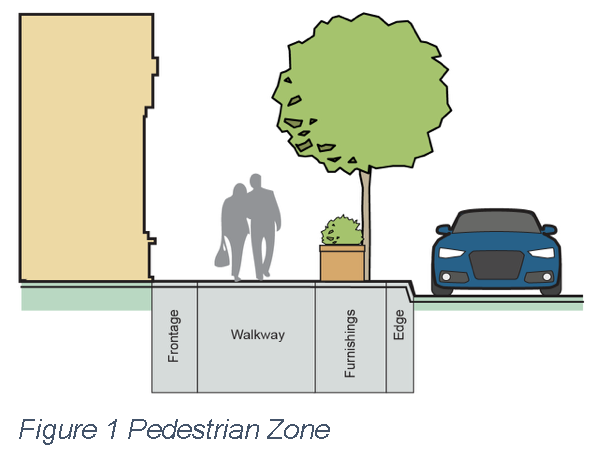
Pedestrian zone. The pedestrian zone is considered to be the area in between the curb and the edge of the right-of-way, and includes area for sidewalks, landscape plantings, street furniture, and other pedestrian-scale uses and amenities. The treatment of the pedestrian zone determines the character of the street, and the quality of the public realm within the right-of-way. Streets are the most common public space in the City and must be designed to be welcoming and accommodating for pedestrians as well as motorized traffic. The pedestrian zone in the Downtown districts should contain four (4) distinct areas, an edge area that allows car doors to open freely and accommodates parking meters, streetlights; a furnishings area that accommodates amenities such as landscaping, planters, and sidewalk furniture; a walkway area where pedestrians walk; and a frontage area adjacent to the building. Figure 1 illustrates the four (4) areas of the pedestrian zone.
The following sidewalk design requirements and recommendations are intended to create an inviting public space alongside City streets:
a.
Pedestrian zone width. The pedestrian zone should have a minimum width of ten (10) feet. A lesser width may be appropriate in constrained areas, and a larger width is appropriate along major streets.
b.
Edge area. The edge area should have a minimum width of two and one-half (2½) feet and should remain clear of obstructions to permit the doors of parked cars to open freely. Streetscape elements such as parking meters, streetlights, traffic control signs, and tree grates may be located in the edge area. The edge area may be paved, or if a tree lawn is combined, it may be combined with the furnishings area and landscaped.
c.
Furnishings area. The furnishings area accommodates amenities such as street trees, planters, and sidewalk furniture. The furnishings area can be paved (with street trees located in tree grates), or it may be landscaped with a street lawn. Outdoor eating areas, sidewalk cafes, or other similar uses associated with a use in a directly adjacent building may be located in the furnishings area. The furnishings area should have a minimum width of five (5) feet.
d.
Walkway area. The walkway area is the basic sidewalk area where pedestrians walk. The walkway area must maintain a five-foot wide clear path free of obstructions at all times to permit free pedestrian travel. No permanent structures or uses may be located in the walkway area.
e.
Frontage area. The frontage area is the portion of the pedestrian zone adjacent to the edge of the right-of-way. The frontage area is an optional area and may be used for street furniture or other uses accessory to the use in the adjacent building. When a building is constructed at the lot line, as is often the case along Chicago Boulevard, the frontage area should have a minimum width of two (2) feet to accommodate opening doors and window shopping.
f.
Alleys. Alleys and lanes that provide access to the rear of buildings or parking areas are permitted in the downtown district. The intersection between an alley and a street should be separated at least one hundred fifty (150) feet from any street intersection (measured from the point of intersection between the centerlines of the streets).
g.
Driveways. Driveways providing access to parcels or public areas such as parking lots may only intersect with minor streets in the D-1 district. A driveway may intersect with any street in the D-2 or D-3 districts.
(Ord. No. O-06-25, § 1(Exh. A), 8-4-2025)
Sec. 98-175. - Lot requirements.
(a)
Primary vs. secondary front yards. When a lot is located on a corner lot, the primary front yard setback shall be measured from the street of higher pedestrian importance or intensity (e.g., traffic volume, number of lanes, etc.). Any lot line that borders on a street shall be considered a front yard.
(1)
The applicant shall identify primary and secondary front yards on any site plan for approval by the reviewing authority. In reviewing an applicant's designation of primary and secondary front yards, the reviewing authority shall consider the following:
a.
Every lot shall have at least one (1) primary front yard.
b.
A lot may have more than one (1) primary or secondary front yard.
c.
A major street shall always be considered a primary front yard.
d.
Chicago Boulevard shall always be considered a primary front yard whenever a lot has sufficient developable frontage on Chicago Boulevard.
e.
The yard facing a minor street may be considered a primary or a secondary front yard.
(Ord. No. O-06-25, § 1(Exh. A), 8-4-2025)
Sec. 98-176. - Building design.
Buildings in the downtown district shall comply with the following requirements, in addition to any applicable requirements of Sec. 98-186. The requirements of this section and Sec. 98-186 are intended to be complimentary; however, in any instance where there is an apparent conflict, the provisions of this section shall control.
(a)
Base, middle, and cap. All buildings shall incorporate a base, middle, and cap, as is applicable.
(1)
Base. The base shall include an entryway with transparent windows and a horizontal molding or reveal placed between the first and second stories or over the second story. The molding or reveal shall have a depth of at least two inches and a height of at least four inches. If a one-story building is proposed, the molding or reveal is not required.
(2)
Middle. The middle may include buildings and/or balconies that are located between the reveal and the cap area.
(3)
Cap. The cap includes the area from the top floor to the roof of the building and shall include a cornice or roof overhang.
(b)
Alignment. Windowsills, moldings, and cornices shall align with those of adjacent buildings. The bottom and top line defining the edge of the windows (the "windowsill alignment") shall not vary more than two (2) feet from the alignment of surrounding buildings. If the adjoining buildings have windowsill alignments that vary by more than two (2) feet from one another, the proposed building shall align with one (1) of the adjoining buildings. This requirement may be waived per Sec. 98-160.
(c)
Building materials. Buildings in the downtown district shall comply with the following building material requirements:
(1)
Primary building materials. Durable natural building materials such as brick, stone, exposed logs or timber, and other similar materials are preferred primary building materials in the downtown district. Concrete block or similar masonry units (including CMU or split-face blocks) are prohibited as a primary building material unless covered with a veneer of natural building materials. Synthetic building materials that convincingly match the appearance of natural building materials may be used as a primary building material. Primary building materials shall be used on a minimum of seventy percent (70%) of the facade area of the building (excluding doors and windows).
(2)
Accent building materials. Accent materials may be used on up to thirty percent (30%) of the facade area of the building (excluding doors and windows). Acceptable accent materials include decorative precast concrete block, metal, and glass. Non-durable building materials such as EIFS may be used as accent building materials on up to ten percent (10%) of the total wall area of any facade but may not be used on the ground floor facade.
(3)
Waiver. This requirement may be waived per Sec. 98-160.
(d)
Ground floor design.
(1)
Building entrance(s). All buildings shall have their principal entrance or entrances open onto a street, sidewalk, or public space. The principal building entrance shall not open onto a parking lot, although a secondary or subordinate entrance may be provided to a parking lot.
(2)
Entryway alignment.
a.
Nonresidential uses. For all buildings in the D-1 district of the downtown district and buildings with nonresidential uses on the first floor in the D-2 and D-3 districts, the ground floor of the principal entrance shall align with the elevation of the adjacent sidewalk. Sunken terraces or stairways to a basement shall not constitute principal entrances to a building for the purposes of this section. It is not the intent of this section to preclude the use of below or above grade entryways, provided that such entryways are secondary, not principal entrances.
b.
Residential and live/work uses. For first-floor residential and live/work uses in the D-2 and D-3 districts of the downtown district, the ground floor of the building (and consequently the principal entrance as well) may be raised up to thirty-six (36) inches above the elevation of the adjacent sidewalk. This is intended to create greater privacy for first floor residential uses by elevating windows above the view of passing pedestrians.
(e)
Windows and entryways. The following requirements apply to facades of buildings facing a public street or public space such as a plaza or square:
(1)
Windows. Windows above the ground floor shall have a height to width ratio of at least 2:1.
(2)
Ground floor facade transparency.
a.
All buildings with first floor nonresidential uses shall maintain transparency for at least seventy percent (70%) of the first-floor facade area between two (2) and eight (8) feet above grade level. Doors and windows provide transparency.
b.
All windows shall use transparent, non-reflective glass.
c.
Areas of solid wall shall not exceed a length of twenty (20) feet.
(3)
Recessed entrances encouraged. Doors are encouraged to be recessed into the face of the building to create a sense of entry and to add variety to the streetscape.
(f)
Encroachments. The following building elements may encroach into a public right-of-way or setback area:
(1)
Balconies. Balconies on upper stories may encroach up to six feet into any required setback area and up to four (4) feet into any right-of-way area.
(2)
Stoops. Unenclosed and uncovered front stoops may encroach up to five (5) feet into a front yard setback area, provided that the stoop maintains a minimum setback of five (5) feet from any right-of-way line.
(3)
Awnings.
a.
Ground-story awnings may encroach up to six (6) feet from the face of the building into the setback or right-of-way area.
b.
Awnings shall have a minimum of eight feet of clear space between the sidewalk and the bottom of the awning or any support structure, and shall not exceed a height of twelve (12) feet to the highest point of the canopy.
c.
If the awning encroachment of six (6) feet would interfere with the placement of street lighting or street trees, the awning projection shall be reduced to resolve the conflict.
d.
Awnings shall be constructed out of fabric and may not be internally illuminated. Metal or other materials may be used for awnings if a waiver is approved per Sec. 98-160.
(4)
Bay windows. Bay windows on the ground story may encroach up to three (3) feet into any setback area but may not encroach into a right-of-way area. Bay windows on upper floors may encroach up to three (3) feet into any setback or right-of-way area.
(5)
Eaves. Roof eaves may encroach up to three (3) feet into any setback or right-of-way area.
(g)
Service areas. All service areas, including utility access, above ground equipment and dumpsters shall be located in side or rear yards and shall be screened from view from any street.
(h)
Mechanical and utility equipment. Mechanical equipment, electrical and gas meters and service components, and similar utility devices (whether ground level, wall mounted, or roof-mounted) shall be screened from view from the front property line. Exterior screening materials shall be the same as the predominant exterior materials of the principal building.
(Ord. No. O-06-25, § 1(Exh. A), 8-4-2025)
Sec. 98-177. - Parking.
The following parking requirements are applicable in the downtown district, and replace any similar requirements set forth in Article XI:
(a)
Minimum parking required. All new development or expansions of existing sites shall provide off-street parking spaces for the use according to the following requirements. The parking spaces shall be provided within five hundred (500) feet of the building.
(1)
Residential uses. One (1) parking space per residential dwelling unit.
(2)
Nonresidential uses. One (1) parking space per five hundred (500) square feet of nonresidential building space.
(3)
Waiver. The minimum parking requirements may be waived by the reviewing authority per Sec. 98-160.
(b)
Payment in lieu of. Instead of constructing parking spaces as required by Sec. 98-177(a), development in the downtown district may choose to make a payment into the City's parking fund equal to the demonstrated cost to construct the parking spaces required for the development (including land costs and construction costs). The applicant may also choose to construct some of the required spaces and to make a payment for the remainder of the required spaces.
The City parking fund shall be used to construct and maintain common parking areas and to provide parking facilities to meet the demand for parking in the downtown district, and may be administered by the City, the DDA, or another public agency.
(c)
On-street parking. On-street parking may be counted toward the minimum parking requirement, as long was the on-street parking space is within five hundred (500) feet of the building.
(d)
Parking lot layout. Off-street parking lot layout, maintenance, and construction shall comply with all of the requirements of Article XI. The planning commission may modify the dimensional requirements of Article XI based on evidence submitted by the applicant indicating that the modification will result in superior site design, will achieve the same purpose as if the parking lot were designed according to conventional standards, and will function in a safe and efficient manner.
(e)
Parking lot access. Entrances to parking lots or parking structures may not be located along a major street in the D-1 zoning district of the downtown district.
(f)
Parking structures. Parking structures are permitted in the D-1 and D-2 districts of the downtown district, provided that they comply with the following requirements:
(1)
Setback from a major street. The parking structure and all parking spaces within shall be set back a minimum of eighty (80) feet from any major street.
(2)
Setback from minor streets. Parking structures shall be set back a minimum of seven (7) feet from any minor street.
(3)
Height. Parking structures may be no taller than any adjacent building located within twenty (20) feet of the structure. Stand-alone parking structures set back twenty (20) or more feet from any adjacent building may not exceed the maximum height permitted for a building at that location in the downtown district, or the height of the tallest building within one hundred fifty (150) feet of the parking garage, whichever is lower.
(4)
Design guidelines. Any parking structure facade that will be visible from a street, civic/open space, or building shall comply with the following design guidelines:
a.
The façade shall comply with the building material requirements of Sec. 98-176(c).
b.
The parking structure shall have the appearance of a flat-roofed building with a parapet cap type.
c.
The ground floor of the structure shall be differentiated from upper floors through the use of a horizontal expression line.
d.
Exterior elevator towers or stair wells shall be open to public view or enclosed with transparent glazing.
e.
Views into the parking structure shall be minimized. Facades of parking structures shall be designed without continuous horizontal parking floor openings. Decorative trellis work or another architectural element that will screen the view of parked cars in the structure shall be provided on all exterior openings.
(5)
Loading space. There are no specific loading requirements in the downtown district; however, buildings and sites should be designed such that trucks and large delivery vehicles may be accommodated on the site without encroaching into a public right-of-way. Further, loading facilities such as truck docks shall be located and screened such that they are not visible from any street.
(Ord. No. O-06-25, § 1(Exh. A), 8-4-2025)
Sec. 98-178. - Outdoor amenity space.
Any development or redevelopment of a building with more than twenty thousand (20,000) square feet of floor area in the downtown district shall provide outdoor amenity space. The outdoor amenity space shall have a minimum area of two percent (2%) of the gross floor area of the building. The size and disposition of the amenity space shall be proportionate to the size and scale of the development, and any amenity space used to satisfy this requirement shall be adjacent to or visible and accessible from a public right-of-way. The emphasis of the amenity space requirement is on the quality rather than the quantity of the space.
(Ord. No. O-06-25, § 1(Exh. A), 8-4-2025)
Sec. 98-179. - Outdoor retail sales.
Outdoor retail sales are permitted in the D-1 and D-2 district of the downtown district, subject to the following requirements:
(a)
No permit required. Temporary or moveable outdoor retail sales activity or displays accessory to a principal use in the downtown district are permitted, subject to the following requirements:
(1)
Area. The total of all outdoor sales display areas on the site shall not exceed three-quarters (¾ or 0.75) square feet per linear foot of building frontage in the build-to zone.
(2)
Location. Outdoor sales areas may be located in the build-to zone, in an area adjacent to and not extending farther than twenty (20) feet from the rear of the building, and/or in the right-of-way. Outdoor sales in the right-of-way shall be located in the frontage or furnishings area of the pedestrian zone directly adjacent to the building containing the use to which it is accessory.
(3)
Time. The outdoor sales display shall only be set out during business hours and shall be moved indoors for storage overnight or when the business is closed. A minimum six-foot wide clear pedestrian pathway on the sidewalk shall be maintained at all times.
(b)
Permit required. A permit from the development services director is required for outdoor sales that exceed the area limitations in subsection (a), above; for special outdoor sales events that will be located anywhere besides the frontage or furnishings area of the pedestrian zone; or for times outside of normal business hours. The permit will specify the permitted size and duration for the outdoor sales event.
(Ord. No. O-06-25, § 1(Exh. A), 8-4-2025)
Sec. 98-180. - Outdoor storage.
In the D-1 and D-2 districts of the downtown district, limited outdoor storage of merchandise, materials, or equipment is permitted in the rear yard if it is not visible from any pedestrian or vehicle circulation area open to the public. In no case shall materials or merchandise being stored outdoors exceed a height of six feet.
(Ord. No. O-06-25, § 1(Exh. A), 8-4-2025)
Sec. 98-181. - Landscaping and buffering.
All landscaping requirements of Article X of this chapter shall apply in the downtown district unless an alternate landscape requirement is specifically identified in this Article VI.
(Ord. No. O-06-25, § 1(Exh. A), 8-4-2025)

