
Tecumseh City Zoning Code
ARTICLE IX
SIGNS
Sec. 98-229. - Intent.
The intent of this article is to permit signs in the City that allow people and businesses to express ideas, identification, and other information while preventing signs from having negative aesthetic impacts on the community. These sign standards are based on the premise that unrestricted signage does not benefit the community or individual property owners.
It is further the intent of this article to:
(a)
Maintain and enhance the aesthetic value of the City.
(b)
Encourage free expression of ideas and dissemination of messages, regardless of content, and protect the right to free speech as guaranteed by the First Amendment of the United States Constitution.
(c)
Promote signs that are compatible with their surroundings and legible under the circumstances in which they are seen.
(d)
Enhance pedestrian and vehicular traffic safety.
(e)
Minimize the adverse effects of signs on nearby public and private property.
(f)
Minimize driver distraction.
(g)
Protect and enhance economic vitality by assuring aesthetic appeal for residents and visitors.
(h)
Preserve property values.
(i)
Enhance the effectiveness of permitted signs and directional and warning signs.
(j)
Seek the removal of illegal signs and encourage the replacement or removal of nonconforming signs that are incompatible with the purpose of this article.
(k)
Protect the public health, safety and welfare.
(l)
The standards in this article are deemed the minimum necessary to achieve the above stated purposes.
(Ord. No. O-06-25, § 1(Exh. A), 8-4-2025)
Sec. 98-230. - Definitions.
The following words used in this article shall have the following meanings:
(a)
Abandoned sign. A sign is considered abandoned if:
(1)
It does not display a well-maintained message for a consecutive thirty-day period;
(2)
The use to which the sign is accessory is discontinued or terminated for more than one hundred eighty (180) consecutive days;
(3)
The owner of the sign cannot be located at the owner's last known address as reflected on the records of the City; or
(4)
A structure designed to support a sign no longer supports the sign for a period of thirty (30) consecutive days.
(b)
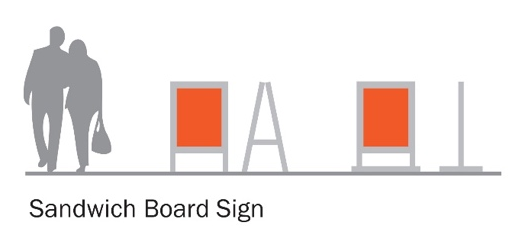
A-frame sign (sandwich board sign). A moveable sign designed to stand on its own that is usually placed along public sidewalks and is stored inside when not in use.
(c)
Banner. A sign made of fabric, cloth, paper or other nonrigid material that is typically not enclosed in a frame.
(d)
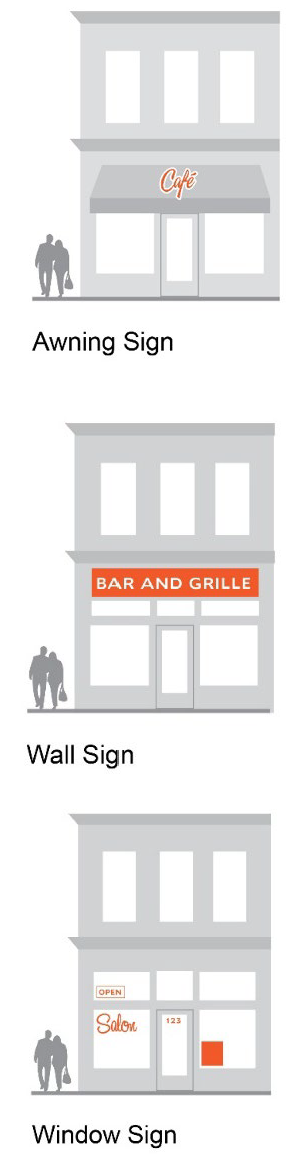
Building-mounted sign. A display sign that is painted on, adjacent to or attached to a building wall, door, window or related architectural feature. Such signs include, but are not limited to, awning, projecting, wall and window signs.
(1)
Awning sign. A sign that is painted on, attached to, or an integral part of an awning or canopy.
(2)
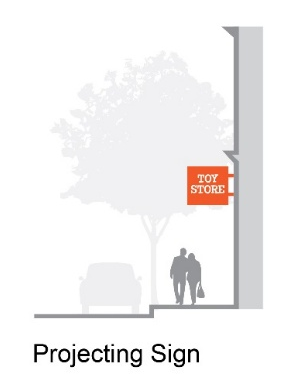
Projecting sign. A display sign attached to and projecting away from a structure. A projecting sign is mounted more or less perpendicular to the wall or structure to which it is attached. A marquee sign is a form of a projecting sign.
(3)
Wall sign. A display sign that is painted on, adjacent to or attached to a building wall, door, window or related architectural feature and projecting not more than one (1) foot from the wall. The signable area of a wall sign shall be more or less parallel to the wall or surface to which the sign is attached.
(4)
Window sign. A sign applied or attached to the exterior or interior of a window or located in such a manner within a building that it is visible from the exterior of the building through a window.
(e)
Canopy (attached). An overhead structure or architectural projection attached to a building on one (1) or more sides. Attached canopies may have attached to a building on one (1) or more sides. Attached canopies may have columns or posts for additional support.
(f)
Change of copy. The replacement of changeable copy only, replacement does not include modifications to sign structure, frame, or alterations of sign size.
(g)
Clearance. The vertical distance between the surface grade beneath the sign and the lowest point of the sign, including framework and embellishments.
(h)
Conforming sign. A sign that is legally installed and maintained in conformance with all regulating laws and ordinances.
(i)
Damaged sign. A sign or supporting structure which is torn, defaced, dented, smashed, broken, vandalized or destroyed.
(j)
Decorative display. A decorative, temporary display designed for the entertainment or cultural enrichment of the public and intended to serve as a cosmetic adornment rather than to convey a message.
(k)
Directional sign. A sign located at the entry or exit of a business or Commercial establishment designed to provide parking, driving and orientation information for pedestrian or vehicular traffic.
(l)
Directory sign. A ground sign listing only the names of tenants or occupants of a building, group of buildings, and/or business district, their professions or business activities, and their direction or location.
(m)
Flag. A piece of cloth having a distinctive size, color and design, used as a symbol, standard or emblem.
(n)
Frontage. The linear dimension of a parcel or lot measured along the public street right-of-way line.
(o)
Ground sign. Any sign supported by one (1) or more uprights and/or braces placed in, or anchored to, the ground, not attached to any building.
(p)
Illegal sign. A sign for which no valid permit was issued by the City at the time such sign was erected, or a sign that is not in compliance with the current Zoning Ordinance and does not meet the definition of a nonconforming sign.
(q)
Illuminated sign. Any sign which has characters, letters, figures, designs, or outlines illuminated by an electric light or luminous tubes as a part of the sign.
(r)
Incidental sign. A sign that is meant to be read in close proximity on the premises and is not generally legible from the street. Such signs shall be no greater than two square feet in area.
(s)
Information display sign. A sign for displaying information near the entry of a building using a display case or structure attached to a wall. An information display sign has a pedestrian scale and is only legible to persons on foot.
(t)
Marquee. A permanent canopy usually of metal and glass displaying, electronically or non-electronically, the title of an attraction which projects over an entrance to a building, such as a theater or hotel.
(u)
Menu board. A sign which is intended to service patrons using a drive-through facility.
(v)
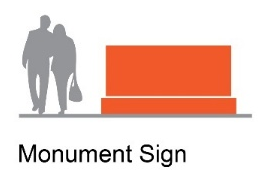
Monument sign base. The lower part of a monument sign, which may appear as a separate architectural feature and serves as its ground support.
(w)
Monument ground sign. A freestanding sign supported by a pedestal or base with permanent attachment to the ground.
(x)
Mural. A graphic displayed on the exterior of a building, including, but not limited to, painting, fresco, or mosaic, intended to serve as a cosmetic adornment for the building, rather than to convey a message.
(y)
Nameplate. A permanent, non-illuminated wall sign used to identify the occupant, business name and/or address of a building or parcel of land.
(z)
Nonconforming sign. A sign for which the City issued a permit at the time such sign was erected, but which is not in compliance with current Zoning Ordinance provisions for signs. Such signs must be located outside of any existing right-of-way, away from any public or private easement and wholly upon the parcel to which it is associated. Such signs must have all necessary structural and decorative parts, including, but not limited to, supports, sign box or enclosure, and electrical equipment. The sign face or sign copy area must be intact and illuminated signs must be capable of immediate illumination.
(aa)
Outline lights sign. A sign consisting of a string of lights including neon, LED, fluorescent or other outline tubing that outlines windows, doors, or other architectural features and is intended to draw attention to a sign or other message rather than to serve as a cosmetic adornment.
(bb)
Pennant. A long, triangular, tapering flag, often bearing an emblem.
(cc)
Pole sign. A ground sign mounted on a freestanding pole(s) or other support(s) with clear space between the bottom of the sign face and grade.
(dd)
Portable sign. A sign, usually temporary nature, not securely anchored to the ground or to the building or structure adjacent to it, and which obtains some or all of its structural stability with respect to wind or other normally applied forces by means of its geometry or character.
(ee)
Projecting sign. Any sign which is attached to a building or other structure which extends more than eight inches beyond the face of the building or structure or eight inches beyond the surface of that portion of the building or structure to which it is attached and is perpendicular to the building surface and is permanently attached to the building or structure surface. A projecting sign shall not include or be part of any canopy, awning or marquee sign.
(ff)
Right-of-way. A legal right of one to pass over the property of another; a strip of land acquired by reservation, dedication, forced dedication, prescription, or condemnation and intended to be occupied by a road, crosswalk, railroad, electric transmission line, oil or gas pipeline, water line, sanitary sewer, storm sewer, and other similar utilities and uses.
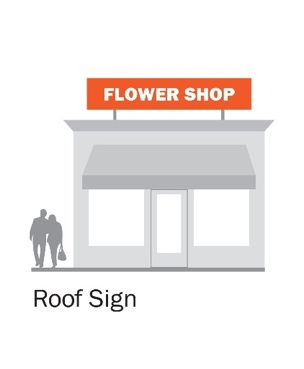
(gg)
Roof sign. A display sign which is erected, constructed and maintained on or above the roof of the building, or that extends above the roofline.
(hh)
Sign. Any surface, fabric, device, display or visual medium, including the component parts, which bears writing, representations, emblems, logos, pictorial forms, sculptured matter or any figures of similar character, together with any frame, tower, or other materials, color or internally illuminated area forming an integral part of the display to convey information or attract attention. Signs shall include banners, bulbs, other lighting devices, streamers, pennants, balloons, propellers, flags, electronic products, or similar devices. Murals and decorative displays, as defined by this chapter, shall not be construed to be signs. The term "sign" includes the sign structure, supports, braces, guys and anchors.
(ii)
Signable area. The area of the street level facade of a building as determined by multiplying the width of the building by height of the building to the eaves line of a single-story building or the second story floor elevation of a multiple-story building. Where more than one (1) business or use occupies space on the street level facade of a building, the signable area shall be divided among the businesses or uses in proportion to the size of their occupied space. Where a building has two (2) or more street level facades (as on a corner lot), the signable area shall equal the area of the largest street level facade.
(jj)
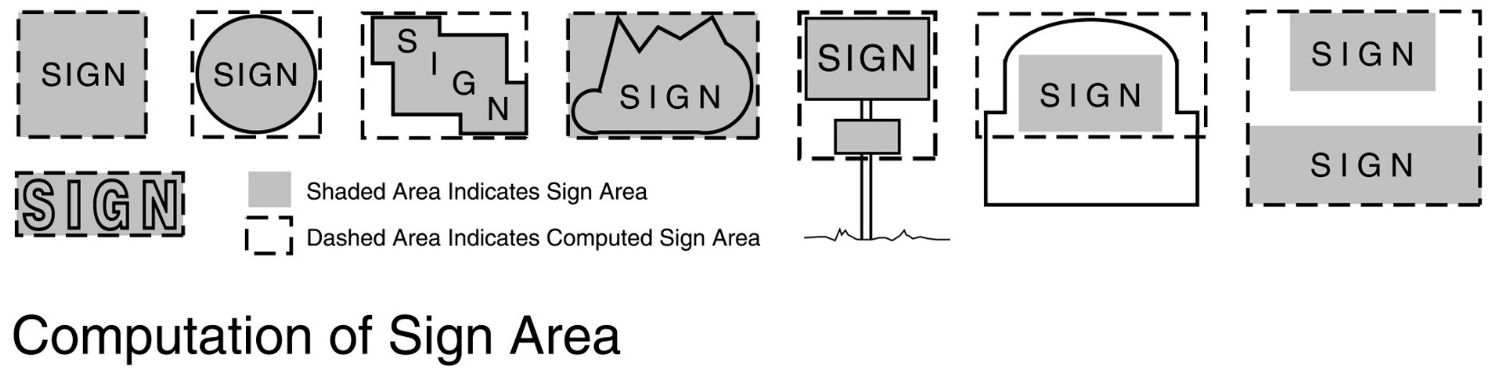
Sign area. The gross surface area within a single continuous perimeter enclosing the extreme limits of all sign copy or surface of any internally illuminated sign, awning or canopy. Such perimeter shall not include any structural or framing elements lying outside the limits of such sign and not forming an integral part of the display. Where a sign has two (2) or more faces, the sign area shall equal the total area of all sign faces, except where two (2) faces are placed back-to-back and are at no point more than three (3) feet apart, the sign area shall equal the area of the larger single sign face.
(kk)
Sign copy. Writing, representations, emblems, logos, pictorial forms, sculptured matter or any figures of similar character, together with any frame, tower, or other materials, color or internally illuminated area forming an integral part of a display to convey information or attract attention.
(1)
Animated copy. Sign copy that flashes, moves, revolves, cycles, or is otherwise altered or changed by mechanical or electrical means at intervals of less than once per hour.
(2)
Changeable copy. Moveable letters or other forms of sign copy, not including animated copy that can be altered by natural, mechanical or electrical means without replacing the sign copy area.
(ll)
Sign Height. The vertical distance measured from the average grade at the sign location to the highest point of the sign.
(mm)
Site Entry Feature with Signage (Entrance Sign). A sign located at the entrance to the development from a thoroughfare or collector road for a residential subdivision, apartment community, condominium development, mobile home park, or office, business or industrial park.
(nn)
Street Level Façade Area. The area of the front wall measured from grade level to a height of eight (8) feet, including doors and windows, of the principal building facing a public street where the address or primary public entrance is located. Buildings on corner lots may have up to two (2) front faces if each face satisfies the above criteria. If the building is devoted to two (2) or more uses or businesses, the front face area for each use or business shall be determined by the development services director based upon the proportionate share of the building occupied by each use or business.
(oo)
Temporary Sign. Display signs, banners, balloons, festoons or other signs constructed of cloth, canvas, fabric, plastic or other light temporary material, with or without a structural frame, or any other sign intended for a limited period of display, but not including decorative displays.
(pp)
Vehicle Sign. Trucks, motor vehicles, trailers and similar equipment bearing advertising visible from off-site and parked at the business location for the intended purpose of advertising a business, service or product, are considered vehicle signs and are prohibited. Delivery Vehicles, service vehicles or trailers and vehicles used for a permanent business used on a daily basis in conjunction with an on-site business are exempt when they are parked in a location that is not visible from off-site, or otherwise creates the least possible visual impact without significant effect on the security of the vehicle or trailer.
(Ord. No. O-06-25, § 1(Exh. A), 8-4-2025)
Sec. 98-231. - General requirements.
(a)
Building permit required. Except as provided in this article, no sign shall be constructed or erected prior to the issuance of a permit by the building official. All signs shall comply with the state construction code.
(b)
Public rights-of-way. Signs shall be expressly prohibited from locating in or overhanging all public rights-of-way and dedicated public easements except as otherwise provided for in the Downtown district, and as follows:
(1)
Signs erected by the City for public purposes are permitted with road agency approval, if required.
(c)
Corner clearance. Signs shall be located outside of any corner clearance area as described in Sec. 98-205.
(d)
Wind pressure. All signs shall be constructed so as to withstand normal wind forces encountered in the area. All signs shall be properly maintained and shall not be allowed to become unsightly through disrepair or action of the elements.
(e)
Traffic and pedestrian hazards. The placement, size, content, coloring or manner of illumination of signs shall not create traffic or pedestrian hazards. No sign shall make use of the words "stop," "look," "danger" or other word, phrase or symbol in a manner that is confusing or misleading. No sign or flashing light shall be erected or maintained in any manner which, by reason of its size, location, context, coloring or manner of illumination, shall constitute a traffic hazard or which shall interfere with the visibility of any traffic control device.
(f)
Illumination. Sign illumination shall comply with the following standards:
(1)
External illumination of signs and awnings. External illumination of signs shall be limited to fully shielded light fixtures per sign face that use a one hundred fifty watt (150W) metal halide, tungsten-halogen or incandescent lamps. Such fixtures shall be mounted above the sign face with all light directed downward and concentrated on the area of the sign to prevent glare upon the street or adjacent property.
(2)
Internal illumination of signs and awnings. Internal illumination of awning signs is prohibited in the Downtown district. Internal illumination of awning signs is permitted in other zoning districts where more than fifty percent (50%) of the illuminated sign area is covered by semi-opaque colors and materials that have a color value and saturation of fifty percent (50%) or higher. Internal illumination of awnings shall be limited to one (1) single-tube fluorescent fixture, provided that the fixture is recessed, and the awning material is opaque except for any permitted sign copy area.
(3)
Animated lighting effects. The use of light emitting elements including, but not limited to, light bulbs, fixtures, LEDs, or fiber optic lighting to create a flashing, scrolling, or animated effect on any sign visible from the exterior of the building is prohibited.
(4)
Electronically illuminated message sign change cycle. The message displayed on signs with an electronically illuminated changeable copy area (often composed of LEDs) must be displayed for a minimum of one minute before changing.
(g)
Substitution. Notwithstanding anything herein to the contrary, noncommercial copy may be substituted for commercial copy on any lawful sign structure, and any sign permitted by this article may contain a non-commercial message.
(h)
Obstruction prohibited. No sign shall be placed so as to obstruct any fire escape, required exit way, window, or door opening used as a means of passage or as access for firefighting purposes.
(i)
Maintenance. All signs, sign frames, sign copy area, panels, structural elements, lamps and electrical hardware shall be maintained in good repair and working order, so as to present a neat and orderly appearance. Non-galvanized or corrosion-resistant materials shall be painted when necessary to prevent corrosion.
(Ord. No. O-06-25, § 1(Exh. A), 8-4-2025)
Sec. 98-232. - Sign design standards.
(a)
Monument ground signs.
1 Monument ground signs are only permitted on lots with buildings greater than five thousand (5,000) square feet in RA-1, RA-2, PRD, MH, RM-1, and RM-2 districts.
(1)
Monument base required. All ground signs in the City shall be low-level monument-style ground signs. Pole signs are not permitted. The monument ground sign shall be provided with a base that is at least eighty percent (80%) of the width of the sign.
(2)
Number of signs. One (1) monument ground sign shall be permitted per lot or parcel. Lots that have more than one hundred (100) feet of frontage on two (2) or more public streets shall be permitted one ground sign for each street frontage. The additional monument ground signs shall have a maximum area of seventy-five percent (75%) of that otherwise permitted for a monument ground sign in the zoning district.
(3)
Setback. Monument ground signs shall be set back a minimum of five (5) feet from the right-of-way of any street, or as required by the above table, whichever is greater. All monument ground signs shall be located outside of corner clearance areas pursuant to Sec. 98-205.
(4)
Materials. Monument ground signs shall be constructed out of decorative materials that complement the design of principal buildings within the development. Natural materials such as stone, decorative masonry, wood, or metal are preferred sign construction materials.
(5)
Landscaping. Low level landscaping shall be provided around the base of the sign but shall not obscure any part of the sign message.
(6)
Monument ground signs not intended to be viewable from a public right-of-way, such as signs serving a drive-through facility, may have a maximum height of six (6) feet and a maximum area of thirty-two (32) square feet, and shall not be included in the computation of total sign area for the parcel unless such signs are legible from a point of observation off the premises. All such monument ground signs shall have a decorative base at least as wide as the sign.
(b)
Building-mounted signs. Building-mounted signs, including wall, awning, projecting and window signs shall comply with the following requirements:
(1)
Location.
a.
In the downtown district. Building-mounted signs shall be located only on a street-facing facade of the building. Signs for first floor tenants should be located at the storefront level. Upper story tenants may only have window signs. Each business use in the downtown district may have an additional secondary wall sign at each entrance that does not face a street.
b.
In the RA-1 and RA-2 districts. One (1) unlighted building-mounted sign, not exceeding eight (8) square feet may be substituted for one (1) temporary sign. This sign may be a ground sign if indicated on the permit application.
c.
In the B-1, B-3, I-1, I-C, RM-1 and RM-2 zoning districts.
1.
Building-mounted signs may be located on any facade that faces a street, parking area, or vehicle circulation area that provides access to more than one (1) parcel, or on a facade where a public entrance is located. Illuminated building-mounted signs may not be located on a facade that faces a property line that abuts a residential zoning district unless the sign is set back at least two hundred (200) feet from the property line or screening is provided that will completely obscure the view of the sign from the adjacent residential district.
2.
In the case of a building that contains two (2) or more businesses (including, but not limited to, a shopping center or office center), each business that is directly accessible from the exterior of the building may have a building-mounted sign on the facade where the primary or main customer entrance is located.
3.
For the purposes of calculating signable area in such multi-tenant buildings, the frontage controlled by each tenant on the facade where the entrance is located shall be used to calculate linear frontage.
(2)
Sign area.
a.
In the downtown district.
1.
The total sign area of all building-mounted signs shall not exceed one hundred (100) square feet or ten percent (10%) of the signable area of the building space occupied by the use associated with the sign, whichever is less. See Sec. 98-230(ii) for a definition of signable area.
2.
An extra ten (10) square feet of sign area is permitted per business where a building contains three (3) or more uses. The additional sign area shall be divided between the businesses located in the building.
3.
Secondary wall signs at entrances that do not face a street shall not exceed sixteen (16) square feet.
b.
In the B-1, B-3, I-1, and I-C zoning districts. The total area of all building-mounted signs shall not exceed three (3) square feet for each one (1) linear foot of building frontage on the street facade of the building, or one hundred (100) square feet, whichever is less.
c.
In the RM-1 or RM-2 zoning districts. For rental or management offices in the RM-1 or RM-2 districts, one (1) wall sign not to exceed six (6) square feet is permitted.
(3)
Minimum height. Awning and projecting signs shall maintain a minimum clearance of eight (8) feet between the grade level below the sign and the lowest part of the sign (including sign support devices).
(4)
Materials.
a.
Building-mounted signs shall incorporate exterior materials, finishes and colors that are the same, similar, or complimentary to those used on the principal building.
b.
Building-mounted signs shall be professionally constructed using high-quality materials such as metal, stone, hard wood, or brass. The use of exposed neon tubing in conjunction with other types of materials to emphasize the sign copy is permitted, however, internal neon lighting or any other use of neon tubing is prohibited.
c.
Internally lit plastic sign copy or plastic box signs are prohibited in the D-1 district.
d.
To minimize irreversible damage to masonry, all mounting and supports should be inserted into mortar joints and not into the face of the masonry.
(5)
Wall signs. No surface of a wall sign may project beyond or overhang any wall or permanent architectural feature by more than one (1) foot.
(6)
Awning signs. Sign copy may comprise up to thirty-five percent (35%) of the total exterior surface of an awning. Awnings with back-lit graphics or other kinds of internal illumination are prohibited.
(7)
Projecting signs.
a.
Projecting signs shall be secured to the building by metal anchors, bolts, supports, rods or braces.
b.
Projecting signs are limited to four (4) square feet of sign area per sign face.
c.
A projecting sign may not be located closer than eight (8) feet to another projecting sign.
d.
A minimum vertical clearance of eight (8) feet shall be provided between the lowest point of the sign and the sidewalk.
e.
Projecting signs may not be mounted above a second-floor window sill on multi-story buildings.
(c)
B-1, B-3, D-1, D-2, and D-3 district signs. A-Frame, and Information display signs are permitted only in the B-1, B-3, D-1, D-2, and D-3 districts and shall comply with the following requirements:
(1)
A-frame signs. A-Frame signs are permitted within the B-1, B-3, D-1, D-2, and D-3 districts subject to the following requirements:
a.
A-frame signs may have a maximum area of six (6) square feet per side.
b.
A-frame signs may be located on the sidewalk within six (6) feet of a building entrance. A-frame signs shall be located such that they will not impede pedestrian traffic on the sidewalk, and such that they will not present a hazard to vehicular traffic.
c.
A-frame signs may not be permanently affixed to any object, structure, or the ground.
d.
A-frame signs shall be stored indoors when not in use.
e.
Each business may have a maximum of one (1) A-frame sign.
(2)
Information display signs. Information display signs may be mounted on the exterior wall of a building and shall be located in a permanently mounted display box on the surface of the building adjacent to the entry. Information display signs may have a maximum area of three (3) square feet.
(Ord. No. O-06-25, § 1(Exh. A), 8-4-2025)
Sec. 98-233. - Waivers.
The planning commission, after a public hearing that meets the requirements of the State of Michigan and this Zoning Ordinance, shall have the ability to waive or modify any of the above standards, provided that the following criteria are met. A waiver granted under this section shall apply for the lifespan of the sign in question, but shall not be transferable to any other sign or premises:
(a)
The applicant provides all requested information and pays all applicable application and review fees, to be determined by the City council.
(b)
The proposed sign does not endanger the public health, safety, and welfare by virtue of being distracting to drivers, obscuring vision, being unnecessarily bright, being designed or constructed poorly, or in any other way.
(c)
The design of the sign is consistent with the character of the surrounding area.
(d)
The sign does not block the view of other nearby signs to the extent that it would harm the ability of neighboring businesses to operate.
(e)
The sign will not be a nuisance to any residential uses.
(f)
A sign designed to meet the standards of the ordinance would not adequately serve the purpose desired by the applicant.
(Ord. No. O-06-25, § 1(Exh. A), 8-4-2025)
Sec. 98-234. - Signs permitted in all zoning districts without a permit.
The following non-illuminated signs are permitted accessory to a permitted use in any zoning district without obtaining a building permit prior to installation:
(a)
Temporary signs. Temporary signs are subject to the following:
(1)
Temporary signs shall only be ground or wall signs. The total area of temporary signs on any single lot shall not exceed twenty-four (24) square feet in all residential districts and forty-eight (48)square feet in any other zoning district.
(2)
The maximum sign height of each temporary sign shall be four (4) feet in all residential districts and six (6) feet in any other zoning district.
(3)
The maximum size of any single temporary sign shall be fifteen (15) square feet.
(4)
Temporary signs shall be located solely on private property outside of any street right-of-way or corner clearance area, with written permission from the property owner.
(b)
Changes to sign copy within an approved changeable sign copy area.
(c)
Required signs. Any sign required to be placed by law, including, but not limited to, address numbers legible from the street, is permitted.
(d)
Window signs.
(1)
Sign area. The total area of all window signs shall not exceed twenty percent (20%), of the total surface area of facade windows, and window signs may not occupy more than forty percent (40%) of the area of any individual window. An individual window shall be determined by framing or other structural elements, divided light window panes or other glazing methods within a window frame are not considered individual windows.
(2)
In the Downtown district. Temporary or permanent window signs are only permitted in street level facade windows for uses with street level space. The maximum area of window signs permitted accessory to a use with street level frontage in the downtown district shall be determined by computing the area of street level facade windows only.
(3)
Upper story tenants that do not have street level frontage may have window signs. In such a case, the upper story window area shall be used for purposes of determining maximum permitted window sign area for the upper story tenant.
(e)
Parking lot identification signs. Signs located in parking lots to identify limitations on the use of parking spaces, such as "customer parking," "reserved parking," or to identify barrier free accessible spaces are permitted, subject to the following:
(1)
The signs shall have a maximum area of one and one-half (1½) square feet (a typical accessible barrier-free parking space sign has a dimension of one (1) foot times one and one-half (1½) feet).
(2)
Such signs shall conform to design standards of the Michigan Manual on Uniform Traffic Control Devices (MMUTCD).
(f)
Official state historical registry signs shall be permitted within all use districts. In all cases, the sign shall be posted within the property line boundary on which the building stands. Official City historical registry signs shall be permitted on a building and shall not exceed one (1) square foot in area.
(g)
Directional signs. All directional signs required for the purpose of orientation, when established by the City, county or state governments, shall be permitted in all use districts.
(h)
Incidental signs. One incidental sign may be posted for every one hundred fifty (150) feet of lot frontage on each side of a lot, provided that each sign is no more than two (2) square feet in area and located entirely upon private property.
(i)
Flags. Flags are permitted provided they meet the following requirements:
(1)
Flags may not be affixed to any fence, tree, or utility pole.
(2)
Flags in residential districts or residentially used parcels may not exceed fifteen (15) square feet in area. Total square footage shall not exceed twenty-four (24) square feet.
(3)
Freestanding flagpoles may not exceed the maximum building height of the zoning district where they are located.
(4)
Only one (1) freestanding flagpole is permitted in a residential district or on a residentially used parcel. The location of the flagpole may be in any required front or rear yard.
(Ord. No. O-06-25, § 1(Exh. A), 8-4-2025)
Sec. 98-235. - Signs permitted in all zoning districts with a permit.
The following signs shall be permitted in any zoning district, subject to the approval of a building permit and compliance with any design standards applicable to that type of sign:
(a)
A-frame signs. A-frame signs and information display signs are permitted only in the B-1, B-3, D-1, D-2, and D-3 districts with a permit. Refer to Sec. 98-232(c)(1) for sign standards specific to each district.
(b)
Monument ground signs. See Sec. 98-232(a) for specific monument sign requirements by zoning district.
(c)
Building-mounted signs, including wall, awning, and projecting signs. See Sec. 98-232(b) for specific building-mounted sign requirements by zoning district.
(d)
On-site directional signs. In the B-1, B-3, D-1, D-2, D-3, I-1 and I-C districts, signs providing traffic or property use direction may be provided on the property to direct patrons or customers. Such signage shall in the aggregate not exceed forty (40) square feet of sign face, and no such single sign shall exceed ten (10) square feet of sign face. Entry and exit signs shall be a maximum of two (2) square feet in area and six (6) feet in height and shall be allowed provided the signs are two (2) feet from any front lot line and twenty (20) feet from any side or rear lot line of an adjacent residential district.
(e)
Site entry features including a sign. Architectural features with signage may be erected at each entrance to a residential subdivision, apartment community, condominium development, mobile home park or office, business or industrial park or similar development from a major street, subject to the following:
(1)
Number of signs. Maximum of one (1) sign on each side of the entrance from a major street.
(2)
Setbacks. Site entry features with signage shall be located outside of any street setback area or corner clearance area and shall be set back a minimum of ten (10) feet from the curb line of any driveway or street.
(3)
Sign area and height. The maximum height and area permitted for all site entry signs on a road frontage shall be equal to the maximum permitted for a ground sign, as permitted in Sec. 98-232.
(4)
Planning commission review. The location and design of each site entry feature with signage shall be subject to review and approval by the planning commission.
(f)
Building directory. Where a single building on a single lot is occupied by more than one business, dwelling or other use above the street level facade (such as a multiple-story office or commercial building), a building directory sign may be located at the primary or main customer entrance for these uses, subject to the following:
(1)
The building directory shall be separate from any permitted signs accessory to the uses occupying the street level façade.
(2)
The maximum sign area of the building directory shall be equal to five percent (5%) of the signable area of the building.
(g)
Temporary signs. Temporary signs for special events, other than those listed elsewhere in this article, shall be subject to the following:
(1)
Number of permitted signs. A maximum of one (1) such sign per street frontage and one (1) sign per public entrance to the building shall be permitted per lot.
(2)
Maximum sign area and height. Ground-mounted signs shall not exceed six (6) feet in height and sixteen (16) square feet in area. Building-mounted temporary signs shall not exceed five percent (5%) of the signable area of the building space occupied by the use associated with the sign.
(3)
Sign removal. A removal agreement or security bond to guarantee removal of such signs may be required. Signs must be removed by the date listed in such agreement.
(4)
Display period. Such signs shall be temporarily displayed for the specific time period stated on the approved permit, which shall not exceed ninety (90) days. Upon expiration of this time period, the sign must be removed, or a new permit must be acquired.
(Ord. No. O-06-25, § 1(Exh. A), 8-4-2025)
Sec. 98-236. - Prohibited signs.
The following signs are prohibited in all zoning districts:
(a)
Abandoned Signs.
(b)
Animated, Flashing or Moving Signs.
(c)
Balloons, Pennants, Inflatables and Other Permanent Objects. Balloons, pennants, inflatables and other permanent objects may be permitted temporarily in accordance with a special event permit.
(d)
Illegal Signs. Including any sign unlawfully installed, erected, or maintained, or any sign advertising activities that are illegal under federal, state, or City laws or regulations.
(e)
Illegally Located Signs. Any of the following type of signage:
(1)
Signs placed in, or projecting into, any public street right-of-way, with exception of traffic regulatory signage erected by any governmental body having jurisdiction over the right-of-way, permitted projecting, awning, canopy or marquee signs in the Downtown District.
(2)
Signs located in clear vision areas.
(3)
Logos on a public or private radio, television, cellular phone, or water towers, with the exception of the name of the municipality.
(4)
Signs that are attached to utility poles, trees, fences, rocks or in an unauthorized manner to walls or other signs.
(f)
Imitating Signs. Signs that imitate or could be confused with the lighting of emergency vehicles or with an official traffic sign or signal, or which contain the words "stop", "go slow", "caution", "danger", "warning", or similar words.
(g)
Mechanical Signs. Signs that have any visible moving parts, mechanical movement or other apparent visible movement achieved by electrical or mechanical means or action of normal wind currents.
(h)
Obscene Material. Signs contain obscene statements, words, or pictures, as defined by Federal law, State law, or applicable case law, are prohibited.
(i)
Obstructing Signs. Any sign which obstructs free access to or egress from any building, including those that obstruct any fire escape, required exit way, or window or door opening or that prevent free access to the roof by firefighters.
(j)
Outline Lights Signs. Outline lights signs are prohibited, with the exception of historic neon signs that are included in a site plan approval as part of a historic building/site restoration.
(k)
Portable Signs. All portable or nonstructural signs except as allowed under other sections of this Ordinance.
(l)
Roof Signs.
(m)
Signs Not Expressly Permitted. Signs not expressly permitted by this article are prohibited.
(n)
Street Furniture/Bench Signs. With the exception of signage on table umbrellas used for outdoor café-style dining.
(o)
Unsafe Signs. Any sign or sign structure which is structurally unsafe or constitutes a hazard to safety or health by reason of inadequate maintenance, dilapidation or abandonment or is not kept in good repair or is capable of causing electrical shock to persons likely to come in contact with it.
(p)
Vehicle Signs. Vehicle signs are prohibited, except for "For Sale" signs that advertise the sale of vehicles on which the sign is displayed. Vehicles for sale must not be parked or displayed within any public right-of-way for more than twenty-four (24) hours.
(Ord. No. O-06-25, § 1(Exh. A), 8-4-2025)
Sec. 98-237. - Nonconforming signs.
Nonconforming signs shall be permitted to continue as such until removed or altered, provided that such signs are maintained in accordance with the following requirements:
(a)
General standards. Nonconforming signs shall be maintained in accordance with the requirements for all signs specified in Sec. 98-231, above.
(b)
Expansion or relocation prohibited. Nonconforming signs shall not be expanded or relocated.
(c)
Servicing. Painting, servicing, cleaning, minor repairs, or changes in sign copy panel area (sign face changes) to a nonconforming sign shall be permitted, provided that the sign is restored to its original design and all work is in compliance with applicable structural and electrical codes and the requirements for all signs specified in Sec. 98-231, above.
(d)
Alterations. Alterations or changes to the sign frame or structural elements of a nonconforming sign shall be subject to the following conditions:
(1)
The sign shall be brought into compliance with the requirements for all signs specified in Sec. 98-231, above.
(2)
The sign shall be brought into compliance with all applicable sign height and sign area standards for the type of sign, as specified in this article.
(3)
Nonconformities caused by inadequate ground sign setback at a ground sign's current location may be permitted to continue so that the existing support structure and wiring may be re-used, provided that permitted alterations will not increase this nonconformity, and provided that the ground sign is located entirely outside of all street rights-of-way and corner clearance areas.
(4)
Approval of appropriate permits by the building official.
(Ord. No. O-06-25, § 1(Exh. A), 8-4-2025)
Sec. 98-238. - Sign removal by City action.
(a)
Obsolete or abandoned signs.
(1)
Any sign that identifies a business that has permanently ceased operations or that identifies an activity or event that has already occurred shall be considered abandoned and shall be removed by the owner, agent, or person having use of the building or structure. Signs associated with seasonal businesses need not be removed during seasons in which the business is not in operation.
(2)
Upon vacating a commercial or industrial establishment, the proprietor shall be responsible for removal of all signs used in conjunction with the business within one hundred eighty (180) days of the premises being vacated. The City may remove the signs after a ten-day notice has been given to the property owner to remove the signs and the cost of removal will be charged to the property owner.
(3)
However, where a conforming sign structure and frame are typically reused by a current occupant in a leased or rented building, the building owner shall not be required to remove the sign structure and frame in the interim periods when the building is not occupied, provided that the sign structure and frame are maintained in good condition.
(b)
Damaged signs. Signs determined to be in a damaged condition by the building official shall be repaired, replaced or removed to the satisfaction of the building official by the owner, operator or person having beneficial use of the property upon which the sign is located. If such action is not taken by the owner within ten days, such signs may be repaired or removed by the City at the expense of the owner of the property upon which the sign is located. The City may then place a lien on the property, adding necessary removal expenses to the tax bill for the property.
(c)
Nonconforming signs. The elimination of nonconforming signs in the City is hereby declared to be for a public purpose and for a public use. The City council shall have the authority to institute and prosecute proceedings for the condemnation of nonconforming signs determined to be in violation of the requirements for such signs specified in Sec. 98-231. For the purpose of removal, the City council may, at its discretion, acquire and remove nonconforming signs by purchase, condemnation or otherwise with the cost paid from general funds.
(d)
Temporary signs. Temporary signs erected or displayed within a street right-of-way or corner clearance area, or without a valid permit or after the expiration of a permit, may be removed by the City without notice.
(e)
Unsafe signs. Signs determined to be unsafe by the building official shall be immediately removed or repaired to the satisfaction of the building official by the owner, operator or person having beneficial use of the property upon which the sign is located. If such action is not taken by the owner within twenty-four (24) hours, such signs may be removed by the City at the expense of the owner of the property upon which the sign is located. The City may then place a lien on the property, adding necessary removal expenses to the tax bill for the property.
(Ord. No. O-06-25, § 1(Exh. A), 8-4-2025)

