
Vernal City Zoning Code
CHAPTER 16
24 Supplementary Regulations
Section 16.24.010 Applicability
The regulations hereinafter set forth in this chapter qualify or supplement, as the case may be, the zone regulations contained elsewhere in this title.
(PZSC § 03-11-001)
Section 16.24.020 Site Development Standards
The requirements of this title as to minimum site development standards shall not be construed to prevent a use as permitted in a respective zone or any parcel of land in the event such parcel was held in separate ownership prior to the initial enactment of this title. Each such parcel to be developed must have not less than sixteen (16) feet of frontage on a street and the density of the development may not exceed that permitted by area requirements in the respective zone.
(PZSC § 03-11-002)
Section 16.24.030 Additional Main Building Regulations
Every main building shall be located and maintained on a "lot" as defined in Chapter 16.04 of this title, and every lot shall have the required frontage on a "street" as defined by Chapter 16.04 of this title, except where a parcel of land was in separate ownership as described in Section 16.24.020 prior to the initial enactment of this title as described in section 16.24.020.
(PZSC § 03-11-003)
(Ord. No. 94-09, Amended, 4/14/94)
Section 16.24.040 Additional Yard Regulations
- No required yard or other open space around an existing building shall be considered as providing a yard or open space for any other building nor shall any yard or other required open space on an adjoining lot be considered as providing a yard or open space on a lot whereon a building is to be erected or established.
- On any lot under separate ownership from adjacent lots and of record at the time of the initial enactment of this title and such lot having a smaller width than required for the zone in which it is located, the following conditions shall apply:
- For interior lots, each side yard may be equal to but not less than the same percentage of the required side yard width as the lot is of the required width; provided, that in no case shall the smaller of the two (2) side yards be less than five (5) feet or the largest less than eight (8) feet.
- On corner lots, each side yard may be equal to but not less than the same percentage of the required side yard width as the lot is on the required lot width; provided, that in no case shall the side yard on the street side be less than fifteen (15) feet or the other side yard be less than five (5) feet in all residential zones.
- Every part of a required yard shall be open to the sky unobstructed, except for accessory buildings in a rear yard and except for permitted architectural projections.
- Open or lattice-enclosed fire escapes, fireproof outside stairways and balconies opening upon fire towers may project into a yard not more than five (5) feet and the ordinary projections of chimneys and flues are permitted.
- No accessory building or group of accessory buildings in any residential zone shall cover more than twenty-five (25) percent of the rear yard.
- No space needed to meet width, yard, area, coverage, parking or other requirements of this title for a lot or building may be conveyed away from such lot and any attempted conveyance or lease in violation hereof shall be void.
- No parcel of land which has less than the minimum width and area requirements for the zone in which it is located may be divided from a larger parcel of land for the purpose, whether immediate or future, of building or development as a lot.
- Additions to dwellings must in design and appearance be similar to the existing dwelling in roof pitch, siding, and other building materials.
- Measurement of setbacks.
- Front yard setbacks;
- General. The front yard setback shall be measured at right angles from the nearest point on the front property line of the parcel to the nearest point of the structure envelope, except for corner parcels.
- Corner parcels. The measurement for corner parcels shall be taken from the nearest point of the structure envelope to the nearest point on the property line adjoining the street to which the property is addressed or from the street to which access to the property is taken, as determined by Vernal City. If the corner is cut, measurements shall be from the projection of the intersecting property lines. Whenever a future street right-of-way line is officially established, required yards shall be measured from the established line.
- Side yard setbacks. The side yard setback shall be measured at right angles from the nearest point on the side property line of the parcel to the nearest line of the structure envelope, establishing a setback line parallel with the side property line that extends between the front and rear yards.
- Exterior side yard setbacks. The side yard on the exterior side of a corner parcel shall be measured from the nearest point of the side property line adjoining the street to the nearest line of the structure envelope, establishing a setback line parallel with the street side property line that extends from the front property line to the rear property line.
- Rear yard setback. The rear yard setback shall be measured at right angles from the nearest point on the rear property line of the parcel to the nearest line of the structure envelope, establishing a setback line parallel with the rear property line that extends between the side yards, except:
- If an access easement or street right-of-way line extends into or through a rear yard, the measurement shall be taken from the nearest point of the access easement or right-of-way line, and;
- Where the side lot lines converge to a point at the rear of the parcel, a line ten (10) feet long within the parcel, parallel to and at a maximum distance from the front parcel line, shall be deemed to be the rear lot line for the purposes of determining the depth of the required rear yard. (See Figure 24-1)
- Projection into setbacks. Any projections shall be measured from the foundation of the structure. Architectural projections, as defined herein, shall be restricted to a maximum of four (4) feet.
- Front yard setbacks;
FIGURE 24-1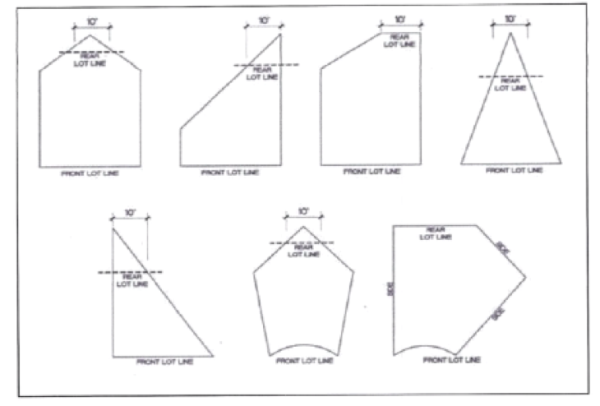
(PZSC § 03-11-004)
(Ord. 2018-01, Amended, 01/17/2018; Ord. 2003-02, Amended, 04/02/2003)
Section 16.24.050 Additional Height Requirements
- Penthouse or roof structures for the housing of elevators, stairways, tanks, ventilating fans or similar equipment required to operate and maintain a building and fire walls or parapet walls, skylights, towers, steeples, flagpoles, chimneys, smokestacks, water tanks, wireless or television masts, theater lofts, silos or similar structures may be erected above the height limit and shall be allowed for the purpose of providing additional floor space.
- No dwelling shall be erected to a height of less than ten (10) feet and no accessory building in a residential zone shall be erected to a height greater than twenty-five (25) feet.
(PZSC § 03-11-005)
Section 16.24.060 Flag Lots Permitted
The residential use of flag lots or panhandle shaped lots in residential zones shall be considered a permitted use provided the following requirements are met:
- It has been demonstrated to the City Zoning Administrator and Vernal City ;Planning Zoning Commission that because of topographical features or unique situations associated with the parcel proposed to be subdivided;
significant utilization of a property in a manner that aligns with the specific guidelines, regulations, and intentions setneighboringforth by local zoning ordinances
can not occur unless a panhandle shape lot is allowed to be created. Significant utilization requires that the use does not detract from the planned development patterns, community goals, or strategic objectives outlines in comprehensive plans or specific area plans. Instead significant utilization must contribute to the long-term vision for growth, sustainability, economic development, housing, transportation or other community priorities. This can include but is not limited to:- The development or use of the parcel that aligns with zoning regulations which conforms to the types of uses that the zoning classification permits. This could include residential, commercial, industrial, agricultural or mixed uses depending on the zone's specifications.
- The property to be used at a similar intensity and scale of use consistent with the criteria established by zoning lows or planning policies. This could involve considerations of building size, the number of units, the extent of land development, or the level of activity associated with the use.
- The lot has the required width for two way access onto a dedicated public street as required in Section 16.26.230. Required setbacks shall not be counted as part of the access strip. The access strip shall be an all-weather driving surface with adequate drainage and properly maintained. "All weather surface" means asphalt, concrete, gravel, or road base. A shared access strip for up to three (3) lots may be allowed with a recorded easement for all property owners.
- The flag lot plant shall show the access from dedicated public street to the property is not a Vernal City roadway and will not be maintained by Vernal City or, the owner of such property shall sign and record an affidavit stating the same.
- The body of the interior portion of the lot meets all of the required dimensions, to include width and area, for the zone in which it is located. The access strip shall not count as part of the land area needed to meet the lot area requirement.
- The building envelope shall be shown on the plat and found to be compliant with fire code regulations and as required in the currently adopted International Fire Codeplat .
- The address of the dwelling located on the panhandle lot shall be clearly visible from a public street which the panhandle lot accesses.
- Setback requirements shall be shown on the plat by the building envelope. Setbacks will be determined based on the requirements for the zone in which property is located and orientation of the structure on the property. In addition, front setback requirements for the zone may be required for any side of the lot adjacent to the access strip if future transportation corridors are reasonable anticipated. Additional setbacks may be required if deemed necessary by the Planning Commission in order to accommodate reasonably anticipated future transportation corridors, access opportunities, privacy concerns, grading constraints, drainage and stormwater management, neighborhood character and aesthetics, etc.
- When any part of a proposed flag lot or parent parcel is crossed by a trail, or trail extension identified in the trails master plan the subdivider shall preserve a right-of-way for the trail dedicated to Vernal City or other public entity as approved by the land use authority. The trail right-of-way shall be noted on the plat as a public trail easement granted to Vernal City or other public entity as approved by the Planning Commission.
- The trail right-of-way shall be designed in a manner that avoids placing undue burden on the land or restricting the property's significant use as outlined in this chapter. It is essential to ensure that the layout of the trail respects the property's existing uses and potential, minimizing any negative impact on the properties functionality.
- When a subdivider is required to preserve a right-of-way the area of the trail right-of-way shall not affect the calculation of lot requirements. Setbacks as shown by the building envelope may be affected by the trail right-of-way, however, the subdivider shall be entitled to the same number of lots, lot sizes, and building coverage had the trail right-of-way not been a part of the subdivision.
(PZSC § 03-11-006)
(Ord. No. 98-02, Amended, 01/28/98)
(Ord. 2016-09, Amended, 08/03/2016; Ord. 2015-01, Amended, 01/21/2015; Ord. 2004-26, Amended, 11/03/2004)
Section 16.24.070 Sewer Regulations
Sewage disposal shall comply with the Uintah County Health Department requirements in all applications for a building permit where a sanitary sewer is not available.
(PZSC § 03-11-007)
Section 16.24.090 Lighting
- No spotlight or floodlight shall be installed in any way which shall permit the direct rays of such lights to penetrate into any residential zone or onto any property used for residential purposes.
- No light, sign or other advertising structure as regulated by this code shall be erected at the intersection of any street in such a manner as to obstruct free and clear vision; or at any location where by reason of the position, shape or color it may interfere with, obstruct the view of or be confused with any authorized traffic sign, signal or device, or which makes use of the words "stop," "look," "drive-in" or any other word, phrase, symbol or character in such manner as to interfere with, mislead or confuse traffic.
(PZSC § 03-11-009)
Section 16.24.100 Private Parks, Playground Or Recreation Areas
In all residential zones, a private park, playground or recreation area, with or without a swimming pool, shall meet the following requirements:
- The lands and facilities used for such purposes shall be owned or leased and operated by a nonprofit corporation for the exclusive benefit of the members, their immediate families and nonpaying guests.
- Adequate restrooms and sanitary facilities shall be provided and kept available for use by members, their families and guests, and shall be maintained in proper working order and in a clean and sanitary condition and in full compliance with the reasonable standards, rules and regulations established by the Uintah Basin Health Department.
- Twenty (20) off-street parking spaces or one (1) off-street parking space for each four (4) members in the operating corporation, whichever is greater, shall be provided on the lot devoted to the principal use.
- Operation or use of the recreational or other facilities provided is forbidden between the hours of 11:00 p.m. to 6:00 a.m. the following morning.
- All facilities, equipment and buildings shall be set back not less than twenty (20) feet from any property line and shall be located not less than fifty (50) feet from any main building on an adjoining lot and from any area upon which any such main building may be constructed upon the adjoining lot if no such main building is in existence.
- The minimum size of the lot used for such recreational or other purpose shall be one (1) acre.
- Any lights used to illuminate the premises shall be installed in such a manner that the source of light shall be suitably screened to avoid annoying illumination of land outside the premises.
(PZSC § 03-11-010)
Section 16.24.110 Public Utility Substations
In any residential zone, public utility substations shall meet the following requirements:
- Each substation shall be located on a lot not less than two thousand (2,000) square feet in area.
- Each substation shall be provided with a yard on each of the four (4) sides of the building or structure not less than five (5) feet in width, except that for such stations located on lots fronting on a street abutted by one (1) or more residential lots, the front, side and rear yards shall equal those required for a single-family residence in the same zone.
- Each substation shall be located on a lot which has adequate access from a street, alley or easement.
- The location of public utility substations in a residential zone shall be subject to approval by the Planning Commission.
(PZSC § 03-11-011)
Section 16.24.120 Family Swimming Pool.
A family swimming pool shall be permitted in the rear yard of a dwelling as an accessory use provided the following requirements are met:
- The location of such family swimming pool or accessory machinery shall not be less than thirty-five (35) feet from any dwelling on an adjoining lot and not less than ten (10) feet from any interior property line. On corner lots, the distance from the pool to the property line facing on a street shall not be less than the required side yard.
- An outside family swimming pool shall be completely enclosed by a substantial fence of not less than five (5) feet in height and any lights used to illuminate the pool or its accessories shall be so arranged as to reflect the light away from adjoining premises.
(PZSC § 03-11-012)
Section 16.24.130 Reserved
Section 16.24.140 Pollution Control
- Any use which emits or discharges gases, fumes, dust, glare, noise or other pollutants into the atmosphere in amounts which exceed the standards as prescribed by the Utah Air Quality Committee and other applicable EPA and Utah state laws and any use which emits or discharges liquids or solid materials onto the soil or water in amounts which result in pollutants entering groundwater in amounts exceeding the standards prescribed by the Utah Water Quality Committee and other applicable EPA and Utah state laws, shall be prohibited.
- All new development shall comply with the requirements of Section 9.28.220 of the Vernal City Code.
(PZSC § 03-11-014)
(Ord. 2008-23, Amended, 10/01/2008)
Section 16.24.150 Temporary Use And Structures
The following regulations govern the operation of certain transitory or seasonal uses:
- Permits. Application for a temporary use permit shall be made to the Building Official and shall contain the following information:
- A description of the property to be used, rented or leased for the temporary use, including all information necessary to accurately portray the property;
- A description of the proposed use;
- Sufficient information to determine the yard requirements, sanitary facilities and availability of parking spaces to service the proposed use.
- Uses: The following are temporary uses and are subject to the following specific regulations and time limits:
- Carnival or Circus or other transient amusement subject to the following standards:
- When authorized by the City, a temporary use permit for a carnival or circus may be issued in any commercial, industrial, fairgrounds / park zone or any school, for a period not longer than fifteen (15) days.
- Compliance with all local, state and federal requirements including, but not limited to, health, fire, building, safety and zoning code requirements.
- A copy of all policies and procedures reflective of site development compliance must be on file with the Vernal City Planning Commission and City Recorder.
- Temporary Sales Event. When authorized by the City, a temporary land use permit for a temporary sales event may be issued in any commercial, industrial, fairgrounds / park zone or any school.
- Contractors Office and Equipment Sheds. In any zone, a temporary office and equipment shed incidental to a construction project. The office or shed shall not contain sleeping or cooking accommodations and shall be located on the construction site. The permit shall be valid for not more than one (1) year but is renewable. The office or shed shall be removed upon completion of the construction project.
- Real Estate Sales Office. In any zone, a temporary use permit may be issued for a temporary real estate sales office in any new subdivision which has been approved in accordance with the subdivision ordinance. The permit shall be valid for not more than one (1) year but is renewable. The office shall be removed upon completion of the development of the subdivision. A model home may be used as a temporary sales office. (Ord. 93-21 § 1: PZSC § 03-11-015)
- Fireworks Stands. In any commercial or industrial zone a temporary land use permit may be issued for a temporary fireworks stand.
- Three (3) parking spaces that are not used to meet the minimum parking requirement for any other structure on the property must be provided.
- Temporary Merchants. In accordance with the following, a temporary land use permit may be issued for a temporary merchant.
- The temporary structure shall not be attached to a permanent foundation and shall be removable from the site within twenty-four (24) hours.
- A permit for a short term temporary merchant may be issued for a period not to exceed thirty (30) consecutive days in a one hundred twenty day (120) period.
- Short term permits may be issued in specific zones as outlined in use tables of this code.
- A permit for a long term temporary merchant may be issued for a period in excess of thirty (30) days.
- Long term permits may be issued in specific zones as outlined in the use tables of this code.
- Three (3) parking spaces that are not used to meet the minimum parking requirement for any other structure on the property, must be provided. The temporary structure must not occupy parking spaces that are used to meet the minimum parking requirement for another structure.
- The temporary structure may not exceed two hundred (200) square feet and must be secured in place in accordance with the International Building Code (IBC).
- Skirting must completely surround the base of the structure and must be in a color matching that of the temporary structure. Skirting must be solid wood or masonry.
- A site drawing shall accompany the application for a temporary land use permit showing access points to the site, size and location of the temporary structure, and location of available parking spaces and how they will be utilized by the temporary use.
- The temporary structure must be constructed with solid walls of wood and / or covered with vinyl, aluminum, stucco, or wood composite molded to look like siding. All wood structures including stairs, awnings, skirting etc. must painted.
- The temporary structure must have a solid roof made of materials capable to support the weight of heavy snowfall.
- The temporary structure must include adequate venting, sinks, etc that comply with health department standards.
- Any auxiliary equipment necessary for the business such as fuel tanks, refrigerators, ice machines, etc. must be screened or enclosed away from view of the general public.
- Food vendors. Temporary food vendors may be permitted in specific zones as outlined in use tables of this code.
- Compliance with all local, state and federal requirements including, but not limited to, health, fire, building, safety and zoning codes and requirements.
- A copy of all policies and procedures reflective of site development compliance must be on file with the Vernal City Planning Commission and City Recorder.
- Food vendors must use structures designed specifically to serve food such as carts, trailers, or catering trucks.
- The temporary structure must include adequate venting, sinks, etc that comply with health department standards.
- Carnival or Circus or other transient amusement subject to the following standards:
(Ord. 2013-08, Amended, 05/16/2013; Ord. 2011-07, Amended, 05/18/2011)
Section 16.24.152 Repealed
Section 16.24.160 Off-Site Improvements
- All development in Vernal City shall have sidewalk, curb and gutter along the public road frontage.
- In cases where unusual topographical, geographic location, or exceptional conditions or circumstances exist, variations or exceptions to the above requirement of this section may be approved in the Master Site Plan by the Planning Commission provided that:
- The special circumstances attached to the property such as topographical, geographic location, or exceptional conditions do not generally apply to other properties.
- The Variance or exemption will not substantially affect the general plan, be contrary to the public interest, or detrimentally affect safety, health or welfare of the public.
- Substantial justice is done ensuring the spirit of the ordinance requiring sidewalk, curb and gutter is done and equivalent arrangements are made. Substantial justice could include but is not limited to;
- Bonding or monetary payments.
- Easements for access through the property at another location.
- Installing necessary improvements to connect to existing improvements such as street crossings to existing sidewalk.
- Constructing alternate access through the site connecting to existing or planned alternate improvements such as trails.
- The reasoning for the variations or exceptions are detailed in the final staff report and signed by both the Public Works Director and Planning Commission Chairman.
- In cases where unusual topographical, geographic location, or exceptional conditions or circumstances exist, variations or exceptions to the above requirement of this section may be approved in the Master Site Plan by the Planning Commission provided that:
- In order to protect the safety and welfare of the public certain off-site improvements such as fences and other improvements may be required for any development proposal. The developer may be required to install such off-site improvements at their own cost.
(PZSC § 03-11-016)
Section 16.24.170 Clear View Of Intersection Streets
In all zones which require a front yard, no obstruction of view in excess of three and one-half (3-1/2) feet in height shall be placed on any corner lot within the clear vision triangle as defined in Chapter 16.04 of the Vernal City code. Trees, pruned high enough to permit unobstructed vision to automobile drivers, are permitted within the above described triangular area.
(PZSC § 03-11-017)
(Ord. No. 96-07, Amended, 03/20/96)
(Ord. 2014-02, Amended, 02/19/2014)
Section 16.24.180 Curb, Gutter, Sidewalk And Street Paving
It is the intent of Vernal City that all developed property have curb, gutter, sidewalk and street paving along the public road frontage, and that all streets abutting all developed property be paved.
- Curb, Gutter and Sidewalk. Prior to the issuance of a building permit for any new development within Vernal City, one (1) of the following requirements must be met:
- Where curb, gutter and sidewalk can be installed, providing for the proper flow and discharge of storm water as determined by the Public Works Department, the applicant shall be required to install such curb, gutter and sidewalk prior to occupancy of the property being developed by the applicant. An extension of time may be granted by the Planning Director when inclement weather prevents the completion of the required curb, gutter and sidewalk improvements provided that a financial guarantee in the form of a duly executed escrow account filed with the City ensuring completion of such improvements.
- Where it is determined by the City that the proper flow and discharge of storm water can not be facilitated with the curb, gutter and sidewalk improvements, the applicant developing the property shall be required to sign an affidavit recorded with the County recorder's office indicating that the applicant will not oppose a Special Improvement District being created for the purpose of installing the street improvements. The affidavit shall be binding on the property owners and successors.
- Street Paving. Prior to occupancy of any developed property not required to comply with Sections 16.58.060 through 16.58.320, the property owner shall be required to pave all roadways abutting curb and gutter along the full length of his developed property. Minimum widths of paved roadway measured face-to-face of curb shall be as follows:
- Where no present roadway exists:
- Residential streets: thirty-eight (38) feet,
- Collector roads: forty-four (44) feet,
- Secondary arterial streets: sixty (60) feet, or conformance to master plan, whichever is greater;
- Where present road exists, the property owner shall be required to pave from the existing roadway to his curb and gutter;
- All improvements, curb, gutter, sidewalk and street paving, shall comply with Vernal City Standard Specifications for Construction of Public Works.
- Variances to street width may be granted by the City Council upon review of the master street plan, safety issues and recommendation of the Planning Commission regarding the width of the street.
- Where no present roadway exists:
- The preceding requirements shall not apply to minor additions to existing developments, except for construction or addition of parking lots. For the purpose of this section "minor additions" means the addition (attached or detached) of less than forty (40) percent of the square footage of the existing structure or structures.
(PZSC § 03-11-18)
(Ord. No. 95-21, Amended, 11/02/95; Ord. No. 96-10, Amended, 04/20/96)
(Ord. 2016-13, Amended, 11/02/2016; Ord. 2003-01, Amended, 02/20/2003)
Section 16.24.190 Manufactured Homes
It is unlawful to place a manufactured home on any lot or parcel in Vernal City, and to use the same for human habitation except in compliance with one (1) of the following conditions:
- When placed in a manufactured home zone (MH) in a licensed manufactured home park, as defined in Chapter 16.56 of this title, and after obtaining approval from the Building Official; or
- When placed on a lot in a recorded manufactured home subdivision where the lot complies with all the regulations of the manufactured home subdivision as defined in Chapter 16.46 of this title and after receiving approval of the Building Official; or
- When placed on any lot where single-family dwellings are permitted and where the lot complies with all the regulations of the zone in which the manufactured home is so placed, provided:
- The manufactured home was fabricated under the revised U.S. Department of Housing and Urban Development (HUD) standards of June 15, 1976, and
- The manufactured home must have been fabricated in two (2) or more sections, each section measuring a minimum of twelve (12) feet in width, and
- The manufactured home is placed on a permanently engineered foundation that meets or exceeds the standard adopted and published by the National Conference of States on Building Codes and Standards (NCSBCS), for the installation of manufactured homes titled "The Standard for Manufactured Home Installations," ANSI 225, the accompanying manufacturer's instructions for the installation of manufactured home, or such equivalent standard as adopted by rule, and
- The manufactured home is installed by a factory-built housing set-up contractor who is licensed by the state in accordance with the Utah Uniform Building Standards Act, April 23, 1990, and
- The manufactured home shall have the appearance when installed of a conventionally-built single-family dwelling and shall have:
- A roof, residential in appearance, which meets all standards of the Uniform Building Code, and
- A facade with dwelling-type siding that includes, but is not limited to, wood, or simulated wood (Masonite), or aluminum siding, and
- Permanent skirting is to be limited to decorative masonry, stone and brick. Skirting material must be permanently fastened to an approved foundation, and
- The manufactured home shall have been issued a City building permit.
- When placed as an addition to an existing home in a residential zone. The addition must be attached to the home, meeting all zoning and building codes. The addition must in design and appearance be similar to the existing home with roof pitch, siding, and other building materials. The manufactured homes must meet all installation requirements and have the appropriate federal tags.
(PZSC § 03-11-019)
(Ord. No. 98-16, Amended, 10/21/98; Ord. No. 98-16, Amended, 10/21/98)
(Ord. 2003-02, Amended, 04/02/2003)
Section 16.24.200 Temporary Dwellings At Construction Sites
- Temporary dwellings may be allowed on parcels that:
- Are zoned CC-1, C-2, CP-2, CCP-1, I-1 or HC-1, or are being developed as a publicly owned project, or a multi-family dwelling containing more than four (4) units;
- Have a current building permit issued for construction on said parcel, and;
- Are one half acre in area or larger.
- For every one half acre of area in a construction site, one temporary dwelling may be allowed.
- The site plan shall be submitted to the City showing:
- Location of temporary dwellings.
- Location of all fire hydrants within five hundred 500 feet.
- Access routes that shall remain clear for emergency vehicles.
- The temporary dwellings as defined in Section 16.04.207 shall be in good and habitable condition. No external utility connections to the temporary dwelling shall be allowed unless first inspected and approved by the City and shown to be in compliance with current municipal and State ordinances and laws.
- A fire hydrant shall be located within 500 feet of the temporary dwelling. Temporary dwellings are only permitted while substantial construction activities are taking place on the site. All temporary dwellings shall be set back fifty (50) feet from any residential use. All temporary dwellings shall conform to the set back requirements for the zone in which they are located.
- Sufficient provisions shall be provided for emergency vehicles to access the temporary dwelling.
- Temporary dwellings shall be used only to house persons actively working on the construction taking place on the premises.
- Temporary dwellings shall be allowed on a parcel for no longer than one hundred eighty (180) days and shall be removed within forty-eight (48) hours of granting of occupancy.
(Ord. 2009-01, Amended, 03/18/2009; Ord. 2007-28, Add, 12/05/2007)
Section 16.24.210 Noise Mitigation Plan
- A noise mitigation plan shall, as a minimum, contain the following:
- A list of all sound sources that contribute to the overall sound emissions from the site and the following for each source;
- Peak sound levels, in decibels, emitted by each source; and,
- Sound levels, in decibels, for sound continuously emitted by each source for a duration exceeding thirty (30) minutes; and,
- The frequencies of the sound emissions from each source;
- A site diagram showing the location of each sound source.
- A description of any and all methods, systems, devices or structures intended to be used to mitigate sound emissions, including technical specifications, descriptions of materials and / or engineering specifications.
- A certification, signed by the preparer of the document, certifying the accuracy of the materials contained within the noise mitigation plan and that the plan will effectively reduce sound emissions to levels required by Vernal City Code.
- A list of all sound sources that contribute to the overall sound emissions from the site and the following for each source;
(Ord. 2017-18, Add, 10/18/2017)

