
Wasatch County Unincorporated
City Zoning Code
City Zoning Code
CHAPTER 16
21: SUPPLEMENTARY DEVELOPMENT STANDARDS
16.21.01: PURPOSE
The purpose of this chapter is to establish land development standards that are applicable to all zones in Wasatch County. The requirements of this chapter shall be in addition to the specific standards set forth within each of the specific zones.
Adopted by Ord. 2002 Code § 16.21.01 on 1/1/2002
16.21.02: EVERY LOT CREATED SHALL MEET MINIMUM STANDARDS OF THIS TITLE
Except as may otherwise be provided in this chapter or required by Utah Code, no lot shall be approved and no building permit shall be issued for a lot unless such lot shall have the area, width, depth, geotechnical studies, culinary and irrigation water, sanitary sewage disposal, road frontage, and any other requirement stated in this title or any subsequent amendments thereto, as required by the regulations for the zone in which the lot is located and the applicable subdivision type. Exceptions will be allowed for lots that are considered legally nonconforming.
Adopted by Ord. 2002 Code § 16.21.02 on 1/1/2002
Amended by Ord. 26-01 on 1/21/2026
16.21.03: REQUIREMENTS DECLARED MINIMUMS
The uses and regulations, which apply to each zoning district, are established in accordance with the general plan and designed for the same purposes for which this title is enacted. All requirements set forth herein are the minimum requirements necessary to accomplish the purposes of this title. No parcel shall be created that does not meet minimum standards for the zoning district in which it is located.
Adopted by Ord. 2002 Code § 16.21.03 on 1/1/2002
16.21.04: YARD SPACE FOR ONE BUILDING ONLY
No required yard or other open space around an existing building shall be considered as providing a yard or open space for any other building; neither shall any yard or other required open space on an adjoining lot be considered as providing the yard or open space on the lot where a building is to be erected or constructed.
Adopted by Ord. 2002 Code § 16.21.04 on 1/1/2002
Amended by Ord. 17-07 on 6/21/2017
16.21.05: SALE OR LEASE OF REQUIRED SPACE PROHIBITED
No space needed to meet the width, yard, area, open space, coverage, parking, frontage on a public street, or other requirement of this title for a lot or building may be sold, bequeathed or leased apart from such lot or building. No land shall be sold which will result in an existing or future lot that does not comply with this title.
Adopted by Ord. 2002 Code § 16.21.05 on 1/1/2002
16.21.06: OPEN SPACE
- When open space is required as part of a development approval or where open space is used to comply with another land use ordinance, the open space shall meet the following minimum criteria in addition to any other criteria specified under the applicable land use section:
- Open space areas shall be protected by a recorded conservation easement enforceable by the county;
- Open space areas shall be a minimum of twenty (20) feet at the narrowest point unless otherwise permitted by the applicable land use ordinance. The county may require a larger size if the open space serves other purposes, such as utility or trail corridors, that require a larger size;
- Open space areas shall be a minimum of 0.2 acres in size and shall not be small isolated remnant parcels that are not contiguous with larger open space parcels.
- Ownership Of Open Space: Permanently protected open space created through the development process shall remain undivided and may be owned as common area, Wasatch County or a or by a qualified land protection organization under the regulations set forth in 170(h) of the Internal Revenue Code and under Chapter 57-18 of Utah Code.. Any ownership other than common area or Wasatch County is subject to approval by the land use authority. A narrative describing ownership, use and maintenance responsibilities shall be submitted for all common space and public improvements, utilities and open spaces. Common area or amenity open space within a development shall be owned, administered and maintained by the homeowners' association.
- Homeowners' Association: The undivided open space and associated facilities may be held in common ownership by a homeowners' association with a conservation easement recorded in favor of Wasatch County or other appropriate entity as determined by the land use authority. The association shall be formed and operated under the following provisions:
- The developer shall provide a description of the association, including its bylaws and methods for maintaining the open space easement.
- The association shall be organized by the developer and shall be operated with a financial subsidy from the developer, before sale of any lots within the development.
- Membership in the association is automatic (mandatory) for all purchasers of homes therein and their successors. The conditions and timing of transferring control of the association from the developer to the homeowners shall be identified at the time of the transfer agreement, which is required by the development agreement.
- The association shall be responsible for maintenance of insurance and taxes on undivided open space, enforceable by liens placed by the county on the association. The association may place liens on the homes or lots of its members who fail to pay their association dues in a timely manner. Such liens may provide for the imposition of penalty interest shares.
- The members of the association shall share equitably the costs of maintaining such undivided open space. Shares shall be defined within the association bylaws.
- In the event of a proposed transfer, within the methods here are permitted of undivided open space land by the homeowners' association, or the assumption of maintenance of undivided open space land by the county, notice of such action shall be given to all property owners within the development. The members of the association shall share equitably the costs of maintaining such undivided open space. Shares shall be defined within the association bylaws.
- The association shall have or hire adequate staff to administer common facilities and properly and continually maintain the undivided open space.
- The homeowners' association may lease open space lands to any other qualified person or corporation for operation and maintenance of open space lands, but such an agreement shall provide:
- The residents of the development shall at all times have access to the open space lands contained therein (except croplands during the growing season);
- The undivided open space to be leased shall be maintained for the purposes set forth in this title, and the development agreement and open space easement;
- The operation of open space facilities may be for the benefit of the residents only, or may be open to the residents of the county, at the election of the county and the developer or homeowners' association, as the case may be;
- In the event said homeowners' association decides to donate the open space to the county, it is not required that the county accept the open space donation;
- Approval for proposed use by the county.
- Offer Of Dedication: In the event the developer desires to deed the open space to an entity other than the homeowners' association, it must give the county the first right of refusal to be the recipient of such open space. The county may, but shall not be required to, accept the open space. Typically the County will require the following:
- Such land is accessible to the residents of the county;
- There is no cost of acquisition other than any costs incidental to the transfer of ownership, such as title insurance;
- The county agrees to and has access to maintain such lands. Where the county accepts dedication of common open space that contains improvements, the county may require the posting of financial security to ensure structural integrity of said improvements, as well as the functioning of said improvements for a term not to exceed two (2) years from the date of acceptance of dedication. The amount of financial security shall not exceed fifteen percent (15%) of the actual cost of installation of said improvements; and
- The transfer would include providing adequate water.
- A conservation easement be recorded in favor of Wasatch County as determined by the land use authority. If the dedication of land is to Wasatch County, the conservation easement shall be in favor of the homeowners' association.
- Dedication Of Easements: The county may, but shall not be required to, accept easements for public use of any portion or portions of undivided open space land, title of which is to remain in ownership by homeowners' association, provided:
- Such land is accessible to the residents of the county;
- There is no cost of acquisition other than any costs incidental to the transfer of ownership, such as title insurance; and
- A satisfactory maintenance agreement is reached between the developer or homeowners' association and the county.
- Such land is accessible to the residents of the county;
- Transfer Of Ownership Or Easements To Private Conservation Organization: With the permission of the county, an owner may transfer ownership or easements to a private, nonprofit organization, among whose purposes it is to conserve open space and/or natural resources; provided, that:
- The organization is acceptable to the county, and is a bona fide credible conservation organization;
- The conveyance contains appropriate provisions for proper reverter, or retransfer in the event that the organization becomes unwilling or unable to continue carrying out its functions; and a maintenance agreement acceptable to the board is entered into by the developer and the organization.
- Homeowners' Association: The undivided open space and associated facilities may be held in common ownership by a homeowners' association with a conservation easement recorded in favor of Wasatch County or other appropriate entity as determined by the land use authority. The association shall be formed and operated under the following provisions:
- Maintenance Of Open Space:
- Maintenance Standards: The ultimate owner of the open space (typically a homeownership association) is responsible to pay for and perform all necessary operation, maintenance and physical improvements to the open space. A homeowners’ association may instead be designated as responsible if approved by the land use authority. A homeowners' association shall be authorized under its bylaws to collect dues or assessments etc., in order to pay for said operation and maintenance and to place liens on the property of residents who fall delinquent in payment of such dues, assessments, etc.
- Maintenance Enforcement:
- In the event that the association or third party owner shall, at any time after establishment of a development containing undivided open space, fail to maintain the undivided open space in reasonable order and condition in accordance with the development plan, the county may serve written notice upon the owner of record, setting forth the manner in which the owner of record has failed to maintain the undivided open space in reasonable condition.
- Failure to adequately maintain the undivided open space in reasonable order and condition constitutes a violation of this chapter.
- If the owner of the open space fails or refuses to provide adequate maintenance, as determined by the county, the county may, but is not required to, perform said maintenance and bill the owner.
- Should any bill for maintenance of the undivided open space be unpaid, a late fee of fifteen percent (15%) would be added to the bill and a lien filed against the land constituting the open space, the lands in the development if the property is owned by the homeowners' association, or any other remedy available to the county.
Adopted by Ord. 2002 Code § 16.21.06 on 1/1/2002
Amended by Ord. 19-05 on 8/7/2019
Amended by Ord. 20-24 on 11/25/2020
Amended by Ord. 22-02 on 2/16/2022
Amended by Ord. 24-13 on 9/18/2024
16.21.07: GENERAL SETBACK REQUIREMENTS
- Highways: Unless otherwise provided herein, all residential buildings abutting upon highways having a state or federal designation shall be set back at least one hundred fifty feet (150') from the right of way line. Due to traffic volumes, posted speed limits and that SR 319 is a dead end, an exception to this requirement is allowed where the setback requirement shall be eighty five feet (85') from the centerline of SR-319, or fifty feet (50') from the right of way, whichever is greater. As an added requirement on SR 319-due to the lessened setback allowance an earthen berm with vegetative cover shall be used in residential areas to insulate the residents from the impacts of the road. In the event a proposed residential building lot or parcel is adjacent (on the same side of the highway) to a separate incorporated lot or parcel on at least two (2) sides, the setback adopted by the incorporated municipality may apply if determined by planning staff to be consistent with the goals of general plan.
- Major County Collector Roads: For buildings abutting upon a county street that is designated as a major collector road in the Wasatch County master transportation plan, the setback shall be eighty five feet (85') from the centerline of any street, or fifty feet (50') from the right of way, whichever is greater.
- Minor Collector Roads Or Residential Roads: On minor collector roads or local residential roads, the setback shall be sixty feet (60') from the center of the road or thirty feet (30') from the right of way, whichever is greater.
- Lot, Gore Shaped: Where such lot is a gore shaped lot, an additional ten feet (10') shall be added to the required rear setback line. (See chapter 16.37, "Appendix 2, Illustrations", figure 2 of this title.) The rear setback line must be parallel with the front setback line.
- Lot, Corner Classified As Having Two Front Setbacks: For the purpose of locating a structure thereon, an owner of an existing corner lot shall treat the lot as having two (2) front setbacks, one rear setback and one side setback. (See chapter 16.27, "Appendix 2, Illustrations", figure 3 of this title.) All new corner lots will be required to have larger area requirements in an amount to accommodate the extra setback areas.
- Front Setback Exceptions: The setback from the street for any dwelling located between two (2) existing dwellings may be the average of the setback distance of all existing homes located on the same side of the street as the proposed home, provided each such existing home must be within one thousand three hundred feet (1,300') of the proposed dwelling site. Notwithstanding this possible exception to the front setback regulations, no dwelling or other structure shall be permitted closer than twenty feet (20') from the right of way or easement line of the street. This provision does not apply to lots that front state or federal highways and/or major collector roads.
- Rear Setbacks: In the absence of different requirements within a specific zone or subdivision, the minimum rear setback for any residential dwelling shall be thirty feet (30'), unless approved on a rear alley for access to a garage. In that event, the setbacks will be established and determined by the approved plan and subject to the adopted building code and the adopted fire code.
- Side Setbacks: In the absence of conflicting regulations contained within a specific zone or subdivision, the general minimum side setback for any building shall be ten feet (10').
- Setbacks For Accessory Buildings: Setbacks for accessory buildings shall be determined in the same manner as for the main building, except that any barn, shed or coop intended to house or contain animals must be located at least one hundred feet (100') from any existing residential structure, and a minimum of fifty feet (50') from any side property line, and one hundred feet (100') from the front property line. Notwithstanding this requirement, accessory buildings that are not intended to, and do not house animals may be approved within a rear setback if it meets the requirement of the specific zone.
- Effect Of Proposed Street Plan: Wherever a front, rear or side yard is required for a building, which building abuts on a proposed street or alleyway which has not been constructed but which has been designated by the legislative body as a future street or alleyway, the depth of such front, rear or side yard shall be measured from the planned street lines.
- Setback From Canals: No structure or obstruction which would prevent access (for the operation and maintenance) shall be allowed within twenty five feet (25') from centerline of a canal, except after a conditional use permit has been authorized by the planning commission.
- Railroads: Setbacks for residential structures along any railroad tracks shall be a minimum of one hundred fifty feet (150') from the edge of any railroad right of way, or the edge of the ballast bed, whichever is greater.
Adopted by Ord. 2002 Code § 16.21.07 on 1/1/2002
Amended by Ord. 2004-26 on 11/17/2004
Amended by Ord. 09-16 on 2/25/2010
Amended by Ord. 17-09 on 8/2/2017
Amended by Ord. 19-05 on 8/7/2019
16.21.08: ACCESSORY STRUCTURES
- Accessory Structure Permit Requirement: Accessory buildings over two hundred (200) square feet, must apply for a building permit in accordance with 16.01.07 unless specifically exempt through a provision of this Title:
- High Tunnels Greenhouses are exempt from regulations in accordance with Utah Code 10-9a-525 for municipalities and any other updates to state code with the following stipulations:
- Building codes and land use codes do not apply.
- No permit or application shall be required.
- Setbacks shall be sufficient to maintain drainage on-site.
- Shall be located behind the rear façade in the rear yard if there is a dwelling on the site.
- Shall be out of any clear view area as defined by County code.
- Shall have a minimum of a 30' setback from any road.
- Building codes and land use codes do not apply.
- High Tunnels Greenhouses are exempt from regulations in accordance with Utah Code 10-9a-525 for municipalities and any other updates to state code with the following stipulations:
- Accessory Buildings Prohibited As Dwelling Unit: Dwelling Units, as defined in 16.04, shall not be permitted in any accessory building unless approved as a guest ADU or caretaker ADU.
- Accessory Buildings; Time Of Construction: No accessory building may be constructed until a main dwelling, or primary structure in the case of a commercially zoned property, has been constructed thereon or a main structure has received a building permit.
- Detached Accessory Structure Setbacks: Accessory structures shall be separated from all primary dwellings or structures by a minimum of ten feet (10') and shall meet all setbacks applicable to the primary structure except as noted below:
- An accessory building that does not contain an ADU may be located in a rear yard ten feet (10') from the rear property line and/or side property line only if all roof drainage is retained on the subject lot or parcel.
- Structures Housing Animals: The distance from any accessory building that houses animals shall be a minimum of one hundred feet (100') from a road right of way, fifty feet (50') from all other property lines not adjacent to a road, and one hundred feet (100') from any existing dwelling off-site.
- Shipping Containers: Shipping containers are not allowed as accessory storage buildings, except when the following requirements are met:
- Shall be maintained with a neutral earth tone color.
- Shall be on a lot with a minimum lot size of five (5) acres.
- Shall meet all requirements for accessory structures listed herein, including, but not limited to height, setbacks, and timing of construction standards.
- Shall only be in the rear yard regardless of lot size.
- Maximum area and location of Accessory Buildings: Accessory Buildings are subject to the following restrictions:
| Lot Area | Maximum square footage of detached accessory structures on lot | Allowed Location (relative to street frontage) | Maximum lot coverage | Maximum building height* |
| Less than 1 acre | Up to 800 sf. permitted. 801-2,000 sf. conditional. No more than 2,000 sf of all accessory structures on site combined. | Rear yard only | 40% maximum lot coverage including all other buildings and impervious paving | 20 feet |
| 1-1.99 acres | Up to 2,000 sf. permitted. 2,001-3.000 sf. conditional. No more than 4,000 sf of all accessory structures on site combined. | Rear or side yard. Accessory structure must be behind the front facade of the main building and have a minimum setback of 50' from the front property line. | 40% maximum lot coverage including all other buildings and impervious paving | 25 feet |
| 2-4.99 acres | Up to 4,000 sf. permitted. 4,001-5,000 sf. conditional. No more than 8,000 sf of all accessory structures on site combined. | Rear or side yard. Accessory structure must be behind the front facade of the main building and have a minimum setback of 50' from the front property line. | 40% maximum lot coverage including all other buildings and impervious paving | 25 feet |
| 5-9.99 acres | Up to 5,000 sf. permitted. 5,001-15,000 sf. conditional. No more than 25,000 sf of all accessory structures on site combined. | Rear, or side yard. May also be located in the front yard in the area between a side property line and a line projecting from the side facade of the home to the front property line and cannot block view of the front door from the street. | 20% maximum lot coverage including all other buildings and impervious paving | 25 feet |
| More than 10 acres | Up to 15,000 sf. permitted. Over 15,000 sf. conditional. Combined sf of all accessory structures subject to maximum lot coverage. | Rear or side yard. May also be located in the front yard in the area between a side property line and a line projecting from the side facade of the home to the front property line and cannot block view of the front door from the street. | 10% maximum lot coverage including all buildings and impervious paving | 25 feet |
* Structures can go 1 additional foot in height for every 2 feet of additional setback from the required setbacks for a maximum increase of 10 feet.
^ Due to unique circumstances of corner lots, and to achieve the intent of this ordinance, corner lots may have an accessory structure encroach on the interior side yard so long as more than 40% of the accessory structure remains in the rear yard, and the accessory structure is set back from the front facade of the primary structure a minimum of 10 feet.
Adopted by Ord. 2002 Code § 16.21.08 on 1/1/2002
Amended by Ord. 2004-26 on 11/17/2004
Amended by Ord. 2005-23 on 3/7/2006
Amended by Ord. 06-15 on 6/30/2008
Amended by Ord. 09-16 on 2/25/2010
Amended by Ord. 2012-13 on 11/14/2012
Amended by Ord. 20-13 on 10/7/2020
Amended by Ord. 21-08 on 6/16/2021
Amended by Ord. 21-15 on 10/22/2021
Amended by Ord. 22-19 on 9/21/2022
Amended by Ord. 24-07 on 7/17/2024
Amended by Ord. 24-13 on 9/18/2024
16.21.09: PUBLIC AND COMMONLY OWNED IMPROVEMENTS
The developer shall be responsible for the dedication and improvement of all off site and on site public improvements, or improvements that are anticipated to be commonly owned by owners of property in the developement, in accordance with this title and other standards of the Wasatch County code, including, without limitation, Title 14 of the Wasatch County Code.
Adopted by Ord. 2002 Code § 16.21.09 on 1/1/2002
Amended by Ord. 10-14 on 1/7/2011
Amended by Ord. 19-11 on 12/18/2019
16.21.10: GENERAL LANDSCAPE STANDARDS
The purpose of the landscaping standards and requirements shall be to enhance and conserve property values by encouraging pleasant and attractive surroundings that create the necessary atmosphere for the orderly development of a pleasant community. Landscaping contributes to the relief of heat, noise, glare and buffers unattractive uses, through the proper placement of plants and trees, and should also be designed to conserve the public's water resources. Each zone may set forth additional standards that apply for that zone. Both the requirements of this section, as well as more specific sections, such as Title 10, shall be required. In the event of a direct conflict, the more specific section shall apply.
- Applicability: The provisions of this ordinance shall apply to all new and rehabilitated landscaping for public agency projects, private development projects, developer-installed landscaping in multi-family and single-family residential projects, and homeowner provided landscape improvements within the front, side, and rear yards of single and two-family dwellings.
- Maintenance: Landscaped areas shall be maintained in a neat, clean, orderly and healthful condition. This includes proper pruning, mowing, weeding, removal of litter, fertilizing, replacement of dead plants and the regular watering of all plantings.
- Landscape Plan Required: A site plan showing the proposed landscape development, watering system and use of the property shall be submitted to the planning department whenever landscaping or alternation of existing landscaping is required by this Title. Landscape and irrigation plans shall be prepared by a landscape architect licensed in the State of Utah. The same plan used to show parking layout or other requirements may be used to show landscaping, providing all proposed landscaping is detailed adequately on the site plan. Whenever the submission and approval of a landscape plan is required by this Title, such plan shall be an integral part of any application for approval. Single-family residential lots shall be exempt from this landscape plan requirement except for open space and common areas within the development which must be landscape by the developer as part of the development plans.
- Preservation of Existing Vegetation: Developments shall be designed to incorporate existing large trees, clusters of trees, or clusters of large shrubs unless the Planning Commission, after recommendation from the Fire District, finds that such preservation is a fire hazard or violates applicable fire laws. The Planning Commission shall review the appropriateness of removal of such vegetation if proposed in a development application.
- The Planning Commission, at its sole discretion, may approve removal of some or all existing vegetation based on a determination of the benefits of such vegetation and the efforts made to save and incorporate the vegetation into the design of a development versus the problems such vegetation may create for the development in terms of general construction techniques, the impact removal may have on the character of the area, the topography of the site, and harmful conditions the vegetation may create.
- The Planning Commission, at its sole discretion, may approve removal of some or all existing vegetation based on a determination of the benefits of such vegetation and the efforts made to save and incorporate the vegetation into the design of a development versus the problems such vegetation may create for the development in terms of general construction techniques, the impact removal may have on the character of the area, the topography of the site, and harmful conditions the vegetation may create.
- Required Landscaped Area: All of the area contained within the front and side yards not being used by approved parking areas or permitted agricultural uses shall be landscaped. Living vegetation including turf grass, shrubs, perennials, or ornamental grasses shall cover a minimum of 35% of the required landscape area within three (3) years of planting. Tree canopies or weeds may not count toward this percentage. The remaining unbuilt area not covered by living vegetation shall be covered by bark or wood mulch, decorative stone, hardscape, or any combination of these materials. Living plants should be dispersed aesthetically throughout the yard.
- Size And Number Of Plants: All areas required to be landscaped shall meet the following requirements:
- At least one tree shall be planted along the roadway for each fifty feet (50') frontage along any road.
- One tree for each one thousand (1,000) square feet of landscape area. Such trees shall be at least two inch (2") caliper and shall be at least six feet (6') tall at time of planting.
- At least one shrub shall be planted for each five hundred (500) square feet of landscape area. At least fifty percent (50%) of the shrubs planted shall be five (5) gallons or larger, and the remainder may not be smaller than one gallon.
- Plant Selection: Landscape design shall recognize the climatic and geologic limitations of Wasatch County and the need for water conservation. While irrigation systems are required for certain landscape areas, and may be desirable for other applications, all irrigation systems shall be designed to minimize the use and runoff of water. To promote water conservation, every effort should be made to use drought-tolerant species that can withstand dry conditions once established. Both native and locally-adapted plants are acceptable. Plants with similar water needs shall be grouped together as much as possible.
- Living ground covers may be used together with mulch to provide complete coverage of bare ground. Mulch, including decorative stone, shall not be used by itself as a substitute for required landscaping.
- Areas with slopes greater than 25 percent, or 4:1 grade, shall be landscaped with deep-rooting, water-conserving plants.
- Parkstrips and other landscape areas less than eight (8) feet wide shall be landscaped with water-conserving plants.
- Landscapes in Commercial, Industrial, and Institutional Developments are not required to have turf areas that exceed 20% of the total landscaped area outside of active recreation areas.
- The use of invasive species or noxious weeds are prohibited.
- Living ground covers may be used together with mulch to provide complete coverage of bare ground. Mulch, including decorative stone, shall not be used by itself as a substitute for required landscaping.
- Irrigation Design Standards: Supplemental irrigation shall be designed to irrigate a landscape with similar site, slope and soil conditions and plant materials with similar watering needs.
- Turf and non-turf areas shall be irrigated on separate valves.
- Drip emitters or bubblers shall be used to irrigate plants in non-turf areas.
- Sprinklers shall have matched precipitation rates with each control valve circuit and are encouraged to have pressure regulation measures where variation in water pressure occurs within the irrigation system.
- Landscape areas shall be provided with a WaterSense labeled smart irrigation controller which automatically adjusts the frequency and/or duration of irrigation events in response to changing weather conditions. All controllers shall be equipped with automatic rain delay or rain shut-off capabilities.
- Turf and non-turf areas shall be irrigated on separate valves.
- Landscape Installation Timing: Landscaping adjacent to nonresidential developments, attached single-family, and multi-family residential developments shall complete the required landscaping prior to bond release and prior to certificate of occupancy for the respective development. Unless allowed under Utah Code, failure to complete landscaping as required shall not be the sole reason for denying a building permit or a certificate of occupancy. See UCA 17-79-901 (November 6, 2025, as amended). Common areas, open space, entry features, or common amenities for all development types shall have landscaping completed prior to 50% of certificates of occupancy being issued, unless agreed upon by the County that specific landscaping will be damaged or destroyed during construction, in which case a specific timeframe shall be presented and approved by the County for those landscaping improvements through which the landscaping will be completed as soon as possible after 50% of certificates of occupancy have been issued. Detached Single-Family Residential lots shall have a period of eighteen (18) months from the date of certificate of occupancy to complete landscaping.
- Any trees or shrubs not living after a period of eighteen (18) months from the time they are planted shall be replaced with trees or shrubs of a size equal to those trees or shrubs remaining still alive on site.
- Any trees or shrubs not living after a period of eighteen (18) months from the time they are planted shall be replaced with trees or shrubs of a size equal to those trees or shrubs remaining still alive on site.
- Active Recreation Areas and Farming: Areas that are dedicated to active play where turf grass may be used as the playing surface such as sports fields, play areas, and other similar uses, and areas intended for farm production may be granted an exception to some of the standards of this chapter at the discretion of the Planning Commission after considering the use of the site and its ability to serve the intended active play or farming need.
Adopted by Ord. 2002 Code § 16.21.10 on 1/1/2002
Amended by Ord. 19-05 on 8/7/2019
Amended by Ord. 22-21 on 12/21/2022
Amended by Ord. 26-01 on 1/21/2026
16.21.11: HEIGHT OF BUILDINGS
- Minimum Height Of Buildings: No dwelling shall be erected which has a ceiling height of less than eight feet (8') above the average level of the ground on which the dwelling is located.
- Maximum Height:
- Churches: Churches are a conditional use in all zoning districts. In the event that a conditional use is granted for a greater height than is permitted in the zone, additional setbacks may be required.
- Structures Not For Human Occupancy: Chimneys, flagpoles, clock towers, church towers and similar structures not used for human occupancy or industrial uses, are excluded in determining height, except as specifically otherwise required in this title.
- Residential Structures: Height of residential structures are contained in the individual zones.
- Compliance Statement: A statement on a building permit application or other form provided by the County that actual construction will comply with applicable local ordinances and building codes, or a statement substantially similar to that required under UCA 17-36-55 (2021, as amended), will be interpreted as an affirmative statement that the structures applied for will comply with the height restrictions under this title, and the setback restrictions under this title, in addition to other local ordinances and building codes. It shall be signed by the responsible party as part of the building permit application. The responsible party is responsible to make any changes to the improvements necessary to correct violations of the compliance statement.
Adopted by Ord. 2002 Code § 16.21.11 on 1/1/2002
Amended by Ord. 24-13 on 9/18/2024
16.21.12: RESERVED
Adopted by Ord. 2002 Code § 16.21.12 on 1/1/2002
Amended by Ord. 19-05 on 8/7/2019
Amended by Ord. 23-13 on 11/15/2023
Amended by Ord. 24-13 on 9/18/2024
16.21.13: FIRE PROTECTION REQUIRED
Notwithstanding other provisions in this title, all structures in Wasatch County shall have fire protection in accordance with the international fire code.
Adopted by Ord. 2002 Code § 16.21.13 on 1/1/2002
Amended by Ord. 2004-26 on 11/17/2004
16.21.14: RIGHT TO FARM REGULATIONS
- Analysis Required: The developer is responsible for the performance of the analysis and shall use the following review guidelines in determining the impacts of the development, and will apply appropriate conditions during the approval process to ensure that the agricultural use is assured a right to farm without undue burden of development growth and complaints by neighbors. Rights to farm are preserved to the best ability of the county, taking into consideration practical land uses and private property rights and concerns.
- Factors To Consider: The following factors shall be used as guidelines in the preparation and review of the impact analysis, and may be addressed by notes on a plat, restrictive covenants and/or in development agreements:
- Protection of irrigation access and maintenance of ditches and canals;
- Safety and protection of the public from ditches, canals, ponds and drainage systems; livestock movement corridor protections and safety concerns;
- Fencing safety (i.e., electrical, barb wire) and design;
- Private property protection issues;
- Hunting protection, access and safety concerns;
- Protection of farm equipment ingress and egress;
- Erosion and soil protection;
- Drainage and designs to minimize impact on agricultural lands and soils;
- Noxious weeds, pests and pet controls in the subdivision;
- Provisions, acknowledgments and understandings by new property owners that farm work hours run late and begin early, and that farm operations may contribute to smells, flies and noises;
- Screening provisions, fencing and landscaping designs to reduce noise or visual impacts; and
- Other reasonable concerns that the planning commission and legislative body deems necessary to protect the rights of the developer as well as the agricultural operation.
- Existing Watercourses: The developer is hereby advised that interfering with natural watercourses or existing irrigation facilities without legal right and prior written notice to the affected irrigation companies is prohibited in Wasatch County. The developer has an obligation to put buyers on notice that the existence of water on the property to be purchased does not, in and of itself, grant any legal rights to the water or the right to alter the natural watercourse or existing irrigation facility. Easements for irrigation canals shall be noted and disclosed to future buyers.
- Obligation To Fence: The Wasatch County council recognizes the importance of agricultural pursuits within the county. As development encroaches upon agricultural uses, fencing becomes an important issue. Therefore, large scale subdivisions must provide a fencing plan at the time of preliminary application. This fencing plan shall adequately address the following: 1) existing and potential agricultural uses in the area; 2) materials that will be used in the fencing; 3) safety; 4) traffic and roads; and 5) aesthetics. If the proposed large scale subdivision is in the vicinity of existing or potential agricultural land, the proposed fencing must be reinforced so as to be of suitable quality to keep farm animals out of residential properties. The sufficiency of the proposed fencing plan will be determined, and approved or rejected, by the land use authority prior to preliminary approval.
- Obligation Of Adjoining Property Owner To Mitigate Damages: If a person owns property adjoining land used for farming and farm animals, and that person desires to protect certain landscaping or other property from damage by stray farm animals, the person is obligated to mitigate potential damage to his or her property by maintaining a lawful fence around the property. It is the intent of this subsection to require the owner of land adjoining an agricultural use to be responsible for adequate fencing on the adjoining property line. If animals escape the agricultural use at any point other than the adjoining property line, the agricultural user is responsible for damages done by his or her animals.
- Right To Abate Nuisance And Enforce This Title Preserved: Nothing in this section shall be construed to limit or in any way impair the right of the county or any private citizen to petition the courts to abate a nuisance or public nuisance arising from agricultural use of land, or to otherwise enforce the provisions of this title.
Adopted by Ord. 2002 Code § 16.21.14 on 1/1/2002
Amended by Ord. 2003-22 on 12/19/2003
Amended by Ord. 2005-26 on 11/23/2005
Amended by Ord. 2005-23 on 3/7/2006
Amended by Ord. 2005-18 on 3/9/2006
Amended by Ord. 2005-23 on 3/9/2006
Amended by Ord. 09-16 on 2/25/2010
16.21.15: OUTSIDE STORAGE AND WASTE DISPOSAL
- Outdoor storage facilities for any commercial, manufacturing or industrial use, except for agricultural products, shall be enclosed by a fence or wall at least six feet (6') in height and impervious to sight, adequate to conceal such facilities from adjacent property and the street. No items may be stacked higher than the fence or wall of the enclosure.
- All commercial, industrial, institutional, multi-family, condominium or other development or enterprise required to provide private garbage collection shall be required to locate all outdoor trash receptacles within an area enclosed by a fence or wall at least six feet (6') in height and impervious to sight, adequate to conceal such facilities from adjacent property and the street. All enclosures must be approved by the Wasatch County public works department as being compatible with the operation of their equipment. Temporary containers for construction sites, containers located as part of a county sponsored cleanup or celebrations, and those in public parks are exempt from these requirements.
- No materials or waste shall be deposited upon any property in such form or manner that natural causes or forces may transfer them off such property. All materials or wastes which might cause fumes or dust, or which constitute a fire hazard, or which may be edible by, or otherwise be attractive to, rodents or insects may not be stored outdoors.
- No yard or other open space around an existing building or which is hereafter provided around any building for the purpose of complying with the provisions of this title, shall be used for the storage of junk, building materials, debris, inoperable and/or unlicensed vehicles or commercial equipment, and no other land shall be used for such purposes except as specifically permitted herein.
- Open storage of hay or other agricultural products shall be located not less than forty feet (40') from a public street, and fifty feet (50') from any dwelling on adjoining property; except, that any accessory building containing such products shall be located as required for all agricultural accessory buildings as provided for herein.
Adopted by Ord. 2002 Code § 16.21.15 on 1/1/2002
16.21.16: EXTERIOR LIGHTING REGULATIONS
The purpose of the exterior lighting regulations is to establish standards for all exterior lighting so that its use does not unreasonably interfere with the reasonable use and enjoyment of property and astronomical observations within the county. It is the intent of this section to encourage, through regulation of types, kinds, constructions, installation and uses of outdoor electricity, lighting practices and systems which will reduce light pollution, conserve energy, provide consistent lighting standards, reduce maintenance and replacement costs while increasing nighttime safety, utility, security and productivity.
In the event that any provisions contained within this title conflict with the provisions contained in this section, the provisions of the more restrictive regulations shall apply.
- Definitions: When used in this section, the following words, terms, and phrases, and their derivations shall have the meanings provided in this section, except where the context clearly indicates a different meaning. Other words not defined shall have their respective and commonly understood meanings.
CORRELATED COLOR TEMPERATURE (CCT): The absolute temperature of a blackbody whose chromaticity most nearly resembles that of the light source. CCT values, measured in units of Kelvins (K), are typically provided in lighting manufacturer data sheets.
EXTERIOR LIGHTING: All lighting, including, without limitation, street lighting; parking lot lighting; commercial, industrial, and institutional lighting, where the light source originates outside the exterior walls of a structure, and lighted exterior signs whether illuminated internally or externally.
FOSSIL FUEL LIGHTING: Lighting whose emissions are directly produced by the combustion of fossil fuels such as natural gas and propane are permitted so long as the light source is completely enclosed in a suitable housing such as a lantern.
FULLY SHIELDED: The condition of an outdoor luminaire constructed such that in its installed position all of the light emitted by the luminaire is projected below the horizontal plane passing through the lowest light-emitting part of the luminaire. In the IES Luminaire Classification System for Outdoor Luminaires, these luminaires have an uplight rating of U0.
GLARE: Light emitting from a luminaire with an intensity great enough to reduce a viewer's ability to see and in extreme cases, causing momentary blindness.
HOLIDAY LIGHTING: Low-intensity string lights, whose luminous output does not exceed fifty (50) lumens per linear foot, and fully-shielded floodlights, whose luminous output does not exceed one thousand (1,000) lumens and which are aimed and oriented in such a way as to not directly emit any light into the night sky, and operated only during prescribed periods of time during the calendar year.
HORZONTAL PLANE: A plane that is locally tangent to the Earth's surface and perpendicular to the nadir.
ILLUMINANCE: the areal density of the luminous flux incident at a point on a surface. Illuminance is a measure of the light received by or on a surface.
ILLUMINATING ENGINEERING SOCIETY (IES): An industry-supported, nonprofit learned society headquartered at 120 Wall Street, New York City, New York, recognized as an authoritative body on the science and application of lighting that publishes and promotes recommended practices for a variety of specific lighting applications.
IMPROVED ACRE: The gross acreage of a parcel less any acres that are not covered by structures, impervious surfaces and manicured or irrigated landscape areas. Landscape areas not accessible to pedestrians, stormwater facilities and areas of native vegetation are considered unimproved for the purposes of this definition.
INTERNATIONAL DARK-SKY ASSOCIATION (IDA): A nonprofit advocacy organization headquartered at 5049 E. Broadway Boulevard #105, Tucson, Arizona, which is a recognized global authority on light pollution.
LIGHT TRESPASS: A condition in which artificial light emitted from a luminaire on one property, not inclusive of light incidentally scattered or reflected from adjacent surfaces, is directed in such a manner that the lamp or light source is visible from any other property.
LUMEN: The SI unit of luminous flux equal to the luminous flux emitted within a unit solid angle (one steradian) by a point source having a uniform luminous intensity of one candela.
LUMINAIRE: A complete lighting unit consisting of a light source(s) and ballast(s) or driver(s) (when applicable), together with the parts designed to distribute the light, to position and protect the light source(s), and to connect the light source(s) to the power supply. Also known as a light fixture.
LUMINANCE: The amount of light that passes through, is emitted, or reflected, from a particular area, and that falls within a given solid angle. Luminance is a measure of light emitted by or from a surface. The SI unit of luminance is candela per square meter (cd/m2).
NADIR: The local vertical direction pointing toward the center of the Earth.
OUTDOOR SPORTS LIGHTING: Lighting equipment designed and installed specifically to illuminate outdoor venues used for the practice and play of any outdoor sport or similar recreation activity. This term refers only to lighting directed toward, or intended to facilitate, play or recreation on outdoor surfaces, or to illuminate spectator viewing stands, but not for illumination of any other part of a connected or adjacent property.
POLE HEIGHT: The distance in the vertical direction above finished grade to the lamp or light source of a pole-mounted luminaire.
SINGLE-FAMILY RESIDENTIAL LOT: A lot for a detached single-family residence, half of a twinhome, or a townhome, and ancillary uses. IADU's, accessory residential units, and caretaker accessory dwelling units do not alone exclude the lot as a single-family residential lot.
UPLIGHTING: Lighting designed and installed in such a manner as to directly cast its light at any angle or toward any direction above the horizontal plane. - Applicability.
- All exterior lighting installed after the effective date of this section in the County, except where specifically stated in subsection I, shall be in conformance with the requirements established by this section and any other applicable ordinances. Single-family residential lots and agricultural uses shall be exempt from these requirements, except for light trespass requirements. The provisions of this section shall apply to all new development of real property that involves:
- New construction for which a land use application is required;
- Remodeling of an existing building or structure for which a land use application is required, provided, however, that compliance with the requirements of this section is required for a remodel of an existing building or structure only with resect to the remodeled portion of the existing building or structure unless the amortization provisions of this section require all lighting to comply; or
- Installation of new outdoor luminaires for any purpose.
- The land use authority may require, as part of a conditional use, for exterior lighting to comply with standards that are more strict than those in this section when the specific land use requires a conditional use permit and the conditional use standards support greater restriction for the use.
- In case of conflict between any of the provisions of this section, or any other applicable law, the most restrictive shall apply.
- All exterior lighting installed after the effective date of this section in the County, except where specifically stated in subsection I, shall be in conformance with the requirements established by this section and any other applicable ordinances. Single-family residential lots and agricultural uses shall be exempt from these requirements, except for light trespass requirements. The provisions of this section shall apply to all new development of real property that involves:
- Amortization of non-conforming installations.
- All exterior lighting luminaires that were lawfully installed prior to the effective date of this section, but that do not comply with the requirements of this section, are declared to be legal non-conforming luminaires.
- All legal non-conforming luminaires may continue to be used and maintained after the adoption of this section, but legal non-conforming luminaires shall be brought into compliance with its requirements upon the first to occur of any of the following:
- Approval of any land use permit or a building permit that includes structures or real property where the luminaire is placed;
- A change of use of the property from a single-family residential use or agricultural use to any other use;
- Any renovation to a structure or other improvement where the luminaire is placed equal to or exceeding twenty (20) percent of its assessed value;
- Reconstruction of a structure where the luminaire is placed in more than fifty (50) percent of the total appraised value of a structure, as determined from the county's assessment records, is destroyed;
- A determination by the Planning Director that the legal non-conforming luminaire constitutes a public hazard or nuisance, or
- The replacement of any legal non-conforming luminaire with new lighting equipment, not inclusive of lamps or similar consumable parts.
- Conformity shall occur prior to issuance of a certificate of occupancy, final inspection, return of any bonds or improvement assurances associated with the project, or approval by the County of the improvement(s). For other permits, the applicant shall have a maximum of sixty (60) days from date of permit issuance to bring the lighting into conformance.
- Approved Materials And Methods Of Construction Or Installation/Operation: The provisions of this section are intended to prevent the use of any design, material or method of installation or operation of an outdoor luminaire not specifically prescribed by this section. See Figure A for examples of acceptable, i.e., fully shielded, and unacceptable luminaires.
FIGURE A
ACCEPTABLE SHIELDING, HOODING AND AIMING OF OUTDOOR LIGHT FIXTURES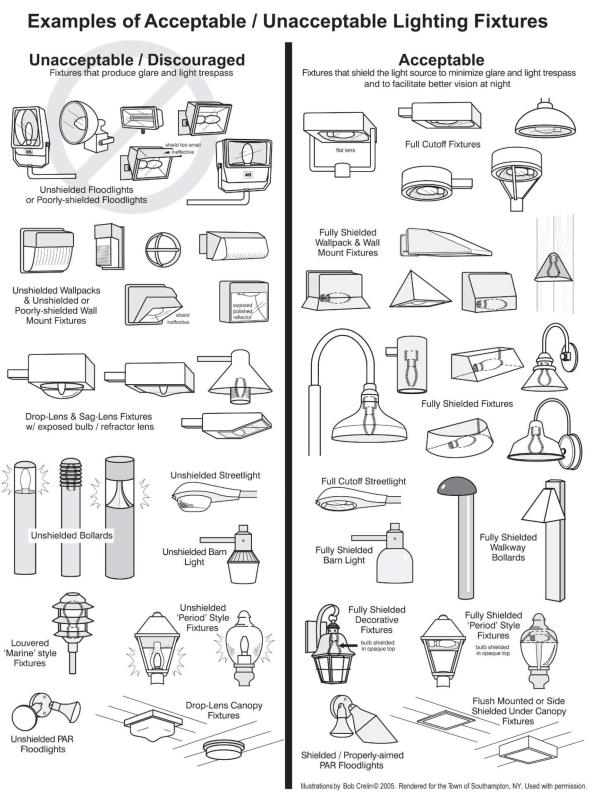
- Heights Of Pole-mounted Luminaires: The pole heights of pole-mounted luminaires shall not exceed twenty feet (20') in commercial or industrial zones and fifteen feet (15') in residential or any other zones.
- Prohibited Lighting: Without limitation to other prohibited luminaires, the use of the following types of exterior lighting is prohibited- except as specifically exempted here or elsewhere in this section.
- Outdoor flood lighting by projection of light above the horizontal plane running through the lowest light-emitting portion of a luminaire, except as permitted in subsection L of this section.
- Searchlights, skybeams, and similar lighting, except as required by first responders in the performance of their duties.
- Lasers, except Class 2 or lower laser light sources as used only for holiday lighting.
- Any luminaire that dynamically varies its output by intermittently fading, flashing, blinking, or rotating. This type of lighting includes strobe lighting.
- Any luminaire that uses mercury vapor lamps or sealed, low-pressure tubes containing inert gasses such as neon.
- Plan Required:
- A lighting plan shall be submitted as part of any development application. Single-family residential lots and agricultural uses shall be exempt from this lighting plan requirement. The lighting plan shall address the following:
- Type of illumination;
- Mounting height above finished grade;
- Streetlights located at the intersections of roads classified as arterials, collectors and minor collectors as identified in the General Plan and at designated school cross walks. If the Public Works Director or the Engineering Coordinator determine that there is a Health, Safety or Welfare issue that can be addressed with additional streetlights, extra streetlights may be required.;
- Source(s) of light;
- Whether the luminaires are fully shielded;
- Correlated color temperature of light sources;
- Inclusion of any equipment intended to actively control the light output of luminaires;
- The number of lumens of light per improved acre, broken down in a manner that indicates:
- Lighting required by the IBC;
- Lighting required by the Federal Aviation Administration (FAA);
- Lighting of walkways or parking lots required to comply with IES recommendations;
- Lighting on a structure not required by IBC or FAA, or in compliance with IES recommendations for walkways or parking lots;
- Landscape lighting, along the height of the landscaping element being lit;
- Uplighting on a structure; and
- Lighting on flags and sign lighting;
- Lighted area for each source light which is proposed;
- A rendering of any pole-mounted street and roadway luminaires;
- Demonstration that all lighting meets the requirements in Section I(3); and
- Calculations or photometric models indicating the maximum luminance value for any illuminated surface of any building or vertical structure.
- Sufficiency of plans. The above required plans and descriptions shall be sufficiently complete to enable the Planning Director to readily determine whether compliance with the requirements of this section can be determined. If such plans and descriptions cannot enable this determination, by reason of the nature or configuration of the devices, luminaires or lamps proposed, the applicant shall submit evidence of compliance by certified test reports as performed by a recognized lab. The Planning Director may use third-party plan reviewers, the cost of whose services shall be charged to the applicant. The Planning Director shall further have the authority to request additional information consistent with the purposes of this section.
- Amendment to approved plans. Any change to approved exterior luminaires or lamps must be approved prior to installation.
- A lighting plan shall be submitted as part of any development application. Single-family residential lots and agricultural uses shall be exempt from this lighting plan requirement. The lighting plan shall address the following:
- Exemptions: The following are exempt from compliance with all provisions of this section, except as noted.
- Public lighting, subject to the requirements of subsection J of this section.
- All temporary emergency lighting needed by first responders only for as long as conditions which warrant the emergency lighting so identified by first responders continue to exist. This includes temporary lighting illuminating the activities of law enforcement, fire and other emergency services, as well as building egress lighting whose electric power is provided by either battery or generator.
- Temporary lighting required to save life, limb or property from imminent peril, provided that use persists only during the hours of the peril.
- Lighting employed during repairs of roads, utilities and similar infrastructure, including unshielded lighting.
- All hazard warning lighting required by any county, state or federal agencies.
- Holiday lighting, for a period not to exceed sixty (60) days, whether consecutive or non-consecutive, in one calendar year. The total quantity of light meeting this definition permitted is not limited, but excessive displays are liable to be declared public nuisances. All holiday lighting must be fully extinguished each night between the hours of 11 P.M. and 5 A.M. during the allowed period.
- Outdoor sports lighting, provided that its design and installation adhere to the version of the International Dark- Sky Association's Criteria for Community-Friendly Outdoor Sports Lighting operative at the time when the land use application is submitted to the County for review.
- Underwater lighting of swimming pools and similar water features provided that such lighting is not oriented in any direction above the horizontal.
- Fossil fuel lighting.
- Lighting required by law to be installed on motor vehicles.
- String, festoon, and similar lighting, provided that the emission of no individual lamp exceeds fifty (50) lumens, and no installation of such lighting exceeds, in the aggregate, three thousand (3,000) lumens.
- Temporary lighting allowed by obtaining a temporary use permit as described in Section 16.24 and subsection K of this section.
- Any form of lighting whose use is mandated or otherwise governed by any legal jurisdiction higher than that of the County.
- Exterior lighting installed on single-family residential lots and agricultural uses, except for light trespass requirements.
- Lighting Standards:
- Compliance with building codes: All exterior lighting luminaires installed in conformance with this section shall comply with all applicable building codes in effect at the time of installation under appropriate permitting and inspection.
- Full shielding required: Unless exempted in this section, all exterior lighting luminaires shall be fully shielded.
- Lighting application illuminance limits:
- Exterior lighting required by the version of the International Building Code (IBC) as adopted in Wasatch County Code Chapter 14.01, including but not limited to points of egress and along the path of travel for the exit discharge from each exit to the public way, shall employ illuminances that adhere to, but not exceed, the IBC-required values.
- For all other exterior lighting applications not governed by IBC requirements, excluding architectural lighting, the illuminance employed in each application shall adhere to, but not exceed, the IES-recommended minimum value for the application.
- With the exception of lighting exempted from regulation in subsection H, item 13 of this section, and permanent lighting of drive aisles and parking areas that adhere to the current IES recommendation found in ANSI/IES RP-8, Table 17-2, in no case shall exterior lighting installed on any site exceed 25,000 lumens per improved acre.
- Spectrum management: The correlated color temperature of light sources shall not exceed 3000 Kelvins.
- Light trespass prohibited: No luminaire shall create conditions of light trespass, except as authorized by this section. Without limitation, single-family residential lots and agricultural uses are prohibited from light trespass.
- General curfew: All exterior lighting shall be extinguished one hour after sunset; or within one (1) hour of the close of normal business hours; or at the conclusion of usual operations and remain extinguished until no earlier than one (1) hour before sunrise. Businesses whose normal operating hours are twenty-four (24) hours per day are exempt from these provisions. Conditional uses may require stricter standards as determined by the land use authority. The following lighting applications shall be exempt from the general curfew:
- Walkway bollard, ramp, and in-step stair luminaires provided with individual motion-sensing switches for resumption of illumination at one hundred percent (100%) of their normal lumen levels for no more than a five (5) minute period per trigger.
- Individual pole-mounted parking lot luminaires provided with individual motion-sensing switches for resumption of illumination at seventy-five percent (75%) of their normal lumen levels for no more than a five (5) minute period per trigger.
- Flagpoles: Property owners are encouraged to not illuminate flagpoles at night, but rather to hoist flags after dawn and lower flags before sunset. If flags are illuminated at night, lighting of up to a total of two (2) flags per property is permitted with the following conditions:
- If nighttime illumination is used, flagpoles with a height greater than 20 feet above ground level shall be illuminated only from above. This may be achieved by utilizing a luminaire attached to the top of the flagpole or a luminaire mounted above the top of the flagpole on a structure within fifteen (15) feet of the flagpole and must comply with all sections of this section. The total light output from any luminaire mounted on top of or above a flag pole shall not exceed 800 lumens.
- Flag poles with a height equal to or less than twenty (20) feet above ground level may be illuminated from below. If ground-level illumination is used, flagpoles may be illuminated with up to two (2) spot type luminaires, utilizing shields or diffusers to reduce glare, whose maximum combined lumen output is 75 lumens per linear foot of pole height, measured from the level of the luminaire above finished grade to the top of the flagpole. Luminaires are to be mounted so that their lenses are perpendicular to the flag pole and the light output points directly toward the flag(s).
- Service station canopies: All luminaires mounted on or recessed into the lower surface of service station canopies shall be fully shielded and utilize only flat lenses or windows. Shielding must be provided by the luminaire itself, and not by surrounding structures such as canopy edges. Illuminance values shall not exceed the IES-recommended minimum values.
- Public Lighting: All exterior lighting owned or operated by the County, a special service district, an interlocal governmental entity, or a municipality, installed after the effective date of this section shall meet all of the following requirements:
- Warranting. Except for street lights, new installations of exterior lighting will only be installed on public properties and rights-of-way upon determination by the County Manager, or that person's designee, that a public health, safety or welfare benefit due to the use of lighting exists. Criteria warranting the use of street lighting are stated in Section 14.02.08.
- Curfew. All public lighting not adaptively controlled must be fully extinguished by 10 P.M., or within one hour of the end of occupancy of the structure or area to be lit, whichever is later, and remain extinguished until no earlier than one (1) hour before sunrise. Street lighting is exempt from this requirement.
- Adaptive controlling. All new installations of exterior lighting on public properties and rights of way must be regulated with adaptive controls such that the lighting of areas is restricted to times, places and amounts required for safe occupancy. Street lighting is exempt from this requirement.
- Additional street lighting requirements. In addition to the above, the following shall be required on all streetlights for consistency of maintenance: 1. Bulb: LED, fifty (50) to seventy (70) watt max. 2. One hundred twenty (120) volt. 3. Toolless replacement and interchangeable ballast. 4. Twistlock photocell. 5. Head: Glass or acrylic, asymmetric. 6. Mounting condition: Concrete base with J bolts. 7. Pole: As required in this section. A different pole may be allowed with the understanding that if the pole needs to be replaced it will be replaced with the typical pole provided by the service provider. Poles other than the typical poles provided by the service provider will be paid for by the homeowners' association or property owners. 8. Fixture head type: Fully shielded with full top aluminum reflector. 9. Fixture style: As agreed to by the County and the service provider in compliance with this title.
- Temporary Lighting: Temporary lighting that does not conform to the provisions of this section may be approved at the discretion of the Planning Director subject to submission of an acceptable temporary use permit for exterior lighting. In addition to the requirements in Section 16.24, temporary lighting is subject to the following requirements:
- Permit term and renewal. Permits shall be valid for no more than thirty (30) calendar days and subject to no more than one renewal, at the discretion of the Planning Director, for an additional thirty (30) calendar days.
- Conversion to permanent status. Any lighting allowed that remains installed after sixty (60) calendar days from the issue date of the permit is declared permanent and is immediately subject to all of the provisions of this section and enforcement provisions of this title.
- Exterior lighting permit contents. A request for temporary exemption to any provision of this section shall contain minimally the following listed information:
- Specific exemptions requested;
- Previous temporary exemptions, if any;
- Duration of time requested exemption;
- Type and use of exterior light involved;
- Type and lumens of proposed lamps;
- A plan with proposed luminaire locations; and
- Manufacturer data sheets for proposed luminaires.
- In addition to the above data, the Planning Director may request any additional information which would enable a reasonable evaluation of the request for temporary exemption.
- Architectural and Landscape lighting: Exterior lighting used to illuminate the walls or architectural features of a building or structure, and landscape lighting used to illuminate trees or other landscape elements, is permitted subject to the following conditions:
- All such lighting shall comply with the curfew requirement and light trespass prohibition specified in this section.
- Luminaires used for uplighting of structures may be unshielded by design provided that their direct light is completely captured by architectural surfaces and not emitted directly into the night sky. In the event that an applicant wishes to illuminate surfaces in this manner, the applicant shall also provide with the lighting plan required in subsection G of this section information on the construction materials of illuminated surfaces, their colors and finishes.
- The luminance of architectural surfaces shall not exceed 27 candelas per square meter. Luminance of a surface shall be measured in a line of sight direction to the observer at an angle perpendicular to the surface being measured. The final measurement shall be the median value of three (3) measurements. A margin of error not to exceed twenty (20) degrees from perpendicular viewing angle is acceptable for purposes of measurement. The device used to measure the luminance shall have a margin of error of not more than ten (10) percent. Measurements associated with enforcement actions may only be taken by the planning director or his designee. Measurements shall be taken at a distance of not less than ten (10) feet from the surface, to avoid anomalies due to polished, reflective or irregular materials.
- Luminaires used for uplighting of trees or other landscaping elements may be unshielded by design provided that their direct light is mostly captured by trees or landscaping and not emitted directly into the night sky. In the event that an applicant wishes to illuminate trees or landscaping in this manner, the applicant shall also provide with the lighting plan required in subsection G of this section, information on the height of the trees or landscaping. The luminaires used for the uplighting of trees or other landscaping elements shall not exceed 10 lumens per vertical foot of the trees or landscaping, and may not exceed 1,000 lumens per improved acre. This limit does not create an additional allowance beyond the site lumen threshold stated in subsection I, item 3c of this section.
Adopted by Ord. 13-15 on 10/16/2013
Amended by Ord. 14-05 on 11/5/2014
Amended by Ord. 23-01 on 4/19/2023
Amended by Ord. 24-13 on 9/18/2024
Amended by Ord. 25-13 on 11/19/2025
16.21.17: USES FOR THE ELDERLY AND PERSONS WITH DISABILITIES
- Residential Facility For Elderly Persons: A residential dwelling unit that offers primary care to a limited number of nonrelated elderly persons may be permitted in any residential zone, except exclusively single-family zones, which such use will be allowed as a conditional use. A residential facility for elderly persons may not operate as a business, and may not be considered a business because a reasonable fee is charged for food or for actual and necessary costs of operation and maintenance of the facility. Residential facilities for elderly persons shall comply with the following requirements:
- The residential facility shall be owned by one of the residents or by an immediate family member of one of the residents, or by a charitable or beneficial organization, or be a facility for which the title has been placed in trust for a resident;
- Shall be consistent with existing zoning of the desired location;
- Shall be occupied on a twenty four (24) hour per day basis by eight (8) or fewer elderly persons in a family type arrangement;
- Shall meet all applicable building, safety, land use and health regulations applicable to similar dwellings;
- Shall provide adequate off street parking space so that residents and visitors will not be allowed to park on the street overnight;
- Shall be capable of use as a residential facility for elderly persons without structural or landscaping alterations that would change the structure's residential character;
- No residential facility for elderly persons shall be established within one mile of another residential facility for elderly persons or residential facility for persons with disabilities, as defined by the Utah state code and the Americans with disabilities act;
- No person being treated for alcoholism or drug abuse shall be placed in a residential facility for elderly persons; and
- Placement in a residential facility for elderly persons shall be on a strictly voluntary basis and not a part of, or in lieu of, confinement, rehabilitation or treatment in a correctional facility.
- Residential Facility For Persons With Disabilities: A residential facility for persons with disabilities shall be consistent with all applicable federal and state laws, and the existing zoning of the desired location, and shall:
- Be occupied on a twenty four (24) hour per day basis by eight (8) or fewer persons with disabilities, in a family type arrangement under the supervision of a house family or manager;
- Conform to all applicable standards and requirements of the department of human services;
- Be operated by or operated under contract with that department;
- Meet all county building, safety and health ordinances applicable to similar dwellings;
- Provide assurances that the residents of the facility will be properly supervised on a twenty four (24) hour basis;
- Establish a county advisory committee through which all complaints and concerns of neighbors may be addressed;
- Provide adequate off street parking space, as required under this title. See section 16.33.13, "Parking Computation", parking computation matrix, of this title;
- Be capable of use as a residential facility for persons with disabilities without structural or landscaping alterations that would change the structure's residential character;
- Not be established or maintained within one mile of another residential facility for the elderly or persons with disabilities;
- Not allow treatment for alcoholism or drug abuse to be performed on the premises of a residential facility for persons with disabilities. This shall not preclude the residence from being used for temporary housing for persons who are being treated for such disabilities on an outpatient basis at an approved facility for such treatment;
- Not allow a person who is violent to be placed in a residential facility for persons with disabilities; and
- Require that placement in a residential facility for persons with disabilities be on a strictly voluntary basis and not a part of, or in lieu of, confinement, rehabilitation or treatment in a correctional facility.
Adopted by Ord. 2002 Code § 16.21.17 on 1/1/2002
Amended by Ord. 2005-18 on 3/9/2006
16.21.18: NONMOTORIZED TRAILS
- All new developments shall provide public trails. Connections must be made with adjoining properties on at least four (4) sides of the development and/or with a complete loop trail system. Public trails and connections must be in compliance with the master trail plan if applicable.
- Back country trails shall be built by a professional trail builder approved by the County. The trail builder must demonstrate sufficiently, through evidence of previously completed projects by either the company, employees, or contracted consultant, experienced in building back country trails to the standards required in Chapter 16.38. Final designs and cost estimates that were not approved with a final plat shall be provided and reviewed and approved or rejected by the County planning department staff prior to construction. County staff shall review the plans for demonstrated compliance with the final plat approval and the county code, including chapter 16.38. An approval or denial of a trail design or a trail builder may be appealed in accordance with Section 2.02.02.
- In limited circumstances a waiver of the improved trail requirement for hard surface trails may be allowed by the land use authority for the subdivision final approval as follows;
- For small scale subdivisions if all the below criteria are met:
- Small scale subdivisions (5 lots or less).
- The development is made up of large lots with a minimum lot size of 5 acres.
- A minimum distance of 1 mile, measured along roadways, to the nearest hard surface trail, or a sidewalk of over 500 feet in length.
- Any further subdividing of lots, if allowed, would require trail improvements to be completed. This would be stated on the plat with a note.
- Due to increased development pressure on areas that have the potential for sewer and water connections the proposed subdivision cannot be within the boundary of any special service district which provides culinary water or sewer.
- Dedication of an easement for the future trail(s) is required unless part of a deeded right-of-way.
- Only residential developments are eligible for the improved trail waiver.
- Small scale subdivisions (5 lots or less).
- For farm preservation developments if all the below criteria are met:
- The trails in the farm preservation subdivision, but outside of the farm preservation parcel, are dedicated and constructed;
- If there is a distance of 1 mile, measured along roadways to the nearest hard surface trail, or sidewalk of over 500 feet in length, the trails in the farm preservation subdivision do not need to be constructed;
- If there is a distance of 1 mile, measured along roadways to the nearest hard surface trail, or sidewalk of over 500 feet in length, the trails in the farm preservation subdivision do not need to be constructed;
- Any trails in the farm preservation parcel are dedicated to the public, and may be built by the County in its discretion; and
- If the farm preservation parcel later develops, the trails shall be constructed by the developer.
- The trails in the farm preservation subdivision, but outside of the farm preservation parcel, are dedicated and constructed;
- An escrow, providing the full cost of constructing the trail, may be used in lieu of construction of the trail, if all the below criteria are met:
- No dedicated trail connections are available within 600 feet of the proposed development;
- The paved public trails in the proposed subdivision are less than 1,200 feet;
- All unbuilt public trails are dedicated to the public by easement, unless included in the dedicated right-of-way;
- A practical difficulty exists with maintenance of the trail or a safety hazard is created by building the trail at this time;
- If a trail is completed within 600 feet of the development providing the escrow, the homeowner's association, or if none, the property owner(s), are required to build the trail, and will be entitled to -the unused escrowed money upon completion of the trail; and
- The trails may be built of require to be built by the County at any time in its discretion.
- No dedicated trail connections are available within 600 feet of the proposed development;
- For small scale subdivisions if all the below criteria are met:
- New developments shall make connections to the Wasatch County trail network when possible.
- Trail plans must comply with the standards provided in Wasatch County trail design standards. See chapter 16.38, "Appendix 3, Wasatch County Trail Standards And Design Guidelines", of this title, and include a sign plan.
- If allowed under UCA 17-27a-508.1, trail maintenance shall be provided by the developer or future homeowners' association (HOA) with provisions made in the covenants, conditions and restrictions (CC&Rs) to fund the necessary maintenance.
- Trail plans must be submitted in hard copy and electronic formats and must show the closest section corner. Electronic files types accepted are: ARC view files in NAD 83 meters and AutoCAD. Hard copy submissions must show the relationship to development units, all stream channels and water sources, roads and slopes.
- Public trail plans shall include the grades of the trails at regular intervals.
- All public trails shall be recorded on the plat as public trails and dedicated to the public.
Adopted by Ord. 2002 Code § 16.21.18 on 1/1/2002
Amended by Ord. 16.15.23 (9)(g) on 3/1/2006
Amended by Ord. 09-16 on 2/25/2010
Amended by Ord. 21-01 on 4/21/2021
Amended by Ord. 25-04 on 4/16/2025
Amended by Ord. 26-03 on 2/18/2026
16.21.19: TRANSITIONAL DEVELOPMENT STANDARDS FOR NONRESIDENTIAL USES BORDERING RESIDENTIAL ZONES
- Where a lot in any business, commercial or industrial zone abuts a lot in any residential zone or use, there shall be provided a landscaped yard of at least ten feet (10') in width along such property line. In addition, the required setback shall increase as building height increases: the building shall be set back at least one foot (1') for each two feet (2') of building height above twenty feet (20').
- Screening of commercial uses adjacent to residential uses shall consist of a mixture of evergreen and deciduous trees, spaced no farther than twenty five feet (25') on center. Sizes of trees shall be in accordance with section 16.21.10 of this chapter.
- Where a lot in any business, commercial or industrial zone abuts a residential zone or use, there shall be provided a landscaped front yard equal to the residence on the abutting property, unless a stricter requirement is listed in the individual zone.
- Any parking lot consisting of four (4) or more spaces is to be screened from adjoining properties in the residential zone or use by a masonry wall, berm or solid fence. There shall be a ten foot (10') landscape buffer between parking areas and residential uses.
- All building and parking lot lighting is to be arranged so that there will be no glare therefrom to the occupants of adjoining property in a residential zone.
- Uses will be strictly prohibited next to a residential zone or use that involves open storage of merchandise or equipment, off premises signs, trade or industry that is noxious or offensive by reason of emission of odor, smoke, gas, vibration or noise.
- No overhead/bay doors are permitted in the wall of the building which faces the residential zone or use if said wall is closer than twenty five feet (25') to the property line.
- All mechanical equipment (i.e., air conditioners, fans, pumps, etc.) shall be located within the building or on the roof with parapet walls. Any mechanical equipment located on the outside of the building within twenty five feet (25') of the nearest residential use/dwelling must have a visual/noise barrier (masonry wall) and/or landscaped berming that completely surrounds the equipment and extends at least one foot (1') above the equipment.
- No loading docks, delivery pick up areas, etc., may be located within fifty feet (50') of a residential use/dwelling. These areas must be screened from the public view with a six foot (6') masonry wall or solid fence.
- No trash container shall be located closer than twenty five feet (25') to a residential property line.
- Fencing between the residential and commercial uses shall be a minimum of six feet (6') in height and shall be a solid wall or fence. Slatted chainlink fences do not meet these requirements.
Adopted by Ord. 2002 Code § 16.21.19 on 1/1/2002
16.21.20: PRIOR CREATED LOTS
Lot or parcels of land which were legally created prior to the enactment of the requirements of this title shall not be denied a building permit solely for reasons of nonconformance with the parcel requirements of this chapter.
Adopted by Ord. 2002 Code § 16.21.20 on 1/1/2002
16.21.21: PROJECTION INTO YARDS
- Sight obscuring fences, not exceeding thirty six inches (36") in height, from the improved road surface may be placed within the front setback or the side setback on a corner lot and may not extend into the road right of way area. Sight obscuring fences or retaining walls that exceed thirty six inches (36") in height shall not protrude into the twenty five foot (25') visibility triangle on the street sides of a corner lot, or near a driveway used for ingress and egress on all lots. (See chapter 16.37, "Appendix 2, Illustrations", figures 5 and 6 of this title.) Fences in rear yards shall not exceed eight feet (8') in height, from finished grade unless a conditional use permit is granted.
- Landscape elements, including trees, shrubs and agricultural crops, except that no sight obscuring plants, trees or shrubs may exceed thirty six inches (36") in height from the improved road surface within the twenty five foot (25') visibility triangle (see chapter 16.37, "Appendix 2, Illustrations", figure 6 of this title), near a corner or a driveway used for ingress and egress. Trees may be permitted if they are kept trimmed so that the area between three feet (3') and eight feet (8') from the improved road surface is kept open and clear within the "visibility triangle" area (see chapter 16.37, "Appendix 2, Illustrations", figure 6 of this title).
- Necessary appurtenances for utility services.
- The architectural elements listed below may project into a required front or rear yard setback up to four feet (4') and up to two feet (2') in required side yards:
- Cornices, eaves, belt courses, sills, buttresses or other similar architectural features;
- Fireplace structures and bays; provided, that they are not wider than ten feet (10') measured generally parallel to the wall of which they are a part;
- Stairways, balconies, porches, fire escapes, awnings and planter boxes or masonry planters not exceeding twenty four inches (24") in height; and
- Porte-cochere over a driveway in a side yard, providing such structure is not more than one story in height and twenty four feet (24') in length, and is entirely open on at least three (3) sides, except for necessary supporting columns and customary architectural features.
- Retaining walls:
- Walls are allowed to project into the front yard setback up to the PUE (public utility easement) as long as all other code requirements are met. Such a wall may also project into the front PUE if the applicant provides letters from all applicable utility companies stating their approval for the wall in the front PUE. All utilities passing through or within the footprint of a retaining wall structure shall be enclosed in a protective casing that extends a minimum of five (5) feet from the wall structure to allow future utility maintenance without disturbing the retaining wall . Multi-parcel retaining walls that run parallel to a road, or along multiple rear yards must comply with section 16.27.20.
- Walls are allowed to encroach into side and rear setbacks and pue's but must be a minimum of one (1) foot from property lines. If encroaching into the PUE the applicasnt must provide letters from all applicable utility companies stating their approval for the wall in the PUE or proof that reasonable attempts have been made to obtain said letters.
Adopted by Ord. 2002 Code § 16.21.21 on 1/1/2002
Amended by Ord. 2003-22 on 12/19/2003
Amended by Ord. 25-16 on 12/17/2025
16.21.22: EQUIVALENT RESIDENT UNITS
Density of developments is a factor of both the sewer and water usage, as well as the size of the structure built in the project. ERU calculations shall be based upon the unit equivalent chart contained in chapter 16.37, "Appendix 2, Illustrations", figure 11 of this title, and in chapter IV.C.5 of the Jordanelle land use plan (JLUP). If a particular unit does not fit the exact description of one of the uses contained within the table, the planning staff shall make a determination of equivalent residential units (hereinafter referred to as ERUs) using the table as a guideline.
Adopted by Ord. 2002 Code § 16.21.22 on 1/1/2002
16.21.23: SWIMMING POOL STANDARDS
- Swimming pools shall be isolated from access by a fence or an enclosure that meets the following requirements:
- Any access gate through the fence or enclosure must open away from the swimming pool, and be self-closing with a self-latching device placed no lower than five feet (5').
- A minimum fence or enclosure height is five feet (5').
- Gaps or voids, if any, are not to allow passage of a sphere equal to or greater than four inches (4") in diameter.
- The outside fence or enclosure surface is to be free of protrusions, cavities or other physical characteristics that would serve as handholds or footholds.
- The fence or enclosure shall be located a minimum of four feet (4') from the nearest edge of the pool.
- If the house walls are used as part of the enclosure, doors must comply with one of the following:
- The residence shall be equipped with exit alarms on those doors providing direct access to the pool; or
- All doors providing direct access from the home to the swimming pool shall be equipped with a self-closing, self-latching device with a release mechanism placed no lower than fifty four inches (54") above the floor.
- Swimming pools and spas equipped with locking covers that meet all of the performance specifications of the American Society Of Testing And Materials (ASTM - F 1346-91) shall be deemed to satisfy the requirement of subsection A of this section.
Adopted by Ord. 2002 Code § 16.21.23 on 1/1/2002
Amended by Ord. 2003-22 on 12/19/2003
16.21.24: RESERVED
Adopted by Ord. 2002 Code § 16.21.24 on 1/1/2002
Amended by Ord. 21-08 on 6/16/2021
16.21.25: BED AND BREAKFASTS
- The property on which the bed and breakfast establishment is located is at least five (5) acres in size. If a building that is older than seventy five (75) years of age and of historical significance applies for a permit, the five (5) acre requirement does not apply, provided there is adequate land for parking to meet the requirements of this title.
- The property front on a street of sufficient size and design to handle the traffic adequately, and has a designation as a "collector" or "arterial" road.
- A report from the building inspector and the county fire marshal has been submitted showing that the building does, or can and will under the current proposal, meet current building and fire codes.
- A report from the health department showing that the building and premises is served by an approved water and sewer or septic service of adequate size, and otherwise does or can be made to comply with current health rules, regulations or laws. If the property line of a proposed bed and breakfast is located within three hundred feet (300') of an available sewer line, the establishment will be required to hook up to the sewer line.
- That adequate off street parking, as required by this title, for all guests and employees of the establishment can be met on the property in an area which screens the parking from the street or nearby neighbors.
- Any outside lighting for the establishment is designed so it will not reflect or direct light onto adjoining property or the night sky.
- The proposed establishment is in accordance with the rules adopted by any appropriate property owners' association, if any, in accordance with their ability to regulate by law.
- The establishment may have no less than three (3) bedrooms for rent on a nightly basis, and no more than eight (8) bedrooms that are rentable. If more than the allowed number of bedrooms are requested, they will not qualify as a bed and breakfast, but may qualify as a hotel, inn, etc., under a different standard.
- Breakfast, brunch or other light snacks or refreshment may be provided only for overnight guests, and must comply with any health code requirements.
- Liquor may not be sold in a bed and breakfast. Overnight guests may provide their own, if desired.
- Receptions for groups not staying overnight on the premises are not allowed, unless the establishment is approved for a reception use in an appropriate zone under a separate ordinance.
- Either the owner or resident manager will occupy the residence full time. Other employees may be hired for cooking, cleaning, etc.
- The guestrooms shall not have any kitchen facilities.
- There must be a distance of at least one-half (0.5) mile between any bed and breakfast, unless in a commercial zone.
Adopted by Ord. 2002 Code § 16.21.25 on 1/1/2002
Amended by Ord. 2003-22 on 12/19/2003
16.21.26: RENTALS OF SINGLE-FAMILY RESIDENCES
Single-family residences will only be permitted to be rented on a temporary (nightly, weekly) basis as allowed by chapter 11.08 of the Wasatch County code.
Adopted by Ord. 2002 Code § 16.21.26 on 1/1/2002
Amended by Ord. 10-14 on 1/7/2011
16.21.27: SINGLE-FAMILY DWELLINGS DESIGN STANDARDS
- Single-family dwellings shall be constructed on permanent foundations.
- The roof of each single-family dwelling should be varied and articulated but may have the majority of the roof flat as long as positive drainage is demonstrated during the building permit process. There shall be an overhang at the eaves of not less than twelve inches (12"). Parapet walls are not permitted for single family residential homes.
- Each single-family dwelling shall not be less than twenty feet (20') in depth at the narrowest point. The depth shall be considered to be the lesser of the two (2) primary dimensions of the dwelling, exclusive of attached garages, bay windows, room additions or other similar appendages.
Adopted by Ord. 2002 Code § 16.21.27 on 1/1/2002
Amended by Ord. 2004-26 on 11/17/2004
Amended by Ord. 18-03 on 6/6/2018
Amended by Ord. 21-07 on 6/16/2021
Amended by Ord. 24-13 on 9/18/2024
16.21.28: WIRELESS TELECOMMUNICATION FACILITIES
- General Provisions:
- The purposes of this section is to:
- Regulate wireless telecommunications services, antennas and support structures, and related electronic equipment and equipment structures to the extent permitted by the State of Utah and Federal Law;
- Provide for the orderly establishment of wireless telecommunications facilities in the county;
- Minimize the number of antenna support structures by encouraging the collocation of multiple antennas on a single structure, and by encouraging the location of antennas on preexisting support structures;
- Establish siting, appearance and safety standards that will help mitigate potential impacts related to the construction, use and maintenance of wireless telecommunications facilities;
- Allow for appropriate service levels while mitigating the visual impacts of telecommunication facilities
- Comply with the telecommunications act of 1996 by establishing regulations that:
- Do not unreasonably discriminate among providers of functionally equivalent services;
- Do not prohibit or have the effect of prohibiting the provision of wireless telecommunications facilities and services;
- Are not based on any claimed environmental effects of radio frequency emissions to the extent that such facilities comply with the federal communication commission regulations concerning such emissions.
- Definitions: The following words shall have the described meaning when used in this section, unless a contrary meaning is apparent from the context of the word:
ANTENNA: A transmitting or receiving device used in telecommunications that radiates or captures radio signals.
ANTENNA SUPPORT STRUCTURES: Any structure that can be used for the purpose of supporting an antenna.
WIRELESS TELECOMMUNICATION FACILITIES: Facilities for the provision of transmitters, antennas, structures supporting antennas, and electronic equipment that is typically installed in close proximity to a transmitter.
COLLOCATION: The location of an antenna on an existing structure, tower or building that is already being used or considered for antenna facilities of another.
GUYED TOWER: A tower that supports an antenna or antennas and requires guywires or other stabilizers for support.
LATTICE TOWER: A self-supporting three (3) or four (4) sided, open steel frame structure used to support telecommunications equipment.
MONOPOLE: A single, self-supporting, cylindrical pole, constructed without guy wires or ground anchors, that acts as the support structure for antennas.
ROOF MOUNTED ANTENNA: An antenna or series of individual antennas mounted on a roof, mechanical room or penthouse of a building.
STEALTH FACILITIES: Facilities which have been designed to be compatible with the natural setting and surrounding structures, and which camouflage or conceal the presence of antennas and/or towers. This term includes, but is not limited to, clock towers, church steeples, light poles, flagpoles, signs, electrical transmission facilities, faux trees and water tanks.
WALL MOUNTED ANTENNA: An antenna or series of individual antennas mounted on the vertical wall of a building or structure.
WHIP ANTENNA: An antenna that is cylindrical in shape. Whip antennas can be directional or omnidirectional and vary in size depending on the frequency and gain for which they are designed. - Applicability: This section applies to all wireless telecommunications facilities except for the following types of communications devices, that may be regulated by other county ordinances and policies:
- Small wireless facilities, although a conditional use, are regulated in 16.21.47.
- Amateur Radio: Any tower or antenna owned and operated by an amateur radio operator licensed by the federal communications commission.
- Satellite: Any device designed for over the air reception of television broadcast signals, multichannel, multipoint distribution service or direct satellite service.
- Cable: Any cable television head end or hub towers and antennas used solely for cable television services.
- The purposes of this section is to:
- Application Requirements: Any person desiring to develop, construct or establish a wireless telecommunications facility shall submit an application for a Conditional Use Permit and Site Plan in compliance with Section 16.23.04. In addition to the Conditional Use Permit application requirements, an application for wireless telecommunication services shall also include the following:
- A map showing the site and all wireless telecommunications facility sites, with detailed description of those facilities, within a two (2) mile radius of the proposed site, whether they belong to the applicant or to another;
- Copies of all licenses and permits required by other agencies and governments with jurisdiction over the design, construction, location and operation of the antenna;.
- A detailed explanation of how the applicant will comply with applicable requirements of subsection C below regarding Priority Of Antenna Site Locations; subsection D below regarding Types of Antennas And Standards; and subsection F below regarding Site Requirements. The County may, require the applicant to submit an impact study from a qualified, third-party radio frequency engineer or the County may hire a third-party engineer, to ensure that the proposed telecommunications facility accomplishes the required, "order of priority" of location requirements as stated in this title.
- A map showing the site and all wireless telecommunications facility sites, with detailed description of those facilities, within a two (2) mile radius of the proposed site, whether they belong to the applicant or to another;
- Priority of Antenna Site Locations: Wireless telecommunication facilities shall be located as unobtrusively as is reasonably possible. Any new wireless telecommunication facility, or addition or alteration to an existing facility shall locate antennas on sites in the following order of priority:
- Co-locate on the same facility where another lawfully existing wireless telecommunication facility is already located; or
- Lawfully existing buildings, structures and antenna support structures; provided, that the buildings, structures or support structures are either:
- Located in the P-160 (preservation) zone not including dwellings; or
- Located in the M (mountain) zone not including dwellings; or
- Located in an Industrial, Highway Services zones, or
- Located on existing accessory structures, not including dwellings, on lots of five (5) acres or larger in a residential zone; or
- Located on multifamily housing and hotels in compliance with this section; or
- Water tanks and other public infrastructures in residential zones
- Monopoles proposed on public or private property in the Jordanelle Basin Overlay Zone (JBOZ), Preservation (P-160) zone, Mountain (M) zone, Highway Services (HS) zone or the Industrial (I) zone.
- Types of Antennas and Standards: There are four (4) general types of antenna structures allowed by this section. The minimum standards are as follows:
- Wall Mounted Antennas:
- Wall mounted antennas may not extend above the roofline of the building or extend more than four feet (4') horizontally from the face of the building.
- The antennas, equipment and supporting structures shall be painted to match the color of the background against which they are most commonly seen. Antennas and the supporting structures on the building shall be architecturally compatible with the building. Whip antennas are not allowed on a wall mounted antenna structure.
- The total area for wall mounted antennas and supporting structures on any one building shall not exceed the lesser of fifty (50) square feet or four percent (4%) of each exterior wall of the building.
- Roof Mounted Antennas on multi-story buildings with flat roofs
- The maximum height of a roof mounted antenna shall be ten feet (10') above the roofline of the building.
- Roof mounted antennas shall be located at least ten feet (10') from the exterior wall of the building or whatever setback is deemed necessary so the antenna is not visible from any public or private right of way.
- Roof mounted antennas, equipment and supporting structures shall be painted to match the color of the background against which they are most commonly seen. Antennas and supporting structures shall be architecturally compatible with the building.
- Monopoles:
- The maximum height of the monopole or monopole antenna shall be sixty feet (60'), although the approving body may grant a total height of up to one hundred feet (100') if the location is not obtrusively visible from residential, commercial and any part of the JSPA area of the county, and the applicant has demonstrated to the satisfaction of the approving body that the additional height is necessary to obtain coverage or allow collocation, and the applicant has taken all reasonable steps to mitigate adverse effects on the surrounding neighborhood.
- Monopoles shall be set back a minimum of one hundred fifteen percent (115%) of the height of the monopole from any residential lot line, measured from the base of the monopole to the nearest residential lot line.
- Monopoles, antennas and related support structures may be required to be painted a neutral color or a color to match the background against which they are most commonly seen.
- Facilities shall be designed to allow for collocation where practicable. Any conditional use permit for any facility may have a condition to allow collocation of other provider's facilities on such terms as are common in the industry.
- Monopoles and towers shall be located at least two thousand feet (2,000') from each other, except upon a showing of necessity by the applicant, or upon a finding by the county that a closer distance would adequately protect the health, safety and welfare of the community and/or the shorter distance will be more visibly screened in a particular instance.
- Monopoles shall not be allowed on ridgelines or open space parcels unless it can be shown by a preponderance of evidence that there are no other options for locating an antenna and that the approval furthers the health safety and welfare of the visitors and residents to Wasatch County and that the impacts of the proposal can be mitigated through a stealth facility proposal or other options including showing that the distance to the antenna structure is such that it will not be visible or conspicuous.
- Stealth Facilities: The height of a stealth facility shall be limited to the maximum height for primary structures allowed in the zone, unless specially approved for a greater height by the planning commission.
- Wall Mounted Antennas:
- Additional Considerations: The planning commission shall also consider the following:
- Height, mass and design of buildings and structures in the vicinity of the facility;
- Whether the facility is located relative to existing vegetation, topography and structures in a manner that optimizes the visual screening;
- The willingness of the applicant to collocate its facility on the facility of another, or to allow others to collocate on applicant's facility on such terms and conditions as are common in the industry.
- Safety:
- Regulations: All operators of CMRS facilities shall comply with the rules and regulations of the federal communications commission (FCC) and the federal aviation administration (FAA) regulations at all times. Failure to comply with the applicable regulations shall be grounds for revoking the conditional use permit approval.
- Licenses And Permits: Applicant will submit copies of all licenses and permits required by other agencies and shall maintain such licenses and permits in good standing and shall provide evidence of renewal thereof upon request by the county.
- All facilities shall be protected against unauthorized climbing by removing the climbing pegs from the lower twenty feet (20') of the facility.
- All facilities shall be fenced in accordance with the condition outlined in the conditional use permit, unless such requirement is determined to be unnecessary in a particular instance.
- Monopoles and towers shall comply with the airport overlay zone requirements and the FAA requirements for height and lighting. If security lighting is used, it shall not be allowed to trespass into any residential areas.
- Abandonment: The county may require the removal of all facilities if the facility has been inoperative or out of service for more than twelve (12) consecutive months.
- Notice: Notice to remove shall be given in writing by certified mail addressed to the operator's last known address, or by personal service.
- Failure to remove the facilities after proper notice has been given is a violation of the terms of this section. The county may initiate criminal and/or civil legal proceedings and may seek a civil injunction requiring the removal of any structures. If the owner does not remove the facilities with the time period allowed in the notice, the county may remove the facilities and the owner shall be responsible for the costs thereof, and failure to remove the facilities after receiving notice to do so automatically transfers ownership of the facilities on the site to the county.
- Site Requirements:
- No outside storage or solid waste receptacles shall be permitted on the site.
- All electronic and other related equipment and appurtenances necessary for the operation of any CMRS facility shall, whenever practicable, be located within or on a lawfully preexisting structure. When a new structure is required, the structure will be harmonious with and blend with the natural features and buildings surrounding such structure.
- The county requires a minimum of one parking space for facilities to allow for service of the facility.
- The CMRS facilities shall be maintained in a safe, neat and attractive manner.
- All sites with a CMRS facility shall be landscaped in accordance with zone requirements where the facility is located.
Adopted by Ord. 2003-22 on 12/19/2003
Amended by Ord. 2005-18 on 3/9/2006
Amended by Ord. 06-15 on 6/30/2008
Amended by Ord. 21-15 on 10/22/2021
Amended by Ord. 24-04 on 6/26/2024
Amended by Ord. 25-14 on 10/15/2025
16.21.29: RESERVED
Adopted by Ord. 2004-26 on 11/17/2004
Amended by Ord. 21-08 on 6/16/2021
16.21.30: SNOW STORAGE IN PUBLIC RIGHTS OF WAY
- Retaining walls or cuts adjacent to roads shall have a ten foot (10') minimum setback from the edge of asphalt. When the road section has a slope of one and one-half to one (1.5:1) or greater, the setback from the edge of asphalt shall be twenty feet (20'). Except for limited landscaping elements, any material or structure (temporary or permanent) that will hinder the removal of snow shall not be allowed in the snow storage area.
- On downhill slopes adjacent to rights of way, there shall be a ten foot (10') minimum clear area. If determined by the county engineering department that more than ten feet (10') is needed for a clear area, the decision will be made at preliminary approval. The snow storage area shall be shown on the county plat as a recorded easement and shall remain open and unobstructed. Except for limited landscaping elements, any material or structure (temporary or permanent) that will hinder the removal of snow shall not be allowed in the easement area.
Adopted by Ord. 2004-26 on 11/17/2004
16.21.31: MAILBOXES IN COUNTY RIGHTS OF WAY
- No structure shall be located within any county right of way except, as noted below.
- Mailboxes may be allowed in county rights of way. Where there is no curb, gutter or sidewalk, mailboxes must be set back from the edge of asphalt a minimum of five feet (5') to the leading edge of the box. Where there is curb, gutter and sidewalk, mailboxes shall be in the park strip and shall not protrude into the edge of the curb or impede pedestrian traffic. Where there is curb, gutter and sidewalk combination, the mailboxes shall be located behind the sidewalk and shall not encroach the sidewalk or impede pedestrian traffic.
No masonry structure that incorporates a mailbox will be allowed in the right of way unless it is in the park strip where there is curb, gutter and walk. If there is no curb, gutter and sidewalk, mailboxes in the right of way must be on a four by four (4 x 4) wood post.
The county will not be responsible for replacing mailboxes within the right of way if destroyed by the county during the regular maintenance of roads or removed to facilitate improvement to the road.
Adopted by Ord. 2004-26 on 11/17/2004
16.21.32: RELOCATION OF BUILDINGS
No persons shall place, move on or affix to the land in any manner any building, requiring a building permit, which was formerly located in another site, unless approval of the Planning Director has first been obtained. The term "building", as used herein, means any structure designed, built, or occupies as a shelter or roughed enclosure for persons, animals or property, and used for residential, business, mercantile, storage, commercial, industrial, institutional, assembly, educational or recreational purposes.
A person seeking approval hereunder shall file an application for such approval in writing upon forms provided by the County, and shall be filed in the office of the planning department as follows:
- Contents: The application shall set forth and contain:
- A description of the building to be moved, giving construction materials, dimensions, number of rooms, conditions of exterior and interior, date of construction, and an estimate of its present value;
- The present location of the building, giving city and street address or legal description at its present site;
- A complete legal description of the lot on which said building is proposed to be located and the street address;
- A plot plan of the proposed new site showing all boundary lines, adjacent lot on all sides, all structures and improvements, means of access, and the location of the building proposed to be moved;
- Photographs of the building showing front, rear and side elevations; and such other photos of the building or site as may help to portray the proposal;
- Any additional information which the Planning Director may find necessary in making a fair determination of whether the application should be approved.
- Standard For Relocation: Before approving any application hereunder, the Planning Director, after recommendation from the Development Review Committee, shall determine that all of the following conditions are satisfied:
- The building will conform to all provisions of the applicable land use regulations at its proposed site;
- The building is of the size and architectural style, which shall be in harmony with existing developments of the neighborhood. If the area into which the building is proposed to be removed is undergoing development or redevelopment, the planning commission may consider developments and improvements planned or anticipated by property owners in the area;
- The building will not have detrimental effects on the environment and property values of the area into which it is to be moved;
- The proposed relocation will not adversely affect any proposed streets or other improvements in the area, nor be in conflict with adopted plan of the county;
- The building and its components can comply or be made to comply with the provisions of all the building codes and standards currently adopted by the Utah state building code commission for new construction.
- Conditional Approval: The Planning Director may approve a proposed relocation subject to such conditions as it may deem warranted by the circumstances. Said conditions may include specified landscaping and exterior finishing, dedication, and improvements of streets and alleys adjoining the property, and time for completion of the work and improvements required. Such conditional approval shall not become effective, nor shall any action be taken thereon, unless and until a performance bond is furnished.
- Performance Bond: If approval is granted subject to performance of conditions by the applicant, a performance bond shall be posted with Wasatch County and shall guarantee the performance of the conditions enumerated by the Planning Director and any work ordered done by the building inspection department.
- Inspection Of Work: The Planning Director shall cause an inspection of the building at its new location to be made on request therefor by the owner or applicant, or at the expiration of the time designation by the Planning Director for completion of the work. Said inspection shall include a determination of compliance with provisions of the current uniform building codes standard act and conditions or requirements imposed by the Planning Director upon approval of the building relocation. No certificate of occupancy and land use compliance shall be issued until the inspection has been made and all code requirements and conditions are complied with.
- Other Permits Required: Approval or conditions approval by the Development Review Committee hereunder is not a building permit, and shall not relieve the applicant of requirements for obtaining necessary building permits or moving permits.
Adopted by Ord. 2004-26 on 11/17/2004
Amended by Ord. 2005-18 on 3/9/2006
Amended by Ord. 19-02 on 3/20/2019
16.21.33: VEHICLES AND CAMPING PROHIBITED; EXCEPTIONS
- Intent: Most camping shelters and recreational vehicles have a life expectancy of somewhat less than conventionally constructed dwellings and do not comply with all of the provisions of the international building code and when located on scattered sites, they tend to depreciate surrounding property values, and they are not designed to be permanently connected to culinary water and waste water services, and thus increase the probability of causing illness and contaminating the water supply as a result of human habitation therein. Therefore, it shall be unlawful to place any camping shelter or recreational vehicles on any lot or parcel of land in Wasatch County and use the same for human habitation, except in compliance with one of the following conditions:
- A recreational vehicle may be temporarily located on a lot, if a permit for a dwelling or project has been issued, and a cash bond, in the amount of two thousand five hundred dollars ($2,500.00), is posted with the county auditor guaranteeing the removal of the mobile home or terminating occupancy of the recreation vehicle once the home is granted occupancy. This bond will be limited to one year, during the time of construction.
- A recreational vehicle or camping shelter located on a tract of land without a main structure may not exceed twenty (20) days in any one calendar year when used for human habitation, unless the property is an established legal camping area, a recreational vehicle park, or a recreational resort park.
- Storage: There may not be more than two (2) recreational vehicles (regardless of whether or not titled to the current property owner or resident) stored on an open tract of land where there is an existing dwelling. On parcels without a main dwelling, storage of recreational vehicles or mobile homes is prohibited.
Adopted by Ord. 2004-26 on 11/17/2004
Amended by Ord. 20-02 on 2/19/2020
16.21.34: RECREATIONAL RESORT PARKS
The purpose of this section is to set forth standards for Recreational Resort Parks including those resorts that have Recreational Vehicle (RV), small rental cabins, and glamping within Wasatch County to facilitate the development of safe and sanitary accommodations for short-term occupants. This use is to allow for a new recreation and tourism use within Wasatch County that generates transient room rental tax through low impact development. For purposes of this section, small rental cabins shall follow the same standards as outlined for RVs unless otherwise specifically noted.
- Definitions:
- Resort Unit: A single recreational vehicle unit or space, a rental cabin, or a single glamping unit or space.
- Size of Park: All Recreational Resort Parks shall be a minimum of 10 acres in size and shall be developed on a legal, conforming lot. Sites that are not considered a legal, conforming lot must obtain subdivision approval prior to receiving approval as a Recreational Resort Park. Glamping parks in the P-160 shall be a minimum of 160 acres.
- Density: A maximum of ten (10) RVs or small rental cabin units per gross acre is allowed. Glamping sites shall be limited to a maximum of five (5) sites per acre. Amenity buildings shall be calculated as commercial ERUs and contribute toward the density for the park.
- Setbacks: The following minimum setback requirements shall apply for all structures, RVs, or campsites. If a conflict exists between these requirements and another setback requirement of Wasatch County Code, the stricter requirement shall apply.
- Minimum setback next to existing residential property line 50 feet
- Minimum setback to any property line 30 feet
- Minimum setback next to public street rights-of-way 50 feet
- Minimum setback from residential, commercial or resort buildings 100 feet
- Minimum landscaped distance between resort units 10 feet
- Minimum distance from RV or tongue to edge of road, alley, or parking aisle 3 feet
- Minimum length for an RV space 40 feet
- Minimum width for an RV space 12 feet
- Minimum total area for an RV space with landscaping 1,200 sq. feet
- Type of Park: The standards set forth in this code require all Recreational Resort Parks to serve both dependent and independent recreational vehicles as defined by Utah Administrative Code R392-301.
- Management: Each recreational resort park owner shall provide management staff that is either on-site or a 24 hour on-call service with a 15 minute response time to the park. Phone numbers for management and on-call service shall be posted throughout the development and in individual units. The management staff will be required to be responsible to handle the daily enforcement and property management for the recreational resort park owner. The recreational resort park owner shall be responsible to ensure that the recreational resort park remains in compliance with the requirements of this section.
- A Wasatch County business license will be required each year for recreational resort parks approved under this ordinance. Said business license may be revoked if compliance with this section cannot be met. Nothing in this section prevents Wasatch County officials or other law enforcement officers from enforcing any applicable law.
- If the recreational resort park provides on-site employee housing, the unit shall meet the following requirements:
- The employee housing unit shall be for single family housing only and shall not be rented, leased, sold or separated from the entire property. A deed restriction shall be filed by the applicant on a form provided by the county that prohibits the rental, sale, condominiumization, subdivision, or separation of the employee housing unit as a separate parcel of property (an illegal subdivision of property).
- All parking for the employee housing unit shall be provided on the property, and not on a public road, and shall be subject to any additional requirements of section 16.33.
- No more than one employee housing unit may be permitted, however, during the master plan approval process, the legislative body may grant an exception for additional employee housing units based on a study, provided by the applicant, demonstrating the need for additional employee housing units for the successful operation of the recreational resort park.
- A Wasatch County business license will be required each year for recreational resort parks approved under this ordinance. Said business license may be revoked if compliance with this section cannot be met. Nothing in this section prevents Wasatch County officials or other law enforcement officers from enforcing any applicable law.
- Roads and Access:
- The main access to a Recreational Resort Park shall be from a road that has direct access to a state highway, arterial or major collector road without going through a residential neighborhood. Said main access road shall meet Wasatch County standards.
- No resort unit shall be accessed from an exterior road. Access to all recreational vehicle spaces shall be from an interior private street of the recreational resort park. There shall be no public streets within a Recreational Resort Park.
- Unless otherwise required by this title or title 14, the minimum road width for all interior resort roads shall be 16 feet for one-way roads and 24 feet of asphalt with 2 foot gravel shoulders for two-way roads. Access from the main park entrance to a glamping unit shall comply with one of the following standards:
- Twenty foot (20') hard surface road that meets fire code standards.
- Ten foot (10') hard surface trail if the glamping park has an onsite emergency services ATV that has been approved by the Wasatch County Fire District and EMS Director.
- All roads shall be paved in compliance with a geotechnical engineers recommendations for the site and as approved by the Wasatch County Engineer. At a minimum, all pavement sections shall comply with the requirements set forth in Title 14 of the Wasatch County Code.
- Parking:
- No on street, on road, or on-trail parking is allowed. Adequate no parking signs or rules shall be posted by the recreational resort owner. Parking shall only be allowed in designated parking spaces.
- One (1) off-street parking space for each RV space is required, in addition to the space for the RV. Two (2) off-street parking spaces are required for each glamping site or small rental cabin.
- One (1) additional off-street parking space for visitors is required for every five (5) resort units, regardless of unit type.
- Parking spaces at each glamping site are not envisioned but may be approved in some cases. Parking for guests is anticipated to be near the main entrance of the glamping park or at the office / check-in area. Guests will park their cars and then hike, or be transported by ATVs or by horseback to their glamping site.
- Recreational Amenities and Common Play Areas:
- Recreational amenities and common play areas for RV uses within a Recreational Resort Park are required. Ten percent (10%) of the total area of the Recreational Resort Park shall be for recreational amenities and play areas which may include but are not limited to: swimming pools, clubhouses, activity centers, restaurants and cafeterias, pavilions, picnic areas, trails, grass play areas, fire pits, playgrounds, horse shoe pits, lakes, and dog parks.
- The recreational amenities and common play areas shall be owned and maintained by the Recreational Resort Park and shall be considered an integral and inseparable part of the resort park. A development agreement will be required that outlines the timing of improvements in connection with the resort.
- Slopes greater than ten percent (10%) may not be used for amenity areas.
- All recreational resort parks with glamping must have a minimum of 75% open, non-developed areas or be included in a master plan that meets this requirement. A large amount of open area is required to provide a quality glamping experience and to promote the rural preservation goals of Wasatch County. Open areas shall be owned by the glamping park and shall be deed restricted from future development. Open areas shall be identified on the site plan and the recorded plat.
- Each recreational resort use, such as glamping or RVs, must meet the required open space independently and may not count off-site open space or open space from another use within the master plan development.
- Community spaces shall be designed to be as contiguous as possible and connected by a trail network.
- Trails within a development must be in accordance with the Wasatch county trail master plan and ordinance and connect to trails planned in adjoining developments or stubbed to property lines if trails are not yet planned in adjoining un-planned property. Trail connections must be kept open to the public for non-motorized travel. This shall not preclude the closing of trails for short periods of time for maintenance, or setting operation during daylight hours only, if so posted.
- A ten (10) foot landscape area around each resort unit shall be provided that shall not be considered as providing the required non-developed open space described above.
- Recreational amenities and common play areas for RV uses within a Recreational Resort Park are required. Ten percent (10%) of the total area of the Recreational Resort Park shall be for recreational amenities and play areas which may include but are not limited to: swimming pools, clubhouses, activity centers, restaurants and cafeterias, pavilions, picnic areas, trails, grass play areas, fire pits, playgrounds, horse shoe pits, lakes, and dog parks.
- Landscape Requirements:
- One (1) tree of a species suitable for the area shall be provided for each resort unit, and shall be located in close proximity to the resort unit. Existing trees on the site may be used to satisfy this requirement.
- The yard area adjacent to neighboring property lines or road rights-of-way and developed areas of the resort shall be densely landscaped with a mix of evergreen and deciduous trees and bermed to visually screen the resort units and developed areas. This requirement may be modified if existing vegetation can be used to meet this requirement and to minimize the impact to the surrounding landscape as long as the intent of visually screening the resort is accomplished.
- Personal Services: A personal services building that contains the following shall be provided:
- A restroom facility for each gender with a toilet for every fifteen (15) resort units.
- A restroom facility with a sink for every two (2) toilets.
- A shower facility with showers equal to the number of sinks.
- A laundry facility.
- Fire Protection:
- Recreational Resort Parks shall provide fire protection, including fire hydrants, in accordance the international fire code and as approved by the Wasatch County Fire District.
- Recreational Resort Parks with more than 30 resort units and/or roads greater than 1,300 feet in length will be required to have a second access for emergencies purposes. The second access must meet fire code standards and shall be approved by the Wasatch County Fire District.
- The Wasatch County Fire District (WCFD) has the right to restrict the use of the fire pits in the glamping sites during very high and extreme fire hazard conditions in the glamping park area. The glamping park manager shall enforce the fire pit restrictions once notified by the WCFD. A landscaping plan or other mitigation plan for glamping sites with fire pits may be required.
- Utility Standards:
- All utilities shall be installed underground and in a recorded utility easement.
- All electrical fixtures, plumbing fixtures, hookups and utility improvements shall be in compliance with applicable county building codes, special service district construction standards and State of Utah health codes at the time of construction.
- Waste Disposal Systems: All wastewater shall be discharged to a public sanitary sewer system whenever practicable. Where connection to public sewer is not practicable, wastewater shall be discharged into an approved onsite wastewater system meeting the requirements of Title R317, Utah Department of Environmental Quality, and local health department regulations.
- Connection to a sewer system is encouraged for all glamping sites. An onsite wastewater system can only be used if the glamping sites are served by an approved water source.
- In remote areas where an approved water source is not available, a vault or earthen pit privy may be used. Privies shall comply with Wasatch County Health Department Rule 17-1 and Utah Administrative Code R317-560. Privies require operation and maintenance by a body politic, typically a special service district.
- Connection to a sewer system is encouraged for all glamping sites. An onsite wastewater system can only be used if the glamping sites are served by an approved water source.
- Water Connection:
- Each RV space shall be provided with a 3/4" connection to a State approved water supply system.
- All Recreational Resort Parks shall provide adequate water rights as outlined in section 16.27.11 of the Wasatch County Code.
- All provided water services for glamping sites shall be connected to a water source approved by the Division of Drinking Water. All water services in the SRZ or JBOZ shall comply with special service district standards. Sites in remote areas may use commercially bottled water that is provided by the guest or by the park owner. Water tanks, water buffalos and other trucked in water is not allowed.
- Electrical Service:
- RVs: Each RV space shall be provided with a service to an approved electrical supply system.
- Glamping: Power is not required to be provided for glamping sites. If provided, each site shall include a service that meets electrical codes and is connected to an approved electrical supply system.
- Dark Sky Lighting: Private realm lighting will be approved on a case-by-case basis by the Planning Commission as part of the final approval process. Exterior building lighting should be located in areas of pedestrian activity or at drop-off zones for vehicular traffic. Security lighting should be considered where necessary, but in no case will large wall pack flood security lighting be acceptable unless in compliance with dark sky standards. All lighting is required to be dark sky compliant and have a full cut-off.
- Solid Waste: All recreational resort parks shall comply with Utah Administrative Code R392-301 - Recreational Vehicle Park Sanitation and the following:
- Solid waste disposal shall be provided with use of covered containers with animal proof lids and shall be stored in an area surrounded on three sides by a masonry block wall.
- A will serve letter from the Wasatch County Solid Waste Department (WCSWD) will be required.
- The recreational resort park shall provide sufficient dumpsters for only twice a week pick up service by the WCSWD.
- In glamping areas, the recreational resort park operator will pick up waste at each site and dispose of it in central container(s) for pick up by the Wasatch County Solid Waste Department.
- Permanent Occupancy: Permanent year round occupancy in a RV space, small rental cabin or glamping site is not allowed. The maximum allowed occupancy in a RV space is restricted to four (4) months. Small rental cabins and glamping sites shall be restricted to 14 days. In no event shall any individual be allowed to reside in the recreational resort park for more than four (4) months in any twelve (12) month period. The recreational resort park shall keep, and the County may audit, records of the recreational resort park to ensure compliance.
- Division of Wildlife Resources Review: The Wasatch County Planning Department may request a review of the Recreational Resort Park site plan by the Division of Wildlife Resources as part of the approval process.
Adopted by Ord. 2004-26 on 11/17/2004
Amended by Ord. 20-01 on 4/15/2020
16.21.35: RESERVED
Adopted by Ord. 2005-18 on 3/9/2006
Amended by Ord. 2005-23 on 3/9/2006
Amended by Ord. 23-21 on 10/18/2023
16.21.36: ILLEGAL OR NON-DEVELOPABLE PARCEL CREATION, AND CORRECTION
- Purpose and Scope
- The purpose of this section is to establish procedures for addressing non-developable parcels or illegally created lots and to provide mechanisms for their correction in compliance with applicable state and county laws.
- This section applies to all parcels within the County that do not comply with all requirements to be a developable parcel under this title.
- General Provisions
- An illegally subdivided parcel, or portion thereof, may not be developed unless corrected to confirm with current county ordinances.
- Illegally subdivided parcels or agricultural splits may create other non-conformities besides the parcel in question. Correction may need to include all affected parcels.
- The burden of proof lies with the property owner to demonstrate that a parcel was legally subdivided by a preponderance of evidence, or if another option that allows for development under this section is used, the burden is on the property owner to demonstrate all the requirements for the applicable option are met by a preponderance of evidence.
- The Planning Department is authorized to create applications that aid in their administration of this section.
- Legal Lot Determination or Correction Application and Process
- If the planning director or his designee determines that there is not readily available evidence that proves that a parcel was lawfully subdivided or altered as a developable parcel, in order to develop the parcel, the applicant must apply for a Lot Determination or Correction Application on a form created by the Planning Department.
- The applicant shall pay all applicable fees with the application.
- At a minimum, the property owner must provide the planning department with the original deed and all subsequent deeds and other documentation necessary to meet the property owner's burden of proof.
- Valid Building Permit: For purposes of this section, a parcel is considered to have a valid building permit if the application demonstrates:
- The tax records from before 1979 show a dwelling, and the structure has not been altered from its design and use since 1979 without a permit and the acreage is the same as it was in 1979, or
- The property has a dwelling that received a building permit approved by the planning department; and that structure has not been altered from its permitted design and use without a permit and the acreage is still the same as when the permit was isssued.
- Certificate of Occupancy: For the purposes of this section, certificate of occupancy means a certificate issued by the building official indicating that a dwelling complies with the applicable provisions of the building code and may be used or occupied for the purpose stated and the acreage has not changed since the issuance of the certificate of occupancy.
- Agriculture Splits
- Since at least 1953, Utah Code has allowed landowners to divide or partition of agricultural land for agricultural purposes, without treating such divisions as "Subdivisions" - a legal classification necessary to create a developable parcel.1 §Utah Code 17-27-27 (1953); §Utah Code 17-79-102(81)(c)(i) (Jan. 1, 2026).
- For purposes of this section, an Agricultural Split is defined as: a bona fide division or partition of agricultural land for agricutural purposes. The property owner proves an Agricultural Split by showing by the preponderance of the evidence that:
- The property existed as a non-conforming lot of record prior to any agricultural splits.
- If contiguous agricultural splits, that are part of a lot of record, as noted in sub section am are in the same ownership and less than all the lots are proposed to be subdivided or developed, a preliminary plan, as required in code section 16.27.10(B,2,f), will be required, which shall include all the parcels planned together and labeled for future phases.
- All resulting parcels must have been continuously on greenbelt for a period of ten years after the split;
- None of the property subject to the split may have a structure on it, unless the structure is an agricultural building pursuant to section 16.01.07(B) and
- For any agricultural parcel resulting from an agricultural split after April 1, 2026 the owner must comply with Utah Code 17-79-708(2) (January 1, 2026, as amended), including the owner of record completes, signs, and records with the county recorder a notice: 1) describing the parcel of agricultural land by legal description: and 2) stating that the parcel of agricultural land is created as land in agricultural use, as defined in Utah Code 59-2-502 (January 1, 2026, as amended), and will remain as land in agricultural use until: 1) a future zoning change permits another use, or current zoning allows a proposed use and 2) all subdivision plat requirements of this title are complied with, and all the applicable land use ordinance requirements are complied with.
- A property may go through multiple agricultural splits, and each one may meet the requirements for an agricultural split oly if all preceding agriclutural splits involving that parcel meet the requirements for an agricultural split.
- An agricultural split does not in itself create an illegal parcel for it or the remainder if the original parcel was a lot of record, but it does not create any developable lots unless expressly allowed in this Section.
- Parcels determined to have been created by an agricultural split may or may not be able to meet code requirements for development, in accordance with this section. As a result, a determination that a legal agricultural split has occurred does not guarantee an ability to develop the parcel beyond its agricultural use.
- A parcel resulting from an agricultural split may be determinded to be -allowed to proceed through a development process without including all other parcels from the original parent parcel if the applicant files a Lot Determination or Correction Application that demonstrates either of the following:
- Valid Building Permit: The parcel received a valid building permit or certificate of occupancy, as defined above, and the parcel has not changed its boundary unless approved through a boundary line agreement approved by the planning department.
- Lawful Subdivision: The parcel meets the requirements for a subdivision, except for the requirement that the parcel was not lawfully subdivided. The applicant must prove all of the following:
- The parcel can be platted as a single lot or multiple lots in conformance with current code requirements including section D.2.b, as demonstrated by a proposed subdivision plat concurrently with the Lot Determination or Correction Application2. The property owners will then need to apply for and receive approval for a conforming subdivision.
- The parcel qualifies as an agricultural split, as defined above, and
- All parcels that were split off of the Lot Of Record parcel from which the subject agricultural split parcel was created must, in addition to D.2.b either meet the minimum frontage requirement fore the zone, or have a recorded easement providing the parcel(s) access that would allow for the owner of the parcel to build, maintain, and use a private access road or conforming driveway built to county standards for a single lot. The feasibility of the road or driveway shall be demonstrated by engineered drawings with an easement, including slope easements, demonstrationg that the road or driveway can be built at a future date. The approval of the subdivision on the subject parcel in no way implies that the other parcels that are divided or partitioned from the non-conforming lot-of-record parcel are developable, may receive building permits, or are compliant with applicable law.
- Since at least 1953, Utah Code has allowed landowners to divide or partition of agricultural land for agricultural purposes, without treating such divisions as "Subdivisions" - a legal classification necessary to create a developable parcel.1 §Utah Code 17-27-27 (1953); §Utah Code 17-79-102(81)(c)(i) (Jan. 1, 2026).
- Correction Options for Illegal Divided Parcels
- The following options may be used to correct illegal or non-developable parcels to allow development:
- Grandfathering: The applicant demonstrates the parcel was created before March 1971 and meets the historic minimum area, width, and frontage requirements of the applicable zoning designation in the applicable land use ordinance at the time the parcel was divided, the parcel has not decreased in size since its creation.
- Verification of Valid Building Permit: The applicant demonstrates the parcel received a valid building permit, and the parcel has the same description and acreage as it was when the building permit was issued except for the lot line adjustments approved in writing by the County.
- Certificate of Occupancy: The parcel has a valid certificate of occupancy, and the parcel has the same description and acreage as it was when the certificate of occupancy was issued except for lot line adjustments approved in writing by the County.
- Compliance with Current Codes: The applicant demonstrates that all parcels created from a non-conforming lot of record that were divided or altered in a manner that did not result in developable lots can be platted in a new subdivision, which meets all current county codes, as demonstrated concurrently with the Lot Determination or Correction Application3. The property owners will then need to apply for and receive approval for a conforming subdivision.
- Parcel Combination: The applicant demonstrates that all parcels created from a non-conforming lot of record that were divided or altered in a manner that did not result in developable lots are combined to result in the same boundaries and acreage as the non-conforming lot of record, and the resulting parcel meets the property access requirements for a non-conforming lot of record.
- The following options may be used to correct illegal or non-developable parcels to allow development:
- Compliance with State Law
- All provisions of this section shall comply with Utah Code Ann. §17-79-101 et seq. (January 1, 2026, as amended) and other applicable state laws.
- Any provision found to conflict with state law shall be deemed unenforceable to the extent of the conflict.
1"Subdivsion" means any land that is divided, resubdivided, or proposed to be divided into two or more lots or other division of land for the purpose, whether immediate or future, for offer, sale, lease, or development either on the installment plan or upon any and all other plans, terms, and conditions. Utah Code 17-79-102(81)(a) (Jan. 1, 2026).
2This can be done as a condition of approval of the Lot Determination or Correction Application, in the reasonable discretion of the planning director or his designee.
3This can be done as a condition of approval of the Lot Determination or Correction Application, in the reasonable discretion of the planning director of his desginee.
Adopted by Ord. 2005-18 on 3/9/2006
Amended by Ord. 2005-23 on 3/9/2006
Amended by Ord. 19-02 on 3/20/2019
Amended by Ord. 26-06 on 4/22/2026
16.21.37: EXPANSION OF COMMERCIAL, INDUSTRIAL OR INSTITUTIONAL USES
Any expansion of an existing structure that is commercial, industrial or institutional in use, may require improvements to the site that conforms to the existing county standards or as determined by the planning director.
Adopted by Ord. 2005-18 on 3/9/2006
Amended by Ord. 2005-23 on 3/9/2006
16.21.38: RESERVED
Adopted by Ord. 2005-18 on 3/9/2006
Amended by Ord. 2005-23 on 3/9/2006
Amended by Ord. 24-13 on 9/18/2024
16.21.39: GRADING PERMIT REQUIRED
No land within Wasatch County may be disturbed, including construction, grubbing, grading, cutting, filling or excavating, without a grading permit issued by the county engineering department. This provision does not apply to agriculture activity or to disturbances of an area less than one thousand (1,000) square feet.
Adopted by Ord. 2005-23 on 3/9/2006
Amended by Ord. 2005-18 on 3/9/2006
Amended by Ord. 09-16 on 2/25/2010
16.21.40: HELIPADS FOR PRIVATE USE
Helipads are not allowed in any zone, unless specifically allowed as follows: Helipads for hospitals (Land Use Classification 6513), the Wasatch County Fire District (Land Use Classification 6723), Wasatch County Sheriff (Land Use Classification 6721) or the County may be permitted if the applicant is in compliance with all requirements of chapter 16.23, "Conditional Use; General Procedures", of this title.
Adopted by Ord. 08-15 on 11/12/2008
Amended by Ord. 09-16 on 2/25/2010
Amended by Ord. 10-14 on 1/7/2011
Amended by Ord. 24-03 on 4/17/2024
16.21.41: SMALL ELECTRIC GENERATION; WIND GENERATORS, TURBINES (4818 SMALL GENERATION UNDER 4800 ELECTRIC UTILITY IN THE LAND USE CHART)
- Purpose: The purpose of this section is to regulate the permitting of wind powered electrical generators for use on a personal basis for noncommercial production of electricity.
- Wind generators/turbines are allowed in any residential zoning district (except the JBOZ and NVOZ) as a permitted use, as long as the parcel is a minimum of five (5) acres and the following requirements are met:
- The wind generator has a maximum height of fifty five feet (55') as measured to the top of the blade from natural grade.
- A wind generator may not violate section 16.27.22 of this title, as currently amended, or applicable county laws pertaining to ridgelines. A ridgeline analysis shall be provided if there is a reasonable basis to believe that there may be encroachment on a ridgeline. For purposes of using section 16.27.22 of this title to determine ridgeline compliance, wind generators shall be considered a structure.
- A galvanized tower and/or neutral colors are required.
- No more that one wind generator/turbine will be allowed per parcel, unless approved as a conditional use.
- Wind generators/turbines may be allowed in any residential zoning district as a conditional use with a lot size between 4.99 acres and one acre, with the following requirements:
- The wind generator has a maximum height of fifty five feet (55') as measured to the top of the blade from natural grade.
- A wind generator may not violate section 16.27.22 of this title, as currently amended, or applicable county laws pertaining to ridgelines. A ridgeline analysis shall be provided if there is a reasonable basis to believe that there may be encroachment on a ridgeline. For purposes of using section 16.27.22 of this title to determine ridgeline compliance, wind generators shall be considered a structure.
- A galvanized tower and/or neutral colors are required.
- The planning commission must find that the use will be consistent with the findings listed in section 16.23.07 of this title, as currently amended.
- No more than one wind generator/turbine will be allowed per parcel, unless approved as a conditional use.
- Wind generators/turbines are allowed as a conditional use in any C (commercial), HS (highway services), OBP (office business park), PF (public facilities) and I (industrial) zoning districts with the following requirements:
- The parcel is a minimum of one acre.
- The wind generator has a maximum height of fifty five feet (55') as measured to the top of the blade from natural grade.
- A wind generator may not violate section 16.27.22 of this title, as currently amended, or applicable county laws pertaining to ridgelines. A ridgeline analysis shall be provided if there is a reasonable basis to believe that there may be encroachment on a ridgeline. For purposes of using section 16.27.22 to determine ridgeline compliance, wind generators shall be considered a structure.
- A galvanized tower and/or neutral colors are required.
- The wind generator must be located a minimum of three hundred feet (300') from the closest residential dwelling off site.
- No more than one wind generator/turbine will be allowed per parcel, unless approved as a conditional use.
- Abandonment: A wind generator/turbine that is out of service for a continuous period of one year will be deemed to have been abandoned. Abandoned wind generators/turbines shall be removed at the owner's expense within three (3) months of receipt of notice.
- Additional Regulations And Prohibitions:
- There shall be no advertising on towers.
- Towers are not allowed to be attached to buildings.
- Towers with guywires are not allowed, unless on property with a minimum of five (5) acres.
- Decibel shall not exceed forty five (45) dBA at the nearest property line.
- All towers, including experimental wind turbines/generators, shall be stamped by a licensed engineer.
- There shall be safety measures to keep towers from becoming a climbing hazard.
- Minimum distance between ground level and blade shall be twenty feet (20').
- Towers shall be set back from all property lines a minimum of one foot (1') for every one foot (1') in height, plus an additional ten feet (10').
- Residential lots smaller than one acre will not be allowed to have a wind generator/turbine.
- No lattice towers are allowed.
- The wind turbine/generators shall meet all the setback requirements for an accessory structure as required in section 16.21.08 of this chapter.
- Critical habitat may be considered in approvals if credible information is provided.
- All wind turbines/generators require a building permit.
Adopted by Ord. 09-09 on 9/25/2009
Amended by Ord. 09-16 on 2/25/2010
16.21.42: SOLAR PANELS
- Purpose: The purpose of this section is to regulate the permitting of solar panels for personal use and encourage renewable energy practices with minimal regulation while mitigating negative effects.
- Flush mounted roof solar panels are allowed as a permitted use in any zone as long as the panels are mounted flush (or minimum parallel separation allowed for cooling) with the roof.
- Structured roof mounted solar panels are a conditional use in any zoning district. "Structured panels" are defined as a panel that does not mount flush with the roof, but has some type of structure to change the angle of the panel.
- Freestanding solar panel structures totaling under 300 square feet are a permitted use in any residential zoning district, with the following regulations:
- A maximum height of fifteen feet (15') from natural grade.
- A maximum area of three hundred (300) square feet.
- The solar panel structure shall meet all the setback requirements for an accessory structure as required in section 16.21.08 of this title.
- Free standing solar panel structures totaling larger than 300 square feet shall be a conditional use in any residential zone with the following additional regulations:
- The lot will need to be at least 1 acre in area.
- The structure is limited to a maximum height of fifteen feet (15') from natural grade.
- The solar panel structure shall meet all the setback and location requirements for an accessory structure as required in 16.21.08.
- There must be a main dwelling on the site.
- Structures and panels should be out of view from the street whenever possible and should not block sightlines or be a reflective nuisance.
- The structure should be appropriately sized to power only the structures on the property. Submittals need to include calculations of energy usage for the property and power output of the system.
- Where possible, panels should first be placed on the dwelling and accessory structures on the lot rather than free standing structures. All applications for free-standing solar panels shall include a detailed explanation of why the panels must be free-standing as opposed to being roof mounted on a dwelling or accessory structure.
- Solar panels require a building permit in all cases.
Adopted by Ord. 09-09 on 9/25/2009
Amended by Ord. 16-04 on 10/5/2016
Amended by Ord. 24-13 on 9/18/2024
16.21.43: EXEMPTIONS FOR SPECIFIC USES
- The following land uses, as identified in the land use classification appendix, may be exempt from specific code requirements: (4800) Utilities, (6721) police protection and related activities; and (6723) fire protection and related activities, (6729) other protective functions and their related activities, NEC (includes, but is not limited to, customs inspection, immigration offices, FBI offices, children's justice centers).
- The land use classifications identified above and related services may be exempt from certain land use requirements if it is determined by the county council, after receiving a recommendation for or against from the planning commission, that the health, safety and general welfare of the citizens of Wasatch County is further protected.
- Exempting the above noted uses from land use requirements means exemptions may be for some or all of the following: frontage, access, acreage, sewer, fees, etc.
Adopted by Ord. 10-08 on 7/6/2010
Amended by Ord. 19-05 on 8/7/2019
Amended by Ord. 20-02 on 2/19/2020
16.21.44: VALUE ADDED AGRICULTURAL PRODUCT REGULATIONS
- Purpose: The purpose for this section is to permit and provide regulations for value added agricultural products and operations in Wasatch County. Value added agricultural products and operations provide community benefits by having fresh and local agricultural products available for purchase by the public and by supporting and assisting local agricultural operations in remaining viable by allowing agricultural products to be marketed and sold directly to the public. Value added agricultural operations are secondary to the agricultural operation and not intended to be large commercial and retail operations due to the potential impact on the residential and agricultural zones in Wasatch County. Value added agricultural operations are intended to promote and maintain local farming and, as such, should mostly sell items produced on the farm or within Wasatch County. Value added agricultural products and operations may be permitted as a conditional use in the A-20, RA-5 and RA-1 zones where the property is actively devoted to agricultural use for at least two (2) successive years, including the preceding tax year, and as long as the regulations in this section are met.
- Requirements: A value added agricultural operation must meet all of the following requirements:
- The required acreage for a value added agricultural operation shall be set by the planning commission as part of the conditional use permit application.
- The use shall be approved as a conditional use. The planning commission shall make the required findings in section 16.23.07 of this title to ensure that all reasonably anticipated detrimental impacts of the proposed use are mitigated with reasonable conditions.
- In the conditional use application, the property owner shall designate the specific value added agricultural product for which the conditional use is requested.
- The total area of the property, including the building and parking, used for the value added agricultural operation shall not exceed two and one-half (2.5) acres.
- Not less than fifty percent (50%) of the value added agricultural product shall be grown or produced exclusively on the property, or on property leased by the applicant, or a combination of both.
- Driveway setbacks, widths and separation shall be in accordance with section 16.33.12 of this title.
- All value added agricultural operations shall be located on a "collector road", as defined in the Wasatch County general plan.
- Setbacks for value added agricultural operations shall be a minimum of sixty feet (60') front, fifty feet (50') sides and fifty feet (50') rear. The planning commission may require additional setbacks as part of the conditional use approval if required to mitigate any reasonably anticipated detrimental impacts.
- The maximum square footage of a value added agricultural operation shall be determined by the planning commission as part of the conditional use permit process.
- Only the value added agricultural products designated in the conditional use permit application and approved by the county shall be produced.
- At least seventy percent (70%) of the value added agricultural products sold at a value added agricultural operation shall be agricultural products. The remaining thirty percent (30%) of the value added agricultural products must be approved by the planning commission as part of the conditional use permit process. The percentage shall be determined based on the value of the products sold.
- Adequate off street parking must be provided in accordance with chapter 16.33 of this title. The surface material of the off street parking must meet the minimum requirements found in section 16.33.16 of this title. The specific surface must be approved by the planning commission or planning staff either as part of the conditional use permit application or business license permit approval process to mitigate any reasonable anticipated detrimental impacts, including, but not limited to, dust, debris and noise.
- The hours of operation must be limited so as not to unreasonably interfere with the character of the surrounding area and the neighboring property owners' peaceful enjoyment of their properties.
- Signs shall comply with the following standards:
- Freestanding signs are only allowed if they are approved as a conditional use and are no larger than 60 square feet (inclusive of the entire structure) and no more than 9' in height. Freestanding signs can only be illuminated i f the source is external and directed downward. Signs should be earth tone in color and no flashing or bright lights are allowed. Free standing signs shall be set back from property lines a minimum of 10';
- Signs may only be located on the front of the structure and may not be fixed to the roof;
- Attached signs shall be no greater than thirty two (32) square feet in area ; and
- Attached signs shall not be illuminated.
- Any new accessory structure constructed for the purpose of providing value added agricultural products for sale must meet all county ordinances, including, but not limited to, setbacks, size and appearance.
- Greenhouses may not be artificially lit between the hours of nine o'clock (9:00) P.M. and seven o'clock (7:00) A.M., unless shielded so as to prevent any light from escaping in any direction.
- Outdoor lighting must comply with section 16.21.16 of this chapter.
- All necessary approvals and permits shall be obtained from the building department, health department and fire district.
- A business license must be obtained.
- All applicable federal, state and local statutes, ordinances, codes and regulations, including, but not limited to, all health and safety regulations, must be complied with.
- A fifteen foot (15') landscape strip shall be installed along the frontage, exclusive of the driveways. A landscape plan shall be provided with the conditional use application and approved as part of the conditional use/site plan approval.
- Value Added Agricultural Product Roadside Stand:
- It is the intent of the legislative body to allow value added agricultural roadside stands in Wasatch County so long as the requirements in this subsection are met.
- A land use permit shall not be required to operate a value added agricultural roadside stand as long as a site plan is submitted first to the planning department, showing the following:
- A written description of the roadside stand;
- The location for the proposed stand;
- Property boundaries, off street parking and access locations;
- Location of temporary or permanent restroom facilities;
- Anticipated number of vehicle trips per day;
- Any proposed lighting or landscaping;
- The location of public roads and rights of way; and
- Existing uses on adjacent properties and locations of dwelling within five hundred feet (500') of the proposed stand.
- Additional requirements:
- Adequate off street parking must be provided or, if none is available, adequate room must exist to park so as not to block, impair or impede traffic;
- A functioning restroom must be within five hundred feet (500') of the value added agricultural roadside stand;
- Hours of operations shall be limited to those hours between dawn and dusk;
- The roadside stand may not be located within a public right of way or road;
- The roadside stand must be removed after the growing season; and
- Lighting may not be used.
- The county may at any time issue a civil or a criminal citation or use any of the remedies in section 16.01.14, "Enforcement Actions", of this title, as currently amended, to enforce the provisions herein.
Adopted by Ord. 11-3 on 7/29/2011
Amended by Ord. 15-02 on 3/18/2015
16.21.45: GROUP TRANSIENT LODGING
- Group transient lodging is prohibited in all residential zones and agricultural zones, unless the property satisfies the requirements enumerated in this subsection:
- Conditional Use: May be allowed as conditional use in the RA-1 and RA-5 if the minimum property area is ten (10) acres;
- Major Collector Or Arterial Access: The property is contiguous to and fronts with access on a major collector or arterial street as designated by the general plan;
- Separation From Other Group Transient Facilities: Each group transient lodging facility shall be separated by at least three-fourths (3/4) mile from another property used for group transient facilities;
- Notification And Public Hearing: Property owner shall conform to the conditional use notification and public hearing process as required by ordinance;
- Mountain Zone: Group transient lodging facility may be allowed as conditional use in the mountain zone when the facility is part of the PD development and conforms with chapter 11.08, "Short Term Home Rentals", of this code. At a minimum the proposed facility shall include:
- Recreation facilities consisting of one or more of the following: 1) pool and clubhouse, 2) basketball courts, volleyball courts, or trails, 3) covered picnic area and cookout facilities, or 4) other similar recreational amenity as approved by the planning commission;
- A written consent of the HOA and allowable by the development's CC&Rs;
- Automobile And Parking Regulations: Adequate off street parking is provided for all guests and employees for the establishment on the property in an area which screens the parking from the street and nearby neighbors. Other than conformance to the parking standard of chapter 16.33 of this title, the following minimum parking requirements shall apply:
- One space per bedroom for overnight rentals;
- One space per employee;
- One space per every four (4) visitors that attend the gathering without overnight stay; and
- Parking along access roads or driveways is prohibited as an overflow area.
- Other Codes; Inspectors: Each transient facility must meet the applicable commercial building, health, and fire codes and has received approval from the county building inspector, health inspector, and county fire marshal;
- Landscape Maintenance: The landscaped areas shall be maintained in a neat, clean, orderly, and healthful condition. This includes proper pruning, mowing, weeding, removal of litter, fertilizing, replacement of dead plants and the regular watering of all plantings;
- Outside Camping: Outside camping (tents and self-contained trailers) may be allowed on the property;
- Noise: To maintain peace, harmony, and tranquility in a neighborhood, outside activities during nighttime shall be kept within the noise level no greater than fifty five (55) dB between the hours of ten o'clock (10:00) P.M. to eight o'clock (8:00) A.M.;
- License; On Call Representative: The owner must obtain a Wasatch County business license for short term rental and is responsible for collection of transient room tax for the establishment. The owner or a contracted management company is responsible to have a twenty four (24) hour on call representative for the establishment;
- License Required: The owner and property manager of each facility shall obtain all licenses, permits, and approvals required by state law or this code prior to commencing the use.
Adopted by Ord. 11-09 on 11/30/2011
16.21.46: INTERNAL ACCESSORY DWELLING UNITS (IADU), CARETAKER ACCESSORY DWELLING UNITS, AND, GUEST UNITS
- Purpose: the purpose of this section is to provide reasonable accommodations for family members, guests, caretaker employees or long term tenants of residents of the County that live in the main dwelling on the site. All stated uses are secondary to the main use and are not intended to significantly increase density, traffic, sewer and water impacts or other impacts to the neighborhood or greater community on a permanent basis. A single-family zoning district's primary use shall remain single-family. Regulations limiting square footage, aesthetics, parking and uses are intended to maintain the character of a single family neighborhood.
- General Definitions of Accessory Unit Types: These 16.21.46(B) definitions are in addition to the 16.04 definitions to aid in quick interpretation of this section. In the event this 16.21.46 definition conflicts with 16.04, 16.04 controls.
- Caretaker accessory dwelling units (caretaker ADU's) are separate residential living quarters that may be attached or detached to the main dwelling unit, and located on the same lot as the main dwelling unit. The Caretaker dwelling must be for the purpose of housing an immediate family member or employee for the purpose of providing a caretaker for larger acreage properties with caretaker needs, which are managing or working on the subject property. Employment on the property shall be for a use that is legally recognized and approved by county zoning ordinance or official county approval, and is limited to farming or ranching operations, property maintenance, or security.
- Guest ADU's are attached or detached dwellings used on a part time basis not intended to be permanent residents for guests of the main dwelling and not short or long term rentals, and is only for housing temporary guests of the primary occupant of the main residence. Guest ADU's are only allowed if they do not alter the character of the neighborhood or create unreasonable impacts to the county.
- Internal Accessory Dwelling Units (IADU's) are units that are secondary units for housing of one additional family within the primary dwelling under the common roofline or in the basement that are deed restricted so they will not become short term rental units.
- Internal Accessory Dwelling Units (IADU's) IADUs are only allowed in compliance with the following restrictions. The allowance of an IADU is intended to provide options for affordable housing and not additional short term rental options. The intent of this ordinance allowing IADU's is for them to be within close proximity to services and not in remote areas of the County. Remote areas of the County are not primarily used for residential purposes and will not be allowed IADU's.
- The application must demonstrate the proposed IADU will meet all the elements in the definition of an IADU.
- IADUs shall only be permitted on lots larger than 6,000 square feet. Mobile homes are not allowed to have an IADU.
- IADU's must be within the footprint of the primary dwelling, and must share common walls. Common walls and roof lines do not include covered or enclosed walkways.
- IADUs are not allowed on any parcel or in any subdivision that is considered non-conforming for any reason or lots that are considered non-conforming lots of record, unless the nonconforming parcel or lot of record has acreage 50% greater than that required by the underlying zone, is greater than 5 acres, and a deed restriction is placed on the property that precludes further subdivision of the subject property.
- No separate meters are allowed for utilities including water, sewer, gas and power. Required utilities (water, sewer, power, gas) shall be connected through the same connections and hookups as the main dwelling unit.
- If connected to an on-site septic system, special conditions may be imposed by the Wasatch County Health department to protect the surface water and groundwater quality from increased degradation above that of a single residence on the property. This may include the use of an alternative on site system for nitrogen reduction, compliance with R317-4-4.2 method 1 for determining lot size, or other property specific requirements. The Health department may also determine to not approve the additional load on the septic system, in which case the application shall be denied.
- The same address and driveway used for the main dwelling must be used for the IADU.
- There must be at least one off-street parking stall provided in addition to the required parking for the main dwelling.
- A building permit issued by Wasatch County is required for any IADU.
- The IADU must fit in with the neighborhood aesthetically, and the primary dwelling must appear to be single family detached dwelling. Impacts, if any, should not detract from the residential nature of the neighborhood.
- A Guest ADU may be converted into an IADU, if it conforms to this section.
- The IADU shall not be rented for less than 30 consecutive days.
- A business license shall be obtained by the primary owner of the property, unless they sign a legal declaration which states they are not renting the IADU, and will obtain a business license if they do start renting the IADU.
- A deed restriction shall be filed by the applicant on a form provided by the county that prohibits the sale, condominiumization, subdivision, or separation of the IADU as a separate parcel of property (an illegal subdivision of property) prior to receiving a certificate of occupancy. It shall state the IADU will not be rented for periods of less than 30 consecutive days and that the owner is required to maintain a business license at any time the IADU is rented.
- Guest Accessory Dwelling Units (Guest ADU's): Guest ADU's are only allowed upon issuance of a conditional use permit in the compliance with the standards of Chapter 16.23 and the following additional restrictions:
- Maximum size of an attached guest ADU if in a basement may be the full area of the basement or if above ground limited to one thousand (1,000) square feet in size. A detached guest ADU may be a maximum of (1,000) square feet or if placed within a larger accessory structure (such as a garage, barn, or arena) the living space of the guest ADU shall be limited to one thousand (1,000) square feet in size.
- A guest ADU shall not be rented.
- No more than one guest ADU may be permitted on a single lot or parcel, the parcel may not have an IADU or a caretaker ADU.
- A guest ADU shall not be allowed on any parcel or subdivision that is considered non-conforming for any reason or lots that are considered non-conforming lots of record.
- The minimum lot size for a guest ADU is one acre if on sewer and 5-acres if on septic unless the underlying zone requires a larger acreage.
- Height of structure, setbacks, and location on property shall conform to all applicable county zoning codes.
- A guest ADU must be connected to a public sewer system or an on-site septic system if 5-acres or more. If connected to an on-site septic system, special conditions may be imposed by the Wasatch County health department to protect the surface water and groundwater quality from increased degradation above that of single residence on the property. This may include the use of an alternative on site system for nitrogen reduction, compliance with R317-4-4.2 method 1 for determining lot size, or other property specific requirements. The Health department may also not approve the additional load on the septic system, in which case the conditional use shall be denied.
- Required utilities (water, sewer, power) shall be connected through the same connections and hookups as the main residence. No separate meters are allowed.
- The guest ADU may not be sold or separated from the entire property unless the property is legally subdivided with official approval of the county.
- A deed restriction shall be filed by the applicant on a form provided by the county that prohibits the rental, sale, condominiumization, subdivision, or separation of the guest ADU as a separate parcel of property (an illegal subdivision of property) prior to receiving a certificate of occupancy.
- All parking for the guest ADU shall be provided on the property, and not on the public road.
- Applicants must provide a letter of approval from the state engineer (for a private well) or public water provider (for public system) for additional water requirements.
- A building permit issued by Wasatch County is required for any guest ADU.
- Applications for detached guest ADU on a lot within a subdivision regulated by a homeowners' or property owners' association shall submit official written notice from said POA or HOA stating that the proposed guest ADU is allowed by subdivision regulations, covenants, and also submit approval from the HOA architectural committee if required.
- The exterior appearance of a newly constructed ADU shall fit in with the neighborhood aesthetically and comply with detached single family home requirements and any other applicable code requirements, and shall be structurally built using materials and designs similar to existing dwellings on the parcel though more modem materials may be used in the event that the materials used on existing dwellings cannot meet building code requirements.
- Caretaker Accessory Dwelling Unit (Caretake ADU's): Caretaker ADU's are only allowed upon issuance of a conditional use permit in compliance with the standards of Chapter 16.23 and the following additional restrictions:
- There is no maximum size limit for the caretaker ADU, however, the caretaker ADU must clearly be incidental to the main use in size, location, and appearance.
- The lot must meet the minimum size requirements of the underlying zone or be a minimum of 10-acres, whichever is larger, and must have a contiguous generally rectangular building envelope of no less than one(1) acre that: a) does not violate any of the physical constraint analysis requirements in 16.27.25 of this chapter, and b) contains no natural or manmade slopes over twenty-five (25%) grade.
- Legally non-conforming lots or lots of record cannot have a caretaker dwelling.
- Approved transient lodges on 10 acres or more may have caretaker dwellings.
- A caretaker ADU may be placed within a larger detached accessory structure (such as a garage, barn, or arena, etc.).
- No more than one caretaker ADU may be permitted on a single lot or parcel.
- Height of structure, setbacks, and location on property shall conform to all applicable county zoning codes.
- A caretaker ADU must be connected to a public sewer system or an on-site septic system. If connected to an on-site septic system, special conditions may be imposed by the Wasatch County health department to protect the surface water and groundwater quality from increase degradation above that of a single residence on the property. This may include the use of an alternative on site system for nitrogen reduction, compliance with R317-4-4.2 method 1 for determining lot size, or other property specific requirements. The Health department may also not approve the additional load on the septic system. In which case the conditional use shall be denied.
- Required utilities (irrigation, water, sewer, power, gas) are encouraged to be connected through the same connections and hookups as the main dwelling unit. If possible no separate meters should be used for utilities, including water, gas or power unless required by the utility provider and approved by the land use authority as part of the conditional use.
- Impact fees will apply for a detached caretaker dwelling.
- The caretaker ADU may not be rented, leased, sold or separated from the entire property. A deed restriction shall be filed by the applicant on a form provided by the county that prohibits the rental, sale, condominiumization, subdivision, or separation of the caretaker ADU as a separate parcel of property (an illegal subdivision of property). The deed restriction shall recite that in the event that the caretaker ADU is not used by a caretaker for farming or ranching operations, property maintenance, security, the caretaker ADU is rented, or the property is subdivided so the acreage is below the required 10 acre minimum the conditional use shall be forfeited.
- All parking for the caretaker ADU shall be provided on the property, and not on a public road, and shall be subject to any additional requirements of section 16.33.
- A caretaker ADU will need to submit for approval from the county water board for additional water requirements that may be necessary to supply water to the caretaker ADU.
- A main residential structure must accompany a caretaker ADU structure. A caretaker ADU may be constructed prior to the main structure with the following conditions:
- The main residential unit must start construction within 5-years of receiving a certificate of occupancy for the caretaker ADU.
- If the main residential structure has not started construction within the 5-year period the conditional use shall be null and void and the applicant will need to apply for a new conditional approval under the current code.
- If the code at the time of the application does not allow for a caretaker dwelling the unit on the property will be considered the main dwelling.
- Applications for a detached caretaker ADU on a lot within a subdivision regulated by a homeowners' or property owners' association shall submit official written notice from said POA or HOA stating that the proposed caretaker ADU is permitted by subdivision covenants and regulations, and also submit approval from the HOA architectural committee if required. The exterior appearance of a newly constructed caretaker ADU shall fit in with the neighborhood aesthetically. Caretaker dwellings shall comply with the standards for single family homes and all other ordinance regulations, and shall be structurally built using materials and designs similar to existing dwellings on the parcel though more modem materials may be used in the event that the materials used on existing dwellings cannot meet building code requirements.
- The planning commission must make a determination that the property proposed to have a caretaker ADU has a justification cause for the caretaker ADU for a use specifically allowed under this section 16.21.46.
- Any violation of this section is a Class B Misdemeanor.
Adopted by Ord. 2012-13 on 11/14/2012
Amended by Ord. 14-05 on 11/5/2014
Amended by Ord. 18-02 on 5/16/2018
Amended by Ord. 19-10 on 11/20/2019
Amended by Ord. 20-02 on 2/19/2020
Amended by Ord. 20-23 on 11/25/2020
Amended by Ord. 21-10 on 9/15/2021
Amended by Ord. 23-20 on 12/20/2023
Amended by Ord. 24-13 on 9/18/2024
Amended by Ord. 25-01 on 1/22/2025
16.21.47: SMALL WIRELESS FACILITIES IN PUBLIC RIGHTS-OF-WAY
- Purpose: The purpose of this section is to establish requirements for the siting and use of Small Wireless Facilities in County-owned rights-of-way in a manner that facilitates the delivery of wireless services within the County while minimizing associated adverse impacts. This includes protecting the public health, safety, and welfare, and, to the extent allowed by Federal law, protecting aesthetic values, by reducing the visibility of Small Wireless Facilities and structures to the fullest extent possible. Techniques include, but not limited to camouflage/concealment, design techniques, and undergrounding of Small Wireless Facilities and associated equipment where possible. This section also regulates Small Wireless Facilities outside of County-owned rights-of-way.
- Definitions: Terms used in this Section but not defined herein shall have the same meaning as the definitions contained in 16.04.02 and 16.21.28(A)(3) of this Title.
AUTHORITY POLE: Means a utility pole owned, managed, or operated by or on behalf of, Wasatch County (the "County"), or the state, a state agency, municipality or town, a public utility district, or an irrigation district.
COLLOCATE: As used in this section, collocate means to install, mount, maintain, modify, operate, or replace a Wireless Facility on an existing wireless support structure or Utility Pole, or, for ground-mounted equipment, adjacent to a wireless support structure or Utility Pole. When the term "collocate" is used in the context of Wireless Facilities outside of publicly owned Rights-of-Way, "collocate" may also refer to installing, maintaining, modifying, operating, or replacing a Wireless Facility on or adjacent to a "structure", as the term "structure" is defined in Section 16.04.02.
LARGE WIRELESS FACILITY: Means any Wireless Facility that does not qualify as a Small Wireless Facility or a Micro Wireless Facility and is governed solely by 16.21.28.
FRANCHISE AGREEMENT: Means an agreement between a provider and the County that sets forth the general terms and conditions pursuant to which the provider may install and operate Small Wireless Facilities within rights-of-way located in the County, or owned by the County.
NEW STRUCTURE: Means, for the purposes of this chapter only, a new utility pole, streetlight, or wireless support structure that must be installed (either replacing a pole previously installed or as a new installation) prior to the placement of a small wireless facility.
OVERLASH: Means to physically tie additional wires or cables to those that are already attached to a utility pole, accommodating any additional strands of cable on existing pole attachments.
PERMITTED USE: Means a use that is permitted in the zone and is not considered a conditional use.
PROVIDER: Means a person that provides wireless services to customers, and/or builds or installs Small Wireless Facilities.
PUE: Means public utility easement.
RIGHT-OF-WAY (ROW): Means the surface of and the space above and below any public street, road, highway, alley, sidewalk, or other way dedicated to public pedestrian or vehicular use, now or hereafter existing as such within the County.
RF: Means radio frequency.
SITE PLAN APPROVAL: Means an approved site plan pursuant to this chapter that authorizes a provider to install and operate Small Wireless Facilities in the ROW, subject to the terms of this chapter and a Franchise Agreement.
SMALL WIRELESS FACILITY (SWF): Means a wireless facility on which each provider's antenna could fit within an enclosure of no more than six (6) cubic feet in volume, and for which all wireless equipment associated with the Wireless Facility, whether ground-mounted or pole-mounted, is cumulatively no more than twenty eight (28) cubic feet in volume.
STRUCTURE: Means, for the purposes of this chapter only, a Utility Pole or a wireless support structure. When the term "structure" is used in the context of Wireless Facilities outside of publicly owned Rights-of-Way, "structure" may also refer to a "structure", as the term "structure" is defined in Section 16.04.02.
UTILITY POLE: Means a pole or similar structure that is in a right-of-way and is or may be used for: wireline communications, electric distribution, lighting, traffic control, signage, or the collocation of a SWF. Utility pole does not include a Wireless Support Structure, a structure that supports electric transmission lines, or County-owned power poles. When the term "utility pole" is used in the context of Wireless Facilities outside of publicly owned Rights-of-Way, "utility pole" may also refer to a pole or similar structure that may be used for: wireline communications, electric distribution, lighting, traffic control, signage, or the collocation of a SWF.
WIRELESS FACILITY: Means equipment at a fixed location that enables wireless communication between user equipment and a communications network, including a radio transceiver, an antenna, a coaxial or fiber-optic cable, a regular or backup power supply, or comparable equipment. Wireless facility does not include the structure or an improvement on, under, or within which the equipment is collocated, or a coaxial or fiber-optic cable that is: a) between wireless support structures or utility poles, b) not immediately adjacent to or directly associated with a particular antenna, or c) a wireline backhaul facility.
WIRELESS SUPPORT STRUCTURE: Means an existing or proposed structure that is in a right-of-way; and designed to support or capable of supporting a wireless facility, including a monopole or tower. Wireless support structure does not include a structure designed solely for the collocation of a small wireless facility, utility poles, or electric power poles owned by the County or by an interlocal entity.
WIRELINE BACKHAUL FACILITY: Means a facility used to transport communications by wire from a Wireless Facility to a communications network.
C. Application Requirements:
1. To receive approval to install Small Wireless Facilities in a County right-of-way, a Provider must submit to the County a complete conditional use permit application. A provider may apply for up to twenty-five (25) SWFs in a single application. The County will not grant conditional use approvals for the installation of Large Wireless Facilities in the ROW.
2. The County shall adhere to the timeframes of approval for Small Wireless Facilitates required by 54-21-302 of the Utah State Code.
3. Application for conditional use approval shall satisfy the requirements contained in 16.27.05(A), and 16.23. SWFs are a permitted use in the P-160 (Preservation) and M (Mountain) zones. For these zones a Provider shall submit a Site Plan application satisfying the requirements of 16.27.05(A). Regardless of the type of approval sought, all applications for SWFs shall include the following plans and documents in accordance with the requirements of this title, or any amendment thereto:
a. Franchise Agreement Required: Before any small wireless facilities may be placed in any rights-of-way or public easements, including public utility easements, a Franchise Agreement will be required before conditional use or site plan applications may be submitted for small cell wireless locations. The Franchise Agreement will be negotiated with the County Attorney and County Manager and will be on a standard form maintained in the County Attorney's Office. The County will not issue any approvals to a Provider until the Provider and the County have executed a Franchise Agreement and all other provisions of this code have been met.
(1) The County shall not enter into agreements that give a Provider an exclusive right to install SMFs in a given right-of-way.
b. Regulatory Approvals: Before offering or providing any services pursuant to the Franchise Agreement, a Provider shall provide proof to the County of any and all regulatory approvals, permits, authorizations or licenses for the offering or provision of such services from the appropriate Federal, State and local authorities, if required, and shall submit to the County upon the written request of the County evidence of all such approvals or licenses.
c. Project Documents: Providers shall include as part of their application:
(1) A site plan showing the location of the proposed SWF(s) including all associated structure(s).
(2) A rendering or photo simulation of the SWF(s) and all associated structures;
(3) A scaled elevation view; and
d. Supporting Documents: Any other supporting drawings and calculations, showing the location and dimension of all improvements and the site where the proposed SWF is to be located. The submittal must include sufficient information to determine compliance with the standards and requirements of this chapter, specifically including information concerning structure height and location within the ROW, easement, or on private property, compliance with the County's intersection and driveway sight distance standards, and compliance with the Americans with Disabilities Act.
e. Pole Load Analysis Required: An industry-standard pole load analysis indicating that the structure on which the SWFs will be mounted will safely support the load and have sufficient strength to accommodate additional small cell equipment loads. The analysis shall be stamped by a licensed engineer.
f. Utility Company Approval: A letter of approval from the owner of the pole if a utility company (and not the County) stating that the Provider may install wireless equipment on that specific pole. The applicant shall also provide a letter of approval from the power provider for the small cell equipment to be installed on the pole.
D. SWFs Outside of County-Owned Rights-of-Way
1. Private Roads: Small Wireless Facilities proposed in privately-owned roads, or transportation easements within a subdivision regulated by a homeowner's or property owners' association are not required to enter into a Franchise Agreement with the County. However, a Provider shall submit official written notice from the association stating that the proposed SWF is allowed in the road or transportation easement by the subdivision. The Provider will also submit approval from the association's architectural committee if required. A Franchise Agreement is required if the Small Wireless Facility is to be placed in a public utility easement or another public easement. If lighting is altered approval is required by the County. All lighting shall be dark sky compliant.
2. Collocation outside a Right-of-Way: Providers are encourage to collate SWFs on structures outside of the right-of-way where possible. If the structure where the collocation is to occur is located on private property, written approval from the property owner shall be submitted as part of the conditional use or Site Plan Approval application.
3. Camouflage: SWFs proposed outside of a right-of-way shall utilize stealth or camouflage as required by 16.21.47(E)(5)(a) of this Title to minimize visual impact.
4. Conditional Use or Site Plan Approval Required: Regardless of where a Provider proposes to place a SWF, a Provider must apply for and receive conditional use approval (or Site Plan Approval in applicable zones) prior to receiving a building or grading permit.
E. Standards Applicable to SWFs: The following standards, requirements, and prohibitions apply to all SWF approvals pursuant to this chapter:
1. Required Licenses and Permits:
a. Valid conditional use or site plan approval;
b. A building permit through the County Building Department;
c. A grading permit through the County Public Works Department if required as County authorization in connection with excavating or performing other work in or along the ROW; and
d. Any other permit, agreement or authorization required in connection with the use of property or facilities owned by third parties.
2. Height: The maximum height shall be:
a. New Structures: New structure height is limited to fifty feet (50'), including the antenna and any new equipment for the SWF mounted on the structure.
b. Collocation: SWFs collated on existing structures are limited to the height of the existing pole but not including the proposed antenna. In no case shall collocated structures exceed fifty feet (50') above ground level.
3. Antenna Height: The antenna of a collocated SWF may not extend more than ten feet (10') above the top of an existing structure with which the SWF is collocated. All equipment permitted to be mounted on the exterior of new or existing structures must be mounted at least eight feet (8') above ground level.
4. Placement: SWFs and new structures must be placed in locations that will not:
a. Obstruct or hinder the usual travel or public safety in the ROW, road, sidewalk, trail or transportation easement;
b. Create a public health or safety hazard;
c. Obstruct, damage, or interfere with another utility facility in the ROW, road, or easement, or the use of such other utility facilities;
d. Materially interfere with the safe operation of traffic control equipment, a sight line or a clear zone for transportation or pedestrians, or compliance with the Americans with Disabilities Act; or
e. Violate applicable laws or legal obligations.
5. Design Requirements: Collocation of SWFs and new structures must be aesthetically similar to existing buildings, structures being collocated on, other light poles and landscaping, including considerations of height, color, style, placement, texture, design and shape. SWFs must be designed to minimize how noticeable they are.
a. Integrated Design: All wireless facilities, equipment, and new structures must employ some or all of the following techniques: screening, concealment, camouflage, or other stealth techniques to minimize visual impacts. The design of small wireless facilities and related equipment, poles, and structures must be integrated with existing buildings, structures, and landscaping and must take into consideration architectural design, height, scale, color, style, placement, and shape.
b. Exposed cabling is prohibited, except for collocations on existing structures where internal cable routing is not feasible (e.g., on a wooden pole).
c. Horizontal protrusions from the structure shall be the minimum distance necessary to meet functional purposes of the small wireless facility, but must not exceed two feet (2').
d. New structures must be of monopole design and match the aesthetics of surrounding poles; lattice structures will not be permitted.
e. New structures must not be made of wood, unless surrounding poles are wood or located in the more rural areas of the County where wooden utility poles are more commonly used.
f. A disconnect such that the County or pole owner may easily shut off radio signals and power while working on the pole is required at each SWF;
g. A maximum of three attachments, including the disconnect and antenna, is allowed at each SWF location. Ground-mounted enclosures, including back-up power supply, must be placed underground. If the applicant proves that an above ground equipment cabinet is required to fulfill the function of the SWF, the equipment cabinet shall be screened using vegetation or other means consistent with the surrounding area and meet clear view requirements.
h. To the extent feasible, equipment shall be installed on the interior of new structures or underground. For either collocation or installation of a new pole, any equipment cabinet shall match the aesthetics of the pole.
i. Lockable Doors: Lockable doors shall be installed in any equipment cabinet to secure equipment stored therein.
j. All pole mounted enclosures shall be securely attached with hardware (not strapped).
k. Power meters are required by the County and must be located such that; (A) interference with other users of the ROW, road, or easement (including pedestrians, motorists, and other entities with equipment in the ROW, road, or easement) is minimized; and (B) aesthetic impact is minimized.
(1) Providers will be solely responsible for establishing electrical power services for their SWFs and for the payment of all electrical utility charges to the applicable electric service provider based upon applicable rates.
l. There shall be no lights on the wireless facility unless required by federal law.
m. Streetlight Pole Requirements:
(1) New Poles: If installation of SWFs requires installation of a new streetlight pole, the new pole must meet County standards and specifications. The new pole shall match the type of surrounding poles, including matching luminaire mast arms to adjacent street lights. Lighting shall comply with Dark Sky requirements contained in section 16.21.16 of this Title.
n. Undergrounding of Lines: All fiber Wireline Backhaul Lines and electrical distribution lines serving SWFs must be located underground, unless the SWF is collocated on an existing structure that already features above-ground lines, and the owner of the existing structure agrees to provide communication or power service to the SWF through those existing lines. In such cases, the new electrical power line shall be overlashed on the existing electrical power line.
o. Additional Requirements: SWFs will be subject to any additional requirements set forth in the applicable Franchise Agreement and conditional use or Site Plan Approval.
F. Modifications to SWFs:
1. A provider may not alter, modify, or enlarge an approved Small Wireless Facility or Utility Pole without prior written consent from the County. To obtain such consent, the provider must submit for approval in accordance with this section 16.21.47 as if for a new Small Wireless Facility, including plans and an industry standard pole load analysis that is stamped by a professional engineer.
2. Applications for modifications to SWFs and structures will be subject to the same standards as applications for collocations.
3. Notwithstanding the foregoing, a provider is not required to submit an application or obtain Site Plan Approval from the County for the following activities:
a. Routine maintenance on a SWF or Utility Pole; and
b. Replacement of a SWF with a Small Wireless Facility that is substantially similar or smaller in size and no larger in size, and must comply with any conditions or other requirements of the approval for the original SWF. Providers must still obtain a grading permit from the County if the work requires closing of sidewalks, vehicular lanes, or excavation in the right-of-way.
c. A Provider shall provide the County, through the Planning Department, with advance written notice of any activity described in this section.
4. The requirement to obtain a grading permit applies even for work that is exempted from the application process pursuant to subsection 3 of this section.
5. Any approved modifications will be documented in a new or amended Approval.
G. Application Fees: Providers shall pay the appropriate fee contained in 04.09.02(C)(3) when making an application for installation of Small Wireless Facilities.
Adopted by Ord. 19-12 on 12/18/2019
16.21.48: SEASONAL SNOWMOBILE RENTAL STAGING AREA
Seasonal snowmobile rental staging areas may be allowed as a conditional use if listed as such under land use number 7419 in the respective zone, and if the applicant shows a preponderance of evidence that the following is true:
- The property on which the seasonal snowmobile rental staging area is located is adjacent to public lands such as US Forest Service or Utah State Parks, providing direct access to public lands and trails. If any adjacent property is private, then written consent from the property owner shall be required for access, use, or accessibility, and any conditional use permit shall require the written consent remain in effect as a condition.
- The conditional use can only be allowed seasonally from November 15 - April 15 of each year.
- If the property is vacant, undeveloped land, then the use shall be seasonal only.
- Temporary fencing with privacy screen shall be required to store equipment. The Planning Commission shall consider the visual impacts of the privacy screen design, and may impose requirements on the fencing to mitigate visual impacts, or find that visual impacts cannot be adequately mitigated. Such temporary fencing shall be erected and removed so as to be in place only within the dates of the seasonal use.
- Portable restrooms are to remain on-site during the entire seasonal use period. Portable restrooms must be approved by the Health Department. Any permanent structure must meet Health Department requirements for wastewater and culinary water.
- Site shall be kept clean of debris and trash at all times. The site plan shall indicate all trash containment measures, chemical storage areas, containment procedures, and spill prevention plans.
- There shall be adequate parking within the property boundaries to sustain the use. Parking surface should meet the following minimum requirements:
- Level or graded with road base, gravel or recycled asphalt;
- Parking area shall be maintained including plowing; and
- Shall be designed to provide clear ingress and egress to the property.
- No commerce shall take place on the property. All business transactions shall occur off-site at a permitted business location.
- Temporary signage may be allowed as part of the conditional use permit. The temporary signage shall not exceed 16 square feet affixed to the temporary fencing and shall not have any permanent footings or structure. Any signage shall also conform to the clear view standards set forth in section 16.26.14.
- Artificial lighting shall not be allowed on the property.
- Use of chemical de-icers is prohibited.
- Clearview standards set forth in section 16.26.14 shall also be met for snow storage and snow removal on the property.
- The applicant has met all requirements for a conditional use permit under Wasatch County Code and Utah Code.
Adopted by Ord. 21-18 on 12/15/2021

