
Wasatch County Unincorporated
City Zoning Code
City Zoning Code
CHAPTER 16
33: GENERAL PARKING STANDARDS
16.33.01: PURPOSE
- To integrate parking areas with other uses;
- Set standards for off street parking;
- Reduce the on street storage of vehicles;
- Enhance traffic circulation onto public streets from parking lots; and
- Require parking lots to be as attractive as possible.
Adopted by Ord. 2002 Code § 16.20.01 on 1/1/2002
Amended by Ord. 12-03 on 2/1/2012
16.33.02: CONFLICT
The following standards are general standards to be applied generally throughout the county. If a specific zone or subdivision type requires a stricter standards than those set forth herein, the more specific zone or subdivision type shall control.
Adopted by Ord. 2002 Code § 16.20.02 on 1/1/2002
Amended by Ord. 12-03 on 2/1/2012
16.33.03: NONCONFORMITY
Any use of property which on the effective date of this chapter, or of any subsequent amendments thereto, is nonconforming relating to off street parking facilities, may continue in the same manner as if the parking facilities were conforming. Such parking facilities shall not be further reduced. If the use is expanded, current parking standards will apply.
Adopted by Ord. 2002 Code § 16.20.03 on 1/1/2002
Amended by Ord. 12-03 on 2/1/2012
Amended by Ord. 23-19 on 12/20/2023
16.33.04: OFF STREET PARKING REQUIRED
At the time of the establishment of any use or at the time any building, structure, or improvement is enlarged or constructed, minimum off street parking shall be provided and permanently maintained, with adequate provisions for ingress or egress by standard sized automobiles as provided and described in this chapter. The actual number of spaces and whether such spaces must be covered are determined using the parking computation matrix in this chapter.
The required off-street parking facilities shall be a continuing obligation of the property owner so long as the use requiring the vehicle parking or vehicle loading facilities continues. It shall be unlawful for any owner of any building or use to discontinue with the required vehicle parking facilities.
Adopted by Ord. 2002 Code § 16.20.04 on 1/1/2002
Amended by Ord. 12-03 on 2/1/2012
Amended by Ord. 23-19 on 12/20/2023
16.33.05: PARKING PLAN REQUIRED
A site plan showing the proposed parking area, number of stalls, aisle layout and accesses thereto shall be provided and approved prior to issuance of any building permit or site plan approval. In addition, the site plan shall clearly show the location, size, shape, design, bumpers, landscaping, lighting, building and use square footages and other features relevant to the proposed parking area.
Adopted by Ord. 2002 Code § 16.20.05 on 1/1/2002
Amended by Ord. 12-03 on 2/1/2012
Amended by Ord. 23-19 on 12/20/2023
16.33.06: COMPUTATION OF PARKING REQUIREMENTS
- Each use shall be calculated separately. The parking requirements for land uses which are not specified in this Chapter shall be determined by the Planning Director. Said determination shall be based upon the requirements for the most comparable use specified herein. Uses not listed in the parking computation matrix may be required to provide a parking analysis for review and approval at the discretion of the Planning Director.
- Off-street parking facilities for one (1) use shall not be considered as providing required parking facilities for any other use unless approved for a parking reduction plan as specified herein. Any request to consider a parking reduction plan shall require submission of a formal parking count justification study prepared by a transportation planner, traffic consultant, licensed engineer, or architect for consideration by the planning commission and legislative body taking into consideration the following:
- Shared Parking: When two (2) or more dissimilar uses are located adjacent to each other and the demand times for parking would not conflict (i.e. one use is considered to be a nighttime use, and the other use is considered to be a primarily daytime use), the maximum number of parking spaces for the lower parking demand use may be reduced by up to 50% as determined by the land use authority. The higher parking demand use shall still provide the full parking requirement. If at any time there is a change in one or both of the uses, additional parking may be required, or the change of use will not be allowed.
- Transportation Demand Management: In addition to the application materials required for a site plan, an applicant shall submit with the parking count justification study, a TDM program that may include, but is not limited to, the following:
- Design of the project site so that landscaped areas, other than those required to meet other provisions of this Title, such as open space or general landscaping, can be converted to provide additional parking areas meeting the full requirements of 16.33.13 if the County determines the parking originally provided under this reduction is inadequate based on parking demand;
- Robust bicycle amenities (e.g. bike lockers, e-bike charging stations, repair facilities) and additional designated bicycle parking areas are provided;
- Proximity of the proposed project to employment centers, mass transit, commercial services, and public recreation spaces;
- Incentive programs for employee uses of transportation modes other than single-occupancy vehicles;
- Designated priority parking for carpool, ride-share, or car-sharing services; and
- Designated loading and unloading areas for micro-transit or shuttle services.
- Any approval of a parking reduction plan, shall be required to record a parking agreement governing the provision of parking for the project. Such agreement shall be between the property owner and the county and shall run with the land and include provisions for:
- Monitoring of parking lot adequacy on at least an annual basis. After a period of five (5) years, during which the number of parking stalls has never been found to be inadequate, the Planning Director may authorize the monitoring report to be reviewed every five years instead of annually;
- Construction of additional parking spaces, implementation of parking demand mitigation measures, or compliance with the full Wasatch County Code parking standards if trip generation rates for uses within the development change from those set forth in the parking count justification study, which may include reductions in seating capacities, useable square footages, or other reductions necessary to achieve compliance;
- A financially responsible party shall be locally available to enforce provisions of the agreement;
- Binding community rules regarding occupancy (including tenant use and hours of operation), parking, other limitations and enforcement procedures and a note on any plat documents, and such rules shall be posted conspicuously on the premises; and
- Failure by the property owner to abide by the agreement shall be unlawful, shall be a zoning violation, and will be subject to enforcement action(s) under this Title.
Adopted by Ord. 2002 Code § 16.20.06 on 1/1/2002
Amended by Ord. 09-16 on 2/25/2010
Amended by Ord. 12-03 on 2/1/2012
Amended by Ord. 23-19 on 12/20/2023
16.33.07: LOCATION OF PARKING FACILITIES
The off street parking facilities required by this chapter shall be located on the same lot as the use except, in cases of practical difficulty the designated land use authority may approve a substitute location which meets the following conditions:
- All or part of the substitute location must be on an adjacent lot, or within two hundred feet (200') from the use, and easily accessible for pedestrian traffic so pedestrians are not required to cross a public street to access the use for which the parking is provided.
- The substitute lot must be in the same possession as the use it is intended to service and must be maintained as long as the use or structure exists. Such possession may be by recorded deed or long term lease and should run concurrently with the life of the building or use. The length of such lease shall be at least twenty five (25) years, but may be terminated or modified earlier with the consent of the county planning department, if the use for which the parking is required is terminated or modified.
- Off-street parking spaces required in connection with a use shall be in the same zone as the use the parking is intended to serve and shall not be located within a different zone, unless off-street parking lots are listed as a stand-alone permitted use within the adjacent different zone.
- Parking shall not be located in required front or side yards.
Adopted by Ord. 2002 Code § 16.20.07 on 1/1/2002
Amended by Ord. 09-16 on 2/25/2010
Amended by Ord. 12-03 on 2/1/2012
Amended by Ord. 19-02 on 3/20/2019
Amended by Ord. 23-19 on 12/20/2023
16.33.08: PARKING DESIGN STANDARDS
All off-street parking facilities shall be built in conformance with the following design standards:
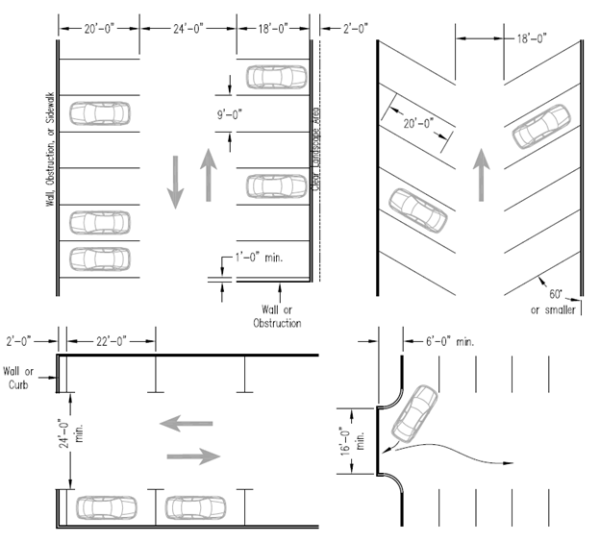
- Each off-street parking space shall be not less than nine feet by twenty feet (9' x 20') for diagonal or ninety degree (90°) spaces, or nine feet by twenty two feet (9' x 22') for parallel spaces, exclusive of access drives or aisles. The planning department may consider allowing up to a two foot (2') reduction in the length of diagonal or ninety degree (90°) parking spaces if bumper guards are placed so that a vehicle can extend over a landscaped area without interfering with the plants or pedestrian passage. No vehicle may protrude over any sidewalk or into the drive aisle. Handicap stalls shall be in accordance with (ADA) Americans with Disabilities Act requirements.
- Notwithstanding the above provisions, commercial and industrial parking lots may have not more than five percent (5%) of the parking spaces designated for motorcycles, which shall measure at least four feet by eight feet (4' x 8').
- Parking located adjacent to walls or other similar obstructions must be one (1) foot wider to accommodate door opening clearance and vehicle maneuverability.
- Additional back-up areas, such as hammerhead, shall be provided at the end of a dead-end parking aisle.
- All bicycle parking facilities shall be built consistent with the Association of Pedestrian and Bicycle Professionals' Essential of Bike Parking guide. In no case shall any bicycle parking be place in a manner that obstructs pedestrian movements, ADA accessibility, or blocks doors.
16.33.08 Figure 1
Adopted by Ord. 2002 Code § 16.20.08 on 1/1/2002
Adopted by Ord. 12-03 on 2/1/2012
Amended by Ord. 23-19 on 12/20/2023
Amended by Ord. 24-13 on 9/18/2024
16.33.09: RESERVED
Adopted by Ord. 2002 Code § 16.20.09 on 1/1/2002
Amended by Ord. 12-03 on 2/1/2012
Amended by Ord. 23-19 on 12/20/2023
16.33.10: LIGHTING
Any lighting used to illuminate off street parking facilities shall be so arranged as to reflect the light away from the adjoining premises and downward so it will not interfere with the night sky. Additional, more specific lighting requirements that must be met are contained in section 16.21.16 of this title.
Adopted by Ord. 2002 Code § 16.20.10 on 1/1/2002
Amended by Ord. 12-03 on 2/1/2012
16.33.11: RESIDENTIAL REQUIREMENTS FOR TWO UNITS OR LESS
- There shall be provided in a private garage, or in a paved area, properly located, sufficient space for the parking of automobiles for each unit in accordance with the parking computation matrix contained in section 16.33.13 of this chapter.
- Mobile home parks shall have two (2) parking spaces for each unit, plus one space for every two (2) units in a guest parking area. Guest parking areas shall be grouped to conveniently serve various blocks within the park.
- No portion of a required front yard, other than driveways leading to a garage or properly located parking area, shall be paved or improved to encourage or make possible the parking of vehicles thereon. Parking of vehicles shall not be allowed except in such designated improved parking areas, and shall not be permitted in areas intended to be landscaped.
- Access to parking spaces and private garages used in conjunction with dwellings of two (2) or less units shall be limited as follows:
- Driveways on a corner lot shall be located a minimum of forty feet (40') from any street intersection as depicted in 16.37.06.;
- No driveway approach shall be located closer than ten feet (10') from a side lot line, excepting an approved shared driveway with the adjoining property.;
- Driveways on private property may be constructed up to the side or rear property line as long as drainage, maintenance, snow removal and adequate soil stability can be addressed on the property. Driveways located over utility easements may be removed and replaced at the owner's expense if access to the easement is required.
- In developments denser than one unit per acre, driveways shall be paved with a hard surfaced material such as concrete, asphalt, brick or stone pavers. In rural type developments, less dense than one unit per acre, compacted road base may be used. Recreational vehicle pads constructed adjacent to a paved driveway may be constructed of a dust and weed free gravel, compacted road base or similar surface.
- Lots shall be limited to one driveway approach per frontage, except where a second driveway approach is specifically approved by the planning department as long as the lot has a minimum frontage at the right-of-way of 150', can meet the side setbacks for driveways and curb cuts into the streets have a minimum separation of 50'. If approval of a second driveway creates a safety hazard (i.e., blind corners, proximity to intersections etc.) of any kind the Planning Department may deny the request. Lots that are double fronted with one frontage on a major collector street, or corner lots with frontage on a major collector street, shall not be permitted to have a drive approach on the major collector street. Upon approval by the planning department, corner lots with frontages on two (2) local streets may have two (2) drive approaches to create a circular driveway if such approval would increase safety.
- Driveways shall be a maximum of thirty feet (30') wide.
Adopted by Ord. 2002 Code § 16.20.11 on 1/1/2002
Amended by Ord. 08-15 on 11/12/2008
Amended by Ord. 12-03 on 2/1/2012
Amended by Ord. 26-04 on 2/18/2026
16.33.12: COMMERCIAL, INDUSTRIAL, INSTITUTIONAL OR RESIDENTIAL OF THREE OR MORE UNITS
- Specific Parking Requirements For Commercial, Industrial, Attached Residential Of Three Or More Units And Institutional Uses: For new buildings, changes in occupancy, enlargement or increase in seating capacity, floor area, or guestrooms of any existing building, a minimum number of parking spaces shall be provided as described in the parking computation matrix in section 16.33.13 of this chapter.
- Circulation Within Parking Area: Circulation within a parking area shall comply with the following requirements:
- Access to driveways shall be provided for ingress to and egress from all parking and loading facilities. Each parking and loading space shall be easily accessible, and not interfere with normal vehicular or pedestrian movement;
- Forward travel to and from parking facilities from a dedicated street or alley shall be required for all uses. The parking area shall be adequate to facilitate the turning of vehicles to permit forward travel upon entering a street. No parking will be allowed that requires vehicles to back onto a public street;
- Access to all off street parking facilities shall be designed in a manner which will not interfere with the movements of vehicular and pedestrian traffic.
- Driveway Locations:
- Access shall be accommodated by not more than one driveway for the first one hundred fifty feet (150') of frontage. A second driveway is allowed if it is shared with a neighboring parcel. For lots over one hundred fifty feet (150'), two (2) driveways are allowed, as long as all aspects of the code are met. Shared driveways, as a second means of access, are encouraged;
- No two (2) of these driveways shall be closer to each other than fifty feet (50'), and no driveway shall be closer to a side lot line than twenty feet (20') unless the access is shared or as granted by the legislative body, after a recommendation for or against by the planning commission, based upon a belief that the design is appropriate in a particular situation for safety or aesthetics;
- No driveway shall be located closer than eighty feet (80') from the point of intersection of two (2) major collector streets, or fifty feet (50') from the intersection of a major collector street. For all streets other than major collectors, this distance shall be fifty feet (50'). Measurements shall be done as set forth in this chapter;
- Lots with frontages of one hundred fifty feet (150') or less are encouraged to share access to streets with adjacent lots;
- The design and location of all driveways entering a state highway shall be done as required by the Utah department of transportation. Approval of the driveways shall be provided to the county in writing prior to the issuance of any building permit.
- Width Of Driveway: Each driveway shall have a width of not less than twenty feet (20'), nor greater than thirty five feet (35') on local and collector streets. On major collector streets, the width shall not exceed forty feet (40') in width. The measurement of driveways shall be taken at right angles to the centerline of the driveway at the front lot line and shall be from face to face of the curb radii.
- Parking Lot Improvement Requirements: Every parcel of land hereafter used as a public or private parking area, including commercial parking lots and automobiles, farm equipment, or other open air sales lots and residential developments of three (3) or more units, shall be developed and maintained in accordance with the following requirements:
- Parking areas shall be properly graded for drainage, surfaced with concrete, asphalt, brick or stone pavers. Such surface must be maintained in good condition, free of weeds, dust, trash and debris;
- The sides and rear of any off street parking area for more than four (4) vehicles, which adjoins a residential or institutional building, or is contiguous to a residential zone, shall be effectively screened by light-tight masonry wall or solid fence. Chainlink fences with inserts shall not be considered acceptable. Such wall or fence shall be of a height determined by the planning department not to exceed eight feet (8') in height, and shall be maintained in good condition. Additional landscaping and buffering shall also be required;
- Lots shall be provided with wheel or bumper guards at least two feet (2') from a lot line or building, located so that no part of a parked car will extend beyond the parking space unless permitted over a landscaped area;
- Parking lots shall be buffered from the street with a minimum of ten feet (10') of landscaping, unless specified differently in the individual zones as per section 16.21.10 of this title;
- Parking lots must have a landscaped island at least eight feet (8') wide by eight feet (8') in length every sixteen (16) spaces to break up the linear appearance of a parking lot. Islands must be landscaped with trees and shrubs, as well as a ground cover, that will help inhibit weed growth. Islands may not be combined into larger, but fewer islands. Islands may be larger, but may not be fewer in number, and must be distributed throughout the parking lot at least every sixteen (16) spaces;
- For condominiums, townhomes, apartments or other residential uses, at least fifty percent (50%) of the off street parking shall be enclosed or have an overhead covering that compliments the architectural design of the main structure. All off street parking shall be located in close proximity to the unit to which it is associated;
- Parking lot aisle width shall be in conformance with parking design standard;
- There shall also be at least ten (10) spaces located at any community or recreation center within the park. There shall also be at least one oversized space for every three (3) mobile home units in the park, located in a designated recreational vehicle parking area.
- Loading Space Requirements: No building shall be designed, erected, altered, increased in capacity, used or occupied, and no land shall be used or occupied for manufacturing, storage, warehousing, goods display, department store, grocery store, hotel, hospital, mortuary, laundry, dry cleaning or other uses similarly involving the receipt or distribution by vehicle of materials or merchandise, unless adequate off street loading space is provided therefor.
- Loading Space Berth Requirements: Each use for which off street loading space is required shall provide the number of loading berths necessary to properly service that use, plus an area or means for adequate ingress and egress to each berth. Loading space location will not require trucks to back into the loading space from a public street. When the use is on property adjoining a residential use or zone, said loading areas shall be screened from the adjoining property by a light-tight masonry wall or solid fence at a height to be determined by the planning department, but not exceeding eight feet (8'). A landscape buffer shall also be required by the planning department that shall be properly maintained in perpetuity by the property owner. Loading space berth areas and circulation areas shall be paved with asphalt or cement.
- Loading Space Location: Off street loading space shall be located on the same site or lot as the use for which it is provided. No loading space shall be designed, arranged or used where all or part of the space would permit loading, unloading or service from a public street or sidewalk.
- Guest/Recreation Vehicle Parking: For residential development containing attached units or single-family planned unit developments of twenty five (25) or more units, recreation vehicle parking areas may be required by the legislative body, after a recommendation for or against by the planning commission.
Adopted by Ord. 2002 Code § 16.20.12 on 1/1/2002
Amended by Ord. 2003-22 on 11/24/2003
Amended by Ord. 09-16 on 2/25/2010
Amended by Ord. 10-14 on 1/7/2011
Amended by Ord. 12-03 on 2/1/2012
Amended by Ord. 23-19 on 12/20/2023
16.33.13: PARKING COMPUTATION
Except as otherwise provided in this Title, the number of off-street parking spaces shall be as follows:
| Use Description | Off Street Spaces Required | |
|---|---|---|
| Residential: | ||
| Single-family dwelling | 2 per unit up to 3 bedrooms 0.25 per bedroom above 3 (Minimum of 2 spaces are to be covered) | |
| Multi-family | 2 per unit up to 3 bedrooms and an additional .25 for each bedroom above 3 bedrooms (Minimum of 1 space per unit is to be covered) | |
| Accessory dwelling | 1 for up to 2 bedrooms, plus 1 for each additional bedroom | |
| Assisted living facilities | 1 for every 2 units, plus 1 for each 4 units for guest parking (Minimum of half [50%] of the spaces are to be covered) | |
| Retirement housing, single-family detached or attached without medical assistance | Treat the same as single-family dwelling (Minimum of half (50%) of the spaces are to be covered) | |
| Batching apartment | 2 stalls per bedroom, plus 1 stall for visitor parking per unit, unless designated for single room (1 person) occupancy, for which there shall be 1 stall per bedroom and 1 per unit for visitor parking | |
| Bed and breakfast - small | 1 for each bedroom, plus 1 for each daytime employee, plus 2 for residential family | |
| Commercial: | ||
| Adult entertainment (SOB) | 1 space for each 3 seats, based upon design capacity | |
| Art gallery | 1 per every 200 square feet of display area, plus 1 for each employee | |
| Auction house | 2 per every 100 square feet of floor area | |
| Auditorium, stadium or theater (indoor or outdoor) | 1 for every 3 seats, based upon design capacity | |
| Automobile and machinery sales and service garages (not gas stations) | 2 spaces plus 1 space for each 400 square feet of display area, plus 1 space for each daytime employee | |
| Bank, savings and loans, drive-in banking | Minimum of 20 spaces with 10 additional spaces for every teller cage over 3. For drive-in windows, 1 space in use, plus 3 in each approach lane. (Minimum of 1 space per 200 square feet of floor area on main floor and 1 space per 500 square feet on any other floor) | |
| Barber/beautician shop | 2 spaces per station | |
| Bowling alley | 4 spaces per alley, plus 1 for each employee, plus any required based upon accessory uses such as cafes or taverns | |
| Cafes, cafeterias, restaurants | 1 space for each 100 square feet of floor space including outside seating areas. | |
| Car wash | 3 spaces in each approach lane to each wash bay | |
| Churches | 1 space for every 3 seating spaces in the main assembly room(s), based upon the maximum occupancy | |
| Commercial recreation, i.e., billiard halls, etc. | 1 space for each 2 persons such place is designed to accommodate, including participants and spectators, based upon design capacity | |
| Dance halls | 1 space for every 3 persons based upon maximum occupancy | |
| Daycare center, children's nursery or preschool | 4 spaces, plus 1 space per 500 square feet of floor area | |
| Drive-in, fast food establishments | 1 space per 100 square feet of floor area but not less than 10 spaces | |
| Drive-up windows | 1 space in use plus 4 in the approach lane. If drive-up window traffic interferes with traffic on a road or unreasonably interferes with traffic flow in the parking lot, the drive-up window shall be closed. | |
| Dry cleaner | 1 space per employee, plus 3 spaces for customer use | |
| Gas stations and convenience stores | 1 space per pump site, plus 1 space per employee. If convenience store also, add 3 spaces per 200 square feet of store area | |
| Golf courses | 4 spaces per hole, plus 1 per daytime employee | |
| Hospitals, sanatoriums, convalescent hospitals, nursing homes | 1 space for each 2 bed capacity, plus 1 space for every employee at the highest shift | |
| Laboratory research, industrial, manufacturing, wholesale establishments | 1 space per employee on the highest shift | |
| Laundromat | 1 space per washer/dryer combination | |
| Library | 5 spaces for every 500 square feet of public area, plus 1 for each daytime employee | |
| Liquor store | 1 space for every 200 square feet, plus 1 space for each daytime employee | |
| Lounges, nightclubs, private clubs or taverns | 1 space for each 100 square feet of floor space | |
| Medical clinics | 4 spaces per staff doctor, physician's assistant, or nurse practitioner, plus 1 for each daytime employee | |
| Mortuary or funeral parlor | 1 space for every 3 persons based upon design occupancy | |
| Motel, hotel, inn | 1 space for each unit and 1 space for each daytime employee, plus 1 space for every 200 square feet of assembly area(s) | |
| Nursery or garden supplies | 1 space for each daytime employee, plus 1 space for each 300 square feet of display area(s) | |
| Offices | 1 space per 200 square feet of office floor space, including reception area(s) | |
| Post office | 1 space per vehicle used by the operation, plus 1 space per employee at the highest shift, plus 10 spaces for customers | |
| Professional office, i.e., legal, employment, insurance, travel, photo, real estate, etc. | 1 space per 200 square feet of office floor space, including reception area(s). | |
| Retail | 1 space for each daytime employee, plus 1 space for each 200 square feet of floor area(s) | |
| Skating rink | 1 per 200 square feet in the building | |
| Swimming pool | 1 per 100 square feet of pool area, plus 1 for each daytime employee | |
| Schools: | ||
| Elementary | 2 spaces for each classroom | |
| Middle and junior high | 2 spaces for each classroom | |
| Senior high | 1 space for each 4 seats provided in the auditorium or classroom, whichever is greater | |
| College | 1 space for each 3 seats provided in the classroom or auditorium, whichever is greater | |
Adopted by Ord. 2002 Code § 16.20.13 on 1/1/2002
Amended by Ord. 2003-22 on 11/24/2003
Amended by Ord. 10-14 on 1/7/2011
Amended by Ord. 12-03 on 2/1/2012
Amended by Ord. 16-05 An Ordinance of Wastach County, Utah Amending Title 16 of the Wasatch County Code section 16.33.13 Parking Computation Matrix Revising the Commercial Office Parking Requirements and Providing an Effective Date. on 10/5/2016
Amended by Ord. 22-22 on 12/7/2022
Amended by Ord. 23-19 on 12/20/2023
16.33.14: RESERVED
Adopted by Ord. 2002 Code § 16.20.14 on 1/1/2002
Amended by Ord. 12-03 on 2/1/2012
Amended by Ord. 24-13 on 9/18/2024
16.33.15: RESERVED
Adopted by Ord. 2002 Code § 16.20.15 on 1/1/2002
Amended by Ord. 12-03 on 2/1/2012
Amended by Ord. 24-13 on 9/18/2024
16.33.16: PARKING FOR VALUE ADDED AGRICULTURAL OPERATION
- Applicability: Parking for value added agricultural operations permitted under section 16.21.44 of this title, as currently amended, shall be in accordance with this section or other sections in this chapter.
- Surface: Nothing contained in this chapter shall be construed as requiring asphalted surfaces for value added agricultural operations. However, parking areas for value added agricultural operations must have at a minimum a road base surface so as to minimize dust and debris from vehicles. The specific surface must be approved by the planning commission or planning staff either as part of the conditional use permit application or business license permit approval process so as to mitigate any reasonably anticipated detrimental impacts, including, but not limited to, dust, debris and noise.
- Off Street Spaces Required: The number of stalls required for a value added agricultural operation shall be the same as the requirement for "retail" in section 16.33.13 of this chapter, as currently amended.
Adopted by Ord. 11-3 on 7/29/2011
Amended by Ord. 12-03 on 2/1/2012

