
Wasatch County Unincorporated
City Zoning Code
City Zoning Code
CHAPTER 16
41: APPENDIX 6, THE JORDANELLE SPECIALLY PLANNED AREA JSPA
16.41.01: PLANNING CONTEXT SUMMARY
1.1 Vision and Purpose. The Vision and Purpose for the JSPA Specially Planned Area ("JSPA") is:
1.1.1 To Create a Globally Recognized "Year Round" Resort.
1.1.2 To Preserve and Enhance the Beauty and Environmental Integrity of the JSPA.
l .l .3 To Support expand the Deer Valley Ski System. The Deer Valley Ski System is a year round recreational amenity that supports skiing, hiking, and mountain biking. A summary of the Ski Portals in relation to the density areas is shown in Plan B-5 in the Plan Book.
1.1.4 To Provide Amenities Supporting the Year Round Activities. In addition to providing enhancements to the Deer Valley ski system, the JSPA will provide amenities and activities year round for the guests and resident s including:
A. Density Pods, as defined below in Section 2.1.2.6, designed in a manner to supportrecreational activities of the area;
B. The quality standards of Four (4) and Five (5) star hotels;
C. Encourage Eighteen to thirty six ( 18-36) holes of golf and a private golf club;
D. Fitness and wellness centers;
E. A comprehensive trail system which connects with the Wasatch County, Summit County, Park City, Deer Valley, Jordanelle State Park and Wasatch Mountain State Park trail systems;
F. The potential for enhanced lakeside access and facilities for boating, fishing and water sports;
G. Retail, dining and entertainment;
H. Transit and people-moving systems to access all major Density Pods and Resort Features and amenities;
I. Adequate and accessible parking;
J. A wide range of well segmented real estate products;
K. Gathering places that create a vibrant village center area; and
L. Immediate access to local recreational activities that are unparalleled.
1.1.5 To Continue the Deer Valley Quality Design Precedents. Deer Valley has established a design standard which is referred as the '·Mountain Resort Look." Its high quality and harmonious relationship to the environment have set it apart from other resorts. The JSPA will continue this tradition.
1.1.6 To Maintain the Deer Valley Quality Operating Standards. The JSPA will maintain the high standards of service and food quality of Deer Valley. It is anticipated that the use of Deer Valley's name by participant s in the JSPA will be subject to a license agreement with the Deer Valley Resort. The effect of the license agreement will be to require high design and operating standards consistent with the Deer Valley "brand." It is encouraged that applicants work with Deer Valley to meet these standards.
1.2 Design Objectives. Implementation Guidelines and Standards have been created to guide the development of the JSPA, to achieve the "Vision," and to encourage a consistent and unified high level quality of land planning, architecture and public spaces.
1.2.1 Long Development Periods. These Implementation Guidelines and Standards contemplate that the development of the JSPA, will occur in multiple phases and will occur over a long period of time. Flexibility is built into the approval and development process to allow developers to adapt to the changing expectations and requirements of buyers and market conditions. However the overall consistency for quality is still required.
1.2.2 Specific Objectives of the Implementation Guidelines and Standards. The goals of the Implementation Guidelines and Standards and more specifically the "Design Guidelines” contained in Sections 5.0, and 6.0 and 7.0 therein, are to:
A. Encourage responsible land use practices based on central and compact growth centers rather than scattered development;
B. Respect the natural topography of the land and existing vegetation;
C. Respect the architectural heritage of the region and the quality design precedents set by Deer Valley while allowing for flexibility of product types that;
D. Create Utah-inspired themes complete with pedestrian oriented streets and public spaces, humanly scaled buildings, appropriate landscaping, and rustic detailing;
E. Create a long term operationally sound resort that encourages multi-modal transportation options within the JSPA without having to drive;
F. Foster the development of year-round amenities and activities that are complementary of each other and consistent with the "Vision;"
G. Design the JSPA to meet the transportation and parking needs of the entire community, both public and private, properly address snow removal and infrastructure maintenance;
H. Create a "green" community, where practical, that is designed to conserve energy and resources;
I. Create a community that is "connected," where visitors and residents will have access to high bandwidth services
1.2.3 Density Guidelines and Procedures. The JSPA Implementation Guidelines and standards allow for density transfers from one Zone to another Zone. This may take place under strict circumstances which will allow developments to adapt to market conditions. Existing densities within the JSPA remain entitled unless densities are formally changed through a process approved by the Wasatch County Council. The clarification on density adopted by Wasatch County, in the original RSPA appendixes 1, 2 and 3 remains in-force, within the J SPA. Valid commercial densities not counted toward maxi mum E RU’s cannot be moved outside of village centers to create higher residential densities.
1.2.4 Parking Guidelines. The Design Guidelines and Standards create new JSPA parking standards, based on a shared use benchmark standard as described in Section 3.4 that will provide sufficient and well designed parking.
1.2.5 Moderate Income Housing. Based on Chapter 16.30 of this Title is a requirement for projects in the JSPA.
1.3 Jordanelle Specially Planned Area. As described in detail in Section 2.1 herein, these Implementation Guidelines and Standards have been prepared to provide the details for the practical implementation of the purposes and objectives of the JSPA. Capitalized terms not otherwise defined herein shall have the meanings set forth in Title 16, the JBOZ and the Jordanelle Basin Land Use Plan.
1.3.1 Wasatch County Code. Other than those items specified herein, these Implementation Guidelines and Standards do not modify the Wasatch County Code, Ordinances or Regulations (including any prior Density Determinations adopted pursuant to the Wasatch County Code) or other provisions in the Jordanelle Basin Land Use Plan or the Jordanelle Basin Overlay Zone. In the event of any inconsistency between the terms of the Wasatch County Code, Ordinances and Regulations and these Implementation Guidelines, the terms and provisions of these Implementations Guidelines and Standards shall control.
1.3.2 Building Codes. The Implementation Guidelines are to be interpreted in a manner which is consistent with the required building regulations of the Wasatch County Code, the International Building Code, international Fire Code and applicable ADA standards.
1.3.3 Relationship to the Jordanelle Basin and Jordanelle Basin Overlay Zone. See Plan B-3 in the Plan Book. The JSPA is established as a new overlay zone for the area. All land uses and Equivalent Residential Unit (ERU) densities established in this ordinance and its accompanying exhibits are deemed as permitted maximums unless conditions are met to allow additional target (bonus) density as established in the associated book of exhibits. Property owners will not be allowed to use the JBOZ in the area of the JSPA overlay. However, coordination and conformance with the JSSD standards is required.
1.3.4 Modification of Implementation Guidelines. The Implementation Guidelines and Standards are intended to guide development within the JSPA throughout the long-term development of the property contained therein. It is anticipated that modifications to the Implementation Guidelines and Standards take place in order to respond to changes in circumstances and market conditions. The Wasatch County Planning Director is auth01ized to review and approve minor modification s to the Implementation Guidelines and Standards within the JSPA. The Planning Director shall refer major modifications to the JSPA Planning Commission (JSPA PC) for review and approval. Any proposals to amend the JSPA guidelines may not lessen the "Mountain Resort Look" intended quality or main purposes and vision of the JSPA. Any proposed modification to the Implementation Guidelines and Standards which is denied by the Planning Director or JSPA Planning Commission may be appealed by the applicant to the Planning Commission. Major modifications shall require amendments to the code.
1.4 Ownership. The land ownership in the JSPA is summarized in Plan B-6 in the Plan Book.
1.4.1 The JSPA area may expand to include the annexation of land owned by Mayflower that includes the area from Bald Mountain to the Bonanza Flats reso1t area. This property has no current entitlements for development within this code and the JSPA will be implemented only after approval of a master plan, density determination and physical constraints analysis as outlined in 16.27 for large scale developments.
1.5 JSPA Boundaries and Annexation. Annexation is anticipated in the future. A1mexati on should take place based on the following criteria:
- A. Adjacent to, or with in the JSPA boundary.
- B. Must support or be resort activity based and connected to the existing resort area.
- C. Recreation al amenities or connections to resort village such as: Skiing, biking, hiking, urbanized trails, golf, and lake access.
- D. Maintains the “Mountain Resort Look” and JSPA design guidelines.
Annexations into the JSPA shall be recommended by the JSPA Planning Commission and approved by the legislative body.
1.6 ERU Calculations. Calculations of ERUs will be made pursuant to the procedures described and the chart in 2.1.2.1 of this code.
Adopted by Ord. 2002 Code § 16.41.01 on 1/1/2002
Amended by Ord. 06-07 on 6/26/2008
Amended by Ord. 09-16 on 2/25/2010
Adopted by Ord. 14-07 on 11/5/2014
Amended by Ord. 17-11 on 8/16/2017
16.41.02: LAND USE PLAN
2.1 Jordanelle Specially Planned Area ("JSPA "). The area covered by the JSPA is shown in Plan B-4 in the Plan Book. The JSPA will be created and codified as section 16.15.07 of the Wasatch County Planning, Zoning and Development Code. The JSPA contains approximately four thousand two hundred sixty eight (4,268) acres of property and may include mixed uses including, single-family homes, condominiums, hotels, time-shares, retail shops, recreational facilities and other support amenities consistent with the development of a resort area. Because specific densities, height limitations, parking requirements, setbacks and other requirements of the Wasatch County Planning, Zoning and Development Code may not accommodate the development details of the JSPA, certain provisions of the Wasatch County Planning, Zoning and Development Code are modified by these Implementation Guidelines and Standards to accommodate the development of the JSPA.
2.1.1 JSPA Zones. The Zones, as defined below, within the JSPA are designed to meet the needs of the JSPA from an operational standpoint and to provide flexibility for developers over the long term development pe1iod contemplated by the JSPA, while still addressing sound planning and density management.
2.1.2 Definitions Pertaining to the JSPA. For purposes of the J SPA, the following definitions shall apply:
2.1.2.1 Equivalent Residential Unit (ERU) means the number of residential equivalents to determine density based on sewer, water and square footage of a structure. ERU calculations shall be based upon the Unit Equivalent Chart shown below. This does not, however, prevent the Special Service District from charging more for sewer and water. Notwithstanding the chart, if a use is proposed that is not specifically listed in the chart, the Planning Staff shall assign an ERU value to said use which most closely compares to the requested use. This assigned value may be adjusted by the Legislative Body, after a recommendation for or against by the JSPA Planning Commission, during the application review process as long as the adjustment is consistent with Title 16 and the General Plan.
CONFIGURATION | NOTES | ERU'S |
Motel/Hotel Room | Not to exceed 500 sf including bathroom areas, but not including corridors outside of room | .25 |
Hotel Suite or One Bedroom Apartment | Not to exceed 700 sf including bathroom areas but not corridors outside of rooms | .33 |
One Bedroom Apartment or Two Bedroom Apartment | Not to exceed 1000 sf and not to exceed 1 1/2 baths | .50 |
Apartment/Condo | Not to exceed 1500 sf | .75 |
All Other Residential Uses | Over 1500 sf | 1.00 |
| Commercial | For each 2,000 sf of gross floor area or for each part of a 2,000 sf interval | .86 |

2.1.2.2 Unit means a dwelling unit within the meaning of Section 16.04 of the Wasatch County Code.
2.1.2.3 Property or Properties means a parcel or parcels of real property with in the JSPA owned by a single owner or entity as shown on Plan B-6 in the JSPA Plan Book. It also includes all government agencies or utility companies that own property or easements within the JSPA (even though they may not be shown on Plan B-6 or listed in the Exhibits).
2.1.2.4 Setbacks means the distance from the right-of-way line or the property lines before any structure can be built. Chimneys or protrusions in a building may be located within the setback to the edge of the building eaves.
2.1.2.5 Story is defined in the Wasatch County Planning, Zoning and Development Code Section 16.04.
2.1.2.6 Density Pods means areas of development as shown in the Target Studies shown in plans B-9, B-12, and B- l 5. Each Density Pod has associated with it a specified number of target Equivalent Residential Units (ERU's). Wasatch County, the landowners and the JSSD understand that these Density Pods are subject to change in size and location as the JSPA master plan develops from the concept stage to the buildable site. The Legislative Body will approve these changes in the Zones, as contemplated in Section 2.1 .2.13 below, as the process evolves and more specific planning is undertaken for each of the Properties.
2.1.2.7 FSR (Floor Space Ratio) means the ratio or percentage computed by the floor surface area (or floor plate) of the main floor of a building, as the numerator, and the size of the building parcel, as the denominator.
2.1.2.8 Gross Density means the total Units in a Property, Density Pod or Zone, divided by the acreage in that Density Pod or Zone.
2.1.2.9 Building Height is defined in the Wasatch County Planning, Zoning and Development Code in Section 16.04.
2.1.2.10 Net Density of a Property or Zone is a measure of density determined by computing the total number of Units ERU's of the Property, or Zone and dividing it by the total acreage in that Property, or Zone less the area of any public rights-of-ways, private roads, easements.
2.1.2.11 Resort Village means a center or hub for the JSPA. In order to qualify as a Resort Village, the area or Zone must have the attributes listed below. A Resort Village can be located in more than one (1) property:
A. Required components;
Significant retail, dining and entertainment facilities;
A minimum of six hundred fifty (650) Units (not ERU's) in the Resort Village Zone; Must be designed to accommodate the 2,400 Foot Rule; (refer to section 3.1) and
A pedestrian walk experience which links Resort Features (as defined in Section 2.1 .2.23) and other elements in the Resort Village together and serves as a focal point for visitor foot traffic.
Community Space Requirements - Each Resort Village shall have a minimum of one acre community space/plaza with 1/2 acre minimum in a consolidated area.
And other resort components.
B. A minimum of four of the following planned uses:
Condominiums;
Hotels;
Timeshares or other shared-ownership products; Private residence clubs;
Town homes;
Single-family homes;
Seasonal Community Housing or other Affordable Housing meeting the Affordable Housing Requirements of Wasatch County; or
Meeting facilities.
2.1.2.12 RSPA means Resort Specially Planned Area per previous ordinance passed in 2002.
2.1.2.13 Potential Densities means the areas shown in plans B-10, B- 11 and B- 12, each having its own height, use and density limitations ("Classifications") for each of the Zones. It is understood by Wasatch County, the landowners and the JSSD that these Zones, which are based on the potential density, are subject to change in size and location as the JSPA master plan is refined from concept to the developed sites. The JSPA Planning Commission (as defined in Section 2.1 .2.26) and the Wasatch County Planning Staff will approve these changes as more specific planning is undertaken by each of the Properties.
2.1.2.14 RSF - Residential Single Family is a Classification of a single family housing element in the land use plan and is generally located on the perimeter of the neighborhood areas. These areas are for larger lot development and shall contain detached or attached housing. Housing in the RSF Zone should respond to the topography and the amenities located near the site. Larger lots are typically located on steeper slopes to allow any necessary grading to be integrated back into land form.
Permitted Uses. Permitted uses within this RSF Zone are limited to single family detached, or townhouse housing, IADU's, Guest ADU's, recreational, trails, golf, ski runs, and parks.
Density per Acre. Net Density shall not exceed six (6) Units per acre.
Building Heights. Building heights are limited to thirty five (35) feet or two and one half (2+) Stories, whichever is greater. Heights will be determined as noted in Title 16. Setback. Front setbacks shall be taken from the back of curb or edge of road asphalt (if there is no curb). All other setbacks shall be taken from property lines. Regulations under the Wasatch County Planning, Zoning and Development Code for the construction on hillside slopes shall apply. The side yard minimum setback shall be ten (10) feet; the rear yard minimum shall be twenty (20) feet and front yard minimum setback shall be twenty (20) feet. Larger houses should be located a minimum of thirty (30) feet from roads to avoid dominating the streetscape and to provide room for sensitive grading transitions into existing slopes. Small units should typically be set closer to the front setback line to provide a more urban pedestrian environment.
2.1.2.15 RMD -- Residential Medium Density. The RMD Classification is provided to allow for greater density with access to recreational facilities such as golf courses, ski runs and with access to the Resort Villages.
Permitted Uses. Permitted uses within this Zone include residential attached, town homes, timeshares and other shared ownership facilities, condominiums, apartments, flats, seasonal employee housing, recreational, trails, ski runs, parks and other Resort Features.
Density per Acre. The maximum Gross Density for the RMD Zone is six (6) to twenty (20) Units per acre.
Building Height. Building heights are limited to forty two (42) feet or three and one half (3+) Stories, whichever is greater. Heights shall be as per Title 16 building height regulations and measured from existing natural grade.
Setback. Front setbacks shall be taken from the back of curb or edge of road asphalt if there is no curb. All other setbacks shall be taken from property lines. Regulations under the Wasatch County Planning, Zoning and Development Code for the construction on hillside slopes shall apply. The side yard minimum setback shall be ten (10) feet, the rear yard minimum shall be twenty (20) feet and front yard minimum setback shall be twenty (20) feet. Larger structures should be located further from roads to avoid dominating the streetscape and to provide room of sensitive grading transitions into existing slopes. Multi-unit structures should be set at the setback line to provide a more urban pedestrian environment.
2.1.2.16 HC -- Hospitality Casita. The HC designation is allowed as part of the mixed use zone. The HC Classification is provided to allow for small casitas or bungalows as an additional room type in conjunction with a hotel, other lodging or timeshare or other shared use facility in the JSPA. The HC Classification is available only if it is designed as an additional product to such a facility and is approved as part of the master plan approval by the JSPA Planning Commission.
Permitted Uses. Permitted uses within the HC Classification include hospitality and short-term rental, timeshare or other shared use facilities, recreational , hospitality support and Resort Features.
Density per Acre. The maximum Gross Density allowable for this Zone is twenty (20) to forty (40) Units per acre.
Building Height. The maximum allowable building height is twenty five (25) feet or two (2) stories, whichever is greater from existing natural grade per Title 16 of the Wasatch County Code.
Setbacks. Property line setbacks for the HC Classification are fifteen (15) feet for the rear yard and twelve (12) feet for the front yard. There are no side yard setback requirements. Parking shall be off-street and any driveways shall provide for off street parking.
2.1.2.17 RVMD -- Resort Village Medium Density. The RVMD Classification contemplates a mixed use Resort Village, as described in Section 2.1 .2. 1 1 and in Section 3.0, with a maximum six (6) Story height limit.
Permitted Uses. Permitted uses are limited to convention facilities, hotels, condominium hotels, condominiums, town homes, timeshare and other shared ownership, office, retail , dining, service, community uses, affordable housing, single family residences, IADU's, Guest ADU's, entertainment, kiosks and street vendors, equestrian facilities, service, storage, support and Resort Features as defined in Section 2.1.2.23.
Density Per Acre. The maximum Net Density allowable for the RVMD Classification is a range from six (6) to seventy (70) Units per acre. Commercial uses will be limited to the amount of floor area on the street level Story and to a maximum of fifty (50) percent of the second Story. Meeting or convention space shall not be deemed to be commercial space for purposes of this limitation.
Building Height. The maximum allowable building height is six (6) Stories above finished grade.
Setbacks. Buildings shall build to street facing property lines. Alternatives shall be reviewed by the JSPA Planning Commission.
Density Exclusions. Density will not be counted for uses as defined in 16.04 under commercial use.
2.1.2.18 RVHD -- Resort Village High Density. This Classification contemplates a mixed use Resort Village, as described in Section 2. 1.2.11 and in Section 3.0, with a maximum eight (8) Story height limit.
Permitted Uses. Permitted uses are limited to convention facilities, hotels, condominium hotels, condominiums, town homes, timeshare and other shared ownership, office, retail, dining, service, community uses, affordable housing, single family residences, IADU;s, Guest ADU's, entertainment, kiosks and street vendors, equestrian facilities, service, storage, support and Resort Features as defined in Section 2.1.2.23.
Density per Acre. Maximum Net Density allowable is six (6) to eighty (80) Units per acre. Commercial uses will be limited to the amount of floor area on the street level Story and to a maximum of fifty (50) percent of the second Story. Meeting or convention space shall not be deemed to be commercial space for purposes of this limitation.
Building Height. The maximum allowable height shall be eight (8) Stories. Basement and below grade structures will not be counted as a Story.
Setbacks. Not applicable.
Density Exclusions. Density will not be counted for uses as defined in 16.04 under commercial use.
2.1.2.19 NC -- Neighborhood Commercial. Neighborhood commercial is meant to be small in scale and provide for the convenience of residents within the JSPA. Maximum commercial building size in the neighborhood commercial zone is 20,000 square feet. Larger or more intense commercial services should be located within a Village Center per Village Center requirements. Multiple users shall appear to be small users with varying facades.
Permitted Uses. Permitted uses include convenience stores, restaurants, neighborhood services, offices, parks and Resort Features (as defined in Section 2.1 .2.23 herein).
Density. The allowable density is a maximum FSR (as defined in Section 2.1 .2.7) of forty (40).
Building Height. The maximum allowable height is forty five (45) feet. Setbacks. Property line setbacks for the NC Classification are twenty (20) feet for the rear, eighteen (18) feet for the front and ten (10) feet for the side.
2.1.2.20 SCH -- School. The SCH Classification is for schools and related educational support services. Like building in all other Zones, any buildings in the SCH Zone shall be subject to the Design Guidelines described hereinafter and subject to the JSPA Planning Commission Process, if applicable.
Permitted Uses. Permitted uses with in areas with the SCH Classification include public or private schools, ancillary educational uses, recreational and support and school maintenance facilities.
Density. Not applicable.
School Height. The SCH Classification has maximum allowable height of seven (7) stories.
Setbacks. Shall be at the discretion of the JSPA Planning Commission.
2.1.2.21 CS -- Common Space. The CS Classification contemplates areas and facilities that are gathering places for residents and visitors. Any buildings in the CS Zone shall be subject to the Design Guidelines described hereinafter and subject to the JSPA Planning Commission Process.
Permitted Uses. Permitted uses within areas of the CS Classification include convention/conference centers, equestrian centers, amphitheaters, community centers, parks, trails, overlooks, and other gathering places as determined suitable by the JSPA Planning Commission.
Density. Not applicable.
Height. Not applicable.
Setbacks. Not applicable.
2.1.2.22 OS -Open Space. The COS Classification has as objectives to preserve visual corridors, to provide recreational opportunities, and enhance the "open" feeling of the JSPA. Erosion of these key elements will result in significant degradation in the overall intent of the JSPA. A minimum of twenty (20) percent community space is required within each development, of which at least ten (10) percent shall be contiguous, usable land which is not contained on slopes over ten (10) percent or in sensitive land areas, which make the land unusable for recreation purposes. The intent of the open space is that some open space shall be available for gathering spaces, parks, playgrounds and other areas that are easily accessible to people who may not be able to access steeper areas. Approval of the proposed amenities and locations shall be by the JSPA Planning Commission.
Permitted Uses. Permitted uses include ski areas, golf courses and ancillary uses, trails including equestrian/pedestrian/bicycle/cross-country uses, parks, overlooks, amphitheaters, developed and natural parks, ancillary park facilities, and natural terrain.
Conditional Uses. Glamorous Camping (or Glamping), which means a form of camping where a hospitality company provides a form of lodging, whether in a tent, yurt, hut, or treehouse, where guests can experience the positive aspects of camping without the "uncomfortable" negatives. The amenities found at glamping site far exceed anything found at a traditional camping site. Glamping does not apply to the ERU calculation. Conditional uses must be approved by the JSPA Planning Commission. Conditions required for approval:
(1) Management of any glamping units must be an extension of, or otherwise associated with a hotel within a resort village. See B-18 in Plan Book for resort village boundaries.
(2) Management of any glamping units must be done directly by the associated hotel , or must present proof of agreement with associated hotel.
(3) Must have adequate water and sewer facilities.
(4) Units cannot be located in drainage's or wetlands.
(5) Units cannot be located on slopes greater than 10%
(6) Units cannot be located on a ridgeline.
(7) Maximum length of stay for guests cannot exceed two weeks.
Density. Not applicable.
Height. Not applicable.
Setbacks. Not applicable.
Roof Slopes. Not applicable.
(1) Sensitive Areas. All areas which have been designated as a sensitive lands shall be designated COS and shall remain as open space, but may be counted towards open space requirements.
(2) Contiguous. Community spaces shall be designed to be as contiguous as possible and connected by the trail network.
(4) Public. Unless otherwise approved by the County, all community spaces shall be dedicated for the use of the public.
(5) Maintenance. Provisions must be made for regular maintenance of all community spaces. Such maintenance may be provided through the homeowner's associations, or if accepted for a public purpose, may be provided through County services or park services. A proposal for community space maintenance should be presented to the County Council for review and included in the development agreement.
2.1.2.23 Resort Feature. A Resort Feature is a facility or area which serves as a major attraction it provides activities or reasons for visitors to travel to the JSPA. Resort Features include, but are not limited to, ski access facilities, ski trails, mountain biking, golf, lake/water activities, tubing hills, convention facilities, amphitheaters, distinctive pedestrian walks or plazas, skating ponds or rinks, health or spa facilities, water sport areas, swimming pools, trail heads, rock climbing walls and hot springs.
2.1.2.24 Target Density means the total of the ERU's for all of the Density within each Zone as shown in the Target Studies refer to JSPA Plan Book B-7. Or as established by this ordinance, an ordinance amendment, or by determination of maximum density. Target densities are encouraged, but only after demonstration that the purpose and intent of the JSPA Code and its accompanying requirements are met. Target densities are not vested densities. Vesting occurs only after a complete constraints analysis, master plan density determination, and water is purchased.
2.1.2.25 Maximum Density means the sum of the Target Densities of all of the Zones in a Property which is the Maximum Density or maximum ERU's allowable for such Property.
2.1.2.26 JSPA Planning Commission means the committee as described hereinafter in Section 8.2, shall be referred to herein as the "JSPA Planning Commission".
2.1.2.28 Unit Size for purposes of computing the size of a residential dwelling unit within the meaning of an ERU (defined above in section 1 .6), shall be measured from interior wall to interior wall, as specified by the International Building Code.
2.1.2.29 Mountain Resort Look means a certain level of quality standards consistent with precedents within Deer Valley, Utah and as approved by processes with the JSPA Planning Commission and Wasatch County, and as established by this code and guidelines.
2.1.2.30 Jordanelle Specially Planned Area (JSPA) Planning Commission shall act as the land use authority in the JSPA area.
2.1.3 ERU 's within Site Plans. Site plans shall be approved by the JSPA Planning Commission and shall render the remaining open space undevelopable by deed restriction, by open space easement, and/or development agreement.
2.1.4 Transfer of Density from Zone to Zone. The owners of a Property located in the JSPA can transfer ERU's from their Property to any other Property or Zone in the JSPA, so long as together, they don't exceed the Maximum Density for both Properties as a result of the transfer, and so long as together they do not exceed the density per acre limits within either Zone. The Transfer will be made in accordance with an agreement between the owners of the affected properties, including approval of the JSPA Planning Commission. Transfers shall render the sending zone undevelopable by some type of deed restriction and/or development agreement.
2.1.5 Use Plans. The overall use plan for the JSPA is shown as Plan B-7 in the Plan Book. As part of the planning process for the JSPA, target use studies were prepared for Neighborhoods A, B and C as shown on Plan B-9, B-12 and Plan B- 15 of the Plan Book ("Target Studies"). The Target Studies were prepared by qualified land planners to show optimal development densities on the various parcels comprising each of the Neighborhoods. The Zone designations for each Neighborhood (B- 10 & 11, B-13 & 14, B-16 & 17) were determined in reliance upon the Target Studies, but the Target Studies do not create Zones, grant densities or establish any other legal rights. The Target Studies are simply provided to show the detailed land use studies on wh ich the Zones were based.
2.1.7 Deer Crest Village (West) Clarifications. An ERU conversion for Deer Crest Village (West) was done as part of the RSPA, and can be found in Exhibit E-25 of the Exhibit book, submitted to Wasatch County on July 3, 2002.
2.1.8 Mayflower South Clarifications. An ERU conversion Mayflower South was done as part of the RSPA, and can be found in Exhibit E-2 1 of the Exhibit book, submitted to Wasatch County on July 3, 2002.
2.1.8.1 Mining. All mining rights shall be reviewed by the County as conditional uses. Mining rights shall be in the form of valid traditional rights as opposed to contract rights. The water quality standard of approval is the discharge quality. A statement must accompany applications for a conditional use containing the following information:
(1) Size of operation;
(2) Work shifts, hours of operation;
(3) Tons per year estimation;
(4) Materials to be extracted;
(5) Processing methods;
(6) Impact statement regarding air quality, water quality, visual impact, re-vegetation plan and transportation ;
(7) Proposed mitigation measures as to above items;
(8) List of all Federal and State permits required , and the name of the supervising authority of each agency involved;
(9) Title report;
(10) Written legal opinion about the applicants right to access their mining products on or under the surface;
(11) Economic viability ;
(12) Parking;
(13) Administrative Offices;
(14) Noise abatement plan not exceeding fifty (50) dBA (decibels) at any adjoining property line;
(15) Adjacent support and subsidence plans;
(16) Transportation plan and impact analysis which evidences that such materials will not be transported through a residential area and will not adversely impact any residential or commercial area; and
(17) A plan which complies with all Wasatch County and Jordanelle Basin Water Quality Standards.
(18) Phasing plan and life span of the mining operation;
(19) Reclamation bond based on an estimate to reclaim the property by acre.
2.1.8.1.1 Mining Influence Zone. The ODD restricted development in an area called the "mining influence zone" on the basis that mining may continue. Mayflower now has the power, by court order, to limit and restrict all mining development on the surface of the property to avoid interference with all recreational and residential uses in the Development Pods within this Mining Influence Zone. No density has been assigned to this area. The plan on B-14 provides for development on only a small portion of this area. Making all of this area available for development would have resulted in a significantly higher original density. An increase in density as a result of development within this Mining Influence Zone will be subject to a physical constraint analysis in the preliminary approval submission by the developer.
2.2 Clustering Density. Cluster zoning is a method in which development density is determined for an entire specified area by allowing the density for the entire properties developable area to be located in one development area. The "clustered'' method is intended to avoid scattering development and infrastructure into steep or sensitive areas and allow less obtrusive development. At the same time clustering should allow more flexibility with recreational opportunities by limiting roads across steep slopes. Within the specified cluster zone, an applicant can exercise greater flexibility in designing and placing structures, as long as the total density allowed for the development piece as calculated by adding the density for all developable pieces is not exceeded. Clustering does not increase the overall permitted density on a lot and shall only be used on a limited basis as approved by the Wasatch County Council at its sole discretion with the following conditions as specified below. The sending areas must be based on areas of existing natural 30% slopes or less, and at least 15,000 sf in size, as well as all other physical constraints. When clustering is approved by the Wasatch County Council the maximum slope restriction within the designated clustered area may increase to 40% however calculations to determine density is based on the 30% code requirement as well as all other constraints. All other site constraints on the development piece shall remain in force and gross density for the parcel shall not increase.
 2.2.1 Qualifying Conditions for Clustering. An Applicant must prove that using the clustering ordinance will:
a. Substantially reduce development impacts for the entire parcel
b. Consolidate development impacts and preserve open space
c. Minimize the removal of significant vegetation
d. Avoids disturbing sensitive slopes
e. Avoids disturbing drainage areas
f. Provide major trail connections
g. Minimize road impacts
h. Allow the designated cluster area to be developed in an appropriate and sensitive manner.
Adopted by Ord. 2002 Code § 16.41.01 on 1/1/2002
Amended by Ord. 06-07 on 6/26/2008
Amended by Ord. 09-16 on 2/25/2010
Adopted by Ord. 14-07 on 11/5/2014
Amended by Ord. 17-07 on 6/21/2017
Amended by Ord. 17-11 on 8/16/2017
Amended by Ord. 17-13 on 8/16/2017
Adopted by Ord. 20-22 on 12/16/2020
Amended by Ord. 21-10 on 9/15/2021
Amended by Ord. 23-05 on 5/17/2023
16.41.03: RESORT VILLAGES IN THE RSPA
3.0 RESORT VILLAGES IN THE JSPA
3.1 The "2,400 Foot Rule." The Resort Villages in the JSPA are designed based on what is referred to herein as the "2,400 Foot Rule." This design benchmark is based on distances that leisure visitors (people on vacation) and local day visitors (shoppers and dining patrons) will comfortably walk from their lodging to the village center in a pedestrian environment. This 2,400 Foot Rule places a functional limitation on the size of a Village, requiring a concentration of density within a circle with a maximum diameter that approximates twenty four hundred (2,400) feet or less [radius of twelve hundred (1,200) feet]. If the Village becomes too spread out, it simply loses its ability to become a place that attracts large volumes of people and it will not be effective as a Resort Village.
3.2 Justification for the 2,400 foot rule. This infonnation is based on extensive studies of Mountain Resort Villages and other tourism based "Village" destinations. It is also based on a study of urban destinations containing retail, dining and entertainment uses. The 2,400 Foot Rule is especially important in dictating successful Resort Village design and the placement of parking and lodging areas in relationship to the retail, dining and entertainment locations within the Resort Village. The Resort Villages in the JSPA are pedestrian oriented. The pedestrian areas are lined with the retail, dining and entertainment uses. The placement of the parking and lodging is key to the design, and in no case should the distance from parking to the village center be more than twenty four hundred (2,400) feet long. The 2,400 Foot Rule is a major reason for the concentrated density within the Resort Village Classifications in the JSPA.
3.3 Resort Village Zoning Classifications. These Zone Classifications, RVMD and RVHD, are defined in Sections 2.1.2.1 7 and 2. 1 .2.18 above. Resort Villages shall adhere to the following design principles as specified in section 5.1 of this document.
3.4 Resort Village Parking Requirements. The Benchmark Parking Plan, described below, is approp1iate in Resort Villages in the JSPA because the current parking requirements under the Wasatch County Planning, Zoning and Development Code are not based on the actual parking needs of a mixed-use high density resort area To illustrate, a hotel guest who is using a hotel parking space will likely walk to use the ski facilities, retail shops, dining or other entertainment facilities that are available because such facilities are within walking distance. For each application, parking on-site is required unless an updated shared parking report is submitted and approved by the JSPA Planning Commission and perpetual cross easements provided with surrounding properties Shared parking strategies are encouraged as part of this study.
3.4.1 Shared Use Parking Study. Consultants pe1fonned a shared use parking study for the Resort Villages in the JSPA. This study, defined as the "Benchmark Study", is found in the 2002 RSPA Plan , Exhibit E- 10.
3.4.2 Benchmark Parking Plan. The Benchmark Study establishes the initial parking requirements of the Benchmark Plan. With each new application for a use that proposes to use shared parking the Benchmark Plan will be updated based upon new information compiled by consultants specifically for the fol lowing year's study. That way, the Benchmark Plan will be modifi ed periodically to accommodate the actual parking needs of the Resort Villages as the JSPA develops.
3.5 Resort Village Community Gathering Space Requirements. Community gathering spaces must be provided in village centers at key locations and shall include public gathering spaces as approved by the JSPA Planning Commission. Gathering spaces are for the purpose of providing vibrant and activated four-season pedestrian spaces. Plazas are typically surrounded by bu ildings or compatible uses that will support or enhance a vibrant resort village.
Adopted by Ord. 2002 Code § 16.41.01 on 1/1/2002
Amended by Ord. 06-07 on 6/26/2008
Amended by Ord. 09-16 on 2/25/2010
Adopted by Ord. 14-07 on 11/5/2014
Amended by Ord. 17-03 on 3/15/2017
16.41.04: LONG TERM INFRASTRUCTURE AND AMENITIES PLAN
4.0 LONG TERM INFRASTRUCTURE & AMENITIES PLAN
4.1 Overview. The infrastructure and amenities envisioned by the JSPA are the foundation of the operating res01t. The eight (8) categories of infrastructure and amenities to be constructed in the JSPA may include, but are not limited to:
roads, trails and trailheads, utility infrastructure, ski enhancements, golf, day use beach, portal, and Parkway.
4.2 Capitol Improvements. It is anticipated that Wasatch County shall provide a list of capitol improvement priorities for infrastructure and amenities in the future.
4.3 Transportation , Roads & Transit System. Transportation conidors are designated areas that are outlined on the Jordanelle Master Plan Map (see B- 19, B-20, and B-21 in Plan Book), and will establish a framework for the consistent linkage of transportation facilities. The plan includes public trails which are continuous from one development to the next on all sides of the development, and create an ability to walk to anywhere in the Jordanelle Basin and shall join with existing trails for that purpose. They shall also include pull-out areas for buses and shuttles and loading areas within commercial areas. All plans submitted will be compared with the existing roads and trails in other developments to determine that they are compatible. Some roads may, with County approval, be relocated providing they are consistent with the goals of the plan. This category is compromised of the following general items:
4.3.1 Roads Master Plan. Planned roads within a development must connect to roads planned in adjoining developments, and be kept open to the public at all times, unless special approval is granted by the County Legislative Body to allow a gated community. Gated communities shall be discouraged unless topography dictates that the development cannot reasonably provide a connection to another development or public facility. See Plan 8- 19 in the Plan Book and Appendix B.
Major roads that will manage traffic in the JSPA are regulated by the map and cross sections provided in Appendix B which shows where specific street cross sections will be used, necessary dedication widths and cross sectional elements. It is essential that the necessary right-of-way widths be dedicated and the associated cross sections be built when needed to maintain level of the service C capacities. The traffic study determining the levels of service will be updated periodically, as needed and determined by the County. The map designating the cross sections is at a build out scenario. Full cross sections will only be built if and when a LOS C is exceeded.
The north and south portals are integral to the transportation circulation of the Mayflower area as they will provide east west access between the major developments while lessening the impact on the interchange. The portals provide quick access to the ski lift area ans the reservoir without having to use the interchange, as well as an additional point of access for the developments. In addition, if a one-way frontage road system is constructed, the portals are essential to the success of the system. Without the portals, the one-way frontage road system does not work and would create excessive out of direction travel. Both the north and south portals must be installed.
4.3.2 Transit System. A transit system providing access to ski terminals may be provided as part of the JSPA. The transi t system wou ld be seasonally operated, and financed by a small assessment to members of the HOA and/or a fare system. See Plan 8-21 in the Plan Book. This Transit System will not be considered until approximately fifty (50) percent of the JSPA is developed and absorbed or as determined by Wasatch County.
4.3.2.1 Pull-outs. All development shall plan for pull-out areas for buses and shelters from the weather while waiting for their bus.
4.3.2.2 Loading Areas. All commercial areas shall include sufficient loading areas to prevent any double- parking of vehicles while loading or unloading.
4.3.2.3 Access Control. All access control standards are contained in the plan as well as the General Access and Parking Standards.
4.3.3 Traffic Study Summary. In 2014 consultants did an initial analysis of the traffic impact as a result of the JSPA. The traffic analysis is found in Appendix B. Appendix B was updated in 2016 to include roadway cross sections for the major roads in the JSPA, including right-of-way dedication widths, and a map showing where the various cross sections apply. Levels of service are intended to be maintained at a C or better. The traffic analysis shall be updated as needed and determined by the County to evaluate the levels of service on various roads.
4.4 Long Term Water, Waste Water, Secondary Water Sewer Systems, and Public Services. A sound concept plan in conjunction with the JSSD's plans will need to be identified for each of these infrastructure items for all areas of the JSPA. The pl an will be comprehensive to work with proposed density and coordinated with a future Capital Improvement Plan.
4.4.1 Sewer. All lots located within the JSPA shall be served with public sewer, except that if the property line is more than three hundred (300) feet from a sewer line, and an owner wishes to build one (1) residence on a parcel of land of at least eighty (80) acres, a septic system for the single residence may be permitted if approved by the Wasatch County Health Department.
4.4.2 Water. All lots located within the JSPA shall be served with a public water source, if such is available within five hundred (500) feet of any portion of the lot, and the lot is a minimum of eighty (80) acres in size, and only one (1) single family residence is built. In the event a private well is allowed it must meet all County and State requirements.
4.4.3 Storm Water Management. All developments and lots contained therein shall control the release of storm water run-off by complying with the regulations established in the Wasatch County Water Quality Management Plan. If, in the future, either Wasatch County or the JSSD adopts a Storm Water System, all developments may be required to bring their Storm Water Management systems into compliance with the required standards prior to acceptance of responsibility for such systems by the County or JSSD.
4.4.4 Utilities. All developments shall supply stub-outs to each lot contained in the development for all u tilities including, but not limited to sewer, water, secondary water, natural gas, telephone, electricity, cable television, etc.
4.4.4.5 Holding/Protection Strips are not permitted.
4.4.5 Snow Removal and Road Maintenance. Snow removal will be done by the County unless roads are approved as private. If roads are private snow removal and road maintenance will be the responsibility of the Homeowners Association within each development for roads contained therein, except for any roads, or portions thereof, which are specifically accepted as public roads at the time of approval of the development, by the County and Jordanelle Special Service Distiict. All roads accepted by the County and the Jordanelle Special Service District shall be maintained and snow removed by the County. All developments will be planned with snow removal requirements in mind. Snow storage areas shall be planned for, and adequate shoulders for roads will be required.
4.4.6 Garbage. Garbage collection will be provided by Wasatch County Solid Waste District. Construction debris shall be properly disposed of by the contractor prior to a Certificate of Occupancy being granted for any building.
4.5 Comprehensive Public Trails System. Planned trails within a development must connect to trails planned in the adjoining developments or stubbed to property lines if trails are not yet planned in adjoining un-planned property. Trails must be kept open to the public for non-motorized travel. This shall not preclude the closing of trails for short periods of time for maintenance, or setting operation during daylight hours only, if so posted. This includes trails that are located within any gated communities. The trail plan for each development must be submitted and be approved by the Wasatch County Planning Office and be a part of the Preliminary and Final approval for such development. The trails are an important part of the JSPA. Not only will they provide the links to Resort Features and activities within the JSPA, they become part of the experience and are very important in creating a year round resort. The different kinds of trails provided will engage the entire family in a resort setting and must be built in accordance with the trails master plan, which designates different types of trails. Trails must appear to be seamless. The same materials must be used as well as the same widths. All trails must be designed and built in accordance with the 16.38 appendix 3 of the Wasatch County Code.
4.5.1 Trails Master Plan. See Plan B-20 in the Plan Book.
4.6 Golf Plan. It is recommended that a golf course be constructed in the JSPA to enhance the JSPA as a four season resort. Refer to B-23 in the Plan Book for an example of how a golf course could be implemented into the JSPA.
4.7 Proposed Enhancements to Deer Valley Ski System. There are number of ski enhancements contemplated in the JSPA. For the most part, these all relate to enhancing the Deer Valley ski system. Any proposed development that has property that is part of the Deer Valley ski plan is encouraged to comply with the layout of the plan and design their project consistent with the plan unless amended. The implementation of the ski plan is very important to Wasatch County and projects must consider this as part of their site planning.
4.7.1 Long Term Deer Valley Ski Master Plan. This plan is preliminmy and could change. See Plan B-24 in the Plan Book.
4.8 Long Term Day Use Beach Facilities Plan. The Jordanelle Reservoir Environmental Assessment provides for a day use beach location adjacent to the JSPA. The location and the plan are subject to input and the approval of the Utah Department of Natural Resources (State Parks) and the Bureau of Reclamation. It is an approved access point on the Jordanelle. Consequently, it is subject to change.
4.8.1 Day Use Beach Area Plan. See Plan 8-7 in the Plan Book
4.9 Governance. The JSPA shall be governed by the Wasatch County Council who will grant master plan density, land-use and final plat approvals only after a recommendation by the JSPA Planning Commission. This committee will have the following five (5) members and two (2) alternates:
Recreational Representative (Ski, Trails, etc)
Qualified Landscape Architect/Resort Designer
Qualified Architect with Experience in Multiple Product Types Found in a Resort Development Two (2) County Council Appointees
Alternates: Two (2) County Council Appointees
Each member of this committee will have a specific expertise and will act to insure the long term vision for the development of the JSPA. See Section 8.0. The JSPA Planning Commission shall be governed by the bylaws of the Wasatch County Planning Commission.
Adopted by Ord. 2002 Code § 16.41.01 on 1/1/2002
Amended by Ord. 06-07 on 6/26/2008
Amended by Ord. 09-16 on 2/25/2010
Adopted by Ord. 14-07 on 11/5/2014
16.41.05: DESIGN PLAN
5.0 DESIGN PLAN
5.1 Guiding Development Principles for Villages. In support of the Vision and the Design Objectives of the JSPA, and their unifying purposes, the following Guiding Development P1inciples are to serve as a basis for the developers and their design teams:
5.1.1 Principle 1: Provide the guest and resident a wide range of experiential choices by providing a critical mass of lodging, retail, dining, entertainment and recreational activities. This includes a high number of "warm" beds in the Resort Villages. This will help ensure foot traffic and energy on a year round basis.
5.1.2 Principle 2: Provide seamless and experiential linkages everywhere possible. This means that pedestrian streets in villages need to have seam less interactive retail, dining and entertainment on both sides of the street. It also means that architectural forms should be found on both sides of the pedestrian streets to capture the energy and integrate pedestrians into the street experience.
5.1.3 Principle 3: The JSPA should be designed such that the resident and guest will have a sense of excitement about discovering what is next within the project/village. This is achieved by an exciting mix of experiences, intriguing and exciting design features and public plazas, art, street furniture, etc., along the roads throughout the JSPA.
5.1.4 Principle 4: The JSPA should provide Resort Features that provide changing experiences so the guest experience is different every time they come. These activities need not all be in the JSPA, but must be readily accessible and available to visitors. This could include events staged by the JSPA. Family oriented gatherings consistent with the design and diverse land uses should be emphasized.
5.1.5 Principle 5: The JSPA should be very accessible and very easy for guests to find their way around. This means well planned wayfinding and simple access for vehicles and pedestrians.
5.1.6 Principle 6: Parking must be adequate, simple, convenient and very easy to find. Structured parking is anticipated. Surface parking in villages is only allowed for on-street parking and service areas unless approved by the JSPA Planning Comm ission in special circumstances. Special circumstances do not include economic constraints.
5.1.7 Principle 7: The design concept must be based on "creating the story" which residents and guests alike will want to experience many times over. In this case, the "Deer Valley" story can be told and enhanced by the JSPA.
5.1.8 Principle 8: The Resort Villages i n the JSPA must be a gathering place providing many experiences, as well as providing basic services. This can be done in a variety of ways but will require some type of public amenity
5.1.9 Principle 9: The Resort Villages in the JSPA must provide a unique environment providing neighborhood services for the entire area.
5.2 Unifying Objectives of the Design Plan. Consistent with the "Vision" and the "Design Objectives" of the JSPA, one of the main purposes for the creation of the JSPA is to unify the various elements and functions within the area so the resort guests and local residents will have a consistent and memorable experience. The design elements in the JSPA are the foundation of th is unification process. Unified marketing activities for the JSPA are outlined in Section 9.1.2.
5.2.1 Unifying Standard Design Elements. There are a series of unifying design elements that are critical for design continuity within the JSPA. It is anticipated that the first development project that submits in the JSPA will set the standard for these elements. Because Deer Valley Resort is an important part of the JSPA image, Deer Valley Resort will be consulted as part of the image exercise and has a potential seat on the JSPA Planning Commission. The standard common design elements may include, but is not limited to the following:
a. The County encourages applicants to work with Deer Valley on the potential use of its logo for their property and throughout the JSPA;
b. Signage, way finding, maps, trail heads, and related design elements that will be used consistently;
c. Landscape and hardscape design features including but not limited to:
Street lighting;
Street furniture and benches, drinking fountains, garbage containers and enclosures;
Bike and ski racks;
Specific consistent landscape plantings;
Creative repetitive use of water features where possible as a design feature and as a sound attenuation technique ;
Walls and fences;
Bridges;
Kiosks and interpretive centers;
Consistent use of color palettes and materials; including boulder massing and monuments.
d. Trails and cart path design elements and materials; and
e. Certain architectural features that are specified in Section 6.0 herein.
It is intended that after the JSPA Planning Commission has identified these items, that they become part of the Standard Design Elements of the JSPA.
5.2.2 Additional Design Guidelines. In addition to the Standard Design Elements, the other Guidelines and Standards in Section 5.0, 6.0 and 7.0 herein will serve as an ongoing guide to the JSPA Planning Commission and the Wasatch County Staff, and County Legislative Body to assist them in the enforcement of sound and effective design principles as the various components in the JSPA are developed over time.
5.2.2.1 Deer Valley Licensing. Deer Valley Resort is the owner of certain trademarks and service marks incorporating the name "Deer Valley" and the Deer Valley leaf and design logo registered in the United States Patent and Trademark Office. Any property owner in the JSPA must obtain a license from Deer Valley before using the Deer Valley name, or logo in any form or derivative thereof. Any license is at the sole discretion of Deer Valley. Under no circumstance shall a property owner be entitled to license the Deer Valley leaf and design logo. The JSPA Plann ing Comm ission shall ensure evidence of a license from Deer Valley exists as a part of the master plan review in any instance where the Deer Valley name is used by the property owner. The JSPA Design Guidelines and Standards include the power of approval revocation for unauthorized use of the Deer Valley name.
5.2.3 Enforcement of Design Guidelines. It will be the JSPA Planning Commission's responsibility to see that the use of these Standard Design Elements and other Guidelines are consistently part of the future development of the JSPA. Modifications to these Standard Design Elements and the Guidelines herein, can only be made by the County Council after recommendation by the JSPA Planning Commission.
5.3 Signage and Unifying Objectives. One of the single most effective unifying elements within the JSPA will be signage and the related design elements. It is the design of the common signage, (those signs that are common to the JSPA and not a specific real estate development project within the JSPA, the nature of the design of the other signage and how they relate together that will provide the most immediate and apparent visual stimulus to the visitor and those who reside locally. The signage must be consistently used throughout the JSPA in order to be effective in the unifying process. All signage shall be consistent with the materials, character, scale and finish that define the JSPA Area as determined by the JSPA Planning Commission. It is the intent of this sign standard that signage contribute to the character of the development in an unobtrusive manner. Signage within the JSPA will add to the character of the area. Signs shall be straightforward, professional in appearance and clear as to ability to convey its information. Signs should be limited throughout the JSPA and will be integrated as decoration or awnings and covers. Signs are to be scaled in a manner as to encourage pedestli an circulation and appropriate scale to the public realm. Distracting, bright or visually intrusive signage shall be avoided. All signs must be reviewed by Wasatch County Planning Department Staff for compliance with the intent of these guidelines, and referred to the JSPA Planning Commission for final conditional sign approval. Refer to Appendix C for precedent images for appropriate signs.
5.3.l Signage Standards & Regulations. The purpose of this Section 5.3 is to recognize the function of signs in the JSPA, and to regulate and control signage, within the JSPA. The JSPA Planning Commission shall establish Signage Standards & Regulations for the JSPA, after approval by the County Council. All exterior signage must be approved on a case by case basis by the JSPA Planning Commission .
5.3.2 Allowed Signs. Allowed signs include projecting signs, freestanding signs, fascia signs, awning signs, hanging signs, window signs, building directories, display boxes, traffic control signs (private), election signs, real estate signs, contractor's signs and rezoning and development permit signs. Exceptions to these sign types shall be where they do not perpetuate a legitimate directional or business purposes.
5.3.2.1 Special Event Signs. Special event signs are allowed in conjunction with said event and where display does not exceed 14 days in duration. Temporary permitted signage is not restricted as to materials of construction.
5.3.3 Common Area Branding and Way finding Signage Design Guidelines. The following are guidelines for the JSPA signage. The JSPA Planning Commission may amend or supplement these guidelines from time to time. The JSPA Planning Commission shall create an escrow account for assessments related to creating and implementing a consistent sign theme for the JSPA. The JSPA Planning Commission will create a formula to distribute sign costs equitably between property owners and other interested parties.
5.3.3.1 Standard Resort Entrance Signs. Each of these signs (or gateways) shall have consistent design and be constructed of consistent natural materials in compliance with the JSPA color palette. The property owners shall develop and coordinate with the JSPA Planning Commission the overall sign guidelines for approval and consistency with an overall brand of the JSPA. A standard JSPA entrance sign reflecting the image and logo elements will established as part of the sign design.
5.3.3.2 Standard Map Signs. Maps of the Resort will be provided at key nodal points, providing visitors with orientation and information. These signs should reflect the image and logo elements of the JSPA.
5.3.3.3 Standard Directional Signs. These standard signs should also reflect the image and logo elements of the JSPA, but at the same time should provide very clear way-finding elements. Visitors should never feel lost or disoriented. The directional signage should be very clear and prominent in the entire JSPA.
5.3.3.4 Residential Neighborhood Signs. These signs, which will identify various local areas or subdivision within the JSPA, will be standard signs. While respecting the design and marketing requirement s of the various developments within the JSPA, these signs will also reflect the image and logo elements of the JSPA.
5.3.3.5 Free Standing & Monument Sign for Projects within the JSPA. These signs, which will identify various local areas or subdivisions within the JSPA, will be standard signs. While respecting the design and marketing requirements of the various developments within the JSPA, these signs will also reflect the image and logo elements of the JSPA. Signs shall be externally illuminated , down lit, and shall be made of natural materials like rock or wood. Internally illuminated signs are not pennitted
5.3.3.6 Resort Village Signage
5.3.3.6.1 Materials. Exposed surfaces of signage may be constructed of any material with the exception of plastic, fiber glass, plywood, or particle board either painted or unpainted. Where possible signage shall be incorporated into the overall building design, or attached features such as awnings and overhangs and shall be consistent in terms of placement , color, scale and material.
5.3.3.6.2 Size. Wall and blade signs shall not exceed 9 square feet and shall be vertical in nature and shall be placed no higher or lower than the 2 feet from top of window level of the ground floor. Letters shall not exceed 18 inches tall or wide, or 2 inches deep when applied to building face or structural overhang. Larger signs may be approved by the JSPA Planning Commission. Lettering on awnings or overhangs is limited to 8 inch tall on a vertical portion facing the curb. Graphics placed upon awnings may not exceed 25% of the material space.
5.3.3.6.3 Lighting. Permanent signage must be front illuminated, while back lighting is prohibited. Illumination shall not be visible from adjacent parcels, passing vehicles or pedestrians. All wiring and conduits must be placed below grade or otherwise concealed. Lighting fixtures for signage illumination must be integrated into the overall design of the building.
5.3.3.6.4 Location. Signage location must not adversely impact the building aesthetic and shall follow the principle building aesthetic for the JSPA. Signage shall fit comfortably into the framework provided by building form. All signage, lettering and images shall not extend more than 2 feet from top of structure, ground floor line or property/lot line. Wall signage must be applied to the podium , as opposed to the upper floors. Desirable signage formats include: Projecting signage, wall signage, window signage, and arcade signage.
5.3.3.6.5 Height. Signage must be located no higher than 25 feet above existing grade, and not extending above the roof line of the building on which it is mounted. Signage located over pedestrian areas or sidewalks must have a clearance of no less than 8 feet above grade.
5.3.3.6.6 Detailing. Sign designs shall carry a theme of the overall building of which it is affixed. Signage shall be low-key and coordinated with the architectural features of the building.
5.3.3.6.7 Hotel/Lodging Signs. National hotel chains may require building signage as a prerequisite to coming to the JSPA. While accommodating the needs of the hotels, the size and nature of building signage will be controlled by the JSPA Signage Standards & Regulations in Section 5.3, taking into consideration the image of the JSPA. These signs shall be sensitive to the materials and design of the buildings and sunoundings. The size of all hotel and lodging signs shall be at a scale consistent with the design intent of the JSPA, as approved by the JSPA Planning Commission.
5.3.3.6.8 Icons or Logo Signs. One (1) major pylon or monument sign will be available to each Resort Village in the JSPA, Pole signs are not permitted. This sign shall be no more than twenty-five (25) feet high, and shall not be for advertising.
5.3.4 Prohibited Signs. The following signs and sign types are prohibited: Billboards, balloons, roof signs, changeable copy signs, pole signs, painted windows or building wa lls, animated, audible, dynamic or moving signs, including but not limited to the emitting of light , air, noise, smoke, vapor, particles or odor. Exceptions shall require an approval from the JSPA Planning Commission. Signs advertising matter thereon that is not applicable to the premises upon which said sign is located are prohibited, as are signs that convey words or images conflicting with county ordinance.
5.3.4.1 Safety. Signs that create a safety hazard by obstructing building ingress/egress or clear view of pedestrian, skier, or vehicular traffic are prohibited.
5.3.4.2 Snipe Signs. All Snipe signs are prohibited , including signs affixed to or leaning on any living plant, tree, bush or shrub, nailed, stapled , screwed, taped, or glued to any building, boulder, retaining wall , bench, sign, bridge, post, lamp, banner , or other permanent fixture, or left lying on the ground that would act to damage or deface that surface.
5.3.4.3 Internally illuminated Plastic/Plexi-Glass and Neon are not permitted.
5.3.4 Exempt Signs.The following signs and sign types are exempt:
Memorial tablets and plaques installed and authorized by a duly constituted governmental agency or recognized historical society.
Official and legal notices issued by any court, public body, or officer in performance of a public duty or in giving legal notice.
Directional, warning or informational signs or structures required or authorized by law, or by federal, state, county, or city authority. Any warning sign required to protect the health and safety of persons within or adjacent to the buildings.
Official flags of the United States of America, the state of Utah, and Wasatch County.
Convenience and directional signs, such as Open/Closed, No Vacancy, Vacancy, Entrance, Exit, Hours of operation, Restrooms, Telephones or similar whereas these signs do not exceed one square foot allowable background area. No offsite or advertising of a business.
5.4 Landscape and Hardscape Elements and Unifying Objectives. Landscape elements within the public and private areas are intended to enhance the mountain character that is important to the overall Resort design . Landscape elements include street furniture, signs, feature landscape elements, walls and planters. Hardscape elements include paving materials, plazas, streetscapes and sidewalks.
5.4.1.Landscape Standard Design Elements. All landscapes are designed to harmonize with the planting, paving, and street furniture.
5.4.2 Street Furniture. Within the public realm, the intent of the street furniture such as benches, trash receptacle and other landscape elements is to unify and define elements of the JSPA and its landscape character. Custom motifs consistent with the theme of the JSPA should be used in public spaces. Street furniture within the public realm must be high quality materials. Finishes should be durable, easily maintained and respond to the demands of heavy use. These materials must be from the accepted palette of materials and design as mentioned in 5.2.1.
5.4.2.1 Benches. A standard bench design for public seating will be identified from a selection of materials that are durable. There can be more than one bench design, so long as they all capture the unifying design within the JSPA.
5.4.3 Color Palette. The color palette should reflect a similar range of hues that have been approved by the JSPA Planning Commission for detailing architectural elements.
5.4.4 Boulder Massing. Individual boulders placed alone in the landscape are discouraged . Boulders should be grouped in clusters to create edges, direct circulation , create informal seating areas, retaining walls, or as physical elements for visually grounding buildings into the landscape. Man-made boulders or molded stones will be considered by the JSPA Planning Commission on a case by case basis.
5.4.5 Walls. Walls are to be utilized for grade change retainage, in building planting areas on slab and for decorative purposes. Walls should be built with a set of standardized materials established by the JSPA Planning Commission as Standard Design Elements. These materials should relate to the standard materials used in bridges and buildings. If stone is used, the stone should be split faced and randomly patterned. Walls exhibiting stone should be comprised of natural patterns. Natural stone caps are encouraged, however concrete caps or timber caps of substantial mass, sloped to drain, are acceptable.
5.4.6 Water Features. Man-made, large scale water features should be designed as special feature elements only and should be located strategically for maximum visitor impact and for sound attenuation. They should be designed to provide visual interest and celebrate entrances and or special areas. Water should be re-circulated through the water feature to minimize water loss. Consideration should be given to water quality by incorporating filtration and/or purification systems where appropriate. The use of accent lighting in water features is encouraged; however lighting level intensities should be kept to a minimum. Light sources, electrical cables and mechanical hardware shall be hidden from view. Consideration should be given to treatment of pool bottoms by using such things as natural stone or material to give a finished elegant look. Water features should be designed to create four (4) season interest.
5.4.7 Street Lighting, Banners, Clocks and Flags. Street lighting illumination levels must be of sufficient intensity to provide secu1ity, but not overpower the nightscape and must be dark sky compliant. Street lights should not be more than fourteen (14) feet in overall height. Bollards and other low-level lighting will be provided for pedestrian pathways. Bollards shall not exceed forty two (42) inches in height and shall have a light cut-off of no more than ninety (90) degrees. Banners, clocks, flags and other elements are strongly encouraged around buildings, they should not be dominated by commercial messages. The JSPA Planning Commission will review proposed street furniture, lighting and commercial messages on a case-by-case basis, but the image and logo elements of the JSPA will be uniformly manifest in the these items and should clearly communicate the unity of the area. Parking lot lights are permitted to be a maximum of twenty (20) feet tall and street lights outside of the villages shall conform to the height and other regulations of the Wasatch County Planning, Zoning and Development Code. Street lights outside of Resort Villages shall be located primarily at street intersections and considered elsewhere by the JSPA Planning Commission on a case by case basis.
5.4.8 Kiosks/Interpretive Centers/Wayfinding. Kiosks, interpretive centers and wayfinding are an important element to enhance the pedestrian experience for the JSPA and should embody the unifying image and logo design elements. Because the unique nature and history of the area, interpretive centers can be another item of interest in the JSPA while maintaining a seamless pedestrian experience. Kiosks are another way to insure a seamless shopping experience to visitors and guests of the JSPA. The kiosks and interpretive centers should be high quality and look permanent. Buildings should be colorful and vibrant, carrying a look of fun and excitement.
5.4.9 Bike, Ski and Snowboard Racks. Ski/snowboard and bike storage will be provided near entries to commercial spaces for use by the public. These amenities should be designed to complement the architectural style of adjacent buildings. Designs should reflect materials used on the nearby building bases. Ski/snowboard and bike racks must be highly visible, convenient and accommodate locking mechanisms to reduce the risk of theft. These items should also embody the design elements of the JSPA.
5.4.10 Other. Garbage containers will be coordinated in design and detailing. These containers, if possible, should also embody the image and logo design elements of the JSPA. Dumpsters shall be screened from public view.
5.5 Hardscape Standard Design Elements. The hardscape in the Resort Villages are an important element in the pedestrian environment. The hardscape includes such things as paving materials, stone walls, and curbs. The hardscape allows for pedestrians to move about freely without damaging landscaped areas. Materials in the hardscape should be durable and none skid. Pavers should be set with enough strength to prevent the pavers from slumping and cracking while allowing for appropriate snow removal. The materials used to create these hardscape areas establish a thread of continuity and , combined with street furniture, landscaping and building architecture, reinforce a consistent and lively theme for guests of the JSPA.
5.5.l Paving Materials. Paving materials and patterns are important ordering elements within the J SPA. Paving character should be inspired by natural elements within the Utah landscape. It is important that a hierarchy of paving within each landscape character area be established to delineate spaces, direct pedestrians and create interest at the ground plane level. Paving will vary in treatment throughout the community space of the Resort Villages adding a dimension of visual interest to the pedestrian streetscape. Acceptable paving materials must be durable, frost proof, easily plowed and should have a high coefficient of friction (in excess of .8).
5.5.2 Plazas. Plazas provide gathering spaces and activities for street festivals and programs and should be carefully located to provide the intended vibrant gathering place for villages. The plazas provide street life and are interactive with the other elements of the public realm such as streetscape and walk-ways. Plazas should provide a variety of different size experiences and scaled spaces for the public. The other elements of resort design should be carefully integrated into the plaza space. Views to storefronts and the physical amenities should be preserved.
5.5.3 Streets. The streetscape is a strong component of the JSPA design. Streetscapes become the primary interface between the pedestrian and automobile. Streetscapes become vibrant activity areas that invite people to come and shop or discover the resorts. Streetscapes should provide interesting signs, banners, paving materials and other JSPA design elements. The streetscape should address the needs of both the pedestrian and automobile. Legibility for these two key users should be at the forefront of every signage design decision. Signs within streetscapes should not be overpowering from sign to sign, but should work in harmony with each other. In the Resort Villages, crosswalks should be designed to accommodate ADA requirements.
5.5.4 Sidewalks. Sidewalks become the lineal elements binding the plazas, and streetscapes together. Sidewalks should be hard surface and made of materials that are consistent with the overall design theme of the resort. Materials should be durable and easily maintained in all seasons. Walkways should be designed to act as their own way-finding features by using textures, colors and materials that reinforce the travel direction and provide an exciting experience for the pedestrian. Sidewalks should have a coefficient of friction of at least .8 and be protected from snow falling off adjacent buildings and not be part of required snow storage areas.
5.6 Landscape Lighting Guidelines and Plan. Based in a mountain setting, it is key to the success of the JSPA to effectively fuse the vernacular landscape with the proposed built form. By weaving the inherent na tural patterning of the landscape into the fabric of the development, a solution appearing to "grow out of the landscape" is born. These guidelines have been written specifically to help guide the JSPA and encourage a quality fit between development and land. As a basis for these guidelines it is essential to discuss the existing site conditions and natural site characteristics as well as criteria for the protection, enhancement or integration of these conditions and characteristics as it pertains to the J SPA. It is strongly recommended that applicants use a qualified landscape architect familiar with mountain settings to implement the following guidelines. All landscaping will be installed per the approved plan unless changes are minor or approved by JSPA Planning Commission.
5.6.1 Pedestrians. In order to meet the objectives of the J SPA, the needs of the pedestrian must be met. The public areas are designed to provide visual interest in all four (4) seasons and to provide a memorable pedestrian experience for the visitor. Community space must be integrated with pedestrian circulation throughout the JSPA and be unique to the area by embracing the native Utah landscape character in a mountain 1etting. Trails, pedestrian walkways, streets, people movers, and b1idges respond to the need for a well-integrated community space plan. Spaces throughout the public areas need to be designed in a flexible manner so that they serve a number of potential purposes such as walkways, gathering spaces, resting areas, staging areas, and emergency access routes. The pedesttian should never feel lost or disoriented anywhere in the JSPA.
5.6.2 JSPA Landscape Design Principles. The basic landscape planning principles for the JSPA are:
5.6.3.1 1: Landscaping is to be reminiscent of the natural landscape found in the Jordanelle Basin by using native materials like landscape boulders and plant species.
5.6.3.2 2: Natural appearing land forms and flora must be maintained and predominate wherever possible. Planting will be integrated in fixed locations, both in-ground and in elevated planters. In natural open areas and private spaces, the landscape design should allow new vegetation to appear to be integrated with the existing mountain landscape, i.e. utilize indigenous species wherever possible.
5.6.3.3 3: Planter walls are recommended adjacent to public spaces to encourage a sense of scale and intimacy. The walls should be faced with materials authorized as Standard Design Elements, but care should be taken to make these walls relate both to land form and building structures.
5.6.3.4 4: Grade changes with in the landscaped pedestrian areas should be made using retaining walls (maximum five (5) feet in height). Wall heights greater than five (5) feet may be used when necessary to minimize disturbance to land form and to preserve the natural character of the area. Higher walls should have more stone and should be visually integrated into the landscape in form and texture. Higher walls shall be approved by the JSPA Planning Commission.
5.6.3.5 5: Building and landscaping must be carefully integrated to assist in creation of the streetscape, improving quality of private open space and providing color and diversity to the JSPA.
5.6.4 Planting. Planting is an important part of the landscape character for the JSPA. Plant composition should help emphasize the sense that the mountain landscape extends through the JSPA and down to the Jordanelle Reservoir. To mimic the natural landscape character, the use of native or native-like plant massing (or plant groupings) and compositions that combine deciduous and evergreen trees with under-story shrubs and groundcovers reminiscent of the surrounding mountain slopes and native Utah landscape is required. Plantings are to be incorporated into landscape design to create edges, frame views, soften building edges and extend the mountain landscape character into the resort core. Planting single shrubs and trees is discouraged except where the intent is specimen planting. Mass planting of trees, shrubs and ground cover areas is necessary to create a stronger, more legible landscape character. A variety of plant sizes is recommended to ensure visual diversity. Planting should be strategically located to ensure views are framed, preserved and/or enhanced. See the Planting List in B-23 of the Plan Book.
5.6.5 Planting Beds. All planting beds that abut roads, walkways and paved areas must be surrounded with a minimum four (4) inch high curb of concrete or finished stone. This is to ensure there is an edge to prevent snowplows from damaging the planter beds.
5.6.6 Plant Materials. Plant materials shall be tolerant to the Jordanelle Basin, which is characterized by cold winters and hot summers with very little rainfall. The Basin is also subject to diurnal winds throughout the year making it difficult to plant large stock plant materials in unprotected lands. However, because of the hilly terrain in the Resort many areas with more hospitable micro climates are formed. Prior to site plan development each site should be analyzed to take advantage of these micro climates that will allow for greater variety in the landscape. Domestic landscaped areas are envisioned that reflect the native vernacu lar in color, texture and fonn. In residential areas domestic plants can add interest and provide elements of landscape design not available with the native plant pallet. When domestic plants are used a seamless transition from the domestic plants to the native environment should be considered. See 8-25 in the Plan Book.
5.6.7 Native Plants/Native-Like Plants. Native landscapes and vegetation areas that reflect the indigenous plant materials and landscape textures are envisioned. Native landscape species consist primarily of drought tolerant plants. Plants in wet areas shall be consistent with native species in these types of plant associations. The plant materials should thrive with very little or no irrigation, except during the period of initial establishment. All native landscape plants should be carefully planted due to the high mortality rate for these species. Plants that are "native-like" are species that may be indigenous but not endemic to the area. The use of the indigenous species or other more recent introduced species that mimic native plants is acceptable. Transplanting existing plants on the site is encouraged.
 5.6.7.1 Gambel Oaks. Protection of native Gambel Oaks on building sites is imperative, since they do not transplant well. Prior to transplanting native plants developers should consult an arborist to determine if native plants may be preserved. Stands of spruces, firs and junipers should also be protected as much as possible. All native plants should be obtained from a repu table local nursery specializing in native plants. Trees must have sufficient root growth to ensure proper plant health.
5.6.8 Turf Meadow Grass and Wildflowers. Where turf areas are necessary, a turf grass blend should be chosen that is durable to traffic and drought tolerant. It is required that irrigation accompanies turf areas, and it is mandatory for irrigation systems to be installed with turf that is laid over slab.
5.6.9 Turf Use. Grass lawn areas may be provided. However, despite their benefits, the economic and environmental costs associated with turf establishment and management are typically overlooked. Lawn areas should be kept to a minimum for the following reasons: operational costs associated with the machinery, labor for mowing and fuel; reduction or elimination of fertilizer and biocide use to reduce expenditures and environmental impacts; and to help foster a landscape character and natural habitat appropriate to the local rugged mountain setting. Given these considerations, the following guidelines are recommended:
5.6.9.1 Minimize Lawn Areas. Lawn areas should be kept to a minimum within the JSPA. An appropriate use of turf is to scale the lawn to the surrounding area and use. Some common public spaces are intended as park-like settings. Maintenance considerations should be taken into account when locating lawn: simplify turf edges and areas, avoid difficult to mow situations like steep slopes and boulders, retain existing ground covers wherever possible, and in wooded or vegetated areas reduce potential lawn areas by retaining as much existing or native material on site as possible. Use alternatives to turf where ever possible. Effective alternatives to turf, which will better maintain a natural setting include: wildflowers for season-long color and interest and shrub massing for season long color. All-season planting beds adjacent to paved areas will require adequate soil depth for plant materials. In certain settings, wild flower reseeding will be necessary to maintain the color vibrancy of the planted areas. Soil depth within the planting beds can be obtained by mounding soil or building walls and raising curb edges. Planting depth requirements are critical to the health and maintenance considerations of the plant material.
5.6.9.2 Maintenance. Maintenance of trees and plant materials is critical to the overall success of planting character and health. All projects are required to have qualified and certified maintenance contractors monitoring the plants in order to maintain the high aesthetic standards demanded by the JSPA. The low maintenance/natural character planting strategy is important. However, this does not mean that maintenance is not required and should be ignored. Rather, it is key to the success of the Resort. A maintenance guarantee is recommended for two (2) years after installation to ensure that plants are healthy and established and or replaced if dead. The JSPA Planning Commission shall formulate, with the help of consultants, a Planting Maintenance Guide for assistance of the developers and contractors within the JSPA. Developments found to be neglecting maintenance may have Deer Valley and JSPA endorsements revoked. Maintenance may be required to be performed on a temporary basis by the HOA.
5.6.9.3 Lighting Selection & Use Process. Lighting is a very important aspect of the JSPA. Due to the nature of lights and how they will attract attention it is imperative that great care be taken in the selection of light stanchions and anns tha t enhance the theme of the JSPA. Lamps should use a minimum amount of lumens and still provide a safe environment for pedestrian and vehicular traffic. Gathering spaces in villages should be better lit to provide for night crowds. For the public areas, a series of JSPA Standard Lights, Poles and Bollards shall be approved by the JSPA Planning Commission. These Standard Lights, Poles and Bollards shall become part of the Standard Design Elements of the JSPA , and shall/ also embody the image and logo elements of the JSPA. All lighting shall be dark sky compliant and approved by the power provider. The private realm lighting will need the approval of the JSPA Planning Commission on a case by case basis.
5.7 Trails and Cart Paths Plan
5.7.1 Design & Unifying Objectives. The design objective for the sidewalks, paths, and trails is to provide a safe, pleasant and "experiential" pedestrian system to link Resort Features, residential areas, community facilities, and public amenities as part of trail system within the JSPA, as well as to areas outside of the JSPA. Suggested Standard Design Elements for trail and cart paths, to be determined by the JSPA Planning Commission, are as follows:
Wasatch County Trail Construction and Design Standards (Wasatch County Code: Title 16, Appendix 3)
Common Lighting Standard Design Elements (Section 5.7.14),
Common Bollards (Section 5.7.14),
Common Paving Materials as described in Section 5.6.1,
Railings (consistent styles and sizes),
Materials and design for rest areas and view points (including restrooms where appropriate),
Landscape planting and re-vegetation as described in Section 5.7,
Trail signs (as contemplated in Section 5.3 and should be the same for the entire JSPA), Walls and wall treatments (as described in Section 5.5.5),
Common Gate designs to exhibit the JSPA image and logo.
5.7.2 Comprehensive Trail System. The master trail system with in the JSPA is also part of a comprehensive trail system in Wasatch County and the Regional Trail System. The JSPA trail plan (B-20 of the plan book) is only a high level framework plan that shows general connections. It is anticipated that many more trails will be built within the JSPA than is shown on the trail plan. The year round success of the JSPA is partly based on a comprehensive, well designed trail system with connections to all adjacent trail systems. The JSPA system is designed as part of a much broader trail system that extends to communities within the County and also connects to the Summit County, the Snyderville Basin and Park City/Deer Valley trail systems. Mountain trails connect to Deer Valley, Park City and The Canyons. The trail system is designed to accommodate multiple non-motorized user groups and to provide a series of recreational experiences i n bicycle riding, equestrian, hiking, cross-country skiing, walking and running. Motorized use of trails is prohibited except for authorized emergency vehicles. As final trail alignments are set, careful coordination should take place between the Wasatch County Trails Planner and the JSPA Planning Commission. Refer to map B-20 of the JSPA Plan Book, and in accordance with Section 16.38, Append ix 3 of Wasatch County Code.
5.7.3 JSPA Trails Master Plan. The JSPA is intended to have an extensive trail network to provide multiple types of trail users with different experiences. Trails within the master planned area shall provide connections to adjacent neighborhoods and to the Resort Villages. The trail system will also provide connections to neighborhood commercial areas and the perimeter trail system at Jordanelle State Park. Final trail alignments should be established to take full advantage of the spectacular views available and to minimize any adverse impacts on neighborhood residents and property owners. In some sections of the trail system, multiple trails are necessary to provide access to specific activity areas. These trails are in sections where trails run under Highway 40 and where the old rail alignment crossed ravines and drainage's. These multi-use trail areas should be designed in a manner to provide wider shoulders, where possible, for the different user types to pull out of the way and minimize conflicts. Bicycle users should avoid the intense pedestrian area in village centers. Bicycle racks should be located in convenient locations on the perimeter of village centers to allow bicyclists to lock their bicycles and participate in the pedestrian experiences in the Resort Village centers. In key locations, small pocket parks should be provided with picnic facilities, restrooms and drinking water. The County may refer to trails experts to review proposed trail plans to ensure the best connections. Developers shall use experienced trail contractors to design and build trails.
5.7.4 Phasing and Costs. The JSPA Planning Commission will use its best judgment in recommending the phasing of the Trails System. It will be flexible and creative when designing the trails so as to keep the costs as low as possible without compromising the intent of the design. Developers will be required to build and maintain public trails on their property. At some time in the future a basin wide maintenance plan may need to be considered.
5.7.5 Trail Types. The trail system is made up of equestrian trails, hard surface pedestrian and bicycle trails , golf cart paths, compacted soft surface pedestrian trails, and back country mountain trails. Each type will be designed to meet the needs of targeted users to maximize the trail experience.
5.7.5.1 Equestrian Trails (six to twelve (6-12) foot width). An equestrian trail is being considered for horseback riders to ride from Mayflower and Deer Crest Villages. If deemed feasible, it is not yet determined where the equestrian center will be located (probably be in a secluded area on the west side of Highway 40), but the trail will link both sides of the Highway. It is also important that the horseback riders have access to the trail system in the Mayflower North Neighborhood and to the trail s in the regional system in Northern Wasatch County, the State Parks and Southern Summit County. The trails will be multi-use and shared with bikers and hikers. (6) foot wide soft shoulder is preferred. Equestrian trails will also provide watering stations for both the rider and the horses (and restrooms where appropriate) in key locations. These locations should be carefully selected to provide access to water lines and avoid negative impacts on residential areas such as odors from the horses. Equestrian parking areas should be provided for these users and should consider the requirements of horse trailers for parking (this trailer parking area may be separate from the equestrian center). Horse tie ups should also be provided in these locations. Horse facilities should be minimized near the Jordanelle Lake to preserve water quality. If a horse facility is located on the east side of Highway 40, forebays should be used to isolate drainage from reaching the reservoir without filtering through the soils.
5.7.5.2 Hard Surface Pedestrian/Bicycle Trails (ten (10) foot width). A hard surface pedestrian and bicycle trail extends to the North. This hard surface connects to the trail system in the Mayflower North Neighborhood and to the trails in the regional system in Northern Wasatch County , the Jordanelle State Park and Summit County system and also creates a loop around the Deer Crest Village Center. The hard surface trail connects to the Mayflower South Neighborhood. Hard surface pedestrian trails shall be ten (10) feet wide and conform to the Wasatch County Trail standards. These trails should provide a four (4) foot soft shoulder on each side for pull outs. Shoulders on the uphill side of the trail should slope back to capture sediment from the hill and keep it from running over the trail system. Drainage swells should be provided on up hillsides of the trail with culverts in key locations to allow water to pass under the trail. Pocket park rest areas with restrooms should also be provided with water and picnic tables in key locations. Bicycle racks should be provided to allow bicycle riders to leave their bicycles and travel on foot if desired. View areas should also be considered in key locations.
5.7.5.3 Golf Cart Paths (six (6) foot width). Golf cart paths are required between holes and will cross through different properties. Golf Course paths are six (6) feet wide, hard surfaced with minimal shoulders. Alignments for the golf paths will be finalized when the final golf course design is completed.
5.7.5.4 Compacted Soft Surface Pedestrian Trails (six to eight (6-8) foot width). Compacted surface trails should be extensive throughout the JSPA. These trails link critical areas to more trafficked hard surface trails. The soft surface trails may run adjacent to the golf course. Great care should be taken to avoid golf spray zones in these areas to help prevent injury to trail users from errant golf balls. Compacted soft surface trails will require regular maintenance to keep the trail from overgrowing. The trail will also require compaction twice a year to maintain the trail surface. Soft surface trail s shall be six to eight (6-8) feet wide and confonn to the Wasatch County Trail standards. These trails should provide a four (4) foot soft shoulder on each side for pull outs. Where necessary, shoulders on the uphill side of the trail should slope back to capture sediment from the hill and keep it from running over the trail system. Drainage swells should be provided on uphill sides of the trail with culverts in key locations to keep water off the trail.
5.7.5.5 Mountain Trails (four (4) foot). Mountain trails are located in sensitive areas that require a minimal disturbance to land . These types of trails should be the most extensive in the RSPA. These trails are primarily for hikers, mountain bikers and equestrian users. Trails should conform to Wasatch County Trail Standards.
5.7.6 Trail Maintenance. Trails will be maintained in a coordinated effort of the Master Association, State Parks, Wasatch County and each individual Property. It is anticipated that the Master Association will include the cost of its obligation to maintain the trails in its annual maintenance budget.
5.8 Parking Plan. Except for those requirements specified in Section 3.4 for Resort Villages, the number of parking spaces required shall be governed by the Wasatch County Planning, Zoning and Development Code regulations. In a resort setting parking lots and parking structures may be critical to the success of the reso11. However, because of aesthetic concerns, it is also just as important that these types of facilities be implemented in such a way as to not detract from the overall theme of JSPA.
5.8.1 Unifying Objectives of the Parking Plan. The unifying objectives of the parking include: Consistent considerations in locating parking areas including ingress and egress, avoidance of pedestrian and vehicular conflicts, and conflicts with street traffic; Standard guidelines for the overall configuration and appearance of the parking area and use of the Standard Signage Regulations and Guidelines to be consistent with the image and logo design for the JSPA. The underlying theme of these objectives is ease and simplicity of access consistent with Sections 5.1.5 and 5. 1 .6. This could include a computerized parking information signage system for those approaching and entering the JSPA.
5.8.2 Resort Village Street Parking Guidelines. Activity on the streets of the Resort Villages is essential to create an atmosphere of vibrancy and interest. Automobiles parked on Resort Village streets can enhance this atmosphere by providing additional interest to the street and providing convenience to short term visitors and shoppers. In a snowy climate it is also important to provide locations along the street for snow storage while at the same time keeping pedestrian ways open and shops along streets easily accessible to shoppers and other visitors. On-street parking shall conform to the following standards:
Parking areas shall provide bulb-out s at the end of parking areas along the street a minimum of thirty (30) feet from intersections;
Bulb-outs shall be landscaped while not blocking the visual cone at intersections; Designated mid-block street crossings shall also provide bulb-outs to minimize street crossing distances for pedestrians;
Parking curbs shall be a minimum of four (4) inches high and
Landscaped areas shall be provided adjacent to parking areas. During snow season, it may be necessary to require parking restrictions on one side of the street during late evening hours for snow removal. The restricted parking side will need to alternate daily allowing snow removal crews to keep street parking areas open all winter. Where necessary, a three (3) foot clear area should also be provided next to the street where parallel parking will occur, to allow passengers in automobiles the ability to exit. These areas should remain free of snow and ice where possible.
5.8.3 Visual Screening of Surface Parking and Structures. Surface parking areas and parking structures shall be screened visually from the streets in Resort Villages. They shall also be screened from Highway 40 or other major view corridors by the use of plants and berms. This visual screening is contemplated to be partial , not a complete cover. Screen walls are not required. This will apply to the view from US 40 as well. In cases where screen walls are used, wall faces must be treated with stone or a living wall in a manner that is consistent with the retaining and free standing wall standards in the Resort Village areas. Parking should be designed to fit in the natural landscape and minimize disturbances to the native vegetation.
5.8.4 Parking Area Design. Parking areas should be designed with the following in mind: Parking areas should be located to the rear or side of buildings whenever possible: Parking facilities should be designed in a manner such that any vehicle on the property is able to maneuver to exit from the property traveling in a forward direction. Additional regulations for driveways and stall sizes are contained in Title 16.
5.8.4.1 Design parking facilities so that a car within a parking area will not have to enter a street to move from one location to another within the same parking area.
5.8.4.2 Provide a four to six (4 to 6) inch continuous raised curb on all parking stalls (except parallel parking) heading into a sidewalk, planting area, or setback area. Care must be taken to ensure that the height of the curb does not damage the vehicle. Rolled curbs may also be appropriate in some areas.
5.8.4.3 Provide for a landscaped area, referred to as the Landscape Buffer, to help provide the visual screening. The width of the Landscape Buffer can vary but optimally should be approximately fifteen ( 15) feet in width. Use these Landscape Buffers, walkways, and plazas to reduce the visual impact of surface parking areas. The design should employ the Landscape and Hardscape Guidelines of Section 5.5 and 5.6 herein for these areas.
5.8.4.4 Where applicable, design the parking areas so that drive aisles are perpendicular to the main building wherever feasible and provide for vehicular circulation through parking areas in the outer edge of the parking area where there is less pedestrian traffic. Minimize si tuations where pedestrians cross parking isles at right angles.
5.8.4.5 Direct vehicular circulation away from fire lanes.
5.8.4.6 Design the parking areas to provide seamless links to the pedestrian patterns in the Resort Villages. This can be implemented through the use of design elements such as painted or enhanced paving, architectural features, or landscape treatments.
5.8.4.7 Minimize the number of entrances and exits to reduce conflict at entries and lessen possible congestion at street intersections.
5.8.4.8 Where possible, provide vehicle queuing within surface parking lots and parking structures according to the following standards measured from the ultimate public right-of way:
5.8.5 Surface Parking Lot Guidelines. Surface parking may be found inside and outside of the Resort Villages. All primary surface-parking areas, including access areas, mu st be paved with asphalt, concrete or pavers. Changes in paving materials between parking areas and access areas are encouraged to promote legibility to users. Parking designs and maintenance must provide for the following:
5.8.5.1 Directional markings and striping must be maintained in good condition at all times;
5.8.5.2 Parking lot pavement strength must be designed for the expected users of the lot;
5.8.5.3 Areas should be reserved for future expansion; and
5.8.5.4 Expansion and overflow areas should utilize turf-block, be fully landscaped or leave natural landscape undisturbed.
5.8.6 Parking Structure Guidelines. Parking structures will be found throughout the JSPA, and their design and appearance is a major consideration for the visual quality of the Resort. The design guidelines in this section are intended to assure that parking structures incorporated design features, which make them m ore attractive. The JSPA guidelines for parking structures are as follows:
5.8.6.1 Partially conceal views of cars parked in parking structures through a combination of visual barriers, retail fronts, architectural design and plantings; open sided facilities, which allow complete views of parked vehicles, are not permitted.
5.8.6.2 Where possible, parking structures must be sited and designed to minimize the view from US Highway 40 or other major view corridors. Screening, as described in Section 5.8.3, is recommended in the Landscape Buffer described in 5.8.6.3.
5.8.6.3 Articulate the elevations of parking facilities visible from Resort Village streets and US Highway 40; such articulation may consist of indentations in the structure, changes in color, addition of applied elements to the surface of the facility, or other devices, including the provision of a Landscape Buffer.
5.8.6.4 Construct parking structures of materials that are consistent with Standard Design Elements described herein and that blend into the mountain landscape.
5.8.6.5 In the Landscape Buffers, utilize earth berms on walls of the parking structure at ground level to minimize visual impact and provide landscape areas. Berms shall not exceed 3:1 slopes.
5.8.6.6 To implement screening in the Landscape Buffers, plant large trees adjacent to the structure to screen views from buildings, roads and pedestrian areas.
5.8.6.7 Parking levels may be stepped or terraced to visually soften the overall mass of the structure. Strong consideration should be given to stepping back the parking structure on levels above the fourth level on elevations adjacent to public streets or visible from Highway 40.
5.8.6.8 Parking structure facade articulation should:
5.8.6.8.1 Create a sense of order through play of light, shadow, and texture.
5.8.6.8.2 Minimize horizontal or vertical handing by balancing both of the horizontal and vertical elements.
5.8.6.8.3 Use opening, columns and beams to visually segment exterior surface and provide scale.
5.8.6.8.4 Spandrels are to be level and uniform when possible.
5.8.6.8.5 Differentiate and identify clearly pedestrian and vehicular entrances to enhance ease of access. There should be minima l conflicts between pedestrians and vehicles.
5.8.6.8.6 Finishes should employ materials consistent with JSPA Guidelines.
5.8.6.9 Parking level clearances should be set in order to provide room for ski racks and higher profile vehicles to enter parking structures. Recommended minimum clearance is 7'0".
Adopted by Ord. 2002 Code § 16.41.01 on 1/1/2002
Amended by Ord. 06-07 on 6/26/2008
Amended by Ord. 09-16 on 2/25/2010
Adopted by Ord. 14-07 on 11/5/2014
16.41.06: ARCHITECTURAL GUIDELINES
6.1 ARCHITECTURAL GUIDELINES
The applicant is required to submit information necessary for a determination of compliance with every element in these architectural guidelines. Additional information may be required if necessary to more clearly understand the application.
6.2 Architectural Objectives & Unifying Purposes. In keeping with the Vision and the Design Objectives of the JSPA (Sections 1.1 and 1.2), developers will be required to design their projects in accordance with the appropriate Standard Design Elements and the other Guidelines described herein. Generally, the JSPA is divided into lower density "Residential" areas and the higher density "Resort Village" areas. For high density projects in and around the Resort Villages, developers will be encouraged to include additional urban design elements in their developments to compliment and support the Resort Village theme and the JSPA Architectural Principles, described in Section 6. l .2 below. The underlying architectural theme of the JSPA is understandably based on the distinctive appearance and image of the Deer Valley, referred to herein as the "Mountain Resort Look." This is described more extensively in Section 6.3 below. The unifying strategy of architectural design is summarized by the following:
6.2.1 Linkages. Create an overall design that links the Resort Features, Resort Villages and the Residential Neighborhoods in an efficient, functional way and in an experiential manner. At the same time, the design should minimize the need for a guest or residence to use an automobile to drive anywhere within the JSPA to participate in the Resort Features.
6.2.2 JSPA Architectural Principles. The Architectural Design Guidelines described in this Section 6.0, are based on the following general principles:
6.2.2.1: The JSPA projects should invoke an image of Northern Utah, and not a generic Rocky Mountain resort;
6.2.2.2: Projects should use indigenous rock as a unifying element or design accent in the building bases, streetscape and pedestrian walk-way details;
6.2.2.3: Roof slopes shall be varied and articulated but may have the majority of the roof flat or near flat as long as positive drainage is demonstrated during the building permit process. All flat roofs must be covered with an appropriate material such as stone or turf to blend into the local JSPA area environmental context, and be consistent with the goals and objectives of the JSPA ordinance. Distinctive roof lines should be created for buildings above two (2) floors, using a low slope with shed and hips vs. gable ends, which will also assist in snow management. No more than a 7/12 slope shall be used. These requirements shall be adhered to unless otherwise approved by the JSPA Planning Commission;
6.2.2.4: As part of the Resort Villages, the commercial kiosk buildings should be developed that are themed and finely detailed, creating a unique architectural style i n each of the Resort Villages;
6.2.2.5: Where appropriate, use wood siding, cemi-plank and smaller areas of stucco on the principal facades of buildings, and utilize large planes of colors drawn from the Northern Utah landscape;
6.2.2.6: Particularly in the Resort Villages, balconies, window trims, lintels, and rafters should be detailed in a manner that is consistent with the "Mountain Resort Look" as described in Section 6.3.1 . Bold statements should be created that are not inconsistent with the "Mountain Resort Look" yet show creativity in the use of building form and orientation. Buildings should be created that compliment and integrate a distinctive look that has been established for the urban design elements of the resort, especially in the banners, lighting and signs of the streetscape.
6.1.3 Unifying Standard Design Elements. In addition to the principles specified above, a series of architectural design elements are identified below to create consistency with the image of the JSPA. These standard design elements will include the following items:
Consistent use of a range of color palettes and materials; Consistent range of roof treatments;
A series of standard mail boxes;
Consistent use of wall treatments (see Section 5.4.5); Consistent use of paving materials (see Section 5.5.1); Consistent use of building finishes and materials.
Street furniture Trail kiosks Street lights
All the items mentioned in 5.2. l
6.2 Neighborhoods. The JSPA has three (3) different planning areas, each having its own characteristics:
6.2.1 Neighborhood A. As shown in Plans 8-9 and B-10, Neighborhood "A" is primarily residential in its land-use. All structures shall reflect the "Mountain Resort Look"' and conform to the design guidelines and standards of the JSPA. Mayflower North is characterized by rolling hills, with foothill Gambel Oak plant associations and may be linked together with a golf course. This neighborhood will have access by the Jordanelle Parkway when it is completed. The neighborhood also contains neighborhood amenities and a potential school site.
6.2.2 Neighborhood B. As shown in Plans 8-12 and 8-13, this area will support meeting and convention markets and may attract middle segment leisure travelers and business groups. This high density area will focus on attracting convention and business groups as well as middle segment leisure travelers. The pedestrian only streets and plazas will provide an exciting experience and will be bordered by retail storefronts, restaurants and cafes. Retail storefronts will be subject to detailed design guidelines for tenants and users and the commercial kiosks will encourage thematic/distinctive building designs and create a unique pedestrian ambiance.
6.2.3 Neighborhood C. As shown in Plans 8-15 and 8-16, the Mayflower South neighborhood or Neighborhood "C" has a village center designated on the west side. This area is anticipated to be a very high quality resort. The west area is nestled in a cove of the mountain shoulders. Residential areas are characterized largely as ski in and ski out. The village core is the terminus for several ski lifts leading to the Deer Valley Resort ski system and Silver Lake Village. The west area has views looking east over Jordanelle Lake. Small canyons, Glencoe, McHenry and Big Dutch Pete, frame the views of the mountains. Adjacent to the southwest area of Mayflower South is Wasatch Mountain State Park. McHenry Canyon has a perennial stream that drains into Jordanelle State Park. The east side of the Mayflower South neighborhood is characterized by residential medium density uses. The neighborhood also has a small neighborhood commercial area and service station to serve the residents and visitors. The Stillwater Resort is located on the north end of the east side of the Mayflower south neighborhood. Stillwater resort is a condominium hotel with some residential single fam i ly and town homes.
6.3 Architectural Theme: Mountain Resort "Look"
6.3.1 Design Elements of the Mountain Resort Look. For purposes of the JSPA, the JSPA Planning Commission shall establish these elements pursuant to Section 8.1 herein. The JSPA Planning Commission may draw upon outside sources for advice on these issues.
6.3.2 Materials and Design Handbook. The JSPA Planning Commission will establish and update from time to time, a Materials and Design Handbook , that will contain images and plans illustrating the Standard Design Elements and the Design Principles described herein . This Material and Design Handbook will be organized according to the outline contained herein and will be maintained in the offices of the JSPA Planning Commission. It will also contain all of the approved materials and finishes.
6.3.3 Green Building Design. Environmentally friendly building design will, wherever reasonable, be embraced. This will apply to residential areas and to the Resort Village areas. The process of site development should be in accordance with green design principles involving three basic systems:
Natural systems;
Habitat and vegetation , hydro-logical systems; Sun/shade, wind/temperature ;
Other elements for consideration in green building design include: Infrastructure;
Utility service including geothermal , solar and co-generation;
Water conservation devices within buildings; Road and parking design;
Pedestrian and site elements; Building and Landscape Systems; Site development , and
Building development.
6.3.3.1 Green Design Building Techniques. Designs should reflect energy efficiency by means of:
Effective daylight penetration; Passive, seasonal heating and cooling; Sun shading;
Natural ventilation, and Optimal solar orientation.
6.3.2.2 Green Materials. Designers should , wherever practical , build with green materials and methods. This includes:
Designing buildings to be flexible and easily adapted to changing needs, temperatures and the change in seasons;
Using local building materials;
Establishing and prioritizing criteria for selecting building materials including: place of origin, durability, embodied life energy, life cycle, toxicity, recycled content, and whether or not it can be recycled (both product and packaging), whether or not excess building products can be recycled;
Use of non-solvent based primers, adhesive sealants, paints, etc.
6.4 Guidelines For Residential and Resort Village Areas
6.4.1 Building Siting and Orientation Guidelines. Building site constraints and opportunities are based on the density Zone of the site. The following should be adhered to:
6.4.1.1 Natural Features & Vegetation. Preservation of major natural site features and existing vegetation is required. Developers shall define the area of disturbance on paper and in the field prior to construction. Areas of disturbance must be approved by the JSPA Planning Commission.
6.4.1.2 Encroachment. Encroachment beyond the property lines is prohibited. Any such proposed encroachment must be noted on the drawings and submitted to the owner of affected adjacent property, the JSPA Planning Commission and Wasatch County at the initial design stages for review and consideration. Without the approval of the affected adjacent property owner, the application will not be accepted by the JSPA Planning Commission.
6.4.1.3 Adjacent Development. Building siting should be responsive to the overall site plan, adjacent development , and the natural environment. Building owners or developers, shall consider any negative impacts to adjacent property owners and demonstrate to the satisfaction of the JSPA Planning Commission mitigation measures implemented in resolving these impacts. The JSPA Planning Commission shall have the power to approve or reject a development until mitigation measures are agreed to. In taking into consideration the impacts of view issues, the JSPA Planning Commission shall assume that the property owners understood that adjacent buildings would be constructed when they purchased or developed each building site.
6.4.1.4 Master Plan. Proposed projects shall also be responsive to the overall master plan when designing buildings or residences. The long-term success of the JSPA is a function of each site being designed to reach its highest and best use.
6.4.1.5 Topography. Buildings and residences should be sited to take full advantage of the topography in creating view corridors, pathways, plazas, gathering places and building orientation. This includes using grade changes as vertical pedestrian l inks and using buildings or residences for retainage.
6.4.1.6 Geology/Soils Conditions. Buildings and residences should be located to take advantage of extraordinary features related to the site. Existing rock outcroppings, landforms and water sources should be considered in the siting and orientation of buildings.
6.4.1.7 Hydrology and Drainage. Whenever possible, buildings and residences shall respect drainages and avoid locating structures across drain swells and small canyons leading to the lake. Whenever possible developers and homeowners should incorporate natural drainages into landscape features and utilize the natural flow of water to create annual stream beds or ponds with a wider variety of plants and plant associations.
6.4.1.8 Viewshed Guidelines. Views are an important aspect of the JSPA. Views to the Jordanelle Lake and the Wasatch Mountains should be respected. Buildings should be sited to capture these views. Development should follow the guidelines in the Wasatch County Planning, Zoning and Development Code regarding viewshed analysis. Ridgelines should be protected. Views from the higher elevations can be captured without detracting from the overall beauty of the Jordanelle Basin. Great care should be taken when building in these locations to protect these sensitive viewsheds.
6.4.1.9 Solar and Micro-climactic conditions. The high altitude of the Resort causes intense climatic changes through the year. However the hilly terrain creates opportunities to establish micro-climates where warmer conditions exist. In addition to the Guidelines in Section 6.4.2, developers and homeowners should utilize the solar angles to take advantage of the sun and create a micro- climate. In summer months the sun angle should be considered to create shade for guests and a longer seasonal outdoor experience.
6.4.1.10 Access and Circulation. Clearly defined access to residences, hotels, other higher buildings and parking areas will improve the experience of visitors to the JSPA. Providing clearly defined access and clear circulation is an opportunity to encourage people to walk and discover the resort on foot.
6.4.1.11 Access Grades. Because of the snowy conditions in the winter months, access grades should be minimized for vehicles. Twelve (12) percent grades are encouraged as a maximum to allow snowplows to clear roads easily and for standard passenger cars to use streets in storms and icy conditions. Some circumstances may require steeper grades. The JSPA Planning Commission will review such circumstances on a case-by-case basis and make recommendations to the County Council on variances.
6.4.2 Solar Orientation. Because of its importance, solar orientation deserves special mention. Taking into consideration micro-climatic conditions, as described in Section 6.4.1.9, building or residence siting should preserve sunlight on neighboring outdoor and indoor spaces. Late afternoon sun is most important for outdoor use/activities. A solar shading diagram must be provided by the JSPA Planning Commission for all developments in the JSPA. For higher density buildings, the placement of buildings relative to public spaces should consider solar access for plazas, walkways, roadways and other outdoor use areas. Designers must minimize the degree of overshadowing of one building by another through such devices as plan form, wall heights, setbacks, and roof variation. Courtyards and at-grade patios are recommended to be adjacent to main living areas and should be located to collect maximum sunlight to allow year round use.
6.4.3 Building Height and Massing Guidelines. Building heights are identified for each Zone in the JSPA in Sections 2.1.2.13 to 2.1.2.21. Where possible, the use of roof space (in attics) as habitable space is encouraged to minimize base building mass:
6.4.3.1 Building Heights Defined. Building height is defined herein at Section 2.1.2.9 and will be calculated in accordance with Section 16.04 of the Wasatch County Planning, Zoning and Development Code except in village centers where building heights shall be from finished grades.
6.4.3.2 Varied Topography. Due to the varied nature of the JSPA's topography, it is important that the height guidelines reflect the differences of the natural landscape. The guidelines, therefore, have been designed to regulate building scale while accommodating this varied terrain.
6.4.3.3 Definition of Story. Story is defined in the Wasatch County Planning, Zoning and Development Code Section 16.04. For purposes of the JSPA, unless otherwise approved by the JSPA Planning Commission, typical residential stories should range from eight to twelve (8-12) feet, commercial use stories in Resort Villages should range from twelve to eighteen (12- 18) feet, and in hotels where meeting space is found it can range up to thirty (30) feet. See Section 2.1 .2.5 herein.
6.4.3.4 Maximum Building Height Rule. The maximum building height is applicable to all development in the JSPA. The maximum building height is defined as the maximum number of stories allowed above grade, measured from the grade at any building face or a specified maximum height above that grade, whichever is greater.
6.4.4 Service Doors Utility doors, storm doors, and screen doors shall be constructed of wood, metal, or vinyl. Storm doors and screen doors shall be half view, three-quart er view, and full view and free of decorative trim. Service Doors shall be hinged.
6.4.5 Garage Doors - Refer to JRA Design Handbook Section 3, Architectural Design Standards item 3.15 Garage Doors and Entrances, for Garage Door Guidelines in the JSPA for Residential and Resort Village Areas.
6.5 Resort Village Guidelines
6.5.1 Special Building Forms: "Commercial Kiosk Buildings." Commercial kiosk buildings provide a commercial space for small retail operations that range from stand-alone buildings to kiosks. All of these buildings or kiosks need to be on wheels so they readily move. Commercial kiosk buildings represent an opportunity to develop a distinctive architectural style for buildings on areas located at the U.S. 40 underpass in Deer Crest Village. These buildings are considered a "special case" because they provide a seamless experience in passing from Deer Crest Village East to Deer Crest Village West. Due to the nature of these buildings they should incorporate the following design criteria:
Follow historical cues and re-create native Utah structures (e.g. Utah frontier commercial buildings or mining town commercial buildings);
Represent literal translations of the local natural environment ; or
Highly detailed- compatible yet standing apart from the village core architecture.
These buildings should be consistent with the overall intent and theme of the JSPA and village center where located. They should also be free standing unless approved by the JSPA Planning Commission. Designs must be in contrast with the surrounding buildings. They should also support heritage, way-finding, and/or public art functions.
6.5.2 Resort Village Envelopes. Within the Resort Villages building envelopes have been established to provide maximum heights to buildings while allowing flexibility for site plans and architecture to adapt to site conditions and market trends. These envelopes represent the total buildable area for buildings without violating the total permitted ERU's for a parcel. Although building envelopes are established as a maximum height, proposed buildings should be stepped in such a manner to allow sunlight to reach the village core pedestrian streets and to manage shade on the streets. Views of both the lake and the mountains should be optimized in the siting and massing of the buildings. The solar orientation of the resort is important in allowing sunlight to reach the pedestrian streets in the village cores.
6.5.3 Resort Village Retail Storefronts. Retail storefronts will be subject to detailed "Guidelines for Users and Tenants" or the "Tenant Handbook as provided by the applicant" to be developed for the approval of the JSPA Planning Commission. Retail storefronts should incorporate a wide variety of forms and designs compatible with the JSPA Standard Design Elements and the guidelines described herein. The use of local rock to allow structures to integrate into the natural landscape is encouraged. Design should create a sympathetic interaction (pedestrian- scaled podium levels, high quality finishes, contextual retail facade treatment, pedestrian- friendly ground-level) between buildings and the street, as all buildings with street frontage. Some office is appropriate at the pedestrian level but retail store fronts are preferred. Office located on the ground or pedestrian level must be designed to allow for future retail when market conditions justify more retail. However, the majority of buildings located on the main pedestrian street or square shall have retail design. Design all buildings to optimize views, privacy, sun , shade and other site opportunities, respecting the natural topography of the land and the form and texture of the existing vegetation. See Section 6.5.7.2 for more details.
6.5.4 Public Restrooms. Wherever possible and near public gathering spaces, public restrooms shall be provided in strategic locations in the Resort Villages as approved by the JSPA Planning Commission.
6.5.5 Resort Village Building Siting and Orientation Guidelines. The Siting and Orientation Guidelines in Section 6.4.1 apply to Resort Villages.
6.5.6 Building and Streetscape Lighting. Public area lighting is subject to the Standards discussed in Section 5.7.14. Private realm lighting will be approved on a case-by-case basis by the JSPA Planning Commission. Exterior building lighting should be located in areas of pedestrian activity or at drop-off zones for vehicular traffic. Careful consideration regarding use of accent lighting for architectural and environmental features is expected. All exterior lighting fixtures are considered a design opportunity to further the building and resort theme and common elements. The selection and/or design of exterior light fixtures must be carefully considered and will be reviewed by the JSPA Planning Commission as part of the final project approval process. Security lighting should be considered where necessary, but in no case will large wall pack flood security lighting be acceptable. Security lighting must be integrated within the design of the building and must not create glare or impede view lines of other developments. All lighting is required to be dark sky compliant and have a full cut-off.
6.5.7 Resort Village Building Design Guidelines. Building design should be implemented in a manner consistent with the theme of JSPA. Buildings should use materials and be sited to take advantage to the views of the Wasatch Mountains and Jordanelle Lake while integrating fonns and massing into the natural environment.
6.5.7.1 Materials. The richness and character of the local natural environment must be recognized through the quality and variety of individual building materials. The use of a variety of wall materials is recommended in order to add visual interest to the building. However, using too many can overpower adjacent buildings and surroundings. In the Design and Material Handbook, the JSPA Planning Commission will keep an up to date palette of approved materials as a guide to developers. The JSPA Planning Commission shall work with development applicants to develop the Design and Material Handbook.
6.5.7.2 Ground Floor. Stone and/or substantial timber construction is required on the building ground floor. The appearance of the stone, timber or other building materials must be in keeping in color and style to what is found in the local environment. Retail storefronts are described in Section 6.5.3. Shop fronts integrated into a ground floor stonework plinth should be varied in treatment, ranging from stonework variations to local cultural themed treatments. Ground floor building materials include: local stone, timber, with cemi-plank as an accent material. Stone, timber, and metal or composite may be used in detailing. All stonework or other construction must have a capped finish at the parapet top. Storefront glazing systems shall be wood or wood looking, recessed from the stonework (or outer) face, unless otherwise approved.
6.5.7.3 Floors 2-4. Buildings three and one half (3 +) stories or less should be clad primarily in wood or stone. Stucco, stonework, approved composite or metal may be used as limited highlights. Buildings should show a variety of detailing from building to building.
6.5.7.4 Wood. Rough sawn sidings can be used with smooth and clear finishes for contrast. Wood may also be present as heavy timbered elements and for infill panels in non-wood frame buildings. Wood shingles and board and batten finishes are also acceptable. Plywood, vinyl siding or particle board is not acceptable as exterior cladding.
6.5.7.5 Stucco. Must be acrylic based and not a paint finish. Stucco can only be used as an accent and not the primary material and must incorporate heavy reveals and expansion joints. Designers are encouraged to protect stucco facades from weather exposure by deep overhanging eaves. Wood trim, stone and other additional detailing is required in combination with stucco. If approved a detail of how the stucco is used must be provided to the county as part of the design handbook in the JSPA.
6.5.7.6 Floors 5+. Floors five (5) and up must employ materials that continue to convey a sense of human-scale, wam1th, and well-crafted construction. A combination of two (2) or three (3) materials is recommended. This variation in cladding is important for buildings over four (4) floors in height to visually minimize the building mass. Such buildings should incorporate heavy elements such as stonework onto the first and second floor in selected vertical elements to help the visual balance of the taller buildings.
6.5.7.7 Roofs. Required roof materials include standing seam metal roof, Vail metal tile, and environmentally sensitive composite shingles such as a substantial forty (40)-year approved wood-like shake profile. Other material that may be acceptable includes concrete, slate tiles, cedar shake, and 40 year architectural grade asphalt shingles (as permitted by the Wasatch County Building Code):
6.5.7.7.1 Pitch and Style. The roof must be treated as an integral part of the building design, completing the overall composition. Roofs must be designed to reduce visual bulk by means of smaller articulated forms as opposed to a single monolithic roof shapes and by stepping down at building ends and comers. Upper floors must be partially or wholly integrated into the roof shape to assist in this visual articulation. Flat roofs must not form the greater part of the building roof, but may be used to accompany pitched roofs on a limited basis if appropriate. All flat roof sections must have a parapet at the perimeter. The main roof form should be articulated with smaller hipped roof elements, related to building form or with shed dormers, or a combination of both. Full gable ends, as opposed to a hipped gable, can be used in combination with a hipped roof form. Gable ends should be grouped with smaller hipped roofs.
6.5.7.7.2 Roof Articulation. Cupolas, dormers, and skylights are recommended for roof articulation. Lightning rods are acceptable.
6.5.7.7.3 Chimneys and Roof Stacks. Chimneys, roof stacks and other penetrations should be completely consolidated into a few chimney stacks, as opposed to many. These stacks should be articulated as features on the roof with appropriate architectural detailing.
6.5.7.7.4 Overhangs. Timber or timber- like brackets are recommended for larger overhangs to add detail and visual appeal. Exposed rafters and eaves should be detailed with large timber sections or approved timber- like composite. Other material will be considered on a case by case basis by the J SPA Planning Commission.
6.5.7.7.5 Mechanical Equipment. Mechanical equipment (including air-conditioning, fans, grease fans, etc.) and elevator rooms must be integrated into the roof form and/or screened from view corridors. Solar collectors must lie flat on roofs, not angled against the roof pitch with supports. Large satellite dishes are not permitted. Small satellite dishes must be discreetly placed and screened from view where possible. See Section 6.7 for more information about satellite antennas.
6.5.7.8 Windows. It is strongly recommended that window and doorframes should be constructed in wood or acceptable wood-like composite only. Standard metal or vinyl window frames are not acceptable. Where mullions and or muntins are used they must be real and not applied. All windows and openings must have wood, stone, composite or stucco trim/articulation adjacent. Where possible in habitable spaces, windows should be operable.
6.5.7.8.1 Bay Windows. Bay windows are encouraged as a means of creating building articulation, but not required.
6.5.7.8.2 Vertical Proportion. Window modules should be broken down into smaller proportions. Emphasis on vertical proportions is recommended.
6.5.7.8.3 Colors. Custom colors integrated into the total palette of colors selected for the building are encouraged. White window frames that exhibit a mountain theme and are consistent with the "Mountain Resort Look," may be approved by the JSPA Planning Commission on a case by case basis.
6.5.7.8.4 Variation. Variation in the opening proportion and fenestration styles from floor to floor is encouraged.
6.5.7.8.5 Shop front Windows. Shop front windows should include large expanses of glazing broken up by real muntin bars. The recommended fenestration should provide interest and vatiety in pedestrian spaces as well as when viewed from a distance.
6.5.7.8.6 Glass Reflectivity. Glass reflectivity "co-efficient" must not exceed ten (10) percent unless otherwise approved for a specific application by the JSPA Planning Commission. Mirror glass or tinted glass is not permitted.
6.5.7.8.7 Individuality. Generally, windows and doors should function as individual openings rather than continuous horizontal and vertical bands. In buildings over four (4) floors, windows above four (4) floors should be grouped to promote over-scaling. (The massing of a set of elements together to make a building or a wall appear smaller than it actually is).
6.5.7.9 Doors and Entries. The building entry should be strongly defined with roofs, walls, accent paving and entry features. Care should be taken to avoid similarities in entrance details from building to building. In particular retail openings and their window displays should avoid repetition. Doors at the ground floor should be expressed with broad timber , stone or approved composite architraves. Where applicable, door openings must be protected from wind and accumulating or drifting snow. A substantial lintel expression is desirable, especially at the ground level. Main entrances to buildings must have a clear identity and be accessible directly from the street. Ground floor entities should be designed to ensure a smooth street-to-dwelling transition.
6.5.7.10 Colors. The Utah landscape presents a vibrant and comprehensive color environment. The color palette to be used in the JSPA is based on the colors of the local natural landscape including the muted tones of the native vegetation layered against the more saturated hues of the rock and ground. In the Design and Materials Handbook, the JSPA Planning Commission will keep examples of the recommended and approved colors for the JSPA.
6.5.7.11 Balconies. Balcony elements are encouraged and must be detailed using large timber sections, metal framing or other approved materials consistent with the "Mountain Resort Look". A subtle variation in approach is expected from building to building. Where applicable, balconies must be protected from wind and accumulating or d1ifting snow. Generally, recessed balconies with roof overhangs are recommended, but not required.
6.5.7.12 Other Building Details. Details such as weathervanes, external wall mounted lighting, and so on are recommended.
6.5.8 Servicing and Mechanical. Any separate buildings for services must be constructed in materials and forms compatible with the main buildings and surroundings. Service bays are to be located within the building or parking structure and not visible from the pedestrian realm.
6.5.8.1 Service Bays. All maneuvering of service vehicles for a specific building must be within property boundaries wherever possible and shall not create a traffic issue on public roads and sidewalks. If exterior service bays are necessary, locations visible to hotel entries or commercial businesses should be avoided. Permanent visual screening for exterior service bays must be provided and not visible from the pedestrian realm. Service bay design must be durable and should be designed to prevent ice and snow build-up to provide ease of access for winter garbage pickup.
6.5.8.2 Air Conditioning and Heating. Air conditioning units installed in windows are prohibited. Air conditioning cooling units or chillers are to be located within the building, concealed in a separate building or concealed in the roof space or design as part of the roof form.
6.5.8.3 Garbage Storage. Enclosed garbage storage and recycling rooms or bays shall be provided in each building. All garbage containers shall be stored on-grade, within the building or in underground parking lots away from public view. Adequate ventilation must be provided (exhaust to roof). Containers must be easily accessible to garbage trucks.
6.5.8.4 Utilities. Each project should include an area for utility tanks, transformers, and gas meters. The area shall be fully screened from the view of the public and adjacent property owners, and screens should be incorporated into the grade and landscape design . Meters should be accessible but screened and protected.
6.5.8.5 Fire/Life Safety. Incorporate fire hose connections and utility meters in the building design. Such protrusions are frequently damaged during snow- removal. Fire hydrants will be featured as standpipes in accordance with the firefighting plan.
6.5.8.6 Transformer. Confirm the transformer location at the early stages of design process in order to minimize its visual impact, especially with reference to adjacent properties and main entrances into buildings transformers and meters should not be an afterthought.
6.5.9 Unloading and Porte-cocheres. Porte-cocheres shall be consistent and integrated into the overall design of the building. Clearance shall be provided for emergency vehicles. Drive through aisles shall be unobstructed at all times. Paving materials shall be consistent with Section 5.6.1. and should be used to delineate pedestrian and vehicular areas where possible. Signage and lighting shall provide for simple and easy access.
6.5.10 Underground and Structured Parking. Underground and structured parking associated with buildings shall be clearly marked and entries shall be established to minimize pedestrian/auto conflicts. Parking entries shall be high enough to provide for sport utility vehicles with luggage or ski racks on top of the vehicles. The guidelines in Section 5.10.6 shall assist developers in the design of underground and structured parking areas. Accesses shall be well marked.
6.5.11 Short Term Surface Parking. Small surface parking areas are permitted in conjunction with porte-cocheres for hotel check-in and check-out. These parking lots are for short term parking of less than one hour to enable the check in process. Where possible, parking in these areas should be well screened and set to allow convenient access to front doors of the hotels or other buildings. Clearance shall be provided for emergency vehicles and drive through aisles shall be unobstructed at all times. Paving materials shall be consistent with Section 5.6.1.
6.6 Residential Area Guidelines.
6.6.1 Approved Case-by-Case. Residences should embody the "Mountain Resort Look" and will be approved on a case-by-case basis by the JSPA Planning Commission in accordance with Section 8.0 herein. The residential design guidelines focus on how the buildings meet the ground, work with the existing grades, and harmonize with the natural character of the specific area within the JSPA. The primary objective of the guidelines is to minimize off-site visual impacts through sensitive massing, color and materials selection. The design standards govern architectural elements such as building massing, roof form and the color and reflectivity of materials. These standards do not mandate an identifiable architectural style or theme beyond the "Mountain Resort Look" as contemplated in Section 6.3. Owners and designers are required to design with materials and forms that reflect the mountain character of the site, and its climate in order to create places intimately connected with the natural surroundings. Imitation of non indigenous styles that are closely identified with other geographic regions is discouraged. Within these parameters, these standards are to give owners and their designers as much flexibility as possible to design living environments that suit the owners' individual needs and tastes.
6.6.2 Site. It is very important that buildings within the JSPA appear harmonious with their mountain environment and that they allow the natural landscape to dominate the distant views of the lake and mountains. Consistent with Section 6.4. 1 herein, important natural features, such as stands of trees and rock outcroppings should be used as organizing elements for the site.
6.6.3 Roofs. In a mountain setting where it is desirable to minimize the visual impacts of development, design decisions regarding roof form and color are crucial to blend a building back into the site. To achieve this goal roof design should reflect the steeper landform of the site. Roof materials must be non-reflective and should match the darkest values and hues of the background environment. From a distance roofs are often the most visible architectural element of a building. Roof design should reflect the forms of the adjacent landscape with the roof requirements of the JSPA roof slope guidelines.
6.6.3.1 Form. Large unbroken expanses of roof area shall not be permitted. Long, uninterrupted ridgelines are discouraged and will not be permitted unless approved by the JSPA Planning Commission, and the JSPA Planning Commission determines that other building elements make the roof ridgeline less conspicuous. Each building will be reviewed on a case-by-case basis with visibility being the primary criteria.
6.6.3.2 Eaves. Eaves should project beyond the building walls in order to minimize reflections from glazing, create shadow patterns on the building walls, and protect south facing interior spaces from glare caused by the low angle of the winter sun and protect pedestrians from falling snow and ice.
6.6.3.3 Materials. Required roof materials include standing seam metal roof, Vail metal tile, and environmentally sensitive composite shingles such as a substantial forty (40)-year approved wood-like shake profile. Other material that may be acceptable includes concrete, slate tiles, cedar shake, and 40 year architectural grade asphalt shingles (as permitted by the Wasatch County Building Code)
6.6.3.4 Fireplaces, Chimneys, Flues and Roof Vents. Chimneys shall be clad in masonry, stone or another inflammable material. Flues and roof vents shall be non-reflective if exposed or enclosed with materials compatible with the building
6.6.3.5 Equipment. Roof top equipment and vents that project through the roof must be grouped and concealed. Vents should be located near the roof ridge or protected by a cricket so that snow-shedding from the roof cannot shear them off.
6.6.4 Buildings. Architectural elements of buildings at the base that express structure should be stockier, and foundation wall should be heavier and more pronounced.
6.6.4.1 Massing. Building massing should step with the natural variations in the topography to integrate the building into the natural landscape.
6.6.4.2 Articulation. Shadow lines are encouraged to add richness to the building. Elements such as windows and doors should be recessed to give deeper relief to the buildings facades and suggest structural strength. Windows shall not be reflective, but should work to enhance the visual interest of the building.
6.6.4.3 Materials. Building materials should incorporate proportionate material of rock and stone. Stucco is permitted as an accent material only, except where approved by the JSPA Planning Commission in unusual cases. Heavy timbers, stone, or cemi-plank should be used to help define the character of the site.
6.6.5 Exterior Walls and Windows. Buildings shall avoid flat wall planes. Building elevations that are visible from off-site should be horizontally and vertically stepped to avoid large uninterrupted wall surfaces that can distract or look out of place from the natural landscape.
6.6.5.1 Materials. Building materials should reflect the natural surroundings. Allowed exterior materials include stained or natural wood, stone, shingles, and logs, cemi- plank type siding. Stucco is also permitted, on a limited basis but only when used in combination and as an accent with these other natural materials ; large unbroken surfaces of stucco are not permitted. Additional materials may be approved by the JSPA Planning Commission if the JSPA Planning Commission deems the material appropriate to the overall character, goals and objectives of the Jordanelle Specially Planned Area (JSPA). Exterior walls shall match the medium color and values of the sites natural landscape. Color samples shall be submitted to the JSPA Planning Commission at the concept and final plan review for approval.
6.6.5.2 Detailing. Careful detailing of window treatments is encouraged. Untreated aluminum, vinyl or metal windows frames are not permitted.
6.6.5.3 Foundation Walls. Buildings must be carefully integrated into the natural landscape and should appear to grow out of the land. In a building that is well integrated with the site, the foundations become a platform that defines the exterior perimeter of the interior and outdoor living spaces and sets the nature of the transition between the existing and built environment. Strong looking foundation materials and forms that express longevity in a harsh climate are key to successful mountain architecture. Exposed foundations within the JSPA must be covered with materials such as masonry, stone, or heavy timbers. Colored or exposed concrete, split face concrete block, aluminum or vinyl siding and brick are not permitted. Wood paneling is prohibited because it deteriorates too quickly in high altitude climates. Because exposed posts and cross bracing appear disconnected from the ground they are not permitted. However knee bracing, large timbers, corbels and substantial stone columns that are consistent with the architectural vernacular are allowed as support structures for projecting elements from buildings.
6.6.6 Fences. Foundations for garden fences and walls shall employ the same materials as the buildings. By utilizing these like materials continuity for built elements is established and the connection the native environment is strengthened. See Section 7.6 for limitations and design of fences.
6.7 Antennas. Only small dish antennas will be permitted in the JSPA. The JSPA Planning Commission shall consider, however, a maximum of two or three larger satellite dishes that may provide cluster programming for JSPA communication or entertainment service companies. These larger antennas will be carefully placed within the JSPA so that they have minimum exposure to views from residences, pedestrians and hotels and are covered by landscaping/screening to the maximum extent possible.
Adopted by Ord. 2002 Code § 16.41.01 on 1/1/2002
Amended by Ord. 06-07 on 6/26/2008
Amended by Ord. 09-16 on 2/25/2010
Adopted by Ord. 14-07 on 11/5/2014
Amended by Ord. 23-05 on 5/17/2023
Amended by Ord. 24-15 on 11/6/2024
16.41.07: OTHER GUIDELINES AND REGULATIONS
7.0 OTHER GUIDELINES & REGULATIONS
7.1 Bridges. There will be various sizes and uses for bridges in the JSPA, as described below. Bridges will have a series of standard design and materials package that will embody the image and logo of the JSPA. These designs will be approved by the JSPA Planning Commission and will become Standard Design Elements. These designs will have a design relationship to the bridges at Deer Crest.
7.1.1 Trail Bridges. Trail Bridges are an important element in the JSPA. The character of the bridges may vary, depending on the proximity to village centers, residential areas and other development. Bridges should be a reflection of the environment where they are placed. The designs and materials will share some of the same elements as other bridges so as to make a clear statement to visitors that they are in the JSPA.
7.1.2 Ski Bridges. Ski bridges may reflect country bridges or logging bridges. Materials may include rough-cut timber accented by stone or approved composite. For example bridges through established stands of trees may utilize large timber construction with stone elements. A bridge which is more exposed and near exposed rock outcroppings may use more stone on the facade. Bridges over ravines or watercourses may balance the use of facade materials to "fit" into the natural environment. Ski bridges will also have a series of standard design with standard materials. The design and materials will share some of the same design elements as other bridges, for example, Deer Crest Ski Bridges, so as to make a clear statement to visitors that they are in the JSPA.
7.1.3 Pedestrian Bridges. Pedestrian bridges that are related closely to Resort Village centers should have a more finished look and are designed to "fit" within the image and style of the village center where they are placed. While these bridges must adhere to the "Mountain Resort Look" the design must carefully be integrated into the form and pedestrian circulation pattern where they are built. Designers of pedestrian bridges that cross over plazas and sidewalks should consider runoff, snow removal and melting snow in deciding the exact location of the bridge. Bridge designs should also incorporate drains and gutters to prevent dripping on pedestrian areas below. Bridges in these areas may have a sculptural effect and in many instances be used to frame views or add usual interest to the Village Center. View areas of plazas may be incorporated into the pedestrian bridge where some of the spectacular views of the landscape are available. Pedestrian bridges will also have a series of standard design guidelines with standard materials and be incorporated into the Design Handbook as approved by the JSPA Planning Commission. The design and materials will share some of the same design elements as other bridges so as to make a clear statement to visitors that they are in the JSPA.
7.1.4 Portals. Portals are very large tunnels or large underpasses under Highway 40 in the JSPA. Portals are an active part of the Resort Villages in the JSPA and shall enhance the pedestrians' and vehicular drivers' experience as they discover the JSPA. Materials and form shall be utilized to integrate the two sides of the highway while also contemplating the individual character and uses of buildings near each Portal. Design of the Portals shall consider the size and nature of kiosks that may be used as a part of the pedestrian experience. The size, clearance and finish materials of the highway must integrate well with the Portal design and finish materials. The north portal at Deer Crest Village is a centerpiece to the entire JSPA. The Portals should make a strong design statement and clearly communicate the image and logo elements of the JSPA as approved in the Design Handbook.
7.1.5 Vehicular Bridges. There may be vehicular bridges in the JSPA. These bridges should also communicate the logo and image concepts of the JSPA with a standard design and material package.
7.2 Golf Related Design Issues. An integral part of developing the golf course component of the JSPA is related directly to land form and ownership. Golf holes are envisioned to follow the existing landforms, and where distinct features such as ravines cross fairways they will be preserved and will become natural hazards. Grading at the golf course should take place in a manner to preserve the natural landform wherever possible. Abrupt grade breaks should be avoided unless they are part of the natural landform; such as a rock outcropping. Slopes should be no more than 3:1 on fill slopes. Cut slopes should also strive to achieve 3:1 slopes unless soils may be reclaimed steeper. Grading easements may be required outside of the golf course. Land owners will provide these easements to the toe of the maximum achievable stable slope from or to the golf course as part of the approval process. Golf design should preserve significant vegetation, drainage ways, and landform wherever possible. In cases where these features need to be changed or removed, the design will strive to reintegrate the golf course so it looks as if it belongs as part of the land. Golf design will strive to be as water efficient as possible and where possible use secondary water or untreated water for the design.
The use of native plants is encouraged wherever possible to integrate the golf design into the local environment. Native plants that are endemic to the area will require less water once established and help integrate the golf into the native landscape. Housing development, roads and recreation facilities have been set back from golf fairways at a distance recommended by the National Golf Foundation to avoid damage from errant golf balls. Buffer easements may be required on some abutting properties in order to maintain desired buffer zones along fairways. The golf course shall take place in community space and as approved by the JSPA Planning Commission.
7.3 Water Quality Guidelines. The JSPA Property owners shall work together with Wasatch County, the JSSD, the Utah Department of Natural Resources, Utah Department of Environmental Quality, the Bureau of Reclamation, and other members of the Provo River Watershed Council, to develop and adopt water quality guidelines for the specific area covered by the JSPA. This will include establishing its own baseline information for different areas within the JSPA. Also, once a baseline is established continued monitoring and implementation of the guidelines will continue until such time that development is complete and impacts can be assessed.
7.4 Erosion Control Guidelines. The JSPA Property owners shall work together with Wasatch County, the JSSD, the Utah Department of Natural Resources, the Bureau of Reclamation, and other member of JTAC Provo River Watershed Council, the JSPA to develop Erosion Control Guidelines and Standards for the area. Each JSPA Property owner will be required to develop specific erosion control plans during the preliminary and final plan review process.
7.5 Animals. Horses will be allowed only in equestrian approved consolidated facilities. No lots regardless of size will have animal rights. No dog runs shall be allowed. No barns, sheds, corrals (other than those in the approved equestrian center area), or other related animal management structure shall be allowed.
7.6 Fences. Generally, fences shall not be allowed in the residential areas supporting an "open" feel to the JSPA and allowing for wildlife migration. Small fenced in areas on a limited basis may be approved by the J SPA Planning Commission.
7.7 Project Access Guidelines. Pursuant to Section VI. C. 1. in the Jordanelle Basin Land Use Plan, Property Landowners are expected to support road building through assessments and cross easements and access easements. Cooperation with neighboring Properties on access issues will be a vital part of the success of the JSPA. All road plans submitted will be compared with 1) existing roads of neighboring Properties or 2) planned roads on the JSPA Land Use Plan or approved Property plans to determine that they are compatible. Cross easements will be provided by Properties for all approved roads.
7.8 Gated Communities. Gated Communities within the JSPA may only be allowed when internal roads are not part of the overall transportation system or are needed to provide connections to other properties provided that Section 7.7 herein has been considered and that no direct access disadvantage is created that would cause another Property to be land-locked by such gated Community.
7.9 Snowmobiles. Snowmobile usage shall be prohibited, except as necessary in connection with ski operations and emergencies in or about the JSPA.
7.10 Affordable Housing. The JSPA shall be subject to the housing requirements in Chapter 16.30 of the Wasatch County Planning, Zoning and Development Code.
7.11 Noise Abatement. The Jordanelle Land Use Plan contains language regarding Noise Control that is modified as follows:
7.11.1 Development Next to Highway 40. Residential development will be allowed next to Highway 40 pursuant to Land Use Plan shown on Plan B-12 in Deer Crest Village (Deer Crest already has a building in the Noise Control zone). Developers will be required by the JSPA Planning Commission to provide for practical sound attenuation and increased acoustical requirements where the noise levels are in excess of 67 dba, but shall not be required to reduce the noise to that level.
7.11.2 Amphitheaters and Special Events. The JSPA Planning Commission will establish maximum noise limitations for amphitheaters and areas where special events will occur in the JSPA. Such venues are Resort Features and are a significant reason why visitors and residents are attracted to a resort. Therefore, the JSPA Planning Commission will take into consideration that the noise levels will be significantly higher for such events. A permit from the appropriate governmental agency will be obtained for each event.
7.11.3 Nightclubs. Nightclubs will not be required to be isolated from residential areas in Resort Villages. Acoustical requirements will be increased for such establishments in hotels and other buildings in the Resort Villages to a level that will attenuate noise almost completely to neighboring buildings. Nightclubs will be prohibited for locations outside Resort Villages.
7.11.4 Utility Lines. All utility lines shall be buried within the JSPA. This shall include telephone and other communication lines and optical cable.
7.11.5 Substations. Electricity substations shall be located in areas that minimize visibility from US Highway 40 and other major view corridors. This is especially true of locations that are at or near the Mayflower off-ramp from US Highway 40 at the entrance to the J SPA. The existing location owned by Utah Power and Light is not an acceptable location. Wasatch County understands that this location will have a devastating impact on the area covered by the JSPA and has directed Utah Power & Light to find another location within the area that is acceptable to the JSPA Planning Commission. The JSPA Planning Commission will work with the company and Wasatch County to find an acceptable site to all parties. Any substation will be bermed and screened with landscaping or other means and which will be approved by the JSPA Planning Commission as well as Wasatch County.
7.11.6 Telephone Central Offices. These buildings, and any other distribution facilities for telephone or optical cable, if required, will also be located in areas that minimize visibility from US Highway 40 and other major view corridors. These buildings will also be bermed and screened by landscaping to minimize visibility in a manner that will meet the approval of the JSPA Planning Commission as well as Wasatch County.
7.11.7 Transit System. In keeping with the design objective described in Section 1.2.2 (V), a recurring transportation system, referred to herein as the "Transit System," is planned within the JSPA. As shown on Plan B-21 , the preliminary concept would provide trolleys and/or themed rubber tire busses to transport people from the Resort Villages and major density areas to the various Resort Features. This Transit System will be phased in over time as needed. The JSPA Planning Commission would develop the phasing plan and the Master Association will approve and implement the phasing plan. The Transit System may be fare based, with a card swipe or sma11 card system . The Master Association may choose to subsidize this Transit System with assessments, but this will be decided when the phasing schedule and demand are determined.
See also Section 9.1.4.
Adopted by Ord. 2002 Code § 16.41.01 on 1/1/2002
Amended by Ord. 06-07 on 6/26/2008
Amended by Ord. 09-16 on 2/25/2010
Adopted by Ord. 14-07 on 11/5/2014
16.41.08: DESIGN APPROVAL PROCESS
8.0 DESIGN APPROVAL PROCESS
8.1 JSPA Planning Commission. A Planning Commission for the JSPA ("JSPA PC") shall be formed to provide guidance, oversight, and recommendations and approvals for the JSPA. The JSPA Planning Commission will be comprised of five members and two alternates, including a recreational representative (ski, trails, etc), a qualified landscape architect/resort designer , a qualified architect with experience in multiple product types found in a resort development, and two (2) county council appointees. The alternates will include two (2) county council appointees. Each member shall hold his or her office until such time as he or she has resigned and a successor has been appointed.
8.2 Resignation from JSPA Planning Commission. Any member of the JSPA Planning Commission may, at any time, resign from the J SPA Planning Commission upon written notice delivered to the office of the JSPA Planning Commission. A quorum shall constitute four members. All vacancies on the JSPA Planning Commission shall be filled by another person meeting the same constituency qualifications (e.g. an architect will be replaced with another architect), and shall be selected by the resigning member.
8.3 Meetings. The JSPA Planning Commission shall meet from time to time as necessary to properly perform its duties. The vote of a majority of the members shall constitute an act by the JSPA Planning Commission. The JSPA Planning Commission shall keep on file all submittals and copies of all written responses to property owners and developers to serve as record of all actions taken. Refer to Appendix A for JSPA Planning Commission bylaws.
8.4 Amendment of Design Guidelines. The JSPA Planning Commission may, from time to time, and at its sole discretion, amend or revise any portion of Sections 5, 6, and 7 of the JSPA Code Design Guidelines. All such amendments or revisions shall be appended to and made a part of the Design Guidelines. Administrative changes may be made in like manner by the JSPA Planning Commissions.
8.5 Non-Liability of JSPA Planning Commission. The purpose for the JSPA Planning Commission is to review proposed improvements in the JSPA for compliance with the JSPA Design Guidelines. The JSPA Planning Commission is not responsible for compliance with applicable building codes, for engineering and structural issues, or any other matter relating to the design and construction of improvements in the JSPA. Neither the JSPA Planning Commission, nor any member thereof shall be liable to any Owner or third party for any construction defects, damage to persons or property, or other loss or damage resulting from any design and construction activities within the JSPA. In addition, neither the JSPA Planning Commission, nor any member thereof, shall be liable to any owner of property within the JSPA, or any other person, for any loss or damage claimed on account of any of the following:
a. The approval or disapproval of any plans, drawing and specifications, whether or not defective.
b. The construction or performance of any work, whether or not pursuant to approved plans, drawings, and specifications regardless of any inspections by the JSPA Planning Commission during the course of construction.
c. The development, or manner of development, of any property within the JSPA.
Every property owner or other person, by submission of plans and specifications to the JSPA Planning Commission for approval, agrees that he or she will not bring any action or suit against the JSPA Planning Commission, or any of its members, relating to any action taken or not taken by the JSPA Planning Commission. Approval by the JSPA Planning Commission of any improvement to be constructed in the JSPA only refers to the compliance with the Design Guidelines, and in no way implies conformance with local government regulations. It shall be the sole responsibility of the property owner to comply with all applicable government codes or ordinances or regulations, including but not limited to zoning ordinances and local building codes.
8.6 Relationship to Other Wasatch County Requirements. The architectural review process described in figure 1, this section, is intended to operate concurrently with the plan review process required by Wasatch County for obtaining a building permit. The JSPA Planning Commission's architectural review is independent of the Wasatch County building plan review process, and is intended solely to assure compliance with the Design Guidelines set forth herein. Each Owner shall be responsible for the design and construction of improvements which meet both the design requirements of the JSPA and the requirements of Wasatch County Planning, Zoning and Development Codes. It is intended that submissions to the County for Preliminary and Final Approval may be forwarded to the JSPA Planning Commission at the same time.
8.7 Notices to and from the JSPA Planning Commission. All notices sent to or from the JSPA Planning Commission shall be in writing and shall be personally delivered, mailed by certified or registered mail, postage prepaid, sent by overnight courier service, or by electronic submission. Notices shall be deemed to have been duly delivered upon personal delivery or email notice of receipt at the time of actual delivery if sent by overnight courier service, or three days after mailing if sent by certified or registered mail. Unless the JSPA Planning Commission is provided with written notice of a different address, all notices to property owners within the JSPA shall be sent to the owner and address shown on the property tax records for Wasatch County at the time of mailing. All JSPA Planning Commission meetings with a full quorum shall be noticed according to Utah State Law notification requirements.
8.8 Enforcement. The JSPA Planning Commission may, at any time, inspect a property or improvement and, upon discovering a violation of the Design Guidelines or other condition of design approval, provide a written notice of non-compliance to the Owner, including a reasonable time limit within which to correct the violation. The JSPA Planning Commission may also record in the office of the Wasatch County Recorder, a notice of violation after the expirations of the time limit. If an Owner fails to comply within this time period, the JSPA Planning Commission or its authorized agents may enter the property and correct the violation at the expense of the Owner of such property. In the event the JSPA Planning Commission deems it necessary to retain legal counsel in connection with the enforcement of the Design Guidelines or conditions of design approval, the Owner against whom such enforcement is sought shall be liable for all legal fees and other out-of-pocket expenses incurred by the JSPA Planning Commission in connection with such enforcement.
8.9 Delegation of Authority. The JSPA Planning Commission may delegate any or all of its architectural review responsibilities to one or more of its members, acting as a subcommittee of the JSPA Planning Commission, and/or a professional design consultant(s) retained by Wasatch County or JSPA Planning Commission. Upon such delegation, the actions of such members or consultant(s) shall make a positive or negative recommendation to the JSPA Planning Commission.
8.10 Code text changes, plan book amendments Application Approval Process. Applications for the designation of new Resort Village Areas, amendments to the JSPA text, increases of target densities and any other changes to the JSPA ordinance or the boundaries of the JSPA are legislative matters that shall be processed in accordance with the legislative procedures applicable in Wasatch County by obtaining a recommendation of the JSPA Planning Commission before final action by the County Council. Applications, to amend the target density maps contained in the plan book without increasing target densities shall be administrative. However, new maps will be required to update the plan book upon final approval from the JSPA Planning Commission.
8.10.1 Design Review Procedures. Site sensitive, site-specific design shall be fundamental in the JSPA. Owners of property within the JSPA should understand that drawings should evolve from the careful and thorough analysis of a site's specific setting and features pursuant to the Guidelines herein. Owners and/or their designers should refrain from approaching a site with a predetermined design expecting to "make it fit", with little regard to natural constraints. The JSPA has established this review procedure to assist the applicant through the design process in its appropriate sequence. For larger residential/hotel buildings and mixed use buildings in or around the Resort Villages, the same adherence to the appropriate Guidelines herein shall be followed. Subdivisions and other projects within the JSPA may adopt additional shicter design guidelines, with the written approval of the JSPA Planning Commission , but all buildings within the JSPA will be subject to the design review procedures set forth herein, regardless of whether they are also subject to additional or supplemental design guidelines. For purpose of this Chapter 8, developers and lot owners shall collectively be referred to as "Owners". The Owner's submission shall be the same for both the County and for the JSPA Planning Commission, except that the JSPA Planning Commission may ask for more detailed architectural design information.
8.10.2 Pre-Application Conference. This is a conference to demonstrate the requirements of the project, understand the goals of the applicant, and explain the application process. The applicant will provide concept and intent for the development of the lot. Attendees for this meeting may include (or designee):
Applicant
County Planning Director
County Engineer
Fire Marshall
JSSD Representative
JSPA Planning Commission Representative
Public Works Director
8.10.3 Master Plan Density (Amended Density) and Constraints Analysis. In order to establish preliminary density, the applicant shall provide a master plan demonstrating density. The intent of this step in the process is to provide land-use and density determination. The applicant shall provide the following:
Physical Constraints (as defined in 16.27.25)
General Concept Layout
General Building Locations
Mobility Elements (Roads, Road Grades, Trails, etc.)
Storm Drainage Concept Plan
Proof of Purchased Water Rights
Site Preservation Areas
Written Authorization from Landowner Parking Plan
Views Analysis with Building Massing
At the conclusion of this application, the Wasatch County Planning Department will review for completeness of the application and if complete forward to the JSPA Planning Commission for review and recommendation for approval or denial to the Wasatch County Council. Water is required to maintain approved density.
8.10.4 Overall Preliminary Site Plan And/Or Preliminary Plat Submittal. The applicant shall provide documentation demonstrating compliance with Sections 4, 5, 6, and 7 of this code. Upon providing a COMPLETE application demonstrating compliance, the County staff will review the application and provide a staff report of support or concerns regarding the application to the JSPA Planning Commission. County staff will be the primary review body for Section 4. The JSPA Planning Commission will do a cursory review of the Overall Preliminary Site Plan Submittal with regards to the JSPA Standards and Guidelines in Sections 5,6, and 7. The JSPA Planning Commission will approve or deny the application.
8.10.5 Final Plat Approval Design Submittal. The owner will submit his or her plans and materials for Final Approval with Wasatch County. Because it is focused on the actual exterior design and materials of the building and how it conforms to the JSPA Standards and Guidelines herein, the JSPA Planning Commission may ask for additional plans, drawings or material samples.
8.10.6 Final Site Plan Approval Design Review. When the submittal is complete, the JSPA Planning Commission will approve or deny the application based on its conformance to the Standards and Guidelines contained in Sections 4, 5, 6, and 7 herein. If the submission is not approved by the JSPA Planning Commission, the Owner can re-submit immediately and start the process again.
8.10.7 Non-Waiver. The approval by the JSPA Planning Commission of any plans, drawings or specifications for any work done or proposed shall not be deemed to constitute a waiver of any right to withhold approval of any similar plan, drawing or specification subsequently or additionally submitted for approval. Failure to enforce any design provisions of these J SPA Implementation Guidelines shall not constitute a waiver of the same.
8.10.8 Right of Waiver. The JSPA Planning Commission specifically reserves the right to make subjective, as well as objective, determinations of whether the goals of the Design Guidelines have been met by a particular plan being submitted. The JSPA Planning Commission reserves the right to waive or vary any of the procedures or guidelines set forth herein at its discretion , for good cause shown.
8.10.9 Design Review Fee. A Design Review fee will be charged as an additional charge collected by Wasatch County on the behalf of the JSPA Planning Commission. The professional members of the JSPA Planning Commission (architect and landscape architect) shall submit bill at prevailing hourly rates for their time spent in the review process.
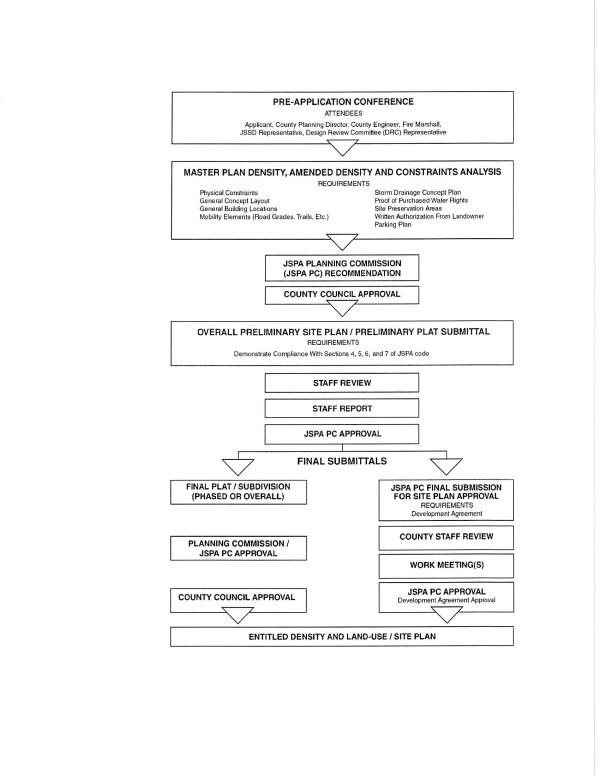
Adopted by Ord. 2002 Code § 16.41.01 on 1/1/2002
Amended by Ord. 06-07 on 6/26/2008
Amended by Ord. 09-16 on 2/25/2010
Adopted by Ord. 14-07 on 11/5/2014
Amended by Ord. 23-20 on 12/20/2023
16.41.09: GOVERNANCE
9.0 GOVERNANCE
It is recommended that the County create and/or support the creation of a Master Association with a governing board for coordinating and managing the JSPA. The purpose of this Master Association is to coordinate marketing efforts, websites, and activities programming throughout the JSPA.
9.1 Items to be coordinated by the Master Association Governing Board. The following items shall be included in, but not limited to, the Governance Documents (GDs) for the Master Association to be reviewed and approved by the JSPA Planning Commission.
9.1.1 Collective Marketing Efforts. Collective marketing efforts shall be contemplated by the GDs. These efforts may be funded through assessments as considered appropriate by the Master Association Board from time to time but shall include, but not be limited to, the following:
JSPA common website with procedures for distribution of leads. This website shall be controlled and maintained by the JSPA.
Offsite preview or marketing centers should be contemplated with procedures for distribution of leads.
JSPA events and attractions created to attract tourism and enhance the experience at the JSPA shall be contemplated by the GDs.
JSPA offsite signage and imagery shall be included in the GDs. Other common channels of distribution should also be considered. Advertising programs shall be contemplated by the GDs.
9.1.2 Transit System. When it is appropriate, it is contemplated by the JSPA to provide a transit system. Although the systems may or may not be fare based, the GDs should contemplate its development and manage its operations.
9.1.3 Master Covenants, Conditions and Restrictions covering all or portions of the JSPA shall be entered into, consistent with the terms and provisions of these Implementation Guidelines and Standards, including Assessments for maintenance of the public or common areas shall also be contemplated by the GDs.
9.1.4 Master Association Organizational Documents. Articles of lncorporation, Bylaws, and other GDs will be entered into for the purpose of establishing a Master Owners Association which will operate and maintain the common areas of the JSPA.
Adopted by Ord. 2002 Code § 16.41.01 on 1/1/2002
Amended by Ord. 06-07 on 6/26/2008
Amended by Ord. 09-16 on 2/25/2010
APPENDIX A: JSPA PLANNING COMMISSION ESTABLISHMENT
NOTE: This section has been moved to 02.02.09 as stated in Ordinance 23-20.
Adopted by Ord. 14-07 on 11/5/2014
Amended by Ord. 15.03 on 3/18/2015
Amended by Ord. 23-20 on 12/20/2023

