
Wasatch County Unincorporated
City Zoning Code
City Zoning Code
CHAPTER 16
26: SIGN REGULATIONS
16.26.01: INTENT
- It is the purpose and intent of this chapter to regulate signs and to authorize the use of signs that are compatible with their surroundings, are legible under the circumstances in which they are seen, are effective in indexing the environment, and are conducive to promoting traffic and pedestrian safety and the convenience and enjoyment of public travel by preventing visual distraction; protecting pedestrians; attracting tourists to the county; preserving and enhancing property values; establishing first class business and commercial districts; and eliminating fire hazards.
- It is also the intention and purpose of this chapter to promote short and long term civic beauty and order by establishing standards and regulations for sign design, location, size, type, compatibility and aesthetics. By doing so it is hoped that this chapter will help create streetscapes that are functional and attractive to both residents of Wasatch County, as well as visitors.
Adopted by Ord. 99-07 on 12/27/1999
16.26.02: PURPOSE AND SCOPE
- The intent is to regulate the design and placement of commercial and governmental identification/communication devices and structures that are built specifically to identify, inform and direct patrons to a particular merchant, store, establishment or service. It is not the intent of this chapter to regulate the content of public speech.
- The regulations of this chapter are intended to apply to both on premises and off premises signs, but do not apply to handheld placards and other similar devices traditionally used for public protest and the exercise of free speech. Any noncommercial message may be substituted for any commercial message permitted under this chapter.
Adopted by Ord. 99-07 on 12/27/1999
16.26.03: INTERPRETATION
In interpreting and applying the provisions of this chapter, the sign regulations contained herein are declared to be the maximum allowable for the purposes set forth. If the director determines that an application needs further interpretation, he may request that the planning commission review the proposal.
Adopted by Ord. 99-07 on 12/27/1999
Amended by Ord. 23-20 on 12/20/2023
16.26.04: DEFINITIONS
All definitions are attempted to be clearly written within the section pertaining to such work within the body of this chapter, but those not precisely defined within the body of the chapter shall be defined by the definitions within this section. If any word is not clearly defined, the generally accepted meaning of such word shall apply.
ABANDONED SIGN: Any sign applicable to use that has been discontinued for a period of forty five (45) days.
ALTERATIONS: As applied to a sign, means change or rearrangement in the structural parts or its design, whether by extending on a side, by increasing in area or height, or in moving from one location or position to another. It also means changing the copy of a sign to name a new business or type of business.
ANIMATED SIGN: A sign that involves motion or rotation of any part or display of flashing, chasing or intermittent lights.
ARTISTIC OR DECORATIVE SIGN: A sign placed on the base of a statue, sculpture, monument or approved object, other than the display of an item to be sold or traded.
AWNING SIGN: A roofed structure constructed of fabric, canvas, vinyl or metal so as to extend outward from the building providing a functional protective shield for doors, windows and other openings with supports extending back to the building.
BILLBOARD: A large sign that identifies or communicates a commercial or noncommercial message related to an activity conducted, a service rendered, or a commodity sold at a location other than where the sign is located.
BUILDING: A building for retail businesses may be defined as an independent unit, regardless if it is connected by a common wall. For other business establishments such as office, industrial, research and development and manufacturing, a "building" may be defined as an independent building without common walls.
DIRECTOR: Refers to the director of the Wasatch County planning department, or his designated representative.
FREESTANDING SIGN: A sign which is not supported by a building, but rather a separate structure consisting of a pole or poles, that incorporates the design and building materials used in the construction of, or accenting the architectural theme of, the building that the sign will identify.
IDENTIFICATION SIGN: A sign identifying an apartment complex, condominium complex, residence, school, church or other nonsales use.
ILLUMINATED SIGN: Any sign which has characters, letters, logos, designs or other outlines illuminated by interior or exterior lights, luminous tubes, neon or similar devices.
LOGO: A reproducible image or design, which serves to represent a business or company's identity.
MONUMENT SIGN: A low profile ground mounted sign with at least a one foot (1') enclosed or solid base (usually brick or stone), meant to serve as a primary identification sign for the purpose of advertising a commercial use.
NONCONFORMING SIGN: Any advertising structure or sign which was lawfully erected and maintained prior to such time as it came within the purview of this chapter, and any amendments hereto, and which fails to conform to all applicable regulations and restrictions of this chapter.
OFF PREMISES SIGNS: A sign that directs attention to a business, commodity, service or entertainment that is not, other than incidentally, conducted, sold or offered on the premises where the sign is located.
ON PREMISES SIGNS: A sign that directs attention to a business, commodity, service or entertainment that is conducted, sold or offered on the premises where the sign is located.
PROJECTING SIGN: A sign characterized by its attachment at an angle to the face of the building, as opposed to being mounted flat on the surface of the building.
PROMOTIONAL SIGNS:
- Development: Signs indicating the sales, lease or rental of commercial units or on premises signs advertising the existence of a new development, whether residential, commercial or mixed use.
- Retail Sales: Signs that are placed temporarily to advertise a special sales event. This can include holiday sales signs.
PUBLIC NECESSITY SIGN: A county or state sign for the purpose of identifying streets, highways, walkways, detours, road work or otherwise.
ROOF SIGN: A sign located on the roof or above a building or face of a wall, which projects above the height of the roof or the face of the wall.
SIGN AREA: The area of a sign and shall be considered to include all lettering, working and accompanying designs or symbols, and any background material. Where a sign consists of individual letters or symbols attached to or painted on a building, wall, window or background, the area of the sign shall be considered to be the area of the smallest rectangle that encompasses all such letters or symbols.
SNIPE SIGN: A sign for which a permit is required and has not been obtained, and which is tacked, nailed, posted or otherwise attached to poles, trees, fences, sticks or other objects, with a message appearing thereon.
SUSPENDED SIGN: A sign which hangs from the eve of a roof or architectural feature of a building, parallel to the wall of the building, or on an approved support, hanging perpendicular to the building, but not extending over the sidewalk.
TEMPORARY SIGN: A sign that is intended for use during specified periods of time, including individual real estate signs and construction signs.
VEHICLE SIGN: A sign placed, added to, or painted on a vehicle or trailer, that is parked or located in such a manner as that its sole purpose is to act as a sign or advertisement, not transportation.
WALL SIGN: A sign mounted or flush on the facade of a building, identifying the building, a business, a profession, or industry and occupants.
WIND SIGN: Any sign inflated by or displayed by wind or air movement.
WINDOW SIGN: A sign attached to or painted upon a window or door, or located within a building so as to be visible through a window or door from the outside of the building.
Adopted by Ord. 99-07 on 12/27/1999
16.26.05: ENFORCEMENT AND PENALTIES
- Issue Permits: Issue permits to construct, alter or repair signs which conform to the provisions of this title. The expiration date for such permits shall be one hundred eighty (180) days from issuance, to allow sufficient time to complete the construction, alteration or repairs.
- Determine Conformance: Ascertain that all signs, constructions and reconstructions or modifications of existing signs are built, altered, modified or constructed in conformance with this chapter by conducting an initial inspection or reinspection upon the completion of construction, erection, re-erection, or modification of any sign for which a permit has been issued and an inspection request is made. This shall also include the inspection of temporary electrical signs. The director may authorize the building inspector to make such inspections.
- Legal Action: The director or his authorized representative shall be empowered to institute any appropriate action or proceeding in any case where any sign is illegally erected, constructed, reconstructed, altered, repaired, converted or maintained, or in any case where any sign is used in violation of any county ordinance, by issuing notices by mail and posting of such notices upon the sign for the specified period of time as follows:
- Issuing Written Notice Of Violation: A notice of violation may be issued to the person who owns the property upon which the sign is located or the person having charge or control or benefit of any sign found to be unsafe, dangerous or in violation of this title, particularly when the county is contemplating removal of said sign. Notice may be mailed to the property owner's address as contained in the county tax rolls and posted upon the sign for five (5) working days prior to removal. Such official may also issue criminal citations and swear to information against violators.
- Removal Of Dangerous Sign: If an unsafe or dangerous sign is not repaired or made safe within five (5) working days after giving said notice, the director or his authorized representative may at once abate and remove the sign, and the person having charge, control or benefit of any such sign shall pay to the county within thirty (30) calendar days after written notice is mailed to such person, the costs incurred in such removal. In the event the director determines there is imminent danger, the sign may be removed without prior notice, but such notice shall then be mailed immediately.
- Abate And Remove Illegal Sign: If a permanent sign is installed without a permit, or is otherwise illegal as defined by this title, and is not made conforming within thirty (30) calendar days after written notice has been given, the director or his authorized representative may at once abate and remove the sign. If the name and/or address of the owner cannot be reasonably determined, notice may be given by posting such notice upon the sign itself for the thirty (30) day period. The person responsible for any such illegal sign shall be liable for the cost incurred in the removal thereof and the county is authorized to effect the collection of said cost.
- Removal Of Temporary Sign: If a temporary sign posted upon private property, without a permit, or is otherwise illegal as defined by this title, the director may provide a written notice to abate or remove said temporary sign. The time period for removal of such sign shall not exceed seventy two (72) hours. All costs pertaining to the removal of said sign shall be borne by the property owner and/or persons or company responsible for the product or service that is advertised by the sign. The county is authorized to effect the collection of such costs.
- Removal Of Sign On Public Property: Any sign posted upon public property may be removed by the county without prior notice. In that event, the sign must be retained by the county for a period of thirty (30) calendar days prior to destruction, to allow the owner to claim such sign if desired. Failure of the county to remove said signs shall not constitute approval of the illegal placement of any such signs, nor waive the right to later remove the sign. Any costs associated with the removal of such signs shall be paid by the person responsible for such posting. The county is authorized to effect the collection of such costs.
- Removal Of Abandoned Sign: Each sign, which is nonmaintained, abandoned or identified as a discontinued use, shall be removed within forty five (45) calendar days after a written notice or posting on such sign, a notice of nonmaintenance, abandonment or discontinuance as described in this chapter. All costs of such removal shall be paid by the owner of such sign.
- Right To Appeal: Any person who has been ordered to alter or remove any sign or has had a sign removed by the county, or any person whose application for a sign permit has been denied, may appeal to the Appeals Hearing Officer by serving written notice to the director with ten (10) days of the order or denial, except in the case of a removal on the grounds of safety, the filing of such appeal shall stay the removal of such sign pending the outcome of the appeal to the Appeals Hearing Officer.
- Penalties: It shall be unlawful for any person to violate any of the provisions of this chapter. Any person, firm or corporation, whether as principal, agent, employee or otherwise, violating or causing the violation of the provisions of this chapter, shall be guilty of a class C misdemeanor and, upon conviction thereof, may be punished by a fine or imprisonment in the county jail. Each and every day a violation occurs shall constitute a separate offense.
Adopted by Ord. 99-07 on 12/27/1999
Amended by Ord. 2003-22 on 12/19/2003
Amended by Ord. 23-20 on 12/20/2023
16.26.06: NONCONFORMING SIGNS
- Definition: A "nonconforming sign" is any advertising structure or sign which was lawfully erected and maintained prior to this chapter, or any amendments hereto, or if it fails to conform to all applicable regulations and restrictions of this chapter.
- Previous Illegal Signs: Previous illegal signs shall not be grandfathered in under this chapter.
- Regulation, Containment And Elimination: In order to minimize confusion and unfair competitive disadvantage to those businesses that are required to satisfy the current sign ordinance standards, the county intends to apply firm regulation of existing nonconforming signs with a view to their eventual elimination. This goal shall be achieved by strictly construing limits on change, expansion, alteration, abandonment and restoration. Excluding normal maintenance and repair, a nonconforming sign shall not be moved, altered (including face changes) or enlarged, unless it is brought into complete compliance with this chapter. The following alterations are exempt from this provision:
- Face changes in nonconforming multi-tenant signs, to reflect a change of tenants only; and
- Copy changes in nonconforming permanent signs, which were originally approved by the county with a changeable copy feature.
- Abandonment: Within forty five (45) calendar days after vacation of existing business, any on site nonconforming signs must be removed or brought into compliance by the property owner. If removal or compliance does not occur, the county may, after giving notice to the owner, have the entire nonconforming sign (both face and structure) removed at the expense of the owner.
- Variances: Upon application by the sign owner or business, the Appeals Hearing Officer may grant a variance, if appropriate. The variance may allow the retention, alteration, movement or expansion of a nonconforming sign.
Adopted by Ord. 99-07 on 12/27/1999
Amended by Ord. 2003-22 on 12/19/2003
Amended by Ord. 23-20 on 12/20/2023
16.26.07: PROHIBITED SIGN DEVICES
- Hot or cold air balloons or inflatables, except those specifically allowed by this chapter for temporary signs as part of a grand opening or special promotion.
- Any sign that flashes, blinks, uses chaser lights, or moves in any way, animate or inanimate. Subtle lighting changes of low intensity are allowed if approved. (Commercial signs may be approved with time/temperature or electronic message center capability.)
- Statuary bearing the likeness or suggestion of any product or logo.
- Projecting signs.
- Roof signs or fence signs.
- Wind signs.
- Snipe signs.
- Temporary signs, except those allowed specifically by this chapter.
- Any truck, trailer or other vehicle conspicuously, or regularly parked on or off premises with an advertising message or logo displayed to attract attention to a business, product or promotion. The director or his authorized representative may require the removal of same if, in his opinion, such a vehicle is being utilized for advertising purposes.
- Graffiti.
- Spotlights directed into the night sky, except as part of an approved promotional period for temporary signs.
- Off premises signs, except as specifically allowed herein.
- Signs on public property, including, but not limited to, public utility poles, public bridges, or within any public right of way unless specifically approved herein for a public purpose. However, nothing in this section shall apply to the installation of a plaque in a sidewalk commemorating an historical, cultural or artistic event, location or personality for which the county has granted written permission. Nor shall this section apply to the painting of house numbers upon curbs.
- A-frame or sandwich board signs.
- Portable signs.
Adopted by Ord. 99-07 on 12/27/1999
16.26.08: SIGNS ALLOWED WITHOUT PERMIT
- Directional Or Instructional Signs: Signs which provide direction or instruction and are located entirely on premises and which do not in any way advertise a business shall not exceed four (4) square feet in area or four feet (4') in height. These signs may identify restrooms, public telephones or walkways, or shall provide direction such as parking lot entrance and exit signs and those of a similar nature.
- No Trespassing Or No Dumping Signs: No trespassing or no dumping signs may be posted not closer than two hundred feet (200'), and each sign shall not exceed four (4) square feet. If more signs are requested, the director or his authorized representative may allow more if he finds that more are required to prevent violation.
- Plaques Or Nameplates: Plaques or nameplates, no more than two (2) square feet, are allowed when fastened directly to the building.
- Symbols Or Insignia: Religious symbols, commemorative plaques of recognized historical agencies, or identification emblems of religious orders or historical agencies; provided, that no such sign shall exceed eight (8) square feet in area; and provided further, that all such signs be placed flat against the building.
- Institutional Signs: Churches, public schools, public utility companies, libraries, governmental buildings, parks, public golf courses, etc., are allowed one monument sign not exceeding thirty two (32) square feet. If the institution has frontage on more than one arterial street, then an additional sign of the same size is allowed.
- Flags: The flags, emblems or insignia of any nation, state, county or city, or Olympics organization, not exceeding twenty (20) square feet each, may be flown in tandem with each other.
- Public Necessity Signs: Public necessity signs installed by a unit of the government for control of traffic and other regulatory purposes.
- Holiday Decorations: Holiday decorations. Must be noncommercial in nature, clearly incidental and associated with any national, local or religious holiday, and contained entirely within the boundary of the private property on which they are erected. They must be placed to avoid confusion and traffic hazards, and removed within a reasonable period after the holiday is over.
- Temporary Holiday Signs: A business (in the industrial or commercial zone only) may advertise a special service, product or sale on the premises of the business, during the following holiday periods without a permit:
- President's Day (February; 5 days);
- Easter (March or April; 5 days);
- Memorial Day (May; 5 days);
- July 4th (July; 5 days);
- July 24 (July; 5 days);
- Labor Day (September; 5 days);
- Halloween (October; 5 days);
- Veterans Day (November; 5 days);
- Thanksgiving (November; 5 days);
- Hanukkah, Christmas and New Years (21 days starting December 15 and ending January 2); and
- One banner sign is allowed during those periods in addition to the normal signage, mounted on the building, and not exceeding fifteen percent (15%) of the size of area of the side of the building.
- Changing Copy: The changing of the message on a permitted sign that has an approved marquee, reader board, electronic message or other replaceable copy area.
- Political Or Campaign Signs: Candidates for public office or measures on election ballots as follows:
- May not be erected earlier than forty five (45) days prior to an election and must be removed by the Monday following the election;
- Shall not exceed sixty four (64) square feet in area and, if freestanding, shall not exceed eight feet (8') in height;
- May not be placed on roofs, fences, public property, in a public right of way, or in any manner which would impede traffic visibility or safety; and
- May not be placed closer than one hundred fifty feet (150') from any building where an official voting station is located.
- On Premises Real Estate Signs: Individual properties (not developments), advertising the sale, rent or lease of property may be placed as follows:
- One sign per street frontage up to one hundred feet (100').
- Shall not exceed six (6) square feet and six feet (6') in height, unless the street frontage exceeds one hundred feet (100').
- For frontages exceeding one hundred feet (100') but less than three hundred feet (300'), one sign may be placed up to sixteen (16) square feet and no more than six feet (6') tall.
- For frontages exceeding three hundred feet (300'), one sign may be placed up to thirty two (32) square feet and no taller than six feet (6').
- On or off premises open house real estate signs, not exceeding nine (9) square feet, may be placed only on private property, with the permission of the property owner. They shall not be attached to trees, poles, in rights of way or other public property, and shall be displayed only during those hours in which the house is open for actual inspection. No open house may be exhibited between the hours of seven o'clock (7:00) P.M. and seven o'clock (7:00) A.M.
- On Premises Home Occupation Signs: One nonilluminated flat wall sign, not over two (2) square feet in size, which identifies the name of the business is allowed without a permit. No other forms of advertising are allowed for a home occupation.
- Garage Sale Signs: Must be placed on private property with the consent of the owner. May not exceed four (4) square feet in area, may not exceed three (3) signs total within the county, and may not be posted more than forty eight (48) hours prior to nor twenty four (24) hours after the time of the sale. The sale may not last longer than forty eight (48) hours.
Adopted by Ord. 99-07 on 12/27/1999
Amended by Ord. 10-14 on 1/7/2011
16.26.09: SIGNS REQUIRING PERMIT
- Purpose; Streetscape: The streetscape is the combination of vehicles, buildings, signs, landscaping, roads, utility poles, etc., that dominate the view of the driver or pedestrian. The streetscape tells residents and visitors how the county as a whole feels about the environment, safety, aesthetics and its sense of order, among other things. A useful, attractive and safe streetscape is one that necessarily regulates the size, location and design of business signs. Because a proliferation of poorly designed, oversized and inappropriately located signs in commercial and industrial areas can be detrimental to the achievement of effective, safe and attractive streetscapes, it is important that the permanent signs in these areas receive approval (permits) from the county.
Commercial and industrial uses are generally more intensive than those found in residential zones. Since these uses are designed by size, location and style to attract attention and provide services to the public, they generally need signage to achieve that end. Business signs of any kind in residential neighborhoods can diminish the quality of life for which those zones were specifically created. However, there may be some residential uses that merit a sign, though much smaller and more subdued than in commercial or industrial zones.
Therefore, it is the intent and purpose of this section to outline regulations and design standards for signs in both commercial/industrial and residential areas that will allow the business to identify itself, while allowing Wasatch County to create and maintain safe and aesthetically pleasing streetscapes, regardless of zone. - Sign Theme Required: All multi-tenant centers/buildings must submit a proposal for all on premises signs to the planning commission for design and placement approval. When the premises of the multi-tenant parcel is five (5) acres or more, and has frontage of two hundred feet (200') or more, sign approvals may vary from the regulations set forth herein. In that event, such signs shall be considered as a conditional use, providing there is a finding that the proposed sign exceptions are not in conflict with the purpose and intent of this chapter; and are in architectural harmony with uses adjacent to the development; and with the understanding that the existing signage may be required to be altered or removed.
- On Premises Freestanding Signs: Parcels less than ten (10) acres shall not be allowed any freestanding signs, except as described in subsection B of this section for multi-tenant centers. No freestanding signs are permitted on parcels less than five (5) acres. All freestanding signs must have pole covers approved by the director.
- Planned Centers Of Ten Acres Or More: The director may approve one freestanding sign per street frontage per street frontage in planned centers of ten (10) acres or more. No freestanding sign shall be allowed for any planned center or parcel that has less than two hundred feet (200') of street frontage. Sign height shall be determined by using the formula of a base height of six (6) for the first tenant, and for each additional tenant in a multi-tenant center, an additional two feet (2') in height may be added, to a maximum height of twenty five feet (25').
- Distance From Corner: Signs must be at least one hundred feet (100') from any corner, unless monument (minimum 60 feet from corner unless special traffic safety study).
- Sign Area: Sign area shall be determined using the graph in section 16.26.16, "Exhibit 1, Sign Area Chart", of this chapter.
- Changeable Copy: Reader boards, changeable copy areas and electronic message centers are allowed, but discouraged. No such device shall exceed fifty percent (50%) of the total sign copy area of the sign.
- Monument Signs: The following standards shall apply:
- Sign Area: Sign area shall be determined using the (section 16.26.16, "Exhibit 1, Sign Area Chart", of this chapter) formula for determining the exact allowable sign area which is thirty two (32) square feet, plus one square foot per one linear foot of street frontage over fifty feet (50'), to a maximum size of eighty (80) square feet;
- Minimum Street Frontage: Monument signs are allowed for any size parcel; provided, that the parcel has at least fifty feet (50') of street frontage;
- Two Street Frontages: Single tenant parcels with two (2) street frontages are allowed a sign on each street, provided they are separated by at least one hundred feet (100') measured diagonally across the property from center to center of both signs. It is also required that both signs be of the same size;
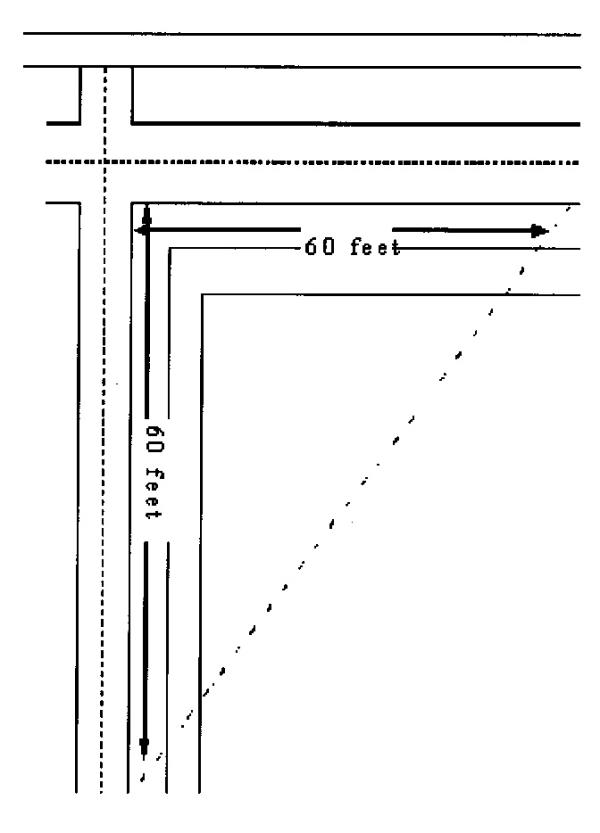
- Visibility Triangle: No signs shall be located within a sixty feet (60') triangular area of each street corner (the area described on the "visibility triangle" chart in section 16.26.17 of this chapter), without a review by a traffic engineer appointed by the county to review the issue to determine the safety of the placement of such sign. The applicant will be required to pay all costs of the hiring of the traffic engineer;
- Monument Signs For Planned Commercial Centers:
- Monument signs shall have a logo/identification theme as part of the sign;
- Planned commercial centers with two (2) or more street frontages are allowed one sign on each street frontage. The signs must be separated by at least one hundred feet (100') measured diagonally across the property from the center of each sign;
- The area of the sign is determined by using the "sign area" chart considering the length of the frontage along which the sign is to be placed, including the frontage of any freestanding buildings included within the planned commercial center;
- In the case of the development of a planned commercial center on multiple parcels of property having common frontages, regardless of the number of separately owned parcels or buildings of separate occupancy within the planned commercial center, the frontage shall be considered to be the composite of the entire commonly used parcels or buildings and not the frontage of each individual business or occupancy. The overall frontage shall be used to calculate allowable sign area for the center identification sign;
- Notwithstanding the center identification sign, a freestanding building within an approved planned commercial center may request a monument sign for the individual business, provided the lot is contiguous to a major arterial street and has at least one hundred feet (100') of street frontage. Such sign may be approved by the director upon a determination that the sign is not in conflict with the intent and purpose of this chapter;
- Freestanding buildings with two (2) street frontages are allowed one monument sign on each frontage, provided such sign shall be placed no closer than one hundred feet (100') as measured diagonally across the property from center of sign to center of sign. Additionally, the sign may not be placed closer than one hundred feet (100') from any other sign located on the same side of the street;
- Monument signs must have at least a one foot (1') pedestal, and the illuminated cabinet may not exceed five feet (5') in height, for a total of six feet (6') in height. The height to the top of the sign measured from the street curb may vary depending upon landscaping and berming, but the combined height of the sign and berming/landscaping may not exceed nine feet (9'). If berming is used to raise the height of the sign above six feet (6'), the entire frontage of the property must be randomly bermed. The sign base shall be landscaped.
- Wall Signs: Wall signs should be the primary form of identification for business uses in the county. Each business is entitled to one wall sign, if the following criteria are met:
- Area: The sign may not occupy more than, whichever is less, of the flat wall area. If a sloping facade or roof exists, the sign may not exceed fifteen percent (15%) or six hundred (600) square feet, whichever is less, of that area. A wall sign may not use a combination of both flat and sloping areas in calculating the fifteen percent (15%). On a sloping roof, the vertical projection is used to calculate area, not actual length of the slope.
- Multiple Sign Area: The fifteen percent (15%) area of the primary wall and five percent (5%) of all secondary walls may be divided into more than one sign, with the approval of the planning commission, under the following guidelines and restrictions:
- The signs blend with the aesthetics of the building and surrounding natural and manmade environment;
- The color, style, size, scale and proportion enhances the exterior of the building and does not place too much bulk and external distraction on the exterior of the building;
- The number of signs are appropriate to the scale of the building;
- The maximum wall signs on any given wall, including multi-tenant buildings, shall be seven (7), unless the planning commission finds that an additional sign is consistent with the criteria contained in subsections I2a through I2c of this section; and
- Multiple walls signs shall utilize individual lettering and logos only. No multiple cabinet signs or combination of cabinet and individual lettering signs shall be approved.
- Painted signs applied directly to any building face must have specific approval of the director.
- Walls signs with changeable copy, reader board or electronic message capability are not allowed.
- Businesses with exposure on two (2) sides may be allowed fifteen percent (15%) on one side and five percent (5%) maximum on the second side. No more than two (2) sides of the building may contain signs.
- Office buildings with small offices inside must have a tenant identification center sign, rather than individual signs for each tenant.
- Signs shall be attached so that on all sides the appearance is such that they appear to be part of the building itself, with no visible support structures such as guy wires or braces.
- No part of the sign structure shall project above the highest part of the wall upon which the sign is mounted. Nor shall any part of the sign project more than eighteen inches (18") from the face of the building to which it is attached.
- Suspended Signs: Permitted in place of wall signs are allowed if the architecture of the building or planned center lends itself to that design and a sign theme is submitted and approved by the planning commission. The following shall apply:
- May not exceed fifteen percent (15%) of flat wall of the tenant space;
- May not project beyond the canopy or facade to which it is attached;
- Must have at least eight inch (8") clearance above the sidewalk or landscaped area over which it hangs; and
- There must be at least five feet (5') horizontal distance on both sides between suspended signs.
- Awning Signs: Only allowed under the following circumstances:
- Must fully comply with the sign standards;
- If in a planned center or multi-tenant center, must conform to an approved sign theme;
- Limited to the first story only;
- Must function as awnings over a doorway, walkway, window, etc.;
- No above sloping or mansard roofs;
- Area of sign limited to fifteen percent (15%) of wall area on primary wall and five percent (5%) if a secondary wall is also used;
- Copy on the awning limited to forty percent (40%) of awning;
- Illuminated, translucent vinyl awnings are not permitted. Translucent accents sewn into opaque canvas or acrylic awnings are permitted;
- Shall not project out from the wall more than eight feet (8') nor less than two feet (2'), except for awnings over an entrance walkway which leads to the main entrance, if compatible with the architecture of the building;
- Shall not project above the highest part of the vertical wall on the first floor;
- There shall be a minimum clearance of seven feet (7') to the bottom of the valance and eight feet (8') to the frame above the sidewalk; and
- Must be maintained in a clean, safe and attractive condition; failure to do so will result in revocation of the sign permit.
- Gas Station Canopies: Signs for canopies over gas islands are regulated as follows:
- Maximum Sign Area: Sign copy, corporate logos, etc., may be a maximum of fifteen percent (15%) of one face of the canopy;
- No More Than Three Sides: Up to three (3) sides of the canopy may be used for signs;
- Maximum Height: The height to the top of the canopy may not exceed twenty feet (20') from grade and no canopy fascia may exceed four feet (4') in height;
- Maximum Font Size: Individual letters, logos or symbols may not exceed four feet (4') in height and may not project out from the surface of the canopy more than eighteen inches (18"), or project above or below the canopy; and
- Gas Prices: Gas prices are allowed on the monument sign or below the canopy over the pumps. They are not allowed on the canopy itself. One double faced sign not over four (4) square feet for each type of fuel sold is allowed per gas island up to a maximum of four (4) sets.
- Temporary On Premises Signs (Located On A Single Lot During A Building Phase): Individual lots may have one sign, not exceeding sixteen (16) square feet nor six feet (6') in height, announcing the name of the construction company, lender, landscaper company, architect, etc., that is contributing to the building effort for that lot. The sign may not be placed more than five (5) days prior to beginning construction for which a valid building permit has been issued. The sign must be removed prior to occupancy of any portion of the building.
- Development Promotional Signs: May be placed on the premises of each development or approved unit sites in any residential or mixed use zone. The total size allowed for the signs depends upon the acreage contained in the development, or the phase of the development, as described below:
- One to ten (10) acres of land in the phase being advertised, may have one sign not over thirty two (32) square feet or two (2) signs of not over sixteen (16) square feet, and not higher than seven feet (7') tall;
- Eleven (11) to twenty (20) acres of land in the phase being advertised may have one sign not over sixty four (64) square feet or two (2) signs not over thirty two (32) square feet and not higher than seven feet (7') tall;
- Twenty one (21) to forty (40) acres of land in the phase being advertised may have one sign not over ninety six (96) square feet or two (2) signs not over forty eight (48) square feet and not higher than eleven feet (11') tall;
- Forty one (41) and over acres of land in the phase being advertised may have one sign not over one hundred twenty eight (128) square feet or two (2) signs of not over sixty four (64) square feet, and not higher than fifteen feet (15') tall;
- On development parcels over two hundred fifty (250) acres in size, the director may allow one sign not over fifteen feet (15') in height and up to one hundred twenty eight (128) square feet for every five hundred feet (500') of street frontage;
- No such signs may be placed until such time as the county has granted preliminary approval for the phase to be advertised, and such signs must be removed upon the sale of the last unit in the phase being advertised or two (2) years, whichever is shorter. Two (2) additional one year extensions may be granted by the director after reviewing the appearance of the sign as to maintenance and the conformance with the chapter. In no event shall such signs remain in place for longer than four (4) years; and
- Must comply with any requirements of the building code adopted by Wasatch County.
- Commercial Or Industrial Developments: On premises signs promoting the development may be placed on the premises of each development having five (5) or more units in any commercial or industrial zone, under the following regulations:
- One to fifteen (15) units may have one sign not over thirty two (32) square feet and not higher than seven feet (7') tall;
- Sixteen (16) to thirty (30) units may have one sign not over sixty four (64) square feet and not higher than seven feet (7') tall;
- Thirty one (31) to sixty (60) units may have one sign not over ninety six (96) square feet and not higher than eleven feet (11') tall;
- Sixty one (61) or more units may have one sign not over one hundred twenty eight (128) square feet and not higher than fifteen feet (15') tall;
- If the street frontage of the property exceeds one hundred feet (100'), then the total area of the sign permitted for that development may be divided into two (2) signs, provided they are placed no closer than one hundred feet (100') apart;
- The development must have preliminary approval prior to placement of the sign or signs and the signs must be removed upon sale of the last unit or two (2) years, whichever is shorter. Two (2) additional one year extensions may be granted by the director after reviewing the appearance of the sign as to maintenance and the conformance with our then existing sign ordinance. In no event shall such signs remain in place for longer than four (4) years; and
- Must comply with any requirements of the building code adopted by Wasatch County.
- Window Signs: Signs which are painted on or temporarily affixed to a window surface and cover no more than twenty percent (20%) of the total window area on the face of the building unit to which the sign is affixed. Window signs may only be used on one side of the unit. These signs are allowed only in a commercial, industrial or mixed use zone.
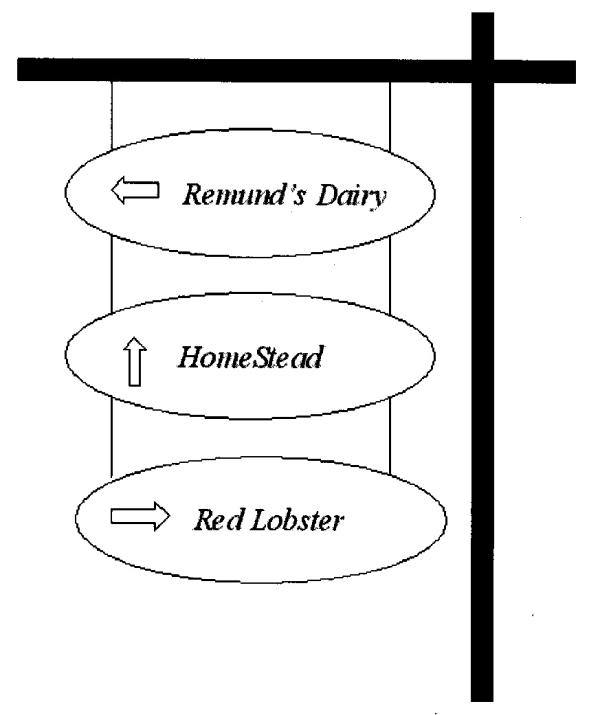
- Off Premises Directional Signs: No off premises signs are permitted, except for sign ladders (example shown in section 16.26.18, "Exhibit 3, Sign Ladder Chart", of this chapter), which have been created by the county and placed on strategic corners on public property, to point the way to businesses that are not located on the premises of the sign. These signs can be placed in any zone, upon approval of the planning commission:
- Number Of Sign Ladders: The county shall place no more sign ladders than deemed appropriate by the planning commission at the intersection of arterial and major collector roads, and no more than one sign ladder shall be placed on any corner at any intersection.
- Pole Height And Attachments: The height of the base pole for each sign shall not exceed twelve feet (12') and may not contain more than eight (8) attachment signs, which shall be uniform in size measuring no more than twelve inches by thirty inches (12" x 30").
- Priority For Placement: The attachment signs shall be placed on the basis of first application has first priority for a choice of placement in one location. If there are insufficient spaces available at any location, the later applicants will be offered placement in other locations before any business is permitted a second location, provided however, if an application is accepted after placements have been awarded for that cycle, the late application will either be offered a site that has not been reserved and is still available, or must wait until the next cycle.
- Review Of Placement: The signs will be reviewed for placement of attachment signs once every six (6) months, in March and September of each year. Applications must be submitted before March 1 and September 1 of each year to ensure consideration for placement during that cycle. Applications will be date and time stamped to establish priority, and may be filed at any time during the year. Once placement has been obtained the applicant may retain placement until the placement is again reviewed, regardless of new applicants who apply after the site has been awarded to an applicant. If any business advertised on such attachment sign closes business, the attachment sign will be removed and will not be replaced by another sign until the next review cycle.
- Payment Of Fees: The applicant must pay the appropriate sign fee adopted by the county legislative body at the time of submission of the application. This fee will include a fee for the creation of the sign extension or the replacement of faded or damaged sign extensions previously used. The determination of whether a new extension sign is needed or not will be at the sole discretion of the director. In addition to any fee that might be necessary for the creation of a sign extension, there shall be charged a fee, as established by the county legislative body, for the administration of the sign program.
- Drawings Required: The applicant will be required to provide a drawing of the requested attachment sign. The size, color and type of style will be considered by the director while considering a uniform, attractive, readable sign theme that will not create a traffic hazard or any greater advertising advantage for one sign than the other. Any business wishing to include a logo on their sign shall submit a drawing of the desired logo and its proposed location on the sign attachment, along with their application. All colors and type sizes of letters will be uniform. Type styles may vary to allow for recognition of type styles normally used for that particular business. Logos may be colored in a color consistent with the normal color of the logo. Other than the logo and/or the name of the business and a directional arrow, there shall be no other advertising copy allowed on the sign.
- Effect Of Existing Illegal Signs: No applicant will be considered for placement on a sign ladder if they are exhibiting illegal signs under this chapter.
- Temporary Signs Requiring A Permit:
- Type And Placement: Shall not be placed in, on or over a public right of way, may not contain any blinking or flashing or moving parts, may not block visibility or create a safety hazard or nuisance of any kind. They may not be attached to telephone poles, fences or trees, but may be firmly secured to the building, an existing sign or the ground. No off premises temporary signs are allowed except those specifically noted and regulated for real estate purposes for a single lot or during the hours of an open house.
- Grand Opening Signs: May not continue more than sixty (60) days during the first year of operation of the business. A combination banner and portable sign may be approved. The size and location must comply with permanent signage requirements for that zone.
- Special Promotion Periods: A business may apply for three (3) special promotion periods during the calendar year, not to exceed seven (7) days each, unless periods are combined to run consecutively.
- Going Out Of Business: For a period not to exceed ninety (90) days, only once for any business license.
- Inflatables: Hot or cold advertising air balloons or inflatables.
Adopted by Ord. 99-07 on 12/27/1999
Amended by Ord. 2004-26 on 11/17/2004
16.26.10: PERMIT PROCESS
- Sign Permit Required: No person shall erect, install or paint any sign, or change the face of any sign, whether it be temporary or permanent in nature, without obtaining a sign permit from the planning department, except as outlined in this chapter. This includes new signs, signs to be added to existing buildings or uses, and existing signs that are to be enlarged, changed or modified.
- Permit Issuance Before Sign Placement: Any new or existing signs installed or maintained without a permit, except as allowed under this chapter, will be required to be removed or will be charged a penalty fee of one hundred dollars ($100.00) or double the applicable sign permit fee, whichever is greater, at the time the owner/operator of the sign makes application for a sign permit with the planning department. This subsection does not limit the ability of the county to require the signs to be removed or to prosecute any criminal penalties for placement of the illegal sign.
- Permits For Prior Nonconforming Signs: All existing signs that do not conform to this chapter, but are allowed as prior nonconforming signs, must obtain a sign sticker from the planning department prior to May 1, 2000. The obtaining of this sticker will create a record of eligible nonconforming signs and confirm the nonconforming use until such time as the sign must be updated under this chapter. Any nonconforming sign that does not display a sticker confirming the nonconforming eligibility prior to May 1, 2000, shall lose its eligibility as a nonconforming sign and will be required to be updated to conform with this chapter. There will be no application fee required to obtain a nonconforming eligibility sticker, except for the actual cost of the manufacturing of the sticker itself. Such stickers must be displayed in the lower left hand corner of each sign.
Adopted by Ord. 99-07 on 12/27/1999
16.26.11: SITE PLAN DESIGN AND REVIEW
- Signs To Be Reviewed As Part of Development Review Process: When new buildings or developments are presented for site plan review, signs proposed for the development shall be reviewed concurrently by staff. All planned centers and multi-tenant buildings must submit a sign theme for approval by the planning commission. The center must have an approved sign theme before any sign permits will be issued. If a plan for a sign package is not submitted at site plan review, which is encouraged, the developer will be notified of sign ordinance standards and expected to submit plans that will adhere to the code.
- Sign Design: Applicants for sign permits should give serious consideration to the following elements when submitting plans for signs:
- Architectural compatibility;
- Color and style;
- Size, scale, proportion and balance;
- Location;
- Landscaping; and
- If the planning staff believes that the application for a sign permit has not considered the above listed criteria and shown such consideration in the submitted plans, the application may be submitted to the planning commission for further approval/denial.
Adopted by Ord. 99-07 on 12/27/1999
16.26.12: REQUIRED INFORMATION
- Monument And Freestanding Signs:
- Plot plan showing the relationship of the sign to buildings, property lines, existing signs, setback from public rights of way, intersections, easements and driveways;
- Two (2) accurately dimensioned, scaled drawings showing height, color, square foot dimensions, landscaping, sign composition, type of illumination, and how the sign will appear from the street;
- Details of sign construction, including electrical plan, foundation scheme and value of the sign; and
- Number of acres and length of linear frontage of the property.
- Wall Signs:
- Two (2) scaled drawings showing square foot dimensions of both the building and the sign, sign composition, and type of illumination;
- A profile drawing of how the sign will appear from the street/parking area and on the building; and
- Details of sign construction and attachment, including electrical plan.
- Temporary Signs:
- Plot plan showing the relationship of the sign to buildings, property lines, setbacks from public rights of way, intersections, easements and driveways; and
- Length of period for display, type of request.
- Additional Information Required:
- Proof of current county business license;
- Business address and phone number;
- Address of property owner and phone number;
- General or electrical contractor name, address, phone and license number;
- Value of sign;
- A statement by building department indicating whether a building permit is required for the erection of the proposed sign; and
- Any other information which is requested in the approved application form.
Adopted by Ord. 99-07 on 12/27/1999
16.26.13: PERMIT TAG
- Sign Permit Required: No person shall erect, install or paint any sign, or change the face of any sign, whether it be temporary or permanent in nature, without obtaining a sign permit from the planning department, except as outlined in this chapter. This includes new signs, signs to be added to existing buildings or uses, and existing signs that are to be enlarged, changed or modified. Failure to comply renders each such sign illegal and subject to criminal penalties.
- Erection Of Sign Without A Permit: Any new or existing signs installed or maintained without a permit except as allowed under this chapter, will be required to be removed or if allowed to remain and obtain a permit, will be charged a penalty fee of one hundred dollars ($100.00) or double the applicable sign permit fee, whichever is greater, at the time the owner/operator of the sign makes application for a sign permit with the planning department.
- Permit Required For Prior Nonconforming Signs: All existing signs, which do not conform to this chapter, but are allowed as prior nonconforming signs, must obtain a sign sticker from the planning department prior to April 1, 2000. The obtaining of this sticker will create a record of eligible nonconforming signs and confirm the nonconforming use until such time as the sign must be updated under this chapter. Any nonconforming sign that does not display a sticker confirming the nonconforming eligibility prior to May 1, 2000, shall lose its eligibility as a nonconforming sign and will be required to be updated to conform with this chapter. There will be no application fee required to obtain a nonconforming eligibility sticker except for the actual cost of the manufacturing of the sticker itself. Such stickers must be displayed in the lower left hand corner of each sign.
Adopted by Ord. 99-07 on 12/27/1999
16.26.14: SAFETY AND LOCATION STANDARDS
- Standards Of Construction:
- Must Comply With Codes: All signs erected in Wasatch County shall comply with the building code adopted by Wasatch County and the Wasatch County sign standard effective at the time the permit is issued;
- Licensed Contractor For Electrical: No sign, fixture or device involving electrical wiring or connections shall be erected or installed in Wasatch County except by a licensed and bonded contractor;
- Engineering: All signs shall be engineered to demonstrate conformance with the applicable provisions of the building code adopted by Wasatch County;
- Materials: All signs must be built of durable and permanent materials; and
- Underground Power: Permanent power sources for signs must be concealed underground away from public view.
- Traffic Safety: No sign or other advertising structure shall be erected which in any manner may be confused with an official traffic sign or signal, or which bears words normally used in such signs (i.e., stop, go, slow, caution, danger, warning, etc.). No sign or any advertising structure shall be erected when by reason of its size, location, shape, content, coloring or manner of illumination might be confused as a traffic control device. No sign shall have lighting, which impairs the vision of anyone traveling upon a public street or distracts any driver so as to create a public nuisance or safety hazard. Specifically, no sign or group of signs may exceed one foot-candle in brightness as measured at the property line.
- Clear View Of Intersecting Streets: No sign more than three feet (3') in height above the top of the curb (or the centerline of the street if there is no curb) shall be erected at any intersection for vehicular traffic within a triangular area formed by the intersection of straight lines extended from the back of the curb (or future curb) and a line connecting them at points sixty feet (60') from the intersection of the lines. Monument signs may be erected in the above mentioned area if they are less than three feet (3') above the curb grade to the top of the sign. The planning commission must approve any removal of landscaping in order to accomplish that objective. See section 16.26.17, "Exhibit 2, Visibility Triangle Chart" of this chapter. Any deviations from these requirements must be reviewed and approved by the planning department after conferring with other departments of the county. Decisions of the planning department may be appealed to the Appeals Hearing Officer.
- Specific Clearance And Location Requirements: The following rules apply for all signs:
- Freestanding signs shall not extend over any pedestrian or vehicular access area unless specifically approved by the planning department;
- No part of any sign shall interfere with the use of any fire escape, exit, required stairway, door ventilator or window;
- No sign shall be erected or maintained which has less horizontal or vertical clearance from communication lines and energized electrical power lines than that prescribed by the laws of the state of Utah or its agencies;
- No sign shall be located on publicly owned land or inside street rights of way, except signs owned and erected by permission of an authorized public agency or specifically authorized herein;
- High profile (freestanding) and low profile signs shall be located at least their height in distance from side property lines in order to prevent damage to adjacent land in case a sign is toppled by accident or an act of God; and
- Low profile (monument) signs shall be set back at least three feet (3') from the front sidewalk or right of way reserved for any future sidewalk, and from all driveways.
- Maintenance: Every sign shall be kept in complete operating condition. The landscaped area in which any sign is placed shall be kept free from weeds, garbage and debris. Landscaping shall also be maintained. "Maintenance" includes the repair of facades where signs have been removed, the painting, cleaning, repairing of the sign. "Maintenance" does not include structural alterations, cosmetic or style changes or enlargements of face changes.
- Landscaping: All freestanding or monument detached signs installed in Wasatch County must be incorporated into a landscape design or planter box. Exceptions to this rule must be approved by the planning commission. The planning commission must also approve any permanent removal of landscaping for the purpose of situating a sign.
- Pole Covers: All on premises freestanding signs must have the structural supports covered or concealed with pole covers (pylon covers) at least twenty four inches (24") wide. The actual structural supports shall not be exposed, and the covers must be architecturally and aesthetically designed to match the building.
- Foundations: All signs must be permanently mounted on foundations and footings that conform to the building code adopted by Wasatch County.
- Pedestal Required: All monument signs must have at least a one foot (1') opaque pedestal designed as part of the foundation, which conceals any pole support. The pedestal should run at least fifty percent (50%) of the horizontal length of the sign, and there may not be any exposed space between the pedestal and the ground or landscaped area. The planning director may review and approve or deny any variation to the pedestal base requirement.
- Lighting: The light from the illumination of signs shall be carefully directed so that the light is not obtrusive or a nuisance to adjacent properties, particularly residential areas.
- Building Identification: All buildings shall be identified with a numbered or lettered street address in addition to option business identification. The letters or numbers shall be at least four inches (4") in height and shall be placed in a location where they are readily located and readable from the street.
Adopted by Ord. 99-07 on 12/27/1999
Amended by Ord. 23-20 on 12/20/2023
16.26.15: MEASUREMENT OF REGULATED SIGN AREA
- Wall Signs: Sign copy mounted or painted on a background panel or area painted, textured or constructed as a background for the sign copy shall be measured as that area contained within the outside dimensions of the background panel or surface which contains sign copy, logos, etc. They are by definition wall signs in their entirety and as such may not exceed fifteen percent (15%) of the wall area. For sign copy mounted as individual letters and/or graphics against a wall or fascia of a building or other structure that has not been painted, textured or otherwise altered to provide a distinctive background for the sign copy, the area shall be defined as the area included within the smallest six (6) sided polygon that will enclose all sign area. For sign area on an illuminated sign or illuminated architectural element of a building, the entire illuminated surface or illuminated architectural element that contains sign copy shall be counted as sign area.
- Monument Signs: The regulated area of a monument sign shall include all parts of the sign or structure that contains identification and information, or if illuminated, the entire illuminated area.
- Multiple Face Signs:
- Single Panel: Measure the area of the single face only.
- Double Panel: If the interior angle between the two (2) faces is forty five degrees (45°) or less, the area to be measured will be the area of one face only (the largest). If the angle between the two (2) sign faces is greater than forty five degrees (45°), the sign area to be measured will be the sum of the area of the two (2) faces.
- Three Or More: The sign area shall be the sum of the areas of the three (3) or more faces.
- Freestanding Signs: The regulated area of a freestanding sign shall include all parts of the sign or structure that contains words or symbols and information. The height of a freestanding sign shall be the distance from the highest point of the sign to the top of the curb or sidewalk or crown of the street when there is no curb or sidewalk.
- Other Sign Shapes: Allowed but not encouraged. For spherical, free form, sculptural or other nonplaner signs, special approval must be granted by the planning commission and the area shall be the sum of the areas of the four (4) vertical sides of the smallest polyhedron that will encompass the sign structure.
Adopted by Ord. 99-07 on 12/27/1999
16.26.16: EXHIBIT 1, SIGN AREA CHART
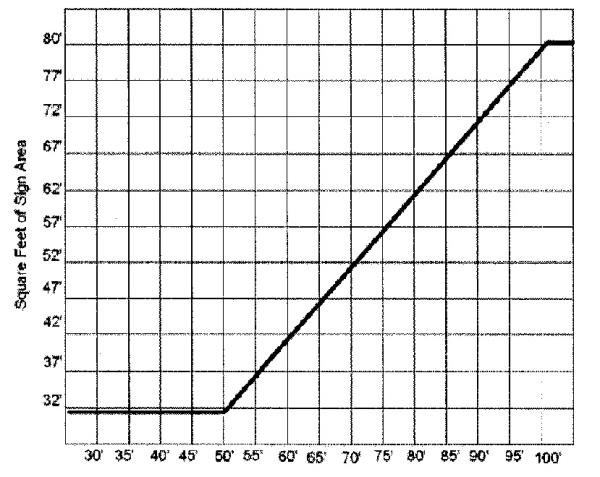 Property Frontage Width

Adopted by Ord. 99-07 on 12/27/1999
16.26.17: EXHIBIT 2, VISIBILITY TRIANGLE CHART
SIGN VISIBILITY TRIANGLE
60 Feet From Edge Of Right Of Way
Adopted by Ord. 99-07 on 12/27/1999
16.26.18: EXHIBIT 3, SIGN LADDER CHART
SIGN LADDER
Adopted by Ord. 99-07 on 12/27/1999

