
Westmont City Zoning Code
ARTICLE XI
SIGNS
Sec. 11.01 - General.
(A)
Purpose. The sign regulations of this section are intended to balance the following differing, and at times, competing goals:
(1)
To support the desired character of the village, as expressed in adopted plans, policies, and regulations;
(2)
To promote an attractive visual environment;
(3)
To encourage the effective use of signs as a means of communication for businesses, organizations, and individuals;
(4)
To provide a means of way-finding for visitors and residents;
(5)
To provide for reasonable business identification, advertising, and communication;
(6)
To prohibit signs of such excessive size and number that they obscure one another to the detriment of the economic and social well-being of the village and its residents, property owners and visitors;
(7)
To protect the safety and welfare of the public by minimizing hazards for motorized and nonmotorized traffic;
(8)
To minimize the possible adverse effects of signs on nearby public and private property; and
(9)
To provide broadly for the expression of individual opinions through the use of signs on private property.
(B)
Scope and applicability. All signs within the village are subject to the regulations of this article and all other applicable provisions of this zoning ordinance.
(C)
Content neutrality; substitution of noncommercial messages. Any sign allowed under this article may contain, in lieu of any other sign message or copy, any lawful noncommercial message if the sign complies with all applicable size, height, location, and other requirements of this article. The purpose of this "substitution" provision is to prevent any inadvertent favoring of commercial speech over noncommercial speech, or the favoring of any one noncommercial message over any other noncommercial message.
(Ord. No. 25-105, § 3(Exh. A), 8-7-2025)
Sec. 11.02 - Prohibited signs.
The following signs and sign characteristics are expressly prohibited in the village unless otherwise expressly stated in this zoning ordinance:
(A)
Signs for which any required permit has not been issued or that are posted or maintained in violation of the sign regulations of this article;
(B)
Signs in, on or above any street, alley, park, parkway, sidewalk or other public place, except as expressly allowed under the provisions of this article;
(C)
Roof signs;
(D)
Signs that project above the building wall unless designed as an architectural element such as a marquee;
(E)
Search lights, strobe lights, rotating beacon lights, flashing lights, and blinking lights that are visible from public right-of-way, except as otherwise expressly allowed by this article or required by law;
(F)
Off-premises outdoor advertising signs other than those expressly permitted within 660 feet of the right-of-way of Route 83 (Kingery Highway) or U.S. Route 34 (Ogden Avenue);
(G)
Signs that obstruct any fire escape, required exit, window or door opening used as a means of egress;
(H)
Signs that interfere with an opening required for ventilation, except that signs may cover transom windows when not in violation of building and fire prevention codes;
(I)
Signs affixed directly to a tree, utility pole or traffic control device;
(J)
Signs attached to fences except as permitted for construction signs in section 11.03(C);
(K)
Projecting signs except as permitted under section 11.05(D);
(L)
Abandoned signs (see section 11.08);
(M)
Balloons, inflatables, feather signs, banner signs, and similar wind-driven devices, unless otherwise expressly allowed by provisions of this zoning ordinance;
(N)
Signs that obstruct, impair, obscure, interfere with the view of, or that may be confused with, any authorized traffic control sign, signal, or device or that makes use of the words "stop," "look," "danger," or any other word, phrase, symbol or character in such a manner as to interfere with, mislead or confuse motorists;
(O)
Sign displays with a brightness of such intensity or brilliance that they impair the vision or endanger the safety and welfare of any pedestrian, cyclist, or person operating a motor vehicle;
(P)
Signs that violate the sight vision triangle regulations of section 12.05;
(Q)
Signs attached to or painted on an inoperable or unlicensed vehicle (motorized or non-motorized) located in view of the right-of-way;
(R)
High-intensity lighting around the border of a window, or the outlining an architectural element or feature of a building or other structure not in compliance with section 12.01(D)(5), except for temporary holiday lighting and seasonal decorations using unshielded low-intensity lamps typical of holiday displays; and
(S)
Signs that are obscene or that when considered as a whole predominantly appeal to prurient interest.
(Ord. No. 25-105, § 3(Exh. A), 8-7-2025)
Sec. 11.03 - Sign exceptions.
The following signs are not counted as signs for purposes of determining the number of signs or sign area on a lot. Such signs are subject to the regulations of section 11.02, section 11.07, and section 11.08 as well as the following:
(A)
Driveway and parking lot signs.
(1)
One driveway sign may be installed at each vehicle entrance and exit to any lot occupied by an allowed nonresidential use or multi-unit building. Such signs must be located within ten feet of the intersection of the driveway and the street right-of-way. Driveway signs may not exceed nine square feet in area or six feet in height.
(2)
Off-street parking areas may display signs within parking lots. Such signs must be oriented to be visible by parking lot users and may not exceed six square feet in area or six feet in height.
(B)
Real estate signs. One temporary real estate sign is allowed per street frontage. Such signs may not exceed:
(1)
32 square feet in area or eight feet in height on lots occupied by nonresidential uses or buildings containing three or more dwelling units; or
(2)
9 square feet in area or six feet in height on lots occupied by fewer than three dwelling units.
(C)
Construction signs.
(1)
One temporary construction sign is allowed per street frontage. Such signs may not exceed:
(a)
Thirty-two square feet in area or eight feet in height on lots occupied by nonresidential uses or buildings containing three or more dwelling units; or
(b)
Nine square feet in area or six feet in height on lots occupied by fewer than three dwelling units.
(2)
Construction signs may be attached to construction fences.
(D)
Static changeable message board signs. One static changeable message board sign is permitted per lot. Such signs may not exceed 32 square feet in area.
(E)
Fuel pump signs. One sign (including an electronic display) is permitted per fuel pump and electric vehicle charging station. Such signs may not exceed two square feet in area per pump or charging station. Operational and payment instructions on the face of the pump or station are exempt from this sign area limitation.
(F)
Drive-Through signs. Drive-through signs are permitted in conjunction with drive-through uses, as follows:
(1)
Number and size.
(a)
A maximum of one primary drive-through sign and one secondary drive-through sign is allowed per drive-through lane.
(b)
Primary drive-through signs may not exceed 50 square feet in area.
(c)
Secondary drive-through signs may not exceed 12 square feet in area.
(d)
Signs on vertical (vehicle height) clearance barriers are not counted as signs if they contain no commercial message.
(2)
Visibility. Drive-through signs must be oriented to be visible by motorists in allowed drive-through lanes.
(G)
Sandwich board signs.
(1)
Sandwich board signs are permitted only in B-1(A), B-1, B-2, B-3, C-1, R-4, R-5, R-6, and R-7 districts.
(2)
One sandwich board sign is permitted per business, subject to location and separation distance or additional allowances specific to the districts listed below.
(3)
Sandwich board signs may not exceed eight square feet per side or four feet in height.
(4)
Sandwich board signs must be removed and stored indoors when the establishment is not open for business.
(5)
Sandwich board signs must be professionally made and maintained in good condition.
(6)
Sandwich board signs must be of an A-frame design and properly weighted so as not to create a windblown hazard.
(7)
Sandwich board signs may not have any protruding nails, tacks, wires or sharp metal edges.
(8)
Sandwich board signs must be located on the ground and not be attached to any structure or person.
(9)
Sandwich board signs must be set back at least five feet from all property lines and 15 feet from any vehicular private drives or entries, and may not obstruct or impede traffic flow.
(10)
A minimum separation distance of 25 feet between any other commercial signage must be maintained, including freestanding temporary signs.
(11)
Sandwich board signs are permitted on private property (except in B-1(A) and B-1 districts where they are permitted on public and private sidewalks), provided that the signs must be located entirely or partially on the sidewalk in front of the business, allowing for at least 5 feet of continuous sidewalk clearance.
(12)
Sandwich board signs are prohibited in parking lots, parking spaces or vehicular drives.
(H)
Window signs. Window signs, including but not limited to "open" covering no more than 40 percent of the total window area are allowed as sign exceptions. Window border lighting is prohibited, as stated in section 11.02(R).
(I)
Pennants. Pennants may be attached to private light poles in nonresidential districts. No more than one pennant is permitted on each light pole and such signs may not exceed four square feet in area. Pennant signs must be attached with a rigid frame that does not allow for wind movement.
(J)
Temporary signs and banners.
(1)
In nonresidential districts, temporary signs and banners may be approved, subject to the following conditions:
(a)
A maximum of one temporary sign is permitted per business per display period.
(b)
The maximum display period may not exceed 30 days.
(c)
Temporary signs may be displayed for no more than 60 days each calendar year per business. Any display of a temporary sign counts towards the maximum number of days for the business.
(d)
Temporary signs may not exceed 32 square feet in area. They may be freestanding or attached to the leased frontage of the building.
(e)
For multi-tenant centers, only one freestanding temporary sign is permitted per street frontage at any time.
(f)
Freestanding signs must be at least five feet from property lines and 15 feet from any driveways. They may not exceed eight feet in height.
(K)
Special event signs. Special event signs and banners located in, on or over the public right-of-way require approval by the board of trustees as part of the special event permit approval and are subject to time, place and size restrictions imposed by the board of trustees. Board of trustees-approved special event signs are not subject to the sign regulations of this article unless otherwise expressly stated at the time of approval.
(L)
Grand opening event signs. Grand opening event signs are permitted in business and employment districts in association with a business opening in a new space. Such signs are subject to the following regulations:
(1)
Grand opening event signs are allowed for a maximum duration of 14 consecutive calendar days, beginning on the first day that the business is open to the public. Any temporary signs in place before or after this grand opening event sign period are subject to the special event sign regulations of section 11.03(K);
(2)
The following types of signs are allowed as grand opening event signs:
(a)
Wall-mounted temporary banners;
(b)
Flags;
(c)
Freestanding temporary banners; and
(d)
Feather signs.
(3)
No more than four total grand opening event signs are allowed. No more than two of the four allowed signs may be feather signs, and no more than one of the four allowed signs may be freestanding temporary banner signs.
(4)
Wall-mounted temporary banner signs may not exceed 32 square feet in area.
(5)
Individual freestanding temporary banner signs and feather signs may not exceed 32 square feet in area or exceed eight feet in height. Both types of signs must be set back at least five feet from lot lines and at least 15 feet from the edge of any on- or off-site driveway.
(6)
Signs on motor vehicles are expressly prohibited as grand opening event signs.
(7)
The zoning administrator is authorized to order the removal of any grand opening signs that are deemed a danger to the public health, safety, or welfare, or that are in violation of any zoning ordinance or village code requirements. Failure to immediately remove such signs is a violation of this zoning ordinance.
(8)
Grand opening event signs are exempt from otherwise applicable window sign area limits (see section 11.03(H)) for the 14-day period during which these grand opening event sign provisions apply.
(M)
Other sign exceptions. The following additional signs are also allowed as sign exceptions:
(1)
Signs erected and maintained pursuant to the discharge of governmental functions, or that are required by law, ordinance, or government regulation, or that are required to be posted in order to effectuate a legal right;
(2)
Flags that do not contain a commercial message (flags that contain a commercial message are regulated as signs);
(3)
Up to six wall plaques and wall signs that are not illuminated or are directly illuminated and that do not exceed four square feet in area per sign;
(4)
Signs within completely enclosed buildings, unless otherwise expressly stated in this zoning ordinance;
(5)
Labels and notices on equipment or structures, provided the label or notice does not exceed 15 square inches in area; and
(6)
Temporary signs with a noncommercial message. Such signs may not exceed:
(a)
Twelve square feet in area or five feet in height on lots occupied by nonresidential uses or buildings containing three or more dwelling units; or
(b)
Four square feet in area or five feet in height on lots occupied by fewer than three dwelling units.
(Ord. No. 25-105, § 3(Exh. A), 8-7-2025; Ord. No. 26-022, § 2, 2-19-2026)
Sec. 11.04 - Allowed signs.
Signs are allowed in accordance with the regulations of Table XI-1.
Table XI-1: Allowed Signs
Table XI-1 Notes:
[1]
Intrinsic brightness may not exceed 50 footcandles per square inch or ten per square inch if visible from an R district. Illumination levels on R-zoned lots may not exceed one-tenth of a footcandle.
[2]
This provision applies only to signs located within 660 feet of the right-of-way of Ill. Route 83 (Kingery Highway) and U.S. Route 34 (Ogden Avenue). Maximum height is measured from grade at centerline of right-of-way.
[3]
Where reflecting, radiating or other illumination of signs is permitted:
(a)
Light may not be projected toward or onto properties located in an R district.
(b)
Any illumination in the line of vision of approaching vehicular traffic may not resemble any authorized traffic sign.
(c)
Flashing, blinking, or stroboscopic lights are prohibited.
(d)
Gooseneck reflectors and lights are permitted on permanent signs; provided, however, that any such reflectors or lights must be installed in such a manner that the direct rays of light are concentrated on the sign and are shielded or otherwise constructed to prevent glare upon streets or adjacent properties.
[4]
In multi-tenant centers with independent outdoor entrances to individual units, each unit is allowed a sign on the leased frontage.
[5]
Notwithstanding the maximum gross sign area standards, all business and office buildings have an assumed minimum facade width of 30 linear feet. If multiple enterprises occupy the 30-foot frontage, each must proportionately share the allowable maximum gross sign area allowance.
[6]
RESERVED
[7]
RESERVED
[8]
Maximum height of freestanding signs located within 660 feet of the right-of-way of Illinois Route 83 (Kingery Highway) is 20 feet, measured from grade at centerline of right-of-way.
[9]
Maximum height measured from grade or elevation of the site on which the sign is to be placed.
[10]
The maximum gross sign area of off-premises advertising signs is counted toward the total sign area allowed in the applicable zoning district and the total number of signs permitted on any premises.
[11]
Off-premises advertising signs must also comply with all rear and side yard setbacks of the applicable zoning district.
[12]
In B-1(A) and B-1 districts, interior illuminated box (panel) signs with translucent faces are prohibited. Box signs are permitted only when they have a completely opaque (screened) background and backlighting that highlights only individual letters, symbols, or logos.
(Ord. No. 25-105, § 3(Exh. A), 8-7-2025)
Sec. 11.05. - Additional regulations for specific sign and site types.
(A)
Wall signs.
(1)
A maximum of one wall sign is permitted for each business except on corner lots, where businesses are permitted a maximum of one wall sign per street-facing building frontage.
(2)
Wall signs must be oriented to the street, except as follows:
(a)
When a business or building has a primary entrance oriented to an internal parking lot rather than a primary street, permitted wall sign allowances are calculated based on the building frontage facing the parking lot.
(b)
If the portion of the building that faces the street is considered the rear of the building, but has been architecturally designed with the same material integrity as the front facade, then one additional sign facing the street frontage is permitted; however, the rear building frontage does not count when calculating the allowed gross sign area permitted on the site.
(c)
In B-1(A) and B-1 districts, when access for patrons is provided from the rear of the principal building, one additional wall sign is permitted; however, the rear building frontage does not count when calculating the allowed gross sign area permitted on the site.
(3)
All new wall signs must be individual letter signs, with each letter mounted independently on the wall or attached to a typical raceway. Square or rectangular-shaped cabinet or box type signs are expressly prohibited as wall signs. One small cabinet sign may be used as a component of a wall sign that is composed primarily of individual letters, provided that the cabinet sign component:
(a)
Does not exceed 20 percent of the area of the proposed sign;
(b)
Reflects the design of the individual letter sign components in terms of color and shape.
(B)
Freestanding signs.
(1)
A maximum of one freestanding sign is permitted on each lot except on corner lots, where a maximum of one freestanding sign is permitted per street frontage with driveway access to the street. Except as otherwise expressly stated in this section, this limit applies to single-tenant and multi-tenant centers. Any subdivided outlots within multi-tenant centers are allowed a maximum of one freestanding sign.
(2)
In the O/R district, additional freestanding wayfinding signs are allowed as follows:
(a)
One additional freestanding wayfinding sign is permitted per each entrance into the property/development with a maximum of four additional freestanding wayfinding signs for the entire property.
(b)
Freestanding wayfinding signs may not exceed 35 square feet in area or ten feet in height.
(c)
Freestanding wayfinding signs must be set back at least 25 feet from all property lines.
(3)
The maximum sign area for an individual freestanding sign is a portion of the permitted maximum sign area of all signage as determined by the frontage (see Table XI-1) and may account for no more than 50 percent of overall allowed signage, except as follows:
(a)
When only one freestanding sign is installed on a corner lot (when multiple freestanding signs are permitted), the cumulative frontage for each street may be used for calculations; however signage may only account for up to 35 percent of overall allowed signage.
(b)
Multi-tenant centers are permitted a maximum gross sign area equal to 50 percent of the lot frontage or 200 square feet per sign, whichever is less.
(4)
All freestanding signs must be constructed with a base that is at least 50 percent as wide as the overall sign width up to eight feet in height, or 75 percent when permitted to be taller; pole signs are prohibited.
(5)
Freestanding signs must be separated by a distance of at least ten feet from any other sign.
(6)
Freestanding signs must prominently display the building addresses (with numerals) that are a minimum height of six inches.
(7)
All newly constructed freestanding signs must be landscaped in accordance with the following regulations and approved as part of a landscape plan for the subject property:
(a)
Freestanding signs must have a minimum landscaped area of five feet around the base of the sign.
(b)
Seventy-five percent of the landscape bed must be planted with vegetation.
(c)
Vegetation must include shrubs, ornamental grasses and perennials that provide year-round interest.
(d)
Plantings must be large enough to conceal the base of the sign.
(e)
Freestanding signs in parking areas must be surrounded by bollards or a masonry barrier.
(f)
All plantings must be continuously maintained and replaced as necessary.
(C)
Electronic message board signs.
(1)
Electronic message board signs are permitted as of right in B-2, B-3, C-1, O/R, O/R-1, M-1, M, and P/I districts, provided that such signs require special use permit approval when the subject lot's street yard or interior side yard abuts an R-zoned lot.
(2)
Electronic message board signs may be approved by special use permit in R districts when located on lots occupied by public or institutional uses subject to compliance with all applicable regulations of this article.
(3)
Electronic message board signs are expressly prohibited in B-1(A) and B-1 zoning districts.
(4)
The electronic message board component of a sign may not comprise more than 40 percent of a freestanding sign's total allowable sign face area, or 75 percent if the freestanding sign is in a monument style (not a pole sign).
(5)
Electronic message board signs may not display flashing, animation, illusion of movement, or similar displays.
(6)
Live or pre-recorded video is prohibited.
(7)
Messages must instantaneously change; no transitions are allowed.
(8)
Messages may not change more than once every five seconds.
(9)
Electronic message board signs are subject to compliance with maximum light intensity and illumination regulations of this article.
(10)
The electronic message board sign module must include dimmer controls that can be adjusted to meet village light emission standards. Proof of such sign module controls must be provided.
(D)
Projecting signs. Projecting signs are permitted only in B-1(A) and B-1 districts, subject to the following regulations:
(1)
A maximum of one projecting sign is permitted per each ground-floor business abutting a street-facing building or building wall facing an off-street parking area where customer access is also available. When a business occupies a corner frontage and is permitted two signs, the business may elect for a single corner projecting sign installed at 45 degrees at the corner.
(2)
Projecting signs may not exceed six square feet in area, or ten square feet for a corner-mounted projecting sign.
(3)
Projecting signs must be mounted to ensure a minimum clearance of eight feet measured from the bottom of the sign to the sidewalk or grade above which the sign extends.
(4)
Projecting signs may not be placed higher than 15 feet above grade, and sign structure and light fixtures may not extend higher than 18 feet above grade. No portion of the sign, structure or lighting may exceed the height of the building or architectural first-floor facade. Projecting signs may not obstruct windows or accessways.
(5)
Projecting signs may not extend or project more than three feet from building facade.
(6)
External illumination, internally illuminated individual channel letter signs, and bare bulb signs are permitted as projecting signs. Internally illuminated box signs are permitted when accessory to a primary sign and letters/sign copy must be dimensional. Sign lighting must be designed to prevent light spillage and glare onto any adjacent R-zoned property or public right-of-way. External light fixtures may not extend beyond two feet from the centerline of the sign.
(7)
Projecting signs that encroach over public property or right-of-way, require a license agreement between the village and property and/or business owners. Such agreement requires the owner to specifically acknowledge responsibility for any injury or property damage caused by the sign encroachment, agrees to indemnify the village, and provide proof of insurance. The zoning administrator is authorized to execute all such agreements on behalf of the village, utilizing a form agreement prepared by the village attorney.
(E)
Fueling stations and vehicle sales establishments.
(1)
The total gross area of signs on lots occupied by fueling stations or vehicle sales establishments (auto dealerships) may not exceed 0.5 square feet per linear foot of street frontage.
(2)
Fueling stations are allowed one additional wall (canopy) sign in addition to permitted wall signs; however, all signs are counted when determining compliance with applicate total sign area limits. Canopy signs may not face a residential district.
(3)
Vehicle sales establishments are allowed one additional wall sign in addition to permitted wall signs; however, all signs are counted when determining compliance with applicate total sign area limits.
(Ord. No. 25-105, § 3(Exh. A), 8-7-2025; Ord. No. 26-022, § 2, 2-19-2026)
Sec. 11.06. - Construction standards.
(A)
All signs and other advertising structures must be designed and constructed in accordance with the building code (chapter 18) and all other applicable ordinances of the village.
(B)
Signs may not be painted on the wall of a building or adhered to the wall of a building with glue or mastic. Wall signs may not be secured with wire, strips of wood or nails.
(C)
All new freestanding sign structures must be properly engineered. No building permit may be granted or plans approved for any new freestanding sign structure unless such plans are prepared by an Illinois licensed architect or structural engineer. The requirement for plans to be prepared by an Illinois licensed architect or structural engineer may be waived by the zoning administrator.
(D)
The lettering or advertising designs to be illuminated may be composed of glass or other transparent or semi-transparent material. Any glass forming a part of any sign must be safety glass or plate glass at least 0.25 inches thick. Any single piece or pane of glass with an area or more than three square feet must be wired glass.
(E)
Any movable part of a sign such as the cover of a service opening must be securely fastened by chains or hinges.
(F)
Signs must be constructed with rigid materials. Vinyl and fabric are considered temporary signs and are expressly prohibited as permanent signs.
(G)
Every sign must identify the date of installation, the permit number and the voltage of any electrical apparatus.
(Ord. No. 25-105, § 3(Exh. A), 8-7-2025)
Sec. 11.07. - Maintenance.
(A)
All signs together with their supports, braces, guys and anchors must be kept in good repair and must be maintained to comply with the standards established in this zoning ordinance and all other applicable ordinances.
(B)
It is the duty of the owner of the lot or premises on which signs are located to maintain sign and the area around such signs in neat, clean, sanitary and inoffensive condition and to keep the area free and clean of all debris, junk and other materials and substances that would tend to create a condition detrimental to the public health, safety and welfare.
(Ord. No. 25-105, § 3(Exh. A), 8-7-2025)
Sec. 11.08. - Abandoned signs.
Any sign that no longer advertises a bona fide business conducted, or a product sold is considered abandoned and must be removed by the owner, agent or person having the beneficial use of the building or structure upon which such sign may be found. This provision does not apply to signs displaying a noncommercial message.
(Ord. No. 25-105, § 3(Exh. A), 8-7-2025)
Sec. 11.09. - Nonconforming signs.
See section 13.05.
(Ord. No. 25-105, § 3(Exh. A), 8-7-2025)
Sec. 11.10. - Permits.
(A)
Except as otherwise provided in this zoning ordinance, it is unlawful for any person to erect, enlarge, alter or maintain a sign without first obtaining a permit for such sign from the community development department.
(B)
Permit fees must be calculated in accordance with the building permit fee schedule of section 18-487. Temporary signs and banners do not require a fee.
(Ord. No. 25-105, § 3(Exh. A), 8-7-2025; Ord. No. 26-022, § 2, 2-19-2026)
Sec. 11.11. - Sign-Related measurements.
(A)
Sign area.
(1)
Signs enclosed in frames or cabinets. The area of a sign enclosed in a frame, box or cabinet is determined based on the outer dimensions of the frame or cabinet surrounding the sign face.
{pick;appa_figxi-1;none;bound;cc;def;def;def}
(2)
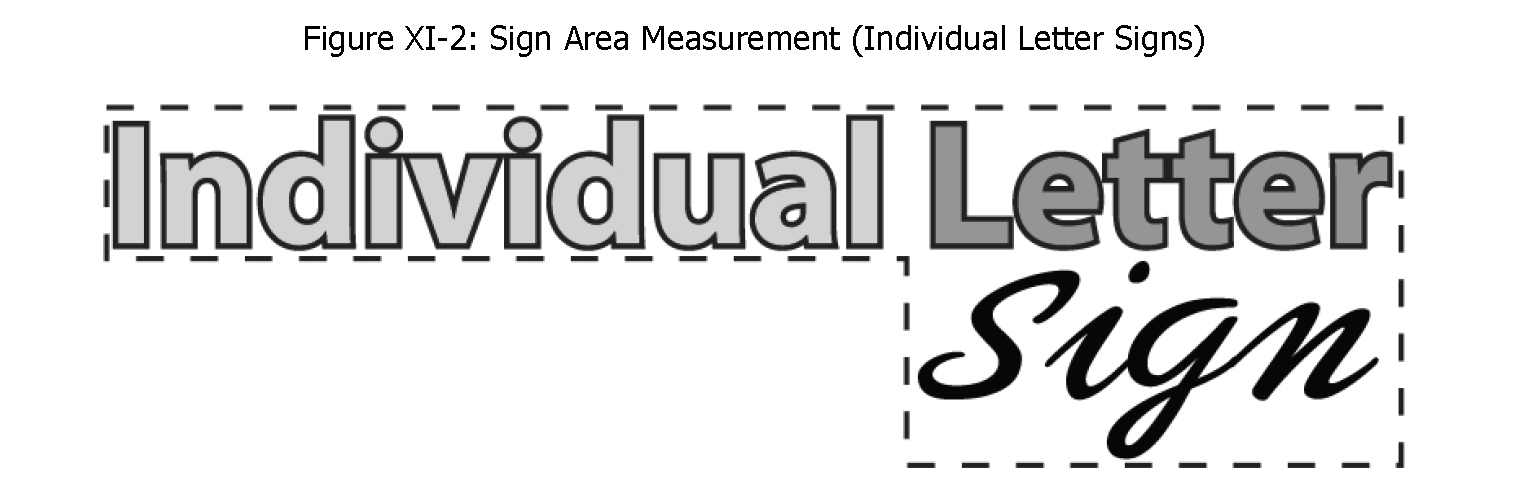
Channel (individual) letter signs. The area of a sign comprised of individual letters or elements attached directly to a building wall is determined by calculating the area of the smallest rectangular polygon that can be drawn around the letters or elements.
(3)
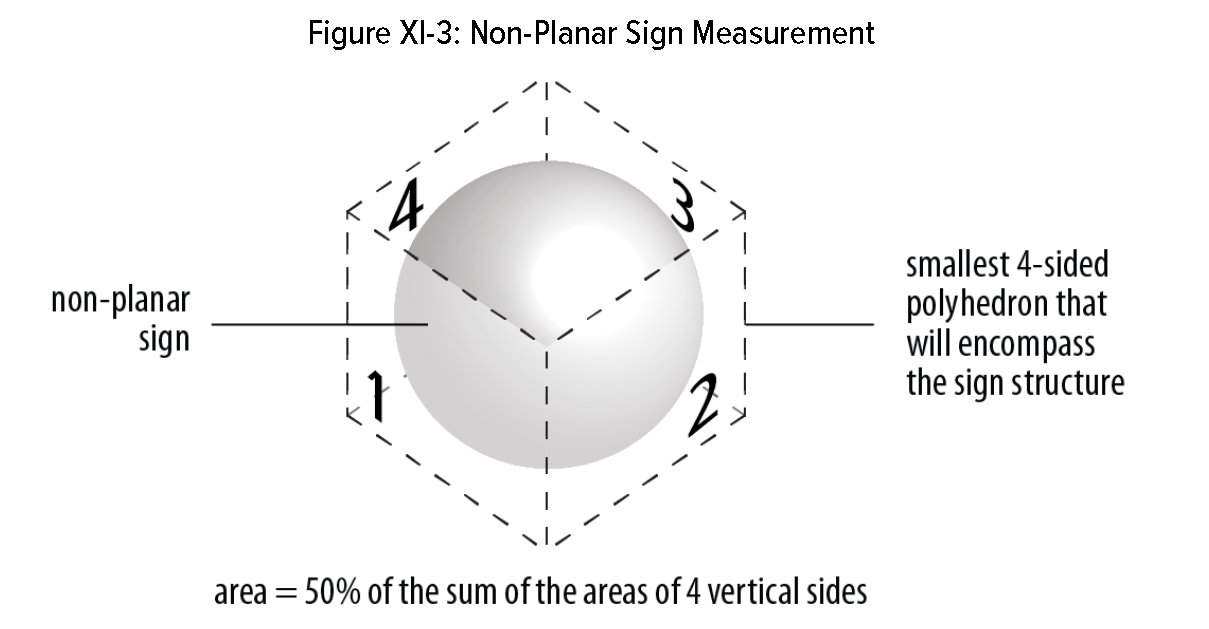
Non-planar signs. Spherical, free-form, sculptural or other non-planar sign area is measured as 50 percent of the sum of the areas using only the four sides of the smallest four-sided polyhedron that will encompass the sign structure. Signs with greater than four polyhedron faces are expressly prohibited.
(4)
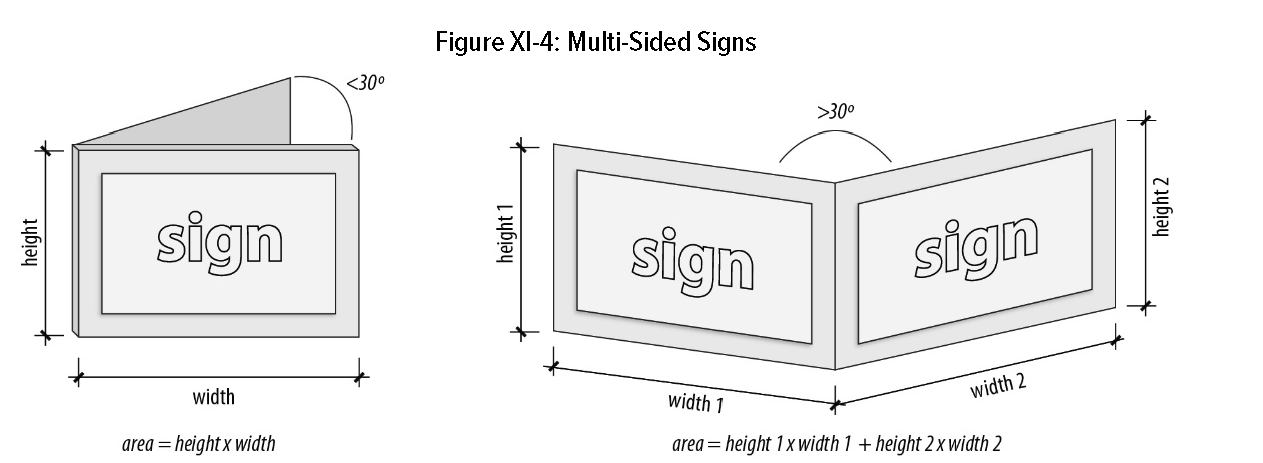
Multi-sided signs. Unless otherwise expressly stated, when the sign faces of a multi-sided sign are parallel or within 30 degrees of parallel, only one side is counted for the purpose of determining the area and number of signs. If the sign faces are not parallel or within 30 degrees of parallel, each sign face is counted as a separate sign. If the size of one sign face is larger than another, the size of the largest sign face is the area of the sign.
(B)
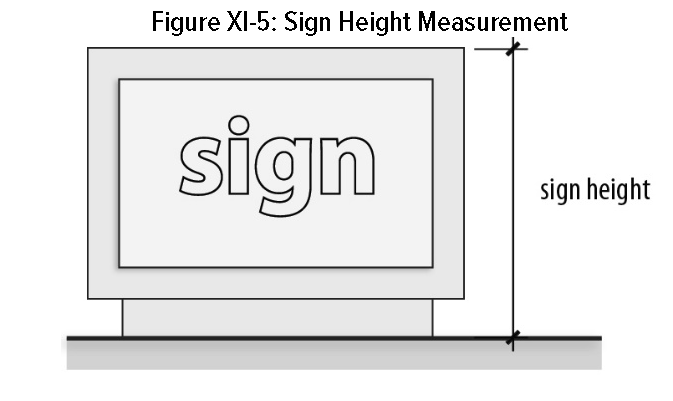
Sign height. The height of a sign is measured as the vertical distance from ground level to the top of the sign. The sign height includes the sign base.
(C)
Building frontage. Many of the sign regulations of this article are based on building frontage. The following rules govern the measurement of building frontage.
(1)
For buildings occupied by a single tenant or multiple tenants that access the building via a common entrance, building frontage is the exterior building wall that: (1) is adjacent to a street or a parking area or other vehicle circulation area that is accessory to and serves the subject building and (2) contains either windows or a public building entrance. Allowed wall sign area for a building that has two or more building frontages must be calculated on the basis of each individual building frontage.
(2)
On buildings housing more than one tenant where each tenant has their own outside entrance, a tenant's building frontage is the exterior building wall (or walls) that directly abut the tenant's interior floor space and that: (1) abuts, parallels, or is the nearest to parallel with a street or a parking area or other vehicle circulation area that is accessory to and serves the subject building and (2) contains either windows or a public building entrance. A tenant with two or more building frontages must calculate the permitted sign area on the basis of each individual building frontage.
(3)
Regardless of the height, number of stories, or number of tenants in a building, building frontage is determined by one measurement of the horizontal length of the wall at finished grade. Building walls must be measured along a flat, unbroken plane, regardless of the presence of recesses or projections along the building wall.
(4)
As an alternative to the allocation of permitted sign area on the basis of individual building frontages, a differing allotment of sign area may be assigned to the various tenants upon receipt and approval by the zoning administrator of written authorization from the building's owner or authorized management firm. In no instance may the total combined sign area for all signs exceed the maximum allowed sign area for the individual building frontages, as determined in accordance with building frontage measurement rules of this section.
(D)
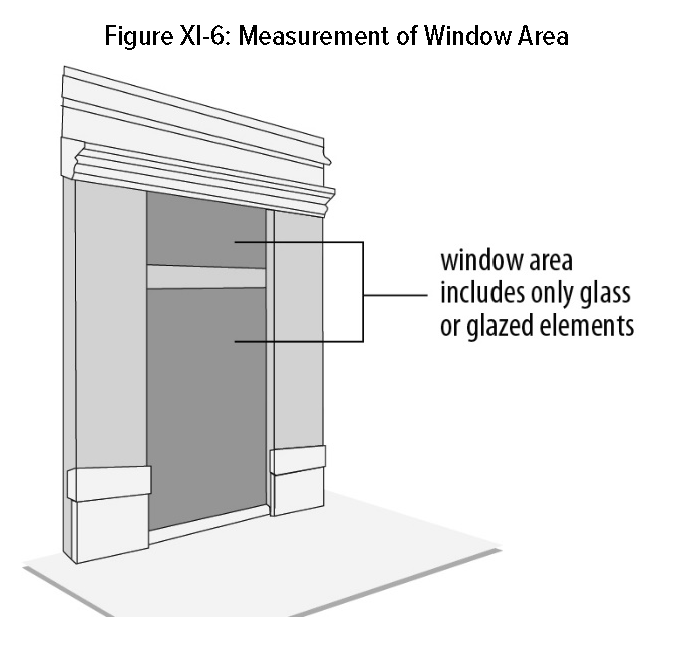
Window area. The area of a window includes only the glass or glazed elements of the window. Frames, mullions, and similar features are not counted as part of the window area. Limits on window coverage apply to each individual window and door. The area of a window sign is based on the entire outer dimensions of the sign, regardless of whether the sign includes see-through mesh or other transparent or semi-transparent material.
(Ord. No. 25-105, § 3(Exh. A), 8-7-2025)

