
Westmont City Zoning Code
ARTICLE IV
DOWNTOWN ZONING DISTRICTS
Sec. 4.01.- Districts established.
The zoning ordinance's downtown zoning districts are listed in Table IV-1. When this zoning ordinance refers to "downtown" zoning districts, it is referring to the districts in Table IV-1.
Table IV-1: Downtown Zoning Districts
(Ord. No. 25-105, § 3(Exh. A), 8-7-2025)
Sec. 4.02. - Purposes.
The village's downtown zoning districts are intended to support and enhance the compact, vibrant, walkable character of the village's downtown area.
(A)
The B-1(A) district is intended to maintain and enhance vibrant, main-street, storefront development pattern within the central business district.
(B)
The B-1 district is intended to be more flexible, allowing a wider mix of supporting uses in the downtown area, while still maintaining a high level of walkability.
(C)
The R-7 district is primarily intended to accommodate residential uses in a variety of building forms and is further intended to accommodate the transition from the downtown area into low-density residential neighborhoods bordering downtown.
(Ord. No. 25-105, § 3(Exh. A), 8-7-2025)
Sec. 4.03. - Uses.
Uses are allowed in downtown districts in accordance with the use regulations of section 6.01.
(Ord. No. 25-105, § 3(Exh. A), 8-7-2025)
Sec. 4.04. - Building types.
Building types are allowed in downtown districts in accordance with Table IV-2. The zoning administrator is authorized to determine the applicable building type classification.
Table IV-2: Allowed Building Types (Downtown Districts)
P = Permitted S = Special Use Approval Required - = Prohibited
(Ord. No. 25-105, § 3(Exh. A), 8-7-2025)
Sec. 4.05. - Lot and building regulations.
The lot and building regulations for the downtown districts are organized by building type in section 4.09, section 4.10, section 4.10, and section 4.11. Rules for measuring compliance with applicable lot and building regulations can be found in article XVI.
(Ord. No. 25-105, § 3(Exh. A), 8-7-2025)
Sec. 4.06. - Generally applicable regulations.
The regulations of this section apply to all building types in downtown districts, unless otherwise expressly stated.
(A)
One building per lot. One building is allowed per lot, unless otherwise expressly stated.
(B)
Treatment of yards. All yards must consist of landscape planting areas, patio space, or sidewalk space, unless otherwise expressly stated as allowed vehicular areas. Vehicular use areas (e.g., parking lots, loading areas, driveways and drive aisles) are limited to certain yards in accordance with section 4.06(E) and the applicable building type regulations of section 4.07, section 4.09, and section 4.10.
(C)
Trash, recycling, and refuse locations. All trash, recycling, and other refuse areas for all buildings within downtown districts must be located in the rear or interior side yard and must meet the nonresidential accessory structure setback requirements of section 7.03.
(D)
Front street.
(1)
General. Front streets establish where the fronts of buildings are located and determine requirements such as the location of principal building entrances. Front streets require the highest level of facade treatment and restrict the location of parking, driveways, and garage entrances.
(2)
Designation. Cass Avenue, Quincy Street, and West Burlington Avenue are front streets.
(3)
Determination based on context. The zoning administrator may allow a different lot orientation based on the existing context of the lot and considering abutting lot orientation.
(4)
Intersecting front streets. Where two designated front streets abut a lot, the street with the most existing or planned front orientation on abutting or adjacent lots must be treated as the front street, as determined by the zoning administrator. The other street may be treated as a side street frontage.
(E)
Parking and loading location.
(1)
Structured parking within building. Parking within buildings is allowed only when located at least 20 feet behind any front or courtyard facade. The first 20 feet of building space behind the front or courtyard facade must include an allowed principal use, regularly occupied, not including parking or any type of storage. Structured parking must meet all setbacks required for the building.
(2)
Garage doors. Garage doors are not allowed on front facades of buildings in B-1(A) and B-1 districts.
(3)
Rear yard. Surface parking is allowed in the rear yard on all sites.
(4)
Limited side yard parking. In the B-1 district only, a surface parking lot may be located in the interior side yard subject to the following requirements:
(a)
Limited side yard parking may include one double- or one single-loaded aisle of parking with the centerline of the aisle perpendicular to the street.
(b)
Limited side yard parking is not in any street yard.
(c)
A maximum of one limited side yard parking lot per building is allowed along any street frontage.
(d)
Limited side yard parking lots may not be located abutting another side yard parking lot.
(e)
Limited side yard parking counts towards meeting front streetwall requirements.
(5)
Setbacks. Parking lots must be set back at least five feet from all side and rear lot lines, except to allow driveway connections between rear yard parking lots on abutting parcels. Parking may not extend closer to any street lot line than the building or a courtyard.
(6)
Driveways.
(a)
No more than one driveway is allowed per lot.
(b)
If an alley exists, vehicle access is allowed only from the alley.
(c)
Limited side yard parking (where allowed) may be accessed from a single driveway off the street.
(Ord. No. 25-105, § 3(Exh. A), 8-7-2025)
Sec. 4.07. - Other relevant regulations.
Uses and structures in downtown zoning districts may be subject to other regulations and standards, including the following:
(A)
Enclosure of operations. All business, servicing, storage, processing, or other operations in B-1 and B-1(A) districts must be conducted within completely enclosed buildings except for:
(1)
Allowed principal and accessory uses for which outdoor operations are expressly authorized in article VI or article VII.;
(2)
Off-street parking or loading;
(3)
Special events, temporary outdoor uses, and outdoor dining on public sidewalks, as expressly approved in accordance with chapter 22 of the village code; and
(4)
Business vehicle storage, in accordance with the regulations of section 7.14.
(B)
Parking. See article IX.
(C)
Landscaping. See article X.
(D)
Signs. See article XI.
(E)
Nonconformities. See article XIII.
(F)
Approval procedures. See article XIV.
(Ord. No. 25-105, § 3(Exh. A), 8-7-2025; Ord. No. 26-022, § 2, 2-19-2026)
Sec. 4.08. - Storefront buildings.
(A)
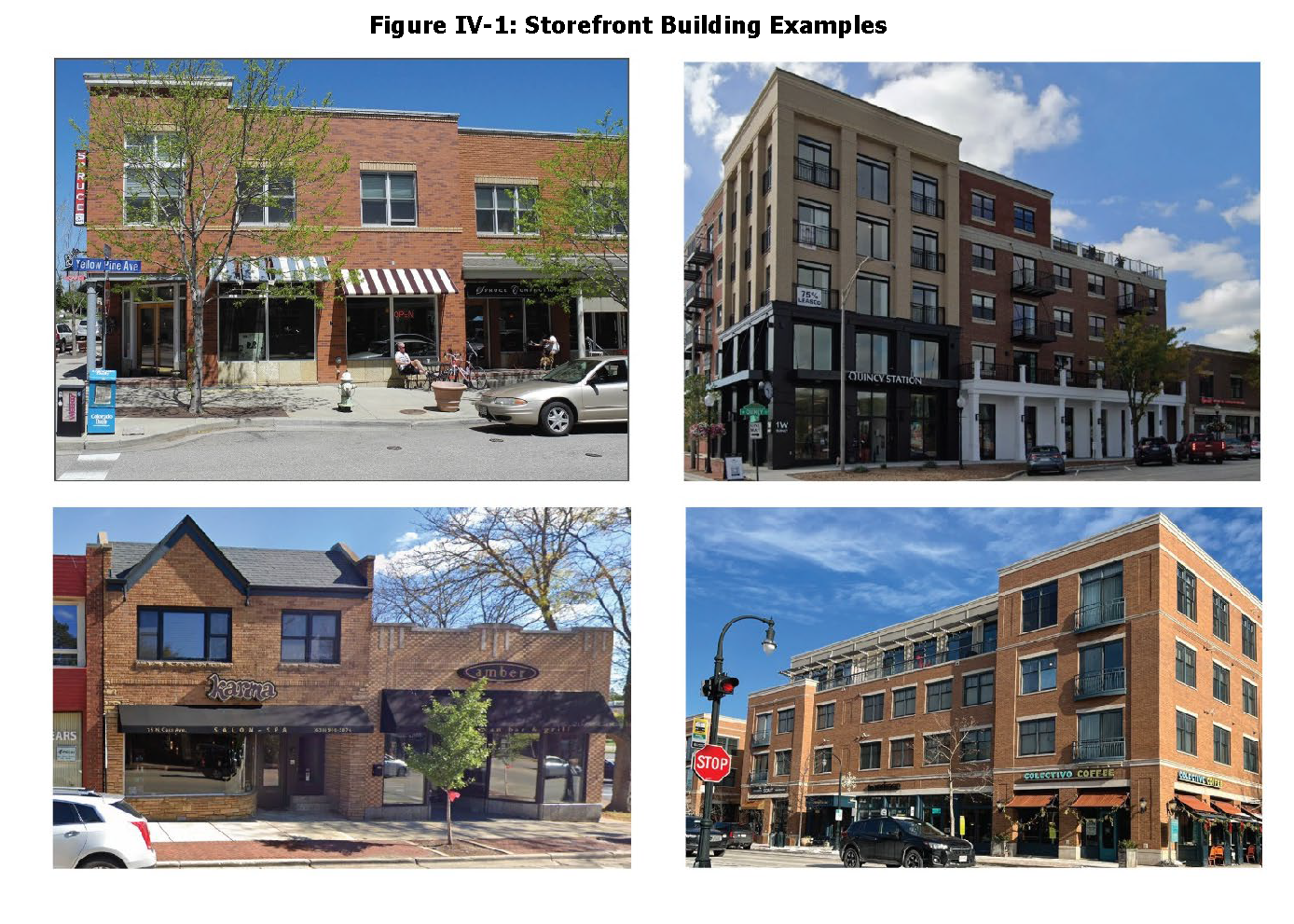
Description. The storefront building is a mixed-use building intended for shopping and dining districts. Oriented to the street with narrow or no side setbacks, storefront building streetwalls help define the public space of the street, and ground-story storefront glass and entrances along the sidewalk make these buildings interesting and inviting to pedestrians. Parking is located in the rear and accessed from the alley.
(B)
Images. The images shown in Figure IV-1 are intended to illustrate the general character of the building type; the buildings and sites in each image may not fulfill all of the building type regulations.
(C)
Building regulations.
(1)
General regulations. See section 4.06 for regulations applicable to all building types.
(2)
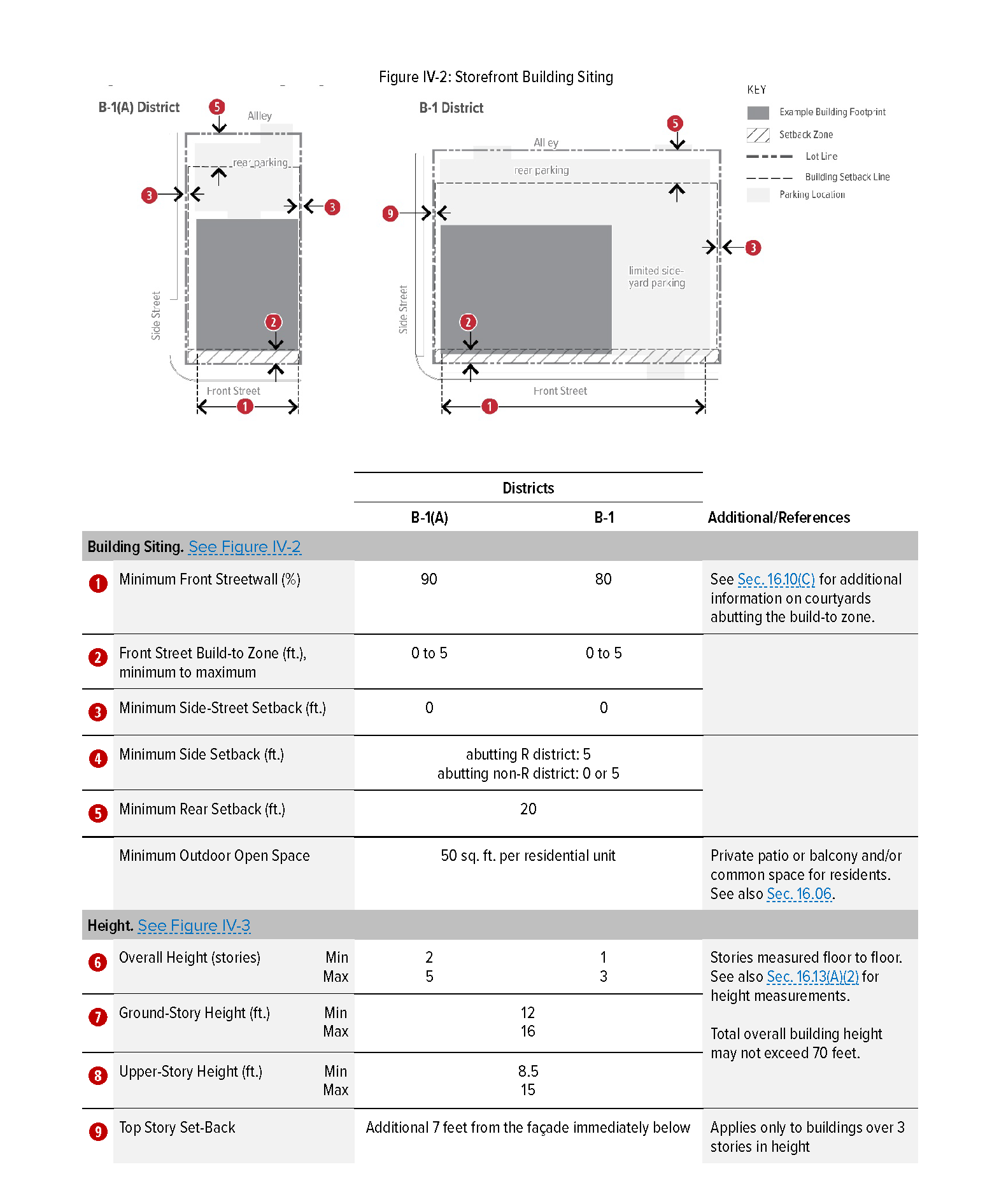
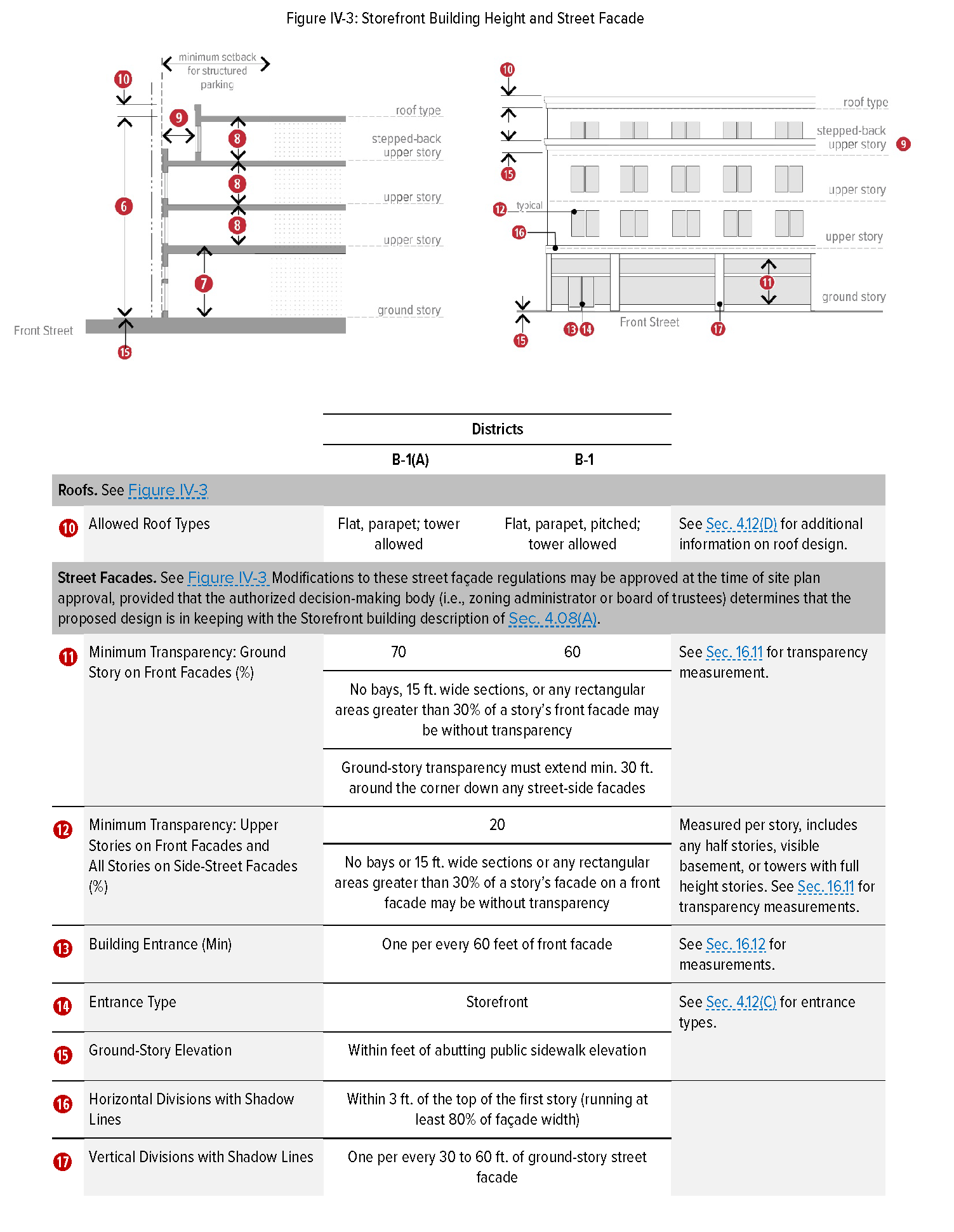
Regulations specific to storefront buildings. The following tables and illustrations establish regulations specific to storefront buildings.
(Ord. No. 25-105, § 3(Exh. A), 8-7-2025)
Sec. 4.09. - General buildings.
(A)
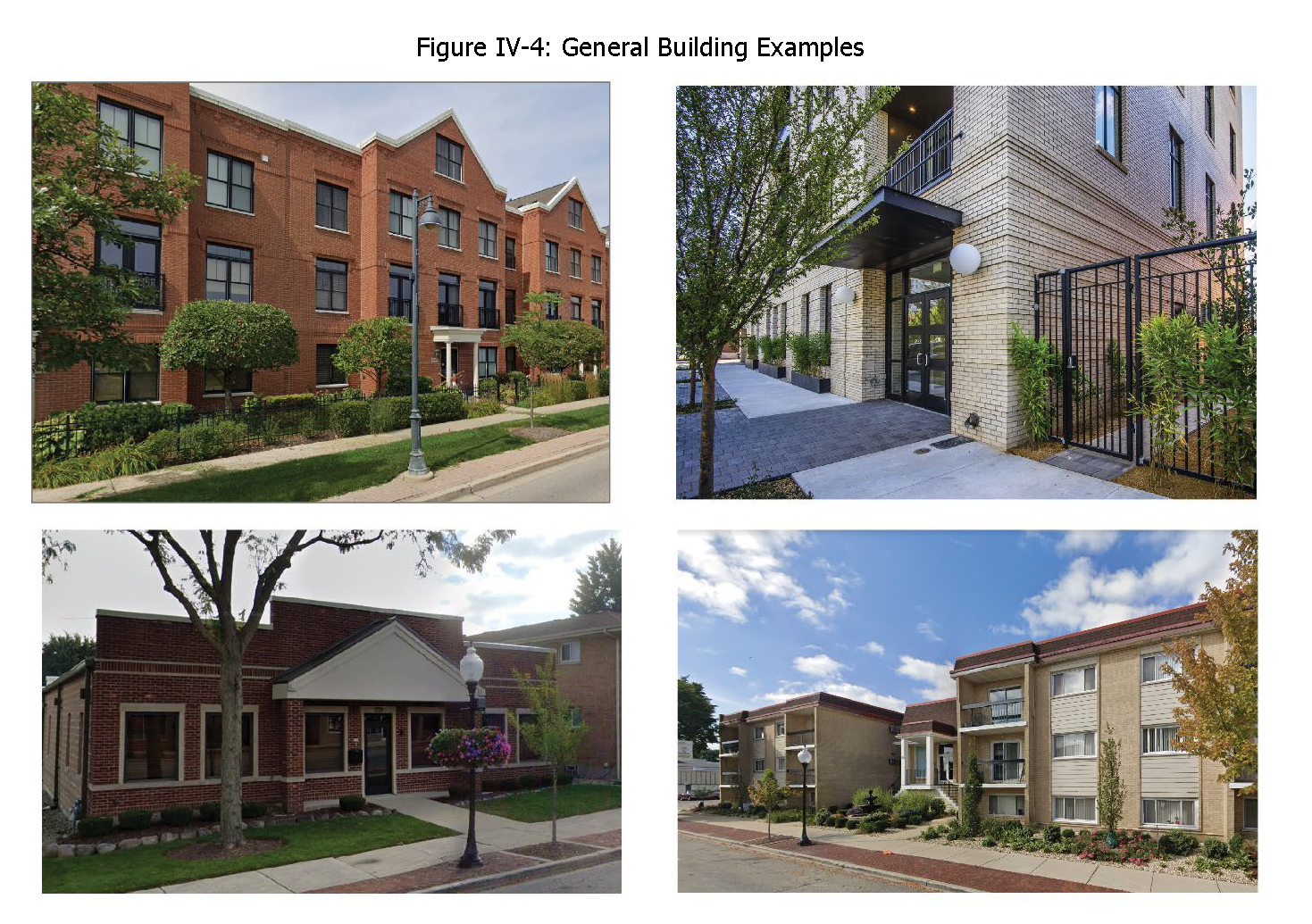
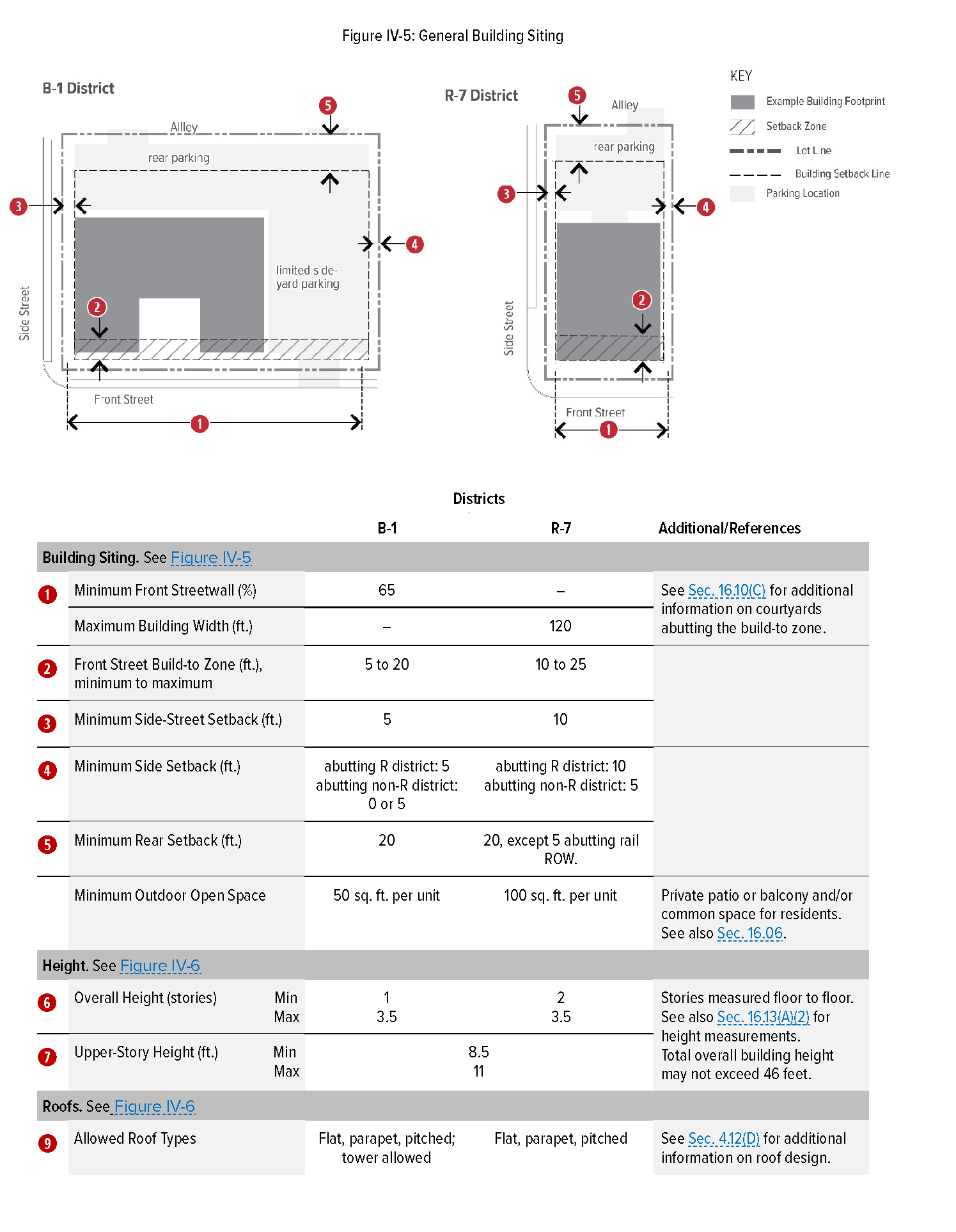
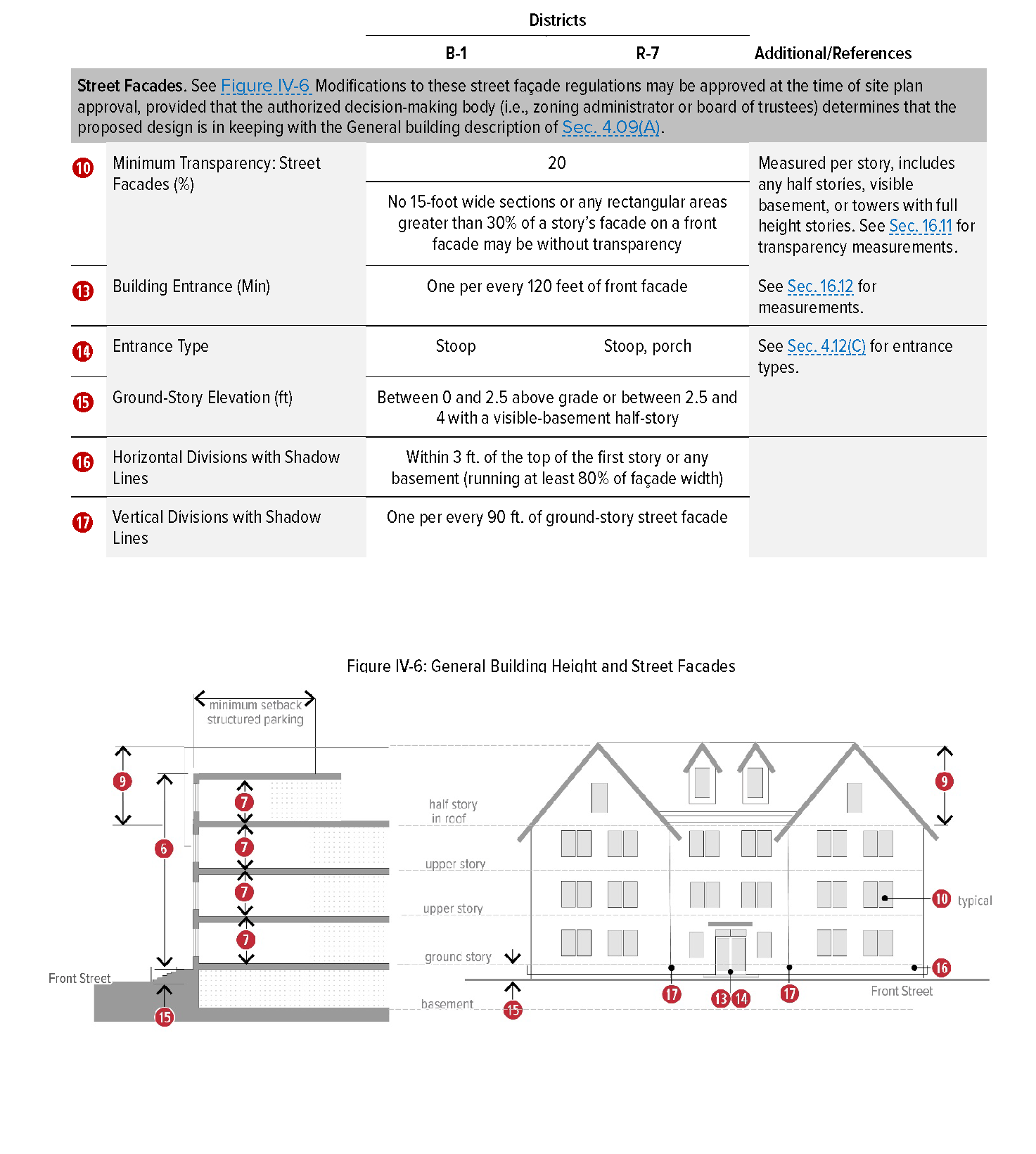
Description. The general building is a basic urban building, typically occupied by multiple residential units, offices and similar uses. General buildings usually have a central main lobby entrance. Parking is located in the rear with any attached garages entered from the rear of the building. Buildings vary in height depending on the district, with allowed half stories located within a pitched roof or in a visible basement.
(B)
Images. The images shown in Figure IV-4 are intended to illustrate the general character of the building type; the buildings and sites in each image may not fulfill all of the building type regulations.
(C)
Building regulations.
(1)
General regulations. See section 4.06 for regulations applicable to all building types.
(2)
Regulations specific to general buildings. The following tables and illustrations establish regulations specific to general buildings.
(Ord. No. 25-105, § 3(Exh. A), 8-7-2025)
Sec. 4.10. - Row buildings.
(A)
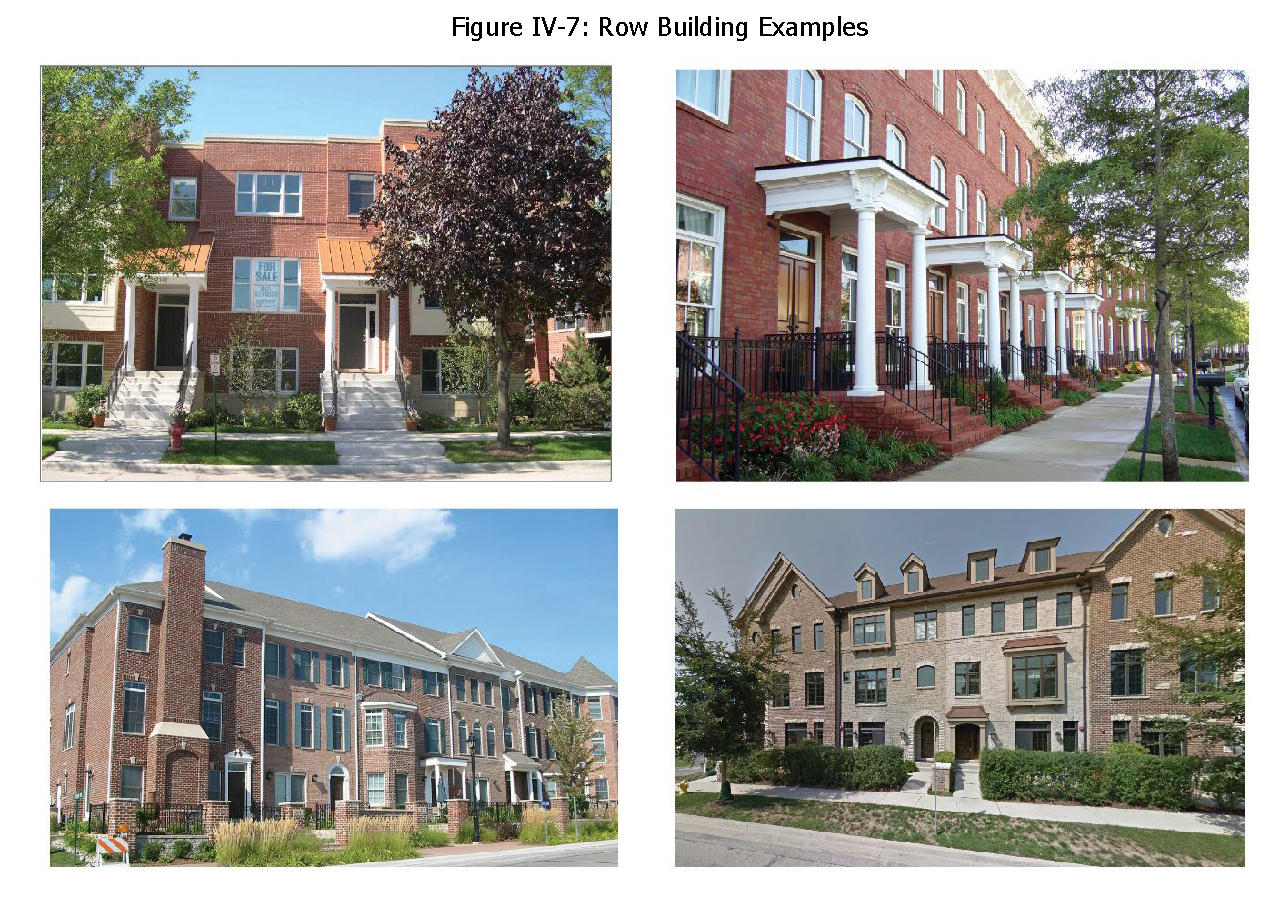
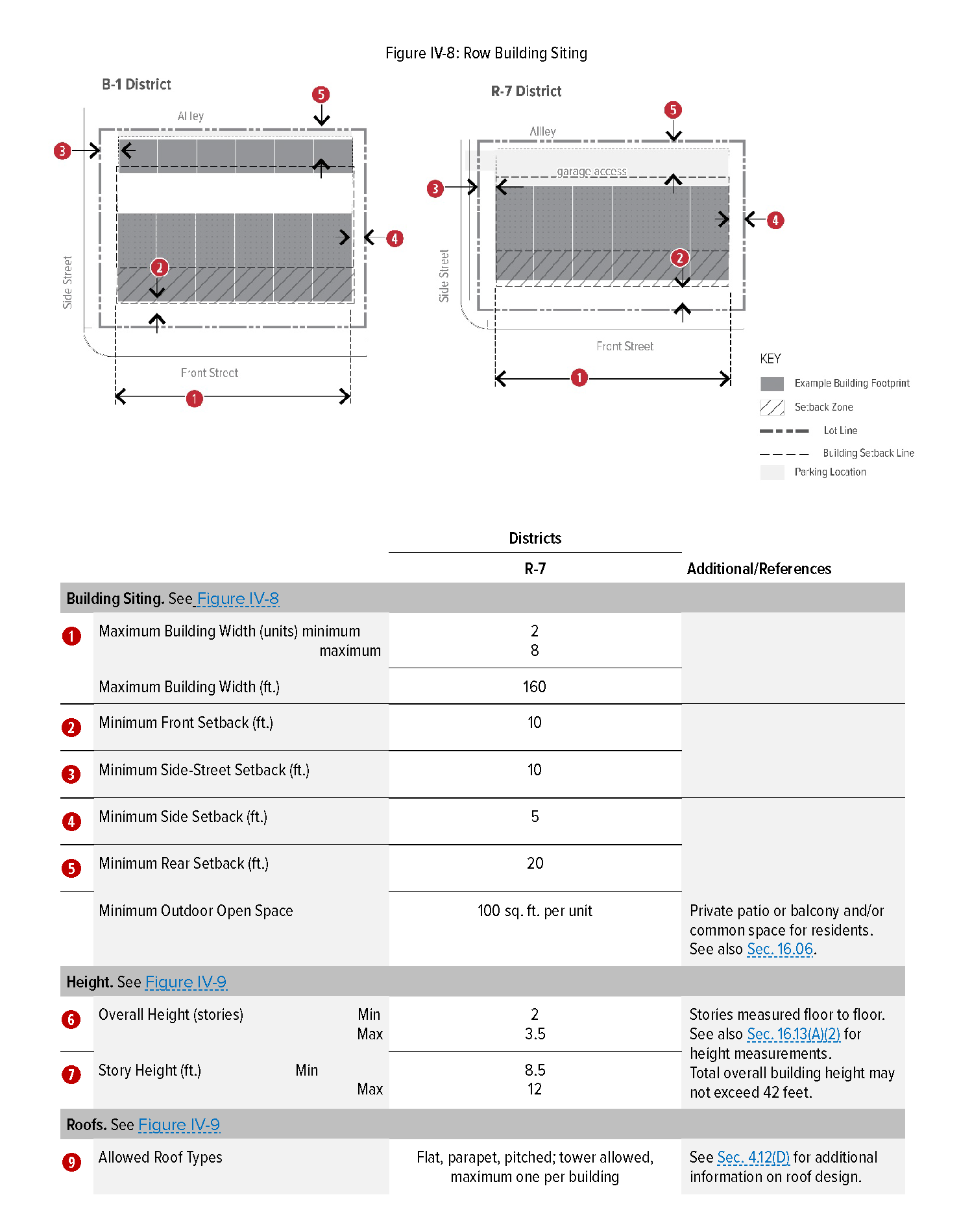
Description. The row building is comprised of multiple vertical units with shared side walls. Each unit is typically oriented to the street with an entrance off the public sidewalk. Parking is located in the rear yard with either detached garages or attached garages entered from the rear of the building.
(B)
Images. The images shown in Figure IV-7 are intended to illustrate the general character of the building type; the buildings and sites in each image may not fulfill all of the building type regulations.
(C)
Building regulations.
(1)
General regulations. See section 4.06 for regulations applicable to all building types.
(2)
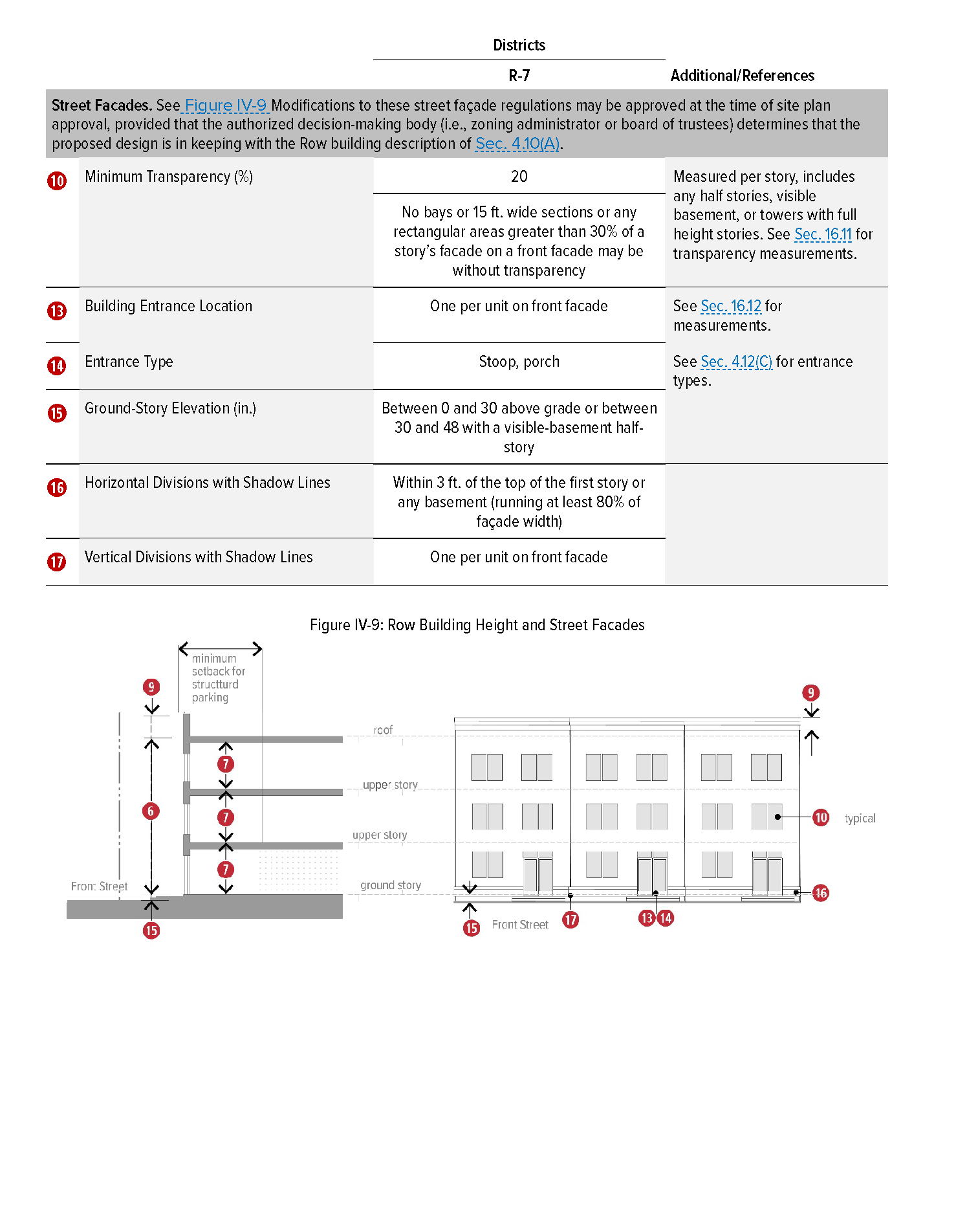
Regulations specific to row buildings. The following tables and illustrations establish regulations specific to row buildings.
(Ord. No. 25-105, § 3(Exh. A), 8-7-2025)
Sec. 4.11. - Detached houses.
(A)
Description. A detached house is a principal residential building that: (i) contains only one dwelling unit; (ii) is located on a single lot; and (iii) is not attached to any other dwelling units.
(B)
General intent.
(1)
Existing detached houses. Although the R-7 district is primarily intended to accommodate and promote the development of row buildings and general buildings, it is recognized that the district includes many detached houses that were constructed before the adoption of this zoning ordinance. In order to ensure that owners of these existing properties do not encounter unnecessary regulatory or procedural obstacles when improvements are proposed on such properties, detached houses established before the effective date of section 1.03 and additions and improvements to such properties are permitted as of right.
(2)
New detached houses. New detached houses may not be constructed in the R-7 district unless such construction is approved in accordance with the special use permit procedures of section 14.04.
(C)
Building regulations.
(1)
General regulations. Detached houses are exempt from compliance with the regulations of section 4.06 (Regulations Applicable to all Building Types).
(2)
Regulations specific to detached houses. All new detached houses and additions and improvements to existing detached houses are subject to compliance with the lot and building regulations that apply to detached houses in the R-5 district (see section 2.05).
(Ord. No. 25-105, § 3(Exh. A), 8-7-2025)
Sec. 4.12. - Building design.
(A)
Applicability. The building design regulations of this section (section 4.12) apply to principal buildings in the downtown districts. Modifications to stated design regulations may be approved at the time of site plan approval, provided that the authorized decision-making body (i.e., zoning administrator or board of trustees) determines that the proposed design meets the intent of the subject design standard.
(B)
Façade materials.
(1)
Intent. These facade materials regulations are intended to ensure the use of high-quality, durable, weather-resistant, exterior grade materials on the majority of finished building surfaces, while permitting a wider range of materials for building details. High-quality materials help improve how well buildings weather, reduce material failure rate, require lower maintenance, have a longer life cycle and sense of permanence, and maintain longer term value. They are also intended to maintain and enhance the physical character of the village's downtown area.
(2)
Major facade materials. Major facade materials are intended to serve as the primary surface material of street facades.
(a)
Minimum amount. Allowed major facade materials, listed in Table IV-3, must be applied to a minimum of 65 percent of all street facades, not including window and door openings and trim.
(b)
Simplicity of facade materials. A single major facade material must be used for each building facade segment.
(c)
Side and rear facades. Interior side and rear building facades may use an approved minor facade material as a major façade material.
(d)
Corners. Major facade materials must extend around the corner of the street facade to a side or rear facade a distance of at least 12 inches.
(e)
Original facade materials. Where brick or stone is an existing building's original major facade material, the original brick or stone may be maintained if in good condition or repaired, or the brick or stone may be replaced by new brick or stone. A different major material may not be installed over the original brick or stone.
(3)
Minor facade materials. A maximum of 35 percent of street facades, not including window and door openings and trim, may be composed of minor facade materials (see Table IV-4).
(4)
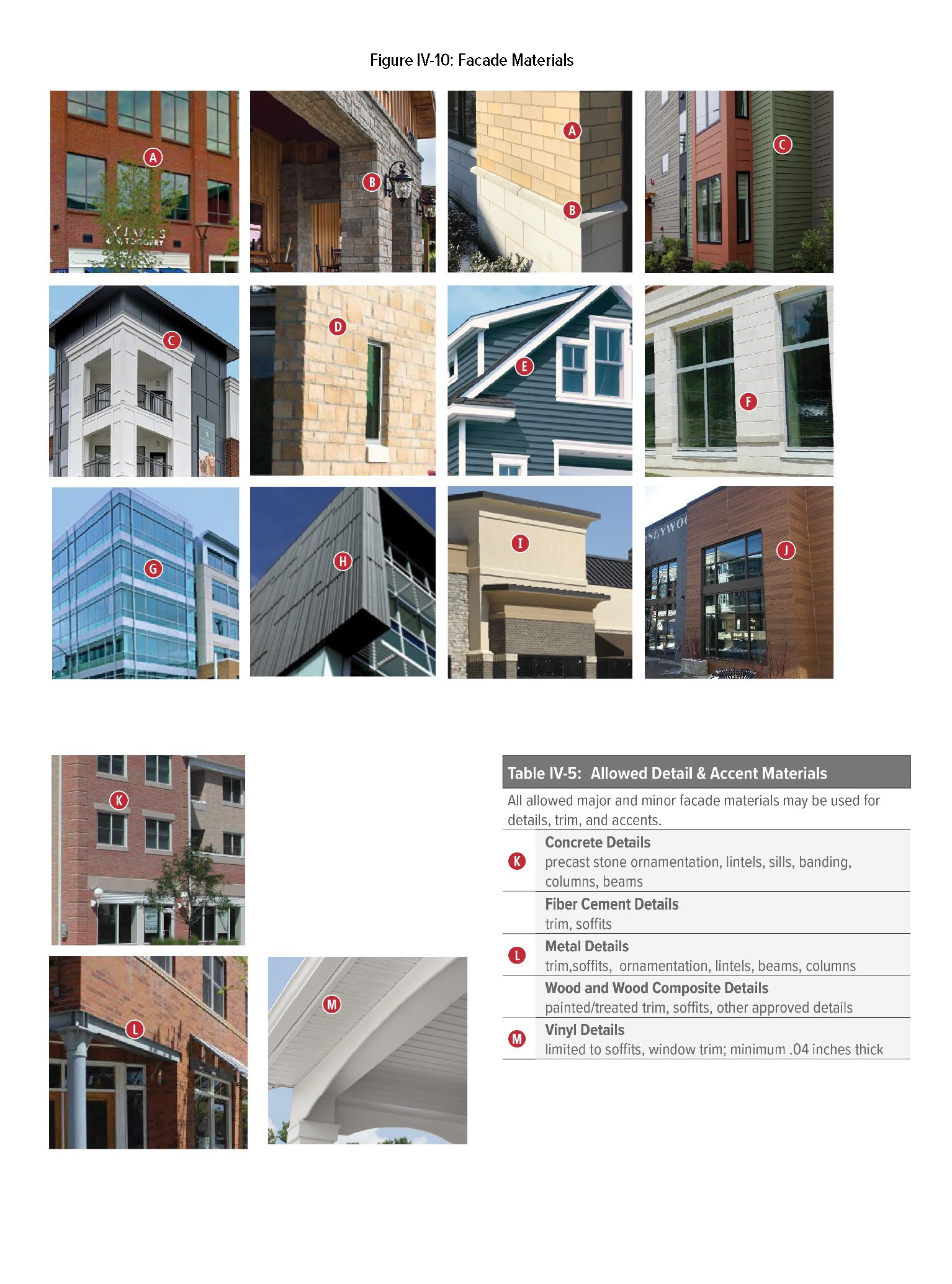
Accents and details. Additional materials are allowed for building accents and details (see Table IV-5). Such materials are not included in measuring facade surface areas.
(5)
Pitched roof materials. Allowed pitched roof materials include dimensional asphalt composite shingles, wood shingles and shakes, metal tiles or standing seam, slate, ceramic tile, engineered wood, slate or equivalent quality material.
(6)
Material grade. All doors, windows, and hardware used on the exterior of storefront and general buildings must be of commercial-grade quality.
(7)
Material installation. The following material installation requirements are intended to advance the quality of construction, durability, and aesthetics of new buildings, specifically related to application and detailing of facade materials.
(a)
Changes in facade materials. Changes in facade materials, whether major materials or minor materials, should occur mainly at concave (inner) corners or changes in facade planes.
(b)
Materials hierarchy. A hierarchy of materials must be maintained on the building facade, where "heavier," articulated unit materials (brick, concrete masonry units, stone) are located at the base of the facade and "lighter," constant surface materials with fewer seams (stucco, panels) are located above those on the facade.
(c)
Shadow lines on surfaces. Shadow lines must delineate changes in materials with solid materials of a thickness that is greater than 1.5 inches. For example, cast stone elements or brick may be offset or wood trim may be layered and offset to create a shadow.
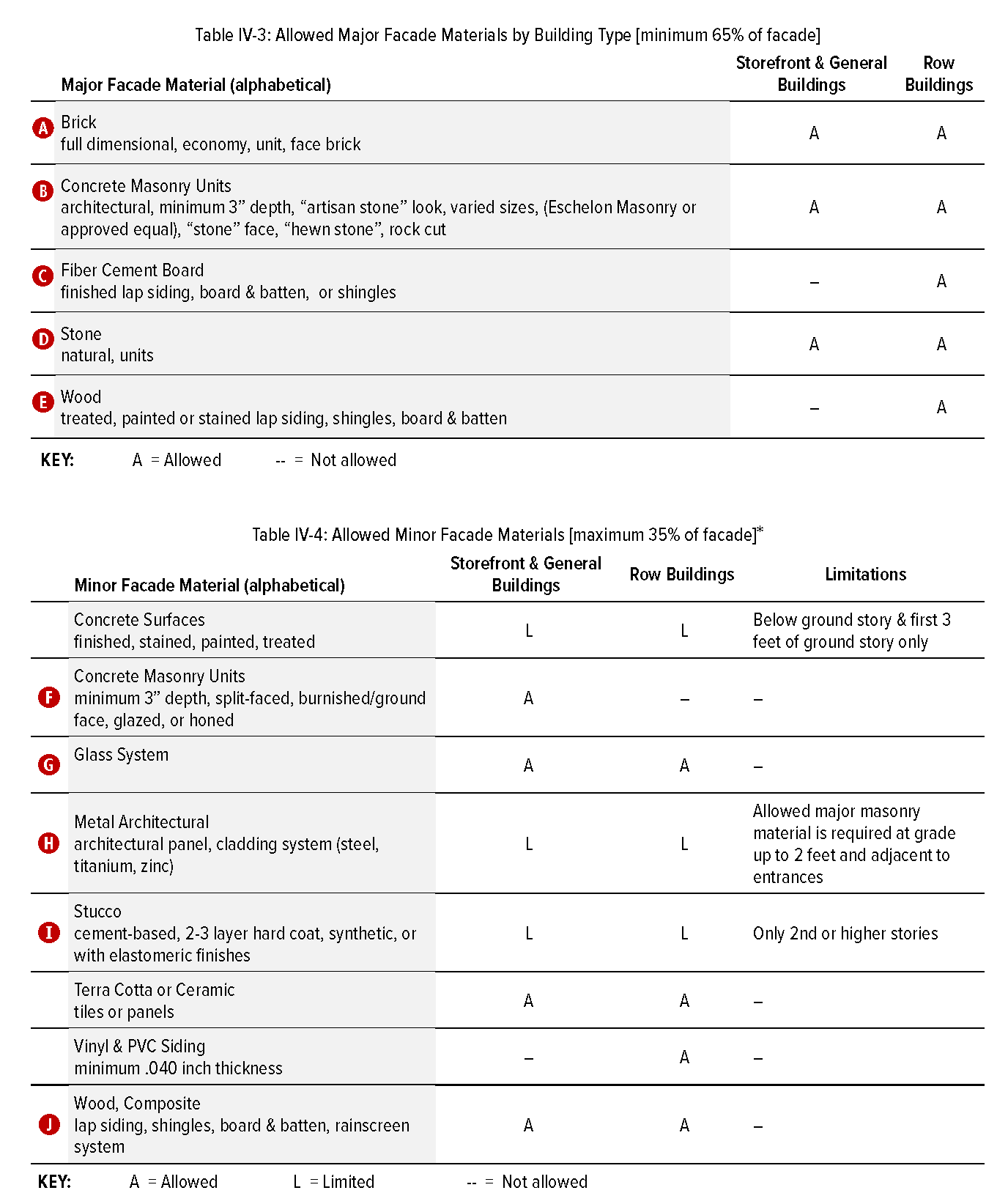
* All major facade materials allowed on the building type (see Table IV-3) may be used for minor facade materials, unless expressly stated otherwise.
(C)
Entrance types. Entrance types provide the transition between the public sidewalk in front of the building into the ground story of the building. Each front entrance must meet the requirements of one of the entrance types permitted by applicable building type regulations.
(1)
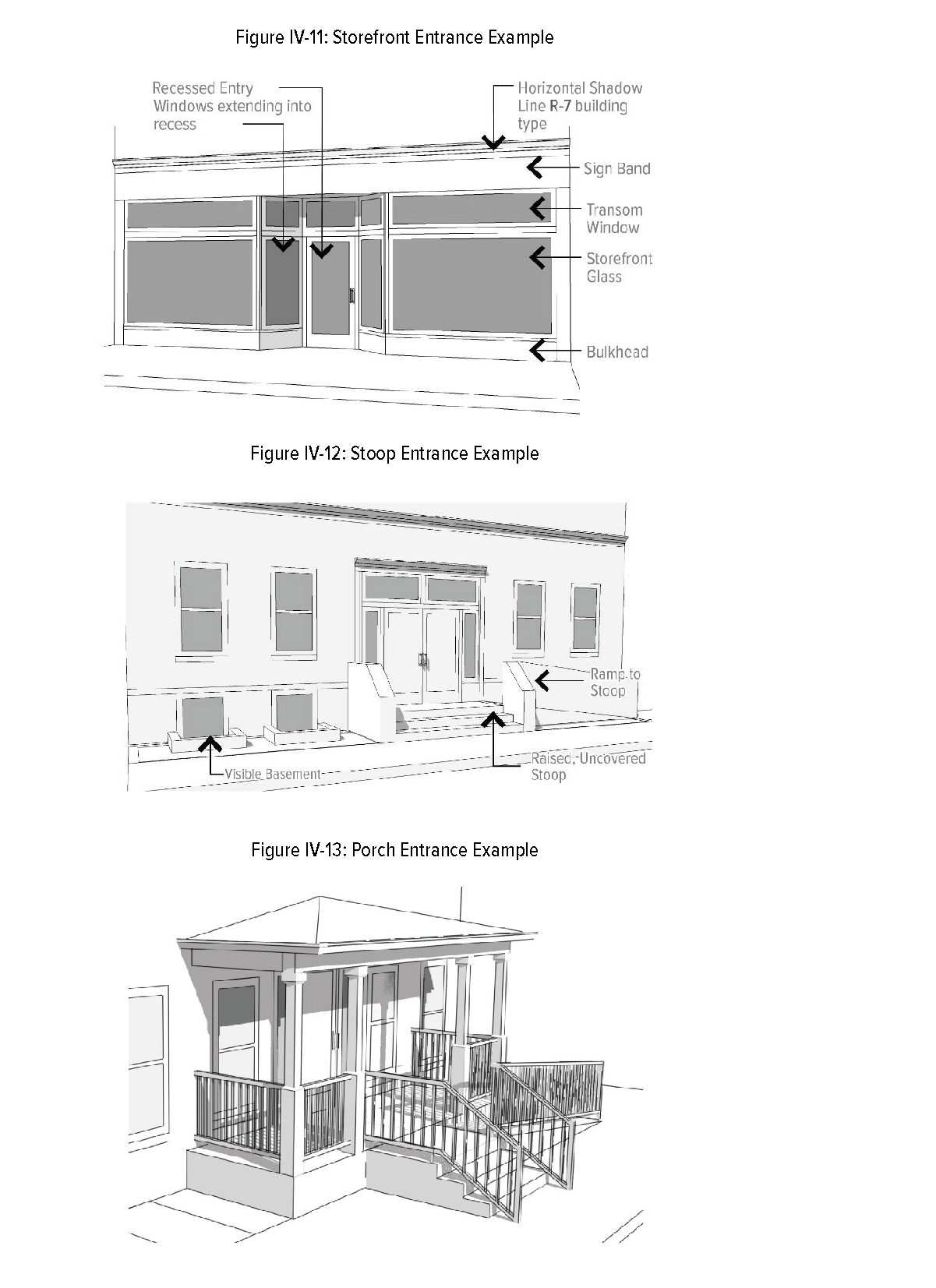
Storefront entrances. Storefront entrance types are intended to provide at or close to grade access between the store and adjacent sidewalk creating a high level of permeability. See Figure IV-11.
(a)
Recessed entrance. Where the sidewalk outside the storefront is less than seven feet in width, measured perpendicular to the facade, entrances must be recessed as follows:
i.
The door must be recessed between three and eight feet deep, measured from the facade.
ii.
The maximum width of the recess is ten feet.
(b)
Transparency. A minimum amount of ground-story storefront glass is required for some building types.
i.
The storefront entrance must meet the minimum transparency requirements.
ii.
The glass must turn the corner of the recessed entry as shown in Figure IV-11.
iii.
Transom windows above doors and storefront windows are encouraged.
iv.
See section 4.12(E)(1) for general window regulations.
(2)
Bulkhead. Where a bulkhead is incorporated, the maximum height is 30 inches. A bulkhead is the lower set of panels or low wall upon which the storefront windows rest. See Figure IV-11. The bulkhead may be constructed of wood, metal, concrete, spandrel glass, or masonry. Concrete masonry units may not be exposed. See section 4.12(B) for allowed facade materials.
(3)
Stoop entrance type. A stoop is a small, open platform that may include a permanent canopy or roof cantilevered off the building. See Figure IV-12. Stoops must comply with minimum building code standards for landings.
(4)
Porch entrance type. A porch is an open raised, platform with a perimeter railing or wall and a porch supported by columns. See Figure IV-13.
(a)
Porches must be at least five feet deep and eight feet wide.
(b)
Porches must meet the minimum and maximum story height for the building type and may be two stories in height to provide a second porch off the second floor.
(D)
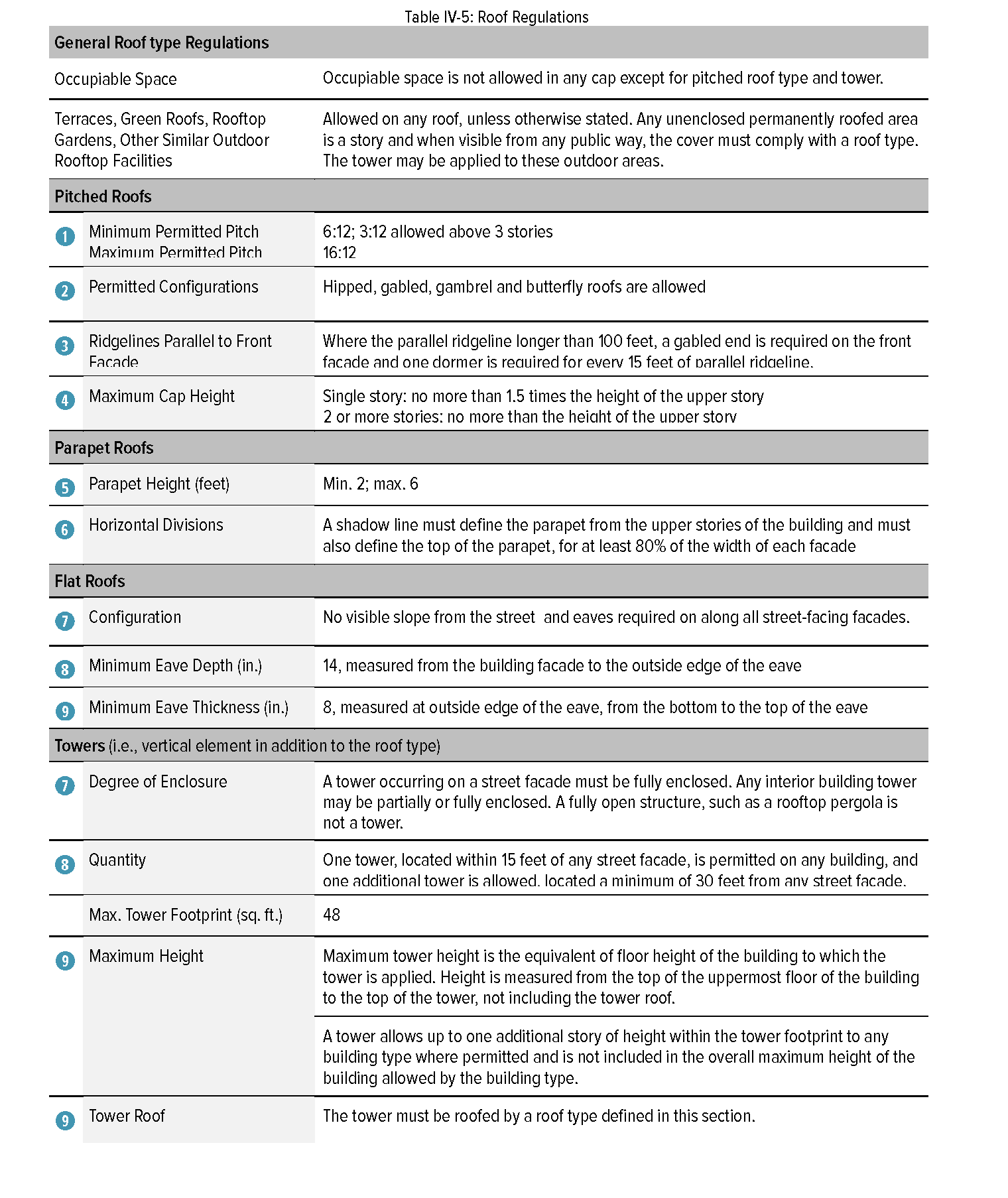
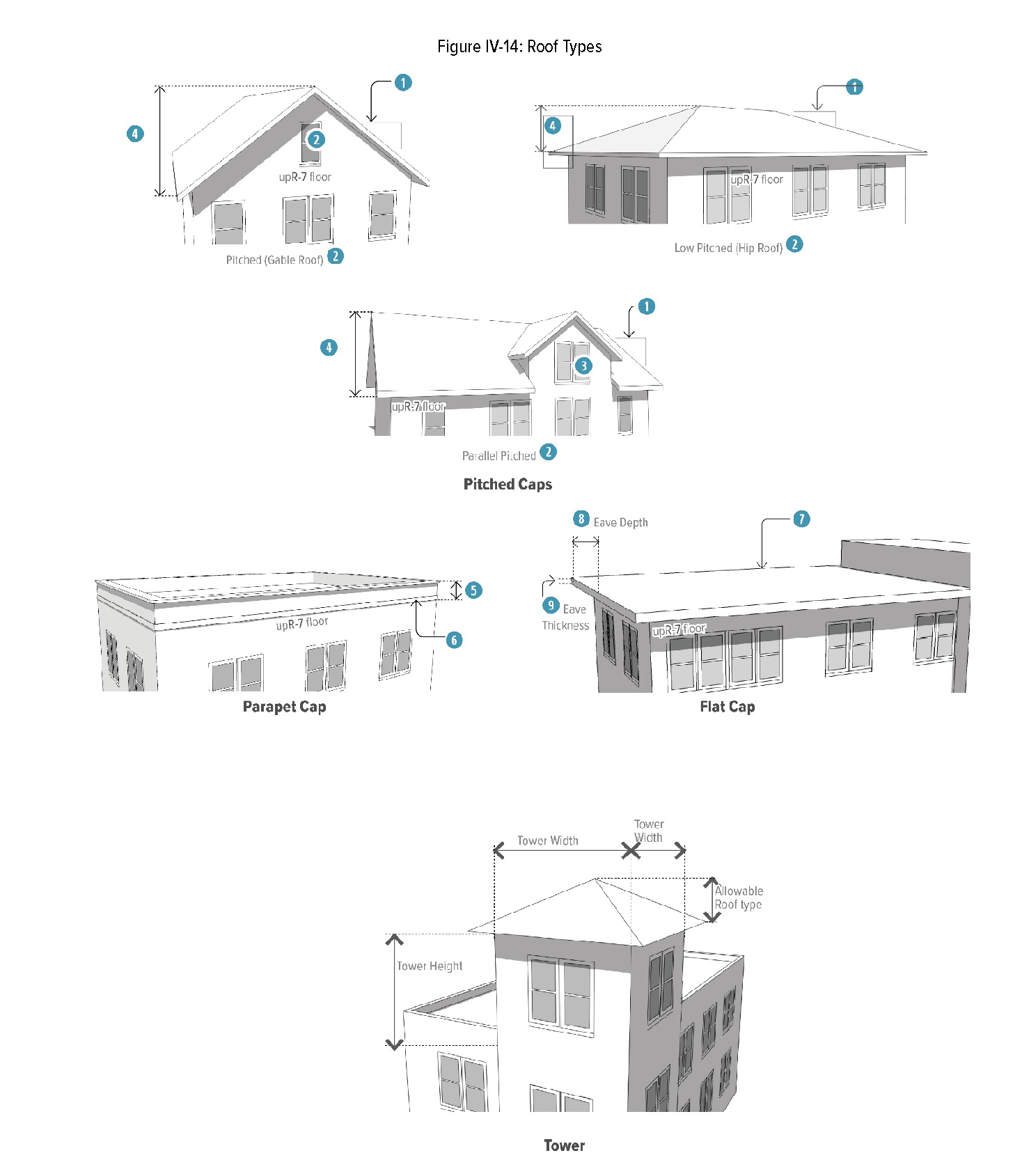
Roof types. Roof type regulations are intended to ensure that buildings have a clearly defined cap consistent with traditional roof types found within the downtown area. The major components of any roof must meet one of the roof types allowed by the building type (see Table IV-5). The roof design is required where the roof is visible from any street. Roofs for bay or bow windows, entrance canopies, and dormers are not required to meet a cap type. Any combination of allowed roof types is allowed.
(E)
Facade elements. The façade regulations of this section along with the building type regulations in section 4.08 through section 4.10, are intended to improve the physical quality of buildings, improve the long-term value and durability of buildings, enhance the pedestrian experience, and protect the scale and physical character of the village.
(1)
Windows. Windows on all street and other front facades of all buildings must be constructed consistent with the following requirements:
(a)
Amount. Each building must meet the transparency requirements that apply to the subject building type. Transparency is the measurement of the percentage of a facade that windows and doors with highly transparent, low-reflectance glass.
(b)
Recessed. All windows, with the exception of ground story storefront systems and glass curtain wall systems, must be recessed with the glass a minimum of two inch from the masonry facade surfaces material or adjacent trim or one inch on other materials.
(c)
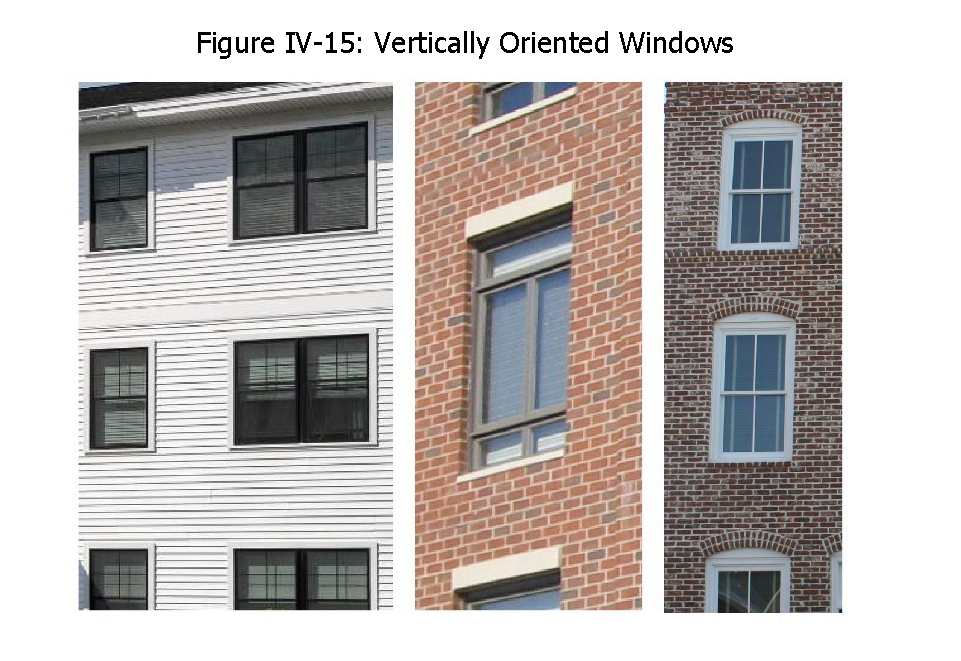
Vertical orientation. Street facade windows must be vertically oriented. A bank of abutting vertically oriented windows is acceptable.
(d)
Visibility through glass. Reflective glass and glass block are prohibited on street-facing building facades. Transparency for all window, door glass, and other storefront glass must be a minimum of 50 percent visible light transmittance and a reflectance factor of not greater than 0.25, unless required by state law or local energy or building codes.
(e)
False windows. The use of false or faux windows, where the window is visible from the exterior with no opening from the interior is prohibited on a front facade.
(2)
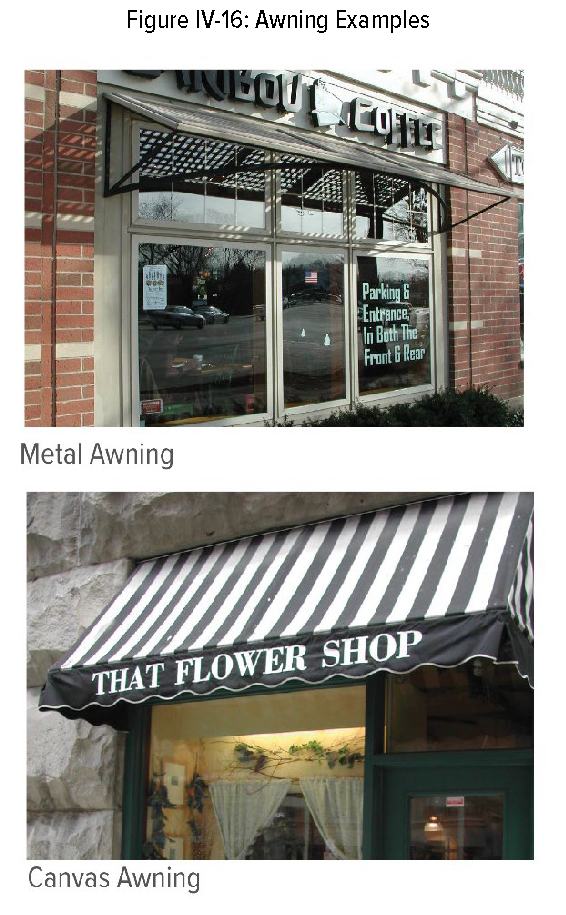
Removable awnings and canopies. Removable awnings and canopies attached to buildings must be constructed consistent with the requirements of this section. See Figure IV-16 for examples of awnings.
(a)
Material. All awnings and removable canopies must be canvas or metal. Plastic awnings are prohibited.
(b)
Shape. Dome, waterfall, and convex awnings are prohibited.
(c)
Lighting. Backlighting is allowed only on metal awnings.
(d)
Structures. Frames must be metal and wall mounted. Support poles from the ground are prohibited except where the awning is over eight feet in depth and utilized for outdoor eating areas or lobby entrances.
(e)
Canopies and light shelves. Permanent canopies, projections, or overhangs used as architectural features, light shelves, or shading devices are allowed and not intended to be regulated by this section.
(f)
Clearance. All portions of any awning or canopy must provide at least eight feet of clearance over any walkway and 15 feet of clearance over vehicular areas.
(g)
Signs. Refer to article XI for regulations governing signs on awnings and canopies.
(3)
Balconies. Balconies on street-facing building facades are subject to the requirements of this subsection.
(a)
Size. Balconies must be a minimum of four feet deep and five feet wide.
(b)
Facade coverage. No more than 35 percent of any street-facing building façade may be covered by balconies. The balcony area is calculated by drawing an imaginary rectangle on the facade elevation around the following: the platform or floor of the balcony; any rails, walls, columns, or indentations; and any ceiling, roof, or upper balcony.
(c)
Platform. The balcony platform must be at least three inches thick and any underside of a balcony that is visible from any street or public way must be finished.
(d)
Front setback requirement. When the balcony is located within the front build-to zone of the lot, the portion of the facade behind the balcony is exempt from meeting the maximum build-to zone setback.
(4)
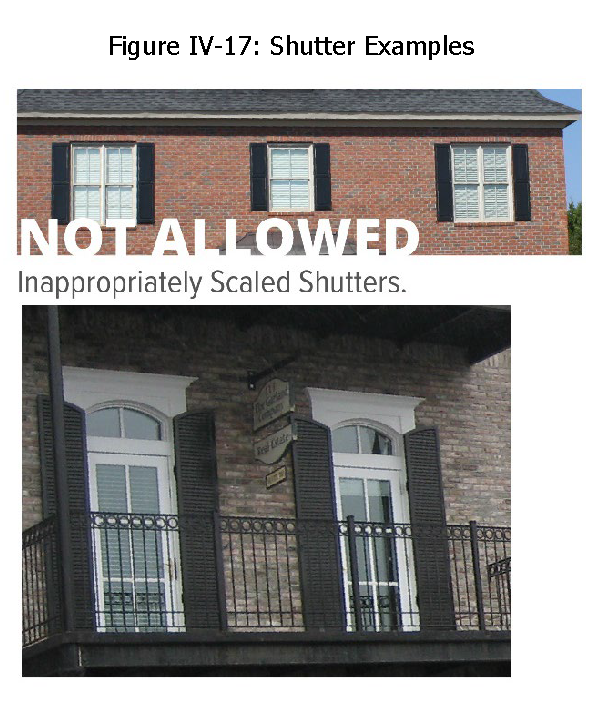
Shutters. When shutters, whether functional or not, are utilized on a street or other front facade of any building type, the shutters must meet the following requirements. See Figure IV-17.
(a)
Size. All shutters must be sized for the windows, so that, if the shutters were to be closed, they would not be too small for complete coverage of the window.
(b)
Materials. Shutters must be wood, metal, composite or engineered woods, or fiber cement.
(5)
Security grills and bars.
(a)
Exterior bars and security grills are prohibited on any street facade opening.
(b)
Security grills must be fully retractable and located completely within the interior of the building. When retracted, the grills must not be visible from the exterior of the building.
(6)
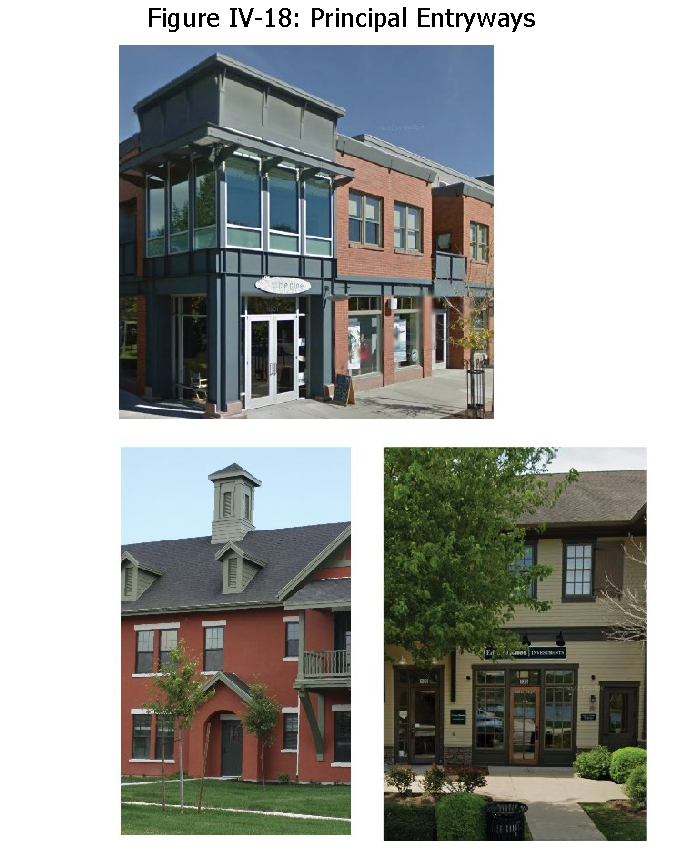
Principal entryway. See Figure IV-18 for examples of defined principal entryways. Principal entrances to all buildings or units, except storefronts, must be clearly delineated through one or more of the following design features:
(a)
Roof or canopy. The entryway is covered by a roof or canopy differentiating it from the overall building roof type.
(b)
Porch. The entryway is through a porch, minimum five feet by eight feet in size. A porch is a raised, permanently roofed structure, transitioning from the public sidewalk into the building.
(c)
Sidelights and transom. Sidelights or transom windows are included around the entryway.
(d)
Extended articulation. The entryway is included in a separate bay of the building that extends up at least two stories.
(e)
Other. Other methods of articulating the principal entryway may be approved at the time of site plan approval.
(F)
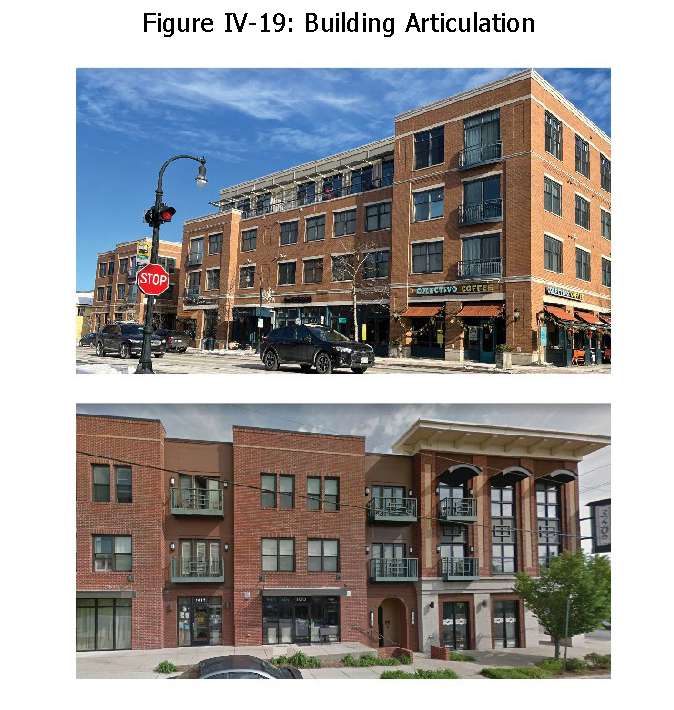
Building articulation. See Figure IV-19 for examples of building facade variety.
(1)
Building variety. Street and front facades 120 feet in length or longer must be varied in segments less than or equal to the required vertical division in the building type street facade regulations. Each facade segment must vary by at least one of the following:
(a)
The proportion of recesses and projections within the build-to zone;
(b)
The location of the entrance and window placement, unless storefronts are utilized;
(c)
Roof type, plane, or material, unless otherwise stated in the building requirements;
(d)
Building height.
(2)
Articulation of stories. Stories must be articulated on street and other front facades, as follows:
(a)
Fenestration. Fenestration or window placement on street facades must be organized by stories in accordance with applicable building type facade transparency regulations.
(b)
Shadow lines. Minimum shadow lines are required for different building types. Additional horizontal shadow lines and lintels over openings may be used to delineate stories.
(c)
Taller spaces. Spaces exceeding the allowable floor-to-floor heights of the building type must be articulated as multiple stories on the street facade.
(G)
Mechanical equipment. Mechanical and utility equipment and appurtenances are necessary for any building, but can have a negative visual impact and detract from the quality of the design of a building. The purpose of these regulations is to ensure that the visual impact of mechanical and utility equipment and appurtenances is considered during the design phase of the building and minimized to the extent practicable.
(1)
"Mechanical equipment" defined. Regulations that refer to "mechanical equipment," include HVAC systems, boilers, condensers, transformers, generators, vents, meters, ducts, and similar any mechanical equipment or utility appurtenance. Solar and wind energy systems are not included.
(2)
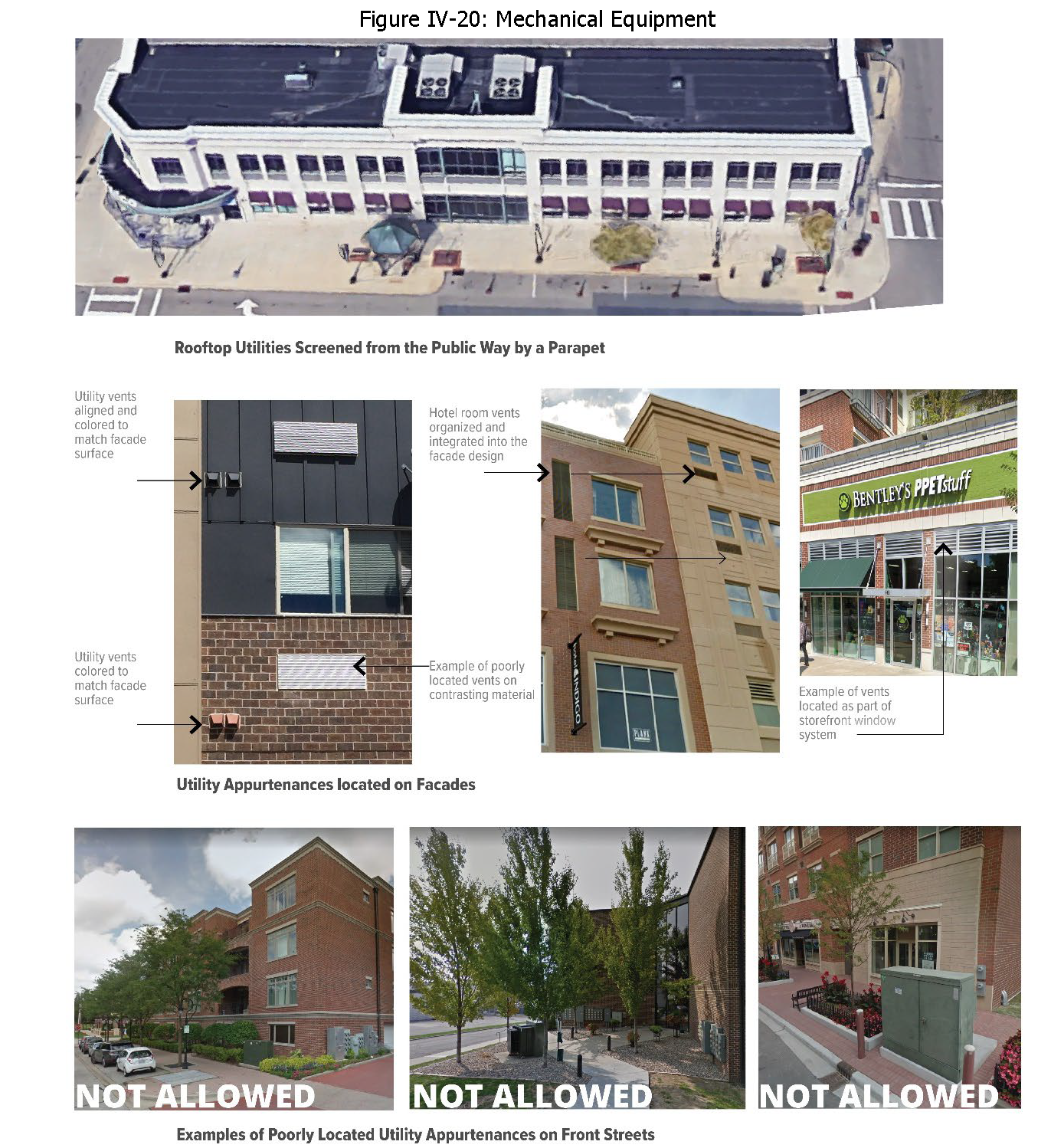
Rooftop mechanical equipment. See Figure IV-20. Any rooftop mechanical equipment must be concealed from view at street level or be:
(a)
Incorporated into the roof design consistent with the applicable roof type standards of section 4.12(D).
(b)
Set back a minimum of ten feet from any street or public way facade.
(c)
Painted to blend with the structural roof and limit its visibility, to the extent practicable (unless screened from street-level view by a parapet).
(3)
Mechanical equipment on street facades. See Figure IV-20. Mechanical equipment and utility appurtenances may not be located on any street facade unless the applicant demonstrates that locating the equipment in a different location would conflict with the equipment's function. Any equipment or appurtenance approved on a facade must be located consistent with the following standards:
(a)
Street façade. The mechanical equipment may be located on a street facade only if the following requirements are met:
i.
The equipment is located on a surface perpendicular (and not parallel) to the adjacent street. The zoning administrator may approve the location of appurtenances on surfaces parallel to the street if all other requirements of this section are met and no other option is available.
ii.
The equipment extends from the facade surface no more than three inches; and
iii.
The equipment is screened from the sidewalk by landscape, railings, other facade walls, or other designs.
(b)
Air vents or grills. Air vents and grills may be successfully incorporated into storefront window systems, provided the transparency requirements are met by the actual windows in the system.
(c)
Alignment. Multiple pieces of mechanical equipment must be organized on the facade in a regular pattern and aligned. Compliance with this standard must be illustrated on all submitted elevations for village approval.
(d)
Material coordination. To the extent practicable, facade-mounted mechanical appurtenances must be located on a material that limits their visibility. For example, dark colored vents will be more visible on light colored fiber cement panels than a textured, darker surface such as brick.
(4)
Mechanical equipment on other horizontal surfaces. Mechanical equipment, such as electrical transformers and air conditioners, located on the ground, decks, or horizontal surfaces other than the roof must be located consistent with the following standards:
(a)
No encroachment. Mechanical equipment may not extend into any right-of-way or easement, unless otherwise approved by the planning and zoning commission.
(b)
Allowed yard location.
i.
Mechanical equipment and appurtenances may not be located in the front street yard, except when no other option exists, as determined by the zoning administrator.
ii.
Mechanical equipment may be approved in the side street yard, provided the equipment is screened from the street in accordance with the screening requirements of this section.
iii.
Mechanical equipment may be located in any rear or side yard.
(c)
Screening from streets, open spaces, or civic spaces. All equipment must be screened from view from any streets, open space, or civic space, as follows:
i.
Screening walls must be consistent with the building design, colors, and materials.
ii.
Where only landscaping is used for screening, the utility must be located in a larger landscape area and the landscape screen must be designed as part of the large planting bed design.
(5)
Street frontage or front yard location. Equipment located in a street yard or other front yard may be approved only if all of the following are met:
(a)
The applicant demonstrates that the equipment cannot be located in a rear or interior side yard.
(b)
Equipment may be located in a front street yard only if the applicant demonstrates that the equipment cannot be located in a side street yard.
(c)
No other utility cabinets, boxes, or other appurtenances are within 200 feet along the same side of the street as the proposed utility appurtenance.
(d)
The appurtenance is located a minimum of 35 feet from a street intersection, measured from the intersection of the curb line, and does not impact the required sight vision clearance at intersections.
(e)
The appurtenance is fully screened in a manner that is consistent with the building design, colors, and materials and of a height that is the minimum to adequately screen the appurtenance and that does not prevent the facade from fulfilling any transparency requirements. See Figure IV-20 for examples of poorly located, unscreened equipment on front streets.
(Ord. No. 25-105, § 3(Exh. A), 8-7-2025)

