
Westmont City Zoning Code
ARTICLE XVII
DEFINITIONS
Sec. 17.01.- General.
Words and terms expressly defined in this zoning ordinance have the meanings assigned unless the context clearly indicates another meaning. Words and terms that are not expressly defined in this zoning ordinance have their ordinary dictionary meaning.
(Ord. No. 25-105, § 3(Exh. A), 8-7-2025)
Sec. 17.02. - Abbreviations.
Abbreviations used in this zoning ordinance have the following meanings:
Table XVII-1: Abbreviations
(Ord. No. 25-105, § 3(Exh. A), 8-7-2025)
Sec. 17.03. - General rules of language and ordinance construction.
See section 1.10 for general rules for interpreting the general language of this zoning ordinance.
(Ord. No. 25-105, § 3(Exh. A), 8-7-2025)
Sec. 17.04. - Use definitions.
See article VI for an explanation of the use categorization system used in this zoning ordinance and for use type definitions.
(Ord. No. 25-105, § 3(Exh. A), 8-7-2025)
Sec. 17.05. - Measurement-related terms.
See article XVI for an explanation of various lot and building regulation terms, such as "lot area," "building height," "setbacks."
(Ord. No. 25-105, § 3(Exh. A), 8-7-2025)
Sec. 17.06 - Definition of words and terms
Abut, abutting: Having a common property line or district line.
Accessory building: A building that is incidental and subordinate to the principal building on the subject lot in terms of its size and purpose and that is customarily found in association with the principal building on the subject lot. Typical examples of accessory buildings include sheds, detached garages, and detached accessory dwelling units.
Accessory structure: Any structure that is incidental and subordinate to the principal structure on the subject lot in terms of its size and purpose and that is customarily found in association with the principal structure on the subject lot. Typical examples of accessory structures include decks, pergolas, trellises, swimming pools, hot tubs, flagpoles, and playground/recreational equipment. Accessory buildings are also considered to be accessory structures, although the regulations of this zoning code often distinguish between those that apply to accessory buildings versus the broader category of accessory structures.
Accessory use: A use is incidental and subordinate to the principal use of the subject property and that meets the criteria established in section 7.01(A).
Agent: A person duly authorized to act on behalf of the owner of the subject property.
Adjacent: To lie near or close to; in the neighborhood or vicinity of.
Adjoining: Touching or contiguous, as distinguished from lying near or adjacent.
Alley: A right-of-way, with a width of not more than 24 feet that affords a secondary means of vehicular access to abutting properties. A street is not an alley.
Alteration: A change in size, shape, occupancy or use of a building or structure.
Amateur radio facility: Any tower or antenna used for non-commercial radio communications (transmission and reception) maintained by an FCC-licensed amateur radio operator.
Animal, companion: Animals that are commonly kept by households as a pet or for companionship. Companion animals have the following characteristics: have a special and close relationship with humans; are partially or totally dependent on people; commonly live inside a residence in close proximity with humans; form bonds with people; and interact with their human companions. Dogs and cats are common companion animals.
Antenna: An exterior transmitting or receiving device mounted on the ground or on a freestanding tower, building, or structure and used in communications that radiate or capture electromagnetic waves, microwaves, digital signals, analog signals, radio frequencies (excluding radar signals), wireless telecommunication signals, or other communication signals.
Antenna, amateur radio: An antenna used for transmitting and receiving noncommercial shortwave or citizens-band radio communications maintained by a Federal Communications Commission-licensed amateur radio operator.
Antenna, broadcast band, receive-only: An antenna used for noncommercial reception of broadcast band radio, broadcast band television, or other broadcast band signals.
Antenna, satellite dish, receive-only: A parabolic, disc-type or micro-replay, "receive only antenna" designed to receive information by radio waves from a communication satellite and used for noncommercial purposes.
Applicant: The owner of the subject property or an agent authorized by the subject property owner to submit an application on the owner's behalf.
Awning: A roof-like structure typically made of cloth, metal or other material attached to a frame that extends from and is supported by a building. Awnings are typically erected over a window, doorway or building front and they may be raised or retracted to a position adjacent to the building.
Balcony: Any roofed or unroofed platform that projects from the wall of a building above grade that is enclosed only by a parapet or railing. This definition does not include balconettes, otherwise known as Juliet balconies or false balconies.
Base (zoning) district: Any zoning district that is not an overlay district.
Basement: A portion of a building having part but not more than one-half of its floor to ceiling height below grade. See also section 16.13(A).
Basement, visible: A basement having more than three feet of its floor-to-ceiling height above the average finished grade of the adjoining ground.
Bay window: A building projection that (1) is primarily comprised of a large window or series of windows; (2) is not supported by a building foundation beneath the window; and (3) has glazing over at least 33 percent of its vertical surface area.
Bioretention: The use of soil and plants to remove pollutants from stormwater runoff.
Block face: All of the property fronting on one side of a street between two intersecting streets, or in the case of a dead-end street, all of the property fronting on one side of the street between an intersecting street and the end of such dead-end street.
Board of trustees: The president and board of trustees of the Village of Westmont, Illinois.
Building: A structure designed or built for the support, enclosure, shelter or protection of persons, animals, chattels or property of any kind, and that is permanently affixed to the land. When any portion thereof is completely separated from every other portion by a party wall, then such portion is deemed to be a separate building.
Building, principal: A non-accessory building in which the principal use of the lot is conducted.
Building, completely enclosed: A building separated on all sides from the adjacent open space, or from other buildings or structures, by a permanent roof and by exterior walls, pierced only by windows and normal entrance and exit doors.
Building, temporary: Any building not designed to be permanently located at the place where it is, or where it is intended to be temporarily placed or affixed.
Building, detached: A building surrounded by open space.
Building, height: See section 16.13.
Building materials: Dimension lumber, millwork, cabinets and other building materials, including milling, planning, jointing or manufacturing of millwork.
Business: An occupation, employment or enterprise that occupies time, attention, labor and materials; or wherein merchandise is exhibited or sold, or where services are offered.
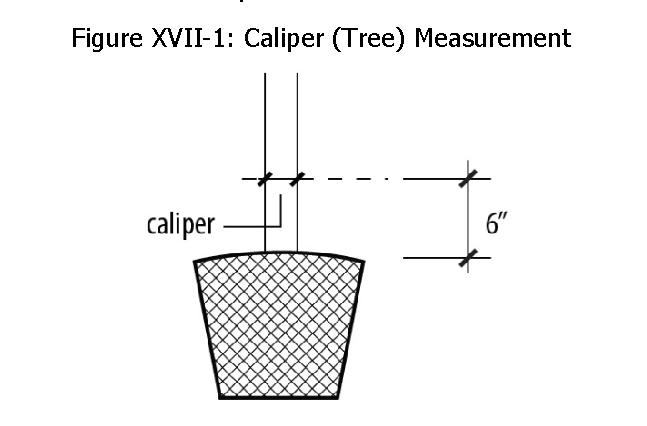
Caliper: The diameter of the tree trunk measured at a point six inches above the root ball or soil level.
Carport: A roofed passenger motor vehicle shelter that is open (without enclosing walls) on two or more sides and that has vehicle access provided by a driveway.
Car-share program: A system in which a fleet of cars (or other motor vehicles) is made available for use by members of the car-share program and that exhibit all of the following characteristics:
1.
Members are permitted to use vehicles from the car-share program fleet on an hourly basis;
2.
Car-share vehicles are generally available 24 hours a day and seven days a week to members in parking spaces at dispersed locations or facilities; and
3.
No separate written agreement is required each time a member reserves and uses a car-share vehicle.
Cellar: A portion of a building having more than one-half of its floor to clear ceiling height below grade. See also section 16.13(A).
Cold frame: An unheated structure no more than four feet in height used for protecting seedlings and plants from the cold.
Commercial message: Any sign, wording, logo, or other representation that directly or indirectly, names, advertises, or calls attention to a business, product, service or other commercial activity.
Conforming building or structure: A building or structure that complies with all applicable lot and building regulations and structure-oriented dimensional or locational regulations of the district in which the building or structure is located.
Contiguous: In actual contact.
Craft alcoholic beverages: Any fermented specialty beverage for sale or for consumption on the premises in which it is produced and that contains ethyl alcohol as an intoxicating agent and that is fit for human consumption. Craft alcoholic beverages include craft beer or artisanal wine.
Courtyard: An open air, uncovered landscape, sidewalk, terrace, and/or deck area, enclosed on at least two sides and with a maximum opening of 50 percent of any street facade.
Curbside pickup: The delivery of foods, drinks, or goods to a customer in parked vehicle on the same site where the goods are produced or sold.
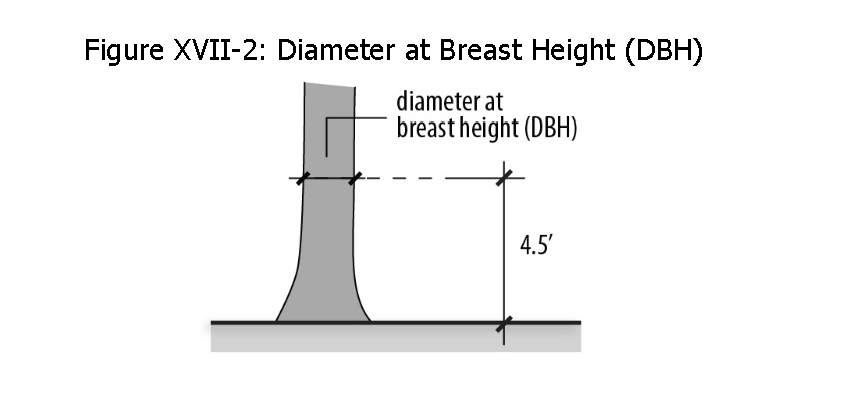
Diameter at breast height (DBH): The diameter of a tree measured at a point 4.5 feet above ground level at the base of the tree. For trees with rounded, knotty growths, or burls, limb extensions or any other abnormalities at 4.5 feet above ground level, the diameter measurement is taken at the point of smallest diameter between the ground and 4.5 feet above ground level. All tree measurements must be calculated to the nearest tenth of an inch.
Disability or Disabled: A defined in the Americans with Disabilities Act and the Fair Housing Amendments Act.
District: See zoning district.
Donation drop box: An unattended container, receptacle, or similar device used for the collection of used clothing, shoes, and small household items donated by the public for redistribution.
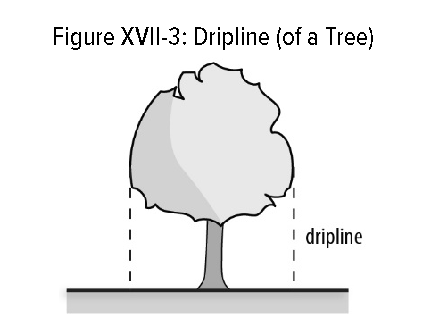
Dripline: An imaginary, perpendicular line that extends downward from the outermost tips of a tree's branches to the ground below.
Drive-through facility: See section 6.08(B).
Dumpster: A container with a capacity of more than 1.5 cubic yards or a height of more than 4.5 feet that is designed for receiving, transporting, and depositing waste materials produced by uses that are on the subject site. Dumpsters are typically designed to be hoisted and emptied into a garbage truck.
Dwelling: A building or portion thereof designed or used exclusively for residential purposes, but not including mobile homes or other trailers or lodging rooms in hotels or motels.
Dwelling unit: One or more rooms that are arranged, designed or used as living quarters for a single household. Individual bathrooms and complete single kitchen facilities, permanently installed to serve the entire household, must always be included within each "dwelling unit."
Electric vehicle: Any vehicle that is licensed and registered for operation on public and private highways, roads, and streets; either partially or exclusively, on electrical energy from the grid or an off-board source, that is stored on-board via a battery. "Electric vehicle" includes: battery electric vehicles; and (2) plug-in hybrid electric vehicles.
Electric vehicle (EV) charging station: A public or private parking space that is served by battery charging station equipment.
Electric vehicle charging station, private (restricted-access): An EV charging station that is not available for use by the general public. Examples include electric vehicle charging stations that serve residential homeowners or renters, executive parking areas, designated employee parking areas and fleet parking areas.
Electric vehicle charging station, public: An EV charging station that is accessible to and available for use by the general public.
Electric vehicle parking space: Any parking space that is clearly identified to be used exclusively for the parking of an electric vehicle.
Establishment, business: A place of business carrying on operation, the ownership or management of which is separate and distinct from those of any other place of business located on the same or other lot.
Façade: The exterior wall of a building,
Facade, front: A building facade generally parallel and facing the right-of-way line along a front street.
Facade, rear: Any facade of a building generally parallel to and facing the rear lot line.
Facade, side-street: Any facade of a building generally parallel to and facing a side street lot line.
Facade, (interior) side: any facade of a building generally parallel to and facing an interior side lot line.
Facade, street: Any facade of a building generally parallel to and facing any street right-of-way and including bays or minor walls perpendicular to the facade. A street facade may be a front or side-street facade, depending on whether it is facing a front or side street, respectively.
Fence: A structure that is a barrier and used as a boundary or means of protection or confinement.
Fence, open: A fence, including gates, that has, for each one-foot-wide segment extending over its entire length and height of the fence, at least 50 percent of the surface area in open spaces that afford a direct view through the fence.
Fence, solid: A fence, including gates, that conceals from view from adjoining properties, streets or alleys activities conducted behind it.
Firearm: A device, including without limitation, a pistol, handgun, revolver, shotgun, machine gun, rifle, automatic or semi-automatic rifle, or any gun, device or instrument in the nature of a weapon, that is designed to or that may readily be converted to expel a projectile by the force of any explosion or force of combustion. Firearms also includes, without limitation, any firearm that is in the nature of an air gun, spring gun or pistol, or other weapon of a similar nature in which the propelling force is a spring, elastic band, carbon dioxide, compressed or other gas or vapor, air or compressed air, or is ignited by compressed air, and ejecting a bullet or missile with sufficient force to injure a person. For purposes of this definition, firearms also include ammunition, including without limitation, a bullet, self-contained cartridge, shotgun shell, or other implement that is designed to be used to adaptable to use in a firearm. For purposes of this definition, firearms also include accessories, including without limitation, scopes, silencers, chargers, and related equipment to be used with firearms. Paint ball guns, and BB guns, that expel a dingle projectile not exceeding 0.18 inches in diameter or that have a maximum muzzle velocity of less than 700 feet per second, are excluded from this definition. Antique firearms are excluded from this definition.
Firearm, antique: Any rifle, shotgun or "antique cannon" that was manufactured before 1898 and for which cartridge ammunition is not commercially available, and that is sold or possessed as a curiosity or ornament or for its historical significance or value.
Footcandle: A unit of illumination, equivalent to the illumination at all points that are one foot distant from a uniform point source of one candlepower.
Foot-Lambert: A unit of brightness, usually of a reflecting surface. A diffusion surface of uniform brightness reflecting or emitting the equivalent of the light from one candle at one foot distant over one square foot has a brightness of one foot-lambert.
Garage: Completely enclosed space within a principal or accessory building used for the storage of motor vehicles with a (typically overhead) door and vehicle access provided by a driveway.
Geothermal heat exchange system: Equipment that exchanges thermal energy between the ground (or a water source) and a building. This includes vertical closed loop, horizontal closed loop, water body closed loop system and open loop systems. Also known as ground source heat pumps and geothermal heat pumps.
Grade (for purposes of building height measurement): See section 16.13(A)(1).
Grade, finished: The vertical location of the ground or pavement surface after site grading work is completed in accordance with an approved plan.
Greenhouse: A building comprised largely of glass or polycarbonate panels and designed for the purposes of protecting and cultivating plants.
Home occupation: An accessory use of a dwelling unit for business or commercial purposes. Home occupations are subject to the regulations of section 7.10(A).
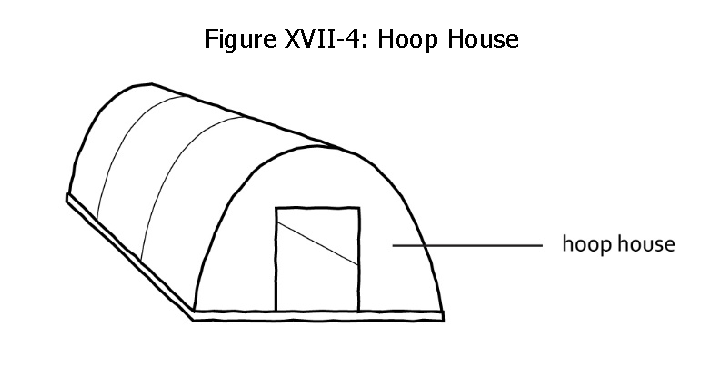
Hoop house: A temporary structure typically made of flexible pipe or other material covered with translucent plastic or similar non-rigid material, constructed in a "half-round" or "hoop" shape, for the purposes of protecting and cultivating plants. A hoop house is considered more temporary than a greenhouse. Sometimes called a "polyhouse" or "polytunnel".
Household: A person living alone, or any of the following groups living together as a single housekeeping unit who have established ties and familiarity with one other, who jointly use common areas, and who share meals, household activities, expenses, and responsibilities:
1.
Any number of persons related by blood, marriage, civil union, adoption, guardianship, or duly-authorized custodial relationship;
2.
A maximum of five unrelated persons; or
3.
Two unrelated persons and any parents or children related to either of such persons.
Hybrid uses: The use of a property for multiple principal uses (see also section 6.02(D)(2)).
Inoperable vehicle: Any motor vehicle from which, for a period of seven days, the engine, wheels, or other parts have been removed, or in which the engine, wheels, or other parts have been altered, damaged, or otherwise modified so that the vehicle is incapable of being driven under its own motor power. "Inoperable motor vehicle" does not include a motor vehicle that has been rendered temporarily incapable of being driven under its own motor power, solely to perform ordinary service or repair operations.
Lawfully established: A use, structure, lot or sign (as the context indicates) that was established in conformance with all applicable zoning ordinance regulations in effect at the time of its establishment.
Lighting, high-intensity: A lamp or light source that emits a total initial output greater than 1,500 lumens. High-intensity lamps are intended to illuminate large areas such as commercial parking lots, loading zones, sports fields, or industrial yards. These lamps may include high-intensity discharge (HID) technologies such as metal halide, high-pressure sodium, or LED equivalents, and are typically mounted above 12 feet in height.
Lighting, low-intensity: A lamp or light source that emits a total initial output of 1,500 lumens or fewer. Low-intensity lamps are typically used for residential, pedestrian-scale, or decorative purposes, including but not limited to porch lights, pathway lighting, landscape accents, and signage illumination. Such lamps are generally mounted at a height of 12 feet or less and must be fully shielded to prevent glare and light trespass.
Light trespass: Light that is emitted into an unintended area.
Loading space: A space for the standing, loading or unloading of trucks and delivery vehicles and with access to a street or alley.
Lot: A tract of land that (at the time of filing for a building permit) is designated by its owner or developer as a tract to be used, developed or built upon as a unit. A "lot" may or may not be a lot of record.
Lot area: See section 16.01.
Lot, corner: A lot located at the intersection of two streets or a lot bounded on two sides by a curving street and any two chords of which form an angle of 120 degrees or less measured on the lot side.
Lot coverage: See section 16.08.
Lot depth: See section 16.09.
Lot, double-frontage: An interior lot with frontage on more than one street or a corner lot with frontage on more than two streets. See also section 16.07(B).
Lot line, front: A lot line that abuts a street. On a corner lot the lot line having the shortest length abutting a street line is deemed to be the front lot line, unless otherwise determined by the zoning administrator. The other lot line abutting a street is the street side lot line.
Lot line, interior: A lot line that does not abut a street.
Lot line, rear: The lot line that is most distant from and is, or is most nearly, parallel to the front lot line and in the case of an irregular, triangular or gore-shape lot, a line ten feet in length within the lot, parallel to and at the maximum distance from the front lot line.
Lot line, interior side: Any lot line that is not a front lot line, street side lot line, or a rear lot line.
Lot line, street: A lot line that abuts a streetand that is not a front lot line. A lot may have more than one street lot line, and a street lot line may be a front lot line or street side lot line.
Lot line, street side: A lot line that abuts a street and that is not a front lot line.
Lot of record: A lot that is part of a subdivision, the map of which has been recorded in the office of the Recorder of Deeds of DuPage County, Illinois; or a parcel of land, the deed of which was recorded in the office of the Recorder of Deeds of DuPage County, Illinois, before the effective date of this zoning ordinance.
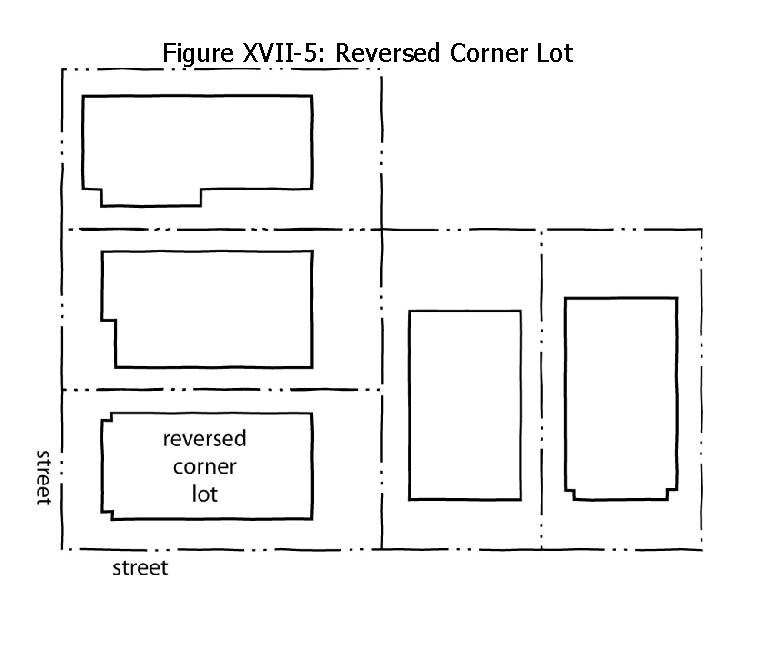
Lot, reversed corner: A corner lot, the street side lot line of which is substantially a continuation of the front lot line of the first lot to its rear.
Lot width: See section 16.03.
Marquee or canopy: A roof-like structure of a permanent nature that projects from the wall of a building.
Multi-Tenant center: A single building, on one lot, under unified control that is occupied by two or more commercial uses. Office buildings are excluded from this definition.
Nonconforming building or structure: See section 13.04.
Nonconforming use: See section 13.03(A) Occupied (or Occupiable) Building Space Interior building.
Occupied (or occupiable) building space: Interior building space occupiable by people, not including storage, mechanical, utility, or garage or parking space.
Open sales lot: Land used or occupied for the purpose of buying, selling or renting merchandise stored or displayed out-of-doors before sale. Such merchandise includes automobiles, trucks, motor scooters, motorcycles, boats or similar commodities.
Outdoor storage: Any open storage of goods, equipment, materials, or vehicles that does not occur in a completely enclosed building.
Parcel: A contiguous area of land under single ownership or control that is used, developed, or built upon as a whole.
Party wall: A common wall dividing a building that extends from its footing below grade to the underside of the roof.
Pennant: A long, narrow, usually, but not necessarily, triangular flag that is rigid with no movement.
Planning and zoning commission: The planning and zoning commission of the Village of Westmont, as created in chapter 2 of the village code.
Planned unit development: See section 5.04
Railroad right-of-way: A strip of land containing railroad tracks and customary auxiliary facilities for track operations, serving as the main line for trains. For the purposes of this zoning ordinance, a "railroad right-of-way" does not include land used or intended to be used for switching, spur, lead, term, or siding tracks, freight depots or stations, loading platforms, train sheds, warehouses, car or locomotive shops, car yards, or classification yards.
Rain barrell: An above-ground prefabricated storage receptacle with an automatic overflow diversion system that collects and stores rainwater runoff from the roof of a structure that would have been otherwise routed into a storm drain.
Recreational equipment: Snowmobiles, all-terrain vehicles (as defined in the Illinois Motor Vehicle Code), and any watercraft such as personal watercraft and specialty prop craft (as defined in the Illinois Boat Registration and Safety Act). Also includes trailers used for their transportation of personal goods.
Recreational vehicle: A habitable vehicle primarily used for recreational purposes, including camping trailers, motor homes, mini motorhomes, travel trailers, truck campers, and van campers, all as defined in the Illinois Motor Vehicle Code.
Residential recreational structure, private: An open-air (unenclosed) structure erected outdoors for children to play in, on and around including swing sets, jungle gyms, and trampolines.
Roadway: That portion of a street that is used or intended to be used for the travel of motor vehicles.
Seating area (outdoor): A fixed permanent seat, provided in the case of open floor area used for temporary or permanent seating purposes, a minimum width of 36 inches is required. Does not include space intended to meet parking or landscaping requirements, parkways, and established paths of travel, such as sidewalks, aisles and walkways, which shall require at least 48 inches in width and which shall take precedence over seating areas.
Setback: An open, unobstructed area that is required to be provided by this zoning ordinance between a building and a lot line. Sometimes referred to as a "building setback." See section 16.07.
Setback, front: The setback required between a building and the front (street) lot line of the lot on which the building is located, extending along the full length of the front lot line between the side lot lines.
Setback, rear: The setback required between a building and the rear lot line of the lot on which the building is located, extending along the full length of the rear lot line between the side lot lines.
Setback, side: The setback required between a building and the side lot line of the lot on which the building is located, extending along the side lot line from the point of the minimum front setback to the point of the minimum rear setback.
Setback, interior side: The side setback required on the side of a lot that abuts another lot or alley (rather than a street).
Setback, street side: The setback required between a building and the side street line of the (corner) lot on which the building is located, extending along the side street lot line between the front building setback and the rear lot line.
Sign: A name, identification, description, illustration, display or device that is affixed to, painted or represented upon a building, structure or land, and that directs attention to a product, place, activity, person, institution or business. A sign does not include any display of any court, public or official notice, nor does it include the flag, emblem, insignia of a nation, political unit, school, religious or charitable institution or organization. A sign does not include a permanent sign located within an enclosed building in such a manner as to be viewed or intended for view primarily from the exterior of the building.
Sign, affixed: A sign that is affixed to any building wall or structure and extends beyond the building wall or structure.
Sign, animation: The presentation of pictorials and graphics on signs displayed in a progression of frames that give the illusion of motion, including but not limited to the illusion of moving objects, moving patterns or bands of light, or expanding or contracting shapes.
Sign area: See section 11.11(A).
(Sign) banner: A sign composed of lightweight, flexible, non-rigid material that is mounted to a pole or a structure at one or more edges either vertically or horizontally. Flags are not considered banners.
(Sign) commercial message: Any sign, wording, logo, or other representation that directly or indirectly, names, advertises, or calls attention to a business, product, service or other commercial activity.
Sign, drive-through: A sign located on the site of an allowed drive-through use.
Sign, driveway: A sign located near a driveway entrance from a street or near an internal site driveway or drive aisle.
Sign, electronic message board: A sign with a fixed or changing display/message composed of a series of lights that may be changed through electronic means.
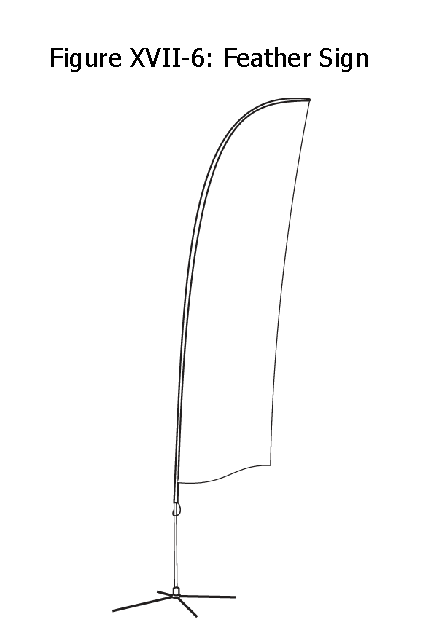
Sign, feather: A lightweight, portable sign mounted on vertical, flexible pole the appearance of which resembles a sail, bow, or feather.
(Sign) flag: A generally rectangular or triangular sign or part of a sign made of fabric or other pliant material attached to a flagpole only along one side and which predominately displays distinctive colors, images, shapes or designs rather than legible words, letters, numbers or other linguistic characters.
Sign, flashing (illumination): A light source or other image that in whole or in part physically changes in light intensity or gives the appearance of such change.
Sign, freestanding: A sign that is part of a self-supporting structure, other than a building or portion of a building. Sometimes referred to as a "ground sign."
Sign, freestanding wayfinding: A freestanding sign intended to direct traffic to specific tenants within a multi-tenant development.
Sign, grand opening event: A sign allowed on a temporary basis in conjunction with the opening of a business in a new space, subject to the regulations of section 11.03(L).
(Sign) nameplate: A sign attached flush against a building.
Sign, projecting: A sign that is affixed to a building wall, canopy, awning or marquee and that extends from the wall, canopy, awning or marquee in a perpendicular manner.
Sign, real estate: A temporary sign located on a lot or portion of a lot that is actively being marketed for sale, rental or lease.
Sign, roof: A sign that is affixed to a roof, extended roof, pitched roof, or canopy, and that extends above the building wall or parapet wall.
Sign, static changeable message board: A sign with a message that can be changed manually by manual modification of the sign message (rather than the replacing the sign face) and that, when displayed, contains no motion, flashing, changeable copy, running lights, variances in brightness, or animation.
Sign, wall: A sign affixed to a building wall, canopy, awning, marquee or parapet wall, or a sign displayed in or on a door that does not extend in a perpendicular manner from the wall, canopy, awning, marquee, parapet wall, or door, nor extend above the parapet wall.
(Sign) wind-driven device: Any flag, banner, pennant, streamer or similar device that moves freely in the wind.
Sign, window: A sign attached to a window.
Small wireless facilities: See definitions and regulations of small wireless facilities found in 50 ILCS 840/1, et seq. and in chapter 82, article X of the village code.
Smoke: The visible discharge from a chimney, stack, vent, exhaust or combustion process that is made up of particulate matter.
Specified anatomical areas:
(a)
Less than completely and opaquely covered (i) human genitals, pubic region, or pubic hair; (ii) buttock; and (iii) female breast below a point immediately above the top of the areola; and
(b)
Human male genitals in a discernible turgid state, even if completely opaquely covered.
Specified sexual activities:
(a)
Human genitals in a state of sexual stimulation or arousal;
(b)
Acts or representations of acts of human masturbation, sexual intercourse or sodomy, bestiality, oral copulation or flagellation;
(c)
Fondling or erotic touching of human genitals, pubic region, buttock or female breast;
(d)
Excretory functions as part of or in connection with any activities set forth in [subsections] (a) through (c) above.
Shadow line: An architectural feature consisting of a typically decorative, 3-dimensional, linear element, horizontal or vertical, protruding or indented at least 1.5 inch in depth from the exterior facade of a building, and creating a shadow on the facade with light overhead, and extending, with limited interruption, the length or height of the designated story. Examples may include cast stone cornices or lintels, pilasters, or stepped brick coursing.
Solar energy system: A device, array of devices, or structural design feature, the purpose of which is to provide for generation or storage of electricity from sunlight, or the collection, storage, and distribution of solar energy for space heating or cooling, daylight for interior lighting, or water heating.
Solar energy system, grid-connected: A solar photovoltaic system that is connected to an electric circuit served by an electric utility company.
Solar energy system, ground-mounted: A solar photovoltaic system mounted on a rack or pole that is ballasted on, or is attached to, the ground and which is accessory to the principal use of the property.
Solar energy system, roof-mounted: A solar photovoltaic system mounted on a rack that is ballasted on, or is attached to, the roof of a building or structure. Roof-mounted systems are accessory to the principal use.
Solar photovoltaic system: A solar energy system that converts solar energy directly into electricity, the primary components of which are solar panels, mounting devices, inverters, and wiring.
Story: See section 16.10(A).
Story, ground: The story closest to the ground level that does not meet the definition of a basement. Also referred to as the "ground floor."
Story, half: See section 16.10(A)
Story, upper: Any story that is above the ground story.
Streamer: A long, narrow strip of cloth, paper, ribbon, plastic or other material hanging loose at one end forming a continuous mounting device.
Street: Any right-of-way containing a roadway that affords the primary means of vehicular access to abutting properties. When such a right-of-way is not an existing or dedicated public "street," it must be at least 40 feet in width, unless otherwise herein regulated. An alley is not considered a street.
Street line: The street right-of-way line abutting a property line of a lot.
Structure: Anything constructed or erected, the use of which requires more or less permanent location on the ground or attached to something having a permanent location on the ground, including, but without limiting the generality of the foregoing, off-premises advertising signs and backstops for tennis courts.
Structural alteration: Any change in the supporting members of a building such as bearing walls, columns, beams or girders, or any substantial change in the roof or in the exterior walls, excepting such repair or replacement as may be required for the safety of the building.
Tent: A structure, enclosure or shelter, meant for temporary use, with or without sidewalls or drops, constructed of fabric or pliable material supported in any manner except by air or the contents it protects.
Tobacco and vape products: Any product sold for the purposes of consumption by ingestion or inhalation through the lungs, including tobacco, vape-liquids, e-cigarette liquids, and similar tobacco and nicotine products, and the devices used to ingest or inhale such tobacco and vape products, including cigarettes, cigars, pipes, electronic cigarettes, and vape pens. Tobacco and vape products do not include cannabis or marijuana products.
Trailer, business: A vehicle without motive power, designed to be towed by another vehicle, and that is owned/leased by a business and used by the business for the short-term carrying of materials, goods, or objects, and that may also be used for food preparation and sales. A business trailer is not designed or used for human occupancy and is not used primarily for storage purposes.
Usable open space: Space suitable for recreation, gardens or household service activities, such as clothes drying. Such space must be at least 75 percent open to the sky, free of automobile traffic, parking and undue hazards, and readily accessible by all those for whom it is intended.
Use: The purpose or activity for which the land, or building thereon, is designed, arranged or intended, or for which it is occupied or maintained.
Use, lawful: The use of any building, structure or land that conforms with all of the regulations of this zoning ordinance or any amendment hereto and that conforms with all of the codes, ordinances and other legal requirements, as existing at the time of the enactment of this zoning ordinance or any amendment thereto, for the structure or land that is being examined.
Use, permitted: Any use that is or may be lawfully established without a special use permit in a zoning district, provided it complies with all requirements and regulations of this zoning ordinance for the district in which such use is located.
Use, principal: The dominant use of land or buildings, as distinguished from a subordinate or accessory use.
Use, special: A use that, because of its unique characteristics, cannot be properly classified as a permitted use in a particular district or districts.
Vehicle, commercial: A vehicle having license plates greater than "D" plates or a vehicle with apportioned plates or a vehicle designed to transport 16 or more persons, excluding school buses. "Commercial vehicle" includes a semi-tractor and a semi-trailer, whether the two are attached or not.
Vehicle, business: A vehicle that is not a commercial vehicle or a school bus and that is regularly used by a business or other organization for delivery, transportation, sales, and/or related operational needs, but that is not used primarily for storage purposes. Examples include light vans and light box trucks.
Vehicle, motor: Any passenger vehicle, truck, truck-trailer, trailer or semitrailer propelled or drawn by mechanical power.
Vending machine: A machine that dispenses goods to consumers after cash, a credit card, or other form of payment is made.
Vibration: The periodic displacement, measured in inches, of earth at designated frequency, cycles per second.
Board of trustees: See board of trustees.
Village clerk: The village clerk of the Village of Westmont, Illinois.
Village president: The village president of the Village of Westmont, Illinois.
Wind energy conversion system: A wind-powered device that converts wind energy into usable thermal, mechanical, or electrical energy, including such devices as windmills and wind turbines. The "system" includes towers and supporting structures and directly connected facilities such as generators, alternators, inverters, batteries, and associated control equipment.
Wind energy conversion system, small: A wind energy conversion system with a power-related capacity of no more than 100 kW that is primarily intended to produce power for on-site consumption, as a supplement to utility power or in lieu of utility power. Small wind energy systems are sometimes connected to the electric utility for the purpose of "net metering."
Yard: An actual (as opposed to "required") open, unoccupied space that exists on a lot between a building and a lot line.
Yard, front: A yard extending along the full length of the front lot lines between the side lot lines.
Yard, (interior) side: A yard extending from the front yard to the rear yard and lying between the side of the principal building and the side lot line.
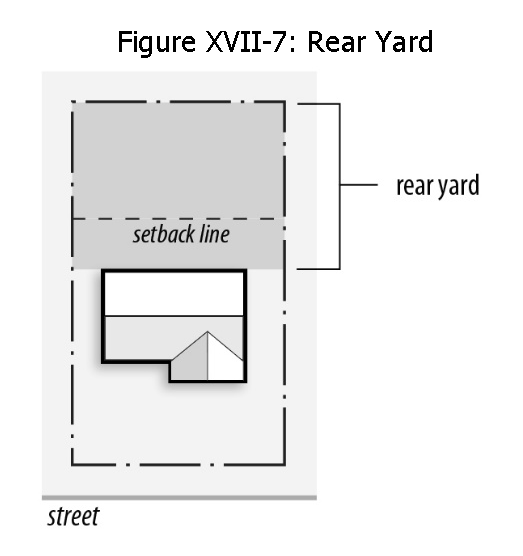
Yard, rear: A yard extending along the full length of the rear lot line between the side lot lines.
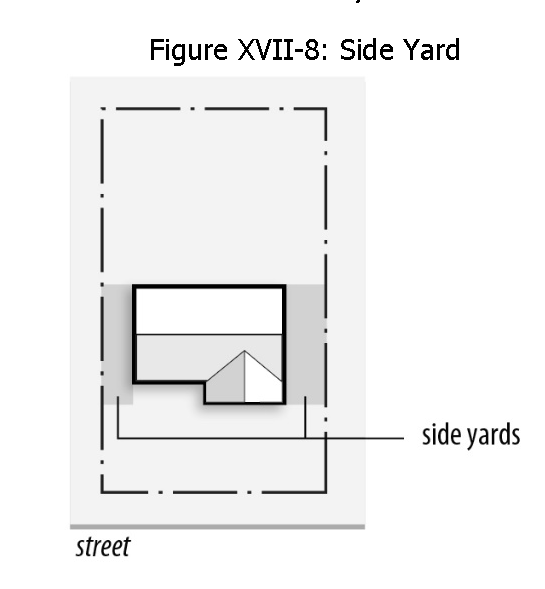
Yard, side: A yard extending along a side lot line between the front yard and the rear yard.
Yard, street: Any yard abutting a street.
Zoning districts: The districts established by this zoning ordinance and as set forth on the zoning map.
(Ord. No. 25-105, § 3(Exh. A), 8-7-2025)

