
Westmont City Zoning Code
ARTICLE XVI
MEASUREMENTS
Sec. 16.01.- Lot area.
Lot area is measured as the total ground-level surface area contained within the property lines of a lot.
(Ord. No. 25-105, § 3(Exh. A), 8-7-2025)
Sec. 16.02. - Lot area per dwelling unit.
Lot area per dwelling unit is a measure of residential density. It governs the amount of lot area required for each dwelling unit on a lot. To determine the number of dwelling units allowed on a lot, divide the lot area by the minimum lot-area-per-unit requirement, and round any fractional result down to a whole number. If, for example, a minimum lot-area-per-unit requirement of 1,750 feet is applied to a 10,000 square foot lot, a maximum of five units would be allowed on that lot (5.71 rounded down to five).
(Ord. No. 25-105, § 3(Exh. A), 8-7-2025)
Sec. 16.03. - Lot width.
Lot width is measured as the horizontal distance between the side lot lines of a lot measured at the narrowest width between the minimum front setback and a point 30 feet to the rear of the minimum front setback. On cul-de-sac lots and similarly shaped lots, lot width is measured along a line tangent to and at the midpoint of the minimum front setback line. On lots located along an opposite shaped curve (i.e., pie-shaped lots or those narrowing toward the rear of the lot), lot width is measured along a line parallel to and 30 feet to the rear of a chord drawn between the opposite ends of the front setback line.
(Ord. No. 25-105, § 3(Exh. A), 8-7-2025)
Sec. 16.04. - Building width.
Building width is measured as the horizontal measurement along the building facade that is generally parallel and facing the front lot line.
(Ord. No. 25-105, § 3(Exh. A), 8-7-2025)
Sec. 16.05. - Build-to zone.
Build-to zones are defined by a minimum and a maximum setback generally parallel and measured from the street lot line or actual right-of-way line. Upper-story recessed balcony facades and courtyard facades are not required to be located within the build-to zone.
(Ord. No. 25-105, § 3(Exh. A), 8-7-2025)
Sec. 16.06. - Outdoor open space.
Minimum outdoor private space required per unit must be open air and available specifically for the use of the building occupants. The form of the space must meet one or a combination of the following:
(A)
The space must be attached to the unit in the form of a patio, balcony, or terrace, located in any abutting yard, with a minimum dimension of six feet in any direction; or
(B)
The space must be common space for residents only in the form of one or more of the following: a garden, courtyard, roof deck, or terrace; each with a minimum dimension of ten feet in any direction. Common space must be accessible and available to all occupants.
(Ord. No. 25-105, § 3(Exh. A), 8-7-2025)
Sec. 16.07. - Setbacks.
The minimum horizontal distance between lot line and the nearest wall of a building or other structure for which minimum setback applies.
(A)
General rules of measurement.
(1)
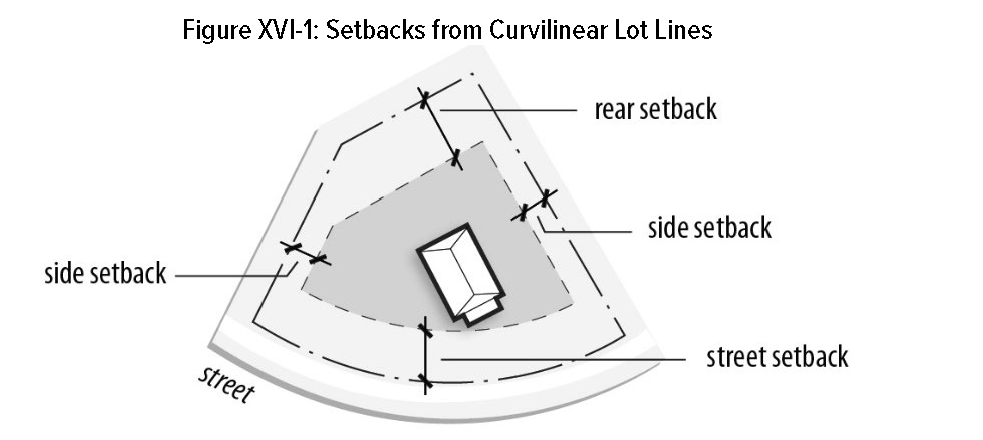
Required setbacks are measured from the applicable lot line or street right-of-way line. Setbacks from streets must be measured from the actual right-of-way line or from the proposed right-of-way as designated on the official map of the village or as established by county or state highway authorities, whichever results in a greater setback. Building setbacks are measured to the nearest exterior building wall. Minimum setbacks that apply to other features (parking areas, fences, storage areas) are measured from the nearest point of the area or feature for which a setback is required. When lot lines are curvilinear, setbacks must be measured parallel to the curvilinear lot line.
(2)
Street setbacks are measured from the actual right-of-way line of the street (other than an alley).
(3)
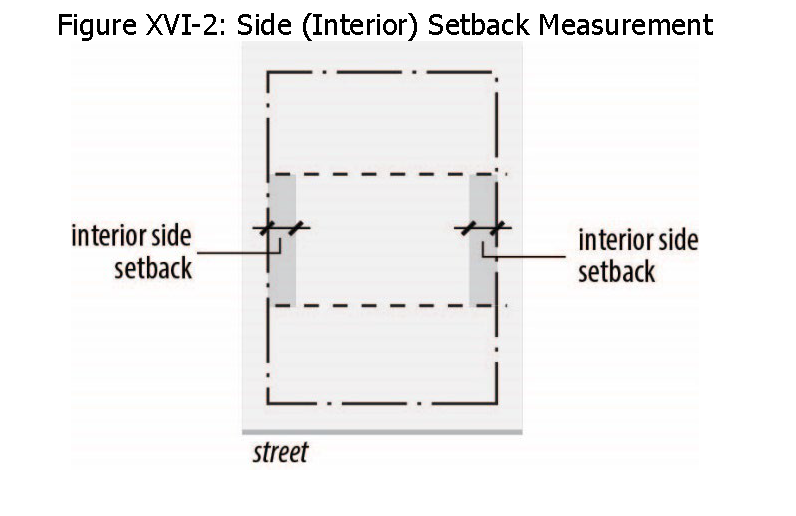
Interior side setbacks are measured from a side lot line that does not abut a street. When there are multiple interior side lot lines, the zoning administrator is authorized to determine the setback regulations that apply (e.g., determining that a minimum front setback is required based on the orientation of streets and buildings in the immediate vicinity).
(4)
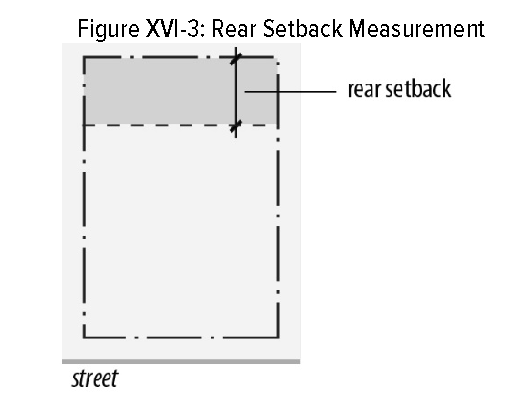
Rear setbacks are measured from the rear lot line.
(a)
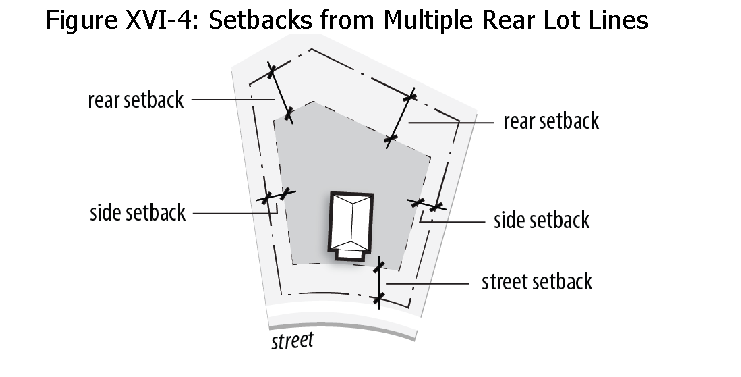
When there are multiple rear lot lines, the rear setback must be measured from each rear lot line.
(b)
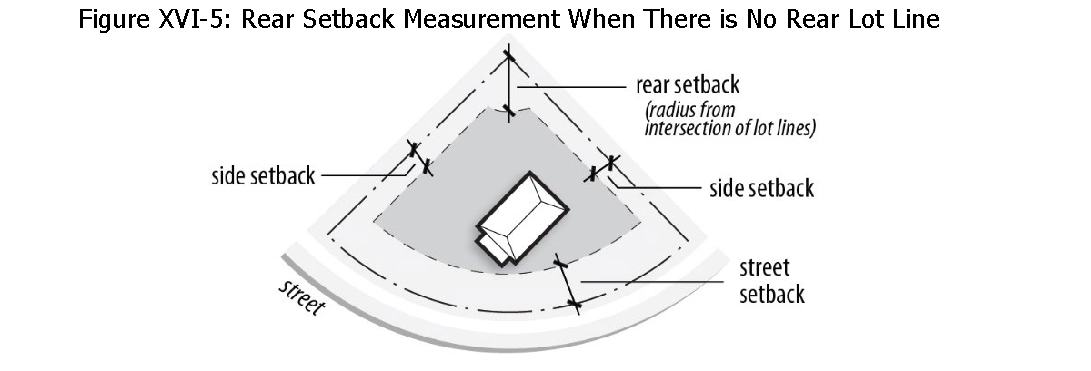
When there is no rear lot line, the rear setback must be measured as a radial distance from the intersection of side lot lines at the rear of the lot.
(c)
Double-frontage lots are subject to the measurement rules of section 16.07(B).
(B)
Double frontage lots. The following measurement rules apply to double-frontage lots:
(1)
Abutting lots facing same direction. When abutting lots take primary access to the same street as the subject lot or are occupied by principal buildings that are oriented to the same street as the principal building on the subject lot, the front lot line is the lot line abutting the street that provides primary access to the subject lot or towards which the principal building on the subject lot is oriented, and the rear lot line is the lot line abutting the street on the opposite side of the subject lot. In such cases, the rear street yard is considered the rear yard.
(2)
Abutting lots facing different direction. When abutting lots take primary access to a different street that the subject lot or are occupied by principal buildings that are oriented to a different street than the principal building on the subject lot, both street lot lines on the subject lot are considered front lot lines. The required front setback must be provided from the lot line abutting the street that provides primary access to the subject lot or towards which the principal building on the subject lot is oriented. The required setback from the opposite front lot line must equal at least the average depth of the front building setbacks that exist on the abutting lots.
(C)
Contextual setbacks.
(1)
Applicability; eligible house types. The contextual setback provisions of this section apply only in R districts and only to the construction of a new detached house, attached house, semi-detached house, or two-unit house or to a street-facing addition to an existing detached house, attached house, semi-detached house, or two-unit house.
(2)
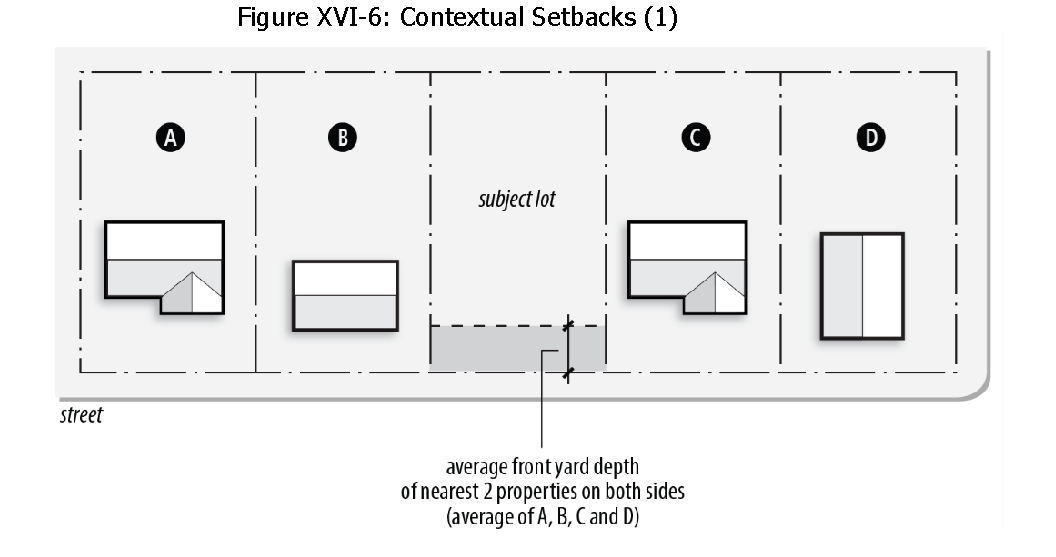
General. When existing buildings on one or more lots abutting a lot on which an eligible house type is proposed to be constructed or altered are closer to the street property line than the otherwise required street setback, additions to existing houses or construction of new houses on the subject lot may comply with the average (i.e., mean) street yard depth that exists on the nearest two lots on either side of the subject lot instead of complying with the zoning district's minimum street setback requirement, provided that the required setback may not be reduced by more than ten feet. See Figure XVI-6.
(3)
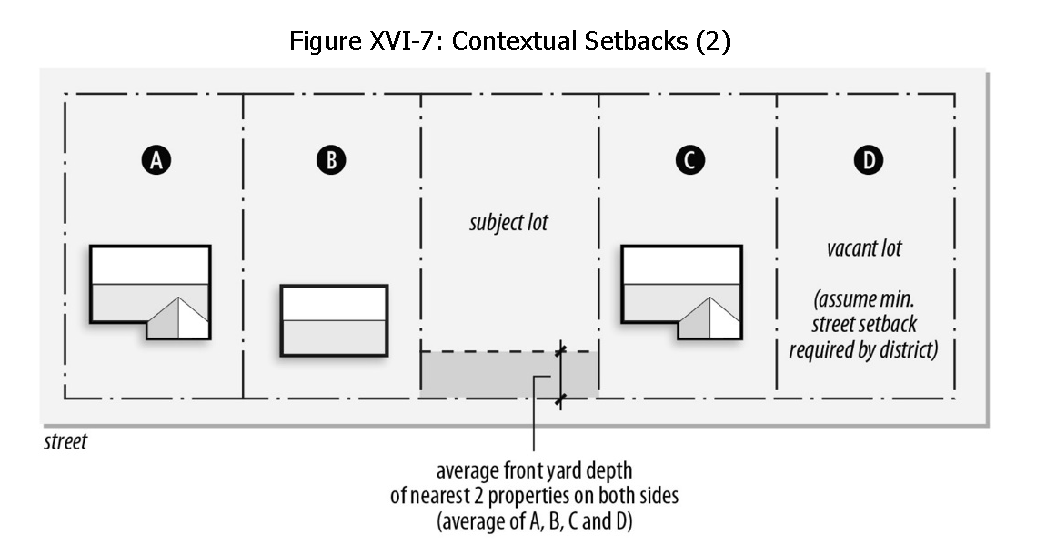
If one or more of the lots required to be included in the averaging calculation is vacant, that vacant lot will be deemed to have a street yard depth equal to the minimum street setback requirement of the subject zoning district. See Figure XVI-7.
(4)
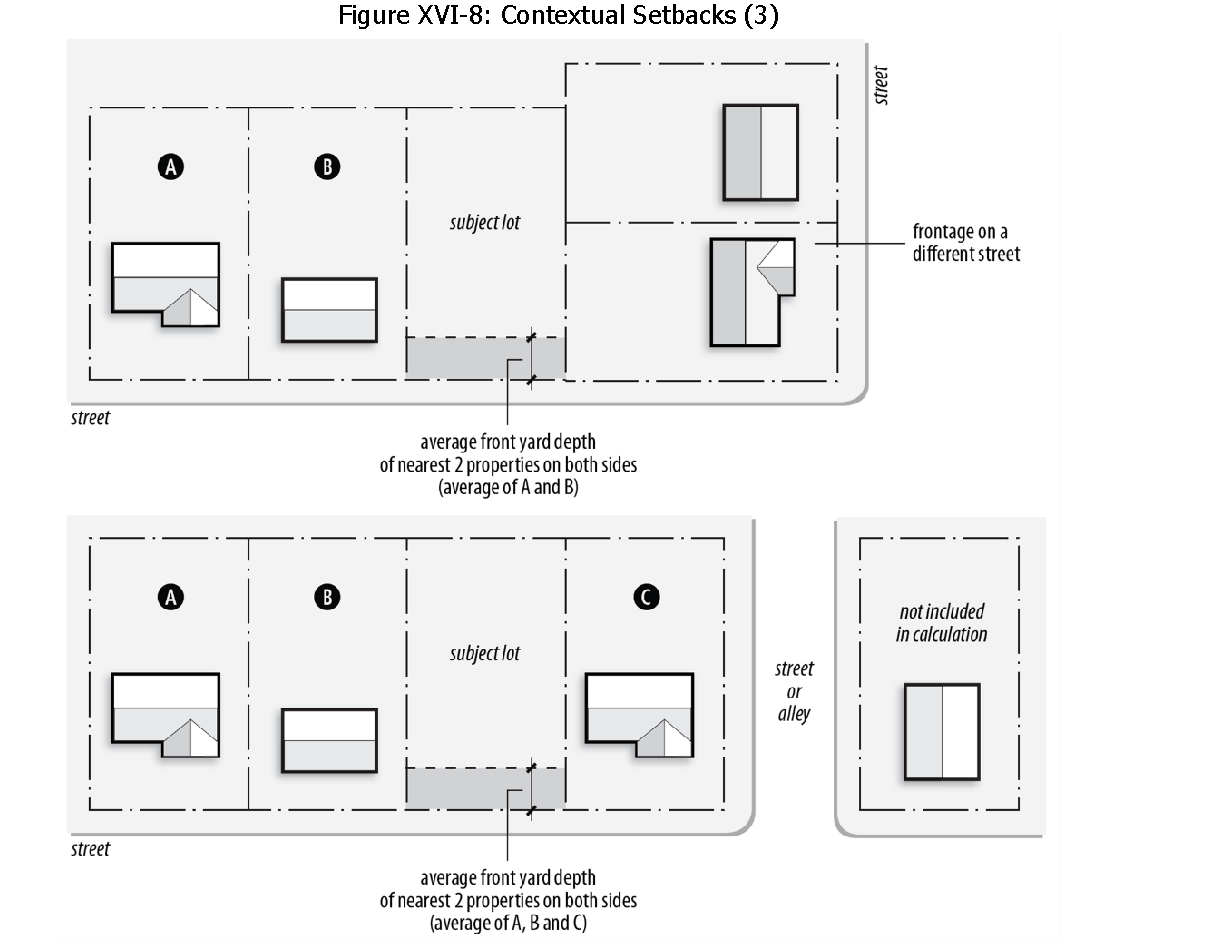
Lots with frontage on a different street than the subject lot or that are separated from the subject lot by a street or alley or that are not within an R zoning district may not be used in computing the average setback. See Figure XVI-8.
(5)
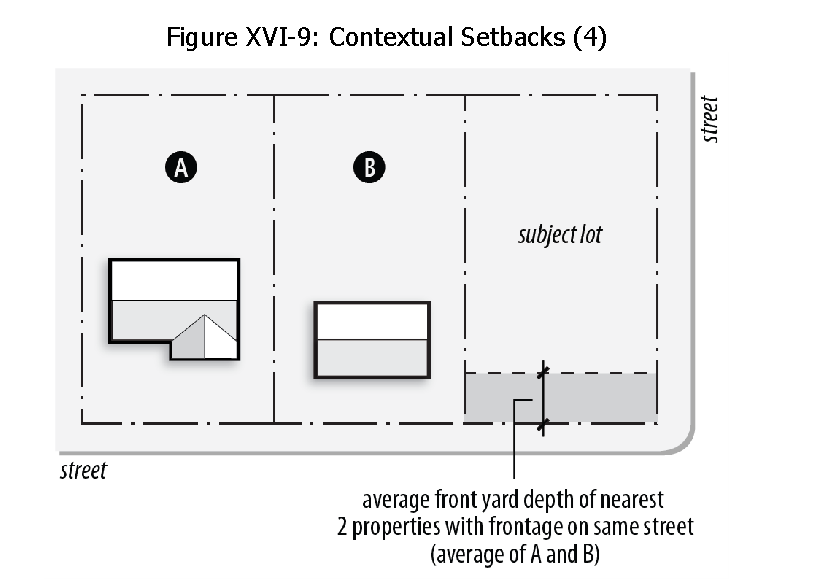
When the subject lot is a corner lot, the average street yard depth must be computed on the basis of the nearest two lots with frontage on the same street as the subject lot. See Figure XVI-9.
(6)
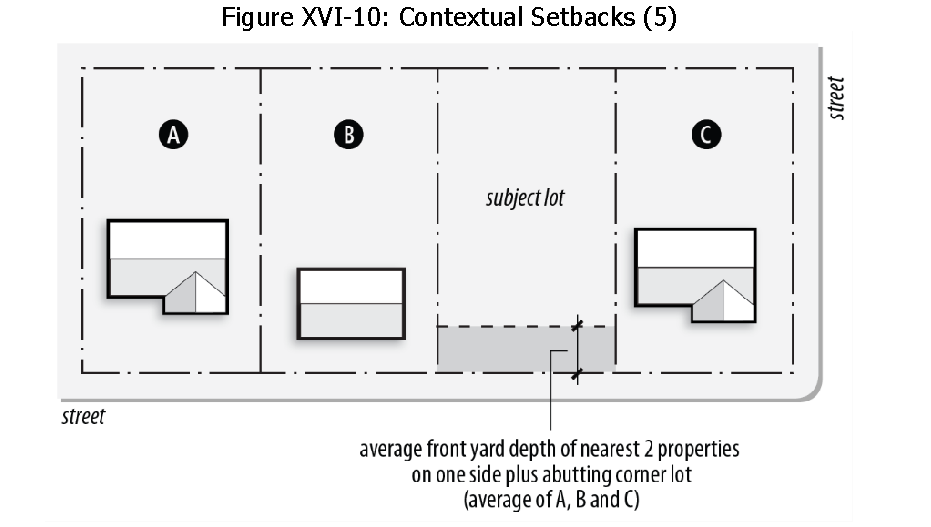
When the subject lot abuts a corner lot with frontage on the same street, the average street yard depth must be computed on the basis of the abutting corner lot and the nearest two lots with frontage on the same street as the subject lot. See Figure XVI-10.
(7)
These contextual setback provisions may not be used to reduce the setback of an attached garage unless such garage is set back at least five feet from the front façade of the principal building.
(8)
If one or more of the lots required to be included in the contextual setback calculation exceeds the minimum street setback, then the required minimum street setback of the subject zoning district applies.
(9)
When calculating the average, only the front wall of the principal building may be used. Attached accessory structures, such as covered porches, landings, and decks may not be used when calculating the contextual setback
(Ord. No. 25-105, § 3(Exh. A), 8-7-2025)
Sec. 16.08. - Lot coverage.
Lot coverage is measured as the percentage of a lot covered by buildings, structures and permanent impervious surfaces. Small accessory buildings that comply with the regulations of section 7.02(A)(2) are not counted when calculating lot coverage.
(Ord. No. 25-105, § 3(Exh. A), 8-7-2025)
Sec. 16.09. - Lot depth.
Lot depth is measured as the mean horizontal distance between the front lot line and the rear lot line of a lot measured within the boundaries of the lot.
(Ord. No. 25-105, § 3(Exh. A), 8-7-2025)
Sec. 16.10. - Streetwall width.
(A)
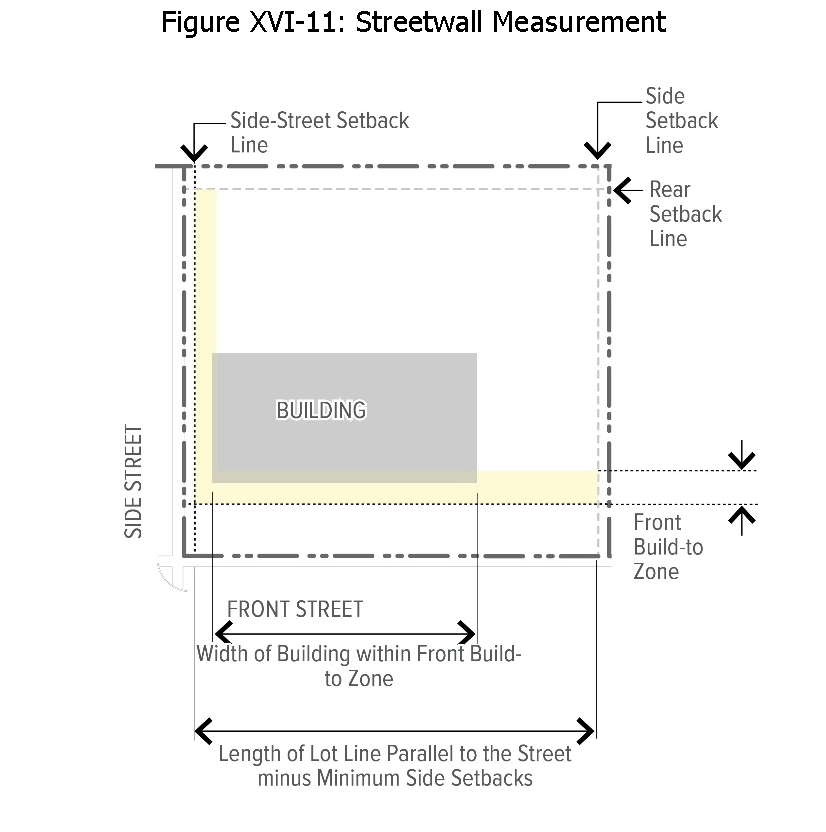
Some building types in downtown zoning districts are subject to minimum front streetwall requirements. These regulations establish a minimum percentage of the required build-to-zone that must be occupied by a building. Compliance with minimum front streetwall (percentage) requirements is calculated as follows:
Width of Building Wall within Build-to Zone
_____
Length Front Lot Line - Minimum Required Side Setbacks
(B)
The streetwall being measured must meet the minimum height required for the subject building type.
(C)
Courtyards may be counted towards meeting minimum front streetwall requirements if such courtyards comply with all of the following:
(1)
The courtyard must be located within the build-to zone. Courtyards on the interior or in the rear of the lot behind the front facade are not subject to the regulations of this subsection.
(2)
The width of a courtyard at the street may not occupy more than 30 percent of a building's front façade.
(3)
Parking is not allowed in a courtyard.
(4)
Building frontages on courtyards must meet all regulations for street facades, including all the transparency and entrance regulations in the building type regulations and facade materials and facade element regulations.
(5)
All ground surfaces in the front courtyard must be treated as either pedestrian paving or landscape bed. Pedestrian paving may include no more than 80 percent standard concrete.
(6)
Buildings abutting the courtyard must have an entrance on the street.
(7)
Landscape materials, such as trees in grates or planters and/or landscape beds, are required and at least one tree is required per courtyard.
(8)
Fences or walls are required along at least 50 percent of the build-to zone to continue the building streetwall. Fences and walls may not be more than 50 percent opaque. Allowed fence materials include masonry and metal.
(9)
Seating is required in the courtyard area, and at least one other amenity must be included. Amenities may include pergolas, trellises, catenaries, string overhead lighting, fountains, sculptures, murals, or similar features, as approved by the zoning administrator.
(Ord. No. 25-105, § 3(Exh. A), 8-7-2025)
Sec. 16.11. - Transparency.
Transparency is the measurement of the percentage of a facade that windows and doors with highly transparent, low-reflectance glass. Transparency for all window, door glass, and other storefront glass must be a minimum of 50 percent transmittance factor and a reflectance factor of not greater than 0.25 unless required by state law or local energy or building codes.
(A)
False windows. The use of false or faux windows, where the window is visible from the exterior with no opening from the interior, to meet the transparency requirement is not allowed.
(B)
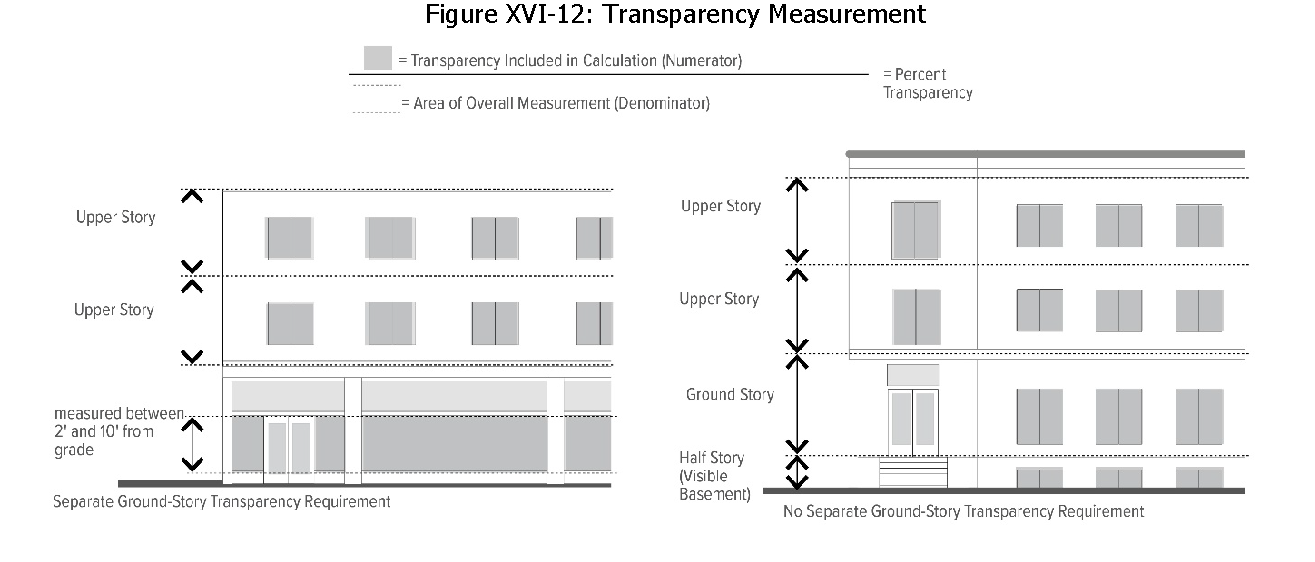
Measurement. Minimum facade transparency is measured from floor-to-floor of each story separately, except for required minimum ground-story transparency as defined below. See Figure XVI-12.
(1)
Transparency requirements must be met with windows or glass in doors that comply with applicable transmittance and reflectance factors.
(2)
The measurement may include the frame, mullions, and muntins, but may not include trim or casing.
(C)
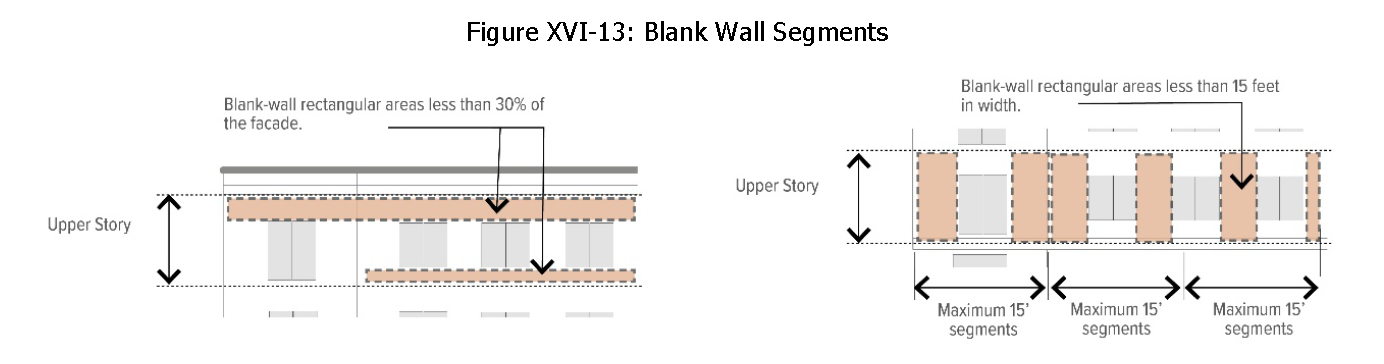
Blank wall segments. When stipulated by applicable building type regulations, blank wall segments on all facades must meet the following:
(1)
No rectangular areas greater than 30 percent of a story's facade, as measured floor to floor, may be blank wall, without transparency. See Figure XVI-13.
(2)
No horizontal segments of a story's facade greater than 15 feet in width may be blank wall, without transparency. See Figure XVI-13.
(D)
Minimum ground-story transparency. When a separate minimum ground-story transparency is required per the building type regulations, ground-story transparency is measured between two feet and ten feet from the average grade at the base of the facade.
(E)
Half stories. All half-story facades located within the roof structure and within visible basements must meet the minimum required transparency for the facade.
(Ord. No. 25-105, § 3(Exh. A), 8-7-2025)
Sec. 16.12. - Building entrances.
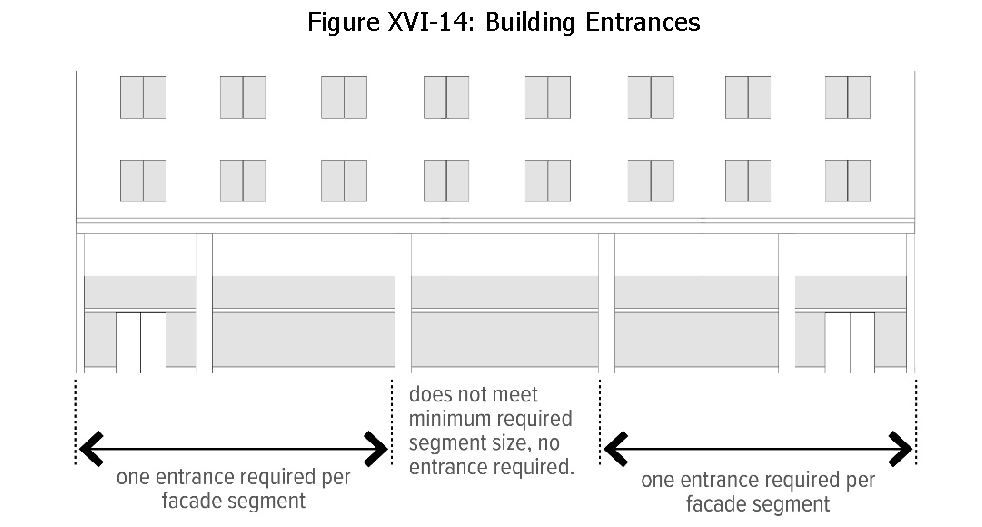
Entrances must be provided in accordance with the entrance location and number requirements established for the applicable building type and consistent with Figure XVI-14.
(Ord. No. 25-105, § 3(Exh. A), 8-7-2025)
Sec. 16.13. - Height.
(A)
Measurement.
(1)
Except as otherwise expressly stated, building height is measured as the vertical distance from grade to the highest point of the coping of a flat roof or to the deck line of a mansard roof, or to the mean height level between eaves and ridge for gable, hip or gambrel roofs. For the purpose of measuring height, grade is the existing or established grade at the building setback line midway between side lot lines.
(2)
Whenever building height limits are expressed in stories, the following rules of measurement apply.
(a)
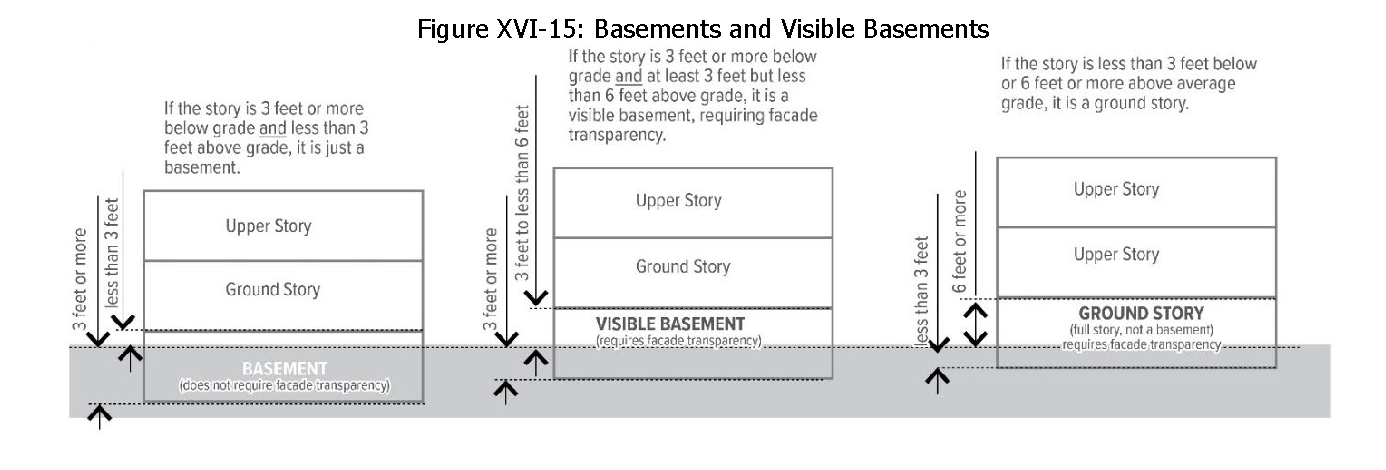
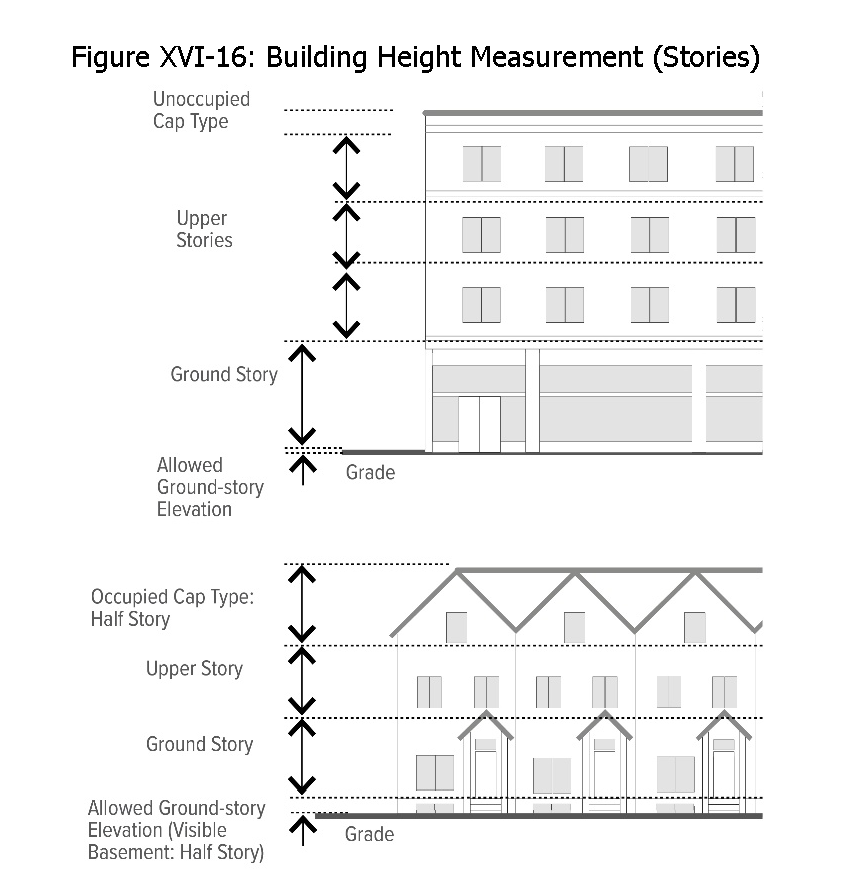
Building height is measured in stories plus any visible basement, exposed basement, and roof type. See Figure XVI-16.
(b)
Buildings must meet any applicable minimum height requirements along all front street facades and for a depth of at least 20 feet into the building.
(c)
All building facades located within the street setbacks must meet applicable minimum building height requirements.
(d)
Maximum height limits apply to the entire building.
(e)
If a building has both a half-story within the roof and a half-story that is a visible basement, the combined height of the two half stories is considered one full story.
(f)
Any building may have a basement, unless expressly prohibited in this article. Visible basements count as a half-story towards the minimum or maximum height of a building. Basements that are not visible basements do not count as a half-story.
(g)
Each story is measured with a range of permitted floor-to-floor heights.
i.
All story heights are measured in feet between the floor of a story to the floor of the story above it. Minimum and maximum floor-to-floor heights are required along a minimum of 80 percent of each facade's horizontal length for each story.
ii.
When noted as a separate story height, the ground-story height must extend from the front street facade into the building a minimum of 20 feet. The remainder of the ground-story may meet either the front street frontage ground-story heights or the height range permitted for all stories.
iii.
For single-story buildings and the uppermost story of a multi-story building, the floor-to-floor height is measured from the floor of the story to the ceiling, unless a specific height is provided for a single-story building.
iv.
Spaces exceeding the maximum allowable floor-to-floor heights of the building type are permitted for a maximum of 20 percent the length of street facades.
(B)
Exemptions. Penthouses or roof structures for the housing of elevators, stairways, tanks, ventilating fans or similar equipment required to operate and maintain a building; and chimneys, fire and parapet walls, water tanks or similar structures may be erected 15 feet above the height of the structure on which it is located even though the overall height may exceed the height limitation of the district in which it is located; however, such building appurtenances must be located or fully screened by parapet walls or similar screening to conceal their view when viewed from the adjoining street from an eye level height of five feet.
(Ord. No. 25-105, § 3(Exh. A), 8-7-2025)

