
Westmont City Zoning Code
ARTICLE XII
GENERAL DEVELOPMENT REGULATIONS
Sec. 12.01 - Outdoor lighting.
(A)
Purposes. The outdoor lighting regulations of this section are intended to help ensure safe and adequate lighting; provide for the efficient use of energy; and reduce the impacts of sky glow, nuisance lighting, and glare on nearby areas.
(B)
Applicability.
(1)
The outdoor lighting regulations of this section apply to new construction activity that is subject to the site plan approval procedures of section 14.05. "New construction" for the purposes of administering and interpreting these outdoor lighting regulations means the construction of new buildings and/or parking lots that include the installation of exterior lighting.
(2)
The zoning administrator is also authorized to require compliance with these outdoor lighting regulations when existing light fixtures are being replaced on nonresidential properties. In applying such regulations to replacement lighting, the zoning administrator is expressly authorized to require incremental improvements and to waive strict compliance based on the scope of work and contextual considerations.
(C)
Exemptions. The following are expressly exempt from compliance with outdoor lighting regulations of this section:
(1)
Outdoor lighting on lots occupied by detached houses, semi-detached houses, or two-unit houses;
(2)
Illuminated signs;
(3)
Emergency lighting used by police, fire fighting, or medical personnel;
(4)
Traffic control devices or streetlights installed by the village or other governmental entity;
(5)
Aviation safety lights required by the FAA (e.g., warning lights on radio, communication and navigation towers);
(6)
Spotlighting of official government flags if the spotlighting is contained within the area of the flag;
(7)
Outdoor lighting used for emergency equipment and work conducted in the interest of law enforcement or for public health, safety or welfare;
(8)
Outdoor lighting used for a village-approved temporary use or event;
(9)
Lighting fixtures with a light output of no more than 1,500 lumens;
(10)
Temporary holiday lighting and seasonal decorations using typical unshielded low-intensity lamps; and
(11)
Properties with approved site plans requesting amendments not related to exterior lighting.
(D)
Prohibited lighting. The following types of outdoor lighting are prohibited:
(1)
Any lighting that could interfere with the safe movement of motor vehicles, bicycles, or pedestrians on public or private streets;
(2)
Laser, strobe, and or flashing light sources or any similar high-intensity light;
(3)
Mercury vapor and low-pressure sodium lighting;
(4)
Tower lighting, unless required by the Federal Aviation Administration (FAA) and
(5)
Any permanent lighting used to outline or highlight an architectural element or feature of a building or other structure that has not been previously authorized by a site plan approval.
(E)
Lighting types and efficiency.
(1)
Light sources must be color-correct types such as Halogen, LED, or metal halide.
(2)
All lighting must have a nominal correlated color temperature (CCT) of no greater than 3,000 degrees Kelvin.
(F)
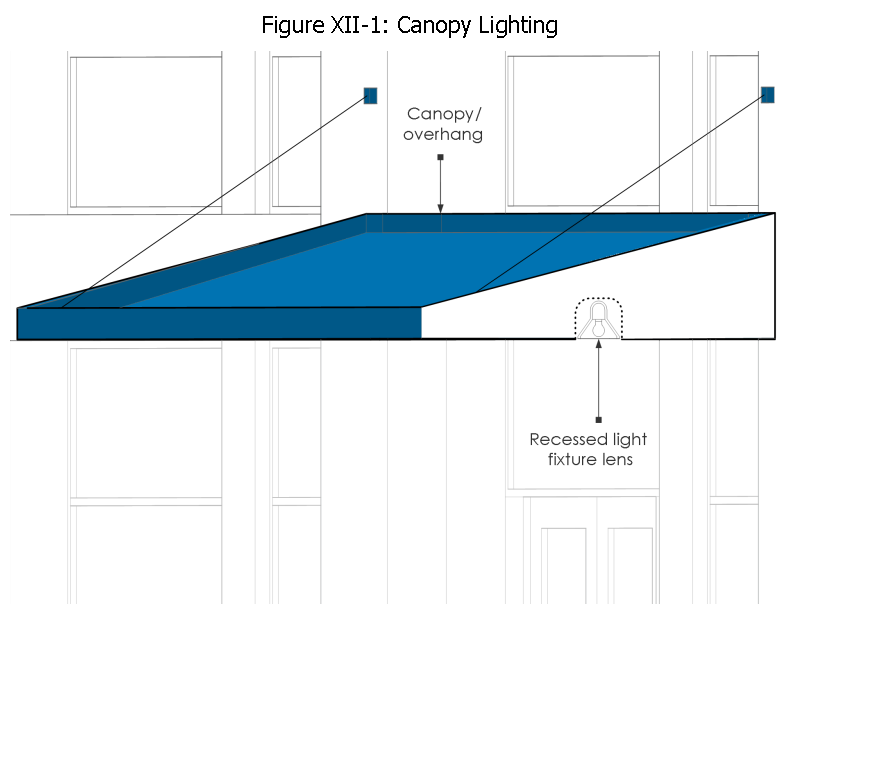
Canopy lighting. Light fixtures installed in canopies, pavilions, drive-through bays, or similar structures must be flush-mounted or recessed above the lower edge of the canopy and equipped with flat lenses that do not project below the canopy ceiling. The canopy fascia may not be internally illuminated.
(G)
Arrangement and shielding.
(1)
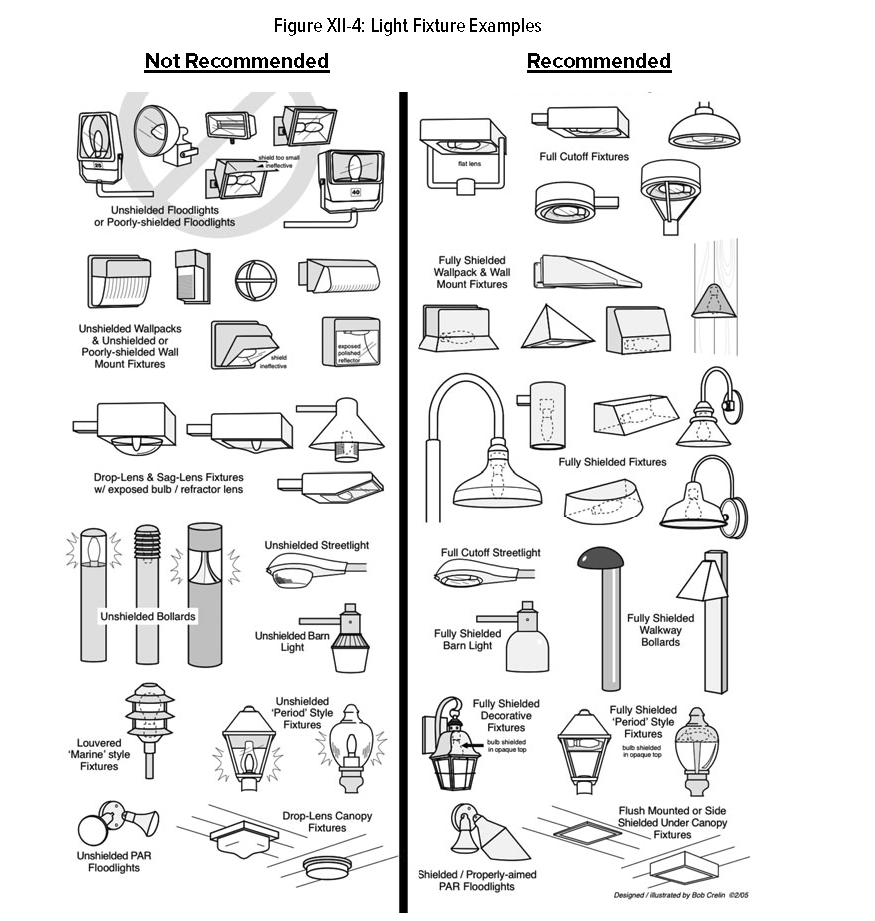
All lighting fixtures, except motion detector-activated lighting, must be fully shielded so that the lighting element is not visible to an observer at any property line, as measured five feet above grade (see Figure XII-4 for examples)
(2)
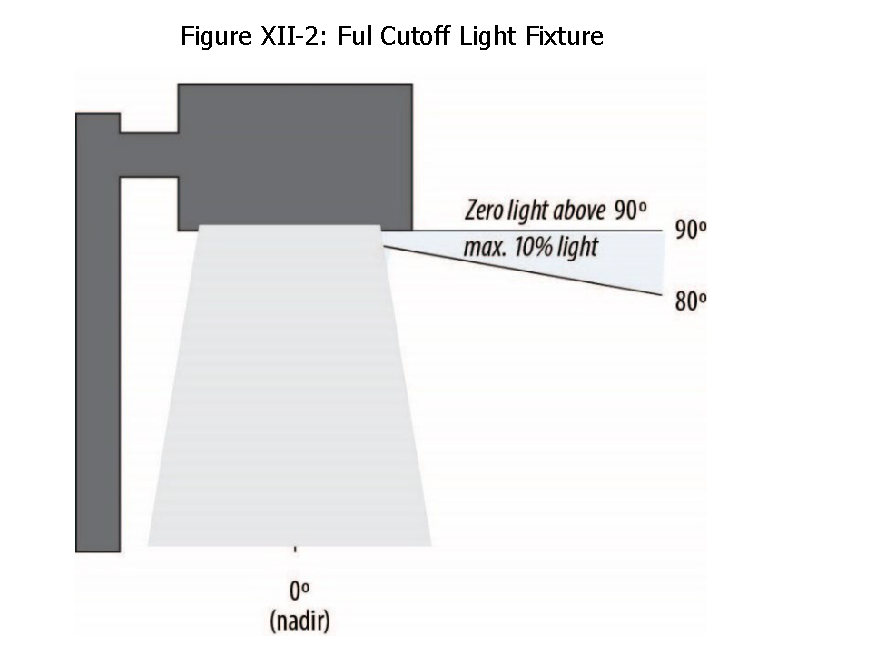
Light-producing elements must be shielded with full cutoffs so that no light emitted directly from the lamp or indirectly from the fixture is projected at an angle of more than 90 degrees above nadir and no more than ten percent of the light emitted directly from the lamp or indirectly from the fixture is projected at an angle of more than 80 degrees above nadir.
(3)
A light fixture may cast light upward only if all upward light is reflected back down by a canopy, roof, or similar feature.
(H)
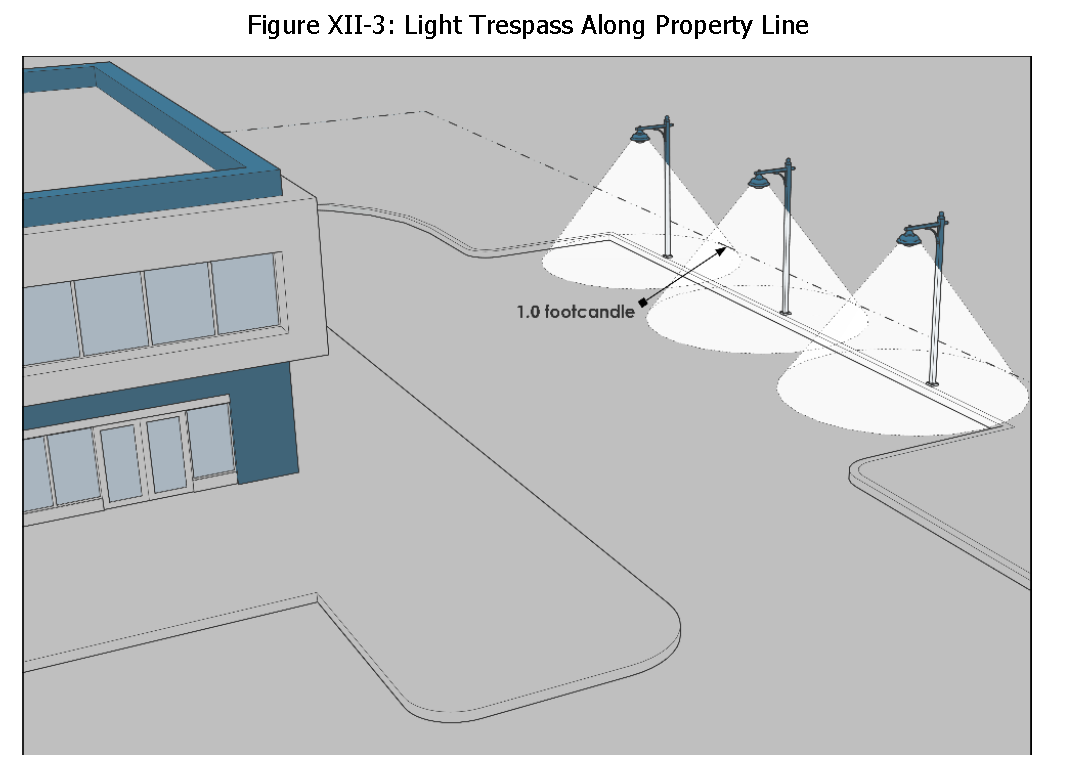
Light trespass. Light trespass along the lot line of the subject property may not exceed 0.5 foot-candles when abutting a residential zoning district or 1.0 foot-candle when abutting any other zoning district or public right-of-way. B-1(A)- and B-1-zoned lots are exempt from the light trespass limitations of this section except when such lot abuts an R-zoned lot.
(I)
Lighting plans.
(1)
General. Outdoor lighting plans demonstrating compliance with the regulations of this section are required with the submittal of a site plan for new or replacement outdoor lighting. If no outdoor lighting is proposed, a note must be placed on the face of the site plan indicating that no outdoor lighting will be provided. Applicants have two options for the format of the required lighting plan:
(a)
A lighting plan that complies with the fixture height lighting plan requirements of section 12.01(I)(2); or
(b)
A photometric plan demonstrating that compliance will be achieved using taller fixture heights, in accordance with section 12.01(I)(3).
(2)
Option 1: Fixture Height Standard Lighting Plan. Option 1 (Fixture Height Standard Lighting Plans) establishes maximum light fixture heights but does not require submittal of a detailed photometric plan.
(a)
Information required. Fixture height standard lighting plans must include at least the following:
i.
A scale drawing of the site with all outdoor lighting locations shown;
ii.
Fixture specifications, including catalog cut-sheets or generic standards;
iii.
Pole type and height of fixture;
iv.
Lamp type and size; and
v.
Fixture mounting and orientation.
(b)
Maximum fixture heights. Allowable heights of light fixtures must be measured from the light-emitting surface to finished grade at the base of the pole. Maximum allowed light fixture heights are based on the (ground-level) horizontal distance between the light fixture and any R-zoned lot or public right-of-way, as established in Table XII-1:
Table XII-1: Maximum Fixture Heights
(3)
Option 2: Photometric Study Lighting Plan. Under option 2 (Photometric Study Lighting Plan) no maximum fixture heights are established, but applicants are required to submit a photometric study in enough detail to demonstrate that all applicable outdoor light regulations will be met. The photometric study must include at least the following:
(a)
A scale drawing of the site with all outdoor lighting locations shown;
(b)
Fixture specifications, including catalog cut-sheets or generic standards;
(c)
Lamp type and size;
(d)
Fixture mounting heights, mounting orientation, and tilt angles if applicable; and
(e)
A representative point-by-point illumination array for the site showing property lines and all off-site lighting impacts.
(J)
Measurement of illumination.
(1)
For purposes of administration and enforcement, light levels must be measured with a direct-reading light meter, calibrated at least annually.
(2)
The meter's sensor must be located at the top of the any fence or wall along on the property line (or at a height of three feet above finished grade at the property line if there is no fence or wall), aimed towards the subject property in horizontal position. Readings must be recorded after the value has stabilized.
(3)
Measurements must be made after establishment of darkness with the light sources to be measured illuminated, and then with those light sources extinguished. The difference between these two readings must be compared to the maximum allowed illumination at the property line. In this way, contributions to light levels by night sky and other ambient light sources are eliminated and the light intensity from the subject light sources can be accurately determined.
(Ord. No. 25-105, § 3(Exh. A), 8-7-2025)
Sec. 12.02. - Underground utilities.
For all new construction, electric power transmission and telephone lines, and other appurtenant installations, other than transformers and street lights, must be installed underground. For all electrical upgrades and remodeling projects, such service may remain overhead.
(Ord. No. 25-105, § 3(Exh. A), 8-7-2025)
Sec. 12.03. - Street access.
All buildings must be on a lot with frontage on a public street or a permanent access easement with a minimum width of 30 feet.
(Ord. No. 25-105, § 3(Exh. A), 8-7-2025)
Sec. 12.04. - Outdoor storage of junk and debris.
The open storage of junk, refuse, scrap, disabled or damaged motor vehicles, whether awaiting repair or not, is prohibited in all zoning districts, except when explicitly allowed through an approved special use permit. For the purposes of interpretation, open storage is any storage not contained completely within a building or structure enclosed on all sides by walls and by a solid roof on the top.
(Ord. No. 25-105, § 3(Exh. A), 8-7-2025; Ord. No. 26-022, § 2, 2-19-2026)
Sec. 12.05. - Sight vision triangles.
(A)
General. Sight visibility triangles are designated areas located near streets, alleys and driveway intersections that must remain free from visual obstruction in order to maintain safe visibility for vehicles, bicyclists, and pedestrians. All properties must maintain sight visibility triangles at non-signalized intersections, as described in this section. See also section 70-7 of the village code.
(1)
Sight visibility triangles shall be provided on all corners at the intersection of any street with another street, an alley or a driveway.
(2)
Within sight visibility triangles, unobstructed sight lines and cross visibility must be maintained between a height of three feet and eight feet above the curb.
(3)
No structure, object, or vegetation may be placed or maintained in a manner that impedes the visibility from a street, alley or driveway of oncoming traffic from any direction on the intersecting public street.
(B)
Sight visibility triangle areas. The required sight visibility triangle area is based on the type of intersection, as follows:
(1)
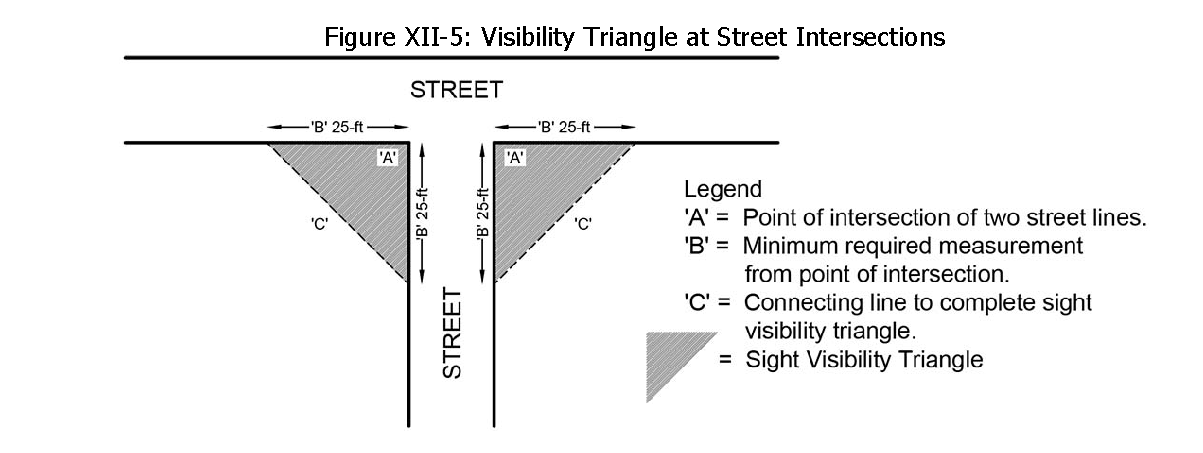
Intersection of streets. The sight visibility triangle at the intersection of two streets is formed with two sides 25 feet in length along the abutting street rights-of-way lines (illustrated by the letter "B" in Figure XII-5), measured from their point of intersection (illustrated by the letter "A" in Figure XII-5), and the third side being a line connecting the ends of the other two sides, illustrated by the letter "C" in in Figure XII-5.
(2)
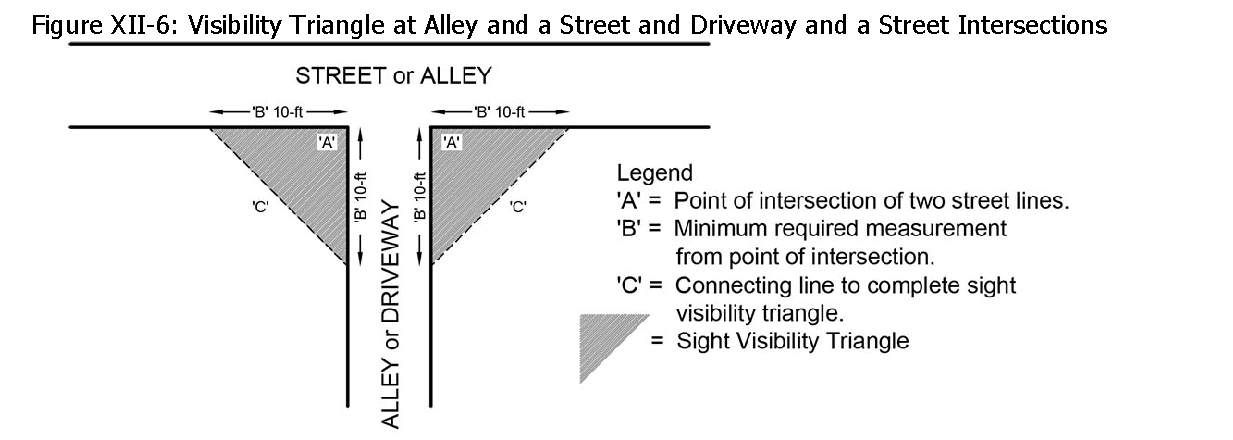
Intersection of an alley and a street or a driveway and a street. The sight visibility triangle at the intersection of an alley and a street or a driveway and a street is formed on both sides of the alley or driveway with two sides of each triangle being ten feet in length along the abutting street right-of-way lines, measured from their point of intersection, illustrated by the letter "A" in Figure XII-6, and the third side being a line connecting the ends of the other two sides, illustrated by the letter "C" Figure XII-6.
(C)
Exemptions. The following are exempt from the sight visibility regulations of this section:
(1)
The B-1 and B-1(A) districts are exempt from the sight visibility triangle regulations of this section, provided that other engineering and design methods are implemented to ensure visibility and safety, as reviewed and approved at the time site plan review.
(2)
Governmental signage and governmental sign posts in the right-of-way.
(3)
Fire hydrants, benches, and traffic control devices in the right-of-way.
(4)
Utility poles and one utility transmission or control device in the right-of-way.
(5)
Open-design fences that comply with the regulations of section 7.11(A)(3).
(Ord. No. 25-105, § 3(Exh. A), 8-7-2025)

