
Westmont City Zoning Code
ARTICLE XIV
REVIEW AND APPROVAL PROCEDURES
Sec. 14.01.- Common procedures.
(A)
Applicability. The common provisions of this section apply to all the review and approval procedures in this article unless otherwise expressly stated.
(B)
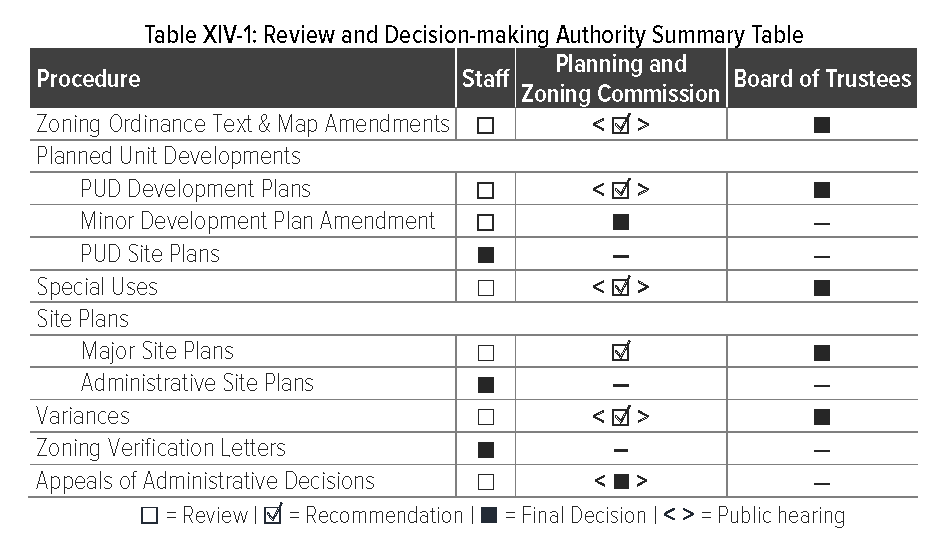
Review and decision-making authority (summary table). Table XIV-1 provides a summary of the review and approval procedures of this article. In the event of conflict between this summary table and the detailed procedures contained elsewhere in this article, the detailed procedures govern.
(C)
Applications and fees.
(1)
Owner-initiated applications. Whenever the provisions of this zoning ordinance allow the filing of an application by the owner of the subject property, that application must be filed by a person, firm or corporation having a freehold interest, a possessory interest entitled to exclusive possession, a contractual interest that may become a freehold interest, an option to purchase, or any exclusive possessory interest that is specifically enforceable on the land described in the application or by the property owner's authorized agent.
(2)
Pre-application meetings.
(a)
Purpose. Pre-application meetings provide an early opportunity for staff and applicants to discuss the procedures, standards and regulations required for approval under this zoning ordinance. Pre-application meetings include all direct correspondence between staff and the applicant including in-person and online meetings, emails, and phone calls.
(b)
Applicability. Pre-application meetings are required whenever the provisions of this zoning ordinance expressly state that they are required. They are encouraged in all cases.
(c)
Scheduling. In-person and online pre-application meetings must be scheduled with the zoning administrator.
(3)
Form of application. Applications required under this zoning ordinance must be submitted in a form and in such numbers as required by the zoning administrator.
(4)
Filing fees and deposits.
(a)
General. All applications must be accompanied by an application fee and such deposits for reimbursable out-of-pocket expenses as described in this section. No action may be taken on such applications until the fee has been paid and required deposits made unless the board of trustees waives otherwise applicable requirements.
(b)
Escrow deposits. Any applicant who files an application requiring review by the planning and zoning commission must, in addition to meeting all other application requirements, fund an escrow account with the village to secure and cover reimbursement to the village for the reasonable fees of third-party consultants to the village who provide professional consulting services on any matter pertaining to the applicant's application. The applicant must complete a development escrow agreement in such form as prescribed by the zoning administrator. The zoning administrator is authorized to reasonably determine the amount of the escrow deposit required based on the complexity of the proposed development and the nature and extent of consulting services anticipated. If the escrow deposit is depleted and additional consultant reviews are required, the applicant must replenish the escrow account in such amount as reasonably determined by the zoning administrator before further consultant reviews are performed. The zoning administrator must promptly refund to the zoning applicant any deposit remaining in an escrow account after the completion of all consultant reviews.
(D)
Application completeness, accuracy and sufficiency.
(1)
An application required under this zoning ordinance will be considered complete and ready for processing only if it is submitted in the required number and form, includes all required information, and is accompanied by all required fees and deposits.
(2)
The zoning administrator must make a determination of application completeness within a timely manner.
(3)
If an application is determined to be incomplete, the official responsible for accepting the application must provide notice to the applicant along with an explanation of the application's deficiencies. Notice of an incomplete application may be provided by personal service, electronic mail, or first-class mail.
(4)
No processing of incomplete applications will occur. When application deficiencies are corrected, the application must be placed in the first available processing cycle. If the deficiencies are not corrected by the applicant within a time period specified by the zoning administrator, the application will be deemed to have been withdrawn.
(5)
Complete applications must be reviewed by staff and other review and decision-making bodies in accordance with applicable review and approval procedures of this zoning ordinance.
(6)
The zoning administrator may require that applications or plans be revised before being placed on an agenda for possible action if the zoning administrator determines that:
(a)
The application or plan contains one or more significant inaccuracies or omissions that hinder timely or competent evaluation of the plan's/application's compliance with zoning ordinance requirements or other regulations;
(b)
The application contains multiple minor inaccuracies or omissions that hinder timely or competent evaluation of the plan's/application's compliance with zoning ordinance requirements or other regulations.
(E)
Application processing cycles. Officials responsible for accepting applications, after consulting with review and decision-making bodies, are authorized to promulgate reasonable cycles and timelines for processing applications, including deadlines for receipt of complete applications.
(F)
Public hearing notice.
(1)
Newspaper notice. Notice of public hearings required under the provisions of this article must be published in a newspaper of general circulation in the village at least 15 days before and no more than 30 days before the public hearing. Required notices must include at least the following information:
(a)
An address or legal description of the property that is the subject of the hearing, along with the property's permanent index number;
(b)
A summary of the nature of the application; and
(c)
The time and place of the hearing.
(2)
Courtesy notice. In addition to notice required by the Illinois Compiled Statutes, the village may provide, as a matter of practice, several types of courtesy notice. Failure to provide any form of courtesy notice that is not required by state law or any defect in such courtesy notice does not invalidate, impair, or otherwise affect any application, public hearing or decision rendered in respect to the matter under consideration.
(a)
Mailed notice.
i.
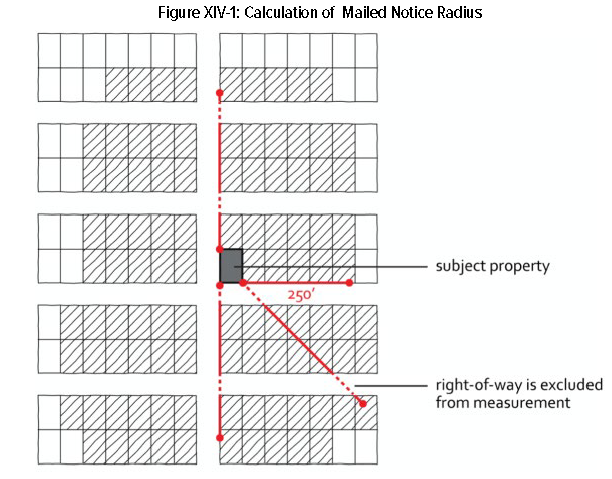
Unless otherwise directed by the zoning administrator, whenever the provisions of this article require mailed notice, the applicant must provide mailed notice to owners of the subject property and all owners of property within 250 feet of the property lines of the subject property, as measured from the property line to property line, but excluding public rights-of-way (i.e., rights-of-way are not counted in calculating the required notification radius). See Figure XIV-1
ii.
Such notices must be deposited in the U.S. mail at least 15 days before but no more than 30 days before the scheduled public hearing.
iii.
Mailed notices must include the time and place of the public hearing; the address of the property that is the subject of the public hearing; the name and address of the applicant; and a brief statement describing the matter to be considered in the public hearing.
iv.
The zoning administrator is authorized to specify the source of property ownership information and to specify the means by which applicants demonstrate compliance with mailed notice requirements.
(b)
Posted notice (signs).
i.
Whenever the provisions of this article require posted notice signs, the community development department must post or require that the applicant post at least one sign on each public street frontage of the property that is the subject of a public hearing.
ii.
Required signs must be posted at least 15 days before the hearing in a location that is clearly visible from all abutting public rights-of-way. Posted notice signs must include the name of the village, a statement indicating that the property will be the subject of an upcoming public hearing, an indication of where additional information may be obtained, and any additional information required by the zoning administrator.
(G)
Hearing procedures.
(1)
The body conducting a required public hearing is authorized to establish reasonable rules and regulations governing the conduct of hearings and the presentation of information and comments.
(2)
Once commenced, a public hearing may be continued by the hearing body. No re-notification is required if the continuance is set for specified date and time and that date and time is announced at the time of the continuance.
(3)
If a public hearing is continued or postponed for an indefinite period of time from the date of the originally scheduled public hearing, new public hearing notice must be given before the rescheduled public hearing.
(4)
If the applicant requests and is granted a continuance or postponement requiring renotification, the applicant must pay any costs of renotification.
(H)
Action by review bodies and decision-making bodies.
(1)
In taking action under the procedures of this article, review and decision-making bodies must act by simple majority vote of a quorum, unless otherwise expressly stated in this zoning ordinance or statutes.
(2)
Review and decision-making bodies may take any action that is consistent with:
(a)
The regulations of this zoning ordinance;
(b)
Any rules or by-laws that apply to the review or decision-making body; and
(c)
The notice that was given.
(3)
Review and decision-making bodies are authorized to continue a public hearing or defer action in order to receive additional information or further deliberate.
(I)
Conditions of approval. Decision-making bodies are authorized to impose reasonable conditions on approved applications to ensure that the proposed use or development meets the standards required for approval and that are reasonably necessary to protect the public health, safety, and general welfare.
(J)
Decision-making criteria; burden of proof or persuasion. Applications must address relevant review and decision-making criteria. In all cases, the burden is on the applicant to show that an application or proposal complies with all applicable review or approval criteria.
(K)
Required time-frames for action. Any time limit specified in this zoning ordinance for any decision or action on behalf of a review or decision-making body may be extended if the applicant agrees to an extension. Unless otherwise expressly stated, if a review or decision-making body does not render a decision or take action within any time period required under this zoning ordinance and the applicant has not agreed to an extension of that time limit, the application is deemed denied.
(L)
No application for a zoning amendment, special use, or variation which has been denied by the corporate authorities shall be resubmitted for a period of one year from the date of such denial, unless the applicant demonstrates to the corporate authorities that there has been a substantial change in circumstances or new evidence which would justify reconsideration.
(Ord. No. 25-105, § 3(Exh. A), 8-7-2025; Ord. No. 26-022, § 2, 2-19-2026)
Sec. 14.02 - Zoning ordinance text and zoning map amendments.
(A)
Authority to file.
(1)
Amendments to the text of this zoning ordinance may be initiated by the board of trustees, the planning and zoning commission, the zoning administrator, or by an owner of property within the village.
(2)
Amendments to the zoning map may be initiated by the board of trustees, the planning and zoning commission, or the owner of the property that is the subject of the proposed zoning map amendment.
(B)
Application filing. Property owner-initiated applications for zoning map amendments must be filed with the zoning administrator.
(C)
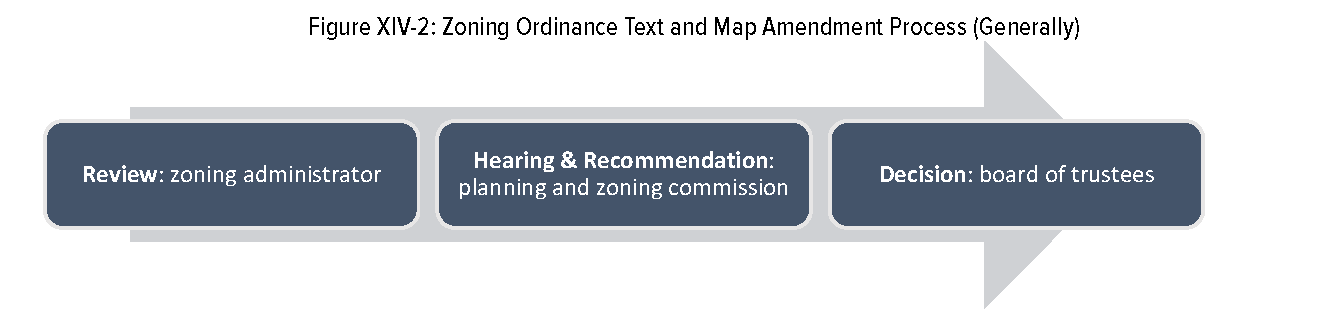
Review—Zoning administrator. Upon initiation of a zoning text amendment or receipt of a complete application for a zoning map amendment, the zoning administrator must review the proposal and transmit relevant information to the planning and zoning commission before their public hearing on the proposed amendment.
(D)
Hearing and recommendation—Planning and zoning commission. The planning and zoning commission must hold a public hearing on the proposed amendment, with newspaper notice of the hearing provided in accordance with section 14.01(F)(1). For zoning map amendments, mailed notice and posted notice of the hearing must also be provided in accordance section 14.01(F)(2)(a) and section 14.01(F)(2)(b), respectively. Following the public hearing, the planning and zoning commission must act to recommend that the proposed amendment be approved, approved with modifications, or denied and transmit its recommendation to the board of trustees. If the planning and zoning commission arrives at a tie vote, such tie vote is deemed a recommendation to deny (not to approve) the amendment.
(E)
Final action—Board of trustees. Following receipt of the planning and zoning commission's report and recommendation, the board of trustees must act to approve the proposed amendment, approve the proposed amendment with modifications or deny the proposed amendment. The board of trustees is also authorized to remand the proposed amendment to the planning and zoning commission for further consideration.
(F)
Review and approval criteria.
(1)
Zoning ordinance text amendments. The decision to amend the zoning ordinance text is a matter of legislative discretion that is not controlled by any one standard. In making recommendations and decisions about zoning ordinance text amendments, review and decision-making bodies must consider all relevant factors, including at least the following:
(a)
Whether the proposed text amendment is in conformity with the comprehensive plan;
(b)
Whether the proposed text amendment is consistent with the purposes of this zoning ordinance; and
(c)
Whether the proposed text amendment corrects an error or inconsistency or is necessary or desirable to meet the challenge of a changed or changing condition or law.
(2)
Zoning map amendments.
(a)
The decision to amend the zoning map is a matter of legislative discretion that is not controlled by any single standard. In making recommendations and decisions about zoning map amendments, review and decision-making bodies must consider at least the following factors:
i.
The existing use and zoning of nearby property;
ii.
The extent to which the particular zoning restrictions affect property values;
iii.
The extent to which any diminution in property value is offset by an increase in the public health, safety and welfare;
iv.
The suitability of the subject property for its zoned purposes;
v.
The length of time that the subject property has been vacant as zoned, considering the context of land development in the vicinity;
vi.
The value to the community of the proposed zoning map amendment; and
vii.
The comprehensive plan.
(b)
In acting on zoning map amendments, review and decision-making bodies are expressly authorized to recommend and approve a less intensive zoning district classification than the zoning district that was described in required public notices.
(G)
Protest petitions.
(1)
If a valid protest petition is filed against any proposed zoning map amendment, passage of the zoning map amendment requires a favorable vote of two-thirds of the members of the board of trustees then holding office.
(a)
A protest petition will be deemed valid if it is signed and acknowledged by the owners of 20 percent of the frontage proposed to be altered, or by the owners of 20 percent of the frontage immediately abutting or across an alley therefrom, or by the owners of the 20 percent of the frontage directly opposite the frontage proposed to be altered.
(b)
A written protest petition opposing a zoning map amendment must be submitted to the zoning administrator at least five business days before the board of trustees' vote.
(c)
When a written protest petition has been submitted, the protest petition must be served by the protestors upon the applicant and upon the applicant's attorney, if any, by certified mail at the address shown on the application.
(Ord. No. 25-105, § 3(Exh. A), 8-7-2025)
Sec. 14.03 - Development plans.
(A)
Purpose. Development plans are required to accompany requests for PUD approval and PUD amendments and some property owner-initiated rezonings. They are optional with other property owner-initiated rezonings. Their purpose is to depict a property owner's generalized plan for the type, amount and physical character of development proposed on the subject property. By providing greater certainty about development proposals, development plans provide review and decision-making bodies with additional information on which to base rezoning and related decisions.
(B)
Applicability.
(1)
Mandatory. Development plans are required (mandatory) for special use requests for planned unit development (PUD) approval and PUD amendments and for Resort District (B-3) zoning map amendments. They are also required for major amendments to planned developments (PDs) that were established before the effective date specified in section 1.03. In acting on mandatory development plans, the planning and zoning commission is authorized to recommend and the board of trustees is authorized to approve use and development limitations that comply with, are more restrictive than or, if permitted by the respective PUD, B-3, or PD provisions of this zoning ordinance, are less restrictive than the base zoning district regulations and otherwise applicable regulations of this zoning ordinance.
(2)
Optional. Property owners may elect to submit a development plan with any zoning map amendment application. In acting on optional development plans, the planning and zoning commission is authorized to recommend and the board of trustees is authorized to approve use and development limitations that are at least as restrictive or are more restrictive than otherwise applicable regulations of this zoning ordinance. Optional development plans may not be used to obtain variances, exceptions, or other relief from otherwise applicable zoning ordinance regulations.
(C)
Preapplication meeting and concept plan.
(1)
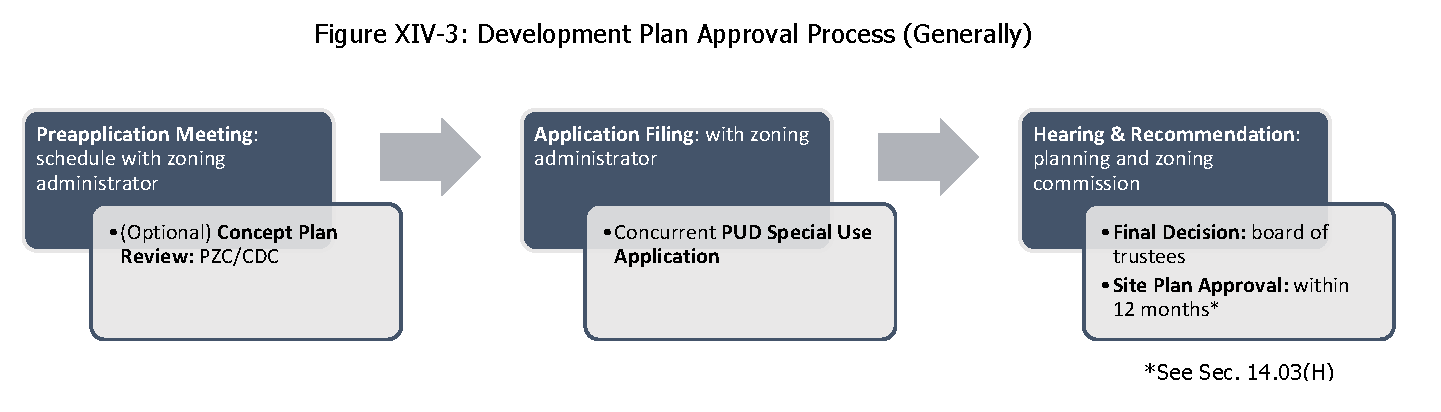
Before filing an application for mandatory or optional development plan approval, a preapplication meeting is required in accordance with section 14.01(C)(2).
(2)
In addition to the preapplication meeting with community development department staff, the zoning administrator may require that applicants for development plan approval present a concept plan to the planning and zoning commission or community development committee for the purpose of obtaining guidance prior to formally filling an application. No notice is required for concept plan review. Opinions or advice provided during the preapplication and concept plan review stage are not binding with respect to any official action of the planning and zoning commission or board of trustees.
(D)
Application filing. Complete applications for development plan approval must be filed with the zoning administrator at the same time as a zoning map amendment application for the subject property. The development plan is intended to provide the applicant an opportunity to submit a plan showing the basic scope, character, and nature of the entire proposed development without incurring undue cost. The development plan is the basis on which the required public hearing is held, thus permitting public consideration of the proposal. In order to permit the village and the applicant to proceed with some assurance, approval of the development plan binds the applicant and the village with respect to the following basic elements of development:
(1)
Categories of uses to be permitted;
(2)
General location of all land uses;
(3)
Overall maximum density of residential uses and intensity of nonresidential uses;
(4)
General building design;
(5)
General location and extent of public and private open space, including recreational amenities;
(6)
General location of vehicular and pedestrian circulation systems;
(7)
Staging of development; and
(8)
Nature, scope, and extent of public dedications, improvements, or contributions to be provided by the applicant.
(E)
Requirements for development plan. The development plan is intended to provide the applicant an opportunity to submit a plan showing the basic scope, character, and nature of the entire proposed development without incurring undue cost. The development plan is the basis on which the required public hearing is held, thus permitting public consideration of the proposal at the earliest stage possible. When submitting a development plan to the village, the applicant must also submit a preliminary plat of subdivision (if subdivision is required), a developer's statement of intent (if PUD approval is sought), and a statement demonstrating that the proposed development meets the standards for PUD approval (if PUD approval is sought), in addition to such other items required by this zoning ordinance or otherwise required by the zoning administrator. In order to permit the village and the applicant to proceed with some assurance, approval of the development plan binds the applicant and the village with respect to the basic elements of the development. Development plans must include, at a minimum, the following information:
(1)
Categories of uses to be permitted;
(2)
Location and approximate dimensions of buildings and structures on the property;
(3)
Location of residential and/or nonresidential uses on the property.
(4)
Overall maximum density of residential uses and/or intensity of nonresidential uses;
(5)
General architectural style of proposed buildings and structures;
(6)
General location and extent of public and private open space, including recreational amenities;
(7)
General location of vehicular and pedestrian circulation systems and off-street parking;
(8)
Location and identification of adjacent public and private streets that will serve the development;
(9)
General location and extent of stormwater management facilities;
(10)
General layout of water main, water line extensions, sanitary sewer, and sanitary sewer line extensions;
(11)
General layout of proposed drainage and utility easements on the property;
(12)
Nature, scope, and extent of landscaping proposed for the development;
(13)
Nature, scope, and extent of public improvements and public dedications or contributions to be provided by the applicant;
(14)
Information about the zoning and uses of adjoining properties; and
(15)
Staging of the development.
(F)
Hearing and recommendation—Planning and zoning commission. The planning and zoning commission must hold a public hearing to consider the proposed development plan and zoning map amendment or other request, with notice of the hearing provided in accordance with the newspaper notice, mailed notice, and posted notice sign provisions of section 14.01(F)(1), section 14.01(F)(2)(a), and section 14.01(F)(2)(b), respectively. Following the public hearing, the planning and zoning commission must act to recommend that the proposed development plan and map amendment or other request be approved, approved with modifications or conditions, or denied and transmit its recommendations to the board of trustees. If the planning and zoning commission arrives at a tie vote, such tie vote is deemed a recommendation to deny (not to approve) the development plan and zoning map amendment.
(G)
Final action—Board of trustees.
(1)
Following receipt of the planning and zoning commission's recommendation, the board of trustees must act to approve the proposed development plan and zoning map amendment or other request, approve the proposed development plan and map amendment with modifications or conditions, or deny the proposed development plan and map amendment or other request. The board of trustees may also may remand the matter to the planning and zoning commission for further consideration.
(2)
Development plans and accompanying zoning map amendments may be approved by a simple majority vote, except as stated in section 14.02(G).
(H)
Requirement for filing of site plan.
(1)
Unless a longer time period or a phasing plan is approved at the time of approval of a mandatory development plan, a complete application for site plan approval must be filed within 12 months of the date of mandatory development plan approval. If an application for site plan approval is not filed within the time required, no further site plans may be approved for the project until the subject property owner has filed the original or amended development plan for re-review and reconsideration by the planning and zoning commission and board of trustees. Such re-review and reconsideration must follow the mandatory development plan review procedures of this zoning ordinance. Following re-review and reconsideration, the planning and zoning commission is authorized to recommend and the board of trustees is authorized to approve any of the following actions based on surrounding land use patterns and other relevant information presented at the time of reconsideration by the planning and zoning commission and board of trustees:
(a)
An extension of time for filing a site plan
(b)
An amendment to the approved mandatory development plan; or
(c)
Rezoning to another zoning district in accordance with the zoning map amendment procedures of section 14.02.
(2)
The site plan filing deadline established in section 14.03(H)(1) does not apply to optional development plans or PD district development plans approved before the effective date specified in section 1.03. The site plan filing deadline established in section 14.03(H)(1) does apply to any major amendments to mandatory development plans approved after the effective date specified in section 1.03
(I)
Amendments to approved development plans.
(1)
Minor amendments.
(a)
The planning and zoning commission is authorized to approve amendments to approved development plans as minor amendments if the planning and zoning commission determines that substantial compliance is maintained with the approved development plan. The following is a non-exhaustive list of changes that the zoning administrator may refer to the planning and zoning commission to be considered as minor amendments:
i.
Any deviation expressly authorized at the time of development plan approval;
ii.
The relocation or addition of customary accessory uses and structures;
iii.
Adjustment of internal development area boundaries, provided the allocation of land to particular uses and the relationship of uses within the project are not substantially altered;
iv.
Limitation or elimination of previously approved uses, provided the character of the development is not substantially altered;
v.
Modification of the internal circulation system that would not increase points of access from adjacent streets, change access to another street or increase projected traffic volumes;
vi.
Modifications to approved signage, provided the size, location, number and type of signs is not substantially altered;
vii.
Modification to approved screening and landscaping plans, provided the modification is not a substantial deviation from the original approved plan;
viii.
Changes reducing the number of permitted dwelling units, the amount of nonresidential floor area or the area covered by buildings or paved areas; and
ix.
Reductions in off-street parking or loading by more than ten percent or one required space, whichever results in a greater reduction.
(b)
In those cases when the board of trustees has expressly imposed a condition of development plan approval, any amendment of that board of trustees-imposed condition must be reviewed and approved by the board of trustees.
(c)
If the planning and zoning commission determines that the proposed development plan amendment, if approved, will result in a significant departure from the approved development plan or otherwise significantly change the character of the subject area or that the cumulative effect of a number of minor amendments substantially alters the approved development plan, then the amendment must be deemed a major amendment to the development plan and processed as a new development plan following the development plan approval procedure of this section (section 14.03), including all requirements for fees, notices and hearings.
(2)
Major amendments. Any amendment to an approved development plan that is not authorized or approved as a minor amendment is considered a major amendment and must be processed as a new development plan following the development plan approval procedure of section 14.03, including all requirements for fees, notices and hearings.
(Ord. No. 25-105, § 3(Exh. A), 8-7-2025)
Sec. 14.04. - Special uses.
(A)
Intent. The special use approval procedures of this section are intended to provide a transparent, public review process for land uses that, because of their widely varying design and operational characteristics, require case-by-case review in order to determine whether they will be compatible with surrounding uses and development patterns.
(B)
Authorized special uses. Only those special uses expressly authorized in this zoning ordinance may be approved as special uses.
(C)
Authority to file. Applications for special use approval may be filed only by the owner of the subject property or the owner's authorized agent.
(D)
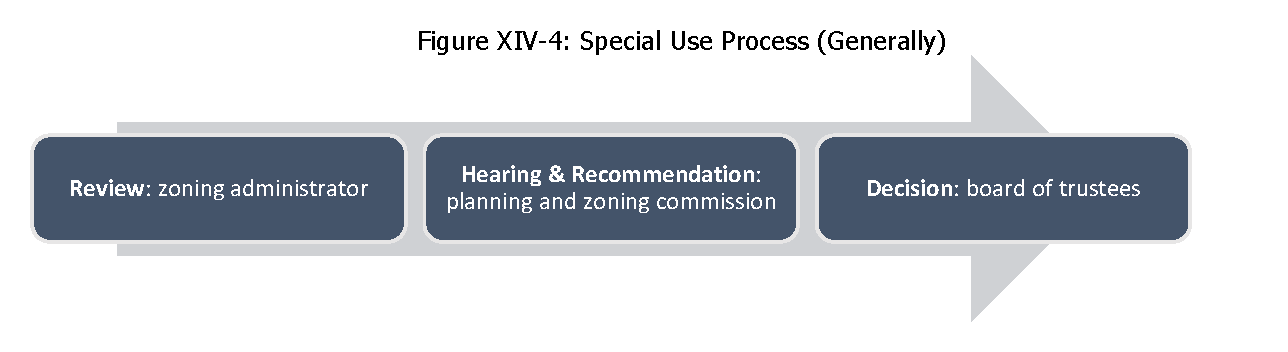
Application Filing. Complete applications for special use approval must be filed with the zoning administrator. The zoning administrator is authorized to require that the applicant submit a site plan in conjunction with the special use application.
(E)
Review and report—Zoning administrator. Following receipt of a complete application, the zoning administrator must review the application and transmit relevant information to the planning and zoning commission before their public hearing on the proposed special use.
(F)
Hearing and recommendation—Planning and zoning commission. The planning and zoning commission must hold a public hearing on the proposed special use, with notice of the hearing provided in accordance with the newspaper notice, mailed notice, and posted notice sign provisions of section 14.01(F)(1), section 14.01(F)(2)(a), and section 14.01(F)(2)(b), respectively. Following the close of the public hearing, the planning and zoning commission must act to recommend that the proposed special use be approved, approved with conditions, or denied and transmit its recommendation, together with its findings of fact, to the board of trustees. If the planning and zoning commission arrives at a tie vote, such tie vote is deemed a recommendation to deny (not to approve) the special use.
(G)
Final action—Board of trustees. Following receipt of the planning and zoning commission's report and recommendation, the board of trustees must act to approve the proposed special use, approve the proposed special use with conditions or deny the proposed special use. The board of trustees is also authorized to remand the proposed special use application to the planning and zoning commission for further consideration.
(H)
Review and approval criteria. No special use may be recommended for approval or approved unless the respective review or decision-making body determines that the proposed special use is consistent with and in substantial compliance with all village ordinances and regulations and that the applicant has presented evidence to support each of the following conclusions:
(1)
That the proposed use or activity is expressly authorized in this zoning ordinance as a special use;
(2)
That the proposed use at the proposed location is necessary or desirable to provide a service or a facility that is in the interest of public convenience and will contribute to the general welfare of the neighborhood or community;
(3)
That the proposed use will not, in the particular case, be detrimental to the health, safety, or general welfare of persons residing or working in the vicinity or be injurious to property values or improvements in the vicinity;
(4)
That approval of the special use will not impede the normal and orderly development and improvement of surrounding property for uses permitted in the district;
(5)
That the proposed special use will be served by adequate utilities, access roads, parking, drainage and other important and necessary facilities, infrastructure and community services; and
(6)
That the proposed special use complies with all applicable regulations of this zoning ordinance except as expressly approved in accordance with the procedures of this zoning ordinance.
(I)
Lapse of approval.
(1)
Special use approval lapses and becomes void:
(a)
Six months after the date of approval by the board of trustees, unless such special use is established within such period or the delay is due to construction or alteration of any structures in connection with the special use; or
(b)
Twenty-four months after the date of approval by the board of trustees if any construction or alteration of any structures in connection with the special use is not substantially completed and the special use in not commenced within that time period.
(2)
Upon written request and good cause shown, the zoning administrator is authorized to grant one extension of the time limitations set forth in this section for up to six months. Any additional extension requests require approval by the board of trustees.
(J)
Termination.
(1)
An approved special use automatically terminates upon the cessation of the special use for a consecutive period of 365 days or more. For purposes of this section, cessation of the special use means a failure to substantially operate the special use activity upon the property, whether by affirmative choice, bankruptcy, liquidation, foreclosure, eviction, or other reason. Cessation is not deemed to occur when the special use activity is temporarily halted due to the making of repairs or upgrades to the property when a building permit is obtained, when the nature of the repairs or upgrades makes the continued operation of the special use impractical, and when the repairs or upgrades are diligently pursued to completion.
(2)
An approved special use also terminates upon revocation of a building permit or a certificate of occupancy for violations of conditions of approval or upon expiration of a building permit to carry out the work authorized by the special use.
(3)
The zoning administrator must provide written notice of special use termination to the subject property owner.
(K)
Transferability. Unless otherwise expressly indicated in the special use approval, approved special uses run with the land and are not affected by changes of tenancy, ownership, or management.
(L)
Amendments. Amendments to approved special uses must be processed as new special use applications, including all requirements for fees, notices and public hearings. However, the zoning administrator is authorized to approve the following:
(1)
Any amendments expressly authorized as minor amendments at the time of special use approval;
(2)
The addition of allowed accessory uses and structures; and
(3)
Changes to the development site or to structures necessitated by engineering, architectural or physical limitations of the site that could not have been foreseen at the time the special use was approved and that are determined by the zoning administrator to not constitute major changes.
(Ord. No. 25-105, § 3(Exh. A), 8-7-2025)
Sec. 14.05. - Site plans.
(A)
Purpose. This section establishes a procedure to ensure timely, competent review of site plans in order to determine whether proposed building and development activities comply with the regulations of this zoning ordinance and with other applicable regulations.
(B)
Applicability. Unless otherwise expressly exempted under provisions of this zoning ordinance, site plan review and approval is required for all of the following:
(1)
Construction or enlargement of a principal building occupied by three or more dwelling units or the addition of more than 1,000 square feet of impervious surface on any lot occupied by three or more dwelling units;
(2)
Construction or enlargement of a principal building occupied by one or more nonresidential uses or the addition of more than 1,000 square feet of impervious surface on any lot occupied by a nonresidential use;
(3)
Reconstruction or replacement of more than 50 percent of the street-facing façade of any principal building in a downtown zoning district; and
(4)
Any other use or activity for which site plan approval is expressly required under this zoning ordinance.
(C)
Authority to file. Applications for site plan approval may be filed only by the owner of the subject property or the owner's authorized agent.
(D)
Application filing. Applications for site plan approval must be filed with the zoning administrator. Unless otherwise approved by the zoning administrator, complete applications for site plan approval must include an accurate dimensioned site plan with at least the following data and information, on one or more sheets:
(1)
A graphic rendering of the existing conditions, depicting:
(a)
All significant natural, topographical and physical features of the subject property including topographical contours at one-foot intervals;
(b)
A tree survey;
(c)
The location and extent of water bodies and courses, wetlands, and special flood hazard areas, floodplains, and floodways on or within 100 feet of the subject property;
(d)
Existing drainage structures and patterns; and
(e)
Soil conditions as they affect development.
(2)
The location, use, size and height in stories and feet of structures and other land uses on properties within 250 feet of the subject property.
(3)
Data concerning proposed structures and existing structures that will remain, including:
(a)
Location, size, use and arrangement, including height in stories and feet;
(b)
Where relevant, floor area ratio, gross floor area and net floor area;
(c)
Where relevant, number and size of dwelling units, by dwelling unit type and number of bedrooms;
(d)
Building coverage and lot coverage; and
(e)
Description of the calculation method utilized in computing all required statistics shown.
(4)
Minimum yard and setback dimensions and, where relevant, relation of yard and setback dimensions to the height, width and depth of any structure.
(5)
A vehicular and pedestrian circulation plan showing the location, dimensions, gradient and number of all vehicular and pedestrian circulation elements including rights-of-way and streets; driveway entrances, curbs and curb cuts; parking spaces, loading spaces and circulation aisles; sidewalks, walkways and pathways; and total lot coverage of all circulation elements divided as between vehicular and pedestrian ways.
(6)
All existing and proposed surface and sub-surface drainage and retention and detention facilities and existing and proposed water, sewer, gas, electric, telephone and cable communications lines and easements and all other utility facilities.
(7)
Location, size and arrangements of all signs and outdoor lighting.
(8)
Location and height of fences or screen plantings and the type or kind of building materials or plantings to be used for fencing or screening.
(9)
Location, designation and total area of all usable open space.
(10)
A detailed landscaping plan, showing location, size and species of all trees, shrubs and other plant material.
(11)
An erosion control plan for the period during which construction will be taking place.
(12)
Building elevations.
(13)
Any other and additional data, information or documentation that the zoning administrator, planning and zoning commission, or board of trustees deems necessary for a full and competent consideration and disposition of the particular application.
(E)
Site plan review and decision-making authority. Site plans required under this zoning ordinance are classified as either "major" site plans or "administrative" site plans, as follows:
(1)
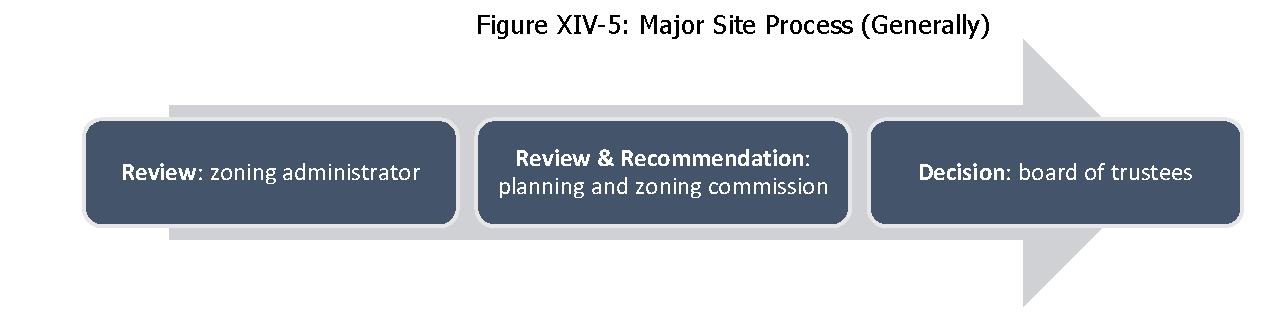
Major site plans. Major site plans require review and recommendation by the planning and zoning commission and final review and decision-making by the board of trustees. Major site plan review is required for all of the following:
(a)
Construction of any new building subject to site plan (see section 14.05(B)) review that includes more than 10,000 square feet of gross floor area;
(b)
Enlargement of any existing building subject to site plan review (see section 14.05(B)) that results in the addition of more than 10,000 square feet of gross floor area;
(c)
Site plans that qualify as administrative site plans but which are referred by the zoning administrator for processing as a major site plan due to potential adverse impacts on neighboring properties, noncompliance with applicable zoning or other village regulations; and
(d)
Any other activities for which major site plan approval is expressly identified in this zoning ordinance.
(2)
Administrative site plans. Any site plan that is not classified as a major site plan is eligible for processing as an administrative site plan.
(F)
Major site plan review process.
(1)
Review and report—Zoning administrator. Following receipt of a complete application for major site plan review, the zoning administrator must review the site plan, forward to site plan application to other reviewers and agencies for review and comment and transmit relevant information to the planning and zoning commission before their consideration of the proposed site plan.
(2)
Meeting and recommendation—Planning and zoning commission. The planning and zoning commission must hold a meeting on the proposed major site plan and act to recommend that the proposed major site plan be approved, approved with conditions, or denied and transmit its recommendation to the board of trustees. If the planning and zoning commission arrives at a tie vote, such tie vote is deemed a recommendation to deny (not to approve) the major site plan
(3)
Final action—Board of trustees. Following receipt of the planning and zoning commission's report and recommendation, the board of trustees must act to approve the proposed major site plan, approve the proposed major site plan with conditions or deny the proposed site plan. The board of trustees is also authorized to remand the proposed major site plan application to the planning and zoning commission for further consideration.
(G)
Review and approval criteria.
(1)
Final action to approve or disapprove a proposed major site must be based on whether the new or modified improvements shown on the site plan, as proposed, comply with the regulations of this zoning ordinance and all other applicable village ordinances and regulations. In reviewing and acting on proposed major site plans, review and decision-making bodies may also consider and be guided in the reasonable exercise of their discretion by the following standards and criteria:
(a)
Whether the proposed plans will protect the public health, safety, and welfare;
(b)
Whether the proposed plans will avoid substantial injury to the value of other property in the area;
(c)
Whether the proposed plans will provide for protection of community appearance and the function of the natural environment, including floodplains, soil and geologic characteristics, and preservation of vegetation;
(d)
Whether the proposed plans comply with all applicable village and county stormwater regulations; and
(e)
Whether the proposed plans comply with adopted building and site design guidelines.
(H)
Administrative site plan review process.
(1)
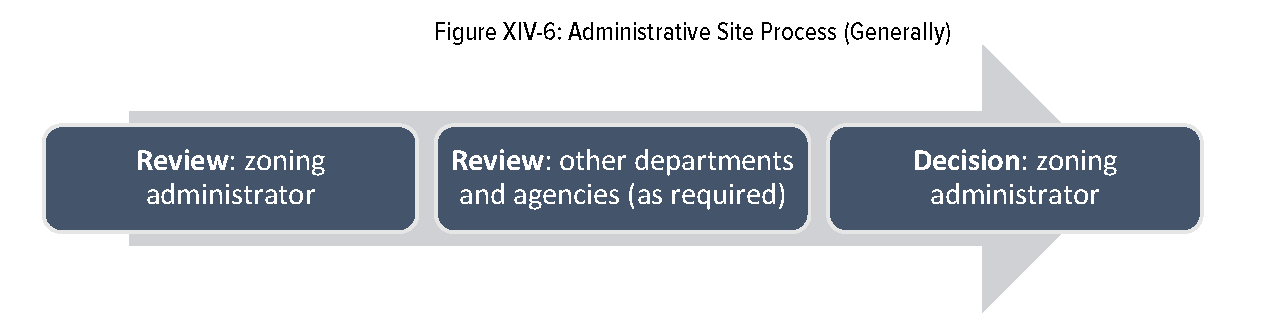
Following receipt of a complete application for administrative site plan review, the zoning administrator must review the administrative site plan application and act to approve the site plan, approve the site plan with modifications, or disapprove the site plan. The zoning administrator is also authorized to refer a site plan that is otherwise eligible for processing as an administrative site plan for processing as a major site plan in accordance with section 14.05(E)(1).
(2)
The zoning administrator is authorized to forward administrative site plans to other village departments and other agencies for the purpose of receiving assistance with reviews.
(3)
Final action to approve or disapprove a proposed administrative site plan must be based on whether the new or modified improvements shown on the site plan, as proposed, comply with the regulations of this zoning ordinance and all other applicable ordinances and regulations. The final action must be transmitted by the zoning administrator in writing to the applicant.
(I)
Lapse of approval.
(1)
Once a major or administrative site plan has been approved, a building permit to carry out the proposed building or development activity must be obtained within 24 months, otherwise the site plan approval lapses and becomes void.
(2)
Upon written request and good cause shown, the authorized decision-making authority for the subject site plan is authorized to grant extensions of the time limitations set forth in this section. Requests for extensions must be filed before site plan approval lapses and must be processed in accordance with the applicable site plan procedures of this section.
(J)
Continued compliance. An approved site plan governs all development and construction on the subject property. No permits or other approvals may be granted that are inconsistent with the approved site plan.
(K)
Termination. An approved major or administrative site plan terminates upon revocation of a building permit or a certificate of occupancy for violations of conditions of approval or upon expiration of a building permit to carry out the work authorized by the site plan.
(L)
Transferability. Approved major or administrative site plans run with the land and are not affected by changes of tenancy, ownership, or management.
(M)
Amendments.
(1)
Significant amendments to approved major or administrative site plans, as determined by the zoning administrator, must be processed as new site plan applications, including any applicable requirements for fees and meetings. However, the zoning administrator is authorized to approve minor amendments to approved major site plans without a formal application for amendment. Minor amendments include, but are not limited to:
(a)
Any amendments expressly authorized at the time of major or administrative site plan approval;
(b)
The addition of customary accessory uses and structures; and
(c)
Changes to the development site or to structures necessitated by engineering, architectural or physical limitations of the site that could not have been foreseen at the time the site plan was approved and that are determined by the zoning administrator to not constitute major changes.
(2)
Records documenting any approved minor site plan amendments must be maintained in the office of the zoning administrator.
(Ord. No. 25-105, § 3(Exh. A), 8-7-2025)
Sec. 14.06. - Variances.
(A)
Intent. A variance is a grant of relief to a property owner from strict compliance with the regulations of this zoning ordinance. The intent of a variance is not to simply remove an inconvenience or general financial burden that may result from compliance with applicable zoning requirements. Variances are intended to help alleviate practical difficulties or particular hardships that would result from strict enforcement of the subject zoning ordinance requirements. They are intended to provide relief when the requirements of this zoning ordinance render property very difficult or impossible to put to reasonable use because of unique or special characteristics of the subject property or to address other hardships.

(B)
Authorized variances. The board of trustees is authorized to grant a variance to any regulation in this zoning ordinance in accordance with the variance procedures of this section, except that the variance procedures of this section may not be used to do any of the following:
(1)
Allow a principal or an accessory use in a zoning district that is not otherwise allowed in that zoning district (i.e., "use variances" are expressly prohibited);
(2)
Waive, modify, or vary any use classification;
(3)
Waive, modify, or otherwise vary any of the review and approval procedures of this article; or
(4)
Allow a sign, structure, feature, or activity that is expressly prohibited.
(C)
Authority to file. Variance applications, including a written statement describing the practical difficulty or particular hardship that would result from denial of the variance request and written statements in response to each of the standards and review criteria in section 14.06(H), must be filed by the owner of the subject property or the owner's authorized agent.
(D)
Application filing. Variance applications must be filed with the zoning administrator.
(E)
Review and report—Zoning administrator. Following receipt of a complete application, the zoning administrator must prepare a report on the requested variance. The report must be transmitted to the planning and zoning commission before the required public hearing.
(F)
Review and recommendation—Planning and zoning commission.
(1)
Following receipt of a complete variance application, the planning and zoning commission must hold a public hearing to consider the requested variance, with notice of the hearing provided in accordance with the newspaper notice, mailed notice, and posted notice sign provisions of section 14.01(F)(1), section 14.01(F)(2)(a), and section 14.01(F)(2)(b), respectively. Following the close of the public hearing, the planning and zoning commission must act to recommend that the requested variance be approved, be approved with conditions, or denied based on the standards and review criteria of section 14.06(H). The planning and zoning commission must make its report promptly, together with its findings of fact, to the board of trustees.
(2)
In recommending approval of a variance, the planning and zoning commission is authorized to recommend such conditions and restrictions as the commission determines to be necessary to ensure compliance with the standards of section 14.06(H), to reduce or minimize the effect of the variance upon other properties in the area, and to better carry out the general purpose and intent of this zoning ordinance.
(3)
Each variance request must be considered by the planning and zoning commission on a case-by-case basis solely on the evidence presented by the applicant in the particular case.
(G)
Review and final decision—Board of trustees. Following the public hearing before the planning and zoning commission, the variance request must be considered by the board of trustees. The board of trustees must act to approve the variance, approve the variance with conditions, or deny the variance. The board of trustees is also authorized to remand the proposed variance application to the planning and zoning commission for further consideration.
(H)
Standards and review criteria. No variance may be approved or recommended for approval unless authorized review and decision-making bodies have made findings of fact based upon the evidence provided by the applicant the variance being sought satisfies each of the standards set forth in this section (section 14.06(H)).
(1)
Particular hardship or practical difficulty. The applicant must demonstrate that requiring strict compliance with the regulation for which a variance is sought would create a particular hardship or a practical difficulty.
(2)
Unique physical condition. The applicant must demonstrate that the subject property is exceptional as compared to other lots subject to the same provision by reason of a unique physical condition, including presence of an existing use, structure, or sign, whether conforming or nonconforming; irregular or substandard shape or size; exceptional topographical features; or other extraordinary physical conditions peculiar to and inherent in the subject property that amount to more than a mere inconvenience to the owner and that relate to or arise out of the subject lot rather than the personal situation of the current owner of the lot.
(3)
Not self-created. The applicant must demonstrate that the unique physical condition is not the result of any action or inaction of the owner, or of the owner's predecessors in title and known to the owner before acquisition of the subject property, and existed at the time of the enactment of the provisions from which a variance is sought or was created by natural forces or was the result of governmental action for which no compensation was paid.
(4)
Denied substantial rights. The applicant must demonstrate that requiring strict compliance with the regulation for which a variance is sought would deprive the subject property owner of substantial rights commonly enjoyed by owners of other lots subject to the same regulation.
(5)
Not merely special privilege. The applicant must demonstrate that the alleged particular hardship or practical difficulty is not merely the inability of the owner or occupant to enjoy some special privilege or additional right not available to owners or occupants of other lots subject to the same provision, nor merely an inability to make more money from use of the subject property.
(6)
Zoning ordinance and comprehensive plan. The applicant must demonstrate that the variance would not result in a use or development of the subject property that would not be in harmony with the general and specific purposes of this zoning ordinance and the comprehensive plan.
(7)
Essential character of the area. The applicant must demonstrate that the variance would not result in a use or development of the subject property that:
(a)
Would be materially detrimental to the public welfare or materially injurious to the enjoyment, use, development, or value of property or improvements permitted in the vicinity;
(b)
Would materially impair an adequate supply of light and air to the properties and improvements in the vicinity;
(c)
Would unduly increase the danger of flooding or fire;
(d)
Would unduly tax public utilities, facilities, or services in the area; or
(e)
Would endanger the public health or safety.
(8)
No other remedy. The applicant must demonstrate that there is no means other than the requested variance by which the alleged hardship or practical difficulty can be avoided or remedied to a degree sufficient to permit a reasonable use of the subject property.
(I)
Lapse of approval.
(1)
An approved variance lapses and becomes void 12 months after it is granted by the board of trustees, unless:
(a)
A building permit for improvements directly related to the variance has been issued (if required); or
(b)
The use or structure directly related to the variance has been lawfully established.
(2)
Upon written request and good cause shown, the zoning administrator is authorized to grant one extension of the time limitations set forth in this section for up to six months. Any additional extension requests require approval by the board of trustees. All requests for extensions must be filed before the variance lapses.
(J)
Termination. An approved variance terminates upon revocation of a building permit or a certificate of occupancy for violations of conditions of approval or upon expiration of a building permit to carry out the work authorized by the variance.
(K)
Transferability. Approved variances run with the land and are not affected by changes of tenancy, ownership, or management.
(L)
Amendments. A request for changes in the specific nature of the approved variance or changes to any conditions attached to an approved variance must be processed as a new variance application, including all requirements for fees, notices, and public hearings.
(M)
Reasonable accommodation. Notwithstanding any of the preceding zoning variance procedures of this section, the zoning administrator is authorized to issue a permit to the owner of a dwelling unit for the purpose of making the dwelling accessible to a person with a disability who resides in or regularly uses the dwelling. If issuance of the permit would otherwise require a variance, the permit is deemed to include the needed variance solely for the installation of equipment or the construction of structures necessary for access to or egress from the dwelling for the person with a disability. The zoning administrator is authorized to impose conditions on the permit, including limiting the duration of the permit to the time that the person with a disability lives or regularly uses the dwelling.
(Ord. No. 25-105, § 3(Exh. A), 8-7-2025)
Sec. 14.07. - Zoning verification letters.
Any person may request a zoning verification letter from the zoning administrator pertaining to property located within the village. A zoning verification letter provides verification of zoning-related information for a particular property, including but not limited to, the zoning classification of the property, whether existing improvements comply with the bulk and development standards of the underlying zoning district, whether existing off-street parking meets minimum parking requirements, whether the existing use is lawful and conforming, and whether signs on the property are lawful and conforming. Zoning verification letter requests must be filed with the zoning administrator and be accompanied by the required filing fee.
(Ord. No. 25-105, § 3(Exh. A), 8-7-2025)
Sec. 14.08. - Certificates of occupancy.
See chapter 18, article X of the village code.
(Ord. No. 25-105, § 3(Exh. A), 8-7-2025)
Sec. 14.09. - Appeals.
(A)
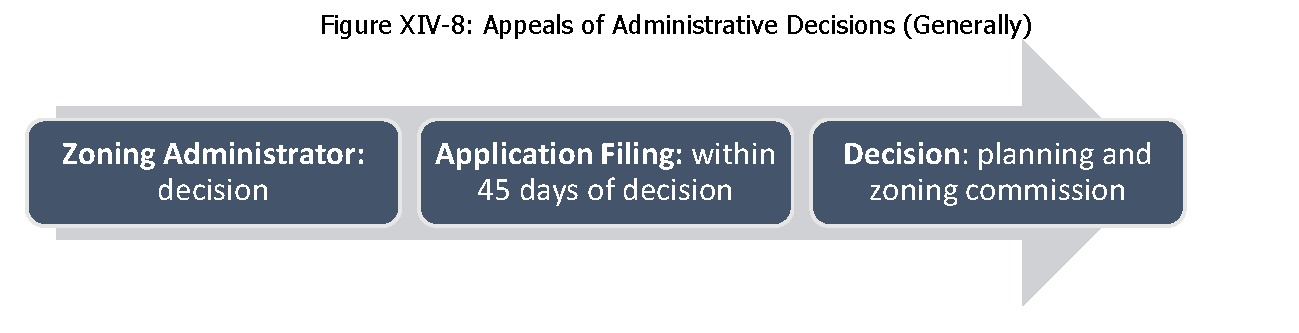
Authority. The planning and zoning commission is authorized to hear and decide all appeals where it is alleged there has been an error in any final order, requirement, decision, or determination made by the zoning administrator in the administration, interpretation, or enforcement of this zoning ordinance. Such appeals must be processed in accordance with Illinois Compiled Statutes and the provisions of this section.
(B)
Right to appeal. Appeals of administrative decisions may be filed by any person, firm or corporation aggrieved by the zoning administrator's decision or action. The planning and zoning commission is authorized to make determinations about whether individuals filing appeals are "aggrieved" by the decision or action.
(C)
Application filing.
(1)
Appeals must be made by filing a notice of appeal with both the zoning administrator and with the planning and zoning commission. The notice of appeal must specify the decision that is being appealed and the grounds for the appeal.
(2)
Appeals of administrative decisions must be filed within 45 days of the date of the decision being appealed.
(D)
Effect of filing. The filing of a complete notice of appeal stays all proceedings in furtherance of the action appealed, unless the zoning administrator certifies to the planning and zoning commission, after the appeal is filed, that, because of facts stated in the certification, a stay would cause immediate peril to life or property, in which case the proceedings will not be stayed unless by a restraining order, which may be granted by the planning and zoning commission or by the circuit court based on due cause shown.
(E)
Record of decision. Upon receipt of a complete notice of appeal, the zoning administrator must transmit to the planning and zoning commission the notice of appeal and information constituting the record related to decision being appealed.
(F)
Processing.
(1)
The planning and zoning commission must:
(a)
Fix a reasonable time for hearing the appeal;
(b)
Give due notice thereof to parties; and
(c)
Decide the appeal within reasonable time.
(2)
Any party to the appeal may appear at the hearing in person or by an agent or by an attorney.
(3)
In acting on the appeal, the planning and zoning commission has all the powers of the zoning administrator from whom the appeal is taken. The planning and zoning commission may affirm or reverse, wholly or in part, or modify the decision being appealed.
(4)
The planning and zoning commission may adopt additional procedures and requirements with respect to hearings on appeals.
(5)
All decisions made by the planning and zoning commission on appeals are considered final administrative determinations and are subject to judicial review only in accordance with applicable Illinois statutes.
(Ord. No. 25-105, § 3(Exh. A), 8-7-2025)

