
Westmont City Zoning Code
ARTICLE VII
ACCESSORY AND TEMPORARY USES AND STRUCTURES
Sec. 7.01.- Accessory uses and structures generally.
The regulations of this section apply to all accessory uses and structures in all zoning districts unless otherwise expressly stated in this zoning ordinance.
(A)
Allowed. Accessory uses and accessory structures are allowed only in connection with lawfully established principal uses and principal structures. Allowed accessory uses and structures are limited to those expressly regulated in this article as well as those that, in the determination of the zoning administrator, satisfy all of the following criteria:
(1)
They are customarily found in conjunction with the subject principal use or principal structure;
(2)
They are subordinate and clearly incidental to the principal use of and the principal structure on the subject property; and
(3)
They serve a necessary function for or contribute to the comfort, safety or convenience of occupants of the principal use or principal structure;
(B)
Time of construction and establishment.
(1)
Accessory uses may be established only after the principal use of the property is in place.
(2)
Accessory structures may be established concurrently with the principal structure or after the principal structure has been established. They may not be established before construction of the principal structure has commenced.
(C)
Location. Unless otherwise expressly authorized by provisions of this article, accessory uses and structures must be located on the same lot as the principal use or principal structure to which they are accessory or on an abutting lot in common ownership with the lot occupied by the principal use or principal structure.
(D)
Ownership. Accessory uses and accessory structures must be under the same ownership and control as the principal use or principal structure.
(E)
Building separation. Accessory buildings must be separated from principal buildings and all other accessory buildings by a minimum distance of ten feet.
(Ord. No. 25-105, § 3(Exh. A), 8-7-2025)
Sec. 7.02. - Residential accessory uses and structures generally.
The regulations of this section apply to residential accessory uses and structures in all R zoning districts unless otherwise expressly stated in this zoning ordinance.
(A)
Number and size of accessory buildings.
(1)
General.
(a)
One detached garage is allowed on any R-zoned lot.
(b)
In addition to a detached garage (if present) a maximum of two additional (non-garage) detached accessory buildings are allowed on an R-zoned lot.
(c)
The total aggregate "footprint" (i.e., ground level coverage) of all accessory buildings on a lot may not exceed 1,250 square feet.
(2)
Small building exemption. Small storage cabinets and sheds are exempt from the two-building limit and combined building footprint limitations established in section 7.02(A)(1)(b) and section 7.02(A)(1)(c), and are exempt from the lot coverage, and accessory building separation requirements of this zoning ordinance, provided that:
(a)
The combined, aggregate footprint of such small buildings does not exceed 50 square feet; and
(b)
Such small buildings are not placed on a permanent foundation.
(B)
Location.
(1)
Accessory buildings are allowed in rear yards and street side yards. They are allowed in front yards but not within the required front setback area. Accessory buildings are prohibited in interior side yards.
(2)
All accessory buildings and roofed structures must be set back at least five feet from all side and rear lot lines, except in the R-3 district, where accessory buildings may be three feet from an interior side lot line, unless otherwise expressly stated in this article or in section 7.04 (Table VII-1). For accessory buildings in street side yards of reversed corner lots, the minimum street setback for an accessory building is 50 percent of the front yard that exists on the lot abutting to the rear of the reversed corner lot. If the abutting lot to the rear is vacant, the 50 percent minimum must be calculated on the basis of the abutting lot's required front setback.
(C)
Height. Accessory buildings may not exceed 18 feet in height or the height of the principal building on the lot, whichever is less.
(Ord. No. 25-105, § 3(Exh. A), 8-7-2025; Ord. No. 26-022, § 2, 2-19-2026)
Sec. 7.03. - Nonresidential accessory uses and structures generally.
The regulations of this section apply to nonresidential accessory uses and structures in all zoning districts unless otherwise expressly stated in this zoning ordinance.
(A)
Special use approval. Nonresidential accessory buildings are allowed only if approved in accordance with the special use procedures of section 14.04.
(B)
Number. No more than one nonresidential accessory building is permitted on any lot unless approved at the time of special use approval.
(C)
Location.
(1)
Accessory buildings are prohibited in front and street side yards.
(2)
Accessory buildings are subject to compliance with the principal building setback regulations of the subject zoning district except as otherwise expressly stated in this article.
(3)
All other accessory structures must be set back at least five feet from interior side lot lines and ten feet from rear lot lines unless otherwise expressly stated in this article.
(4)
Accessory structures are prohibited in required landscape areas and required parking spaces unless such location is expressly approved at the time of site plan approval.
(D)
Height. Unless otherwise approved at the time of special use approval, nonresidential accessory buildings may not exceed 20 feet in height or the height of the principal building on the lots, whichever is less.
(E)
Design. Nonresidential accessory buildings must:
(1)
Be placed on a permanent foundation or improved surface;
(2)
Be constructed with materials that have a similar appearance to those used on the principal building; and
(3)
Comply with the foundation landscape requirements of section 10.07(D)(3).
Sec. 7.04. - Accessory structures in setbacks.
Setbacks in all zoning districts must remain unobstructed and unoccupied from the ground to the sky except as indicated in Table VII-1 or otherwise expressly stated in this zoning ordinance. See also section 12.05 for sight vision triangle requirements.
Table VII-1: Allowed Setback Encroachments and Obstructions
(Ord. No. 25-105, § 3(Exh. A), 8-7-2025)
Sec. 7.05. - Accessory dwelling units (ADUs).
(A)
Purpose.
(1)
The accessory dwelling unit regulations of this section are intended to help promote the benefits of accessory dwelling units, while also preserving neighborhood character and promoting predictability and certainty for established neighborhoods.
(2)
Accessory dwelling units ("ADU") help advance the village's housing and land use goals and policies by:
(a)
Accommodating additional housing units while preserving the physical character of existing neighborhoods;
(b)
Allowing efficient use of the village's housing stock and infrastructure;
(c)
Providing housing options and choices that respond to varying income levels, changing household sizes and lifestyle needs;
(d)
Providing a means for residents to remain in their homes and neighborhoods, and obtain extra income, security, companionship and assistance; and
(e)
Promoting a broader range of accessible and more affordable housing.
(B)
General regulations for all ADUs. All accessory dwelling units must comply with the regulations of this subsection.
(1)
Zoning district regulations. Accessory dwelling units are subject to all applicable regulations of the zoning district in which they are located, unless otherwise expressly stated in this section.
(2)
Where allowed. Accessory dwelling units are allowed only on lots occupied by a detached house on an R-zoned lot.
(3)
Number. No more than one accessory dwelling unit is allowed per lot.
(4)
Methods of creation. An accessory dwelling unit may be created through any of the following methods:
(a)
Converting existing area within the interior of the principal dwelling unit (e.g., attic or basement) to an ADU;
(b)
Adding floor area to an existing principal dwelling unit to accommodate an ADU;
(c)
Constructing a detached accessory dwelling unit on a parcel with an existing principal dwelling unit;
(d)
Converting space within a detached accessory building; or
(e)
Constructing a new principal dwelling unit with an internal or detached accessory dwelling unit.
(5)
Location of entrances. Only one entrance to a principal dwelling unit containing an accessory dwelling unit may be located on a façade that faces a street, unless the principal dwelling unit contained an additional street-facing entrance before the accessory dwelling unit was created. Detached ADUs are exempt from this regulation.
(6)
Size. The floor area of an ADU may not exceed the floor area of the principal dwelling unit on the subject lot or 850 square feet, whichever is less. For purposes of this provision, the following are excluded from the definition of "floor area":
(a)
Garage areas;
(b)
Basement areas where the ceiling height measured from the floor is less than seven feet; and
(c)
Any other areas of the building where the floor-to-ceiling height is either less than seven feet or not accessible by a stairway.
(7)
Parking. No additional parking is required for an accessory dwelling unit. Existing required parking for the principal dwelling unit must be maintained or replaced on-site.
(8)
Building permit approval. Before the issuance of a building permit for the construction of any new accessory dwelling unit, plans must be reviewed and approved by the building official to determine compliance with all applicable building and life safety codes.
(C)
Regulations for detached ADUs and building additions. The regulations of this subsection apply to all detached buildings and building additions proposed to be occupied by ADUs.
(1)
Exterior finish materials. The exterior finish material must be the same or visually match in type, size and placement, the exterior finish material of the principal dwelling unit.
(2)
Roof pitch. The roof pitch must be the same as the predominant roof pitch of the principal dwelling unit.
(3)
Trim. Trim on edges of elements on the building addition to the principal dwelling unit or the accessory building occupied by the ADU must be the same in type, size and location as the trim used on the principal dwelling.
(4)
Entrances. Entrances to ADUs occupying detached accessory structures may not face the nearest side or rear property line unless there is an alley abutting that property line.
(5)
Setbacks.
(a)
A detached accessory dwelling unit must be set back at least 15 feet from any street side lot line or at least as far as the principal dwelling unit is set back from the street side lot line, whichever distance is greater.
(b)
A detached accessory dwelling unit must be set back at least ten feet from the rear lot line and located at least ten feet behind the principal dwelling. This required ten-foot separation distance must be free of structures except that it may include walkways, patios, decks and similar structures that do not exceed 30 inches in height above finished grade.
(6)
Height. The maximum allowed height of a detached accessory dwelling unit is 24 feet, provided that required setbacks must be increased by at least six inches for every one foot of building height in excess of 18 feet.
(Ord. No. 25-105, § 3(Exh. A), 8-7-2025)
Sec. 7.06. - Air conditioner compressors and heat pumps.
Central air conditioner (AC) compressors, heat pumps, and similar HVAC equipment are prohibited in front and street side yards.
(Ord. No. 25-105, § 3(Exh. A), 8-7-2025)
Sec. 7.07. - Animals.
Accessory uses may not include the keeping, propagation or culture of pigeons, rabbits, livestock, horses or other traditional farm animals or non-companion animals, except as regulated and permitted in chapter 14 of the village code.
(Ord. No. 25-105, § 3(Exh. A), 8-7-2025)
Sec. 7.08. - Antennas.
(A)
Satellite dish antennas.
(1)
Building-mounted satellite dish antennas up to one meter in diameter are permitted as accessory structures in all zoning districts. The building-mounted installation:
(a)
May not exceed the maximum allowable building height of the subject district or more than 3.5 feet above the top of the building on which it is attached, whichever is less; and
(b)
May not project into a required street setback and may not project more than 3.5 feet into a required side or rear setback.
(2)
Ground-mounted satellite dish antennas up to five feet in diameter and five feet in height are permitted as accessory uses in all zoning districts. Ground-mounted satellite dish antennas must be located in the rear yard and must be set back at least ten feet from all lot lines.
(B)
Amateur radio facilities. Amateur radio towers and antennas are allowed as accessory structures subject to the following regulations.
(1)
Amateur radio towers are prohibited in street yards and interior side yards.
(2)
Amateur radio towers are subject to a maximum overall height limit of 60 feet above grade. Tower height may exceed 60 feet if approved in accordance with special use procedures of section 14.04. Special use approval may be granted only if the board of trustees determines, based on evidence provided by the applicant, that the additional height is the minimum needed to engage in amateur radio communications under a license issued by the FCC.
(3)
Antennas must be mounted on an approved noncombustible tower and may not extend more than 15 feet laterally from the tower.
(4)
Antennas and supporting electrical and mechanical equipment must be grey or neutral in color and include U.L. approved lightning protection.
(C)
Roof-mounted receive-only antennas. Roof-mounted receive-only antennas are permitted in all zoning districts, provided they do not exceed a height of five feet above the roofline.
(Ord. No. 25-105, § 3(Exh. A), 8-7-2025)
Sec. 7.09. - Donation drop boxes.
(A)
Applicability. The donation drop box regulations of this section apply to donation drop boxes that are not directly associated with and managed by the principal user of the subject site. They do not, for example, apply to book drop-off bins on lots occupied by public libraries or holiday donation bins on lots occupied by religious assembly uses.
(B)
Where allowed. Donation drop boxes may only be placed on properties occupied by an active principal use located in a B-2, C-1, M-1, M, or P/I zoning district.
(C)
Approvals. Approval must be obtained from the village before placement of a donation drop box outside of a principal building. Applications to construct or locate a donation drop box must include at least the following:
(1)
Proof of ownership or authorization from the property owner or authorized representative of the property upon which the donation drop box is to be located.
(2)
A site plan drawn to scale of the lot upon which the donation drop box is to be located, showing the proposed location of donation drop box.
(3)
Plans and specifications of the donation drop box including the dimensions (height, width, depth) of the box, elevations, configuration, foundation and any additional information required by the zoning administrator.
(D)
Number. No more than two donation drop boxes may be located on any lot or parcel, regardless of whether it is occupied by a single tenant or multiple tenants (e.g., shopping center).
(E)
Location. Donation drop boxes must be located on a paved surface. They are prohibited in the following locations:
(1)
A public right-of-way;
(2)
A required front or side street setback;
(3)
A required parking space;
(4)
A driveway, drive aisle, crosswalk or public sidewalk;
(5)
Within five feet of a fire hydrant;
(6)
On a private sidewalk or walkway if such location would obstruct a minimum five-foot clear zone for sidewalk users; or
(7)
Any location that would result in a driveway or street visibility obstruction for pedestrians or motorists. See also section 12.05.
(F)
Height and size. A donation drop boxes may not exceed six feet in height, and the aggregate combined footprint of donation drop boxes on a lot may not exceed 50 square feet.
(G)
Signs. Signs on a donation drop box may not exceed three square feet per side (of box). All donation boxes must contain contact information in at least one-inch letter height on the front of the box indicating the name, address, email, and phone number of the owner and operator.
(H)
Maintenance.
(1)
Donation drop boxes must be maintained in good condition and appearance with no structural damage, holes, or visible rust and be kept free of graffiti.
(2)
All areas around the box mut be free of debris and be serviced regularly to prevent overflow of donations or the accumulation of debris or other material. All donations mut be placed in the donation drop box. No donations may be left outside of the donation drop box.
(3)
Upon telephone or email notification from the village that materials are being placed outside of the donation drop box, the owner of the property on which the donation drop box is located has 24 hours to remove said materials. Failure to do so is a violation of this zoning ordinance. Three violations of this section constitute grounds for immediate revocation of the approval.
(I)
Revocation of approval. Any approval granted pursuant to the provisions of this section is subject to revocation for cause by the zoning administrator. Upon revocation of the approval, the donation drop box must be immediately removed. If the drop box is not immediately removed, the owner of the property upon which the drop box is located will be held responsible for compliance, enforcement, and removal.
(Ord. No. 25-105, § 3(Exh. A), 8-7-2025)
Sec. 7.10. - Electric vehicle charging stations.
(A)
General.
(1)
Private (restricted-access) electric-vehicle (EV) charging stations are permitted as accessory uses to lawfully established principal uses in all zoning districts.
(2)
Public EV charging stations are permitted as accessory uses to lawfully established principal nonresidential uses in all zoning districts.
(B)
Parking. Electric vehicle charging stations may be counted toward satisfying minimum off-street parking space requirements.
(C)
Equipment. Vehicle charging equipment must be designed and located to not impede pedestrian, bicycle, or wheelchair movement or the creation of safety hazards on sidewalks. Vehicle charging equipment may not be located within required landscape areas unless expressly approved by the zoning administrator.
(Ord. No. 25-105, § 3(Exh. A), 8-7-2025)
Sec. 7.11. - Fences.
Fences are allowed as accessory structures in all districts, subject to compliance with the following regulations.
(A)
General. The general regulations of this subsection apply to all fences.
(1)
Public safety. Fences may not be constructed or maintained in any way that would impair public protection services or impair public safety by obstructing the vision of persons using streets, sidewalks or driveways. Fences may not be constructed in a way that would impede the natural flow of storm water (drainage).
(2)
Structural elements. All fences must be constructed so that fence posts and structural elements are located on the side of the fence facing the property being enclosed.
(3)
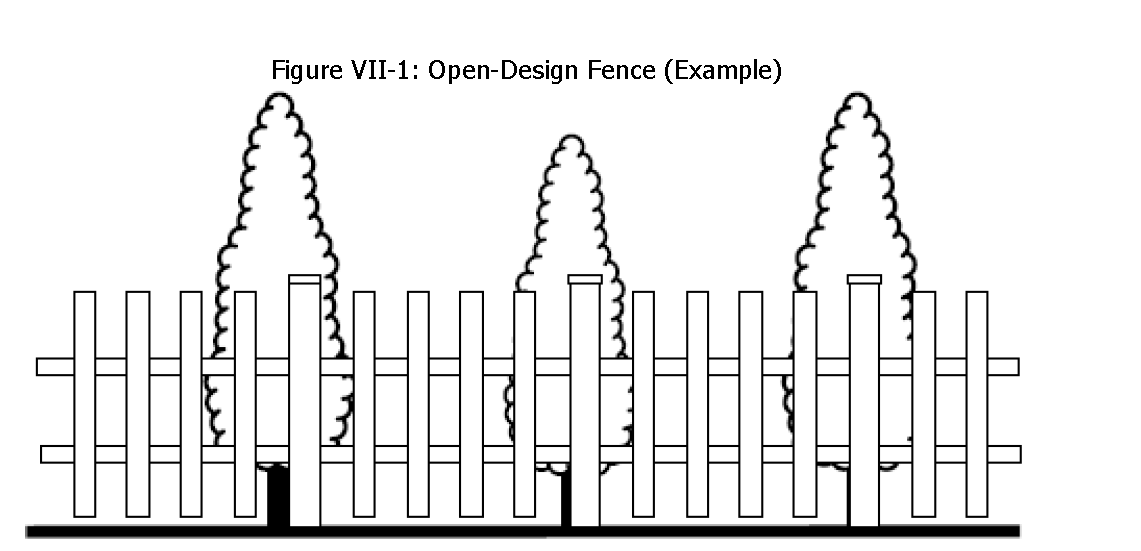
Open-Design fences. "Open-design" fences must be designed and constructed so that at least 50 percent of the fence's surface area, including posts and cross supports, consists of regularly distributed openings affording direct views through the fence.
(4)
Electrified or barbed wire fences. Electrified or barbed wire fences are regulated in accordance with section 58-23 of the village code.
(B)
Residential and downtown districts. Fences in residential zoning districts (see section 2.01) and downtown zoning districts (see section 4.01) are subject to the general regulations of section 7.11(A) and the regulations of this subsection.
(1)
Front yards. Fences are allowed in front yards of lots in residential and downtown districts. Front yard fences in residential and downtown districts may not exceed 30 inches in height except as follows:
(a)
Front yard fences may be up to three feet in height if they are open-design fences.
(b)
Front yard fences may be up to four feet in height if they are constructed of wrought iron, aluminum, or other metal material and at least 80 percent of the fence's surface area, including posts and cross supports, consists of regularly distributed openings affording direct views through the fence.
(c)
Front yard fences on lots abutting an arterial street may be up to six feet in height if such fence is set back at least five feet from the lot line abutting the street.
(d)
Interior side yard fences up to six feet in height may encroach up to 13 feet into the required front setback or match the front wall of the principal building, whichever results in a smaller encroachment into the required front setback.
(2)
Street side yard fences. Fences are in street side yards of lots in residential and downtown districts must comply with the front yard fence regulations of section 7.11(B)(1), except that fences up to six feet in height are allowed in street side yards when:
(a)
The fence is behind the principal structure and set back at least five feet from the street side lot line;
(b)
The fence complies with all applicable sight vision triangle requirements of section 12.05; and
(c)
On reverse corner lots, fences up to six feet in height may be allowed, provided they are set back at least 15 feet from the street side lot line.
(3)
Interior side and rear yards. Fences are allowed in interior side and rear yards lots in residential and downtown districts. Such fences may not exceed six feet in height.
(C)
Business, employment and special purpose districts. Fences in the business and employment zoning districts established in section 3.01, the B-3 zoning district (see section 5.01), and the P/I zoning district (see section 5.02) are subject to the general regulations of section 7.11(A) and the regulations of this subsection.
(1)
Street yards. Open-design fences are allowed in street yards. Such fences may not exceed seven feet in height unless approved through the special use process of section 14.04.
(2)
Interior side and rear yards. Fences are allowed in interior side and rear yards. Such fences may not exceed seven feet in height unless approved through the special use process of section 14.04.
(Ord. No. 25-105, § 3(Exh. A), 8-7-2025)
Sec. 7.12. - Fireplaces, grills, kitchens, and fire pits (outdoor).
Permanent masonry fireplaces grills, fire pits, outdoor kitchens (typically a masonry structure with a cooktop, oven, plumbing, cabinets, and countertop) are allowed only in rear yard areas and are subject to the following regulations:
(A)
All structures must be set back at least ten feet from side and rear lot lines.
(B)
Chimneys associated with fireplaces, grills, or outdoor kitchens may not exceed 18 feet in height. Other components of an outdoor kitchen may not exceed five feet in height.
(Ord. No. 25-105, § 3(Exh. A), 8-7-2025)
Sec. 7.13. - Flagpoles.
Flag poles must be setback from lot lines a minimum distance equal to the height of the pole and sited so that the flag does not extend beyond any lot line. Flagpoles are subject to the maximum allowed building height regulation of the subject zoning district.
(Ord. No. 25-105, § 3(Exh. A), 8-7-2025)
Sec. 7.14. - Business vehicles.
(A)
The outdoor storage of business vehicles owned or leased and operated by a business or organization for commercial purposes is allowed as an accessory use in O/R-1, O/R, B-2, C-1, M-1, M, B-1, and B-1(A) districts, subject to the regulations of this section. For purposes of this section, business vehicles include business trailers.
(B)
The outdoor storage of commercial vehicles is prohibited, except as expressly allowed in the M or M-1 district.
(C)
Only business vehicles regularly operated in conjunction with an allowed principal use of the property may be stored outdoors. Business vehicles used primarily for storage purposes may not be stored outdoors.
(D)
Outdoor business vehicle storage is limited to a maximum of two business vehicles, unless approved in accordance with the special use procedures of section 14.04.
(E)
If a business obtains special use approval to store more than two business vehicles on a single lot, the storage of all additional business vehicles beyond the two allowed by right must be screened from view of public rights-of-way, unless such screening is not reasonably feasible in light of existing improvements and layout of the property.
(F)
Business vehicles must be parked in parking stalls or entirely within an enclosed building. Parking spaces provided to meet the minimum off-street parking requirements of section 9.02, may not be used for business vehicle storage.
(G)
All business vehicles must comply with applicable village code provisions, including chapter 78.
(Ord. No. 25-105, § 3(Exh. A), 8-7-2025)
Sec. 7.15. - Garages and carports.
(A)
A maximum of one detached garage or one detached carport is allowed per lot in R zoning districts.
(B)
Detached garages and carports are subject to the general accessory building setback and location requirements of section 7.02(B) except that detached garages in the R-3 district require a minimum three-foot setback from side lot lines.
(C)
Garages and carports may not exceed 18 feet in height or the height of the principal building on the lot, whichever is less.
(D)
See also the residential driveway regulations of section 9.07(A).
(Ord. No. 25-105, § 3(Exh. A), 8-7-2025)
Sec. 7.16. - Generators.
Natural gas or propane generators used solely for purposes of standby (emergency backup) electrical power are permitted in all zoning districts subject to the following regulations:
(A)
Generators may not be located in the required front, interior side, or street setbacks. Generators may project up to ten feet into the required rear setback, provided that the equipment is within five feet of the side or rear wall of the building. Generators must be installed to mitigate noise impacts.
(B)
Generators must be enclosed by a sound attenuation box or cabinet that does not exceed 30 square feet in area or five feet in height. Any noise reducing mufflers provided by the manufacturer must be utilized.
(C)
Generator boxes or cabinets must be screened from view of public rights-of-way and abutting lots.
(Ord. No. 25-105, § 3(Exh. A), 8-7-2025)
Sec. 7.17. - Geothermal heat exchange systems.
(A)
General. Geothermal heat exchange systems are permitted as an accessory use in all zoning districts.
(B)
Location.
(1)
Underground equipment, piping and devices may be located in yard areas but may not be located in any public easement or right-of-way.
(2)
Above-ground equipment is prohibited in front and street side yards.
(Ord. No. 25-105, § 3(Exh. A), 8-7-2025)
Sec. 7.18. - Home occupations.
(A)
Description. Home occupations are jobs or professions conducted wholly or partly from a residential dwelling. They are allowed as accessory uses to any residential use.
(B)
Purpose. The home occupation regulations of this section are intended to allow Westmont residents to engage in customary home-based work activities, while also helping to ensure that neighbors are not subjected to adverse operational and land use impacts (e.g., excessive noise or traffic or public safety hazards) that are not typical of residential neighborhoods.
(C)
Exemptions. Nonresidential uses that are expressly allowed in conjunction with residential uses (e.g., day care homes) are not subject to home occupation regulations.
(D)
Allowed uses. The home occupation regulations of this section establish performance standards for home occupations rather than listing specific uses allowed as home occupations. Uses that comply with the regulations of this section are allowed as of right unless otherwise expressly stated.
(E)
Prohibited uses. The following uses are expressly prohibited as home occupations:
(1)
Any type of assembly, cleaning, maintenance, painting or repair of vehicles or equipment with internal combustion engines or of large appliances (such as washing machines, clothes dryers or refrigerators);
(2)
Catering services;
(3)
Dispatch centers or other businesses where employees come to the site and are dispatched to other locations;
(4)
Firearms sales;
(5)
Limo, van or bus services;
(6)
Tow truck services;
(7)
Taxidermists;
(8)
Rental equipment or supply businesses;
(9)
Restaurants;
(10)
Funeral or interment services;
(11)
Animal care, grooming or boarding businesses; and
(12)
Any use involving the use or storage of vehicles, products, parts, machinery, plants or landscape material, or similar items outside of a completely enclosed building; and
(13)
Any use that does not comply with the regulations of this section.
(F)
Regulations.
(1)
Home occupations must be accessory and subordinate to the principal residential use of the property.
(2)
At least one individual engaged in the home occupation must reside in the dwelling unit in which the home occupation is located as their primary place of residence.
(3)
No more than two clients or customers may be present at any one time on the site of a home occupation. Family members of the client or customer are not counted towards the two-person limit.
(4)
A maximum of one nonresident employee is allowed. For the purpose of this provision, the term "nonresident employee" includes an employee, contractor, business partner, co-owner or any other person affiliated with the home occupation, who does not live at the site, but who visits the site as part of the home occupation.
(5)
Home occupations and all related activities, including storage (other than the lawful parking of passenger vehicles), must be conducted entirely within a completely enclosed building.
(6)
External structural alterations or site improvements that change the residential character of the lot upon which a home occupation is located are prohibited. Examples of such prohibited alterations include construction of parking lots, the addition of commercial-like exterior lighting, the addition of a separate building entrance that is visible from abutting streets or the exterior display of a sign.
(7)
Only passenger automobiles, passenger vans and passenger trucks may be used in the conduct of a home occupation. No other types of vehicles may be parked or stored on the premises. This provision is not intended to prohibit deliveries and pickups by common carrier delivery vehicles (e.g., postal service, united parcel service, Fed Ex, et al.) of the type typically used in residential neighborhoods.
(8)
Home occupations that produce light, noise, vibration, odor, parking demand, or traffic impacts that are not typical of a residential neighborhood in Westmont are prohibited. Home occupations must be operated so as not to create or cause a nuisance.
(9)
No business activities occur between the hours of 10:00 p.m. and 8:00 a.m.
(Ord. No. 25-105, § 3(Exh. A), 8-7-2025; Ord. No. 26-022, § 2, 2-19-2026)
Sec. 7.19. - Manufacturing accessory uses.
Accessory uses limited to fabricating, processing, assembling, warehousing, or distributing of materials, goods, or products may be approved as a special use in the O/R district, subject to the following regulations:
(A)
Accessory operations may not exceed more than 25 percent of gross floor area of the principal use.
(B)
Existing building construction must support the accessory use as designed without substantial alterations beyond building and fire code requirements to accommodate the accessory use.
(C)
Automotive and/or vehicle assembly, repair, maintenance and service uses are prohibited.
(D)
Refuse must be completely contained within a dumpster surrounded by a trash enclosure and screened with landscape materials.
(E)
Allowed accessory use may not reduce required off-street parking below minimum requirements for principal uses that occupy the subject property.
(F)
Accessory uses may not involve the assembly of large equipment and machinery and has limited external impacts in terms of noise, vibration, odor, hours of operation and truck and commercial vehicle traffic.
(G)
Fleet vehicle storage is subject to the regulations of section 7.14:
(Ord. No. 25-105, § 3(Exh. A), 8-7-2025)
Sec. 7.20. - Outdoor accessory uses.
(A)
Outdoor display areas. The regulations of this section apply to areas used for accessory outdoor displays of merchandise.
(1)
Outdoor display areas are allowed only on sites occupied by a principal nonresidential use and may be used solely for the display of goods or merchandise sold or offered by the principal use.
(2)
Outdoor display areas are subject to all applicable setback regulations that apply to the principal building on the lot.
(3)
Outdoor display areas on corner lots must be confined to a single frontage.
(4)
Merchandise or other items may be displayed only during hours of operation of the principal use.
(5)
Outdoor display areas may not interfere with pedestrian or automobile traffic on the subject lot or on public rights-of-way, and may not interfere with the enjoyment or operation of adjacent properties and uses.
(B)
Outdoor storage areas. Outdoor storage areas may be allowed in M-1 and M districts if approved in accordance with the special use procedures of section 14.04. Such areas are subject to the following regulations:
(1)
Outdoor storage areas may be used solely for the storage of goods or merchandise allowed in association with the principal use;
(2)
Outdoor storage areas are subject to all applicable setback regulations that apply to the principal building on the lot;
(3)
Outdoor storage areas must be screened from view of abutting lots and rights-of-way an opaque fence or wall or evergreen plant material with a minimum height of six feet; and
(4)
Outdoor storage areas are subject to the nuisance provisions of the village code (see chapter 38, article III).
(C)
Outdoor seating and dining areas. New or expanded outdoor seating and dining areas (accessory to eating and drinking place uses) established after the effective date specified in section 1.03 for the relocation, reorganization, and amendments to this zoning ordinance are subject to the following regulations when they are located on private property and contain more than four seats:
(1)
Outdoor seating and dining areas must comply with principal building setback regulations of the subject zoning district.
(2)
A perimeter barrier (e.g., fence at least four feet in height, bollards, rigid planter boxes or similar features) is required around portions of the outdoor seating and dining area that do not abut the building. Required fences must be metal (e.g., wrought iron or aluminum) and at least four feet in height. Chain link fences are prohibited.
(D)
Other outdoor accessory uses. to accommodate customary business practices in association with an allowed principal use, other accessory outdoor uses may be approved through the special use procedures of section 14.04. In acting on requests for approval of such outdoor accessory uses, the board of trustees is authorized to impose conditions deemed necessary to ensure protection of and compatibility with the surrounding area.
(Ord. No. 25-105, § 3(Exh. A), 8-7-2025; Ord. No. 26-022, § 2, 2-19-2026)
Sec. 7.21. - Recreational vehicles and equipment.
(A)
Purpose and applicability. The regulations of this section govern the parking and storage of recreational vehicles, recreational equipment, and utility trailers on lots occupied by a detached house, semi-detached house, or two-unit house.
(B)
Permitted Parking and Storage.
(1)
A maximum of one recreational vehicle and one item of recreational equipment or utility trailer may be parked or stored in the rear yard or side yard of any lot occupied by a detached house, semi-detached house, or two-unit house.
(2)
For the purposes of this section, one item of recreational equipment means:
(a)
One non-motorized vehicle with no more than one watercraft; or
(b)
No more than two snowmobiles, personal watercraft, or specialty prop-craft.
(3)
Recreational vehicles, recreational equipment, and utility trailers may not be stored in a street yard.
(C)
Temporary parking provisions.
(1)
Notwithstanding the other regulations of this section, recreational vehicles, recreational equipment, and utility trailers may be temporarily parked in the rear yard, side yard, or street yard, provided such parking occurs on a driveway.
(2)
For the purposes of this section, "temporary parking" means the parking of such vehicles or equipment for a period not to exceed ten aggregate days, whether or not consecutive, within any 30 consecutive day period.
(D)
Surface requirements. All recreational vehicles, recreational equipment, and utility trailers parked or stored on any lot occupied by a detached house, semi-detached house, or two-unit house must occur situated on an improved surface composed of a hard-surface material, including but not limited to asphalt, brick pavers, or concrete. Such improved surfaces are subject to the residential driveway regulations of section 9.07(A), appropriately sized to the item, and allow reasonable access to a public right-of-way.
(E)
Ownership requirement. All recreational vehicles, recreational equipment, and utility trailers parked or stored in residential zoning districts must be owned by the owner or occupant of the subject property.
(F)
Licensing and conditions.
(1)
All recreational vehicles, recreational equipment, and utility trailers must be properly licensed in accordance with applicable state and local regulations.
(2)
Vehicles and equipment may not have wheels removed or be affixed to the ground, or otherwise be stored in a manner that prevents ready-removal.
(G)
Prohibited uses. Recreational vehicles, recreational equipment, utility trailers, and similar vehicles and equipment may not be used for living, sleeping, or business purposes.
(Ord. No. 25-105, § 3(Exh. A), 8-7-2025)
Sec. 7.22. - Solar energy systems.
(A)
General. Solar energy systems are allowed as an accessory use in all zoning districts, subject to compliance with the regulations of this section and all applicable building and electrical code requirements.
(B)
Building-mounted solar energy systems. Building-mounted solar energy systems are subject to the following regulations.
(1)
Only building-integrated and/or flush-mounted solar energy system may be installed on street-facing building elevations.
(2)
Systems mounted on principal buildings may encroach up to two feet into interior side and rear setbacks.
(3)
On pitched roof buildings, solar energy systems may not extend more than two feet above the roofline or above peak of the roof, whichever is less. On flat roof buildings, solar energy systems may not extend more than six feet above the roofline or more than one foot for each foot that the system is set back from the outermost edge of the roof, whichever is greater. Increased height may be granted through the special use approval process.
(C)
Ground-mounted solar energy systems.
(1)
Ground-mounted solar energy systems are allowed only in rear yard areas. They must be set back at least three feet from side and rear lot lines.
(2)
Ground-mounted solar energy systems may not exceed six feet in height in residential districts or seven feet in height in any other zoning districts. Increased height may be granted through the special use approval process.
(Ord. No. 25-105, § 3(Exh. A), 8-7-2025)
Sec. 7.23. - Swimming pools, hot tubs, saunas, and spas.
The regulations of this section apply to private, accessory swimming pools, hot tubs, saunas, spas, and their related equipment in residential zoning districts.
(A)
Swimming pools, hot tubs, saunas, spas, and their related equipment are prohibited in street yards.
(B)
Swimming pools, hot tubs, saunas, spas, and their related equipment must be set back at least seven feet from interior side and rear lot lines.
(C)
Any in-ground swimming pools, hot tubs, saunas, spas, and their related equipment may not be located within ten feet of the principal building unless engineering plans for protecting the principal structure's foundation are submitted to and approved by the village.
(Ord. No. 25-105, § 3(Exh. A), 8-7-2025; Ord. No. 26-022, § 2, 2-19-2026)
Sec. 7.24. - Temporary storage units.
Temporary storage units are allowed in accordance with the regulations of this section.
(A)
A permit must be obtained from the zoning administrator before placement of any temporary storage unit.
(B)
A temporary storage unit may be placed only upon a driveway or parking lot, provided the placement in a parking lot does not impede the flow of traffic and its location is approved by zoning administrator. Temporary storage units may not be placed within the public right-of-way.
(C)
No more than one temporary storage unit is allowed on an R-zoned lot. Temporary storage units on R-zoned lots may not exceed 16 feet in length or eight feet in width.
(D)
Temporary storage units may remain in place for a maximum of 30 days per calendar year. If a dwelling unit on the subject lot has been damaged by natural disaster or act of God, the zoning administrator is authorized to grant time extensions of otherwise applicable temporary storage unit time limits
(E)
Only non-toxic, non-flammable material may be stored in a temporary storage unit.
(F)
Temporary storage units may not be used for conducting business, selling merchandise or property, or human or animal occupancy.
(Ord. No. 25-105, § 3(Exh. A), 8-7-2025)
Sec. 7.25. - Tents.
Any person proposing to erect and use a tent must complete a tent permit application, receive approval of the tent permit application, and pay the required tent permit fee before erecting the tent. The village's tent guidelines, which are incorporated herein by reference, govern the erection, placement, and use of tents.
Sec. 7.26. - Vending machines.
Outdoor vending machines are allowed as an accessory use to a principal nonresidential use only if located entirely underneath a weather-protected canopy connected to the principal building on the lot. See also chapter 22, article VII of the village code.
(Ord. No. 25-105, § 3(Exh. A), 8-7-2025)
Sec. 7.27. - Wind energy conversion systems (WECSS).
(A)
General. Small wind energy conversion systems are allowed as an accessory structure in all zoning districts, subject to compliance with the regulations of this section and all applicable building and electrical code requirements.
(B)
Location.
(1)
Ground-mounted wind energy conversion systems are allowed only in rear yard areas. They must be set back a distance equal to at least the tower's height, excluding the turbine blades, from interior side and rear lot lines and all principal buildings on the subject property. For purposes of this provision, tower height is the height above grade of the vertical tower of the WECS, exclusive of rotor blades.
(2)
Building mounted wind energy conversion systems are subject to the same setbacks that apply to the building on which they are mounted.
(C)
Height.
(1)
Ground-mounted wind energy conversion systems, including turbine blades, may not exceed the maximum (principal) building height that applies in the subject zoning district. The lowest point of any vertical axis, exposed turbine blade must be at least ten feet above the ground immediately beneath the moving element.
(2)
Building-mounted wind energy conversion systems are not subject to the maximum building height regulations of the subject zoning district but may not extend more than six feet above the roofline of any building in an R district or more than 15 feet above the roofline of a building in any other (non-R) district.
(3)
Increased system height may be granted through the special use approval process.
(D)
Removal. Both ground-mounted and building-mounted wind energy conversion systems must be disassembled and removed from the property when non-functional or when not actively used for a period of 90 consecutive days or more.
(Ord. No. 25-105, § 3(Exh. A), 8-7-2025)

