
Westmont City Zoning Code
ARTICLE IX
PARKING
Sec. 9.01.- General.
(A)
Purpose. The regulations of this article are intended to help ensure provision of off-street motor vehicle parking facilities in rough proportion to the generalized demands of different land uses. By requiring such facilities, it is the intent of this article to help avoid the negative impacts associated with spillover parking into adjacent areas, while at the same time avoiding the negative environmental and visual impacts that can result from excessive motor vehicle parking. The provisions are also intended to provide flexible methods of responding to the transportation and access demands of various land uses in different areas of the village.
(B)
Applicability.
(1)
General. Unless otherwise expressly stated, the regulations of this article apply to all zoning districts and uses.
(2)
New uses and development. Unless otherwise expressly stated, the parking regulations of this article apply to all new buildings constructed and all new uses established in all zoning districts.
(3)
Enlargements and expansions.
(a)
Unless otherwise expressly stated, the parking regulations of this article apply whenever an existing building or use is enlarged or expanded to include additional dwelling units, floor area, seating capacity, employees or other units of measurement used for establishing off-street parking requirements.
(b)
In the case of enlargements or expansions that trigger requirements for additional parking, additional spaces are required only to serve the enlarged or expanded area, not the entire building or use. In other words, there is no requirement to address a lawful, existing parking deficit.
(4)
Change of use. When the use or occupancy of property changes, additional off-street parking and loading facilities must be provided to serve the new use or occupancy only when the number of parking or loading spaces required for the new use or occupancy exceeds by 20 percent or more the number of spaces required for the use that most recently occupied the building, based on the standards of this zoning ordinance.
(5)
Existing. Existing off-street parking and loading areas may not be eliminated, reduced or modified below the minimum requirements of this article.
(6)
Damage or destruction. When a use that has been damaged or destroyed by fire, collapse, explosion, or other cause is re-established, off-street parking and loading facilities must also be re-established or continued in operation in an amount equal to the number maintained at the time the damage or destruction occurred or the minimum established in section 9.02, whichever is less.
(Ord. No. 25-105, § 3(Exh. A), 8-7-2025)
Sec. 9.02. - Minimum parking requirements.
Except as otherwise expressly stated in this zoning ordinance, off-street motor vehicle parking spaces must be provided in accordance with Table IX-1. See section 9.04 for an explanation of exemptions and allowed reductions of minimum motor vehicle parking requirements.
Table IX-1: Minimum Motor Vehicle Parking Requirements
(Ord. No. 25-105, § 3(Exh. A), 8-7-2025)
Sec. 9.03. - Calculation of required parking.
The following rules apply when calculating the required number of off-street parking spaces:
(A)
Multiple uses. Unless otherwise expressly allowed in accordance with the shared parking regulations of section 9.04(D), lots containing more than one use must provide parking in an amount equal to the total of the requirements for all uses on the lot.
(B)
Fractions. When measurements of the number of required spaces result in a fractional number, any fraction of less than one-half is rounded down to the next lower whole number, and any fraction of one-half or more is rounded up to the next higher whole number.
(C)
Area measurements. Unless otherwise expressly stated, all floor area-based (square footage) parking requirements must be computed based on the sum of the gross horizontal areas of a building devoted to a use requiring off-street parking excluding parking and loading areas, storage areas, mechanical equipment areas, basements, attics, bathrooms, and other similar areas of a building devoted exclusively to uses accessory to the operation of the entire building, as determined by the zoning administrator based on plans and information provided by the applicant. All horizontal dimensions must be taken from the outside of the exterior walls of the building.
(D)
Bench seating. Each 20 inches of seating area in bleachers, pews or similar bench-seating arrangement counts as one seat for the purpose of calculating seating-based parking requirements.
(E)
Occupancy- or capacity-based standards. For the purpose of computing parking requirements based on employees, students, members, residents or occupants, calculations must be based on occupancy standards established by the building code or as otherwise determined by the zoning administrator (see also section 9.03(G)).
(F)
Unlisted uses. Upon receiving a development application for a use not specifically listed in an off-street parking schedule, the zoning administrator is authorized to apply the off-street parking ratio specified for the listed use that is deemed most similar to the proposed use or establish a minimum off-street parking requirement for the proposed use in accordance with section 9.03(G).
(G)
Establishment of other parking ratios. The zoning administrator is authorized to establish required minimum off-street parking ratios for unlisted uses and in those instances where authority to establish a requirement is expressly granted. Such ratios may be established on the basis of a similar use determination (as described in section 6.02(D)) and on parking data provided by the applicant or information otherwise available to the zoning administrator. Parking data and studies must include estimates of parking demand based on reliable data collected from comparable uses or on external data from credible research organizations (e.g., Institute of Transportation Engineers (ITE) or American Planning Association [APA]). Comparability will be determined by density, scale, area, type of activity and location. Parking studies must document the source of all data used to develop recommended requirements.
(Ord. No. 25-105, § 3(Exh. A), 8-7-2025)
Sec. 9.04. - Parking exemptions and reductions.
(A)
B-2 and C-1 Districts.
(1)
Requirement for three or fewer parking spaces. When the application of minimum motor vehicle parking requirements for uses in the B-2 or C-1 zoning districts results in a requirement of three or fewer spaces, such parking spaces need not be provided.
(2)
Multi-tenant centers. The following off-street parking regulations apply to multi-tenant centers existing in the B-2 or C-1 zoning district as of December 17, 2020:
(a)
The number of off-street parking spaces currently provided on the property occupied by the multi-tenant center is deemed conforming for all uses.
(b)
New uses in an existing multi-tenant center may use the existing off-street parking provided on the property and are not required to obtain a variance for off-street parking.
(c)
Once an existing multi-tenant center is demolished or destroyed by more than 50 percent of the building's fair market value, the conforming status of existing off-street parking is no longer valid.
(d)
Expansions of existing multi-tenant centers must provide off-street parking in the minimum amount of 2.5 spaces per 1,000 square feet of new or expanded building area, regardless of the type of use. Additional off-street parking spaces must be provided only if the existing parking lot does comply with the minimum requirement of 2.5 spaces per 1,000 square feet.
(e)
New multi-tenant centers must provide parking at a rate of 2.5 spaces per 1,000 square feet.
(B)
B-1(A) and B-1 districts. The following off-street parking regulations apply in B-1(A) and B-1 zoning districts:
(1)
Proposed uses on lots with existing buildings as of December 17, 2020, are not required to provide off-street parking. If the existing building is enlarged by more than 400 square feet, off-street parking spaces must be provided for the expanded portion of the building in accordance with section 9.04(B)(2). Parking is not required for the existing portion of the building.
(2)
New buildings and building expansions constructed after December 17, 2020, must provide off-street parking at the rate of at least one space per 400 square feet of nonresidential gross floor area and at least 1.1 spaces per residential dwelling unit.
(3)
Existing off-street parking provided on a lot in the B-1(A) and B-1 district may not be removed or reduced unless such removal is approved as part of an approved site plan for the lot.
(C)
Car-share service. For nonresidential uses that are required to provide 12 or more motor vehicle parking spaces and for residential or mixed-use projects that are required to provide 24 or more motor vehicle parking spaces, the number of required motor vehicle parking spaces is reduced by four spaces for each parking space reserved for use by village-approved car-share program for use by a car-share vehicle. The off-site parking area may be under separate ownership only if a legal instrument, approved by the village attorney, guaranteeing access to the parking for the shared parking users is provided.
(D)
Shared parking.
(1)
General. Shared parking refers to the practice of two or more users who need parking at different times to agree to make use of the same motor vehicle parking spaces. Shared parking is encouraged as a means of conserving scarce land resources, reducing stormwater runoff, reducing the heat island effect of large paved areas, and improving community appearance.
(2)
Eligibility. Shared parking facilities are allowed for mixed-use projects and for multiple uses with different times of peak parking demand, subject to approval by the zoning administrator.
(3)
Submittal requirements and methodology.
(a)
Applicants proposing to use shared parking as a means of reducing overall motor vehicle parking requirements must submit:
i.
The names and addresses of the uses and of the owners or tenants proposed to share the parking;
ii.
The location and number of parking spaces that are being shared;
iii.
A shared parking analysis;
iv.
A legal instrument approved by the village attorney guaranteeing access to the parking for the shared parking users.
(b)
The required shared parking analysis must be based on the latest edition of the Urban Land Institute (ULI) shared parking model or be prepared by a traffic engineer or transportation planner with demonstrated expertise in transportation and parking demand.
(c)
The shared parking analysis must demonstrate that the peak parking demands of the subject uses occur at different times and that the parking area will be large enough to accommodate the average anticipated demands of such uses.
(4)
Location. Shared parking may be located on-site or off-site. Off-site parking is subject to the regulations of section 9.05(B).
(Ord. No. 25-105, § 3(Exh. A), 8-7-2025)
Sec. 9.05. - Location of off-street parking.
(A)
General. Except as otherwise expressly stated in this zoning ordinance, required off-street parking spaces must be located on the same lot as the building or use they are required to serve.
(B)
Off-site parking.
(1)
When allowed. The zoning administrator is authorized to allow all or a portion of required off-street parking for nonresidential uses in all districts and residential uses or mixed uses located in the B-1(A), B-1, and R-7. zoning districts to be provided off-site, in accordance with the regulations of this section. Required accessible parking spaces may not be located off site.
(2)
Location. Off-site parking areas must be located within a 600-foot radius of the use served by such parking, measured between the nearest public entrance door of the use to be served and the outer perimeter of the furthest parking space within the off-site parking lot.
(3)
Required zoning. Off-site parking lots are allowed only:
(a)
In zoning districts that permit non-accessory parking;
(b)
In zoning districts that allow the principal use to be served by the off-site parking spaces; or
(c)
In other zoning districts when approved in accordance with the special use procedures of section 14.04.
(4)
Control of off-site parking area. The property to be occupied by off-site parking spaces must be under the same ownership as the lot containing the use to be served by the parking. The off-site parking area may be under separate ownership only if a legal instrument, approved by the village attorney, guaranteeing access to the parking for the shared parking users is provided.
Sec. 9.06. - Use of required off-street parking areas.
(A)
Required off-street parking spaces are intended to serve residents, tenants, patrons, employees, or guests of the principal use. Required off-street parking areas may be used solely for the temporary parking of licensed motor vehicles in operating condition.
(B)
Required off-street parking spaces may not be used for the storage, display or sale of goods, equipment, or materials. No motor vehicle repair work of any kind is permitted in a required parking space.
(C)
Required spaces may be used for electric vehicle charging.
(Ord. No. 25-105, § 3(Exh. A), 8-7-2025; Ord. No. 26-022, § 2, 2-19-2026)
Sec. 9.07. - Parking area design.
(A)
Residential driveways. Driveways serving detached houses, semi-detached houses, attached houses, and two-unit houses, whether leading to a garage, carport or other vehicle parking space, must be improved with a hard-surface pavement or concrete approved by the zoning administrator and comply with the following regulations:
(1)
Residential driveways must be at least nine feet and no more than 22 feet in width at any point, including paver bricks and other impervious material added to the sides of the driveway. Residential driveways may include a reasonable flair at the street and at the garage and may include a reasonable turning area at or near the garage, subject to approval by the zoning administrator.
(2)
Residential driveways may not cover more than 40 percent of the front yard area and must be set back at least three feet from interior side lot lines.
(3)
Residential driveways are permitted on only one side of the principal building.
(4)
Residential driveways must be constructed in compliance with village standards and specifications.
(B)
Stall size.
(1)
Required motor vehicle parking spaces must be at least nine feet in width and 18 feet in depth, exclusive of access drives and aisles, except as otherwise expressly stated in this section.
(2)
Accessible spaces must comply with dimensional standards of the Illinois Accessibility Code.
(C)
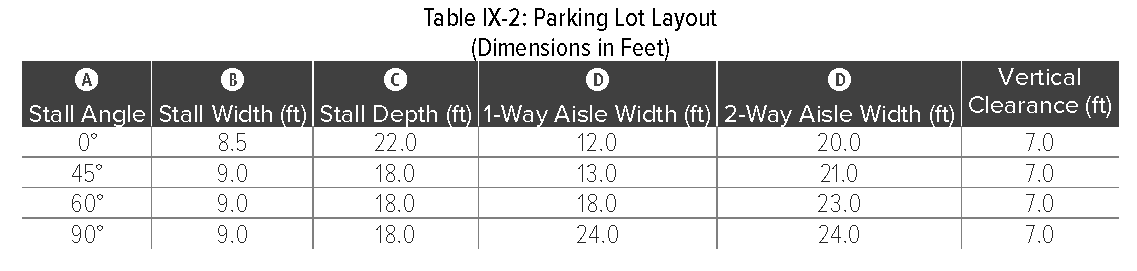
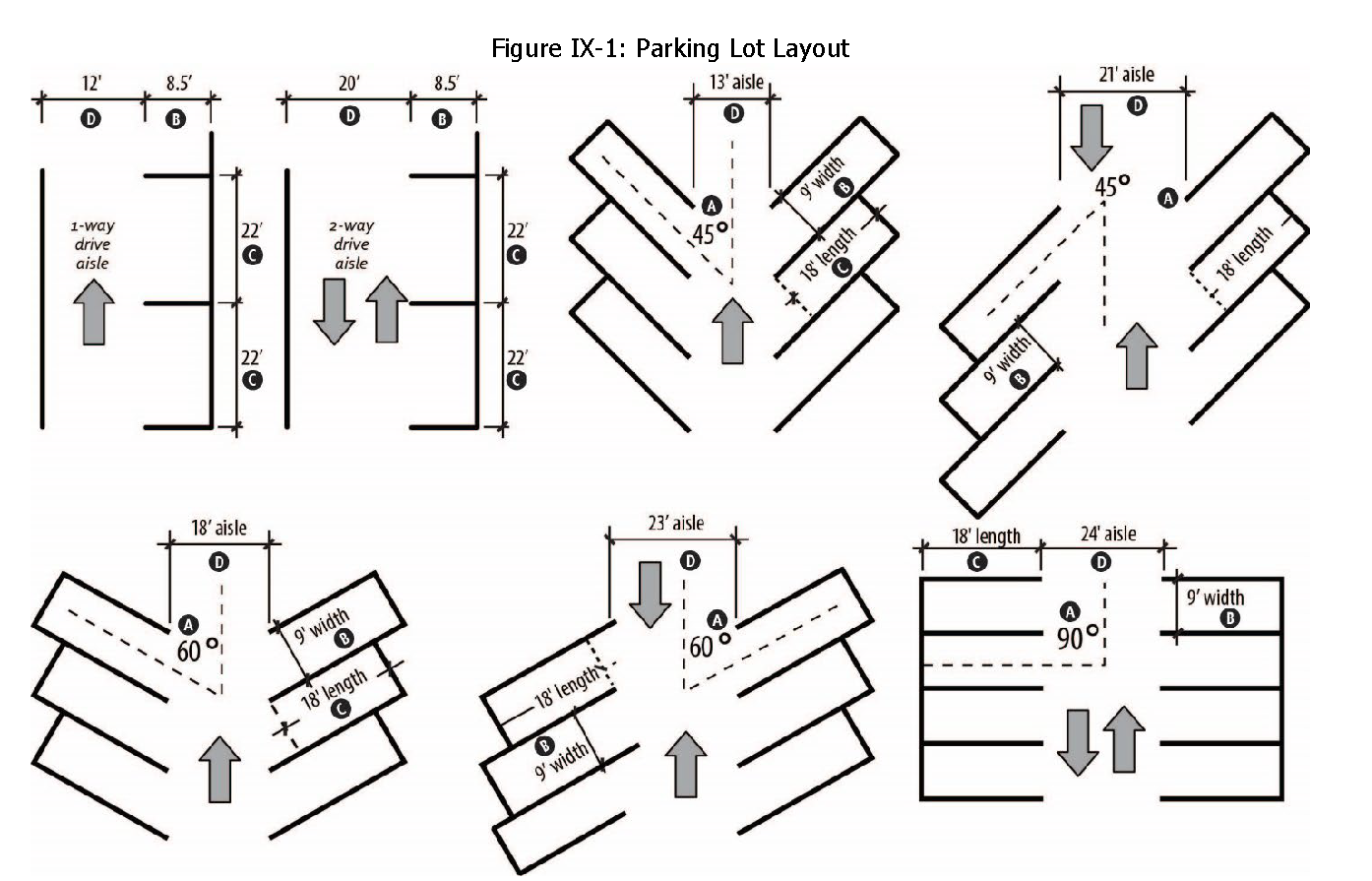
Parking lot layout. Parking areas containing four or more motor vehicle parking spaces must be designed and marked in accordance with the dimensional standards of Table IX-2, which shows minimum dimensions for various parking layouts (angles). Requirements for layouts or angles not shown in Table IX-2 may be interpolated from the layouts shown, as approved by the zoning administrator.
(D)
Curbs. Concrete, barrier-type curbs must be provided for all parking lots containing four or more motor vehicle parking spaces. This includes driveways accessing such parking areas.
(E)
Surfacing. All off-street parking areas containing four or more motor vehicle parking spaces must be surfaced with a dustless, all-weather surface unless otherwise expressly stated. Pervious pavement or pervious pavement systems are allowed subject to approval by the village engineer. Parking area surfacing must be completed prior to initiation of the use to be served by the parking, provided that the zoning administrator is authorized to approve the use of parking areas improved with a gravel base for a period of up to 180 days for temporary uses or when seasonal conditions prevent installation of permanent surfacing.
(F)
Construction. Parking lots containing four or more motor vehicle parking spaces must be constructed in accordance with the Illinois Department of Transportation's Standard Specifications for Road and Bridge Construction, as supplemented by other specifications contained in the Village of Westmont Standard Specifications.
(G)
Pavement marking. All motor vehicle parking spaces within parking areas containing four or more motor vehicle parking spaces must be designated in some manner such as by pavement marking, curbs, bumper blocks, or some other method as approved by the village engineer, except that pavement marking of parking areas for multi-unit residential buildings containing fewer than five dwelling units is not required. Pavement marking must comply with the Illinois Department of Transportation's Standard Specifications for Traffic Control Items. Pavement markings (lines) must be yellow or white with a minimum width of three inches.
(H)
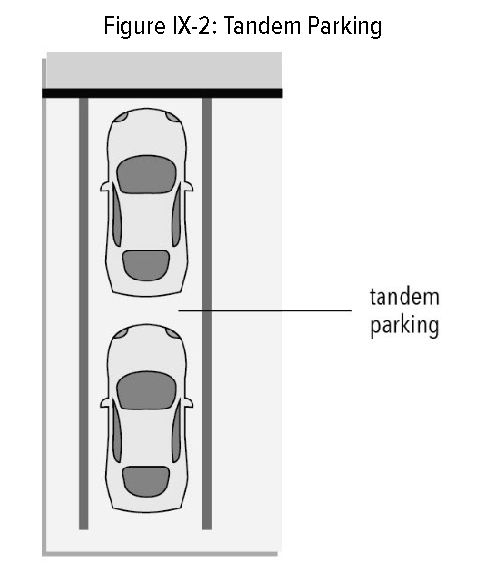
Tandem parking. Tandem parking spaces are allowed only in R-7, B-1(A), and B-1 zoning districts and only when spaces serve residents of the same dwelling unit or employees of the same business. In all other cases, parking spaces must be designed to allow each parking space to be accessed without passing through another parking space. Tandem parking arrangements must have a minimum stall width of nine feet and a minimum depth of 36 feet.
(I)
Landscaping and screening. See section 10.07(D)(4) and section 10.07(D)(5).
(J)
Lighting. See section 12.01.
(Ord. No. 25-105, § 3(Exh. A), 8-7-2025)
Sec. 9.08. - Accessible parking.
The number, location and design of accessible parking spaces for persons with disabilities must be provided in accordance with the Illinois Accessibility Code. Accessible parking spaces and access areas provided to satisfy Illinois Accessibility Code requirements count toward satisfying the minimum parking requirements of section 9.02.
Sec. 9.09. - Stacking spaces for drive-through facilities.
(A)
Spaces required. In addition to the parking required for each use, establishments with drive-through facilities must provide stacking spaces for each drive-through station as indicated in Table IX-3. Decision-making bodies are authorized to require the provision of additional stacking spaces as part of the special use process when such additional spaces are deemed necessary to ensure that stacked vehicles do not obstruct traffic on adjacent streets or pose safety hazards for motorized or non-motorized travel.
Table IX-3: Drive-through Stacking Space Requirements
(B)
Dimensions. Each lane of stacking spaces must be at least eight feet in width and at least 18 feet in length. Stacking lanes must be delineated with pavement markings.
(C)
Location and design.
(1)
Stacking lanes must be located on the subject property. They may not be located within required driveways or drive aisles, parking spaces or loading areas and may not interfere with access to parking or ingress and egress from the street.
(2)
All areas associated with drive-through facilities, including drive-through signs, stacking lanes, trash receptacles, loudspeakers and service windows may not be located between the principal building and the front street.
(3)
Drive-through lanes must be set back at least ten feet from abutting R-zoned lots and screened in accordance with the parking lot screening regulations of section 10.07(D)(5)(c).
(4)
Each drive-through facility must have an escape lane with a minimum width of ten feet to allow other vehicles to pass those waiting to be served. A drive aisle may serve as the escape lane if it meets the requirements of this section. Escape lane requirements can also be waived during the special use approval process when the applicant demonstrates that such a waiver will not result in an adverse effect on public safety or customer convenience.
(D)
Pedestrian access. The principal pedestrian access to the entrance of the use from a public sidewalk may not cross the drive-through facility stacking lane.
(Ord. No. 25-105, § 3(Exh. A), 8-7-2025)
Sec. 9.10. - Off-street loading.
(A)
General. All uses that regularly receive materials or merchandise carried by trucks or large delivery vehicles must provide off-street loading facilities in accordance with the regulations of this section.
(B)
Location.
(1)
All required off-street loading spaces must be located on the same lot as the use to be served. All vehicle maneuvering and loading/unloading operations must occur on private property and not interfere with or create safety hazards for motorized or non-motorized circulation.
(2)
Loading spaces may not be located in any street yard or within 25 feet of the nearest point of intersection of any two streets. Unenclosed off street loading areas may not be located within 25 feet of any abutting R-zoned lot.
(C)
Access. Off-street loading spaces must be designed with appropriate means of access to a street or alley in a manner that will least interfere with traffic movements.
(D)
Surfacing. All loading areas and access drives must be surfaced and maintained with an asphaltic or Portland cement binder concrete or other dustless, all-weather surface approved by the village engineer.
(E)
Spaces required. Off-street loading spaces must be provided in accordance with the Table IX-4.
Table IX-4: Off-Street Loading Space Requirements
(Ord. No. 25-105, § 3(Exh. A), 8-7-2025)

