
Wilmette City Zoning Code
ARTICLE 30
10.- VILLAGE CENTER DISTRICT
Sec. 30-10.1.- VC Village Center District purpose statement.
The purpose of the VC, Village Center District is to promote a transit oriented, mixed use, walkable village center. The VC District is designed to accommodate pedestrian-oriented development in the Village core as well as development oriented to both pedestrian and motorist along Green Bay Road at the gateways leading into this area. The design regulations of the VC District are of critical importance to the image of the Village and are more specific than those provided elsewhere in this Ordinance.
(Code 1993, § 20-10.1)
Sec. 30-10.2. - Existing development deemed conforming.
As of the date of adoption of this Ordinance, all existing structures within the boundaries of the VC District that do not conform to the standards of this Ordinance shall be deemed conforming until such time as the structure is destroyed by any means to an extent of more than fifty percent (50%) of its replacement cost at the time of destruction, and may be repaired, enlarged or altered in conformance with the requirements of Article 30-17 (Non-conformities). Any structure destroyed by any means to an extent of more than fifty percent (50%) of its replacement cost at the time of destruction shall not be reconstructed except in conformity with the requirements of the VC District.
(Code 1993, § 20-10.2)
Sec. 30-10.3. - Planned Unit Development Required.
Notwithstanding any other provision of this Chapter, a planned unit development is required for the development of land or construction of any structure located in the VC District that exceeds 42 feet in height or exceeds 3.0 in floor area ratio.
(Ord. No. 2020-O-63, § 3, 1-12-2021)
Editor's note— Ord. No. 2020-O-63, § 3, adopted Jan. 12, 2021, added a new Section 30-10.3 and subsequently renumbered Sections 30-10.3—30-10.10 as Sections 30-10.4—30-10.11. Historical notations have been retained for references purposes.
Sec. 30-10.4. - Street frontage designations.
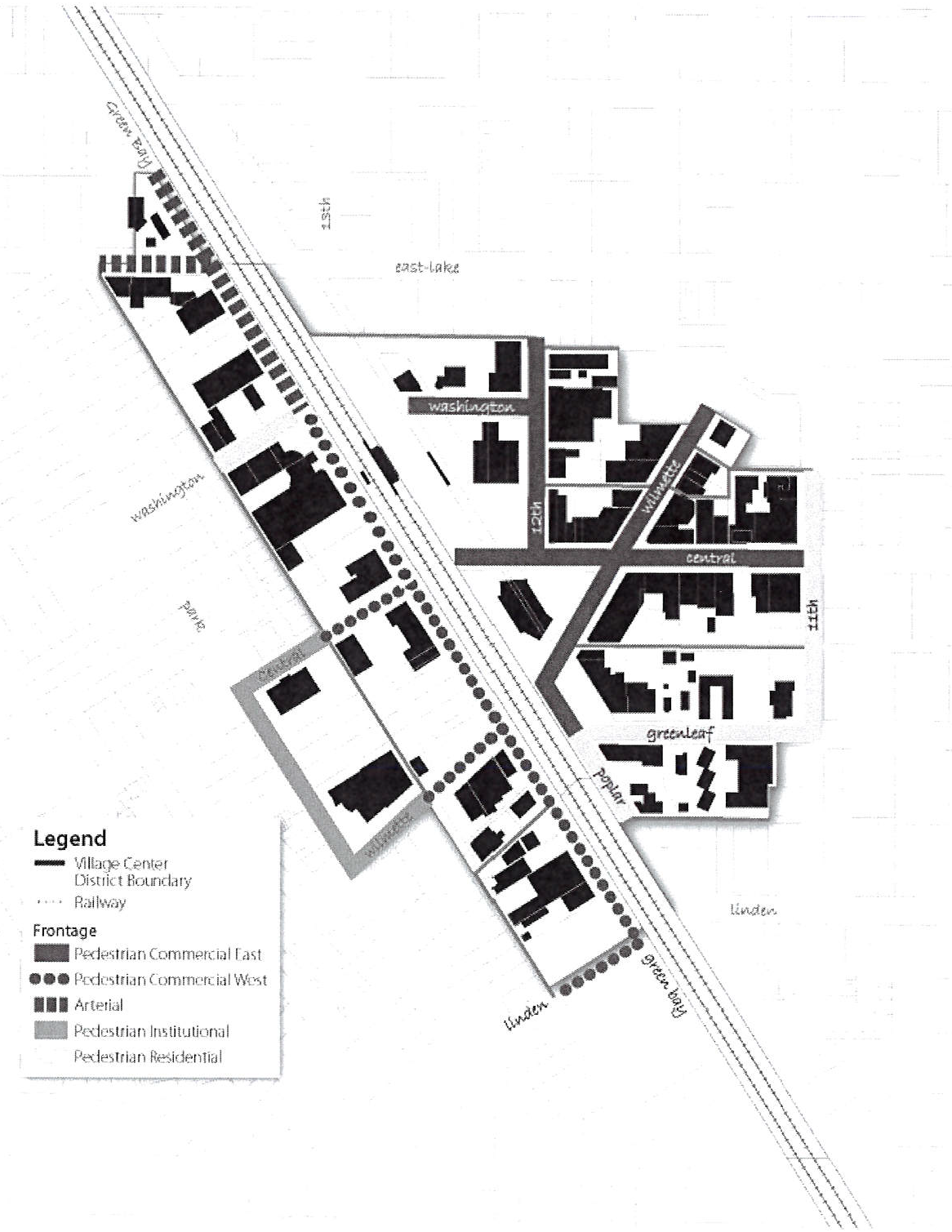
All public ways within the VC District are assigned a street frontage designation as shown on Figure 10-1: Village Center Street Frontage Map. Each designation establishes a set of site and building location, design and use regulations for structures and lots that abut such frontages. Where a lot abuts more than one (1) street frontage designation, the requirements of each street frontage designation shall apply to the appropriate frontage of the lot: (See Table 10-1: Village Center Building Setback Regulations and Table 10-2 Permitted and Special Uses.) Where a use abuts more than one (1) street frontage designation the use must conform to the requirements of both frontage designations. The street frontage designations are:
(a)
Pedestrian Commercial East Street Frontage.
(b)
Pedestrian Commercial West Street Frontage.
(c)
Arterial Street Frontage.
(d)
Pedestrian Institutional Street Frontage.
(e)
Pedestrian Residential Street Frontage.
FIGURE 10-1: VILLAGE CENTER STREET FRONTAGE MAP
(Code 1993, § 20-10.3; Ord. No. 2019-O-9, § 2, 1-22-2019; Ord. No. 2020-O-63, § 3, 1-12-2021)
Editor's note— Former § 30-10.3. See Editor's Note at § 30-10.3.
Sec. 30-10.5. - Building setback.
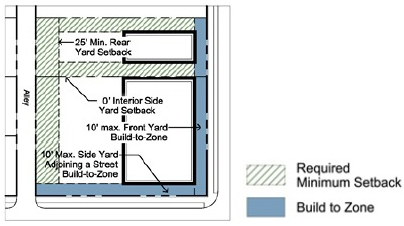
The location of a building shall be regulated by Table 10-1: Village Center Building Setback Regulations. Such regulations are further illustrated in Figure 10-2: Pedestrian Commercial East Street Frontage, Figure 10-3: Pedestrian Commercial West Street Frontage, Figure 10-4: Arterial Street Frontage, Figure 10-5: Pedestrian Institutional Street Frontage and Figure 10-6: Pedestrian Residential Street Frontage.
NOTES:
(1)
See Figure 10-10: Overall Building Frontage Diagram to determine the allowable configuration of the ground floor facade.
(2)
Front setback shall be equal to the setback provided on the blockface on opposite side of street, but in no case less than five (5) feet or greater than twenty-five (25) feet.
(3)
Minimum interior side yard setbacks shall be zero (0) feet, except when side building pedestrian access is provided along an adjacent building. In this case, the interior side yard facade shall be setback a minimum of five (5) feet and a maximum of ten (10) feet from the existing adjacent building facade.
(4)
For a corner lot, the side yard adjoining a street setback requirement shall extend to the rear property line.
(5)
When the side yard adjoining a street adjoins Green Bay Road, the minimum and maximum setback shall be five (5) feet.
FIGURE 10-2: PEDESTRIAN COMMERCIAL FRONTAGE - EAST
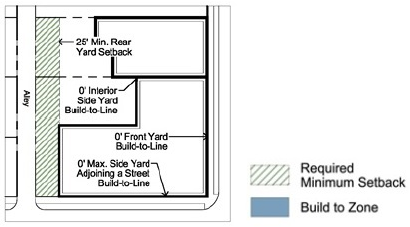
FIGURE 10-3: PEDESTRIAN COMMERCIAL FRONTAGE - WEST
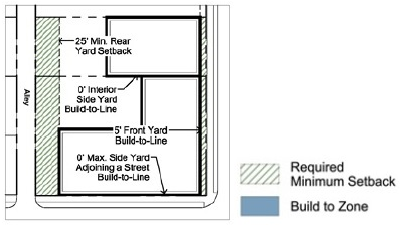
FIGURE 10-4: ARTERIAL FRONTAGE
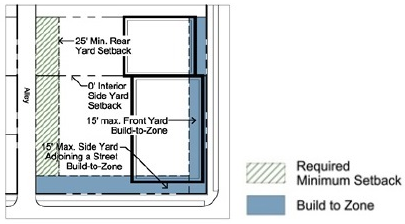
FIGURE 10-5: PEDESTRIAN INSTITUTIONAL FRONTAGE
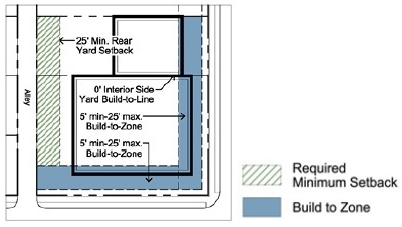
FIGURE 10-6: PEDESTRIAN RESIDENTIAL FRONTAGE
(Code 1993, § 20-10.4; Ord. No. 2020-O-63, § 3, 1-12-2021)
Editor's note— Former § 30-10.4. See Editor's Note at § 30-10.3.
Sec. 30-10.6. - Permitted and special uses.
Table 10-2: Village Center District Permitted and Special Uses lists permitted and special uses for the district. A "P" indicates that a use permitted within that district. An "S" indicates that a use a special use in that district and must obtain a special use permit as required in Section 30-5.3 (Special Use). No letter (i.e., a blank space), or the absence of the use from the table, indicates that use is not permitted within that district.
(Code 1993, § 20-10.5; Ord. No. 2018-O-48, § 5, 7-24-2018; Ord. No. 2019-O-9, § 4, 1-22-2019; Ord. No. 2020-O-63, § 3, 1-12-2021)
Editor's note— Former § 30-10.5. See Editor's Note at § 30-10.3.
Sec. 30-10.7. - Permitted building height.
The VC district contains four (4) height sub-districts as listed in Table 10-3: Village Center Building Height Regulations and as identified on Figure 10-7: Village Center Allowable Building Height Map.
(a)
Historic Center Height District. The Historic Center Height Sub-District is intended for application to a significant majority of the one- to three-story structures in the Village Center National Register Historic District.
(b)
Core Height District. The Core Sub-District is intended for application in areas where new development is proposed in the 2011 Village Center Master Plan.
(c)
Traditional Height District. The Traditional Sub-District is intended for application in the central areas of the Village Center that have been traditionally developed for pedestrian access.
(d)
Corridor Height District. The Corridor Sub-District is intended for application along portions of Green Bay Road where uses are oriented to automobile as well as pedestrian access.
NOTES:
(1)
Minimum ground floor height shall be measured from the finished floor of the ground floor to the finished floor of the second story.
Figure 10-7: VILLAGE CENTER ALLOWABLE BUILDING HEIGHT MAP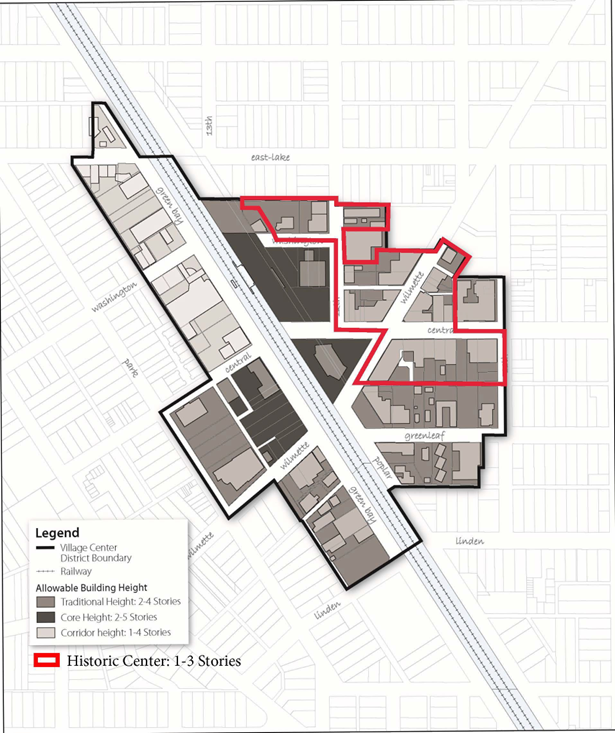
(Code 1993, § 20-10.6; Ord. No. 2020-O-63, § 3, 1-12-2021; Ord. No. 2024-O-49, §§ 2—4, 7-23-2024)
Editor's note— Former § 30-10.6. See Editor's Note at § 30-10.3.
Sec. 30-10.8. - Building design and location regulations.
The following regulations shall apply to all frontage designations except where applies to specific frontage designations.
(a)
Building Massing.
(1)
All buildings over one (1) story must evidence a design that illustrates a bottom, middle and top.
(2)
Buildings with priority corners are encouraged to use architectural massing elements, such as towers, turrets, or chamfered facades, to create interest and draw attention to highly visible areas. (See Figure 10-8: Village Center Priority Corners and Figure 10-9: Priority Corner Articulation.)
FIGURE 10-9: PRIORITY CORNER ARTICULATION
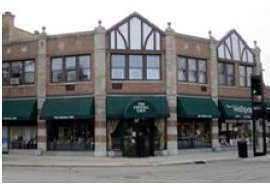
Example of a Chamfered Corner
(3)
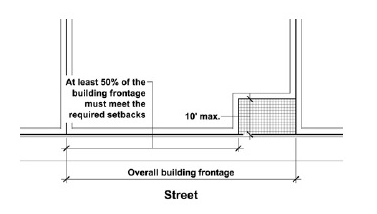
The front yard may be increased to a maximum of ten (10) feet if a courtyard, plaza or seating area is incorporated into the development adjacent to the public street. At least fifty percent (50%) of the building frontage must meet the required setbacks. (See Figure 10-10: Overall Building Frontage Diagram.)
FIGURE 10-8: VILLAGE CENTER PRIORITY CORNERS
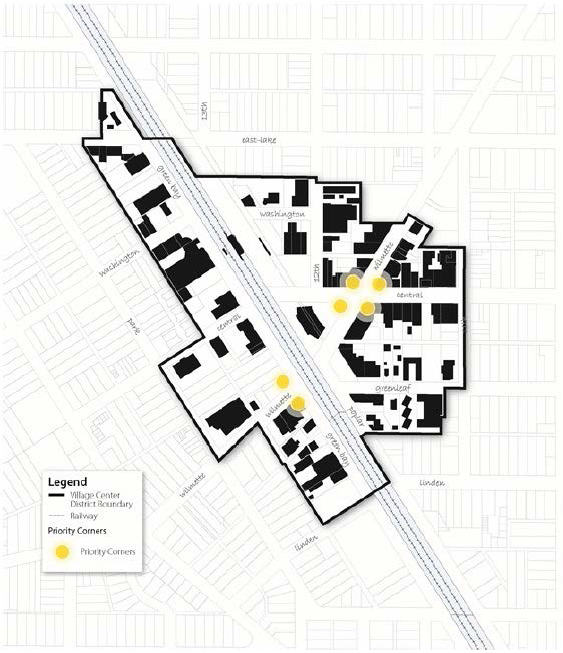
FIGURE 10-10: OVERALL BUILDING FRONTAGE DIAGRAM
(4)
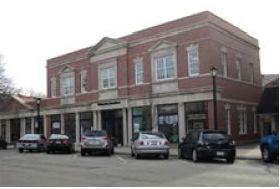
Facades of buildings that face the public right-of-way including side and rear facades must be visually broken into bays to avoid the appearance of large, blank walls. Visual breaks in the facade include alterations in materials, color, texture or pattern, and/or the addition of columns, pilasters and/or windows. (See Figure 10-11: Facade Articulation.) In addition, the following requirements apply:
(A)
For every twenty-five (25) linear feet of building length, roof lines must either be varied with a change in height or within the incorporation of a major focal point feature such as a dormer, gable or projected wall feature.
(B)
The ground floor of commercial buildings must be designed with a minimum ground floor height of fourteen (14) feet, as measured from the finished floor of the ground floor to the finished floor of the second story.
(C)
Horizontal ground floor facade elements shall, to the extent possible, align with horizontal ground floor facade elements of surrounding buildings in order to create continuity at the pedestrian level.
(D)
Horizontal ground floor facade elements may be interrupted in specific locations to allow for significant architectural features, for example turrets and articulated entryways, that add visual interest and reinforce the overall design theme.
(E)
Upper story horizontal elements should be generally consistent with surrounding buildings. Small variations can be used to create visual interest and attractive building silhouettes.
FIGURE 10-11: FACADE ARTICULATION
(5)
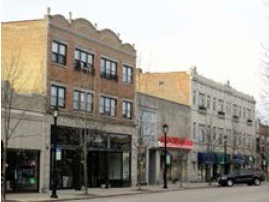
The use of vertical cornice line elements is encouraged to create visual interest and articulate the building facade at the roof line. Such elements should align with facade articulation elements on the ground floor or upper story facades. (See Figure 10-12: Roofline Articulation.)
FIGURE 10-12: ROOFLINE ARTICULATION
(b)
Building Orientation and Pedestrian Access.
(1)
A building shall be oriented with its primary facade towards the front lot line. The primary facade shall include transparency requirements as described in Section 30-10.8.(c) (Ground Floor Transparency) of this Article and the highest level of architectural design. Building access shall be provided from dedicated on-site or adjacent off-site parking areas.
(2)
Direct access shall be provided from parking areas to individual ground floor tenants or shared lobby areas. A secondary building entry may be used for this purpose if it provides access to all ground floor tenants and vertical circulation similar to the primary entry.
(3)
Multi-family buildings shall provide entry from the public sidewalk to shared entry areas or lobbies.
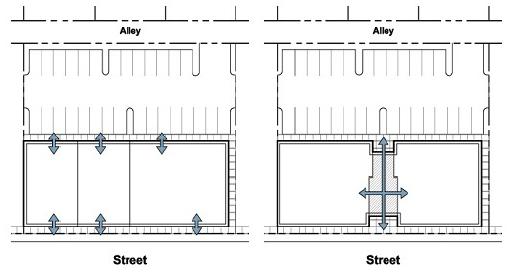
(4)
Multiple-tenant commercial buildings, including the ground floor of mixed-use buildings, may include an individual entry for each tenant, or a primary lobby entrance that provides internal access to individual tenants. (See Figure 10-13: Permitted Commercial Building Entry Access.)
FIGURE 10-13: PERMITTED COMMERCIAL BUILDING ENTRY ACCESS
(5)
For commercial and mixed-use projects, a designated pedestrian access path from rear parking areas to the public sidewalk shall be provided based on the following regulations:
(A)
For parcels fifty (50) feet to seventy-four (74) feet in width, no dedicated pedestrian access path is required.
(B)
For parcels seventy-five (75) feet to one hundred forty-nine (149) feet in width, one (1) dedicated pedestrian access path is required.
(C)
For parcels one hundred fifty (150) feet or more in width, two (2) dedicated pedestrian access paths are required.
(D)
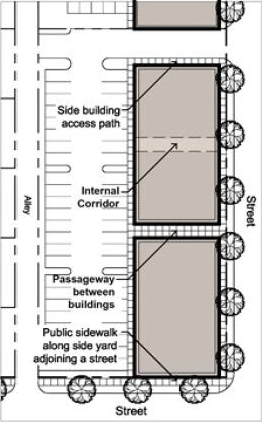
Permitted pedestrian access paths may include the following (See Figure 10-14: Permitted On-Site Pedestrian Paths):
(i)
Side building access path.
(ii)
Passageway between buildings.
(iii)
Internal corridor.
(iv)
Side yard adjoining a street public sidewalk.
FIGURE 10-14: PERMITTED ON-SITE PEDESTRIAN PATHS
(E)
All parking lot pedestrian access paths shall have a minimum width of five (5) feet.
(F)
All passageways between buildings shall have a minimum width of five (5) feet and a maximum width of ten (10) feet.
(G)
On a parcel with a side yard adjoining a street, a public sidewalk on the secondary street may serve as the designated pedestrian access if the following are true:
(i)
The sidewalk has a minimum width of five (5) feet.
(ii)
The sidewalk is determined to be in good condition and meeting all accessibility requirements.
(iii)
Direct pedestrian access is provided from the on-site parking area to the public sidewalk.
(c)
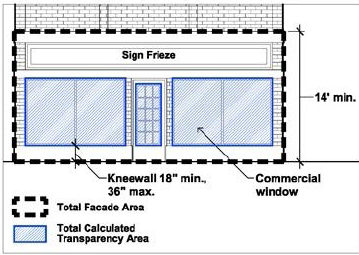
Ground Floor Transparency. Ground floor facades for single-story commercial and mixed use projects shall include a minimum of forty percent (40%) clear glass (no tinting) that allows full view into the facility. This requirement applies to any portion of the exterior wall facade that separates the exterior from a publicly accessible interior space (i.e., restaurant seating area, retail display area, etc.) Exterior walls that enclose private areas, such as kitchens, storage, articulated entries to upper story residential units, are not required to conform to the fenestration regulation. The percent of ground floor transparency is calculated as the total window and door area (not including mullions) divided by the total facade area between the ground plane and the awning/signage frieze. (See Figure 10-15: Facade Transparency Measurement Diagrams.)
FIGURE 10-15: FACADE TRANSPARENCY MEASUREMENT DIAGRAMS
(d)
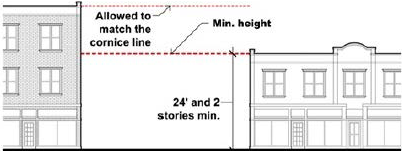
Pedestrian Frontage, Infill Building Relationships. Infill buildings must match the height of an adjacent building or be at least twenty-four (24) feet in height and two (2) stories. (See Figure 10-16: Infill Building Context.)
FIGURE 10-16: INFILL BUILDING CONTEXT
(e)
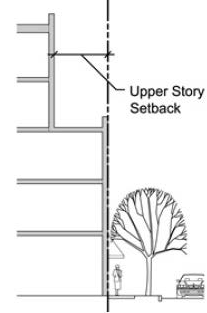
Pedestrian Frontage Design Regulations. The facades of the bottom three (3) stories shall be within the permitted build-to-zone. Stories above the third story may be setback beyond the build-to-zone. (See Figure 10-17: Upper Story Setback.)
FIGURE 10-17: UPPER STORY SETBACK
(f)
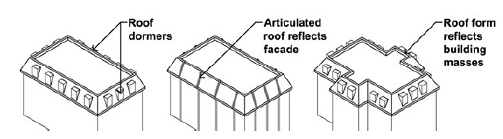
Roof Types. Roof types are permitted in the Village Center district according to Table 10-4: Permitted Roof Types. Buildings are encouraged to include design elements, such as turrets, dormers, or articulated roof elements that break up large roof areas. Decorative mansard roofs are permitted for projects that are four (4) or more stories. (See Figure 10-18: Illustration of Permitted Roof Types and Figure 10-19: Techniques for Creating Decorative Mansard Roofs.)
FIGURE 10-18: ILLUSTRATION OF PERMITTED ROOF TYPES
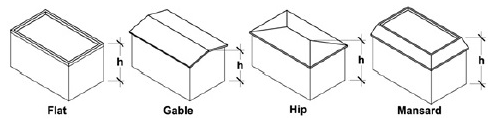
FIGURE 10-19: TECHNIQUES FOR CREATING DECORATIVE MANSARD ROOFS
(g)
Prohibited Building Materials.
(1)
The following exterior building materials are prohibited in the VC District. The use of any materials not specifically prohibited in this section are subject to the review of the Zoning Administrator.
(A)
Plain concrete masonry units (CMU); however, CMU is permitted as a base course (foundation) for residential uses for a maximum of four (4) feet in height as measured from grade.
(B)
Vinyl siding, aluminum or wood-slat siding.
(C)
Formstone.
(D)
Exterior Insulation Finish System, EIFS or "Dryvit" (non-masonry stucco products a.k.a. Artificial Stucco, Synthetic Stucco, Vinyl Stucco, and Latex Stucco).
(E)
T-111 Composite plywood siding.
(F)
Utility-sized, king-size or jumbo brick.
(G)
Fiberglass or plastic.
(H)
Exposed aggregate (rough finish) concrete wall panels.
(I)
Reflective, tinted or colored glass.
(2)
Any expansions of structures existing in the VC District as of the date of the adoption of this Ordinance may use the same building materials on the facade as the facade of the existing structure, even if such materials are not listed as permitted or are listed as prohibited in this section. The use of such materials is subject to approval by the Appearance Review Commission (ARC).
(Code 1993, § 20-10.7; Ord. No. 2020-O-63, § 3, 1-12-2021)
Editor's note— Former § 30-10.7. See Editor's Note at § 30-10.3.
Sec. 30-10.9. - Off-street parking access and design regulations.
(a)
Access to parking shall be provided in accordance with the following regulations:
(1)
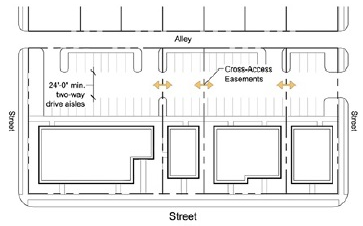
Access to on-site parking shall be provided via an abutting alley, drive aisle from the public street as permitted on a portion of the site, or a cross-access agreement with an adjacent property owner.
(2)
Parking access to lots abutting alleys. All lots with access to a rear or side public alley shall comply with the following regulations:
(A)
Pedestrian Frontage.
(i)
No parking is allowed in front of a building line established along pedestrian frontage streets.
(ii)
Parking that abuts and fronts on a pedestrian frontage must be set back a minimum of twenty-five (25) feet.
(iii)
Lots with pedestrian frontage and access to alleys are not permitted a curb cut.
(B)
Arterial Frontage.
(i)
No parking is allowed in front of a building line established along arterial frontage streets.
(ii)
Parking that abuts and fronts on an arterial frontage must be set back a minimum of ten (10) feet, such area to be screened according to the standards provided in Article 30-15 (Landscaping and Screening).
(iii)
Lots having at least one hundred twenty-five (125) feet of frontage are allowed one (1) curb cut along the arterial frontage.
(3)
Parking access to lots without abutting alleys. All lots without access to a rear or side public alley shall comply with the following regulations:
(A)
For corner lots with less than one hundred fifty (150) feet of lot frontage, one (1) curb cut is permitted on the non-arterial frontage. If both streets consist of arterial frontage, only one (1) of the arterial streets can have a curb cut allowed on that street.
(B)
For corner lots with at least one hundred fifty (150) feet of lot frontage, one (1) curb cut is permitted on each frontage that is at least one hundred fifty (150) feet.
(C)
Interior lots without an abutting alley are not permitted a curb-cut.
(4)
Cross-Access Easement. See Section 30-14.5.(b)(6), Cross Access Driveway Easements.
FIGURE 10-20: CROSS-ACCESS EASEMENTS
(5)
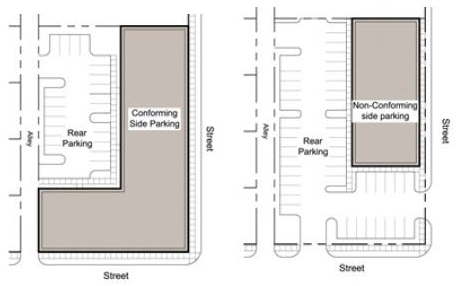
Parking Lot Layout. For commercial or mixed-use projects, one (1) aisle of parking is permitted to the side of or between primary buildings, subject to meeting all other pertinent conditions of this Article. No parking lot located at grade may be located within twenty-five (25) feet of a lot line adjoining a street along a pedestrian frontage, and ten (10) feet of a lot line adjoining a street along an arterial frontage. (See Figure 10-21: Permitted Side Parking Aisles.)
FIGURE 10-21: PERMITTED SIDE PARKING AISLES
Conforming Side Parking Aisle Non-conforming Side Parking Aisle
(Code 1993, § 20-10.8; Ord. No. 2020-O-63, § 3, 1-12-2021)
Editor's note— Former § 30-10.8. See Editor's Note at § 30-10.3.
Sec. 30-10.10. - Village center accessory structures and uses.
(a)
Coordination with Principal Building. All accessory structures shall complement and coordinate with the principal buildings on the lot, both in architectural style and material selection. Accessory structures shall comply with the following design regulations:
(1)
Accessory structures shall be constructed of facade materials that reflect the general character and theme of the principal building.
(2)
Accessory structures shall apply the same facade articulation as the principal building.
(3)
Accessory structures that abut the principal building shall, to the extent possible, include horizontal design elements, such as knee walls and cornices, that match the character and elevations of those on the principal building.
(b)
Refuse Containers.
(1)
Refuse containers shall be located only to the rear or side of the building. No refuse containers shall be located within the front or side yard adjoining a street, or within five (5) feet of an adjacent parcel or on-site primary structure.
(2)
Shared refuse containers and enclosures among adjacent properties are encouraged.
(c)
Roof-Mounted Mechanical Equipment.
(1)
Roof-mounted mechanical equipment shall be screened from view from the all surrounding public sidewalks. The full enclosure of mechanical equipment within the building is encouraged.
(2)
Screening shall be accomplished by the roof structure, parapet walls, or other screening structure. The height of the screening shall equal the height of the tallest rooftop mechanical element installed on the building. Such screening shall be designed to blend in with and complement the architecture of the building.
(d)
Ground-Based Mechanical Equipment.
(1)
Ground-based mechanical equipment is discouraged. Wherever possible, mechanical equipment shall be contained within buildings or shall be roof-mounted.
(2)
All ground-based mechanical equipment including, but not limited to, heating, ventilating, and air-conditioning units (HVAC), shall be located only in the rear of the building or interior side yard. No ground-based mechanical equipment shall be located within the front or side yard adjoining a street.
(3)
All ground-based mechanical equipment, including, but not limited to, heating, ventilating, and air-conditioning units (HVAC), shall be fully screened from public view in accordance with the screening regulations of Article 30-15 (Landscaping and Screening).
(Code 1993, § 20-10.9; Ord. No. 2020-O-63, § 3, 1-12-2021)
Editor's note— Former § 30-10.9. See Editor's Note at § 30-10.3.
Sec. 30-10.11. - General standards of applicability.
(a)
Accessory Structures and Uses. See Section 30-13.4 (Accessory Structures and Uses) for standards covering accessory structures and uses.
(b)
Permitted Encroachments. See Section 30-13.5 (Permitted Encroachments) for standards governing encroachments.
(c)
Temporary Uses and Structures. See Section 30-13.6 (Temporary Uses and Structures) for standards governing temporary uses.
(d)
Off-Street Parking and Loading. See Article 30-14 (Off-Street Parking and Loading) for standards governing off-street parking and loading.
(e)
Landscaping and Screening. See Article 30-15 (Landscaping and Screening) for standards governing landscaping and screening.
(f)
Signs. See Article 30-16 (Signs) for standards governing signs.
(Code 1993, § 20-10.10; Ord. No. 2020-O-63, § 3, 1-12-2021)
Editor's note— Former § 30-10.10. See Editor's Note at § 30-10.3.

