
Wilmette City Zoning Code
ARTICLE 30
14.- OFF-STREET PARKING AND LOADING
Sec. 30-14.1.- Purpose.
The off-street parking and loading regulations of this Article are intended to provide accessible, attractive, secure and well-maintained off-street parking and loading areas with the appropriate number of spaces in proportion to the needs of the proposed use, increase public safety by reducing congestion of public streets, and encourage the use of alternative modes of transportation where appropriate.
(Code 1993, § 20-14.1)
Sec. 30-14.2. - General provisions.
The provisions of this Article apply as follows:
(a)
Existing Facilities.
(1)
The existing number of off-street parking and loading spaces must not be reduced below the requirements of this Article. If the number of such existing spaces is already less than the requirements of this Article, it cannot be further reduced.
(2)
Existing off-street parking and loading areas that do not conform to the requirements of this Article, but were in conformance with the requirements of this Ordinance at the time the parking or loading facilities were established, are permitted to continue as a legal non-conforming structure.
(3)
If a building permit for a structure was lawfully issued prior to the effective date of this Ordinance, and if construction has begun within one hundred eighty (180) days of the issuance of a permit, the number of off-street parking and loading spaces must be provided in the amount required for the issuance of said building permit, regardless of what may be required by this Article.
(b)
Damage or Destruction. When a building is reconstructed or repaired after being damaged or destroyed, off-street parking and loading facilities must be restored or maintained in an amount equivalent to that at the time of such damage or destruction. However, it is not necessary to restore or maintain parking and loading facilities in excess of the applicable requirements of this Article.
(c)
Change in Land Use. When the existing use of a structure or land is changed to a new use, parking and loading spaces must be provided as required for the new use. Additional parking or loading spaces are required in the amount by which the requirements for the new use exceed the requirements for the existing use.
(d)
Change in Intensity of Use.
(1)
When the intensity of use of any structure or land is increased, additional parking and loading spaces must be provided. The number of additional parking and loading spaces are based on the increase in the number of dwelling units, gross floor area, seating capacity, or other unit of measurement used to calculate the required number of parking or loading spaces.
(2)
When the intensity of use of any structure or land is decreased, the number of parking and loading spaces may be reduced so long as the parking requirements of this Article are met for the entire structure or land as modified.
(e)
Provision of Additional Spaces. Nothing in this Article prevents the voluntary establishment of additional off-street parking or loading facilities in all districts except for VC, provided that all regulations governing the location, design and control of such facilities are in accordance with this Article.
(f)
Limitations on Use. Motor vehicle repair or cleaning of any kind is prohibited in any parking space, parking lot, or loading berth.
(Code 1993, § 20-14.2)
Sec. 30-14.3. - Computation.
The total number of required parking and loading spaces is based upon the requirements for the principal use of the lot. However, when more than one (1) use occupies the same lot, the number of required spaces is the sum of the separate requirements for each use. All off-street parking facilities must be completed before occupancy of the structure. In computing the number of off-street parking or loading spaces required by this Article, the following standards for computation apply:
(a)
Space allocated to any off-street loading space does not satisfy the requirement for any off-street parking space or access aisle, or portion thereof. Conversely, the area allocated to any off-street parking space cannot be used to satisfy the replacement for any off-street loading space or portion thereof.
(b)
A fraction of less than one-half (1/2) may be disregarded, and a fraction of one-half (1/2) or more is counted as one (1) parking or loading space.
(c)
In places of assembly in which patrons or spectators occupy benches, pews or similar seating facilities, each twenty-four (24) inches of such seating facility is counted as one (1) seat for the purpose of determining the requirement for off-street parking facilities. Floor area of a prayer hall is counted as one (1) seat per marked prayer mat space or one (1) seat for every five (5) square feet in the prayer hall if prayer mat spaces are not marked.
(d)
Except as otherwise specified, parking or loading spaces required on an employee basis is based on the maximum number of employees normally present on the premises at any one (1) time. When the determination of the number of parking spaces is based on the number of employees, the owner and/or manager is counted as an employee(s).
(e)
For the purpose of determining off-street parking and loading requirements, floor area shall mean the sum of the gross horizontal floor area (GFA) of the several floors of a building measured from the interior faces of the exterior walls, excluding areas used for the storage of merchandise or materials, mechanical equipment rooms, rest rooms, and areas used for off-street parking and loading and related aisles, ramps, and maneuvering space.
(f)
In the VC District, each non-residential use containing a total gross floor area (GFA) of two thousand five hundred (2,500) square feet or less is exempt from all off-street parking requirements. Non-residential uses in excess of two thousand five hundred (2,500) square feet floor area and all residential uses shall provide parking according to the requirements of Article 30-14 (Off-Street Parking and Loading).
(g)
Any off-street parking space occupied by a vehicle for sale or lease or occupied by a fleet vehicle kept on a non-residential property by the owner or occupant of the property, shall not be counted toward the number of parking spaces required under this Article. Any off-street parking space(s) dedicated to product drop-off shall not be counted towards number of parking spaces require under this Article.
(h)
Up to two (2) off-street parking spaces designated for the parking of car-sharing vehicles may be counted toward the number of parking spaces required under this Article.
(i)
Off-street parking spaces for use with an electric vehicle charging station shall be counted toward the number of parking spaces required under this Article.
(Code 1993, § 20-14.3; Ord. No. 2015-O-13, 4-14-2015; Ord. No. 2019-O-59, § 3, 9-10-2019; Ord. No. 2024-O-35, § 5, 6-11-2024)
Sec. 30-14.4. - Location of off-street parking spaces.
(a)
Residential Uses.
(1)
All required parking spaces for residential uses must be located on the same lot as the structure.
(2)
A single-family dwelling existing as of the date of this Ordinance with two (2) or more enclosed parking spaces must maintain at least two (2) enclosed parking spaces.
(3)
New single-family dwellings and two-unit dwellings must provide enclosed parking spaces for each required parking space within the principal building or in a detached garage.
(4)
Open parking spaces are not permitted in a required front yard or side yard adjoining a street. Open spaces must maintain a minimum of five (5) feet from side and rear lot lines.
(5)
The maximum number of open and enclosed parking spaces for a single-family dwelling are as follows:
(A)
A lot area less than fifteen thousand (15,000) square feet: Four (4) spaces.
(B)
A lot area of fifteen thousand (15,000) to nineteen thousand nine hundred ninety-nine (19,999) square feet: Six (6) spaces.
(C)
A lot area of twenty thousand (20,000) to twenty-nine thousand nine hundred ninety-nine (29,999) s.f.: Eight (8) spaces.
(D)
A lot area of thirty thousand (30,000) s.f. or more: Ten (10) spaces.
(6)
Tandem parking is permitted for residential dwellings but both spaces must be allotted to the same dwelling unit and located on the same lot as the dwelling served. Tandem spaces shall not count as more than one (1) required parking space except for multi-family dwellings where the number of required spaces exceeds one (1) per dwelling unit.
(7)
At least fifty percent (50%) of all parking spaces required for townhouse/stacked flat and multi-family dwellings must be enclosed within the principal building or within a detached garage on the subject property.
(8)
In the NR-1 district, no parking lot or enclosed parking area located at or above grade may be located within twenty-five (25) feet of a lot line adjoining Fourth Street or Linden Avenue.
(b)
Non-Residential Uses.
(1)
All required off-street parking facilities for non-residential uses must be located on the same lot as the structure. However, off-street parking may be located within three hundred (300) feet walking distance of a use when the following conditions are met:
(A)
The parking facility is located in a zoning district where allowed as a permitted use or special use.
(B)
The parking facility is located on a lot owned by the same party as the use to be served or is secured by long term lease containing a twenty (20) year deed restriction upon the use of the facility limiting the use of the facility to parking for the purpose intended.
(C)
A covenant running with the land and prohibiting any other use of the lot, naming the Village as a beneficiary of the covenant and subject to the review and approval of the Village, is recorded in the office of the Recorder of Deeds of Cook County for the lot on which the parking facility is located. A copy of the recorded covenant, certified by the Recorder of Deeds or Registrar of Titles, must be filed with the Zoning Administrator.
(D)
The required covenant above will not be released until such time as one (1) of the following conditions occurs:
(i)
The use served by the required off-street parking is terminated and/or the structure housing that use is removed.
(ii)
The required off-street parking is provided on the same lot as the use served.
(iii)
Another facility meeting all these requirements is used to provide the required parking.
(2)
The use may provide valet service to a parking facility with no distance restriction.
(3)
Off-street parking spaces are permitted within the rear, interior side or side yard adjoining a street and are subject to buffer yard standards of Section 30-15.10 (Buffer Yards) in all non-residential districts. Off-street parking spaces are permitted in the front yard only in the Planned Commercial Development Districts.
(4)
An open off-street parking space serving a non-residential use must be located a minimum of five (5) feet from any lot line.
(5)
In the NR-1 district, no parking lot or enclosed parking area located at or above grade may be located within twenty-five (25) feet of a lot line adjoining Fourth Street or Linden Avenue.
(Code 1993, § 20-14.4; Ord. No. 2017-O-59, 10-10-2017)
Sec. 30-14.5. - Design standards.
All off-street parking facilities must comply with the following standards:
(a)
Dimensions.
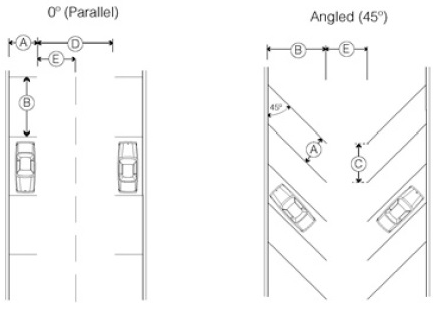
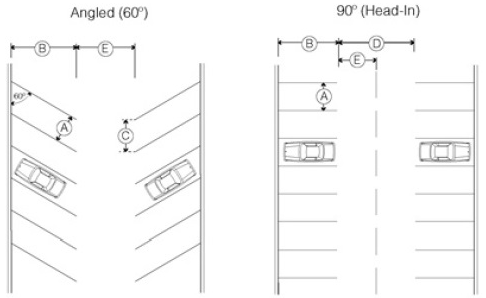
Off-street parking spaces must be designed in accordance with Figure 14-1: Off-Street Parking Dimensions. All off-street parking spaces shall have a minimum width of eight and one-half (8 1/2) feet. All off-street parking spaces shall have a minimum depth of eighteen (18) feet. All parking spaces require a minimum vertical clearance of seven (7) feet.
The required eighteen (18)-foot length may include up to two (2) feet of abutting space in a vegetative buffer or landscaped area over which a parked vehicle may extend, provided that no parked vehicle will project over a sidewalk or other pedestrian walkway.
(b)
Access.
(1)
Each off-street space must open directly upon an aisle or driveway of such width to provide adequate means of vehicular access to the parking space. All off-street parking facilities must provide vehicular access in a manner that least interferes with traffic movement and allows the driver of the vehicle to proceed forward into traffic rather than back out. No off-street parking space may open directly onto a street or alley.
(2)
All required off-street parking facilities must have vehicular access from a street, alley, driveway or cross-access connection.
(3)
Within off-street parking facilities, all aisles must be designed in accordance with Figure 14-1: Off-Street Parking Dimensions.
(4)
Section 30-10.8 includes additional requirements for on-site parking access and design in the VC district.
(5)
Multi-Family, Townhouse/Stacked Flat and Non-Residential Driveways.
(A)
Driveways, off-street parking areas and access aisles for multi-family residential and non-residential parking lots must be designed in accordance with Figure 14-1: Off-Street Parking Dimensions.
(B)
Any driveway located in a non-residential district that provides direct vehicular access into a lot from an arterial street or collector must be located at least twenty-five (25) feet from any other driveway or curb-cut located on the same side of the street and at least sixty-five (65) feet from any street intersection, as measured along the edge of the pavement.
(6)
Cross-Access Driveway Easements. See also Figure 10-20: Cross-Access Easements.
(A)
Adjacent non-residential uses that possess dedicated parking areas are encouraged to provide a cross-access driveway to allow circulation between sites. If cross-access driveways are provided, the property owners must provide proof to the Village that adjacent property owners have been contacted in writing regarding the provision of cross-access.
(B)
The easement shall be of a size to permit two-way travel.
(C)
Bump-outs and other design features shall be provided to make it visually obvious that the abutting properties are tied together.
(D)
Pursuant to this section, property owners who establish cross-access driveways must:
(i)
Record an easement allowing cross-access to and from properties served by the cross-access driveway.
(ii)
Record an easement that any pre-existing driveways will be closed and eliminated after construction of the joint-use driveway.
(iii)
Record a joint maintenance agreement defining the maintenance responsibilities of each property owner.
(iv)
All such easements and joint maintenance agreements shall be subject to the prior review and approval of the Village.
FIGURE 14-1: OFF-STREET PARKING DIMENSIONS
(d)
Striping. Off-street parking areas of more than four (4) spaces must delineate parking spaces with paint or other permanent materials, which must be maintained in clearly visible condition. Parking spaces for handicapped persons must be identified with the appropriate sign and visible at all times of the year, regardless of snow cover, plant growth or similar conditions.
(e)
Curbing and Bumper Stops. Off-street parking areas of more than four (4) spaces must provide concrete curbing no less than six (6) inches in height along the perimeter of the parking lot a minimum of five (5) feet from the street line in districts where a front yard is not required or from the property line when abutting a public sidewalk.
(f)
Drainage and Grading.
(1)
All parking spaces for single-family and two-unit dwellings may be constructed no more than three (3) feet below existing grade. However, for property that slopes downward towards a rear lot line, parking spaces accessed by a driveway, including the apron, constructed to follow the existing property contour is permitted.
(2)
All open off-street parking areas containing more than four (4) parking spaces must have a storm water drainage system connected to a public sewer, as approved by the Village Engineer. No surface runoff is allowed to flow across any lot line.
(g)
Lighting. Parking lot lighting must comply with Section 30-13.3 (Exterior Lighting). Illumination of an off-street parking area must be arranged so as to deflect light away from adjacent properties and streets.
(h)
Landscaping and Screening. All parking lots must be landscaped in accordance with Section 30-15 (Landscaping and Screening).
(Code 1993, § 20-14.5)
Sec. 30-14.6. - Special regulations for the design of parking structures.
Parking structures shall be designed as follows:
(a)
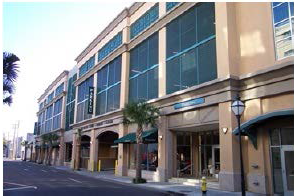
In the VC district, where parking structures are allowed along pedestrian frontages, at least sixty percent (60%) of the ground floor frontage shall be developed with non-residential uses. No more than one (1) curb cut is allowed along the pedestrian street frontage to accommodate vehicular access to the parking structure. (See Figure 14-2: Commercial Frontage on Parking Garage Ground Floor.)
FIGURE 14-2: COMMERCIAL FRONTAGE ON PARKING GARAGE GROUND FLOOR
(b)
On facades that front on public streets, the exterior articulation of interior vertical circulation, such as ramped portions of the structure used for access to higher levels of parking, shall be prohibited. In such a case where interior ramps front on public streets, facade design and screening shall be used to mask the interior ramps and create the illusion of horizontality. The design of the primary facade shall include horizontal design elements, such as knee walls and cornices, which reflect the design of other structures in the district. (See Figure 14-3 and Figure 14-4: Non-conforming Facade Design and Conforming Facade Design.)
FIGURE 14.3: NON-CONFORMING FACADE DESIGN (TOP) AND CONFORMING FACADE DESIGN (BOTTOM)
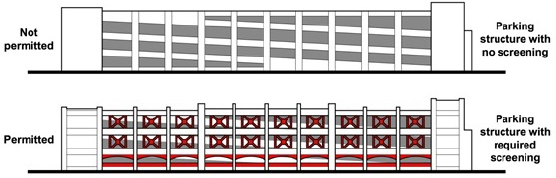
FIGURE 14-4: NON-CONFORMING FACADE DESIGN (LEFT) AND CONFORMING FACADE DESIGN (RIGHT)
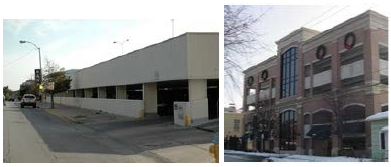
Non-Conforming Conforming
(c)
Parking structures in the Village Center district shall conform to the facade articulation regulations of Section 30-10.7.
(d)
A parking structure shall be constructed with materials and design elements that reflect the principal building that it serves. In the Village Center district, if the parking structure itself is the principal building, it shall conform to the building material regulations for the Village Center District.
(e)
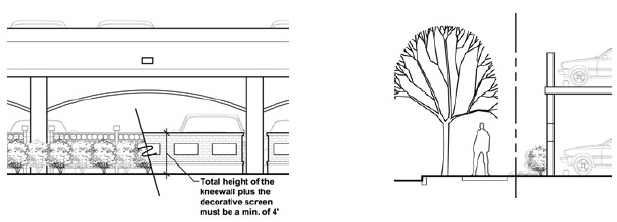
On portions of the ground floor facade where parking spaces are visible, a decorative screen shall be provided atop the knee wall to screen traffic and pedestrians in the public right-of-way from headlight glare. The total height of the knee wall and decorative screen shall be a minimum of four (4) feet. (See Figure 14-5: Parking Structure Ground Floor Decorative Screening.)
FIGURE 14-5: PARKING STRUCTURE GROUND FLOOR DECORATIVE SCREENING
(f)
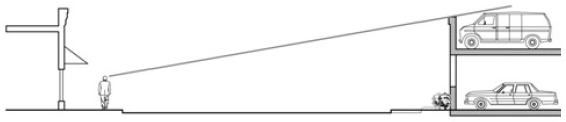
For parking structures with rooftop open-air parking, the parapet of the facade shall be extended such that a seven (7)-foot tall vehicle is not visible from the curb of the public sidewalk across the street from the facade along which parking is designated. (See Figure 14-6: Extended Parapet Vehicular Screen.)
FIGURE 14-6: EXTENDED PARAPET VEHICULAR SCREEN
(g)
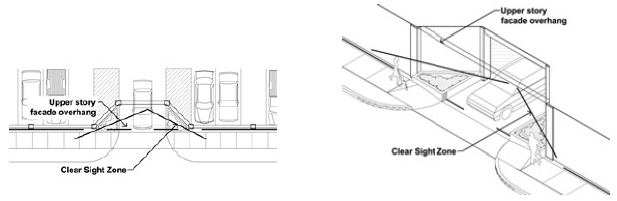
A vehicular clear sight zone shall be included at vehicular exit areas that includes a triangular sight area on each side of the exit defined by the following requirements (See Figure 14-7: Plan and 3-Dimensional Diagram of the Vehicular Clear Sight Zone.):
(1)
The facade of vehicular exit areas shall be setback from the public sidewalk a minimum of eight (8) feet setback for the portion of the facade that includes the vehicle exit area and eight (8) linear feet on each side of the exit opening.
(2)
A sight triangle shall be defined by drawing a line from the edge of the vehicular exit area to a point on the property line abutting the public sidewalk eight (8) feet to the side of the exit lane.
(3)
In the sight triangle (bound by the parking structure wall, public sidewalk and vehicular exit lane), ground cover, landscaping, or decorative wall shall be used to act as a buffer between the exit aisle and the public sidewalk. Landscaping or a decorative wall shall not exceed three (3) feet in height in order to maintain driver peripheral sightlines to the public sidewalk.
FIGURE 14-7: PLAN AND 3-DIMENSIONAL DIAGRAM OF THE VEHICULAR CLEAR SIGHT ZONE
(4)
The upper story facade(s) of the parking structure may be built to the property line.
(Code 1993, § 20-14.6)
Sec. 30-14.7. - Accessible parking.
(a)
Required Spaces. With the exception of single-family, two-family, and townhouse dwellings, in all off-street parking facilities where parking is provided for employees, visitors or both, parking spaces for disabled persons must be provided. The number of accessible parking spaces is included in the total number of required parking spaces and must meet the requirements of the Illinois State Accessibility Code, as amended from time to time, and all additional governing codes and applicable laws.
(b)
Dimensions and Design. Such spaces must comply with the design standards presented in the State of Illinois Accessibility Code.
(Code 1993, § 20-14.7)
Sec. 30-14.8. - Stacking spaces for drive-through facilities.
(a)
Design. Every drive-through facility must provide a minimum of four (4) stacking spaces per bay, unless otherwise required by Table 14-1: Required Off-Street Parking of this Ordinance. Stacking spaces provided for drive-through uses must meet the following:
(1)
A minimum of nine (9) feet in width, as measured from the outermost point of any service window to the edge of the driveway, and eighteen (18) feet in length.
(2)
Placed in a single line behind the drive-through facility.
(3)
Located so that, when in use, they do not obstruct ingress or egress to the site and do not obstruct access to required parking or loading spaces or the garbage enclosure(s).
(4)
Stacking spaces begin behind the vehicle parked at a last point of service, such as a window or car wash bay.
(Code 1993, § 20-14.8)
Sec. 30-14.9. - Required off-street parking spaces.
(a)
For multi-tenant commercial developments, parking requirements shall be calculated as three (3) required spaces per one thousand (1,000) square feet of gross leasable area, and not by individual uses.
(b)
Table 14-1: Off-Street Parking Requirements and Table 14-2: Off-Street Parking Requirements for the Village Center list the minimum number of off-street parking spaces to be provided for a use when [section] 20-14.9.(a) above does not apply. In some cases, uses that are considered part of a generic use category are listed with specific parking requirements. Certain uses listed within the districts do not have parking requirements and are not listed in Table 14-1 or Table 14-2.
(c)
In the VC and NR-1 Districts, uses located in structures erected prior to the effective date of this Ordinance are exempt from the parking requirements of Table 14-1 and Table 14-2, with the exception of any large medical clinics and residential dwellings. However, where there are existing parking spaces in the VC and NR-1 Districts, such spaces must be maintained unless the same number of spaces is provided elsewhere in accordance with all requirements of this Article.
(d)
In the VC and NR-1 Districts, on-street parking spaces located along the front or side property line may be counted toward required off-street parking spaces for commercial uses. At least fifty percent (50%) of the width of an on-street parking space must be located along the property line of the property under consideration in order to count toward off-street parking requirements. In a multi-tenant structure, all commercial tenants may utilize this provision.
(e)
In the VC District, in no case shall the provided off-street vehicular parking exceed ten percent (10%) more than the required minimum, except in the case of residential uses.
(f)
Public Parking Credit. For all non-residential uses, public off-street parking spaces located within five hundred (500) feet of any property line may be credited against the parking requirement at a rate of one (1) credit for every three (3) public parking spaces. Public commuter parking spaces are excluded from this credit.
(g)
No more than two (2) required parking spaces may be dedicated to car-sharing services.
(h)
No more than the greater of five-percent (5%) of provided parking spaces or one (1) space may be dedicated for the exclusive use by electric vehicles. Each electric vehicle charging space dedicated for the exclusive use of electric vehicles shall be marked by the appropriate signage.
Notwithstanding the above, any number of additional electric vehicle charging stations may be provided for parking spaces, when such parking spaces are not signed as to restrict the parking of non-electric vehicles.
(Code 1993, § 20-14.9; Ord. No. 2014-O-65, 11-11-2014; Ord. No. 2015-O-13, 4-14-2015; Ord. No. 2021-O-56, § 5, 9-28-2021; Ord. No. 2024-O-35, § 6, 6-11-2024; Ord. No. 2025-O-19, § 5, 3-11-2025)
Sec. 30-14.10. - Permitted parking alternatives.
(a)
Collective Parking. Off-street parking spaces for separate uses may be provided collectively if the aggregate number of spaces provided is no less than the sum of the spaces required in Table 14-3: Collective Parking Calculation. Table 14-3 is applied in the following manner:
(1)
The required number of spaces for each use is calculated according to Table 14-3.
(2)
The required number of spaces for each use is then applied to the percentages for each time, according to the appropriate land use category, in Table 14-3 to determine the number of required spaces. This is done for each time category.
(3)
The numbers are the sum of all land uses within each timeframe and the highest sum total in a timeframe is the required number of spaces.
(b)
Alternating Parking. An off-street parking facility may be alternated between two (2) or more uses, provided that use of such facility by each user does not occur at the same time. Alternating parking arrangements must meet the following conditions:
(1)
Approval is obtained from the Zoning Administrator that confirms that the use of such facility by each user does not take place at the same hours and/or days of the week.
(2)
The users of the alternating parking arrangement must record an agreement to share parking facilities, subject to approval by the Zoning Administrator. A copy of the recorded agreement must be submitted to the Zoning Administrator.
(3)
The number of spaces provided meets the minimum requirement for each use.
(4)
The off-site parking facilities are located on or within three hundred (300) feet of the lot line of the use.
Any subsequent change in use must require proof that the minimum parking requirements, per this Ordinance, have been met for each use. The owner of an existing building or use has one hundred eighty (180) days within which to accommodate required off-street parking or to apply for a variance. If the owner is unable to accommodate the parking or fails to apply for a variance, then the occupancy permit is revoked with respect to the use for which the separate parking was required. The occupancy permit will be reinstated when all applicable provisions of this Ordinance are complied with. As an alternative to a variance, a new alternating parking agreement may be arranged in accordance with this section.
(c)
Fee-In-Lieu of Parking.
(1)
A reduction in the required number of off-street parking spaces for non-residential uses in the VC district may be granted by the Village Board conditioned upon payment, by the owner, of a fee-in-lieu of providing the required parking spaces, such fee established from time to time by resolution of the Village Board. Such payment must be placed into a Village fund to be used by the Village for the acquisition, construction and maintenance of public off-street parking facilities to serve that area.
(2)
Upon payment, the property granted the modification in the number of required off-street spaces must be credited permanently by ordinance with the number of spaces for which payment was received by the Village.
(3)
The parking fee-in-lieu of provision is only applicable for new construction or where additional floor area in excess of five hundred (500) square feet is added to an existing building. Changes in use within existing buildings do not require payment of a fee-in-lieu.
(Code 1993, § 20-14.10)
Sec. 30-14.11. - Outdoor storage of trucks, trailers, boats and recreational vehicles.
Only travel trailers, recreational vehicles, commercial or industrial trailers and boats that meet the standards of this section may be stored in any residential district. However, a trailer may be used as a temporary office or storage space incidental to construction when granted a temporary use approval.
(a)
A travel trailer must not be used as a dwelling, storage, or accessory structure. However, a travel trailer may be parked or occupied for lodging purposes on a vacant lot or on the same lot as a dwelling for no more than seventy-two (72) hours in any consecutive thirty (30)-day period.
(b)
A travel trailer or boat must not be stored in connection with a business conducted at the location.
(c)
A stored travel trailer or boat must be maintained in mobile condition. No major construction or repair of a stored travel trailer or boat may be performed on a residential lot.
(d)
The parking of trucks is limited to vehicles with a state license classification of "B" or smaller and having an overall height of no more than ninety (90) inches, except for pick-up and delivery service during normal business hours.
(e)
The State license plates, display title, and Village vehicle sticker, where required, must be current and properly displayed. The lot owner must have, and display upon request to authorized Village officials, proof of ownership of any stored travel trailer or boat.
(f)
The owner of a boat, boat trailer, or travel trailer must not park or store such boat, boat trailer, or travel trailer in such manner as to create a dangerous or unsafe condition on the lot where parked or stored, this includes parking or storage where the boat, boat trailer, or travel trailer, whether loaded or not, may readily tip or roll or the storage of flammable liquids aboard in portable containers.
(g)
No travel trailer or boat stored in a residential district may exceed ten (10) feet in height as parked, including trailer cradle or mount but excluding mast, twenty-six (26) feet in body length, excluding trailer hitch, tongue and bumper, and eight (8) feet in body width, excluding hardware.
(h)
A travel trailer or boat stored in a residential district is permitted only in the rear yard and must be a minimum of six (6) feet from any principal building and three (3) feet from any lot line.
(i)
No animal transport trailer may be stored in any residential district.
(Code 1993, § 20-14.11)
Sec. 30-14.12. - Required bicycle parking.
As of the effective date of this Ordinance, all new construction must provide bicycle parking when indicated in Table 14-4: Required Bicycle Parking.
(a)
Design.
(1)
Required bicycle spaces must have a minimum dimension of two (2) feet in width by six (6) feet in length, with a minimum overhead vertical clearance of seven (7) feet. A minimum five (5) feet wide aisle shall be provided behind bicycle parking facilities to allow maneuvering.
(2)
Bicycle parking facilities must provide lockable enclosed lockers or racks, or equivalent structures, in or upon which the bicycle may be locked by the user. Structures that require a user-supplied locking device must be designed to accommodate U-shaped locking devices. All lockers and racks must be securely anchored to the ground or the building structure to prevent the racks and lockers from being removed from the location.
(3)
If required bicycle parking facilities are not visible from the street, signs must be posted indicating their location.
(4)
Areas used for required bicycle parking must be paved and drained to be reasonably free of mud, dust, and standing water, and must be well-lighted.
(5)
Alternate designs for bicycle parking may be approved by the Zoning Administrator if necessary.
(b)
Location.
(1)
All required bicycle spaces must be located on the same lot as the use served. However, required bicycle spaces may be constructed in the public right-of-way, subject to approval by the Site Plan Review Committee.
(2)
Required bicycle parking for residents of dwellings must be provided in garages, storage rooms and other resident-accessible and indoor secure areas. Space within dwelling units or on balconies are not counted toward satisfying bicycle parking requirements. Visitor bicycle parking may be provided outdoors and must be accessible to non-residents.
(c)
Required Number of Bicycle Spaces.
(1)
Where off-street parking facilities are provided, the number of bicycle parking spaces must be provided as indicated in Table 14-4: Required Bicycle Parking.
NOTES:
(1)
Wherever bicycle parking is required, a minimum of two (2) spaces shall be provided.
(2)
In all cases where bicycle parking is required, a minimum of two (2) spaces are required.
(3)
After the first fifty (50) bicycle parking spaces are provided, additional bicycle parking spaces required are one-half (1/2) space per unit listed.
(4)
A non-residential use may use up to two (2) required vehicle parking spaces as space for providing bicycle parking.
(Code 1993, § 20-14.12)
Sec. 30-14.13. - Required off-street loading spaces.
Off-street loading spaces must be provided for each use which requires the receipt or distribution of materials or merchandise by trucks or other vehicles in accordance with Table 14-5: Off-Street Loading Requirements. No loading space may be used to satisfy the off-street parking requirements. All uses located in structures erected prior to the effective date of this Ordinance within the VC District are exempt from loading requirements; however, new construction in the VC District must provide loading spaces.
(Code 1993, § 20-14.13)
Sec. 30-14.14. - Design of off-street loading spaces.
(a)
Location.
(1)
All required off-street loading spaces must be located on the same lot as the use to be served so that no portion of a vehicle projects onto the public right-of-way, including alleys.
(2)
No loading space is permitted in a front or side yard adjoining a street. Every loading space must be located at the rear or side of the building and must have direct access to a service entry through the rear or side of the building.
(3)
All loading spaces must be designed with appropriate means of vehicular access to a street or alley in a manner that will least interfere with traffic movements. The location of loading spaces must be approved by the Village Engineer.
(b)
Dimensions. All loading spaces shall have a minimum width of ten (10) feet, minimum depth of twenty-five (25) feet and minimum vertical clearance of twelve (12) feet.
(c)
Surfacing. All loading spaces must be improved with a compacted macadam base no less than eight (8) inches thick and surfaced with no less than two (2) inches of asphaltic concrete or comparable hard-surfaced, all-weather, dustless material, as approved by the Village Engineer.
(d)
Lighting. Loading facility lighting must be in accordance with Section 30-13.3 (Exterior Lighting). Illumination of an off-street loading facility must be arranged so as to deflect the direct rays of light away from adjacent properties and streets.
(e)
Landscaping and Screening. All loading facilities must be landscaped and screened in accordance with Article 30-15 (Landscaping and Screening).
(f)
Shared or Central Loading Facilities. Shared or central loading facilities are permitted if the following conditions are met:
(1)
Each zoning lot served shall have direct access to the central loading area without crossing streets or alleys.
(2)
Total off-street loading spaces provided shall meet the minimum requirements herein specified, based on the sum of the several types of uses served unless reviewed and approved by the Zoning Administrator through site plan review.
(3)
No zoning lot served shall be more than five hundred (500) feet from the central loading area.
(4)
Shared or Central Loading Facility Agreement. An agreement approved by the Village Attorney providing for cooperative use of shared or central loading facilities, executed by the parties involved, shall be reviewed by the Zoning Administrator as part of the site plan review process. If the agreement is no longer in force, then a loading facility must be provided as otherwise required in this section. The agreement must state that if required loading can no longer be provided per the approved agreement, that the owner will be required to provide the loading facility on-site.
(Code 1993, § 20-14.14; Ord. No. 2014-O-65, 11-11-2014)

