
Wilmette City Zoning Code
ARTICLE 30
16.- SIGNS
Sec. 30-16.1.- Purpose.
The purpose of this Article is to establish a framework for a comprehensive system of sign controls governing the display, design, construction, installation and maintenance of signs that will:
(a)
Promote and protect the health, safety and welfare of the Village by ensuring the compatibility of signs with surrounding architecture and land uses.
(b)
Create a more attractive business and economic climate in the commercial and industrial areas of the Village by enhancing and protecting the orderly and effective display of signs.
(c)
Discourage an excessive number of signs and unsightly, dissimilar and inappropriate signs.
(d)
Protect the public from hazardous conditions that result from the indiscriminate use and placement of signs, structurally unsafe signs, signs which obscure the vision of pedestrians or motorists, and signs which compete or conflict with necessary traffic signals and warning signs.
(Code 1993, § 20-16.1)
Sec. 30-16.2. - Sign permit and variation.
Unless specifically permitted as exempt from sign permit requirements by this Article, it is unlawful for any person to erect, relocate or structurally alter any sign without first obtaining a sign permit from the Village in accordance with Section 30-5.13 (Sign Permit). The Zoning Administrator may revoke any sign permit where there has been a violation of the provisions of this Ordinance or misrepresentation of fact on the sign permit application. An Appearance Review Certificate must be issued by the Appearance Review Commission before a sign permit may be issued.
(Code 1993, § 20-16.2)
Sec. 30-16.3. - Obsolete signs.
Any sign, awning or canopy which advertises a business no longer being conducted, or a product no longer being sold, in or from the premises to which the sign relates shall be taken down and removed by the owner, agent or person having the beneficial use of the building, structure or premises upon which such sign is found. Removal shall be effected within twenty (20) days after written notice from the Zoning Administrator. If such a sign is not removed after such twenty (20) day period, the Zoning Administrator is authorized to cause the sign to be removed. Any expense incident thereto shall be paid by the owner, agent or person having the beneficial use of the building, structure or premises on which such sign is found.
(Code 1993, § 20-16.3)
Sec. 30-16.4. - Location.
(a)
Installation of Signs.
(1)
The placement of signs on public property is controlled by the following provisions of the Village Code: Sections 24-165, 14-205, 20-58, 20-90, and 20-91.
(2)
No signs may be placed on any private property without prior consent of the owner thereof and, where applicable, the issuance of a sign permit.
(3)
No sign mounted on the exterior of a structure may cover any windows, doors or architectural features other than doorway transoms.
(b)
Required Sign Orientation.
(1)
An awning or canopy sign must be oriented to the street which is most nearly parallel to the face of the sign, or where a use has frontage on two (2) streets that intersect, a sign may be oriented half to one (1) street and half to the other street.
(2)
A ground sign must be oriented to the street on which the activity has frontage and from which the information displayed on such sign may readily be seen.
(3)
A projecting sign must be oriented to the street that is most nearly perpendicular to the face of the sign; or where a use has frontage on two (2) streets that intersect, a sign may be oriented half to one (1) street and half to the other street.
(4)
A wall or window sign must be oriented to the street which is most nearly parallel to the face of the sign.
(5)
If an activity has no public street frontage, the entrance intended for use by the general public determines sign orientation.
(6)
A public parking lot or shopping center plaza is considered a street for the sake of this section.
(Code 1993, § 20-16.4)
Sec. 30-16.5. - Sign dimension computations.
(a)
Computation of Sign Area.
(1)
For signs on a background, the entire area of the background is calculated as sign area, including any material or color forming the sign face and the background used to differentiate the sign from the structure against which it is mounted. Sign area does not include any supports or bracing. (See Figure 16-1: Computation of Sign Area.)
(2)
For signs consisting of free standing letters or logos, the sign area is calculated as the area of the smallest rectangle that encompasses all letters, numerals and logos. Sign area does not include any supports or bracing. (See Figure 16-1: Computation of Sign Area.)
(3)
The sign area of a three-dimensional, free-form, or sculptural (non-planar) sign is calculated as fifty percent (50%) of the sum of the area of the four (4) vertical sides of the smallest cube that will encompass the sign. (See Figure 16-1: Computation of Sign Area.)
(4)
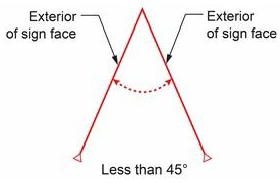
If the interior angle between two (2) sign faces is forty-five degrees (45°) or less, the sign area is computed as the area of one (1) face only. If the angle between two (2) sign faces is greater than forty-five degrees (45°), the sign area is computed as the sum of the areas of the two (2) faces. (See Figure 16-2: Angle of Sign Face.)
FIGURE 16-1: COMPUTATION OF SIGN AREA
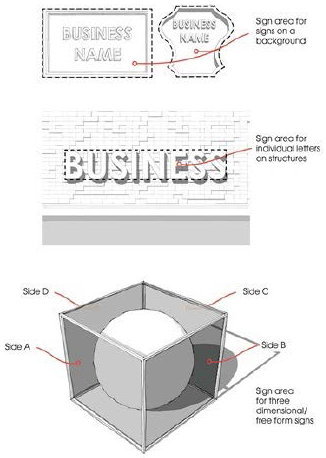
FIGURE 16-2: ANGLE OF SIGN FACE
(b)
Sign Height.
(1)
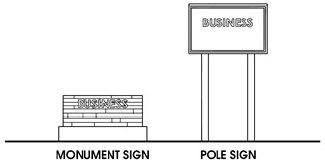
Pole type ground sign height is measured from the sidewalk along the lot line where the sign will be installed to the uppermost point of the sign. (See Figure 16-3: Monument Signs and Pole Signs.)
(2)
Monument type ground sign height is measured from average abutting grade to the uppermost point of a sign. (See Figure 16-3: Monument Signs and Pole Signs.)
FIGURE 16-3: MONUMENT SIGNS AND POLE SIGNS
(Code 1993, § 20-16.5)
Sec. 30-16.6. - General sign standards.
(a)
Construction.
(1)
All signs constructed, erected, modified or altered must comply with the provisions of this Article and the requirements of the Village Code.
(2)
All signs with a display area of greater than eighteen (18) square feet must be constructed of fire retardant wood, metal or other non-combustible material.
(3)
All signs constructed on, over or within five (5) feet of a public right-of-way must have no nails, tacks, wires or other hazardous projections from their surface.
(b)
Sign Structure and Installation. Supports and braces must be an integral part of the sign design. Supports or braces must be hidden from public view to the extent technically feasible. All signs attached to a building must be installed and maintained so that wall penetrations are watertight and the structure does not exceed allowable stresses of supporting materials.
(c)
Wind Pressure and Direct Load Requirements. All signs must be designed and constructed to withstand a wind pressure of no less than thirty (30) pounds per square foot of net surface area. All signs must comply with Village Code requirements (Section 1609.3 of 2006 International Building Code).
(d)
Electrical Components. All electrical fixtures, devices, circuits, conduits, raceways or apparatus used to illuminate, move or project any sign must be installed and maintained as required in the Village Code. All signs with electrical wiring and connections must have a plate, affixed to the sign, showing the voltage of the electrical apparatus used in connection with the sign.
(e)
Lettering. All letters, figures, characters or representations in cut-out or irregular form, maintained in conjunction with, attached to, or superimposed upon any sign must be safely and securely built or attached to the sign structure.
(f)
Illumination.
(1)
All sign illumination must be designed, located, shielded and directed so as to prevent the casting of glare or direct light upon adjacent publicly dedicated roadways and surrounding properties.
(2)
In no case may the lighting intensity of any sign, whether from internal illumination or external illumination, exceed seventy-five (75) footcandles when measured with a standard light meter perpendicular to the face of the sign at a distance equal to the narrowest dimension of the sign.
(3)
No sign may be illuminated between the hours of twelve o'clock (12:00) a.m. and six o'clock (6:00) a.m. unless the activity displaying the sign is open for business during those hours. The Zoning Administrator is authorized to grant an exemption from this provision to provide for the security and safety of the use on the property.
(4)
Goose-neck reflectors and lights are permitted provided that they concentrate the illumination upon the area of the sign so as to prevent glare upon the street or adjacent property. Any device used to provide external illumination for a sign may project no more than eighteen (18) inches from the face of the sign.
(g)
Limitation on Items of Information.
(1)
Signs are limited to seven (7) items of information.
(2)
Each piece of information on a sign is defined as an item of information. For example, each of the following is defined as one (1) item of information: establishment name, logo, telephone number, website address, or product or service. A street address number, if included in the sign copy, is not counted as an item of information. If a sign advertises products or services, each product or service, including multi-word, is considered one (1) item of information.
(3)
The changeable copy portion of changeable copy signs, including gas prices, are counted as one (1) item of information.
(4)
For a sign that contains a time and temperature component, the time and temperature component is not counted as an item of information.
(5)
All signs on a lot must be related to goods and/or services sold or offered on the premises, with the exception of non-commercial messages or political signs.
(6)
Directory signs, sidewalk signs and menu board signs are exempt from the items of information limitation.
(h)
Maintenance.
(1)
All signs, and the premises surrounding the sign, must be maintained in a clean, sanitary and inoffensive condition, and free and clear of all noxious substances, rubbish and weeds. All signs must be repainted or otherwise maintained periodically by the owner to prevent corrosion or deterioration caused by weather, age or other conditions.
(2)
If the Village finds that any sign is unsafe or insecure, is a menace to the public, or has been constructed or erected in violation of the provisions of this Article, the Zoning Administrator must immediately be advised of such condition and give written notice to the property owner. If sign permit holder fails to remove or alter the structure so as to comply with the standards of this Article within twenty (20) days, such sign may be removed by [the] Village at the expense of the sign permit holder or the property owner where the sign is installed. The Village may cause any other sign or other advertising structure that is an immediate peril to persons or property to be removed summarily and without notice.
(Code 1993, § 20-16.6)
Sec. 30-16.7. - Local sign ordinances.
(a)
Applicability. A multi-tenant commercial development, office building or association of merchants doing business within a specific area within the Village may establish specific sign regulations for such area. These regulations, called "Local Sign Ordinances," must be submitted to the Village Board for approval. If the Local Sign Ordinance is approved or approved with conditions by the Village Board, the Local Sign Ordinance will control in lieu of compliance with this Article.
(b)
Conditions for Approval. No Local Sign Ordinance will be approved by the Village Board unless the regulations are binding upon all properties within the shopping center, office building or specific area within the Village to which the regulations apply.
(c)
Approval Procedure. To obtain approval of a Local Sign Ordinance, an applicant must submit a complete set of sign regulations to the Zoning Administrator, together with any additional materials requested by the Zoning Administrator. The Zoning Administrator will review the regulations and transmit them with comments and recommendations to the Appearance Review Commission. The Appearance Review Commission will review the regulations and transmit them with comments and recommendations to the Village Board, who has final approval of the Local Sign Ordinance. The Village Board may approve, approve with conditions, or deny Local Sign Ordinances.
(d)
Private Sign Agreements. Nothing in this section or Ordinance prevents any property owner or association of merchants from establishing, by lease or other form of agreement, sign regulations that are more stringent than in this Article.
(e)
Exemption from Appearance Review Certificate. Signs that conform to the approved Local Sign Ordinance are exempt from the Appearance Review Certificate requirements. The Zoning Administrator, upon review of the sign permit application, may issue a sign permit if all signs are in compliance with the approved Local Sign Ordinance.
(f)
Adopted Local Sign Ordinances. The following Local Sign Ordinances are incorporated into this Ordinance as the following appendices.
(1)
Appendix A. Plaza Del Lago Local Sign Ordinance.
(2)
Appendix B. Edens Plaza Local Sign Ordinance.
(3)
Appendix C. West Lake Shopping Plaza Local Sign Ordinance.
(Code 1993, § 20-16.7)
Sec. 30-16.8. - Prohibited signs.
It is unlawful to erect or maintain the following signs:
(a)
Animated Signs. Animated signs are prohibited, including electronic display screens and electronic message signs. This does not include time and temperature components or order display screens on menu board signs.
(b)
Attention-Getting Devices. Attention-getting devices are prohibited, including strobe lights, spotlights and floodlights.
(c)
Box Signs. Box signs are prohibited. This does not apply to West Lake Plaza.
(d)
Flashing Signs. Flashing signs, defined as those signs with blinking, traveling/chasing or flashing lights, illuminating devices that change light intensity, brightness or color and rotating beacons, are prohibited. Time and temperature signs are not considered flashing signs.
(e)
Moving Signs. Signs with moving, revolving or rotating parts or visible mechanical movement of any kind, including pennants, streamers and all other signs that flutter, undulate, swing, rotate, oscillate or otherwise move by natural or artificial means, are prohibited. Clocks with movable hands are permitted.
(f)
Obscene Signs. A sign that displays any matter where the dominant theme of the material, taken as a whole, appeals to a prurient interest in sex or is patently offensive because it affronts contemporary community standards relating to the description or representation of sexual matters, and is utterly without redeeming social value is prohibited.
(g)
Off-Premise Signs. Off-premise signs are prohibited, unless specifically permitted by this Ordinance.
(h)
Painted and Illegally Affixed Signs. Signs painted directly on an exterior wall, roof, fascia, parapet or chimney of a building or on a fence are prohibited.
(i)
Portable Signs. Portable signs are prohibited. Sidewalk signs are not considered portable signs.
(j)
Roof Signs. Roof signs are prohibited.
(k)
Signs that Interfere with Ingress and Egress. Signs that prevent free ingress to or egress from any door, window or fire escape, or are attached to any fire escape or standpipe are prohibited.
(l)
Signs that Interfere with Traffic. A sign that interferes with traffic is prohibited. Such prohibited signs:
(1)
Obstruct free and clear vision at any street, intersection, parking lot entrance or exit, or driveway.
(2)
Interfere with, obstruct the view of, or be confused with any authorized traffic sign, signal or device because of its position, shape or color.
(3)
Make use of the words STOP, LOOK, DETOUR, DANGER or any other word, phrase, symbol or character in a manner that misleads, interferes with, or confuses traffic unless specifically approved by the Zoning Administrator.
(4)
Are illuminated in red, green or amber color, so as to resemble a traffic signal, when in the direct line of vision of a traffic signal.
(m)
Vehicle Advertising Signs. Advertising signs placed on a parked vehicle, or trailer, for the purpose of advertising a product or directing viewers to a business or activity are prohibited. This does not apply to public transit vehicles.
(n)
Neon Signs (Distance Restriction). Neon signs within a residential district or within sixty-six (66) feet of a residential district lot line.
(Code 1993, § 20-16.8)
Sec. 30-16.9. - Signs not requiring a permit.
The following signs, and sign alteration and maintenance activities, are exempt from the sign permit requirements of this Article.
(a)
Alteration and Maintenance Operations. The following activities are exempt from sign permit requirements:
(1)
Changing of the advertising copy or message on an existing changeable copy sign or similar approved sign, whether illuminated or non-illuminated.
(2)
Painting, repainting, cleaning, changing permitted items of information, or other normal maintenance and repair of a sign, not involving changes to the appearance, location, size or structural changes or changes to the electrical components of a sign.
(b)
Address Numbers and Nameplates. House numbers, as required by Section 30-16.13 of the Village Code, and house nameplates are exempt from sign permit requirements. Nameplates are limited to sixty (60) square inches in area.
(c)
Banners. Banners are exempt from sign permit requirements subject to the following:
(1)
Banners are permitted for any non-residential use.
(2)
Banners are limited to thirty-two (32) square feet in area.
(3)
Only one (1) banner is permitted per lot.
(4)
No banner may be located higher than the roofline of the building to which it is attached or, if attached to a permanent sign, higher than the sign. There must be no encroachment into the public right-of-way.
(5)
Banners are limited to a display period of thirty (30) days and must be removed within two (2) days after a specified event. Banners may be erected on a lot no more than four (4) times in a year.
(d)
Construction Signs. A construction sign identifying the parties involved in the construction to occur or occurring on the lot or premises on which the sign is placed is permitted without a sign permit, subject to the following:
(1)
Such temporary signs must be removed within seven (7) days after primary construction ceases for the project to which the sign pertains.
(2)
Only one (1) construction sign per street frontage may be placed on the lot or premises to which it pertains.
(3)
The sign area of each sign may not exceed:
(A)
Twenty (20) square feet in sign area where the street frontage is less than one hundred (100) feet.
(B)
Sixty-four (64) square feet in sign area where the street frontage is at least one hundred (100) feet.
(4)
Illumination of temporary construction signs is prohibited.
(e)
Construction Fence Signs.
(1)
Signage on construction fencing that is related to the construction or a commercial use, including multi-family uses, occurring on the premises on which the construction fence sign is placed is allowed without a sign permit, subject to the following:
(A)
Construction fencing signage may cover the entire construction fence but all text shall be limited to seventy-two (72) square feet for each twenty-four (24) linear feet of fencing.
(B)
Construction fencing signage shall not be illuminated.
(C)
Construction fencing signage shall be removed within six (6) months of issuance of the building permit authorizing the construction. The Zoning Administrator may grant an extension for up to one additional year.
(f)
Directional Signs. The following directional signs are exempt from sign permit requirements:
(1)
Directional or instructional signs accessory to parking and driveway areas, subject to the following regulations:
(A)
One (1) single or double faced sign may be erected to designate each entrance to or exit from a parking or driveway area. Sign area is limited to seven and one-half (7 1/2) square feet.
(B)
Signs designating the conditions of use of off-street parking spaces furnished by an activity may be placed in parking lots or alleys. Such signs may include the name of the activity furnishing the parking spaces but may not include any advertising.
(2)
Signs that direct or guide persons to facilities intended to serve the public, including signs identifying rest rooms, public telephones, walkways, and similar facilities. Advertising matter is not permitted on such signs.
(3)
In addition, an off-street parking facility that contains car sharing spaces may provide signs that in the aggregate total no more than two square feet in area identifying organizations that have car sharing vehicles available at such parking area. No such sign shall be located higher than seven feet above curb level.
(g)
Event Sign.
(1)
A sign announcing the opening or closing of a business, or a business founding anniversary at a location is permitted without a sign permit. Such a sign may not be displayed for more than eight (8) weeks from the date on which the activity commences or concludes. Signs announcing a sale related to the closing of a business or a stock liquidation may be displayed only two (2) times within a calendar year.
(2)
An event sign announcing a campaign, drive or event of a civic, philanthropic, educational or religious organization is permitted without a sign permit. Such signs must be removed within two (2) days after a specified event.
(3)
The sign area of an event sign may not exceed thirty-two (32) square feet.
(h)
Flags. Flags bearing the official design of a nation, state or political subdivision of a state are exempt from sign permit requirements.
(i)
Garage or Yard Sale Signs. A garage sale or house sale sign which announces the sale of tangible personal property by the property owner by means of the activity commonly known as a "garage sale," "yard sale" or "house sale" is permitted without a sign permit. Such signs must be displayed on private property only and must be removed within three (3) days of the sale. A garage sale or house sale sign is limited to four (4) square feet.
(j)
Government and Public Signs. The following government and public signs are exempt from sign permit requirements:
(1)
Signs displayed or erected by a governmental body.
(2)
Signs required or authorized for a public purpose by any law, statute or ordinance, to the extent that said signs are of the type, number, area, height, location or illumination as may be authorized by law, statute or ordinance.
(k)
Holiday Decorations. Holiday decorations, signs or other material displayed in connection with civic, patriotic or religious holidays are permitted without a sign permit.
(l)
Informational Matter.
(1)
Informational matter appearing on gasoline pumps, newspaper vending boxes and other vending machines, automatic teller machines, or matter appearing on or adjacent to entry doors such as PUSH, PULL, OPEN and/or CLOSED, or matter appearing on display windows or doors denoting hours of operation, credit cards accepted, and similar information are exempt from sign permit requirements.
(2)
An automobile service station may display one (1) sign, no larger than nine (9) square feet, above each pump island stating whether the area is a "self service" or "full service" area and the current price per gallon of gasoline sold at the station. No element of the cost to the customer of the gasoline may be omitted from the statement of the price.
(m)
Memorial Plaques. Memorial plaques, including cornerstones, historical plaques and similar signs, displayed for non-commercial purposes are exempt from sign permit requirements.
(n)
Political and Non-Commercial Message Signs.
(1)
A sign or poster expressing the opinion of the owner or occupant of the property about a political, religious, social or similar issue of public concern is permitted without a sign permit, provided that no advertising of goods or services is included.
(2)
Such signs must be posted on private property only, and only with the permission of the property owner.
(o)
Property Management Signs. Property management signs are exempt from sign permit requirements. Such signs must be installed as wall signs and are limited to one (1) square foot in area.
(p)
Real Estate Signs.
(1)
A sign advertising the sale or lease of real estate is permitted without a sign permit and must be located on the lot where the sale or lease of real estate is offered.
(2)
Real estate signs must be removed within seven (7) days after the buyer and seller are mutually bound to conclude the sale or lease of the real estate to which the sign pertains.
(3)
Only one (1) real estate sign per street frontage may be placed on the lot or premises to which it pertains.
(4)
The sign area of each sign may not exceed:
(A)
Ten (10) square feet in sign area where the street frontage is less than sixty (60) feet.
(B)
Twenty (20) square feet in sign area where the street frontage is at least (60) feet.
(q)
Restaurant Menu Signs. Restaurant menu signs containing only the current menu or specials offered by the restaurant are exempt from sign permit requirements. Restaurant menu signs must be wall or window signs and are limited to four (4) square feet in sign area. This does not apply to menu board signs for drive-through uses.
(r)
Theater Marquee. Information displayed on a theater marquee that indicates the names, showtimes and information on current movies or performances are exempt from sign permit requirements.
(s)
Window Signs - Temporary. A business is allowed one (1) or more temporary window signs without a sign permit, provided the total area of the business' window signs does not exceed fifteen percent (15%) of the window area. Temporary window signs are limited to a display period of eight (8) weeks. Temporary window signs cannot display any off-premise advertising, with the exception of non-commercial messages.
(t)
Window Wrap Signs.
(1)
Window wrap signs that are directly related to the commercial activity of the storefront in which the sign is to be placed are allowed without a sign permit, subject to the following:
(A)
Window wrap signs shall be removed within seven (7) days after the primary construction has been completed or within seven (7) days of the issuance of a Certificate of Occupancy for the business that will occupy the storefront.
(B)
Window wrap signs may cover one hundred percent (100%) of the window area.
(C)
The total text size on window wrap signs may not exceed fifty percent (50%) of the total wrap area.
(D)
Window wrap signs are permitted only on the ground floor, individual storefront of a commercial use that is vacant or is not open to the public due to construction activity within the building.
(Code 1993, § 20-16.9; Ord. No. 2015-O-13, 4-14-2015; Ord. No. 2017-O-44, 8-22-2017; Ord. No. 2023-O-57, § 3, 8-8-2023)
Sec. 30-16.10. - Signs requiring a permit.
(a)
General Restrictions. Table 16-1: Sign Types Permitted by District describes the sign types permitted within a district. In addition, the following restrictions also apply:
(1)
All businesses fronting on public or private streets and having their principal operation on the ground floor of a building are allowed those sign types and quantities as listed in Table 16-1. Such signs must be located on that part of the building having street frontage and are subject to the following:
(A)
Signs on an awning valance are always permitted but are limited to five (5) inches in height and no more than one (1) item of information.
(B)
Commercial uses located in residential zoning districts may display one (1) wall or projecting sign per street frontage. No other sign types are permitted.
(C)
Institutional uses located in residential zoning districts may display one (1) wall or ground sign per street frontage. No other sign types are permitted.
(2)
Townhouse, stacked flat and multi-family dwellings located in residential districts may display a ground sign oriented to the street on which it fronts only if the development consists of at least twenty (20) dwelling units and has at least one hundred (100) feet of street frontage.
(3)
Businesses lacking frontage on a public or private street may locate only one (1) sign in accordance with applicable sections of this Article on that face of the building which is designated by that business as its principal frontage, and contains the primary entry into the business.
(4)
All signs must comply with the standards of this section.
(b)
Awnings. Awnings that are considered an architectural feature of a structure and are not used for identifying the premises or the goods and/or services sold are not considered a sign. Awnings used as signs are subject to the following regulations:
(1)
No portion of an awning may extend beyond a point two (2) feet inside the curb line. When an awning extends over a Village right-of-way, the applicant must sign a hold harmless/indemnification agreement.
(2)
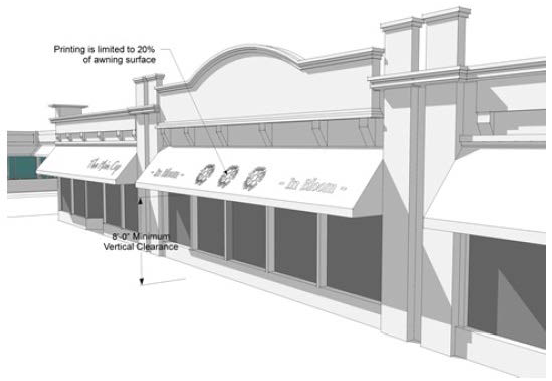
An awning must maintain a minimum vertical clearance of eight (8) feet above the ground over which it projects. (See Figure 16-4: Awning Surface.)
(3)
Awnings must be securely attached to and supported by a building. All frames and supports must be made of metal or similar rigid material. Frames and supports may not be made of wood or plastics.
(4)
Printing on an awning sign is limited to twenty percent (20%) of the face of the awning not including sidewalls. (See Figure 16-4: Awning Surface.)
(5)
Awning signs must be constructed out of canvas, canvas-like material, fabric or metal. Back-lit box and plastic awnings are prohibited.
(6)
An awning sign may be externally illuminated.
FIGURE 16-4: AWNING SURFACE
(c)
Directory Signs. Multi-tenant non-residential uses shall be permitted a directory sign in addition to any other signs allowed. A multi-tenant building shall be permitted one (1) wall mounted directory sign of no more than six (6) square feet per building, or one (1) free standing ground sign of no more than sixteen (16) square feet per building.
(d)
Ground Signs.
(1)
Ground signs are permitted as follows:
(A)
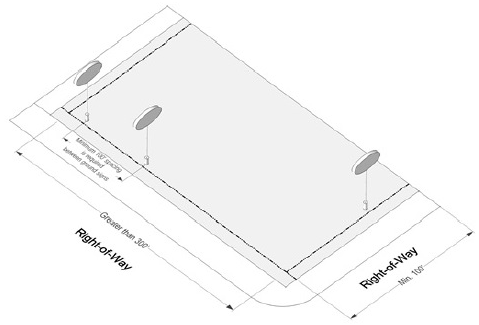
A non-residential use may display a ground sign oriented to any roadway if the use has at least one hundred (100) feet of street frontage. (See Figure 16-5: Ground Signs on Corner Lots.)
(B)
A non-residential use which has in excess of three hundred (300) feet of street frontage may display one (1) additional ground sign for each three hundred (300) feet of frontage in excess of the first three hundred (300) feet of frontage. Such ground signs must be separated by a minimum of one hundred (100) feet. (See Figure 16-5: Ground Signs on Corner Lots.)
(2)
The maximum sign area of a ground sign is as follows:
(A)
Ten (10) square feet for townhouses and multi family uses in a residential zoning district.
(B)
Ten (10) square feet for non-residential uses in a residential zoning district.
(C)
Thirty (30) square feet for any non-residential use in a non-residential zoning district.
(3)
The maximum height of a ground sign is as follows:
(A)
Seven (7) feet for townhouses and multi family uses in a residential zoning district.
(B)
Seven (7) feet for any use in the OR District.
(C)
Seven (7) feet for non-residential uses in a residential zoning district.
(D)
Ten (10) feet for any non-residential use in a non-residential zoning district if oriented to a street other than Green Bay Road, Lake Avenue or Skokie Boulevard.
(E)
Fifteen (15) feet for any non-residential use in a non-residential zoning district if oriented to Green Bay Road, Lake Avenue or Skokie Boulevard.
(4)
A ground sign is limited to support by no more than two (2) upright standards.
(5)
A ground sign may be internally or externally illuminated in all non-residential districts, except the OR District. A ground sign may be externally illuminated in all residential zoning districts or the OR district.
FIGURE 16-5: GROUND SIGNS ON CORNER LOTS
(e)
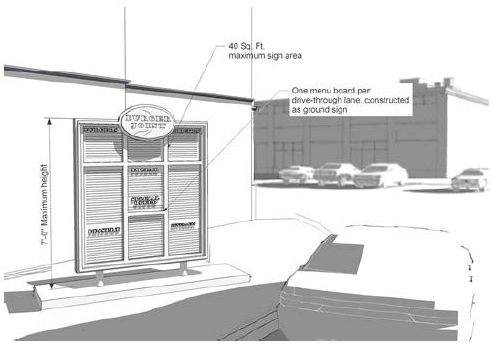
Menu Board Signs. Drive-through facilities are permitted one (1) menu board sign, constructed as a monument sign, no more than forty (40) square feet in sign area, no more than seven (7) feet in height, and no less than fifteen (15) feet from any lot line. Menu boards shall not face or be located adjacent to residential properties. Menu boards shall not be internally illuminated, but may be externally illuminated using a shielded bulb. The use of audio components is limited to communications between the driver and the establishment. (See Figure 16-6: Menu Board Signs.)
FIGURE 16-6: MENU BOARD SIGNS
(f)
Marquees.
(1)
Marquees are only permitted for indoor amusement facilities and live performance venues.
(2)
Marquees are restricted to a position over the main entrance into a building. Marquees are limited to the width of the entrance or entrances of the building plus five (5) feet on each side thereof.
(3)
No portion of a marquee may extend beyond a point one (1) foot inside the curb line. When a marquee extends over a Village right-of-way, the applicant must sign a hold harmless/indemnification agreement.
(4)
Marquees must maintain a vertical clearance of ten (10) feet above the sidewalk over which it extends.
(5)
Marquees must be supported solely by the building to which they are attached, and no columns or posts are permitted as supports. All marquees, including anchors, bolts, supports, rods and braces, must be constructed of incombustible or approved combustible materials, designed by a structural engineer and approved by the Village Engineer.
(6)
No marquee is permitted on any building of wood frame construction.
(7)
The roof of all marquees must be properly guttered and connected by downspouts to a storm sewer or other drainage acceptable to the Zoning Administrator so that water will not flow onto public property.
(8)
The roof of any marquee must be designed and constructed to support a live load of no less than forty (40) pounds per square foot.
(9)
The roof of all marquees must be used for no other purpose than to form and constitute a roof, and must be constructed of incombustible materials.
(10)
No temporary sign may be attached to or hung from a marquee.
(11)
A changeable copy sign affixed or illuminated directly upon the vertical hanging fascia of the marquee is permitted.
(g)
Projecting Signs.
(1)
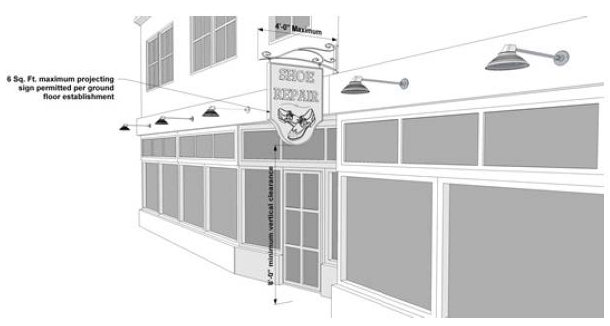
Projecting signs are limited to six (6) square feet in sign area. (See Figure 16-7: Projecting Signs.)
(2)
A projecting sign must maintain a vertical clearance of eight (8) feet above the ground over which it projects. No projecting sign affixed to a building may project higher than the building height, including the sign support structure. When a projecting sign extends over a Village right-of-way, the applicant must sign a hold harmless/indemnification agreement. (See Figure 16-7: Projecting Signs.)
(3)
Projecting signs, including frames, braces, and supports must be designed by a licensed structural engineer or manufacturer. No projecting sign may be secured with wire, chains, strips of wood or nails nor may any projecting sign be hung or secured to any other sign. Any movable part of a projecting sign, such as the cover of a service opening, must be securely fastened by chains or hinges.
(4)
Projecting signs are limited to four (4) feet of projection from the face of the building to which they are attached, including the area between the sign and the face of the building. (See Figure 16-7: Projecting Signs.)
(5)
A permitted projecting sign may only be externally illuminated.
FIGURE 16-7: PROJECTING SIGNS
(h)
Sidewalk Signs.
(1)
Restricted Information.
(A)
Off-premise advertising is prohibited.
(B)
Information on the sale of alcoholic beverages or price for alcoholic beverages is prohibited.
(2)
Design Standards.
(A)
Sidewalk signs must be constructed of weather-resistant materials, such as wood, plastic or metal. Sidewalk signs constructed of impermanent materials, such as cardboard and paper, are prohibited.
(B)
Foil, mirrors, bare metal or other reflective materials that could create hazardous conditions to motorists, bicyclists or pedestrians are prohibited.
(C)
Illumination of sidewalk signs is prohibited.
(D)
Sidewalk signs must be sufficiently weighted or constructed to keep sign in approved location.
(3)
Size and Number of Sidewalk Signs Allowed.
(A)
The maximum signable area is limited to six (6) square feet per sign face, with a maximum of two (2) sign faces per sidewalk sign.
(B)
Maximum overall height of a sidewalk sign is limited to forty-two (42) inches above the sidewalk upon which it is placed.
(C)
A maximum of one (1) sidewalk sign per business is permitted, including businesses having more than one (1) street frontage.
(4)
Permitted Location.
(A)
Sidewalk signs are allowed in non-residential districts only.
(B)
In the case of a sidewalk sign on the public sidewalk, a sidewalk sign may be placed only along the street level frontage of the business whose sign is being displayed. In the case of a sidewalk sign on a private sidewalk, a sidewalk sign may only be displayed in front of the building with frontage on that private sidewalk where the business is located. No sidewalk sign may be displayed in front of any other business.
(C)
No sidewalk sign is permitted for a home occupation or for any use within a residential zoning district.
(D)
Sidewalk signs must be placed in so that there is a continuous unobstructed width of a sidewalk or walkway of at least five (5) feet.
(E)
Sidewalk sign placement may not obstruct ingress/egress to a building, steps or driveway access, or other similar feature, or be placed within five (5) feet of a wheelchair ramp or curb cut.
(F)
Each sidewalk sign must be at least fifteen (15) feet from any other sidewalk sign.
(G)
Sidewalk signs are prohibited in streets, roadways and alleys.
(H)
Sidewalk signs must be free standing, and cannot be attached to any other structures, such as parking meters, trees and utility poles.
(I)
Sidewalk sign placement must not create a visual obstruction so as to create a safety hazard.
(5)
Display Period.
(A)
Sidewalk signs may be displayed only during the hours the business is open.
(B)
Owners are responsible for the removal of their sidewalk signs following business hours and during periods of strong winds and snow accumulation.
(6)
Sidewalk Sign Permit Required.
(A)
A sign permit is required for any sidewalk sign. A sign permit for a sidewalk sign may only be issued for period of validity up to one (1) year. Every sign permit for a sidewalk sign expires December 31st of each year.
(B)
An applicant for a sidewalk sign permit must sign a statement that the applicant agrees to adhere to the standards and requirements of this regulation, and if not, the sign may be removed by the Village and/or the sign permit revoked.
(C)
An applicant wishing to obtain a permit for a sidewalk sign is required to sign a hold harmless/indemnification agreement or provide evidence that the applicant maintains liability insurance in an amount as required by the Zoning Administrator naming the Village of Wilmette as an additional insured. Such coverage may not be canceled or modified without thirty (30) days prior written notice to the Zoning Administrator. Failure to maintain such insurance coverage will result in revocation of the permit.
(D)
A copy of the approved permit must be legibly attached to the underside of the sign at all times.
(E)
Failure to comply with any of the above standards at any time may result in the Village removing said sidewalk sign without prior notice. If the Village removes a sidewalk sign, written notice of the sign's removal will be mailed to the business owner at the address listed on the sign permit application via U.S. Postal Service regular mail. The notice must state with particularity the reason for removal. The confiscated sidewalk sign will be stored for thirty (30) calendar days after the mailing of such notice.
(F)
An owner of a sidewalk sign that has been removed by the Village may retrieve said sidewalk sign upon payment of an impoundment fee, payable to the Village of Wilmette, no later than thirty (30) days after the date of the notice of impoundment. The impoundment fee is as follows:
(i)
First Offense in the amount set forth in section 2-1340 of this Code.
(ii)
Second Offense in the amount set forth in section 2-1340 of this Code.
(iii)
Third Offense and thereafter in the amount set forth in section 2-1340 of this Code.
(G)
Alternatively, said owner within the same thirty (30) day period may submit a written protest to the Zoning Administrator stating with particularity why the sidewalk sign in question should not have been confiscated, and the Zoning Administrator must respond in writing to such protest within ten (10) business days. Any sidewalk sign not retrieved by the owner within thirty (30) calendar days after the date of the notice of impound, or within thirty (30) days after the Zoning Administrator has mailed a response to such written protest as may have been filed, may be destroyed by the Village.
(i)
Time and Temperature Signs. A time and temperature sign may not include any advertising or convey any news information. The sign display may not change more frequently than one (1) change per three (3) seconds.
(j)
Wall Signs.
(1)
Non-residential uses are permitted one (1) wall sign per street frontage.
(2)
Wall signs must be safely and securely attached to the building wall no less than eight (8) feet above the ground and affixed flat against the building wall.
(3)
Wall signs are limited to a maximum projection of twelve (12) inches from the building wall.
(4)
No wall sign affixed to a building, including sign support structure, may project beyond the ends or top of the wall to which it is attached. On existing buildings, a parapet wall may not be constructed for the sole purpose of increasing the allowable height of a wall sign. For new buildings, when a sign is to be mounted on a parapet wall, that parapet wall must be consistent with the architectural design of the building, including building materials. Wall signs may not be attached to un-reinforced masonry parapets. Wall signs must not cover windows, doors or architectural features.
(5)
Wall signs must be constructed of wood, plastic/acrylic or metal.
(6)
A permitted wall sign may be externally or internally illuminated, except that a non-conforming use in a residential zoning district may not be internally illuminated.
(7)
The permitted sign area for a wall sign is as follows:
(A)
Wall signs are limited to the signable area of a building, and must cover no more than thirty percent (30%) of the signable area. The signable area for a building is established by filing with the Zoning Administrator a written description or sketch defining or showing the signable area.
(B)
The responsibility for filing the description or sketch of the signable area is with the building owner and the building occupant or occupants. Such persons may file the description or sketch prior to or within twenty (20) days after being requested to do so by the Zoning Administrator. If the building owner and building occupant or occupants fail to establish the signable area for the building within twenty (20) days after being requested to do so by the Zoning Administrator, the signable area for the building will be established by the Zoning Administrator.
(k)
Window Signs - Permanent.
(1)
The combined total area of a permanent window sign and temporary window signs is limited to a maximum of twenty percent (20%) of the window area. Window panels separated only by mullions are considered one (1) continuous window area in the computation of window surface area.
(2)
The total area of a permanent window sign is limited to a maximum of ten percent (10%) of the window area. However, if no wall or awning sign is displayed, businesses are permitted up to twenty percent (20%) of window coverage with permanent window signs.
(Code 1993, § 20-16.10; Ord. No. 2024-O-54, § 2, 10-10-2024)
Sec. 30-16.11. - Non-conforming signs.
See Section 30-17.6 (Non-conforming Signs) for the provisions for non-conforming signs.
(Code 1993, § 20-16.11)

