
Ascension Parish City Zoning Code
17-2038
Solar energy farm facility standards for development.
A.
Purpose. The purpose of this ordinance is to set minimum standards and requirements for the permitting and operation of solar energy farm facilities (SEFFs) in Ascension Parish.
B.
SEFFs may be permitted as a conditional use in the following zoning districts, subject to the applicable minimum standards: Mixed use corridors (MU), mixed use 2 corridors (MU2), crossroad commercial (CC), medium intensity residential (RM), rural district (R), conservation (C), heavy industrial (HI), medium industrial (MI) and light industrial (LI).
1.
An application for a conditional use permit for SEFFs shall be heard by the Ascension Parish Zoning Commission who shall submit recommendation(s) to the Ascension Parish Council who shall give final approval or denial under the following procedure at two meetings.
a.
The Parish Council shall vote to accept or deny the recommendation of the Zoning Commission at the first meeting.
b.
A public hearing shall be held at the second meeting, noticed as required under Appendix II — Development Code to approve or deny the conditional use permit.
c.
If denied, the application will be eligible for resubmission one year from the date of the denial.
2.
If approved, the petitioner shall have one year to obtain the appropriate building permits or commence construction at the site from the date of approval of the Ascension Parish Council, unless otherwise stipulated by the approval.
C.
Applicability. This ordinance applies to all solar energy farm facilities constructed in the parish. Solar energy farm facilities are defined as:
Power generating facilities constructed on immovable property for the purpose of producing photovoltaic electricity, solar heated fluids, or solar thermal electricity intended for distribution and sale through the power grid. The term shall not include residential or commercial facilities for the production of electricity or other solar power that is produced on or adjacent to the site where it is directly consumed or where the residential or commercial facility is connected to the power grid on a net-metering basis where the beneficiary of the net metering is the residential or commercial facility owner or occupant.
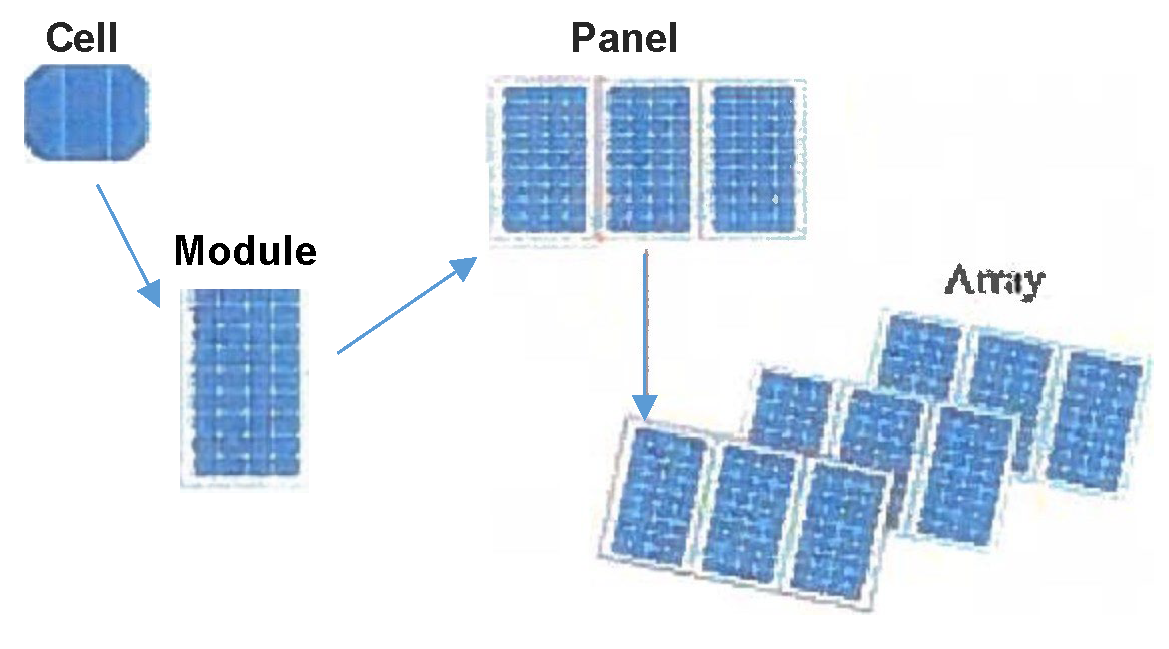
For convenience, solar energy farm facilities shall be referred to herein as "SEFFs." Components of a SEFF shall be identified in accordance with the following schematic:
As used in this section, the following terms shall have the meanings indicated:
Cell means a photovoltaic (PV) cell, commonly called a solar cell, is a single nonmechanical device that converts sunlight directly into electricity and is the fundamental component from which larger units of a SEFF are assembled and are typically grouped into modules.
Panel means a collection of cells or modules assembled as a pre-wired, field-installable unit that mounts to the structural components of a SEFF, typically with dimensions of approximately four feet x seven feet.
D.
The Parish Office of Planning and Development is responsible for the initial evaluation of all SEFF conditional use applications to ensure the development is constructed and operated in compliance with the requirements of this ordinance. SEFF permit applications shall be evaluated and processed in accordance with section 17-2038. No SEFF development permit will be issued unless the application conforms to these requirements.
E.
Lot size. Minimum lot size of the facility shall be 20 contiguous acres or greater.
F.
Height. All solar panel structures and supporting equipment shall be restricted to a maximum height of 16 feet. Medium and low voltage collection lines shall not exceed the height of more than eight feet above the ground and comply with all applicable codes. Meteorology (met) towers necessary for monitoring of the SEFF shall not exceed 50 feet in height. These height restrictions shall not apply to interconnection equipment (i.e., collector substation, switchyard, high voltage transmission lines) to ensure public safety and to ensure compliance with electrical safety codes and standards.
G.
Setbacks. All solar panels, support structures, inverters, transformers, and mechanical equipment within the SEFF shall be setback at least the greater of:
1.
Five hundred feet from any occupied residence or formal place of worship;
2.
Five hundred feet from the boundary of any nearby area designated for residential neighborhood or employment (industrial/business park);
3.
Five hundred feet from the perimeter boundary of the SEFF if the facility is permitted in a residential neighborhood or employment (industrial/business park) area, or;
4.
One hundred feet from any adjacent property line.
5.
All lease/property boundaries of a SEFF shall be a minimum of 300 feet from any public road right-of-way to allow for commercial or residential corridor development.
Agriculture uses are permitted within the setback areas.
H.
Fire Protection. Areas of the SEFF susceptible to fire shall be equipped with a fire monitoring system. The system shall automatically notify off-site emergency personnel listed in the facility's emergency response plan. These efforts will be coordinated with the local fire district. The facility will be designed and built to the National Electrical Safety Code (NESC) guidelines. The facility shall comply with all applicable codes and regulations standards for fire protection and shall be designed and constructed utilizing engineering controls to limit the spread of fire.
The facility will comply with chapter 8 of the Ascension Parish Code of Ordinances, emergency management.
I.
Safety/Access. A minimum eight-foot security fence shall be placed around the perimeter of the SEFF to prevent unauthorized access. Fencing shall be agricultural-style woven wire fencing, chain link, or an alternative providing an equal or better measure of security and safety, as approved under the conditional use permit. Perimeter barbed wire fencing is not required, unless state or federal codes or regulations require otherwise. The fencing shall encompass the perimeter of facility inside of the vegetative buffer required under subsection N. Lock boxes and keys to the facility shall be stored at locked entrances for emergency access. Entrances shall be equipped with lights for nighttime illumination.
J.
Signage. One or more signs shall be affixed to the fence at the main entrance identifying the owner of the facility and emergency contact information.
K.
Emergency Services. A copy of the electrical schematic and site plan shall be submitted to the Fire Chief of the fire district. The owner or operator shall develop an emergency plan and provide it to the Fire Chief for approval prior to commencing commercial operations. Emergency plans for the SEFF will be updated (or confirmed as current) in writing to the Fire Chief by March 1 of each year, and shall be reviewed annually by the Fire Chief, prior to April 1 of each year. Copies of the emergency plan and approval(s) shall also be provided to the Planning and Zoning Department as part of the conditional use permit.
L.
Noise. The SEFF shall not exceed 50 A-weighted decibels (dBA) or five dBA over existing ambient levels, whichever is greater, as measured at the facility's immovable property boundary(s) while the facility is in operation. A noise analysis demonstrating compliance with this noise standard shall be provided with the application. The study shall be conducted in conformance with American National Standard ANSI/ASA S1.13-2020: Measurement of Sound Pressure Levels in Air (as supplemented and updated as an American National Standard) and shall be completed by an independent third party.
M.
Maintenance. The owner or operator of the SEFF shall maintain the SEFF in good condition. This should include, without limitation, painting, structural repairs, vegetation control, non-public roads, perimeter fencing and locks, perimeter landscaping, and integrity of security equipment.
1.
Adherence to the plan is subject to periodic or random inspections by the parish, and the parish may require adherence to the plan regarding maintenance.
2.
In the event an inspection notes a failure to adhere to the plan, the parish may levy a fine of up to $100.00 if the applicant fails to remedy the failure within one day of such notice. Each day thereafter shall be an additional violation and shall be subject to an additional $200.00 fine for each violation until the failure is remedied. After five consecutive days of violation, the per day fine shall increase to $500.00. A repeat violation within the same month as a prior violation is remedied shall be subject to a fine of $500.00. Such fine shall apply to each day of the repeat violation shall provide written notice to the permittee of the deficiency, which notice shall be deemed provided upon delivery by mail or electronic means. The permittee shall have five days from the date of delivery of the notice to remediate the deficiency. If the permittee fails to remediate the deficiency, the permittee shall be fined $500.00. The permittee shall be fined $500.00 for each day, or part thereof, for each subsequent day that the deficiency is not remediated, with each day considered a separate violation.
N.
Landscaping. Prior to commencing construction of the SEFF, a perimeter landscaping buffer shall be planted (but with allowances for construction ingress and egress). The buffer shall be designed and certified by a registered landscape architect to create an opaque vegetative "hedge" within two years of commercial operation along all property lines that are oriented to public roads, highways and existing occupied residences within 500 feet of the SEFF boundary. The vegetative perimeter shall consist of trees, foliage, bamboo, etc. such that the facility equipment is concealed from public view. Vegetation shall be maintained for the duration of the SEFF's operation. The Zoning Commission/Parish Council may require visual screening with fabric or solid fencing where special circumstances related to adjacent occupied structures warrant such treatment.
O.
SEFF Permit Application. The following information shall be submitted to the Ascension Parish Office of Planning and Development for each proposed SEFF, or an addition to an existing SEFF.
1.
Facility Description and Rationale. Identify the name of the facility, name(s) of all owner(s), and engineers, surveyors, other professionals and contractors to be engaged in the design and construction of the facility, along with a description of their licensing and/or professional credentials. The type, size, rated power output, performance, safety and noise characteristics of the proposed system should be identified.
2.
Permits. The SEFF shall not begin delivering power in commercial quantities to the electrical grid until all required permits from the local, state, and federal levels have been obtained. A list of permits already obtained and permits anticipated to be obtained along with a timeline to obtain said permits shall be provided with the SEFF permit application.
3.
Lease. If the immovable property site of the facility is leased, the facility owner or operator shall submit a copy of the recorded notice of lease (or similar recorded instrument), which shall contain the following: (a) a declaration that the property is leased and the names and addresses of the lessor and lessee; (b) an immovable property description of the leased property and size of the leased property; (c) the date of the lease; (d) its term and the provisions of any extensions and renewals of the term provided for in the agreement; and (e) if a sublease, a reference to the recordation information of the primary lease of notice of lease that is subleased.
4.
Economic Impact. The facility owner or operator shall submit a report detailing the estimated financial economic impact to the parish over the entire life of the SEFF. This report shall be prepared by a qualified third party. The economic report shall fully disclose the underlying data, methods of analysis, and other statistical information to support the report's conclusions. Any economic modelling utilized in preparing the report shall be made available to the parish, upon request, for verification. The Office of Planning and Zoning may retain the services of a consultant to review this report.
5.
Boundaries. Identify all immovable property boundaries and actual dimensions upon which the SEFF will be located, including total acreage, with bearing and distances. Identify on same plat, the names and addresses of all adjacent property owners.
6.
Site Plan. A site plan shall be submitted showing streets, circulation, driveways, service building(s), easements, arrangements and locations of solar panels and all systems and equipment on the immovable property. Include the location of all facility signage, including warning signage. Site plan shall denote all FEMA flood zones and designated base flood elevations (BFE's) within the facility with all buildings and equipment meeting Ascension Parish elevation requirements as per Appendix V — Drainage of the Unified Land Development Code.
7.
Transportation Management. Applicants shall be required to adhere to section 17-4060 — traffic impact analysis, contained in Appendix IV —Subdivision Regulations of the Unified Land Development Code. The traffic impact analysis shall consider the number of trips generated by temporary construction jobs and the number of permanent jobs associated with the facility. The traffic impact analysis shall meet DOTD in addition to parish requirements. The application shall include a dust control component to mitigate the traffic impact indicated by the analysis, and shall provide for limestone, hard surface, or similarly durable materials on all access roads.
8.
Visual Impacts. Applicant shall demonstrate the visual impact of the proposed SEFF using renderings and drawings with the consideration of the vegetative buffering. Renderings shall be provided to illustrate the visual appearance of the facility from relevant public roads and from areas of existing occupied residential or commercial development.
9.
Wildlife. Submit a report summarizing the potential effects of the facility on wildlife and endangered species in the area. This report must be prepared by a qualified third-party consultant with expertise in wildlife management and environmental studies. To the extent that a proposed facility will impact a natural wildlife habitat, the report shall comply with the March 20, 1996, U.S. Fish and Wildlife Service "Habitat Evaluation Procedures," Publication 870 FW I (as supplemented and updated).
10.
Environmental and Health Safety Standards. All applicable environmental, health and safety regulations and standards shall be complied with during construction and operation of the facility to protect the public health and the environment.
11.
Drainage Impact. Applicant shall provide a drainage impact study according to Attachment B — Drainage Impact Study Procedure contained in Appendix V — Drainage of the Unified Land Development Code.
12.
Solid and Hazardous Waste. Identify solid waste or hazardous waste that will be generated by the SEFF. The application shall include a plan for spill prevention, clean-up and disposal of obsolete materials, fuels, oils and hazardous wastes, as well as collection and storage methods for solid waste generated by the SEFF.
a.
There shall be installed a containment levee with an impermeable barrier both below and at the perimeter of the SEFF to prevent any hazardous materials due to spills, accidents, or panel damage from exiting perimeter boundary of the SEFF.
13.
Wind. Provide an analysis of the solar equipment's ability to withstand hurricane sustained winds and provide evidence that the facility racking is designed and constructed either in accordance with Minimum Design Loads and Associated Criteria for Buildings and Other Structures, ASCE 7-16 (as supplemented) published by American Society of Civil Engineering, or in accordance with the Louisiana State Uniform Construction Code in effect at the time of SEFF construction, whichever results in the stronger structural standard.
14.
Lighting. Provide lighting plans showing all lighting within and on the perimeter of the facility. Dark sky lighting shall be employed to prevent 'spill over' to adjacent properties.
15.
Transportation Plan. Provide an access plan for both the construction and operation phase of the facility. The plan must show proposed facility service road ingress and egress access onto the primary and secondary routes and the layout of the facility service road system.
16.
Vegetative Maintenance Plan. Submit a plan for the upkeep and maintenance of the vegetation in compliance with subsection 17-2038.N.
17.
Public Safety. Submit a copy of the emergency response plan to the parish Director of Homeland Security and Emergency Preparedness in compliance with chapter 8 of the Ascension Parish Code of Ordinances, emergency management. Note that sole dependance on local fire department(s) and public employee emergency responders are not the primary responders and that independent fire/emergency responders must be secured by contract to perform these services.
18.
Sound Limitations. Identify anticipated noise levels at the fence line of the facility when construction is complete and when in operation. Project must adhere to the Ascension Parish Code of Ordinances, chapter 14, article III — noise.
19.
Magnetic Field Limitations. Identify anticipated magnetic field levels in mG at various distances from representative solar panels, inverters, and medium voltage transmission lines.
20.
Telecommunications Interference. Identify electromagnetic fields and communications interference to be generated by the facility when construction is complete and when the facility is in operation.
21.
Solar Panel Angles. Submit a vehicular glare analysis on the layout, mounting and movement of the solar panels and demonstrate that the glare will be minimized and will not interfere with vehicular traffic. The glare analysis methodology shall be consistent with that described in Ho, C. K., Ghanbari, C. M., and Diver, R. B., 2011, Methodology to Assess Potential Glint and Glare Hazards, as published in the ASME Journal of Solar Engineering, Vol. 133, August 2011. Glare impacts must fall within the "Low Potential for After-image" region shown in Figure 2 of that publication.
22.
Aviation Analysis. Submit an aviation glare analysis developed by a qualified third-party contractor showing any potential aviation glare hazards that would arise from the facility and their effect on local airports and/or flightpaths. The aviation analysis shall be performed in accordance with Federal Aviation Administration policy related to solar systems, published on May 11, 2021, at 86 FR 2580 I, as updated but subsequently issued policies in force at the time an application is submitted.
23.
Life of the Facility and Final Reclamation. Submit a decommissioning and final immovable property reclamation plan ("decommissioning plan") in compliance with state law without exception as contained in RS 30:1154, subsection (c). In the absence of state law, the Zoning Commission/Parish Council may establish the requirements for a decommissioning plan, which will include a surety bond or other suitable security to guarantee the execution of the decommissioning plan.
P.
Application and Permit Fee. The SEFF permit application fee shall be $5,000.00 plus 1.2 cents per square foot of gross area of solar panels located within the facility's fenced boundary. This fee shall be paid with the SEFF permit application. No processing or review of the SEFF permit application will begin until the permit fee has been paid. The permit fee shall be adjusted annually in accordance with the Consumer Price Index published by the U.S. Bureau of Labor Statistics (www.bls.gov/news.re1ease/cpi.t04.htm or its successor URL) using Table 4, Consumer Price Index for All Urban Consumers (CPI-U): Selected Areas, All Items Index, South Region, Size Class B/C, or that index's successor indicator.
The permit application fee is intended to cover the expenses to the parish, which include, but are not limited to, the cost of advertisement, hiring of consultants to guide the review process, and administration and supervision of any approved project by the consultant(s) as authorized by the parish. The fee is not refundable. If the parish, in their administration and enforcement of this ordinance, requires expert assistance that exceeds the application fee, the cost of such assistance shall be borne by the applicant or owner/operator and shall be deposited into escrow upon request, with any balance of any unused portion of the deposit returned to the applicant, owner or operator.
Q.
Annual Inspection and Permit. All SEFFs shall be required to receive an annual inspection by the parish on or before June 1 in advance of hurricane season to confirm ongoing compliance with section 17-2038. This annual inspection requirement shall apply to all SEFFs, whether constructed or approved before or after the effective date of this Ordinance.
Inspection Fee. An annual inspection fee shall be required. This fee is intended to account for the costs of providing the annual inspections by the parish, or their certified consultant. The inspection fee shall be submitted by April 1 of each calendar year. The fee shall be $3,000.00 plus 1.2 cents per square foot of gross area of solar panels located within the facility's fenced boundary. The inspection fee shall be adjusted annually on the same basis as the application fee. Late payments of the annual inspection fee shall be charged interest at the statutory judicial interest rate, along with a late penalty of five percent per month, not to exceed a total of 25 percent of the inspection fee.
R.
Dedication of SEFF annual inspection fees. Upon completion of the annual inspection and payment to the certified consultant, remaining funds collected from annual inspections will be dedicated to the parks and recreation budget for identified capital projects that benefit the residents of the parish. If no capital projects are identified for parks and recreation, the annual inspection fees will be submitted to the road and bridge fund for road maintenance.
S.
Conflict of Laws. Whenever the requirements of this ordinance conflict with each other or with the requirements of any other applicable state, regulation, or law, including, without limitation, any regulations that may be promulgated by the Louisiana Department of Natural Resources, the more restrictive regulations shall apply.
T.
Applicability/Retroactivity. Notwithstanding any language in this Ordinance to the contrary, subsections 17-2038.I, 86-26(h), (i), (j), (I), and (q) shall apply to all SEFFs in the parish, regardless of when they were originally constructed or permitted. Section 17-2038 in its entirety shall apply to any SEFF for which final approval has not been rendered by the parish as of the effective date of this ordinance.
U.
Variances. The Zoning Commission/Parish Council may recommend/approve variances from the strict application of section 17-2038 when reasonably warranted by site conditions or project features that are not fully accounted for by the provisions of section 17-2038. To be effective, any such variance must be explicitly stated in the Zoning Commission's recommendation and approved by the Parish Council as a condition of the conditional use permit.
(Ord. of 10-3-2024(1), Exh. A; Ord. No. ZT24.01, Exh. A, 2-20-2025)

