
Ashland City Zoning Code
ARTICLE III
RURAL RESIDENTIAL DISTRICT RR-1
97-05
95-04
96-32
97-10
98-2
98-8
99-4
2003-16
2009-08
2017-02
98-23
12-13-94
Sec 21-23 Statement Of Intent
The purpose of this district is to allow for large lot residential development, limited agricultural uses and other open space uses. This district is also intended for protection of watersheds, water resources, forest areas, and scenic values.
Adopted by Ord. 97-05 § 1 on 4/27/1997
Sec 21-24 Use Regulations
The following uses and structures shall be permitted in the Rural Residential District RR-1:
- Accessory uses as defined
- Agriculture, Limited, to include temporary stands for seasonal sale of products raised on premises
- Bed and Breakfast, with a conditional use permit and in accordance with the provisions of Sec. 21-262
- Cemetery, with a conditional use permit
- Church or Place of Religious Worship
- Community Center, with a conditional use permit and as an accessory use to a Church or Place of Religious Worship
- Community Garden, over one (1) acre with a conditional use permit
- Day Care Center, with a conditional use permit and as an accessory use to a Church or Place of Religious Worship
- Day Care Center, Adult, with a conditional use permit and as an accessory use to a Church or Place of Religious Worship
- Dwelling, Accessory Apartment, with a conditional use permit and in accordance with the provisions of Sec. 21-264
- Dwelling, Single-Family Detached
- Educational Facility, with a conditional use permit and as an accessory use to a Church or Place of Religious Worship
- Home occupation
- Parks, over one (1) acre with a conditional use permit
- Public Facilities, with a conditional use permit
- Schools, with a conditional use permit
- Timbering and wood storage not over 30 days
- Towers and Aerials, if over 60' with a conditional use permit
- Utilities, Major, with a conditional use permit
- Utilities, Minor
Adopted by Ord. 1-28-86 Paper Archive §§ 1, 2 on 1/28/1986
Amended by Ord. 10-26-93 Paper Archive § 1 on 10/26/1993
Amended by Ord. 95-04 § 1 on 4/25/1995
Amended by Ord. 96-32 § 1 on 12/10/1996
Amended by Ord. 97-10 § 1 on 8/12/1997
Amended by Ord. 98-2 § 1 on 3/24/1998
Amended by Ord. 98-8 § 1 on 6/23/1998
Amended by Ord. 99-4 § 1 on 4/27/1999
Amended by Ord. 2-8-00 Paper Archive Paper Archive § 1 on 2/8/2000
Amended by Ord. 2003-16 § A1 on 2/17/2004
Amended by Ord. 2009-08 on 10/6/2009
Amended by Ord. 2017-02 on 2/20/2018
Sec 21-25 Area Regulations
The minimum lot area for single-family dwellings shall be two (2) acres.
Adopted by Ord. 98-23 § 1 on 12/15/1998
Sec 21-26 Reserved
Adopted by Ord. 12-13-94 § 2 on 12/13/1994
Amended by Ord. 98-8 § 1 on 6/23/1998
Amended by Ord. 98-23 § 1 on 12/15/1998
Amended by Ord. 2017-02 on 2/20/2018
Sec 21-27 Frontage Regulations
The minimum width of any lot at the setback shall be two hundred (200) feet.
Adopted by Ord. 12-13-94 § 3 on 12/13/1994
Sec 21-28 Yard Regulations
- Front. The minimum front setback shall be fifty (50) feet.
- Side. The minimum width of each side yard, including street side yards, shall be fifty (50) feet.
- Rear. There shall be a rear yard of not less than fifty (50) feet.
See ATC chapter 21, article XXV for supplemental yard regulations. See the Design Guidelines Handbook for guidelines and examples for treatment of setbacks.
Adopted by Ord. 98-8 § 1 on 6/23/1998
Amended by Ord. 98-23 § 1 on 12/15/1998
Amended by Ord. 2017-02 on 2/20/2018
Sec 21-28.1 Structure Regulations
- Window percentage. A minimum of fifteen percent (15%) of the front facing building façade shall consist of windows. Elements to count towards the achievement of the minimum window percentage include any opening in a wall, roof, dormer, front door, or garage door which functions or appears to function to admit light to a building or structure. Glass block and vents do not meet this standard. See the Design Guidelines Handbook for guidance on window percentage calculation. On corner lots where a building has more than one street facing side, the minimum window percentage would only be required for the street facing façade with the primary entrance to the building.
- Street entrance. The primary structure shall have a minimum one (1) pedestrian street-facing entrance on the front façade. The entrance must be within eight (8) feet of the longest street-facing wall and shall:
- Face the street;
- Be at an angle of up to 45 degrees from the street; or
- Open on to a porch.
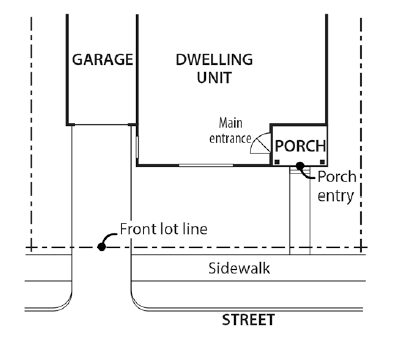
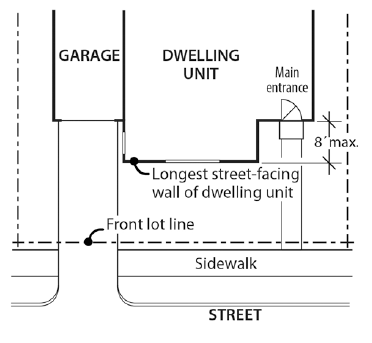 On corner lots where a building has more than one street facing side, the required entrance would only apply to one street facing façade for the primary entrance to the building.
- Garage location. If the garage is attached to the primary dwelling, then the garage door opening shall not face the primary frontage of the parcel, or if the garage is front-loading, it must be recessed from the primary façade of the main structure by a minimum of five (5) feet. For development of multiple lots (more than one), no more than fifty (50%) percent of dwellings may have a recessed front-loading, attached garage.
- Consistent materials. Exterior finish materials on the majority of the façade (greater than fifty-percent) shall be the same type on the majority (greater than fifty-percent) of all elevations of the primary structure so that the main body provides a consistent palette of materials, finishes, and colors for wall and roofing materials. See the Design Guidelines Handbook for guidelines and examples.
- Material quality. Concrete masonry units, or cinderblock, shall not be a visible exterior finish material from the public road, right-of-way, or adjacent residential property.
Where a proposal is for an alteration or addition to existing structure, these requirements will only be applied to the portion of a structure being altered or added.
Amended by Ord. 2017-02 on 2/20/2018
Sec 21-29 Height Regulations
- No building or structure shall exceed a height of thirty-five (35) feet from grade. See ATC chapter 210, article XXV for supplemental height regulations.
- No accessory structure may be built for an accessory apartment that exceeds the height of the main structure after September 28, 1999.
Adopted by Ord. 98-8 § 1 on 6/23/1998
Amended by Ord. 2-8-00 Paper Archive § 1 on 2/8/2000
Sec 21-29.1 Site Plan Required
A site plan shall be required as set forth in ATC article XVII of this chapter.
Adopted by Ord. 2003-16 § A4 on 2/17/2004
Sec 21-30 Landscape Plan: Landscaping, Trees, Buffers And Screening
A landscape plan shall be required and landscaping, trees, buffers, and screening shall be provided in accordance with the applicable provisions of ATC article XXIII of this chapter.
Adopted by Ord. 2003-16 § A2 on 2/17/2004
Sec 21-30.1 Purpose And Applicability
- The purpose of the Rural Residential Cluster (RRC) provisions is to provide an alternative form of subdivision development that is optional on qualifying sites located within the Rural Residential District RR-1. The RRC provisions permit higher overall density of residential development than generally permitted in the RR-1 District by enabling the clustering or grouping of individual building lots of smaller size than generally permitted, and shall be reserved for purposes of common open space, natural buffers, agricultural or forestal use or preservation of environmentally sensitive lands or devoted to other amenities that benefit residents of the subdivision.
- The RRC provisions are intended to promote more efficient use of land, lower site development costs and more efficient provision of utilities, roads and public services, while affording flexibility in development standards to respond to local market conditions and unique features of individual sites. RRC development is intended to encourage an alternative to usual subdivision patterns in a manner that provides a more rural character, avoids strip development along arterial roadways, provides a transition between rural and more urban areas within and adjacent to the town and promotes the village character of the town.
- The development standards, requirements and approval process applicable to RRC development are set forth in this division. Except as specifically described to the contrary in this division, all other standards and requirements applicable in the Rural Residential District RR-1 and set forth in division 1 of this article and elsewhere in this chapter and shall be applicable to RRC development.
Adopted by Ord. 9-27-94 Paper Archive § 1 on 9/27/1994
Amended by Ord. 98-8 § 1 on 6/23/1998
Sec 21-30.2 Site Area And Configuration
In order to qualify for RRC development, a site shall be no less than twenty-five (25) acres of contiguous area. The site shall be generally compact in shape, as opposed to linear, so as to enable the clustering of building lots and the provision of open space and other amenities in a manner that complies with the intent of this division.
Adopted by Ord. 9-27-94 Paper Archive § 1 on 9/27/1994
Amended by Ord. 98-8 § 1 on 6/23/1998
Sec 21-30.3 Permitted Uses
Permitted uses on individual building lots within an RRC development shall be the same as RR-1, Rural Residential, as identified in Sec. 21-24, with the exception of Towers and aerials, which shall not be a permitted use in RRC, Residential Rural Cluster zoning.
Adopted by Ord. 9-27-94 Paper Archive § 1 on 9/27/1994
Amended by Ord. 98-8 § 1 on 6/23/1998
Amended by Ord. 99-4 on 4/27/1999
Amended by Ord. 2017-02 on 2/20/2018
Sec 21-30.4 Density And Lot Size
- Density. The density of an RRC development site shall not exceed six-tenths (0.6) building lots per acre of gross site area, inclusive of areas devoted to streets and open space.
- Lot size. Individual lots for single-family dwelling purposes shall be not less than one acre in area and not less than one hundred fifty (150) feet in width at the setback line.
Adopted by Ord. 9-27-94 Paper Archive § 1 on 9/27/1994
Amended by Ord. 98-8 § 1 on 6/23/1998
Sec 21-30.5 Setback And Yard Regulations
- Front. The minimum front setback shall be forty (40) feet.
- Side. The minimum width of each side yard shall be twenty (20) feet. On corner lots, the side yard facing the side street shall be not less than thirty (30) feet for both the main and accessory buildings.
- Rear. The minimum rear yard shall be forty (40) feet.
See ATC chapter 21, article XXV for supplemental yard regulations. See the Design Guidelines Handbook for guidelines and examples for treatment of setbacks.
Adopted by Ord. 9-27-94 Paper Archive § 1 on 9/27/1994
Amended by Ord. 98-8 § 1 on 6/23/1998
Amended by Ord. 2017-02 on 2/20/2018
Sec 21-30.6 Open Space Requirements
- Area. Not less than twenty-five (25) percent of the gross area of each RRC development site shall be devoted to open space as described herein.
- Dimensions. Open space used for purposes of satisfying the minimum required open space area shall be not less than fifty (50) feet in width at any point and shall comply with the following:
- Open space areas of not less than fifty (50) feet in width shall be provided as buffers to separate individual lots and clusters of lots from all boundaries of the development site, except as provided in subsection (b)(2) of this section. Such buffers may be included within individual subdivided lots as provided in subsection (d)(2) of this section.
- Open space areas of not less than one hundred (100) feet in width shall be provided adjacent to all arterial streets as designated in the comprehensive plan for the town and no driveways serving individual lots shall be connected to such arterial streets.
- The provisions of this subsection (b) shall not be interpreted to prohibit the installation of approved streets necessary to provide access to the development site.
- Open space areas of not less than fifty (50) feet in width shall be provided as buffers to separate individual lots and clusters of lots from all boundaries of the development site, except as provided in subsection (b)(2) of this section. Such buffers may be included within individual subdivided lots as provided in subsection (d)(2) of this section.
- Permitted uses of open space. The minimum open space area as required herein shall be left undeveloped and in a natural state, or may be improved to provide amenities that enhance the character of the subdivision and benefit its residents by providing privacy, visual enjoyment or recreational opportunities, and shall not be devoted to streets, parking areas, buildings, structures or building sites.
- Required open space areas may be used for natural or landscaped buffer areas, courtyards, limited agriculture or forestry activity, wildlife preserves, conservation areas, water or stormwater management areas, ponds and other water features, pedestrian and jogging trails, bicycle paths picnic and sitting areas, active or passive recreation areas and necessary utilities.
- To the extent the amount of open space within a development site exceeds the minimum area required, it may be devoted to improved active recreation area, community center or other use permitted in the RR-1 district.
- Required open space areas may be used for natural or landscaped buffer areas, courtyards, limited agriculture or forestry activity, wildlife preserves, conservation areas, water or stormwater management areas, ponds and other water features, pedestrian and jogging trails, bicycle paths picnic and sitting areas, active or passive recreation areas and necessary utilities.
- Preservation and maintenance. Adequate provisions shall be made by the subdivider to ensure preservation of required open spaces and continued maintenance thereof. Such provisions shall be specified in general at the time of submission of the preliminary subdivision plat and in detail at the time of submission of the final subdivision plat and shall constitute conditions of preliminary and final subdivision plat approvals in accordance with the following:
- Ownership of required open space areas shall be vested in one or more of the following: a homeowners' association comprised of all owners of lots within the development site; a local or state governmental agency, subject to its acceptance of such areas; an approved independent conservation organization; or other party having an ownership interest in any other portion of the development site.
- Open space which is not devoted to active recreation use may be located within the boundaries of individual subdivided lots, provided that it is in addition to minimum required lot area, setback and side and rear yard areas and is subject to provisions for preservation and maintenance of open space in accordance with the requirements of this section.
- Required open space areas shall be subject to waiver of development rights in such form that precludes further subdivision for development purposes and prohibits other use or development not permitted by the provisions of this division. Such waiver shall be provided through restrictive covenants, conservation easements, other easements, or a combination thereof.
- Agreements or covenants guaranteeing continued maintenance and care of required open space areas shall be established. In any case where ownership of open space areas is not vested in a homeowners' association or governmental agency, such agreements or covenants shall provide that an established homeowners' association or governmental agency, subject to its approval, may maintain the property and bill the owners or exercise lien rights in the event of lack of maintenance.
- Necessary documents setting forth ownership, restrictive covenants, easements and maintenance agreements shall be approved by the town attorney with respect to compliance with the provisions of this section. Such documents shall be submitted and approved in conjunction with the required subdivision approvals and shall be recorded with the final subdivision plat. Notations shall be included on the final subdivision plat to identify open space areas, indicate the ownership thereof and indicate generally the applicable easements covenants and agreements.
- Ownership of required open space areas shall be vested in one or more of the following: a homeowners' association comprised of all owners of lots within the development site; a local or state governmental agency, subject to its acceptance of such areas; an approved independent conservation organization; or other party having an ownership interest in any other portion of the development site.
Adopted by Ord. 9-27-94 Paper Archive § 1 on 9/27/1994
Amended by Ord. 98-8 § 1 on 6/23/1998
Sec 21-30.7 Street And Utilities
- Street access. Every RRC development site shall have frontage on and access to at least one improved public street. Any RRC development site having more than fifty (50) residential lots shall have at least two (2) means of access to improved public streets. The number of access points to any one street shall be the minimum necessary to adequately serve the development.
- Internal streets. Every lot intended for single-family residential use within the development site shall have frontage on a public street meeting the subdivision street standards of the town, provided that:
- Streets which exclusively serve an RRC development site, and which do not enable through-traffic and along which no curb-side or shoulder parking is permitted, may be constructed with a pavement width of not less than twenty-two (22) feet and a right-of-way width of not less than forty (40) feet, provided that other applicable street construction standards adopted by policy of town council are met. In the case of any approved street which does not qualify for maintenance payment to the town by the Virginia Department of Transportation (VDOT) by reason of the width of such street, provision shall be made in accordance with the policy adopted by town council for annual cash payment by a homeowners' association to the town of an amount equal to that which the town would receive from VDOT for annual maintenance of such street if it qualified for such payment.
- Curb and gutter shall not be required unless it is determined to be necessary as an element of a storm drainage system by the director of public works based on engineering considerations.
- Streets which exclusively serve an RRC development site, and which do not enable through-traffic and along which no curb-side or shoulder parking is permitted, may be constructed with a pavement width of not less than twenty-two (22) feet and a right-of-way width of not less than forty (40) feet, provided that other applicable street construction standards adopted by policy of town council are met. In the case of any approved street which does not qualify for maintenance payment to the town by the Virginia Department of Transportation (VDOT) by reason of the width of such street, provision shall be made in accordance with the policy adopted by town council for annual cash payment by a homeowners' association to the town of an amount equal to that which the town would receive from VDOT for annual maintenance of such street if it qualified for such payment.
- Utilities. Every residential lot within an RRC development site shall be served by public water and sewer in accordance with applicable subdivision standards.
Adopted by Ord. 9-27-94 Paper Archive § 1 on 9/27/1994
Amended by Ord. 98-8 § 1 on 6/23/1998
Sec 21-30.8 Site Design And Layout Standards
The following standards shall be observed in the design and development of all RRC sites:
- Consistency with RRC purposes. Residential lots, open spaces and streets within the development site shall be arranged in a manner consistent with the purposes of RRC development as set forth in ATC section 21-30.1..
- Preservation of natural features. Individual building lots, building sites, open space areas and streets shall be arranged to preserve to the greatest extent practical significant natural features of the site such as streams, wetlands, floodplains and other environmentally sensitive features; existing topography; and wooded areas and other areas of significant natural vegetation, and to utilize the most suitable soils.
- Arrangement of open spaces. Open spaces shall be arranged so as to provide: buffers of physical and visual separation from adjacent properties and public streets on the periphery of the site and an interconnected system of open spaces which, in conjunction with streets and walkways in the subdivision, will provide residents of the development with means to access open spaces intended for their use, adjoining roads, public facilities and major nearby destinations. Remaining open spaces shall be consolidated into areas of sufficient size and shape to accommodate the intended purposes thereof.
- Exceptions to subdivision design standards. Where necessary to accommodate cluster development and to facilitate compact and efficient arrangement of residential lots intended by the provisions of this division, the planning commission may recommend and the town council may grant exceptions to the normal subdivision design standards pertaining to dimensions and arrangement of blocks, alignment and layout of streets and dimensions of cul-de-sacs.
Adopted by Ord. 9-27-94 Paper Archive § 1 on 9/27/1994
Amended by Ord. 98-8 § 1 on 6/23/1998
Sec 21-30.81 Structure Regulations
- Window percentage. A minimum of fifteen percent (15%) of the front facing building façade shall consist of windows. Elements to count towards the achievement of the minimum window percentage include any opening in a wall, roof, dormer, front door, or garage door which functions or appears to function to admit light to a building or structure. Glass block and vents do not meet this standard. See the Design Guidelines Handbook for guidance on window percentage calculation. On corner lots where a building has more than one street facing side, the minimum window percentage would only be required for the street facing façade with the primary entrance to the building.
- Street entrance. The primary structure shall have a minimum one (1) pedestrian street-facing entrance on the front façade. The entrance must be within eight (8) feet of the longest street-facing wall and shall:
- Face the street;
- Be at an angle of up to 45 degrees from the street; or
- Open on to a porch. On corner lots where a building has more than one street facing side, the required entrance would only apply to one street facing façade for the primary entrance to the building.
- Garage location. If the garage is attached to the primary dwelling, then the garage door opening shall not face the primary frontage of the parcel, or if the garage is front-loading, it must be recessed from the primary façade of the main structure by a minimum of five (5) feet. For development of multiple lots (more than one), no more than fifty (50%) percent of dwellings may have a recessed front-loading, attached garage.
- Consistent materials. Exterior finish materials on the majority of the façade (greater than fifty-percent) shall be the same type on the majority (greater than fifty-percent) of all elevations of the primary structure so that the main body provides a consistent palette of materials, finishes, and colors for wall and roofing materials. See the Design Guidelines Handbook for guidelines and examples.
- Material quality. Concrete masonry units, or cinderblock, shall not be a visible exterior finish material from the public road, right-of-way, or adjacent residential property.
Where a proposal is for an alteration or addition to existing structure, these requirements will only be applied to the portion of a structure being altered or added.
Amended by Ord. 2017-02 on 2/20/2018
Sec 21-30.9 Approval Process
Every RRC development shall require approval as a subdivision and shall be submitted, reviewed and approved in the same manner as other subdivisions in accordance with the provisions of ATC chapter 17, except that:
- Submission and subsequent approvals of preliminary and final subdivision plats shall include specification of means to accomplish preservation and maintenance of required open space as set forth in this division.
- A preliminary sketch of the proposed RRC development, drawn to scale, together with a description of the proposed manner in which preservation and maintenance of required open space areas are to be accomplished, shall be submitted to the director of planning prior to preparation of an engineered preliminary or final plat. The director shall review the submitted material and advise applicant whether the plans are, in general, consistent with the requirements of this chapter and the subdivision regulations. The director may also make suggestions as to changes in the plans which would further accomplish the intent and purpose of RRC development. Such review and assistance shall commit the director to specific recommendations when plats are officially submitted.
- The director of planning shall review the preliminary and final subdivision plats prior to submission to the planning commission and advise the commission whether the applicable provisions of this chapter are met.
Adopted by Ord. 9-27-94 Paper Archive § 1 on 9/27/1994
Amended by Ord. 98-8 § 1 on 6/23/1998

