
Ashland City Zoning Code
ARTICLE IV
RESIDENTIAL, RESTRICTED DISTRICT R-1
Sec 21-31 Statement Of Intent
Sec 21-32 Use Regulations
The following uses and structures shall be permitted in the Residential District R-1:
- Accessory uses as defined
- Bed and Breakfast, with a conditional use permit and in accordance with the provisions of Sec. 21-262
- Church or Place of Religious Worship
- Community Center, with a conditional use permit and as an accessory use to a Church or Place of Religious Worship
- Community Garden, over one (1) acre with a conditional use permit
- Day Care Center, with a conditional use permit and as an accessory use to a Church or Place of Religious Worship
- Day Care Center, Adult, with a conditional use permit and as an accessory use to a Church or Place of Religious Worship
- Dwelling, Accessory Apartment, with a conditional use permit and in accordance with the provisions of Sec. 21-264
- Dwelling, Single-Family Detached
- Educational Facility, with a conditional use permit and as an accessory use to a Church or Place of Religious Worship
- Home Occupation
- Parks, over one (1) acre with a conditional use permit
- Public Facilities, with a conditional use permit
- Schools, with a conditional use permit
- Utilities, Major, with a conditional use permit
- Utilities, Minor
Editors Note: Section 2 of an ordinance adopted Oct. 27, 1987, amended § 21-32 by adding subsection (l) thereto. The editor has relettered such subsection as (j).
Adopted by Ord. 10-27-87 Paper Archive § 2 on 10/27/1987
Amended by Ord. 95-04 § 2 on 4/25/1995
Amended by Ord. 96-19 § 2 on 7/23/1996
Amended by Ord. 96-32 § 2 on 12/10/1996
Amended by Ord. 98-8 § 1 on 6/23/1998
Amended by Ord. 99-4 § 1 on 4/27/1999
Amended by Ord. 2003-16 § A1 on 2/17/2004
Amended by Ord. 2009-08 on 10/6/2009
Amended by Ord. 2017-02 on 2/20/2018
Sec 21-33 Area Regulations
The minimum lot area for single-family dwellings shall be fifteen thousand (15,000) square feet.
Adopted by Ord. 98-23 § 1 on 12/15/1998
Sec 21-34 Reserved
Adopted by Ord. 12-13-94 § 4 on 12/13/1994
Amended by Ord. 98-23 § 1 on 12/15/1998
Amended by Ord. 2003-16 § A7 on 2/17/2004
Amended by Ord. 2017-02 on 2/20/2018
Sec 21-35 Frontage Regulations
The minimum width of any lot at the setback shall be one hundred (100) feet.
Adopted by Ord. 12-13-94 § 5 on 12/13/1994
Sec 21-36 Yard Regulations
- Front. The minimum front setback shall forty (40) feet.
- Side. The minimum side yards for main buildings shall be fifteen (15) feet. The minimum street side yard for all buildings and structures shall be thirty (30) feet.
- Rear. The minimum rear yard for main buildings shall be thirty-five (35) feet.
- Accessory structures. The minimum side and rear yards for accessory structures shall be five (5) feet.
See ATC chapter 21, article XXV for supplemental yard regulations. See the Design Guidelines Handbook for guidelines and examples for treatment of setbacks.
Adopted by Ord. 98-8 § 1 on 6/23/1998
Amended by Ord. 98-23 § 1 on 12/15/1998
Amended by Ord. 2017-02 on 2/20/2018
Sec 21-36.1 Structure Regulations
- Window percentage. A minimum of fifteen percent (15%) of the front facing building façade shall consist of windows. Elements to count towards the achievement of the minimum window percentage include any opening in a wall, roof, dormer, front door, or garage door which functions or appears to function to admit light to a building or structure. Glass block and vents do not meet this standard. See the Design Guidelines Handbook for guidance on window percentage calculation. On corner lots where a building has more than one street facing side, the minimum window percentage would only be required for the street facing façade with the primary entrance to the building.
- Street entrance. The primary structure shall have a minimum one (1) pedestrian street-facing entrance on the front façade. The entrance must be within eight (8) feet of the longest street-facing wall and shall:
- Face the street;
- Be at an angle of up to 45 degrees from the street; or
- Open on to a porch.
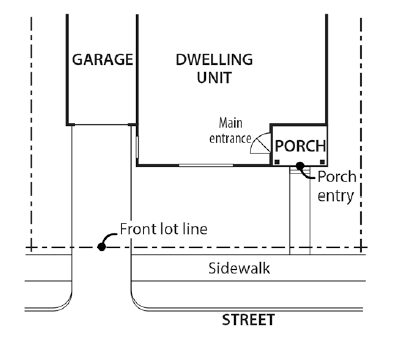
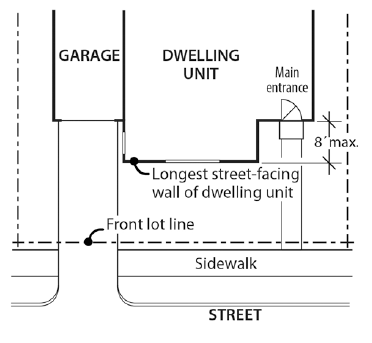 On corner lots where a building has more than one street facing side, the required entrance would only apply to one street facing façade for the primary entrance to the building.
- Garage location. If the garage is attached to the primary dwelling, then the garage door opening shall not face the primary frontage of the parcel, or if the garage is front-loading, it must be recessed from the primary façade of the main structure by a minimum of five (5) feet. For development of multiple lots (more than one), no more than fifty (50%) percent of dwellings may have a recessed front-loading, attached garage.
- Consistent materials. Exterior finish materials on the majority of the façade (greater than fifty-percent) shall be the same type on the majority (greater than fifty-percent) of all elevations of the primary structure so that the main body provides a consistent palette of materials, finishes, and colors for wall and roofing materials. See the Design Guidelines Handbook for guidelines and examples.
- Material quality. Concrete masonry units, or cinderblock, shall not be a visible exterior finish material from the public road, right-of-way, or adjacent residential property.
Where a proposal is for an alteration or addition to existing structure, these requirements will only be applied to the portion of a structure being altered or added.
Amended by Ord. 2017-02 on 2/20/2018
Sec 21-37 Height Regulations
No building or structure shall exceed a height of thirty-five (35) feet from grade. See ATC chapter 21, article XXV for supplemental height regulations.
Adopted by Ord. 98-23 § 1 on 12/15/1998
Sec 21-37.1 Site Plan Required
Adopted by Ord. 2003-16 § A4 on 2/17/2004
Sec 21-38 Landscape Plan: Landscaping, Trees, Buffers And Screening
A landscape plan shall be required and landscaping, trees, buffers, and screening shall be provided in accordance with the applicable provisions of ATC article XXIII of this chapter.
Adopted by Ord. 2003-16 § A2 on 2/17/2004

