
Ashland City Zoning Code
ARTICLE IX
RESIDENTIAL INCENTIVE RIn
Sec 21-79 Intent
Adopted by Ord. 2017-02 on 2/20/2018
Sec 21-80 Use Regulation
The following uses and structures shall be permitted:
- Accessory uses as defined
- Bed and Breakfast, with a conditional use permit and in accordance with the provisions of Sec. 21-262
- Church or Place of Religious Worship
- Community Center, with a conditional use permit and as an accessory use to a Church or Place of Religious Worship
- Community Garden, over one (1) acre with a conditional use permit
- Day Care Center, with a conditional use permit and as an accessory use to a Church or Place of Religious Worship
- Day Care Center, Adult, with a conditional use permit and as an accessory use to a Church or Place of Religious Worship
- Dwelling, Accessory Apartment, with a conditional use permit and in accordance with the provisions of Sec. 21-264
- Dwelling, Cottage Court
- Dwelling, Single-Family Attached
- Dwelling, Single-Family Detached
- Dwelling, Townhome
- Dwelling, Two-Family, with a conditional use permit
- Educational Facility, with a conditional use permit and as an accessory use to a Church or Place of Religious Worship
- Home Occupation
- Parks, over one (1) acre with a conditional use permit
- Public Facilities, with a conditional use permit
- Schools, with a conditional use permit
- Utilities, Major, with a conditional use permit
- Utilities, Minor
Amended by Ord. 2017-02 on 2/20/2018
Sec 21-81 Area Regulations
The minimum lot area for permitted uses shall be as follows:
- Ten thousand (10,000) square feet for single-family detached, single-family attached, or two-family dwellings.
- Townhouse developments shall be located on sites of not less than one acre. The minimum width of individual townhouse lots shall be twenty-four (24) feet.
- Cottage court shall be located on sites of not less than one acre. The minimum width of individual cottage courts lots shall be forty (40) feet.
Amended by Ord. 2017-02 on 2/20/2018
Sec 21-82 Frontage And Width Regulations
- The minimum width of any lot at the setback shall be sixty (60) feet for single-family detached and two-family dwellings, and thirty-seven and one half (37.5) feet for single-family attached lots.
- The minimum frontage of cottage court or townhouse developments shall be one hundred and eighty (180) feet. The minimum width of individual townhouse lots shall be twenty-four (24) feet. The minimum width of individual cottage court lots shall be forty (40) feet.
Amended by Ord. 2017-02 on 2/20/2018
Sec 21-83 Yard Regulations
- Front. The minimum front setback shall be twenty (20) feet. The maximum setback for townhome units shall be no greater than thirty-five (35) feet from the property line or new development shall bring the existing structure into greater conformity with this maximum setback. The minimum setback between townhome rows shall be twenty (20) feet. The minimum side setback between cottage court units shall be six (6) feet.
- Side. The minimum side yards for main buildings shall be a cumulative of twenty (20) feet, with the minimum for one-side being six (6) feet. For example, the side yards can be ten (10) feet each, or one side at six (6) feet and the other at fourteen (14) feet. For cottage court units, the minimum side setback between units shall be six (6) feet. For single-family attached lots, one of the side yards shall have a zero-lot line setback. For townhomes, the minimum setback between rows (connected units) shall be twenty (20) feet. The minimum street side yard for all buildings and structures shall be twenty (20) feet.
- Rear. The minimum rear yard for main buildings shall be twenty (20) feet. The minimum rear yard setback for individual townhome and cottage court units shall be five (5) feet.
- Accessory structures. The minimum side and rear yards for accessory structures shall be five (5) feet.
See ATC chapter 21, article XXV for supplemental yard regulations. See the Design Guidelines Handbook for guidelines and examples for treatment of setbacks.
Amended by Ord. 2017-02 on 2/20/2018
Sec 21-84 Required Open Space
Except in such developments regulated by the Virginia Condominium Act (chapter 4.2 of title 55, Code of Virginia), in the event common areas are provided which are not contained in lots or streets conveyed to individual owners, said common areas shall be maintained by and be the sole responsibility of the developer-owner of the development until such time as the developer-owner conveys such common area to a nonprofit corporate owner whose members shall be all of the individual owners in the development. Said land shall be conveyed to and held by said nonprofit corporate owner solely for recreation, parking or other common purposes of the individual owners in the development. In the event of such conveyance by the developer-owner to a nonprofit corporate owner, deed restrictions and covenants, in form and substance satisfactory to the town attorney, shall provide, among other things, that any assessments, charges and costs of the maintenance of such common areas shall constitute a pro rata lien upon the individual lots or units, inferior in lien and dignity only to taxes and bona fide duly recorded first deeds of trust on each lot or unit.
Sec 21-79 Statement Of Intent*
Adopted by Ord. 2017-02 on 2/20/2018
Sec 21-85 Development Size
Maximum of six (6) townhouse units shall be connected in a continuous row. Maximum of twelve (12) dwelling units in a single multifamily building. Maximum of twelve (12) units per cottage court development.
Amended by Ord. 2017-02 on 2/20/2018
Sec 21-86 Screening
Amended by Ord. 2017-02 on 2/20/2018
Sec 21-87 Incentive Zoning
A development plan which meets the requirements of Sec. 21-142 and any necessary information to determine compatibility with the incentive zoning requirements shall be submitted to the Zoning Administrator. The requirement of a traffic impact analysis (TIA) may be waived by the Zoning Administrator due factors of a limited traffic generation, existing studies, or sufficient transportation infrastructure.
Fulfillment of these elements shall be determined by the Zoning Administrator, unless otherwise noted. Further definition of these elements is provided in the Design Guidelines Handbook.
For single-family detached, single-family attached, or two-family dwellings, incentive zoning would allow a reduction to a minimum lot area of eight thousand (8,000) square feet if sixty percent (60%) of the incentive zoning elements are met and a reduction to a minimum lot area of six thousand (6,000) square feet if eighty-percent (80%) of the zoning elements are met.
Incentive zoning elements include the following:
- Site Design (New Urbanism and Traditional Neighborhood Development)
- Variety in lot frontages (e.g. widths) along block. No more than fifty percent (50%) of the lots within a block shall have the same lot width. The minimum difference to achieve variation shall be five (5) feet.
- Variety in housing setbacks from street along a block. No more than fifty percent (50%) of the homes along the same side of the street within a block shall have the same front yard setback. The minimum difference to achieve variation shall be five (5) feet.
- Variety in elevations in homes along a block. No more than three (3) homes of the same front elevation shall be located adjoining each other on the same side of the street within a block.
- Housing types provide a mix of incomes. Housing should include a mix of types (e.g. single-family detached, single-family attached, townhomes, etc.), or if the same type (e.g. single-family detached) then a variety sizes as determined by square foot.
- Preferred architectural styles. Housing shall reference Federal, Georgian, Greek Revival, Victorian, Queen Anne, Craftsman, Colonial (all varieties), Foursquare, I-House, Bungalow, Ranch, Classical, and other early settlement era architecture referenced between 1630 –1950s. Individual buildings should not reference multiple building styles or eras. Minimum elements to be included in defining an architectural style are detailed in the Design Guidelines Handbook. The Zoning Administrator shall determine compatibility with preferred architectural style. Town Council may grant a special exception if the Applicant is proposing a new style not listed in this section based upon compatibility with traditional neighborhood design.
- Preferred building materials. Brick, masonry, hardiplank, wood, or other building materials of similar type or a combination thereof. Zoning Administrator shall determine compatibility with preferred building materials of a similar style. Town Council may grant a special exception if the Applicant is proposing a new type not listed in this section based upon compatibility with traditional neighborhood design.
- Consistent design. Building foundation is screened with landscaping or consists of finished materials similar to that of the majority of the exterior.
- High proportion of openings (doors/windows) to walls. Defined as a minimum twenty-percent (20%) windows on street facing façade.
- No blank facades or walls. Defined as a minimum five-percent (5%) windows on side elevations.
- Four-sided consistent materials. Exterior finish materials on the majority of the façade (greater than fifty-percent) shall be the same type on the majority (greater than fifty-percent) of all elevations of the primary structure.
- Accessory structure consistency. Building materials on accessory structures shall be of similar type to that of the main structure.
- Garage orientation. Maximum of twenty-five percent (25%) street-facing recessed and attached front-loading garages. Preferred locations are detached or attached and side- or rear-loading.
- Age-in-place design. Universal Design (age-in-place) standards, as identified by VHDA guidelines or a similar certification, are met.
- Connectivity and walkability. Through use of pedestrian features (e.g. sidewalks, trails, multi-use paths, etc.) connectivity internally between homes and connections to future extensions or existing infrastructure is provided.
- Quality of features. Applicant may receive a special exception from Town Council if the architectural-style of the proposed home conflicts with meeting the three (3) features requirement. Minimum of three (3) of the following features shall be provided per individual home:
- Columns, minimum of two (2), with a minimum six (6) inch diameter or six (6) by six (6) inch square;
- Dormer(s);
- Roof pitch between 6:12 and 12:12;
- Patio of a minimum of one-hundred (100) square feet;
- Balcony at a minimum of seventy-five (75) square feet; or
- Front porches at a minimum of six (6) by eight (8) feet minimum.
- Street lights. If street lights are required, then light types are of a traditional or historic design. Or, if the Applicant offers additional historic or traditional design lighting on private property (e.g. lamp posts).
- Outdoor amenities. If twenty (20) or more residential units are proposed, then pedestrian outdoor seating or amenities such as public art or a pocket park are provided at a rate of one item for every twenty (20) residential units.
- Alleyways. If housing is being desgned on new street blocks, or in areas where an alleyway is already platted, and alleyway should be developed to serve housing.
- Grid pattern blocks. Where new blocks are being developed or a development is adjacent to an existing neighborhood street network, the streets shall be arranged in a traditional grid pattern to continue a sustainable network.
- Complete Streets. Where new streets are being developed, a Complete Streets approach shall be followed that includes a plan for pedestrians, cyclists, and public transit (per Ashland’s long-range plans), as well as automobiles. All improvements do not need to be accommodated on-site, but the property should be analyzed and identify pathways for each of these users following the Complete Streets policy.
- Environmentally sustainable and energy-efficient building design
- No developed lots in wetlands. The area should be reserved for conservation or preservation.
- Quality tree coverage. Provide a tree canopy at a minimum of twenty-five percent (25%).
- Tree-lined streets. Provide street trees at a minimum one (1) tree per thirty (30) feet.
- Environmentally friendly building practices. Achieve green building standards of LEED, USGBC, Viridant (formerly Earthcraft House Virginia), or a similar certification system. The Zoning Administrator shall determine compatibility of a similar certification system.
- Stormwater Quality. Use of Low Impact Design (LID) practices in stormwater treatment or additional landscaping to compliment stormwater features as to address them as an amenity.
- Quantity of open space. If more than twenty (20) residential units are proposed, provide parks with recreation for new residential development at a minimum of two-hundred (200) square feet per unit.
- Quality open space. If more than twenty (20) residential units are propsoed, park or recreation space should be centrally located and provide pedestrian connections between the space and homes. Park space, whether public or private, should be publicly accessible.
- Protection of environmental features. If environmentally sensitive areas (e.g. wetlands, habitat, forest, etc.) are present, arrange or cluster housing to provide open space or land preservation for environmentally sensitive areas.
- Green infrastructure. If there is an existing green infrastructure feature or path, as identified in the Environment Map of the Comprehensive Plan, and provide an internal path for future connections.
- Affordable housing creation and preservation
- Revitalizes existing affordable housing. If existing affordable housing is present, new development would renovate or redevelop existing affordable units. In making the determination as to whether housing is "affordable" the Zoning Administrator shall base determination on housing analysis provided in the Ashland Comprehensive Plan.
- Revitalizes existing affordable housing. If existing affordable housing is present, new development would renovate or redevelop existing affordable units. In making the determination as to whether housing is "affordable" the Zoning Administrator shall base determination on housing analysis provided in the Ashland Comprehensive Plan.
- Historic preservation
- Preservation of historic structures or features. Applies if structures or features are existing in the proposed development area. If historic structures or features (e.g. trees) identified on the historic register, or documentation is submitted that structures or features have historic value and it is determined by the Zoning Administrator that it could be a future historic resource, these resoruces are protected or preserved.
- Preservation of historic viewsheds or gateways. Applies if viewsheds or a rural gateway is existing in the proposed development area. Preserves a historic viewshed or rural gateway as identified on the historic register, Town Edge in Comprehensive Plan, or documentation of historic value is submitted and it is determined by the Zoning Administrator that it could be a future historic resource.
Adopted by Ord. 2017-02 on 2/20/2018
Sec 21-88 Structure Regulations
- Window percentage. A minimum of fifteen percent (15%) of the front facing building façade shall consist of windows. Elements to count towards the achievement of the minimum window percentage include any opening in a wall, roof, dormer, front door, or garage door which functions or appears to function to admit light to a building or structure. Glass block and vents do not meet this standard. See the Design Guidelines Handbook for guidance on window percentage calculation. On corner lots where a building has more than one street facing side, the minimum window percentage would only be required for the street facing façade with the primary entrance to the building.
- Street entrance. The primary structure shall have a minimum one (1) pedestrian street-facing entrance on the front façade. The entrance must be within eight (8) feet of the longest street-facing wall and shall:
- Face the street;
- Be at an angle of up to 45 degrees from the street; or
- Open on to a porch.
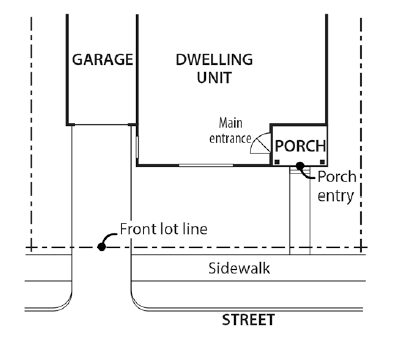
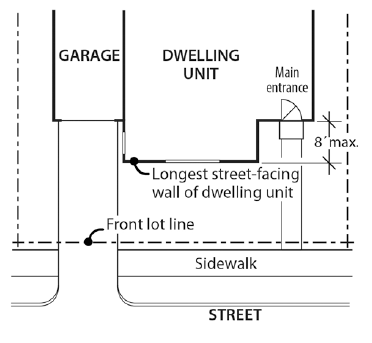 On corner lots where a building has more than one street facing side, the required entrance would only apply to one street facing façade for the primary entrance to the building.
- Garage location. If the garage is attached to the primary dwelling, then the garage door opening shall not face the primary frontage of the parcel, or if the garage is front-loading, it must be recessed from the primary façade of the main structure by a minimum of five (5) feet. For development of multiple lots (more than one), no more than fifty (50%) percent of dwellings may have a recessed front-loading, attached garage. For townhome or cottage court structures, attached front-loading garages (e.g. garage door opening faces the primary frontage) shall not be permitted. Off-street parking shall adhere to screening regulations, per Sec. 21-65.1.
- Consistent materials. Exterior finish materials on the majority of the façade (greater than fifty-percent) shall be the same type on the majority (greater than fifty-percent) of all elevations of the primary structure so that the main body provides a consistent palette of materials, finishes, and colors for wall and roofing materials. See the Design Guidelines Handbook for guidelines and examples.
- Material quality. Concrete masonry units, or cinderblock, shall not be a visible exterior finish material from the public road, right-of-way, or adjacent residential property.
Where a proposal is for an alteration or addition to existing structure, these requirements will only be applied to the portion of a structure being altered or added.
Adopted by Ord. 2017-02 on 2/20/2018
Sec 21-89 Height Regulations
Adopted by Ord. 2017-02 on 2/20/2018
Sec 21-90 Site Plan Required
Adopted by Ord. 2017-02 on 2/20/2018
Sec 21-90.1 Landscaping Required
Adopted by Ord. 2017-02 on 2/20/2018
Sec 21-90.2 Reserved
Adopted by Ord. 2017-02 on 2/20/2018

