
Brookhaven City Zoning Code
DIVISION 2
MEASUREMENT-RELATED TERMS
Sec. 27-1329. - Fractions and rounding.
When calculations required under this zoning ordinance result in fractions, the results shall be rounded as follows:
(1)
Minimum requirements.
a.
When calculating minimum off-street parking requirements, any fractional result of less than one-half is rounded down to the whole number and any fractional result of one-half or more is rounded up to the whole number.
b.
When a requirement other than off-street parking is expressed as a minimum requirement, any fractional result shall be rounded up to the next consecutive whole number.
(2)
Maximum limits. When a regulation is expressed as a maximum limit, any fractional result shall be rounded down to the preceding whole number. For example, if a maximum limit of 3.33 parking spaces per 1,000 square feet of floor area is applied to an 8,000 square foot building, the resulting fraction of 26.64 is rounded down to 26 allowed parking spaces. This provision is not to be interpreted as allowing fractional results to be rounded down when determining compliance with percentage-based limits. For example, if maximum allowed impervious coverage is 45 percent, a lot with 45.33 percent coverage is not considered to be in compliance.
(Ord. No. RZ-2018-11-06, § I, Exh. A(27.419), 11-27-2018; Ord. No. RZ-2023-02-03, § I, 2-28-2023)
Sec. 27-1330. - Lot area.
Lot area is measured as the total ground-level surface area contained within the property lines of a lot.
(Ord. No. RZ-2018-11-06, § I, Exh. A(27.420), 11-27-2018)
Sec. 27-1331. - Lot width.
Lot width is the horizontal distance between the side property lines of a lot, measured at the minimum front setback line.
(Ord. No. RZ-2018-11-06, § I, Exh. A(27.421), 11-27-2018; Ord. No. 2019-05-03, § I(Attch.), 5-28-2019)
Sec. 27-1332. - Lot frontage or street frontage.
Lot frontage is measured between side property lines of a lot along the property line that abuts the street right-of-way.
(Ord. No. RZ-2018-11-06, § I, Exh. A(27.422), 11-27-2018)
Sec. 27-1333. - Impervious coverage.
(a)
Impervious coverage is the total area of a lot covered by impervious surfaces, including principal and accessory buildings and structures, driveways, patios, parking lots and sidewalks.
(b)
Nonconforming lots may be altered to remove, replace, and reconfigure structures and improvements provided that:
(1)
The existing impervious coverage was lawfully established;
(2)
The lot modifications do not result in more impervious coverage;
(3)
Water quality and stormwater mitigation measures are provided to account for all impervious surface coverage in excess of that allowed under existing zoning.
(Ord. No. RZ-2018-11-06, § I, Exh. A(27.423), 11-27-2018; Ord. No. RZ-2023-02-03, § I, 2-28-2023)
Sec. 27-1334. - Floor area.
(a)
The floor area of a building is the sum of the gross horizontal areas of all floors within the building, excluding garages and open porches.
(1)
Floor area of principal buildings is measured from the interior face of the exterior walls of the building.
(2)
Floor area of accessory buildings is measured from the exterior face of the exterior walls of the building.
(Ord. No. RZ-2018-11-06, § I, Exh. A(27.424), 11-27-2018; Ord. No. RZ-2023-02-03, § I, 2-28-2023)
Sec. 27-1335. - Density.
Density is measured as the number of dwelling units per acre of land area. In calculating density, public rights-of-way are not counted. Workforce housing units provided to meet mandatory requirements or incentive-based workforce housing provisions shall not be counted as dwelling units for purpose of calculating the maximum allowable density allowed on the subject property,
(Ord. No. RZ-2018-11-06, § I, Exh. A(27.425), 11-27-2018)
Sec. 27-1336. - Setbacks.
(a)
Measurement.
(1)
Required setbacks are measured from the applicable lot line, right-of-way, or location referred to below. Building setbacks are measured to the nearest exterior building wall. Minimum setbacks that apply to other features (parking areas, fences, storage areas) are measured from the nearest point of the area or feature for which a setback is required. Unless otherwise expressly stated, no part of any structure may be located within the street right-of-way.
(2)
Street (front and street-side) setbacks are measured from the actual right-of-way line of the street (other than an alley).
(3)
Interior side setbacks are measured from the nearest side lot line that does not abut a street.
(4)
Rear setbacks are measured from the rear lot line.
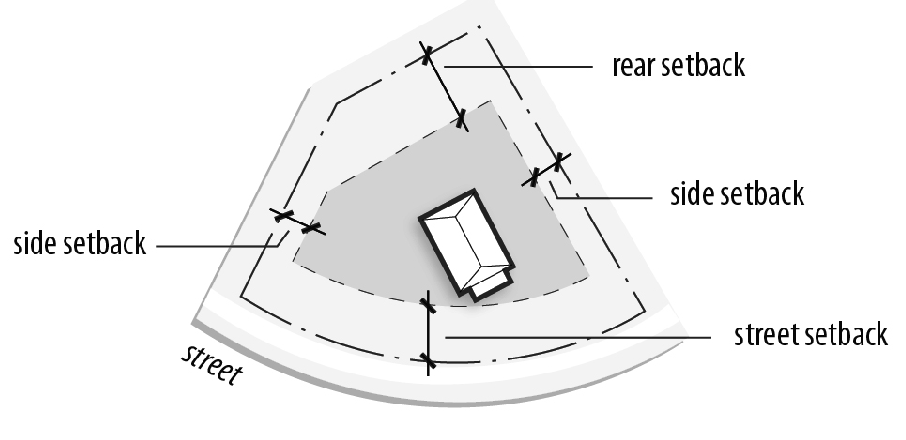
Figure 13-1. Setbacks on Curvilinear Lots
(5)
On double-frontage lots, the required street setback shall be provided from both streets.
(b)
Setbacks on irregular lots. Setbacks are measured from lot lines towards the center of the lot, except as follows:
(1)
When lot lines are curvilinear, setbacks shall be measured parallel to the curvilinear lot line (see figure 13-1).
(2)
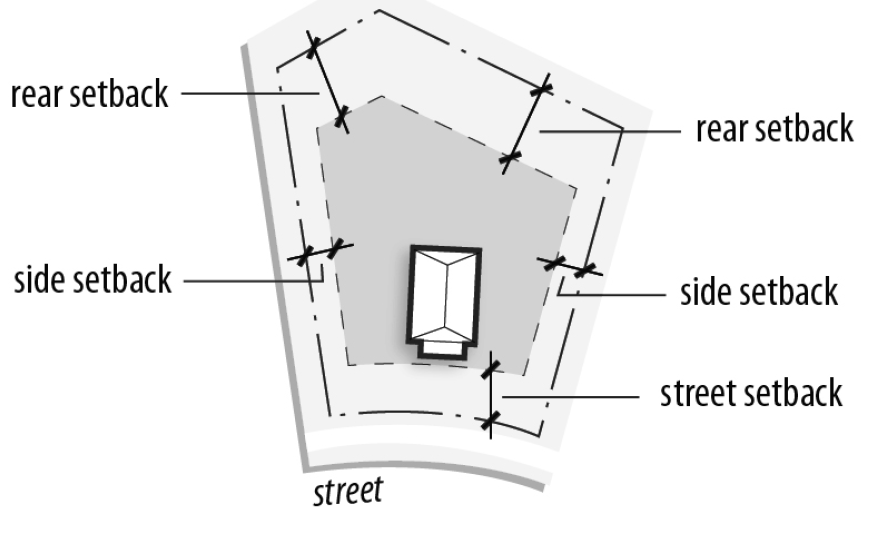
When there are multiple rear lot lines, the rear setback shall be measured from each of rear lot lines (see figure 13-2).
Figure 13-2. Multiple Rear Lot Lines
(3)
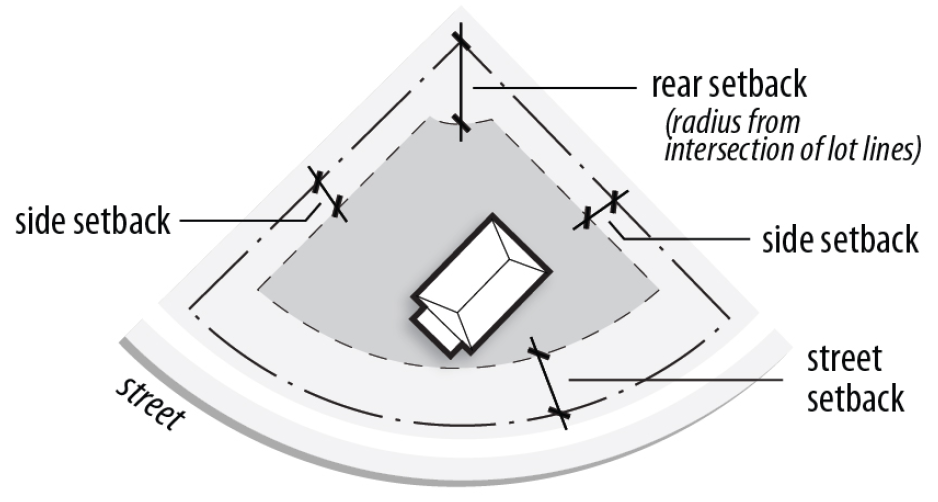
When there is no rear lot line, the rear setback shall be measured as a radial distance from the intersection of side lot lines at the rear of the lot (see figure 13-3).
Figure 13-3. No Rear Lot Lines
(c)
Encroachments and obstructions. Every part of a required setback shall be unobstructed and open to the sky except as follows:
(1)
Sills, belt courses, cornices, eaves, chimneys, buttresses and other ornamental and architectural features, may project up to three feet into any required setback;
(2)
Porches, terraces, patios, steps, stoops and similar building fixtures may project into a setback for up to ten feet to a point not closer than five feet to any lot line.
(d)
Average front yard setback for residential infill.
(1)
Generally applicable regulations.
a.
When a lot is located within a block where 60 percent or more of the lots within said block have been developed, and where there are existing buildings fronting on the same street and within the same zoning district within 75 feet of the side lot lines of such vacant lot, then setback averaging shall be required. The minimum required building setback line for said vacant lot shall be determined by averaging the existing building setbacks of buildings within 75 feet of the side lot lines of such vacant lot. The minimum setback for additions to existing structures may be the average of the existing setbacks.
(2)
Administrative variance from average front yard setback provisions.
a.
The director is authorized to consider an administrative variance on petitions requesting reduction of the average front yard setback pursuant to the procedures provided in article X of this chapter. Administrative variance approval shall be based on unique site features including stream buffer protection, tree preservation, and existing easements only. The average front yard setback for residential infill may be reduced up to 25 percent. Appropriate conditions to said administrative variances shall be imposed to ensure the continued health of any preserved trees following the granting of such variances, including, but not limited to, mandatory replacement requirements. The department shall issue a decision in writing no later than 21 business days after the date of filing a complete application. A denied petition for an administrative variance by the director may be presented to the board of appeals as a regular variance, following the general procedures herein.
(Ord. No. RZ-2018-11-06, § I, Exh. A(27.426), 11-27-2018; Ord. No. 2021-02-01, § I(Attch.), 2-9-2021; Ord. No. 2025-04-01, Attch., 4-22-2025)
Sec. 27-1337. - Build-to-zone.
(a)
The build-to zone is the area on the lot where all or a portion of the street-facing building façade shall be located, established as a minimum and maximum setback range.
(b)
The street-facing building façade shall be located in and extend along the length of the build-to-zone for a minimum distance equal to a percentage of the width of the lot, as required by specific provisions of this zoning ordinance. The required minimum percentage is calculated by dividing the width of the building façade located within the build-to-zone by the width of the lot. For purposes of this calculation, the width of the lot is the narrowest width of the lot within the build-to-zone.
(Ord. No. RZ-2018-11-06, § I, Exh. A(27.427), 11-27-2018)
Sec. 27-1338. - Height.
(a)
Building height.
(1)
Measurement in feet.
a.
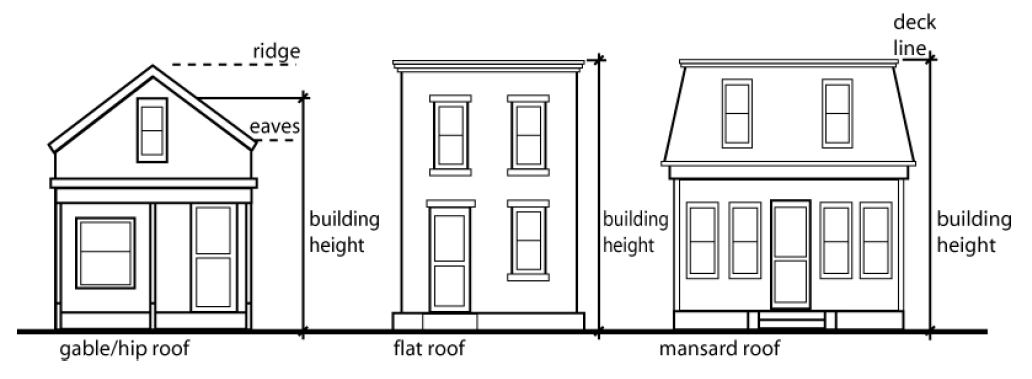
When expressed as a regulation in "feet," building height is measured from average grade along all sides of the building to the highest point of the coping of a flat roof; to the deck lines of a mansard roof; or to the mean height level between the eaves and ridge of a gable, hip, or gambrel roof.
b.
Except in the /AE overlay district, chimneys, elevators, equipment penthouses, belfries, clock towers, cupolas, spires and similar non-habitable structures and features may exceed maximum building height limits that are expressed in feet, provided such features cover no more than 25 percent of the total roof area of the building.
(2)
Residential infill and redevelopment.
a.
The proposed front door threshold elevation for any new detached house may not be more than two feet higher than the front door threshold elevation of the residential structure that existed on the lot prior to demolition. If the proposed construction would require alteration or eradication of the original threshold, then the original threshold elevation must be measured and certified by a licensed surveyor or engineer.
b.
The community development director is authorized to approve proposed front door threshold elevations for new detached houses that exceed the threshold elevation allowed by subsection (2)a if the applicant for a building permit establishes that the elevation of the front door threshold of the proposed residential structure does not exceed the average elevation of the front door thresholds of the residential structures on both lots immediately abutting the subject lot. When using threshold height averaging, the applicant must provide the community development director with the threshold elevations, as certified by a licensed surveyor or engineer.
Figure 13-8. Building Height (in Feet)
(3)
Measurement in stories.
a.
A building "story" includes any portion of a building, other than a basement, included between the surface of any floor and the surface of the floor next above or, if there is no floor above, the space between the floor and the ceiling next above. Each floor or level in a multistory building used for parking, excluding a basement, is considered a story.
b.
When building height regulations are expressed in terms of building "stories," headhouses, mechanical equipment normally built above the roof and not designed or used for human occupancy and roof structures that are completely open on at least three sides are not counted as stories. Any enclosed structure that is designed or used for human occupancy is counted as a "story" if the total area of such enclosed structures exceed in the aggregate: 330 square feet if the total roof area of the building is 3,300 square feet or less; or ten percent of the total roof area of the building if the total roof area is greater than 3,300 square feet.
c.
Minimum and maximum story (floor-to-floor) heights shall be met along all street facing facades and for at least 75 percent of the floor area of each story.
d.
In measuring building height, stories with a floor-to-floor height of 18 feet or greater are counted as two stories.
e.
The following requirements apply to all building types required to be at least two stories in height:
1.
The second story floor area shall be covered and enclosed and equal at least 75 percent of the first story floor area;
2.
The second floor facade shall extend the entire width of any first floor building facade that fronts on Peachtree Road or Apple Valley Road, except for second story areas used for unenclosed or uncovered outdoor dining area, uncovered decks, uncovered balconies, unenclosed stairs and uncovered atriums; and
3.
The entire indoor area of the second floor shall be conditioned space (HVAC) and available for human occupancy.
f.
Building types subject to minimum overall height limits shall meet the applicable minimum height requirement along street-facing facades for a depth of at least 30 feet into the building.
g.
Maximum overall building height limits apply to the entire building.
(b)
Retaining wall height. Retaining wall height is measured vertically from the finished grade on the exposed side of the retaining wall to the highest point of the wall.
(c)
Height of other structures. The height of structures other than buildings and retaining walls is measured as vertical distance from the average finished grade on all sides at the base of the structure to the highest point of the structure.
(Ord. No. RZ-2018-11-06, § I, Exh. A(27.428), 11-27-2018; Ord. No. 2019-05-03, § I(Attch.), 5-28-2019)

