
Brookhaven City Zoning Code
DIVISION 4
GENERAL DEFINITIONS
Sec. 27-1359. - Terms beginning with "A".
Abut or abutting. To touch or share a contiguous boundary or border.
Accessory building. A subordinate building detached from but located on the same lot as the principal building. See also article VII, division 11 of this chapter.
Accessory dwelling unit (ADU). An ancillary or secondary living unit existing either within the same structure or on the same lot as the principal dwelling unit. Accessory dwelling units are also known as backyard cottages, carriage houses, in-law suites, granny flats, secondary suites, etc.
Accessory dwelling unit, attached (AADU). An accessory dwelling unit that exists within and/or is not separated from the principal dwelling unit.
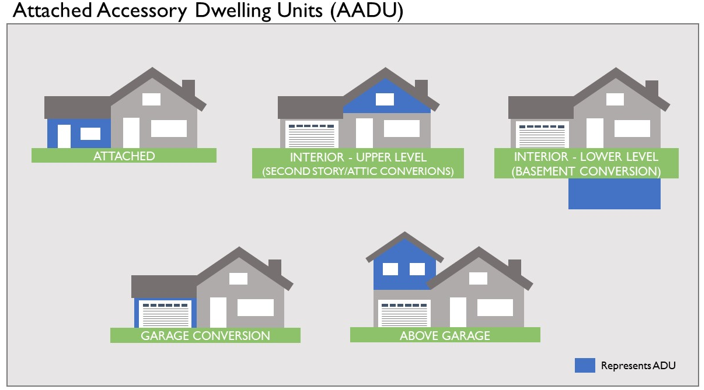
Accessory dwelling unit, detached (DADU). An accessory dwelling unit that is entirely free standing and separated from the principal dwelling unit on the property.
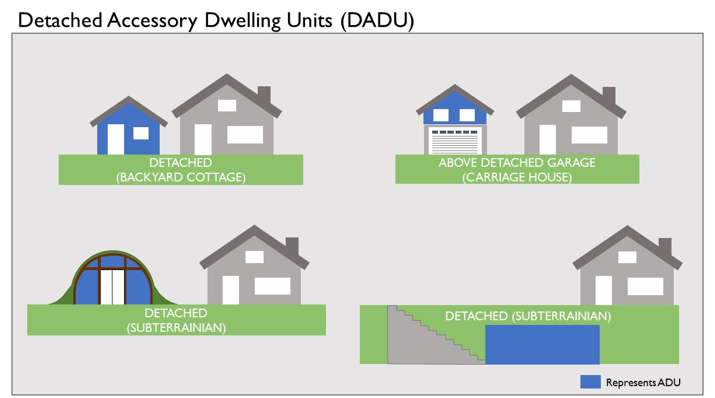
Accessory structure. A subordinate structure detached from but located on the same lot as the principal building. See also article VII, division 11 of this chapter.
Accessory use. A use that is incidental to and customarily associated with the principal use of the subject lot. See also article VII, division 11 of this chapter.
Adjacent. Lying near or in the immediate vicinity.
Administrative permit. See article X, division 9 of this chapter.
Agent. A person duly authorized to act on behalf of the owner of the subject property.
Alley. A public right-of-way that affords a means of access to abutting property, generally secondary in nature.
Animal, companion. Animals that are commonly kept by persons as a pet or for companionship. Companion animals have the following characteristics: have a special and close relationship with humans; are partially or totally dependent on people; commonly live inside a residence in close proximity with humans; form bonds with people; and interact with their human companions. Dogs and cats are common companion animals.
Antenna. For the purpose of administering and interpreting the wireless communication facility regulations of article VII, division 9 of this chapter, this term means, communications equipment that transmits, receives or transmits and receives electromagnetic radio signals used in the provision of all types of wireless communications services. For purposes of administering and interpreting other regulations of this chapter, the term means equipment designed to transmit or receive radio or electronic signals, including but not limited to directional antennae, such as panels, microwave dishes, and satellite dishes, and omnidirectional antennas, such as whip antennas.
Applicant. The party applying for permits or other approvals required by this chapter.
Archaeological resource. Any material remains of past human culture or activities that are at least 200 years of age and are of archaeological interest, including basketry, bottles, carvings, graves, human skeletal materials, pit houses, pottery, rock intaglios, rock paintings, soapstone quarries, structures or portions of structures, tools, weapons, weapon projectiles, or any portion or piece of any of the foregoing items.
Arterial street. A street identified by the Comprehensive Transportation Plan as a major arterial street or minor arterial street.
Attached house building. A building that is occupied by multiple dwelling units, each located on its own lot with a common or abutting wall along the dwelling units' shared lot lines. Each dwelling unit has its own external entrance.
Authorized use. A use identified in this zoning ordinance as allowed as-of-right or upon approval of a special land use permit.
Automobile. A self-propelled, free-moving vehicle, with not more than six wheels, usually used to transport not more than seven passengers and licensed by the appropriate state agency as a passenger vehicle.
(Ord. No. RZ-2018-11-06, § I, Exh. A(27.429), 11-27-2018; Ord. No. RZ2023-12-10, § I, 12-19-2023)
Sec. 27-1360. - Terms beginning with "B".
Base (zoning) district. Any zoning district that is not an overlay district.
Basement. A space having one-half or more of its floor-to-ceiling height below the average level of the adjoining ground and with a floor-to-ceiling height of not less than six and one-half feet.
Base station. A station at a specific site authorized to communicate with mobile stations, generally consisting of radio transceivers, antennas, coaxial cables, power supplies and other associated electronics.
Bioretention. The use of soil and plants to remove pollutants from stormwater runoff.
Block face. All lots abutting one side of a street between the two nearest intersecting streets.
BTZ. Build-to-zone, which is the area on the lot where all or a portion of the street-facing building façade shall located (see also section 27-1337).
Buildable area. The area of a lot remaining after the minimum setbacks and open space requirements of this zoning ordinance have been met.
Building. Any structure having a roof supported by columns or walls and intended for the shelter, housing, or enclosure of any individual, animal, process, equipment, goods, or materials of any kind.
Building, accessory. See "accessory building."
Building footprint. The outline of the total area covered by a building's perimeter at the ground level.
Building, principal. A building in which the principal use of the lot is located.
(Ord. No. RZ-2018-11-06, § I, Exh. A(27.430), 11-27-2018; Ord. No. RZ2023-12-10, § I, 12-19-2023)
Sec. 27-1361. - Terms beginning with "C".
Caliper. The diameter of the tree trunk measured at a point six inches above the root ball or soil level.
Car-share program. A system in which a fleet of cars (or other motor vehicles) is made available for use by members of the car-share program and that exhibit all of the following characteristics:
(1)
Members are permitted to use vehicles from the car-share program fleet on an hourly basis;
(2)
Car-share vehicles are generally available 24 hours a day and seven days a week to members in parking spaces at dispersed locations or facilities; and
(3)
No separate written agreement is required each time a member reserves and uses a car-share vehicle.
Car-share vehicle. A motor vehicle from a car-share program fleet.
Civic building. A building used exclusively to accommodate public and civic uses.
Collector street. A street identified by the Comprehensive Transportation Plan as a collector street
Commercial district. See article IV.
Commercial house building. A building that has been converted from a detached house or that generally resembles a detached house and that is exclusively used to accommodate allowed nonresidential uses.
Common ownership. Ownership as recognized by law of real property by two or more persons, their parents, brothers, sisters, children over the age of 18 years, spouses or any association, firm, corporation or partnership in which such person or spouse is a corporate officer, partner or is a stockholder with an ownership interest of ten percent or more.
Composting. The controlled biological decomposition of organic matter into a stable, odor-free humus.
Condominium. A building, or group of buildings, in which dwelling units, offices, or floor area are owned individually, and the structure, common areas, and facilities are owned by all the owners on a proportional, undivided basis in compliance with state law.
Courtyard housing. A series of small, detached or attached dwelling units arranged around a shared courtyard or open space feature.
(Ord. No. RZ-2018-11-06, § I, Exh. A(27.431), 11-27-2018)
Sec. 27-1362. - Terms beginning with "D".
Detached house. A building, other than a manufactured housing unit or mobile home, that contains only one dwelling unit and that is located on a single lot not occupied by other principal buildings.
Development permit. Any permit that authorizes land disturbance for the use, construction thereon or alteration of any real property.
Diameter at breast height (DBH). The diameter of a tree trunk measured at a point four and one-half feet above ground level at the base of the tree.
Distributed antenna systems ("DAS"). A network of spatially separated antenna nodes connected to a common source via a transport medium that provides wireless service within a geographic area or structure.
Donation box. Any unattended container, receptacle, or similar device used for soliciting and collecting donations of clothing or other salvageable personal property. The term "donation box" shall not include the following: (a) an unattended container, receptacle, or similar device located within the interior of an enclosed building; (b) drop boxes for books and audio-visual materials utilized by a public library; or (c) small drop boxes for books and pantry items utilized by a residential street or a residential neighborhood and located on a residential lot.
Dripline. A vertical line extending from the outermost edge of the tree canopy or shrub branch to the ground.
Driveway. A roadway that provides access for vehicles from a street or alley to a lot, garage, dwelling, building, or structure.
Dwelling unit. One or more rooms, designed, occupied, or intended for occupancy as a separate living quarters, with cooking, sleeping, and bathroom facilities provided within the dwelling unit for the exclusive use of a single-family maintaining a household.
(Ord. No. RZ-2018-11-06, § I, Exh. A(27.432), 11-27-2018; Ord. No. RZ-2023-06-07, § I, 6-28-2023)
Sec. 27-1363. - Terms beginning with "E".
Electric assist bicycle. Any bicycle that is integrated with an electric motor used to assist propulsion provided that the rider maintains the ability to pedal. Also known as e-bikes, pedelecs (pedal electric cycle), or EPAC (electronically power assisted cycle).
Electric assist bicycle charging station. A public or private bicycle parking space that is served by battery charging station equipment.
Electric assist bicycle parking space. Any bicycle parking space that is clearly identified to be used exclusively for the parking of an electric assist bicycle.
Electric vehicle. Any vehicle that is licensed and registered for operation on public and private highways, roads, and streets; either partially or exclusively, on electrical energy from the grid or an off-board source that is stored on-board via a battery. "Electric vehicle" includes: (1) battery electric vehicles; and (2) plug-in hybrid electric vehicles.
Electric vehicle (EV) charging station. A public or private parking space that is served by battery charging station equipment.
Electric vehicle charging station, private (restricted-access). An EV charging station that is not available for use by the general public. Examples include electric vehicle charging stations that serve residential homeowners or renters, executive parking areas, designated employee parking areas and fleet parking areas.
Electric vehicle charging station, public. An EV charging station that is accessible to and available for use by the general public.
Electric vehicle parking space. Any parking space that is clearly identified to be used exclusively for the parking of an electric vehicle.
Electric vehicle supply equipment (EVSE). The conductors, including the ungrounded, grounded, and equipment grounding conductors, and the electric vehicle connectors, attachment plugs, and all other fittings, devices, power outlets, or apparatus installed specifically for the purpose of transferring energy between the premises wiring and the electric vehicle.
Electric vehicle supply equipment (EVSE) infrastructure. The equipment, as defined by the National Electrical Code, which is provided to support future electric vehicle charging. This shall include but not be limited to: the design load placed on electrical panels and service equipment to support the additional electrical demand, the panel capacity to support additional feeder/branch circuits, the installation of raceways, both underground and surface mounted, to support the electrical vehicle supply equipment.
Equipment compound. An area surrounding or near the base of a wireless support structure within which are located wireless communication facilities.
(Ord. No. RZ-2018-11-06, § I, Exh. A(27.433), 11-27-2018; Ord. No. 2019-07-02, § I(Attch.), 7-23-2019; Ord. No. 2022-05-03, § I, 5-24-2022; Ord. No. 2023-01-05, 1-24-2023; Ord. No. 2025-02-02, § I, 2-25-2025)
Sec. 27-1364. - Terms beginning with "F".
Fall zone. The area in which a wireless support structure may be expected to fall in the event of a structural failure, as measured by engineering standards.
Family. See "household."
Fence. An enclosure or barrier, constructed of wood, masonry, stone, wire, metal or other manufactured material or combination of materials and erected to enclose, screen or separate areas, but not including hedges, shrubs, trees, or other natural growth.
Fenestration. The arrangement, proportioning, and design of windows and doors in a building.
Floodplain, 100-year. Land within the 100-year flood elevation, as defined in chapter 14.
Flood hazard district. As defined in chapter 14.
Floodway. As defined in chapter 14.
Floor area. See section 27-1334.
Frontage, lot or street. See section 27-1332.
(Ord. No. RZ-2018-11-06, § I, Exh. A(27.434), 11-27-2018)
Sec. 27-1365. - Terms beginning with "G".
General building. A building that accommodates residential, office, service or employment uses or a combination of such uses.
Geothermal heat exchange system. Equipment that exchanges thermal energy between the ground (or a water source) and a building. This includes vertical closed loop, horizontal closed loop, water body closed loop system and open loop systems. Also known as ground source heat pumps and geothermal heat pumps.
Grade, average. The average (mean) elevation of the ground along a line determined by dividing the sum of the elevation of the highest point on the line and the elevation of the lowest point on the line by two.
Grade, existing. The elevation of the ground surface before development.
Grade, finished. The final grade of the ground surface after development.
Ground-Story (or floor) level. The lowest level of a building that is at or above grade for at least 50 percent of its interior floor-to-ceiling height.
(Ord. No. RZ-2018-11-06, § I, Exh. A(27.435), 11-27-2018)
Sec. 27-1366. - Terms beginning with "H".
Height. See section 27-1338.
Historic. A building, structure, site or district identified as historic by the city council or the city historic preservation society, the comprehensive plan, by listing on the state register of historic places or the National Register of Historic Places, by listing as a national historic landmark, or determined potentially eligible for listing in the National Register of Historic Places or as a result of review under section 106 of the National Historic Preservation Act, as amended.
Home occupation. An accessory use of a dwelling unit for business or commercial purposes. Home occupations are subject to the regulations of section 27-700.
Household. A person living alone, or any of the following groups living together as a single nonprofit housekeeping unit who have established ties and familiarity with one other, who jointly use common areas, and who share meals, household activities, expenses, and responsibilities:
(1)
Any number of persons related by blood, marriage, adoption, guardianship, foster or other duly-authorized custodial relationship;
(2)
A maximum of four unrelated persons; or
(3)
Two unrelated persons and any parents or children related to either.
(Ord. No. RZ-2018-11-06, § I, Exh. A(27.436), 11-27-2018)
Sec. 27-1367. - Terms beginning with "I".
Industrial district. See article IV.
Inoperable vehicle. Any motor vehicle from which, for a period of seven days, the engine, wheels, or other parts have been removed, or in which the engine, wheels, or other parts have been altered, damaged, or otherwise modified so that the vehicle is incapable of being driven under its own motor power. "Inoperable motor vehicle" does not include a motor vehicle that has been rendered temporarily incapable of being driven under its own motor power, solely to perform ordinary service or repair operations.
Intermodal freight terminal. An industrial establishment in which freight is transferred in containerized form from truck to railroad cars for transportation.
(Ord. No. RZ-2018-11-06, § I, Exh. A(27.437), 11-27-2018)
Sec. 27-1369. - Terms beginning with "K".
Kiosk. A freestanding structure upon which temporary information and/or posters, notices, and announcements are posted.
Kitchen facilities. A room used to prepare food containing, at a minimum, a sink and a stove or oven.
(Ord. No. RZ-2018-11-06, § I, Exh. A(27.439), 11-27-2018)
Sec. 27-1370. - Terms beginning with "L".
Land use. A manner in which land is occupied or utilized.
Lawfully established. A use, structure, lot or other feature (as the context indicates) that was established in conformance with all applicable zoning ordinance regulations in effect at the time of its establishment.
Light trespass. Illumination that is emitted into an unintended area.
Livestock. Domestic animals and fowl customarily kept on a farm including horses, mules, donkeys, cows, cattle, sheep, goats, ducks, geese and turkeys.
Local street. A street identified by the Comprehensive Transportation Plan as a local street.
Lot. A designated parcel, tract, or area of land lawfully established by plat, subdivision, or as otherwise permitted by law, to be separately owned, used, developed, or built upon.
Lot, buildable area of. The portion of a lot remaining after required setbacks have been met. Buildings may be located within any portion of the buildable area of a lot, except that if there are lot coverage limitations that exceed the area in required setbacks, the remaining required open space shall be provided within the buildable area of the lot.
Lot, conforming. A designated parcel, tract, or area of land that meets the lot area, lot width, lot frontage and access requirements of this zoning ordinance.
Lot, corner. A lot abutting two or more streets at their intersection or upon two parts of the same street forming an interior angle of less than 135 degrees.
Lot, double-frontage. A lot that abuts two parallel streets or that abuts two streets that do not intersect at the boundaries of the lot. A double-frontage lot may also be referred to as a through lot.
Lot, interior. A lot, other than a corner lot, abutting only one street.
Lot frontage. The distance for which the front boundary line of the lot and the street line are coincident.
Lot line, front. The boundary of a lot that abuts the street. Unless otherwise expressly stated in this zoning ordinance, the community development director is authorized to determine which line is the front lot line on corner lots.
Lot line, street. The boundary of a lot that abuts a street. A lot may have more than one street lot line, and a street lot line may also be a front lot line.
Lot line, rear. The boundary of a lot that is most distant from and most nearly parallel to the front lot line.
Lot line, side. Any boundary of a lot that is not a street lot line or a rear lot line.
Lot width. See section 27-1331.
Lot line. Any boundary of a lot.
Low-impact development (LID). An approach to land development (or redevelopment) that works with nature to manage storm-water as close to its source as possible. LID employs principles such as preserving and recreating natural landscape features, minimizing impervious area to create functional and appealing site drainage features that treat stormwater as a resource rather than a waste product. Common LID practices include bioretention facilities, rain gardens, green roofs, rain barrels or cisterns, and permeable paving.
(Ord. No. RZ-2018-11-06, § I, Exh. A(27.440), 11-27-2018)
Sec. 27-1371. - Terms beginning with "M".
Multi-tenant development. A nonresidential development typically under unified ownership and control consisting of two or more business establishments, which may be on the same lot or on separate lots. The tenants of multi-tenant development typically share vehicle access and parking facilities.
Multi-unit building. A building occupied by multiple dwelling units, all of which are located on a single lot, which may be occupied by more than one multi-unit building. The dwelling units are attached and may be located on separate floors or side-by-side.
(Ord. No. RZ-2018-11-06, § I, Exh. A(27.441), 11-27-2018)
Sec. 27-1372. - Terms beginning with "N".
Neighborhood. An area of the city within which residents share a commonality of interests including distinct physical design and street layout patterns, a shared developmental history, distinct housing types, or boundaries defined by physical barriers such as major roads and railroads or natural features such as creeks or rivers.
Node. A concentration of population, retail, and employment within a well-defined area that has a diverse mix of land uses and a pedestrian and transit orientation.
Nonconforming development feature. See article XII, division 5 of this chapter.
Nonconforming lot. See article XII, division 2 of this chapter.
Nonconforming use. See article XII, division 4 of this chapter.
Nonconforming structure. See article XII, division 3 of this chapter.
Nonconformity. A nonconforming lot, nonconforming use, nonconforming structure, nonconforming development feature or nonconforming sign.
Nonresidential building. Any principal building other than a residential building.
Nonresidential development. All commercial, office, institutional, industrial and similar uses, other than household living or group living uses.
(Ord. No. RZ-2018-11-06, § I, Exh. A(27.442), 11-27-2018)
Sec. 27-1373. - Terms beginning with "O".
Occupied space. Building floor that is designed for and intended to be occupied by customers and employees. Storage areas, utility spaces, parking spaces and similar areas are not considered "occupied space>"
Open-air uses. Uses of land that do not involve buildings or that involve buildings that are incidental and accessory to the open-air use of the lot. Typical examples include storage yards, vehicle impound yards, junk yards and salvage yard uses.
Outdoor customer seating/dining area. The area of all unenclosed areas used or intended to be used for seating and dining by customers and guests, including standing table areas.
Overlay district. A zoning district that over-lays one or more base zoning districts and imposes requirements in addition to those of the base district or relaxes or modifies the regulations otherwise applicable in the base zoning district.
Outdoor storage. The keeping, in an unenclosed area, of any goods, material, merchandise, or vehicles in the same place for more than 24 hours.
Overstory tree or large tree means trees that compose the top layer or canopy of vegetation and will generally reach a mature height of greater than 40 feet and a mature branch spread of 1,600 square feet or more.
(Ord. No. RZ-2018-11-06, § I, Exh. A(27.443), 11-27-2018; Ord. No. RZ-2022-12-03, § I, 12-13-2022)
Sec. 27-1374. - Terms beginning with "P".
Parapet or parapet wall. A wall-like barrier at the edge of a roof that acts as a vertical extension of an exterior building wall extending above the roof height of the building. Parapets may serve as a safety or architectural feature.
Parking garage. A covered or sheltered structure designed, constructed and used for the parking of motor vehicles.
Parking lot. Any area designed for temporary storage of motor vehicles in normal operating condition, regardless if whether or a fee is charged.
Paved. An area that is covered by asphalt, concrete, pervious pavers, or a similar material approved by the community development director.
Permitted use. A use identified by this zoning ordinance as permitted as-of-right in the subject zoning district.
Pitch, roof. The ratio of the rise to the run on a roof.
Portable storage container. Any non-motorized vehicle, trailer or fully enclosed container intended for the temporary storage of items until relocated to another location or a long-term storage facility. Storage containers include, but are not limited to PODS, Pack-Rats and similar containers.
Principal use. The primary or predominant use of any lot.
Principal structure. The building in which the principal use is located.
Private drive. A street that provides for vehicular circulation within a single legal lot of record, which is not dedicated to the city, and which is not maintained by the city.
Private restrictive covenants. Private restrictions on the use of land or structures imposed by private contract, such as subdivision covenants.
(Ord. No. RZ-2018-11-06, § I, Exh. A(27.444), 11-27-2018)
Sec. 27-1375. - Terms beginning with "Q".
Quasi-judicial officers, boards, or agencies. An officer, board, or agency appointed by a local government to exercise delegated, quasi-judicial zoning powers including hearing appeals of administrative decisions by such officers, boards, or agencies and hearing and rendering decisions on applications for variances, special exceptions, special land use permits, or other similar permits not enumerated herein as a zoning decision, pursuant to standards for the exercise of such quasi-judicial authority adopted by Chapter 27 Zoning Ordinance.
(Ord. No. RZ-2023-06-06, § I, 6-28-2023
Sec. 27-1376. - Terms beginning with "R".
Rainwater harvesting equipment. A rain barrel, cistern or similar container that collects and stores rainwater or other water that would otherwise be lost as runoff.
Recreational vehicle. Any motorized or nonmotorized vehicle that is intended for personal recreational use and not intended for daily transportation. Such vehicles include Class A and C motor homes, campervans, bus conversions, boats, military surplus vehicles, all terrain vehicles (ATVs), and similar vehicles intended for recreational purposes. Pickup trucks with a fully enclosed bed that are used for daily transportation are not considered recreational vehicles.
Residential building. A detached house, attached house, duplex or other building containing residential dwelling units.
Residential district. See article II.
Residential housing project. One or more buildings that collectively contain ten or more new or additional dwelling units on one or more lots or parcels under common ownership or control, including contiguous parcels. A "residential housing project" may be developed in one or more phases and may consist of new construction, rehabilitation, or the conversion of rental housing to condominiums. In determining whether a development constitutes a residential housing project, the community development director shall consider all relevant factors, including whether the development is marketed as a single or unified project, shares common elements, or is a phase of a larger development. The definition of "residential housing project" shall be interpreted broadly to promote the provision of workforce housing and to prevent evasion of the workforce housing requirements of this chapter.
Residential use. Occupancy of a building and land for human habitation.
Retaining wall. A structure constructed and erected between lands of different elevations.
(Ord. No. RZ-2018-11-06, § I, Exh. A(27.446), 11-27-2018)
Sec. 27-1377. - Terms beginning with "S".
Satellite television antenna. An apparatus capable of receiving but not transmitting television, radio, or cable communications from a central device transmitting such communications.
Screening fence. An opaque structure designed to provide a visual barrier constructed of materials including wood, chain link with wood or plastic inserts, metal, vinyl, plastic and other such materials as may be approved by the community development director.
Setback. The minimum distance by which a building or structure shall be separated from a street right-of-way or lot line. See also section 27-1336.
Shopfront building. A building situated near the front property line, with parking located at the rear or in small parking lots located to the side of the building. Shopfront buildings have front-facing building entrances and a high-level of transparency at the ground-floor level. Upper levels of multi-story shopfront buildings are typically occupied by residential dwelling units or by office or service uses, as allowed by the subject zoning district.
Site plan. That plan required to acquire a development, construction or building permit that shows the means by which the developer will conform with applicable provisions of this zoning ordinance and other applicable ordinances.
Solar energy system. A system intended to convert solar energy into thermal, mechanical or electrical energy.
Solar energy system, building-integrated. A solar energy system that is an integral part of a principal or accessory building, rather than a separate mechanical device, replacing or substituting for an architectural or structural part of the building. Building-integrated systems include, but are not limited to, photovoltaic or hot water systems that are contained within roofing materials, windows, skylights, shading devices and similar architectural components.
Solar energy system, structure-mounted. A solar energy system that is mounted on the façade or roof of either a principal or accessory structure.
Solar energy system, flush-mounted. A solar energy system that is mounted flush with a finished building surface, at no more than six inches in height above that surface.
Solar energy system, ground-mounted. A solar energy system mounted on the ground and not attached to any other structure other than structural supports.
Solar Panel. A group of photovoltaic cells assembled on a panel. Panels are assembled on-site into solar arrays.
Special land use permit. See article X, division 3 of this chapter.
Story. See section 27-1338.
Street, arterial. See "arterial street."
Street, collector. See "collector street."
Street, local. See "local street."
Street, public. Any right-of-way set aside for public travel deeded to the city and any right-of-way that has been accepted as a street for maintenance by the city.
Street right-of-way line (or right-of-way line). The dividing line between a lot, tract or parcel of land and a street right-of-way.
Structure. Anything constructed or erected with a fixed location on the ground, or attached to something having a fixed location on or in the ground.
Structure, accessory. See "accessory structure."
Substantial modification (to a wireless communication facility). The mounting of a proposed wireless communication facility on a wireless support structure that substantially changes the physical dimensions of the support structure. A mounting is presumed to be a substantial modification if it meets any one or more of the following criteria:
(1)
Increases the existing vertical height of the wireless support structure by (a) more than ten percent, or the height of one additional antenna array with separation from the nearest existing antenna not to exceed 20 feet, whichever is greater;
(2)
Adds an appurtenance to the body of a wireless support structure that protrudes horizontally from the edge of the wireless support structure more than 20 feet, or more than the width of the wireless support structure at the level of the appurtenance, whichever is greater (except where necessary to shelter the antenna from inclement weather or to connect the antenna to the tower via cable);
(3)
Increases the square footage of an existing equipment compound by more than 2,500 square feet.
(Ord. No. RZ-2018-11-06, § I, Exh. A(27.447), 11-27-2018)
Sec. 27-1378. - Terms beginning with "T".
Territorial boundaries. The area lying within the corporate limits of the City of Brookhaven.
Three-flat building. A building occupied by three dwelling units, all of which are located on a single lot that is not occupied by other principal buildings. The three dwelling units are attached and may be located on separate floors or side-by-side.
Threshold. The top of the subfloor in the opening that is designated as the front door of a dwelling.
Top plate. The horizontal timber directly carrying the trusses of a roof or the rafters.
Trailer. Any non-motorized vehicle or wheeled attachment designed to be towable, including landscape utility trailers, horse trailers, storage trailers, campers, recreational vehicle trailers, trailers designed for temporary living quarters while traveling or camping, fifth-wheel trailers, travel trailers, pop-up campers, transport trailers and boat trailers.
Tree. Any self-supporting woody plant that usually provides one main trunk and produces a more or less distinct and elevated head with branches.
Tree canopy. The area directly beneath the crown and within the outermost edges of the branches and leaves of a tree.
Truck. A motor vehicle designed, used, or maintained primarily for the transportation of property.
Two-flat building. A building occupied by two dwelling units, both of which are located on a single lot that is not occupied by other principal buildings. The two dwelling units are attached and may be located on separate floors or side-by-side.
(Ord. No. RZ-2018-11-06, § I, Exh. A(27.448), 11-27-2018; Ord. No. RZ-2023-06-06, § I, 6-28-2023)
Sec. 27-1379. - Terms beginning with "U".
Usable satellite signals. Satellite signals from all major communications satellites that, when viewed on a conventional television set, are at least equal in picture quality to those received from local commercial television stations by way of cable television.
Use. The purpose or activity for which land or buildings are designed, arranged, or intended or for which land or buildings are occupied or maintained.
(Ord. No. RZ-2018-11-06, § I, Exh. A(27.449), 11-27-2018)
Sec. 27-1380. - Terms beginning with "V".
Variance. Permission to depart from strict compliance with applicable zoning ordinance requirements, pursuant to article X, division 6 of this chapter.
Vehicle fuels, alternative. Electricity, CNG (compressed natural gas), LNG (liquefied natural gas), LPG (liquefied petroleum gas), and hydrogen.
Vehicle fuels, conventional. Gasoline and diesel fuel.
Viewshed. The total area visible from an identified observation position.
(Ord. No. RZ-2018-11-06, § I, Exh. A(27.450), 11-27-2018)
Sec. 27-1381. - Terms beginning with "W".
Wall, masonry. An enclosure or barrier, constructed of brick, stone, concrete, concrete block or other aggregate material and erected to enclose, screen or separate areas.
Wall, retaining. A structure constructed and erected between lands of different elevations to protect structures or prevent erosion and located outside the buildable area of a lot (within required setback areas).
Wall, wing. A wall that is part of or structurally attached to a building's foundation and located within the buildable area of a lot (outside of required building setbacks).
Walk-up building. A small, non-elevator building occupied by multiple dwelling units, all of which are located on a single lot that is not occupied by other principal buildings. The dwelling units are attached and may be located on separate floors or side-by-side.
Workforce housing. For-sale or rental housing units that are affordable to those households earning no more than 80 percent of the median household income for the Atlanta MSA, as determined by the current fiscal year HUD income limit table.
Workspace building. A modified, more flexible form of the general building type. Workspace buildings are primarily intended to accommodate warehouse, light industrial and heavy service uses.
(Ord. No. RZ-2018-11-06, § I, Exh. A(27.451), 11-27-2018)
Sec. 27-1383. - Terms beginning with "Y".
Yard. The actual (as opposed to "required") open, unoccupied space that exists on a lot between a building and a lot line.
Yard, front. A yard extending the full width of the lot (between the side lot lines) between the principal building and the street right-of-way.
Yard, interior side. A yard extending between the front yard and the rear yard between the principal building and the adjacent side lot line.
Yard, rear. A yard extending the full width of the lot (between the side lot lines) between the principal building and the rear lot line.
Yard, street side. A yard extending between the front yard and the rear yard between the principal building and the adjacent street side lot line.
Yard, street. Any yard abutting a street.
(Ord. No. RZ-2018-11-06, § I, Exh. A(27.453), 11-27-2018)
Sec. 27-1384. - Terms beginning with "Z".
Zoning. The power of local governments to provide within their respective territorial boundaries for the zoning or districting of property for various uses and the prohibition of other or different uses within such zones or districts and for the regulation of development and the improvement of real estate within such zones or districts in accordance with the uses of property for which such zones or districts were established.
Zoning decision. Final legislative action by a local government which results in:
(1)
The adoption or repeal of a zoning ordinance.
(2)
The adoption of an amendment to a zoning ordinance which changes the text of the zoning ordinance.
(3)
The adoption or denial of an amendment to a zoning ordinance which rezones property from one zoning classification to another.
(4)
The adoption or denial of an amendment to a zoning ordinance by a municipal local government which zones property to be annexed into the municipality.
(5)
The grant or denial of a permit relating to a special use of property.
(6)
The grant or denial of a variance or conditions concurrent and in conjunction with a decision pursuant to subparagraphs (1) or (5) of this subsection.
(Ord. No. RZ-2018-11-06, § I, Exh. A(27.454), 11-27-2018; Ord. No. RZ-2023-06-06, § I, 6-28-2023)

