
Carmel City Zoning Code
ARTICLE 11
Definitions
11.01 General
Words used in a special sense in the Unified Development Ordinance are defined in Article 11: Definitions as follows.
11.02 Definitions
4-sided Architecture: See “Four-sided Architecture.”Accessory Dwelling: See “Dwelling, Accessory.” Accessory Use: See “Use, Accessory.”Administrator: See “Planning Administrator.”
Advisory Planning Law: The Advisory Planning Law of the State of Indiana, as defined in IC 36‑7‑4‑101.
Agricultural Building: See “Building, Agricultural.”
Agriculture, General: The use of land for agricultural purposes, including farming, pasturage, horticulture, floriculture, viticulture, and the necessary accessory uses for parking, treating or storing the produce; provided, however, that the operation of any such accessory uses shall be secondary to the normal agricultural activities. The term agriculture does not include chemical storage or manufacturing associated with Agriculture.
Airport: A facility with surfaced runways and navigation devices for the takeoff and landing of aircraft and with or without services available for aircraft.
Airstrip: A grassed area runway without navigation devices for the takeoff and landing of aircraft and without services available for aircraft.
Alley: A permanent public service way providing a secondary means of access to abutting lands.
Alteration, Material: Any change to an approved plan of any type that involves the substitution of one material, species, element, etc. for another.
Alteration, Minor: Any change to an approved plan of any type that involves the revision of less than ten percent (10%) of the plan’s total area or approved materials.
Alteration, Sign: Any location, lighting, design, structure, size, color, or installation method change of the materials comprising an established sign.
Alteration, Structural: Any change in the supporting members of a Building such as bearing walls, partitions, columns, beams, girders, or any substantial change in the exterior walls or the roof. The term does not include Substantial Modification of a Wireless Support Structure.
Alteration, Substantial: Any change to an approved plan of any type that involves the revision of ten percent (10%) or more of the plan’s total area or approved materials. The term does not include Substantial Modification of a Wireless Support Structure.
Alteration of Real Estate: Any act by which vegetative cover or soil is removed, or soil is graded and land changed that may result in erosion or the movement of sediments, or the covering of land surfaces with impermeable material on areas totaling more than 15,000 square feet.
Animal, Domestic: An animal that is tame or domesticated and not normally found in the wild state.
Animal, Exotic: Any wild animal not customarily confined or cultivated by man for domestic or commercial purposes but rather kept as a pet or for display.
Animal, Farm: Any animal that customarily is raised for profit on farms.
Antenna: Any communications equipment that transmits or receives electromagnetic radio signals used in the provision of Wireless Communications Service.
Antenna, Satellite Receiving: A signal receiving device, the purpose of which is to receive radio communications, television, data transmission or other signals from a satellite or satellites in earth orbit. Considered a Structure, thus subject to all ordinances relating to Structures. Not considered a Wireless Facility, thus not subject to Article 5, Section Wireless Support Structure Standards.
Antenna, Radio or Television Transmission: A signal receiving device, the purpose of which is to receive radio communications or television signal transmissions.
Apartment: A dwelling unit, primarily of a rental nature.
Area, Building: See “Building Area.”
Area, Common: Areas within a development that serve either a portion of or the entire development. (Example common area - signs, lighting, landscaping, maintenance shed, etc.)
Area, Gross: Entire area of project or platted area.
Area, Window: See “Window Area.”
Art and Music Center: See “Center, Art and Music.”
Art Gallery: A room or structure in which original works of art or limited editions of original art are bought, sold, loaned, appraised or exhibited to the general public.
Artificial Lake or Pond: See “Lake or Pond, Artificial.”
As-Built Drawing: A drawing stamped by a Professional Engineer or Registered Land Surveyor, as appropriate, who is licensed to do business in the State of Indiana in accordance with State Statutes, that accurately depicts an improvement or installation as it was actually constructed.
Assessed Valuation: The monetary value placed on a property and/or Building as established by the assessor with authority over the planning jurisdiction.
Assisted Living Facility: See “Facility, Assisted Living.”
Attached Dwelling: See “Dwelling, Attached.”
Automated Teller Machine (ATM): A mechanized consumer banking device operated by a financial institution for the convenience of its customers, whether outside or in an access-controlled facility.
Automobile Filling Station: See “Station, Automobile Filling.”
Automobile or Boat Sales: See “Sales, Automobile or Boat.”
Automobile or Truck Repair (Indoor): See “Repair (Indoor), Automobile or Truck.”
Automobile Service Station: See “Station, Automobile Service.”
Awning, Permanent: A permanent shelter supported entirely from the exterior wall of a building and composed of rigid or non-rigid materials. (See definition of Wall Sign).
Awning, Temporary: A temporary shelter, erected and in place for less than six (6) months of any given year, supported entirely from the exterior wall of a building and composed of non-rigid materials except for the supporting framework. One decorative and non-commercial nature, clearly incidental and customary and commonly associated with any national, state, local or religious holiday.
Banner: A temporary sign composed of lightweight material either enclosed or not enclosed in a rigid frame, secured or mounted so as to allow movement of the sign caused by movement of the atmosphere.
Base Station: A station located at a specific site that is authorized to communicate with mobile stations. The term includes all radio transceivers, Antennas, coaxial cables, power supplies, and other electronics associated with a station.
Basement: A story having part, but not less than one-half (½), of its height below grade. A basement is counted as a story for the purposes of height regulation if subdivided, used for dwelling purposes and/or as walk-out access.
Bay: See “Berth or Bay, Loading and Unloading.”
Bed and Breakfast Inn: A private, owner-occupied business with two (2) to ten (10) guest rooms where overnight accommodations and a morning meal are provided to transients for compensation and where the Bed and Breakfast Inn is operated primarily as a business. A Dwelling that is occupied by a Permanent Resident where only one (1) guest room or group of rooms is made available to transients for compensation shall not be considered a Bed and Breakfast Inn.
Berth or Bay, Loading and Unloading: The off-street area required for the receipt or distribution by vehicles of material or merchandise, which in the Unified Development Ordinance is held to be a twelve-foot (12’) by forty-five- foot (45’) loading space with a fifteen-foot (15’) height clearance and paved with a hard surface in accordance with the current standards of the City of Carmel.
Best Management Practices, Drainage: Structural or nonstructural practices, or a combination of practices, designed to act as effective, practicable means of minimizing the impacts of development and human activities on water quality. Traditional structural BMPs, including extended detention dry ponds, wet ponds, infiltration trenches, and sand filtration systems, are now common elements of most new development projects. Structural BMPs rely heavily on gravitational settling and/or the infiltration of soluble nutrients through a porous medium for pollutant removal. Nonstructural BMPs, which may be used independently or in conjunction with structural BMPs, rely on a much wider breadth of mechanisms to prevent or control non-point source pollution. Nonstructural BMPs range from programs that increase public aware- ness to prevent pollution, to the implementation of control-oriented techniques (such as bio-retention and stormwater wetlands) that utilize vegetation to enhance pollutant removal and restore the infiltrative capacity of the landscape.
Bicycle Parking, Long-Term: Bicycle parking spaces intended to be used for periods of time that are longer than two hours and are targeted to residents, employees and other long term users. Long term bicycle parking typically offers increased levels of security in lit, covered, and permanently anchored locations, which are proximate to employee or resident locations/entrances. Examples include storage lockers, locked rooms or enclosures, and parking areas internal or external to the building.
Bicycle Parking, Short-Term: Bicycle parking spaces intended to be used for periods of time that are two hours or less and are targeted to visitors, customers and other short term users. Short-term bicycle parking typically includes bike racks near building entrances.
Block: A unit or property bounded by one or more streets and by streets and/or railroad rights-of-way, waterways or other barriers.
Block Frontage: Property having frontage on one (1) side of a street and lying between the two (2) nearest intersecting or intercepting streets, or nearest intersecting or intercepting street and railroad Right-of-way, waterway or other barrier.
Board of Zoning Appeals: The City of Carmel Board of Zoning Appeals.
Bona Fide Servants Quarters: Living quarters, which may include kitchen facilities, that are either attached or detached from the principal residence, used as a residence by persons employed to provide domestic services to the occupants of the principal residence.
Borrow Pit: An area of land from which earth is removed for use on another site and a permanent or temporary irregular terrain is created.
Buffer or Screen, Solid Visual: May include, but not be limited to a minimum five-foot (5’) high solid evergreen hedge; stone, brick or wood fence; earth mounding or other suitable material or any combination a minimum of five (5) feet in height. If a chain link fence (with or without screen slats) is used, a minimum of five-foot (5’) high solid evergreen hedge shall be provided on the residential or commercial side of the fence.
Bufferyard: A landscaped area with setback widths extending along all perimeter property lines. Both the amount of land and the type and amount of plant material specified for each lettered bufferyard determination is specified and is designed to ameliorate nuisances between adjacent zoning districts and to ensure a desired character along public streets and roads.
Build-To Line: A line appearing on the development plan, stated as the setback dimension from the Right-of-way along which a Building facade must be placed.
Building: Any structure used or intended for supporting or sheltering any use or occupancy. See also Structure. See also Section 1.09(E): Building or Structure.
Building, Accessory: A Building subordinate to another Structure or Use located on the same Lot which is not used for permanent human occupancy. An Accessory Building may also include electric distribution and secondary power lines; gas, water and sewer lines; their supports and poles, guy wires, small transformers, wire or cable and other incidental equipment and public telephone booths.
Building, Agricultural: Any building or structure customarily used in connection with a farm other than a dwelling.
Building Area: The maximum horizontal projected area of the Principal and Accessory Building, excluding open steps or terraces, unenclosed porches not exceeding one story in height and architectural appurtenances projecting not more than the amounts specified herein.
Building, Commercial: any structure used for business or non-residential activities, such as offices, retail, industrial, hospitality, educational, or healthcare facilities.
Building, Detached: A Building having no structural connection with another Building.
Building, Front Line of: The line of the face of the Building nearest the Front Lot Line, not counting patios, terraces, etc.
Building Frontage: See “Frontage, Building.”
Building Height: See “Height, Building.”
Building; Multi-Tenant, Ground Floor: A single level office or commercial Building, occupied by two (2) or more businesses.
Building; Multi-Tenant, Multi-Level: An office or commercial Building, occupied by two (2) or more businesses with two (2) or more occupiable floors.
Building; Multi-Tenant, Multi-Level, Mixed Use: A Building with two or more floors where the ground floor is generally reserved for retail and service uses and the upper stories are generally intended for residential uses.
Building, Municipal: A Building that is owned and/or operated by the City of Carmel and/or Clay Township.
Building, Principal: A Building in which is conducted the main or principal Use of the Lot on which said Building is situated. Where a substantial part of an Accessory Building is attached to the Principal Building in a substantial manner, as by a roof, such Accessory Building shall be counted as a part of the Principal Building.
Building Safety Official: A designee of the Director of Community Services authorized to carry out the City’s building permit and inspection program as provided in Article 1 of the City of Carmel Unified Development Ordinance.
Building Setback Line: (Sometimes called a Building Line.) The line nearest the front of and across a Lot establishing the minimum open space to be provided between the front line of a Building or Structure and the Front Lot Line.
Building, Single-Tenant: An office or commercial building in which all space is occupied by one (1) tenant.
Burning, Free: A rate of combustion described by a material which burns actively and easily supports combustion.
Burning, Intense: A rate of combustion described by a material that burns with a high degree of activity and is consumed rapidly.
Burning, Moderate: A rate of combustion described by a material which supports combustion and is consumed slowly as it burns.
Burning, Slow, or Incombustible: Materials which do not in themselves constitute an active fuel for the spread of combustion. A material which will not ignite, nor actively support combustion, during an exposure for five (5) minutes to a temperature of 1200 degrees Fahrenheit.
Business Day: A day other than a Saturday, a Sunday, or a legal holiday (as defined in IC 1-1-9-1).
Camp, Public: Any area or tract of land used or designed to accommodate two (2) or more camping parties, including cabins, tents or other camping outfits.
Campground: See “Camp, Public.”
Canopy: A permanent shelter supported entirely from the exterior wall of a building and composed of rigid materials.
Car Wash: The use of a site for washing and cleaning of passenger vehicles, recreational vehicles, or other light duty equipment.
Carnivals, Fairs, or Circuses: A traveling or transportable group or aggregation of rides, shows, games or concessions or any combination thereof.
Catering Establishment: An establishment providing meals and/or refreshments for public or private entertainment for a fee.
Cemetery: Land used for the burial of the dead and dedicated for cemetery purposes, including columbariums, crematories, mausoleums and mortuaries when operated in conjunction with and within the boundary of such cemetery.
Center Identification Ground Sign: See “Sign, Center Identification Ground.”
Center, Art and Music: A structure or complex of structures for housing the visual and/or performing arts.
Center; Civic, Community, or Convention: A place, structure, area, or other facility used for and providing religious, fraternal, social, and/or recreational programs generally open to the public and designed to accommodate and serve significant segments of the community.
Center, Family or Child Advocacy: An establishment serving the physical, emotional, spiritual and legal needs of victims or at-risk individuals.
Center, Medical-Health: See “Clinic or Medical-Health Center.”
Center, Surgery: An establishment that delivers surgical procedures on an outpatient basis and requiring less than a twenty-four-hour stay.
Center, Unified: A grouping of businesses or buildings designed to function as a unit including converted residential structures with more than one (1) occupant space.
Center, Urgent Care: An establishment that delivers generally non-surgical physician services on an emergency or immediate basis or without the requirement of an appointment for such services.
Centerline: A line lying midway between the sidelines of a street or alleyRight-of-way and/or pavement.
Certificate of Occupancy: A certificate signed by the Director of Community Services stating that the occupancy and Use of land or a Building or Structure referred to therein complies with the provisions of the Unified Development Ordinance.
Changeable Copy: See “Copy, Changeable.”
Character Building: Character Buildings are those that have certain characteristics that are in keeping with historical construction in the Old Town District.
Charitable Institutions: See “Institutions, Religious or Charitable.”
Child Advocacy Center: See “Center, Family or Child Advocacy.”
Church, Temple, or Place of Worship: A Building, together with its Accessory Buildings and property, where persons regularly assemble for religious purposes and related social events and which Buildings, together with Accessory Buildings and uses, is maintained and controlled by a religious body organized to sustain religious ceremonies and purposes.
Circus: See “Carnivals, Fairs, or Circuses.”
City: The City of Carmel, Indiana.
City Engineer: The City of Carmel’s City Engineer and/or his/her authorized representatives. The City Engineer is delegated the role of overseeing engineering related matters in the Unified Development Ordinance. The City of Carmel Engineering Standards, design-specific context, evaluation of safety issues, project-specific studies, classification of streets, condition of existing infrastructure, capacity of existing infrastructure, and the City’s Transportation Plan are used as the basis for engineering decisions.
Civic, Community, or Convention Center: See “Center; Civic, Community, or Convention.”
Civil Violation: See “Violation, Civil.”
Clinic or Medical-Health Center: An establishment where human patients are admitted for special study and treatment by two or more licensed physicians or dentists, and their professional associates.
Club or Lodge, Private: An association organized and operated on a non-profit basis for persons who are bona fide members paying dues, which association owns or leases premises, the use of which premises is restricted to such members and their guests, and which manages the affairs of such association by and through a board of directors, execu- tive committee or similar body chosen by the members. Food, meals and beverages may be served on such premises, provided adequate dining room space and kitchen facilities are available. This includes fraternities and sororities.
Coliseum: See “Stadium or Coliseum.”
College or University: An Institution accredited at the college level by an agency or association recognized by the U.S. Secretary of Education and legally authorized to offer at least a one-year program of study creditable towards a degree.
Collocation: The placement or installation of Wireless Facilities on existing structures (not including a Utility Pole or an Electrical Transmission Tower) that include a Wireless Facility or Wireless Support Structure, including water towers, and other Buildings or Structures. The term includes the placement, replacement, or modification of Wireless Facilities within an approved Equipment Compound.
Commercial Recreational Enterprise or Facility: See “Recreational Enterprise or Facility, Commercial.”
Commercial Use: Those uses identified in Article 2: Zoning Districts under the sub-heading of: Office Permitted Uses, Office Special Uses, Institutional Permitted Uses, Institutional Special Uses, Retail and Services Permitted Uses, Retail and Services Special Uses, Cultural/Entertainment Permitted Uses, Cultural/Entertainment Special Uses, Industrial Permitted Uses, and Industrial Special Uses.
Commission: See “Plan Commission.”
Commitment: A covenant concerning the use or development of a parcel of real property which is made in writing by the owner of that parcel, either voluntarily or in accordance with an order or request of the Plan Commission.
Community Center: See “Center; Civic, Community, or Convention.”
Community Development Director: See “Director of Community Services.”
Condominium: One or more Structures, each Structure having two (2) or more Dwelling Units or other units for occupancy, wherein provisions have been made for separate ownership of each individual Dwelling Unit or occupancy unit. A type of ownership.
Construction, Commencement of: The point in time commemorating the breaking of ground for the construction of a development or Structure.
Construction Facility, Temporary: Temporary Buildings or Structures incidental to construction operations used during construction development.
Construction Fencing: Temporary fencing typically used for the purpose of concealing construction development.
Construction Site: A parcel of land that is under active development, for which an Improvement Location Permit has been issued.
Continuing Care Retirement Community (CCRC): A Health Care Facility that:
- Provides independent living services and health facility services in a campus setting with common areas; and
- Where three (3) or more levels of continued care are provided to senior citizens, including but not limited to: independent living, assisted living, and skilled nursing/memory care. Examples include a campus of independent apartments, detached or attached cottages, and nursing home rooms in a congregate building, as well as support services and facilities.
Convenience Market: See “Market, Convenience.”
Convention Center: See “Center; Civic, Community, or Convention.”
Cooperative: A type of ownership characterized by collective ownership of an object by an organization whose members share in the profits or other benefits of said collective ownership.
Copy: The wording on a sign surface either in permanent or removable letter form.
Copy, Changeable: Characters, letters or illustrations that can be changed or rearranged non-electrically or non-electronically without altering the face or surface of the sign.
Copy Area: The area in square feet of the smallest geometric figure(s) which describes the portion of the sign which encloses the actual Copy of the sign.
Council: The Common Council of the City of Carmel, Indiana.
County: Hamilton County, Indiana.
Country Club: A club with recreation facilities for members, their families and invited guests.
Court: See “Cul-De-Sac.”
Courtyard Garage: A garage that faces a paved area in front of the house, typically perpendicular of the front facade. Courtyard garages must be within twenty degrees (20°) of perpendicular to be considered a courtyard garage and have a large enough paved area for cars maneuver safely into and out of the garage.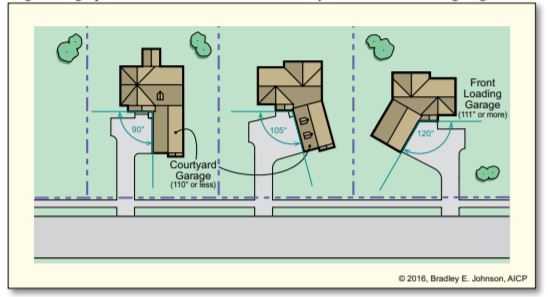
Crossway: A pedestrian mid-block walk located in an easement within the street.
Cul-De-Loop: A street that turns into and reconnects with its main axis, with the center or island used for parking or open space purposes.
Cul-De-Sac (Court or Dead End Street): A short street having one end open to a through street and being permanently terminated by a vehicle turn-around. The length of a cul-de-sac is measured from the center of the turn-around to the centerline of the first intersecting through street.
Cut: An excavation. The difference between a point on the original ground and a designated point of lower elevation on the final grade. Also, the material removed in excavation.
Data Processing and Analysis Facility: Facility where electronic data is processed by employees, including, without limitation, data entry, storage, conversion or analysis, subscription and credit card transaction processing, telephone sales and order collection, mail order and catalog sales, and mailing list preparation.
Day (or Day Care) Nursery: An organized group program for the care of preschool children away from their own residence for any part of a twenty-four (24) hour day, for compensation or otherwise.
DBH: See "Diameter at Breast Height."
Decibel: A unit of measurement of the intensity or loudness of sound. Sound level meters are used to measure such intensities and are calibrated in decibels.
Dedication: A gift, by the owner, of a right to use land for stated purposes. These property rights are transferred through a recorded written document.
Density, Gross: The total number of Dwelling Units divided by the Gross Area in acres.
Department: The Carmel Department of Community Services.
Development: Any man-made change to improved or unimproved real estate including but not limited to:
- Construction, reconstruction, or placement of a building or any addition to a building;
- Installing a Manufactured Home on a site, preparing a site for a Manufactured Home or installing a Recreational Vehicle on a site for more than 180 days;
- Installing utilities, erection of walls or fences, construction of roads, or similar projects;
- Construction of flood control structures such as levees, dikes, dams, channel improvements, etc.;
- Mining, dredging, filling, grading, excavation, or drilling operations;
- Construction and/or reconstruction or bridges or culverts;
- Storage of materials, or;
- Any other activity that might change the direction, height, or velocity of flood or surface waters. “Development” does not include activities such as the maintenance of existing buildings and facilities such as painting, re-roofing; resurfacing roads; or gardening, plowing, and similar agricultural practices that do not involve filling, grading, excavation, or the construction of permanent buildings.
Development Requirements: Development standards, plus any additional requirements specified in the Unified Development Ordinance which must be satisfied in connection of the approval of a Subdivision or Development Plan.
Diameter at Breast Height (DBH): Diameter of a tree trunk measured at fifty-four (54) inches above grade.
Director of Community Services: The person who holds the position of Director of the Department of Community Services for the City of Carmel, or his/her designee.
Director of Parks: The person who holds the position of Director of the Carmel-Clay Parks, or his/her designee.
Dish: That part of the earth station shaped like a saucer or dish.
Display, Outdoor: The temporary showing of materials or products in an unroofed and/or unenclosed area for a period less than twelve (12) hours.
Disposal Facility: A site or plant where solid waste is subject to treatment, storage, recovery, incineration, grinding, composting, collection or covering by earth.
District: The zoning districts established in the Unified Development Ordinance.
Domestic Animal: See “Animal, Domestic.”
Drainage Concentration: The diversion of the natural flow of water, directed to a point or an area, that creates a greater than natural flow at that point or area.
Driveway: That space or area of a Lot which is specifically designated and reserved for the movement of motor vehicles within the Lot or from the Lot to a public street.
Dry Cleaning With On-Site Plant: An establishment or business maintained for the pickup and delivery of dry cleaning and/or laundry with an on-site plant and the maintenance or operation of any laundry or dry cleaning equip- ment on the premises.
Dry Cleaning Without On-Site Plant: An establishment or business maintained for the pickup and delivery of dry cleaning and/or laundry without an on-site plant and without the maintenance or operation of any laundry or dry cleaning equipment on the premises.
Dwelling: A Building, or portion thereof, used primarily as a place of abode for one or more Permanent Residents of the Dwelling, but not including Hotels or Motels, lodging or Boarding Houses, Bed and Breakfast Inns, or Tourist Homes.
Dwelling Unit: One or more rooms in a residential Building, or residential portion of a Building, which are arranged, designed, used or intended for use as a complete, independent living facility for one (1) Family and which includes permanent provisions for living, sleeping, eating, cooking and sanitation.
Dwelling, Accessory: A Dwelling that is attached to or located on the same Lot as a detached or attached Single family Dwelling, has an independent means of access and is owned by the owner of the Principal Building but occupied by another. Accessory Dwellings include Apartments integrated within or attached to a Single-family Dwelling, or located in detached Accessory Buildings located on the same Lot as the Single-family Dwelling.
Dwelling, Attached: A Townhouse, duplex, triplex, or quadruplex dwellings, developed side by side for sale as condominiums or fee-simple dwelling where land is sold with the Dwelling. Attached dwellings whether sold as condominiums or as individually deeded lots are excluded from the definition of apartments.
Dwelling, Multiple-Family: A residential Building containing three (3) or more Dwelling Units and occupied by three (3) or more families. Except as otherwise provided by state statute, a Group Home shall not be considered a Multiple- Family Dwelling and treated as such under the Unified Development Ordinance.
Dwelling, Single-Family: A residential Building containing only one (1) Dwelling Unit and not occupied by more than one (1) Family.
Dwelling, Two-Family: A residential Building containing two (2) Dwelling Units and not occupied by more than two Families. Except as otherwise provided by state statute, a Group Home shall not be considered a Two-FamilyDwelling and treated as such under the Unified Development Ordinance.
Easement: A grant by the property owner of the use of a strip of land by the public, a corporation, or persons, for specified purposes.
Electrical Transmission Tower: A structure that physically supports high voltage overhead power lines. The term does not include a Utility Pole.
Electronic Scrolling Numerals: In reference to signs, numbers that move electronically to change the display. Light may shine through the numeral; however, the numeral is not constructed of lights.
Engineering Standards, City of Carmel: Any Federal, State, or local rules or guidelines used to regulate the design and installation of streets, sidewalks, multiple-use trail, curb, sanitary sewer, storm sewer, water, swales, storm water collection, storm water detention, storm water quality structure, lighting, and any other facility in which the City has interest in quality design and installation. Best practice manuals, published engineering standards from engineering organizations, and research published by engineering or similar organizations may be used where applicable or appropriate to a proposed project.
Entryway Feature: Hardscaping utilized at the entrance of a development that portrays a development theme, or character complementary to the overall development and nearby developed area.
Equipment Compound: The area that:
- Surrounds or is near the base of a Wireless Support Structure; and
- Encloses Wireless Facilities.
Equipment Sales and Repair: The use of land, buildings or structures for the sale, storage or repair of equipment and machinery, which may include but is not limited to farm implement sales and repair and small engine sales and repair.
Erosion: The removal of surface materials by the action of natural elements.
Establish: In reference to signs, this term shall mean attach, alter, construct, paint, or move.
Excavation: Any act by which earth, sand, gravel, rock or any other similar material is dug into, cut, quarried, uncovered, removed, displaced, relocated or bulldozed and shall include the conditions resulting therefrom.
Event, Special: See “Special Event, Outdoor.”
Existing Manufactured Home Park or Subdivision: See “Manufactured Home Park or Subdivision, Existing.”
Exotic Animal: See “Animal, Exotic.”
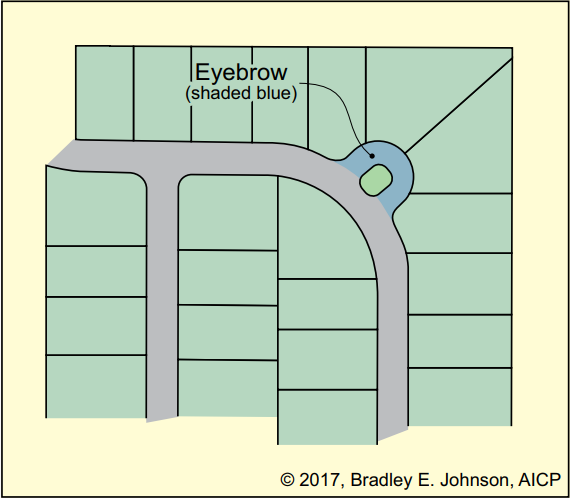
Eyebrow Cul-de-sac: A semi-circular extension of a street on one (1) side of a street used to provide additional street frontage for a small number of lots, and that has an island for traffic management purposes.
Facade: Any side of a Building.
Facade, Tenant: The exterior portion of a tenant’s space.
Facility, Assisted Living: Housing wherein limited health care is provided for the aged.
Facility, Health and Fitness: A place to exercise although not necessarily under the supervision of a physical therapist, occupational therapist, exercise physiologist, or other similar health care provider.
Facility, Occupational Therapy: A place where therapy in which the principal element is some form of productive or creative activity is provided.
Facility, Physical Therapy: A place where treatment of disease and injury by mechanical means such as exercise, heat, light, and massage is provided.
Facility, Rehabilitation: A place used to assist humans to achieve or to restore good health or useful life through therapy, treatment and education.
Fair: See “Carnivals, Fairs, or Circuses.”
Family: One or more persons living as a single housekeeping unit, including up to five (5) unrelated persons, as distinguished from a group occupying a hotel, club, nursing home, fraternity or sorority house.
Family Advocacy Center: See “Center, Family or Child Advocacy.”
Farm: A tract of land comprising an area of at least three (3) acres which is devoted to agricultural operations, such as forestry; the growing of crops; pasturage; the production of livestock and poultry; the growing of trees, shrubs and plants; and other recognized agricultural pursuits and including Accessory Buildings essential to the operation of the farm. Accessory Buildings may include barns; equipment and animal sheds; farm residences for the owner, operator or farm assistants; roadside sales Structure for the sale of products of the farm, not including industrial or commercial operations or Structures or feedlots.
Farm Animal: See “Animal, Farm”.
Farm, Horse: A building or structure and/or land whose operator keeps equines primarily for breeding and boarding and which operation may or may not be incidental to the owner’s primary occupation. A horse farm includes related equestrian trails and equestrian schools.
Fee, Re-review: When previously identified issues have not been corrected or plans are so poorly conceived and prepared that review cannot take place, a re-review will occur and Re-review Fee will be assessed.
Feed Store: An establishment engaged in the retail sale of supplies directly related to the day-to-day activities of agricultural production.
Feedlot: Any area, enclosed or unenclosed, used for the concentrated feeding of livestock, other than grazing.
Fees, Inspection Late: An Inspection Late Fee is assessed for a failure to request or call-in a required inspection or when a required inspection is missed indicated by construction that has progressed beyond a defined required inspection.
Fees, Permit Late: A Permit Late Fee is assessed for construction or site activity that occurred prior to obtaining a required permit.
FEMA: Federal Emergency Management Agency.
Fence: A freestanding device made of metal, masonry, composition or wood, or any combination thereof, resting on or partially buried in the ground, rising above ground level and used for confinement, screening protection or partition purposes, but does not include a pool cover.
Fence, Stockade: A fence constructed of vertical wood strips, with no intervening spaces, providing a complete visual barrier.
Fill: Any act by which earth, sand, gravel, rock or any other material is placed, pushed, dumped, pulled, transported or moved to a new location above the natural surface of the ground or on top of the stripped surface and shall include all conditions resulting therefrom. The difference in elevation between a point on the original ground and a designated point of higher elevation on the final grade.
Financial Institution: See “Institution, Financial.”
Fireworks, Legal: Legal fireworks shall refer to that term as defined by IC 22‑11‑14‑8.
Fiscal Officer: See “Officer, Fiscal.”
Flagpole: A pole used solely for flying a flag, which does not include any other structures or fixtures.
Flash Point: The lowest temperature at which a combustible liquid under prescribed conditions will give off a flammable vapor which will burn momentarily using the closed cup method.
Floor, Ground: The first level of a Building that provides outside access by a door.
Floor Area, Gross: The sum of the total horizontal areas of the several floors of all Buildings on a Lot, measured from the interior faces of exterior walls. The term Gross Floor Area shall include basement, elevator shafts and stairwells of each story, floor space used for mechanical equipment with structural headroom of six (6) feet six (6) inches or more, penthouses, attic space (whether or not a floor has actually been laid providing headroom of six (6) feet six (6) inches or more), interior balconies, and mezzanines.
Floor Area, Ground: The square foot area of a Building within its largest outside dimensions computed on a horizontal plane at the ground floor level, exclusive of open porches, breezeways, terraces, attached garages, and exterior stairways.
Floor Area, Net: The sum of the total horizontal areas of the several floors of all Buildings on a Lot, measured from the interior faces of exterior walls and from the center line of walls separating two (2) or more Buildings. The term Net Floor Area shall include outdoor display areas for the sale, rental and display of recreational vehicles, boats and boating equipment; trailers; horticultural items, farm or garden equipment and other similar products; but shall exclude areas designed for permanent Uses such as toilets, utility closets, malls enclosed or not, truck tunnels, enclosed parking areas, meters, rooftop mechanical Structures, mechanical and equipment rooms, public and fire corridors, stairwells, elevators, escalators, and areas under a sloping ceiling where the headroom in fifty percent (50%) of such area is less than six (6) feet six (6) inches.
Floor Area Ratio (FAR): A figure expressing the total Gross Floor Area as a multiple of the area of a Lot or parcel. This figure is determined by dividing the Gross Floor Area of all Buildings including basements, but not covered parking on a Lot or parcel, by the area of that Lot or parcel.
Food Stand: A portable structure used for the display and retail sale of food products with no space for customers within the structure itself. Food items may require further preparation, or they may include items pre-prepared and ready for consumption.
Foot-candle: A unit of illumination. It is equivalent to the illumination at all points which are one (1) foot distant from a uniform source of one (1) candlepower.
Fossil Fuel: Liquid petroleum-based fuel or bio-fuel used mainly as an engine fuel in vehicles and yard maintenance equipment. Includes all liquid fossil fuels and bio-fuel blends such as E90 and E85. Does not include compressed fuels such as propane, natural gas or hydrogen.
Four-sided Architecture: A term of art meaning a building that has equal or very similar architectural embellishments that add character, positive aesthetic, and visual interest on all sides of the building. Embellishments include elements like: windows, window trim, shutters, mullions, lintels, doors, side lights, transoms, two (2) or more complementary siding or cladding materials, use of brick or stone facades, eaves, ornamental attic vents, multiple roof lines, stamped concrete foundation walls, and the like. Additionally, four-sided architecture includes using similar proportions of embellishments on each side of the building.
Fraternity: See “Club or Lodge, Private.”
Freeway: Keystone Parkway, US 31 and Interstate 465.
Frontage: The distance of the Front Lot Line that abuts a Street right-of-way.
Frontage, Building: The linear length of the Building or segment thereof facing a street on which a sign may be established.
Frontage Place: A permanent public or private way situated parallel to an arterial street, boulevard street, or a collector street in order to provide access to private lots and to eliminate through traffic.
Frontage, Property: The length of property line of any one premises parallel to and along one (1) public and/or one (1) private street.
Frontage, Street: The linear length of the Facade of the Building or segment thereof facing a public street on which a sign may be established.
Frontage Road: A public way running parallel to a limited access highway or a railroad right-of-way located at sufficient distance from the highway or railroad that appropriate use can be made of the land between the highway or railroad and such streets. (adopted per Z-318)
Funeral Home or Mortuary: An establishment providing services such as preparing the human dead for burial and arranging and managing funeral, and may include limited caretaker facilities. This may also include crematoriums.
Gallery, Art: See “Art Gallery.”
Garage, Private: An Accessory Building or portion of the Principal residential Building, commonly used for the shelter and storage of vehicles.
Garage, Public: Any Building, except those defined herein as a Private Garage, used for the storage or care of motor vehicles or where such vehicles are equipped for operation, repaired or kept for remuneration, hire or sale.
General Agriculture: See “Agriculture, General.”
General Office: See “Office, General.”
General Personal Services: See “Personal Services, General.”
General Retail: Enclosed establishments engaged in selling goods or merchandise to the general public for personal or household consumption and rendering services incidental to the sale of such goods.
Golf Course: A tract of land laid out with at least nine holes for playing a game of golf and improved with tees, greens, fairways, and hazards. A golf course includes a clubhouse and shelters as accessory uses.
Grain Elevator: A building for elevating, storing, discharging, and sometimes processing grain.
Green Roof: A building feature allowing vegetation to grow on the roof for the purpose of stormwater storage, stormwater filtration, food gardens, flower gardens, heating and cooling benefits, aesthetics, and recreation.
Greenbelt: That portion of the Front Yard of the Lot which is immediately adjacent and parallel to the Right-of-way of Keystone Parkway, US 31 or US 421 - Michigan Road, located within an Overlay District district boundary and having a minimum depth of thirty (30) feet.
Greenhouse: A Structure for the propagation of plant materials and for sale of same.
Greenhouse, Commercial: A Building used for the growing of plants, all or part of which are sold at retail or wholesale. This includes plant growing operations.
Gross Density: See “Density, Gross.”
Ground Sign: See “Sign, Ground.”
Group Home: See “Home, Group.”
Guest House: See “House, Guest.”
Habitation/Occupancy: The act, state or condition of being or becoming a tenant or of living in or taking up quarters or space in a Structure or on a land area.
Hardscape: Features incorporated into landscaping or outdoor living spaces for the purpose of aesthetic enhancement and human interaction. Features include: masonry knee-wall, masonry walls, sculpture, gazebo, decorative fences, boulders, waterfall features, monuments, bird baths, fountain structures, benches, and the like. Generally, hardscape features are permanently installed and are not inclusive of plant material.
Health and Fitness Facility: See “Facility, Health and Fitness.”
Heavy Industrial: See “Industrial, Heavy.”
Heavy Manufacturing: See “Manufacturing, Heavy.”
Height of Ground Sign: See “Sign, Height of Ground.”
Height, Building: The vertical distance from the lot ground level to the highest point of the roof for a flat roof, to the deck line of a mansard roof and to the mean height between eaves and ridges for gable, hip and gambrel roofs.
Helicopter Pad: A level surface designed to accommodate the landing and taking off of helicopters.
Heliport: A facility or land area with navigation devices for the takeoff and landing of helicopters with or without services available for aircraft.
Historic Site: A location set aside for no other purpose than to commemorate a historical event, activity, or person.
Home, Group: A residential Structure or facility where six (6) or more unrelated persons who are in need of care, support or supervision can live together, such as children or those who are elderly, disabled or mentally ill. Group Homes housing persons with developmental disabilities shall obtain, comply with, and maintain a license from the Indiana Division of Disability and Rehabilitative Services. Group Homes housing those living with psychiatric disorders or addictions shall obtain, comply with, and maintain a license from the Indiana Division of Mental Health and Addictions
Home, Manufactured: IC 36‑7‑4‑1106 established a definition of a Manufactured Home to be a Dwelling Unit designed and built in a factory containing a seal certifying that the home was built in compliance with Federal Manufactured Housing Construction and Safety Standards Law (42 U.S.C. 5401 et seq.) and applies to such homes that were built after January 1, 1981. Manufactured Homes which exceed 950 square feet may not be totally precluded by ordinance from being located in various areas zoned for housing.
Home, Mobile: (See “Mobile Home”).
Home, Model: A finished, residential unit, including units in a multiple-family structure and mobile homes for which a certificate of occupancy could be obtained, located in a residentially zoned district but utilized as an example of
a product offered for sale to purchasers (by a realtor, builder, developer, or contractor). The dwelling house may be furnished but not occupied as a residence while being used as a Model Home.
Home, Tourist: A Building, not occupied by a Permanent Resident, in which guest rooms are used to provide or offer overnight accommodations to transient guests for compensation.
Home Occupation: An Accessory Use conducted in a Single-, Two- or Multiple-familyDwelling which is clearly incidental and secondary to the Use of the Dwelling for dwelling purposes. (See also Article 5, Section 5.18: Home Occupation)
Horizontal Visibility: A direct line of sight forty-eight inches high across a plane parallel to the plane of the horizon.
Horse Farm: See “Farm, Horse.”
Hospice: An establishment that provides palliative care and attends to the emotional and spiritual needs of terminally ill patients.
Hospital: An establishment for humans providing physical or mental health services, in-patient or overnight accommodations, and medical or surgical care of the sick or injured. Hospital includes sanitariums.
Hospital, Veterinary, With Kennel: A facility for the practice of veterinary medicine with provisions for the boarding of animals.
Hospital, Veterinary, Without Kennel: A facility for the practice of veterinary medicine without provisions for the boarding of animals.
Hotel: Any Building or group of Buildings containing five (5) or more rooms without direct entrance to or from the outside, designed or intended to be occupied for sleeping purposes by guests for a fee, often with a common kitchen and dining room facilities provided within the Building or an Accessory Building, and which caters to the traveling public.
Hotel, Full Service: A commercial Building or Buildings with guest rooms for sleeping, a common kitchen, and a full service dining room to provide meals for paying guests, a twenty-four (24) hour reception desk, a lobby, and conference rooms with a minimum of forty (40) square feet of conference room per guest room. The rooms shall be primarily designed for and occupied by transients renting them on a daily basis and usually staying less than seven (7) days. Recreational amenities shall be included within the hotel, or within 300 feet (walking distance) of the hotel.
House, Boarding: A Building not open to transients, where lodging and/or meals are provided for three (3) or more, but not over thirty (30), persons regularly; a lodging house.
House, Guest: Living quarters within a detached accessory building located on the same premises with the main residence building for use by temporary guests of the occupants of the main residence building, and not rented or otherwise used as a separate Dwelling.
House Pad Elevation: The lowest outside finished ground elevation necessary to meet the minimum drainage requirements for the Ground Floor of a Structure.
Illumination: Artificial light which shall not be blinking, fluctuating, or moving. Light rays shall shine only upon the property within the premises and shall not spill over the property lines in any direction in excess of development standards of the Ordinance.
Impact Fee Review Board: The Carmel Clay Impact Fee Review Board established under Article 1, Section 1.30(J): Establishment of Review Board; Hearing of Appeals.
Impact Fee Statute: The following provisions to the Indiana Code, as amended: IC 36‑7‑4‑1300 through IC 36‑7‑4‑1342.
Improvement: Any change in Use, any major exterior remodeling of a Structure or grounds, any addition to a Structure or parking area, or any interior remodeling of over thirty percent (30%) of the gross square footage of a Structure.
Improvement, Substantial: Any reconstruction, rehabilitation, addition, or other improvement of a structure, the cost of which equals or exceeds fifty percent (50%) of the market value of the structure before the “start of construction” of the improvement. This term includes structures that have incurred “substantial damage” regardless of the actual repair work performed. The term does not include improvements of structures to correct existing violations of state or local health, sanitary, or safety code requirements of any alterations of a “historic structure,” provided that the alteration will not preclude the structure’s continued designation as a “historic structure.” The term does not include Substantial Modification of a Wireless Support Structure.
Improvement Location Permit: A permit signed by the Director of Community Services stating that a proposed improvement complies with the provisions of the Unified Development Ordinance and such other ordinances as may be applicable. For the purposes of the Impact Fee Statute, an Improvement Location Permit (issued under the Carmel Unified Development Ordinance) shall be considered a “structural building permit.”
Incombustible: See “Burning, Slow, or Incombustible.”
Indoor Storage: See “Storage, Indoor.”
Industrial, Artisan: The production of goods by the shared or individual use of hand tools or small-scale, mechanical or electrical tools, which is conducted entirely within enclosed Buildings, does not use the open area around such Buildings for storage of raw materials or manufactured products, provides for enclosed loading and unloading berths and which is not discernible by reason of the emission of smoke, dust, fumes, gas, odors, noises or vibrations at or beyond the property line. Examples include woodworking, metal, glass or ceramic studios, robotics, jewelry manufacturing and similar types of arts and crafts, production of alcohol or food processing.
Industrial, Heavy: An industrial Use which requires both Building and open Area for manufacturing, fabricating, processing, repairing, dismantling, storage or disposal of raw materials, manufactured products or wastes which is not injurious to health or safety of humans or animals, or injurious to vegetation and which is not noxious or offensive by reason of the emission of smoke, dust, gas, fumes, odors, or vibrations beyond the limits established herein.
Industrial, Light: An industrial Use which creates a minimum amount of nuisance outside the plant, is conducted entirely within enclosed Buildings, does not use the open area around such Buildings for storage of raw materials or manufactured products or for any other industrial purpose other than transporting goods between Buildings, provides for enclosed loading and unloading berths and which is not noxious or offensive by reason of the emission of smoke, dust, fumes, gas, odors, noises or vibrations beyond the limits established herein. This may include a machine shop, sign shop, welding shop, sheet metal shop, specialized contractor shop, or exterminating shop.
Infrastructure, Parks and Recreation: The capital improvements that comprise the parks and other recreational facilities that:
- Are owned or leased by the Carmel-Clay Board of Parks and Recreation and/or the City solely for a public purpose, and
- Are included in the Zone Improvement Plan.
Parks and Recreation Infrastructure includes the site improvements and interests in real property needed for such parks and other recreational facilities.
Institution: A non-profit organization established for public, charitable, educational or religious purposes such as church, college or university, hospital or school.
Institution, Financial: Any Building wherein the primary occupation is concerned with such Federal- or State regu- lated businesses as banking, savings and loans, loan companies and investment companies.
Institution, Penal or Correctional: The use of land for the confinement or safe custody of persons so confined as the result of legal process and includes attendance centers established for persons sentenced to serve periods of community service.
Institution, Religious or Charitable: Non-profit organizations that are supported primarily by charity and whose principal function is the performance of charitable works or religious activities. This definition shall include but not limited to churches, mosques, synagogues, or other religious institutions. Not included in this definition are social organizations or clubs.
Integral Sign: See “Sign, Integral.”
Junk Yard: Any place at which personal property is or may be salvaged for reuse, resale or reduction or similar disposition and is owned, possessed, collected, accumulated, dismantled or sorted, including, but not limited to used or salvaged base metal or metals, their compounds or combinations; used or salvaged rope, bags, paper, rags, glass, rubber, lumber, millwork, brick and similar property, except animal matter; and used motor vehicles, machinery or equipment which is used, owned or possessed for the purpose of wrecking or salvaging parts therefrom.
Jurisdiction: See “Planning Jurisdiction.”
Kennel, Commercial: Any Lot on which four (4) or more dogs, or small animals, at least four months of age are kept.
Kennel, Residential: Any Lot on which three (3) or less dogs, or small animals, at least four months of age are kept.
Kindergarten (Pre-School): A school for children primarily between the ages of three and five, whose only function is providing preparation for elementary school. A Kindergarten (Pre-School will not provide daycare services.
Laboratory, Medical: A place for gathering, sampling, handling, processing, observing, and testing human tissue, blood, and other similar items.
Lake or Pond, Artificial: A manmade body of water of 1,000 square feet or greater in area.
Lake or Pond, Artificial, Non-Platted: A body of water created artificially that is either fed or not fed by a watercourse that is not a part of a plat.
Land Disturbance Permit: See “Permit, Land Disturbance.”
Landscape: To make a plot of ground more attractive by adding plantings other than grass and which may include Mounding per the Unified Development Ordinance.
Landscaped Green Area: An area which includes live plantings other than grass. The size of planting at the time of installation shall be not less than a minimum of eighteen (18) inches width and height for shrubs, a minimum of four to five (4 - 5) feet in height for evergreen trees and a minimum of six to eight (6 - 8) feet in height for shade trees.
Landscaping: The improvement of a Lot with grass and mounding, shrubs, trees, other vegetation and/or ornamental objects. Landscaping may include pedestrian walks, flowerbeds, retention ponds, ornamental objects such as fountains, statues and other similar natural or artificial objects designed and arranged to produce an aesthetically pleasing effect.
Legal Non-Conforming Sign: See “Sign, Legal Non-Conforming.”
Letter of Map Amendment (LOMA): An amendment to the currently effective FEMA map that establishes that a property is not located in a Special Flood Hazard Area (SFHA). A LOMA is only issued by FEMA.
Letter of Map Revision (LOMR): An official revision to the currently effective FEMA map. It is issued by FEMA and changes flood zones, delineations, and elevations.
Library: A public facility for the use, but not sale, of literary, musical, artistic, or reference materials.
Light Industrial: See “Industrial, Light.”
Light Manufacturing: See “Manufacturing, Light.”
Limited Access Highway: A street designed, planned and intended for through vehicular traffic, with full and partial control of access in conformance with the Comprehensive Plan, to which entrances and exists are provided only at controlled intersections and access is denied to abutting properties.
Livestock: Animals and especially farm animals, raised for use, profit or enjoyment including horses, ponies, cattle, sheep, goats and other similar domesticated animals.
Lodge: See “Club or Lodge, Private.”
Lot: A portion of a Subdivision or other parcel of land intended as a unit for transfer of ownership or development and having its principalfrontage on a street.
Lot, Corner: A Lot at the junction of, and having frontage on, two or more intersecting streets.
Lot Coverage: The percentage of the Lot or parcel which can be developed (Buildings, principal or accessory; storage areas; driveways, parking lots and other accessory Uses).
Lot, Depth of: The mean horizontal distance between the Front Lot Line and the Rear Lot Line, measured in the general direction of the Side Lot Lines.
Lot, Double Frontage: A Lot fronting on two (2) non-intersecting streets.
Lot Ground Level: For Buildings having walls adjoining one (1) street only, the elevation of the sidewalk or the established grade of the street at the Front Lot Line at the center of the wall adjoining the street; for Buildings having walls adjoining more than one street, the average of the elevation of the sidewalk or the established grade at the center of the walls adjoining the streets, and, for Buildings having no wall adjoining the street, the average level of the ground adjacent to the exterior walls of the Building. Any wall approximately parallel to and not more than five (5) feet from a street is to be considered as adjoining the street.
Lot, Improved: A Lot fronting on an improved or partial street that is open for public Use.
Lot, Interior: A Lot other than a Corner Lot or Through Lot.
Lot Line, Front: In the case of an Interior Lot, a line separating the Lot from the Right-of-way of the street and, in the case of a Corner Lot, a line separating the narrowest frontage of the Lot from the street, except in cases where deed restrictions in effect specify another street Right-of-way line as the Front Lot Line.
Lot, Reversed Interior: A Lot, other than a Corner Lot, which has frontage on a street perpendicular to, or at an angle with, the frontage street of the adjacent Lots.
Lot, Through: A Lot having frontage on two (2) parallel or approximately parallel streets.
Lot Line, Rear: A lot line which is opposite and most distant from the Front Lot Line and, in the case of an irregular or triangular-shaped Lot, a line ten (10) feet in length within the Lot, parallel to and at the maximum distance from the Front Lot Line.
Lot Line, Side: Any Lot boundary line not a Front Lot Line or a Rear Lot Line.
Lot Line, Zero: The placement of a Dwelling Unit on an individual Lot in which one or more of the walls of the Dwelling Unit are at one or more of the lot lines.
Lot of Record: A Lot which has been recorded prior to December 21, 1957.
Lot Width: The dimension of a Lot, measured between Side Lot Lines on the Building Line (or in the case of a curved Building Line, it is measured tangent to the arc).
Low Noise Amplified (LNA): A signal amplifying device situated within the earth station; the purpose of which is to magnify the electronic signals received and transfer them through the coaxial cable to the receiver.
Lumber or Building Materials Sales: See “Sales, Lumber or Building Materials.”
Major Intersection: A street intersection where the intersecting streets are either: Two (2) arterial streets or one (1) arterial street and one (1) boulevard street.
Manufactured Home: A structure transportable in one or more sections which, in the traveling mode, is 8 body feet (2,438 body mm) or more in width or 40 body feet (12,192 body mm) or more in length or, when erected on site, is 320 or more square feet (30 m2), and which is built on a permanent chassis and designed to be used as a dwelling with or without a permanent foundation when connected to the required utilities, and includes the plumbing, heating, air-conditioning and electrical systems contained therein; except that such term shall include any structure which meets all the requirements of this paragraph, except the size requirements and with respect to which the manufacturer voluntarily files a certification required by the Secretary of the U.S. Department of Housing and Urban Development (HUD) and complies with the standards established under this title. The term “manufactured home” does not include a “recreational vehicle.”
Manufactured Home Park or Subdivision, Existing: A manufactured home park or subdivision for which the construction of facilities for servicing the lots on which the Manufactured Homes are to be affixed (including, at a minimum, the installation of utilities, the construction of streets, and either final grading or the pouring of concrete pads) is completed before the effective date of the Unified Development Ordinance.
Manufactured Home Park or Subdivision, Expansion to on Existing: The preparation of additional sites by the construction of facilities for servicing the lots on which the Manufactured Homes are to be affixed (including installa- tion of utilities, the construction of streets, and either final site grading or the pouring of concrete pads).
Manufactured Home Park or Subdivision, New: A manufactured home park or subdivision for which the construction of facilities for servicing the lots on which the Manufactured Homes are to be affixed (including at a minimum, the installation of utilities, the construction of streets, and either final site grading or the pouring of concrete pads) is completed on or after the effective date of the Unified Development Ordinance.
Manufactured Housing Sales: See Sales, Manufactured Housing.
Manufacturing, Heavy: The manufacture or compounding process of raw materials. These activities or processes would necessitate the storage of large volumes of highly flammable, toxic materials or explosive materials needed for the manufacturing process. These activities may include disposal of radioactive materials, fertilizer manufacturing, leather curing and tanning, lime, cement, asphalt, and gypsum refining and manufacturing, petroleum refining and manufacturing, reclaiming processes involving materials and/or chemicals that are considered dangerous to the health, safety and welfare of the general public as determined by the State of Indiana, Board of Health, or the City of Carmel, slaughtering, stock yards, wood preservatives refining and manufacturing, and the manufacture of flammable liquids or gases.
Manufacturing, Light: The manufacture, predominantly from previously prepared materials, of finished products or parts, including processing, fabrication, assembly, treatment and packaging of such products, and incidental storage, sales, and distribution of such products, but excluding basic industrial processing and custom manufacturing. This may include a lithographing establishment.
Marginal Access Highway or Frontage Road: A minor street, generally parallel and adjacent to a limited access highway, providing access to land abutting upon said marginal access street.
Market, Convenience: An establishment, not exceeding 5,000 square feet of Gross Floor Area, serving a limited market area and engaged in retail sales or rental, from the premises, of food, beverages and other frequently or recur- rently needed items for household use, excluding gasoline sales.
Mature Woodland: See "Woodland, Mature."
Medical-Health Center: See “Clinic or Medical-Health Center.”
Medical Laboratory: See “Laboratory, Medical.”
Meeting or Party Hall: A building designed for public assembly, containing at least one room having an area equivalent for 400 square feet per dwelling unit or 2,400 gross square feet, whichever is greater.
Mineral, Soil, or Gravel Extraction Operations: Any process used in obtaining, from the earth, naturally occurring substances.
Mobile Home: Any vehicle, including the equipment sold as a part of a vehicle, used as a conveyance upon streets by either self-propelled or non self-propelled means and which is designed, constructed, reconstructed or structurally altered in such a manner as will permit the occupancy thereof as a Dwelling and which is both used and occupied as a Dwelling but having no foundations other than wheels, jacks, skirting, or other temporary supports.
Mobile Home Park: An area of land upon which two or more Mobile Homes are harbored for the purpose of being occupied either free of charge or for revenue purposes, including any Building, Structure, vehicle or enclosure used or intended for use as a part of the equipment of such Mobile Home Park.
Mobile Home Stand or Pad: A stationary foundation designed for a Mobile Home providing support, water supply, waste disposal and electrical convenience.
Model Home: See “Home, Model.”
Mortuary: See “Funeral Home or Mortuary.”
Motel: Any Building or group of Buildings containing five (5) or more rooms with direct entrance to or from the outside, designed or intended to be occupied for sleeping purposes by guests for a fee.
Motor Bus or Railroad Station: See “Station, Motor Bus or Railroad.”
Motor Vehicle: See “Vehicle, Motor.”
Mounding: Slopes with a ratio in excess of 1 (vertical) : 10 (horizontal), 1:10 (10%) slopes require approval by the Plan Commission per ADLS review. Approval of mounding must be a part of the overall site landscaping plan.
Multi-Tenant, Multi-Level Building: See “Building, Multi-Tenant, Multi-Level.”
Multi-Tenant, Ground Floor Building: See “Building, Multi-Tenant, Ground Floor.”
Multi-Tenant Building Complex: Two (2) or more buildings designed to function as a unit including converted residential structures with more than one occupant space.
Multiple-FamilyDwelling: See “”Dwelling, Multiple-Family”.”
Museum: An Institution that is established for the purpose of acquiring, conserving, studying, interpreting, assembling and exhibiting to the public for its instruction or enjoyment, a collection of artifacts of historical interest.
Music Center: See “Center, Art and Music.”
Natural Open Space: Natural Open Space includes all land areas set aside in a naturally occurring state, including priority conservation areas, used either:
- For the purpose of passive neighborhood recreational use;
- To protect scenic views; or
- To minimize views of new development from existing roads.
Net Density: The number of dwelling units per acre in any segment of a subdivision.
New Manufactured Home Park or Subdivision: See “Manufactured Home Park or Subdivision, New.”
Nightclub: See “Tavern or Nightclub.”
Non-contributing Building: Non-contributing Buildings, usually built later, do not have many of these characteristics. The aim of the guidelines is to preserve or create contributing characteristics where it is possible to do so.
Notice of Violation: Written notification of non-compliance in accordance with Section 10.01: Violations and Penalties.
Nursing, Retirement or Convalescent Facility: A home for the aged or infirm in which three (3) or more persons not of the same immediate Family are housed and provided with food, and/or care for compensation in one (1) or more congregate buildings; but not including hospitals, clinics, or similar Institutions devoted primarily to the diagnosis and treatment of the sick or injured. Included are limited care apartments, suites for the elderly, hospice, and assisted living and nursing homes.
Occupancy: See “Habitation/Occupancy.”
Occupational Therapy Facility: See “Facility, Occupational Therapy.”
Occupied Space: The total area of earth horizontally covered by the Structure, excluding accessory buildings such as, but not limited to attached and detached garages, yard barns, swimming pools, patios and porches.
Octave Band: A term denoting all of the frequencies from one given frequency to a second. In sound octave bands, the second frequency is usually twice the first one.
Octave Band Filter: An electrical device which separates the sounds in each octave band and presents them to the sound level meter.
Office, General: A place of business used exclusively for office purposes where no product or commodity for retail sale is located or sold, including but not limited to sales offices, real estate offices, financial offices and Professional Offices. May also include data processing and analysis facilities, insurance offices, office buildings, office spaces, office uses, travel service bureaus, utility company business offices, and license bureaus.
Office Park: A multiple-lot development in which the primary use of each lot is office or similar uses.
Office, Professional: The office of a recognized profession maintained for the conduct of that profession. A profession is a vocation, calling, occupation, or employment requiring training in the liberal arts or sciences, or combination thereof, requiring advanced study in a specialized field; any occupation requiring licensing by the State and maintenance of professional standards applicable to the field.
Office Building: A Building or portion of a Building wherein services are performed involving predominantly administrative, professional or clerical operations not involving any equipment other than furniture and document processing and storage facilities.
Officer, Fiscal: The fiscal officer, as defined by state law, of the local government unit imposing an impact fee pursuant to the Parks and Recreation Impact Fees Ordinance, namely the Clerk-Treasurer of the City of Carmel.
Open Drive: See “Drive, Open.”
Open Space: Land areas, free of Buildings, carefully designed and specialized in function, which act as neighborhood focal points, and allow for passive or active recreation Use. Open Space is not incidental, residual land between Buildings, but land areas which are integrated into an overall site or neighborhood design, are accessible visually as well as physically, and are functional for use by people for gathering or play.
Outdoor Storage: See “Storage and/or Warehousing, Outdoor.”
Overlay District: An additional, secondary zoning classification which establishes additional restrictions on the Use of land.
Ownership, Type of: Refers to methods of ownership of any type of Dwelling Unit, or premises, including individual, corporate, Cooperative or Condominium form of ownership or rental.
Park, Public: A public space and supporting facilities designed and used for a variety of recreational activities, a greater part of which take place outside of any Structure.
Parking Area, Private: An area, paved with a hard surface in accordance with the current standards of the City of Carmel, other than a Street, Place or Alley, designed or used for the temporary parking of more than four (4) motor vehicles and available for public Use, whether free or for compensation, or as an accommodation for clients or customers.
Parking Area, Reserve: Parking areas provided by the developer as additional yard space which need not be paved or used as parking until needed by the related Use.
Parking Court: An aesthetically enframed, on-site surface parking lot designed for fifty (50) or less parking spaces defined by buildings, landscaping, and/or hardscaping. Parking courts may be interlinked with other parking courts when clearly preserving the character and intent of a parking courts. Parking courts are generally intended to be used in urban areas, off alleys, and/or in-between buildings.
Parking Lot, Commercial: Any area of land used or intended for off-street parking and operated for remuneration.
Parking, Off-Site: Parking spaces which are located within the platted area and within reasonable proximity to Dwelling Units and supportive Uses (club house, tennis courts, etc.) which they serve.
Parking, On-Site: Parking spaces which are located outside the garage or carport area and are located on the individ- ual Driveway.
Parking, Podium: A building with a parking garage integrated into one (1) or more floors, but not the ground floor front elevation.
Parking Space: An area, unenclosed or enclosed in the main Building or in an Accessory Building, having a rectangular area of not less than 180 square feet and a minimum width of nine (9) feet inclusive of driveways, permanently reserved for the temporary storage of one automobile and connected with a street or alley. In parking structures one half of the area occupied by supporting columns may be included in determining the width and area of each adjacent parking space and the minimum height of such space shall be seven (7) feet.
Parks and Recreation Infrastructure: See “Infrastructure, Parks and Recreation.”
Parks Board: The Carmel-Clay Board of Parks and Recreation, which is hereby identified as the “infrastructure agency” that is responsible for acquiring, constructing, or providing Parks and Recreation Infrastructure.
Particulate Matter: Finely divided liquid or solid material which is discharged and carried along in the air.
Party Wall or Common Wall: A single, un-pierced masonry wall that completely separates two (2) separate Dwelling Units.
Patio, Commercial: An enclosed or open-air outdoor area adjacent to or attached to a commercial building, often paved or decked, that is used for business-related activities such as dining, seating, or events.
Patio, Residential: A paved or hardscaped outdoor area, typically at ground level and adjacent to a residential dwelling and not enclosed by walls or a roof.
Patio, Sidewalk: An outdoor seating area located on a public sidewalk or right-of-way, adjacent to a commercial establishment, and used for serving food and/or beverages to customers.
Paved: A hard surface used for driving, parking and maneuvering motor vehicles; walking, biking, recreation, and the like. The hard surfaces include, asphalt, concrete, pavers, porous asphalt, porous concrete, structural grass pavers, and the like. See the definition for "Unpaved" for surfaces that do not qualify as paved.
Pavement Width: See “Width, Pavement.”
Penal or Correctional Institution: See “Institution, Penal or Correctional.”
Permanent Resident: See " Resident, Permanent."
Permit, Land Disturbance: An Improvement Location Permit (ILP) for activities involving Alternation of Real Estate that may or may not involve building construction, but shall not be required for agriculture uses and activities, nor for domestic gardening.
Person: A corporation, firm, partnership, association, organization or any other group acting as a unit, as well as a natural person, or persons.
Personal Services, General: An establishment or place of business primarily engaged in the provision of frequent or recurrent needed services of a personal nature. Typical uses include, but are not limited to, beauty and barbershops, shoe repair shops, and tailor shops.
Petition For Review: A petition filed with the Director of Community Services to initiate an appeal of an impact fee calculation.
Phase: Any land area, whether platted or unplatted, Building or Buildings designated by the applicant in the Final Development Plan application.
Physical Therapy Facility: See “Facility, Physical Therapy.”
Place: An open, unoccupied, officially designated space, other than a street or alley, permanently reserved for use as the principal means of access to abutting property.
Place of Worship: See “Church, Temple, or Place of Worship.”
Plan, Architectural: A plan for the construction of any structure designed by a qualified registered architect.
Plan Commission: The City of Carmel Advisory Plan Commission, and its respective committees as established under their Rules of Procedure.
Plan, Comprehensive: The Carmel Clay Comprehensive Plan (i.e. C3 Plan). Generally, a long-range plan for the development of public and private property for the City of Carmel, including a Land Classification Plan, Thoroughfare Plan, Bicycle and Pedestrian Plan, and Transit Plan.
Plan, Development: A specific plan for the development of real property, drawn to scale so that all text is legible for Plan Commission information, that is submitted for Plan Commission approval showing proposed facilities and structures. This plan review includes, but is not limited to: topography, vegetation, floodplains, marshes and wetlands, open spaces, general landscaping, walkways, parking, means of ingress and egress, centerlines of rights-of-way, dimensions, drainage, erosion control, utility services, signage, lighting, screening and Buildings information for a site. A development plan may include only parcels that are contiguous and not separated by the Right-of-way of any highway in the state highway system.
Plan, Site: See “Plan, Development.”
Plan, Zone Improvement: The 2025-2029 Zone Improvement Plan for Parks and Recreation Infrastructure which was prepared by the Plan Commission in conjunction with the Comprehensive Plan and approved by the Council on or before July 1, 2024.
Planned District: The R5, B4 and M3 zoning districts, which require the submission and approval of a Development Plan.
Planned Unit Development District: A zoning district for which a PUD District Ordinance is adopted under Section 9.05: Planned Unit Development. Also known as Planned Developments.
Planning Administrator: A designee of the Director of Community Services authorized to act on behalf of the Plan Commission as indicated in the City of Carmel Unified Development Ordinance.
Planning Jurisdiction: The City of Carmel, Indiana. The jurisdiction of the Unified Development Ordinance, Carmel Board of Zoning Appeals and Carmel Advisory Plan Commission are identical.
Plant Nursery: The growing of plants outside of a structure, intended for wholesale or retail sale.
Planting Strip: A section of land not less than ten (10) feet in width intended to contain plant materials and for the purpose of creating a visual separation between Uses or activities.
Plat: A map or chart indicating the Subdivision or replat of land, intended to be filed for record.
Plat, Final: An application for secondary approval of a subdivision, within the meaning of IC 36‑7‑4‑700 et seq. (adopted per Z-540-10)
Plat, Preliminary: An application for primary approval of a subdivision, within the meaning of IC 36‑7‑4‑700 et seq. (adopted per Z-540-10)
Pond: A body of water either occurring naturally or artificially created and not fed by any watercourse. See also “Lake or Pond, Artificial or Lake or Pond, Artificial, Unplatted.”
Porch Sign: See “Sign, Porch.”
Portable Sign: See “Sign, Portable.”
Post Office: Houses service windows for mailing packages and letters, post office boxes, offices, vehicle storage areas, and sorting and distribution facilities for mail.
Power Generating Plant: A complex of structures, machinery, and associated equipment for generating electric energy from another source of energy, such as nuclear reactions or a hydroelectric dam.
Pre-School: See “Kindergarten.”
Premises: A tract or Lot together with all of the structures in that tract or Lot.
Premises Identification: The common street address of a building displayed in numerals.
Printing or Publishing Establishment: A facility for the custom reproduction of written or graphic materials on a custom order basis for individuals or businesses. Typical processes include, but are not limited to, photocopying, blueprint, and facsimile sending and receiving, and including offset printing. This may also include a newspaper publishing or printing plant, and a photography establishment.
Private Airplane/Helicopter Landing and/or Service Facility: Any landing area, runway or other facility designed, used or intended to be used privately by any person or persons for the landing or taking off of aircraft and including all necessary taxiways, aircraft storage, tie-down areas, hangars, and other necessary buildings and open spaces.
Private Recreational Facility: See “Recreational Facility, Private.”
Private Swimming Pool: A Recreational Facility designed and intended for water contact activities that serves a Single-family Dwelling(s), Two-family Dwellings and/or Multiple-family Dwellings, or combinations thereof.
Professional Office: See “Office, Professional.”
Projecting Sign: See “Sign, Projecting.”
Property Frontage: See “Frontage, Property.”
Public Access Entrance: An entrance to a building that is used daily by the general public, not an employee or private entrance.
Public Facility Improvements and Installations: Those facilities and installations which are intended to be accepted for maintenance by a governmental authority or public utility.
Public Service Facility: Those facilities and installations which are intended to be accepted for maintenance by a governmental authority or public utility.
Public Utility: A business or service, having an appropriate franchise from the state, which is engaged in regularly supplying the public with some commodity or service which is of public consequence and need such as electricity, gas, water, transportation or communications.
PUD District Ordinance: An ordinance that:
- Designates a parcel of real property as a Planned Unit Development District;
- Specifies uses or a range of uses permitted in the Planned Unit Development District;
- Expresses in detailed terms the development requirements that apply in the Planned Unit Development District;
- Specifies the plan documentation and supporting information that must be supplied before an Improvement Location Permit may be issued for development or real property in the Planned Unit Development District;
- Specifies any limitation applicable to the Planned Unit Development District; and
- Meets the requirements of IC 36‑7‑4‑1500 et seq.
Radio/Television Studio: See “Studio, Radio and/or Television.”
Radio Transmission Antenna: See “Antenna, Radio or Television Transmission.”
Railroad: All facilities owned and/or operated by a railroad, except switching facilities.
Raising and Breeding of Non-Farm Fowl and Animals: As establishment where animals are impregnated either naturally or by artificial insemination and the principal purpose of which is to propagate the species.
Recreation Vehicle: See Vehicle, Recreational.
Recreational Development or Facility, Private: Any land area and/or facilities used or intended for recreational purposes not open to the general public and operated with or without remuneration charges.
Recreational Facility, Commercial Indoor: Any area of land, Buildings and/or facilities used or intended for indoor recreational purposes and operated for remuneration. This may include amusement parks and arcades, billiard parlors, bowling alleys, dance halls, indoor skating rinks, health/fitness facilities, indoor sports facilities, and indoor tennis and racquetball facilities.
Recreational Facility, Commercial Outdoor: Any area of land, buildings and/or facilities used or intended for outdoor recreational purposes and operated for remuneration. This may include outdoor theaters, go cart or race tracks, miniature golf, and water slides.
Recreational Facility, Private: A private recreational facility for use solely by the residents and guests of a particular residential development, planned unit development, or residential neighborhood, including indoor and outdoor facilities. These facilities are usually proposed or planned in association with development and are usually located within or adjacent to such development.
Rehabilitation Facility: See “Facility, Rehabilitation.”
Religious or Charitable Institutions: See “Institutions, Religious or Charitable.”
Repair, Automobile or Truck: Any building, structure, improvements, or land used for full service or specialized repair and maintenance of automobiles, motorcycles, trucks, trailers, or similar vehicles.
Repeated Civil Zoning Violation: See “Violation, Repeated Civil Zoning.”
Research Laboratory or Facility: A Building for the accommodation of scientific research facilities such as electronic, engineering, chemical, medical and similar laboratories and planned and placed on its site in accordance with harmonious principles of architectural and landscape architectural design.
Reservation of Land: An obligation by the owner to keep a particular property free from development for a stated period of time.
Reserve Parking Area: See “Parking Area, Reserve.”
Resident, Permanent: A natural person who occupies a Dwelling for at least sixty (60) consecutive days with intent to establish the Dwelling as his or her primary residence. A Permanent Resident may be an owner or a leasee.
Residential Complex: Building(s) for housing purposes combining any of the following: Attached, Multiple Family, Single Family or Two Family Dwellings.
Residential District: The S1, S2, R1, R2, R3, R4 and R5 zoning district classifications.
Responsible Party: Any person, firm or corporation, who uses property in violation of the Unified Development Ordinance or who knowingly permits another person, firm or corporation to do so.
Restaurant: An establishment which is primarily engaged in serving food and beverages which are consumed on its premises by its customers seated at tables and/or counters either inside or outside the building thereon, and, as an accessory use thereto, may be engaged in providing customers with take-out service of food and beverages for off-site consumption. This includes a delicatessen and a brewery or brew pub.
Restaurant With Drive-Thru and/or Walk-Up Food Sales: An establishment engaged primarily in the business of preparing food and purveying it on a self-serve or semi self-serve basis. Customer orders and/or service may be by means of a walk-up counter or window designed to accommodate automobile traffic. Consumption may be either on or off the premises.
Restaurant, Drive-Thru or Drive-In: An establishment where food and/or beverages are sold in a form ready for consumption, where all or a significant portion of the consumption takes place or is designed to take place outside the confines of the restaurant, and where ordering and pickup of food may take place from an automobile.
Resultant Displacement: The maximum amount of motion in any direction. It shall be determined by means of any three component (simultaneous) measuring systems approved by the Plan Commission.
Review Board: See “Impact Fee Review Board.”
Riding Stable: Any stable for the housing of horses which is operated for remuneration, hire, sale, or stabling; or, any stable with a capacity of more than four (4) horses which is not related to the ordinary operation of a Farm, whether or not such stable is operated for remuneration, hire, sale or stabling.
Right-of-Way: An area of land permanently dedicated to provide light, air and access.
Ringelmann Number: The number of the area on the Ringelmann chart that most nearly matches the light obscuring capacity of smoke. The Ringelmann chart is described in the U.S. Bureau of Mines Information Circular 6888. On it are illustrated graduated shades of gray for use in estimating smoke density. Smoke below the density of Ringelmann No. 1 shall be considered no smoke or Ringelmann No. 0.
Road, Through: A drive, road, Street or other motor vehicle path having separate ingress to and egress from an easement, Greenbelt, Lot, parcel or other similarly established area.
Roadside Sale Stand: A temporary structure used for the sale of goods or produce made or grown on the same Lot.
Roadway Width: See “Width, Roadway.”
Roof Sign: See “Sign, Roof.”
ROW: See "Right-of-Way."
Runoff: The surface water discharge or rate of discharge of a given watershed after a fall of rain or snow that does not enter the soil but runs off the surface of the land.
Runoff From a Fully Developed Area Upstream: The surface water runoff that can be reasonably anticipated upon maximum development of that area of the watershed located upstream from the subject tract, as permitted by prevailing zoning and the Township Comprehensive Plan.
Sales, Automobile or Boat: Any land, building, structure, or premises used for the sale or lease of new or used Motor Vehicles and/or boats. Automobile or Boat Sales may include automobile or boat repair and service.
Sales, Lumber or Building Materials: Retailing, wholesaling, or rental of building supplies or construction equipment within a completely enclosed structure, or within an outdoor area which is 100% fully screened with a solid fence or wall with a minimum height no less than that of the material being sold or rented. This classification includes lumberyards, home improvement sales and services, tool and equipment sales or rental establishments.
Sales, Manufactured Housing: Any land, building, structure, or premises used for the sale or lease of manufactured houses.
Sales, Mobile Home or Recreational Vehicle: Any land, building, structure, or premises used for the sale or lease of mobile homes or recreational vehicles.
Sales, Outdoor: The short-term outdoor display of products or merchandise in an unroofed and/or unenclosed area by a business permanently established on the premise of which the sale is located. This shall include, but is not limited to grand opening sales, sidewalk sales, food stands, kiosks, and specialty sales.
Sales, Seasonal Outdoor: The short-term sale of agricultural products that are seasonal in nature, including produce, nursery stock, Christmas trees, pumpkins, farmers’ markets, and other similar products as qualified by the Director of Community Services.
Sales, Wholesale: An establishment or place of business primarily engaged in selling and/or distributing merchandise to retailers; to industrial, commercial, institutional, or professional business users, or to other wholesalers; or acting as agents or brokers and buying merchandise for, or selling merchandise to, such individuals or companies. This is not considered a general commercial use. May include uses such as optician/optical supply, or orthopedic/medical appliance and supply sales.
Sanitary Landfill: A solid waste disposal facility which may include an incinerator, grinder, composting facility or other State Environmental Protection Agency approved facility other than an open dump or facility for storage of contained liquid or semi-solid waste or gas, including, but not limited to environmentally harmful chemicals or radioactive materials of any type.
School, Private: Private pre-primary, primary, grade, high or preparatory school or academy.
School, Trade or Business: Secretarial or business school or college when not publicly owned or not owned or conducted by or under the sponsorship of a religious, charitable or non-profit organization; or, a school conducted as a commercial enterprise for teaching instrumental music, dancing, barbering or hair dressing, drafting or for teaching industrial or technical arts, or culinary arts. May also include vocational or industrial training facilities, performing arts studios, art schools, business/commercial schools, and dancing academies.
School, Elementary or Secondary Education: Any public, parochial or Private school for any grades between first and twelfth that is either accredited by the Indiana Department of Public Instruction or recognized by and in good standing with the Indiana Department of Public Instruction for purposes of compulsory education requirements.
Screen, Solid Visual: See “Buffer or Screen, Solid Visual.”
Scrub Woodland: See "Woodland, Scrub."
Sedimentation: The process by which mineral or organic matter is accumulated or deposited by wind, water or gravity. Once this matter is deposited (or remains suspended in water), it is usually referred to as “sediment”.
Self Service Laundry: A facility where patrons wash, dry, or dry clean clothing or other fabrics in machines operated by the patron.
Servants Quarters: Living quarters within a portion of a main Building, or in an Accessory Building located on the same Lot with the main Building, used for servants solely employed on the premises with such quarters not being rented or otherwise used as a separate Dwelling.
Setback: The least measured distance between a Structure and the Street Right-of-way or proposed Right-of-way as identified in the Thoroughfare Plan (whichever is greater), the Side Lot Line or the Rear Lot Line.
Setback Line, Building: See “Building Setback Line.”
Sewage or Garbage Disposal Plant, Public or Commercial: A facility either publicly or privately owned and operated providing treatment for sewage and/or garbage disposal.
Sexually-Oriented Business: An establishment that has as a substantial portion of its stock-in-trade and offers for sale and/or for viewing, for any form of consideration, any one or more of the following:
- Books, magazines, periodicals, or other printed matter, or photographs, films, motion pictures, video cassettes, slides, or other visual representations that are characterized by an emphasis upon the depiction or description of sexual activities; or
- Instruments, devices, or paraphernalia that are designed for use in connection with sexual activities. Also, a nightclub, bar, restaurant, or similar establishment that regularly features live performances that are characterized by the exposure of less than completely and opaquely covered human genitals, pubic region, buttocks, anus, female breasts below a point immediately above the top of the areolae, or human male genitals in a discernibly turgid state, even if completely and opaquely covered.
Short-Term Rental; Non-Dwelling: Any outdoor or indoor pool, yard, patio, deck, accessory building, and other non-dwelling structure or facility that is rented or leased to transient guests by a Permanent Resident of the property where such non-dwelling rental is located.
Short Term Residential Rental Unit: A Dwelling, or portion thereof, that is rented or leased to transient guests by a Permanent Resident of the Dwelling for a period of less than thirty (30) consecutive calendar days.
Sign: Any type of sign as further defined and regulated by Section 5.39: Sign Standards. Any structure, fixture, placard, announcement, declaration, device, demonstration or insignia used for direction, information, identification or to advertise or promote any business, product, goods, activity, services or any interests.
Sign, Address: Address numbers identifying a building placed on any Façade of the building.
Sign Area: The area of a sign shall be calculated by multiplying its maximum vertical dimension by its maximum horizontal dimension, excluding the structural support. The gross Sign Area of a Ground Sign or Projecting Sign with back-to-back identical Copy mounted on the same standard(s) shall be the total area on one (1) side of the sign.
Sign, Entrance: A ground sign located at the vehicular entrance to a Residential Complex or Multi-Tenant Building Complex.
Sign Face: The part of the sign area that is intended primarily for or can be utilized for communication purposes.
Sign Permit: A permit signed by the Director of Community Services stating that a proposed sign has met with general provisions of the Unified Development Ordinance.
Sign Plan: A package detailing all exterior signage proposed to be located within a development.
Sign Structure: Any structure which supports, has supported or is capable of supporting a sign, including decorative cover and planter boxes.
Sign, Address: Address numbers identifying a building may be placed on any Facade of the building.
Sign, Awning: Permanent Awnings attached to the Building shall be considered a part of the Structure, and signs established on Permanent Awnings shall be considered Wall Signs.
Sign, Blade: A sign attached to and supported by a building, which extends out at any angle therefrom and is vertically oriented on the building.
Sign, Canopy: A Sign located on a permanent roof-like structure or canopy of rigid materials extending from the building entrance. Permanent Canopies attached to the Building shall be considered a part of the Structure.
Sign, Construction Fence: Signage printed onto a mesh fabric or screen installed on Construction Fencing.
Sign, Electronic Message Board: Signs which contain, include or are illuminated by any flashing, intermittent, or moving light or lights, or signs which use various types of evolving technology such as lights, glow tubes, rotating slats, moving or static reflective discs, etc.
Sign, Entrance: A ground sign located at the vehicular entrance to a Residential Complex.
Sign, Flag: Any sign printed, painted, or sewn on cloth, plastic, canvas, or other like material attached to a pole or staff and anchored along only one edge or supported or anchored at only two corners.
Sign, Government: A sign that is constructed, placed, or maintained by the federal, state, or local government or a sign that is required to be constructed, placed, or maintained by the federal, state, or local government either directly or to enforce a property owner’s rights.
Sign, Ground: A sign supported by one or more uprights or braces placed in the ground, not attached to any building or structure.
Sign, Height of Ground: The vertical distance measured from the ground level upon which the sign is Established to the highest point of the Sign Structure.
Sign, Integral: A sign that is embedded, extruded or carved into the material of a building façade. A sign made of bronze, brushed stainless steel or aluminum, or similar material attached to the building façade.
Sign, Legal Non-Conforming: Any given sign which was lawfully established and maintained prior to the time that it came under the initial Sign Code of the City, May 23, 1973, and which has been continuously maintained since that time but fails to conform to all applicable regulations and restrictions of the Unified Development Ordinance, or a non-conforming sign for which a variance has been granted by the Board of Zoning Appeals and for which a sign permit has been issued.
Sign Masonry: Brick, stone, concrete, concrete masonry units (CMUs) or simulated/man-made stone used to construct the base of a Ground Sign.
Sign, Off Premise: Signs which advertise goods, products, services, facilities, an activity, business, project or service no longer conducted on the premises where the sign is located. Also includes signs which direct persons to a different location (or to a telephone number at a different location) from where the sign is installed.
Sign, Permanent: A sign that is approved and intended to be erected for more than one (1) year.
Sign, Porch: A sign attached to a porch or overhang. This type of sign shall be permitted only on residential structures that have been converted to businesses.
Sign, Portable: A sign not permanently anchored or secured to either a building or the ground.
Sign, Projecting: A sign attached to and supported by a building, which extends out at any angle therefrom and is horizontally oriented on the building.
Sign, Public Access Entrance: A sign located at a Public Access Entrance.
Sign, Roof: A sign established and maintained upon the roof of a building.
Sign, Secondary Projecting: A sign established under an Awning or Canopy or perpendicular from the wall on a smaller scale intended for pedestrian traffic. Secondary Projecting signs shall be considered Wall Signs.
Sign, Suspended: A Ground Sign suspended from and installed on an arm or spar attached to one (1) upright, decorative pole.
Sign, Temporary: A sign that is not intended for permanent installation.
Sign, Traffic Directional: Sign directing traffic movement onto and/or within a premise. Standard traffic directional signs, such as STOP and YIELD signs, shall comply with the “Uniform Manual for Traffic Control Devices.”
Sign, Vehicle: A sign on a vehicle of any kind, provided the sign is painted or attached directly to the body of the original vehicle and does not project or extend beyond two (2) inches from the original manufactured body proper of the vehicle. The vehicle to which the sign is attached shall be in proper working order and shall bear a current license plate and shall not be permanently parked on a public street or street right-of-way.
Sign, Wall: A sign established on the wall of a building with the face in a parallel plane to the plane of the building wall.
Sign, Window: Any building sign, picture, symbol or combination thereof, designed to communicate information about an activity, business, commodity, event, sale or service that is placed inside of and within two (2) feet of a window, or upon the window panes or glass.
Single-Family Dwelling: See “Dwelling, Single-Family.”
Single-Tenant Building: See “Building, Single-Tenant.”
Slope: The face of an embankment or cut section; any ground whose surface makes an angle with the plane of the horizon. Slopes are usually expressed in a percentage based upon vertical difference in feet per 100 feet of horizontal distance.
Small Cell Facility: Either:
- A personal wireless service facility (as defined by the Federal Telecommunications Act of 1996 as in effect on July 1, 2015); or
- A wireless service facility that satisfies the following requirements:
- Each Antenna, including exposed elements, has a volume of six (6) cubic feet or less.
- The primary equipment enclosure located with the Facility has a volume of twenty-eight (28) cubic feet or less. For purposes of clause b, the volume of the primary equipment enclosure does not include the following equipment that is located outside the primary equipment enclosure: electric meters; concealment equipment; telecommunications demarcation boxes; ground based enclosures; back up power systems; grounding equip- ment; power transfer switches; cut off switches.
Small Cell Network: A collection of interrelated Small Cell Facilities designed to deliver Wireless Communications Service.
Smoke: Small gas-borne particles resulting from incomplete combustion consisting predominantly of carbon and other incombustible material, but excluding metallurgical fume and dust, and present in sufficient quantity to be observable independently of the presence of other solids.
Smoke Unit: The number obtained when the smoke density in Ringelmann number is multiplied by the time of emission in minutes. For the purpose of this calculation, a Ringelmann density reading shall be made at least once a minute during the period of observation. Each reading is then multiplied by the time in minutes during which it is observed. The various products are then added together to give the total number of smoke units observed during the entire observation period.
Soil Map: A National Cooperative Soil Survey prepared by U.S.D.A. Soil Conservation Service in cooperation with Purdue Experiment Station and the Hamilton County Soil and Water Conservation District, showing soil types and composition of their locations.
Soil Stabilization: Chemical or structural treatment of a mass of soil to increase or maintain its stability or otherwise improve its engineering properties.
Soil Volume Replacement Technologies: The use of advanced technologies for ameliorating site limitations to improve plant growth and development. Examples: CU-Structural Soil ™, DeepRoot Silva Cell ™
Sorority: See “Club or Lodge, Private.”
Sorority, Fraternity, or Student Cooperative: A Building providing sleeping and living accommodations for a number of usually unrelated persons and usually associated with an educational Institution.
Spandrel Panel: An opaque rectangular wall panel area in a facade filling the space between architectural elements, usually above and below windows or between building expansion joints.
Special Event, Outdoor: Short-term cultural, community and entertainment events that take place outdoors shall be considered special events, including but not limited to fund-raising activities by not-for-profit organizations, car washes, walks, runs and bike events, concerts, or festivals.
Stadium or Coliseum: An amphitheater, large theater or other such facility used for public meetings, sports, exhibitions, etc.
Station, Automobile Filling: Any place of business with pumps and underground storage tanks, having as its purpose the selling of motor vehicle fuels, Fossil Fuels and lubricants at retail.
Station, Automobile Service: Any place of business with or without pumps and underground storage tanks having as its purpose the retail servicing of Motor Vehicles with Fossil Fuels and lubricants, including oil change and lubrication, minor maintenance and inspections incidental thereto but not including Automobile or Truck Repair. May include Automobile Filling Stations.
Station, Motor Bus or Railroad: Improvements and facilities at selected points along motor bus or railroad routes for passenger pickup, drop off, and waiting. Facilities and improvements may include shelters, benches, signs, structures, and other improvements to provide security, protection from weather, and access to nearby services.
Storage: The existence of any stock, vehicles, equipment or materials enclosed or unenclosed for a period of more than seventy-two (72) hours and not for retail or wholesale display or sale, including the utilization or manufacture of explosive materials (not including explosive products), and flammable liquids or gases other than those used by the manufacturing establishments in their operational activity.
Storage or Distribution Facility: A facility where goods are received and/or stored for delivery to the ultimate customer at remote locations. This includes food products distributing stations, trucking terminals, and packaging facilities.
Storage or Sale of Petroleum Products: Retail or wholesale sales and storage of Fossil fuels, fuel, oil, or flammable liquid.
Storage and/or Warehousing, Indoor: An enclosed space or place where goods, materials, or personal property is placed and kept for more than 24 consecutive hours. This may include cold storage lockers, self storage or mini-ware- house facilities, commercial warehouse storage, and contractor storage facilities.
Storage and/or Warehousing, Outdoor: The keeping of any goods, junk, material, merchandise or vehicles in the same place, in an unroofed and/or unenclosed area, for more than twenty-four (24) hours.
Storage Warehouse: An enclosed Structure used as a place for Storage of goods and property.
Story: That part of any Building comprised between the level of one finished floor and the level of the next higher finished floor or, if there is no higher finished floor, that part of the Building comprised between the level of the highest finished floor and the top of the roof beams.
Street: A Right-of-way, other than an Alley, dedicated and accepted, or otherwise legally established for public use, usually affording the principal means of access to abutting property.
Street, Arterial: A street designated for large volumes of traffic movement.
Street, Boulevard: A street, typically developed with a median, providing a park-like or scenic character.
Street, Feeder: A street planned to facilitate the collection of traffic from Local Streets, and to provide circulation within neighborhood areas and convenient ways for traffic to reach Arterial Streets.
Street, Local: A street designated primarily to provide access to abutting properties, usually residential. Certain Local Streets may be Marginal Access Highways or Frontage Roads parallel to Arterial Streets, which provide access to abutting property and ways for traffic to reach access points on Arterial Streets.
Street, Private: A Street which is not dedicated to or maintained by any public agency.
Structure: Anything constructed or installed or portable, the Use of which requires a location on a parcel of land. It includes a movable Structure which is located on land which can be used for housing, business, commercial, agricultural or office purposes, either temporarily or permanently. Structure also includes billboards, swimming pools, poles, pipelines, transmission lines, tracks and advertising signs, whether located on a rock, tree, separate Structure or part of another Structure. Also, a Structure that is principally above ground and is enclosed by walls and a roof. The term includes a gas or liquid storage tank, a manufactured home, or a prefabricated Building. The term also includes recreational vehicles to be installed on a site for more than 180 days.
Structure, Accessory: Structure which is on the same parcel of property as a Principal Building and the use of which is incidental and subordinate to the use of the Principal Building
Structure, Class I: A Class I structure is any building or structure occupied by the public or used by one or more employees of another or is three or more residential units, or a site improvement that provides access to such buildings or structures for persons with disabilities. Includes all commercial and multi-family buildings.
Structure, Class II: A Class 2 structure is a townhouse or a building with one or two dwelling units, or improvements such as swimming pools, garages or barns that are accessory to a Primary Structure. Includes Single-family dwellings.
Structure, Type of: Refers to the physical arrangement of Dwelling Units such as a detached Single-family Dwelling, cluster Single-family Dwelling, duplex or Two-familyDwelling, Row House or Multiple-familyDwelling.
Studio, Radio and/or Television: Space in an outdoor or indoor area, building, part of a building, structure, or defined area, that is used primarily for the creation of film, television, music video, multi-media, or other related activities.
Subdivider: Any person or persons, firm or corporation engaged in developing or improving a tract of land that complies with the definition of a subdivision as defined in the Unified Development Ordinance.
Subdivision: Any of the following shall be considered the subdivision of land requiring plat approval by the Plan Commission:
- The division of any parcel of land (recorded after January 21, 1980, and before January 1, 2000) into three (3) or more parcels, sites or Lots, when more than two (2) of the Lots are less than five (5) acres in area, for the purpose of transfer of ownership, or building development, excluding cemeteries; or,
- The improvement (before January 1, 2000) of one (1) or more parcels of land for residential, commercial or industrial structures or groups of structures involving the subdivision and allocation of land as streets or other open spaces for common use by owners, occupants or lease holders or as easements for the extension and maintenance of public sewer, water, storm drainage, or other public utilities and facilities; or,
- Any division (recorded after December 31, 1999) of a Lot or parcel of land where:
- The division results in two (2) or more smaller Lots or parcels, at least two (2) of which are less than five (5) acres in area;
- The division results in two (2) or more smaller Lots or parcels, any of which front on or utilize an easement of access; or,
- The division is for the purpose of building development (excluding cemeteries) and a street is to be dedicated, reserved, or otherwise platted.
All divisions of land recorded after a certain date, as specified in this definition, from a Lot or other parcel of land described on or before that date in the records of the Hamilton County Recorder shall be counted in determining the number of Lots or parcels for the purpose of this definition. The original Lot or parcel shall also be counted for this purpose.
Subdivision, Major: Any Subdivision that is not less than five (5) acres in area and that has five (5) or more Lots.
Subdivision, Minor: Any Subdivision that either has less than five (5) acres in area, or fewer than five (5) Lots.
Subdivision Plat: See “Plat.”
Substantial Modification of a Wireless Support Structure: The mounting of a Wireless Facility on a Wireless Support Structure in a manner that either:
- Increases the height of the Wireless Support Structure by ten percent (10%) of the original height of the Wireless Support Structure, or twenty (20) feet, whichever is greater;
- Adds an appurtenance to the Wireless Support Structure that protrudes horizontally from the Wireless Support Structure more than twenty (20) feet, or the width of the Wireless Support Structure at the location of the appurte- nance, whichever is greater; or
- Increases the square footage of the Equipment Compound in which the Wireless Facility is located by more than 2,500 square feet. However, notwithstanding Subdivisions 1, 2, and 3, the term does not include any of the following:
- Increasing the height of a Wireless Support Structure to avoid interfering with an existing Antenna.
- Increasing the diameter or area of a Wireless Support Structure to shelter an Antenna from inclement weather, or to connect an Antenna to the Wireless Support Structure by cable.
- Any Modification of a Wireless Support Structure or Base Station that involves only Collocation, removal of transmission equipment, or replacement of transmission equipment.
Subsurface Drainage: The flow of water in man-made structures including storm drains, drain tile, culverts and tunnels, and the flow of water underground through natural passage to geologic formations.
Surface Drainage: In general, the flow of surface water over a given area to a natural or man-made waterway.
Surgery Center: See “Center, Surgery.”
Suspended Sign: See “Sign, Suspended.”
Swale: A low-lying stretch of land which gathers or carries surface water runoff.
Tavern or Nightclub: A commercial establishment dispensing alcoholic beverages for consumption in the premises.
Television, Franchise or Cable: Any television distribution system designed to serve any residents within the planning jurisdiction authorized by any local, state or federal agency.
Television Transmission Antenna: See “Antenna, Radio or Television Transmission.”
Temple: See “Church, Temple, or Place of Worship.”
Temporary Use: See “Use, Temporary.”
Tenant Space: a portion of a Commercial Building or business property leased to a single tenant, typically with its own entrance and separated from other tenant spaces by walls.
Theater, Indoor: A building or part of a building devoted to showing motion pictures, or for dramatic, dance, musical, or other live performances. Uses include but are not limited to a movie theater and a performing arts center.
Three-Component Measuring System: Instrumentation which can measure earthborne vibrations in three directions, that is, vibration occurring in a horizontal as well as a vertical plane.
Thoroughfare Plan: A part of the Comprehensive Plan that sets forth the location, alignment, dimensions, identification and classification of existing and proposed streets, highways and other thoroughfares.
Topsoil: Surface soils and subsurface soils which presumably are fertile soils and soil material, ordinary rich in organic matter or humus debris. Topsoil is usually found in the uppermost soil layer, called the “A Horizon.”
Tourist Home: See “Home, Tourist.”
Tower: A ground or roof-mounted pole, spire, structure, or combination thereof taller than fifteen (15) feet, including supporting lines, cables, wires, braces, and masts, intended primarily for the purpose of mounting a meteorological device or other similar apparatus above grade. The term does not include:
- A water tower that is owned by any public utility or municipally owned utility; or
- Any pole, spire, structure, or combination thereof on which an amateur radio station antenna is mounted; or
- A Wireless Support Structure.
Tower, Radio or Television Transmission: Any ground-mounted pole, spire, structure, or combination thereof, including supporting lines, cables, wires, braces, masts, intended primarily for the purpose of mounting a radio or television transmission antenna (other than an amateur radio station antenna) above ground.
Townhouse: One or more Single-family Dwellings with a minimal Front and Rear Yards, and no Side Yards, arranged side by side, separated by common walls between living areas, each having more than one story.
Tract, Parent: A tract of land described by metes and bounds, the description of which has been recorded in the office of the Hamilton County Recorder of Deeds and which existed prior to the date of adoption of the Unified Development Ordinance.
Transit Hub: A transit stop at which two (2) or more types of public and/or private mass transit operations utilize the facility; or two (2) or more public and/or private mass transit routes use the location for a transit stop; and the location has a physical shelter for departing or arriving passengers.
Traffic Directional Sign: See “Sign, Traffic Directional.”
Tree Preservation Plan: A graphic illustration labeling existing trees or stands of trees while detailing how they will are protected and incorporated into the overall Landscape Plan design. Existing vegetation proposed to be removed and preserved shall be shown on the Tree Preservation Plan. Tree preservation details showing how existing trees to be preserved will be protected are required. (See City of Carmel’s Tree Preservation Detail – Available from the Department of Community Services)
Truck Stop: A facility intended to provide services to the trucking industry, including but not limited to the following activities: dispensing of fuel, repair shops, automated washes, restaurants, and motels; all as part of the facility.
Turnaround: A space on private property that permits the turning around of any passenger vehicle without the necessity of using any public Right-of-way to turn around.
Unified Center: See “Center, Unified.”
Unified Development Ordinance: The City of Carmel Unified Development Ordinance which was created by merging the City’s Zoning Ordinance and Subdivision Control Ordinance in 2017.
University: See “College or University.”
Unpaved: A soft, often natural surface that cannot withstand, without damage, frequent vehicular traffic, parking, biking, walking and other uses. Soft surfaces include, but are not limited to turf grass, landscaping, dirt, gravel, mulch, and natural landscapes (e.g. prairie grasses). See the definition for "Paved" for surfaces that do not qualify as unpaved.
Urgent Care Center: See “Center, Urgent Care.”
Use: The employment or occupation of a Building, Structure or land for a person’s service, benefit or enjoyment.
Use, Accessory: A Use subordinate to the main Use, located on the same Lot or in the same Building as the main Use, and incidental to the main Use.
Use, Conforming: A Use of a Building, land or premises which does conform to all of the applicable provisions of the Unified Development Ordinance.
Use, Nonconforming Illegal: A Use of a Building, land or premises existing at the time of the passage of the Unified Development Ordinance which does not conform to all of the applicable provisions of the Unified Development Ordinance nor those of any ordinance superseded by the Unified Development Ordinance.
Use, Nonconforming Legal: A Use of a Building, land or premises existing at the time of the passage of the Unified Development Ordinance which does not conform to all of the applicable provisions of the Unified Development Ordinance but did conform to applicable provisions of any ordinance superseded by the Unified Development Ordinance.
Use, Temporary: Short-term or seasonal uses which may be associated with construction projects or which intend to sell or promote specific merchandise or products and shall include, but not be limited to, special events, outdoor displays, outdoor seasonal sales, temporary construction facilities, residential model homes, and temporary sales offices.
Utility Pole: A structure (other than a Wireless Support Structure or Electrical Transmission Tower) that is:
- Owned or owned or operated by a public utility, a communications service provider, a political subdivision, an electric membership corporation, or a rural electric cooperative; and
- Designed and used to carry lines, cables, or wires for telephony, cable television, or electricity, or to provide lighting, traffic control or signage.
Variance: A modification of the specific requirements of the Unified Development Ordinance granted by the Board of Zoning Appeals in accordance with the terms of the Unified Development Ordinance for the purpose of assuring that no property, because of special circumstances applicable to it, shall be deprived of privileges commonly enjoyed by other properties in the same vicinity and district.
Vehicle Sign: See “Sign, Vehicle.”
Vehicle, Commercial: Any vehicle used to generate income, and which, by appearance, is anything other than usual and customary personal family transportation. These may include school buses, buses used for public transportation, limousines, stake body trucks, trucks or tractors having dual rear wheels and more than two (2) axles, semi-trailer tractors, semi-trailers and trailers having an overall length of more than twelve (12) feet. Vehicles and trailers used for the transport of livestock or goods associated with and located upon the premises of a property used for farming or grazing shall not be construed as to meet the definition of a commercial vehicle.
Vehicle, Motor: An automobile, truck, motorcycle, Mobile Home or any other vehicle propelled or driven otherwise than by muscular power.
Vehicle, Recreational: A vehicle which is:
- Built on a single chassis;
- 400 square feet or less when measured at the largest horizontal projections;
- Designed to be self-propelled or permanently towable by a light-duty truck; and
- Designed primarily not for use as a permanent dwelling, but as quarters for recreational camping, travel, or seasonal use, including but not limited to travel trailers, camping trailers, truck campers, motor homes, boats and boat trailers.
Vehicular Entrance: An entrance into a development used primarily for passenger vehicles.
Vertical Visibility: A direct line of sight across a plane perpendicular to the plane of the horizon.
Veterinary Hospital With Kennel: See “Hospital, Veterinary With Kennel.”
Veterinary Hospital Without Kennel: See “Hospital, Veterinary Without Kennel.”
Vibration: Oscillatory motion transmitted through the ground.
Visible Light Source: Neon, LED or any other lighting types that may be Seen through a clear or translucent glass covering that may or may not be tinted/colored. The lighting source may also be directly exposed with no covering other than the casing around the light source.
Violation, Civil: The erection, alteration, enlargement, maintenance or use of any building, structure or land in violation of any provision of the Unified Development Ordinance, Sign Ordinance, Building Code applicable to such building, structure, or land in the Zoning District in which it is located.
Violation, Repeated Civil Zoning: A recurring violation of the Unified Development Ordinance at the same location; or a violation of the same section of the Unified Development Ordinance at a different location by the same Responsible Party.
Vision Clearance On Corner Lots: A triangular space at the street corner of a Corner Lot, free from any kind of obstruction to vision between the heights of three (3) and eight (8) feet above the established street grade. The street grade is measured at the intersection of the centerlines of the intersecting street pavement, and the triangular space is determined by a diagonal line connecting two (2) points measured fifteen (15) feet equidistant from the Lot corner along each property line at intersections of two (2) local streets or alleys, or twenty-five (25) feet at the intersection of any other types of Streets.
Wall: A structure, often times, constructed of masonry, wood or other structural material and used as an enclosure, boundary marker or as a means of retention for earth or other material.
Wall Sign: See “Sign, Wall.”
Waste, Solid: All putrescible waste in a form other than a liquid, semi-solid or gaseous form, whether contained in any form or object, and which is not hazardous waste as defined in IC 13‑7‑1‑2 nor waste which contains any biological, chemical, bacteriological, radioactive or any other contaminant which may be harmful or injurious to the public health, safety or welfare of the domestic, commercial, industrial, agricultural, recreational or conservation concerns of the City of Carmel and/or Clay Township and its citizens. This definition is intended to specifically exclude human bodies and sewage.
Watercourse: A permanent stream, intermittent stream, river, brook, creek, channel or ditch for water whether natural or man-made.
Water Management Facility: A public or privately owned facility engaged in the distribution of raw or finished water. Uses may include water towers, pumping stations, above or below ground storage tanks, or water treatment facilities.
Wholesale Sales: See “Sales, Wholesale.”
Wholesaling Facility: A facility primarily engaged in the selling and/or distributing of bulk merchandise to retailers, industrial, commercial, institutional, or professional business users, or to other wholesalers. This may include a transportation facility.
Width, Pavement: The actual width of a street surface that includes only the area that is drivable by vehicles, not including curbs.
Width, Roadway: The paved area of a Street measured from back of curb to back of curb.
Window Area: The total area of all windows along a Building Frontage.
Window Sign: See “Sign, Window.”
Wireless Communications Service: Services, whether mobile or at a fixed location, that are provided using wireless facilities through licensed or unlicensed spectrum.
Wireless Facility: The set of equipment and network components that are owned and operated by a wireless communications provider and are necessary to provide Wireless Communications Service. The term does not include a Wireless Support Structure.
Wireless Support Structure: A freestanding structure that is designed to support or is capable of supporting Wireless Facilities. The term does not include a Utility Pole or Electrical Transmission Tower.
Woodland, Mature: An area of predominantly native plant material covering one-half (½) acre, or more, and consisting of twenty-five percent (25%) or more shade trees having a twelve (12) inch or greater caliper, or any grove consisting of seven (7) or more trees having an eighteen (18) inch or greater caliper.
Woodland, Young: An area of predominantly native plant material covering one-half (½) acre, or more, and consisting of twenty-five percent (25%) or more shade trees having a six (6) inch or greater caliper, or any grove consisting of seven (7) or more trees having a ten (10) inch or greater caliper.
Woodland, Scrub: An area of predominantly native plant material covering one-half (½) acre, or more, and consisting of seventy-five percent (75%) or more shade trees having a two and one-half inch (2½”) or greater caliper, or any grove consisting of fifteen (15) or more trees having four-inch (4”) or greater caliper.
Yard: A space on the same Lot with a Principal Building which is open, unoccupied and unobstructed by Structures, except as otherwise provided in the Unified Development Ordinance, which is a maintained green area composed of grass and/or live plant materials.
Yard, Front: A Yard extending across the full width of the Lot between the Building Setback Line and the Front Lot Line which is unoccupied other than by steps, walks, terraces, Driveways, lamp posts and similar Structures, the depth of which is the least distance between the Front Lot Line and the Building Setback Line. Any side of a Lot adjacent to a Street Right-of-way.
Yard, Rear: A Yard extending across the full width of the Lot between the rear of the Principal Building and the Rear Lot Line which is unoccupied other than by Accessory Buildings, steps, walks, terraces, Driveways, lamp posts and similar Structures, the depth of which is the least distance between the Rear Lot Line and the rear of such Principal Building.
Yard, Side: A Yard extending from the Front Yard, or from the Front Lot Line where no Front Yard is required, to the Rear Yard between the Principal Building and the Side Lot Line. The width of the required Side Yard is measured horizontally, at ninety degrees (90°) with the Side Lot Line, from the nearest part of the Principal Building.
Young Woodland: See "Woodland, Young."
Zone Improvement Plan: See “Plan, Zone Improvement.”
Planning Administrator: See “Planning Administrator.”
Zoning Official: See “Planning Administrator.”
Zoning Ordinance: See “Unified Development Ordinance.”

