Carmel City Zoning Code
Appendix C
US 421- Michigan Road Overlay District Photo Samples
C.01 Intent
The intent of the US 421—Michigan Road Overlay District is to promote consistent and coordinated treatment of those properties bordering Michigan Road. This corridor helps form the western boundary of Carmel, and as a highly-traveled corridor, serves as one of the gateways into our community. The US 421—Michigan Road Overlay District Seeks to promote a sense of place through innovative and high-quality site, landscape, and architectural design, while encour- aging efficient land use and multimodal transportation. To this end, a detailed set of requirements for sites, structures, and landscaping has been created. This document will provide a visual architectural summary of the quality, design,
and level of detail expected by the US 421—Michigan Road Overlay District, through examples of existing sites and structures.
C.02 Design Guidelines
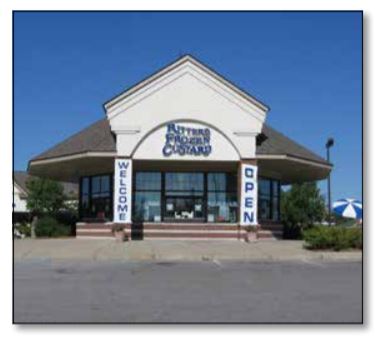
One of the primary elements of the US 421—Michigan Road Overlay District is the architectural style requirement. All buildings built in the US 421—Michigan Road Overlay District shall be consistent with or complementary to one of the following styles: Georgian; Federal; Italianate; or Greek Revival.

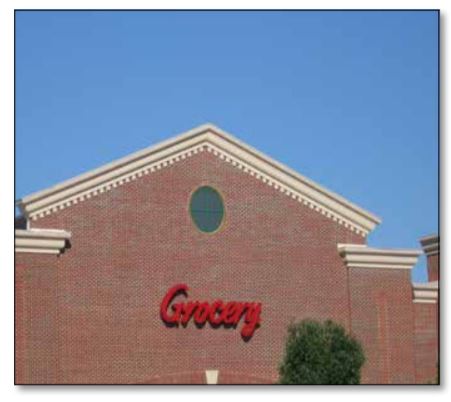
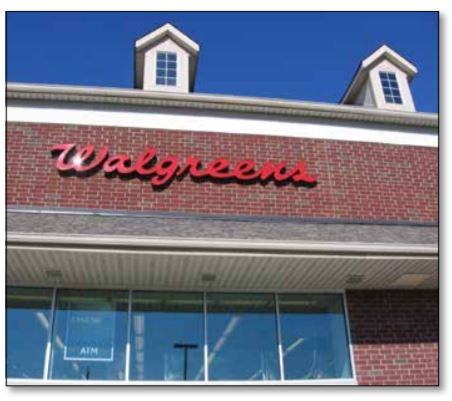
- Permissible materials are red brick, stone, or split-face block that looks like stone or brick for the foundation; and red brick, stone, smooth cedar shingles, clapboard or beaded siding, or stucco for the facade walls.
- Stucco, or EIFS, shall not exceed more than 20% of the overall non-window area.
- Warehouse facilities may be built of red brick trimmed with split face block; split face aggregate block that resem- bles Indiana limestone; or pre-cast concrete walls that resemble either red brick or Indiana limestone. They shall also incorporate contrasting trim details; for example, a splitface block warehouse may be trimmed with red brick.
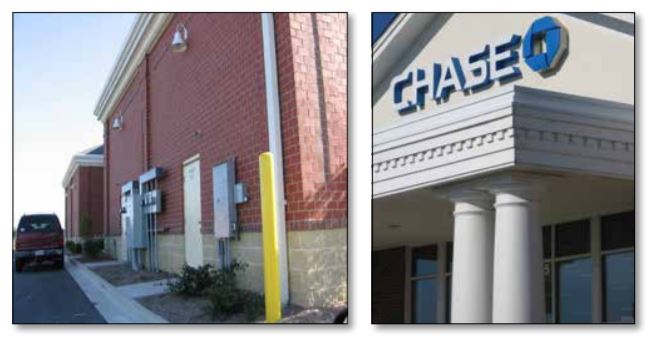
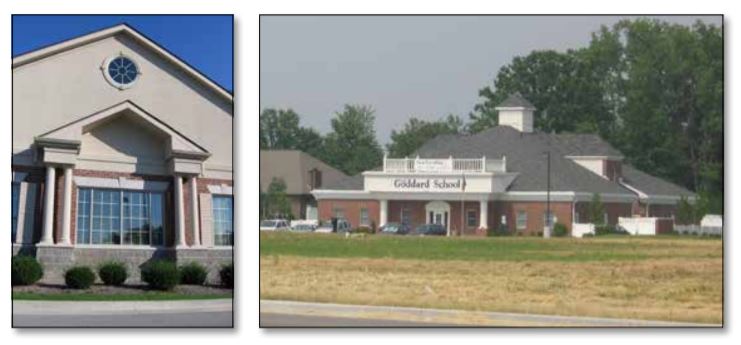
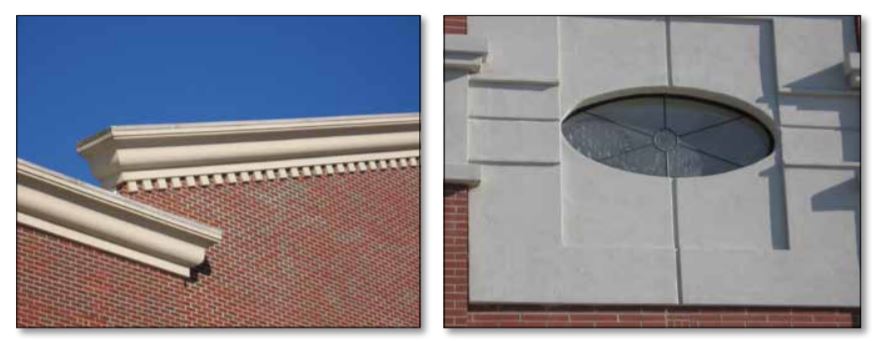
- Buildings within the US 421—Michigan Road Overlay Zone should be designed to reflect a composition of related forms, as expressed by the Golden Section (1:16).
- Buildings shall not include long, uninterrupted walls or roof planes. Windows, doors, and facade breaks should represent a rhythm of regulating lines.
- Facades shall have a defined base, middle or modulated wall, and top. The top should be formed by a pitched roof or cornice, depending on the chosen style.
- Buildings with continuous facades 90 feet or longer shall be articulated by offsets, either projecting or recessed, measuring no less than 8 feet deep, at intervals of no more than 60 feet. Material changes should occur horizon- tally, not vertically.
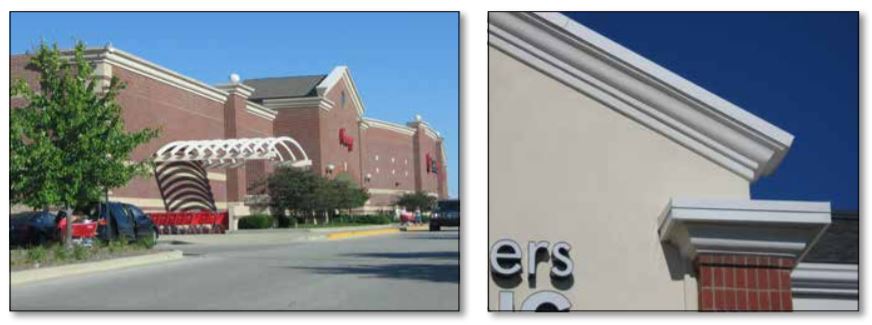
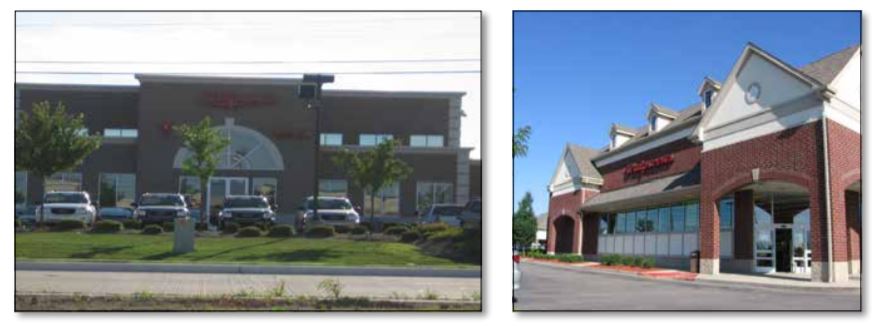
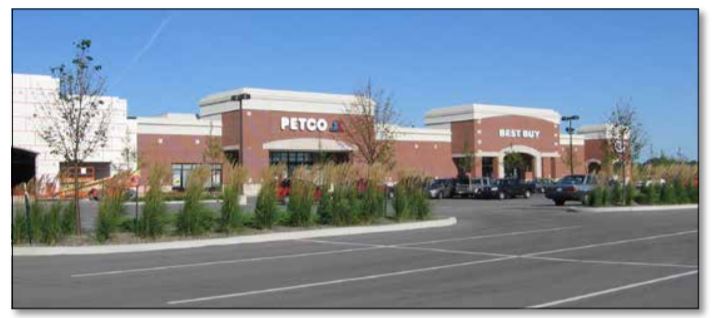
- Buildings shall, at a minimum, be 20 feet tall at the roofline or parapet, and appear to be one and one-half stories tall. Two stories are preferable.
- If the roof is pitched, the pitch shall be between 4:12 and 14:12.
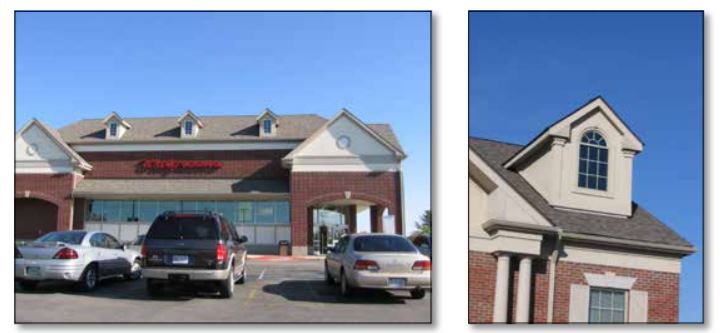
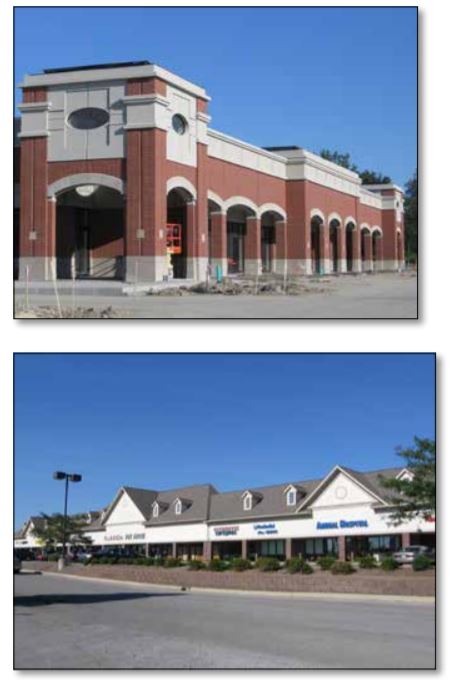
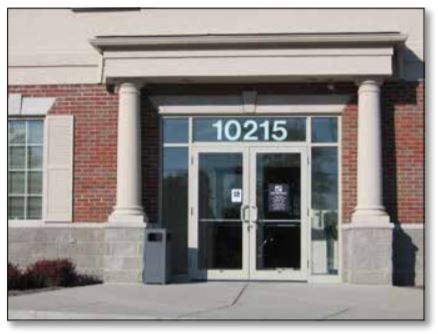
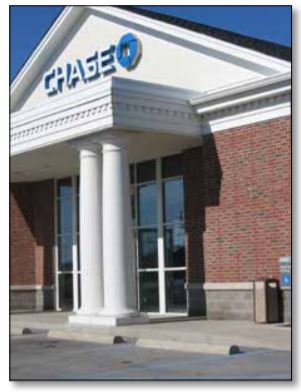
- Building entrances shall be well-defined, using such architectural elements as columns, pilasters, pediments, lintels, and other design elements as appropriate to the chosen style. The entrance’s location, orientation, proportion, and door style shall also reflect the chosen style.
- Windows, including the number, location, proportion, and style of framing and lights, shall also be appropriate to the chosen style of architecture.
- Awnings are permissible if they complement the building’s architectural style, materials, and colors, and do not conceal architectural features or impair the overall composition of the facade. Awnings which are made of metal or aluminum are not permitted.
- Building storefronts shall be integrated with the overall style, character, and proportion of the building. While storefronts should have large expanses of glass, the total area of ground-floor level glass shall not exceed more than 75%. Buildings with multiple storefronts shall exhibit a unified design theme.
- Drive-thru windows are permissible, provided they are integrated into the overall design of the building.