
Carmel City Zoning Code
ARTICLE 5
Development Standards
5.01 How to Use this Article
Article 5: Development Standards contains development standards that are arranged by category. There are two (2) ways to determine which development standards apply to a specific zoning district. They are:
- Blue Boxes: Refer to the two-page layouts in Article 2: Zoning Districts for a specific zoning district. In the “Additional Development Standards that Apply” box for that specific zoning district are listed four-digit codes that determine which development standards apply. Only the development standards referenced by the four-digit codes listed in the “Additional Development Standards that Apply” section apply to that zoning district.
- District Icons: Refer to the icons used at the top of each development standard section in Article 5: Development Standards. Each development standard section begins with a four-digit code and introductory sentence followed by one (1) or more icons with zoning district abbreviations (e.g. R1 for the Single-family Residential zoning district). These zoning district icons note that the development standard written in that section applies to that zoning district.
5.02 AB-01: Residential Accessory Building and Use Standards
This Accessory Building and Use Standards (AB) section applies to the following zoning districts:
S1 | S2 | R1 | R2 | R3 | R4 | R5 |
- Accessory Buildings and Uses Generally: Accessory Buildings and Uses customarily and purely incidental to those uses allowed in a given zoning district are permitted provided that:
- An Improvement Location permit shall be required per the standards found in Carmel City Code; Chapter 7: Building Code; Article 3: Specific Regulations.
- Accessory Buildings and Uses shall not alter or change the character of the premises;
- Accessory Buildings and Uses shall be on the same lot as the Principal Building to which they are accessory;
- Accessory Buildings shall not be attached to the Principal Building, with the exception of an allowable uniform and continuous roof supported by customary supports or joists, and no other connection or attachment between the structures exists;
- Where an Accessory Building is entered from an alley, it shall be set back a minimum of five (5) feet from the alleyeasement or right-of-way line.
- Timing:
- No Accessory Building shall be constructed upon a lot until the construction of the Principal Building has actually commenced; and
- No Accessory Building shall be used unless the Principal Building on the Lot is also being occupied for the intended purposes.
- However, nothing shall prevent the use of a Temporary Construction Facility for the storage of tools, material and equipment by a contractor during building construction;
- Setback, Area and Lighting Requirements:
- Minimum Lot Standards:
- Minimum Front YardSetback:
- Except as otherwise provided for Corner and Through Lots, when detached from the Principal Building, Accessory Buildings shall be set back a minimum of the greater of the following:
- On Corner Lots no residential Accessory Building shall be erected:
- On Through Lots no Accessory Building shall be erected:
- Minimum Side and Rear YardSetback:
- When more than ten (10) feet away from a Principal Building, Accessory Buildings and Uses shall be set back a minimum of the greater of the following:
- When ten (10) feet or closer to a Principal Building, Accessory Buildings shall be considered as part of the Principal Building and shall be provided with the Side and Rear Yards required for the Principal Building.
- Minimum Front YardSetback:
- Maximum Lot Coverage: Per applicable zoning district or applicable Overlay District.
- Maximum Ground Floor Area:
- The combined square footage of the Ground Floor Area of a Private Garage and/or Accessory Building shall not exceed seventy-five percent (75%) of the Ground Floor Area of the Principal Building.
- A detached garage, which is the only Accessory Building on the lot, may equal the maximum dimensions of twenty-four (24) by thirty (30) feet provided that the Ground Floor Area of the garage is less than or equal to the Ground Floor Area of the Principal Building.
- Lots over three (3) acres and Multiple-family Residential shall be exempt from the requirements of this Section 5.02(B)(3): Maximum Ground Floor Area.
- Lighting: No lighting shall cause Illumination at or beyond any Lot Line in excess of 0.1 Foot-candle of light.
- Minimum Lot Standards:
- Accessory Uses:
- Exceptions: Accessory Uses such as public utility installations, private walks, driveways, retaining walls, mail boxes, nameplates, lamp posts, birdbaths and structures of a like nature are permitted in any required Front, Side or Rear Yard.
- Multiple‑family Districts:
- Trash Receptacles: Trash and recycling receptacles shall be enclosed on all four (4) sides, including a self-closing gate, and be screened with landscaping to a minimum height of dumpster and/or compactor plus two (2) feet.
- Private Radio and Television Reception and Transmitting Towers and Antennas:
- Permitted subject to applicable local, state and federal regulations.
- No structure shall be located or permitted within ten (10) feet of a power transmission line.
- Guest House: One (1) Guest House with cooking facilities may be permitted as an Accessory Building on Lots containing not less than one (1) acre.
- Servants Quarters: Quarters for bona fide servants employed by the occupants of the Dwelling are permitted.
- Tennis and Pickleball Courts:
- Shall be located only within a Side or Rear Yard.
- Private Swimming Pool or Hot Tub:
- Minimum Side and Rear Yard Setbacks: A swimming pool, hot tub, or its deck or equipment shall be set back a minimum of the greater of the following:
- Ten (10) feet from the Side Lot Line and Rear Lot Line, or
- Be three (3) feet from any Easement.
- Fill From Pool Placement: No fill from pool or hot tub excavation shall be placed within three (3) feet of any Easement.
- Safety: For purposes for safety, the following shall apply:
- Walls or Fencing: Walls or fencing deemed by the enforcing authority to be impenetrable, that is not less than four (4) feet high completely surrounding the swimming pool and the deck area with exception of self-closing and latching gates and doors, both capable of being locked;
- Other Means: Other means not less than four (4) feet high and deemed by the enforcing authority to be impenetrable at the time of construction and completely surrounding the pool and deck area when the pool is not used; and
- Combination: A combination of Section 5.02(C)(7)(c)(i) and Section 5.02(C)(7)(c)(ii) that completely surrounds the pool and deck with the exception of self-closing and latching gates and doors which are capable of being locked; or
- Pool Cover: A safety pool cover may be used provided that:
- There is a continuous connection between the cover and the deck, so as to prohibit access to the pool when the cover is completely drawn over the pool;
- It is mechanically operated by key or key and switch such that the cover cannot be drawn open or retracted without the use of a key;
- It is capable of supporting a 400 pound imposed load upon a completely drawn cover;
- It is installed with a track, rollers, rails or guides;
- It bears an identification tag indicating the name of the manufacturer, name of the installer, installation date, and applicable safety standards, if any.
- Or that it is in compliance with the Indiana swimming pool code, 675 IAC 14‑4.3‑296, as amended.
- Minimum Side and Rear Yard Setbacks: A swimming pool, hot tub, or its deck or equipment shall be set back a minimum of the greater of the following:
- Raising of Chickens: Up to six (6) hens shall be permitted provided they are confined by a chicken tractor, chicken coop or similar Accessory Building subject to the setbacks prescribed in Section 5.02(B)(1): Minimum Lot Standards. Properties with more than six (6) hens, or with any rooster, shall be considered a Farm.
- Beekeeping: The intent of this Section 5.02(C)(9): Beekeeping is to regulate beekeeping in accordance with state law. However, where beekeeping constitutes an agricultural nonconforming use under IC 36‑7‑4‑616, that use may be continued so long as it is maintained and operated in compliance with all (I) state environmental and state health laws and rules, including IC 14‑24‑8 pertaining to the annual registration of bees, and any requirements to which conforming agricultural use land is subject under the Zoning Ordinance of Hamilton County, Indiana, as in effect as of July 1, 2020. Beekeeping for purposes of personal use and not for agricultural use shall be permitted on property in the City that the person owns, rents, or leases, subject to the following regulations:
- The maximum number of hives permitted per lot area shall be as follows:
- One (1) hive for a lot up to 4,350 square feet.
- Two (2) hives for lots greater than 4,350 up to 10,500 square feet.
- Four (4) hives for lots greater than 10,500 up to 21,000 square feet.
- Six (6) hives for lots greater than 21,000 up to 43,560 square feet.
- Eight (8) hives for lots greater than 43,560 square feet.
- Bee colonies shall be kept in movable-frame hives that do not exceed twelve (12) cubic feet. Hives shall be spaced at least three (3) feet apart when more than one (1) hive is present.
- Bee hives may only be located on the ground or on the roof of a building with a permanent foundation. When located on the ground, hives shall not exceed five (5) feet in height. When located on a roof, hives shall be placed a minimum of ten (10) feet from the ground.
- Minimum Setbacks:
- Front: No hives may be located forward of the Front Line of the Principal Building, or within 300 feet of a front lot line, whichever is less.
- Side: Hives located on the ground shall be located a minimum of fifteen (15) feet from a side lot line. The setback of hives placed on a roof shall follow the setbacks for the structure on which the hives are located.
- Rear: Hives located on the ground shall be located a minimum of twenty (20) feet from a rear lot line. The setback of hives placed on a roof shall follow the setbacks for the structure on which the hives are located.
- Beekeepers shall maintain an adequate supply of fresh water located near each hive.
- Whenever a colony exhibits overly defensive or aggressive behavior, such as stinging or attacking without provocation, the beekeeper shall split the hive to keep it from swarming or take other immediate mitigating actions.
- At least one (1) swarm trap shall be provided where bees are kept.
- If hives are visible from homes on adjacent lots, a six (6) foot tall barrier (such as a fence or landscaping hedge) shall be installed. Fences shall comply with Section 5.09: Fence and Wall Standards.
- A sign indicating the existence of live bees shall be conspicuously placed on all lots upon which hives are present. The sign shall measure no larger than three (3) square feet in size.
- The maximum number of hives permitted per lot area shall be as follows:
5.03 AB-02: Non- Residential Accessory Building and Use Standards
This Accessory Building and Use Standards (AB) section applies to the following zoning districts:
P1 | B1 | B2 | B3 | B5 | B6 | B7 | B8 | I1 | M3 |
Accessory Buildings and Uses Generally: Accessory Buildings and Uses customarily and purely incidental to the uses allowed in a given district are permitted provided that:
An Improvement Location permit shall be required per the standards found in Carmel City Code; Chapter 7: Building Code; Article 3: Specific Regulations.
Accessory Buildings and Uses do not alter or change the character of the premises;
Accessory Buildings and Uses are on the same lot as the Principal Building to which they are accessory;
Accessory Buildings and Uses shall not constitute more than one-third (1/3) of the Gross Floor Area (GFA) of all buildings combined.
Timing:
No Accessory Building shall be constructed upon a lot until the construction of the Principal Building has actually commenced; and,
No Accessory Building shall be used unless the Principal Building on the Lot is also being occupied for the intended purposes.
However, nothing shall prevent the use of a Temporary Construction Facility for the storage of tools, material and equipment by a contractor during building construction;
Setback, Area and Lighting Requirements:
Minimum Lot Standards:
Minimum Front YardSetback:
When detached from the Principal Building, Accessory Buildings shall be set back a minimum of the greater of the following:
Twenty-five (25) feet behind the Front Line of Building;
Twenty-five (25) feet behind the Building Setback Line.
Minimum Side and Rear Yards:
When more than ten (10) feet from a Principal Building, Accessory Buildings shall be set back a minimum of the greater of the following:
When closer than ten (10) feet to a Principal Building, Accessory Buildings shall be considered as part of the Principal Building and shall be provided with the Side and Rear Yards required for the Principal Building.
Maximum Lot Coverage:
Maximum Gross Floor Area: Reserved.
Lighting: Lighting shall not cause Illumination beyond any residential Lot Line or road right-of-way line in excess of 0.1 Foot-candle of light. Lighting shall not cause Illumination beyond any non-residential Lot Line or road right-of-way line in excess of 0.3 Foot-candle of light.
Accessory Uses:
Exceptions: Accessory Uses are permitted in the required Front Yard in all Business, Industrial, and Manufacturing districts.
Business, Industrial, and Manufacturing Districts:
Private trash receptacles, recycling containers, and grease trap containers. Private trash receptacles, recycling containers, and grease trap containers shall be enclosed on all four (4) sides and be screened with landscaping to a minimum height of dumpster and/or compactor plus two (2) feet.
5.04 AR-01: General Residential Architectural Standards
These Architectural Standards (AR) apply to the following districts:
S1 | S2 | R1 | R2 | R3 | R4 | R5 |
- PrincipalDwelling Structure - Minimum Width: All single-family or duplex dwelling units shall be required to be constructed with a width of no less than twenty-three (23) feet.
5.05 AR-02: Urban Residential Architectural Standards
These Architectural Standards (AR) apply to the following district:
UR |
- Public Frontage:
- Require Street Trees: Street trees shall be required along all street frontage, in the right-of-way, at a rate of one (1) tree for every sixty (60) feet of frontage. Trees shall be planted in tree beds within the sidewalk which shall be at least sixty-four (64) square feet in area, and be spaced no closer than twenty-five (25) feet from one another. All required trees shall be from Appendix D: Recommended Tree List. The required street trees may be fully or partially waived, or be allowed to be planted within thirty (30) feet of the right-of-way by the Planning Administrator if the trees cannot be located properly; due to utility conflicts, to maintain ADA compliance, or similar constraints. However, under no circumstance shall the required street trees be reduced by the Planning Administrator by more than twenty-five percent (25%).
- Side Setback: The following three (3) side setback and side facade options are permitted for principal buildings.
- Option 1, Common Wall: Any side facade built on the side property line (no setback), intended to be a common wall to a future or existing neighboring principal building shall be exempt from Section 5.05(C): Facades, thus being permitted to be a “blank” wall. However, if a neighboring principal building with a common wall does not exist, there shall be a cooperative legal agreement with the neighboring property owner indicating that within three (3) years a principal building will be built on the neighboring property adjoining to the subject common wall. One (1) year extensions may be granted by the Planning Administrator if approval for the neighboring building are forthcoming. Only portions of the side facade that will be “common” to the neigh- boring lot’s principal building shall be exempt from Section 5.05(C): Facades. Portions of that side facade that are not intended to share a common wall shall meet the facade standards in Section 5.05(C): Facades.Additionally, a letter of agreement between the subject property owner and the City of Carmel shall be drafted and signed indicating that the “blank wall” on the principal building on the subject lot shall be made to be in full compliance with Section 5.05(B)(2): Zero Lot Line Facadeif two (2) principal buildings fail to be adjoined by common walls.
- Option 2, Zero Lot Line Facade: A side facade may be constructed on the side property line (no setback) if an agreement is in place between the subject property owner and neighboring property owner, acknowledging that the neighboring property owner supports the zero lot line setback, understands its impact on the neighboring property, and grants the subject lot’s owner the right to access to maintain the side facade from the neighboring property in perpetuity. The side facade shall be in full compliance with Section 5.05(C): Facades.
- Option 3, Setback from Property Line: A side facade may be constructed any distance between the minimum and maximum side setback. Under no circumstances shall a side facade be between zero (0) feet and four (4) feet from the side property line due to lack of air circulation and natural daylight. The side facade shall be in full compliance with Section 5.05(C): Facades.
- Facades:
- Primary Facades: Any facade fronting on a public street shall be a Primary Facade, meaning be architecturally significant and detailed with ornamentation or other character-building materials.
- Ground Floor Facades: Ground floors used for retail or commercial uses, or that are adjacent to a street, shall be designed to look like neighborhood-serving storefronts, complementary of the predominant residential use, and have at least sixty percent (60%) of the storefront be clear glazing. Further, any ground floor facade design shall not be used for more than fifty (50) feet before changing design such that no dominant design spans more than fifty (50) feet. Articulation of design may include arcades, awnings, change in wall plane (projection or recess), or change in color, material or texture.
- Upper Floor Facades: Upper floor facades shall include at least two (2) windows per on each exterior wall for each residential unit.
- Corner Architectural Feature: A corner building shall have a prominent architectural feature on or near the corner of the building closest to the intersection with a public pedestrian entrance, if two (2) arterial and/or boulevard streets make up that intersection.
- Parking Garage: Any parking garage associated with an UR District development shall be located in an inconspicuous location on the site and screened with shade trees, or shall be skinned with an architecturally-de- signed building facade complementary to adjacent buildings.
- Building Materials: High quality, durable, architectural building materials shall be used for all aspects of a building’s facade. EFIS shall not be permitted within eight (8) feet of ground level.
- Massing:
- Narrow Width Lots: Lots that are 100 feet wide or less shall have a single principal building covering at least seventy-five percent (75%) of the lot’s width.
- Moderate Width Lots: Lots that are greater than 100 feet but less than 200 feet wide shall have one (1) or two (2) principal buildings, cumulatively covering at least seventy-five percent (75%) of the lot’s width. If two (2) principal buildings are constructed, they may be joined by a single-story, enclosed or un-enclosed structure, setback from the principal building’s front facade, and designed to be complementary to the principal building’s facades.
- Wide Width Lots: Lots that are 200 feet wide or greater shall have at least two (2) principal buildings, cumula- tively covering at least seventy percent (70%) of the lot’s width. Two (2) or more principal buildings may be joined by a single-story, enclosed or un-enclosed structure, setback from the principal building’s front facade.
- Stepback: Buildings greater than three (3) stories shall be stepped back resulting no more than three (3) stories of facade being on the same vertical plane. Generally, the fourth (4th) and higher stories shall be stepped back; however, the required stepback may occur at the second (2nd) or third (3rd) floor. Required stepbacks shall be a minimum of twelve (12) feet.
5.06 AR-03: Urban Core Architectural Standards
These Architectural Standards (AR) apply to the following districts:
UC |
- Public Frontage:
- Require Street Trees: Street trees shall be required along all street frontage, in or out of the right-of-way, at a rate of one (1) tree for every sixty (60) feet of frontage. Trees shall be planted in tree beds within the sidewalk and be at least sixty-four (64) square feet in area, and be spaced no closer than twenty-five (25) feet from one another. All required trees shall be from the approved species list for street trees. The required street trees may be fully or partially waived, or be allowed to be planted within twenty (20) feet of the right-of-way by the Planning Administrator if the trees cannot be located properly: due to utility conflicts, to maintain ADA compliance, or similar constraints. Under no circumstance shall the required street trees be reduced by the Planning Administrator by more than twenty-five percent (25%).
- Side Setback: The following three (3) side setback and side facade options are permitted for principal buildings.
- Option 1, Common Wall: Any side facade built on the side property line (no setback), intended to be a common wall to a future or existing neighboring principal building shall be exempt from Section 5.06(C): Facades, thus being permitted to be a “blank” wall. However, if a neighboring principal building with a common wall does not exist, there shall be a cooperative legal agreement with the neighboring property owner indicating that within three (3) years a principal building will be built on the neighboring property adjoining to the subject common wall. One (1) year extensions may be granted by the Planning Administrator if approval for the neighboring building are forthcoming. Only portions of the side facade that will be “common” to the neigh- boring lot’s principal building shall be exempt from Section 5.06(C): Facades. Portions of that side facade that are not intended to share a common wall shall meet the facade standards in Section 5.06(C): Facades.
Additionally, a letter of agreement between the subject property owner and the City of Carmel shall be drafted and signed indicating that the “blank wall” on the principal building on the subject lot shall be made to be in full compliance with Section 5.06(B)(2): Zero Lot Line Facadeif two (2) principal buildings fail to be adjoined by common walls. - Option 2, Zero Lot Line Facade: A side facade may be constructed on the side property line (no setback) if an agreement is in place between the subject property owner and neighboring property owner, acknowledging that the neighboring property owner supports the zero lot line setback, understands its impact on the neighboring property, and grants the subject lot’s owner the right to access to maintain the side facade from the neighboring property in perpetuity. The side facade shall be in full compliance with Section 5.06(C): Facades.
- Option 3, Setback from Property Line: A side facade may be constructed any distance between the minimum and maximum side setback. Under no circumstances shall a side facade be between zero (0) feet and four (4) feet from the side property line due to lack of air circulation and natural daylight. The side facade shall be in full compliance with Section 5.06(C): Facades.
- Option 1, Common Wall: Any side facade built on the side property line (no setback), intended to be a common wall to a future or existing neighboring principal building shall be exempt from Section 5.06(C): Facades, thus being permitted to be a “blank” wall. However, if a neighboring principal building with a common wall does not exist, there shall be a cooperative legal agreement with the neighboring property owner indicating that within three (3) years a principal building will be built on the neighboring property adjoining to the subject common wall. One (1) year extensions may be granted by the Planning Administrator if approval for the neighboring building are forthcoming. Only portions of the side facade that will be “common” to the neigh- boring lot’s principal building shall be exempt from Section 5.06(C): Facades. Portions of that side facade that are not intended to share a common wall shall meet the facade standards in Section 5.06(C): Facades.
- Facades:
- Primary Facades: All facades shall be a Primary Facade, meaning they shall be architecturally significant and detailed with ornamentation or other character-building materials. However, any facade built on a property line, intended to be a common wall between two (2) buildings shall be exempt; and a commitment for the future adjacent building shall be provided; with a build-by date, not to exceed three (3) years from commitment.
- Ground Floor Facades: Ground floors facing any street shall be designed to look like storefronts with at least sixty-percent (60%) clear glazing. Further, any ground floor facade design shall not be used for more than fifty (50) feet before changing design such that no dominant design spans more than fifty (50) feet. Articulation of design may include arcades, awnings, change in wall plane (projection or recess), or change in color, material or texture.
- Upper Floor Facades: Upper floor facades shall include at least two (2) windows on each exterior wall for each residential unit, if applicable.
- Corner Architectural Feature: A corner building shall have a prominent architectural feature on or near the corner of the building closest to the intersection, with a public pedestrian entrance, if two (2) arterial and/or boulevard streets make up that intersection.
- Parking Garage: Any parking garage associated with an UC District development shall be skinned with an architecturally-designed building facade complementary to adjacent buildings.
- Building Materials: High quality, durable, architectural building materials shall be used for all aspects of a building’s facade. EFIS shall not be permitted within eight (8) feet of ground level.
- Massing:
- Narrow Width Lots: Lots that are eighty (80) feet wide or less shall have a single principal building covering at least ninety percent (90%) of the lot’s width.
- Moderate Width Lots: Lots that are greater than eighty (80) feet but less than 150 feet wide shall have one (1) or two (2) principal buildings, cumulatively covering at least ninety percent (90%) of the lot’s width. If two (2) principal buildings are constructed, they may be joined by a single- or two-story, enclosed or un-enclosed structure, setback from the principal building’s front facade, and designed to be complementary to the principal building’s facades.
- Wide Width Lots: Lots that are 150 feet wide or greater shall have at least two (2) principal buildings, cumula- tively covering at least eighty-five percent (85%) of the lot’s width. Two (2) or more principal buildings may be joined by a single- to three-story, enclosed or un-enclosed structure, setback from the principal building’s front facade, and designed to be complementary to the principal building’s facades.
- Stepback: Buildings greater than three (3) stories shall be stepped back resulting no more than three (3) stories of facade being on the same vertical plane. Generally, the fourth (4th) and higher stories shall be stepped back; however, the required stepback may occur at the third (3rd) floor if the developer prefers. Required stepbacks shall be a minimum of twelve (12) feet.
5.07 AR-04: Meridian Corridor Architectural Standards
These Architectural Standards (AR) apply to the following district:
MC |
- Public Frontage:
- Require Street Trees: Street trees shall be required along all street frontage, in or out of the right-of-way, at a rate of one (1) tree for every sixty (60) feet of frontage. Trees shall be planted in tree beds within the sidewalk and be at least sixty-four (64) square feet in area, and be spaced no closer than thirty (30) feet from one another. All required trees shall be from the approved species list for street trees. The required street trees may be fully or partially waived, or be allowed to be planted within thirty (30) feet of the right-of-way by the Planning Administrator if the trees cannot be located properly: due to utility conflicts, to maintain ADA compliance, or similar constraints. Under no circumstance shall the required street trees be reduced by the Planning Administrator by more than twenty-five percent (25%).
- Side Setback: The following three (3) side setback and side facade options are permitted for principal buildings.
- Option 1, Common Wall: Any side facade built on the side property line (no setback), intended to be a common wall to a future or existing neighboring principal building shall be exempt from Section 5.07(C): Facades, thus being permitted to be a “blank” wall. However, if a neighboring principal building with a common wall does not exist, there shall be a cooperative legal agreement with the neighboring property owner indicating that within three (3) years a principal building will be built on the neighboring property adjoining the common wall. One (1) year extensions may be granted by the Planning Administrator if approval for the neighboring building are forthcoming. Only portions of the side facade that will be “common” to the neighboring lot’s principal building shall be exempt from Section 5.07(C): Facades. Portions of that side facade that are not intended to share a common wall shall meet the facade standards in Section 5.07(C): Facades. Additionally, a letter of agreement between the subject property owner and the City of Carmel shall be drafted and signed indicating that the “blank wall” on the principal building on the subject lot shall be made to be in full compliance with Section 5.07(B)(2): Zero Lot Line Facade if two (2) principal buildings fail to be adjoined by common walls.
- Option 2, Zero Lot Line Facade: A side facade may be constructed on the side property line (no setback) if an agreement is in place between the subject property owner and neighboring property owner, acknowledging that the neighboring property owner supports the zero lot line setback, understands its impact on the neighboring property, and grants the subject lot’s owner the right to access to maintain the side facade from the neighboring property in perpetuity. The side facade shall be in full compliance with Section 5.07(C): Facades.
- Option 3, Setback from Property Line: A side facade may be constructed any distance between the minimum and maximum side setback. Under no circumstances shall a side facade be between zero (0) feet and fifteen (15) feet from the side property line due to lack of air circulation and natural daylight. The side facade shall be in full compliance with Section 5.07(C): Facades.
- Facades:
- Primary Facades: All facades shall be a Primary Facade, meaning be architecturally significant and detailed with ornamentation or other character-building materials. However, any facade built on a property line, intended to be a common wall between two (2) buildings shall be exempt; and a commitment for the future adjacent building shall be provided; with a build-by date, not to exceed three (3) years from commitment.
- Ground Floor Facades: Ground floors used for retail or commercial uses along a public street shall be designed to look like storefronts with at least sixty-percent (60%) clear glazing. Ground floor facades that are not facing a public street are not required to have distinguished store fronts.
- Upper Floor Facades: Upper floor facades shall be designed to reflect the character of an office building, regardless of the use. Any building with exceptionally high ceilings (e.g. indoor recreation facility) shall have exterior finished to resemble a proportionate multiple-story office building.
- Corner Architectural Feature: A corner building shall have a prominent architectural feature on or near the corner of the building closest to the intersection, with a public pedestrian entrance, if two (2) arterial and/or streets make up that intersection.
- Parking Garage: Any parking garage associated with an MC District development shall be located in an inconspicuous location on the site and buffered with shade trees, or shall be skinned with an architecturally-de- signed building facade complementary to adjacent buildings.
- Building Materials: High quality, durable, architectural building materials shall be used for all aspects of a building’s facade. EFIS shall not be permitted within eight (8) feet of ground level.
- Massing:
- Narrow Width Lots: Lots that are 100 feet wide or less shall have a single principal building covering at least eighty percent (80%) of the lot’s width.
- Moderate Width Lots: Lots that are greater than 100 feet but less than 300 feet wide shall have one (1) or two (2) principal buildings, cumulatively covering at least seventy-five percent (75%) of the lot’s width. If two (2) principal buildings are constructed, they may be joined by a single- or two-story, enclosed or un-enclosed structure, setback from the principal building’s front facade, and designed to be complementary to the principal building’s facades.
- Wide Width Lots: Lots that are 300 feet wide or greater shall have at least two (2) principal buildings, cumula- tively covering at least seventy-five percent (75%) of the lot’s width. Two (2) or more principal buildings may be joined by a single- to two-story, enclosed or un-enclosed structure, setback from the principal building’s front facade, and designed to be complementary to the principal building’s facades.
- Stepback:
- Along Arterial or Boulevard Streets or US 31: Any facade greater than five (5) stories shall be stepped back at or below the sixth story (i.e. the 6th story and higher shall be stepped back).
- Along Collector or Local Streets: Any facade greater than three (3) stories shall be stepped back at or below the fourth story (i.e. the 4th story and higher shall be stepped back).
- Along Local Streets: Any facade greater than two (2) stories shall be stepped back at or below the third story (i.e. the 3rd story and higher shall be stepped back).
- Distance of Stepback: Any required stepback shall be a minimum of twelve (12) feet.
5.08 DI-01: Density and Intensity Standards
These Density and Intensity Standards (DI) apply to the following districts:
| P1 | S1 | S2 | R1 | R2 | R3 | R4 | R5 | UR | B1 | B2 | B3 | B5 | B6 | B7 | B8 | C1 | C2 | UC | MC | I1 | M3 |
The following standards apply:
- Applicability: If a density or intensity standard does not appear on the two-page layout in Article 2: Zoning Districts for a zoning district, then a density or intensity standard shall not apply to that particular zoning district.
- Maximum Lot Coverage: The Maximum Lot Coverage shall be as indicated on the applicable two-page layout in Article 2: Zoning Districts.
- Minimum Ground Floor Area: The Minimum Ground Floor Area shall be as indicated on the applicable two-page layout in Article 2: Zoning Districts.
- Maximum Density: The Maximum Density shall be as indicated on the applicable two-page layout in Article 2: Zoning Districts.
- Minimum Living Area per Dwelling: The Minimum Living Area per Dwelling shall be as indicated on the applicable two-page layout in Article 2: Zoning Districts.
- Maximum Principal Buildings per Lot: The Maximum Principal Buildings per Lot shall be as indicated on the applicable two-page layout in Article 2: Zoning Districts.
- Minimum Principal Buildings per Lot: The Minimum Principal Buildings per Lot shall be as indicated on the applicable two-page layout in Article 2: Zoning Districts. In some cases, a principal building is required to be able to locate an accessory structure on a parcel. See Section 5.02 Residential Accessory Building and Use Standards for most residential districts and Section 5.03: Non‑Residential Accessory Building and Use Standards for most commercial district for applicable accessory building standards.
5.09 FW-01: Fence and Wall Standards
These Fence and Wall Standards (FW) apply to the following districts:
| P1 | S1 | S2 | R1 | R2 | R3 | R4 | R5 | UR | B1 | B2 | B3 | B5 | B6 | B7 | B8 | C1 | C2 | UC | MC | I1 | M3 |
- Permit Required: An Improvement Location Permit shall be obtained prior to installation of any new fence, except when the fence or wall will be used for exempted uses on lots or tracts larger than three (3) acres.
- Fences in Front Yards. The following shall apply to all residentially zoned lots or tracts, except those larger than three (3) acres:
- Maximum Height: Fences located within any required Front Yard shall not exceed forty-two (42) inches in height, except as otherwise noted in Sections 5.09(B)(4‑6) for fences on corner lots or along certain street classifications.
- Fence Type: Fences located in Front Yards are not intended for privacy. At least twenty five percent (25%) of its area shall be open to allow visibility through the fence. Such open spaces shall be reasonably dispersed throughout the entire area of the fence, except where solid stone or brick walls are permitted. Examples include wrought iron or picket fences.
- Front Setback: Fences and walls may be constructed on the Front Lot Line but shall be set back at least one foot from any sidewalk or multi-use path.
- Corner Lots: The requirements of this section shall apply to yards along both streets, except for replacement fences along local streets. An existing privacy fence which exceeds forty-two (42) inches in height may be replaced as follows:
- At its existing height, up to six (6) feet, whichever is less; and
- Is located along only one of the local streets at the side or rear of the principal building.
- Collector, Arterial, or Boulevard Streets: In the case of through lots, where the property line behind a residence abuts a Collector, Arterial, or Boulevard street, a fence may exceed forty-two (42) inches in height, up to six (6) feet in height, and shall be exempt from the twenty-five percent (25%) visibility requirement in Section 5.09(B)(2): Fence Type if set back at least six (6) feet from the property line, and is accompanied by plantings equivalent to a Bufferyard A.
- Keystone Parkway: Fences along a Keystone Parkway may be up to eight (8) feet in height and shall be exempt from the twenty-five percent (25%) visibility requirement in Section5.09(B) (2): Fence Type. The Director may approve up to an additional twenty-four (24) inches in height in cases where the ground adjacent to the fence is lower than the street.
- Subdivision Fences and Walls: No primarily wooden fences, or walls, shall be constructed within any required front yard adjacent to any Collector, Arterial, or Bouelvard street (See also Section 7.11: Residential Entryway Feature, Section 7.12: Non‑Residential Entryway Feature Standards, and Section 7.23: Perimeter Landscaping Standards).
- Fences in Side and/or Rear Yards: Residential fences located within any required side or rear yard shall not exceed six (6) feet in height, as measured from the topmost point thereof to the ground adjacent to the fence.
- Fences in other locations:
- Height Measurement: Fences shall be measured from its topmost point to the ground adjacent to the fence. The height of any fence placed upon an erected earth berm or masonry wall shall be measured from the ground adjacent to said earth berm or wall.
- Athletic Facilities: Open wire mesh fences surrounding tennis courts or similar athletic facilities may be erected up to a height of sixteen (16) feet, if such fences shall only enclose a regulation court or field area. Wire mesh fences shall be black unless otherwise approved by the Director of Community Services.
- Institutions, Parks, Schools: Except as provided in Section 5.09(B): Fences in Front Yards, fences enclosing an institution, a public park and schools may consist of a black open mesh fence not to exceed a height of ten (10) feet unless otherwise approved by the Director of Community Services.
- Commercial and Industrial: Fences enclosing commercial and industrial uses shall not exceed six (6) feet in height in a required front yard and shall not exceed ten (10) feet in a required side or rear yard. Unless otherwise approved by the Plan Commission as part of an ADLS, fences in a required front yard shall have at least seventy five percent (75%) of its area open to allow visibility through the fence.
- Vision Clearance: No fence, wall or other obstruction to vision shall exist in the area designated as the vision clearance area of corner lots.
- Swimming Pools. In districts where a private swimming pool is permitted as an Accessory Use, the fencing for such pool shall comply with both this Section 5.09: Fence and Wall Standards and Section 5.02(C)(7): Private Swimming Pool or Hot Tub.
- Maintenance: It shall be the responsibility of the owners to ensure proper maintenance of fences in accordance with the standards set by this sub-section. This includes the repair, removal and timely replacement of missing, damaged or dilapidated materials.
5.10 FP-01: Floodpain Standards
These Floodplain Standards (FP) apply to the following districts:
| P1 | S1 | S2 | R1 | R2 | R3 | R4 | R5 | UR | B1 | B2 | B3 | B5 | B6 | B7 | B8 | C1 | C2 | UC | MC | I1 | M3 |
5.11 FA-01: Urban Residential Floor Area Standards
The Floor Area Standards (FA) section applies to the following zoning districts:
| UR |
- Total Floor Area: The total floor area for a project shall be determined by the below criteria.
- Parking: No project shall have more dwelling units or square feet of usable space above what is permitted by the total number of parking spaces dedicated to the development. For example, if the developer can only construct or otherwise secure ninety (90) dedicated parking spaces (e.g. on- or off-site, shared parking when permitted) for a residential project, then the total number of dwelling units would be capped at sixty (60).
- Storm Water: No project shall exceed the maximum post-development discharge of storm water, even if the project is allowed a higher maximum lot coverage. Regional detention, green roofs, and rain gardens may be used for storm water management, if available and approved to allow greater lot coverage.
- Height: Even though a project may meet the criteria for a five (5) story building, if other regulations limit its total square feet, then the building shall be in compliance with all standards.
5.12 FA-02: Urban District Floor Area Standards
The Floor Area Standards (FA) section applies to the following zoning districts:
| UC | MC |
- Total Floor Area: The total floor area for a project shall be determined by the below criteria.
- Parking: No project shall have more square feet of usable space above what is permitted by the total number of parking spaces dedicated to the development. For example, if the developer can only construct or otherwise secure 100 dedicated parking spaces (e.g. on- or off-site, shared parking when permitted) for an office project, then the total square feet shall not exceed 35,000 square feet (1 parking spaces per 350 square feet of office space).
- Storm Water: No project shall exceed the maximum post-development discharge of storm water, even if the project is allowed a higher maximum lot coverage. Regional detention, green roofs, and rain gardens may be used for storm water management, if available and approved to allow greater lot coverage.
- Height: Even though a project may meet the criteria for a six (6) story building, if other regulations limit its total square feet, then the building shall be in compliance with all standards.
5.13 GD-01: Grading and Drainage Standards
The Grading and Drainage Standards (GD) section applies to the following zoning districts:
| P1 | S1 | S2 | R1 | R2 | R3 | R4 | R5 | UR | B1 | B2 | B3 | B5 | B6 | B7 | B8 | C1 | C2 | UC | MC | I1 | M3 |
- Cross Reference: See the Carmel Stormwater Management Ordinance; Chapter 6 and Article 7in the City’s Municipal Code, and Stormwater Technical Standards Manual.
- Grading, filling, excavating or any change in the grade of any property is permitted, but shall not be detrimental to surrounding properties in appearance or in the diversion of storm water.
- Any obstruction of the natural flow of drainage in the planning jurisdiction is prohibited.
The Grading and Drainage Standards (GD) section applies to the following zoning districts:
| P1 | S1 | S2 | R1 | R2 | R3 | R4 | R5 | UR | B1 | B2 | B3 | B5 | B6 | B7 | B8 | C1 | C2 | UC | MC | I1 | M3 |
- Cross Reference: See the Carmel Stormwater Management Ordinance; Chapter 6 and Article 7in the City’s Municipal Code, and Stormwater Technical Standards Manual.
- Grading, filling, excavating or any change in the grade of any property is permitted, but shall not be detrimental to surrounding properties in appearance or in the diversion of storm water.
- Any obstruction of the natural flow of drainage in the planning jurisdiction is prohibited.
5.14 HT-01: General Height Standards
This Height Standards (HT) section apply to the following zoning districts:
| P1 | S1 | S2 | R1 | R2 | R3 | R4 | R5 | UR | B1 | B2 | B3 | B5 | B6 | B7 | B8 | C1 | C2 | UC | MC | I1 | M3 |
- Applicability: The maximum height, minimum height, maximum floor and minimum floor standards shall be as indicated on the two-page layout for the subject zoning district in Article 2: Zoning Districts.
- Exceptions: Upon approval by the appropriate authority, chimneys, spires associated with churches, temples or other places of worship, non-mechanical and non-inhabitable architectural features, monuments, flagpoles, water towers, stage towers or scenery lofts may be erected to minimum height appropriate unless prohibited by other laws.
- Mechanical Equipment: Upon approval by the appropriate authority, essential mechanical or utilitarian roof-top appurtenances shall be screened, and such items and their screening may be erected to a minimum height appro- priate unless prohibited by other laws or ordinances. Such appurtenances shall include, but not limited to: cooling towers, elevator bulkheads, conveyors, heating, ventilation, and air conditioning equipment (HVAC), and rooftop stairway access structures.
- Wireless Support Structures: Upon approval by the appropriate authority, a Wireless Support Structure may include an increase in height to not more than 150 feet.
5.15 HT-02: Urban Residential Height Standards
These Height Standards (HT) apply to the following district:
| UR |
- Transitional Limitation: Any UR District project adjacent to any non-urban single-family residential zoning district shall be limited to a two-story building for any portion of the subject building within fifty (50) feet of the shared property line.
- Additional Stories: Additional stories shall be permitted if any of the below criteria exists or is committed to by the developer. However, the absolute maximum number of stories shall be seven (7) when adjacent to the P1, UR, B2, B6, C1, C2, UC, or MC Districts.
- Major Intersection: One (1) extra story shall be permitted if the subject building is partially or fully within 800 feet of a major intersection, measured from the closest point of the subject building and the center point of the intersection.
- Transit Hub: One (1) extra story shall be permitted if the subject building is partially or fully within 800 feet of a transit hub, measured from the closest point between the transit shelter and subject building.
- Green Roof: Two (2) extra stories shall be permitted if the subject building has a green roof installed over at least sixty percent (60%) of its footprint.
- Step-backs: Any story above four (4) stories shall be setback from the facade of the lower floors by a minimum of ten (10) feet when the adjacent street right-of-way is less than ninety (90) feet.
5.16 HT-03: Urban Core Height Standards
These Height Standards (HT) apply to the following districts:
| UC |
- Transitional Limitation: Any UC District project adjacent to any non-urban single-family residential zoning district shall be limited to a two-story building for any portion of the subject building within forty (40) feet of the shared property line.
- Additional Stories: Additional stories shall be permitted if any of the below criteria exists or is committed to by the developer. However, the absolute maximum number of stories shall be eight (8).
- Major Intersection: Two (2) extra stories shall be permitted if the subject building is partially or fully within 800 feet of a major intersection, measured from the closest point of the subject building and the center point of the intersection.
- Transit Hub: Two (2) extra stories shall be permitted if the subject building is partially or fully within 800 feet of a transit hub, measured from the closest point between the transit shelter and subject building.
- Green Roof: Two (2) extra stories shall be permitted if the subject building has a green roof installed over at least sixty percent (60%) of its footprint.
- Step-backs: Any story above four (4) stories shall be setback from the facade of the lower floors by a minimum of ten (10) feet when the street right-of-way is less than ninety (90) feet.
- Height Limitations when Adjacent to Lower Intensity: Under no circumstances shall a building, or portions thereof, exceed four (4) stories within fifty (50) feet of any property line that abuts any district other than P1, UR, B2, B6, C1, C2, UC and MC.
5.17 HT-04: Meridian Corridor Height Standards
These Height Standards (HT) apply to the following district:
| MC |
- Transitional Limitation: Any MC District project adjacent to any non-urban single-family residential zoning district, or established use, shall be limited to a two-story building for all portions of the subject building within 100 feet of the shared property line.
- Additional Stories: Additional stories shall be permitted if any of the below criteria exists or is committed to by the developer. However, the absolute maximum number of stories shall be eleven (11) when not within 100 feet of a single-family residential area.
- Major Intersection: One (1) extra story shall be permitted if the subject building is partially or fully within 800 feet of a major intersection, measured from the closest point of the subject building and the center point of the intersection.
- Transit Hub: One (1) extra story shall be permitted if the subject building is partially or fully within 800 feet of a transit hub, measured from the closest point between the transit shelter and subject building.
- Green Roof: Two (2) extra stories shall be permitted if the subject building has a green roof installed over at least sixty percent (60%) of its footprint.
5.18 HO-01: Home Occupation Standards
These Home Occupation Standards (HB) apply to the following zoning districts:
| P1 | S1 | S2 | R1 | R2 | R3 | R4 | R5 | UR | B3 | B5 | B6 | B7 | C1 | C2 | UC | MC | M3 |
- General:
- Floor Area: Home Occupations shall utilize no more than fifteen percent (15%) of the gross floor area of the dwelling.
- Character:
- The Home Occupation shall not change the character of the Dwelling, Lot, or parcel;
- The Dwelling shall not bear any indication from the exterior that it is being utilized in whole or in part for any purpose other than a Dwelling;
- The Home Occupation shall not be permitted outside storage or display of materials in connection with the Home Occupation;
- The Home Occupation shall be permitted signage per Section 5.39: Sign Standards.
- Nuisance: The Home Occupation shall be conducted wholly within the Dwelling, such that there is no outside noise, vibration, odor, smoke, dust, glare or electrical disturbance.
- Employees: The Home Occupation shall employ no more than one (1) individual outside of the immediate family.
- Deliveries: The delivery of any materials for the Home Occupation shall not exceed two (2) trips per day by any vehicle not owned by a family member.
- Equipment: The Home Occupation shall utilize only mechanical equipment that is customarily used for domestic purposes and is of a size and type that is similar to domestic mechanical equipment or is customarily found in a business office.
- Excluded Uses:
- Antique or gift shop;
- Serving of food or beverages;
- Animal hospital or commercial kennel;
- Automobile repair;
- Major appliance repair or services; and
- Any processing or manufacturing that produces noxious materials or products.
5.19 LS-01: Commercial Landscaping Standards
These Landscaping Standards (LS) apply to the following zoning districts:
| B1 | B2 | B3 | B5 | B6 | B6 | B7 | B8 | MC | I1 | M3 |
- Purpose and Intent: The purpose of Section 5.19: Commercial Landscaping Standards is to protect and enhance the community’s environmental, economic and aesthetic quality, thereby contributing to the overall objective of promoting the public’s health, safety and general welfare. This section is intended to enhance, preserve and develop Carmel’s environment by:
- Promoting compatibility between land uses through reducing the visual, sound and lighting impacts of commercial and residential developments;
- Managing development impacts by planting trees and landscaping in order to increase the real estate values of properties; and
- Creating innovative and environmentally-friendly landscape designs that enhance and define the public and private spaces.
- Provide landscape standards for any development, regardless of district, deemed by the Board of Zoning Appeals to be appropriate.
- Cross Reference:
- Subdivision’s Perimeter Landscaping: Perimeter landscaping required per the subdivision control regulations in Section 7.23: Perimeter Landscaping Standards shall not be regulated by Section5.19: Commercial Landscape Standards. However, perimeter landscaping is subject to Plan Commission review and approval as part of a plat as indicated in Section 7.23: Perimeter Landscaping Standards.
- Manufactured Home Development: See Section 5.24: Manufactured Home Standards.
- Satellite Receiving Antennas: See Section 5.40: Satellite Receiving Antennas Standards.
- Overlay Districts: Wherever conflict exists between the landscaping required by Section 5.19: Commercial Landscaping Standards and an overlay district’s regulations in Article 3: Overlay Districts, the overlay district’s regulations shall govern.
- Board of Zoning Appeals: The Board of Zoning Appeals may apply these standards to Special Use or Use Variance requests. See Section 9.09: Special Use or Section 9.15: Variance.
- Landscape Plan:
- A Landscape Plan shall be submitted to the Plan Commission per Development Plan and Architectural Design, Exterior Lighting, Landscaping and Signage process (See Section 9.03: Development Plan and ADLS) and the Board of Zoning Appeals per Special Use process (See Section 9.09: Special Use) .
- The Landscape Plan shall provide, but is not be limited to, Bufferyards, Greenbelts, street trees, foundation plantings, parking lot plantings, and other exterior improvements such as courtyards, plazas, and tree preserva- tion areas.
- The Landscape Plan shall be submitted electronically (portable document format (PDF) or equivalent) and also on paper sheets not smaller than eleven (11) by seventeen (17) inches, and not larger than twenty-four (24) by thirty-six (36) inches.
- The Landscape Plan shall exhibit a design that is integral and coordinated with other corresponding improve- ments for the site and which clearly demonstrates the function, location, size and scale of plants in relation to buildings and other site improvements, and to minimize conflicts with commercial signage. (See City of Carmel’s Sign Ordinance Visual Guide – Available from the Department of Community Services)
- The Landscape Plan shall be drawn to scale, including dimensions and distances, and drawn to correspond with all existing and planned buildings and other physical improvements, including overhead and underground utilities.
- The Landscape Plan shall identify locations of all current and proposed utilities and service areas, including: ground level mechanical equipment, HVAC compressors, telecommunication equipment, electrical transform- ers, utility meters, public approaches and any adjoining residential zones.
- The Landscape Plan shall include graphic planting details for trees, shrubbery, and ground cover/ornamental grass. (See City of Carmel’s Graphic Planting Details – Available from the Department of Community Services)
- The Landscape Plan shall include a schedule of plants: including a symbol key, botanical name, common name and shall delineate the size, container type, description and quantity of all plant material.
- The Landscape Plan shall identify locations of new plant material with keyed symbols.
- The Landscape Plan shall identify existing vegetation to remain by botanical name and size.
- General Provisions:
- The dimensions and design of any planting area shall be sufficient to contain the landscaping material planted therein and to provide for proper growth. The planting areas shall contain topsoil which is free of non-soil material, brick and other building and construction material. The following minimum interior dimensions for all planting areas shall be used:
- Shade and Evergreen Trees: Fifteen (15) feet long by eight (8) feet wide by three (3) feet in depth
- Ornamental Trees: Ten (10) feet long by five (5) feet wide by three (3) feet in depth
- Shrubs (only): Five (5) feet long by five (5) feet wide by three (3) feet in depth
- When trees are isolated from other lawn and green areas by sidewalks, drives or other impervious surfaces, the Plan Commission or Director of Community Services may require Soil Volume Replacement Technologies be applied to sustain the life of the plant material.
- When trees are planted within hardscaped areas, they shall be planted in tree wells with approved drainage systems and Soil Volume Replacement Technologies. When a tree grate is used it shall be capable of expansion and be expanded to accommodate tree growth. The dimensions of the tree well and grate shall be at least six (6) feet by six (6) feet by three (3) feet in depth.
- A vegetative cover shall be used for all landscaped areas except for mulched plantings beds containing trees and/or shrubbery and inert stabilization in areas subject to severe runoff or erosion.
- Screening General Areas: All air conditioning units, utility boxes, pad mounted transformers, HVAC systems, exhaust pipes or stacks, and satellite dishes shall be integrated into the overall building design or screened from the Street Right-of-Way and adjoining residential zones by using walls, fencing, mounding, parapets, penthouse screens, landscaping, camouflage or other approved methods. Access to these areas for maintenance purposes shall be designed into the plan.
- Screening of Outdoor Storage, Refuse and Loading Areas: All outdoor storage, trash and refuse containers and loading areas shall be screened from all Streets and adjacent residential properties. An opaque screen at least six (6) feet in height comprised of plants, trees, walls or other opaque materials shall be provided.
- No plant material or berm shall obstruct the sight distance of motorists entering or leaving the site.
- Irrigation System: Any irrigation system shall be selected and installed with the following requirements:
- Design and Installation: All new irrigation systems shall be designed by a Certified Irrigation Contractor (CIC), Certified Irrigation Designer (CID), Certified Landscape Irrigation Manager (CLIM), Certified Landscape Irrigation Auditor (CLIA) or a Licensed Landscape Architect (PLA). All installations shall be consistent with specifications established in City of Carmel Ordinance A‑69 and City Code § 9‑52.
- System Controllers and Components: All system controllers for newly installed Irrigation systems shall be an EPA WaterSense labeled controller. As additional components of irrigation systems are reviewed and labeled by the EPA WaterSense program, those components shall be used in new irrigation installations. This includes but is not limited to: sprinkler heads of all types including sprays and rotors; micro-drip systems; automatic shutoff devices; and any other irrigation component as it is added to the WaterSense labeled list.
- Maintenance: It shall be the responsibility of the owners and their agents to insure proper maintenance of the irrigation system. This should consist of proper directional spray of water so not to water sidewalks, streets or drives. All broken heads should be promptly replaced and the system checked periodically for leaks. Sprinkler head heights should be adjusted or relocated to adapt to plant growth or changes in landscape design.
- The dimensions and design of any planting area shall be sufficient to contain the landscaping material planted therein and to provide for proper growth. The planting areas shall contain topsoil which is free of non-soil material, brick and other building and construction material. The following minimum interior dimensions for all planting areas shall be used:
- Plant Material: Plant material shall be selected and installed to comply with the following requirements:
- Landscape materials selected shall be appropriate to local growing and climate conditions and follow the guidelines set by the American Standard for Nursery Stock. ANSI Z60.1 (current edition) American Association of Nurserymen, Inc.
- Recommended and Undesirable Trees: (See Appendix D: Recommended Tree List)
- Trees and shrubs shall be carefully selected and properly planted and maintained whereas they will not:
- Impair pedestrian access to sidewalks and structures;
- Cause damage to nearby buildings or adjoining public improvements;
- Interfere with above-ground and underground utilities, including access to above-ground and underground utilities;
- Conflict with vehicles when parked; and
- Restrict or impair sight distance of motorists and bicyclists entering or leaving the site.
- Ground Cover Shall be of Live Plant Material: Bark, stone, gravel, and similar materials may be used in combination with a vegetative cover.
- Condition: All plants shall be of specimen quality, superior form, healthy, vigorous, well branched, densely foliated when in leaf, free of disease and insects eggs or larvae and shall have well-developed root systems. Plants shall be free from damage or conditions that would prevent normal growth.
- Diversity: Tree genus and species selections for a site shall coincide with the following chart. To achieve certain design effects, a greater number of the same tree genus and/or species may be approved by the Director of Community Services. The following chart represents tree genus and species variation for any given site. An appropriate and diverse mix of plant sizes and materials shall be provided for all other plant material.
Number of New Trees Maximum Percentage of Any One Genus Maximum Percentage of Any One Species 1-19 50% 50% 20-39 33% 25% 40-59 25% 15% 60 or more 15% 15% - Size of Plant Material: All plant material shall be installed in accordance to the following size specifications below. All planting material shall be in accordance with the most current publication of the American Standard for Nursery Stock as produced by the American National Standards Institute, Inc.
- Street Trees and Shade Trees: All street trees and shade trees at the time of planting shall have a minimum caliper of two and one-half (2.5) inches when measured from six (6) inches above ground level.
- Ornamental Trees: All ornamental trees at the time of planting shall have a minimum caliper of one and one-half (1.5) inches when measured from six (6) inches above ground level.
- Evergreen Trees: All evergreen trees at the time of planting shall have a minimum height of six (6) feet.
- Shrubbery: All deciduous and evergreen shrubs at the time of planting shall have a minimum height of eighteen (18) inches.
- Ground Cover/Ornamental Grass: All ground cover/ornamental grass at the time of planting shall have a minimum size of one (1) gallon, unless otherwise noted on the Landscape Plan.
- Landscape Requirements:
- Bufferyard:
- The Bufferyard requirements shall apply to all Special Uses, properties containing multifamily uses, and properties within all Business, Manufacturing and Industrial districts, unless greenbelt standards are specified within an individual zoning district.
- Bufferyards shall be located along the front, side and rear lot lines of subject parcel(s) and shall extend the entire length of the front, side and rear lot lines.
- Bufferyards shall not be located within any portion of a street right-of-way, private street right-of-way, or county regulated drain easement.
- Existing vegetation may be applied toward a Bufferyard when:
- The vegetation located upon the subject parcel is of a quality and state of health to achieve buffering;
- The vegetation proposed is to be preserved using accepted best management practices for tree protection during construction. A tree protection detail is required on the Landscape Plan and associated construction documents; (See City of Carmel’s Tree Protection Detail – Available from the Department of Community Services) and
- Tree preservation area guidelines are submitted with the Landscape Plan to manage and protect these areas. (See City of Carmel’s Tree Preservation Guidelines – Available from the Department of Community Services)
- To Determine the Applicable Bufferyard Requirements:
- Use the Bufferyard table to identify the land use category of the proposed project use.
- Use the Bufferyard table to identify the land use(s) of the adjoining properties or Street classification adjoining the proposed use by referring to the Transportation Plan.
- Determine the Bufferyard(s) required on each boundary (or segment thereof) of the subject parcel by referring to the Table for Bufferyard.
- Bufferyard:
Bufferyard Table | Proposed Use | ||||||
| Single- Family; Duplex | Multiple- Family | Park; Recreation | Institutional | Office;Retail | Warehouse; Industrial | ||
| Adjacent Existing Use | Single-Family; Duplex | A | C | B | D | D | D |
| Multiple-Family | C | A | A | C | B | C | |
| Park; Recreation | B | A | A | B | B | B | |
| Institutional | C | C | B | A | A | B | |
| Office; Retail | C | B | B | A | A | B | |
| Warehouse; Industrial | C | C | B | B | B | A | |
| Collector Street; Boulevard Street | C | B | B | A | A | A | |
| Arterial Street; Keystone Parkway; Interstate; or US State Highway | C | C | C | C*/** | C*/** | C | |
| * Type ‘A’ Bufferyard shall apply along a Front Yard where buildings are placed with their front door located within eighty-five (85) feet of a Street Right-Of-Way. | |||||||
| ** A Bufferyard shall not be required along a Front Yard where buildings are placed with their front door located within twenty (20) feet of a Street Right-Of-Way. | |||||||
| Bufferyard | Minimum Yard Width | Shade or Evergreen Trees | Ornamental Trees | Shrubs* | |
| Font and Side | Rear | ||||
| A | 5 feet | 10 feet | 4 | 10 | |
| B | 10 feet | 20 feet | 5 | 1 | 10 |
| C | 15 feet | 25 feet | 6 | 1 | 15 |
| D | 30 feet | 30 feet | 8** | 2 | 20 |
| * Evergreen trees may substitute in lieu of shrubbery on a 1:3 basis (one evergreen equals three shrubs). | |||||
| ** At least 3 of the required trees shall be evergreen trees. | |||||
| Bufferyard Design Standards in the table above are stated in terms of minimum width and number of plants required per 100 linear foot increment. | |||||
2. Street Trees:
- Street trees shall be required with all new or re-developed Street Rights-of-Way except in places where utility conflicts occur
- Street trees shall be planted, replaced, and maintained within the Street Right-of-Way per the Street Tree Regulations passed by the Common Council pursuant to Ordinance D‑1091 (See Carmel City Code §2‑22).
- Maximum spacing between street trees shall be fifty (50) feet and a minimum of twenty-five (25) feet.
- When a median is established on or adjacent to a street, the following regulations shall apply:
- The median shall exist along the center of the thoroughfare and act as a divider between opposing lanes of traffic.
- The minimum base-planting unit for this area shall include: Three (3) shade trees and ten (10) shrubs per 100 linear feet. (See also General Provisions, Section 5.19(D): General Provisions, for minimum planting area dimension requirements.)
3. Foundation Planting:
- Foundation plantings shall be provided for all new commercial buildings except new industrial buildings.
- Foundation plantings shall occur within planting beds at least five (5) feet in width, with exceptions for appropriate approach driveways, courtyards, plazas, and pedestrian access to building entrances.
- The primary landscaping materials used shall be shrubs, ornamental grasses and ground cover. Plantings shall cover seventy-five percent (75%) of the planting area.
- Spacing between shrubbery shall not exceed five (5) foot intervals; except where occupied by an impervi- ous surface.
4. Parking Lot Planting:
- When an existing parking lot is expanded or improved which increases either the total area of impervious surface or the number of parking spaces by thirty-five percent (35%) or more, the expansion shall be required to comply with this Section 5.19(F)(4): Parking Lot Planting.
- A minimum of one (1) shade tree and five (5) shrubs shall be planted for every ten (10) parking spaces provided. (See also Section 5.19(D): General Provisions, for minimum planting area dimension requirements.)
- Parking lot plantings shall be located within parking lots and contained by landscaped islands, medians, traffic delineators, at the end of parking bays, and located within five (5) feet of the perimeter of the parking lot in a manner such that no parking space is located more than sixty-six (66) feet from a shade tree.
- Fifty percent (50%) of the required parking lot plantings shall be located within five (5) feet of the perime- ter of the parking lot, except when this area is landscaped by perimeter bufferyard requirements per Section 5.19(F): Landscape Requirements.
G. Innovative Landscape Design Applications: At least two (2) innovative and environmentally-friendly applications are required and shall be described and shown on the landscape plan. When within Carmel City limits, examples in Section 5.19(G)(1)(a) through Section 5.19(G)(1)(d) may also count toward stormwater quality BMPs, as defined in Chapter 700 of the Stormwater Technical Standards Manual established by Carmel City Code §6‑186.
- Examples of Applications:
- Rain gardens consistent with water quality calculations contained in Chapter 700 of the Stormwater Technical Standards Manual.
- Bioswales consistent with water quality calculations contained in Chapter 700 of the Stormwater Technical Standards Manual.
- Pervious surfaces, such as pavers, concrete and asphalt consistent with water quality calculations contained in Chapter 700 of the Stormwater Technical Standards Manual.
- Green roof system covering at least twenty-five percent (25%) of the roof area
- Native trees making up a significant percentage (generally 75%) of the total tree count as determined by the Urban Forester. For purposes of this section, a native tree may be considered a tree species with some form of a cultivar or variety of an Indiana native tree. (See Appendix D: Recommended Tree List)
- Existing tree protection - Proper tree preservation of at least ten percent (10%) of the Bufferyard or twenty-five (25) inches of trunk diameter (DBH) within the property.
- Foundation planting areas that are asymmetrical or curvilinear provided that the required amount of space is landscaped.
- Parking Lot Interior Planting areas that are asymmetrical or curvilinear, provided that the required amount of space is landscaped.
- Soil Volume Replacement Technologies to provide connectivity of planting beds or to provide each tree with at least 200 square feet of root volume as determined by Urban Forester.
- Rubber sidewalks or similar technology within ten (10) feet of any tree or as determined by Urban Forester.
2. Modification by Zoning Waiver: The Plan Commission may modify the requirement for landscape setbacks and open space areas. The modification may only be approved when the Plan Commission finds that the project provides:
- For outdoor dining activities, special paving, or other examples of exceptional architectural quality in the project’s design;
- A higher overall quality of landscape design than would normally be expected for a similar development project; and,
- A superior landscape maintenance plan.
H. Landscape Installation and Maintenance:
- Installation: All required landscaping approved as part of a Development Plan/ADLS plan shall be installed prior to the issuance of a full Certificate of Occupancy. When it is not possible to install the required landscap- ing because of weather conditions, the property owner may be issued a temporary Certificate of Occupancy for a period up to six (6) months or until the installation can be completed and the final landscape inspection passed, whichever is less.
- Maintenance: It shall be the responsibility of the owners and their agents to insure proper maintenance of all trees, shrubbery and other landscaping approved as part of the Development Plan/ADLS Plans in accordance with the standards set by this sub-section. This should consist of watering, fertilizing, proper mulching, clearing of debris and weeds, monitoring for pests and disease, mowing, pruning, the removal and timely replacement of dead, hazardous or dying plants, treating for disease or injury, or any other similar act(s) which promotes growth, health, beauty and the life of trees, shrubs, turf and other plants.
- Maintenance practices shall follow the guidelines set by the American National Standard for Tree Care Operations, ANSI A300 (current edition). American National Standards Institute, Inc.
- Injury of Trees: Unless specifically authorized in writing by the Director of Community Services, no Person shall intentionally damage, cut, carve, transplant, remove, or attach any rope, wire, nails, staples, advertising posters, or other contrivance; allow any substance which is harmful to such trees to come in contact with them; or set fire or permit any heat to burn and injure any portion of any such tree.
- Topping of Trees: Topping [as defined herein] shall not be considered a maintenance practice and is subject to tree removal and replacement, as determined by the Urban Forester. Topping is defined as the severe cutting back of limbs internodally to stubs within the tree’s crown to such a degree as to remove the natural canopy and disfigure the tree. Trees damaged by storms or other natural events, or trees under utility wires or other obstructions where proper pruning practices are impractical, may be exempted from the Unified Development Ordinance at the determination of the Director of Community Services.
- Shrubbery will be allowed to grow to a natural height of at least three (3) feet without hedging or signif- icant pruning. Minor pruning of dead, dying, crossing or individual elongated limbs for shaping will be allowed.
- Irrigation systems shall not be installed in the city owned Right-of-Way without approval by the Board of Public Works. The City does not assume responsibility for any damage incurred to an unpermitted irrigation system that is caused by work being performed in these areas.
3. Changes After Approval: No landscaping which has been approved by the Plan Commission may later be substantially altered, eliminated or sacrificed without first obtaining further Plan Commission approval pursuant to ADLS review in Article 9: Processes and in accordance with the Plan Commission’s Rules of Procedure. However, Minor and Material Alterations in landscaping may be approved by the Director of Community Services in order to conform to specific site conditions, only when the alteration results in an improvement to the previously approved plan. A letter requesting approval of changes shall state the following:
- Letter shall be on company letterhead – preferably owner’s
- Name of the project, Plan Commission or Board of Zoning Appeals docket number and building permit number
- Count of plant material that will be substituted and the count of plant material that will be installed
- Species of plant material that will be substituted and the species of plant material that will be installedLocation of substitutions or an attached revised Landscape Plan
- Quantity of plant material shall be equal or greater
- Quality of plant material shall be equal or better
4. Inspection: The Director of Community Services shall have the authority to visit any development to inspect the landscaping and check it against the approved plan on file.
5.20 LS-02: Bufferyard Standards
These Landscaping Standards (LS) section apply to the following districts:
| R4 | R5 |
- The Bufferyard requirements shall apply to all properties containing multiple-family uses. For all other properties, See Section 5.19(F)(1): Bufferyard.
- Bufferyards shall be located along the front, side and rear lot lines of a lot/parcel and shall extend the entire length of the front, side and rear lot lines.
- Bufferyards shall not be located within any portion of a Street Right-of-Way, Private Street Right-of-Way, or county regulated drain easement.
- Existing vegetation may be applied toward a Bufferyard when:
- The vegetation located upon the subject parcel is of a quality and state of health to achieve buffering;
- The vegetation proposed is to be preserved using accepted best management practices for tree protection during construction. A tree protection detail is required on the Landscape Plan and associated construction documents; (See City of Carmel’s Tree Protection Detail – Available from the Department of Community Services) and
- Tree preservation area guidelines are submitted with the Landscape Plan to manage and protect these areas. (See City of Carmel’s Tree Preservation Guidelines – Available from the Department of Community Services)
- To determine the applicable Bufferyard requirements:
- Use the Bufferyard table to identify the land use category of the proposed project use.
- Use the Bufferyard table to identify the land use(s) of the adjoining properties or Street classification adjoining the proposed use by referring to the Transportation Plan.
- Determine the Bufferyard(s) required on each boundary (or segment thereof) of the subject parcel by referring to the Table for Bufferyard.
Bufferyard Table
Bufferyard Table | Proposed Use | |||
| Single- Family; Duplex | Multiple- Family | Park; Recreation | ||
| Adjacent Existing Use | Single-Family; Duplex | A | C | B |
| Multiple-Family | C | A | A | |
| Park; Recreation | B | A | A | |
| Institutional | C | C | B | |
| Office; Retail | C | B | B | |
| Warehouse; Industrial | C | C | B | |
| Collector Street; Urban Collector Street; or Parkway Collector Street | C | B | B | |
| Primary Arterial Street; Primary Parkway Street; Arterial Street; Urban Arterial Street; Parkway Arterial Street; Interstate; or US State Highway | C | C | C | |
Number of Plants Per 100 Feet
| Bufferyard | Minimum Yard Width | Shade or Evergreen Trees | Ornamental Trees | Shrubs* | |
| Fornt and Side | Rear | ||||
| A | 5’ | 10’ | 4 | ||
| B | 10’ | 20’ | 5 | 1 | 10 |
| C | 15’ | 25’ | 6 | 1 | 15 |
| * Evergreen trees may substitute in lieu of shrubbery on a 1:3 basis (one evergreen equals three shrubs) ** Stated in terms of minimum width *** Stated in terms of number of plants required per 100 linear foot increment | |||||
5.21 LS-03: C1 and C2 Landscaping Standards
These Landscaping Standards (LS) section apply to the following district:
| C1 | C2 |
- Landscape Design: Landscaping shall be designed in accordance with the adopted landscaping style and species palette established by the City of Carmel Redevelopment Commission.
- Street Trees: Shade trees shall be planted along all streets within the rights-of-ways, parallel to the street. Species, size, and installation shall be per the standards of the City of Carmel.
- Bufferyards (C2 District Only):
- Bufferyards shall be required along any side and/or rear lot line abutting a side or rear lot line of detached single family residences and shall extend the entire length of the lot line.
- The minimum Bufferyard width shall be equal to the building height of the nearest building to each side or rear lot line, not to exceed thirty-five (35) feet.
- The minimum planting standard shall be Bufferyard C as set forth in the Bufferyard Table prescribed in Section 5.19(F)(1): Bufferyards.
- Landscaping Installation and Maintenance:
- Installation: All required landscaping pursuant to the ADLS approval shall be installed prior to the issuance of a Certificate of Occupancy by the Department Administrator. If it is not possible to install the required landscaping because of weather conditions, the property owner shall post a bond for an amount equal to the total cost of the required landscaping prior to the issuance of the Final Certificate of Occupancy.
- Maintenance: It shall be the responsibility of the owners and their agents to insure proper maintenance of the landscaping, in accordance with the standards set forth in the Development Plan. This is to include, but is not limited to, replacing dead plantings with identical varieties or a suitable substitute, and keeping the area free of refuse and debris.
5.22 LO-01: General Lot Standards
This Lot Standards (LO) section applies to the following zoning districts:
| P1 | S1 | S2 | R1 | R2 | R3 | R4 | R5 | UR | B1 | B2 | B3 | B5 | B6 | B7 | B8 | C1 | C2 | UC | MC | I1 | M3 |
- No Building shall be erected, reconstructed or structurally altered in any manner which will encroach upon, or reduce in any manner the Yards, Lot Area per Dwelling Unit, Ground Floor Area of residential Building, or Lot Coverage regulations, established and specified for the Use and the District in which such Building is located prior to having had the appropriate Development Standards Variance(s) approved by the Board of Zoning Appeals.
- Where a lot of record has less area than herein required in the district in which it is located, and was of record on December 21, 1957, and the owner of such lot does not own any other parcel or tract adjacent thereto, said lot may nevertheless be used for a dwelling or for any non-dwelling use permitted in the district in which it is located.
- In no circumstances, other than on a lot of record, shall the minimum lot width and lot size be less than that provided by the Unified Development Ordinance; however, the State Board of Health or the Hamilton County Board of Health may prescribe an increase in those minimums in accordance with their regulations.
- Double frontage lots should not be platted except along arterial or boulevard streets where lots may face on an interior street and back up to such thoroughfares. In that event, a planting strip easement, at least twenty (20) feet in width, shall be provided along the back of the lot.
5.23 LO-02: Urban Lot Standards
This Lot Standards (LO) section applies to the following zoning districts:
| UR | C1 | C2 | UC | MC |
- Lot Coverage: The lot standards on urban lots allow very intense use of the property. However, under no circumstances shall the high lot coverage allowances suggest that storm water detention and storm water quality requirements and standards no longer apply. Rather, it is the expectation of the City that non-traditional, or a combination of traditional and non-traditional storm water practices be utilized to meet Carmel Engineering Standards. Therefore, the City Engineer will accept proposals for meeting all storm water requirements, including vaults, rain gardens, green roofs, and off-site compensatory storage. However, the City Engineer reserves the right to limit options to those with proven performance.
5.24 MH-01: Manufactured Home Standards
These Manufactured Home Standards (MH) apply to the following zoning districts:
| S1 | S2 | R1 | R2 | R3 | R4 | R5 |
- Applicability: Manufactured homes, as identified in this Section, shall be permitted in any area zoned for single-family or two-family dwellings; however, in any subdivision which is not specifically platted for manufac- tured homes, the number of manufactured homes located in said subdivision shall not exceed ten percent (10%) of the total number of platted lots.
- General Requirements: Manufactured homes shall meet the following requirements and limitations:
- Manufactured homes shall be required to meet the minimum square footage requirements provided for in any area zoned for single-family and two-family homes.
- The homes shall meet all requirements applicable to single-family or two-family dwellings and shall be subject to all necessary improvement location, building and occupancy permits.
- The homes shall be larger than 950 square feet of occupied space, or meet the standards as required by the appropriate zoning district, whichever is greater.
- The homes shall be permanently attached to a solid foundation extending down below the frost line a minimum of thirty-two (32) inches or on basement walls. The space between the floor joists of the home and the exca- vated area under floor grade shall be completely enclosed with permanent perimeter foundation or basement walls, except for required openings.
- The homes shall be covered with an exterior material of one or more of the following types which shall extend over the top of the foundation:
- Horizontal aluminum or vinyl lap siding;
- Cedar or wood siding;
- Weather resistant grain pressboard;
- Stucco, block or stone; or
- Other materials approved by the Director of Community Services.
- The homes shall have a roof composed of a material customarily used on site built residential dwellings, such as asbestos, fiberglass, shake, asphalt or tile, which shall be installed onto a surface appropriately pitched for the materials used.
- Placement with Permit: Manufactured homes not meeting the terms of this subsection shall be permitted only after receiving a variance approved by the Board of Zoning Appeals or be located in an approved Mobile Home Park.
- Structural Alteration: Any structural alteration or modification of a manufactured home after it is placed on the site shall be in full compliance with the Carmel Unified Development Ordinance and approved by the Director of Community Services prior to a building permit being issued.
5.25 OD-01: Outdoor Display Standards
This Outdoor Display Standards (OD) section applies to the following zoning districts:
B1 | B2 | B3 | B5 | I1 |
- Limitations: As an Accessory Use to the Primary Use on the same lot or tract of land, a person conducting an established business in a principal building shall be permitted to display goods or merchandise.
- Standards: Outdoor displays shall conform with the following requirements:
- Outdoor displays shall not exceed twelve (12) consecutive hours and shall only be permitted according to the applicable zoning district in Article 2: Zoning Districts.
- Areas designated for an Outdoor Display shall not exceed ten percent (10%) of the total floor area of the structure occupied by the primary use to which such outdoor display is accessory, or 1,000 square feet, which- ever is less.
- Outdoor Displays shall not be located within nor encroach upon:
- Any public right-of-way;
- Any minimum required setbackyard, unless otherwise approved by the Plan Commission;
- Any drainage easement;
- A fire lane;
- A maneuvering aisle;
- A parking area.
- Where located adjacent to a building and a parking lot, an unoccupied area of not less than five (5) feet in width shall be provided for pedestrian access between any Outdoor Display and vehicle overhang areas of any adjacent parking lot.
- Signs associated with Outdoor Displays shall be prohibited.
- Architectural Design, Exterior Lighting, Landscaping and Signage: To ensure the compatibility of the proposed use with adjoining areas, the Plan Commission shall review the ADLS application of any proposed Outdoor Display. The application shall include the types of merchandise and/or finished products, location, landscaping and other improvement of the display area. Once approved by the Plan Commission, the ADLS shall not be materially or substantially changed or altered without the prior approval of the Plan Commission. Plan Commission approval is required prior to the issuance of an Improvement Location Permit.
5.26 OS-01: Outdoor Storage Standards
This Outdoor Storage Standards (OS) section applies to the following zoning districts:
| B1 | I1 |
- Outdoor Storage shall be permitted only as an Accessory Use to the Primary Use on the same lot or tract of land.
- Outdoor Storage shall only be permitted according to the applicable zoning district in Article 2: Zoning Districts.
- Outdoor Storage areas shall not encroach into any minimum required setbackyard or into any drainage easement.
- All Outdoor Storage shall provide a solid, opaque wall or fence of not less than six (6) feet in height measured at the highest finished grade to screen the view from any adjacent residentially zoned property or public right-of-way.
- A chain link fence or a variation of a chain link fence combination shall not constitute an acceptable screening device to satisfy the requirements of Section 5.26: Outdoor Storage Standards.
- Materials stored behind any screening wall or fence shall be stacked no higher than one (1) foot below the top of the fence or wall. Vehicles, trailers, mobile machinery or equipment shall be permitted to exceed the height of such screening wall or fence, provided, however, that no vehicle, trailer, mobile machinery or equipment shall be used for, nor constitute, permanent storage.
5.27 OS-02: Commercial Vehicle Standards
This Outdoor Storage Standards (OS) section applies to the following zoning districts:
| S1 | S2 | R1 | R2 | R3 | R4 | R5 | UR |
- Commercial Vehicle Storage: Commercial vehicles or trailers shall not be parked, stored, maintained or kept on any residentially used or zoned lot unless the vehicle has a maximum load capacity of three-quarters (3/4) of a ton or less; and
- Serves as the sole vehicular transportation of a resident of the property upon which it is parked, stored, main- tained or kept; or
- Such vehicle is within a garage or carport which complies with all the standards and regulations of the Unified Development Ordinance.
- Exemptions: Commercial Vehicles that are in the course of making normal and reasonable service calls are exempt from the above Section 5.27(A): Commercial Vehicle Storage.
5.28 PK-01: General Parking Standards
These Parking Standards (PK) apply to the following districts:
| P1 | S1 | S2 | R1 | R2 | R3 | R4 | R5 | UR | B1 | B2 | B3 | B5 | B6 | B7 | B8 | UC | MC | I1 | M3 |
- Every Principal Building hereafter erected shall provide Parking Space for Motor Vehicles as specified hereinafter for the Use to which such Principal Building is to be devoted.
- Additional Parking and Loading Regulations:
- The required number of parking spaces for any use permitted in a district is set forth in Section 5.30: Amount of Parking Spaces Standards. The following regulations establish requirements for computing spaces, the location of spaces and minimum improvements.
- Exemption: Section 5.30: Amount of Parking Spaces Standards does not apply to UR, UC and MC Districts except as described in Section 5.31: Urban Residential Parking Standards, Section 5.32: Urban Core Parking Standards and Section 5.33: Meridian Corridor Parking Standards.
- Computation of Number of Required Spaces: In computing the number of required off-street and/or on-street parking spaces, the following rules shall apply:
- Floor area shall mean the gross floor area of the specific use, excluding any floor or portion thereof used for parking, as herein defined.
- In the case of mixed uses, the parking spaces required shall equal the sum of the requirements of the various uses computed separately.
- The parking space requirements for a use not specifically listed in the chart shall be the same as for a listed use of similar characteristics of parking demand generation.
- On-street parking spaces may be substituted at a rate of two on-street spaces per three required off-street spaces provided that the total number of parking spaces is not reduced by more than ten percent (10%).
- Whenever a building or use is reconstructed or is enlarged to the extent of twenty percent (20%) or more in gross floor area, said building or use in its entirety shall then and thereafter comply with the parking require- ments set forth herein. Any enlargement or change in use of less than twenty percent (20%) of the gross floor area shall be provided with additional parking based on the requirement for the enlargement or change.
- Location of Required Parking Spaces: All parking spaces required herein shall be located as follows:
- Off-street parking spaces may be located on an area within 300 feet of said building and two or more owners of buildings may join together in providing the required parking spaces. Where the required parking spaces are not located on the same lot with the building or use served, the usage of the lot or tract upon which said parking spaces are provided shall be restricted by an instrument of record describing the premises for which said parking is provided and assuring the retention of such parking so long as required by Section 5.28: General Parking Standards.
- Parking spaces in any Business, Industrial or Manufacturing District shall not be located closer than five (5) feet to any lot or parcel located in a residential district or used for residential purposes.
- Parking spaces may be located on any part of a lot, unless otherwise specified herein. Parking spaces shall not be located in any required greenbelt or lawn area.
- On-street parking spaces which are counted toward total requirement shall be located in the right-of-way immediately adjacent to the lot.
- Parking Facilities:
- All parking lots shall be paved with hot mix asphalt or concrete installed in accordance with the current standards of the City of Carmel. A waiver from the requirement for hot mix asphalt or concrete surfaces shall be considered if hot mix asphalt or concrete porous pavement is proposed as an on-site stormwater quality best management practice or as a component of the detention facility. Dimensions of parking spaces for on-street parking facilities, off-street parking facilities, including parking garages or other structures, shall be in accor- dance with Section 5.29(G): Parking Dimension Design.
- The perimeter of all parking lots, and any islands located therein, shall be curbed with Combined Curb and Gutter Type II, Combined Curb and Gutter Type III or Straight Concrete Curb meeting the current standards of the City of Carmel. A waiver from the requirement for perimeter or island curbing shall be considered if the proposed on-site storm water quality best management practices require that curbing, or portions thereof, not be installed. A stormwater collection, conveyance, detention and treatment system, designed in accordance with applicable City Standards, Policies and Ordinances, shall be installed for all parking lots. Traffic control within all parking lots shall be by means of curbed islands. Pavement markings and traffic control devices shall conform to the requirements of the Indiana Manual of Uniform Traffic Control Devices, latest revision.
- A shelter for the use of a parking lot attendant may be maintained on the lot.
- Parking spaces that are perpendicular to a pedestrian sidewalk or path shall have wheel stops that prevent the bumper of cars from projecting over the surface of the pedestrian facility. Alternatively, the pedestrian sidewalk or path can be a minimum of ten (10) feet wide, such that car projection would maintain a minimum of eight (8) feet of clearance for pedestrians.
- Additional Off-Street Loading Requirements: In all cases where the off-street loading space is located in a manner that a truck has to back directly from a major street into a loading space, a maneuvering space of not less than fifty (50) feet in depth shall be provided on the lot on which the commercial, industrial or manufacturing use is located.
- Parking Dimension Design:
Required Parking Dimensions Table
| Angle | Minimum Space Width | Minimum Space Length | Minimum One Way Aisle Width | Minimum Two Way Aisle Width | Minimum Depth from Aisle |
| Parallel | 9’ | 23′ | 12′ | 20′ | Not Applicable |
| 30° | 9′ | 18′ | 12′ | 20′ | 15′ |
| 45° | 9′ | 18′ | 15′ | 22′ | 16′ |
| 60° | 9′ | 18′ | 18′ | 24′ | 17 |
| 90° | 9′ | 18′ | 20′ | 25′ | 18′ |
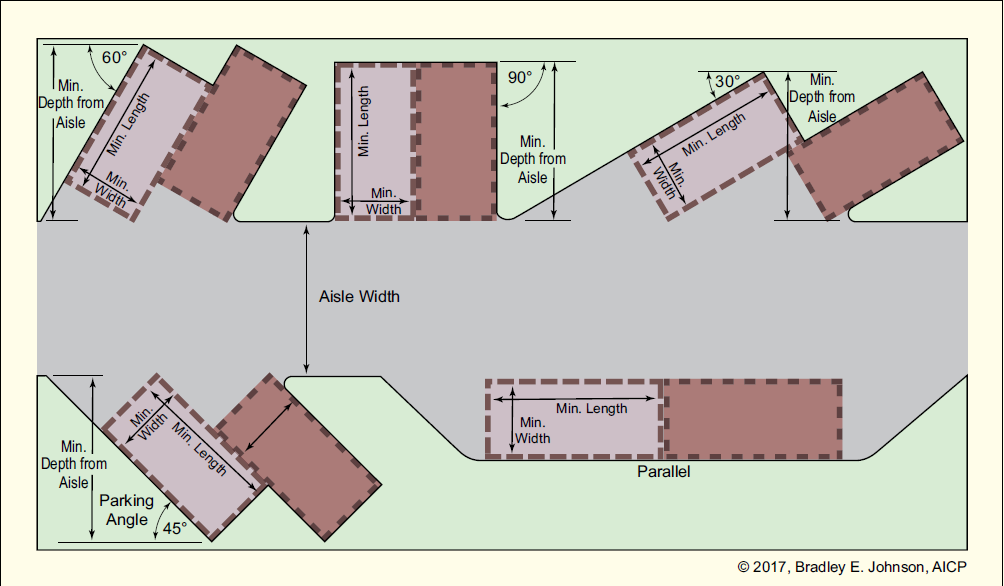
5.29 PK-02: Bicycle Parking Standards
These Parking Standards (PK) apply to the following districts:
| P1 | S1 | S2 | R1 | R2 | R3 | R4 | R5 | UR | B1 | B2 | B3 | B5 | B6 | B7 | B8 | C1 | C2 | UC | MC | I1 | M3 |
- Bicycle Parking: It is the purpose of Section 5.29: Bicycle Parking Standards to ensure adequate and safe facilities for the storage of bicycles for all projects.
- The bicycle parking requirements and recommendations in this Section shall apply to new Development or Improvement requiring Plan Commission or Board of Zoning Appeals approval.
- The number of bicycle parking spaces shall be required and encouraged as follows:
Use Category
Short-term
(Required)Long-term
(Encouraged, Unless Otherwise Noted: See also Section 5.29(C): Long-term Bicycle Parking)Dwelling, Single Family or Two-Family No requirement No requirement Dwelling, Attached or Multiple Family 0.1 spaces for each bedroom, minimum of 4 spaces No requirement for units with private garages,
0.5 spaces for each bedroom for units without garages, minimum of 2 spacesCCRC or Senior Housing 0.1 spaces for each unit, minimum of 4 spaces No requirement for Memory Care or Skilled Nursing Units, 0.5 spaces for each assisted living and independent living unit, minimum of 2 spaces Restaurants, Grocery Stores 1 space for each 2,000 sq ft, minimum of 4 spaces 1 space for each 12,000 sq ft of floor area,
minimum of 2 spacesGeneral Retail 2 spaces for each 5,000 sq ft, minimum of 4 spaces 1 space for each 12,000 sq ft of floor area,
minimum of 2 spacesOffice 1 space for each 10,000 sq ft, minimum of 4 spaces 2 spaces for each 10,000 sq ft, minimum of 2 spaces Hotel 1 space per 30 guest rooms, minimum of 4 spaces Required: 1 space per 15 guest rooms, minimum of 4 spaces Assembly (church, theaters, stadiums, parks, etc.) spaces for 2% of maximum capacity, minimum of 4 spaces 1.5 spaces for each 20 employees, minimum of 2 spaces Auto sales, rental, and delivery, automotive serving, repair and cleaning 1 space for each 20,000 sq ft, minimum of 2 spaces 1 space for each 10,000 sq ft, minimum of 2 spaces Commercial parking lots 1 per 10 auto spaces, minimum of 6 spaces 1 space per 20 automobile spaces, minimum of 2 spaces Commercial parking garages 1 per 10 auto spaces, minimum of 6 spaces 1 space per 20 automobile spaces, minimum of 2 spaces In addition to public bicycle parking commercial parking garages shall also include water fountain(s), bicycle maintenance equipment such as a bike maintenance stand with bike tools, a tire pump, and other equipment. The location and design shall be reviewed and approved by the Transportation Systems Coordinator. School, kindergarten and elementary (1 - 5) 1 space for each 20 students of planned capacity, minimum of 4 spaces 1 per 10 employees, minimum of 2 spaces School, grades 6 - 12 1 space for each 20 students of planned capacity, minimum of 4 spaces 1 per 10 employees and 1 space for each 20 students planned capacity, minimum of 2 spaces Colleges and Universities 1 space for each 10 students of planned capacity, minimum of 4 spaces 1 spaces for each 10 employees plus 1 space for each 10 students of planned capacity, or 1 space per 20,000 sq ft, whichever is greater Healthcare/hospital 1 space for each 20,000 sq ft, minimum of 4 spaces 1 space for each 20 employees or 1 space for each 70,000 sq ft, whichever is greater, minimum of 2 spaces Day Care or Day Nursery 1 space for each 20 students of planned capacity, minimum of 4 spaces 1 for each 20 employees, minimum of 2 spaces
- Short-term Bicycle Parking: The location and design of short-term bicycle parking spaces shall be provided as follows:
- The bike rack shall be an inverted U-type or an A-type structure unless otherwise approved by the Transportation Systems Coordinator. Racks to accommodate smaller bicycles may be considered for schools. (Diagram 1: Bicycle Rack Type)
- Racks requiring a user supplied locking device shall be designed to accommodate both a chain and U-type locking device and shall have the capability to support the bicycle at two locations.
- All bicycle parking racks shall be coated with a black Thermoplastic powder coating, unless otherwise approved by the Transportation Systems Coordinator.
- All racks shall be securely anchored to the ground to prevent the racks from unauthorized removal.
- The bicycle parking areas shall have adequate separation from motor vehicle parking areas to minimize safety risk to riders; as well as to protect parked bicycles and motor vehicles from damage. The separation can come from curbs, grade differences, landscaping, poles, physical barriers or other similar features.
- The bicycle parking areas shall be installed on a concrete surface that allows the bike rack to be securely fastened to the ground unless otherwise approved by the Transportation Systems Coordinator.
- Bicycle parking spaces shall be a minimum of two feet by six feet (2’ X 6’) feet per bicycle. (Diagram 2: Bicycle Parking Location and Design ‑ side view and Diagram 3: Bicycle Parking Location and Design ‑ top view)
- Bicycle racks shall be installed a minimum of twenty-four inches (24”) from all walls or obstructions. (Diagram 2: Bicycle Parking Location and Design ‑ side view and Diagram 3: Bicycle Parking Location and Design ‑ top view)
- Bicycle racks mounted in a row should be placed on thirty-inch (30”) centers. (Diagram 2: Bicycle Parking Location and Design ‑ side view and Diagram 3: Bicycle Parking Location and Design ‑ top view).
- Bicycle racks shall allow a minimum of five feet (5’) of clearance behind a parked bicycle to allow for room to maneuver. (Diagram 3: Bicycle Parking Location and Design ‑ top view)
- The bicycle rack shall be placed within fifty (50) feet of the entrance designated as the main entrance of the building for which the racks are required. Buildings with multiple main entrances or separate tenant entrances may disperse bicycle racks for rider convenience and functionality at multiple entrances. The bicycle parking areas should be located in a clearly safe and convenient location as to not discourage their use, and located to minimize conflicts between cyclists, vehicles and pedestrians.
- Bicycle parking areas shall be easily accessible from all trails, sidewalks and other alternative transportation facilities. Access to bicycle racks from these facilities shall be direct and clearly designated.
- Bicycle parking can be shared by two (2) venues in the case that all of the venues’ entrances are within fifty (50) feet of another.
- Bicycle racks shall be placed so as to not impede the flow of pedestrian traffic, leaving a minimum pedestrian clear path of five (5) feet but still possess the ability to be visually monitored.
- Bicycle parking areas shall be placed in a location that is visible from the building entrance and with proper lighting to ensure security.
- Long-term Bicycle Parking: The location and design of long-term bicycle parking spaces are encouraged to be provided as follows:
- The parking areas shall provide protection for each bicycle from theft, vandalism and weather, in lit, covered and permanently anchored locations. Long-term bicycle parking may consist of a locker, locked enclosure or locked room, and may be located within or external to a building, unless otherwise approved by the Transportation Systems Coordinator.
- The location of the long-term bicycle parking areas shall be reviewed and approved by the Transportation Systems Coordinator.
- Buildings with multiple main entrances or separate tenant entrances may disperse bicycle parking for rider convenience and functionality at multiple locations. The bicycle parking area(s) should be located in a safe and convenient location as to not discourage their use, and located to minimize conflicts between cyclists, vehicles and pedestrians.
- External bicycle parking areas shall be easily accessible from all trails, multi-use paths and other bicycle facilities. Access to bicycle parking from these facilities shall be direct and clearly designated.
- External bicycle parking areas shall be placed in a location that is visible from the building entrance and with proper lighting to ensure security.
- Parking Space Reduction: Buildings in compliance with the Long-term Bicycle Parking standards in Section 5.29(A)(2) and Section 5.29(C)(2) may reduce the number of automobile parking spaces required in Section 5.30: Amount of Parking Spaces Standards by up to five percent (5%).
- Employee Facilities: Employee shower facilities and locker areas are encouraged as an end of ride facility to bolster bicycle commuting in the community.
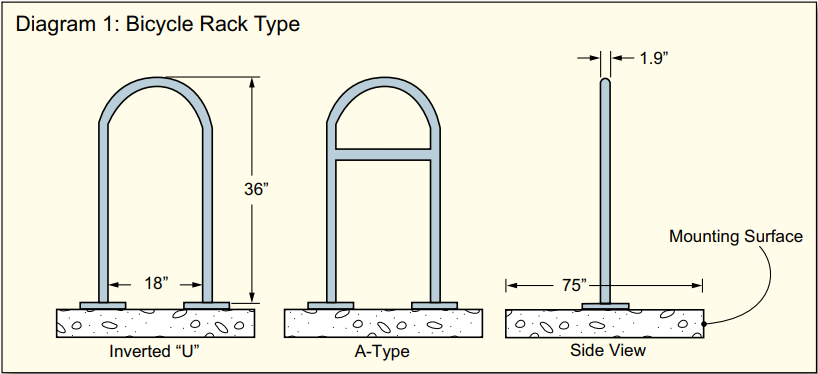
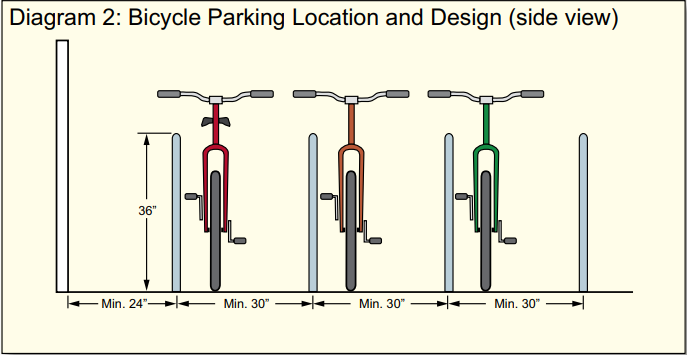
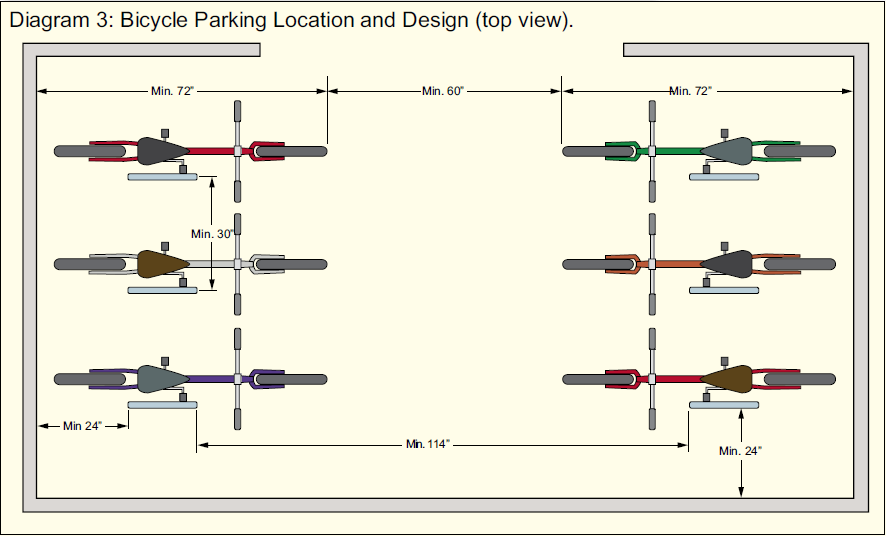
5.30 PK-03: Amount of Parking Spaces Standards
These Parking Standards (PK) apply to the following districts:
| P1 | S1 | S2 | R1 | R2 | R3 | R4 | R5 | B1 | B2 | B3 | B5 | B6 | B7 | B8 | I1 | M3 |
Minimum Parking Spaces Required
| Use | Parking Requirements |
| Art gallery | One space per 300 sq. ft. of floor area |
| Art and music center | One space per 300 sq. ft. of floor area |
| Automobile service station | One space per pump plus one space per service bay |
| Automobile or truck repair | Two spaces per service bay |
| Boarding or lodging house | One space per bed |
| Bowling Alley | Five spaces per lane |
| Bus/Transit Stop or railroad passenger train | One space per employee plus one space per seat in waiting area |
| Carnivals, fairs, circuses, etc. | Fifty spaces per acre |
| Catering establishment | One space per 200 sq. ft. of floor area |
| Church, temple or other place of worship | One space per 4 seats in the main place of assembly |
| Clinic or medical health center | One space per 250 sq. ft. of floor area |
| College or University | One space per 4 students, based on maximum capacity |
| Commercial greenhouse | One space per 1,000 sq. ft. of floor area |
| Commercial Kennel | Four spaces |
| Commercial parking lot | One additional space per employee |
| Commercial Recreational Facility, Park, or Community Center | One space per 200 sq. ft. of interior area plus one space per 5,000 sq. ft. of outdoor area |
| Commercial Sewage, Trash, Garbage Disposal or Recycling Plant | One space per employee |
| Conference/Civic Center | One space for the largest shift of employees plus 1 space per 150 sq. ft. of floor area. |
| Continuing Care Retirement Community (CCRC) | One space per independent living unit plus 0.5 spaces per assisted living unit plus 0.3 spaces per long term care/memory support unit plus one space per employee of the largest shift |
| Country Club | One space per 200 sq. ft. of floor area |
| Day Nursery/Day Care | One space per employee plus one space per six students |
| Dry cleaning | One space per 300 sq. ft. of floor area |
| Dwelling, Attached | Two spaces per dwelling unit (excluding private garage) plus one space per 7 dwellings |
| Dwelling, Multiple Family | Two spaces per dwelling unit plus one space per 7 dwellings |
| Dwelling, Single Family | Two spaces per dwelling unit (excluding private garage) |
| Dwelling, Two Family | Two spaces per dwelling unit (excluding private garage) |
| Equipment Sales/Repair (Indoor) | One space per 300 sq. ft. of floor area |
| Funeral Home/mortuary/crematory | One space per 50 sq. ft. of public floor area |
| General Agriculture (Farm) | none |
| Golf Course | Six spaces per hole |
| Grain elevator | One space per 300 sq. ft. of floor area plus one space per elevator |
| Helicopter or Airplane Landing/Service Facility | One space per employee plus adequate additional spaces related to terminal use as approved by the Board |
| Home occupation | One additional space per 200 sq. ft. of dwelling devoted to home occupation |
| Hospital | One space per bed plus one space per employee |
| Hotel, motel | One space per room or suite |
| Indoor theater | One space per two seats |
| Use | Parking Requirements |
| Industrial establishments, light or heavy | Two spaces per three employees or one space per 300 sq. ft. of floor area, which ever is greater, plus sufficient space to accommodate all trucks or other vehicles used in connection therewith |
| Kindergarten/Pre-School | One space per employee plus one space per six students |
| Lumber or building materials sales | One space per 300 sq. ft. of interior area plus one space per 500 sq. ft. of exterior area |
| Manufacturing Facilities | Two spaces per three employees or one space per 500 sq. ft. of floor area, whichever is greater, plus sufficient space to accommodate all trucks or other vehicles used in connection therewith |
| Mineral extraction, borrow pit, top soil removal and their storage | One space per employee |
| Mobile home park | Two spaces per mobile home |
| Nursing, retirement or convalescent facility | One space per bed plus one space per employee |
| Office, Call Center | One space per 150 sq. ft. of floor area |
| Office, General | One space per 250 sq. ft. of floor area |
| Outdoor theater | One space per three seats or maximum capacity of guests |
| Penal or correctional institution | One space per employee plus one space per five inmates |
| Plant nursery | One space per 300 sq. ft. of indoor area plus one space per acre |
| Post Office or postal station | One space per official vehicle plus one space per employee plus one space per 500 sq. ft. of floor area |
| Power Generating Plant | One space per employee |
| Printing/Publishing Establishment | One space per 300 sq. ft. of floor area |
| Private club or lodge | One space per 200 sq. ft. of floor area plus one space per two seats (seating capacity) in main place of assembly |
| Private Recreational Facility | One space per 200 sq. ft. of interior area plus one space per 5,000 sq. ft. of outdoor area |
| Private water treatment and/or storage facilities | One space per employee |
| Professional office | One space per 300 sq. ft. of floor area |
| Public Service Facility or Governmental Facilities | One space per 250 sq. ft. of floor area or (option) one space per 500 sq. ft. of floor area and one reserved space per 500 sq. ft. of floor area, plus sufficient space to accommodate all trucks or other vehicles used in connection therewith |
| Radio/television studio | One space per 300 sq. ft. of floor area |
| Radio or television transmission tower | One space per employee |
| Recreational Vehicle/Mobile Home/Farm Implement/Automobile/Boat Sales | One space per 300 sq. ft. of indoor area plus one space per 2,000 sq. ft. of outdoor sales area |
| Research laboratory | One space per 250 sq. ft. of floor area |
| Residential Kennel | (no additional requirements) |
| Restaurant, with Walk-Up/Drive-Thru Food Sales | One space per 80 sq. ft. of floor area |
| Restaurant, without Drive-Thru Food Sales | One space per every 2.5 patron seats, plus one space per employee per largest shift |
| Retail Sales/General Service | One space per 200 sq. ft. of floor area |
| Riding stable | One space per stall |
| Sanitary Landfill, Junk Yard, Salvage Yard | One space per employee |
| School, elementary or secondary education (accredited by the state) | One space per employee plus two spaces per classroom(elementary) or ten spaces per classroom (secondary) |
| School, Trade or Business | One space per 2 students, based on maximum capacity |
| Self-service laundry | One space per 200 sq. ft. of floor area |
| Shooting gallery | One space per 1000 sq. ft. of floor area |
| Stadium or coliseum | One space per four seats |
| Use | Parking Requirements |
| Storage, Warehousing, or Distribution | One space per employee |
| Tavern or night club | One space per 100 sq. ft. of floor area |
| Veterinary Hospital | One space per 300 sq. ft. of floor area |
| Wholesale Facility | One space per 300 sq. ft. of floor area |
| Wholesale sales | One space per employee plus one space per 600 sq. ft. of sales floor area |
5.31 PK-04: Urban Residential Parking Standards
These Parking Standards (PK) apply to the following district:
| UR |
- Qualifying Parking: The following types of parking shall count toward the minimum required parking spaces.
- On‑Site Underground: Any parking spaces located in a below-ground, on-site parking garage.
- Parking Court: Any surface parking lot located behind a building or otherwise located in a discrete location. Discrete locations may included surface parking court significantly screened by vegetation.
- Parking Garage: Any parking garage located behind a building or otherwise located in a discrete location; See Section 5.05: Urban Residential Architectural Standards for more regulations.
- On‑Street: Any on-street parking spaces located immediately adjacent to the subject lot; spaces across a street shall not count.
- Off‑Site: Any off-site public or private parking garage or surface lot where a permanent allocation has been acquired, and that is located within 800 feet of the subject building footprint.
- Disqualified Parking: Any parking space that is allocated to another development shall not count toward the minimum required parking.
- Minimum Required Parking Spaces:
- Residential Units: One and five-tenths (1.5) parking spaces is required per dwelling unit.
- Retail and Services: One (1) parking space per 300 square feet of total square feet.
- Restaurants: One (1) parking space per two (2) patron seats.
- Office: One (1) parking space per 300 square feet
- All Other Uses: As per Section 5.30: Amount of Parking Spaces Standards.
- Reduction of Minimum Required Parking Spaces:
- Transit Hub: If the development is partially or fully within 800 feet of a transit hub, the minimum required parking spaces shall be reduced by ten percent (10%).
5.32 PK-05: Urban Core Parking Standards
These Parking Standards (PK) apply to the following district:
| UC |
- Qualifying Parking: The following types of parking shall count toward the minimum required parking spaces.
- On‑Site Underground: Any parking spaces located in a below-ground, on-site parking garage.
- Parking Court: Any surface parking lot located behind a building or otherwise located in a discrete location. Discrete locations may included surface parking courts significantly screened by vegetation.
- Parking Garage: Any parking garage located behind a building or otherwise located in a discrete location; See Section 5.06: Urban Core Architectural Standards for more regulations.
- On‑Street: Any on-street parking spaces located immediately adjacent to the subject lot; spaces across a street shall not count.
- Off‑Site: Any off-site public or private parking garage or surface lot where a permanent allocation has been acquired, and that is located within 800 feet of the subject building footprint.
- Disqualified Parking: Any parking space that is allocated to another development shall not count toward the minimum required parking.
- Minimum Required Parking Spaces:
- Residential Units: One and two-tenths (1.2) parking spaces is required per dwelling unit.
- Hotel: One (1) parking space per unit, plus one (1) per employee on the largest shift.
- Retail and Services: One (1) parking space per 350 square feet of total square feet.
- Restaurants: One (1) parking space per three (3) patron seats.
- Office: One (1) parking space per 350 square feet
- All Other Uses: As per Section 5.30: Amount of Parking Spaces Standards.
- Reduction of Minimum Required Parking Spaces:
- Transit Hub: If the development is partially or fully within 800 feet of a transit hub, the minimum required parking spaces shall be reduced by ten percent (10%).
5.33 PK-06: Meridian Corridor Parking Standards
These Parking Standards (PK) apply to the following district:
| MC |
- Qualifying Parking: The following types of parking shall count toward the minimum required parking spaces.
- On‑Site Underground: Any parking spaces located in a below-ground, on-site parking garage.
- Parking Court: Any surface parking lot located behind a building or otherwise located in a discrete location. Discrete locations may included surface parking courts significantly screened by vegetation.
- Parking Garage: Any parking garage located behind a building or otherwise located in a discrete location; SeeSection 5.07: Meridian Corridor Architectural Standards for more regulations.
- On‑Street: Any on-street parking spaces located immediately adjacent to the subject lot; spaces across a street shall not count.
- Off‑Site: Any off-site public or private parking garage or surface lot where a permanent allocation has been acquired, and that is located within 800 feet of the subject building footprint.
- Disqualified Parking: Any parking space that is allocated to another development shall not count toward the minimum required parking.
- Minimum Required Parking Spaces:
- Residential Units: One and four-tenths (1.4) parking spaces is required per dwelling unit.
- Hotel: One (1) parking space per unit, plus one (1) per employee on the largest shift.
- Retail and Services: One (1) parking space per 350 square feet of total square feet.
- Restaurants: One (1) parking space per two (2) patron seats.
- Office: One (1) parking space per 350 square feet
- All Other Uses: As per Section 5.30: Amount of Parking Spaces Standards.
- Reduction of Minimum Required Parking Spaces:
- Transit Hub: If the development is partially or fully within 800 feet of a transit hub, the minimum required parking spaces shall be reduced by ten percent (10%).
5.34 RV-01: Recreational Vehicle Standards
These Recreational Vehicle Standards (RV) apply to the following districts:
| P1 | S1 | S2 | R1 | R2 | R3 | R4 | R5 | UR | B1 | B2 | B3 | B5 | B6 | B7 | B8 | C1 | C2 | UC | MC | I1 | M3 |
- Recreational vehicles shall not be stored any closer to a lot line than three (3) times the maximum height of the recreational vehicle, except when stored inside of a lawfully-erected structure that fully encloses the vehicle and includes a roof. Non-motorized recreational vehicles shall not be stored on a public right-of-way at any time. Motorized recreational vehicles may be stored on a public right-of-way for a period not to exceed ten (10) days per month.
- At no time shall parked or stored vehicles be occupied or used for habitation as defined herein.
- The owner of a recreational vehicle shall not park or store such vehicle in such a manner as to create a dangerous or unsafe condition on the property where parked or stored. Parking or storage of the recreational vehicle while not locked or chocked, whether loaded or not, shall be considered a dangerous and unsafe condition.
- No recreational vehicle shall be connected to gas, electric, water or sanitary sewer service for purposes of habita- tion, except as cited herein.
- Non-resident recreational vehicles may be parked in a front yard or driveway, not on the public right-of-way and used for habitation, including temporary connection to any appropriate utilities, for a period not to exceed ten (10) days per month.
5.35 PI-01: Premises Identification Standards
These Premises Identification Standards (PI) apply to the following districts:
| P1 | S1 | S2 | R1 | R2 | R3 | R4 | R5 | UR | B1 | B2 | B3 | B5 | B6 | B7 | B8 | C1 | C2 | UC | MC | I1 | M3 |
- Purpose: It is hereby declared to be the purpose of this article to require Premises Identification for buildings within the City of Carmel and set enforcement provisions for failure to display said identification.
- Requirements:
- The assigned premises identification of a building shall be displayed in such a manner so that the numerals can readily be Seen from the street. Identification shall be displayed on the building, on or near the main entrance door, or displayed on a mailbox near the street in such a manner as they identify corresponding building.
- Any dwelling or commercial building that abuts an alley or secondary access that could be used by motor vehicles shall not only display the premises identification on the front, but shall also display its premises identification visible from the alternate access to the property.
- When the numerals representing premises identification are removed or become illegible, such numerals shall be renewed or replaced by the owner or occupant of the building.
- The provisions of Section5.35: Premises Identification Standards requiring premises identification shall apply to all existing residential and commercial structures within Carmel.
5.36 SB-01: General Setback Standards
These Setback Standards (SB) apply to the following districts:
| P1 | S1 | S2 | R1 | R2 | R3 | R4 | R5 | UR | B1 | B2 | B3 | B5 | B6 | B7 | B8 | C1 | C2 | UC | MC | I1 | M3 |
- General: No Building shall be erected, reconstructed or structurally altered in any manner which will encroach upon, or reduce in any manner the Yards established and specified for the Use and the District in which such Building is located.
- Front Setback Measurements: All front setbacks shall be measured from the right-of-way.
5.37 SB-02: S1 Yard Standards
These Setback Standards (SB) apply to the following districts:
| S1 |
- Historic Subdivisions: The Minimum Front Yard of any Lot in a Subdivision approved prior to April 21, 2008, which utilized relaxed Front Yard standards granted for commitments to increased open space shall be as follows:
- Dwelling With Attached, Front‑Loading Garage: Twenty (20) feet. Garage shall be set back a minimum of twenty-five (25) feet.
- Dwelling With Attached, Side‑Loading Garage: Fifteen (15) feet. Garage shall be set back a minimum of twenty-five (25) feet.
- Dwelling With Attached, Rear‑Loading; or Detached, Alley‑Access Garage: Ten (10) feet.
5.38 SB-03: Urban Setback Standards
These Setback Standards (SB) apply to the following districts:
| UR | C1 | C2 | UC |
- Exceptions to Front Setback: Urban residential and urban commercial minimum setbacks and maximum setback shall apply per the applicable two-page layout in Article 2: Zoning Districts, except as provided below.
- Allowance for Courtyards or Plaza: A courtyard or plaza may be located adjacent to the street.
- Maximum Setback for Courtyards or Plazas: The maximum setback for the portion of frontage used for a courtyard or plaza shall be sixty (60) feet or sixty percent (60%) of the lot’s depth, whichever is greater.
- Maximum Width of a Courtyard or Plaza: The maximum width of a courtyard or plaza shall be forty percent (40%) of the lot’s width measured at the minimum front setback line.
- Standards for a Courtyard or Plaza: A courtyard or plaza shall be partially used for stormwater storage and filtration, landscaping, and be available to the public. A minimum of twenty percent (20%) of the area in a courtyard or plaza shall be used for stormwater storage and/or filtration. The design shall be ADA compliant and allow for public seating. Sculpture, fountain, hardscape, ornamentation, trees, plants and flowers are encouraged, as may be appropriate to the building design, building use, and context.
- Limitations: Private areas shall not be considered a courtyard or plaza.
5.39 SI-01: Sign Standards
These Sign Standards (SI) apply to the following districts:
| P1 | S1 | S2 | R1 | R2 | R3 | R4 | R5 | UR | B1 | B2 | B3 | B5 | B6 | B7 | B8 | C1 | C2 | UC | MC | I1 | M3 |
- Purpose and Intent: Signs obstruct views, distract motorists, displace alternative uses for land, and pose other problems that legitimately call for regulation. The purpose of Section 5.39: Sign Standards is to regulate the size, illumination, movement, materials, location, height and condition of all signs placed on private property for exterior observation, thus ensuring the protection of property values, the character of the various neighborhoods, the creation of a convenient, attractive and harmonious community, protection against destruction of or encroach- ment on historic convenience to citizens and encouraging economic development. Section 5.39: Sign Standardsallows adequate communication through signage while encouraging aesthetic quality in the design, location, size and purpose of all signs. Section 5.39: Sign Standards shall be interpreted in a manner consistent with the First Amendment guarantee of free speech.
- Sign Maintenance:
- Every sign, including but not limited to those signs for which permits are required, shall have all parts and surfaces cleaned, painted or replaced as necessary to maintain the original appearance.
- A Sign Permit shall not be required for sign maintenance (i.e. the repainting, cleaning and other normal maintenance or repair), nor for change of copy for legal Changeable Copy of a sign or sign structure for which a permit has previously been issued.
- However, any Sign Alteration shall require sign permit approval.
- Landscaping around Ground Signs shall be maintained so that the sign may be visible at all times and from all visual angles.
- A Sign Permit will not be required for a change of copy for legal Changeable Copy or otherwise allowed under Section 5.39: Sign Standards.
- All signs shall be subject to an inspection by the Planning Administrator.
- Exempted Signs: The following types of signs are exempted from all provisions of Section 5.39: Sign Standards, but shall be established and maintained in such a manner as to not cause safety hazards. Signs which are included as part of a Sign Plan may require approval by the Planning Administrator, however, do not require fees. Otherwise, no procedures, approvals, permits or fees are required for the following signs:
- Each property owner shall mark their property using numerals that identify the address of the property so that public safety departments can easily identify the address from the public street. The size and location of the identifying numeral and letters shall be proportional to the size of the building and the distance from the street to the building.
- Integral Signs (3 square feet or less).
- Traffic control devices on private or public property shall be erected and maintained to comply with the Manual of Uniform Traffic Control Devices.
- Traffic Directional Signs not exceeding three (3) square feet in sign area for any one (1) sign; and not higher than three (3) feet above ground level. Standard traffic directional signs, such as STOP and Yield signs, shall comply with the “Manual for Uniform Traffic Control Devices” which can be found at www.mutcd.fhwa.dot.gov.
- Government Signs.
- Flags
- Flag Poles shall meet the minimum yardsetback requirements for a Principal Building or a minimum of ten (10) feet, whichever is more restrictive.
- Flag Poles mounted onto a building shall not extend above the cornice line of the building.
- Standalone Flag Poles shall not exceed 40 feet in height.
- Accessory Structures less than five (5) feet in height may display a sign no larger than three (3) square feet in area.
- Parking lot row/area identifiers (3 square feet or less).
- Umbrella signs (3 square feet or less).
- Prohibited Signs: The following types of signs are prohibited.
- Signs which contain obscene statements, words or pictures.
- Signs which contain or are in imitation of an official traffic sign or signal or contain the words “stop”, “slow”, “caution”, “danger”, “warning” or similar words, or are of a size, location, movement, content, coloring, or manner of illumination which may be confused with or construed as a traffic or street sign or signal.
- Off Premise signs.
- Signs with a Visible Light Source on the exterior of a Building unless they are permitted specifically by other sections of Section 5.39: Sign Standards.
- Signs of the flashing, blinking, animated, or audible type, except those giving public service information placed by the City of Carmel and/or the State of Indiana. The message can change no more than one (1) time per ten (10) seconds.
- Signs which rotate, swing, inflate or move as a result of wind (natural or man-made), e.g. banners, posters, pennants, ribbons, streamers, strings of light bulbs, spinners or similar devices, unless they are permitted specifically by other sections of Section 5.39: Sign Standards (See Section 5.39(R): Temporary Sign; Permitted Banners).
- Signs which are located in such a manner as to obstruct the view of the intersection of a street, highway, or trail crossing.
- Signs which are projected on, located upon, over, or in any street or highway right-of-way, except for official highway and regulatory signs of the City of Carmel and the State of Indiana.
- Portable signs which are not permanently affixed to anything or are movable.
- Signs which are established on trees, utility poles and fences, unless they are permitted specifically by other sections of Section 5.39: Sign Standards (See Section 5.39(R): Temporary Sign; Permitted Banners).
- Roof Signs.
- Signs which are established on Accessory Structures (e.g. parking garages, gas station canopies, or sheds) unless they are specifically permitted in Section 5.39: Sign Standards.
- Vehicles Used as Signs: It shall be prohibited to park or use a vehicle in such a way as to function as a sign, defined to include the parking of any vehicle, trailer or similar movable structure containing or supporting any signage between any Street or highway right-of-way line and any Building and the greater of two distances: forward of the Front Line of Building of the Principal Building or 150 feet from the public right-of-way, with the exception of:
- Vehicles actively involved in construction on or serving of the site;
- Vehicles delivering products to the site in designated loading areas;
- Vehicles parked in designated truck parking areas of a development that have been screened from or are not generally visible from the public right-of-way;
- Vehicles parked on sites where parking is not available 150 feet or more from the public right-of-way. In such cases, vehicles supporting signage shall be located as far as possible from the public right-of-way, subject to determination by the Director of Community Services.
- Passenger vehicles, pick-up trucks, and vans of a size that can fully fit within a standard parking space, containing signs painted on or permanently affixed on the doors or integral body panels that do not exceed sixteen (16) square feet in area.
Permanent Sign Standards
E. General Permanent Sign Standards:
- All signs require Sign Permit approval by the Planning Administrator.
- All Sign Permits require fees per Section 1.29: Filing Fees.
- No sign shall interfere with Vision Clearance per Section 5.76:Vision Clearance Standards.
- All permanent Ground Signs require a Landscaped Green Area at its base equal to the Sign Area. For example, ornamental grasses, shrubs and seasonal flowers.
- Wall Signs are allowed provided that they fit within the horizontal and vertical elements of the Building and do not obscure architectural details of the Building.
- No Wall Sign shall be allowed to extend above the cornice line of a Building, beyond the edges of the wall upon which it is mounted, nor above the roofline.
- All sign types shall be designed to relate to the architectural style of the main Building or Buildings upon the site.
- All signs shall be installed a minimum of five (5) feet from the street right-of-way.
F. Permanent Sign; Residential Complex:
- Sign Classification: Blade, Canopy, Entrance, Projecting, Suspended or Wall.
- Number and Type:
- Entrance and Suspended: One (1) sign per entrance if the Building(s) are set back greater than fifteen (15) feet from the street right-of-way.
- Matching Entrance Signs which border either side of one (1) entrance into a Residential Complex shall be treated as one (1) sign.
- However, both Sign Faces shall be used to calculate the total Sign Area.
- Or one (1) Blade, Canopy, Projecting, or Wall Sign per Street Frontage.
- Clubhouse/leasing office in a Residential Complex: 1 sign.
- One (1) Wall or Projecting Sign for Vehicular Entrances to structured parking.
- One (1) Public Access Entrance Sign per Building Façade at the ground floor.
- Entrance and Suspended: One (1) sign per entrance if the Building(s) are set back greater than fifteen (15) feet from the street right-of-way.
- Maximum Sign Area:
- Blade:
- Seventy percent (70%) of tenant’s Spandrel panel height.
- The depth of the sign (between the two sign faces) shall be no more than eighty-five percent (85%) of tenant’s Spandrel Panel width.
- No Blade Sign shall exceed seventy-five (75) square feet.
- Entrance: Fifty (50) square feet.
- Canopy:
- Clubhouse/leasing office: Twenty (20) square feet.
- Projecting: Twenty (20) square feet.
- Public Access Entrance: Twenty (20) square feet
- Suspended: Twelve (12) square feet.
- Wall:
- Seventy percent (70%) of tenant’s Spandrel Panel height.
- Eighty-five percent (85%) of tenant’s Spandrel Panel width, with a ten percent (10%) leeway allowance for architectural elements that may hinder sign visibility.
- Spandrel Panel on a glass building will be determined by separation details between the panes of glass and/or by floor levels. Signs on glass buildings shall not obscure vision of tenants inside the building.
- No Wall Sign shall exceed 300 square feet.
- Blade:
- Maximum Height of Ground Sign: Per Sign Chart A: Ground Signs.
- Location:
- Canopy: Shall be placed at an appropriate height over windows or doors for protection from the elements.
- Entrance: At Vehicular Entrance to Residential Complex; installed a minimum of five (5) feet from the street right-of-way.
- Signage May be installed on a residential Entryway Feature, see Section 7.11: Residential Entryway Feature Standards.
[1] Required Approval: ADLS or ADLS Amendment. - However, a Residential Complex cannot have both an Entrance Sign and an Entryway Feature.
- Prohibited when the building(s) for which it is to be established are set back less than fifteen (15) feet from the street right-of-way.
- Signage May be installed on a residential Entryway Feature, see Section 7.11: Residential Entryway Feature Standards.
- Clubhouse/Leasing Office: At pedestrian entrance to Building.
- Projecting and Blade:
- Shall be located a minimum of two (2) feet behind the curb.
- Shall measure a minimum distance of eight (8) feet from the bottom of the sign to ground level.
- Shall not extend more than five (5) feet from the face of the Building.
- A Projecting or Blade Sign installed on the corner of a building will be considered facing two (2) Street Frontages.
- Design:
- Canopy: Text and/or graphics shall provide one inch (1”) of clearance from the top and bottom of the canopy face, but shall not exceed length of sign installed on canopy.
- Entrance:
- Base of sign shall be constructed of Sign Masonry material to match the design of the building.
- If no masonry material is used on the building, then a Sign Masonry material shall be used.
- Sign Masonry base shall at least equal the width and depth of the sign.
- Shall include a delineated cornice designed to relate to the architectural features of the main Building(s) upon the site.
- Wall: See Section 5.39(E)(5), Section 5.39(E)(6), and Section5.39(E)(7).
- Illumination: Permitted.
G. Permanent Sign; Home Occupation and Boarding House:
- Sign Classification: Wall.
- Number and Type: One (1) Sign.
- Maximum Sign Area: Three (3) square feet.
- Location: As per definition of Wall Sign.
- Illumination: Not permitted.
H. Permanent Sign; Single Tenant, Non-Residential Uses:
- Sign Classification: Awning, Blade, Canopy, Ground, Porch, Projecting, Suspended, or Wall.
- Number and Type:
- One (1) sign per Street Frontage, maximum three (3) signs.
- A building owner with two (2) or more Street Frontages may elect to transfer a permitted sign from one (1) Street Frontage to another.
- However, no more than two (2) signs may be oriented to one (1) Street Frontage as follows: One (1) Blade, Canopy, Projecting or Wall Sign and one (1) Ground or Suspended Sign.
- Maximum Sign Area:
- Awning:
- The area of any Awning graphic will be subtracted from the allowable Sign Area of the sign type chosen.
- If used as the primary business sign, the allowable Wall Sign Area applies.
- Blade:
- Seventy percent (70%) of tenant’s Spandrel Panel height.
- The depth of the sign (between the two sign faces) shall be no more than eighty-five percent (85%) of tenant’s Spandrel Panel width.
- No Blade Sign shall exceed seventy-five (75) square feet.
- Canopy:
- The area of any Canopy graphic will be subtracted from the allowable Sign Area of the sign type chosen.
- If used as the primary business sign, the following applies:
[1] Height: Two (2) feet
[2] Width:
[a] Ninety percent (90%) of tenant’s canopy length if fourteen (14) feet or less.
[b] Seventy percent (70%) of tenant’s canopy length if greater than fourteen (14) feet.
- Ground: Per Sign Chart A: Ground Signs.
- Porch: Six (6) square feet.
- Projecting: Twenty (20) square feet.
- Suspended: Twelve (12) square feet.
- Wall:
- Seventy percent (70%) of tenant’s Spandrel Panel height.
- Eighty-five percent (85%) of tenant’s Spandrel Panel width, with a ten percent (10%) leeway allowance for architectural elements that may hinder sign visibility.
- Spandrel Panel on a glass building will be determined by separation details between the panes of glass and/or by floor levels. Signs on glass buildings shall not obscure vision of tenants inside the building.
- No Wall Sign shall exceed 300 square feet.
- Awning:
- Maximum Height of Ground Sign: Per Sign Chart A: Ground Signs.
- Location:
- Awning and Canopy:
- Shall be placed at an appropriate height over windows or doors for protection from the elements.
- Prohibited on residential structures that have been converted to commercial or offices.
- Ground:
- Minimum five (5) feet from the street right-of-way.
- Prohibited when the building for which it is to be established is set back less than fifteen (15) feet from the street right-of-way.
- Prohibited where residential structures have been converted to commercial or office uses.
- Porch and Suspended:
- May be utilized only where residential structures have been converted to office or commercial uses.
- Minimum five (5) feet from the street right-of-way.
- Projecting and Blade:
- Shall be located a minimum of two (2) feet behind the curb.
- Shall measure a minimum distance of eight (8) feet from the bottom of the sign to ground level.
- Shall not extend more than five (5) feet from the face of the building.
- A Projecting or Blade Sign installed on the corner of a building will be considered facing two (2) Street Frontages.
- Prohibited on residential structures that have been converted to commercial for office uses.
- Wall: Prohibited on residential structures that have been converted to commercial or office uses.
- Awning and Canopy:
- Design:
- Awning:
- Text and/or graphics shall provide one inch (1”) of clearance from the top and bottom of the front valance of a fabric awning.
- Valances shall not exceed fourteen inches (14”) in height.
- Text and or graphics may be placed on the top of the Awning.
- Canopy: Text and/or graphics shall provide one inch (1”) of clearance from the top and bottom of the canopy face, but shall not exceed length of sign installed on canopy.
- Ground:
- Base of sign shall be constructed of Sign Masonry material to match the design of the building.
- If no masonry material is used on the building, then a Sign Masonry material shall be used.
- Sign Masonry base shall be at least equal to the width and depth of the sign.
- Shall include a delineated cornice designed to relate to the architectural features of the main Buildings(s) upon the site.
- Wall: See Section 5.39(E)(5) and Section 5.39(E)(6), and Section 5.39 (E)(7).
- All Others: No restrictions.
- Awning:
- Copy:
- Any permissible Ground sign may include Changeable Copy.
- Any permissible Ground Sign for an Automobile Filling Station use may utilize Electronic Scrolling Numerals.
- llumination: Permitted.
I. Permanent Sign; Multi-Tenant Buildings for Mixed-Use and Non-Residential Uses:
- Sign Classification: Awning, Blade, Canopy, Ground, Projecting, Secondary Projecting, or Wall.
- Number and Type:
- Multi-Tenant Ground Floor Building
- Per Tenant:
- One (1) Awning, Canopy, Projecting, or Wall Sign per Street Frontage, maximum two (2).
- One (1) Secondary Projecting Sign per tenant Façade, maximum two (2) for pedestrian identification along a sidewalk.
- One (1) Wall Sign for the rear parking lot Public Access EntranceFacade if the building is set back fifteen (15) feet or less from the street right-of-way.
- Per Building:
- If a Building has more than one Street Frontage, One (1) Ground Sign may be installed for the Street Frontage without Awning, Canopy, Projecting, or Wall Signs per Section5.39(I)(2)(a)(i)[1] above, maximum three (3).
- A building owner with two (2) or more Street Frontages may elect to transfer a permitted sign from one Street Frontage to another.
- However, no more than two (2) signs shall be oriented to one (1) Street Frontage as follows: One (1) Projecting or Wall Sign and one (1) Ground Sign.
- Per Tenant:
- Multi-Tenant, Multi-Level Office Building
- Per Building: Two (2) signs per Street Frontage, maximum six (6).
- A building owner may transfer Street Frontages for two (2) Wall or one (1) Wall and one (1) Blade and one (1) Ground Sign to face the same Street Frontage.
- Buildings with more than one (1) Public Access Entrance and served by separate parking lots are permitted one (1) Public Access Entrance Ground Sign at each of the Public Access Entrances
- Multi-Tenant Building Complex
- One (1) Ground Sign per Street Frontage, maximum three (3) in addition to Wall Signs for Multi- Tenant Ground Floor or Multi-Tenant, Multi-Level Office Buildings.
- Signage may be installed on a commercial entryway feature, see Section 7.12: Non-Residential Entryway Feature Standards.
- Required Approval: ADLS or ADLS Amendment
- Multi-Tenant, Multi-Level, Mixed-Use Building
- Per Building:
- One (1) Blade or Wall Sign per Street Frontage.
- One (1) Wall or Projecting sign for Vehicular Entrances to structured parking.
- Per ground floor tenant:
- One (1) Canopy, Wall, or Projecting Sign per Street Frontage.
- One (1) Secondary Projecting Sign per Façade, maximum two (2) for pedestrian identification along a sidewalk (See Section5.39(I)(5)(g)(iii)).
- One (1) Wall Sign for the rear (Public Access Entrance) Facade if the building is set back fifteen(15) feet or less from the street right-of-way.
- For upper level tenants:
- One (1) Multi-Tenant, Multi-Level Mixed Use Wall Sign per Building Façade at the ground floor Public Access Entrance; or
- One (1) Multi-Tenant, Multi-Level Mixed Use Ground Sign per Building at the rear Public Access Entrance to the building.
- Per Building:
- Multi-Tenant Ground Floor Building
- Maximum Sign Area:
- Awning:
- The area of any Awning graphic will be subtracted from the allowable Sign Area of the sign type chosen.
- If used as the primary business sign, the allowable Wall Sign Area applies.
- Blade:
- Seventy percent (70%) of tenant’s Spandrel height.
- The depth of the sign (between the two sign faces) shall be no more than eighty-five percent (85%) of tenant’s Spandrel Panel width.
- No Blade Sign shall exceed seventy-five (75) square feet.
- Canopy:
- The area of any Canopy graphic will be subtracted from the allowable Sign Area of the sign type chosen.
- If used as the primary business sign, the following applies:
- Ground: See Sign Chart A: Ground Signs.
- Multi-Tenant, Multi-Level Mixed Use Building Wall: Six (6) square feet.
- Multi-Tenant, Multi-Level Mixed Use Building Ground: Twelve (12) square feet.
- Projecting: Twenty (20) square feet.
- Public Access Entrance: Twenty (20) square feet.
- Secondary Projecting: Five (5) square feet.
- Wall:
- Seventy percent (70%) of tenant’s Spandrel Panel height.
- Eighty-five percent (85%) of tenant’s Spandrel Panel width, with a ten percent (10%) leeway allowance for architectural elements that may hinder sign visibility.
- Spandrel Panel on a glass building will be determined by separation details between the panes of glass and/or by floor levels. Signs on glass buildings shall not obscure vision of tenants inside the building.
- No Wall Sign shall exceed 300 square feet
- Awning:
- Maximum Height Of Ground Sign: Per Sign Chart A: Ground Signs.
- Location:
- Awning and Canopy:
- Shall be placed at an appropriate height over windows or doors for protection from elements.
- Not permitted on residential structures that have been converted to office or commercial uses.
- Ground:
- Minimum of five (5) feet from street right-of-way.
- Located at or near the Vehicular Entrance to the complex.
- Ground Signs are not permitted where residential structures have been converted to office or commercial uses.
- Prohibited when the building for which it is to be established is set back less than fifteen (15) feet from the street right-of-way.
- Multi-Tenant, Multi-Level Mixed Use Building Wall: At the Public Access Entrance located at the rear of a building on the Façade of the building.
- Multi-Tenant, Multi-Level Mixed Use Building Ground: At the Public Access Entrance located at the rear of a building in a Landscaped Green Area.
- Porch and Suspended: May be utilized only on residential structures that have been converted to office or commercial uses.
- Projecting and Blade:
- Shall be located a minimum of two (2) feet behind the curb.
- Shall measure a minimum distance of eight (8) feet from the bottom of the sign to ground level.
- Shall not extend more than five (5) feet from the face of the Building.
- A Projecting or Blade Sign installed on the corner of a building will be considered facing two (2) Street Frontages.
- Not permitted where residential structures have been converted to office or commercial uses.
- Secondary Projecting:
- May be installed under an awning/canopy or perpendicular to the Building Façade near the entrance to the tenant space.
- Shall measure a minimum distance of eight (8) feet from the bottom of the sign to ground level.
- If Projecting Sign is selected as main sign type, a Secondary Projecting Sign shall not be used on the same Façade.
- Not permitted where residential structures have been converted to office or commercial uses.
- Wall:
- Within the Spandrel Panel of the Building Street Frontage occupied by the tenant.
- For Multi-Tenant, Multi-Level Office buildings, Wall Signs facing the same Street Frontage shall be placed symmetrically within the Spandrel Panel (i.e. one on each end of the Façade). If a Wall Sign is placed in the middle of the Spandrel Panel, no other Wall Sign shall be placed on that same Façade.
- Awning and Canopy:
- Design:
- Awning:
- Text and/or graphics shall provide one inch (1") of clearance from the top and bottom of the front valence of a fabric awning.
- Valences shall not exceed fourteen inches (14”) in height.
- Text and or graphics may be placed on the top of the Awning.
- Canopy: Text and/or graphics shall provide one inch (1”) of clearance from the top and bottom of the canopy face, but shall not exceed length of sign installed on canopy.
- Ground:
- Base of sign shall be constructed of a Sign Masonry material to match the design of the building.
- If no masonry material is used on the building, then a Sign Masonry material shall be used as the base for the ground sign.
- Width of Sign Masonry base shall at least equal the width and depth of the sign.
- Shall include a delineated cornice designed to relate to the architectural features of the main Building(s) upon the site.
- Wall: See Section 5.39(E)(5), Section 5.39(E)(6) and Section5.39(E)(7).
- All others: No restrictions.
- Sign Plan: Existing or new Multi-Tenant Buildings shall have and follow a Sign Package approved through ADLS or ADLS Amendment specifying the following:
- Sign placement on Building and site
- Wall Sign installation method to Building
- Lighting method of signage
- Sign size
- Awning:
- Copy:
- Any permissible Ground Sign may include Changeable Copy.
- Any permissible Ground Sign for an Automobile Filling Station use may utilize Electronic Scrolling Numerals.
- Illumination: Permitted.
J. Permanent Sign; Window Signs:
- Non‑Illuminated:
- Maximum Sign Area: Window Signs shall not exceed thirty percent (30%) of the total Window Area on which the signs are placed or through which they are viewed.
- Location: As per definition of Window Sign.
- Required Approval: ADLS approval is required for all permanent signs that are established in a Zoning District and/or Overlay Zone requiring ADLS approval.
- Illuminated:
- Number: One (1) sign per tenant/property owner and may be in addition to any other permitted signs.
- Maximum Sign Area: Three (3) square feet.
- Location: As per definition of Window sign.
K. Permanent Sign; Drive-Thru Food Service for Mixed-Use and Non-Residential Uses:
- Sign Classification: Ground Sign.
- Number and Type:
- Two (2) per establishment with one drive-thru lane.
- Three (3) per establishment with two drive-thru lanes.
- Maximum Sign Area:
- One drive-thru lane: Fifty (50) square feet total between the two (2) signs; maximum of thirty (30) square feet per sign.
- Two drive-thru lanes: Eighty (80) square feet total between the three (3) signs; maximum of thirty (30) square feet per sign.
- Maximum Height of Ground Sign: Six (6) feet.
- Location: In line with the drive-thru lane and shielded from street view.
- Design:
- May utilize Electronic Message Board.
- Base of sign shall be constructed of a Sign Masonry material to match the design of the building.
- If no masonry material is used on the building, then a Sign Masonry material shall be used.
- Sign Masonry base shall be at least equal to the width and depth of the sign.
- Illumination: Permitted.
L. Permanent Signs in a C1 & C2 District:
- Sign Classification: Sign classification shall follow the permanent sign standards by building or complex type per Sections 5.39(F) through (K).
- Number: The number of permanent signs shall be in accordance with the project standards established by the Carmel Redevelopment Commission.
- Maximum Sign Area: Sign areas shall follow the permanent sign standards by building or complex type per Sections 5.39(F) through (K).
- Maximum Height Of Ground Sign: Sign heights shall follow the permanent sign standards by building or complex type per Sections 5.39(F) through (K).
- Location: The location of permanent signs shall be in accordance with the project standards established by the Carmel Redevelopment Commission.
- Design: Sign areas shall follow the permanent sign standards by building or complex type per Sections 5.39(F) through (K).
- Illumination: Permitted.
Temporary Sign Standards
M. General Temporary Sign Standards: Temporary Signs are subject to the following standards.
- Shall only be located on property owner’s property and shall not be placed on any utility pole, street light, similar object, or on public property; and
- If the property is leased, the tenant assumes this right.
N. Temporary Sign; Construction Site:
- Sign Classification: Construction Fence or Ground.
- Number and Type: One (1) sign per Street Frontage.
- Maximum Sign Area:
- Construction Fence Sign:
- Twenty percent (20%) of total mesh area.
- Ground:
- Residential Zone: Sixteen (16) square feet.
- Business/Industrial/Manufacturing District: Thirty-two (32) square feet.
- Construction Fence Sign:
- Maximum Height:
- Construction Fence Sign: Not to exceed height of Construction Fencing
- Ground: Eight (8) feet.
- Location:
- Construction Fence Sign: Shall be installed on Construction Fencing.
- Ground:
- Shall be a minimum of five (5) feet from the street right-of-way.
- For lots with more than one (1) Street Frontage, the distance between any two (2) signs shall not be less than fifteen (15) feet at any point.
- Design:
- Ground:
- Shall be constructed of a rigid substrate material with a durable sign face.
- Sign face may be split up to sixty degrees (60°) and still be considered one (1) sign. See Diagram 1: Sign Face Separation.
- Ground:
- Required Approvals: Permit required for signs over six (6) square feet.
- Illumination: Not permitted.
- Time:
- Shall not be established until Improvement Location Permit (ILP) is issued.
- Sign shall be removed upon completion of construction or expiration of Improvement Location Permit (ILP).
- Fees: Required for signs over six (6) square feet.
O. Temporary Sign; Property for Sale/Lease:
- Sign Classification: Ground Sign.
- Number and Type: One (1) Ground sign per Property Frontage shall be allowed when the property is being offered for sale through a licensed real estate agent or the owner of the property.
- Maximum Sign Area:
- Residential District:
- Lot size less than five (5) acres: Six (6) square feet.
- Lot size five (5) acres and over: Twenty (20) square feet.
- Business, Industrial and Manufacturing District:
- Non-highway: Twenty (20) square feet.
- Highway: Thirty-two (32) square feet.
- Residential District:
- Maximum Height of Ground Sign:
- Lot size less than five (5) acres: Five (5) feet.
- Lot size five (5) acres or greater: Eight (8) feet.
- Location:
- Minimum of five (5) feet from the street right-of-way.
- For lots with more than one (1) Street Frontage, the distance between any two (2) signs shall not be less than fifteen (15) feet at any point.
- For Through Lots (fronting two parallel streets), two (2) signs shall not face the same street.
- Design: Sign face may be split up to sixty degrees (60°) and still be considered one (1) sign. See Diagram 1: Sign Face Separation.
- Required Approvals: Permit required for signs over six (6) square feet.
- Illumination: Not permitted.
- Time: May be installed for the duration of the sale or leasing offer and fifteen (15) days following the closing of the sale on the property.
- Fees: Required for signs over six (6) square feet.
P. Temporary Sign; Signage for Temporary Uses.
- Sign Classification: Wall or Ground.
- Number and Type: One (1) sign.
- Maximum Sign Area: Thirty-two (32) square feet
- Maximum Height Of Ground Sign: Six (6) feet.
- Location:
- Shall not interfere with Vision Clearance.
- Shall be a minimum of five (5) feet from the street right-of-way.
- Design: No restrictions.
- Required Approvals:
- Permit required for signs over six (6) square feet.
- Use shall be permitted according to the applicable zoning district in Article 2: Zoning Districts.
- Shall require an approved Temporary Use permit.
- Illumination: Not permitted.
- Time: Limited to duration of Temporary Use permit.
- Fees: Required.
Q. Temporary Sign; Yard Signs in a Residential District:
- Sign Classification: Ground.
- Number and Type: No restrictions.
- Maximum Sign Area: Sixteen (16) square feet total for premises.
- Maximum Height of Ground Sign: Six (6) feet.
- Location: Shall be a minimum of five (5) feet from the street right-of-way.
- Design: As per definition of Ground Sign.
- Required Approvals: None.
- Time: No time limit.
- Fees: Not required.
R. Temporary Sign; Permitted Banners:
- Street Banners
- Sign Classification: Banner.
- Number, Type and Location:
- One (1) Banner per Street Frontage on the property where the event is held.
- Sign shall be a minimum of five (5) feet from the street right-of-way.
- Maximum Sign Area: Three feet by eight feet (3’ x 8’); horizontal format.
- Design: See Diagram 2: StreetBanner.
- Required Approvals: Public Event Permit required.
- Time:
- Shall be installed for a period of no more than two (2) weeks.
- Shall be removed no more than twenty-four (24) hours after the event.
- Recurring events may be advertised once per quarter.
- Fees: Not required.
- Interim Signage
- Sign Classification: Banner.
- Number and Type: One (1) Banner for each approved Permanent Sign.
- Maximum Sign Area: Not to exceed the area of the approved Permanent Sign.
- Location: Shall be placed in the location(s) of the not yet erected Permanent Sign(s).
- Design: No restrictions.
- Illumination: Permitted.
- Required Approvals: A sign permit for Permanent signage shall be applied for before an interim sign permit can be issued.
- Time:
- An interim sign shall not be displayed for more than ninety (90) days following the issuance of the temporary Banner permit.
- An extension of time, not to exceed ninety (90) days, may be granted. Such extension request shall be made in writing.
S. Temporary Signs in a C1 & C2 District:
- Sign Classification: Sign classification shall be in accordance with the project standards established by building or complex type per Section 5.39(M) through Section5.39(R).
- Number: The number of temporary signs shall be in accordance with the project standards established by the Carmel Redevelopment Commission.
- Maximum Sign Area: Sign areas shall follow the temporary sign standards by building or complex type per Sections Section 5.39(M) through Section5.39(R).
- Maximum Height Of Ground Sign: Sign heights shall follow the temporary sign standards by building or complex type per Section 5.39(M) through Section5.39(R).
- Location: The location of temporary signs shall be in accordance with the project standards established by the Carmel Redevelopment Commission.
- Design: Sign areas shall be in accordance with the project standards established by building or complex type per Section 5.39(M) through Section5.39(R).
- Required Approvals: Sign approval shall follow the temporary sign standards by building or complex type per Section 5.39(M) through Section 5.39(R).
- Illumination: Sign illumination shall follow the temporary sign standards by building or complex type per Section 5.39(M) through Section5.39(R).
- Time: Sign time shall follow the temporary sign standards by building or complex type per Section 5.39(M) through Section5.39(R).
- Fees: Sign fee shall follow the temporary sign standards by building or complex type per Section 5.39(M) through Section5.39(R).
Sign Chart A: Ground Signs
| Single- and Multiple-Tenant Buildings | |||
| Distance of Sign from Street Right-of-Way* (minimum of 5 feet) | Building Frontage (Tenant Unit) | Maximum Sign Area | Maximum Height of Ground Sign |
| 5 – 30 feet | under 50 feet | 30 sq. ft. | 6 feet |
| 51 - 100 feet | 35 sq. ft. | 6 feet | |
| 101 - 150 feet | 40 sq. ft. | 6 feet | |
| 151 - 300 feet | 45 sq. ft. | 6 feet | |
| 31 - 60 feet | under 50 feet | 35 sq. ft. | 6 feet |
| 51 -100 feet | 40 sq. ft. | 6 feet | |
| 101 - 150 feet | 45 sq. ft. | 6 feet | |
| 151 -300 feet | 50 sq. ft. | 6 feet | |
| 61 – 100 feet | under 50 feet | 40 sq. ft. | 6 feet |
| 51 - 100 feet | 45 sq. ft. | 6 feet | |
| 101 - 150 feet | 50 sq. ft. | 7 feet | |
| 151 - 300 feet | 55 sq. ft. | 8 feet | |
| 101 + feet | Any | 75 sq. ft. | 8 feet |
| *Street Right-of-Way, as designated in the Thoroughfare Plan. | |||
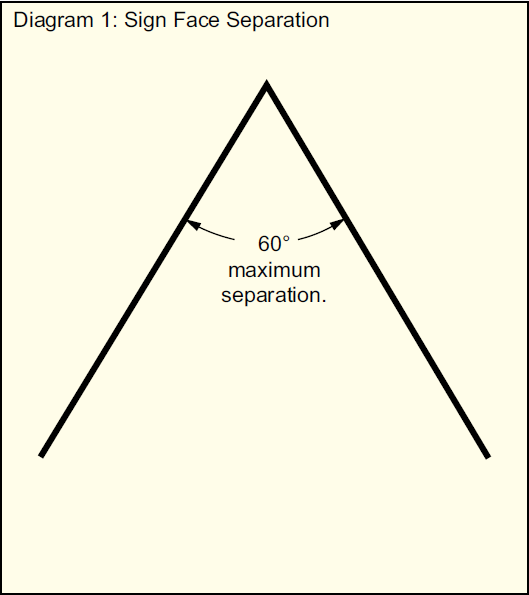 | 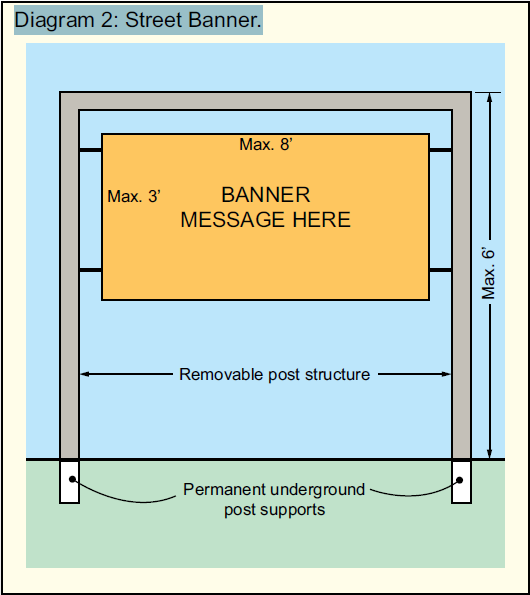 |
| Diagram 2: For reoccurring events, a semi permanent structure may be created and installed to display a banner message at the event site. Underground support post holes may be installed. A removable post structure may be installed with a banner when a Street Banner application has been approved. The sign and structure shall be removed no more than 24 hours after the event concludes. |
5.40 TC-01: Satellite Receiving Antennas Standards
These Telecommunication Facility Standards (TC) apply to the following zoning districts:
| P1 | S1 | S2 | R1 | R2 | R3 | R4 | R5 | UR | B1 | B2 | B3 | B5 | B6 | B7 | B8 | C1 | C2 | UC | MC | I1 | M3 |
- Satellite Receiving Antennas:
- Satellite receiving antennas shall be permitted within all zoning districts of the City of Carmel subject to all applicable Federal, State, local and manufactures codes and guidelines with the following regulations as well as any and all review and approval procedures within the City of Carmel Unified Development Ordinance.
- All ground-mounted satellite receiving antennas shall be located only within the rear yard of any residential and commercial principal structure as defined by the City of Carmel Unified Development Ordinance.
- Satellite receiving antennas shall not be allowed on the roof of any principal or accessory structure.
- Only one (1) satellite receiving antenna shall be located on any one (1) lot.
- Maximum Height: A satellite receiving antenna and support structure shall be limited to a maximum height of fifteen (15) feet.
- A satellite receiving antenna having printed matter on its surface shall be regulated as a sign.
- An Improvement Location Permit shall be required prior to the erection of a satellite receiving antenna greater than twenty-four (24) inches in diameter.
- All cables, wires and connectors from a satellite receiving antenna to other equipment shall be buried underground.
- A satellite receiving antenna shall not be located within five (5) feet of any property line, easement or public right-of-way.
- All satellite receiving antennas shall be obscured from the view of adjacent property owners of public rights- of-way by buildings, screen wall, fence, berm, evergreen planting or any combination thereof. Such screening devices shall be at least eighty percent (80%) obscuring when viewed from adjacent property or public street right-of-way, as approved by the Department of Community Services, Plan Commission and/or Board of Zoning Appeals when applicable.
- All satellite receiving antennas shall be neutral or black in color and, to the extent possible, shall be compatible with the appearance and character of the neighborhood.
5.41 TU-01: Temporary Construction Facility Standards
This Temporary Use and Structure Standards (TU) section applies to the following zoning districts:
| P1 | S1 | S2 | R1 | R2 | R3 | R4 | R5 | UR | B1 | B2 | B3 | B5 | B6 | B7 | B8 | C1 | C2 | UC | MC | I1 | M3 |
- Temporary Construction Facilities:
- Temporary Construction Facilities, which shall include temporary construction offices, temporary storage units, and temporary sales facilities shall only be permitted according to the applicable zoning district in Article 2: Zoning Districts.
- Temporary Construction Facilities require a temporary use permit however shall not be assessed the temporary use permit fee.
- The duration of the temporary construction facility shall be fixed by the Director of Community Services for a term not to exceed eighteen (18) months. However, upon request and upon a site inspection, the Director of Community Services may extend such a permit for a length of time deemed appropriate not to exceed eighteen (18) months per extension.
- Temporary Construction Facilities shall be removed and permits shall expire within thirty (30) days of the issuance of a Certificate of Occupancy for the related construction project.
- Temporary Construction Facilities utilized as a temporary sales facility shall be fixed by the Director of Community Services for a term not to exceed four (4) months or upon the issuance of a Certificate of Occupancy for a model home, whichever is less.
- Temporary Construction Facilities applications intended to be utilized as a temporary sales facility shall be submitted concurrently with a model home or temporary sales center application as regulated under Section 5.42: Model Homes Standards.
- Signs for Temporary Construction Facilities shall be prohibited except as provided by Section5.39: Sign Standards.
- The Director of Community Services shall ensure prior to issuing a Temporary Construction Facility permit, that:
- If the temporary facility serves multiple properties, that the lot of which the facility is located is not visually prominent from a primary project entryway;
- Adequate access and off-street parking will be provided;
- The placement of the temporary facility on the site shall not obstruct any Vision Clearance;
- The applicant has supplied the mobile unit certification number issued from State Fire Prevention and Building Safety, Division of Code Enforcement; and
- The applicant has supplied a copy of the mobile unit structure plans.
5.42 TU-02: Model Home Standards
This Temporary Use and Structure Standards (TU) section applies to the following zoning districts:
| S1 | S2 | R1 | R2 | R3 | R4 | R5 | UR | C1 | C2 |
- Model Homes:
- Model Homes, which may include Temporary Sales Offices, may be permitted in all residential districts but only as a Temporary Use, subject to approval by the Director of Community Services based on a finding that the Temporary Use will not detrimentally affect the health, welfare, safety, or morals of the neighborhood under construction for such Temporary Use.
- The duration of a Model Home permit shall be assigned by the Director of Community Services, for a term not to exceed eighteen (18) months. However, upon request, the Director of Community Services may extend such a permit for increments of six (6) months, so long as the Temporary Use in the aggregate does not continue for more than thirty-six (36) months.
- The Director of Community Services shall ensure, before issuing a Model Home permit, that:
- Adequate access and off-street parking facilities will be provided,
- That public address systems will not be used
- That flood lights and other lighting on the subject premises will be directed only upon those premises, and
- That a Certificate of Occupancy will be issued before the Temporary Use commences.
- A Model Home is also subject to all other regulations of the applicable district.
5.43 TU-03: Outdoor Sales Standards
This Temporary Use and Structure Standards (TU) section applies to the following zoning districts:
| B1 | B2 | B3 | B5 | I1 |
- Limitations: As an Accessory Use to the Primary Use on the same lot or tract of land, a person conducting an established business in a principal building shall be permitted to temporarily display goods or merchandise.
- Standards: Outdoor sales shall conform with the following requirements:
- Outdoor Sales shall only be permitted according to the applicable zoning district in Article 2: Zoning Districts. Such uses shall be allowed only as a Temporary Use, requiring a Temporary Use Permit.
- Areas designated for Outdoor Sales shall not exceed five-percent (5%) of the area of the lot.
- Areas designated for Outdoor Sales shall not be located within nor encroach upon:
- Any minimum required setbackyard;
- Any drainage easement;
- A fire lane;
- A maneuvering aisle,
- A parking space or spaces necessary to meet the minimum parking requirements of the other use(s) of the lot or parcel.
- Outdoor Sales may be located within parking areas, provided it:
- Does not interfere with pedestrian or vehicular access or parking.
- Does not create a visibility obstruction to moving vehicles within a parking lot.
- Goods or merchandise displayed in conjunction with an Outdoor Sale shall not exceed six (6) feet in height.
- Only three (3) Outdoor Sales, Temporary Use permits shall be issued per property per year. Outdoor Sales, Temporary Use Permits shall be issued for a term of five (5) consecutive days per permit.
- Signs for Outdoor Sales shall be prohibited except as provided by Section 5.39: Sign Standards.
- Findings: The Director of Community Services may approve an application for Outdoor Sales, Temporary Use as specified in this section only upon making the following findings:
- The proposed use will not adversely affect adjacent structures and uses nor the surrounding neighborhood;
- The proposed use will not adversely affect the circulation and flow of vehicular and pedestrian traffic in the immediate area;
- The proposed use will not create a demand for additional parking which cannot be met safely and effi- ciently in existing parking areas;
- The proposed use will not otherwise constitute a nuisance or be detrimental to the public welfare of the community.
5.44 TU-04: Outdoor Special Event Standards
This Temporary Use and Structure Standards (TU) section applies to the following zoning districts:
| P1 | S1 | S2 | R1 | R2 | R3 | R4 | R5 | UR | B1 | B2 | B3 | B5 | B6 | B7 | B8 | C1 | C2 | UC | MC | I1 | M3 |
- Zoning Districts: Special Outdoor Events shall only be permitted according to the applicable zoning district in Article 2: Zoning Districts. Such uses shall be allowed only as a Temporary Use, requiring a Temporary Use Permit.
- Areas designated for Special Outdoor Events shall not be located within nor encroach upon:
- Any minimum required setbackyard;
- Any drainage easement;
- A fire lane;
- A maneuvering aisle.
- Location: Special Outdoor Events may be located within parking areas, provided:
- It does not interfere with pedestrian or vehicular access or parking.
- It does not create a visibility obstruction to moving vehicles within a parking lot.
- The site has adequate on and off-street parking for patrons of the Special Event as determined by the Director of Community Services.
- Duration: Duration of Special Events shall not exceed five (5) days per event. The Director of Community Services may provide for a five (5) day extension.
- Signs: Signs for Special Outdoor Events shall be prohibited except as provided by Section 5.39: Sign Standards.
5.45 TU-05: Seasonal Outdoor Sales Standards
This Temporary Use and Structure Standards (TU) section applies to the following zoning districts:
| B1 | B2 | B3 | B8 | I1 |
- Zoning District: Seasonal Outdoor Sales shall only be permitted according to the applicable zoning district in Article 2: Zoning Districts.
- Limitations: Seasonal Outdoor Sales shall be allowed only as a Temporary Use, requiring a Temporary Use Permit. Local non-profit organizations shall be exempt from all fees associated with this type of Temporary Use permit. All licenses, certificates and permits from all governmental agencies shall be prominently displayed on the Outdoor Sales stand.
- Special Application Requirements: Submittal of a site plan, indicating sales areas, signage and parking areas, shall be required before the issuance of any permits related to Seasonal Outdoor Sales. Signage plans are also required.
- Encroachment Limits: Areas designated for Seasonal Outdoor Sales shall not be located within nor encroach upon:
- Any minimum required setbackyard;
- Any drainage easement;
- A fire lane;
- A maneuvering aisle,
- Any right-of-way, greenway or trail;
- A parking space or spaces necessary to meet the minimum parking requirements of the other use(s) of the lot or parcel.
- Location: Seasonal Outdoor Sales may be located within parking areas, provided it:
- Does not interfere with pedestrian or vehicular access or parking.
- Does not create a visibility obstruction to moving vehicles within a parking lot.
- Height Limitation: Goods or merchandise displayed in conjunction with a Seasonal Outdoor Sale shall not exceed nine (9) feet in height.
- Permit Limitations: Only one (1) Seasonal Outdoor Sales, Temporary Use permit shall be issued per property per year. Seasonal Outdoor Sales, Temporary Use Permits shall be issued for a term of thirty (30), sixty (60), ninety (90), or 120 consecutive days per permit, depending on use. One-time extensions may be granted for all Seasonal Outdoor Sales, unless otherwise approved by the Board of Zoning Appeals. Seasonal Outdoor Sales shall not be renewed beyond the time period indicated in the Time Limits for Seasonal Outdoor Sales table. Periods of time are considered to include one (1) calendar year.
Item(s) Sold Fruit/Vegetables Plants, Flowers and Holiday Items Time Period 30 Days X X 60 Days X X* 90 Days X 120 Days X * = nonrenewable - Signs: Signs for Seasonal Outdoor Sales shall be prohibited except as provided by Section 5.39: Sign Standards.
- Architectural Design, Exterior Lighting, Landscaping and Signage: To ensure the compatibility of the proposed temporary use with adjoining areas, the Director of Community Services shall review the Architectural Design, Exterior Lighting, Landscaping and Signage (ADLS) application of any proposed Seasonal Outdoor Sale. Once approved by the Director of Community Services, the Architectural Design, Exterior Lighting, Landscaping and Signage (ADLS) shall not be materially or substantially changed or altered without the prior approval of the Director of Community Services. Plan Commission approval is required prior to the issuance of Temporary Use Permit. An applicant may continue to use an ADLS Approval to obtain subsequent Temporary Use Permits provided that the proposed Temporary Use is consistent with such ADLS Approval, including time limits.
5.46 TU-06: Firework Sales Standards
This Temporary Use and Structure Standards (TU) section applies to the following zoning districts:
| R5 | B1 | B2 | B3 | B5 | B6 | B7 | B8 | C1 | C2 | UC | MC | I1 | M3 |
- Limitations:
- General Retail: The temporary sale of legal fireworks shall only be permitted in the zoning districts permitting General Retail, according to the applicable zoning district in Article 2: Zoning Districts. Such uses shall only be permitted as a Temporary Use, requiring a Temporary Use Permit.
- Building and Fire Code: Legal fireworks shall only be sold from permanent structures meeting the conditions of the 2003 Indiana Building Code (sec 307.5) and 2003 Indiana Fire Code (sec 202).
- Per Property: Only one (1) Sale of Fireworks, Temporary Use Permit shall be issued per property per year. Sale of Fireworks, Temporary Use Permits shall be issued for a term not to exceed thirty (30) consecutive days.
- Signs: Signs for Sale of Fireworks shall be prohibited except as provided by Section 5.39: Sign Standards.
- Special Application Requirements: Sale of Fireworks, Temporary Use Permits applications shall include:
- Three (3) copies of permit from Indiana State Fire Marshall;
- Three (3) copies of Proof of Insurance;
- Three (3) site plans illustrating the following:
- Location of all structures;
- Public right-of-ways and easements;
- Parking spaces, parking lot circulation;
- Location of proposed temporary signage.
- Three (3) structure plans illustrating the following:
- Location of the fireworks;
- Location of sprinklers and exits.
5.47 US-01: Cemetery Use-Specific Standards
This Use-Specific Standards (US) section applies to the following zoning districts:
| P1 | S1 | S2 | R1 | R2 | R3 | R4 | B1 | B2 | B3 | B5 |
- Minimum Lot Area Requirements: A cemetery use shall have a minimum of thirty (30) acres of lot area.
5.48 US-02: Commercial Greenhouse Use-Specific Standards
This Use-Specific Standards (US) section applies to the following zoning districts:
| S1 | S2 | B6 | I1 | M3 |
- Minimum Lot Area Requirements: A commercial greenhouse use shall have a minimum of ten (10) acres of lot area.
5.49 US-03: Day Nursery and Day Care Use-Specific Standards
This Use-Specific Standards (US) section applies to the following zoning districts:
| B2 | B3 | B6 | B7 | B8 |
- Minimum Lot Area Requirements: A day nursery or day care use shall have a minimum of one (1) acre of lot area.
5.50 US-04: Kindergarten or Preschool Use-Specific Standards
This Use-Specific Standards (US) section applies to the following zoning districts:
| S1 | S2 | R1 | R2 | R3 | R4 | B1 | B2 | B3 | B5 | B7 |
- Minimum Lot Area Requirements: A kindergarten or preschool use shall have a minimum of one (1) acre of lot area.
5.51 US-05: Plant Nursery Use-Specific Standards
This Use-Specific Standards (US) section applies to the following zoning districts:
| S1 | S2 | B1 | B2 | B3 | B6 |
- Minimum Lot Area Requirements: A plant nursery use shall have a minimum of ten (10) acres of lot area.
5.52 US-06: Mobile Home Park Use-Specific Standards
This Use-Specific Standards (US) section applies to the following zoning districts:
| R4 |
- Minimum Lot Area Requirements: A mobile home park use shall have a minimum of fifteen (15) acres of lot area.
5.53 US-07: Commercial Use-Specific Standards
This Use-Specific Standards (US) section applies to the following zoning districts:
| R5 |
- Uses Applicable: The following uses shall be regulated by Section 5.53(B): Minimum Lot Area Requirements:
General Office, General Retail and Professional Office. - Minimum Lot Area Requirements: The total gross area of a commercial use in the R5 District shall not exceed fifty percent (50%) of the R5 District tract, which shall have a minimum gross area of thirty (30) acres.
5.54 US-08: Sanitary Landfill, Junk Yard or Salvage Yard Use-Specific Standards
5.55 US-09: Outdoor Theater Use-Specific Standards
This Use-Specific Standards (US) section applies to the following zoning districts:
| B2 | C1 | I1 |
- Minimum Lot Area Requirements: An outdoor theater use shall have a minimum of five (5) acres of lot area.
5.56 US-10: Stadium or Coliseum Use-Specific Standards
This Use-Specific Standards (US) section applies to the following zoning districts:
| B6 | I1 |
- Minimum Lot Area Requirements: A stadium or coliseum use shall have a minimum of five (5) acres of lot area.
5.57 US-11: General Retail Use-Specific Standards
This Use-Specific Standards (US) section applies to the following zoning districts:
| M3 |
- Limitations of Use: A general retail use shall be limited to twenty percent (20%) of the total gross area of the M3 District.
5.58 US-12: Residential Use-Specific Standards
This Use-Specific Standards (US) section applies to the following zoning districts:
| M3 |
- Limitations of Use: Residential uses shall be limited to twenty percent (20%) of the total gross area of the M3 District and limited to a density of ten (10) dwelling units per acre.
5.59 US-13: General Retail (Ground Floor Only) Use-Specific Standards
This Use-Specific Standards (US) section applies to the following zoning districts:
| UC | MC |
- Limitations of Use: General retail (ground floor only) uses shall be limited to the ground floor of a multiple-floor principal building (i.e. shall not be a permitted use in a single story buildings).
- Non-permitted Uses: The following general retail (ground floor only) uses shall not be permitted:
- Roadside sales stand.
- Sexually oriented business.
5.60 US-14: General Service (Ground Floor Only) Use-Specific Standards
This Use-Specific Standards (US) section applies to the following zoning districts:
| UC | MC |
- Limitations of Use: General service (ground floor only) uses shall be limited to the ground floor of a multiple-floor principal building (i.e. shall not be a permitted use in a single story buildings).
- Non-permitted Uses: The following general service (ground floor only) uses shall not be permitted:
- Dry cleaning with on-site plant.
- Commercial kennel.
- Sexually oriented business.
5.61 US-15: Borrow Pit and Top Soil Removal and Storage Use-Specific Standards
This Use-Specific Standards (US) section applies to the following zoning districts:
| S1 | S2 | R1 | R2 | R3 | R4 | R5 | B1 | B2 | B3 | B5 | B8 |
- Borrow Pit and Top Soil Removal and Storage: Borrow pit and top soil removal and storage use shall have a minimum perimeter, Natural Open Space Buffer of 300 feet when adjoining or abutting any residential use or district.
5.62 US-16: Mineral, Sand and Gravel Extraction Operation Use-Specific Standards
This Use-Specific Standards (US) section applies to the following zoning districts:
| S1 | S2 | R1 | R2 | R3 | R4 | R5 | B1 | B2 | B3 | B5 | B8 |
- Mineral, Sand and Gravel Extraction Operation: Mineral, Sand and Gravel Extraction Operation use shall have a minimum perimeter, Natural Open Space Buffer of 300 feet when adjoining or abutting any residential use or district.
5.63 US-17: Carnival, Fair and Circus Use-Specific Standards
These Use-Specific Standards (US) apply to the following districts:
| B1 |
- Not to exceed fifteen (15) days per calendar year.
5.64 US-18: Roadside Sales Use-Specific Standards
These Use-Specific Standards (US) apply to the following districts:
| B1 | B2 | B3 | B6 |
- Shall not exceed six (6) months per calendar year.
5.65 US-19: Automobile Service Station; Automobile Filling Station Use-Specific Standards
These Use-Specific Standards (US) apply to the following districts:
| B1 | B2 | B3 | B6 | B8 | I1 |
- Setback:
- Principal Building: Per primary zoning district.
- Pumps and Pump Islands: Minimum of five hundred (500) feet from residentially zoned or used property. May not be located within required yards.
- Vent pipes for underground storage tanks: Minimum of five (500) hundred feet from residentially zoned or used property. May not be located within required yards.
- Lighting:
- Light standards may be located within the required Front Yard.
- Light standards shall be located a minimum of thirty (30) feet from residentially zoned or used property.
- Intensity: Lighting shall not cause illumination beyond any residential Lot Line or road right-of-way line in excess of 0.1 Foot-candle of light. Lighting shall not cause illumination beyond any non-residential tract or parcel line or road right-of-way line in excess of 0.3 Foot-candle of light.
- Under-canopy lighting shall use full cut-off, recessed luminaires with flat lenses to minimize glare and light trespass.
5.66 US-20: Food Standard Use-Specific Standards
These Use-Specific Standards (US) apply to the following districts:
| P1 | UR | B1 | B2 | B3 | B5 | B6 | B7 | B8 | C1 | C2 | I1 | M3 |
- Food Stands shall only be permitted according to the applicable zoning district in Article 2: Zoning Districts. Such uses shall only be allowed as a Temporary Use, requiring a Temporary Use Permit. All licenses, certificates and permits from all government agencies shall be prominently displayed on the Food Stand. Non-incorporated children’s stands, such as a lemonade stand, shall be exempt from Temporary Use permits.
- Submittal of a site plan, indicating sales areas, shall be required before the issuance of any permits related to Food Stands. Signage plans are also required. Areas designated for Food Stands shall not be located within nor encroach upon:
- Any drainage easement;
- A fire lane;
- A maneuvering aisle,
- Any right-of-way, greenway or trail;
- A parking space or spaces necessary to meet the minimum parking requirements of the other use(s) of the lot or parcel.
- Food Stands may be located within parking areas, provided it:
- Does not interfere with pedestrian or vehicular access or parking.
- Does not create a visibility obstruction to moving vehicles within a parking lot.
- Food Stands shall be removed from the premises when not in operation.
- The height of the Food Stand, including all accessory equipment and signage, shall not exceed ten (10) feet.
- Signage in conjunction with a Food Stand shall be permitted signage per Section 5.39 (P): Temporary Sign; Signage for Temporary Uses and attached to the Food Stand.
- Food Stand vendors shall be prohibited from using or maintaining sound amplifying equipment, lights or noisemak- ers, such as bells, horns or whistles.
- Customer seating areas associated with Food Stands shall be prohibited.
- Temporary Use Permits for Food Stand may be issued for up to one (1) year.
- All Food Stand requirements listed herein are in addition to health and safety codes administered by the State or County Health Departments.
5.67 US-21: Manufactured Home Park Use-Specific Standards
These Use-Specific Standards (US) apply to the following zoning district:
| R4 |
- All inhabited Mobile Homes/Manufactured Homes shall be located in a Mobile Home Park/Manufactured Home Park that has received Special Use approval. No inhabited Mobile Home Manufactured Home, outside an approved Mobile Home Park Manufactured Home Park, shall be connected to utilities except those Mobile Homes Manufactured Homes being offered for sale. Mobile Homes Manufactured Homes used for all other purposes shall be placed in accordance with the regulation of the Unified Development Ordinance.
- Each lot provided for the occupancy of a single mobile home unit shall have an area of not less than 5,000 square feet and a width of not less than fifty (50) feet, and each mobile home park shall provide a total gross court area of not less than five (5) acres. The maximum gross density of the court shall be ten (10) units per gross acre.
- Each mobile home site shall abut or face a clear unoccupied space, driveway, public or private roadway, or street of not less than twenty (20) feet in width, which shall have unobstructed access to a public highway or street.
- Space between mobile homes may be used for the parking of motor vehicles if the space is clearly designated. Each mobile home unit shall have two (2) parking spaces.
- The mobile home park shall be surrounded by a fifty-foot (50’) wide landscaped strip.
- A planting screen six (6) feet high is required where a mobile home park abuts a residential district.
- The mobile home park shall provide a water distribution system and a sanitary collection system with connection to a public sanitary system.
- Adequate storm water drainage by surface and subsurface means shall be provided.
5.68 US-22: Sexually Oriented Business Use-Specific Standards
These Use-Specific Standards (US) apply to the following district:
| I1 |
- Commitments by Owner: In the case of an sexually oriented business application which Seeks approval for the erection of a new building, the Board of Zoning Appeals shall, before approving such Special Use, require the applicant to make written Commitments that:
- The building will be designed and erected in such manner that it can reasonably accommodate up to three (3) additional sexually oriented business within the same building;
- The owner of the building will offer commercially reasonable lease terms to any other sexually oriented business owner that Seeks to collocate its business in the building, so as to accomplish the purpose of mini- mizing the number of such buildings that shall be erected in the City of Carmel community, and will agree to submit any disputes regarding the commercial reasonableness of such terms to binding arbitration;
- The owner of the building will notify the Director of Community Services within thirty (30) days after any oral or written communication from another sexually oriented business owner inquiring about collocation within the building, providing the Director of Community Services with the name and address of the owner making the inquiry; and
- The owner of the building will notify the Director of Community Services within thirty (30) days after any sexually oriented business located in the building goes out of business or is abandoned, and will agree to remove from the building all supplies and equipment that were used by such sexually oriented business, and to remove from the site all associated facilities. The commitment shall require that such removal be completed within sixty (60) days of the cessation of sexually oriented business operations at the site, and shall authorize the Director of Community Services, in the event that supplies, equipment, and facilities are not removed within the required sixty-day period, to enter upon the premises and remove the supplies, equipment, and facilities, with the costs of such removal to be assessed against the owner of the parcel.
- Commitment: A Commitment made under Subparagraph (2) above shall be recorded pursuant to state statute and may be enforced by the Board of Zoning Appeals, by the Director of Community Services, or by any sexually oriented business owner that desires to collocate its business in the building subject to the Commitment.
- Loss of Approval: If, after thirty (30) days notice from the Board of Zoning Appeals, a person subject to a binding Commitment refuses to honor or abide by such Commitment, the Special Use approval shall be revoked by the Board of Zoning Appeals.
5.69 US-23: Private Recreational Facility Use-Specific Standards
These Use-Specific Standards (US) apply to the following district:
| S1 | S2 | R1 | R2 | R3 | R4 | R5 | UR | B1 | B2 | B3 | B5 | B8 |
- Commercial Swimming Pool:
- Minimum Area: 2,000 square feet.
5.70 US-24: Ground Floor Residential Use-Specific Standards
This Use-Specific Standards (US) section applies to the following zoning districts:
| UC |
- Purpose: Ground floor multiple family and single family residential shall only be permitted as a short-term use, allowing the owner the opportunity to generate revenue until demand for commercial space strengthens.
- Permitted: The ground floor space may fully or partially be used for multiple family and/or single family residen- tial use as a Special Use, subject to any conditions per the Board of Zoning Appeals Rules of Procedure.
- Time Limitation: Ground floor multiple family residential and single family residential shall only be permitted for up to five (5) years.
- Documentation and Written Commitment: A signed affidavit or letter of understanding stating the following shall be submitted by the property owner prior to approval as a Special Use.
- Time: That the ground floor of the subject property shall only be used for residential purposes for the time frame approved by the Board of Zoning Appeals.
- Restoration: That the space will be abandoned as residential use by the end of the approved time frame at the expense of the owner.
- Binding: That the commitment to revert the space to commercial use shall be binding on all assignees or successors.
- Ground Floor Facade Design: When the ground floor space is used for residential use, the ground floor facades shall fully maintain commercial character.
5.71 US-25: Retail and Commercial Use-Specific Standards
This Use-Specific Standards (US) section applies to the following zoning districts:
| UR |
- Uses Applicable: The following uses listed as permitted uses in the UR District shall be regulated by Section 5.71(B): Floor Limitations.
- General Office*
- General Retail*
- General Service*
- Professional Office*
- Floor Limitations:
- Buildings Two Stories or Less: The above listed permitted uses shall only be permitted on the first floor in buildings with two (2) stories or less.
- Buildings Three Stories or Greater: The above listed permitted uses shall only be permitted on the first and second floor in buildings with three (3) stories or more.
- Square Feet Limitation: Under no circumstance shall residential permitted uses be less than sixty percent (60%) of the building’s total occupiable square feet to assure the districts intent be preserved.
5.72 US-26: Group Home Use-Specific Standards
This Use-Specific Standards (US) section applies to the following zoning districts:
| S1 | S2 | R1 | R2 | R3 | R4 | R5 | UR |
- Purpose: It is the purpose of this Section to benefit the general public by minimizing adverse impacts on established residential neighborhoods in the City and the owners and residents of properties in these neighborhoods which may result from the conversion of residential properties to business or institutional uses. However, it is also the purpose of this Section to provide that the City may not refuse to make a reasonable accommodation for a Group Home whenever such an accommodation would not impose undue financial or administrative burdens on the City or require a fundamental alteration in the Comprehensive Plan.
- Special Exception Eligibility: A Dwelling located in a Residential District may be used as a Group Home only if the owner or occupant applies for and is granted a Special Exception, pursuant to Section 9.08: Special Exception (Group Homes and Short Term Residential Rentals) hereof.
- Required Information for Application: Both the initial application and any renewal application for a Special Exception or Improvement Location Permit for a Group Home shall contain primary and secondary emergency contact information, including mailing address, phone number or email address. Upon approval of a Special Exception, emergency contact information shall be shared with the Carmel Police Department. Group Homes housing persons with developmental disabilities shall obtain, comply with, and maintain a license or certification from the Indiana Division of Disability and Rehabilitative Services which shall be included in its initial application. Group Homes housing those living with psychiatric disorders or addictions shall obtain, comply with, and maintain a license or certification from the Indiana Division of Mental Health and Addiction, which shall be included in its initial application.
- Limitations:
- No Group Home in an S1, S2, R1, R2, R3, R4, R5 or UR district shall provide housing for more than eight (8) unrelated persons.
- The term of a Special Exception permit granted to a Group Home shall be for five (5), ten (10), or fifteen (15) years, at the discretion of the Board of Zoning Appeals. The grant of a Special Exception permit provides an exception only to the other requirements of the Unified Development Ordinance. It does not confer a right to lease, sublease, or otherwise use a Dwelling as a Group Home where such use is not otherwise allowed by law, a homeowners association agreement or requirements, any applicable covenant, condition, and restriction, a rental agreement, or any other restriction, requirement, or enforceable agreement.
- Nothing in this Section shall relieve any person of the obligations imposed by any and all applicable provisions of Federal and State laws and the Carmel City Code, including but not limited to those obligations imposed by Indiana tax laws and rules. Further, nothing in this Section shall be construed to limit any remedies available under any and all applicable provisions of Federal or State law and the Carmel City Code.
- Reasonable Accommodation: After formal acceptance of an application for a Special Exception for a Group Home, the Director of Community Services shall review the application for the purpose of determining whether it would be a reasonable accommodation for the City to grant the Special Exception in order to provide the residents who would be provided services at the Group Home with access to housing that is equal to that of residents who are not in need of such services. In addition to the items listed in Section 9.08(C): Basis of Review hereof, the Director of Community Services shall consider the following:
- Proximity of other Group Homes to the proposed site;
- The number of unrelated persons who will be living in the Group Home, and whether any professional support staff will also be residing there;
- In addition to any residents’ cars, if more than two (2) staff cars will be parked at the Group Home, and whether they will be marked;
- If the Dwelling, existing, modified or new, is similar in design, materials and landscaping as other adjacent and nearby Dwellings;
- Any other exterior indication that the Dwelling will be inhabited by Group Home residents;
- Any undue financial or administrative burdens that would be imposed on the City; and
- If a fundamental alteration in the Comprehensive Plan would be required.
Based upon this review, the Director of Community Services may support or oppose the granting of the Special Exception.
5.73 US-27: Short-Term Rental Use-Specific Standards
This Use-Specific Standards (US) section applies to the following zoning districts:
| S1 | S2 | R1 | R2 | R3 | R4 | R5 | UR |
- Purpose: It is the purpose of this Section to benefit the general public by minimizing adverse impacts on established residential neighborhoods in the City and the owners and residents of properties in these neighborhoods resulting from the conversion of residential properties to tourist and transient use.
- Special Exception Eligibility: A Permanent Resident of a Dwelling located in a Residential District may use the Dwelling as a Short Term Residential Rental Unit if:
- The Permanent Resident applies for and is granted a Special Exception, pursuant to Section 9.08: Special Exception (Group Homes and Short Term Residential Rentals) hereof.
- The Permanent Resident maintains a valid Registered Retail Merchant Certificate;
- The Permanent Resident posts a clearly printed sign inside his or her Dwelling on the inside of the front door that provides information regarding the location of any fire extinguishers in the unit and building, gas shut off valves, fire exits, or pull fire alarms;
- Required Information for Application: Both the initial application and any renewal application for a Special Exception permit shall contain the following:
- Information sufficient to show that the applicant is the Permanent Resident of the Short Term Residential Rental Unit, and that the applicant has a Registered Retail Merchant Certificate. Permanent residency shall be established by showing that the Unit is listed as the applicant's residence on at least two (2) of the following: motor vehicle registration; driver's license; voter registration; tax documents showing the unit as the applicant’s primary residence for a standard homestead credit; or utility bill. A renewal application shall contain sufficient information to show that the applicant is a Permanent Resident and has occupied the unit for at least two hundred seventy-five (275) days of the preceding calendar year.
- Primary and secondary emergency contact information, including mailing address, phone number or email address. Upon approval of a Special Exception, emergency contact information shall be shared with the Carmel Police Department.
- Limitations: The term of a Special Exception permit granted to a Permanent Resident shall be one (1) year. The grant of a Special Exception permit provides an exception only to the other requirements of this Ordinance. It does not confer a right to lease, sublease, or otherwise use a Dwelling as a Short Term Residential Rental Unit where such use is not otherwise allowed by law, a homeowners association agreement or requirements, any applicable covenant, condition, and restriction, a rental agreement, or any other restriction, requirement, or enforceable agreement. Nothing in this Section shall relieve any person or facilitator of the obligations imposed by any and all applicable provisions of state law and the Carmel City Code, including but not limited to those obligations imposed by Indiana tax laws and rules. Further, nothing in this Section shall be construed to limit any remedies available under any and all applicable provisions of state law and the Carmel City Code.
- Suspension of Section: The Mayor may, subject to approval by resolution of the Council, suspend operation of this Section for not more than thirty (30) days per calendar year, during periods of time when major sporting activities or other special events, including, but not limited to the Indianapolis 500, PGA Tournament, NCAA Tournament, or a large convention, are scheduled in the Central Indiana community. During these periods, a Permanent Resident may use his or her Dwelling as a Short Term Residential Rental Unit without obtaining a Special Exception permit.
5.74 US-28: Non-Dwelling Short-Term Rental Use-Specific Standards
This Use-Specific Standards (US) section applies to the following zoning districts:
| S1 | S2 | R1 | R2 | R3 | R4 | R5 | UR |
- Purpose: It is the purpose of this Section to benefit the general public by minimizing adverse impacts on established residential neighborhoods in the City and the owners and residents of properties in these neighborhoods resulting from the conversion of residential properties or portions thereof to tourist, entertainment, transient and/or temporary uses.
- Special Exception Eligibility: A Permanent Resident of a Dwelling located in a Residential District may use a portion of the real estate where such Dwelling is located as a Non-Dwelling Short-Term Rental if:
- The Permanent Resident applies for and is granted a Special Exception, pursuant to Section 9:08: Special Exception (Group Homes and Short-Term Residential Rentals) hereof.
- The Permanent Resident maintains a valid Registered Retail Merchant Certificate;
- The Permanent Resident posts a clearly printed sign in the clearly-visible location within the rented space that provides information regarding the location of lifesaving equipment, fire extinguishers, gas shut off valves if gas-operated equipment is present, evacuation exits, and emergency contact information.
- Required Information for Application: Both the initial application and any renewal application for a Special Exception permit shall contain the following:
- Information sufficient to show that the applicant is the Permanent Resident of the real estate where Non-Dwelling Short-Term Rental is located, and that the applicant has a Registered Retail Merchant Certificate. Permanent residency shall be established by showing that the Unit is listed as the applicant’s residence on at least two (2) of the following: motor vehicle registration; driver’s license; voter registration; tax documents showing the unit as the applicant’s primary residence for a standard homestead credit; or utility bill. A renewal application shall contain sufficient information to show that the applicant is a Permanent Resident and has occupied the real estate for at least 275 days of the preceding calendar year.
- Primary and secondary emergency contact information, including mailing address, phone number or email address. Upon approval of a Special Exception, emergency contact information shall be shared with the Carmel Police Department.
- Any other information as may be required by the Director to evaluate the application.
- Limitations:
The term of a Special Exception permit granted to a Permanent Resident shall be one (1) year. The grant of a Special Exception permit provides an exception only to the other requirements of this Ordinance. It does not confer a right to lease, sublease, or otherwise use a residential property or portions thereof as a Non-Dwelling Short-Term Rental where such use is not otherwise allowed by law, a homeowners association agreement or requirements, any applicable covenant, condition, and restriction, a rental agreement, or any other restriction, requirement, or enforceable agreement. Nothing in this Section shall relieve any person or facilitator of the oblications imposed by any and all applicable provisions of state law and the Carmel City Code, including but not limited to those obligations imposed by Indiana tax laws and rules. Further, nothing in this Section shall be construed to limit any remedies available under any and all applicable provisions of state law and the Carmel City Code.
- If, after obtaining a permit, the real estate is subject to two (2) notices of violations or citations for violation of any provision of this Section, the Carmel City Code or state law that is attributable to the use of the real estate as a Non-Dwelling Short-Term Rental, the permit shall be revoked. Director of Community Services shall notify the Permanent Resident of the permit revocation via first class mail and/or posting such notice at the real estate.
- In addition to all of the Limitations of Subsection 5.74(D)(1) above, Non-Dwelling Short-Term Rental shall have the following use-specific limitations:
- Pools:
- Permanent Resident must be at the property at all times during a Non-Dwelling Short-Term Rental operation.
- Permanent Resident must obtain premises liability insurance in the amount not less than $1,000.000.00 per occurrence. The insurance must be renewed annually. The certificate of such insurance shall be delivered to the Department of Community Services prior to listing the real estate as a Non-Dwelling Short-Term Rental. Proof of annual insurance renewal shall be delivered to the Department of Community Services.
- Operation hours shall be between 10 A.M and 8 P.M.
- A group size for a single Non-Dwelling Short-Term Rental shall not exceed ten (10) individuals. At least one of these individuals shall be at lease twenty-one (21) years of age.
- Number of Non-Dwelling Short-Term Rentals shall not exceed one (1) day per calendar month. The rental shall not exceed five (5) hours.
- Permanent Resident must provide sufficient guest parking that must be contained within the real estate.
- Permanent Resident must comply with any applicable state laws, rules and regulations relating to pool operation.
- Permanent Resident shall ensure that renters do not trespass on the neighbors’ properties.
- Yards and other facilities (includes decks, patios, accessory structures etc.):
- Permanent Resident must be at the property at all times during a Non-Dwelling Short-Term Rental operation.
- Permanent Resident must obtain premises liability insurance in the amount not less than $1,000.000.00 per occurrence. The insurance must be renewed annually. The certificate of such insurance shall be delivered to the Department of Community Services prior to listing the real estate as a Non-Dwelling Short-Term Rental. Proof of annual insurance renewal shall be delivered to the Department of Community Services.
- Operation hours shall be between 10 A.M and 8 P.M.
- A group size for a single Non-Dwelling Short-Term Rental shall not exceed ten (10) individuals. At least one of these individuals shall be at least twenty-one (21) years of age.
- Number of Non-Dwelling Short-Term Rentals shall not exceed one (1) day per calendar month. The rental shall not exceed five (5) hours.
- Permanent Resident must provide sufficient guest parking that must be contained within the real estate.
- Pools:
5.75 UT-01: Utility Services Standards
These Utility Services Standards (UT) apply to the following districts:
| P1 | S1 | S2 | R1 | R2 | R3 | R4 | R5 | UR | B1 | B2 | B3 | B5 | B6 | B7 | B8 | C1 | C2 | UC | MC | I1 | M3 |
- Required Community Facilities: When community facilities (community water, community sanitary sewer, and/or storm sewer) are required in a particular zoning district and one or all of the public systems are unable to support an additional load, the Plan Commission may grant approval for use of an alternative method of providing the service or services with the provision that public facilities will be utilized when they become available.
5.76 VC-01: Vision Clearance Standards
These Vision Clearance Standards (VC) apply to the following districts:
| P1 | S1 | S2 | R1 | R2 | R3 | R4 | R5 | B1 | B2 | B3 | B5 | B6 | B7 | B8 | MC | I1 | M3 |
- Corner Lots: A triangular space at the street corner of a Corner Lot, free from any kind of obstruction to vision between the heights of three (3) and eight (8) feet above the established street grade. The street grade is measured at the intersection of the centerlines of the intersecting street pavement, and the triangular space is determined by a diagonal line connecting two (2) points measured fifteen (15) feet equidistant from the Lot corner along each property line at intersections of two (2) local streets or twenty-five (25) feet at the intersection of any other types of Streets.
- Vision Clearance Triangle: A vision clearance triangle shall be maintained at every intersection of two (2) or more streets, intersection of a street and alley, intersection with a street and entrance, and intersection of a street and driveway.
- Horizontal Area:
- Streets: The vision clearance triangle leg lengths shall be measured from the intersection of right-of-way lines (See “A” in the illustration below). If the right-of-way line curves, then each right-of-way line shall be extended to form a corner point to measure from. The distances for each leg of the vision clearance triangle shall be as follows:
- Speed Limit 30 MPH or Less: A triangle leg that parallels a street with a speed limit of 30 MPH or less shall be fifteen (15) feet.
- Speed Limit 35 MPH to 40 MPH: A triangle leg that parallels a street with a speed limit of 35 MPH to 40 MPH shall be twenty-five (25) feet.
- Speed Limit 45 MPH or Greater: A triangle leg that parallels a street with a speed limit of 45 MPH or greater shall be thirty-five (35) feet.
- Alleys, Entrances and Driveways: The vision clearance triangle leg lengths shall be ten (10) feet as measured from the right-of-way line and the intersection of a driveway, entrance, or alley (See “B” in the illustration below). The edge of pavement shall be used for driveways, entrances and alleys.
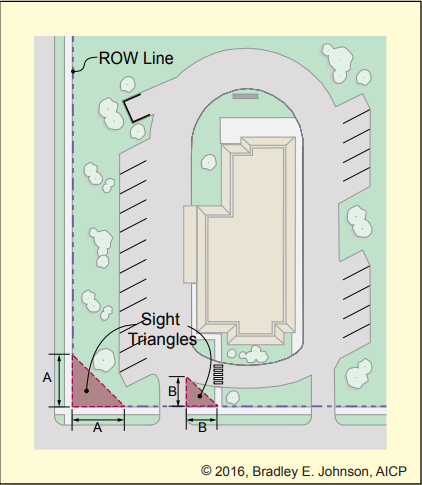
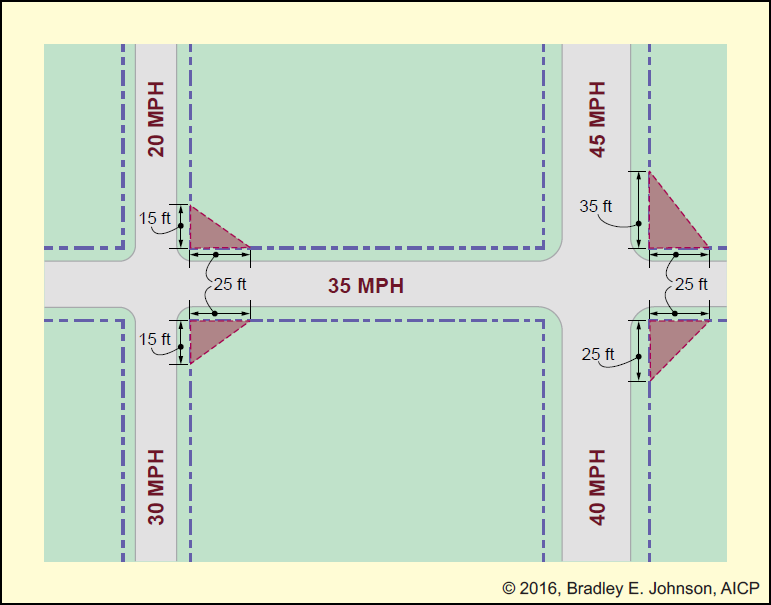
- Vertical Area: No primary or accessory buildings, landscaping, fences, walls, or signs shall be permitted to be placed in or to project into the vision clearance triangle between the heights of two (2) feet and nine (9) feet above the established street grade. The street grade is measured at the intersection of the centerlines of the street and the intersecting street, alley, entrance or driveway.
- Exemptions: Public street signs, utility boxes, utility markers, and utility poles shall be exempt from the vision clearance standards if all reasonable opportunities to keep the vision clearance triangle free from obstructions is not reasonably possible or considered unsafe for motorists or pedestrians.
- Streets: The vision clearance triangle leg lengths shall be measured from the intersection of right-of-way lines (See “A” in the illustration below). If the right-of-way line curves, then each right-of-way line shall be extended to form a corner point to measure from. The distances for each leg of the vision clearance triangle shall be as follows:
- Horizontal Area:
5.77 WS-01: Weed and Solid Waste Standards
These Weed and Solid Waste Standards (WS) apply to the following districts:
| P1 | S1 | S2 | R1 | R2 | R3 | R4 | R5 | UR | B1 | B2 | B3 | B5 | B6 | B7 | B8 | C1 | C2 | UC | MC | I1 | M3 |
- All developed or improved property in the Business, Industrial and Manufacturing Districts, and all developed or improved residential lots, shall be maintained so as to be free of weeds and other unsightly growth of plant materials.
- Trash, garbage and solid wastes shall not be stored outside of any building, covered receptacle or approved dumpster enclosure, if applicable, for a period of longer than seven (7) days, except when construction is in progress.
5.78 WP-01: Wellhead Protection Standards
These Wellhead Protection Standards (WP) apply to the following districts:
| P1 | S1 | S2 | R1 | R2 | R3 | R4 | R5 | UR | B1 | B2 | B3 | B5 | B6 | B7 | B8 | C1 | C2 | UC | MC | I1 | M3 |
The following standards apply to any property that partially or fully is within a one-year time of travel recharge area for a public well, whether in Carmel’s planning jurisdiction or an adjacent jurisdiction.
- Lakes and Ponds: Any on-site, man-made lake, pond, or water impoundment shall completely seal the lake, pond, or other water impoundment of any kind when it is located within the one-year time of travel for any existing public wellhead. No lakes, ponds or other water impoundment of any kind shall be allowed within the 200 foot radius of a public wellhead.
- Infiltration and Percolation: A development shall be designed to cause the least practicable disturbance to natural infiltration and percolation of precipitation to the groundwater table, through careful planning of vegetation and land disturbance activities, and the placement of streets, buildings and impervious surfaces.
5.79 WL-01: Wireless Support Structure Standards
These Wireless Support Structure Standards (WP) apply to the following district:
| I1 |
- Generally: The purpose of this Section is intended to implement the provisions of IC 8‑1‑32.3, but otherwise to comply with IC 36‑7‑4, in regard to the City’s regulation of the placement, construction, or modification of Wireless Support Structures.
- Delegation of Authority: For purposes of IC 8‑1‑32.3 and Section 332(c)(7)(B) of the Federal Telecommunications Act of 1996 as in effect on July 1, 2017, the Board of Zoning Appeals shall exercise the authority to conduct hearings, to make decisions, and to approve the issuance or denial of Improvement Location Permits (except for Collocation) under this Section. The Planning Administrator shall exercise the authority to review applications for completeness, within the meaning of IC 36‑7‑4‑1109, and to issue Improvement Location Permits or building permits under this Section.
- Review of Applications: The Planning Administrator shall promptly review for completeness every application duly filed with the City which requests authorization to place, construct, or modify personal Wireless Facilities. Every applicant shall be notified within ten (10) Business Days of the City’s receipt of an application whether its application is complete and whether a public hearing will be required regarding its request. Whenever no public hearing is required, the Planning Administrator shall take final action on the request within a reasonable period of time after the request is duly filed. Whenever a public hearing is required regarding a request, the Board of Zoning Appeals shall conduct the hearing and take final action on the request within a reasonable period of time. For purposes of Section 5.79: Wireless Support Structure Standards, any application that contains all of the following information shall be considered complete:
- A statement that the applicant is a person that either provides Wireless Communications Service or owns or otherwise makes available infrastructure required for such Service.
- The name, business address, and point of contact for the applicant.
- The location of the proposed or affected Wireless Support Structure or Wireless Facility.
- A construction plan that includes evidence of conformance with all applicable building permit requirements.
- Except for an application that requests Collocation only, evidence showing that the application complies with the applicable criteria set forth in Section 9.09: Special Use for a special use, or that the application complies with the applicable criteria for a variance of use under IC 36‑7‑4‑918.4. An application that requests Collocation only is required to comply only with Section 5.79(C)(1‑4).
- If the application requests an Improvement Location Permit for the construction of a new Wireless Support Structure, a construction plan that describes the proposed Wireless Support Structure and all equipment and network components, including Antennas, transmitters, receivers, Base Stations, power supplies, cabling, and related equipment, along with evidence supporting the choice of location for the proposed Wireless Support Structure, including a sworn statement from the individual responsible for the choice of location demonstrating that Collocation of Wireless Facilities on an existing Wireless Support Structure is not a viable option because Collocation:
- Would not result in the same Wireless Communications Service functionality, coverage, and capacity;
- Is technically infeasible; or
- Is an economic burden to the applicant.
- If the application requests an Improvement Location Permit for Substantial Modification of a Wireless Support Structure, a construction plan that describes the proposed modifications to the affected Wireless Support Structure and all equipment and network components, including Antennas, transmitters, receivers, Base Stations, power supplies, cabling, and related equipment.
- Failure to Notify: Any failure by the Planning Administrator to notify an applicant within ten (10) Business Days whether its application is complete shall be considered a non-final zoning decision within the meaning of IC 36‑7‑ 4‑1602(c), with the applicant consequently entitled to expedited judicial review of the non-final zoning decision.
- Deadlines for Final Action: For purposes of Section 5.79: Wireless Support Structure Standards a reasonable period of time shall be determined as follows:
- If the request involves an application for Collocation only, a reasonable period of time is not more than forty-five (45) days from the date that the applicant is notified by the Planning Administrator that the application is complete. An application for Collocation only is not subject to a public hearing before the Board of Zoning Appeals, but the Planning Administrator may review the application for compliance with applicable building permit requirements before issuing the applicant an Improvement Location Permit or building permit.
- If the request involves an application for an Improvement Location Permit to construct a new Wireless Support Structure or for Substantial Modification of a Wireless Support Structure, a reasonable period of time is not more than ninety (90) days from the date that the applicant is notified that the application is complete, or not more than 120 days in any case in which the approval of a variance of use is necessary. The Board of Zoning Appeals shall conduct a public hearing on the request and shall make a decision on the request at the meeting at which it is first presented. Decisions made by the Board of Zoning Appeals after a public hearing conducted in accordance with this Section are considered zoning decisions for purposes of IC 36‑7‑4 and are subject to judicial review under the IC 36‑7‑4‑1600 series.
- If an applicant has requested additional time to amend its application or requested or agreed to a contin- uance during the review or hearing process, then the period of time prescribed by Section 5.79(D)(1) and Section 5.79(D)(2) shall be extended for a corresponding amount of time. However, any failure by the Planning Administrator or the Board of Zoning Appeals to take final action on a request within a reasonable period of time shall be considered a non-final zoning decision within the meaning of IC 36‑7‑4‑1602(c), with the applicant consequently entitled to expedited judicial review of the non-final zoning decision.
- Additional Rules: Notwithstanding IC 36‑7‑4 or any rules adopted by the Board of Zoning Appeals under that provision,the following provisions apply to all applications submitted under Section 5.79: Wireless Support Structure Standards:
- In reviewing applications and conducting hearings, the Planning Administrator and the Board of Zoning Appeals shall comply with all applicable provisions of Section 332(c)(7)(B) of the Federal Telecommunications Act of 1996 as in effect on July 1, 2015, and Section 6409(a) of the Middle Class Tax Relief and Job Creation Act of 2012 as in effect on July 1, 2015.
- Neither the Planning Administrator nor the Board of Zoning Appeals may require an applicant to submit information about or evaluate an applicant’s business decisions with respect to the applicant’s designed service, customer demand, service quality, or desired signal strength to a particular location.
- All meetings of the Board of Zoning Appeals are subject to the Open Door Law (IC 5‑14‑1.5). However, neither the Administrator nor the Board of Zoning Appeals may release to the public any records that are required to be kept confidential under Federal or State law, including the trade secrets of applicants, as provided in the Access to Public Records Act (IC 5‑14‑3) and other applicable laws.
- The Planning Administrator shall allow an applicant to submit a single consolidated application to collocate multiple Wireless Facilities, or for multiple Small Cell Facilities that are located within the planning juris- diction and that comprise a single Small Cell Network. Whenever a consolidated application is approved, the Planning Administrator shall issue the applicant a single Improvement Location Permit for the multiple facilities, or for the Small Cell Network, in lieu of issuing multiple Permits for each respective Facility.
- The Board of Zoning Appeals shall not impose on an applicant a fall zone requirement for a Wireless Support Structure that is larger than the area within which the structure is designed to collapse, as set forth in the applicant’s engineering certification for the structure, unless evidence submitted by a professional engineer demonstrates that the engineering certification in the application is flawed. Section 5.79(F)(5) does not apply to any setback requirement prescribed by the Unified Development Ordinance for the land use which is not based on the height of the Wireless Support Structure.
- Neither the Board of Zoning Appeals nor the Planning Administrator may require or impose conditions on an applicant regarding the installation, location, or use of Wireless Facilities on Utility Poles or Electrical Transmission Towers.
- Neither the Planning Administrator nor the Board of Zoning Appeals may require an applicant to pay a fee associated with the submission, review, processing, or approval of the application unless the same or a similar fee also applies to applications for Permits for similar types of commercial or industrial development within the planning jurisdiction. In addition, if a fee is imposed in connection with the submission, review, processing, or hearing of an application, including a fee imposed by a third party that provides review, technical, or consulting assistance to the Planning Administrator or the Board of Zoning Appeals, the fee shall be based on actual, direct, and reasonable costs incurred for the review, processing, and hearing of the application, and shall not include:
- Travel expenses incurred by a third party in its review of an application; or
- Direct payment or reimbursement of third party fees charged on a contingency basis.
- Conditions of Approval: Notwithstanding IC 36‑7‑4 or any rules adopted by the Board of Zoning Appeals under that provision, the following conditions apply to all applications submitted under Section 5.79: Wireless Support Structure Standards:
- If a Wireless Support Structure is abandoned or remains unused for a period of six (6) months, the owner shall remove the Wireless Support Structure and all associated facilities from the site. Such removal shall be completed within twelve (12) months of the cessation of operations at the site. In the event that a Wireless Support Structure is not removed within the required twelve (12) month period, the Director of Community Services may remove the Wireless Support Structure and the associated facilities, and the costs of such removal shall be assessed against the owner of the parcel.
5.80 YS-01: General Yard Standards
These Yard Standards (YS) apply to the following districts:
| P1 | S1 | S2 | R1 | R2 | R3 | R4 | UR | B1 | B2 | B3 | B5 | B6 | B7 | B8 | I1 | M3 |
- On lots fronting on two non-intersecting streets, a front yard shall be provided on both streets (double frontage).
- Corner Lots:
- There shall be a Front Yard provided on both Streets.
- On Corner Lots that are Lots of Record, the buildable Lot Width shall not be reduced to less than twenty-eight (28) feet, except that there shall be a Side Yard of at least five (5) feet along each Side Lot Line.
- The minimum buildable Lot Width of twenty-eight (28) feet for a principal building is reduced to twenty-two (22) feet for an accessory building.
- Where a frontage is divided among districts with different front yard requirements, the deepest front yard required shall apply to the entire frontage.
- There may be two (2) or more related multiple-family, hotel, motel or institutional buildings on a lot provided that:
- The required yards be maintained around the group of buildings, and
- Buildings that are parallel or that are within forty-five degrees (45º) of being parallel be separated by a horizon- tal distance that is at least equal to the height of the highest building.
- Those parts of existing buildings that violate yard regulations may be repaired and remodeled, but any addition shall provide the required yards.
- The minimum width of side yards for schools, libraries, churches, community buildings, and other public and semi-public buildings in residential districts shall be twenty-five (25) feet, except where a side yard is adjacent to a Business, Industrial or Manufacturing District, in which case the width of that yard shall be as required in the district in which the building is located.
- Open, unenclosed porches (not under roof) or patios may extend ten (10) feet into a front yard.
- Terraces which do not extend above the level of ground (first) floor may project into a required yard, provided these projections be a distance of at least two (2) feet from the adjacent side lot line.
- No side yards are required where dwellings are erected above commercial and industrial structures, except such side yard is required for a commercial or industrial building on the side of a lot adjoining a residential district.
- Sills, belt courses, window air-conditioning units, window wells, cornices, and ornamental features may project into a required yard a distance not to exceed twenty-four (24) inches.
- Normal roof overhang, open fire escapes, fireproof outside stairways and balconies opening upon fire towers, and the ordinary projections of chimneys and flues shall be permitted to project into required yards for a distance of not more than forty-eight (48) inches when so placed as to not obstruct light and ventilation.
5.81 YS-02: Residential Yard Standards
These Yard Standards (YS) apply to the following districts:
| S1 | S2 | R1 | R2 | R3 | R4 | R5 |
- Residential Districts:
- The measurement for the required front yard of any lot accessed via a frontage place may include the frontage place.
- Where twenty-five percent (25%) or more of the lots of record in the block are occupied by buildings, the average setback of such buildings determine the dimension of the front yard in the block.
- Building lines or building setback lines established in a recorded subdivision shall establish the dimension of front yards in such subdivisions except such building setback lines shall not be less restricting than the Unified Development Ordinance.
5.82 YS-03: Non-Residential Yard Standards
These Yard Standards (YS) apply to the following districts:
| P1 | B1 | B2 | B3 | B5 | B6 | B7 | B8 | I1 | M3 |
- Business, Industrial and Manufacturing Districts:
- Alley space shall not be included for loading and unloading berths.
- Where twenty-five percent (25%) or more of the lots of record in a block are occupied by buildings, the average setback of such buildings shall determine the dimension of the front yard in the block.
- Parking is permitted in the required front yard in the Business and Industrial Districts.
5.83 ZL-01: Zero Lot Line Standards
These Zero Lot Line Standards (ZL) apply to the following districts:
| UR | C1 | C2 | UC | MC |
The following standards apply to any principal building or accessory building built on or within four (4) feet of a side property line, front property line, or rear property line.
- Foundation Landscaping Exemption: If a side facade of a principal building is approved as a common wall to which another principal building on the adjacent property will attach, then foundation landscaping shall not be required.
- Foundation or Building Projections: A principal building or accessory building’s foundation, including any window well, deck, balcony, or other building appurtenance shall not project beyond the plane of the property line.
- Easements:
- Access Easement: An access easement with the adjacent property owner shall be established such to grant access to the subject property owner for building maintenance in perpetuity.
- Drainage Easement: When necessary for the detention, conveyance or water quality, a storm water drainage easement shall be provided.
- Landscaping Easement: If foundation plantings are required for the principal building on the subject property, a landscaping easement shall be established for the landscape bed, plants, shrubs and the like, such that the subject property owner may maintain the required landscaping in perpetuity.
- Mechanical Equipment and On-Site Utilities: Mechanical equipment and utility components such as air condition- ing condensers, generators, electrical panels, electrical drops, gas meters, meter pits, telecommunication equipment, water heater cabinets, and the like shall not be located between the principal building and the property line, or project into the neighboring property.
- Utilities: Water mains, sanitary sewer mains, gas mains, storm water mains, power trunk lines, and the like, built parallel to a public right-of-way in a utility easement, or otherwise built along or through a property in a utility easement, shall not be encroached upon by a principal building or other permanent structure without the written authority to do so by the easement holder(s).
- Detention of Right-of-Way: Under no circumstance shall the detention of storm water from an adjacent right-of- way be waived.

