
Chino Hills City Zoning Code
CHAPTER 16
33 - EQUESTRIAN AND LARGE ANIMAL OVERLAY
16.33.010 - Intent and purpose.
A.
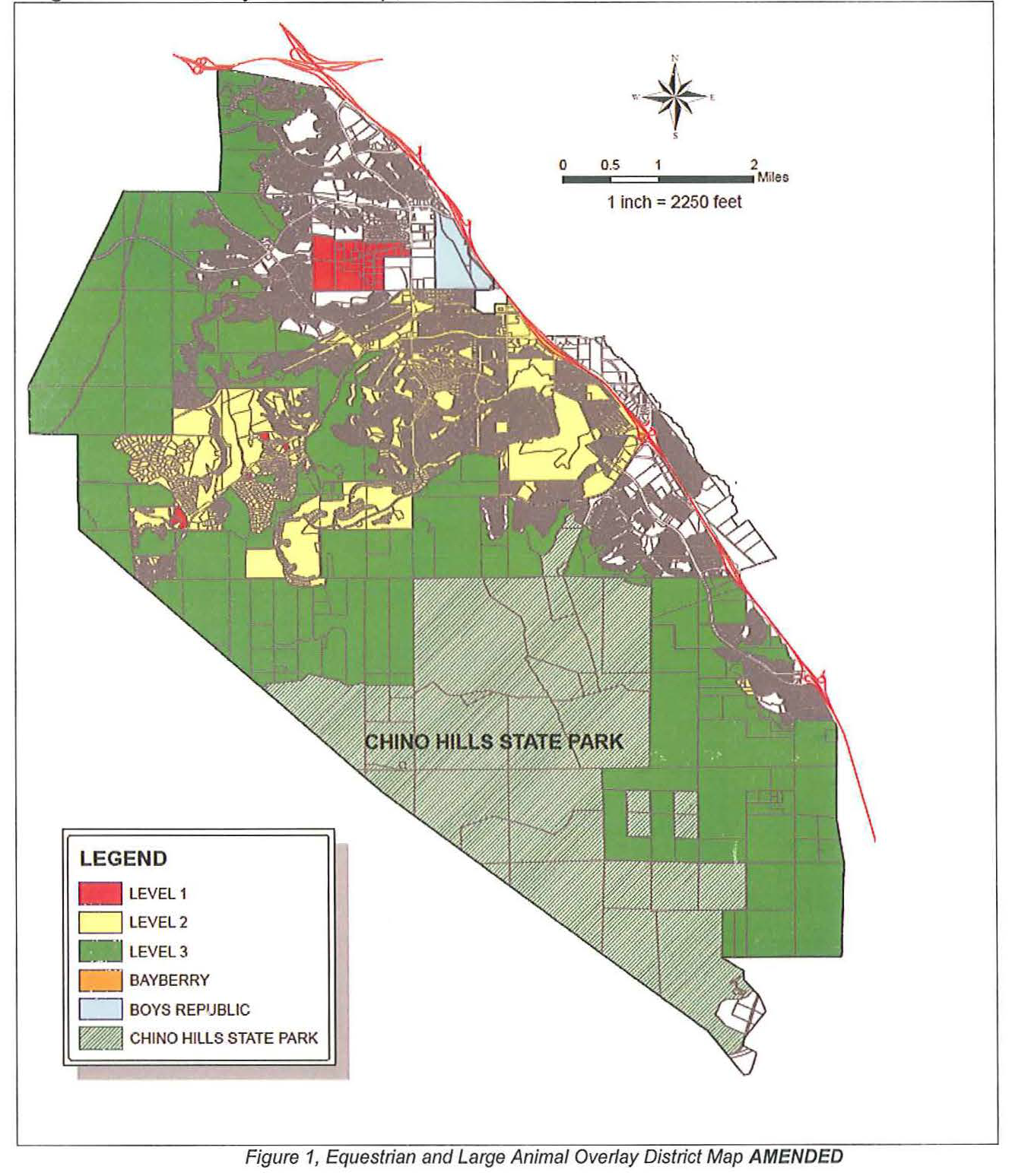
Intent and purpose. The City of Chino Hills has a rich rural heritage of equestrian uses. Chapter 16.33 is intended to preserve the City's equestrian heritage while establishing standards to ensure that the number of animals on a property, and associated uses and operations, do not create a negative impact on the environment and the surrounding community. The Equestrian and Large Animal Overlay District includes five different overlay categories throughout the City, namely "Level 1", "Level 2", "Level 3", "Bayberry", and "Boys Republic". Each category is defined by specific locations within the City shown in Figure 1, Equestrian and Large Animal Overlay District Map below. Each overlay category has standards appropriate to the physical parameters of its location for maximum number of animals allowed, permitted uses, and best management practices in order to comply with water quality requirements.
B.
The following overlay districts are established in the Equestrian and Large Animal Overlay District:
1.
The Level 1 Overlay allows equestrian and large animal operations as an accessory use to a primary residential dwelling unit within the English Road area of the City's Agriculture Ranch General Plan land use designation areas. The City of Chino Hills' General Plan classifies the Agriculture Ranch land use designation as large lot residential development, suitable for equestrian estates. The Agriculture Ranch land use designation also allows for public and private stables and related uses as an accessory use to a primary residential dwelling unit. Given the historical equestrian commercial operations in the English Road community, and its Agriculture Ranch land use designation, the area is included in the Level 1 Overlay classification.
2.
The Level 2 Overlay provides for animal keeping and light equestrian and large animal operations as an accessory use to a primary residential dwelling unit. In order to ensure compatibility of land uses and preserve the quality of life for all residents, the Level 2 Overlay classification is proposed for low density residential and rural residential designated lots with a minimum lot size of 20,000 square feet of flat, usable topography and compatible for the keeping of large animals. This area is located between Eucalyptus Avenue and Soquel Canyon Parkway.
3.
The Level 3 Overlay provides for grazing on public and private open space land and vacant, undeveloped lots. Grazing on open space and undeveloped lands is part of the City's rural heritage. The Level 3 Overlay classification is proposed for large open space and undeveloped areas of five (5) acres or more, throughout the City that can support the grazing of large animals without the need to import feed. This allows for fuel modification in open space areas without the degradation of the land.
4.
The Bayberry Overlay has unique characteristics which deviate from the Level 2 Overlay, requiring specific and separate regulations. The Bayberry Overlay has existing large animal keeping uses on smaller lot sizes. These conditions require specific issues related to drainages and water quality, and existing unique animal uses.
5.
The Boys Republic Overlay is unique in that it is specific to the Boys Republic, which is an institutional and educational use that has historically included animal keeping operations, primarily of cows. As of the adoption of this Chapter 16.33, the Boys Republic site has four lots totaling one hundred ninety-three (193) acres.
(Ord. No. 270, § 4.A, 4-8-2014; Ord. No. 274, § 3, 8-26-2014)
16.33.020 - Definitions of Title 16, Chapter 16.33.
The following definitions for this chapter are in addition to the general definitions in Chapter 16.02 of the Municipal Code, as follows:
"Adult animal" means any large animal twelve (12) months old or older.
"Animal keeping " means providing food and/or water and/or shelter to horses or large animals and includes possessing, housing, controlling, exercising, maintaining, grazing, riding, leading, tying or tethering, hitching, stabling, harboring and allowing to run at large.
"Animal keeping area" means that portion of a lot upon which horses and/or large animals receive food and/or water and/or shelter and includes possessing, housing, controlling, exercising, maintaining, grazing, riding, leading, tying or tethering, hitching, stabling, harboring and allowing to run at large.
"Boarding" means any riding stable, riding academy, horse ranch, or other place or premises where horses or other large animals are kept, housed, raised, boarded, groomed, lodged, fed, hired, trained, sold or bred, where such services are available to the public and where horses or other large animals of the subject property, are kept as a commercial activity and rented, used or boarded for compensation.
"Breeding" means the business of reproducing animals for sale or trade.
"Clean Water Large Animal Equestrian Stewardship Program" is a City compliance program to ensure individual large animal operators comply with National Pollutant Discharge Elimination System (NPDES) regulations contained in the Federal Clean Water Act. The program specifically aims to meet bacteria discharge limits in Order No. R8-2010-0036 issued by the Santa Ana Regional Water Quality Control Board, including mandatory inspections of animal facilities such as petting zoos and boarding and training facilities.
"Commercial stables and boarding" means any horse or riding stable, riding academy, horse ranch, or other place or premises where horses are kept, housed, raised, boarded, groomed, lodged, fed, hired, trained, sold or bred, where such services are available to the public and where horses of the subject property are kept as a commercial activity for compensation or as a non-profit organization.
"Corral" means an area or yard that is enclosed to adequately confine animals.
"Dairy" means any site where milk is produced for wholesale or commercial distribution and where three (3) or more cows, goats or milk producing animals are in lactation.
"Drainage course" means any creek, stream, ravine, gully, channel, hollow, swale or depression or any unofficial ditch, drain culvert or pipe through or over which surface water periodically flows in its natural course, including watercourses where water would flow during a rain event, or other water supplying event up to and including the highwater mark.
"Equestrian and large animal accessory use" means animal use activity deemed an accessory use within the Equestrian and Large Animal Overlay District. Such an equestrian and large animal accessory use is deemed to exist when there is more than one property under the same ownership and such properties are contiguous to that which has the principal residential use (residential dwelling unit). The intent of this provision is to avoid unnecessary merger or lot line adjustments while generally ensuring resident oversight on a twenty-four (24) hour basis.
"Equestrian center or facility" means a structure, facility, land or area the use of which is devoted to activities related to horses.
"Equestrian/horses in common developments" means developments which have equestrian use for said community in a designated area shared by the community rather than on individual residential lots.
"Farrier" means a person who shoes horses; blacksmith.
"Grazing" is all non-confined feeding of large animals on grassy land that is not pasturing. (See definition of pasturing below.)
"Horse ranches" means a place where horses are enjoyed for pleasure, sold, purchased, traded, and/or exchanged.
"Horse training" means and includes teaching horses to obey commands for the purpose of competition, show, pleasure or sale, providing riding lessons, or teaching care and maintenance of horses where the trainer receives compensation.
"Keeping or kept" means that portion of a lot upon which horses and/or large animals receive food and/or water and/or shelter and includes possessing, housing, controlling, exercising, maintaining, grazing, riding, leading, tying, tethering, hitching, stabling, harboring and allowing to run at large.
"Large animal" means and includes domesticated horses and ponies, mules, donkeys, burros, cows, sheep, goats, llamas, alpacas, miniature horses, pygmy goats and recognized miniature animals of the same species.
"Livestock" means any horses, mules, asses, cattle, sheep, goats, hogs, buffalo, poultry, rabbits, dogs, or any animal or animals which are kept in captivity or under control or ownership of any person for any purpose.
"Livestock Feeding Ranch" means a cattle operation which serves as a central site for storing feed, feeding large number of animals, and generally raising agricultural livestock for sale, slaughter, or milk production.
"Miniature animal" means a recognized adult large animal that is bred on a smaller scale than its larger scaled counterpart and which is at least half the size of a larger recognized "large animal." Two (2) miniature animals equal one (1) adult for the purposes of determining the maximum number of animals allowed in Table 1 Equestrian and Large Animal Overlay District Lot Criteria and Maximum Number of Animals Permitted.
"Natural waterway" means a channel, stream, or river which conveys water in the undeveloped landscape.
"Private stable" means a building or portion of a building and corrals designed or used to shelter and feed horses, ponies or other large animals which are of the property of which the stable is situated and not rented, used or boarded on a commercial basis for compensation.
"Pasturing" is all non-confined feeding of animals on grassy areas with a maximum of one hundred (100) large animals excluding cows. For cows, the maximum of cows to be considered "pasturing" is forty-nine (49) cows.
"Riding academy" means and includes any place where horses are rented or held for rent to the public, or where such horses are stabled, kept, or maintained, or where horses are boarded or cared for by a person or persons other than their owner for the purposes of teaching riding, training and/or care of horses as a commercial activity for compensation.
"Riding and Hiking Trails" means a trail or way designed for or used by equestrians, pedestrians, and/or cyclists using non-motorized bicycles.
"Sensitive Area/Habitat" means any area in which plant or animal life or their habitats are either rare or especially valuable and any area which meets one of the following criteria: (1) contains or supports "rare and endangered" species as defined by the California Department of Fish and Wildlife, (2) all perennial and intermittent streams and their tributaries, including, but not limited to, riparian corridors, and wetlands.
"Temporary use in Equestrian and Large Animal Overlay District" means a use in the Level 3 district established for a fixed period of time. Temporary uses are permitted and subject to an Equestrian and Large Animal Use Permit (EUP).
"Wild, endangered or exotic animal" means any animal not customarily confined, cultivated or domesticated by man for domestic or commercial purposes including any species of animal commonly referred to as wild as defined in Fish and Wildlife Code Section 2116 or as hereafter amended.
(Ord. No. 270, § 4.A, 4-8-2014)
16.33.030 - Permitted uses and animal types of Title 16, Chapter 16.33 Equestrian and Large Animal Overlay District.
A.
Table 1: Equestrian and Large Animal Overlay District—Permitted uses and animal types of this Municipal Code indicates the uses and animal types permitted in the overlay districts. Residential uses represent the primary permitted uses, although other uses are allowed with the approval of an Equestrian and Large Animal Keeping Permit, an Equestrian and Large Animal Business Permit, a Grazing Permit, or an Equestrian and Large Animal Use Permit as indicated in Table 1.
TABLE 1
Equestrian and Large Animal Overlay District—Permitted Uses and Animal Types
(Ord. No. 270, § 4.A, 4-8-2014)
16.33.040 - Equestrian and Large Animal Keeping Permit.
Equestrian and Large Animal Keeping Permit. Public/commercial operations are not permitted with an Equestrian and Large Animal Keeping Permit (see Section 16.33.050 Equestrian and Large Animal Business Permit for public/commercial operations.)
A.
Purpose. The purpose of this section is to provide a mechanism to ensure that all equestrian and large animal keeping activities within the City meet the requirements of this Code and any other applicable law.
B.
Permit required. An Equestrian and Large Animal Keeping Permit is required for all equestrian and large animal keeping activities within the City that do not possess either an Equestrian and Large Animal Use Permit or an Equestrian and Large Animal Business Permit, and all permittees must comply with the terms of such a permit. The permit shall continue unless any of the following occur:
1.
The permit is suspended or revoked by the City pursuant to the procedures set forth in Section 16.33.100 below; or
2.
The animal keeping activities are increased in any manner beyond those set forth in the permit. Prior to increasing animal activity beyond that set forth in any Permit, a modification must be applied for on the increased activity pursuant to subsection D below.
C.
Permit approval attached to the property. An Equestrian and Large Animal Keeping Permit that is valid and in effect and granted pursuant to the provisions of this Development Code shall run with the land and shall continue to be valid upon change of ownership of the land, unless suspended or revoked by the City.
D.
Procedure for obtaining or modifying a permit.
1.
An application for a new or modified Equestrian and Large Animal Keeping Permit shall be submitted to the Community Development Department and comply with the requirements of Section 16.58.020 of this Development Code. The application shall include, but not be limited to, the following:
i.
Site plan with dimensions showing dwelling unit(s) on or within one hundred (100) feet of the proposed animal keeping sites as well as all existing and proposed equestrian and large animal related structures including, but not limited to, barns, stables, arenas and rings.
Written proposed inventory of number of horses and other large animals and types.
ii.
Clean Water Equestrian Stewardship Program Certificate of Compliance.
iii.
Description of any proposed pasturing.
2.
The Community Development Director or his or her designee shall review the application to determine if the application meets the requirements of this Code.
3.
If the application meets the requirements of this Code, and all findings required in subsection E below are met, the Community Development Director or his or her designee shall issue the permit subject to the conditions that the permittee substantially comply with the Site Plan, Inventory, and Clean Water Equestrian Stewardship Program submitted with the application required by this subsection B (as approved by the Director with any modifications, as appropriate), and any other conditions the Director may impose, as long as such modifications and conditions are reasonably necessary to ensure the project is consistent with the General Plan, compatible with surrounding land use, and meets the provisions and intent of this Code and other applicable law.
4.
If the findings required by subsection E below cannot be met, the Community Development Director shall deny the permit.
E.
Basis for Approval or Denial of Equestrian and Large Animal Keeping Permit. The Director shall issue an Equestrian and Large Animal Keeping Permit if all of the following findings are made:
1.
That the Site Plan with dimensions showing dwelling units and all equestrian and large animal related structures complies with the requirements of this Code;
2.
That the inventory of number of animals and types complies with the requirements of this Code;
3.
That the Clean Water Equestrian Stewardship Program complies with the requirements of this Code including Chapter 13.16 Storm Drain Systems; and
4.
That the application for the permit meets the requirements of this Code and all applicable state and federal law.
F.
Referral. The Director or designee may, at his or her discretion, refer the Equestrian and Large Animal Keeping Permit to the Planning Commission for review and approval. In this case, the Planning Commission shall have the authority to approve, deny, or conditionally approve the application.
(Ord. No. 270, § 4.A, 4-8-2014)
16.33.050 - Equestrian and Large Animal Business Permit.
A.
Purpose. The purpose of this section is to:
1.
Provide a mechanism to ensure that all public and commercial equestrian and large animal operations within the City meet the requirements of this Code and any other applicable law;
2.
Maintain the residential character of residential neighborhoods; and
3.
Ensure that the business is consistent with the General Plan and the Development Code.
B.
Permit required. An Equestrian and Large Animal Business Permit is required for all public and commercial equestrian and large animal operations within the City. This permit is in lieu of the home occupation permit required by Chapter 16.56 of this Code such that a home occupation permit is not required if an Equestrian and Large Animal Business Permit is obtained. This permit also serves the purpose of and is in lieu of an Equestrian and Large Animal Keeping Permit. Nothing in this section relieves a business from the requirement of obtaining a City business license, currently set forth in Chapter 5.04 of this Code or, if a sign is proposed, from obtaining a sign permit, currently set forth in Appendix D, Chapter 7 et seq., of this Code. The Equestrian and Large Animal Business Permit shall continue unless any of the following occur:
1.
The permit is suspended or revoked by the City pursuant to the procedures set forth in Section 16.33.100 below; or
2.
The equestrian and large animal public and commercial activities are increased in any manner beyond those set forth in the Permit. Prior to increasing activity beyond that set forth in any permit, a modification must be applied for and a new fee assessed on the modified permit pursuant to subsection D. below.
C.
Permit approval attached to the property. An Equestrian and Large Animal Business Permit that is valid and in effect and granted pursuant to the provisions of this Development Code shall run with the land and shall continue to be valid upon change of ownership of the land, unless suspended or revoked by the City.
D.
Procedure for obtaining or modifying a permit.
1.
An application for a new or modified Equestrian and Large Animal Business Permit shall be submitted to the Community Development Department and shall comply with the requirements of Section 16.58.020 of this Development Code. Upon acceptance of the application as complete, and payment of a fee, as such fee is set forth by resolution of the City Council for an Equestrian and Large Animal Business Permit, the application shall include, but not be limited to, the following:
i.
Site plan with dimensions showing dwelling unit(s) on or within one hundred (100) feet of the proposed animal business sites as well as all existing and proposed equestrian and large animal related structures including, but not limited to, barns, stables, arenas and rings.
ii.
Written proposed inventory of number of horses and other large animals and types.
iii.
Clean Water Equestrian Stewardship Program Certificate of Compliance.
iv.
Description of any proposed pasturing.
iv.
Impact studies including traffic and noise, as determined to be reasonably necessary by the Director or his or her designee.
2.
The Community Development Director's designee shall review the application to determine if the application meets the requirements of this Code.
3.
If the application meets the requirements of this Code, the Community Development secretary shall schedule the matter for a public hearing before the Community Development Director pursuant to the provisions of Chapter 16.58 (Administrative Procedures) of this Development Code. Notice of the public hearing on all Equestrian and Large Animal Use Permit applications, shall be provided as set forth in Section 16.58.040 (Notice of public hearings).
4.
The Community Development Director shall hear and take action upon the application pursuant to the provisions of Chapter 16.58 of this Development Code.
5.
The Director shall act to approve, conditionally approve, or deny the application.
6.
Basis for Approval or Denial of Equestrian and Large Animal Business Permit. The Community Development Director, in acting to approve an Equestrian and Large Animal Business Permit, may impose conditions as are reasonably necessary to ensure the business is consistent with the General Plan, compatible with surrounding land uses, and meets the provisions and intent of this Development Code and other applicable law. The Community Development Director shall grant an Equestrian and Large Animal Business Permit if the following findings are made:
i.
That the proposed use is consistent with the General Plan;
ii.
That the nature, condition, and development of adjacent uses, buildings, and structures have been considered, and that the use and number of animals will not adversely affect or be materially detrimental to these adjacent uses, buildings, or structures;
iii.
That the Site Plan with dimensions showing dwelling unit and all equestrian and large animal related complies with the requirements of this Code;
iv.
That the proposed use complies with all applicable development standards of the zoning district and overlay district;
v.
That the proposed use observes the spirit and intent of this Development Code;
vi.
That the inventory of number of animals and types complies with the requirements of this Code; and
vii.
That the Clean Water Equestrian Stewardship Program complies with the requirements of this Code including Chapter 13.16 Storm Drain Systems.
E.
Referral. The Director or designee may, at his or her discretion, refer the Equestrian and Large Animal Business Permit to the Planning Commission for review and approval. In this case, the Planning Commission shall have the authority to approve, deny, or conditionally approve the application.
(Ord. No. 270, § 4.A, 4-8-2014)
16.33.060 - Grazing permit.
A.
Purpose. A Grazing Permit is required for over one hundred (100) large animals (other than cows), or over forty-nine (49) cows or more grazing on public and private open space land and vacant, undeveloped lots.
B.
Permit Required. Grazing shall be regulated by a one-time application and fee, as set forth by resolution of the City Council for a Grazing Permit.
C.
Procedure for obtaining permit.
1.
An application for a Grazing Permit shall be submitted to the Community Development Department on the appropriate application form. The application shall include, but not be limited to, the following:
i.
Site plan with dimensions showing dwelling unit(s) on or within one hundred (100) feet of the proposed animal grazing sites as well as all existing and proposed equestrian and large animal related structures including, but not limited to, barns, stables, arenas and rings.
ii.
Written proposed inventory of number of large animals and types proposed for grazing.
iii.
Clean Water Equestrian Stewardship Program Certificate of Compliance.
2.
The Community Development Director or his or her designee shall review the application to determine if the application meets the requirements of this Development Code.
3.
If the application meets the requirements of this Development Code, the Community Development Director or his or her designee shall issue the permit.
4.
If the application does not meet the requirements of this Development Code, the Community Development Director shall deny the permit. The decision of the Community Development Director may be appealed in accordance with Section 1.20.010 et seq., of the Municipal Code.
5.
Basis for Approval or Denial of Grazing Permit. The Community Development Director, in acting to approve a Grazing Permit, may impose conditions as are reasonably necessary to ensure the grazing is consistent with the General Plan, compatible with surrounding land uses, and meets the provisions and intent of this Development Code and other applicable law. The Community Development Director shall grant a Grazing Permit if the following findings are made:
i.
That the proposed permit is consistent with the General Plan;
ii.
That the Site Plan with dimensions showing area of grazing and any related structures (maximum of one hundred twenty (120) square feet) will not adversely affect or be materially detrimental to the surrounding uses or structures.
iii.
That the inventory of number of animals and types will not adversely affect or be materially detrimental to the surrounding uses or structures.
iv.
That the Clean Water Equestrian Stewardship Program complies with the requirements of this Code including Chapter 13.16 Storm Drain Systems.
D.
Permit approval attached to the property. A Grazing Permit that is valid and in effect and granted pursuant to the provisions of this Development Code shall run with the land and shall continue to be valid upon change of ownership of the land, unless suspended or revoked by the City pursuant to Section 16.33.100 below.
E.
Referral. The Director or designee may, at his or her discretion, refer the Grazing Permit to the Planning Commission for review and approval. In this case, the Planning Commission shall have the authority to approve, deny, or conditionally approve the application.
(Ord. No. 270, § 4.A, 4-8-2014)
16.33.070 - Equestrian and large animal use permit.
A.
Purpose. The City recognizes that certain uses, due to the nature of use, intensity, or size, require special review to determine if the use proposed, or the location of that use, is compatible with surrounding uses, or, through the imposition of development and use conditions, can be made compatible with surrounding uses. The Equestrian and Large Animal Use Permit (EUP) is provided for the purpose of conditionally permitting more than the maximum animals per lot within each designated overlay permitted by right, and/or conditionally permitting certain types of animals not permitted by right, or conditionally permitting a commercial equestrian and large animal operation within the Level 2 Overlay.
B.
Application requirements. Applications for Equestrian and Large Animal Use Permits may be submitted only for those uses specified as EUP uses in Table 1 Permitted Uses and Animal Types. If the proposed use does not comply with applicable development standards, a separate Variance application shall be filed. The EUP and Variance applications may be processed concurrently. The application shall include, but not be limited to, the following:
i.
Site Plan with dimensions showing dwelling unit(s) on or within one hundred (100) feet of the proposed animal keeping sites as well as all existing and proposed equestrian and large animal related structures including, but not limited to, barns, stables, arenas and rings.
ii.
Written proposed inventory of number of horses and other large animals and types and/or description of proposed commercial equestrian or large animal use.
iii.
Clean Water Equestrian Stewardship Program Certificate of Compliance.
iv.
Description of any proposed pasturing.
v.
Impact studies including traffic and noise, as determined to be reasonably necessary by the Director or his or her designee.
C.
Proceedings.
1.
An application shall be filed pursuant to the provisions of Section 16.58.020 of this Development Code. Upon acceptance of an Equestrian and Large Animal Use Permit (EUP) application as complete, the Community Development Director or his or her designee shall review the application for conformance with the applicable policies of the Chino Hills General Plan and the provisions of this Development Code. If the application meets the requirements of this Code, the Community Development secretary shall schedule the matter for a public hearing before the Community Development Director pursuant to the provisions of Chapter 16.58 (Administrative Procedures) of this Development Code. Notice of the public hearing on all Equestrian and large animal use permit applications, shall be provided as set forth in Section 16.58.040 (Notice of public hearings).
2.
The Community Development Director shall hear and take action upon the application pursuant to the provisions of Chapter 16.58 of this Development Code.
3.
The Director shall act to approve, conditionally approve, or deny the application.
D.
Basis for approval or denial of Equestrian and Large Animal Use Permit. The Director, and Planning Commission on appeal, in acting to approve an Equestrian and Large Animal Use Permit application, may impose conditions as are reasonably necessary to ensure the project is consistent with the General Plan, compatible with surrounding land use, and meets the provisions and intent of this Development Code and other applicable law. In making such a determination, the hearing body shall find that the proposed use is in general in accord with the following principles and standards:
1.
That the proposed conditional use is consistent with the General Plan;
2.
That the nature, condition, and development of adjacent uses, buildings, and structures have been considered, and that the use and number of animals will not adversely affect or be materially detrimental to these adjacent uses, buildings, or structures;
3.
That the site for the proposed conditional use is of adequate size and shape to accommodate the use and number of animals proposed;
4.
That the proposed conditional use complies with all applicable development standards of the zoning district and overlay district;
5.
That the proposed conditional use observes the spirit and intent of this Development Code;
6.
That the inventory of number of animals and types complies with the requirements of this Code; and
7.
That the Clean Water Equestrian Stewardship Program complies with the requirements of this Code including Chapter 13.16.
E.
Referral. The Director or designee may, at his or her discretion, refer the Equestrian and large animal use permit to the Planning Commission for review and approval. In this case, the Planning Commission shall have the authority to approve, deny, or conditionally approve the application.
F.
Time Limits.
1.
Use of Equestrian and Large Animal Use Permit. Any EUP which is not used within the time specified in the grant of approval or, if no time is specified, within one year of the effective date of such approval, expires at the end of that period. The Planning Commission may extend such approval for a period of time not to exceed one year, provided an application requesting the extension is filed prior to the original extension date. For purposes of this section "used" means the commencement of construction activity or any activity authorized by the grant.
2.
Any applicant disputing the expiration of any EUP under this section must appeal within ten (10) working days of the expiration date. The appeal must follow the process set forth in Section 16.58.060 of this Code. The appeal must be made to the Planning Commission for permits approved by the Planning Commission, and to the City Council for permits approved by the City Council.
G.
Permit Approval Attached to the Property. An Equestrian and Large Animal Use Permit that is valid and in effect and granted pursuant to the provisions of this Development Code shall run with the land and shall continue to be valid upon change of ownership of the land, unless suspended or revoked by the City pursuant to Section 16.33.100 below.
(Ord. No. 270, § 4.A, 4-8-2014)
16.33.080 - Equestrian and Large Animal Overlay District Lot Criteria and Maximum Number of Animals Allowed.
A.
Table 2: Equestrian and Large Animal Overlay District—Lot Criteria and Maximum Number of Animals Allowed of this Development Code sets forth the lot criteria and maximum number of animals allowed for the overlay districts.
TABLE 2
Equestrian and Large Animal Overlay District—Lot Criteria and Maximum Number of Animals
Allowed
(Ord. No. 270, § 4.A, 4-8-2014)
16.33.090 - Equestrian and Large Animal Overlay District standards and regulations.
A.
Table 3: Equestrian and Large Animal Overlay District—Standards and Regulations of this Development Code indicates the standards and regulations for the overlay districts.
(Ord. No. 270, § 4.A, 4-8-2014; Ord. No. 292, § 20, 11-24-2015; Ord. No. 406, § 8(Exh. D), 2-27-2024)
16.33.095 - Right of appeal.
Any decision made by the Director of Community Development or his or her designee pursuant to this chapter may be appealed to the Chino Hills Planning Commission in accordance with Section 16.58.060 of the Chino Hills Development Code.
(Ord. No. 270, § 4.A, 4-8-2014)
Editor's note— Ord. No. 270, § 4.A., adopted April 8, 2014, set out provisions intended for use as § 16.33.090. Inasmuch as the ordinance specified two such sections to be designated as 16.33.090, at the editor's discretion, this section has been renumbered as § 16.33.095.
16.33.100 - Enforcement.
The following applies to all permits issued pursuant to this Chapter:
A.
Inspections. The Community Development Director or his or her designee, or any official designated by the City to enforce the provisions of this Code, shall have the right at any time, upon reasonable request, and subject to any applicable protections under the United States Constitution or State Constitution, to enter and inspect any approved equestrian and large animal keeping area to determine compliance with any permit issued pursuant to this Chapter and the provisions of this Code.
B.
Reservation of Right to Review and Modify Permit—Changed circumstances. The City, the Community Development Director, and the Planning Commission and City Council upon referral or appeal, retain and reserve the right and jurisdiction to review and to modify any permit issued or approved under this chapter —including the conditions of approval—based on changed circumstances. Changed circumstances include, but are not limited to, the modification of the use/business, a change in scope, size, number or types of animals, or nature of the use/business, or the expansion, alteration, reconfiguration, or change of use or a change in applicable federal, state or local law. If the Community Development Director deems such modifications are warranted, the Community Development Director shall cause notice of any such modification order to be served on the permit-holder by regular first-class U.S. mail and by posting the notice on the property. If no written objection is filed with the Community Development Director within twenty (20) days, the modification order shall become effective. If such a written objection is filed, the Community Development shall schedule the matter for a public hearing before the Planning Commission pursuant to the provisions of Chapter 16.58 (Administrative Procedures) of this Development Code. Notice of the public hearing on changed circumstances shall be provided as set forth in Section 16.58.040 (Notice of public hearings). The Planning Commission shall hear and take action upon the application pursuant to the provisions of Chapter 16.58 of this Development Code, applying the applicable findings for such permit in this Chapter. The reservation of right to review and modify any permit issued or approved under this chapter by the City, the Community Development Director, the Planning Commission, and City Council is in addition to, and not in lieu of, the right of the City, the Community Development Director, the Planning Commission, and City Council to review and suspend or revoke any such permit pursuant to subsection C below.
C.
Suspension/revocation of permit.
1.
The Community Development Director or designee may issue an order suspending any permit issued pursuant to this Chapter pending a hearing before the Planning Commission upon a showing of probable cause by any official designated by the City to enforce the provisions of this Code of any of the following:
a.
That the permit was obtained by fraud, or that the applicant made a materially false representation on the subject application; or
b.
That the permit is being or recently has been exercised contrary to, or in violation of, the terms or conditions of such approval or other authorization; or
c.
That the permit is being or recently has been exercised in violation of any statute, law, or regulation; or
d.
That the use for which permit was granted, or other use(s) not directly related, is exercised in a manner detrimental to the public health and safety or in a manner which constitutes a nuisance.
2.
The Director shall cause notice of any such suspension order to be served on the permit-holder by regular first-class U.S. mail and by posting the notice on the property.
3.
Whenever the Director has issued a suspension order, or whenever the Director suspects a violation but the requisite showing has not been made, the Director shall cause a noticed hearing to consider the revocation of a permit to be held by the Planning Commission within forty-five (45) days of the notice. Notice of the hearing shall be mailed to the permit-holder, any party complaining of the violation, and to all adjoining residents and property owners.
4.
At the conclusion of the hearing, if the Planning Commission finds by a preponderance of the evidence that there is a violation of this Code or the conditions of any permit issued pursuant to this chapter, the Planning Commission may revoke the permit. If the Planning Commission does not so find, the Planning Commission shall order the termination of the suspension of the permit and order reinstatement of the permit. The decision of the Planning Commission may be appealed pursuant to Section 1.20.010 et seq., of the Municipal Code. The Director shall cause notice of the revocation or reinstatement order to be served on the permit-holder by regular first-class U.S. mail and by posting the notice on the property.
D.
Penalties.
1.
It is unlawful and a misdemeanor for any person, firm, or corporation to violate, disobey, omit, neglect, refuse to comply with, or resist the enforcement of any of the provisions of this chapter. Such behavior shall subject the violator to penalty as set forth in Section 1.36.020 of this Code. Each day that a violation exists shall constitute a separate offense.
2.
In addition to subsection 1 above, any violation of the provisions of this chapter or the conditions of operation of any permit issued pursuant to this Chapter are and shall be a public nuisance subject to abatement by the City through obtaining a court injunction from a court of competent jurisdiction or through the procedures set forth in Chapter 8.12 of this Code.
(Ord. No. 270, § 4.A, 4-8-2014)

