
Chino Hills City Zoning Code
CHAPTER 16
10 - RESIDENTIAL DISTRICTS
16.10.010 - Intent and purpose.
A.
The intent of this chapter is to create, preserve, and enhance residential areas for a wide range of housing types and lifestyles. These regulations are directed toward encouraging quality development and integrated, attractive residential neighborhoods. Toward this end, six residential districts are established. For each district, the City has established a density limit, measured in gross acres. No entitlement for the maximum allowable density is granted by this Development Code. The actual density achieved on a development site will be based upon factors to include, but not be limited to, topography, access, availability of utilities and other infrastructure, proximity to sensitive environmental resources, availability of public services, viewshed considerations, etc.
B.
The following residential land use districts are established in Chino Hills:
1.
Agriculture-Ranch (R-A). The agriculture-ranch (R-A) zone district provides for the preservation of large lot residential uses with related agricultural operations. The minimum lot size is five (5) acres, yielding a maximum density of 0.2 units per acre. In addition to the primary residential use, permitted accessory uses include equestrian facilities, agricultural uses, and cattle grazing. Both public and private stables and related uses are allowed as accessory uses. Minimum lot sizes in this zoning district may be increased depending on terrain, availability of services, or other factors; if modified, the minimum lot size shall be shown on the Zoning Map.
2.
Rural Residential (R-R). The rural residential (R-R) zone district is a single-family zone which permits residential development on very large lots, with a minimum lot size of one half acres (maximum density two units per gross acre). Minimum lot sizes in this zoning district may be increased depending on terrain, availability of services, or other factors; if modified, the minimum lot size shall be shown on the Zoning Map.
3.
Low Density Residential (R-S). The low density residential (R-S) zone district is a single-family zone which permits detached residences at a density of up to six units per gross acre. Development at this density requires full urban levels of service and public improvements. Minimum lot sizes in this zoning district may be increased depending on terrain, availability of services, or other factors; if modified, the minimum lot size shall be shown on the Zoning Map.
a.
Low Density Residential - Hunters Hill (R-S-1). The low density residential (R-S-1) district encompasses the area known as Hunters Hill, located northeast of Butterfield Ranch Road, at the intersection of Butterfield Ranch Road and Hunters Hill Drive. The (R-S-1) district is a single-family zone which permits detached residences at a density of up to 2.3 dwelling units per gross acre. Development at this density requires full urban levels of service and public improvements. Minimum lot sizes in this zoning district may be increased depending on terrain, availability of services, or other factors; if modified, the minimum lot size is shown on the Zoning Map.
b.
Low Density Residential - Tract 13250 (R-S-2). This low density residential district encompasses the area known as the Richland Highlands, located east of Peyton Drive between Morningfield Drive and Eucalyptus Avenue. This district is a single-family zone which permits detached residences at a density up to 3.54 dwelling units per acre.
c.
Low Density Residential - Tract 13432 (R-S-3). This low density residential district encompasses the area known as Galloping Hills, located north of Eucalyptus Avenue traversing Galloping Hills Road. This district is a single-family zone which permits detached residences at a density up to 3.1 dwelling units per acre.
d.
Low Density Residential - Tract 13690 (R-S-4). This low density residential district encompasses the area known as Montefiore, located east of Chino Hills Parkway between Windmill Creek Road and Ranchview Terrace. This district is a single-family zone which permits detached residences at a density up to 6.16 dwelling units per acre.
e.
Low Density Residential - Tract 13692 (R-S-5). This low density residential district encompasses the area known as Inverness, located east of Chino Hills Parkway between Windmill Creek Road and Sweet Water Court. This district is a single-family zone which permits detached residences at a density up to 3.91 dwelling units per acre.
f.
Low Density Residential - Tract 13792 (R-S-6). This low density residential district encompasses the area known as Seville Knolls, north of Eucalyptus Avenue between Chino Hills Parkway and Galloping Hills Road. This district is a single-family zone which permits detached residences at a density up to 6.63 dwelling units per acre.
g.
Low Density Residential - Tracts 13915 through 13915-9 and Parcel Map 13532 (R-S-7). This low density residential district encompasses the area known as Gordon Ranch, largely traversing Rancho Hills Drive between Chino Hills Parkway and Eucalyptus Avenue. This district is a single-family zone which permits detached residences at a density up to 1.53 dwelling units per acre.
h.
Low Density Residential - Tract 15723 (R-S-8). This low density residential district encompasses the area known as Van Daele, located east of Chino Hills Parkway between Rustic Drive and Hawk Road. This district is a single-family zone which permits detached residences at a density up to 2.7 dwelling units per acre.
i.
Low Density Residential - Tract 13627-1 (R-S-9). This low density residential district encompasses the area known as the Western Hills, located east of Canon Lane between Highland Pass Road and Carbon Canyon Road. This district is a single-family zone which permits detached residences at a density up to 1.5 dwelling units per acre.
j.
Rural Residential - Tract 14094 (R-R-1). This rural residential district encompasses the area known as Hillcrest, located east of Canyon Hills Road, north of Carbon Canyon Road. This district is a single-family zone which permits detached residences at a density up to .5 dwelling units per acre. [4]
4.
Medium Density Residential (RM-1). The medium density residential (RM-1) zone district permits a variety of residential development types, including single-family attached townhouses, condominiums, and apartments. Single-family detached residential development is prohibited in the RM-1 zone district. Densities within the RM-1 zone district may range up to twelve (12) units per gross acre.
5.
High Density Residential (RM-2). The high density residential (RM-2) zone district permits higher density residential development, including condominiums and apartments. Single-family detached residential development is prohibited in the RM-2 zone district. Development is permitted at a density of up to twenty-five (25) units per gross acre.
a.
High Density Residential - Tract 12972 Lot 11 (RM-2.1). This high density residential zoning district encompasses the area known as The Summit Apartments, north of Ridgeview Drive between Eucalyptus Avenue and Windmill Creek Road. This zoning district permits higher density residential development, including condominiums and apartments. Single-family detached residential development is prohibited. Development is permitted at a density up to 14.5 units per acre.
b.
High Density Residential - Tract 13689 (RM-2.2). This high density residential zoning district encompasses the area known as Sunset Townhomes, west of Chino Hills Parkway between Moon Crest Lane and Moon Ray Drive. This zoning district permits higher density residential development, including condominiums and apartments. Single-family detached residential development is prohibited. Development is permitted at a density up to 13.5 units per acre.
6.
Very High Density Residential (RM-3). The very high density residential (RM-3) zone district is intended to provide affordable rental and ownership units adjacent to shopping and employment areas. Single-family detached residential development is prohibited in the RM-3 zone. Densities of up to thirty-five (35) units per gross acre are permitted.
(Ord. 112 § 5, 1998; Ord. 68 § 9.20.010, 1995)
(Ord. No. 320, § 4, 11-28-2017; Ord. No. 338, §§ 6, 7, 8-13-2019; Ord. No. 361, § 6, 9-8-2020; Ord. No. 362, § 6, 9-22-2020)
Editor's note— Ord. No. 362, § 6, adopted Sept. 22, 2020, originally designated subsection "j. Rural Residential - Tract 14094 (R-R-1)." as subjection i. In order to avoid duplication of subsection designations the editor redesignated this subsection as j. The city intends to correct the subsection designation in a future Planned Development Revision.
16.10.020 - Permitted uses, accessory uses, conditional uses, and temporary uses.
A.
Appendix A: Regulation of Uses by Zone District of this Development Code indicates the uses permitted in the residential zone districts. Residential uses represent the primary permitted uses, although other uses are allowed as accessory, conditionally permitted, and temporary uses, as indicated in Appendix A.
B.
Uses listed as conditionally permitted uses are subject to the review requirements and conditions contained in Chapter 16.68 of this Development Code. Temporary uses are subject to the review requirements and conditions contained in Chapter 16.80. Other uses are subject to a Site Development Permit and the review requirements and conditions contained in Chapter 16.78.
C.
One (1) guest house is permissible as an accessory use on properties that are zoned for single-family residential use, contain an existing single-family dwelling unit, and do not contain an existing accessory dwelling unit or junior accessory dwelling unit.
D.
Accessory dwelling units are permissible as an accessory use on properties that are zoned for residential use, and which contain an existing or proposed, single-family or multi-family dwelling unit, subject to the provisions of CHMC Section 16.10.140.
E.
Except as otherwise permitted by this Code, transient lodging uses for remuneration are prohibited in all residential districts. For purposes of this section, "transient" means a period of time less than thirty (30) consecutive days.
(Ord. 163 § 3(D), 2004; Ord. 142 §§ 2, 3, 2001; Ord. 112 § 6, 1998; Ord. 68 § 9.20.020, 1995)
(Ord. No. 292, § 12, 11-24-2015; Ord. No. 299, § 7, 6-14-2016; Ord. No. 321, § 8, 11-28-2017; Ord. No. 337, § 4, 4-9-2019; Ord. No. 364, § 7, 2-9-2021)
16.10.025 - Accessory lot temporary structures and uses.
A.
The purpose of this accessory lot section is to establish a temporary use permit process to enable a homeowner within designated areas of the small lot overlay to expand their useable outdoor area to an adjacent undeveloped lot for limited passive uses.
B.
This section applies to undeveloped residentially zoned single-family lots within the following tracts of the R-S Small Lot Overlay Zone as governed by Section 16.32.010 of the Municipal Code. These tracts are included within this section because they are located in canyon areas of the City which are further constrained by varied topography and limited vehicular access:
• The Canon Lane area, including:
◦ Tract 1913
◦ Tract 1945
• The Sleepy Hollow area, including:
◦ Tract 1868
◦ Tract 2037
◦ Tract 2211
◦ Tract 2358
◦ The "Carbon Canyon Tract"
◦ The "Sleepy Hollow Tract"
C.
For the purposes of this section, "primary lot" is defined as the property that contains a single-family residential dwelling and is owned and occupied by the applicant owner of the accessory lot. For the purposes of this section, "accessory lot" is defined as the adjacent undeveloped lot on which the owner of the "primary lot" has applied to operate a limited passive use for a temporary period.
D.
For the purposes of this section only, "adjacent" means no further than fifty (50) feet between the accessory lot and primary lot, measured property line to property line.
E.
Uses permitted on the accessory lot shall be limited to passive recreational or horticultural uses. Passive recreational uses include play areas consisting of grass or ground cover areas, swing sets and slides, and play houses. Horticultural uses include gardening areas that include decorative plants, fruits and vegetables and trees compliant with the City Tree Ordinance (Chapter 16.90 of the Municipal Code). All horticultural uses shall be conducted outdoors.
F.
The Community Development Director, and Planning Commission and Council on appeal, in acting to approve an application under this section, may impose conditions as are reasonably necessary to ensure the use is consistent with the General Plan, compatible with surrounding land use, and meets the provisions and intent of this Development Code. In making such a determination, the following findings must be made:
1.
That the proposed use is consistent with the General Plan;
2.
That the nature, condition, and development of adjacent uses, buildings, and structures have been considered, and that the use will not adversely affect or be materially detrimental to these adjacent uses, buildings, or structures;
3.
That the site for the proposed use is of adequate size and shape to accommodate the use and structures proposed;
4.
That the proposed use and structures comply with all applicable development standards of the zoning district; and
5.
That the proposed use observes the spirit and intent of this Development Code.
G.
Maximum height of play equipment such as slides and swing sets shall be eight (8) feet from adjacent grade or floor elevation.
H.
Maximum height of play houses shall be five (5) feet from adjacent grade or floor elevation and maximum area shall be thirty (30) square feet in size with a maximum of two (2) play houses. For the purposes of this section, "play house" is defined as an open temporary structure intended for the sole use of child daytime play, with openings on all sides that must remain clear of any coverings or locks so that the interior of the play house remains viewable from the outside at all times.
I.
Maximum height of sheds shall be four (4) feet from adjacent grade or floor elevation and maximum area shall be twenty (20) square feet in size with a maximum of two (2) sheds. For the purposes of this section, "shed" is defined as an enclosed temporary structure used primarily for storage.
J.
No equipment shall be stored on the accessory lot unless fully contained in the shed structure(s).
K.
No vehicles shall be stored on the accessory lot.
L.
No dirt piles shall be permitted on the accessory lot.
M.
No grading or paving shall be permitted on the accessory lot.
N.
No electrical or mechanical equipment shall be permitted on the accessory lot.
O.
No hazardous materials, fires, barbeques or other uses or structures deemed by the Chino Valley Fire District and/or the Community Development Director to be a potential fire hazard shall be permitted on the accessory lot.
P.
At no time shall the accessory lot be used for habitation including nighttime use or sleeping.
Q.
All structures on the accessory lot shall be subject to the development standards of the small lot overlay, including setback requirements.
R.
All structures on the accessory lot shall be subject to City Building Permits, including applicable fire resistant code requirements.
S.
Use of an accessory lot shall be subject to a Temporary Use Permit (Chapter 16.80 of the Municipal Code), and valid for a period of five years unless the applicant applies for, and the Community Development Director approves, an extension for a maximum period of five years.
T.
A deed restriction in a form acceptable to the City Attorney shall be required to tie the ownership, use, maintenance and sale of the accessory lot to the primary lot for the duration of the accessory use.
(Ord. No. 337, § 4, 4-9-2019)
16.10.030 - Development standards.
A.
Table 20-1(A) sets forth the development standards that all residential units in the residential zone districts must comply with, except for residential uses in the Planned Development District or in a PD or in R-S-1 Residential Zone District. For the applicable minimum standards for residential uses in the Planned Development district, see Chapter 16.20. For additional standards for residential lots within legal subdivisions in the small lot overlay districts as identified on the City of Chino Hills Zoning Map, see Section 16.10.090. For R-S-1 Residential Zone District see Subsection D below.
B.
A copy of the Table 20-1(A), as amended by Ordinance 112 is attached hereto as Exhibit "A" and incorporated in this chapter.
C.
Notwithstanding subsection A and B § 16.10.030 above, clustering is permitted for certain designated properties to protect environmental and visual resources. As an alternative to the development standards set forth in Exhibit "A" Table 20-1(A), designated properties within the R-A and R-R zone identified in Figure 20-1B may apply to have the clustering standards set forth in Exhibit "B" Table 20-1(B). Applications for clustering apply through and comply with the requirements of the site plan review process (Chapter 16.76) and the additional following requirements.
1.
Applications to cluster must clearly demonstrate that clustering results in:
i.
Reduced grading;
ii.
Reduced roadways and driveway intrusions into sensitive habitat areas, open space, and the Chino Hills State Park;
iii.
Protection of increased amounts of open space; and
iv.
Protection of environmental and visual resources.
D.
The development standards for R-S-1 Residential Zone District is set forth in Exhibit "C" Table 20-1(C).
E.
The development standards for R-S-2 through R-S-8, RM-2.1 and RM-2.2 Residential Zone Districts are set forth in Exhibit "D" Table 20-1(D) through Exhibit "L" Table 20-1(L).
(Ord. 68 § 16.10.030, 1995; Ord. 112 § 7, 1998; Ord. 194 §3 (part), 2007; Ord. No. 263, § 3(e), 5-28-2013; Ord. No. 297, §§ 5, 6, Ord. No. 298, § 5, 6-14-2016; Ord. No. 320, §§ 5, 6, 11-28-2017; Ord. No. 338, §§ 8, 9, 8-13-2019; Ord. No. 361, § 7, 9-8-2020; Ord. No. § 7, 9-8-2020; Ord. No. 362, § 7, 9-22-2020)
Editor's note— The editor has renamed the two tables attached to § 16.10.030 as Table 20-1(A) and Table 20-1(B) for purposes of clarification.
EXHIBIT "A"
TABLE 20-1(A).
Residential Zone Districts—Development Standards
Abbreviations:
sf = square feet;
ft = feet;
ac = acre;
du = dwelling unit;
N/A = not applicable.
EXHIBIT "B"
TABLE 20-1(B)
R-A and R-R Residential Zone Districts - Clustering Development Standards
Abbreviations: sf = square feet; ft. = feet; ac = acre; du = dwelling unit; N/A = not applicable.
EXHIBIT "C"
TABLE 20-1(C)
Single-Family Residential Zoning Districts for Former Planned Development (PD) Tracts
- Development Standards
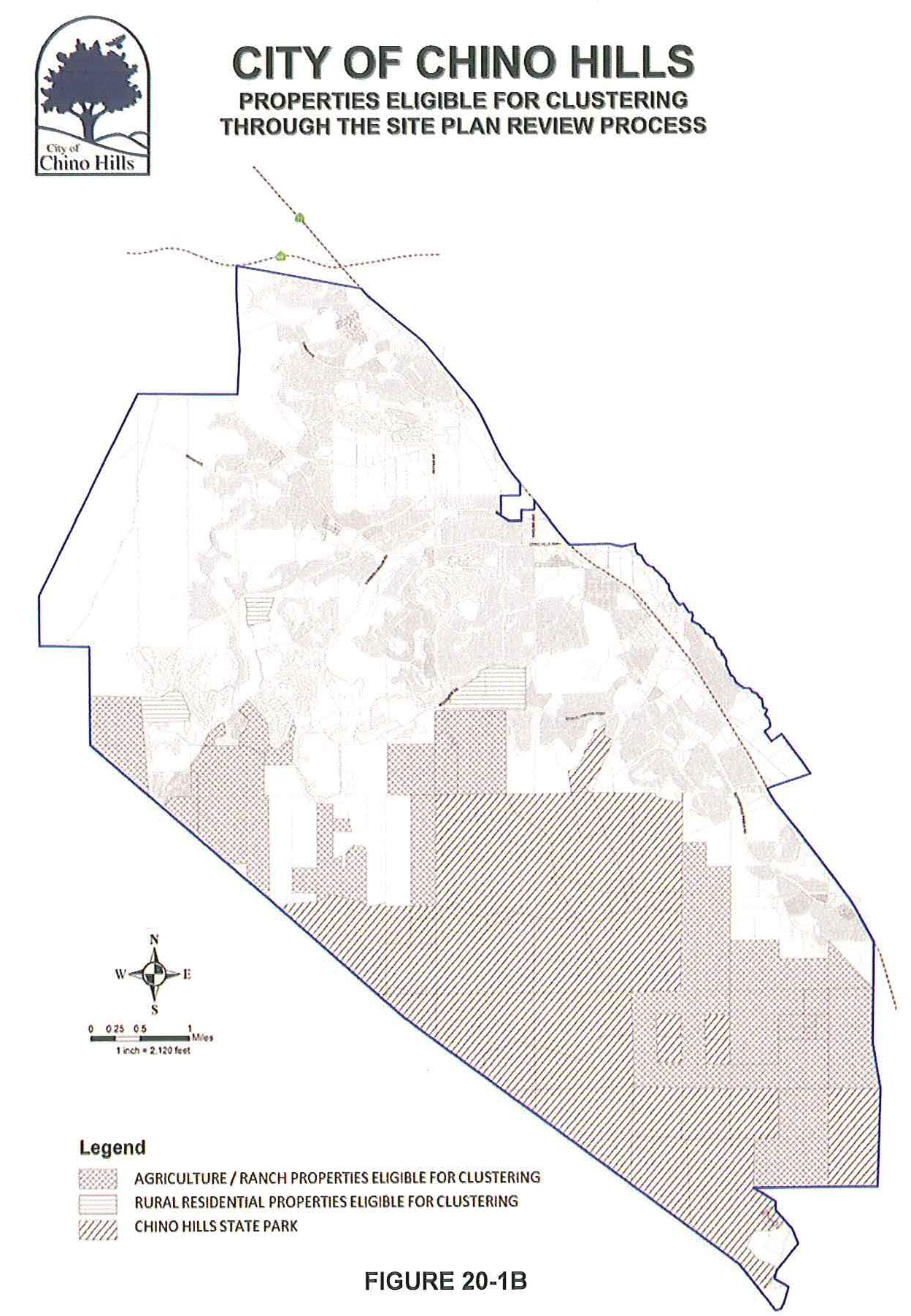
Exhibit "D"
TABLE 20-1(D)
Multi-Family Residential Zoning Districts for Former Planned Development (PD) Tracts
- Development Standards
16.10.040 - Minimum residential design standards.
The following minimum standards shall apply to all residential construction projects, including manufactured housing. Additional or alternative requirements may apply to substandard lots, as provided for in Section 16.10.100.
A.
All dwelling units shall have a minimum gross floor area of seven hundred fifty (750) square feet. The minimum dwelling unit width and depth shall be twenty (20) feet, measured from the exterior of the structure and excluding garages, porches, patios, eaves, cabanas, and bay windows.
B.
Siding material shall consist of stucco, wood, brick, stone, or decorative concrete block. Synthetic materials of a similar appearance and equivalent durability shall be permitted. Exterior siding shall extend to a point at or near grade. However, if an approved solid wood, metal, concrete, or masonry perimeter foundation is used, the siding need not extend below the top of the foundation.
C.
Roofing materials shall be Class "A" as defined by the California Building Code.
D.
Utility hookups and an area shall be provided to accommodate installation of a clothes washer and dryer. The hookups and area shall be provided within the primary structure or within an enclosed accessory structure.
E.
For dwelling units located within a fire safety overlay district, additional standards apply. See Chapter 16.22 of this Development Code.
F.
Areas for trash receptacles and recycling containers shall be provided as required by the City.
G.
Mobilehomes or manufactured homes placed in residential districts, and not within a mobile home park, shall be designed and built to have an appearance similar to or in conformance with the predominant architectural style of homes on the street and consistent with the provisions of this Chapter applicable to single-family residences. This shall include, but not be limited to:
1.
Massing;
2.
Foundations;
3.
Roofing materials;
4.
Compliance with fire overlay standards;
5.
Building materials; and
6.
Window and architectural treatments.
H.
Every single-family detached residential development shall have a perimeter landscape buffer area between the development perimeter wall or fence and any and all arterial/collector streets where the houses do not front on the street. This buffer area shall be a minimum of fifteen (15) feet in width and shall be permanently landscaped. The landscape buffer area shall be a separate lot; it shall not be included as part of any adjacent lot containing a residential unit. This area is to be provided between the perimeter wall of the development and the sidewalk.
1.
The minimum size of the shrubs to be planted within the landscape buffer area shall be five gallons. At maturity, the shrubs shall cover sixty (60) percent of the landscape buffer area.
2.
The trees to be planted within the landscape buffer area shall be a fifty (50) percent ratio of fifteen (15) gallon and twenty-four (24) inch box specimens.
3.
Ground cover shall be planted underneath all of the shrubs.
4.
Automatic irrigation shall be installed within the landscape buffer area, with separate valves provided to water the turf areas and shrub beds.
5.
If turf is installed within the landscape buffer area, such turf shall be drought tolerant and shall not exceed ten (10) percent of the total planting area of the landscape buffer.
6.
Herbaceous perennials shall be planted as accent color and shall cover at least three percent of the total planting area of the landscape buffer. All perennials shall be a minimum of one gallon in size.
7.
The landscape buffer area shall include such other improvements as deemed necessary by the City in order to achieve a fully landscaped appearance.
I.
A minimum of ten (10) percent of all single-family detached residential units in a single-family detached residential development shall be single-story structures, including corner lots, unless the Planning Commission determines, pursuant to the process described in Section 16.10.050(A) below, that there are counterbalancing factors associated with the development such that the intent of the residential design guidelines will be met notwithstanding any modification or waiver. This single-story requirement may be satisfied if the City finds, that the design of ten (10) percent of the residential units to be built as part of the development, including those to be located on corner lots, is such that the units have a strong single-story element at the front of the structure so as to minimize the appearance of bulk and overcrowding when viewed from the street. A single-story element is defined as the first or lowest story in a building which qualifies as a story as set forth in the California Building Code and which does not exceed fourteen (14) feet in height for the first twenty-five (25) feet from the front setback. Further, this single-story requirement may be modified or waived by the Planning Commission pursuant to the process described in Section 16.10.050(A) below.
(Ord. 112 § 8, 1998; Ord. 68 § 9.20.040, 1995)
(Ord. No. 225, § 3A, 6-9-2009; Ord. No. 261, § 3(b), 1-8-2013)
16.10.050 - Residential design guidelines.
A.
Administration.
1.
Intent and Purpose.
a.
These residential design guidelines are intended as objectives for building a diverse and lasting community with a strong identity and high quality residential development. It is envisioned that single-family detached residential development will be designed in such a manner as to create an attractive streetscape through implementation of Site Planning, architectural, and community design elements that result in variety and create visual interest. Single-family detached residential development projects which are characterized by repetitious street scenes of nearly identical two-story houses built at the minimum setback lines are discouraged. Rather, high quality single-family detached residential development is to be achieved through the use of a combination of design concepts as enumerated in this section to create varied, interesting, and attractive streetscapes.
b.
These guidelines are intended to complement the residential development standards, Site Planning, and design regulations contained elsewhere in this Development Code. They provide design solutions and design interpretations of the City's various regulations in effect for residential development in the City of Chino Hills.
c.
The guidelines are to be used by the Planning Commission during the City's design review process to ensure that the highest level of design quality is achieved while at the same time providing the flexibility necessary to encourage creativity and innovation. The Planning Commission shall be responsible for the design review of single-family detached residential development projects.
d.
While the overall intent of the guidelines shall be followed and every attempt shall be made to comply with the guidelines, compliance with any one specific guideline, or every single guideline, is not mandated for each project, unless the term "shall" is used specifically in such guideline. Compliance with any one specific guideline may be modified or waived by the Planning Commission if the Commission determines that there are counterbalancing factors associated with the development which ensure that it will be consistent with the overall intent of these guidelines. Any time a specific guideline is modified or waived by the Planning Commission, the following must be identified: (1) the specified guideline modified or waived, (2) the rationale for such modification, (3) the counterbalancing factor, and (4) how the intent of the guidelines will continue to be achieved notwithstanding such modification or waiver.
2.
Applicability.
a.
The provisions of this section shall apply to all single-family detached residential development within the City, unless a model home for the same single-family detached residential product type in the same recorded parent tract has been previously approved by the Planning Commission. Any residential construction on vacant property, any structural additions which are equal to fifty (50) percent or more of the floor area of the existing on-site buildings, and any reconstruction projects which are equal to fifty (50) percent or more of the floor area of the existing on-site buildings shall adhere to these residential design guidelines and parking requirements per Chapter 16.34 of this Code, where applicable. Structural addition or reconstruction projects that are less than the fifty (50) percent threshold do not need to meet the parking requirement as indicated in Table 65-1 provided that the existing single-family home already provides two covered parking spaces.
b.
For those applicants seeking building permits for units within a single-family detached residential development for which a Tentative Tract Map was approved prior to the effective date of this chapter: (a) the seven thousand two hundred (7,200) square foot minimum lot size, the sixty (60) foot average minimum lot width, and the aggregate twenty (20) foot minimum side yard setback do not apply as required by Section 16.10.030 of this chapter and (b) all of the Site Planning and architectural guidelines of this Section 16.10.050 (Residential Design Guidelines) of this Development Code apply, except for subsections (B)(2)(a)(i), (B)(2)(a)(ii), (B)(2)(a) (iv), (B)(2)(a)(v), (B)(2)(b)(ii), (B)(2)(b)(iii).
c.
For those applicants seeking building permits for units within single-family detached residential developments for which a Final Map has been recorded prior to the effective date of this chapter: (a) the seven thousand two hundred (7,200) square foot minimum lot size, the sixty (60) foot average minimum lot width, and the aggregate twenty (20) foot minimum side yard setback do not apply as required by Section 16.10.030 of this chapter and (b) all of the Site Planning and architectural guidelines of this Section 16.10.050 (Residential Design Guidelines) apply, except for subsections (B)(2)(a)(i), (B)(2)(a)(ii), (B)(2)(a)(iv), (B)(2)(a)(v), (B)(2)(b)(ii), (B)(2)(b)(iii).
3.
Interpretation. Whenever any provision contained elsewhere in this Development Code differs from those in this section, the more restrictive provisions shall apply, subject to the reasonable interpretation of the City.
4.
Appeals. All actions and decisions of the Planning Commission or the Community Development Director as authorized by this section are subject to appeal as set forth in Section 16.58.060 (Appeals) of the Development Code.
5.
Application Required.
a.
An application is required to initiate the City's design review process for single-family detached residential development, per the provisions of Section 16.58.020 (Application Procedures) of the Development Code. A design review application shall be deemed complete when it contains all of the information requested by the design review application form on file in the Community Development Department.
b.
Such an application shall be submitted concurrently with any application seeking approval of: (a) a tentative tract or parcel map for a single-family detached residential development pursuant to the Division of Land Procedures in Appendix D of this Code, (b) a preliminary development plan (PDP) or a PDP amendment pursuant to Chapter 16.74 of this Code, (c) a final development plan (FDP) or an amended FDP pursuant to Chapter 16.74 of this Code, or (d) building permits (with the exception of grading permits, which may be issued prior to the completion of the design review process), at the landowner's option.
6.
Proceedings.
a.
An application shall be filed pursuant to the provisions of Section 16.10.050(A)(5) and Section 16.58.020 (Application Procedures) of the Development Code. The Community Development Director or his or her designee shall review the residential design review application for completeness and conformance with the provisions of this Development Code. Upon the determination that the application is complete and the completion of the environmental review, the Director shall prepare a recommendation and forward the recommendation, the application, and any other relevant materials to the Planning Commission Secretary within the timeframe specified in Government Code Section 65950. The Secretary shall schedule the matter for consideration concurrently with the approval of the tentative tract or parcel map, preliminary development plan, final development plan, or if none of the above are applicable at the next regularly scheduled Planning Commission meeting for which it is practical to provide the required notice. The Community Development Director or designee shall provide notice to all contiguous property owners of the design review and the scheduled Planning Commission meeting ten (10) days prior to the meeting. At the Planning Commission meeting, the applicant and all other persons shall have the right to present testimony and evidence on any relevant aspect of the application under consideration.
b.
The Planning Commission shall hear and take action on the residential design review application. The Planning Commission shall act to approve, conditionally approve, or deny the application. When taking its action, the Commission shall adopt a resolution containing its findings and decisions. The resolution shall recite the facts and reasons which make the granting or the denial of the application necessary to carry out the intent and purpose of Section 16.10.050 (Residential Design Guidelines). If the application is approved, the resolution shall include the conditions and limitations imposed, if any.
7.
Required Findings.
a.
The Planning Commission, and the City Council on appeal, in acting to approve a residential design review application, may impose conditions as are reasonably necessary to ensure that the single-family detached residential development is consistent with the General Plan, is compatible with the surrounding land uses, and is in conformance with the provisions and intent of this Development Code.
b.
In making such a determination, the hearing body shall find:
i.
That the proposed single-family detached residential development is consistent with the General Plan;
ii.
That the proposed design and layout of the single-family detached residential development:
(A)
Is sufficiently varied to avoid monotony in the external appearance; and
(B)
Is in harmony with the appearance of other existing residences in the neighborhood, as well as those found throughout the community.
iii.
That the plans for the single-family detached residential development have properly implemented the residential design guidelines set forth in this section of the Development Code.
8.
Time Limits.
a.
Applicability. The time limit provisions of this section shall apply to Design Reviews for all single-family detached residential development within the City, unless the development is part of a tract home Design Review, in which case the tract home Design Review will not expire unless otherwise tied to the expiration of the tentative map in which the property is located.
b.
Use of Approved Design Review Plan. Any approved Design Review plan which is not used within the time specified in the grant of approval or, if no time is specified, within four years of the effective date of such approval, expires at the end of that period. For the purposes of this section, "used" means the commencement of construction activity authorized by the approval.
c.
[Expiration; Appeal.] Any applicant disputing the expiration of any design review plan under this section must appeal within ten (10) working days of the expiration date. The appeal must follow the process set forth in Section 16.58.060 of this Code. The appeal must be made to the Planning Commission for permits approved by the Planning Commission, and to the City Council for permits approved by the City Council.
B.
Site Planning Guidelines.
1.
An important goal of the single-family Site Planning guidelines is to create a functional and varied streetscape. It is the intent of these Site Planning guidelines to discourage single-family detached residential developments where identical homes march down long, uninterrupted straight streets with no variation in building placement or the street scene.
2.
All single-family detached residential developments will be evaluated by the Planning Commission for their conformity with the design guidelines contained in this section, with particular emphasis placed on meeting the following general and specific Site Planning criteria:
a.
General Site Planning Criteria.
i.
Variation of Size, Dimensions, and Placement of Lots within a Single-Family Detached Residential Development. The design of single-family detached residential developments shall be such that there is variation in the size, dimensions, and placement of the lots to avoid a repetitious street scene of nearly identical two-story houses built at the minimum setback lines. The size and width of the individual lots within a development shall differ from one another. This requirement is intended to create variety and avoid monotony within a development.
ii.
Preservation of protected trees as defined in Section 16.90.020(G) and as regulated by Chapter 16.90, and other significant site features. The significant existing natural features of the project site shall be retained. These features shall be an integral part of the overall design and layout of the single-family detached residential development.
iii.
Variation of Placement of Dwelling Units on the Individual Lots. The placement of the houses on individual lots within a single-family detached residential development shall be varied to create visual character and avoid repetition. The variation in the placement of each house on the individual lot shall be such that no dwelling unit on two or more adjacent lots are the same.
iv.
Provision of Neighborhood Amenities (entrance treatment for the single-family detached residential development, enhanced landscaping to create a mature appearance, decorative/accent paving, passive and active open space, et cetera). The design of single-family detached residential developments shall include neighborhood amenities which orient and give focus to the neighborhood, thereby creating a sense of community and providing the residents with opportunities to walk, jog, and bike. There is a need to create strong pedestrian and open space connections within and between neighborhoods. Usable outdoor areas such as playgrounds, tot lots, small parks, footpaths, et cetera shall be included as part of the overall design and layout of a new single-family detached residential development so as to provide areas for the residents to meet one another and to recreate.
v.
Enhanced Treatment of Drainage Courses and Drainage Structures. The color treatment of down drains and other drainage structures is encouraged. Natural drainage courses shall be preserved and integrated into the overall layout and design of a single-family detached residential development.
vi.
Enhanced Treatment of Walls. The walls constructed within a single-family detached residential development shall reflect quality and shall complement the architectural style of the development within which they are located. The materials of the walls shall be such that they are permanent. Decorative walls (i.e., masonry) shall be provided at the edges of the single-family detached residential development and along the streets. Such walls are to include architectural embellishments, whenever the walls are visible from any street and/or common areas within a development. All walls and fences shall be constructed of durable materials such as masonry, masonry combination, stone, brick, concrete, wrought iron (tubular steel), or other type of material as may be approved by the Planning Commission or the Community Development Director for durability, aesthetics, and sound attenuation purposes. No wood fencing shall be permitted; this prohibition against wood fencing is not applicable to fencing used as part of multi-purpose trails. No chain-link fencing is permitted in front or street facing side or rear yards, except that chain-link fencing that was installed prior to November 24, 2015, shall be considered legal non-conforming structures. No barbed wire, razor ribbon, or other similar temporary material shall be permitted as a wall and/or fencing material, except in undeveloped Agriculture Ranch or Open Space areas as required to restrict cattle movement, or on utilities or other public facilities required to provide security. The setbacks of the walls in a single-family detached residential development shall be varied, especially when they are located adjacent to major streets (arterials/collector streets), in order to increase visual interest.
vii.
Other Amenities Unique to the Project. In addition to entrance treatments, enhanced landscaping, and passive and active open space, other amenities shall be included as part of the design of a new single-family detached residential development in order to provide opportunities for the residents to enjoy, meet, and recreate within their community. The provision of street furniture, such as benches, trash containers, fountains, planting pots, ornamental streetlights, and other appropriate amenities, is encouraged. Such amenities shall be provided in all single-family detached residential development within parkways and common areas, in order to create visual interest and address pedestrian needs.
b.
Specific Site Planning Criteria.
i.
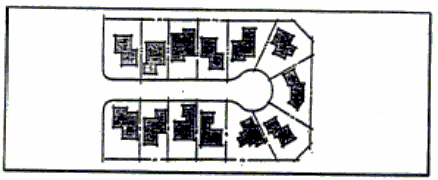
Variable Front Yard Setbacks. Varied and staggered setbacks of the houses on the individual lots are encouraged in order to avoid the monotony of repetitive setbacks. The variation in the placement of each house on the individual lot shall be such that the front yard setback on two adjacent lots are not the same. Front yard setbacks must vary by at least two feet to satisfy these criteria.
ii.
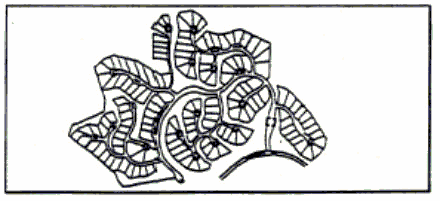
Curvilinear Streets. Curvilinear streets are encouraged. On straight roads, knuckles or culs-de-sac are to be used in order to limit the length of straight stretches. Occasional curves change the street scene. Curves that seem very slight are readily perceived by the driver and interrupt the line of sight, thus creating a variable street scene.
iii.
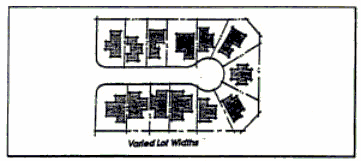
Variable Lot Widths. Single-family detached residential developments shall include lots of variable widths with some of the lots being wider than the others. The use of different lot widths throughout a development will assist in creating a varying streetscape, making it more interesting by breaking up the monotony that occurs with uniform lot widths. In no case shall two adjacent lots have the same lot width; lot widths must vary, with a five foot minimum suggested. By using differing lot widths, variation in the building mass is provided because there is more diversity in the placement of each house on the individual lot and there is greater variation in the size and shape of the footprint of the house. A continuous row of the same lot width is discouraged because it will inevitably result in a dull and repetitive streetscape.
iv.
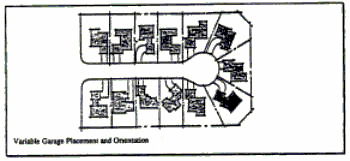
Variable Garage Placement and Orientation. The placement of garages on the individual lots shall be varied. Further, the garages shall be designed to reduce their visual impact on the street. The visual dominance of garages on streets shall be minimized by locating garages at the front, rear, or side of the house with a front or side entry. The garages shall be of differing sizes. Garage elements can be completely separate, detached or connected to the house by a breezeway.
(A)
Front Entry Garages. For front loaded garages where the entrance to the garage is parallel to the street, the distance between the garage door in the closed position and the street shall be a minimum of nineteen (19) feet. This nineteen (19) foot minimum dimension is to allow for the parking of vehicles on the driveway without encroaching into the street.
(B)
Garages located at the front of the house shall have a strong single-story element at the front of the structure, unless the Planning Commission determines, pursuant to the process described in Section 16.10.050(A) of this Development Code, that there are counterbalancing factors associated with the development which ensure that the intent of the guidelines will be met notwithstanding such modification or waiver.
(C)
The purpose of this single-story element requirement is to minimize the appearance of bulk and overcrowding when viewed from the street. The single-story element of the garage is to provide relief and an architectural transition into the two-story massing of the remainder of the structure. The transition from the single-story to the second-story shall not occur any closer than fifteen (15) feet from the front of the garage.
(D)
Side Entry Garages. For side loaded garages with access provided from a curved driveway (where the garage entrance is perpendicular to the street), the front yard setback shall be a minimum of sixteen (16) feet.
(E)
Split, tandem (for three car garages), detached, and perpendicular garages are encouraged to break up the monotony which would otherwise occur if all of the garage doors of each house were to be located parallel to the street.
(F)
All garages shall have roll up garage doors.
C.
Architectural Guidelines.
1.
Building Massing/Scale and Style.
a.
Massing/Scale. Mass is the three dimensional bulk of a structure: its height, width, and depth. Scale is the size and magnitude of a structure as distinguished from its shape, which is the form of a building created by its outline. The mass and scale of a building should relate to its use as a single-family residence. Each residence should be designed at a human scale so as not to overwhelm or dominate its surroundings.
b.
Second Story Massing Guidelines:
i.
The second story of a house shall, wherever feasible, exhibit a lighter mass and scale than the base, by reducing floor area and/or building mass.
ii.
Second story wall planes oriented towards a street, including front, side, and rear elevations, shall be varied and articulated to reduce the overall massing and scale, and to avoid an uninterrupted flat wall from the ground floor to the second story.
c.
Style. There is no particular architectural "style" required for single- family residences. Rather, the focus is to be on developing a high quality residential environment, a neighborhood. The appearance of the houses, including their architectural style, should be compatible with the character of the neighborhood, including harmonious and unified style, form, size, color, material, and roofline. However, each of the individual houses should be distinguishable from one another. The mixing of various elements from distinctly different architectural styles should be avoided. The creation of houses with a classic and/or vintage style using scale, proportion, and materials is encouraged so as to create a strong sense of place.
2.
Enhanced Architectural Treatment.
a.
The ornamentation of the facades and variation in the massing of the structures give them richness and scale. All residential units shall include enhanced architectural treatment on all elevations (i.e., three hundred sixty (360) degree architecture) that are visible from any street and/or common area within a development, unless otherwise approved by the Planning Commission through the design review process. Long, flat, uninterrupted exterior walls or roof planes shall be avoided on all structures. All walls of the houses shall have "relief" to create visual interest and to cast shadows. Enhanced architectural treatment includes porches, tower elements, balconies, ornamented chimneys, and other highly articulated architectural features.
b.
Variation in the roof planes and use of ornamental elements on the roof is encouraged. Such variation may be achieved by changes in plane and/or the use of traditional roof forms such as gables, hips, sheds, and dormers. When appropriate to the architectural style, moderate roof overhangs of at least eighteen (18) inches shall be provided in order to create strong shadow lines. Both vertical and horizontal articulation of each individual roof is encouraged; long, unbroken rooflines are to be avoided. Rooflines are to be representative of the design and scale of the units under them. The pitch and scale of the roof is to be in proportion to the size of the house. The bulk of a building may be reduced by breaking the roof form into smaller parts. Flat roofs are generally discouraged, unless they are appropriate to the architectural style. Roof mounted equipment is prohibited.
3.
Varied Structure Design. The design of the houses within each single-family detached residential development shall be varied to create visual interest and diversity in the street scene. Excessive repetition of single-family houses with near identical elevations shall be avoided. A significant difference in the massing and composition (not just the finish materials) of each adjacent house is to be accomplished. One exterior design shall not be repeated more frequently than each fourth house. The elevations of the houses within a single-family detached residential development are to be varied as follows:
* Reverse footprints, alternate orientation of 90 degrees or greater, or alternate garage orientation (i.e., side entry or detached) may be counted as additional elevations.
4.
Materials. The choice and mix of materials on the facades of the houses and the garage doors is important in providing an attractive living environment. Any materials applied to the exterior elevation shall be integrated into the overall architecture of the building so that the materials do not appear to be artificial or otherwise tacked onto the structure. Piecemeal embellishment and frequent changes in the type of materials applied to the building exterior shall be avoided. Whenever a building can be viewed from any street and/or common areas within a development, the visible elevations shall be architecturally treated, unless otherwise approved by the Planning Commission through the design review process.
5.
Vents and Downspouts. Roof flashing, rain gutters, and downspouts, vents, and other roof protrusions shall be finished to match the adjacent materials and/or colors. The use of copper, bronze, verdigris, or aged finishes is encouraged.
6.
Equipment Screening. Roof-mounted equipment is prohibited. Any equipment placed on the ground shall be shielded and architecturally screened from view from on-site parking areas, on-site common areas within the development, any street from a point immediately adjacent to the site, and adjacent residentially zoned properties at the same elevation. The method of equipment screening shall be architecturally compatible with the design of the house in terms of materials, color, shape, and size. Satellite dishes, air conditioners and pool equipment shall not be located in the front yard; rather, they shall only be located in the rear and side yards so as to be screened from view of the adjoining properties and the street.
7.
Walls.
a.
Walls are to be constructed of durable materials, such as masonry, masonry combination, stone, brick, concrete, or other approved masonry. Walls shall include a finish. Finishes may be plaster, stucco, molded, patterned, or any other texture that adds interest. Walls are to include pilasters at appropriate intervals throughout the development and at least at every property line. Additionally, all walls that are visible from any street and/or common area within a development are to include copings. The walls shall be designed to be of such a style and consisting of such materials and colors which complement the development within which they are located.
b.
Other wall materials to be located within a single-family detached residential development shall include wrought iron (tubular steel), tile insets, grillwork, plexiglass, or other materials as may be approved by the City for durability, aesthetic, and/or sound attenuation purposes. No wood fencing shall be permitted; this prohibition against wood fencing is not applicable to fencing used as part of multi-purpose trails. No barbed wire, razor ribbon, or other similar temporary materials shall be permitted as a wall material.
c.
Both sides of all walls should be architecturally treated, whenever visible from any street and/or common area within the development. All walls and fences shall complement the architectural style of the development within which they are located. They shall be designed to be decorative, including architectural embellishments, whenever the walls are visible from any street and/or common area within a development. All walls and fences shall be constructed of durable materials such as masonry, masonry combination, stone, brick, concrete, wrought iron (tubular steel), or other type of material as may be approved by the Planning Commission or Community Development Director for durability, aesthetic, and/or sound attenuation purposes.
8.
Garage Doors. Garage doors shall appear to be set into the walls of the garage or the house rather than being flushed with the exterior wall of the garage or the house. A variety of compatible designs are to be used throughout a single-family detached residential development so as to insure visual interest and avoid monotony. The design of the garage door is to relate to the particular architectural style of the house.
(Ord. 174 § 3, 2005; Ord. 112 § 9, 1998)
(Ord. No. 250, § 2, 1-24-2012; Ord. No. 261, § 3(c), 1-8-2013; Ord. No. 291, § 7, 9-8-2015; Ord. No. 293, § 7, 11-24-2015; Ord. No. 333, § 5, 12-11-2018)
16.10.060 - Multifamily housing—Additional standards.
A.
Open Space Requirements. All multifamily developments with ten (10) or more dwelling units shall provide a minimum of three hundred (300) square feet of a combination of private and common usable open space per unit. Table 20-1 in Section 16.10.030 provides standards for the minimum required usable private open space for multiple-family housing development.
B.
Trash Receptacles. Trash receptacles shall be provided consistent with the requirements of Title 16 of the Municipal Code. Areas for recycling containers shall be provided as required by the City of Chino Hills.
C.
Parking Space Location. Parking spaces shall be provided as specified in Chapter 16.34 of this Development Code.
D.
Required Building Separation. The building separation requirements outlined in Table 20-3 shall apply to any lot containing two or more dwelling units located in separate, detached structures, except that the minimum building separation requirement shall be six (6) feet for developments consisting solely of duplex dwelling units. The required separations shall be between opposite exterior walls of any buildings containing dwelling units. In the event that more stringent requirements are imposed by the California Building Code or City Fire Hazard Overlay Zone, the more stringent regulations shall apply.
Table 20-3.
Minimum Building Separation
For Multifamily Developments
1 Where buildings of different heights are adjacent, the standard for the taller building shall apply.
2 For duplex units, reference Section 16.10.060(D) above.
(Ord. 194 § 3 (part), 2007; Ord. 68 § 9.20.050, 1995; Ord. No. 225, § 3A, 6-9-2009; Ord. No. 311, § 5, 6-13-2017)
16.10.070 - Mobilehome parks.
A.
Purpose. The purpose of this section is to provide regulations for the location, design, and improvement of mobilehome parks, as defined by Section 18214 of the Health and Safety Code.
B.
Other Regulations. The provisions of the Mobilehome Parks Act, California Health and Safety Code, Division 13, Part 2.1 and the applicable regulations adopted pursuant to it by the State Department of Housing and Community Development are adopted as a part of this section. It shall be the duty of the County Department of Environmental Health Services to enforce all of the provisions of such Act pertaining to the construction, alteration, or modification of all manufactured dwelling units within mobilehome parks. Construction only of all other structures shall be subject to the review and approval of the Community Development Department and the Building and Safety Division. It shall be the duty of the County Department of Environmental Health Services to enforce all the provisions pertaining to permits for the operation, maintenance, use, occupancy, sanitation, and safety of all mobilehome parks.
C.
Establishment of Mobilehome Parks.
1.
A Conditional Use Permit (CUP) application shall be filed pursuant to the requirements of Chapter 16.68. Each CUP application filed pursuant to this section shall be in compliance with the General Plan, Specific Plan, and any adopted amendment(s) to them.
2.
Each map or plan completed for the CUP application shall be prepared by an architect, professional engineer, or other person qualified to do such work. The map shall be drawn at a scale of one inch equals fifty (50) feet or less. Information required shall be as specified by the CUP application packet.
D.
Standards of Design and Improvements.
1.
Minimum Areas. Manufactured housing parks shall be developed on a parcel of land at least ten (10) acres in area.
2.
Drainage and Flood Hazard. The park shall be located on a well-drained site, properly graded to provide for adequate runoff. The site shall be free of flood hazard from external sources. The Community Development Director may require dedications and improvements which will ensure proper protection of the park in accordance with this section.
3.
Streets and Highways. The Community Development Director may require dedication and improvements on streets and highways abutting the proposed park in accordance with the circulation element of the General Plan and established widths of local and collector streets.
4.
Lot/Space Area and Dimensions. Each lot or space shall contain a minimum area of three thousand five hundred (3,500) square feet with a minimum width of forty (40) feet fronting on a driveway and a minimum depth of seventy (70) feet. However, the following exceptions shall apply:
a.
Lots larger than the above minimum sizes may be required where it is determined that increased lot size will be consistent with the general pattern established by manufactured housing parks in the vicinity, or be necessary to accommodate manufactured home sizes proposed by the CUP.
b.
Lots on curved driveways or culs-de-sac, where lot lines are either converging or diverging from the front to the rear of the lot, shall have an average width at least thirty (30) feet, but in no case shall the frontage on a driveway be less than twenty-five (25) feet.
5.
Distance Between Units. Mobilehomes shall be spaced in accordance with the requirements of Title 25 of the California Code of Regulations.
6.
Lot Coverage. Maximum lot coverage shall be as specified in Title 25 of the California Code of Regulations.
7.
Required Perimeter Landscaping. A landscaped parkway of at least twenty (20) feet in width shall be provided along the entire perimeter of each mobilehome park where the park is adjacent to a public roadway.
8.
Private Roads Within a Park. Roads within parks shall be designed to provide reasonable and convenient traffic circulation and shall meet the following minimum standards:
a.
No road shall be less than thirty-three (33) feet wide if car parking is permitted on one side of the road, and not less than forty-one (41) feet wide if car parking is permitted on both sides.
b.
The entire width of the roads within manufactured housing parks shall be surfaced with a minimum of two-inch thick asphalt, concrete, plant mix, or other approved material.
9.
Parking. Parking shall be provided as specified in Chapter 16.34 of this Development Code.
10.
Walkways. Walkways shall be provided to permit reasonably direct access to all lots, service buildings, and other areas or buildings used by occupants of the manufactured homes. Collector walkways serving utility buildings, playgrounds, and other general areas shall be four feet wide or more, and individual entrance walks to each manufactured home site shall be at least two feet wide. All walkways shall be constructed of asphalt, concrete, or other approved materials which will permit all-weather pedestrian movement.
11.
Vehicle Storage. Common storage areas shall be provided for the residents of the park for the storage of recreational vehicles, trailers, travel trailers, and other licensed or unlicensed vehicles. This area shall total not less than fifty (50) square feet for each lot. All storage on a lot shall be in accordance with the provisions of Title 25 of the California Code of Regulations.
E.
Subdivisions of Mobilehome Parks. Subdivision of mobilehome parks shall comply with all appropriate design standards established by this section and all applicable state and City subdivision requirements.
(Ord. 68 § 9.20.060, 1995)
16.10.110 - Special development standards for Tract 2557 (Los Serranos Area).
Tract 2557 lies within a natural drainage course. About half the area within the tract is subject to inundation during storms. In order to adequately protect the safety and welfare of local residents, the following development standards shall apply within the tract:
A.
Finished floors for residential structures shall be elevated a minimum of one foot above the finished centerline elevation of the street for all lots which are located west of or adjacent to Carmelita Avenue within Tract 2557.
B.
Finished floors for residential structures shall be elevated a minimum of one-and-one-half feet above the finished centerline elevation of the street for all lots which are located east of or adjacent to Monterey Avenue within Tract 2557.
(Ord. 68 § 9.20.100, 1995)
16.10.120 - Storage of recreation vehicles.
The storage of boats, travel trailers, and other recreational vehicles on residential lots shall be permitted subject to the following:
A.
The open of storage of boats, travel trailers, and other recreational vehicles is permitted on residential lots subject to the requirements contained in Section 16.34.050(A) of this Code.
B.
Portable, semi-permanent, or permanent covers used to protect boats, travel trailers, or recreational vehicles from the sun and weather may be used, provided that:
1.
Such structures are located entirely behind the front setback line of the lot;
2.
Sufficient distance, as required by the California Building Code, is provided between the structure and any inhabited building;
3.
The boat, trailer, or vehicle under the cover is parked consistent with the requirements of Section 16.34.050(A) of this Code; and
4.
The cover is maintained in good repair.
A maximum of one such cover may be used for each ten thousand (10,000) square feet of lot area.
(Ord. 68 § 9.20.110, 1995)
(Ord. No. 225, § 3A, 6-9-2009)
16.10.130 - Density bonuses and other incentives for affordable housing projects.
A.
Definitions. For purposes of this chapter, the following definitions apply:
1.
"Affordable housing cost" has the definition set forth in California Health and Safety Code Section 50052.5.
2.
"Affordable rent" has the definition set forth in California Health and Safety Code Section 50053.
3.
"Child care facility" means a facility other than a family day care home, including, but not limited to, infant centers, preschools, extended day care facilities, and school age child care centers.
4.
"Common interest development" has the definition set forth in California Civil Code Section 4100.
5.
"Concession" or "incentive" have the definition set forth in Government Code section 65915(k). This definition does not limit or require the provision of direct financial incentives for a housing development, including the provision of publicly owned land by the City or the waiver of fees or dedication requirements.
6.
"Density bonus" means a density increase over the otherwise maximum allowable residential density under the applicable Zoning Ordinance provisions and the land use element of the General Plan as of the date of application by the applicant to the City.
7.
"Development standard" means the site or construction conditions, including, but not limited to, a height limitation, a setback requirement, a floor area ratio, an onsite open-space requirement, or a parking ratio that applies to a residential development pursuant to any ordinance, General Plan element, specific plan, or other local condition, law, policy, resolution, or regulation.
8.
"Housing development" means a development project for five (5) or more residential units, including mixed use developments. "Housing development" also includes a subdivision or common interest development consisting of residential units or unimproved residential lots and either a project to substantially rehabilitate and convert an existing commercial building to residential use or the substantial rehabilitation of an existing multifamily dwelling where the result of the rehabilitation would be a net increase in the number of residential units. For the purpose of calculating a density bonus, the residential units shall be on contiguous sites that are the subject of one development application, but do not have to be based upon individual subdivision maps or parcels. The density bonus is permitted in geographic areas of the housing development other than the areas where the units for the lower income households are located.
9.
"Lower income households" has the definition set forth in California Health and Safety Code Section 50079.5.
10.
"Major transit stop" has the same definition as set forth in Public Resources Code 21155(b).
11.
"Maximum allowable residential density" means the density allowed under the Zoning Ordinance or General Plan land use designation for a parcel, or if a range of density is permitted, the highest allowable density within that range.
12.
"Moderate income households" has the definition for "persons or families of moderate income" set forth in California Health and Safety Code Section 50093(b).
13.
"Multifamily dwelling" has the definition set forth in California Government Code Section 65863.4(d).
14.
"Senior citizen housing development" has the definition set forth in California Civil Code Sections 51.2 and 51.3.
15.
"Special needs housing development" has the same definition as set forth in California Health and Safety Code Section 51312.
16.
"Specific, adverse impact" has the definition set forth in California Government Code Section 65589.5(d)(2).
17.
"Very low income households" has the definition set forth in California Health & Safety Code Section 50105.
B.
General Density Bonus Provisions.
1.
Consistency with Government Code. Wherever provisions of this chapter conflict with or are superseded by Government Code Section 65915, the provisions of Government Code Section 65915 shall take precedence.
2.
Application. Any person that desires a density bonus shall make an application on a form approved by the Community Development Director or designee at the time of submitting an entitlement application for the housing development for which a density bonus is requested.
3.
Right to Incentives and Concessions. When an applicant seeks a density bonus for a housing development or proposes to donate land for housing within the City, the City shall provide the applicant incentives or concessions for the production of housing units and child care facilities as provided in this chapter.
4.
Density Bonus Determination. Any determination required of incentives or concessions pursuant to this chapter shall be based on the development project at the time the application is deemed complete. This determination shall be adjusted based on any changes to the project during the course of development.
5.
Available Density Bonus Options. The City Council will grant one density bonus, the amount of which will be as specified in Section 16.10.130(E), and incentives or concessions as described in Section 16.10.130(C), when an applicant for a housing development seeks and agrees to construct a housing development, excluding any units permitted by the density bonus awarded pursuant to this chapter, that will contain at least one of the following:
a.
Ten (10) percent of the total units of a housing development for lower income households.
b.
Five (5) percent of the total units of a housing development for very low income households.
c.
A senior citizen housing development or a mobilehome park that limits residency based on age requirements for housing for older persons pursuant to Section 798.76 or 799.5 of the Civil Code.
d.
Ten (10) percent of the total dwelling units in a common interest development for persons and families of moderate income provided that all units in the development are offered to the public for purchase.
e.
Ten (10) percent of the total units of a housing development for transitional foster youth, as defined in Section 66025.9 of the Education Code, disabled veterans, as defined in Section 18541 of the Government Code, or homeless persons, as defined in the federal McKinney-Vento Homeless Assistance Act ( 42 U.S.C. Sec. 11301 et seq.).
f.
Twenty (20) percent of the total units for lower income students in a student housing development that meets the requirements of Section 65915(b)(1)(F) of the Government Code.
g.
One hundred (100) percent of the total units, exclusive of a manager's unit or units, are for lower income households, except that up to twenty (20) percent of the total units may be for moderate-income households.
6.
Applicant's Election of Basis for Bonus. For purposes of calculating the amount of the density bonus, the applicant who requests a density bonus pursuant to this chapter shall elect whether the bonus will be awarded on the basis of subparagraph (B)(4.)(a), (b), (c), (d), (e), (f), or (g) of this Section 16.10.130.
7.
Continued Affordability. The applicant for a density bonus shall agree to the following affordability provisions:
a.
An applicant shall agree to the continued affordability of all very low and low-income rental units that qualified the applicant for the award of the density bonus for fifty-five (55) years or a longer period of time if required by the construction or mortgage financing assistance program, mortgage insurance program, or rental subsidy program. Rents for the lower income density bonus units shall be set at an affordable rent or as otherwise provided in Section 65915(c)(1)(B) of the Government Code.
b.
An applicant shall agree that the initial occupant of all for-sale units that qualified the applicant for the award of the density bonus are persons and families of very low, low, or moderate income, as required, and that the units are offered at an affordable housing cost. The local government shall enforce an equity sharing agreement, unless it is in conflict with the requirements of another public funding source or law. The equity sharing agreement shall comply with the provisions of Government Code section 65915(c)(2)(C).
8.
Number of Incentives or Concessions: The applicant shall receive the following number of incentives or concessions:
a.
One incentive or concession for projects that include at least ten (10) percent of the total units for lower income households, at least five (5) percent for very low income households, or at least ten (10) percent for persons and families of moderate income in a development in which the units are for sale.
b.
Two incentives or concessions for projects that include at least seventeen (17) percent of the total units for lower income households, at least ten (10) percent for very low income households, or at least twenty (20) percent for persons and families of moderate income in a development in which the units are for sale.
c.
Three incentives or concessions for projects that include at least twenty-four (24) percent of the total units for lower income households, at least fifteen (15) percent for very low income households, or at least thirty (30) percent for persons and families of moderate income in a development in which the units are for sale.
d.
Four incentives or concessions for projects meeting the criteria in Section 16.10.130(B)(4)(g). If the project is located within one-half (½) mile of a major transit stop, as defined in Public Resources Code 21155(b), the applicant shall also receive a height increase of up to three additional stories, or thirty-three (33) feet.
e.
One incentive of concession for projects that include at least twenty (20) percent of the total units for lower income students in a student housing development.
9.
Ineligibility for a Density Bonus. An applicant shall be ineligible for a density bonus or any other incentives or concessions under this section if the housing development is proposed on any property that includes a parcel or parcels on which rental dwelling units are or, if the dwelling units have been vacated or demolished in the five-year period preceding the application, have been subject to a recorded covenant, ordinance, or law that restricts rents to levels affordable to persons and families of lower or very low income; subject to any other form of rent or price control through a public entity's valid exercise of its police power; or occupied by lower or very low income households, unless the proposed housing development replaces those units, and as provided in Section 65915(c)(3) of the Government Code.
10.
Findings to Deny Density Bonus. An applicant for a density bonus may submit to the City a proposal for the specific incentives or concessions that the applicant requests pursuant to this section, and may request a meeting with the City. The City shall grant the concession or incentive requested by the applicant unless the City makes a written finding, based upon substantial evidence, of any of the following:
a.
The concession or incentive does not result in identifiable and actual cost reductions, consistent with Government Code section 65915(k), to provide for affordable housing costs, as defined in Section 50052.5 of the Health and Safety Code, or for rents for the targeted unites to be set as specified in Government Code section 65915(c).
b.
The concession or incentive would have a specific, adverse impact upon public health and safety or on any real property listed in the California Register of Historical Resources, and there is no feasible method to satisfactorily mitigate or avoid the specific adverse impact without rendering the development unaffordable to low- and moderate-income households; or
c.
The concession or improvement would be contrary to state or federal law.
C.
Waiver or Reduction of Development Standards.
1.
Proposal by Applicant. An applicant may submit to the City a proposal for the waiver or reduction of development standards that the applicant believes will have the effect of physically precluding the construction of a housing development that meets the criteria of Section 16.10.130(B)(4), at the densities or with the concessions or incentives permitted by this chapter, and may request a meeting with the Community Development Director or designee. Such proposal shall neither reduce nor increase the number of incentives or concessions that the applicant is entitled to under Section 16.10.130(B)(7).
2.
Findings to Deny Waiver or Reduction. The City may deny an applicant's request to waive or reduce development standards if the City makes a written finding, based upon substantial evidence, of any of the following:
a.
The waiver or reduction of development standards would have a specific, adverse impact upon public health and safety and for which there is no feasible method to satisfactorily mitigate or avoid the specific adverse impact.
b.
The waiver or reduction of development standards would have an adverse impact on any real property listed in the California Register of Historical Resources.
c.
The waiver or reduction would be contrary to state or federal law.
3.
Limitations on Receipt of a Waiver or Reduction. A housing development that receives a waiver from any maximum controls on density by virtue of it being located within one-half (½) mile of a major transit stop shall only be eligible for a waiver or reduction in development standards as provided in Government Code Section 65915(e)(3), unless the City agrees to additional waivers or reductions of development standards.
D.
Calculation of Density Bonus.
1.
The amount of density bonus to which the applicant is entitled shall vary according to the amount by which the percentage of affordable housing units exceeds the percentage established in Section 16.10.130(B)(4). The applicant may elect to accept a lesser percentage of density bonus.
2.
For housing developments meeting the criteria of Section 16.10.130(B)(4)(a), the density bonus shall be calculated as follows:
3.
For housing developments meeting the criteria of Section 16.10.130(B)(4)(b), the density bonus shall be calculated as follows:
4.
For housing developments meeting the criteria of Section 16.10.130(B)(4)(c), the density bonus shall be twenty (20) percent of the number of senior housing units.
5.
For housing developments meeting the criteria of Section 16.10.130(B)(4)(d), the density bonus shall be calculated as follows:
6.
For housing developments meeting the criteria of Section 16.10.130(B)(4)(e), the density bonus shall be twenty (20) percent of the number of the type of units giving rise to a density bonus under that subparagraph.
7.
For housing developments meeting the criteria of Section 16.10.130(B)(4)(f), the density bonus shall be thirty-five (35) percent of the student housing units.
8.
For housing developments meeting the criteria of Section 16.10.130(B)(4)(g), the following shall apply:
a.
Except as otherwise provided in Section 16.10.130(D)(8)(b), the density bonus shall be eighty (80) percent of the number of units for lower income households.
b.
If the housing is located within one-half (½) mile of a major transit stop, there are no maximum controls on density.
9.
All density calculations resulting in fractional units shall be rounded up to the next whole number.
E.
Additional Density Bonus Through Donation of Land.
1.
Criteria for Additional Density Bonus. An applicant for a tentative subdivision map, parcel map, or other residential development approval shall be eligible for the additional density bonus described in this section if all of the following conditions are met:
a.
The applicant donates and transfers land to the City no later than the date of approval of the final subdivision map or parcel map or residential development application.
b.
The developable acreage and zoning classification of the land being transferred are sufficient to permit construction of units affordable to very low income households, in an amount not less than ten (10) percent of the total number of residential units in the applicant's proposed housing development.
c.
The transferred land is at least one (1) acre in size or of sufficient size to permit development of at least forty (40) units, has the appropriate General Plan designation, is appropriately zoned for development as affordable housing, and is or will be served by adequate public facilities and infrastructure.
d.
No later than the date of approval of the final subdivision map, parcel map, or of the residential development, the transferred land shall have all of the permits and approvals, other than building permits, necessary for the development of the very low income housing units on the transferred land, except that the local government may subject the proposed development to subsequent design review, to the extent authorized by Government Code Section 65583.2(i), if the design is not reviewed by the City prior to the time of transfer.
e.
The transferred land and the affordable units shall be subject to a deed restriction ensuring continued affordability of the units consistent with Section 16.10.130(B)(5), which restriction shall be recorded on the property at the time of the transfer.
f.
The land is transferred to the City or to a housing developer approved by the City. The City may require the applicant to identify and transfer the land to such housing developer.
g.
The transferred land shall be within the boundary of the proposed housing development or, if the City agrees, within one-quarter (¼) mile of the boundary of the proposed housing development.
h.
A proposed source of funding for the very low income units shall be identified not later than the date of approval of the final subdivision map, parcel map, or residential development application.
2.
Grant of Additional Density. When an applicant for a housing development approval donates land to the City that meets the criteria of Section 16.10.130.E.1, the applicant will be entitled to an increase above the otherwise maximum allowable residential density under the applicable zoning and the land use designation of the General Plan for the entire development, as follows:
3.
Limitations. This increase provided for in this section shall be in addition to any increase in density up to a maximum combined density increase of thirty-five (35) percent if an applicant seeks increases required pursuant to both this section and Section 16.10.130(B)(3).
a.
All density calculations resulting in fractional units shall be rounded up to the next whole number.
b.
Nothing in this section shall be construed to enlarge or diminish the authority of the City to require a developer to donate land as a condition of development.
F.
Additional Density Bonus or Concession or Incentive Through Provision of Childcare Facility.
1.
Grant of Additional Density or Concessions. When an applicant proposes to construct a housing development that conforms to the requirements of Section 16.10.130(B)(3) and includes a childcare facility that will be located on the premises of, as part of, or adjacent to, the housing development, the City shall grant one of the following:
a.
An additional density bonus that is an amount of square feet of residential space that is equal to or greater than the amount of square feet in the childcare facility; or
b.
An additional concession or incentive that contributes significantly to the economic feasibility of the construction of the childcare facility.
2.
Conditions of Approval. The City shall require, as a condition of approving the housing development, that the following occur:
a.
The child care facility shall remain in operation for a period of time that is as long as or longer than the period of time during which the density bonus units are required to remain affordable pursuant to this section.
b.
Of the children who attend the child care facility, the children of very low income households, lower income households, or moderate income households shall equal a percentage that is equal to or greater than the percentage of dwelling units that are required for very low income households, lower income households, or moderate income households pursuant to Section 16.10.130(B)(3).
3.
Adequate Facilities Exception. Notwithstanding any requirement of this section, the City is not required to provide a density bonus or concession for a childcare facility if it finds, based upon substantial evidence, that the community has adequate childcare facilities.
G.
City's Discretion in Granting Density Bonus. Nothing in this chapter shall be construed to prohibit the City from granting a density bonus greater than what is described in this chapter for a housing development that meets the requirements of this chapter, or from granting a proportionately lower density bonus than what is required by this chapter for housing developments that do not meet the requirements of this chapter.
H.
Parking Requirements.
1.
Maximum Ratios. Upon the request of the applicant, the City will not require a vehicular parking ratio, inclusive of parking for disabled individuals and guest parking, of a housing development meeting the criteria of Section 16.10.130(B)(3) that exceeds the following ratios:
a.
Zero (0) to one (1) bedrooms: One (1) on-site parking space.
b.
Two (2) to three (3) bedrooms: One and one-half (1½) on-site parking spaces.
c.
Four (4) and more bedrooms: Two and one-half (2½) parking spaces.
2.
Provision of Parking. If the total number of parking spaces required for a housing development is other than a whole number, the number shall be rounded up to the next whole number. For purposes of this section, a housing development may provide "on-site parking" through tandem parking or uncovered parking, but not through on-street parking.
3.
If a development includes the maximum percentage of low-income or very low income units provided for in Section 16.10.130(D)(2) and (3), and is located within one-half (½) mile of a major transit stop, and there is unobstructed access to the major transit stop from the development, then, upon the request of the applicant, the City shall not impose a vehicular parking ratio, inclusive of parking for disabled individuals and guest parking, that exceeds 0.5 spaces per bedroom. For purposes of this subdivision, a development shall have unobstructed access to a major transit stop if a resident is able to access the major transit stop without encountering natural or constructed impediments.
4.
If a development consists solely of rental units, exclusive of a manager's unit or units, with an affordable housing cost to lower income families, then, upon the request of the applicant, the City shall not impose vehicular parking standards if the development meets either of the following criteria:
a.
The development is located within one-half (½) mile of a major transit stop and there is unobstructed access to the major transit stop from the development.
b.
The development is a for-rent housing development for individuals who are sixty-two (62) years of age or older that complies with Sections 51.2 and 51.3 of the Civil Code and the development has either paratransit service or unobstructed access, within one-half (½) mile, to fixed bus route service that operates at least eight (8) times per day.
5.
If a development consists solely of rental units, exclusive of a manager's unit or units, with an affordable housing cost to lower income families, and the development is either a special needs housing development or a supportive housing development, then, upon the request of the applicant, the City shall not impose any minimum vehicle parking requirement. A development that is a special needs housing development shall have either paratransit service or unobstructed access, within one-half (½) mile, to fixed bus route service that operates at least eight (8) times per day.
6.
An applicant may request parking incentives or concessions beyond those provided in this subsection pursuant to Section 16.10.30(B)(9).
7.
In addition to the provisions of this section, the City may further reduce or eliminate a parking requirement for development projects of any type in any location.
8.
If the City or an independent consultant has conducted an areawide or citywide parking study in the last seven (7) years, then the City may impose a higher vehicular parking ratio not to exceed the ratio described in paragraph (1), based upon substantial evidence found in the parking study, that includes, but is not limited to, an analysis of parking availability, differing levels of transit access, walkability access to transit services, the potential for shared parking, the effect of parking requirements on the cost of market-rate and subsidized developments, and the lower rates of car ownership for low-income and very low income individuals, including seniors and special needs individuals. The City shall pay the costs of any new study. The City shall make findings, based on a parking study completed in conformity with this paragraph, supporting the need for the higher parking ratio.
(Ord. 142 § 7, 2001)
(Ord. No. 383, § 7(Exh. C), 5-25-2022)
16.10.140 - Accessory dwelling units.
A.
An accessory dwelling unit or junior accessory dwelling unit that conforms to the requirements of this section shall not be considered to exceed the allowable density for the lot upon which such unit is proposed to be established and shall be deemed a residential use that is consistent with the existing general plan and zoning designations for the lot. Furthermore, such an accessory dwelling unit shall not be considered in the application of any ordinance, policy, or program to limit residential growth.
B.
Except as required by Government Code section 66341, accessory dwelling units and junior accessory dwelling units shall not be sold or otherwise conveyed separately from the primary dwelling.
C.
Owner Occupancy Requirement for Junior Accessory Dwelling Units with Shared Sanitation. The owner of the property on which a junior accessory dwelling unit that shares sanitation facilities with the primary dwelling is located shall reside in either the junior accessory dwelling unit or the remaining portion of the primary dwelling unit on the property as their primary residence as long as the junior accessory dwelling unit remains on the property. This provision does not apply to a junior accessory dwelling unit that contains sanitation facilities separate from those of the primary dwelling unit. This is a perpetual requirement that runs with the land.
D.
Rental Period. Any rental or lease of an accessory dwelling unit or junior accessory dwelling unit shall be for a period exceeding thirty (30) days.
E.
Building Separation. Accessory dwelling units shall conform to the building separation requirements of Section 16.06.160 Fire Resistive Design Requirements or Chapter 16.22 Fire Hazard Overlay District, as applicable to the subject property.
F.
Accessory Dwelling Units within the Fire Hazard Overlay District. Accessory dwelling units located within the Fire Hazard Overlay District shall conform to the requirements and standards stipulated in Chapter 16.22 Fire Hazard Overlay District.
G.
Properties Ineligible for Accessory Dwelling Unit Development for Preservation of Public Safety. There shall be established an overlay zoning district, "ADU Ineligibility District" defined by specific locations within the City shown in Figure 20-2 shown below. Accessory dwelling units (detached, attached, and within existing structures) and junior accessory dwelling units shall not be permitted within the ADU Ineligibility District, except for those properties within the overlay district that conform to all of the following criteria:
1.
The property abuts the Carbon Canyon Road right-of-way;
2.
The property has direct vehicular access via a private driveway to Carbon Canyon Road; and
3.
The property has sufficient onsite parking to accommodate the aggregate number of required parking spaces for the primary dwelling and any accessory dwelling units.
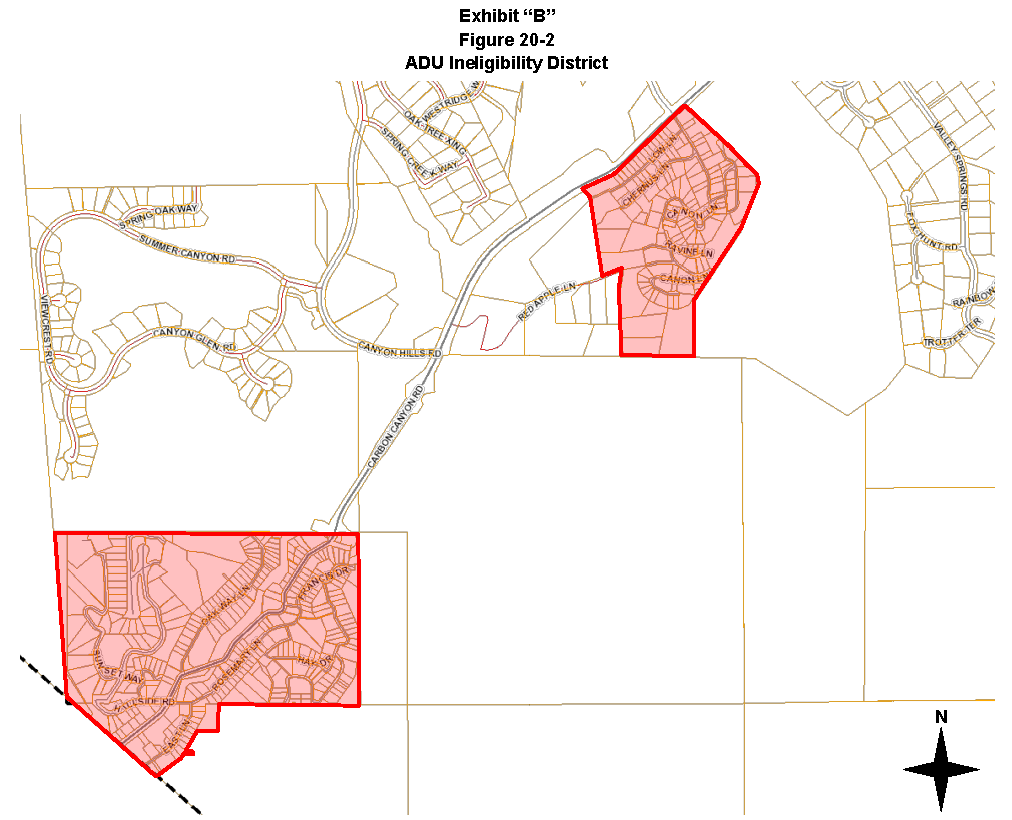
H.
State Exempt ADUs. Notwithstanding any other provision of this section, the city shall ministerially approve an application for a building permit within a residential or mixed-use zone to create any of the following units, or any combination of the following units:
1.
One accessory dwelling unit and one junior accessory dwelling unit per lot with a proposed or existing single-family dwelling if all of the following apply:
a.
The accessory dwelling unit or junior accessory dwelling unit is within the proposed space of a single-family dwelling or existing space of a single-family dwelling or accessory structure and may include an expansion of not more than one hundred fifty (150) square feet beyond the same physical dimensions as the existing accessory structure. An expansion beyond the physical dimensions of the existing accessory structure shall be limited to accommodating ingress and egress.
b.
The space has exterior access from the proposed or existing single-family dwelling.
c.
The side and rear setbacks are sufficient for fire and safety.
d.
The junior accessory dwelling unit complies with the requirements of Title 7, Division 1, Chapter 13, Article 3 of the Government Code (commencing with Section 66333).
2.
One detached, new construction, accessory dwelling unit that does not exceed four-foot side and rear yard setbacks for a lot with a proposed or existing single-family dwelling. The accessory dwelling unit is subject to the following conditions:
a.
A total floor area limitation of not more than eight hundred (800) square feet of livable space.
b.
A height limitation as provided in subparagraph (M).
3.
Multiple accessory dwelling units within the portions of existing multifamily dwelling structures that are not used as livable space, including, but not limited to, storage rooms, boiler rooms, passageways, attics, basements, or garages, if each unit complies with state building standards for dwellings. The city will allow at least one accessory dwelling unit within an existing multifamily dwelling and will allow up to twenty-five (25) percent of the existing multifamily dwelling units.
4.
Multiple accessory dwelling units, not to exceed the number specified in subparagraph (H)(4)(a) or (H)(4)(b), as applicable, that are located on a lot that has an existing or proposed multifamily dwelling, but are detached from that multifamily dwelling and are subject to a height limitation in subparagraph (M), as applicable, and rear yard and side setbacks of no more than four feet. However, if the existing multifamily dwelling has a rear or side setback of less than four feet, no modification of the existing multifamily dwelling shall be required as a condition of approving the application to construct an accessory dwelling unit that otherwise satisfies the requirements of this subparagraph.
a.
On a lot with an existing multifamily dwelling, not more than eight detached accessory dwelling units. However, the number of accessory dwelling units allowable pursuant to this subparagraph shall not exceed the number of existing units on the lot.
b.
On a lot with a proposed multifamily dwelling, not more than two detached accessory dwelling units.
I.
Minimum Size. Accessory dwelling units and junior accessory dwelling units shall have a minimum size of two hundred twenty (220) square feet.
J.
Maximum Size. The maximum size of an accessory dwelling unit shall not exceed eight hundred fifty (850) square feet of interior livable space for an accessory dwelling unit containing up to one bedroom, or one thousand (1,000) square feet of interior livable space for an accessory dwelling unit containing more than one bedroom. Additionally, the total interior livable space of an accessory dwelling unit attached to the primary dwelling unit and exceeding eight hundred (800) square feet in floor area shall not exceed fifty (50) percent of the floor area of the proposed primary dwelling unit or of the existing livable floor area of an existing primary dwelling unit.
K.
Setbacks. Accessory dwelling units and junior accessory dwelling units shall comply with the following setbacks:
1.
Front setback: Same as the primary dwelling.
2.
Side setbacks: Four feet to the property line.
3.
Rear setback: Four feet to the property line.
4.
For accessory dwelling units and junior accessory dwelling units within an existing structure, the side and rear setbacks shall comply with current City building and fire code requirements.
5.
No part of the accessory dwelling unit structure shall project into the four-foot side or rear setbacks specified in this Section "K".
L.
Lot Coverage. Unless deviation from the standard is necessary to permit the construction of an accessory dwelling unit with at least eight hundred (800) square feet of interior livable space, accessory dwelling units shall conform to the maximum lot coverage standard of the underlying zoning district.
M.
Maximum Height. Accessory dwelling units shall not exceed one-story and eighteen (18) feet in height, except that an accessory dwelling unit attached to the primary dwelling shall not exceed the height of the existing primary dwelling or twenty-five (25) feet, whichever is greater.
N.
A detached two-story accessory dwelling unit, not exceeding the maximum height of the zoning district, may be permitted where the accessory dwelling unit matches the architectural style, material, and colors of the primary dwelling unit; and complies with the setbacks applicable to the primary dwelling unit.
O.
Independent Access. All accessory dwelling units and junior accessory dwelling units shall be provided with exterior access independent from the primary residence. A junior accessory dwelling unit that shares a sanitation facility with the primary dwelling shall be provided with an interior entry to the main dwelling in addition to the independent exterior access.
P.
Required Parking.
1.
One covered or uncovered parking space shall be provided for any accessory dwelling unit containing one or more bedrooms.
2.
An accessory dwelling unit meeting one or more of the criteria listed in subdivision (a) of Government Code section 66322 shall be exempt from the parking requirement.
3.
The replacement of parking spaces shall not be required when a garage, carport, or other covered parking structure is converted into an accessory dwelling unit or demolished to accommodate the construction of an accessory dwelling unit. The primary dwelling unit shall be deemed legal, non-conforming if it no longer satisfies the parking requirements of Chapter 16.34 Parking and Loading as a result of such conversion or demolition; subsequent additions to the primary dwelling unit shall comply with the parking requirements of Chapter 16.34 Parking and Loading.
Q.
Objective Design Standards. Except for the State Exempt accessory dwelling units and junior accessory dwelling units described in subparagraph (H), all accessory dwelling units and junior accessory dwelling units shall conform to the following design standards:
1.
Attached accessory dwelling units shall match the primary dwelling in architectural style (characterized by features that make the primary house notable such as roof pitch, trim, and window and door styles), exterior materials, and exterior colors.
2.
Any exterior doors and/or windows installed in the development of the accessory dwelling unit, attached to or within the primary dwelling, shall match the primary dwelling unit in design, color, and decorative molding/trim.
3.
For accessory dwelling units developed within a garage, the garage door(s) shall be removed and replaced with a wall(s), containing a window or door, that matches the architectural style (characterized by features that make the primary house notable such as roof pitch, trim, and window and door styles) and exterior materials and colors of the front elevation of the home. The accessory dwelling unit shall comply with all California Building Code requirements pertaining to the conversion of the garage into habitable space.
4.
All new exterior lighting shall be limited to down-lights.
5.
New detached accessory dwelling units shall provide decorative trim of at least three-quarter inches in depth and three inches in width around windows and exterior doors. Decorative trim may be omitted if the window or door is recessed at least three inches into the exterior wall plane.
6.
New second story accessory dwelling units (not converted within an existing space) shall be set back a minimum of five feet from the first story building face at the front and street-facing elevations.
7.
Entrances and stairways serving a second story accessory dwelling unit shall not be located on the front or street-facing elevations.
8.
Accessory dwelling units shall provide clear addressing visible from the street. Addresses must be at least four inches high.
9.
An accessory dwelling unit shall have utility hookups and an area shall be provided to accommodate installation of a clothes washer and dryer within the dwelling unit.
10.
Accessory dwelling units shall incorporate roof overhangs of at least twelve (12) inches.
R.
Separate Utilities.
1.
Separate utility connections and meters, excluding sewer service, are required of all accessory dwelling units.
2.
Notwithstanding the above, separate utility connections and meters are not required for junior accessory dwelling units, attached accessory dwelling units, or accessory dwelling units described in subparagraph (H)(1), unless the unit was constructed with a new single-family dwelling or unless the Building Official determines that the existing utility connections are not of an adequate size and capacity to serve the unit.
S.
Separate Addresses. All accessory dwelling units and junior accessory dwelling units shall be issued a separate address from the primary dwelling unit.
T.
Building Code. The accessory dwelling unit shall comply with all provisions of the currently adopted building and construction codes pursuant to Title 15, except that accessory dwelling units and junior accessory dwelling units shall not be required to provide fire sprinklers if they are not required for the existing primary residence.
U.
For the purposes of this section, an accessory dwelling unit shall be considered attached if it is connected by a common wall or segment thereof.
V.
For the purposes of this section, words and phrases defined in Title 7, Division 1, Chapter 13 of the Government Code shall have the same meaning when used in this section.
W.
For the purposes of this section, "car share vehicle location" refers to a location where a vehicle available for short term rental by a licensed car sharing organization is stored while not being used.
X.
As part of the application for a permit to create an accessory dwelling unit connected to an onsite wastewater treatment system, a percolation test completed within the last five years, or, if the percolation test has been recertified, within the last ten (10) years, is required.
(Ord. No. 321, § 9, 11-28-2017; Ord. No. 364, § 8, 2-9-2021; Ord. No. 406, § 7(Exh. C), 2-27-2024; Ord. No. 417, § 5(Exh. A), 2-11-2025; Ord. No. 429, § 5(Exh. A), 1-13-2026)
16.10.150 - Urban lot split subdivisions and housing developments pursuant to Government Code §§ 65852.21 and 66411.7—SB 9.
A.
Urban Lot Split Subdivisions and Housing Development of up to Two (2) Dwelling Units.
1.
Criteria. A parcel may be subdivided through an urban lot split ("Urban Lot Split") or developed with up to two (2) dwelling units as authorized in Government Code §§ 65852.21 and 66411.7 ("SB 9") pursuant to this section, provided it satisfies the following criteria:
a.
The parcel is zoned single-family residential use.
b.
The proposed urban lot split or housing development does not involve the demolition or alteration of any of the following types of housing:
i.
Housing that is subject to a recorded covenant, ordinance, or law that restricts rents to levels affordable to persons and families of moderate, low, or very low income.
ii.
Housing that is subject to any form of rent or price control through a public entity's valid exercise of its police power.
iii.
Housing that has been occupied by a tenant in the last three (3) years.
iv.
Housing that is on a parcel on which an owner has exercised the owner's rights under Chapter 12.75 (commencing with Section 7060) of Division 7 of Title 1 to withdraw accommodations from rent or lease within fifteen (15) years.
c.
The parcel is not within an area(s) specified in subparagraphs (B) through (K), inclusive, of paragraph (6) of subdivision (a) of Government Code § 65913.4. These areas include, but are not limited to, prime farmland, wetlands, very high fire hazard severity zones, hazardous waste sites, earthquake fault zones, special flood hazard areas, regulatory floodway, and lands identified for conservation or habitat preservation as specifically defined in Government Code § 65913.4.
d.
Properties Ineligible for SB 9 Urban Lot Split Subdivision and Housing Development for Preservation of Public Safety. There shall be established ineligible areas "SB 9 Urban Lot Split and Housing Development up to Two (2) Units Ineligibility Areas" defined by two (2) specific locations within the City shown in Figure 20-3 shown below. Urban lot split and housing development (of more than one (1) unit a lot) under SB 9 shall not be permitted within the ineligibility areas.
e.
Uses.
i.
Notwithstanding § 16.10.020, and CHMC Appendix A, parcels resulting from an urban lot split shall be limited to residential uses.
ii.
Any rental or lease of any dwelling unit created pursuant to this section shall be for a period exceeding thirty (30) days.
iii.
No more than two (2) dwelling units, shall be developed on a lot resulting from an urban lot split. For the purposes of this section, "dwelling unit" means any dwelling unit, including an accessory dwelling unit or a junior accessory dwelling unit created pursuant to § 16.10.140.
iv.
Guest houses shall not be developed on a lot resulting from an urban lot split or housing development under SB 9.
f.
An urban lot split or housing development under SB 9 may be denied if the building official makes a written finding, based upon a preponderance of the evidence, that the proposed housing development project would have a specific, adverse impact, as defined and determined in paragraph (2) of subdivision (d) of Section 65589.5, upon public health and safety or the physical environment and for which there is no feasible method to satisfactorily mitigate or avoid the specific, adverse impact.
B.
Additional Requirements for Urban Lot Split.
1.
Criteria. The following criteria applies to all urban lot split subdivisions:
a.
The parcel was not established through a prior exercise of an urban lot split as provided for in this section or pursuant to Government Code § 66411.7.
b.
Neither the owner of the parcel nor anyone acting in concert with the owner has previously subdivided an adjacent parcel through an urban lot split as provided for in this section or pursuant to Government Code § 66411.7.
c.
Subdivisions under this section shall comply with applicable provisions of the Subdivision Map Act.
2.
Site Standards.
a.
Each lot resulting from the urban lot split shall be at least one thousand two hundred (1,200) square feet in area.
b.
The lots resulting from an urban lot split shall be of approximately equal size and the smaller of the two (2) lots shall not be smaller than forty (40) percent of the lot area of the original parcel being subdivided.
c.
Each parcel shall have legal access to a public or private street consistent with the Chino Hills Municipal Code.
d.
Easements shall be provided as necessary to ensure the provision of public services and facilities to the lots resulting from the urban lot split and surrounding parcels.
C.
Additional Requirements for Housing Developments Containing Up to Two (2) Dwelling Units under SB 9.
1.
Criteria. The following criteria applies to all housing developments under SB 9:
a.
The applicant/owner shall sign an affidavit stating that the applicant/owner intends to occupy one (1) of the housing units as their principal residence for a minimum of three (3) years from the approval date of the urban lot split. Community land trusts and qualified nonprofit corporations, as defined in Revenue and Taxation Code §§ 402.1 and 214.15, respectively, are exempt.
b.
The proposed housing development does not involve the demolition of more than twenty-five (25) percent of the existing exterior structural walls unless the site has not been occupied by a tenant in the last three (3) years.
2.
Site Standards.
a.
Required Parking.
i.
One (1) off-street parking space per dwelling unit is required and shall adhere to the parking standards and dimensions of parking facilities in Chapter 16.34 Parking and Loading.
ii.
Off-street parking is not required in either of the following instances: (1) the parcel is located within one-half (½) mile walking distance of either a high-quality transit corridor as defined in subdivision (b) of Section 21155 of the Public Resources Code, or a major transit stop as defined in Section 21064.3, or (2) there is a car share vehicle located within one (1) block of the parcel.
b.
Setbacks.
i.
Front Setback. Shall comply with the underlying zoning district.
ii.
Side Setback. Four (4) feet from the property line.
iii.
Rear Setback. Four (4) feet from the property line.
iv.
No side or rear setbacks are required for an existing dwelling unit or a dwelling unit construed in the same location and to the same dimensions as the existing dwelling unit.
v.
There shall be no permitted projections into the required setbacks.
c.
Lot Coverage. The maximum building coverage shall be forty (40) percent, except that the lot coverage shall be increased, if necessary, to allow the development of two (2) dwelling units with a floor area up to eight hundred (800) square feet each.
d.
Pursuant to CHMC § 16.10.030 Development Standards, the maximum coverage in the front yard setback by impervious surfaces shall be the greater of fifty percent (50%) or the aggregate area of the following: (i) the area comprising the driveway directly fronting a primary garage door(s) to the street, (ii) one (1) additional area of up to fifteen (15) feet in width on one (1) side of the driveway to the street, (iii) a walkway(s) of up to five (5) feet in width providing a walking path between the front door of the residence and the front property line and/or the driveway, and (iv) a walkway of up to five (5) feet wide providing access from the driveway to the side yard.
e.
Trash Pad. Each dwelling unit shall provide a concrete trash pad of at least three (3) feet in width and eight (8) feet in length that is visually screened from the public right-of-way for the storage of waste and recycling bins. A paved pathway shall be provided from the paved area of the trash pad to the location from which the bins will be emptied by the City approved waste hauler.
f.
Mechanical Equipment. Any mechanical equipment shall be located in the side or rear of the house, outside of the required setback, and shall be visually screened from the public right-of-way.
g.
Perimeter Fence. Each parcel shall have a perimeter fence or wall conforming to the standards specified in Section 16.06.120 Fences, Walls and Hedges.
h.
Landscaping. Each dwelling unit shall provide front yard landscaping involving planting areas, turf areas, and water features in a landscape design plan aggregate landscape area in the front yard equal to or greater than five hundred (500) square feet and rehabilitated landscape projects with an aggregate landscape area equal to, or greater than, two thousand five hundred (2,500) square feet subject to Chapter 16.07 Landscape and Water Conservation Requirements.
i.
Drainage. Each parcel shall drain to the street or to an approved storm drain facility. All roof drainage shall be collected by gutters and downspouts.
j.
Wastewater. For proposed residential units connected to an onsite wastewater treatment system, a percolation test shall be provided and completed within the last five (5) years. Existing percolation tests must be recertified within the last ten (10) years.
k.
Tree Removal. Any tree removals shall comply with Chapter 16.90 Tree Preservation.
l.
Accessory Structures. Accessory structures are not subject to the standards within this section and shall comply with Chapter 16.06 General Development Standards.
m.
Fire Hazard Overlay. For dwelling units located within a fire hazard overlay, additional standards apply. See Chapter 16.22 Fire Hazard Overlay District.
n.
Utilities. All dwelling units shall have separate utilities and facilities (connections, lines, and meters) including wastewater, electrical and water systems.
o.
All water meters shall be located within the public right-of way unless otherwise approved by the City. Public easements shall be required for any meter installed outside of public right-of-way. Recorded documents must be submitted to the City prior to occupancy release.
p.
All driveways and street corners shall illustrate compliance with § 16.06.080 Clear Corner Areas for Sight Visibility of the CHMC. Nothing shall be placed or allowed to grow taller than thirty (30) inches within the clear corner areas in a manner which obstructs visibility or threatens vehicular or pedestrian safety.
q.
All improvements within both public or private rights-of-way shall be built to City standards and in accordance with the current edition of "standard specification for public works construction" and the City of Chino Hills Development Code (CHMC Chapter 16).
3.
Design Standards.
a.
Dwelling Unit Size. All dwelling units shall have a minimum gross floor area of seven hundred fifty (750) square feet. The minimum dwelling unit width and depth shall be twenty (20) feet, measured from the exterior of the structure and excluding garages, porches, patios, eaves, cabanas, and bay windows.
b.
Siding Material. Siding material shall consist of stucco, wood, brick, stone, or decorative concrete block. Synthetic materials of a similar appearance and equivalent durability shall be permitted. Exterior siding shall extend to a point at or near grade.
c.
Roofing. Roofing materials shall be Class "A" as defined by the California Building Code.
d.
Utility Hookups. Each dwelling unit shall have utility hookups and an area shall be provided to accommodate installation of a clothes washer and dryer. The hookups and area shall be provided within the primary structure (house).
e.
Building Massing/Scale.
i.
Second Story Setback. The second story of a dwelling unit shall be set back a minimum of three (3) feet from the first story wall plane on all street facing elevations.
ii.
Maximum Building Height. The maximum building heights shall comply with the underlying zoning district.
f.
Enhanced Architectural Treatment.
i.
Ornamental Facades. Each dwelling unit shall have architectural ornamentation, including decorative light fixtures, stone veneer, two-tone exterior paint, or siding to enhance the architectural treatment of the dwelling unit.
ii.
Each dwelling unit shall incorporate roof overhangs of at least twelve (12) inches.
iii.
Decorative window trim of at least two (2) inches in depth and four (4) inches in width shall be provided for all windows in a color complimentary to the exterior color scheme of the dwelling unit.
g.
Vents and Downspouts. Roof flashing, rain gutters, and downspouts, vents, and other roof protrusions shall be finished to match the adjacent materials and/or colors.
h.
Garages. Materials and colors of garages shall be similar to those used for the primary structure.
i.
Garage Doors. Garage doors shall appear to be set into the walls of the garage or the house rather than being flushed with the exterior wall of the garage or the house. Garage doors shall be of a roll-up design.
j.
Lighting. All exterior lights shall be oriented to the subject property and shall not create glare or light trespass on an adjacent property.
4.
Fees. Properties developed under this section shall be subject to all applicable fees, including development impact fees and assessments.
D.
Repeal. If Senate Bill 9 is repealed in whole or part, the corresponding chapter or section shall also be deemed repealed.
(Ord. No. 380, § 5(Exh. A), 1-11-2022)

