
Chino Hills City Zoning Code
CHAPTER 16
38 - SIGNS10
Editor's note— Ord. No. 318, § 5, adopted Sept. 26, 2017, amended former Ch. 16.38, §§ 16.38.010—16.38.080, in its entirety to read as herein set out. Former Ch. 38 pertained to similar subject matter and derived from Ord. No. 309, § 6, adopted April 11, 2017.
16.38.010 - Intent and purpose.
A.
The provisions of this chapter establish general regulations for the use of signs and other exterior advertising formats within the City.
B.
Sign regulations are established to promote the public health, safety, and welfare by safeguarding and enhancing property values; protecting public and private investment in buildings and open spaces; improving the appearance of the City as a place in which to live and work, and as an attraction to nonresidents who come to visit or trade; encouraging sound signing practices as an aid to business, and to provide information to the traveling public; preventing excessive and confusing sign displays; reducing hazards to motorists and pedestrians, and reducing visual blight.
C.
No person may erect any sign regulated by this chapter without first obtaining appropriate permits, where required. Such signs must be erected in conformance with the provisions of this Code and any applicable approved sign program.
(Ord. No. 318, § 5, 9-26-2017)
16.38.012 - Definitions.
"Animated" means having the appearance of movement using computerized, electrical, or mechanical animation techniques.
"Billboard" or "off-site sign" means a sign or sign structure of any kind or character erected or maintained for the purpose of advertising a business, activity, service, or product not located, sold, or manufactured on the premises upon which the sign or sign structure is placed.
"Business" for purposes of this chapter has the same meaning as set forth in Section 5.04.010 of this Code and means any employment avocation, occupation, profession, trade, calling, lawful game, show, exhibition, event, venture, fund-raising activity, commercial enterprise, company, corporation, joint enterprise, place of business, partnership or other activity or enterprise engaged in for gain, profit, benefit, advantage or livelihood, whether or not a gain, profit, benefit, advantage, or livelihood is earned by such business.
"Business tenant" means the business occupying a specific lease space within a commercial center.
"Business tenant sign" means a sign that is attached to the exterior of the building entry that a business occupies.
"Cabinet sign" (also known as a "box" sign or "can" sign) means a sign structure consisting of the frame and face(s), not including the internal components, embellishments, or support structure.
"Copy" means the words, letters, numbers, figures, designs, or other symbolic representations incorporated into the visually communicative elements of a sign.
"Electronic changeable message" means an alphabetic, graphic, or symbolic informational content or display, either in whole or in part, that is composed of electrically illuminated or mechanically driven changeable segments, which may be changed or altered by means of electrical, electronic, or computerized programming.
"Freestanding sign" means a monument sign or pylon sign as defined in this Code.
"Freeway-oriented sign" means a sign on a commercial property immediately adjacent to the Chino Valley Freeway and as regulated by this Code.
"Hindu-Arabic numerals" means a positional decimal numeral system utilizing ten (10) different glyphs, 0 through 9.
"Modern Latin Alphabet" means the most widely used alphabetic writing system in the world utilizing twenty-six (26) letters in upper and lower-case type.
"Monument sign" means a freestanding sign that is detached from a building and having a support structure that is a solid-appearing base constructed of a permanent material, such as concrete block or brick.
"Neighborhood identification sign" means a sign located at the entry to a single-family neighborhood for the purpose of identifying the location of the neighborhood within the community.
"Noncommercial sign" means a sign that is not erected or maintained for the purpose of advertising a business or product.
"Pedestrian pathway" means a public sidewalk, private sidewalk, or internal pedestrian circulation path.
"Project identification entry wall sign" means a sign face incorporated within the street facing entry wall of a commercial, business park, industrial, multi-family development, or a single-family neighborhood.
"Property" means a building or buildings and the land belonging to it or them.
"Public right-of-way" for purposes of this chapter has the same meaning as set forth in Code Section 12.44.020 and means any place, of any nature, which is dedicated to use by the public for pedestrian and/or vehicular travel, and includes, but is not limited to, a street, sidewalk, curb, gutter, crossing, intersection, parkway, highway, alley, lane, mall, court, way, avenue, boulevard, road, roadway, viaduct, subway, tunnel, bridge, thoroughfare, park, square, and any other similar public way.
"Pylon sign" means a freestanding sign with a visible support structure such as a pole or post.
"Sign" means the entire sign, including structure, sign face, lettering, and logo.
"Sign face" means the area or portion of a sign on which copy is intended to be placed.
"Temporary sign" means a sign that is intended to display information to the public for a limited period of time.
"Vehicular way" means a highway, street, drive aisle, or driveway.
(Ord. No. 318, § 5, 9-26-2017; Ord. No. 386, § 8(Exh. D), 7-12-2022; Ord. No. 412, § 3, 11-12-2024)
16.38.015 - Exempt signs.
The following signs are exempt from the requirements of this Code and any applicable plan:
A.
Signs, flags, banners, emblems or notices issued or endorsed by a constituted governmental body, public agency, court, government employee or agent or officer in performance of a public duty, including traffic or highway signs, railroad crossing signs or similar regulatory or warning devices and legal notices.
(Ord. No. 318, § 5, 9-26-2017)
16.38.020 - Sign construction and maintenance standards.
All permanent signs shall comply with the following criteria:
A.
The sign must be legible to the intended audience under normal viewing conditions, based on its proposed location, and the design of its visual element.
B.
The sign must not obscure the view of, or detract from, existing signs, based on its location, shape, color, and other considerations.
C.
Materials and Structure.
1.
Sign materials (including those for framing and support) should be representative of the type and scale of materials used on the building or buildings that the sign identifies. To the extent feasible, sign materials should match the materials used on the building and on other signs.
2.
Materials selected for permanent signs must be durable and capable of withstanding weathering over the life of the sign with reasonable maintenance.
3.
Cabinet signs are not permitted.
D.
The sign must be in harmony with adjacent properties and surroundings, based on the size, shape, height, color, placement, and the proximity of the proposed signs to adjacent properties and surroundings.
E.
Size of signs must be proportional to the scale of the building and the surface they are affixed to.
F.
The height of a sign is measured from its highest point to its lowest adjacent grade.
G.
A sign may only be lit by steady, stationary, shielded light directed only at the sign, by light inside the sign, by direct neon or similar lighting.
H.
External light sources must be directed and shielded to limit direct illumination of any object other than the sign.
I.
All transformers, equipment, programmers, and other related items must be screened or concealed within the sign structure.
J.
All permanent signs must be constructed of quality, low-maintenance materials such as metal, concrete, natural stone, glass, acrylics or comparable material. Techniques must be incorporated during construction to reduce fading and damage caused by exposure to sunlight.
K.
All signs must be constructed in compliance with any applicable building, electrical, or other Code in effect at the time of construction or maintenance.
L.
Signs must be cleaned and/or repaired as necessary to maintain an attractive appearance and to ensure safe operation of the sign. Unacceptable sign conditions include: broken or missing sign faces, broken or missing letters, chipped or peeling paint, missing or inoperative lights, exposed mechanical or electrical components, and missing or broken fasteners. Failure to respond to a written request from the City to perform maintenance work shall be grounds for revocation of the sign's permit.
M.
All signs of a discontinued business must be removed within thirty (30) days and the underlying façade shall be restored to its pre-sign condition with no indication of previous signage on the façade.
(Ord. No. 318, § 5, 9-26-2017)
16.38.023 - Sign design guidelines.
The following design criteria apply to individual signs:
A.
Colors on signs and structural members should be harmonious with one another and consistent with the dominant colors of the building or buildings being identified.
B.
The size of the structural members (e.g. columns, crossbeams, and braces) should be proportional to the sign panel they are supporting. In general, fewer larger supporting members are preferable to many smaller supports.
C.
The use of individual letters incorporated into the building design is encouraged, rather than signs with background and framing other than the building wall.
D.
Logos should be three-dimensional whenever possible.
E.
These guidelines do not regulate the message content (copy) of signs; however, the following are principles of copy design and layout that can enhance the readability and attractiveness of signs. Copy design and layout consistent with these principles is encouraged, but not required.
1.
Sign copy should relate to the name and/or nature of the business or commercial center.
2.
Permanent signs that advertise continuous sales, special prices, etc. should be avoided.
3.
Information should be conveyed briefly or by logo, symbol, or other graphic manner. The intent should be to increase the readability of the sign and thereby enhance the identity of the business.
4.
Freestanding signs should contain the street address of the property or the range of addresses for a multi-tenant center.
(Ord. No. 318, § 5, 9-26-2017)
16.38.025 - Sign placement.
A.
Signs may be placed on private property only, except as otherwise provide in this Section 16.38.043.H of this Code. No sign may be placed on any property without the property owner's consent, (including applicable fee and easement holders), even if a permit is obtained pursuant to Section 16.38.043.H of this Code.
B.
No sign, or any portion thereof, may extend over the public right-of-way (except as otherwise provide in Section 16.38.043.H of this Code) or over a property line onto an adjacent property unless consent is obtained from the adjacent property owner.
C.
No portion of a sign may be located closer than one foot from the existing public right-of-way line, except as otherwise provided in Section 16.38.043.H. of this Code.
D.
No sign may interfere with a driver's or pedestrian's view of public rights-of-way or in any other manner impair public safety, or interfere with the safe operation of a motor vehicle on public streets. This includes, without limitation, the driver's view of approaching, merging, or intersecting traffic.
E.
No signs may be allowed within clear sight triangles as established by Section 16.06.080 of the Municipal Code.
F.
Signs may not be erected in any location where the City determines the sign may cause a safety hazard or interfere with any authorized traffic sign.
G.
No sign may be attached to, or painted on, natural features such as trees, shrubs or rocks.
H.
No sign may be attached to, or painted on, a public utility pole or street light.
I.
No sign may be painted on a wall, roof or door of a building.
J.
Signs placed on walls may project no more than eight inches from the wall, and may not project above the roof line or extend over a sidewalk or right-of-way.
K.
Sign letters may not project below the façade upon which it is placed.
(Ord. No. 318, § 5, 9-26-2017; Ord. No. 326, § 6, 4-24-2018)
16.38.030 - Permanent exterior business sign requirements.
To protect and serve the public health, safety and welfare by facilitating the location and identification of premises, every business must have at least one exterior business sign consisting of a business tenant sign, freestanding sign, project identification wall sign and/or freeway-oriented sign as permitted by this Code that complies with all of the following:
A.
Shall be oriented to a vehicular way or pedestrian pathway.
B.
For signs oriented to a vehicular way, such signs shall have a minimum letter height in accordance with Table 1. For each additional thirty (30) feet from the street right-of-way, the minimum letter height shall be increased by one inch in order to be legible from the street. For example, if a sign is located sixty (60) feet from the right-of-way along a street with a speed limit of thirty-five (35) mph, the minimum letter height would be: 9 inches + (60 feet - 30 feet) × 1 inch/30 feet = 10 inches.
Table 1
Minimum Letter Height for Street and Freeway-Oriented Signs
C.
For signs oriented to a pedestrian pathway, if the required exterior business sign is within 50 feet of the pedestrian pathway, such sign shall have a minimum letter height of three inches. If further than 50 feet from a pedestrian pathway, for each additional 30 feet, the minimum height of the letters must increase by one inch.
D.
Regardless of the above, for businesses oriented to both vehicular way and pedestrian pathway, but for which the vehicular sign is not visible in the pedestrian pathway, such business shall have at least one sign oriented to the vehicular way and one sign visible to the pedestrian way.
E.
If the required exterior business sign does not contain a word or words in the Modern Latin alphabet, the sign shall also contain a translation or interpretation into words comprised of letters from the Modern Latin alphabet and, if numbers are used, Hindu-Arabic numerals. Such translation or interpretation shall be chosen by the business and contain the business name.
(Ord. No. 318, § 5, 9-26-2017)
16.38.032 - Permanent exterior sign general number and size standards.
The following standards apply to permanent business tenant signs, freestanding signs and project identification wall signs:
A.
In all non-residential districts and mixed-use districts, building tenant signage shall comply with the following standards:
1.
Maximum of one building tenant sign per business per vehicular way or pedestrian pathway frontage.
2.
Maximum area of a building tenant sign shall be one square foot per one foot of linear lease space frontage, provided the maximum length of a sign shall be no greater than seventy (70) percent of linear lease space frontage.
3.
Maximum height of a building tenant sign shall be two feet.
B.
In all non-residential districts and mixed-use districts, freestanding signs shall comply with the following standards:
1.
Maximum of one freestanding sign per street frontage.
2.
Maximum area of a freestanding sign shall be one square foot per one foot of linear street frontage, provided the maximum size of a sign shall be no greater than 60 square feet.
3.
Maximum height of a freestanding sign shall be eight feet.
C.
In all non-residential and mixed-use districts, project identification wall signs shall comply with the following standards:
1.
Maximum of one project identification wall sign per street frontage or single-family neighborhood entry.
2.
A project identification wall sign shall be permitted in lieu of a freestanding sign but not in addition to a freestanding sign.
3.
Maximum area of the sign face shall be fifty (50) square feet.
4.
Dimensions of the entry wall shall be consistent with the underlying zone.
D.
In all residential districts, project identification wall signs shall comply with the following standards:
1.
Maximum of one project identification wall sign per street frontage or single-family neighborhood entry.
2.
A project identification wall sign shall be permitted in lieu of a freestanding sign but not in addition to a freestanding sign.
3.
Maximum area of the sign face shall be forty (40) square feet.
4.
Dimensions of the entry wall shall be consistent with the underlying zone.
E.
In all multi-family districts, freestanding signs shall comply with the following standards:
1.
Maximum of one freestanding sign per street frontage.
2.
Maximum area of a freestanding sign shall be one square foot per one foot of linear street frontage, provided the maximum size of a sign shall be no greater than sixty (60) square feet.
3.
Maximum height of a freestanding sign shall be eight feet.
F.
For neighborhood identification signs in single-family residential districts, freestanding signs shall comply with the following standards:
1.
Maximum of one freestanding sign per street frontage.
2.
Maximum area of a freestanding sign shall be one square foot per one foot of linear street frontage, provided the maximum size of a sign shall be no greater than sixty (60) square feet.
3.
Maximum height of a sign shall be eight feet.
G.
For all non-residential uses in residential districts, freestanding signs shall comply with the following standards:
1.
Maximum of one freestanding sign per street frontage.
2.
Maximum height of a sign shall be four feet.
3.
Maximum size of a sign shall be thirty-two (32) square feet.
4.
Lettering of a sign shall be centered on the sign face.
H.
Freestanding signs shall be no closer than fifty (50) feet from another freestanding sign.
(Ord. No. 318, § 5, 9-26-2017)
16.38.033 - Electronic changeable message standards.
Notwithstanding any other provision in this chapter, in public and private institutional districts only, an electronic changeable message may be permitted as part of one permanent freestanding sign. The following standards apply to electronic changeable messages:
1.
The permanent freestanding sign containing an electronic changeable message shall comply with the provisions of Section 16.38.032.B, above except only one sign per property shall contain an electronic changeable message component.
2.
The electronic changeable message portion shall not exceed sixty (60) percent of the total sign face.
3.
The electronic changeable message portions shall be internally illuminated or self-illuminating, including light emitting diodes (LEDs), fiber optics, light bulbs, or other illumination devices within the electronic display panel(s).
4.
The electronic changeable message shall not change more frequently than one (1) frame every seven (7) seconds, and the duration or interval of time between each individual message is a maximum of two (2) seconds.
5.
The electronic changeable message shall have a sensor or other device that adjusts the brightness of the sign to be no more than three-tenths foot-candles greater than ambient light conditions when measured at the closest property line.
6.
The electronic changeable message shall not include fading movement, flashing, spinning, revolving, shaking, scrolling, fluctuation in light intensity, use sudden transitory bursts, nor any other type of movement or motion.
(Ord. No. 386, § 8(Exh. D), 7-12-2022)
16.38.034 - Comprehensive sign programs.
A.
The purpose of a comprehensive sign program is to ensure that permanent signs within a development project are coordinated with the project's design and in harmony with adjacent properties and the surrounding area.
B.
A comprehensive sign program is required for every new and substantially remodeled commercial, business park or light industrial project in order to create a coordinated project theme of uniform design elements, such as color, lettering style, and placement. A substantially remodeled project is a physical change to the project façade affecting twenty-five (25) percent or more of the entire project building façade, or a physical change to the buildings affecting twenty-five (25) percent or more of the total project building area and requiring a building permit pursuant to the Municipal Code.
C.
An application for a comprehensive sign program shall include a plot plan and elevations that show the location of all proposed signs and detailed designs for all proposed signs, including without limitation, dimensions, materials, colors, font, illumination, and logo.
D.
Application and processing requirements for comprehensive sign programs shall be the same as set forth in Chapter 16.78 of the Municipal Code.
(Ord. No. 318, § 5, 9-26-2017)
16.38.035 - Freeway-oriented signs.
Commercial uses on properties immediately adjacent to the Chino Valley Freeway (SR-71) may install signs that meet the following criteria:
A.
Maximum height of freeway-oriented signs shall be 100 feet. An illustration of maximum sign height is shown in Figure 70-1 of this chapter.
B.
Maximum sign area for each sign face shall be four hundred (400) square feet. Each sign shall have a maximum of two faces. An illustration of maximum sign size is shown in Figure 70-1.
C.
Developments of up to ten (10) acres may erect no more than one freeway-oriented sign. Developments of more than ten (10) acres may erect a maximum of two signs.
D.
Freeway-oriented signs shall not rotate or be animated in any way.
E.
Freeway-oriented signs consistent with this section may be placed on properties not immediately adjacent to the freeway.
F.
The design and location of all freeway-oriented signs shall be subject to the review and approval of the Planning Commission.
G.
Application and processing requirements for freeway-oriented signs shall be the same as set forth in Chapter 16.78 of the Municipal Code.
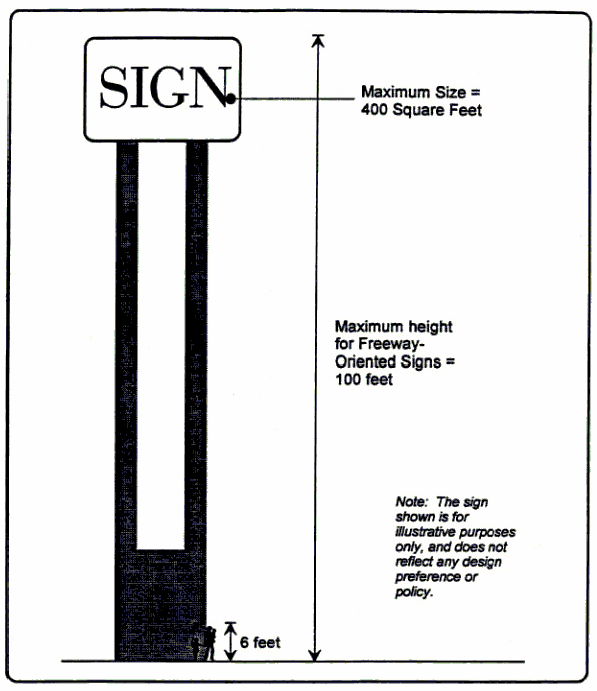
Figure 70-1. Maximum Height and Size
for Freeway-Oriented Signs
(Ord. No. 318, § 5, 9-26-2017)
16.38.037 - Window signs.
Non-residential uses may install or display signage within the windows of an establishment subject to the following criteria:
A.
No more than twenty-five (25) percent of the window area of a commercial establishment may be covered with signage.
1.
Window area shall be defined as the transparent area of all exterior windows and doors of a commercial establishment.
2.
Indoor signs and displays located within three feet of a window or door and which are oriented so as to be visible from the exterior of the establishment shall be considered window signage pursuant to this section.
B.
Window signs shall be located in a manner that does not unreasonably impede visibility into the public areas of the establishment (e.g. lobbies, queuing areas, etc.).
C.
Visibility may be obscured for windows providing a view of areas intended to be private (e.g. offices, exam rooms, etc.), where restaurant patrons are seated adjacent to windows, where equipment (e.g. coolers, ovens, etc.) is stored or operated, and preparation and maintenance areas.
1.
Obscured window area shall not be used for advertising purposes in a manner that results in window signage exceeding twenty-five (25) percent of the window area of the establishment.
D.
An aggregate of up to four square feet of window signage may be steadily illuminated (neon, LED, or equivalent illumination system).
1.
Illumination systems shall not be used to create a border around doors or windows.
2.
Signs or illumination systems that flash, change in illumination color or intensity, or are otherwise animated are prohibited.
E.
Up to an aggregate of five square feet of window area may be used for the posting of flyers by residents and non-profit organizations and shall not be included in the window signage area.
(Ord. No. 318, § 5, 9-26-2017)
16.38.040 - Temporary signs—General.
The following standards apply to all temporary signs permitted by this Code:
A.
Temporary signs are not restricted by content, except as otherwise provided in this Section 16.38.044.E of this Code, but are customarily used to advertise real estate sales, political or ideological positions, garage sales, special events, promotional events, home construction or remodeling. Temporary signs are only allowed as set forth in this section.
B.
Temporary signs may not be erected within any street intersection, clear sight triangle as established by Section 16.06.080 of the Municipal Code or at any location where the sign may interfere with, obstruct the view of, or be confused with any authorized traffic sign.
C.
Temporary signs may not be nailed or affixed to any tree, fence post or City public utility pole and shall not be located in the public right-of-way, City parkway or on City-owned land.
D.
Temporary signs that have an adhesive backing may not be affixed directly to any structure, and must be affixed in a manner that allows for easy removal without damaging the structure and without the need for specialized tools.
E.
Temporary signs may not be illuminated.
F.
All temporary signs and banners must be made of a material designed to maintain an attractive appearance for as long as the sign is displayed.
G.
Temporary signs, if permitted by this Code to exceed thirty-two (32) square feet and/or six feet in height, may require a permit through the City Building Division.
H.
Temporary flags erected on a building, if permitted by this Code, that exceed four feet by six feet in size or temporary flags if permitted by this Code erected on a ground mounted pole that exceed fifteen (15) feet in height require a permit through the City Building Division.
I.
Temporary signs posted in violation of this section are subject to removal by the City. Each violation of this section constitutes an infraction.
(Ord. No. 318, § 5, 9-26-2017; Ord. No. 412, § 4, 11-12-2024)
16.38.042 - Temporary real estate signs authorized by Civil Code Section 713.
A.
Temporary real estate signs are permitted in any zoning district when placed on real property that is for sale, lease, or exchange by the owner or his or her agent.
B.
In single-family zoning districts, temporary real estate signs shall have a maximum area of six square feet and a maximum height of five feet per sign. For double-sided signs, only the area of one side shall be counted toward the maximum area allowed.
C.
In non-residential and multi-family zoning districts, temporary real estate signs shall have a maximum area of thirty-two (32) square feet and a maximum height of eight feet per sign. For double-sided signs, only the area of one side shall be counted toward the maximum area allowed.
D.
Only one temporary real estate sign is permitted on a property at one time except that one additional sign of the same size is permitted if the property borders a second street and the copy on each sign is not visible simultaneously from either street.
E.
Temporary real estate signs must be removed within 10 days from the sale, lease or exchange of the property.
(Ord. No. 318, § 5, 9-26-2017)
16.38.043 - Temporary signs placed in connection with a single exhibition event.
A.
General: The following standards apply to all temporary signs placed in connection with a single exhibition event:
1.
A single exhibition event means a specific time when members of the public are invited to a private property within a residential zone in the City of Chino Hills for the purpose of socializing, viewing and/or engaging in sale or lease transactions, including, without limitation, events such as a real estate open house, holiday open house or similar activity. (For yard sales and additional signs that are permitted in conjunction with yard sales, reference Chino Hills Municipal Code Section 5.04.330.)
2.
Temporary single exhibition event signs shall only be placed during the day of the event and only on Fridays, Saturdays, Sundays, observed Memorial Day and observed Veterans Day between the hours of 7:00 a.m. and 6:00 p.m.
3.
Temporary single exhibition event signs shall have a maximum sign area of four (4) square feet. For double-sided signs, only the area of one side shall be counted toward the maximum area allowed.
4.
The maximum height of temporary single exhibition event signs shall not exceed four (4) feet.
5.
Notwithstanding any other provision of this chapter, this section does not regulate the content (copy) of signs in any way (except the display of the permit required in Section 16.38.043(C)(7)).
B.
Private Property: In addition to the general requirements listed in subsection A above, the following standards apply to all temporary signs placed on private property in connection with a single exhibition event:
1.
A maximum of five (5) temporary single exhibition event signs are permitted on the residential property on which the single exhibition event is being held.
2.
Temporary single exhibition event signs placed on privately-owned legal parcels in a residential zone must be attached to a wire, wood or similar post, or A-frame and placed in a stable manner on a landscaped or other permeable ground surface.
3.
One (1) temporary single exhibition event sign may be placed on other privately-owned residential properties in addition to the property holding the single exhibition event provided the consent of the property owner is received prior to sign placement.
C.
Public Right-of-Way (ROW): In addition to the general requirements listed in subsection A above, the following standards apply to all temporary single exhibition event signs placed on the public ROW:
1.
Location:
a.
Temporary single exhibition event signs shall be placed only in the landscaped portion of the public street parkway, and shall be prohibited in public ROW center medians, tree wells, sidewalks, trails or any other location where the City determines the sign may cause a safety hazard or interfere with vehicular or pedestrian movement, including, but not limited to, the movement and accessibility of persons with disabilities.
b.
No temporary single exhibition event signs shall be placed within fifty (50) feet of the corners at the following intersections:
1)
Butterfield Ranch Road and Shady View/SR71 off ramp
2)
Carbon Canyon Road and Canyon Hills Road
3)
Chino Avenue and Peyton Drive
4)
Chino Hills Parkway and Carbon Canyon Road/Rustic Drive
5)
Chino Hills Parkway and Chino Hills Marketplace
6)
Chino Hills Parkway and Eucalyptus Avenue
7)
Chino Hills Parkway and Grand Avenue
8)
Chino Hills Parkway and Peyton Drive
9)
Chino Hills Parkway and Pipeline Avenue
10)
Chino Hills Parkway and Ramona Avenue
11)
Grand Avenue and Boys Republic Drive
12)
Grand Avenue and Peyton Drive
13)
Peyton Drive and Eucalyptus Avenue
14)
Soquel Canyon Parkway and Pomona Rincon Road
15)
Soquel Canyon Parkway and Los Serranos Country Club Drive/ Butterfield Ranch Road
2.
Attachment: Temporary single exhibition event signs placed in the public ROW must be attached to a wire, wood or similar post, or A-frame and placed in a stable manner on a landscaped or other permeable ground surface of the public street parkway. Placement by any other manner or on light poles, utility poles, fire hydrants, permanent signs or sign poles, or any other public equipment or facility is prohibited.
3.
Spacing of the Same Signs: The minimum distance between the same temporary single exhibition event signs placed in the public ROW shall be one hundred (100) feet.
4.
Duration: The temporary single exhibition event sign permits in the public ROW are valid for a maximum of six (6) months per location, but only during the event and only on Fridays, Saturdays, Sundays, observed Memorial Day and observed Veterans Day between the hours of 7:00 a.m. and 6:00 p.m. and as otherwise specified in this section.
5.
Permit Required: All temporary single exhibition event signs placed in the public ROW must contain the following information:
a)
Name of person or entity responsible for placing the temporary single exhibition event sign;
b)
Phone number of person or entity responsible for placing the temporary single exhibition event sign;
c)
Location of the single exhibition event;
d)
Start date of the single exhibition event; and
e)
Real Estate or Broker State License Number (if applicable). This will be required for all persons or entities holding a real estate open house and pursuant to California Business & Professions Code Section 10140.6(b) and California Code of Regulations Title 10 Chapter 6 Article 9 Section 2773.
6.
Maximum Number of Signs: The maximum number of temporary single exhibition event signs placed in the public ROW is fifteen (15) per permit.
7.
Permit Displayed: The permit must be adhered to both sides of each temporary single exhibition event sign placed in the public ROW. The applicant shall be responsible for ensuring the permit is securely placed on both sides of each sign.
8.
Permit Processing Time: Application to place temporary single exhibition event sign in the public ROW shall be submitted to the City at least four (4) days prior to the single exhibition event.
9.
Enforcement: Violations of this section are subject to enforcement proceedings contained in Section 16.38.080.
(Ord. No. 326, § 6, 4-24-2018; Ord. No. 353, § 5, 3-10-2020)
16.38.044 - Temporary residential signs.
Temporary residential signs are permitted without a permit in all residential zone districts subject to the following limitations:
A.
Signs shall be no larger than four (4) square feet in area, and no more than one sign may be displayed per legal dwelling unit on a property. Signs permitted by this Section 16.38.044 are in addition to signs and square footage permitted by other sections in this code.
B.
If placed in the yard, the maximum height of the sign shall be no more than five (5) feet above grade level; alternatively, signs may be placed in a window, or on the residence as a banner.
C.
Signs shall not be permitted on vacant property.
D.
On properties developed with multi-family residential dwellings, a sign placed by the occupant of a dwelling unit must be displayed within five (5) feet of the main entrance of that dwelling unit.
E.
Signs shall be noncommercial in nature.
F.
Additional restrictions are in Sections 16.38.025 "Sign Placement" and 16.38.040 "Temporary signs—General."
(Ord. No. 412, § 5, 11-12-2024)
16.38.045 - Temporary real estate signs and flags placed in connection with new residential development projects consisting of multiple single-family residential units or multi-family units, or an approved increment or phase.
A.
A maximum of two temporary real estate signs placed in connection with new residential development projects are permitted within the development project boundaries. These signs may be located at the entrances to the residential development project and at the sales office site.
B.
Temporary real estate signs placed in connection with new residential development projects may have a maximum area of thirty-four (34) square feet per lot in all zoning districts. For double-sided signs, only the area of one side shall be counted toward the maximum area allowed. Maximum height of temporary real estate signs placed in connection with new residential development projects may be no more than ten (10) feet in all zoning districts.
C.
Temporary real estate flags placed in connection with new residential development projects may have a maximum area of twenty-four (24) square feet per lot in all zoning districts. Maximum height of temporary real estate flags placed in connection with new residential development projects may be no more than 15 feet in all zoning districts.
D.
A maximum of fifteen (15) temporary real estate flags placed in connection with new residential development projects may be permitted.
E.
Temporary real estate signs and flags placed in connection with a new residential development must be removed within ten (10) days from the sale of the last unit within a for-sale residential development and within six months of the last finaled building permit within a for-rent multi-family residential development.
F.
This section does not regulate the content (copy) of signs in any way, i.e., the message on the sign is not required to be related to the temporary real estate event or have any other required content.
(Ord. No. 318, § 5, 9-26-2017)
16.38.046 - Temporary election season signs.
Temporary election season signs are permitted in any zoning district subject to the following limitations:
A.
Temporary election season signs may contain any non-commercial or commercial message.
B.
Temporary election season signs shall have a maximum area of eight square feet per sign in residential zoning districts and thirty-two (32) square feet per sign in all other zoning districts. For double-sided signs, only the area of one side shall be counted toward the maximum area allowed.
C.
Maximum height of temporary election season signs shall be no more than five feet in residential zoning districts and eight feet in all other zoning districts.
D.
In residential zoning districts, the maximum total sign area shall be thirty-two (32) square feet per property, provided the maximum individual sign size is not exceeded. In all other zoning districts, there is no limit to the number of signs.
E.
Temporary election season signs may not be placed more than forty-five (45) days before an election at which residents of Chino Hills are eligible to vote. All such signs must be removed within ten (10) days after the election is held.
F.
This section does not regulate the content (copy) of signs in any way, i.e., the message on the sign is not required to be related to the election season or have any other required content.
(Ord. No. 318, § 5, 9-26-2017)
Editor's note— Please refer to CHMC Sections 16.38.025 "Sign Placement" and 16.38.043 "Temporary signs placed in connection with a single exhibition event" for additional Code sections applicable to sign placement.
16.38.047 - Temporary banners and flags placed in connection with a special event, temporary use, or promotional event.
A.
A special event is as defined in Section 12.36.020 of the Municipal Code.
B.
A temporary use is as defined in Section 16.40.010 of the Municipal Code.
C.
A promotional event is an occasion that draws attention to a particular business activity or product, such as a grand opening, sale or new product.
D.
Temporary banners and flags in connection with a special event, temporary use, or promotional event may be placed only on private properties and only in non-residential districts.
E.
Temporary banners and flags placed in connection with a special event, temporary use, or promotional event shall be limited to the following: not more than one banner or two flags per business tenant street frontage. At no time shall a business display more than one banner or two flags per business tenant street frontage.
F.
Temporary banners in connection with a special event, temporary use, or promotional event may not exceed forty-five (45) square feet. Banners may be displayed on wall or fence areas only of leased/owned space.
G.
Temporary flags for a special event, temporary use, or promotional event may not exceed ten (10) feet in height and fourteen (14) square feet in total area. Flags may be displayed within the front or side yard setback area.
H.
All temporary banners and flags displayed in connection with a special event, temporary use, or promotional event are subject to the approval of a temporary banner and flag permit. The maximum time period for display of a banner or flag approved in connection with a special event shall be forty-five (45) days and with a promotional event shall be sixty (60) days within a ninety-day period, and a maximum of four events per calendar year. For a temporary use, the maximum time period for display of an approved banner or flag shall be the duration of the use as determined through the temporary use permit process as established by Section 16.40.010 of the Municipal Code.
I.
Temporary banners and flags placed in connection with a special event, temporary use, or promotional event shall be displayed no sooner than thirty (30) days prior to the event and shall be removed no later than five days after the event.
J.
Temporary banners and flags placed in connection with a special event, temporary use, or promotional event shall not be used in lieu of permanent business tenant signage, except for a sixty-day period following the businesses grand opening.
K.
All temporary banners and flags displayed in connection with a special event, temporary use, or promotional event must, to the satisfaction of the Community Development Director or designee, be compatible with the design of the existing non-residential facility and its signs, except that banners and flags may feature seasonal design themes.
L.
All temporary banners or flags for a special event, temporary use, or promotional event must display an approved City banner permit sticker.
M.
This section does not regulate the content (copy) of the banners or flags in any way, i.e., the message on the sign is not required to be related to the special event, temporary use or promotional event or have any other required content.
(Ord. No. 318, § 5, 9-26-2017)
16.38.050 - Additional signs.
A.
The following additional signs may be permitted:
1.
Service station product price signs, provided such signs do not exceed twenty-four (24) square feet in area per sign. One such sign shall be allowed per street frontage. For double-sided signs, only the area of one side shall be counted toward the maximum area allowed.
2.
Drive-in restaurant menu boards, including those with speakers, provided each sign does not exceed thirty (30) square feet. For double-sided signs, only the area of one side shall be counted toward the maximum area allowed. No more than two such signs shall be permitted per site.
3.
Movable or portable A-frame and H-frame signs placed on commercial, business park, and light industrial zoned properties, provided that such signs do not exceed six square feet in area per side or face. Movable or portable A-frame and H-frame signs cannot have more than two sides or faces and shall not exceed four feet in height. One such sign is allowed per business storefront, and may be placed immediately adjacent to the main entrance of that business. The sign is intended to be visible from the interior of the commercial, business park or light industrial property in which the business is located. The sign may not be visible from the public rights-of-way and shall not impede pedestrian or vehicular travel or pathways. All portable A-frame or H-frame signs must be removed from public display at the end of each business day.
(Ord. No. 318, § 5, 9-26-2017)
16.38.060 - Message substitution.
Non-commercial copy may be substituted for any commercial or non-commercial copy on any sign that is allowed by this Code, whether permitted or exempt. Message substitution may be made without any additional City approval or permitting. This section prevails over any more specific provision to the contrary within this Code. The purpose of this Section is to prevent any inadvertent favoring of commercial speech over non-commercial speech, or favoring of any particular non-commercial message over any other non-commercial message. This section does not create a right to increase the total amount of signage on property, does not affect the permitting requirements of this Code, and does not override terms and conditions in private contracts.
(Ord. No. 318, § 5, 9-26-2017)
16.38.070 - Prohibited signs.
The following signs are prohibited in all zoning districts:
A.
Signs that make sounds.
B.
Signs that obscure, imitate or otherwise limit the effectiveness of official traffic control signs or devices.
C.
Signs that display any statement or symbol of an obscene nature as to offend the public morals or decency.
D.
Tethered balloons or other inflatable devices used to draw attention to a use or event, except as follows:
1.
Inflatable devices (those filled with pressurized air) may be displayed on private property for commercial and non-commercial purposes, only in conjunction with a special event as defined in Section 12.36.020 of the Municipal Code, subject to the requirements listed below.
a.
Inflatable devices must be placed on, and tethered to, the ground only. These devices may not be displayed on a rooftop.
b.
A maximum of one inflatable device is permitted per business or within a shopping center at any given time.
c.
Inflatable devices may not exceed a height or width of twenty (20) feet.
E.
Signs with flashing or animated elements.
F.
Signs that are not effectively shielded so as to prevent beams or rays of light being directed at any portion of the traveled way or that are of such intensity or brilliance as to cause glare or to impair the vision of the driver of any motor vehicle, or that may otherwise interfere with the operation of a motor vehicle.
G.
Billboards and off-site signs.
(Ord. No. 318, § 5, 9-26-2017; Ord. No. 412, § 6, 11-12-2024)
16.38.080 - Enforcement.
A.
In addition to the following provisions, violations of this chapter are subject to the penalties set forth in Chapter 1.36 of the Municipal Code.
B.
The following signs are hereby declared to be public nuisances:
1.
Any sign or advertising structure, including flags, unlawfully constructed, placed on, projecting over land owned in fee simple by a governmental entity, or unlawfully on or over a public right-of-way.
2.
Any sign declared to be hazardous or unsafe by the City. Hazardous or unsafe signs shall include those which are determined to be capable of causing harm to the public or to property (a) directly, through collapse or deterioration, or (b) indirectly, by obscuring sight lines or creating a hazard to pedestrians, motorists, or other persons.
C.
A City enforcement officer may move, remove, and/or dispose of a sign or advertising structure that is a public nuisance pursuant to the Code. In addition, an enforcement officer may authorize any work required to correct a hazardous or unsafe condition.
D.
A City enforcement officer shall charge the cost of moving, removing, disposing, correcting, storing, repairing, or working on a sign or sign structure to any one or all of the following, each of which shall be jointly and individually liable for such expense:
1.
The permittee;
2.
The owner of the sign;
3.
The owner of the premises on which the sign is located;
4.
The sign lessee or lessor.
E.
The charge for expenses shall be in addition to any penalty for the violation.
F.
Signs removed by the City which are made of paper, cardboard, lightweight plastic, or similar materials may be discarded immediately. All other removed signs shall be held no less than thirty (30) days after notice and hearing (as provided in the Code) by the City, during which period it may be recovered by the owner upon paying the City for costs of removal and storage. If not recovered within the allowed 30 day period, the sign and structure is declared abandoned and title to such sign and structure shall vest in the City.
(Ord. No. 318, § 5, 9-26-2017)

