
Chino Hills City Zoning Code
CHAPTER 16
74 - PLANNED DEVELOPMENT REVIEW
16.74.010 - Purpose.
A.
The Planned Development (PD) process is established: (1) to facilitate the development of properties where greater flexibility in design would provide a more efficient use of the land, and (2) to provide for the detailed planning and design of some land uses over and above that which would otherwise be required.
B.
Where it is used as part of a land use planning process for a development process, Planned Development encourages the creative and imaginative planning of integrated, mixed-use developments which provide a balance of residential, commercial, industrial, open space, and support land uses.
C.
Where it is used in conjunction with a development project (a Conditional Use Permit, Tentative Map, or other project), Planned Development is used to provide detailed Site Planning, landscaping, and other requirements and standards which will govern a particular project.
D.
Once approved, a Planned Development will contain land use regulations and development standards that replace certain provisions of this Development Code. In a sense, each PD will be a mini-Development Code for the properties that it governs. Thus, a Planned Development ordinance must contain sufficient detail to allow City staff to implement its provisions and to describe to developers how properties within a Planned Development may be developed. Where no specific standard is contained in a Planned Development ordinance (for example, parking or landscaping standards), the applicable provisions of the Development Code shall govern.
(Ord. 68 § 9.145.010, 1995)
16.74.020 - Projects which require the preliminary and final development plan process.
A preliminary and final development plan shall be required for each of the following types of projects:
A.
Any project where the applicant proposes development of a type which cannot be achieved through the use of standards (including, but not limited to: lot sizes, setbacks, or land use types) as contained in this Code.
B.
Any Conditional Use Permit involving the construction of new buildings, even if the proposed development can be built in conformance with the standards contained in this Code. Conditional use permits involving the placement of a use in an existing building shall not require a preliminary or final development plan.
C.
Any other project which the Director of Community Development determines, at his or her sole discretion, would benefit from the use of the preliminary/final development plan process.
(Ord. 68 § 9.145.020, 1995)
16.74.030 - Two-step application process.
The application process for Planned Developments shall consist of a two-step approach involving a preliminary development plan (PDP) and a final development plan (FDP), as outlined in Figure 145-1 and described in the following sections. Applications for both preliminary development plans and final development plans shall be submitted as specified in Section 16.58.020 of this Development Code.
(Ord. 68 § 9.145.030, 1995)
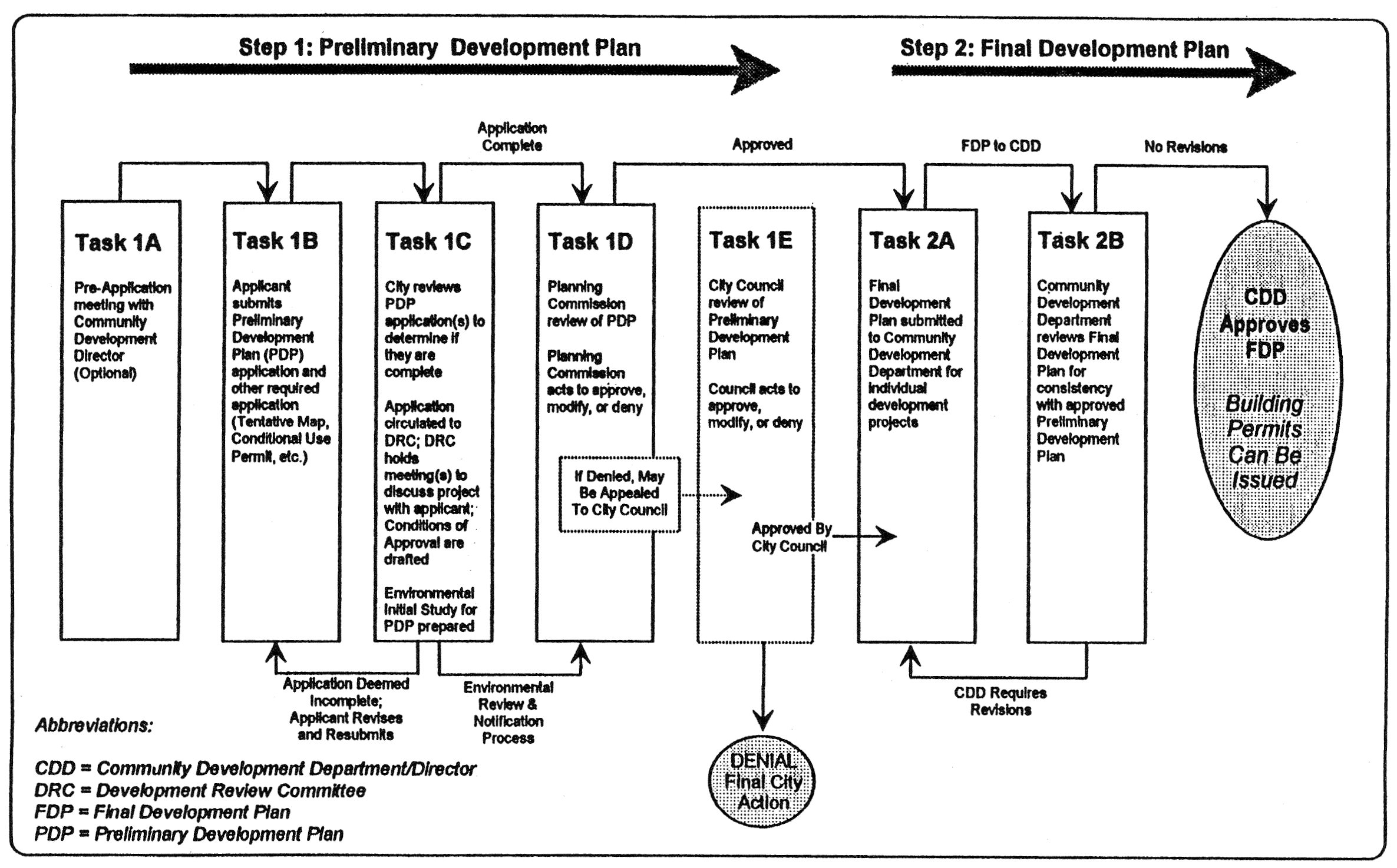
Figure 145-1.
Planned Development Process
16.74.040 - Preliminary development plan.
A.
Purpose. The preliminary development plan (PDP) functions as a development suitability analysis and comprehensive plan for the proposed development. As such, the PDP shall provide the information outlined in this section.
B.
Required Scope and Contents. The PDP shall set forth in text, maps, and diagrams the following, unless determined by the Director of Community Development to be unnecessary for a particular project:
1.
An existing setting description which includes:
a.
A description of the physical characteristics of the site,
b.
Available public services and facilities,
c.
The capacity of the existing circulation system, and
d.
The existing and planned land use of adjacent properties;
2.
A discussion of specific objectives and limits for development of the property which recognize and respond to identified constraints;
3.
Proposed land uses which correspond to the land use categories established by the General Plan, and a statement of how the PDP relates to the General Plan;
4.
A land use and circulation plan;
5.
The distribution of land uses expressed in terms of acreage and the total number of residential units allowed;
6.
The density ranges of residential uses to correspond to density ranges established in the General Plan;
7.
a.
Development standards for each of the proposed land use categories, including, but not limited to, regulations for setbacks, building heights, site coverage, parking, provision of open space, and grading,
b.
To the greatest extent possible, the PDP shall utilize the development standards established for the zoning districts most closely related to the uses proposed by the PDP. Deviations shall be permitted only where the applicant can justify that such deviation will enhance the quality of development, or is absolutely necessary to respond to conditions at the site;
8.
The level of public services and facilities required to serve the proposed development;
9.
Access requirements;
10.
Significant natural features and areas to be retained for common open space, and provisions for preserving, maintaining, and using those area;
11.
Known manmade and natural hazards, and the methods for mitigating the hazards.
C.
Process for Reviewing PDP.
1.
Prior to the formal submission of a PDP, the applicant shall meet with the Director of Community Development or his or her designee for the purpose of acquainting the applicant with the Planned Development process and its requirements.
2.
A completed PDP application shall be submitted to the Department of Community Development as set forth in Section 16.58.020 of this Development Code.
3.
The completed PDP application shall be processed in the manner prescribed for a Development Code amendment, as outlined in Chapter 16.62 of this Development Code.
(Ord. 68 § 9.145.040, 1995)
16.74.050 - Final development plan.
A.
Purpose. The purpose of the final development plan (FDP) is to allow for further definition of planned uses of individual properties within an approved preliminary development plan, and to allow those properties to be developed in phases, provided each phase can function as a complete and separate development from the remaining phases.
B.
Form and Content of Final Development Plan.
1.
The FDP shall be a detailed Site Plan which sets forth the location and dimensions of all uses and structures on a property in sufficient detail to permit preparation of construction drawings. In the case of a Tentative Tract Map, individual housing units need not be shown, unless determined necessary by the Director of Community Development.
2.
The FDP shall comply with all provisions of an approved PDP.
C.
Processing of a Final Development Plan. The Director of Community Development or his or her designee shall be responsible for reviewing all final development plans for compliance with an approved preliminary development plan.
(Ord. 68 § 9.145.050, 1995)
16.74.060 - Findings required for a preliminary development plan.
The Planning Commission and City Council shall be required to make the following findings of fact before approving a preliminary development plan:
A.
That the proposed PDP is consistent with the goals, policies, and objectives of the General Plan; and
B.
That a proposed PDP will not adversely affect surrounding properties.
(Ord. 68 § 9.145.060, 1995)
16.74.070 - Concurrent subdivision applications.
Applications for a Planned Development shall not constitute an application for a land division pursuant to the provisions of Title 16 of the Municipal Code. If a subdivision of land is proposed in conjunction with a Planned Development, a separate application and review shall be made in accordance with the provisions of Title 16.
(Ord. 68 § 9.145.070, 1995)

