
Cincinnati City Zoning Code
CHAPTER 1421
GENERAL SITE STANDARDS
§ 1421-01.- Accessory Residential Structures.
Structures ancillary to a principal structure are considered accessory structures. This section establishes regulations for residential accessory structures that are not accessory dwelling units. All accessory structures must be located, developed and operated in compliance with the following:
(a)
Location. Accessory structures are not permitted in a front yard or a side yard except for fences and walls, flagpoles, lamp posts, arbors, trellis, birdbaths, decorative fountains, or other similar structures as determined appropriate by the Zoning Administrator.
(b)
Minimum Distance from Principal Structure: One foot. Accessory structures, other than fences and walls, within one foot of the principal structure are considered part of the principal structure.
(c)
Maximum Size: 800 square feet for all structures other than fences and walls.
(d)
Maximum Number of Accessory Buildings: Two, subject to the provisions set forth in § 1421-06(e).
(e)
Maximum Height: 15 feet.
(f)
Setbacks. A minimum three-foot rear yard setback and three-foot side yard setback is required. Agricultural structures and animal keeping shelter structures shall conform to the provisions set forth in Chapter 1422.
(Ordained by Ord. No. 15-2004, eff. Feb. 13, 2004; a. Ord. No. 246-2005, eff. July 21, 2005; a. Ord. No. 0056-2008, § 1, eff. March 13, 2008; Emer. Ord. No. 141-2015, § 27, eff. July 1, 2015; a. Ord. No. 251-2019, § 26, eff. July 26, 2019; a. Ord. No. 266-2023, § 3, eff. Oct. 2, 2023)
§ 1421-03. - Accessory Nonresidential Structures.
Structures ancillary to a principal structure are considered accessory structures. This Section establishes regulations for nonresidential accessory structures. All accessory structures must be located, developed, and operated in compliance with the following:
(a)
Location. Accessory structures, other than fences and walls, are not permitted in a front yard or a side yard.
(b)
Minimum Distance from Principal Structure: One foot. Accessory structures, other than fences and walls, within one foot of the principal structure are considered part of the principal structure.
(c)
Building Height and Bulk. Accessory structures are subject to the standards of the district within which the principal structure is located unless an exception to height limits is provided by § 1421-19.
(Ordained by Ord. No. 15-2004, eff. Feb. 13, 2004)
§ 1421-05. - Accessory Structures on Corner Lots.
This section establishes setback regulations for accessory structures located on a corner lot in a residential district. A setback from the side street line of the corner lot must be maintained as follows:
(a)
Within 25 feet of the Side lot Line. When the accessory building is erected within 25 feet of the side lot line of a lot adjacent to the corner lot that is located on the side street, the setback must be equal to the established front yard for such adjacent lot, but need not exceed 40 feet.
(b)
More Than 25 feet of the Side lot Line. When the accessory building is erected more than 25 feet from the side lot line of such adjacent lot, the setback must be one-half the front yard required for a principal building on the corner lot.
(c)
Narrow Corner Lots. When the corner lot is narrow and the regulations of (a) and (b) of this section would cause an accessory building of impracticable shape and size, the accessory building may be erected within 25 feet of the interior side lot line and must be set back not less than five feet from the side street lot line.
(Ordained by Ord. No. 15-2004, eff. Feb. 13, 2004)
§ 1421-06. - Accessory Dwelling Units.
This section establishes regulations for accessory dwelling units. All accessory dwelling units must be located, developed, and operated in compliance with the following provisions:
(a)
General. Where permitted, an accessory dwelling unit may be established within the building envelope of a single-family dwelling, as an addition to a single-family dwelling, or as a detached structure on the same lot as a single-family dwelling, provided that no more than one accessory dwelling unit may be established on a single lot.
(b)
Entrance. Each accessory dwelling unit must provide a separate exterior entrance independent of the entrance to the single-family dwelling to which it is subordinate and incidental.
(c)
Lot Size. Any lot on which an accessory dwelling unit is established must meet the minimum-lot-size requirements for single-family dwellings prescribed by the applicable zoning district or § 1421-09, whichever requirement is less restrictive.
(d)
Lot Coverage. The footprint of a detached accessory dwelling unit located on a lot of 4,000 square feet or larger shall not occupy more than 15% of the total lot area or 800 square feet, whichever is greater. If a lot is less than 4,000 square feet, the combined footprint of the primary single-family dwelling and an accessory dwelling unit shall not exceed 60% of the total lot area or 800 square feet, whichever is greater.
Exception: The alteration of a legally existing accessory structure (e.g., a garage) is permitted even though it may exceed the lot coverage restrictions above provided that the alteration of the structure does not expand its existing footprint.
(e)
Maximum Number of Accessory Buildings: No more than two accessory buildings of any type, inclusive of a detached accessory dwelling unit, are permitted on a single lot.
(f)
Setbacks.
(1)
The establishment of an accessory dwelling unit within the building envelope of a legally existing single-family dwelling or through the alteration of a legally existing accessory structure is not subject to setback restrictions provided that the establishment of the accessory dwelling unit does not expand the existing structure's footprint.
(2)
Detached accessory dwelling units are subject to the side and rear-yard setback requirements for accessory residential structures in the applicable zoning district.
Exception: The alteration of a legally existing accessory structure for the purpose of establishing an accessory dwelling unit is not subject to setback restrictions provided that the establishment of the accessory dwelling unit does not expand the existing structure's footprint.
(3)
An accessory dwelling unit established as an addition to a legally existing single-family dwelling must comply with all setback requirements for single-family dwellings in the applicable zoning district.
(4)
Detached accessory dwelling units are not permitted in front yards.
(g)
Maximum Size: The square footage of an accessory dwelling unit may not exceed the square footage (excluding unfinished spaces) of the principal single-family dwelling to which it is subordinate and incidental.
(h)
Maximum Height.
(1)
Detached accessory dwelling units shall not exceed 25 feet in height.
Exception: The alteration of a legally existing accessory structure for the purpose of establishing an accessory dwelling unit shall not exceed 25 feet in height or the existing height of the accessory structure, whichever is greater.
(2)
An addition to a principal single-family dwelling that will contain an accessory dwelling unit must comply with all height requirements for single-family dwellings in the applicable zoning district.
(i)
Detached Accessory Dwelling Units: Detached accessory dwelling units must be of permanent construction and must contain permanent utility hookups. Mobile tiny homes and recreational vehicles are not permitted as accessory dwelling units.
(j)
Parking. Accessory dwelling units are exempt from the off-street parking requirements set forth in § 1425-19.
(k)
Short-Term Rentals. An accessory dwelling unit may be operated as a short-term rental in accordance with the provisions of Chapter 856, Short Term Rentals.
(l)
Occupancy by Owner or a Responsible Person.
(1)
The owner of each lot on which an accessory dwelling unit is established must (i) maintain a residence in the principal single-family dwelling or the accessory dwelling unit on the lot for so long as the accessory dwelling unit exists; or (ii) designate a responsible person who maintains a residence in the principal single-family dwelling or the accessory dwelling on the lot for so long as the accessory dwelling unit exists.
(2)
To ensure ongoing compliance with subsection (1), the owner of each lot on which an accessory dwelling unit is established and maintained shall:
(i)
record a covenant, in a form acceptable to the City Solicitor and irrevocable without the prior written consent of the Zoning Administrator, that provides the property owner or a responsible person shall maintain a residence on the property for so long as the accessory dwelling unit exists;
(ii)
register the accessory dwelling unit with the Zoning Administrator and verify compliance with subsection (1) upon the establishment of the accessory dwelling unit;
(iii)
renew the registration and verification no later than December 31 of every year ending in an odd number following the initial year of registration; and
(iv)
update each registration and verification upon a change in ownership of the property or the designated responsible person.
(3)
Any person who fails to maintain compliance with subsection (1) shall be liable for a Class F civil offense.
(4)
For the purposes of this section 1421-06(l), the following terms shall have the following meanings:
(i)
"Residence" means a dwelling unit that is the true, fixed, and permanent home where an individual intends to remain permanently and indefinitely; to which, whenever absent, the individual intends to return; and that only one of which may exist for one person within the city limits of the City of Cincinnati at any time.
(ii)
"Responsible Person" means a natural person designated by the owner of a lot on which an accessory dwelling unit is established as having the independent duty, responsibility (including financial responsibility), and authority to operate, maintain, and manage the lot and all the dwelling units thereon.
(Ordained by Ord. No. 266-2023, § 4, eff. Oct. 2, 2023)
§ 1421-07. - Building Projections Into Yards.
The standards for building projections into setback areas are prescribed in Schedule 1421-07 below.
Schedule 1421-07: Maximum Projections Allowed Into Yards (Feet)
1 Except within required buffer yard.
(Ordained by Ord. No. 15-2004, eff. Feb. 13, 2004; a. Ord. No. 287-23, § 1, eff. August 2, 2023; a. Emer. Ord. No. 199-2024, § 2, eff. 7-1-2024)
§ 1421-09. - Lot Area for Lots of Record.
In any SF or RM District a single-family dwelling may be erected on a lot less than the minimum lot area specified for the district provided that:
(a)
The lot has been of record as defined in § 1401-01-L15; and
(b)
The structure complies with all yard and height regulations of the district or as may be modified by § 1421-19 through § 1421-25; and
(c)
The area of the lot is no less than:
(1)
SF-20 District: 16,000 square feet
(2)
SF-10 District: 8,000 square feet
(3)
SF-6 District: 4,800 square feet
(4)
SF-4 District: 3,200 square feet
(5)
SF-2 District: 1,600 square feet
(6)
RMX District, Single Family: 2,000 square feet
(7)
All RM Districts: Minimum lot area is equal to the lot area per dwelling unit requirement of the district.
(Ordained by Ord. No. 15-2004, eff. Feb. 13, 2004; a. Ord. No. 392-2008, eff. Dec. 19, 2008)
§ 1421-11. - Lot Area Reductions Due to Public Acquisition.
If a portion of a legally existing lot in any district is acquired for public use, the remaining lot area, setbacks and density are considered in compliance.
(Ordained by Ord. No. 15-2004, eff. Feb. 13, 2004)
§ 1421-13. - Lot Area of Panhandle Lots.
Panhandle lots shall be sufficiently large to contain the minimum square-foot area of the applicable zoning district, exclusive of the panhandle or access strip, which panhandle or access strip shall not contribute to the minimum lot area calculation.
(Ordained by Ord. No. 15-2004, eff. Feb. 13, 2004; a. Ord. No. 0050-2019, §§ 5, 6, eff. 2-6-2019)
§ 1421-15. - Reduced Lot Area Per Dwelling Unit for Structured Parking.
Where part or all of the parking spaces required for a multi-family dwelling are provided within the principal building or within a parking structure attached to the principal building, the minimum lot area per dwelling unit specified for the district may be reduced by a maximum of 20 percent, using the following formula:
A/B times 20 percent, where
A equals the number of parking spaces provided within the principal building or attached parking structure, and
B equals the number of parking spaces required for the multi-family dwelling.
(Ordained by Ord. No. 15-2004, eff. Feb. 13, 2004)
§ 1421-17. - Increased Floor Area Ratio for Structured Parking.
In the OL, OG, UM and IR Districts where part or all of the parking spaces required for OL, OG, UM and IR uses are provided within the principal building or within a parking structure attached to the principal building, the maximum floor area ratio specified for the OL, OG, UM and IR Districts may be increased by a maximum of 20 percent using the following formula:
A/B times 20 percent, where
A equals the number of parking spaces provided within the principal building or attached parking structure, and
B equals the number of parking spaces required for the OL, OG, UM or IR uses.
(Ordained by Ord. No. 15-2004, eff. Feb. 13, 2004; a. Ord. No. 0221-2007, § 5, eff. July 6, 2007)
§ 1421-19. - Exceptions to Height Limits.
Height limits do not apply to farm buildings and structures, railings with transparency of fifty percent or greater, flush-mounted solar panels, and access elevators and stair towers with a total footprint of 200 square feet or less, spires, belfries, cupolas, domes, false mansards, monuments, water towers, fire and hose towers, transmission towers, windmills, chimneys, smoke stacks, flag poles, radio and television towers, masts, aerials, parabolic satellite receivers, microwave transmitters and receivers used in connection with radio and television broadcasting, unless subject to specific regulations by other provisions of the Cincinnati Zoning Code.
(Ordained by Ord. No. 15-2004, eff. Feb. 13, 2004; a. Emer. Ord. No. 199-2024, § 2, eff. 7-1-2024)
§ 1421-21. - Front Yard Modifications.
The front yard requirements for principal buildings in residential and Office Limited (OL) districts, excluding panhandle lots, must be modified subject to the following:
(a)
Required Front Yard. Front yard setback requirements for principal buildings on lots in residential and the Office Limited (OL) districts, excluding panhandle lots, must be modified subject to the following:
(1)
Development must equal the average of the setback of three lots or 300 feet in both directions, whichever is greater, on the same side of the street and in the same block face and in the same zoning district.
(2)
If only one structure exists within three lots or 300 feet in both directions, whichever is greater, on the same side of the street and in the same block face and the same zoning district, then the front yard setback shall be the average of the setback on the existing structure and the setback required by the zoning district.
(3)
If no structures exist within three lots or 300 feet in both directions, whichever is greater, on the same side of the street and in the same block face and the same zoning district then the setback shall be as required by the zoning district.
(b)
Double Frontage Lots. Where a lot extends through the block from street to street, the required front yard must be provided along each street.
(Ordained by Ord. No. 15-2004, eff. Feb. 13, 2004; a. Ord. No. 0253-2007, § 1, eff. June 19, 2007; a. Ord. No. 039-2010, § 1, eff. March 18, 2010)
§ 1421-23. - Side Yard Modifications.
The side yard requirements specified for principal buildings are subject to the following:
(a)
Side Yard of a Corner Lot. A corner side yard along the side street of a corner lot in a residential district, which adjoins in the rear, either directly or across an alley, the side lot line of another lot in a residential district must provide a width of no less than one-half the required front yard for the principal building on the corner lot.
(b)
Irregular Side Yards. Where the side lot line is irregular or where the side lot line is not parallel to the building line, the average side yard width must conform to the side yard requirements, provided the point of least width is no less than five feet wide or the point of least width is no less than one-half the side yard requirement, whichever is greater.
(c)
Increased Side Yards. In addition to the side yard requirements set forth for the SF, RM and O Districts and after adjusted by other provisions of this section, the required side yard is increased by one foot for each ten feet or fraction thereof by which the depth of the building exceeds 60 feet.
(d)
Side Yards of Sub-minimum Lots. On lots of record, as defined in § 1401-03-L7, that do not comply with the minimum lot widths specified in the SF and RM Districts, the side yard requirements may be reduced from the district regulations by one and one-half inches for every foot such lot is less than the minimum lot width. The sum of the least widths of both side yards may be reduced by three inches for every foot such lot is less than the minimum lot width. In no case may a side yard be reduced to less than three feet.
(Ordained by Ord. No. 15-2004, eff. Feb. 13, 2004; a. Ord. No. 138-2008, § 1, eff. May 23, 2008)
§ 1421-25. - Rear Yard Modifications.
The rear yard requirements specified for principal buildings may be modified subject to the following:
(a)
Irregular Rear Yard. In the case of an irregularly or triangularly shaped lot, the average depth of the rear yard may be used to determine whether the rear yard requirements are satisfied. In no case may any rear yard so averaged be less than ten feet or one-half the required minimum rear yard depth at any point, whichever is greater.
(b)
Required Rear Yard. Principal buildings must have a rear yard that:
(1)
If abutted on both sides by improved lots whose rear yards do not conform to the district regulations, equals the average depth of those abutting rear yards; or
(2)
If abutted on one side by an unimproved lot or a side street of a corner lot and on the other side by an improved lot whose rear yard does not conform to the district regulations, equals the average of the depth of the rear yard of the improved lot and the rear yard setback requirement of the district.
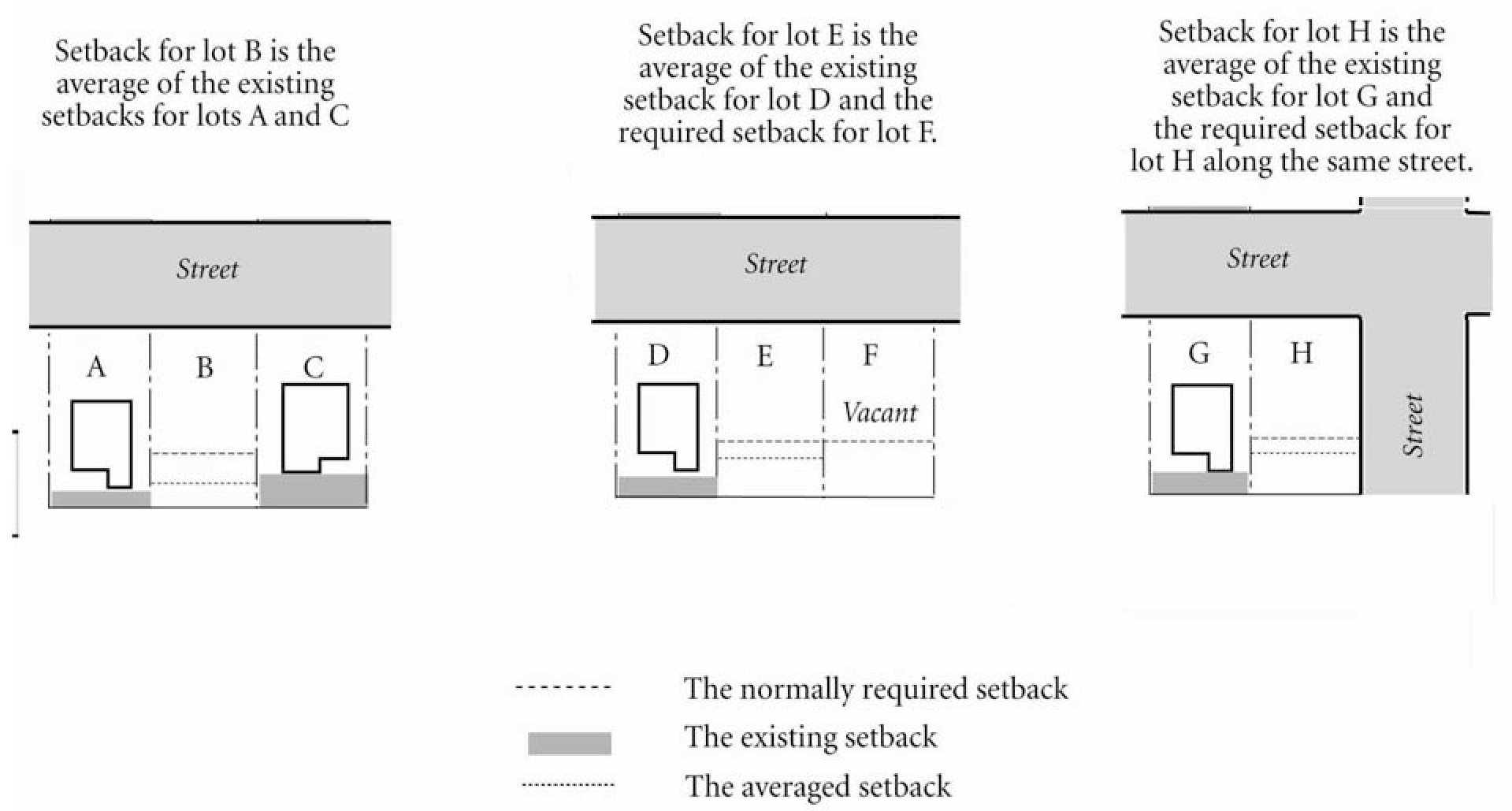
Figure 1421-25 Rear Yard Averaging
(c)
Rear Yards Adjacent to Alleys. In computing the dimension of a required rear yard adjoining a public alley, one-half of such alley may be assumed to be a portion of the yard, except that in no case may any building or accessory structure other than fences and walls be erected closer than five feet to any such alley.
(Ordained by Ord. No. 15-2004, eff. Feb. 13, 2004)
§ 1421-27. - Repealed.
(Ordained by Ord. No. 15-2004, eff. Feb. 13, 2004; a. Ord. No. 0346-2007, § 11, eff. Oct. 13, 2007; a. Ord. No. 295-2009, § 1, eff. Dec. 12, 2009; r. Ord. No. 359-2010, § 1, eff. Nov. 13, 2010)
§ 1421-29. - Reduction of Area.
A lot may not be reduced in area by conveyance of a portion thereof to make the lot area or setbacks of the lot less than the minimum requirements prescribed, provided that such requirements may not be construed to prevent the sale of an individual unit of a multiple-dwelling building.
(Ordained by Ord. No. 15-2004, eff. Feb. 13, 2004)
§ 1421-31. - Use of Land Restricted.
Land used to meet the setback, parking, density or other open space requirements of the Cincinnati Zoning Code for a building or group of buildings may not be used to meet the setback, parking, density or other open space requirements for any other building or group of buildings.
Provided, however, where the land used to meet the requirements of the Cincinnati Zoning Code for a building or group of buildings consists of more than one recorded parcel of land, or a part of a parcel of land, the owner must execute on behalf of himself, his successors or assigns in the ownership of the land, or part thereof, a written instrument in a form acceptable to the City Solicitor covenanting that the requirements of this section will be met prior to the issuance of a building permit for the construction of a building on such land. See § 1441-07.
(Ordained by Ord. No. 15-2004, eff. Feb. 13, 2004)
§ 1421-33. - Fences and Walls.
All fences and walls are accessory structures and must comply with the provisions of this section, any other applicable provisions of the Cincinnati Zoning Code, and any applicable provisions of the Municipal Code.
(a)
General. Fences and walls are permitted in all zoning districts and may be required for specific uses, as provided in Chapter 1419, Additional Development Regulations, or as buffering between certain uses, as provided in Chapter 1423, Landscaping and Buffer Yards.
(b)
Maximum Height. In any front, corner side yard or corner rear yard the maximum height of any fence or wall or any combination thereof may not exceed four feet in Residential Districts and six feet in all other districts and may not exceed an opacity of 50 percent. (EXCEPTION: Fences and walls used as parking lot screening per § 1425-27). In any interior side or rear yard, the maximum height may not exceed six feet and may be 100 percent opaque.
(c)
Entry Gateway. An entry gateway, trellis or other entry structure may be permitted in the required front yard provided the maximum height and width do not exceed ten feet.
(d)
Driveway Visibility. All fences are subject to the driveway visibility requirements of § 1425-35.
(e)
Electrical Fences and Razor Wire. Electrical, barbed and razor wire fences are an accessory conditional use in C, M and RF Districts, and prohibited in all other districts.
(f)
Decks and Railings. Within the limits of a rear yard in a residential district, decks and railings for above ground swimming pools may be up to eight feet above grade and located at least three feet from all property lines.
(Ordained by Ord. No. 15-2004, eff. Feb. 13, 2004; a. Ord. No. 248-2005, eff. July 21, 2005; a. Ord. No. 0060-2008, § 9, eff. March 13, 2008; a. Ord. No. 139-2008, § 1, eff. May 23, 2008; a. Ord. No. 329-2011, § 1, eff. Nov. 26, 2011)
§ 1421-35. - Refuse Storage Areas.
The purpose of these regulations is to ensure the provision of adequate, accessible and convenient locations for the collection and storage of recyclable materials and refuse within containers and enclosures that are compatible with surrounding land uses and structures.
Refuse and recycling containers required for all residential and non-residential developments by Chapter 729, Waste Disposal, of the Municipal Code must comply with the following:
(a)
Access. Driveways and aisles must be unobstructed.
(b)
Enclosure. All refuse collections and recycling containers must be enclosed or screened so as not to be visible from the right-of-way or other publicly accessible areas. The structure must be enclosed on all sides, one of which includes a gate or door that can be secured.
(c)
Location. The enclosures may not be located in any required front yard, street side yard, required parking or landscape areas or any other area required by law to be maintained.
(d)
Enclosure Materials. The enclosure may consist of screen fencing of chain link with slats, solid wood, vinyl fencing or masonry walls.
(e)
Height. A minimum of one foot taller than the container and no taller than eight feet.
(f)
Landscaping. The exterior perimeter of the enclosure must be landscaped excluding the access point.
(g)
Maintenance. Enclosures must be maintained in a manner that protects adjacent properties as well as tenants located on the subject property from adverse environmental, health and safety impacts such as noise, odors and attraction of rodents or other pests. The receptacle must be covered by either a roof on the enclosure or covered receptacles.
(h)
Hours of Operation. The use of refuse storage areas is prohibited between 11 PM and 7 AM on weekends and between 10 PM and 7 AM on weekdays if located within 50 feet of residential district boundaries.
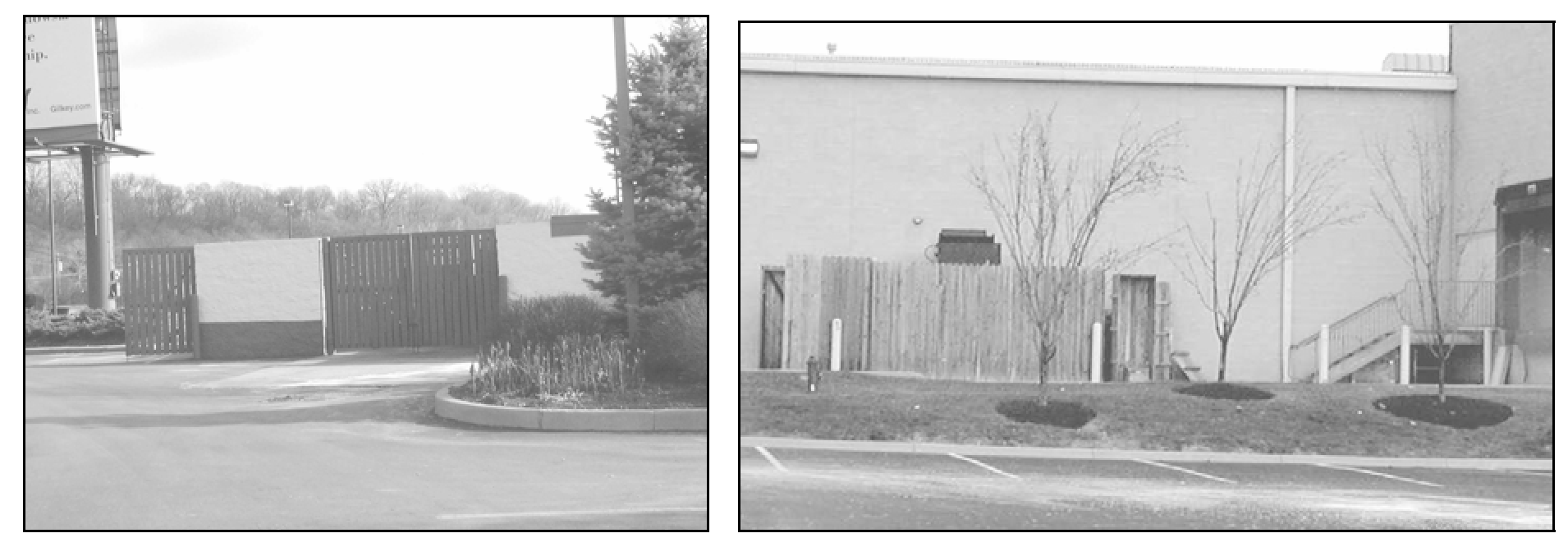
Figure 1421-35 Examples of Refuse Storage Areas—Note: They are Missing the Required
Landscaping
(Ordained by Ord. No. 15-2004, eff. Feb. 13, 2004)
§ 1421-37. - Repealed.
(Ordained by Ord. No. 15-2004, eff. Feb. 13, 2004; ; r. Ord. No. 251-2019, § 26, eff. July 26, 2019)
§ 1421-39. - Exterior Lighting.
All exterior light sources on private property, including canopy, perimeter, and flood, must be energy-efficient, stationary and shielded or recessed within the roof canopy to ensure that all light is directed away from adjacent properties and public rights-of-way. The maximum height may not exceed 20 feet above grade.
(Ordained by Ord. No. 15-2004, eff. Feb. 13, 2004)
§ 1421-41. - Off-Site Development Rights.
Rights to develop dwelling units or gross floor area may be transferred from other lots under common ownership. The conditions applicable to the density calculations are as follows:
(a)
The area included for computing the number of dwelling units or gross floor area permissible on a building site lot may include a separate lot or lots under the same ownership, provided that:
(1)
The lot from which the development rights are being transferred does not have any structures.
(2)
The lot from which the development rights are being transferred abuts the same street or alley on which the building site lot is located.
(3)
The maximum distance between the building site lot and the nearest point on the lot from which the development rights are being transferred is 60 feet, and the maximum distance between the building site lot and farthest point on the lot from which the development rights are being transferred is 250 feet.
(b)
When one or more lots are to be included in the computation of dwelling units to be erected on a lot as in Paragraph (a) above, the owner must prepare and record a covenant in a form acceptable to the City Solicitor that the land may not be occupied by any structure for dwelling purposes and may not be used to meet the density requirements of the Cincinnati Zoning Code for any other building or group of buildings. See § 1441-07.
(c)
The lot from which the development rights are being transferred may be used for parking and recreation facilities as permitted by other provisions of the Cincinnati Zoning Code.
(Ordained by Ord. No. 15-2004, eff. Feb. 13, 2004; a. Ord. No. 0346-2007, § 11, eff. Oct. 13, 2007)
§ 1421-43. - Rooming Unit Requirements.
A rooming unit within a rooming house is subject to the following:
(a)
A rooming unit may be occupied by only one person if the unit is less than 100 square feet in floor area and by no more than two persons if larger than 100 square feet in floor area.
(b)
For purposes of calculating the permitted rooming unit density, each rooming unit is equal to one-half the lot area per dwelling unit requirement of the district in which the rooming house is located.
§ 1421-45. - Transit Stops.
Transit stop structures approved by the Department of Transportation and Engineering are permitted in all zoning districts and are exempt from accessory structure regulations set forth in § 1421-01, § 1421-03, and § 1421-05.
(Ordained by Emer. Ord. No. 199-2024, § 1, eff. 7-1-2024)
§ 1421-47. - Density, Height, and Parking Modifications for Projects Utilizing Certain Financial Programs
(a)
Minimum lot-area-per-dwelling-unit requirements and minimum off-street parking requirements shall not apply to the establishment of new dwelling units in a newly constructed or renovated building, and a newly constructed or renovated building may have a maximum height twelve feet greater than otherwise permitted by the zoning code, provided the building is constructed or renovated pursuant to Low-Income Housing Tax Credit programs.
(b)
To be eligible for density, height, and parking modifications, the owner of the building that is to be constructed or renovated, or its successor-in-interest, as applicable, must establish and maintain compliance with the affordability restrictions pursuant to Low-Income Housing Tax Credit programs for the building on the property for so long as those restrictions remain in effect.
(c)
Any person who fails to maintain compliance with subsection (b) shall be liable for a Class F civil offense for each dwelling unit that is not in compliance, as applicable, in a given year.
(Ordained by Emer. Ord. No. 199-2024, § 1, eff. 7-1-2024)

