
Cincinnati City Zoning Code
CHAPTER 1413
MANUFACTURING DISTRICTS
§ 1413-01.- Purposes.
The general purposes of manufacturing districts are to:
(a)
Promote and preserve manufacturing areas as significant employment generators.
(b)
Facilitate the necessary infrastructure to accommodate a wide variety of transportation, manufacturing and technology uses.
(c)
Accommodate existing traditional industries, while anticipating new technologies and business service uses.
(d)
Preserve appropriate location of industries that may have the potential to generate off-site impacts, while providing compatibility in use and form.
(e)
Establish appropriate standards for reviewing proposals for new development and redevelopment, where appropriate, in manufacturing areas.
(f)
Ensure the provision of services and facilities needed to facilitate planned employment densities.
(Ordained by Ord. No. 15-2004, eff. Feb. 13, 2004)
§ 1413-03. - Specific Purposes of the Manufacturing Subdistricts.
The specific purposes of the manufacturing subdistricts are:
(a)
MA Manufacturing Agricultural. To create, preserve and enhance areas that are appropriate for agricultural, farming, low impact manufacturing and supporting commercial uses. Low impact manufacturing and supporting commercial uses may be permitted provided they meet specific performance standards and are buffered from residential uses. Single-family residential is also encouraged in the district.
(b)
ML Manufacturing Limited. To create, preserve and enhance areas that are appropriate for a range of low-impact manufacturing activities and supporting commercial uses. High-impact manufacturing uses may be permitted, provided they meet specific performance standards and are buffered from residential areas. Loft dwelling units may be permitted in this district and any commercial uses should be located along major transportation corridors.
(c)
MG Manufacturing General. To create, preserve and enhance areas that are appropriate for a wide variety of supporting and related commercial and manufacturing establishments that may have the potential to generate off-site impacts. Future development will accommodate heavy industrial and manufacturing uses, transportation facilities, warehousing and distribution and similar and related supporting uses. These uses typically require sites with good transportation access. Uses that may inhibit industrial development are prohibited.
(d)
ME Manufacturing Exclusive. To recognize and preserve areas that are intended exclusively for the location of manufacturing establishments. Future development will accommodate heavy industrial and manufacturing uses. These uses typically require sites with good transportation access. Uses that may inhibit or compete with industrial development are prohibited.
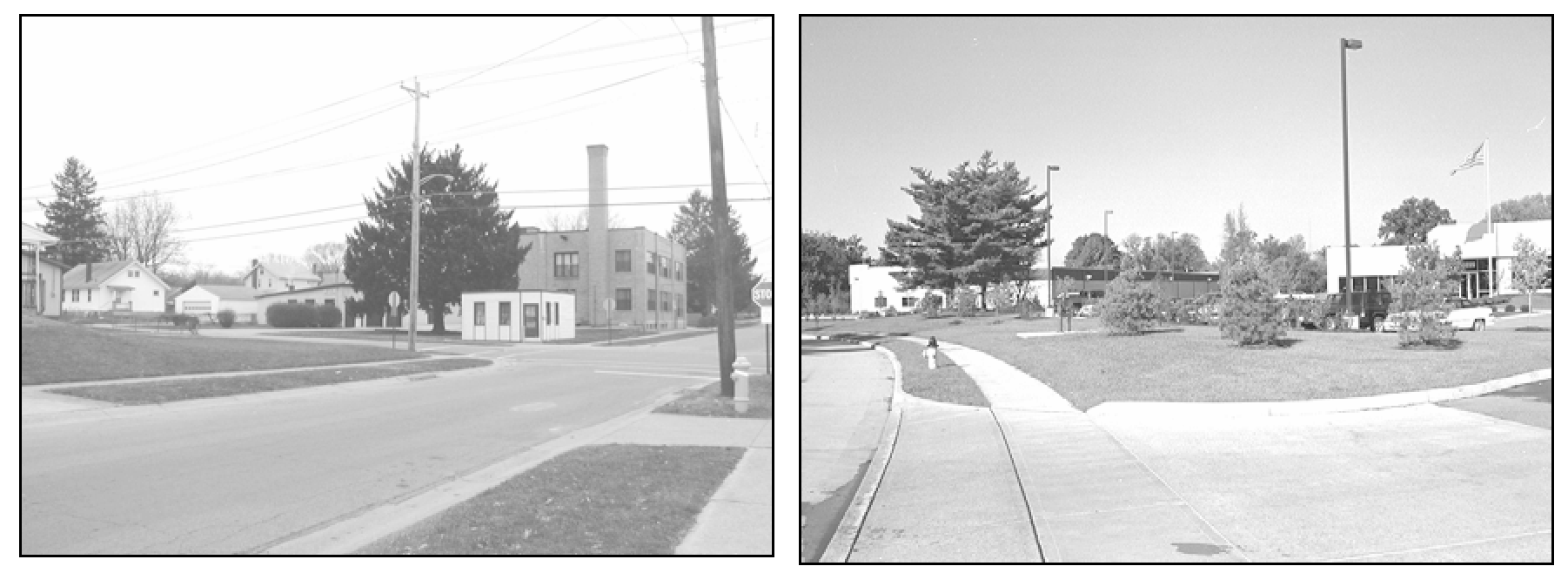
Figures 1413-03-A, B
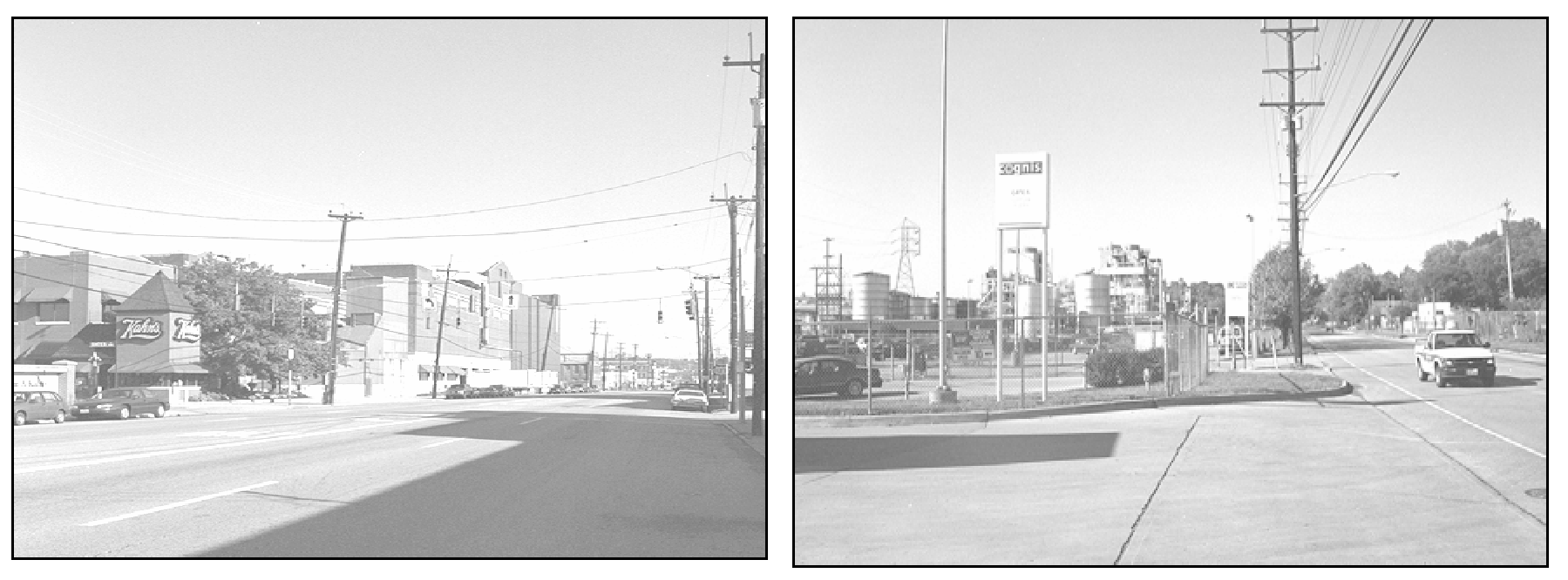
Figures 1413-03-C, D
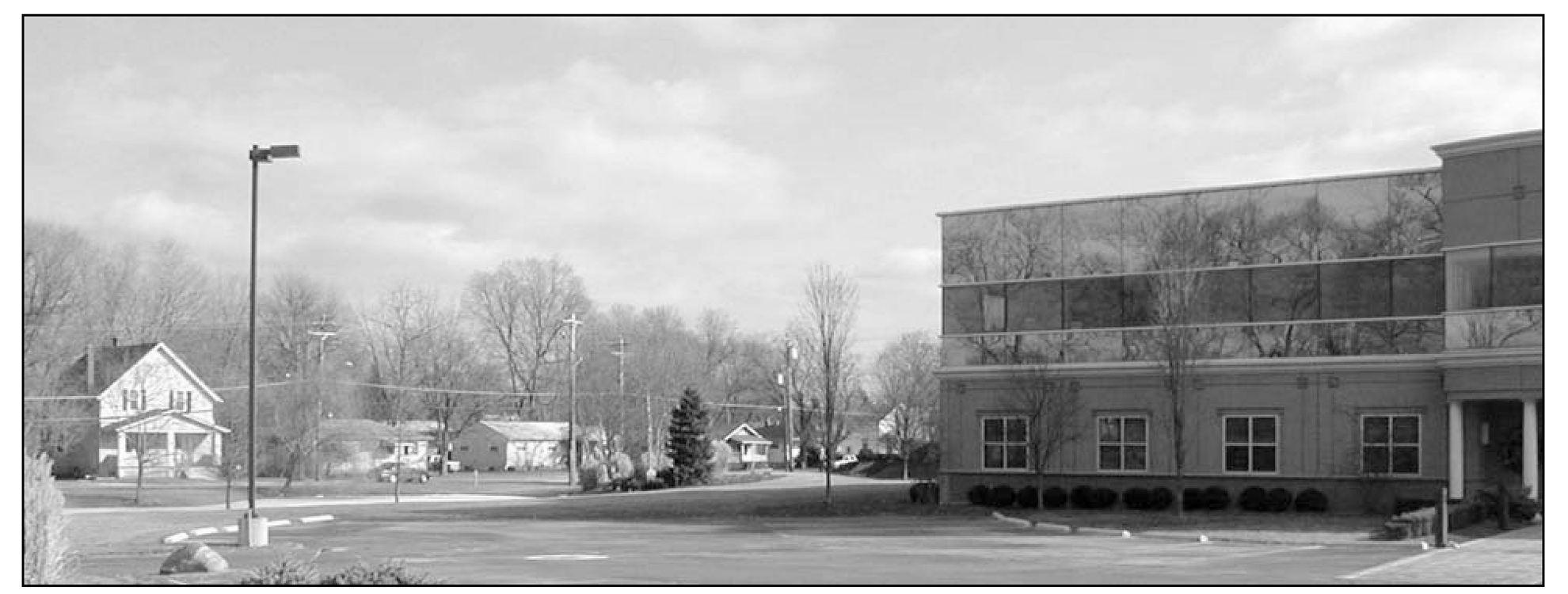
Figure 1413-03-E
(Ordained by Ord. No. 15-2004, eff. Feb. 13, 2004; a. Ord. No. 0060-2008, § 6, eff. March 13, 2008)
§ 1413-04. - Connected Communities.
Three Connected Communities designations are established to enhance the base zoning district. The underlying zoning district and map overlays apply where not inconsistent with the development regulations below.
(a)
Neighborhood Business District 'B'. This district designation is intended for areas located within established neighborhood business districts. The neighborhood business district 'B' designation is subject to the following development regulations:
(1)
Two-family, three-family, and four-family uses are permitted, subject to the development regulations of the underlying zoning district, except as otherwise provided in subsections (a)(2) and (a)(3).
(2)
Minimum lot-area-per-dwelling-unit regulations do not apply.
(3)
Parking:
(i)
No off-street parking is required for residential uses in a new building containing ten or fewer dwelling units.
(ii)
Residential uses in a new building with more than ten dwelling units require one-half space per additional dwelling unit over ten dwelling units.
(iii)
No off-street parking is required in a new commercial or mixed-use building if the building has 5,000 square feet or less of commercial space.
(iv)
The underlying zoning district parking requirements are reduced by one-half for commercial uses in a new commercial or mixed-use building if the building has more than 5,000 square feet of commercial space.
(v)
Additions to existing buildings are considered new construction for purposes of this section.
(vi)
Accessory surface parking facilities shall be located in the rear yard.
(b)
Middle Housing 'MH'. This district designation is intended for areas surrounding neighborhood business districts. The middle housing 'MH' designation is subject to the following development regulations:
(1)
Two-family, three-family, and four-family uses are permitted subject to the development regulations of the underlying zoning district, except as otherwise provided in subsection (b)(2).
(2)
Parking:
(i)
No off-street parking is required for residential uses in a new building containing ten or fewer dwelling units.
(ii)
Residential uses in a new building with more than ten dwelling units require one-half space per additional dwelling unit over ten dwelling units.
(iii)
No off-street parking is required in a new commercial or mixed-use building if the building has 5,000 square feet or less of commercial space.
(iv)
The underlying zoning district parking requirements are reduced by one-half for commercial uses in a new commercial or mixed-use building if the building has more than 5,000 square feet of commercial space.
(v)
Additions to existing buildings are considered new construction for purposes of this section.
(vi)
Accessory surface parking facilities shall be located in the rear yard.
(c)
Transportation Corridor 'T'. This district designation is intended for areas located along major transportation corridors. The transit corridor 'T' designation is subject to the following development regulations:
(1)
Two-family, three-family, and four-family uses are permitted subject to the development regulations in Section 1413-07, except as otherwise provided in subsections (c)(2)-(5).
(2)
Minimum lot-area-per-dwelling-unit regulations do not apply.
(3)
Minimum off-street parking regulations do not apply.
(4)
The height of new structures may exceed the maximum height of the underlying zoning district by an additional twelve feet.
(5)
Accessory surface parking facilities shall be located in the rear yard.
(d)
Design Standards. Two-family, three-family, and four-family dwellings located within a designated Connected Communities district shall comply with the design standards set forth below.
(1)
Entrance. At least one dwelling unit entrance shall be located on each street frontage.
(2)
Building Form. Building composition shall consist of a base, middle, and top component to reduce the apparent bulk of the building. The designs of new buildings shall avoid long unrelieved expanses of wall along the street frontage by maintaining a rhythm of windows and structural bays.
(i)
Buildings shall have a distinct base at the ground level, using articulation and materials such as stone, masonry, or decorative concrete.
(ii)
Buildings shall have a change in material and/or design that marks the transition from base component to middle component, and from middle component to top component.
(iii)
The top of the building shall be treated with a distinct outline with elements such as a projecting parapet, cornice, or projection.
(3)
If the Zoning Administrator determines a permit application does not conform to the requirements of Section 1413-04(d), the Zoning Board of Appeals has the duty to determine whether the application satisfies the standards set forth in this Chapter prior to the issuance of a building permit.
(Ordained by Emer. Ord. No. 199-2024, § 1, eff. 7-1-2024)
§ 1413-05. - Land Use Regulations.
Schedule 1413-05 below prescribes the land use regulations for M Manufacturing Districts. Use classifications are defined in Chapter 1401: Definitions. Use classifications not listed in Schedule 1413-05 are prohibited.
The regulations for each subdistrict are established by letter designations as follows:
(a)
"P" designates permitted uses. These uses may be subject to additional regulations as indicated.
(b)
"L" designates uses that are permitted, subject to certain limitations. Numeric suffixes refer to limitations listed at the bottom of Schedule 1413-05. Except as otherwise indicated, modifications of a numerical, locational or dimensional limitation requires a variance under Chapter 1445 - Variances, Special Exceptions and Conditional Uses.
(c)
"C" designates uses permitted only after review and approval of the conditional use by the Zoning Hearing Examiner. These uses may be subject to additional regulations as indicated.
Schedule 1413-05: Use Regulations - Manufacturing Districts
Specific Limitations
L1
New residential is permitted only when abutting an existing residential use or structure.
L2
Permitted on arterial street only. Vehicle loading and unloading must occur on-site.
L3
Permitted only as an accessory use to a use allowed in the district.
L4
The facility must be completely enclosed on all sides with a six foot screen fence which is protected from damage by a guardrail or other barriers approved by the Zoning Administrator. Must be located at least 100 feet from a residential district.
L5
Permitted only if occupying less than 5,000 sq. ft. in ML and 10,000 sq. ft. in MG.
L6
Landing strip, pad, or apron may not be located within 500 ft. of a residential district boundary.
L7
Not allowed within 250 ft. of a residential use in a Residential District.
L8
Antenna height may not exceed 20 feet; greater height requires a conditional use approval. The antenna may be attached to a multi-family, public or semi-public, public utility, a commercial or industrial building or structure.
L9
Fencing a minimum of four feet in height must be provided for purposes of securing outdoor play areas which must be located in the rear yard only.
L10
Accessory uses determined by the Zoning Administrator to be customarily incidental to a use of the district are permitted. All others require conditional use approval.
L11
The storage space is less than 30 cubic yards; enclosed by a screen fence or within a structure; and at least 100 feet from any property used for residential purposes.
L12
Provisions of § 1421-35 apply when refuse storage.
L13
Antenna height may not exceed 20 feet; greater height requires a conditional use approval. The antenna may be attached to an agricultural, public or semi-public or public utility building or structure.
L14
One commercial vehicle may be parked or stored on residential property with the following provisions:
a.
Commercial vehicles with current license owned by a resident of the residential property on which it is stored or parked may not exceed two tons in capacity.
b.
Recreational vehicles, watercraft and personal trailers may be parked on the lot beyond the front yard.
L15
No more than two rooming units may be rented or leased in a single-family dwelling.
L16
Retail sales of products manufactured or wholesaled on the premises, when incidental and subordinate to a principal permitted use, provided that the floor area devoted to such retailing shall not exceed 35 percent of the floor area devoted to such principal use, but in no case shall the retail floor area exceed 5,000 square feet.
L17
Permitted only when subordinate and incidental to a single-family dwelling that is the principal use of the lot.
(Ordained by Ord. No. 15-2004, eff. Feb. 13, 2004; a. Ord. No. 0060-2008, § 7, eff. March 13, 2008; a. Ord. No. 0152-2008, § 1, eff. June 7, 2008; a. Ord. No. 414-2008, § 14, eff. Jan. 4, 2009; a. Ord. No. 307-2009, § 1, eff. Dec. 12, 2009; a. Ord. No. 038-2010, § 1, eff. March 18, 2010; Emer. Ord. No. 141-2015, § 14, eff. July 1, 2015; a. Ord. No. 0281-2017, § 16, eff. Nov. 4, 2017; a. Ord. No. 127-2018, § 11, eff. July 6, 2018; a. Ord. No. 251-2019, § 19, eff. July 26, 2019; a. Emer. Ord. No. 418-2021, §§ 5, 39, eff. Nov. 10, 2021; a. Ord. No. 266-2023, §§ 11, 15, eff. Oct. 2, 2023; a. Emer. Ord. No. 199-2024, § 2, eff. 7-1-2024)
§ 1413-07. - Development Regulations.
Schedule 1413-07 below prescribes the development regulations for M Manufacturing Districts, including minimum lot area, maximum height, minimum yards and other standards. Additional standards are included in Chapter 1419.
Schedule 1413-07: Development Regulations - Manufacturing Districts
(Ordained by Ord. No. 15-2004, eff. Feb. 13, 2004; a. Ord. No. 0060-2008, § 8, eff. March 13, 2008; a. Ord. No. 0152-2008, § 2, eff. June 7, 2008; a. Ord. No. 0152-2008, § 2, eff. June 7, 2008)
§ 1413-09. - Driveway Restrictions.
Site access must be from a local street or alley wherever practical, but not from a residential street where alternate access is available, as determined by the Department of Transportation and Engineering.
(Ordained by Ord. No. 15-2004, eff. Feb. 13, 2004)
§ 1413-11. - Truck Docks; Loading and Service Areas.
Where a building is adjacent to a residential district, the location of these facilities must be the side away from the district boundary. Where truck docks, loading and service areas are adjacent to a residential district boundary a 100 foot setback is required from the district boundary line. In the ML Districts, these facilities must be located at the side of buildings or in the rear of the site and screened so as not to be visible from a public street other than an alley.
(Ordained by Ord. No. 15-2004, eff. Feb. 13, 2004)

